Category Archives: Health Information

A Brief (Personal) Memoir of HIV & AIDS

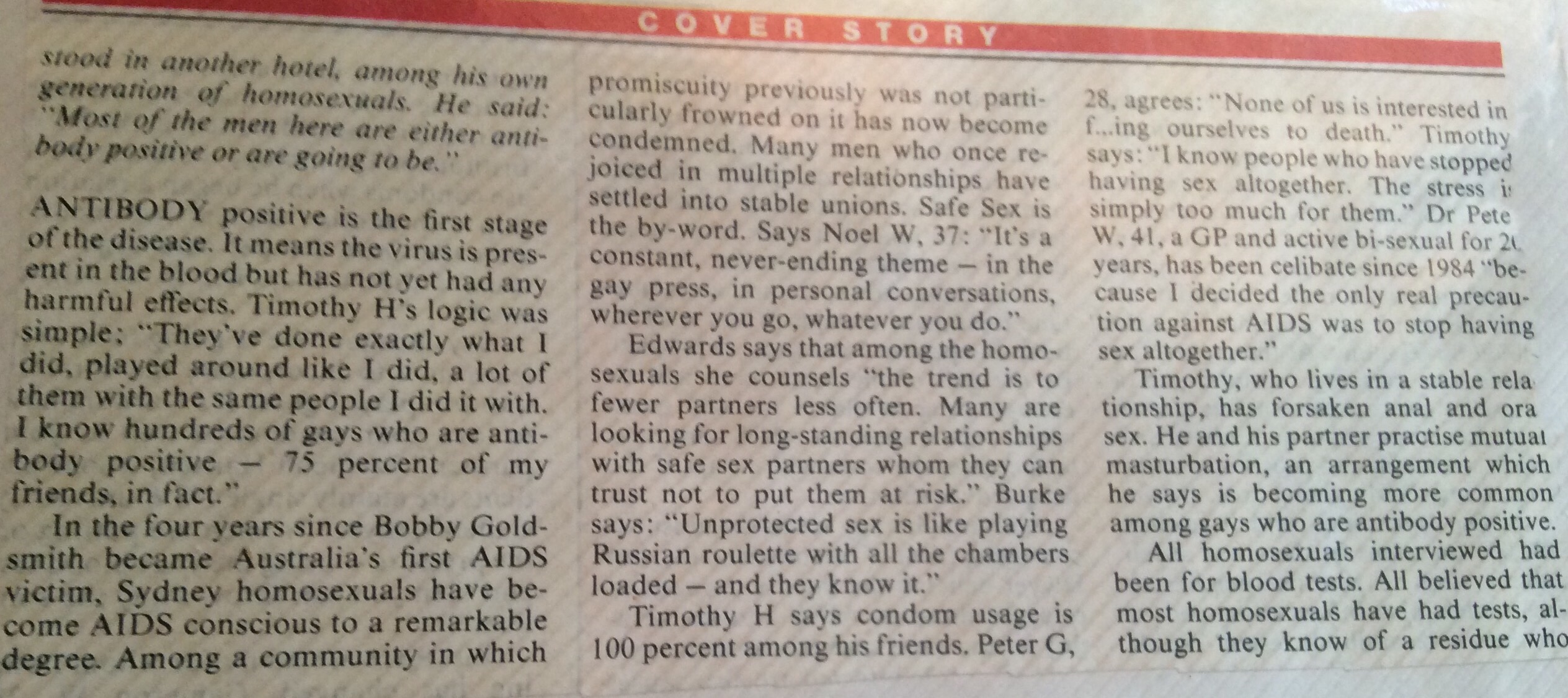
I discovered this older article recently while rummaging through my article archives. I present it here with some edits and newspaper inclusions. HIV & AIDS (note the separation of the two) has an intricate, but morbidly fascinating, national & international history. I watched “The Normal Heart” again only a couple of days ago, and the hospital scene where Felix is in the hospital ward with the meal sitting outside the door of his KS infected friend, and being told not to go in without contagion gear raised a whole plethora of unpleasant memories with me. To understand where HIV is now, you need to understand where it was! 
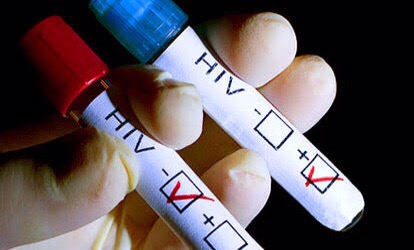

I can’t believe it has been about thirty seven years since we first started hearing about HIV/AIDS. I find it even harder to believe that I have been infected for thirty five years. Over half my life has been lived with this virus! In personal retrospection, I could say that compared to the bad, bad old days of 1981, life is a bed of roses today. But then I am aware that quite a lot of people would still not share that sentiment, so out of respect to them, I will avoid such romanticism.
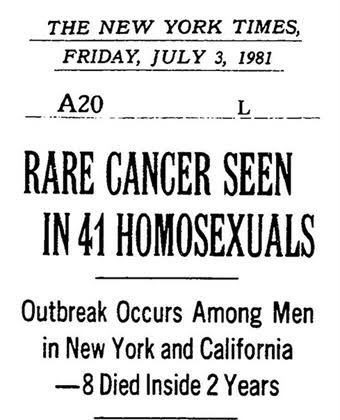

I was living in Melbourne at that time, and I believe that HIV/AIDS got its first mention in the gay press a little earlier than 1981, though I could be wrong. There were only snippets, overseas briefs if you like, of a strange STD that seemed to be selectively attacking the San Francisco gay community, or more specifically, those members of that community who frequented the baths and back rooms of the famous city. I know that no one here was particularly concerned. We thought it was just another of ‘those American things’, or just a mutated form of the clap. Nothing that a pill wouldn’t fix! By the time I returned to Sydney in 1982, we had started to think quite differently. Some of us were getting very scared!

The media began drowning us in information, mainly from the United States. There was the dramatic scenario of ‘Patient 0’, from whom it was assumed the whole epidemic had spread like an out of control monster. The USA and France argued over who had discovered the virus, and made the link between HIV infection and AIDS (watch “Dallas Buyers Club” for an inkling of what this was all about!). A debate raged as scientists tried to decide what to call it and which acronym to use. We had GRID (Gay Related Immune Disease) and HTLV 1 & 2 (Human Transmitted Lymphoma Virus – if memory serves me well). They eventually settled on HIV for initial viral infection, and AIDS for any subsequent illnesses that resulted from the breakdown of the immune system. The original Center for Disease Control (CDC) classification system for the various stages of HIV and AIDS progression was so complicated that you really needed a university degree to be able to decipher them. To make things more manageable they finally settled on four classifications.
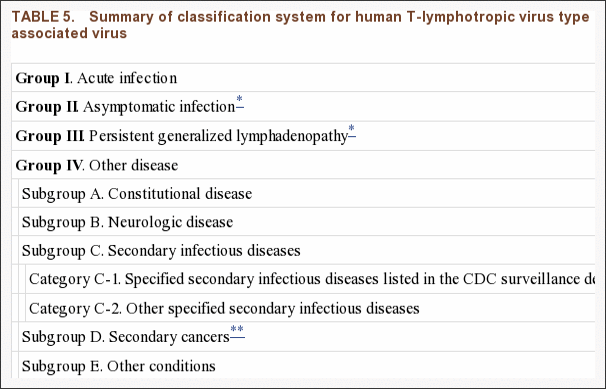
Then came ARCs (AIDS Related Conditions) but that was considered politically incorrect, so we settled on OIs (Opportunistic Infections).

The argument over names and classifications wasn’t half as frightening as the reality of the disease itself, which started to hit home in 1985. Official testing began in that year, and is still the earliest date that medicos will accept as a point of diagnosis with HIV. Any date earlier than that is declared to be a ‘self-report’. Like many others, I assumed I was HIV+ long before testing started. Virgin and chaste were not words to be found in my life resume. Sydney’s Albion Street Centre was the first here to begin testing, and it was done very discreetly and anonymously. We all used an assumed first name, and were issued with a number to identify who we were. (In 1996, when I needed to tap into my first HIV test results done at Albion Street, they were still there.) Counseling was atrocious. You were given your HIV+, or HIV- (if you were lucky) status very bluntly, then quickly shunted over to a counsellor before the shock had a chance to set in. You were also told, almost apologetically, that you probably had about two years to live. That was HIV diagnosis circa 1985.

A number of our conservative politicians, and some of our outraged Christian clergy started to say that they wanted us placed in quarantine. It was very specifically a gay disease, according to them, and they truly believed that fencing off the gay areas of Sydney and leaving it to run its course could contain it. These people wondered why we got tested anonymously!

By 1985 people were starting to die. There were no dedicated HIV wards in any of our hospitals, and patients were shuttled between temporary beds in wards and the emergency department. Reports started to filter through of hospital staff wearing contagion suits around patients with HIV. Worse still, meals were being left outside the doors of rooms, and would often be cold by the time the patient managed to get them. Cleaners refused to clean the rooms. There were scares of infection by contact with everything from a toothbrush, to a glass, to cutlery, so patients were offered very disposable forms of hygiene. Even mosquito’s copped some of the blame.

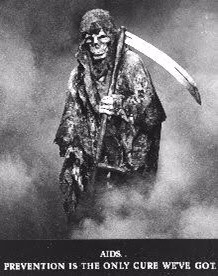
Then, of course, we had the living daylights frightened out of all of us with the “Grim Reaper”television ads. From 1985 to 1995, death lived with us on a daily basis. If you weren’t visiting sick friends, lovers, or partners in hospital, you were visiting them at home, or attending their funerals and wakes. Most of us lost the majority of our friends, and for most of us those friendships have never been replaced.
Around that time, the gay community took charge of what was quickly becoming an out-of-control situation. Tired of seeing friends dying in emergency wards, and getting only the minimum of care at home and in hospitals, we established our own care, support and advocacy groups. Out of the pub culture grew groups as diverse as BGF, CSN, ANKALI, ACON, and PLWHA. Maitraya, the first drop in centre for plwha was founded, and we raised the first quarter of a million dollars through an auction at “The Oxford” Hotel to start to improve ward conditions at St. Vincent’s Hospital. The gay community can forever take great pride in itself for bringing about great changes, not only in the care of plwha, but in the way the disease was handled, both politically and socially..

The Department of Social Security streamlined people with HIV/AIDS through the system and onto Disability Support Pensions, and the Department of Housing introduced a Special Rental Subsidy so that those on a Pension, and unable to wait interminable amounts of time for housing, were able to live in places of their own choice, at greatly subsidised rent. Home care became available through CSN, which, at that time, was not a part of ACON. By 1992, there was a perceived need for improved dental services for HIV patients, especially considering the high incidence of candida. The United Dental Hospital led the way with a HIV Periodontal Study, which at last provided reasonable dental care to plwha.
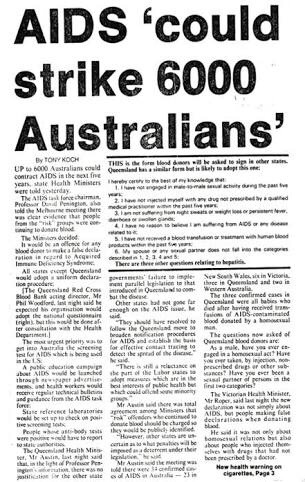
The first vaccine, p24VLP, was trialled with absolute zero results. There were quite a number of scares with HIV contaminated blood, and screening of blood donors was tightened. Discrimination reared its ugly head in the Eve van Grafhorst case, which forced this poor little girl to not only leave her school because of the hysterical reaction to her HIV infection, but to flee the country with her family.

In 1987, the first therapy for AIDS – azidothymidine (AZT) – was released in the USA, and its use in patients with HIV/AIDS was fast-tracked through the approval process here. In France a huge trial called ‘The Concord Trial’ was conducted – unethically – and its findings were found to be inaccurate. The resulting announcement that AZT was ineffective in the control of HIV, and the drug nothing more than ‘human Rat Sak’, caused a universal outcry. The damage was done. Many had no faith in the new drug at all, and local activists and proponents of alternative therapies tried to encourage people not to use the drug. Many of us chose otherwise. True, the effects of AZT were short-term only – maybe six to twelve months – but many saw it as a way to keep the wolf from the door long enough for some other drugs to come along. And come along they did. AZT was quickly followed by what are referred to as the ‘D’ drugs – d4T, ddi, ddc, and the outsider 3TC. However, these were all drugs from one class called Nucleoside Analogues and all had short effectiveness. Some doctors tried giving them in double combinations, but the effectiveness wasn’t much better. Despite their short life span, these drugs were being prescribed in enormous doses, which resulted in problems such as haematological toxicity, anemia, and peripheral neuropathy. We needed a miracle! Add travel restrictions in many countries, blood transfusion infections, and some babies dying as a result of this and things weren’t looking good!

Those of us who had managed to survive to 1996 were starting to give up hope. Most of us were on a pension, had cashed in and spent our superannuation and disability insurance, had a declining health status, and didn’t hold out much hope for a longer survival time. Prophylaxis for illnesses such as PCP, CMV, MAC and candida had helped improve most people’s lives, but they didn’t halt the progress of the virus. The first of the Protease Inhibitors, Saquinavir, was introduced that year, and evidence started to emerge of the effectiveness of combining the two classes of drugs into what came to be known initially as ‘combination therapy’ and later as HAART (Highly Active Antiretroviral Therapy). The results were astounding; those close to dying suddenly found their CD4 counts rising, accompanied by a return to reasonable health. Viral Load testing was introduced and people were finding not just a raising of their CD4 counts, but a drastic lowering of their viral load, often to the point of its being undetectable. This became known amongst doctors as ‘the gold standard’. Ganciclovir Implants to assist with the control of CMV retinitis were trialled the same year, and Albion Street Clinic started a trial using decadurabolane, a steroid, to assist in controlling Wasting Syndrome. The new drug combinations (NNRTI’s – Non-Nucleoside Reverse Transcriptease Inhibitors – a third class of drugs, were introduced shortly after) were not without their complications and problems. Most combinations still required huge quantities of pills to be taken daily, not just of the HAART drugs, but also prophylaxis and drugs to help control side effects such as nausea and diarrhoea. Their use required time and dietary compliance. Other problems such as lipodystrophy, lipoatrophy, and renal problems appeared, but we were, despite any drawbacks, a lot better off than we had been ten years, hell even two years earlier.

People’s health changed drastically, and suddenly new services started to take prominence. Some people required lots of counselling to help them reconnect with the life they thought had been taken from them. Others went to peer support groups or turned to treatment management groups, and some to the larger range of support services being provided by The Luncheon Club, The Positive Living Centre, NorthAIDS and other similar groups. There was recognition that there was a need for services to assist people with an improved health status, as some of them were contemplating returning to work. Despair had, to a large extent, been replaced by hope. Organisations concerned with people’s changing needs reassessed and changed their services to meet the demand. Those that changed have survived, and are still prominent in our community.

The war is far from over. New generations require new strategies, and while everyone seems happy that infection rates for HIV have remained steady in Australia (despite rampaging out of control in Third World countries), many feel it is still not good enough that, at this stage of 37+ years into HIV/AIDS, countries like Australia with high levels of education and accessibility to media and information should be seeing a decline in infections. Remembering my own youth I find it difficult to comment on the attitudes of young people. I grew up through the very worst that HIV/AIDS had to throw at us, and the lessons it taught are not easy to forget. I have to ask myself had I not had that experience, how would I be viewing it? It is no longer just the responsibility of the gay community to guard against new infections. Responsibility also rests with the straight community, and the IDU community, as infection rates remain at their current level. Some scaremongers have ventured forth theories of a ‘third wave’ of infection, but I trust we are too wise, and too educated to allow that sort of irresponsibility to happen.
Many of us (certainly not all) are going on to lead relatively normal lives. Many have returned to work either as volunteers, or in casual, part-time or full-time employment. Many like myself have returned to tertiary education, determined not to leave this world without at least fulfilling some gnawing ambition. However, we are not living in a ‘post-AIDS’ world, and to think so would be foolish. Even if the battles have been won at home, they still need to be fought elsewhere. We still need new drugs, and we still need people to trial both the emerging antiviral and opportunistic infection drugs and the immune-based therapies. We now have a fourth class of drugs in the form of Nucleotide Analogues. Many medical practices have adopted a holistic approach to medicine, and this can be judged to be a direct spin-off from the HIV/AIDS wars. Hopefully, soon please, a new vaccine will appear.

I really don’t know how much longer I will live now. Certainly with the standard of health care I get, and the close monitoring, I may live out whatever my allotted time was to be. Time will be a better judge of that than I will. For me, HIV/AIDS has been a two-edged sword. It has taken good health from me, I have permanent disabilities from AIDS, and I have seen far too many friends, lovers and partners die from this hideous disease. At the same time, it has presented me with opportunities I would never have grasped if it had not come along. I am re-educating myself, taking myself off along strange paths. It has given me a whole new understanding not just of HIV, but of disabilities in general, and a great respect for those who overcome difficulties and recreate their lives.

At a university tutorial last semester, a young woman asked me if I thought every day about having HIV. I don’t! It may have taken thirty five years, but it is now so integrated into my life, that I have trouble remembering the time when I didn’t have it. The pills are just pills now (and thankfully a lot less of them than even 4 years ago), and most of my current medical problems have more to do with ageing than with HIV.

I can tell you, that really gives me something to think about!

Tim Alderman (C © Revised 2017)

Rumination of the Day (6th December 2016

56 NAMES FOR SUGAR

I don’t hate sugar per se, but I do hate how it is snuck into just about everything we eat. It is a highly addictive product, despite the sugar industry denying it – no shock there! The only way you can avoid sugar is to not shop in the centre of your supermarket! The less processed foods you eat, and the more you prepare yourself, the healthier you will be. Sure, you do go through withdrawal, and everything fresh & healthy tastes “wrong” for a while, but that passes, and once you adapt, it is hard to go back. I get posts in my feed of things like Malteser desserts, and Tim Tam’s and the such like – and all it does is put my teeth on edge when I think about how sweet they would be. 

When I did Nutrition as part of my Certificate III in Fitness, the tutor asked the class, during a lesson on sugar, what one thing would the body burn first to give you a burst of energy. I was the only one in the class who said…sugar! The human body is intrinsically lazy, and hares to expend energy to run itself, so it looks for the easy way out. Given the choice between sugar, and fat as an energy source – sugar wins because it is easier to burn. However, if you don’t burn it off, it stores it to burn later…thus you get fat.

The sugar industry itself is responsible for a multitude of misinformation, dishonest advertising, and self-funded health reports relling us sugar is not a baddie! It is all very underhanded, and badically caters to the lazy cook, and those who really just don’t care!

There is no harm in some sugar! Have an occasional slice of cake, or biscuit, or a dessert…just don’t do it daily. 

Barley malt
Dehydrated cane juice

Golden sugar

Molasses

Barbados sugar

Demerara sugar

Golden syrup 

Muscovado

Beet sugar

Dextran

Grape sugar

Panocha

Brown sugar

Dextrose

High fructose corn syrup

Powdered sugar

Buttered syrup

Diastatic malt

Honey

Raw sugar

Cane juice

Diatase

Icing sugar

Refiner’s syrup

Cane sugar

Ethyl maltol

Invert sugar

Rice syrup

Caramel

Free flowing brown sugars

Lactose

Sorbitol

Corn syrup

Fructose

Malt

Sorghum syrup

Corn syrup solids

Fruit juice

Maltodextrin

Sucrose

Confectioner’s sugar

Fruit juice concentrate

Maltose

Sugar (granulated)

Carob syrup

Galactose

Malt syrup

Treacle

Castor sugar

Glucose

Mannitol 

Terpinado sugar

Date sugar

Glucose solids

Maple syrup

Yellow sugar

Some of these you will recognize as sugar, but what about ethyl maltol and maltose? Manufacturers are sneaking these types of sugar into everyday products without the consumer knowing what they are eating or drinking. Even the most health-conscious of us consumes processed foods, even if just on the odd occasion. However if we don’t know what these sugars are called, and what they can do to our bodies, how can we make informed decisions? Is the answer to simply avoid processed foods altogether, or are we simply misunderstanding sugar and the effect it has on us?

Tim Alderman (2016)

Daily (Or When The Mood Takes Me) Gripe: The Disgrace of the Tasmanian Salmon Farming Big Guns- Tassal!

4 Corners Monday 31st October 2016 – Big Fish 

On last nights 4 Corners, we were presented with an investigation into the big wigs of salmon farming in Tasmania, and what was revealed is everything that is wrong with big corporations, not just here but worldwide. The lack of accountability, and the culture of denial for these companies is no longer something that can be hidden in plain sight.
To quote from my Facebook post just an hour after watching this  gobsmacking investigation where a serious  issue is treated like a game by Tassal –  “Lies, no transparency, lies, huge profits, lies, environmental vandalism to the once pristine waters around Tassie, lies, setting up “plants” for the 4 Corners interview, lies, ruining other businesses through their practices, lies, over-populating salmon farms, lies, denial of everything, and lies. Did I mention lies? And as to the WWF – just like the Heart Tick, it’s all up for sale under the guise of “donations” – provided the WWF can see fit to bestow its logo upon you…or as long as you can afford it. Corporate corruption is just par for the course these days, with government and its agencies seemingly turning a blind eye! Thank heaven for concerned citizens, whistleblowers, and those who are so fed up with it all that they just give the big FUCK YOU to them!

Oh..and in case you didn’t know, your lovely pink farmed salmon is coloured chemically through the fish food…they even get to choose the shade of pink! 

I am so glad I hate salmon, so not helping towards the profits of these unethical, immoral corporations. What an eye-opener…and unfortunately, none of it a shock! Let’s hope the pot has had a good stirring!”

Tassal are currently in the process of gaining permision to expand their salmon farming in bays along the Tasmanian shoreline. The environmental impact of what will become over-farming is dividing the community, but as always local government, state govrrnment and related agencies appear to be ignoring impact reports, and personal attempted interventions from those both experienced in the industry, and in several cases those impacted on a oersonal level by the current aggressive actions by Tassal.

The amount of fish excrement, and residue from feeding pellets, has to have a detrimental effect on what is currently a pristine environment, sitting on a knife edge. It doesn’t take a lot of common sense to see that things could – and have been – be tipped over the edge. That 4 Corners came to town obvioysly wasn’t a welcome intrusion “Four Corners doesn’t come down unless the community is concerned, I get that… I would be happier if we just slid under your radar and you hadn’t been here, but you’re here.” Company CEO. Obviously some Tassal employees are in the job just fot the pay – and not company loyalty – as several leaked documents from Tassal showed an attempt at subterfuge as far as the investigative team were concerned. Not only was a 50-page how-to-handle-Four-Corners manual produced by them, but most tellingly was a list of local big wigs who were “encouraged” to offer their support of Tassal in a contrived meeting that was rigged in their favour. One has to wonder just what inducements were offered by Tassal to gain their endorsement!

Even worse was a mussel farming small business that had been put out of business by Tassal’s intensive farming methods. A deadly sludge produced by cleaning methods on the salmon farms had coated and killed the mussels. Not only did the farm go broke, but a marriage was destroyed. Tassal, obviously not afraid to take advantage of a situation, offered to buy out the mussel farm leases – but with caveats attached. Most notable was the requirement to silence on the matter, that it was never to be spoken about, nor were they to denigrate Tassal. The poor ex-owner of the mussel farm was sick of carrying the burden around, and broke the caveat by speaking out against them. We need more people like this in the world! 

But perhaps the most disappointing – though not really coming as a shock – was the attitude and lack of ethics of WWF (World Wildlife Fund) Australia. We have known for some time now that organisations like this – and the Heart Tick is another – get funding from selling their logo to put on products distributed by corporations like Tassal – with no impunity! This organisation is supposedly about protecting the environment, and the wildlife within the environs. However, it would appear that money is more important than ethics, despite knowing that their logo on a product is, from the publics point of view, a reason to select that product for purchase. What a savage deception! The organisations we turn to to provide protection in the environment against the violations of big business (who only care about shareholders and profits) is disillusioning! They are really no better than those offering “donations” to procure an endorsement that is, as it turns out, just a joke. WWF Australia did a total fail with their attempts to validate why Tassal were allowed to use their logo!

The sad thing is that once again, big business is bulldozing its way through the process, offering the community much needed jobs and money…but at what cost! Often, as we know, the end does not justify the means. Tassal are, like so many corporations now, using language and trends to portray their businesses in a positive light. They tout their transparency (at the opaque end of the scale) and their environmental “sustainability” and “best practice” like badges of honour, meanwhile hiding behind the semantics, and self-reporting (all in-house) to subvert the outcome to something that is less than desirable, or accountable  Producing salmon is big business and the industry is reaping big profits with plans to turn it into a billion dollar industry within 15 years. “”I would say that salmon farming is clean and green though it’s not a term that I’d like to use. I would say that it’s a responsibly farmed product and I think we do it in an environmentally responsible way.” Company spokesperson”.

Thankfully, I do not like salmon, so feel I can assume the high moral ground…don’t take that seriously, please! However, finding out what went into the feeding pellets…some ingredients even unknown by the employee intervieed – would positively turn your stomach. I encountered a similar situation with dogs kibble several years ago, and I now read ingredients listings, and pay more for quality kibble. That there is a chemical colouring agent included in the feed should be of concern to everyone. “If a consumer were to see a salmon fillet that was a pale grey or a white, chances are they wouldn’t buy it.” Lawyer!

There are those who care – members of the local community, environmentalists, ecologists, whistleblowers, and those whose livlihoods have been destroyed by the bullying tactics of big business like Tassal. While empty-mouthing platitudes about “the industry pulling  together”, are really just interested in their own profits, and giving shareholders a dividend. It is a sad state of affairs.

Tim Alderman (C) 2016

Daily (Or When The Mood Tales Me) Gripe: Has HIV Inc. Run Out of Steam!

This year marks, for me, 34 years of living with HIV/AIDS…though now it is just HIV. I consider it a landmark, as back in 1996 I was admitted to Prince Henry hospital with chronic CMV retinitis, chronic candida, chronic anaemia, wasting syndrome (48 kg and going down), 10 CD 4 cells, and no immune system, and was not supposed to leave…at least not under my own steam. That  I did was only due to advances in medications at that particular time, very aggressive treatment, some great doctors and nurses –  and a lot of will power. I don’t give a fuck how negative many HIV+ guys are about life with HIV. For me, this was the great singular event of my life, a pivotal point that resulted in life-altering decisions, a mental overhaul, and the knowledge that there was a hell of a lot more to life THAN HIV. It altered the course of my life, and for better or worse I have never looked back. 

I was a speaker for the Positive Speakers Bureau for 12 years before realising that when you continually tell a story you start doing it by rote. Time to get out before it became totally meaningless. I have also written for “Talkabout” magazine (the flag ship publication of Positive Life NSW – formally PLWHA NSW Inc) for 15 years, both as a features writer and a columnist. As a writer I see my role to be not just to inform people, but to provoke debate, at times to be opinionated, to raise questions, to address abuses and unfairness and to be, when required, controversial. Unfortunately, my time with “Talkabout” taught me that to get published in a HIV publication you need to walk the safe road. To be controversial is to be tolling your own death knell. Mind you, this censorship has nothing to do with the editors who, in my experience, have been nothing but supportive. Community Health and a certain AIDS council provide funding to the magazine, so to poke your nose into sensitive areas will ensure your censure and non-publication. As a HIV+ person writing about HIV issues I have always found my hands tied. I have written two extremely controversial articles on HIV issues over the years. One, on Options Employment Services using HIV clients as a free work force, in the guise of “work experience”, was so watered down by the editor after threats of suing PLWHA, the editor and myself (I truly wish they had) that by the time of publication it was a mere shadow of its original fiery tirade…despite the fact that I had evidence of this going on. The manager of “Options”even took me aside and “suggested” that I quieten down my opinions as they were providing a service to the HIV community. Shortly after this fiasco, they went broke and disappeared. The second article was amongst the best pieces I have ever written, and covered the controversial area of bug-chasing (HIV- guys who deliberately have unprotected sex with HIV+ guys in the hope of contracting HIV). The magazines working group deemed that by writing about bug-chasing I may have been promoting it amongst a certain sector of the community. Considering that the practice is well documented, is acknowledged and exists, I failed to see how being informative about it was in any way promoting it…oh shit! I forgot that community health and certain HIV organisations wanted to keep their heads buried in the sand about such unpleasant issues…and they held the purse-strings. Censorship is alive and well within the HIV community and always has been. Want to tell the truth about what is going on or want to expose something? Not on their watch!

But despite this I continue to write, though I keep it to the more nondescript these days, and publish them on my blog. I have around 100 followers – not bad for an unknown.. I do enjoy being published! When I moved to Brisbane I began phasing out my writing for “Talkabout” (which after 15 years of being published in pretty well every issue, has gone unacknowledged by the organisation itself, though not by the editors), and had started writing for QPP “Alive”, the magazine of Queensland Positive People. Same story, different place as far as funding goes, I’m afraid. Nothing controversial would be coming out of there either. Nor did I get paid anymore – one advantage of “Talkabout”.

34 years ago at the start of the HIV shit fight, people never questioned anything about treatments, definitions, philosophies, or courses-of-action. We were in crisis mode and anything was better than nothing. We let a lot happen that in more sane, accountable times would never have been allowed to happen. This far down the line it is time to start asking questions, time to demand investigations and redefinition into many aspects of treatment, time to look back at some of the historical record and say “we were wrong”, and set the record straight. I no longer allow my doctor, or the HIV establishment, nor the drug companiesi in particular, to dictate my path to positive health outcomes. I follow my own path, which is dictated to by knowledge and experience. 12 years ago I made a decision to halve my daily medications, and dose myself once a day only. Considering the negative impacts of huge amounts of HIV medication on the body I decided to take a risk. Well, this far down the line my health has never been better (though diet and exercise also contribute to that), my viral load has remained at undetectable, and not only has my CD4 count remained stable, it has in fact risen substantially. Considering the recent emphasis on drug regime “compliance”, and considering my own circumstances, I am forced to ask – controversially, naturally – if the compliance issue is being driven by HIV specialists, or by the drug companies who stand to make a fortune out of HIV drugs. In the same way, I question resistance testing. I will leave that question in the air for you to mull over and answer for yourself. This is a personal opinion, and one I am entitled to.

I started “withdrawing” from the HIV community – in a generalised way – a number of years ago. It was starting to irk me, and was bogged down in academia, and a narrow mind-set. As stated earlier, the fact that something comes from the upper echelons of HIV Inc, doesn’t necessarily mean I believe or accept it. You tend to get a reputation for being obstreperous when you adopt this philosophy, and question everything that is thrown your way. There is little doubt that anyone from HIV Inc…or its sycophants (those who blindly follow and agree with every word from the mouth of) who reads this opinion piece will accuse me of negativity, and not being supportive or a believer in the end of HIV. This is not correct. It is a big step from negativity to a position of voicing reality!

I have written on several occasions about my distrust of drug companies…though it is an area that many are now accepting. These multi-billion dollar corporations are as corrupt as – despite much denial from health practitioners, community groups, and the drug companies themselves. As long as there are stakeholders salivating at the stock price, this will never change. That we are over-dosed – a now acknowledged stand – is all to thebenefit  of the drug companies, who are, at the end of the day, just research, manufacturing & distribution companies, with no stakes in public health other than shoveling their massively over-priced medications down our gullible throats. Now that community pharmacies are handling HIV meds, I went to my local, and was probably the first to get my meds through them. They nearly had conniptions when they saw the price of them! Considering how many years some of these drugs gave been on the market for, the price has never come down. HIV was a regular little money spinner for the drug companies!

Our larger HIV community groups have also been very good at wasting money over the years, and still continue to. I have seen so many ineffective campaigns churned out by them over the years that I’ve lost track. Nothing like churning out the same messages year after year, targeting the converted, and the blasé. When you are given advertising targets, you…well…spend it! The community groups themselves will tell you that no campaign is launched without the blessings of a focus group. What they don’t tell you is that it is pretty well a hard core group of people who attend these focys groups and forums, so in actual fact it is the same people – irrespective of the organisation arranging things – castings their blessings on every campaign that is tested. No wonder they all look the same!

And don’t ever think you can rely on the same groups to be able to assist and support you as needs change, despite however much notice is given of situations changing. By the time they catch up with what is happening, hundreds will have fallen through the cracks, and others will have just given up, and end up fighting their own battles. At the time of the introduction of the then-named combination therapies, there were two major issues raised. One was assisting those who were resurrected from a porential death sentence, being cast back into a world ill-prepared for them, or their needs. The second issue was handling the massive volume of drugs being rammed down the throats of basically every HIV+ people at that time. At the height of new treatment regimes, I was shoveling 358 pills per week down my throat – antivirals, prophylactics,  and pills for side-effects. Wasn’t that fun, with the added value of time & dietary restrictions! The only group committed to the problem of compliance was “Caleo”, which had its funding withdrawn after 2 years – just when it was needed. HIV Inc. prioritising, .as usual. Bet there was plenty of money for yet ANOTHER wasted campaign on condom use! While they were throwing yet more money away, many like ne were negotiating unprotected sex with like-minded – usually other HIV+ – guys. Money would have been better spent advusing guys on this at that time, not years down the line…then treating it like it was a great revelation from the powers that be.

Likewise when I worked for the Positively Working Project. Sonia Lawless & myself spent 12 months putting together a needs assessment for guys returning to the workforce after being returned to reasonable health via HAART. Nothing truly innovative was actioned after this very important report was released. Guys were basically given no assistance at all to help in the transition from DSP to a form of “work” that was beneficial to them in the long run. I was a speaker for the “Reconstruction” program for quite some time, and the most obvious negative from these programs was that many guys got recycled from one program into another. How many times can you be shown how to write a resume, or how to approach an intervuew before it becomes a lost cause? Considering the recycle rate, one would have thought that it clicked with someone that the approach was wrong, that maybe the guys were looking for inspiration and support to direct their lives in new directions – one of the key outcomes of the Positively Working report was that guys did not want to return to their old professions, but wanted to go off in new directions. No one listened!

HIV Inc. has a bad habit of being dogmatic, of only expressing the narrow, popularist view! You only have to go to any HIV web site, or forum to see how prolific this attitude is. If you want help and support, then ensure you walk in the safe zone, looking neither left nor right. Don’t problem solve yourself, don’t question the status quo! Over the 23 years I have been on DSP, I have – perhaps to my detriment – never used many of the services and financial assistance available. I hate the victim mentality, and have always liked my independence and financial freedom, and have always managed to get by. If I truly needed the help, I would have gone for it. I always remember my anger at guys who used to attend the Luncheon Club. They would be given cheap meals, and access to cheap food through the Larder – yet after the lunch, you would see them in yhe pub drinking till all hours, and all smoking! Seems they weren’t willing to sacrifice anything at all – the more you gave, the more they took. I always thought it was wrong, that their priorities were skewed. I still think that. Add in bill assistance from BGF, and housing subsidies…and these guys had it a lot better than many pensioners in the general community.

Anyway, times moved on. Now we have PrEP, and “Ending HIV”! According to HIV Inc, implementing the former will create the latter. According to a comment on a recent post placed on a FB HIV group page, during a discussion on PrEP, “if you have raw sex and take PrEP, no more HIV transmission, so no more HIV”. As simple as that! I was so angry at the naivety of it all Inever  returned to the post. The “Ending HIV” campaign is just ANOTHER example of HIV Inc. wasting precious money. There are several big problems here. One is the emphasis on sexual practice, and the assumption that because testing kits, and PrEP are available, that everyone is going to use them…another assumption being that everyone prepares for sex. Yeah, we all know about that! The only realistic fact I’ve read so far is that guys are sick of using condoms – are, in fact, not using them! I could have told them this 20 years ago!  The general discussion seems to be around eradicating HIV in Australia (no man is an island…) but logic decrees that is never going to happen. We have to account for the tyranny of distance often making both kits and PrEP difficult to obtain, people who are heavy drug users, bisexuality, guys who want to remain anonymous, cultural differences, worldwide travel, religious beliefs – these are just some of the obstacles. And as one guy pointed out, why should we be exposing perfectly healthy guys to the toxic effects of HIV drugs! It’s a good point. Most of us who take the drugs regularly are concerned about the long term side effects of same. I wouldn’t be taking them if I didn’t have to! It was also pointed out that new classes and alternate antibiotics are currently geing tested, and that these, along with PrEP will not only eliminate HIV, but STI’s in general. Evidently we are heading towards the perfect world. My immediate thought was…oh, new antibiotics…so, how long until STI’s make us resistant to these as well! Worth thinking about. This seems to be all HIV is about now – at least that’s all I seem to read about, and encounter through HIV groups. There is a lot of philosophising around both issues – good luck with that!

There was a time about 10 years ago when I thought that a changing of the guard from the older to the younger generation would bring about new thinking and ideas. It may have worked, but the old guard hovered in the background, never really wanting to relinquish their hold. The new guard just became copies of the old guard, and nothing seems to have progressed. There is a certain degree of internalised discrimination towards some sectors of the HIV community, and that hasn’t helped things. Also a certain degreebof self-stigmatisation, and being a victim amongst a group of guys fairly recently converted who will, in all probability, never get ill. A current trend to outing their HIV status to employers – who rarely receive the news gratefully – then leads to a string of posts on what to do. I don’t quite get why there is a need to advertise you status to all and sundry. Even in pre-HIV days, if you contracted an STI, the only people you informed were sexual partners. In my 34 years of living with HIV, I have only ever informed one company of my status – and that was for OH&S reasons. It’s not like the 80s & 90s when people with AIDS looked very obviously ill, and there was no hiding it. That doesn’t happen anymore. Maybe I’m just old-fashioned, and don’t believe in making a rod for my own back. I acknowledge that it is their lives to do with as they see fit, but common sense should decree that if you are going to travel that road, you should ask yourself – what can go wrong here! And if the worstcase  scenario presents, are you prepared to deal with the backlash. 

So, right here and now, I’m an ageing HIV+ man. I see a lot of HIV funding been spent on a lot of things – but nothing that is of any use to me! I don’t see the funding assisting with an actual cure, or giving me a place to go should my current pathway be diverted! As someone with a disability brought about by AIDS, no one has ever asked me…what would you really like? What can we do to assist and support you? There was much to-do about a Long-Term Survivors Day earlier this year. I remember thinking at the time – Why? Nothing will come out of it! As usual, we will be left to fight our own battles! It was a nice bit of tokenism, I guess. We like to think that we are thought about occasionally, even as just a passing thought. You see, we are seen as HIV past, not as HIV present. No one really understands us, as few walk in our shoes. It’s a lonely path at times, and frequently alienating. But we have defied the odds, and will probably continue to. HIV Inc. doesn’t have us in their sights any more…but then…

Maybe that’s just how we want it. It’s a no-bullshit world for most of us!

Tim Alderman (C) 2016

PS The following article appeared in the Sydney Morning Herald on the 22nd May 2017. It would seem to discount both using PrEP, and Ending HIV! http://www.smh.com.au/national/health/melbourne-man-tests-positive-to-hiv-while-taking-preventative-drug-20170522-gwaavh.html 

Daily (Or When The Mood Takes Me) Gripe: Drugs in Sport

“A very cynical attitude is taken by sponsors like Nike. They pay for records to be broken, then when athletes test positive, instead of canceling their contracts, they carry on paying them! It’s as if the executives at Nike always knew what Marion Jones, Justin Gatlin and Marta Dominguez where up to! Nike sponsored them even after they tested positive! It gives you  some idea of Nike’s take on the doping problem”

I am watching this weeks “Four Corners” program on drug doping in sports, especially professional athletics. It really is endemic, and quite frightening in its length, breadth & depth! That drug doping of athletes was not only sponsored but encouraged in countries like Russia, and resulted in the banning of 4,000 Russian athletes after 2 whistleblowers – now exiled to Berlin due to being considered “traitors” – says way too much about how drug doping is rapidly taking over sports. That so few athletes were banned as a result of doping in the London Olympics is more a result of corruption in the Russian drug testing agency than actual lack of drug-influenced athletes. It is not just a disgrace, but very disillusioning and wortying. That the thinking surrounding drug doping is that of “well,everyone else is doing it, so why shiuldn’t I” shows a clear lack of personal pride and self-challenging in sports.

Lance Armstrong is a classic example, and one where one has to ask the question – was it a deliberate choice not just to take ut, but to admit to it? After all, as a professional cyclist, he earned $300,000 a year. He now has earnings of around $23,000,000. In reality, being banned from the sport has paid well! The World Ant-Doping Agency (WADA), after a year of investigations in Russia, delivered a slamming report at a recent conference “We have found cover-ups, we found destruction of samples in the laboratories, we found payments of money in order to conceal doping tests, among others. It’s worse than we thought. All this could not have happened, and continues to happen, without the actual or implied consent of the state authorities. So, their lab is gone, their national anti-doping organisation is gone. We have recommended that the Russian Athletics Federation be suspended, gone!”. State sanctioned sports doping…wow! That’s mindblowing. 

Personally, I don’t get it! I can’t comprehend how you can fill yourself with performance enhancing drugs, win a race, break a record…and feel you have done it by giving yoyr best, challenging and pushing yourself in a natural, physical sense! I would feel that I had cheated myself, and in many respects let myself down. One of the German athletes who had come clean about her doping experiences as a world record breaking runner stated that, on being brought into the Olymouc team for her country, she found herself in a culture of very average athletes, in many respects under-achievers. They didn’t have to have abilities or even ambition, as the drugs brought on those traits. To me, achieving anything in a sporting or athletic field is pushing yourself beyond your limits, challenging yourself at every step along the way, and when you win, it’s because of your own abilities, and doing it through hard work, training and the sheer will to win. If drugs were involved, I would actually feel like a cheat. That everyone else might be doing it is no excuse for indulging, and robbing yourself of the sheer satisfaction of having done it under your own steam. I can see the thinking – if everyone else is using drugs, then everyone is still on an equal footing. But are they? As drugs come and go, what’s to ssy they aren’t taking  something that you don’t as yet know about! Doesn’t that open all sorts of cans of worms! If everyone is going to be on an equal footing…why not a drug-free one? If athletes feel the need – or want – to deliberately cheat, doesn’t one have to question their motive, but more so their self-worth? And just as drugs change and become more sophisticated, so does the testing. Blood and urine samples are kept for 10 years, so in actual fact – due to future testing that can detect drugs that can’t currently be detected – we will not know the actual medal winners from the 2016 Olympics until 2026! Suely the ultimate humiliation as a medal winner would be to have it taken off you in 10 years time! Chez embarrassing!

Remember when our elite swimmers were wearing their specially designed suits? Okay, it’s not doping, but the principal is the same. It’s an enhanced way of winning that has no regard for the personal challenge. I remember saying to my partner that it just wasn’t right, and as record, after record, after record fell…that fact was just enhanced. Where was the challenge if a record eas that easy to break? Surely the swimmers themselves must have felt cheated, that despite having won, and broken a record – they really hadn’t. I was ecstatic when the suits were banned, as it put the challenge – and the interest – back into swimming. If you won or lost, it was always a fair win, whereby the time and work you had put in was on show for all to see. The personal satisfaction was obvious on their faces. I won because I deserved to, not because I had my abilities enhanced by technology. 

As a regular gym goer, I know that a percentage of the muscle-bound bodies around me are not necessarily naturally produced. Steroid use amongst body builders has always been a problem. At 62, for me it’s as much about fitness as building myself up, though I’m not adverse to developing some musculature. But I’m in no rush, and if it takes me months to start to work my way up through the weights, that’s fine. It is a challenge I set for myself, and there is no rush to get there. A chat with a mate recently – who looked really hot at the peak of his performances – revealed an insidious world of two to three trips to the gym daily, enhanced by pre-workout supplements, and other things. In his own words, it was an unhealthy obsession that made him a not nice person. If you are going to build your body up, you have to be able to maintain it with a minimum of work. These guys who build up huge bodies don’t stop to think of the factors that cause you to stop working out, or taking dangeroys substances to achieve your size – things like relationships, having children, illness, changed work curcumstances, or not living in close proximity to a gym. All that muscle suddenly becomes – fat! I don’t  get why, if you are in your 20s, there would be this great need to rush to build yourself up – after all, you have a lot more time than me!

But the steroid/performance-enhancing drug scenarios present what should be a light-bulb moment for all imbibers – the long term side effects of pumping this shit into your body. Liver, kidney, heart and skeletal problems will probably plague you for the remainder of your life – may, in fact, cut it short. 

We need to curb this insidious practice at a world-wide level. We need to create an environment where everyone is respectful of the exhilaration of winning something due to your natural abilities and talent – the setting of a personal goal…and achueving it! Yes, use technology, but use it to enhance your abilities, not to be the sole cause of you winning, or breaking a record. We need to re-establish personal pride in sport, that knowledge thathaving  won a nedal, you are going to keep it!

Tim Alderman (2016)

A Mineral Worth Its Salt

3/4/2010 The Sydney Morning Herald

Author: Helen Greenwood

Section: Good Living

Page: 8

This often-maligned compound now comes in a dazzling array of flavours and textures from countries across the globe, writes Helen Greenwood.

We all know too much salt is bad for us. Yet we can’t live without the ionic compound known as sodium chloride or NaCl. Remove salt from the diet and you die. What’s more, your food tastes better with salt.
Thomas Keller writes in The French Laundry Cookbook: “The ability to salt food properly is the single most important skill in cooking … Salt opens up flavours, makes them sparkle. But if you taste salt in a dish, it’s too salty.”
The question is, which salt? In the past few years, Sydney cooks have been deluged with a flood of artisan salts. They are extracted from the Himalayas in Pakistan, skimmed at Halen Mon in Wales, drawn from pans in Brittany in France or evaporated from the sea at Trapani in Sicily. We are now inundated with choices. And colours. And textures.
Gourmet salts can be white (Maldon), pink (Murray River), black (Cypriot), red or green (Hawaiian) and grey or natural (Italian). They can be flaky or grainy, pyramid- or crystal-shaped. They can be damp, dry or powdery.
More importantly, these gourmet salts have different mineralities that give each one a different flavour. They have depth, power and pungency and need only to be used sparingly to great effect.

At Rock Restaurant in the Hunter Valley, chef and owner Andrew Clarke has been playing with gourmet salts. “We use anywhere up to 12 different salts in the restaurant,” he says. “We use the vanilla Halen Mon with balmain bugs after they’ve been grilled. We use a coarse-grain curing salt for meats. We use iodised salts to flavour blanching water. We use the Cyprus black salt to finish off our wood-roasted goat. We put Maldon on the table because it’s clean and has a soft sea-saltiness.”
All salt comes from the sea, whether it’s mined high in the Himalayan mountains or collected from salt flats in Bolivia. Yet this inorganic mineral carries the flavour of the environment in which it was formed. In the case of the famous French fleur de sel, or flower of the salt, which is “young” crystals that form on the surface of salt evaporation ponds, the flavour varies from region to region – like fine wines.

Alderman Providore is a specialist online food retailer that sells Himalayan, Hawaiian, Bolivian and French sea and rock salts. Former co-owner Tim Alderman maintains salts from different countries impart different flavours. “Each one has a different minerally quality, as distinct from Saxa,” he says. “The grey salt has a distinct mineral taste, the pink and rose salts tend to be more subtle and are different the Murray River salt. The textures change, too.”
This is a contrast to the traditional view of salt as a mono-flavouring. Most of us grew up with an iodised salt that just tasted, well, salty. It was mined and refined to remove most of its minerals and took away bitter – and any other – tastes. Plain table salt was also available but most people preferred iodised salt, which manufacturers starting producing in the 1920s after US studies found people were suffering from goitre, an enlargement of the thyroid gland caused by iodine deficiency. It is believed Australians’ consumption of iodine has dropped considerably in the past few decades.
Humans need less than 225 micrograms of iodine a day. The mineral is found in seafood and sea salts, both natural replacements for refined salt.
Sea salts are harvested from salt pans, ponds or marshes, or by channelling ocean water into large clay trays and allowing the sun and wind to evaporate it naturally. Sea salts are less treated than other commercial salts so they retain traces of iron, magnesium, calcium, potassium, manganese, zinc and iodine. Sea salts’ fans rave about their bright, subtle flavours.

Gourmet salts can be used for cooking or for finishing a dish and sometimes both. Like a spice or herbs, different salts lend themselves to being used at different times as you cook.
Kala Namak, or Indian black salt or sanchal, is an unrefined mineral salt that, despite it’s name, is a pearl-pink grey. It’s strong, sulphuric odour dissipates when used in Indian cooking and is magic with eggplant. You can also sprinkle it on melon or yoghurt as a final seasoning.

Italian sea salts, such as Ravida from Trapani, is produced from the low waters along the coast of Sicily. They are rich in iodine, fluorine, magnesium and potassium with a lower percentage of sodium chloride than regular table salt. Delicate but with a defined flavour, they are finishing salts that bring a salad or a sauce to life.
Both these salts were part of a tasting held by The Salt Book. A dozen gourmet, plain and flavoured salts were lined up and paired with a variety of foods.
The exercise was fascinating. Strips of rare, grilled sirloin fared better or worse depending on which salt you used.

The coarse rock crystals of pink Himalayan salt looked pretty but the Ravida sea salt from Sicily made the meat jump in your mouth. The green Hawaiian salt was recommended with yellow fin tuna but added a polish to prawns.
James Ballingall, program director at the William Blue College of Hospitality Management in North Sydney, which hosted the tasting, used a brine made from Olsson’s macrobiotic salt to cure a chicken before roasting. The wonderful, tender, firm flesh tasted more like chicken than most birds, apart from organic chooks.
Good all-rounders, favoured by chefs and home cooks, are the Maldon sea salt and the home-grown Murray River salt. Guerande Fleur de Sel stood out as a pure, light seasoning that should only be used at the table.
Fleur de sel is a soft, moist salt that looks like sea foam and surprises consumers who are used to their salt being dry and grainy. Italian salts such as those from Trapani are also moist and often off-white.
The wonderful Riserva Camillone from Cervia in the Emilia Romagna region is strangely sweet. Flavoured salts such as Netherlands smoked salt, Tetsuya’s truffle salt, Cyprus lemon salt flakes and vanilla fleur de sel figured in the tasting, too.
They overpowered the plain ones and need to be used carefully.
Suggestions include salmon, kipfler potatoes, poached prawns and desserts respectively.
The key to a healthy diet is to cook fresh produce and then season it with a salt that has personality and provenance.

The Salt Book, Arbon Publishing, by Fritz Gubler and David Glynn, $34.99.
PROCESSED FOODS: THE REAL SINNERS
About 20 per cent of the world’s salt production is used in food. The remainder is used in the chemical industry and applications such as de-icing roads.
Most of the 20 per cent we consume is “hidden salt” in manufactured foods, from breakfast cereals to instant soups.
The Australian division of World Action on Salt and Health (AWASH) has reported many Australians consume 10 times the amount of salt they need for a healthy diet. The recommended daily intake for salt is four grams but many Australians regularly consume up to 40 grams.
The chairman of AWASH, Professor Bruce Neal, has asked manufacturers of processed food to reduce the salt content of their products by 5 per cent a year.
AWASH’s research has shown excessive consumption of salt comes mainly from eating processed food and can lead to high blood pressure, kidney damage and stomach cancer.
A leading nutritionist, Rosemary Stanton, (pictured), advises people to avoid such products in the first place. “The problem is we eat so much of it,” she says. “That’s why our salt intake has increased so much in the past few decades.”

KNOW YOUR SODIUM CHLORIDE

COOKING SALTS

Kala namak (also known as sanchal) Use in Indian cooking, on raw tropical fruits and cooked vegetables. It’s sold at Indian grocery stores.
Celtic salt, French grey sea salt Use for general purpose, soups, stews and sauces. Buy Coarse Guerande Salt.
Coarse salt Use for salt crusts on meat or fish, curing and flavouring in soups, stews and sauces. Buy Himalayan Pink, La Baleine, Esprit du Sel.
Rock salt Use for curing and brining. Not ideal for the table.

FINISHING SALTS

Flake salt Use as an all-round general salt in cooking or at the table. Buy Maldon, Murray River, Halen Mon, Pyramid.
Fleur de Sel (Flower of Salt) Use for salads, cooked fresh vegetables and grilled meats. Buy Le Paludier.
French sea salt Use in salads and on cooked fresh vegetables and grilled meat. Buy Le Paludier.
Grey salt (sel gris, Celtic sea salt) Use at the end of the cooking process or on the table. Good for casseroles and stews. Buy Le Paludier, Riserva Camillone sale di Cervia, Trapani.
Hawaiian sea salt (alaea, Hawaiian red salt) A natural mineral called alaea (volcanic baked red clay) adds iron oxide and imparts a mellow flavour. Used to preserve and season native Hawaiian dishes. Good for meats. Buy Alaea.
Italian sea salt Use for salads and to finish roasts and sauces. Great as a garnish on bruschetta. Buy Ravida.
Organic salt Standards include purity of the water, cleanliness of salt beds and how the salt is harvested and packaged. Certifiers include Nature et Progres (France), BioGro (New Zealand), Soil Association Certified (Wales). Buy Halen Mon, Olsson’s.

SUPPLIERS

GJ Food The Fine Food Connection (Le Paludier Fleur du Sel and others from Guerande).
Cantarella Bros (Ravida).
Lario Imports (Trapani, Riserva Camillone sale di Cervia).
Alderman Providore, aldermanprovidore.com.au (Himalayan Pink, Alaea, Bolivian Rose, Sel Gris de Guerande).
Simon Johnson (Halen Mon).
F. Mayer Imports (Maldon).
The Essential Ingredient (Murray River Salt).
Waimea Trading, 0409 219 280 (Cyprus Black sea salt).
Olsson Industries, olssons.com.au (Olsson’s Pacific Salt).
HBC Trading, 9958 5688 (Himalayan Pink).
Kirk Food (Pyramid).

Salts


Daily (Or When the Mood Takes Me) Gripe: After More Than 30 Years of HIV Knowledge and Experience We STILL Have Stigma!

Please view this video first

https://m.youtube.com/watch?utm_source=GayAussie.co&v=UV5uv0589Ec&utm_term=HIV+Queensland&utm_medium=ga-social-ads&utm_campaign=HIV+FQ+GAY+AUSSIE

I can’t believe stigmatisation and internalised homophobia like this still goes on, and we need to have a dialogue about it! However, my own experiences as a 61 year-old with HIV, and a disability who used (note tense) gay dating sites tells me we do! We no longer have the shared experience of the 80s & 90s, so ignorance keeps on rearing it’s ugly head! Both the gay and HIV communities should be ashamed of themselves. The lessons of the past have quickly been forgotten!

This year I “celebrate” 33 years of being HIV+ (yeah, cheers, thanks). It doesn’t take a brilliant mathematician to work out the percentages – I have spent over half my life with this dubious honour. This is not braggodocio, me looking for a chest to pin a medal on, or leaning my head forward for a pat. This has also included a brush with AIDS – not to be confused with HIV, despite the still incorrectly used AIDS misnomer to describe someone with HIV. For those who think that just because I am walking around it has been an easy road, or similarly think that now, thanks to drugs, my life is a dream…think again. Every single day is a challenge, not so much something I dwell on daily, but certainly live daily.

Over those years I have seen stigma and discrimination of pretty well every variety – reluctance of governments to fund in the early day; religious intolerance, including a call for segregation and for internment camps; hospital staff refusing service to those with HIV; the incident with young Eve van Grafhorst (if you don’t know of it, look it up); social stigma; advertising scare campaigns; HIV denialists (while thousands drop dead around them); the deathly silence of many world leaders (mainly US presidents); ignorance and misinformation on every level. Personally, I have experienced workplace discrimination and bullying both as a gay and a HIV+ man. As the mother in the above video states, if this was cancer you would receive nothing but sympathy and support. But as soon as you say HIV, people back off, and the implication is that you are dirty, a sexual deviant. After all this time, and the misnomer that it is a “gay”disease with its prominent creep into the straight world at about the same time – can’t have them as scapegoats, can we! – one would have thought that all the misconceptions about HIV would have been pretty well eliminated. Well, I’m afraid not!

Even now, on Gay dating sites you eill encounter many instances of people adding labels like “clean” to both their profiles, and sexualpartner  requests! The insinuation is that if you have HIV, uou are domehow “unclean” or “dirty” – and it has nothing to do with me having a shower! Ironically, the profiles making this request don’t seem to think that the same language applies to them. Let’s face it, if I don’t disclose my status, you are going to be none the wiser…no I, for that matter! I have to take your word for it as much as you have to take mine! You haven’t really made any sort of a point, have you!

But apart from the degrading insult, it shows a huge gap in the education of the person posting – almost criminal, if they are Gay! For at keast the last decade or more, it has been pretty well acknowledged that if you are HIV, taking meds, and have an undetectable viral load, you are not going tomoass HIV on. The latest research http://mobile.aidsmap.com/No-one-with-an-undetectable-viral-load-gay-or-heterosexual-transmits-HIV-in-first-two-years-of-PARTNER-study/page/2832748 indicates that after two years into yhe latest study, chances of transmission are, to date, zero!

I hate condoms, and haven’t worn one for decades. Back in my pick- up days, I deliberately seeked other HIV+ guys, as within that circle unprotected sex was a norm, of more recent times I have used sites like BBRT – a barebacking site – for sex. At least on this site there is no foubt about what you get. If I had to ge honest – and the same would apply to the HIVphobes from the other sites – you have a getter chance of picking up a garden-variety STD than HIV…something that is conveniently overlooked! 

Perhaps rather than education – which to-date has got us absolutely nowhere – people just heed to get some manners…and a life!

Tim Alderman (C) 2015


The Hidden Faces of Domestic Violence

Sometime, I just don’t get the one-eyed views of our modern world, how we discern that one aspect of an issue is important, but other aspects aren’t! Our current anti-domestic violence campaigns are a classic example of blinkered views. The whole domestic violence issue, which for many decades has been a problem swept under the rug, has recently – thanks to a public outcry, and government incentives – had one corner lifted for a good spring clean.

Let’s get one thing straight right from the start – I am not trying to trivialise domestic violence! I detest any “man” who raises  a hand to a woman, or a child! It is the ultimate abuse of trust, and power! It is pure cowardice! I grew up in a generation where this just did not happen – or so we thought, as it was either well hidden, or people just turned a blind eye! 

What I don’t get is – why are we only focusing on one aspect of domestic violence…that of men-to-women! Why is female to male, female to female, and male to male domestic violence been overlooked? Surely that ANY form of domestic violence happens should be of concern to all of us! That one woman a week dies as a direct result of domestic violence is a frightening statistic. However, the fact that the “One In Three” site exists – dedicated to female to male domestic violence – speaks loudly that the problem is a lot bigger than that being focused on. The definition of domestic violence from their site is “Family violence and abuse is a serious and deeply entrenched problem in Australia. It has significant impacts upon the lives of men, women and children. It knows no boundaries of gender, geography, socio-economic status, age, ability, sexual preference, culture, race or religion. Domestic violence between partners, boyfriends and girlfriends (also known as intimate partner violence or IPV); violence between other family members (siblings, parents, children, aunts, uncles, and grandparents); most elder abuse, child abuse and sexual abuse are all different forms of family violence. Thankfully reducing family violence against women and children has been firmly on the agendas of government for many years. Now is the time to move to the next, more sophisticated stage of tackling the problem: recognising men as victims as well.” (http://www.oneinthree.com.au/).

According to their statistics, one in every three instances of domestic violence is a male. 94% of these instances is committed by a female. Between 2010 and 2012, 75 males were killed as a result of DV by a woman. This equates to one death every 10 days. Yet these acts of DV are neglected by government agencies such as Our Watch, and ANROWS. 

According to the Sydney Morning Herald, 30 May 2015, same-sex violence in relationships is a “silent epidemic”. Roughly one in three lesbian, gay bisexual, transgender, and intersex (LGBTI) couples experience domestic violence. Those statistics are echoed among the general population. (http://www.smh.com.au/nsw/domestic-violence-a-silent-epidemic-in-gay-relationships-20150415-1mm4hg.html#ixzz3sTIxDpWL). 

Imagine this personal scenario from the early 90s. I was picked up one night in a local gay bar my a guy – Graeme, who I fancied – and his partner Peter – who was okay – for a threesome. Everything went fine back at their home, with no indication of any undercurrants…until breakfast the next morning. Right in front of me, as if I wasn’t there, Peter openly abused and humiliated Peter almost continually. It was incredibly uncomfortable, and not just for me. After breakfast, Greame drove me back home, apologising for the incident almost as if it had been his fault. When I asked him in for a coffee, he declined, saying that the clock was on him, and he had to get home to avoid any further problems. I was staggered that I had actually witnessed these events. Fortunately for Peter, the relationship did end. Funnily enough, we ended up as fuck-buddies for the next five years. In that time, he never discussed that issue with me, nor did I ask.

The statistics all round are frightening. No one – adult, child, male or female – should ever have to suffer violence as a way of control, or power play, or anger outlet. It is time to shift the focus from male-to-female violence, and rackke the oroblem in its broader context.

Tim Alderman (C) 2015


Living with HIV – 1987 Style.

This is an interview on “life” with HIV that I did back in 1987 with “The Bulletin”. When I read it now, I cringe, as it seems so naive. The reporter, whose name I can’t remember now, knew absolutely nothing about HIV…or the gay lifestyle! As you can tell, his grasp of it was no better after talking to us, and editorial license is in full bloom, with distortions, misrepresentations, and fact twisting the order-of-the-day. However, the thinking of the time is evident if you read between the lines. At two years after official testing was introduced, none of us really expected to survive. It was party, party, party! At this time, I had already lost several friends. It was very scary times. Just part of my lived history now.
   
   
Tim Alderman (C) 2015

Dieting Myths

This excellent article appeared today from  http://www.shebudgets.com/health/diet-fitness/10-weight-loss-tricks-that-are-complete-myths/55503?utm_source=facebookpage&utm_medium=luan&utm_term=shebudgets&utm_campaign=weightlossmyths&ts_pid=2

If losing weight was easy and simple and becoming thin and gorgeous was easy and simple, we’d all be thin and gorgeous. But it’s not always the case; if you want to lose 10 pounds, you have to lose 10 pounds. You can’t just sit down and hope some magic potion is going to give you a wish and then you’ll be thinner and more gorgeous than you were an hour ago. There is no magic potion or trick for weight loss. If you want to get healthy and fit and look great, you have to make some lifestyle changes. You have to stop eating like a pig, over-indulging, skipping the good stuff and hoping that the bad stuff is going to make you skinny. It’s not. You’re not going to get thin and stay thin eating nothing but milkshakes or drinking pepper water. You have to eat well, exercise and live a healthy lifestyle.
Sorry (not sorry) – this is not what you want to hear. You want to hear that you can take a pill and lose weight and all kinds of good things will happen to you without you actually having to work for those things. And it’s not going to happen. You have to work for what you want and get actual results. It’s called responsibility and dedication. Diet trends and myths don’t work because you have to keep them up forever and ever and it’s not healthy or possible to do so. We have, instead, decided that we’d tell you that all those things you’re hoping will make you look good in time for beach season will not work long term. Skip them; make lifestyle changes for the better. These diets are myths and they will not work.

Goodbye Gluten

If you have celiac disease and you have to eliminate gluten from your diet, do it. But it always makes me laugh to see people who go gluten-free as if they’re doing something good for themselves as a whole. A gluten-free diet is not a weight loss tool. It’s a way for people with a certain illness to eat food without getting sick. So if you’re using this as a way of dieting, you’re just wasting time and money buying things that aren’t doing it for you.

Juice Diets

Why would you drink just juice and hope that you could lose weight? Of course you are going to lose weight just drinking juice. You are eliminating actual food from your diet and you are not going to be able to keep that up forever. Can you go the rest of your life without actual food? No, you cannot, and that’s why these silly diets do not work.

Soup Diets

See above – you cannot live on soup for the rest of your life. Sure, it’s healthier than juice, but it’s not a way of life. You cannot just hope that you will lose weight because you are eating only soup and hoping that weight loss comes to you in many forms. You have to actually go about losing weight like a real person by eating healthy foods.

Skipping Breakfast

It’s never a good idea to skip breakfast. Of course you feel thin when you wake up; you haven’t eaten in 15 hours. So skipping breakfast is not going to make you thinner or healthier. It’s just going to make you hungrier and it’s going to make you feel bad because your metabolism is going to slow down and work on a pace that doesn’t burn any calories.

Negative Calorie Foods

Some people call this the grapefruit diet, and it consists of eating only things that have negative calories. These are foods that have fewer calories in them than it takes to consume them. While most of these foods are healthy, they cannot complete your diet. You still have to eat and use regular meals if you plan on getting healthy and losing weight for the long term.

No More Carbs

You can’t do it; because carbs are amazing. Sure, it might work for a few days and you’ll feel good and healthy, but when you eat them again you’re going to miss them. And you cannot stay away from carbs forever. Some of them are actually good for you and you need those to survive. So skip the fad and just limit your intake.

Eating Every Two Hours and Skipping Meals

Little meals are good throughout the day, but you cannot skip big meals at all in favor of snacking and grazing every two hours. A handful of nuts or yogurt every two hours does not make for a healthy day. You’re doing yourself a great disservice assuming you can eat like this in a way that’s healthy and beneficial.

Drinking your Calories

All right, so sometimes we all do this. We order a small salad with nothing on the side and then we order three glasses of wine. While it might make for a fun occasional night out, it’s not good for us on so many levels. You can’t skip food to drink – it’s going to kill you. It’s disgusting and unimpressive and not at all good for you.

Food Pairings

Did you know that some people say you should not eat certain foods together? For example, you should not eat carbs with protein because it will make you fat the way that they work together as they digest. Whatever; it’s not the truth. You can’t let people tell you that you can eat as much as you want if you just avoid eating certain things together. It’s not the way eating works.

Not Eating

Sure, not eating is going to make you lose weight. It’s also going to bloat you and make you feel awful. It’s not healthy, and it’s not good for anyone. You’re entire life will change if you stop eating. You’ll become sick, tired, anxious, stressed, grouchy, depressed and you still won’t feel as if you look good. Why? Because you won’t look good and you won’t feel good.

Some real home truths there.

Tim