Category Archives: Health Information

Disabling The Disabled

Can I be blunt here? One of the biggest problems of living with disabilities is that people think you are disabled!

Forgive me for delving into my nightly vice of “Home and Away” but they were covering the touchy subject of Alzheimer’s recently. Irene Roberts had been diagnosed with this, and not only were they handling the subject quite sympathetically, there is a touch of scary realism that many of us with disabilities are faced with. Irene had decided to travel overseas for whatever remains of her lucid periods. However, John Palmer is convinced that this is a bad decision on her part, and was being quite vocal about it, telling her that travel overseas is dangerous, and that selling her home to finance it would leave her with no assets. Irene was sticking with her decision, and had put plans in place to cover any contingency. But can you see what John was done here? He’s decided that seeing as Irene has to deal with the disabling effects of Alzheimers, that she’s become incapable of making decisions for herself. Everyone is doing what they consider to be helping her…but no one asks her if that is what she wants! She doesn’t necessarily want things to be easier! She wants to be seen as an independent person, capable of making her own decisions!

Yes, this is only happening on a daily soap, but it raises an important issue…the attempts by outside forces to influence the decisions of someone with a disability, attempts to downplay their ability to make decisions, to try to control their lives, and disempowers them.

I’m legally blind (an important label when accessing services), and have mobility and balance issues due to medication-induced peripheral neuropathy. I’m on an aged care home support package, and access services through a service provider. Overall, I’m pleased with the services I get, which includes cleaning and assisted shopping. One of the workers who takes me shopping mothers me! I hate it…my friends will tell you I’m very independent…and despite attempts on my part to assert that I do not like it, and can make my own decisions, they persist, so I just grin and bear it. I know they mean well, but they have been taught that disabled people are DIS-abled, so they need to take control when out with us.

Many well-intentioned people make the mistake of trying to take control from us, with unwanted assistance. When I used to use a white cane (something I no longer use, as they can be dangerous on badly maintained paths and concourses), when crossing roads at crossings or lights, they would just grab my arm to guide me across. It would seem logical to me that if I’m out and about on my own, that I’m capable of doing things like crossing roads without help. The problem is…they don’t ask if I need help, it is just assumed I do. It is not only rude, it’s an attempt to take away my power to decide things for myself!

Every morning I walk my dog, I walk down the street to meet friends for lunch, or to do shopping. I go to an exercise physiology gym to do balance and stretch classes (they go out of their way so ensure I can navigate a very equipment-crowded gym, and that my requests for easily seen equipment…and placement of…during classes is seen too). Obviously I write articles, using a large font. I read books, also using a large font, or access audiobooks. I look after myself on a day-to-day basis, doing laundry, bathing, preparing meals, I memorise the number of steps I need to negotiate, in the absence of disability ramps, the safest routes to take to access shops and services. So I actually lead a pretty normal, mundane life despite the absence of vision. If I need to access things in unfamiliar territory, I either use my service providers drivers, or ask friends to go with me. In other words, I’m regulating my own life. If you want to assist me…please just ask me if I need help!

Despite the Invictus Games, the disabled Olympics, and other peer led examples of blind and physically disabled activities, there is still a perception that when we are in public places, we need to be helped, as we are incapable of making decisions for ourselves. Please…don’t just move in to help without asking permission! We are more than capable of developing our own coping mechanisms. This is how we empower ourselves. Of course, this doesn’t apply to everyone who wants to help, but experience has taught me that many act without thinking first.

Remember…if we need help, we’ll ask! At that point, we appreciate it.

Tim Alderman ©️2025

A 40 Year Journey Into (And Out Of) Fear Part 6A

We had been forewarned! Told that the new antiretrovirals were game changers. That people who were on the brink of death could be reprieved, could, like Lazarus, be brought back to life. The community organisations were given time to prepare for a change in how HIV/AIDS was handled! Did they listen? From my perspective…no!

I was discharged from Prince Henry Hospital on the 19th June 1996, after ten days in hospital. That was how quickly things were turned around. It was winter. I weighed just under 50kg, and I really felt the cold. I got a taxi from the hospital to Bondi Junction. My first port of call was Target for a new duna, and warm clothing, then home.

And so began a period of self-imposed boredom. For those of us who survived the final ravages of AIDS, we were, for a time, in a no-mans land. Caught between recovering from something we thought would be our end (and under earlier circumstances would have been), and having to mentally and physically readjust ourselves to an ongoing life, with minimal support services, not knowing what to do with ourselves, and realising that nobody else knew what to do with us either. It was a new world for all of us!

For anyone who thinks that surviving something as devastating as AIDS would send me back to my old life…think again! For the next 18 months, life became an often tiring and frustrating round of clinics, doctors appointments, specialists, support services, support groups, and pharmacy trips. When not doing that, I was stuck in front of the television watching “Days of Our Lives” and other trash daytime television. I ruminated on, and disected my previous life, as it was now a pre-AIDS, and post-AIDS existence…as that is what it was! It wasn’t a life! Change was going to be essential!

So reality started setting in…where exactly was I going from here? Taking vast amounts of antiretrovirals came with its own problems. In these early days of HAART, compliance was drummed into you. The drugs came with both dietary and time constraints. You often couldn’t eat fatty foods prior to dosing, or they had to be taken on an empty stomach. This both restricted eating out with friends, or involved rising at ridiculous times to conform. Likewise, doses had to be eight hours apart, so you were often getting out of bed in the early hours just to take pills. So I was often tired, and cranky! Added onto an already heavy pill burden were prophylaxis drugs like bactrim, dapsone, ketaconizole, clarithromycin, and the list goes on, which were often taken a couple of times daily. Then we have side effects…mainly diarrhoea and nausea. I was getting scripts for Imodium as I was buying fifteen by five boxes (yes, 75) at a time. If I was lucky, they’d last one month. They often didn’t! A bucket of Napisan was permanently in the bathroom for soiled underwear. It was a nightmare, and I often wondered if I had survived AIDS, to die of organ failure from all the drugs I was taking! It sounds like an exaggeration when I tell people that initially I was taking around 340 pills a week…but just look at Imodium, where I was taking a staggering 140 pills a week, or more!

Help came from the wonderful, empathetic Pene Manolas, and her “Calao” Project. Caleo was a treatment management program, whose sole purpose was to encourage and empower those attending to remain compliant despite the burdensome load of pills we were taking. Over the 6 (or 8) weeks of the program you were given tools to help you achieve that aim. It was incredibly successful, and lasted for 2 years, then ceased due to funding. It was not my last encounter with Pene.

At the outpatient eye clinic at Prince of Wales (POW) hospital in Randwick, I was still attending on a monthly basis, and continued, at least for a time, to get the ganciclovir injections directly into the left eye. In 1998, Professor Patrick Versace asked me if Ivwas willing to participate in the Vitrasert Implant trial. The tiny implant was inserted into both eyes, and leached ganciclovir into the eyes over a 9 month period. The chances of developing a cataract were estimated at 4%. I was a more than willing participant in this trial, knowing how stressful it was having the intraocular injections. So, two operations to insert the implants, which were held in place with a stitch. The 4% chance of developing cataracts became 100%, so then another two operations to remove the cataracts, and insert new lenses. The whole sad part of this was, that with HAART proving so successful at keeping opportunistic illnesses away, they were never needed, despite their success. It is still present in my right eye.

Then the panic attacks started. I would wake up during the night and feel like my bedclothes were suffocating me, and had to throw them off. I’d get claustrophobic in underground trains, and stopped getting them. I had a panic attack one Sunday night, home on my own watching television. A gay lifeline had been established by one of the community groups… can’t remember who. I rang the line, needing someone to talk to, only to find their phones weren’t manned on Sundays…just an answering machine. They rang me the next day to apologise, but it would have been a bit late if I was suicidal!

I had a transition period getting used to bad vision, and only one eye. I had a couple of serious accidents. I was on my way to the POW eye clinic one week day, and got caught in this crush of people rushing to get a bus on Crown Street. There was a wooden bus seat just out of my line of vision, and my knees hit it, and I went for a sixer. Took the skin off my knees and shins. Only one guy stopped to help me! One! He checked me over, and despite how serious the wounds were, I told him I was on my way to the hospital anyway. He saw me onto the bus, and the nurse in the eye clinic patched me up. The second time, on the opposite side of Crown Street, I tripped over some tree roots which had pushed the asphalt up. This time the skin was off both knees. I then realised that I had no perspective in my one working eye…the footpath looked flat to me. I started slowing down my walking from that time on. My peripheral neuropathy was setting in at this stage as well, moving from my feet to my ankles and lower shin. This caused me to stagger when I walked, and was responsible for getting me banned from three gay hotels over time. I wrote a letter to the Star Observer about it when the bouncers denied me entry to the Colombian Hotel on the night of my 50th birthday, and refused to get a manager or supervisor for me to speak too. The Colombian apologised in a return letter, saying the bouncers had been out of line.

The most serious falls happened in Bondi. I went to visit a favourite gift store down there, and while wandering around the store, my legs just gave out on me and I collapsed on the floor. The shop assistant, who had been talking to the owner, helped me up. Five minutes later, it happened again. Thankfully I didn’t break anything. But this time, with a frustrated look on their faces, without asking me what was wrong (in retrospect, I should have requested an ambulance) and assuming I was either drunk or drugged, just grabbed my arms, ushered me out of the shop, and sat me on the footpath up against their window. I was in a pretty serious state of shock, not knowing what was going on. I sat there for over an hour, not game to try standing again in case the same thing happened. When I eventually tested them, they seemed to be fine. I started walking home…we had moved from Penkivil Street to Ocesn Steet at this time…up Bondi Road. Deciding to visit a cafe on the other side, I crossed at an intersection that had both lights, and a small pedestrian crossing. I crossed through the lights fine, but on using the crossing my legs just gave out again, and I collapsed on the road, hitting my head on the gutter. Thankfully there was no turning traffic, and a guy sitting in the window of a nearby pub rushed out, grabbed me and helped me to the footpath. I eventually got upl had a coffee in the cafe, and walked home. The gash on my head was serious enough to go to hospital. It never happened again, though I suspect it was a precursor for what was to come!

Feeling a bit lonely and outcast at this time, I decided to try a personal classified in the Star Observer. I was quite open about my HIV status, and that I was damaged goods (yes, I really did say that!) from AIDS. I received about 10 letters in reply…I still have them…all from HIV+ guys. I met a number of them, though none really compatible except for about 3. One was a serial replier to classifieds whom I had been warned about. He was a bit of a problem, so dropped very quickly. Had a one-nighter with another (I’d had no secxual encounters for about two years at this time), and I liked him, but he didn’t want anything further. Then I met Michael, who lived at Rose Bay. We started a bit of a “thing”, though I think it was more a matter of us both being lonely, more so than being compatible, and we both had someone to go places with. Having had a number of bad experiences through the classifieds, the first thing he said to me when I knocked on his door was “Wow…you’re actually good looking!”.

Between 1996, and 1997 antiretrovirals started being pumped out at a staggering rate. Over this period, I must have been, in HAART combinations of three or four drugs, on every drug that was released (thank heavens for the PBS, who approved them very quickly). These included AZT, 3TC, Indinavir (a high dosage caused nausea), Nelfinavir (caused chronic diarrhoea), Saquinavir, Neverapine, Retonavir (more on this shortly), Combavir (AZT+ 3TC)l Efavirenz, and Abacavir. The quick approval of drugs, due to their efficacy, had its drawbacks. Long term side effects often popped up as time went on, for example it was found that Indinavir could cause kidney stones. For me, with both AZT and 3TC still being included in my combinations, my peripheral neuropathy got worse (even now in 2025 I have totally numb feet, which now affects my balance).

In early 1998, through a mutual friend I was out with one Sunday night, I met David in the bottom bar of the Midnight Shift. I was in a casual relationship with Michael, and he was in a relationship as well. We finally surfaced a couple of days later, both deciding to end our current relationships. David and I then went on to be in a relationship for 16 years.

Nelfinavir was the worse drug of all as far as diarrhoea went. David and I were both on it, and it was a nightmare. We were both scared to go out for any length of time, as we would inevitability be caught short. Nelfinavir gave you no warning (and it over rode any amount of Imodium) so you were often caught out grocery shopping, at a movie, or on a walk. We discovered that public toilets were disgusting! There were often underwear changes several times a day. I got so fed up with it restricting my life, that I just charged into Cassy’s consulting room, and demanded she change it! She did! Shortly after, David was also taken off it.

However, despite all this, my viral load continued to, initially, drop, then maintained itself at undetectable. My CD4 cells continued to do a slow, but constant, rise. Probably the only reason we put up with what we did.

But even more changes were coming!

Tim Alderman ©️2025

Why HIV/AIDS History Matters!

Please note that my use of language here is deliberate, and of-the-time! I make no apologies for it!

The one thing that really got my back up during the Coronavirus/Covid pandemic was that this was touted as the most devastating pandemic of our times. There was the occasional nod to the 1918 Spanish flu pandemic, but it was almost as if the 40-odd year whispers about the most devastating pandemic of the modern era…HIV/AIDS…had never happened. I looked at the worldwide death figures from Covid, approxiamately 7.5 million, with many millions more recovering from it. I then compare this to the death rates from HIV/AIDS over the last 40+ years which stands at over 43 million and still rising (630,000 in 2023 alone) despite modern treatments. The difference between the two pandemics is staggering! And of course, up until 1996 and the advent of HAART (Highly Active AntiRetroviral Therapy), your chances of recovering from AIDS was almost zero!

In this day and age, your chances of living with HIV with no serious illness implications, and by taking 1 or 2 pills a day, is very high. Yes, stigma and discrimination still exist, and I would never downplay that, but for the ease of maintaining good health for the lifetime you may have it for, there is little recognition now for the 40 year battle that led to now! Most people who seroconvert now, due in many respects to generational experiences, have no knowledge of the history of HIV/AIDS, and may never encounter a long term survivor who has lived that history!

So, why is HIV/AIDS history important? Well for starters, the response was nothing like Covid! HIV/AIDS has to be viewed in its main time setting of the 1980s/90s. This alone is a historically important era, as the LGBT community gained rights under the laws of many countries, where we finally came out into the open and proudly displayed our sexuality to the world. In retrospect, HIV/AIDS could not have picked a worse time to raise its head! It’s effects upon a newly openly emerging sub-culture were devastating, and in a world where hatred, misinformation, prejudice and stigma were still rife within the general communities we lived in, for many it was a rough journey from being closeted, to being “out”. So, just as my journey as a late emerging 26yo gay male, just starting out on my sexual awakening, little knowing that three years later both that journey and my HIV journey would go forward hand in hand, so the journey of the LGBT community would find itself both politically and socially intertwined.

From a community perspective, HIV/AIDS created an affirming group of mixed people. That here in Sydney we created what was an LGBT ghetto gave us great strength. The vast majority of this community lived in the Darlinghurst/Surry Hill/Paddington/Newtown/Kings Cross areas, and in many respects our services were centred in these areas. We had our bars, hotels and nightclubs; our own retail strip; cafes and restaurants; our newspapers; medical, dental and legal services; community and support groups. A self-contained community within the wider communit. There was a security and strength within this.

And this is where the strength of the community becomes historically important when HIV/AIDS appeared in the early 1980s. Despite knowing very little about the origins or eventual outcomes of what was to become a worldwide pandemic, the community stepped in early to put both political, medical and support mechanisms in place, as what started as a dribble of cases became a waterfall.

Out of our community of both positive and negative individuals, gay men and lesbians, we started negotiating with politicians to make funds available to help set up support mechanisms, and fortunately we had the very foresighted health minister Neal Blewett conferring with our community on strategy. As a country, we were among the first in the world to start taking the upper hand with HIV/AIDS,to attempt to minimise its impacts

We established what are now long-standing groups for both political clout, and support for those infected. ACON (AIDS Council of NSW), NAPWA (National Association of People Living with HIV/AIDS), BGF (Bobby Goldsmith Foundation), CSN (Community Support Network), ANKALI, PLWHA (NSW) Inc (People Living with HIV/AIDS), ASHM (Australian Society of HIV Medicine), Maitraya Day Centre, NorthAIDS, HALC (HIV/AIDS Legal Centre), NUAA (NSW Users and AIDS Association), ACTUP, and many other groups (even an AIDS bus at one stage) had their foundations in the 1980s/90s, and many still continue today within the framework of an evolving pandemic.

A lot of negativity also existed alongside this. Misinformation raised its ugly head even in our hospitals, leading to disgraceful headlines regarding full contagion gear, meals being left outside patients doors. Politicians like the Rev Fred Nile openly created fear and religious discrimination through misinformation. People in contact with HIV/AIDS patients wouldn’t touch crockery, cutlery, glassware, bed linen, toothbrushes. There was no open dialogue about those infected sexually, through blood transfusions, or needles. Safe sex messages became confused, and the badly timed Grim Reaper ad appeared. There was a perception of HIV/AIDS being a “gay disease” even when it crossed over into the straight community. Virus’s do not discriminate!

The community itself suffered innumerable and relentless loss as the pandemic ravaged our social circles. Funerals were daily affairs, our newspapers death notices took up pages. It politicised Mardi Gras! St Vincent’s Hospital established Ward 17 South as a dedicated AIDS ward, and set itself up as the premiere health care hospital, along with palliative care at the Sacred Heart Hospice.

Money poured in…not always political funding, but from within the community itself. Pubs ran auctions, and groups like BGF established fund raisers such as the Bake-Off. We had dedicated HIV GPs, and PBS funding for HIV treatments were established, so that care and treatments were always within the financial constraints of those on pensions. Government departments such as Centrelink, and the Department of Housing came on board with fast track pension approvals, and rental subsidies. Centres, such as the Dental Hospital set up trials. Clinics became specialised. We established memorials such as the Candlelight Vigil, the AIDS quilt, World AIDS Day, and the AIDS Memorial Garden in Sydney Park, so that grief could be openly expressed, never alone, but nurtured within a group setting.

This is why HIV/AIDS history in important, not just as to how a community responded to a seemingly chaotic pandemic, bringing all its diverse aspects together to create support and care, but how we, as individuals, have our seperate and diverse stories of how our lives were, in many ways, empowered and enriched within the structures we had created. Our lives, and deaths, mattered.

This history must never be forgotten. Recent pandemics such as Covid could have taken lessons from these pages of history. There is strength in community, provided we evade the negativity of exclusion, stigma and prejudice.

Sometimes, instead of looking forward, we need to look back.

Interestingly, from a historic perspective, there has never been a review, detailed study, or a commission into the handling of the HIV/AIDS pandemic. It would be fascinating to see what was revealed!

And over 40 years down the line from the first infections, we seem to be no closer to having a vaccine, or method of eradication! At this time, despite being able to suppress it using antiretrovirals, it would appear that HIV still has the upper hand!

Tim Alderman ©️2025

A 40 Year Journey Into (And Out Of) Fear Part 5

The period of the Great Denial was about to begin.

I have copies of many of my medical records from around 1994 through to 1999. Included are correspondence between my GP and specialists, information on trials, pathology, viral loads, hospital discharges, along with my own notes giving a chronology to all that was going on. I haven’t actually looked through them for many years. Perusing them now is a very scary process. How I ever survived all this I do not know! There are some frightening prognosis, and the word “enigmatic” appears more than once as my medicos tried to work out just what the hell was going on with many of my symptoms, and test results. If I was religious, I’d say it was a miracle! But I’m not religious! This was pure stubbornness, nothing else!

Ever since having pneumonia, I’d had ongoing problems with anaemia, and though possibly just because I was HIV+, it was later acknowledged by Professor Dwyer, from POW hospital, that there was a distinct possibility it was caused by AZT. I do remember how tired it made me feel. Everything was an effort! I used to walk from Darlinghurst to the then Redfern Mall in Surry Hills to do my groceries…Clancy’s in Darlo were scandalously overpriced…and it was a slow, exhausting walk.

Everything started to decline. For most of the two years between 1994 and 1996, I was put on, and taken off AZT. My CD4 counts dropped to 160, and continued on a slow downhill slide from there. My weight started dropping! In one letter from a specialist to Marilyn McMurchie, it was stated that my weight was 52kg! Considering that for many more recent years my weight was stable at 68kg, and that I now try to maintain it at between 74kg and 76kg, find it hard to visualise myself at 52kg! During my recovery years of late 1996/1997, drinking mates at The Oxford informed me, scarily, that despite wearing baggy clothes to try to disguise it, they could tell I was rapidly losing weight, and speculated on when I would just…disappear, like so many others!

Yet despite all the signs of a rapid decline towards the inevitable end, I went into full denial, and carried on as if nothing was happening. By 1995, the Stronghold Bar had closed, though I continued to DJ at the Oxford Hotel, and for the Dolphin Motor Club at the Midnight Shift. A couple of close friends died which utterly shattered me. Stuart and Don, both whom I did my gutter drag stints with, both passed…Don from stomach cancer, Stuart from AIDS. With them gone, all the wind went out of my sails, and I threw a large party at my apartment…still shared with Tony…and sold off all my costumes and drag. An era had come to an end! The other thing that ended around this time…though in some ways substituted by copious amounts of alcohol…was my sex life. Always pretty healthy up until this time, I just lost interest, and, I gues with my weight dropping at the rate it was, I just didn’t want to be seen stripped down naked!

In early 1996, Tony and I decided to move from The Dorchester in Darlinghurst, to an apartment in Penkivil St in Bondi. It was here that things took a turn for the worst. Initially, I started complaining to Tony about how dark the apartment was…it wasn’t! Then stepping out of the shower one day, I caught sight of myself in the mirror. Who was that person, that emaciated skeleton in the bathroom with me! It was a horror show! Skin stretched over bone! I often went to the French patisserie on the other side of Bondi Rd from the end of our street. Just crossing Bondi Rd was an effort. A couple of years later, I ran into the woman who used to serve me there. She told me she would watch me crossing the road, always fearing I would collapse midway, I was so thin and frail looking. She was astounded that I had survived that period (all that I said was that I had a viral infection on my brain…not quite the truth, not quite a lie…I didn’t go into detail!).

In early June 1996, I collapsed on the footpath outside my apartment building. I could hardly breathe, and had this heavy weight in the centre of my chest. My immediate thought was that a heart attack was going to spirit me away before AIDS got me! It could be a blessing! With no one around to help, I got myself into my apartment, and rang Tony to get me to St Vincent’s. It was a collapsed left lung! Thankfully neither the cardiac problems, or PCP I was suspecting.

I was in St Vincent’s Ward 17 South (the AIDS ward) for 2 weeks. Despite my vision greying out, I kept insisting that I just needed new lenses in my glasses. I saw Dr David Cooper, but although questioned regularly about my eyes, I insisted they were fine! Talk about denial! It is a period of stupidity I’ve never forgiven myself for! To my thinking, having gotten though 13 years of HIV relatively unscathed, it could not possibly get me now! My care at St Vinnie’s could not have been better, despite a massive cut to hospital funding that occurred at this time. Our HIV nurses were walking miracles. I was still on the Oxfords DJ roster at this time, though I remember the shocked look on Sandy’s face (a manager at the Oxford) when, on visiting someone else there, she realised I was in there as well. It probably looked obvious I wouldn’t be returning to the mix-decks anytime soon!

I was discharged at the end of two weeks. It is at this point where I am about to make a decision that would save my life! Feeling that Marilyn had too soft an approach to HIV, and desiring a more aggressive approach to my health care…I had my rather scary discharge papers sent to Dr Cassy Workman! Perhaps more importantly, despite being told it could take three-plus months to get in to see the tee-shirt wearing, chain-smoking Cassy…a week later her receptionist rang to say she wanted to see me…urgently!

So a few days later, I turned up at her (then) Surry Hills surgery. Her consults were far from normal, something patients were thankful for as the casual setting put them more at ease. It is not even a point of despute that Cassy was one of the most knowledgeable, most radical, most aggressive HIV GPs in Sydney at this time. Those under her care adored her. The very first thing she did when I got in was to check my eyes. She immediately suspected CMV (Cytomeglovirus retinitis). She rang Patrick Versace (a leading Sydney ophthalmologist) and arranged for me to visit him at his Hurstville eye clinic the next day. A friend drove me there the next morning. He confirmed the diagnosis. By the time I got back to Bondi Junction, I received a phone call from Cassy to say I was to get to Prince Henry hospital, at Little Bay, IMMEDIATELY! They were waiting for me!

25th June 1996! So, a very scary bus trip to Prince Henry, without even a stop-over at home. It was coming on nightfall when I got there. As promised, the nurse in triage was waiting for me. It was not a healthy boy who turned up that night. Weighing in at 48kgs, I had chronic anemia, chronic candida, chronic bilateral CMV retinitis, and 10 CD4 cells. They didn’t need to tell me prognosis was not good! I was admitted to Mark’s Pavilion (the AIDS ward) that night, then followed 2 weeks of blurred memories…life went into fast-forward! Hooked up to blood, and saline drips. Hourly blood sugar tests…my finger tips were so sore from the pricks! In my mind, this was my final pit-stop. I remember vividly how reconciled I felt about that. Not scared at all…just very much at peace at such an…inevitability!

But the twist was coming!

The ward on the floor above us in Marks Pavilion was for the HIV/AIDS Tuberculosis guys. My first morning there, I was piled into a mini van with other patients from both floors who required care at Prince of Wales (POW) hospital in Randwick. The eye clinic there was to become a very familiar place over the next couple of years. And so my first experience with the very scary ganciclovir intraocular injections. Trust me on this…no matter how necessary it may be, our eyes just don’t want needles poked into them. And will go to any means to avoid it. Trying to keep your eye still when you know a needle is heading towards it…they have to try every trick in the book. The weird thing is that it doesn’t hurt, it’s just the eyes defensive function. Anyway, we got there, and this had to be done quite a few times a week until the CMV became quiescent. Both my eyes were full of the cloudy formations typical of CMV, though my left eye was more severely affected, with only a small window of vision left in it. The optic nerve was severely affected. I was lucky…it never got into my nervous system…a very scary way to die.

There was one very touching incident that happened. One of the TB boys and myself often attended the same eye clinic. He was a good looking lad, and appearing to have little support from family and friends, I sort of took him under my wing. I consider myself to be a pretty tough guy…I’ve had enough hard strikes in my day to make me so…my friends say they admire my pragmatism. I can’t remember the guys name, but we were sitting together in the waiting room and started discussing our situations, our fears. I put my arm around his shoulder, and it was like a trigger…we both ended up in tears. Such a brief, intimate encounter, and it was the last time I saw him, but I’ve never forgotten it. The lonely guy and the tough guy sharing an instant in time. I hope he survived his TB and eye encounter. I hope his fight coontimued.

Under Immunologist Professor Dwyer I was started on a combination of old and new drugs…AZT, 3tc and the new kid on the block…the protease inhibitor Indinivir! This was the start of what was to become known as HAART (High;y Active Antitetroviral Therapy). Viral load counts were started around the same time…my initial reading in Prince Henry was 500,000! The initial high dosage of Indinivir caused nausea, so dosages were modified. I also had a bone marrow biopsy to explore how much AZT was present there. The very nervous male nurse gave me Pethidine. I was so high…an amazing experience. The biopsy was done at the rear top of my thigh, and his first sample wasn’t sufficient. Upon asking my permission to go in again for a better sample, I was so off my face I told him to do whatever he liked! There was a very nice bruise there after,

I was in Prince Henry for 2 weeks. As I stated earlier, most of it was a blur. I’m sure I had visitors, but don’t ask me who! It was all medical…including 8 trips to POW for the ganciclovir injections. At the end of the two weeks…thanks to the new drug regimes, my CD count was doing a slow rise. Handing me over to the care of clinicians and my GP, was a logical step.

So I was discharged from Prince Henry on the 9th July 1996. I got a cab home. One would think…gee this is a really good outcome! And it should have been! I’d survived AIDS! But it was just the start of an 18 month recovery nightmare.

Thrust back into a world that was not prepared for me…for us! We became the HIV worlds Lazarus syndrome survivors! No one knew what to do with us! We were left flailing in the winds of change!

Tim Alderman ©️2025

A 40 Year Journey Into (And Out Of) Fear Part 4

Before diving into the 90s, a brief note on sub-cultures (Tribes) within the gay community at this time…or to be more exact, how I placed myself within the community as far as lifestyle went in the 80s and 90s. After coming out in 1980, I intentionally positioned myself in the Clone sub-culture. It was a Tribe I felt comfortable in, and adopted it with ease. It was a badge I wore with pride pretty well for the duration of my active life on the scene. The short hair, big moustache, white or black tee-shirts (and flannelette shirts during winter), Levi 501 jeans and boots were, in my eyes, the look that defined gay masculinity. I was, at times, known to dip into the leather world, but my interest in leather was never sexual! I just liked its look, so never saw myself as a leatherman. For a number of years I was an active member of the Dolphin Motor Club (DMC), and member of a gang known by the acronym G.O.D. (Girls/Guys of Disgrace) which was established by the girls who founded Wicked Women, and whose purpose was to peruse the scene at night, and report any potential problems…problems which had escalated since the advent of HIV/AIDS thanks to the media, and societal homophobia. This morphing between scenes meant I could indulge my fun-side by doing what was known as “gutter drag”…a sort of respectful parody of drag itself, using huge wigs, over-the-top make-up, big frocks…and no removal of facial,or body hair. Cleo’s “reputation” and antics still live on amongst my friends. My life revolved around the Oxford Hotel, and the Midnight Shift night club.

By the 1990s, what I call the Great Diaspora of the gay community began, starting, in many eyes, the slow demise of the gay ghetto. People fled to the far flung suburbs, the north and south coasts, to the hinterlands, to the bush, and even interstate, and overseas. Some from fear, some to get away from the relentless deaths and illnesses, some to find peace and quiet, some to die.The scene has never recovered.

So we enter the 90s! Little did we know that the apocalyptic start to the decade, with death notices filling page after page in the gay rags, and with no end in sight, would morph into a decade of great hope by the time we hit 1996. It was at its start, a time of monotherapy, and trials. At the start of 1990, I had a CD4 count of 453…and going down! Two of my ex-partners died of AIDS. Damien evidently returned to his family in Victoria, and died in 1991. I found out quite some time later, when running into a mutual acquaintance in the Oxford Hotel one might, just as I was about to attend a DMC dinner. Frank…my first Sydney partner, if I don’t count the psycho who dragged me back to Sydney from a happy Melbourne life…I ran into when leaving my hairdressers (Kulture In Hair) in Goulburn St one day in 1994.I hardly recognised the figure slowly shuffling up the street. He died a short time later.

Personally, I had a fleeting relationship with Anthony. My sex lifestyle was pleasantly fulfilled with three fuck-buddies. Paul I met in the bottom bar of the Midnight Shift in the very late 80s and would have had a serious relationship with him if he wasn’t already married to his job. Graeme I met when he and his partner Peter took me home…after picking me up in the Midnight Shift…for a threesome. The next morning I found myself in the middle of a domestic abuse (verbal) situation. It was like I wasn’t even there. Graeme drove me home, and when I asked him up for a coffee, he told me Peter would have him on the clock for his return. Shortly after, they thankfully split up, and Graeme and and I saw each other regularly for a couple of years. Gregg I met at the Oxford late one night. He wore way too much after-shave, and he had a wife and two daughters in Forbes. One of those marry-to-cover-up-being-gay situations. He came to Sydney every month to tutor on computers at Sydney Uni. We saw each other very regularly for about 2 years…until I started to get serious with him.

I quit my managerial job at Numbers Bookshop, and moved to a managerial position with Liquorland in 1990, whose store was situated under Numbers. This job was to be my last for quite some time. Not only was I out as a gay man, but also out as a HIV+ man. To my thinking, a gay man running a business on the gay strip was a no-brainer. Obviously I had the contacts in the community to bring in business…and I did. Under my management, the store shot up the rankings from 43 to 18. However, not everyone was happy with my presence! More on this shortly.

Healthwise, in 1992 I started seeing Dr. Marilyn McMurchie as my HIV specialist, and she started monitoring my CD4 and CD8 counts, and percentages. At that time, my CD4 count was <350 My greatest fears were realised…I was diagnosed as stage 3 HIV infection, and started on AZT (my thoughts on this have already been mentioned.There was a slow decline in my CD4 counts once I started on it. Having been taken off AZT briefly, I was asked to go on a trial using another monotherapy drug called 3TC (lamivudine). A short way into the trial, it was found that nearly all participants had haematological toxicity and become anaemic, so the trial was stopped. I also went on the p24-VLP (Very Light Protein) trial around this time. It was an injectable, and the theory was that by stimulating the p24 antigen, it may stop the decline to AIDS. It did nothing!

It was also the year I had viral pneumonia in my upper right lung. It was pretty serious, and something I may have shaken off more quickly if I wasn’t a chain smoker. It pretty well crippled me for a couple of weeks, and I pretty well took up residence on the lounge, in front of the tv. Recovery was very slow, and my holiday pay in advance saw me through.

In 1993, I went onto DDI (didanosine). I was reluctant to take ddC due to side effects. DDI was vile. The huge chalky tablets (jokingly called horse tablets) had to be ground down to a powder in a mortar & pestle, then you mixed them into whatever liquid made them palatable…in my case, Nestles chocolate Nesquik. Even then, you had to hold your nose when downing it! It was a nightmare to prepare in the workplace…which was only one of several problems I encountered at Liquorland.

When I started there in late 1990. The area manager was a wonderful man, who believed in inclusion and treated all the staff with respect. He left in late 1991, and replaced by Rowan, pretty well his exact opposite. Not only homophobic, but as it turned out…HIVphobic as well. For the next 18 months I was subjected to relentless bullying, by an expert. Always out of earshot of staff, the smallest thing was picked on. With no witnesses, so a his-word-against-mine situation, knowing from experience that head office would take his side. Things came to a head in late 1993 when he installed an assistant manager at the same pay grade as me. With me working 50-60 hour weeks, smoking and drinking heavily, and with a bad diet…I’d had enough. My health was already in decline, and I was losing weight. I arranged a meeting with Rowan to request that I step back to a position of assistant manager to reduce my work load. At the time of the very uncomfortable meeting, he said to my face…”You should consider quitting. You’ll be dead in a couple of years anyway!”. As it turned out, an assistant manager position opened up at the Surry Hills branch. I then went on 2 weeks vacation. Rowan would not confirm the transfer despite a number of calls. A day before I was due to return to work, he confirmed the transfer…he had been hoping I’d quit in the interim. As an act of planned revenge, I turned up at the Surry Hills store…and handed in my 2 weeks notice. Rowan said not one word to me over that period…not even a farewell!

I had started to indulge in my passion for dance music by becoming a resident DJ at The Oxford Hotel in 1990. I DJd there until 1996, and also at the Stronghold Bar (in the basement of the Clock Hotel in Surry Hills) from 1990-1994. This proved to be a handy source of additional income as time went on.

I met John at The Oxford one night just before quitting Liquorland. A gentle, artistic man (his mother thought I was too old for him) we were together for about 8 months. With my health slowly declining, I pushed him away. I didn’t want him (he was HIV-) to have to nurse me through, what I saw at that time, the inevitable end.

In 1993, Carol Ann King started the Luncheon Club and Larder, providing cheap meals and grocery items to HIV+ boys on pensions. Though never attending the club myself, I did become a disability pensioner that same year. Fred Oberg at ACON was instrumental in getting me onto the pension, and a SAS (Special Assistance Subsidy) with the Department of Housing, who paid a percentage of my private rental in The. Dorchester, in Darlinghurst.

At the same time, the Dental Hospital in Chalmers St, Surry Hills started providing free dental care to those with HIV (a trial). Having ongoing bouts of thrush as a result of a declining immune system, I attended there and had a number of teeth removed that were so loose I could have pulled them out. They also devised a small denture to fill a gap at the front lower jaw. I could smile again without covering my mouth to hide the gap.

Prophylaxis was another term we came to grips with. In 1992 I started on Bactrim for my reoccurring bouts of thrush, and Fluconazole to ensure I didn’t get PCP.

I had my 40th birthday 1n 1994. I considered myself very lucky to have reached this milestone, and threw a big bash at the Stronghold bar, where I was a DJ. Tim Vincent, a close friend and owner opened the bar early in the afternoon, put on a long happy hour, and was an open house until the bars usual opening hour. It was quite a crowd, and quite an afternoon.

By May that year my CD4 count was 160, and I was back on AZT! At this stage I estimated I had maybe 2 years left…if I was lucky, or a miracle happened. On the former, I was accurate, little knowing the latter would happen, and a miracle did happen!

Tim Alderman ©️ 2025

A 40 Year Journey Into (And Out Of) Fear Part 3

We create our own memorials for a growing list of names of friends, acquaitenances, partners, and family members swept away in this new tide, a tide of grief. I attended my first AIDS Candlelight Rally and Vigil…it was the first held… in October 1985. My friend Dietmar Hollman was a reporter for 2SER Gaywaves, and reported from the rally and AIDS Candlelight Vigil,,organised by Sydney City councillors Brian McGahen (died 1990, using voluntary euthanasia) and Craig Johnston. The recording, which can be found on the Australian Film & Sound Archive, includes discussion of the 1985 Public Health Proclaimed Diseases Amendment Act, speeches from Brian McGahen, Craig Johnston, Dorothy McRae-McMahon (Dean of the Pitt Street Uniting Church), Dennis Scott, a performance from Judy Glen and vox pops from the crowd, including Robert French, and Mother Inferior (Sisters of Perpetual Indulgence). The candlelight walk down Oxford Street started in Green Park, had the vigil in Hyde Park…there weren’t many names to read out at that stage, but as the years rolled by the list got longer and longer…and finished with a rally at Parliament house in Castlereagh Street. Along the way, there was a brief halt to remember Michael Stevens, a young gay man who had been bashed to death two months earlier, caught up in the tide of gay hate and hysteria brought about by media reports on the HIV/AIDS pandemic at that time. The whole event was solemn, and tearful.

The other equally emotive memorial was the AIDS quilt. The panels were created as part of the Australian AIDS Memorial Quilt Project, which was founded in September 1988 by Andrew Carter OAM (the brother of Don Carter, known as Dodge Traffic) and Richard Johnson in Sydney. It was formally launched on World AIDS Day, 1 December 1988 by Ms Ita Buttrose. Quilt unfolding started in 1988 with 35 panels, now 122 quilt blocks with 8 panels per block. This was the most powerful of the AIDS memorials, due to its panels being designed and partially put together by friends and family of the deceased. Wandering around the blocks of panels…with conveniently placed boxes of much needed tissues…and hearing the names being read out was a truly moving experience, and no one left with dry eyes, and feeling emotionally drained. Myself and a group of friends assisted with the beautiful, quiet unfolding of the panels at both the Commonwealth Pavilion (in the old Sydney Showgrounds) and the Conference Centre in Darling Harbour. I was also a names reader, and despite the solemnity of the occasion, there was the occasional lapse

Above photo…Peter McCarthy, Peter Gilmore (Deceased), Bevan (Deceased),,Steve Thompson and myself at an AIDS Quilt unfolding (we were in folders) at the Government Pavilion (Sydney Showgrounds ) around 1988/89. The tee-shirts bear the Quilts Insignia, and “Remember Their Names”

into humour when the names of the Sisters if Perpetual Indulgence were read out. It was hard to keep a straight face. It is the one singular AIDS ritual that I miss, and feel that the panels are wasted hanging on a museum wall.

In August 1987, I was approached by The Bulletin to gather some HIV+ friends together for an interview (unfortunately I can’t remember the reporters name). The interview was held in The Oxford Hotel. I still have a copy of it, and when I read it now, I cringe. There was so much naivety back then, as we were still “filling in the gaps” in our knowledge base, so to speak. There was a mixture of positive and negative attitudes about how we rated our chances of survival, but the general feeling amongst all interviewees 3as…we will be killed by it, so let’s party while we can!

Then, despite all this solemnity going on around us, we still managed a bit of dark humour with the publication of “The Daily Plague”. This was a fanzine that had no regular publication dates…it just seemed to pop up out of nowhere. It’s tongue-in-cheek satirical approach to the AIDS pandemic came at a time when it was needed. I also can’t overlook the huge role played by the Sisters Of Perpetual Indulgence. Despite what seemed to be a bit of flippancy, both with their over-the-top names, and the irreligious n and interpretation of Catholic ritual, they were in fact outspoken radicals, and would be seen at most rallies and vigils. I always have great admiration for those who don’t take themselves too seriously.

Much to my amazement, by this stage I was still very healthy. By 1987 I was already four years into the fray, with no sign of illness, though my CD4 counts had slowly started dropping This was the year that the controversial…most toxic and most expensive ever… drug Retrovir (AZT, Zidovudine) was introduced. A failed cancer drug, it was thought that it might “keep the wolf from the door” with HIV huts…yeah, right! Despite several flawed trials, and some evidence to show that it pretty well did nothing, they fostered it onto us.,I wanted nothing to do with it, due to the bad press around its side effects, and the results from the Concorde trial in 1991.. Patients on zidovudine should be monitored closely for nausea, vomiting, diarrhea, headaches, myalgias, insomnia, bone marrow suppression, peripheral myopathy, lactic acidosis, elevated liver enzymes, and hepatotoxicity…oh…and suppression of their immune systems! I fought my doctor on this one. Some patients flatly refused to go on it. They were the lucky ones. My doctor won that battle…and I reluctantly started on it, with massive dosing. I, and many others, paid the price for that decision.

Shortly after my return to Sydney from Melbourne in mid 1082, I met my first partner, Frank. We had an apartment over;poking the harbour in Neutral Bay. We split up around the time I seroconverted, and left my retail job in the city to take up the then far more lucrative jobs…we were paid huge amounts of money under the counter back then…as a bar useful in the Midnight Shift, and doing the graveyard shift in Numbers Bookstore. It 3as an amicable breakup and we remained flat mates. Frank also seroconverted around this time, though we both had a lot of casual sex back then, so it was impossible to pinpoint any one person for causing it. Frank died in the early 90s. While working at Numbers, I met my second partner, Damien. At that time he worked at “Dudes”, a male brothel in Goulburn Street (which later became Kulture In Hair). Damien also worked at the Den Club in Oxford Street. He was also HIV+, and died in October 1991. At the time I was officially flagged as HIV+ in 1985, my partner was Tony. He was HIV-, and the two differing status put what was already a shaky relationship on a downward spiral. We split shortly after, though have remained friends…and occasional housemates…through to the present day. Tony is still HIV-.

As we entered the 90s, things were about to come yo a head.

Tim Alderman ©️ 2025

Searching For The Body Positive

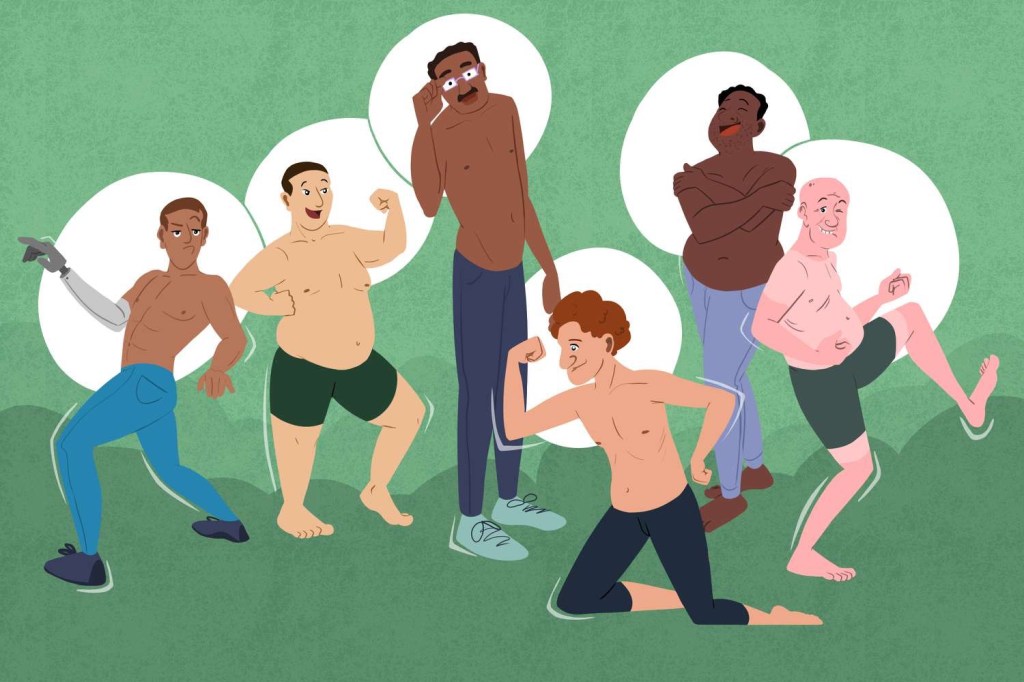
Macho, Mota: Why It’s High Time Body Positivity Movement Included Men

I’ve always considered myself a broad-minded person, and certainly not caught up in the worlds of discrimination, exclusion, or enabling others in these areas. Well, it seems I’ve had a bit of a reality check, quite unintentionally being a hypocrite…something I don’t readily admit to.

Recently, I watched a local documentary called “Shape” (on Tubi if you are interested to view). The documentary maker interviewed a cross-section of local gay men…an Asian twink, bear, muscle guy (who identifies as a nerd), drag queen, elder (who I identified with)…prompting their reactions and opinions on the current trend of male body obsession, and how its tentacles are reaching into many areas of our lives, such as social media, advertising (both print and video/television/streaming), movies, celebrities, and at gay parties, as well as the pub and club scene. It points out how this current trend is encouraging both discrimination, and exclusion.

Like many, I had an Instagram feed that was full of muscle eye candy. I never really thought about it, I guess it was just a gay male thing to do. I have to admit…they did pretty much all look like clones…all pecs and 6-pack abs, all posing with their arms held to show of all the biceps, all in briefs or boxer briefs, or gym gear, or just a towel, making sure attention was drawn to the nether regions, or butt shots either fully naked or in very tight briefs…or doing gym workouts. There really wasn’t much to differentiate one from another. What really made me sit up, and start rethinking WHY was I addicted to this was when the documentary brought up one very simple fact…that these guys didn’t care one iota about me. All they were interested in was accumulating “Followers”, and getting “Likes”. To them it is a competitive business, getting one-upmanship on the other guys doing the same thing. And though obviously posing for a gay audience, many are straight, and don’t care where the likes and comments are coming from. Not a single one of them ever liked,or commented on my posts. When they have anything from 45K upwards of followers, any posts from followers would just be left in the storm of images on their feeds. We really didn’t matter! Yeah, SOCIAL media…NOT!

I will say…which makes my unintentional obsession with muscle boys a bit contradictory…that for some time now, I have expressed to friends my concerns that this over emphasis on the muscled body image must be having a negative impact on young guys, especially those going through puberty, or coming out of it, and becoming aware of body Image. It was sending out the wrong messages about what a healthy, active life was, about excessive exercising, about diet, and about how they viewed their bodies. Body Dysmorphia Disorder was something we used to associate with women, and led to things such as anorexia, and bulimia, and amongst schoolgirls could lead to suicide as a result of bullying, and being excluded from peer groups, especially in late developers. However, this has now crossed the gender divide, and has become a big problem with men, especially gay men.where body image can be seen to determine your desirability, and sexual attractiveness. One in four persons with DDS will commit suicide…a sobering statistic.

Love your male body

Another concerning aspect of the documentary was getting the interviewees to read out typical gay profiles from Tinder. All participants were quite shocked to finds terms such as “no fats or fems”, “no Asians”, “no guys over (whatever age group) and specifying age groups was prevalent. Discrimination, stigma, prejudice and ageism were rife. One guy stated that it made him feel ashamed. Personally, I was horrified at so much internalised homophobia. One could only see it as toxic masculinity. I ditched the apps over ten years ago after encountering discrimination, and ageism.

As gay, HIV+ men, we are only too aware of the ravages to,our bodies from HIV and AIDS. My personal run in with AIDS in 1996 saw my weight (due to Wasting Syndrome) drop to 46kg. That was not a good look. As part of my recovery I was in a trial involving regular injection of Deca-Durabolin (an anabolic steroid) to restore my weight loss. After initially going to the other extreme and turning into a 86kg bear, my weight returned to my normal 68kg after the trial ended. But many of us have endured lipoatrophy, and lipodystrophy as a result of lifesaving drug routines. Even with newer, simpler treatment options now, many of us are still seeing weight gains that affect our bodies, giving many of us (like me) bellies, and dad bods. And no amount of diet or exercise will solve the problem. I guess that counts us out as muscle-bound posers on Instagram! Yet despite this, there is still an attitude of body positivity among this group, guys who unashamedly flaunt their bodies as a way of gaining control, and empowering themselves, in a world dominated by the male body beautiful.

Which brings things back to me, and my muscle guy dominated feed. The “Shape” documentary gave me a real kick up the behind, made me see these guys for what they were…narcissic posers. Even before seeing the doco, I had reached a point of boredom with it, just scrolling and double tapping from habit…and the algorithm that just presented me with more of the same. I intentionally went back to my feed, and started unfollowing the muscle guys, in particular those with a “K” after their followers count. To be honest, it felt really good! Instead, I ignored the algorithms suggestions, and alternatively searched out the guys who hid in the Instagram shadows, showing bodies that were often dressed, bodies that were proudly Bears, or had dad bods, or just ordinary everyday bods. Even older guys who were displaying their sags and wrinkles, espousing the doctrine of body positivity.…”this is who I am, I’m not ashamed of it, and feel proud in my normality”. And in return, more guys are visiting my profile, and liking my fairly mundane everyday life posts. When I flick through my feed now, I see the everyday bodies of everyday guys. And you know what? It feels really good!

Tim Alderman ©️ 2025

A 40 Year Journey Into (And Out Of) Fear Part 1

I love history. Always have, and excelled at it at school. Not just local and world history in general, but individuals personal history as well. Though often distorted, edited to fit the times, world history is fixed. There is only one truth to it, no matter what narrators may say. Personal histories are quite a different thing. A hundred people will produce a hundred histories, each distinctly individual, never duplicated by anyone else. I have written much about my experiences with HIV over the last 25 years, most of it via “Talkabout”. Though personal, and often intimate, none have really gotten into the nitty-gritty of my personal, lived experience. This reflective piece is to rectify those omissions, giving both a factual and lived insight into a period in gay history that should never be forgotten. The recent Covid experience really drove home to me how HIV, its past, and still present history, was no longer of any consequence. Covid was being spoken about as though it is the only pandemic of recent time. It would be interesting to see where Covid sits in 40 years time. So this is my history with HIV/AIDS. It is more detailed, and more anecdotal than my previous writings…which also means it’s much longer. It is, with no strutting involved, a story of survival, but if survival is the gauge of one’s strength and tenacity, then I have come out at the end of it with flying colours, the glass half full, so to speak.

Over 40 years has passed since I sero-converted to HIV. I remember it well…I was managing a retail store in Sydney and was due to go on leave in August 1983. My last day before going off on my break was hellish. Temperature, diarhhea, extreme lethargy, disorientation…I couldn’t wait for the day to end. As it turned out…for the fortnight it went on for to end. I had only been out for 3 years…a late closet jumper…and I have to admit to being very trashy, making up for lost time as it was. I have wondered over the years, as have many, just who it was that infected me…and where! Was it that hot American boy who was staying in The Connaught in Darlinghurst, who picked me up one night just after my return from Melbourne (very likely!) or was it a Melbourne or Sydney local who had returned from a holiday in the USA, or, like me, gotten off with American boys (the flagour of the month) here. Of course, I’ll never know, but the speculation remains anyway!

Since that time, both as a writer, and as a 12-year public speaker with the Positive Speakers Bureau, I have told of my journey with HIV/AIDS. But the story has always had constraints…either in word length with articles, or time restrictions in talks. There is a lot more to the story than I tell in these…often done by rote…sessions.

I have just finished reading Cheryl Wares “HIV Survivors In Sydney – Memories Of The Epidemic”, an oral history project that I was part of, contributing a 21/2 hour interview with Cheryl when I lived in Gaythorne, Queensland in 2014. I was disappointed in the book, for as much as Cheryl wanted it to be a story of ordinary gay men surviving HIV/AIDS, and how it affected their lives both then, and now, it really came across as a voice for…and was hijacked by… HIV activists, rather than just us bar crawling gays-on-the-Golden-Milers. I was left feeling that both my contribution, and the contribution of others like me who weren’t part of the activist community was largely overlooked…again. I know it sounds like sour grapes, and mine is only one of a thousand survivor stories, but like many others I want there to be some sort of public record of many aspects of the HIV/AIDS survival story that doesn’t make it into many articles, or talks. The one thing Cheryl’s book did do was to invoke memories of so many personal experiences…and feelings…that made my personal HIV journey…MY journey.

This is not the first time I’ve contributed to interviews and photo sessions on HIV/AIDS survival, and either been left out in the cold, or had my story overshadowed by activists…or academics. But more on that as we go along. Because this is a personal transcript, I am not putting a word limit on it, so it’s going to be long. I want all this unknown or forgotten information to be in one article. It’s not a soul-cleansing, so don’t get me wrong. I see it more as an addendum to HIV history. I want it in writing before I either forget it, or confuse it in the fog of ageing. Luckily, I am a bit of a hoarder, so have copies of a lot of the things I will be referencing as the story unfolds. To make sense of it, I guess I need to go back to the beginning.

I have written a lot on my family, the dysfunctionality of my growing up, in my blog (http://timalderman.com), so I am not going to rehash already told stories here. In a nutshell, I was born in St. George Hospital, in Kogarah (NSW) on the 18th January 1954. I had one younger brother, Kevin, who was born in 1959. My childhood was pretty uneventful until I was 11, where with my mother deserting the family home, when my brother and I were at school. My father was a difficult man, trapped in a past that had long gone! Yet, he managed to find the housekeeper from hell…to this day I have no idea where he found her, though her move from the bed in the sunroom of our Sylvania home to the bed in the master bedroom occurred within a week, so I am left to wonder… entering our lives. Her persecution of my ADHD brother was relentless, and led to the death of him, at my father’s hands, in the waters below the cliff top known as The Gap. This blew my innocence all to the shit. My knowledge of “being different” at age 9, and my eventual coming out after my father’s suicide are also on my blog, so let’s move it all along.

1980 finds me in Melbourne, where I had just come out as a 26 year-old. A HIV story begins. Little did I know that both my life as a gay man, and my life as a HIV+ man were to walk the same road.

So what was it really like in 1982 to be reading snippets in our local gay press about this mysterious illness (KS, or Kaposi Sarcoma), rearing its ugly head in the gay ghetto’s of America, that seemed to be targeting gay men who frequented the saunas, and quickly killed them? Well, cynicism and disbelief to start with, and the surety that within a short period of time they would find an antibiotic to clear up yet another STD. However, the snippets were to become columns, the columns pages as the mysterious and deadly virus…originally labelled as GRID (Gay-Related Immune Deficiency (Gay plague/Gay syndrome) in 1981, it was followed by HTLV-3 in 1083…human T-lymphotrophic virus type 3…leapt from the shores of America and found its way into the gay scene here. The panic and fear began!

Our response was mixed. The first case of AIDS was reported in Sydney in October 1982 by Dr Ronald Penny. In July 1983, the first recorded Australian death from AIDS-related causes occurred in Melbourne.. The most notable death in these early days was Bobby Goldsmith (1984).We had our usual ratbags who yelled and screamed about “God’s vengeance on the evil, sick and perverted gay lifestyle”…obviously a different God to the compassionate, all-forgiving one that Christians liked to rant about…the most vocal and notable being the Rev Fred Nile MLC and his Festival of Light, and Call To Australia affiliations, the advocates of hate and intolerance who demanded quarantine for all infected persons, and those of the citizenry who either quietly or vocally wished that we would all die or just go away. Mind you, we did have our fun with them. I vividly recall one early Mardi Gras…back then, joining the parade was a very informal process…where the Festival of Light were protesting at the parades starting point. Myself and some friends, dressed in leather chaps with our bare backsides hanging out of them, deliberately stood in front of them, shaking our booty, much to their horror and disgust.

There is no watering it down…discrimination and stigmatisation was rife. It was frightening!

Thankfully, common sense eventually prevailed and both the government and the grassroots gay community combined to put both AIDS Councils and NGO programs in place. Our quick response was instrumental in Australia always being at the forefront of HIV/AIDS care. Within 2 years every state had an AIDS Council under the national umbrella of NAPWA (National Association of People with AIDS), and the formation of support organisations such as The Bobby Goldsmith Foundation (BGF), Community Support Network (CSN) PLWA (which was to become PLWHA), ActUp, and Ankali. Without these organisations life would have been grim for those infected. They provided financial, emotional and spiritual support for those who, quite suddenl found them selves with a death sentence hanging over their heads, along with the fear of unemployment and homelessness in the midst of the hysteria going on.

I digress! In 1985 testing was introduced. It was a bit of a strange affair in the early days. Due to the hysteria, discrimination, and fear of being dragged off to quarantine…a genuine fear… no one wanted their personal details on a database, so at clinics like the Albion St Centre you chose a fictitious name, and the clinic then issued you with a number that then became your ID. Mine was Peter 3080. When things cooled down, the fictitious name was dropped, and replaced with your real name. You had a blood test, and waited for two to six weeks – talk about high anxiety – to get your result. At the time of my HIV test, I already suspected that I had sero-converted and was going to come up HIV+. I was right. Counseling? Oh yeah, we had a lot of that back then. “You’ve got about 2 years to live”. Shrug shoulders “Okay”. And off we went knowing the inevitable was rapidly approaching! The initial window periods were reasonably long, but got much shorter as time progressed, and the virus mutated. That I did not get seriously ill with AIDS until 1996…though their were other factors in play…I always put down to getting infected early in the history of the virus, thus getting a much weaker mutant of the virus than what was to come. I was in a relationship at that time, and my partner came up HIV-…already the juxtaposition between positives and negatives had begun. The strange thing was that I felt no need to hide my status. I turned up at the Oxford Hotel and said to friends…oh well, I’m positive. Of course, I was far from being the only one.

Then the horror stories started! The disgusting treatment of young Eve Van Grafhorst is something for all Australians to be ashamed of. Born in 1982, she was infected with HIV via a blood transfusion. When she attempted to enrol in her Kincumber pre-school in 1985, parents threatened to withdraw their children due to the (supposed) risk of infection. The family was literally hunted out of town, and forced to leave the country and go to NZ. I will never forget the sight of this poor, frail girl on her way to the airport. I, like many others, was horrified that this could happen in Australia. Thankfully, her NZ experience was quite the opposite, and she lived a relatively normal life until her death in 1993 at 11 years of age. Her parents received a letter from Lady Di praising her courage

To be continued

Tim Alderman ©️ 2024

That Crazy Weird Old HIV Guy

Let’s get one thing straight…I’m NOT a conspiracy theorist! I would like to think I weigh things up before coming to a conclusion. I’ve seen…and heard… a lot over the last 41 years of my life with both HIV, and AIDS! Some good, some not so good. Many will not agree with me on some, or all of these points, and that’s fine! But there are also a lot who will! There will never be a Royal Commission, not even a dissection of how HIV was handled “back in the day”. There was a thinking that drastic times called for drastic actions, and thus everything was acceptable, despite any damage it caused. I’m one of those who begs to differ, even if it makes me out to be a crackpot! Oh…and another point I need to make…yes, I AM suspicious of Big Pharma! Both their intentions, and practises!

So…why am I defending myself? Well…I have some “outside-the-square” theories/thinking on how the HIV community has been used by the drug companies over the decades. Of course, they are BIG, so have a lot of clout, and nobody ever seems to question their intentions.

I have always considered it a bit odd that there have been investigations into how Covid was handled, federally and on a state level, but nothing into the handling of the HIV pandemic. As stated already, it is almost like there was an “anything goes” attitude towards issues regarding HIV. As long as an action could be justified, it was okay!

In 2018, I had a chapter dedicated to me in the “HIV Book Project” publication of the same name. Over the decades, I have had many interviews by media, including Good Weekend, and a segment on the television series Healthy, Wealthy & Wise. Apart from a very cringy article in The Bulletin in 1987, back when we knew fuck all about HIV treatment, and survival rates, my story, as interesting as it is, as told in interviews and photographic sessions, had never been published in the mainstream media. This has always appeared to be the domain of activists, HIV “hierarchy”, and academics. So much for the voice of the HIV guy on the street!

My interview and photography session for the HIV Book Project took place in Sydney Park, with an ex, and my dog, Benji tagging along. When they decided to include me in the book, I was, to a point, surprised! My opinions were controversial, and my actions to handle my HIV drug treatments my own way must have raised many an eyebrow. After all, compliance had been rammed down our throats for over 20 years, and that someone like me dared to defy the norm was, to say the least, foolhardy! To my way of thinking, our doctors didn’t decide our medication dosing…the drug companies did!

After being on one regime or another…extending back to the days of mono therapy…for over 25 years I was greatly concerned about how these drugs must have been knocking my body around. At that time, I was on a regime of three drugs twice a day. Over a 7 year period, I had made the very personal decision to halve my regime to once a day. This effectively cut out side effects I was experiencing at that time. It also gave my body some respite from the continued battering of long-term drug dosing. To make things worse…I was also taking a drug holiday every weekend. So these views and actions were published in the book. I had never admitted to anyone that I had taken this action. Not even my doctor!

After publication, I read the other stories in the book. Comparing my story to theirs, I actually felt as though I had come across as a bit of a weirdo! Perhaps to my own detriment, what I hadn’t explained was that when I started this action, my intention had been that if by halving my dosing my viral load climbed, or my CD4 count dropped, I would resume the prescribed dosing. Yet after 7 odd years of doing this, my viral load was still undetectable, and my CD4 count continued to climb! So much for the need for compliance! I’m not advocating that everyone on HIV drug regimes should do this…but it is food for thought!

And it doesn’t stop there! I openly defied those who love to claim that AZT was beneficial, and kept the wolf from the door! This was an incredibly toxic drug! Having failed as a cancer drug due to its toxicity, it was suddenly hailed as a breakthrough drug in the treatment of HIV, despite trials such as the Concorde trial (Britain/Ireland/France) labelling it as “human rat sac”. Anyone who saw “Dallas Buyers Club” would be familiar with the disdain in which the drug was held. Its side effects…and we were dosed massively with it…were horrendous, including liver and kidney damage, peripheral neuropathy, knocked the immune system around (immune suppression), and anaemia. On a HIV forum many years ago, I posted that I personally held AZT responsible for the sudden decline in my CD4 count, and the immune suppression that brought about my run in with AIDS. I thought I would cop a slamming for expressing such an opinion, only to find in the comments that many agreed with me! Like me, many regretted taking it!

I also question…please note that word…the ethics behind the pricing of HIV drugs! At one time, the actual retail price of the drug…usually in the many hundreds of dollars…was printed on the pharmacy label. Anyone on three or four drugs would never have been able to afford to buy them every month, especially anyone on a pension. One has to wonder that, without the PBS, would the drug companies have just allowed us to die…or would we also have had to run buyers clubs!

Which brings me to resistance testing…another drug company instigated test, and one I have always been…vocally…doubtful about. Excuse my cynicism, but if a drug company is developing and pushing a particular test, there has to be something in it for them!Has anyone noticed…and I’m sure you must have…that pretty well everyone who had a drug resistance test was taken off the older drugs (despite them still working) and placed on the newer drug regimes! Logic decrees that, considering the costs of research and development, Big Pharma would prefer us all to be on the newer drugs, considering that they would have the highest financial outlay! I reckon we were really duped on this one, especially considering that currently those who are experiencing weight gain…another point worth raising…from the newer drug regimes are requesting a return to the older drugs…which at some stage they would have been told they are resistant too. Interesting, that!

So call me a weirdo, or a ratbag! To be honest, I really don’t care! For no reason has the term HIV Industry been coined! Someone is making money from it, and undoubtedly keeping the shareholders happy…and it’s not US! I would rather be called a whacko…at the least, after 41 years being HIV+…that I’ve experienced enough, indeed seen enough, to know that if you are not one of the sheep who just goes along with the flow, if you are someone who thinks for themselves with a moderate dose of cynacism, you are always going to be attacked and slammed.

I have broad shoulders. I can handle a bit of criticism.

Tim Alderman ©️ 2024

Buddhism 101: Buddhist Ritual Objects

Thunderbolt and Bell

Thunderbolt and bell, 1403–1424. China; Ming dynasty (1368–1644), Reign of the Yongle Emperor (1403–1424).(Opens in a new window) Gilded bronze. Gift of Margaret Polak, B85B3.a and B85B3.b.

What are these ritual objects?

The vajra (Tibetan: Dorjie) and bell (Sanskrit: ghanta; Tibetan: drilbu) are the most important ritual objects of Tibetan Buddhism. Most every lama has a pair and knows how to use them. They represent “method” (vajra) and “wisdom” (bell). Combined together they symbolize enlightenment as they embody the union of all dualities: bliss and emptiness, compassion and wisdom, appearance and reality, conventional truth and ultimate truth, and male and female, etc.

What is meant by method and wisdom?

Method indicates the compassionate activities of the bodhisattva that relieve living beings of their miseries. It is the skillful means that brings about the elimination of ignorance, greed, cruelty, etc. in living beings and causes them to follow the path to enlightenment. Wisdom is the direct insight into ultimate reality; it is the wisdom that realizes emptiness. By combining method and wisdom, the bodhisattva accumulates merit and insight and eventually attains Buddhahood.

What is the symbolism of the Vajra and bell?

Most vajras have five prongs that symbolize the five wisdoms that are attained through the transcendance of five kleshas (greed, anger, delusion, pride and envy). The hub between them signifies emptiness. This one has eight prongs plus the central hub. Vajra is a Sanskrit word, in Tibetan it is called a dorje. It is related to the word for diamond, and appears to be similar to the thunderbolt weapon carried by the Vedic god Indra, and the Olympian Zeus. As a thunderbolt weapon it destroys both internal and external enemies. As a diamond it symbolizes the indestructible and all-penetrating mind of enlightenment.

The sound of the bell calls to mind the empty nature of all things. That is, according to the Buddha, nothing whatsoever can exist independently, all phenomena are empty of true or inherent existence. By being profoundly aware of the empty nature of all things, we become free of attachment and aversion, and are liberated from the painful cycle of birth and death (samsara). The bell is also a musical instrument Its sound, together with other sacred instruments such as the hand-drum (damaru), are played in rituals as musical offerings to the Buddhas and other gods.

How are they used?

The vajra and bell are often seen represented in the hands of deities in art, and in practice are held in the hands of the monks during rituals, the vajra in the right hand, the bell in the left. They are moved in prescribed movements. When the arms are crossed this symbolizes that the two are united—representing enlightenment. The sound of the bell is considered by Tibetan Buddhists as the most beautiful music. This music is presented as one of eight offerings to the deity that is invoked during the ritual.

What are the eight offerings presented in rituals?

When Tibetans Buddhist begin meditation, they will invoke the presence of the deity, bow, and make offerings. For peaceful deities, the offerings are as follows:

  • pure water for the deity to drink
  • water for the deity to wash with
  • scented oil for the deity to be anointed with
  • flowers
  • incense
  • butter lamps
  • food
  • music, played on the ghanta (bell) and the damaru, a small two-faced drum with clappers attached by string, played by twisting back and forth in the hand

This thunderbolt and bell were cast for the Chinese Emperor Yongle (1403–1424) as a gift for a distinguished lama of Tibet. The Emperor possibly wished to gain merit for the commission. This and other gifts like it show the relationship between the Tibetan lamas and the emperors of China. Known as the priest-patron relationship, this was one way that ideas and artistic styles spread between China and Tibet. Artists working in China in imperial workshops were ordered to make Tibetan style objects for either the personal use of the emperor or to send to important lamas in Tibet, who were often considered to be their spiritual teachers.

Tibetan Drum (Damaru)

The Tibetan drum, or Damaru, might seem a little familiar. That’s probably because of the way in which you play this instrument. You take the drum and roll it from side to side, whilst small beads on the end of strings will ‘bang’ the leather drum heads. Estimates guess that this instrument reached the Himalayas in around the 8th century, and this wood and leather object has been a staple in the Buddhist faith ever since. Within Buddhism, these Tibetan ritual items hold immense significance during tantric practices.

Tibetan Drum (Damaru)

There are actually three different types of Damaru, each one holding its own properties and purpose. The most widely used is the Chöd Damaru. This tends to be made from wood and covered with leather skins for the drum surface. Usually, they are 8 to 12 inches in diameter, although in rare cases this has been known to vary. The purpose of the Chöd Damaru is to be used during the tantric practice of Chöd, where a believer tries to ‘cut through’ the problems that face them and hinder their quest for enlightenment.

A slightly more grotesque Damaru is that of the Skull Damaru. This is certainly one of the more unusual Tibetan ritual items, and takes the form of a human skull, shaped into that of a drum. This version tends to be used in temples and large festivals, so keep an eye out when visiting Tibetan religious festivals. It’s a unique sight and usually coated in rare and precious stones

Tibetan Buddhist right-turning conch shell (Shankha)

The Shankha looks like an ornate snail shell. The outside is usually decorated with patterns regarding the Buddhist faith, and is usually painted in light, white colors. The shell is one of the eight auspicious symbols of Buddhism (the Ashtamangala), and represents water and Buddhism’s pervasiveness.

Tibetan Buddhist right-turning conch shell (Shankha)

If you want to see one of the conches in person, it tends to be used to bring together and call on followers to meet. During rituals, it is sometimes used as a musical instrument, but can also be used to carry holy water from one place to another.

Tibetan prayer beads (malas)

The Malas is probably one of the most well know Tibetan ritual items. These Tibetan prayer beads are composed of 108 beads, each of which signifies the mortal sins of humanity. The beads themselves tend to be made from the wood of a special tree, known as the Ficus religiosa. Sometimes, bodhi seeds are also used, or rattan seeds. The different materials generally signify different uses, with the wooden beads being seen as generally ‘all-purpose’.

Tibetan prayer beads (malas)

A visit to any Buddhist temple will usually allow you to see the Tibetan prayer beads both on sale, and being used by the monks themselves. Monks will usually count the beads whilst praying.

Gawu box

The Gawu box is an amulet usually made from silver, which is used to hold an image of the Buddha made from metal or clay. The outside is usually decorated with expensive and rare stone, with ornate designs and patterns you’ll find on other Tibetan ritual items as well. Usually, the Gawu is used during prayer to ward off evil spirits and bring about the Buddha’s blessing.

Gawu box
Gawu box

Whilst travelling to Tibetan temples, keep an eye out for the differences you’ll see. One of the most striking is that males tend to wear a square shaped amulet, whilst women will adorn a more rounded one.

Tibetan prayer wheel

The Tibetan prayer wheel is a cylindrical wheel which comes in many different shapes, sizes, and materials. Whilst small, personal ones can be found, there are also those which are much larger and must be held up by (usually) wooden structures. One thing they tend to have in common, though, is that they usually come in gold. The Prayer wheels also tend to be decorated with the 8 auspicious symbols of Ashtamangala.

Tibetan prayer wheel

Larger, stationary prayer wheels tend to be located in most monasteries. Visitors can usually move the wheels themselves by running their hands over them as they walk past.

Tibetan butter lamp

The Tibetan Butter Lamp is found in almost all Tibetan temples and sanctuaries. The (usually) golden cup tends to burn Yak Butter, which represents the illumination of Wisdom. If you head to the temples early in the morning, you’ll find monks taking part in their morning ritual, which consists of an offering of the Tibetan butter lamp, along with seven other bowls containing other symbolic offerings. Pilgrims, whilst travelling between temples, tend to supply oil for these lamps to gain favor.

Tibetan butter lamp

Reference