APOLOGY: This is my second post of this blog…tidied up and re-edited. The first post had dot-points all over the place, and I have no reason why! Nothing I do gets rid of them, and the post just got messier and messier. The only way to fix the problem was to redo the entire post. So…here it is as it should be!
GAMMARELLI

His name never appears in the list of Italy’s top fashion designers, who bring worldwide prestige to the country’s high fashion, yet he left a deep mark, and that’s because he created the robes the Pope wore (and still wears).
His name was Annibale Gammarelli.
For over two hundred years the famous Gammarelli family have been at the heart of serving the clergy. From deacons to Popes everyone experiences the same courtesy and attention to detail.There is an old saying, ‘you get what you pay for’ this is certainly true here. Quality is at the heart of the service offered by the Gammarelli family.
Now, after the death of manager Annibale Gammeralli (July 2016), the business will pass to the hands of the sixth generation.
Established in 1798 by Giovanni Antonio Gammarelli, the “Ditta” was founded under Pius VI as a tailor for the Roman clergy. After Giovanni died, management of the shop passed to his son Filippo, and then to Filippo’s son Annibale.
In 1874 Annibale moved the shop from its original location to its current spot on Via Santa Chiara 34, just steps away from the Pantheon. It’s located inside the building of the Pontifical Ecclesiastical Academy, the institute that forms future Vatican diplomats.
When Annibale died, his sons Bonaventura and Giuseppe decided to keep the name “Ditta Annibale Gammarelli” as a homage to their father – a name that has since become known to clergy throughout Italy and the world.
In an additional act of homage, Bonaventura decided to name his own son after his father: making the late Annibale Gammarelli the second to carry the name of the family business and to carry it forward.
Annibale passed away July 12 in Rome after a long career managing the sartorial workshop, leaving it in the care of his son Stefano Paolo and his nephews Maximillian and Lorenzo, who are the sixth generation to sew garments for the Pope.
During each conclave the Gammerellis are charged with making three white cassocks in different sizes – small, medium and large – which sit ready and waiting for the new Successor of Peter.
And though Francis doesn’t use it, the white cassocks are always accompanied by the red mozzetta (the papal half-cape of choir dress that buttons in the front and covers the shoulders), as well as the white pellegrina (the buttonless white shoulder cape worn with a cassock and open in front), the white fascia (the waistband typically embroidered with the papal coat of arms, though Francis opted out of this), and the white zucchetto (or skullcap).
(A point worthy of noting is that Popes typically change cassocks more or less every two months, since the silver cross they wear oxidizes, leaving a stain on the white fabric).
In 2000 the Ditta Annnibale Gammarelli was added to the list of historic shops in the city of Rome, and is likely the oldest shop to still be managed by the direct descendants of its founder.
The shop has served thousands of priests and hundreds of bishops and cardinals, and sewn garments for the Roman Pontiffs since Blessed Pius IX, who was elected Bishop of Rome in 1846.
Photos of the past nine Popes decorate the walls inside the workshop, which will continue to dress Popes under the guidance of yet another generation of Gammarellis.
POPE SOCKS: A FAVOURITE ROMAN SOUVENIR
Deep in my heart I still believe that the best gift ever given to anyone in the history of the world was given by me, to my sister.
She was the lucky recipient of a combination bottle opener/toe-nail clipper in the shape of Pope John Paul II’s face.
But in case you missed it because the rock you are living under is pret-ty soundproof, Pope Francis is the new big deal around here. That means his tailor is a big deal too.
Lest you believe those robes make themselves, I’ll let you in on a little secret: the pope gets all his sweet swag from Gammarelli.
Gammarelli is a small ecclesiastical shop near the Pantheon, that technically anyone can visit.

I say “technically” because, well, it is a little bit awkward to walk into a tiny store that sell exclusively priest clothes when you are dressed like an Italian teenager in ripped jeans and black tennis shoes.
Please, learn from me, and do not wear ripped jeans to Gammarelli’s. They will be nice about it, but you might (like me) end up weirdly hovering outside while waiting for actual priests to leave the store.
Any. Ways.
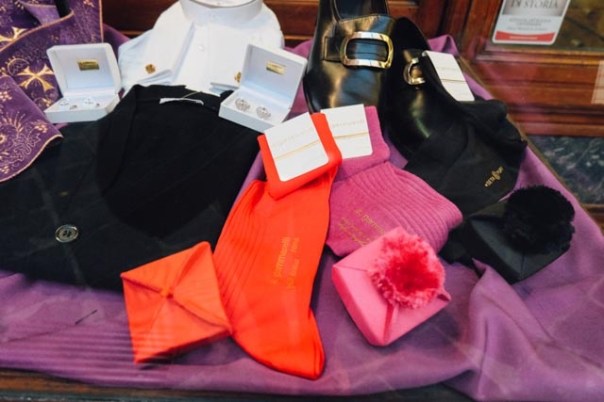
The whole reason that you would want to visit the Pope’s tailor is so you can get your hands on Pope socks.
The actual socks that the Pope actually wears. (Bishops and Cardinals, too, no doubt).
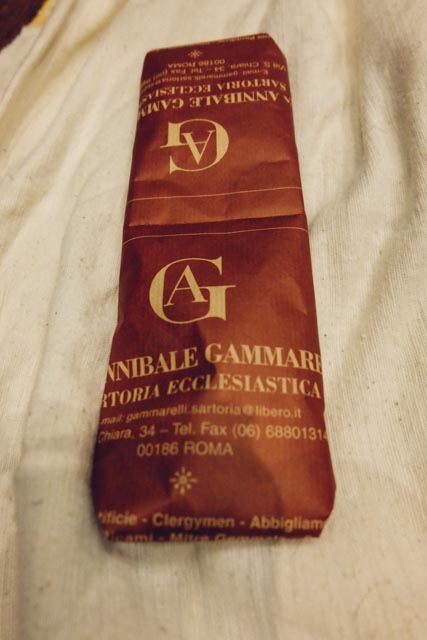
Pope socks make an excellent Christmas present or unique Roman souvenir. (Or at least that is what I told my father-in-law when I gave him a pair over the holidays last year).
At €12 (approx A$19) a pop, you get a great story and some excellent quality socks.
HOW MUCH DOES IT COST TO GET OUTFITTED AS A CARDINAL?

On the eve of the next consistory, the six new cardinals may be finding that those red hats don’t come cheap.
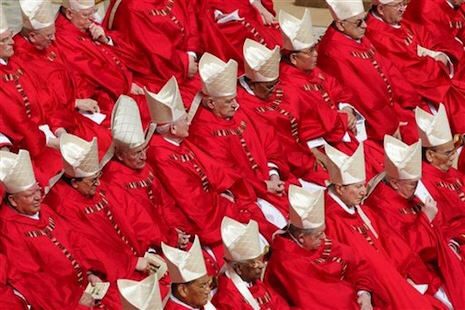
On Saturday Benedict XVI will create six new cardinals, just nine months after last February’s consistory. Addressing the Synod’s bishops, the Pope explained the reasons for this “informed” choice of new cardinals, none of whom are European: this is a way for the Church to show its true universality after the batch of cardinals created during the last consistory, who were mainly Curia members or Italian.
The new cardinals are: James Harvey, the American head of the Papal Household; His Beatitude Bechara Boutros Raï, patriarch of the Maronite Church in Lebanon; His Beatitude Baselios Cleemis Thottunkal, head of the Syro-Mankar Church in India; Archbishop John Olorunfemi Onaiyekan of Abuja; Archbishop Rubén Salazar Gómez of Bogota, Colombia and Archbishop Luis Antonio Tagle of Manila in the Philippines.
Even though there are only six of them, Rome’s ecclesiastical tailors started work immediately on the vestments for the Church’s newly elected “princes”. When a bishop is created a cardinal, they stop wearing the violet coloured garments they donned previously and replace these with red coloured ones. Tailors prepare a list of all the garments and accessories cardinals will need. Those who wish to make a gift to a cardinal can consult this list.
Here are the current prices for items prepared by Rome’s most renowned tailor, Gammarelli, which has traditionally been the Pope’s tailor:
*The red mozzetta which cardinals wear with their choral vestments, costs about 200 Euro (A$319). but the price goes up if one chooses cord buttons – which are hand made and more sought after (they cost 20 Euro (A$32) each) – instead of cloth buttons.
*The red cassock costs approximately 800 Euro (A$1,274),
*while the three-cornered hat without a bow, which is typical for cardinals, can cost between 80 (A$127) and 120 Euro (A$191).
*The red and golden cord for the pectoral cross costs around 80 Euro (A$127): the price varies according to how elegant it is and the size of the bow on the back.
*The red fascia which is worn with the red cassock and the black cassock with red piping, costs about 200 Euro (A$319).
*A black cassock with red piping costs approximately 600 Euro (A$955),
*while the cardinal’s red zucchetto is priced at around 40 Euro (A$64).
*Finally, the red socks cost about 15 Euro (A$24) for a pair.
Given that cardinals usually purchase two sets of each of these outfits, they can expect to spend around four to five thousand Euro(A$6371-7964) to complete their wardrobe. The cardinal’s ring is a gift from the Pope.
FROM LIPSTICK-RED LOAFERS TO PONTIFF BLING RINGS; THE MOST FASCINATING PAPAL FASHION CHOICES
On Wednesday, Catholic cardinals in Vatican City ended their 2013 search for the Next Top Catholic by electing Jorge Mario Bergoglio from Argentina as the world’s 266th pope. Bergoglio, who will go by Francis, greeted his following while wearing traditional white vestments, an austere crucifix, and understated glasses on the balcony of St. Peter’s Basilica—a sartorial tabula rasa for the vintage accessories and bold-colored papal attire that may be to come. Because, as tradition-bound as the Catholic Church is, its leaders have historically exhibited a daring sense of style over their 2,000 years in the high office. (What other men outside the rap community can get away with red slippers, fur-trimmed caplets, ruby bling, white skullcaps, and engraved chalices?) In anticipation of Pope Francis defining his personal papal style, we look back at some of the highlights in pontiff fashion—the jaunty headware, flamboyant footwear, and designer eyewear that have separated the Carrie Bradshaws of Catholic leaders (Benedict XVI) from the Mirandas (John Paul II).
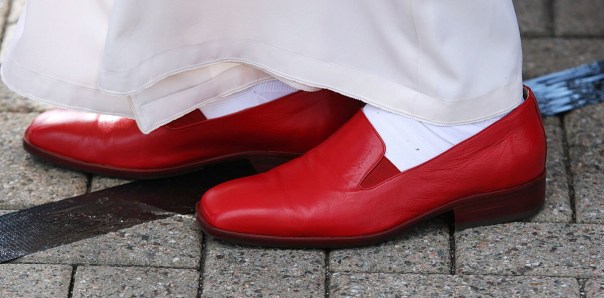
Red Papal Loafers: Pope Benedict XVI’s decision to incorporate these vintage papal accessories into his daily ensemble~ was so popular that Esquire named him “Accessorizer of the Year” in 2007. Following widespread reports that Pope Benedict’s footwear was Prada, Vatican officials felt the need to clarify that the pope was not a designer-clotheshorse with statements like “he wouldn’t know Gucci from Smoochi” and “[t]he pope, in summary, does not wear Prada, butChrist.”

Saturno, Fedora’s Cousin: While Popes Leo XII, John XXIII, John XIII, and John Paul II have all worn this style of wide-brimmed hat—named for Saturn’s rings, popular in summer, and often constructed from beaver hair or straw—no one looked quite as fly in the style as Benedict XVI. Here he is peacocking during a St. Peter’s Square audience.
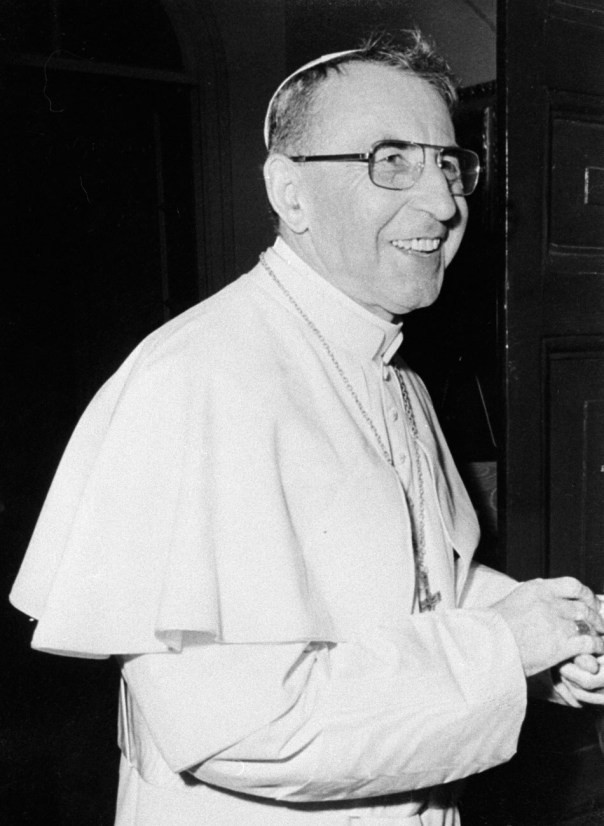
Metal-Rimmed “Shop Teacher” Glasses: With thin, rectangular metal frames, John Paul I’s “cheaters” communicated several important messages: “Go easy on the bandsaw” and “Someone clean up that linseed-oil spill.” Although Pope Francis appeared at his first audience wearing a similar style—with what appear to be transition lenses—he had already ditched the outdated eyewear by mass on Thursday morning after what we can only assume was a Vatican-mandated She’s All That–style makeover. For cooler shades, refer to Benedict XVI’s Serengeti sunglasses—a popular brand with Val Kilmer and Jack Nicholson.

Rainbow Vestments: In 1997, French designer Jean-Charles de Castelbajac managed to convince John Paul II and several thousand priests to wear multicolored vestments for a World Youth Day state visit—because the rainbow represented God’s promise of peace to Noah. When Castelbajac also suggested that his design symbolized homosexual liberation, the Vatican responded that no one had a copyright on the rainbow—or, apparently, clever retorts on colorful fashion statements.

The Mozzetta: Of the five versions of the mozzetta—in essence, an elbow-length cape—worn by the pope, the most glam is the winter version, which is red velvet and lined with white ermine fur. (In a pinch, it could also be used as a Christmas-tree skirt.) While the mozzetta has been depicted in portraits of the pope since at least the 14th century, John Paul II—who, preferring cleaner lines, was the Calvin Klein of Catholic leaders—buried it in the back of the papal closet before you-know-who (Benedict XVI) revived the style.

The Camauro (Matching-Accessory Alert!): What better to pair with that red-velvet, white-ermine-fur-trimmed cape than a matching cap? The hat has been part of the papal wardrobe since the 12th century, when it was apparently much more in vogue. Benedict XVI once tried to pull off this look during a 2005 St. Peter’s Square appearance. When he received criticism from both the fashion and eyesight-capable communities—he was cruelly called “Santa Pope” and narrowly avoided appearing in *Us Weekly’*s “What Not to Wear” column—the pope made like a million excuses for the hat and vowed never to wear it again. “I was just cold, and I happen to have a sensitive head,” he was quoted as saying. “And I said, since the camauro is there [in the closet], let’s put it on. But I was really just trying to fight off the cold.” Sure, sure.
Papal Bling Rings: The most famous papal finger jewelry is the “Ring of the Fisherman,” which traditionally shows St. Peter (a fisherman) casting his net. A new ring is cast in gold for each pope and, in the past, was extravagantly destroyed in Thor-like fashion with a silver hammer at the end of his term. (Recognizing that this seems extreme, the Church now just scratches a cross-shaped mark into the ring.) Pope Pius IX, apparently the Paris Hilton of pontiffs, eschewed tradition by reportedly wearing a cameo of himself constructed almost entirely out of tiny diamonds. While it is rare for popes to wear self-portrait signets, it is not uncommon for popes to wear additional ecclesiastical rings set with stones—more ornate depending on the fashion of the era—and pectoral crosses affixed with diamonds, rubies, and sapphires.

The Papal Tiara: The most regal of the papal accessories, the pontiff’s ornamental headpiece seems less like a tiara and more like an extravagantly bejeweled conehead. The three-tiered style (“triregnum”) has many symbolic interpretations and for centuries was most famously exhibited during the traditionally six-hour-long coronation ceremonies. Because they are usually constructed from silver and enriched with, on some occasions, hundreds of jewels, the elaborate neck-straining devices can weigh upwards of 10 pounds. In somewhat fitting tiara trivia, the heaviest papal headpiece was provided by Napoleon, supposed inferiority-complex sufferer, who gifted Pope Pius VII an 18-pound crown. As an added bonus, the triregnum can be melted down for ransom money in emergency situations and used as an easy conversation starter in literally every situation imaginable. (Unlike the camauro, which Benedict XVI discovered the hard way. Learn from his mistake, Francis!).
PAPAL ACCESSORIES
MANTUM

The mantum or papal mantle differs little from an ordinary cope except that it is somewhat longer, and is fastened in the front by an elaborate morse. In earlier centuries it was red in colour; red, at the time being the papal color rather than white. In the eleventh and twelfth centuries the immantatio, or bestowal of the mantum on the newly elected pope, was regarded as specially symbolical of investiture with papal authority: Investio te de papatu romano ut praesis urbi et orbi, “I invest thee with the Roman papacy, that thou rule over the city and the world” were the words used in conferring it at the Papal Coronation. The use of the mantum by the popes ceased under Paul VI, following the reforms of Vatican II. This is the first of the traditional papal vestments restored by the current Pope, Benedict XVI. In the image above we see Pope Benedict XVI wearing the mantum. [Wikipedia]
CAPPELLO ROMANO

A cappello romano (literally Roman hat) or saturno (because it is reminiscent of the ringed planet Saturn) is a hat with a wide, circular brim and a rounded rim worn by Catholic clergy. It is made of either beaver fur or felt, and lined in white silk. Unlike many other articles of ecclesiastical attire, it serves no ceremonial purpose, being primarily a practical item, worn in private life. The pope wears a red cappello with gold cords. Cardinals formerly also had the privilege of wearing a red cappello, but this rule was overturned by Paul VI, and now Cardinals’ cappelli are black, as are those of all other clerics. [Wikipedia]
CAMAURO
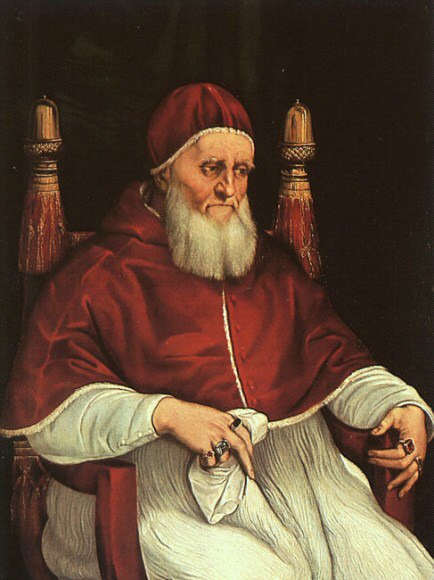
In the image above we see Pope Julius II. This is another tradition restored by Benedict XVI. Papal camauros are of red wool or velvet with white ermine trim and are worn, usually in winter, in place of the zucchetto, which in turn takes the place of the biretta worn by other members of the clergy. Like the biretta (priest’s hat) worn by lower clergy and the mortarboard worn by academics, the camauro derives from the academic cap (the pileus), originally worn to protect tonsured clerical heads from the cold. It is often worn with a shoulder winter cloak (mozzetta), also sometimes fur-lined. The papal camauro fell into disuse after the death of Pope John XXIII in 19
PAPAL SLIPPERS

The Papal Slippers are a historical vestment of the Roman Catholic Church traditionally worn by the pope. They are a form of episcopal sandals worn by early bishops. Red in color to symbolize the blood of the martyrs, the slippers altogether symbolized the submission of the pope to the ultimate authority of Jesus Christ. Pope Paul VI discontinued their use in favor of the outdoor red papal shoes. Pope Benedict XVI has chosen to wear the red papal shoes, similar to those worn by Paul VI. [Wikpedia]
FANON

In the photo above we see Pope John XXIII wearing the fanon. The fanon consists of a doubled shoulder-cape (somewhat like a mozzetta) of white silk ornamented with narrow woven golden stripes, so that the colors alternate white and gold. The pope wears it only when celebrating a solemn Pontifical Mass, that is, only when all the pontifical vestments are used. The manner of putting on the fanon recalls the method of assuming the amice universal in the Middle Ages and still observed by some of the older religious orders. [Wikipedia]
PALLIUM

The Pallium or Pall (derived from the Roman pallium or palla, a woollen cloak) is an ecclesiastical vestment in the Roman Catholic Church, originally peculiar to the Pope, but for many centuries bestowed by him on metropolitans and primates as a symbol of the jurisdiction. The modern pallium is a circular band about two inches wide, worn about the neck, breast and shoulders. It has two pendants, one hanging down in front and one behind, which are about two inches wide and twelve inches long, and are weighted with small pieces of lead covered with black silk. The remainder of the pallium is made of white wool, part of which is supplied by two lambs presented annually as a tax by the Lateran Canons Regular. [Wikipedia]
SEDIA GESTATORIA

The sedia gestatoria is the portable throne on which Popes were once carried. It consists of a richly-adorned, silk-covered armchair, fastened on a suppedaneum, on each side of which are two gilded rings; through these rings pass the long rods with which twelve footmen (palafrenieri), in red uniforms, carry the throne on their shoulders. The Sedia gestatoria is an elaborate variation on the sedan chair. Two large fans (flabella) made of white ostrich feathers—a relic of the ancient liturgical use of the flabellum, mentioned in the Constitutiones Apostolicae, VIII, 12—are carried at either side of the sedia gestatoria. In the picture above, we see Pope Pius XII on the throne. [Wikipedia]
PAPAL CROSS

Above we see Pope Saint Sylvester I carrying the traditional Papal cross. The practice of Popes carrying a Crosier (shepherd’s crook) was gradually phased out and had disappeared by the time of Innocent III’s papacy in the eleventh century. In the Middle Ages, popes would carry a three-barred cross (one more bar than on those carried before archbishops), in the same manner as other bishops carried a crosier. This was in turn phased out, but Paul VI introduced the modern papal pastoral staff, which instead of the triple cross depicts a modern rendition of the crucified Christ, whose arms are fixed to a crossbar that is curved somewhat in the manner of an Eastern crozier. [Wikipedia]
RING OF THE FISHERMAN

Above we see Pope Saint Sylvester I carrying the traditional Papal cross. The practice of Popes carrying a Crosier (shepherd’s crook) was gradually phased out and had disappeared by the time of Innocent III’s papacy in the eleventh century. In the Middle Ages, popes would carry a three-barred cross (one more bar than on those carried before archbishops), in the same manner as other bishops carried a crosier. This was in turn phased out, but Paul VI introduced the modern papal pastoral staff, which instead of the triple cross depicts a modern rendition of the crucified Christ, whose arms are fixed to a crossbar that is curved somewhat in the manner of an Eastern crozier. [Wikipedia]
TIARA
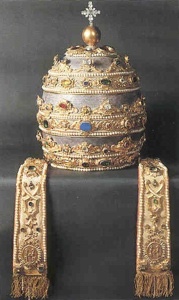
The Papal Tiara (Triregnum) is the three-tiered jewelled papal crown, supposedly of Byzantine and Persian origin, that is a prominent symbol of the papacy. The Supreme Pontiff’s arms have featured a “tiara” since ancient times, notably in combination with Saint Peter’s crossed keys. Though not currently worn as part of papal regalia (though still permissible), the continuing symbolism of the papal tiara is reflected in its use on the flag and coats of arms of the Holy See and the Vatican. Although often referred to as the Papal Tiara, historically there have been many, and twenty-two remain in existence. [Wikipedia]
THE EPISCOPAL OR PONTIFICAL GLOVES
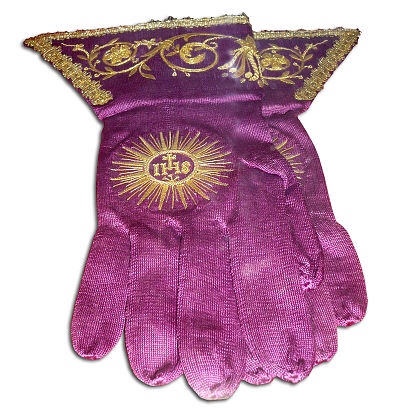
(chirothecœ, called also at an earlier date manicœ, wanti) are a Roman Catholic pontifical vestment worn a by bishop when celebrating Solemn Pontifical Mass. They are worn from the beginning of the Mass until the offertory, when they are removed, they can be elaborately embroidered and generally match the liturgical color of the Mass. They are not worn for Good Friday or Requiem Masses. While normally reserved for bishops, other prelates entitled to use pontificals, including abbots, may also use them without a special papal privilege. The gloves are considered symbolic of purity, the performance of good works and carefulness in procedure. The Caeremoniale Episcoporum, as revised in 1984, omits all mention of episcopal gloves, they are very rarely seen today except in celebrations of the 1962 form of the Roman Rite or yet earlier forms by some traditionalist Catholics. Anglo-Catholic and Old Catholic bishops also sometimes make use of the Episcopal gloves.[citation needed] Episcopal gloves are used only at a Pontifical Mass, and then only up to the washing of the hands before the Eucharistic Sacrifice. In the pre-Vatican II rite of consecration of a bishop, the consecrator, aided by the assisting bishops, put the gloves on the new bishop just after the blessing. As of 1909, Episcopal gloves are knitted by machine or hand-woven from silk thread. They are normally ornamented on the back with a cross; the border of the opening for the hand is also, as a rule, embellished; the colour of the gloves must correspond with the liturgical colour of the feast or day in the services of which they are worn; episcopal gloves, however, are never black, as they are not used on Good Friday nor at a Requiem. The use of episcopal gloves became customary in Rome probably in the tenth century, outside of Rome they were employed somewhat earlier. Apparently they were first used in France, as the earliest traces of the custom are found in this country, whence it gradually spread into all other parts and eventually to Rome; the chief reason for the introduction of the usage was probably the desire to provide a suitable adornment for the hands of the bishop, rather than practical considerations such as the preservation of the cleanliness of the hands etc. Episcopal gloves appertained originally to bishops, but at an early date their use was also granted to other ecclesiastics, thus no later than 1070 the abbot of the monastery of San Pietro in Cielo d’Oro at Pavia received this privilege, the first certain instance of such permission. In the Middle Ages these gloves were either knitted or otherwise produced with the needle, or else they were made of woven material sewed together; the former way seems to have been the more usual. Gloves made by both methods are still in existence, as for example, in Saint-Sernin at Toulouse, at Brignoles, in S. Trinità at Florence, in the cathedrals of Halberstadt and Brixen, in New College at Oxford, Conflens in Savoy and other places. In the later Middle Ages it became customary to enlarge the lower end, giving it the appearance of a cuff or gauntlet, and even to form the cuff with a long joint which hung downwards and was decorated with a tassel or little bell; the back of the glove was always ornamented, sometimes with an embroidered medallion or some other form of needlework, sometimes with a metal disk having on it a representation of the Lamb of God, a cross, the Right Hand of God, Saints etc., the disk being sewn on to the glove, or, at times, the ornamentation was of pearls and precious stones. The gloves were generally made of silk thread or woven fabric, rarely of woollen thread, sometimes of linen woven material. Up to the end of the Middle Ages the usual colour was white, although the gloves at New College, Oxford, are red; apparently it was not until the sixteenth century that the ordinances as to liturgical colours were applied to episcopal gloves. Even in the Middle Ages the occasions on which the gloves were worn were not many, but their use was not so limited as later, for in the earlier period they were occasionally worn at the pontifical Mass after Communion, at solemn offices and during processions.
PECTORAL CROSS OR PECTORALE

Pectoral of Pope Paul VI
(from the Latin pectoralis, “of the chest”) is a cross that is worn on the chest, usually suspended from the neck by a cord or chain. In ancient and medieval times pectoral crosses were worn by both clergy and laity, but by the end of the Middle Ages the pectoral cross came to be a special indicator of position worn by bishops. In the Catholic Church, the wearing of a pectoral cross remains restricted to popes, cardinals, bishops and abbots.[1] The modern pectoral cross is relatively large, and is different from the small crosses worn on necklaces by many Christians. Most pectoral crosses are made of precious metals (platinum, gold or silver) and some contain precious or semi-precious gems. Some contain a corpus like a crucifix while others use stylized designs and religious symbols.
THE DALMATIC

Is a long, wide-sleeved tunic, which serves as a liturgical vestment in the Catholic, Lutheran, Anglican, United Methodist, and some other churches. When used, it is the proper vestment of a deacon at Mass or other services. Although infrequent, it may also be worn by bishops above the alb and below the chasuble, and is then referred to as pontifical dalmatic.
Like the chasuble worn by priests and bishops, it is an outer vestment and is supposed to match the liturgical colour of the day. The dalmatic is often made of the same material and decoration as a chasuble, so as to form a matching pair. Traditional Solemn Mass vestment sets include matching chasuble, dalmatic, and tunicle.
A dalmatic is also worn by the British monarch during the Coronation service.
THE EPISCOPAL SANDALS

Also known as the pontifical sandals, are a Roman Catholic pontifical vestment worn by bishops when celebrating liturgical functions according to the pre–Vatican II rubrics, for example a Tridentine Solemn Pontifical Mass.
In shape, the episcopal sandals more closely resemble a pair of loafers than actual sandals. The liturgical stockings (caligae) are worn over the episcopal sandals and cover the episcopal sandals and the ankle. The episcopal sandals and liturgical stockings usually match the liturgical color of the Mass. However, when black vestments are worn, the pontifical footwear is not used.
After the Second Vatican Council, the episcopal sandals fell out of common use following the revisions of the liturgy resulting in the Mass of Paul VI, which is now known as the Ordinary Form of the Roman Rite. While still permitted for use in the Ordinary Form of the Mass, they are rarely used in that context. Today, the use of the episcopal sandals is primarily seen in those celebrating the Tridentine Mass.
The episcopal sandals should not be confused with the velvet papal shoes, which were recently reinstated by Pope Benedict XVI. The papal shoes evolved as the outdoor counterpart of the papal slippers, which are similar to the episcopal sandals, except that the papal slippers are worn by the Pope outside liturgical functions and are always red.
THE MITRE

(British English) (/ˈmaɪtər/; Greek: μίτρα, “headband” or “turban”) or miter (American English; see spelling differences), is a type of headgear now known as the traditional, ceremonial head-dress of bishops and certain abbots in traditional Christianity. Mitres are worn in the Orthodox Church, Roman Catholic Church, as well as in the Anglican Communion, some Lutheran churches, and also bishops and certain other clergy in the Eastern Catholic Churches and the Oriental Orthodox Churches. The Metropolitan of the Malankara Mar Thoma Syrian Church also wears a mitre during important ceremonies such as the Episcopal Consecration.
Three types of mitres are worn by Roman Catholic clergy for different occasions:
• The simplex (‘simple’, referring to the materials used) is made of undecorated white linen or silk and its white lappets traditionally end in red fringes. It is worn most notably at funerals, Lenten time, on Good Friday and by concelebrant bishops at a Mass. Cardinals in the presence of the Pope wear a mitre of white linen damask.
• The auriphrygiata is of plain gold cloth or white silk with gold, silver or coloured embroidered bands; when seen today it is usually worn by bishops when they preside at the celebration of the sacraments.
• The pretiosa (‘precious’) is decorated with precious stones and gold and worn on the principal Mass on the most solemn Sundays (except in Lent) and feast days. This type of mitre is rarely decorated with precious stones today, and the designs have become more varied, simple and original, often merely being in the liturgical colour of the day.
The proper colour of a mitre is always white, although in liturgical usage white also includes vestments made from gold and silver fabrics. The embroidered bands and other ornaments which adorn a mitre and the lappets may be of other colours and often are. Although coloured mitres are sometimes sold and worn at present, this is probably due to the maker’s or wearer’s lack of awareness of liturgical tradition.[dubious – discuss]
On all occasions, an altar server may wear a shawl-like veil, called a vimpa, around the shoulders when holding the bishop’s mitre.
FASHION: THE POPE WEARS PRADA
He may never make the best-dressed lists, but Pope Benedict XVI is nothing short of a religious-fashion icon, riding in the Popemobile with red Prada loafers under his cassock and Gucci shades. But his penchant for designer wear and a move to ditch the papal tailors who have dressed popes for more than 200 years are causing new wrinkles in the Vatican.
Benedict has favored his tailor from his days as cardinal, Alessandro Cattaneo, and the 20-year-old religious-fashion house of Raniero Mancinelli, which has provided the pope with dazzling new vestments (some with shimmering, sequinlike details). At risk of losing the papal-dress contract are the Annibale Gammarelli tailors, who have made papal wear since 1792. But they blundered when Benedict had to make his debut blessing in a cassock that was too short, ending just above his ankles. Subsequent celebratory vestments made by Gammarelli are reported to have made the pope uncomfortable.
The Vatican won’t comment on papal attire, and Gammarelli denies it is getting the ax: “We are still in contact with the Holy Father. Perhaps there was only an occasional gift by some friend of the pontiff,” the tailor says.
THE POPE’S NEW (BESPOKE) SHOES
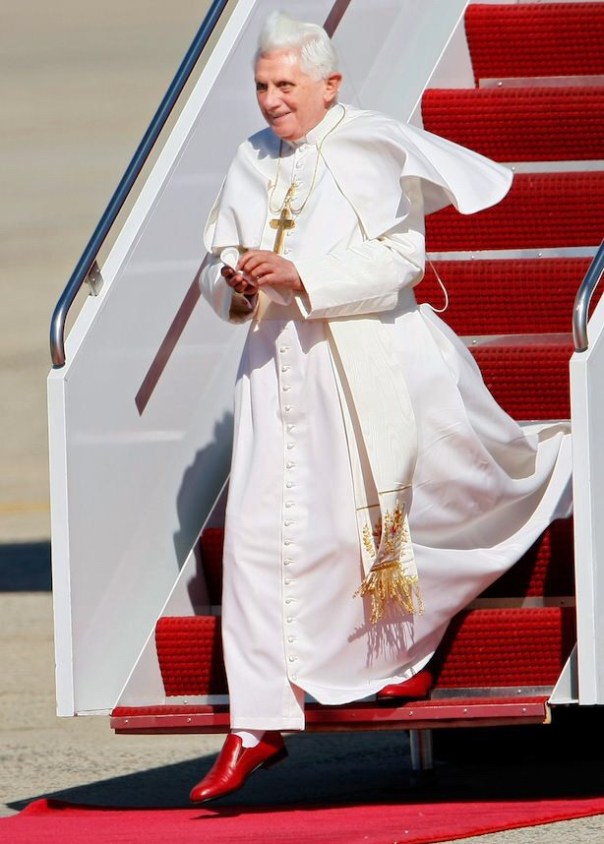
Say what you will about Pope Benedict XVI, but the man knows his loafers: hand-made, size 42 (8.5, American), and a bright cardinal red, which adds serious panache to a guy who otherwise < target=”_blank”>resembles the emperor from Star Wars. The slippers became his signature look — so much so that we named him the accessorizer of the year in 2007. But now that he’s stepping down and becoming an “emeritus pope,” he’s sadly letting them go.
As most personal papal possessions do — like Benedict’s Serengeti sunglasses, iPod Nano, and a leather-upholstered golf cart (and bulletproof popemobile) — the red shoes came as a gift. When the Pope first donned the shoes, rumors spread that they were Prada, but that turned out not to be the case. In 2005, Adriano Stefanelli, a Roman with a three-generation shoemaking lineage, hand-delivered a pair to Benedict in St. Peter’s Square. Stefanelli, who quickly became Benedict’s cobbler, had given a different style of shoe to John Paul II in 2002, but, as he explains, Benedict chose a ruby red instead of John Paul’s oxblood shade. (Most pontiffs have had unique shoe style — often picking between a cross, golden insignia, or buckles, by way of adornment.)
But as he departs the Vatican, officials say Benedict wil keep the cassock, but leave the reds behind. Apparently he plans to slip into a pair obtained during a trip to Leon, Mexico. Artisanal, of course.
THE POPE DOESN’T WEAR PRADA: VATICAN NEWSPAPER

Pope Benedict wears his Saturno sun hat as he arrives to lead a weekly general audience at the Vatican June 25, 2008. REUTERS/Chris Helgren
ROME (Reuters) – After years of speculation that Pope Benedict wears shoes by Prada, the Vatican’s official newspaper denied such talk as “frivolous”.
Esquire magazine last year named the 81-year-old pontiff “accessorizer of the year” for his red leather loafers that fashionistas had said were probably made by the Italian fashion house.
While the Vatican had never confirmed or denied if the shoes were Prada, continued chatter about the pope’s dress sense led the Vatican daily Osservatore Romano to print a condemnation of media stories it said trivialized the head of the church.
Esquire’s inclusion of the pope on its best-dressed men list was, it said, “of a frivolity that is very characteristic of an era that tends to trivialize and does not understand”.
The article explained that the pope’s shoes, like his range of flamboyant hats, are nothing to do with vanity but all to do with tradition. “The pope, in summary, does not wear Prada, but Christ,” it said.
The article did not say who did make the shoes.
Benedict’s choice of garments has often been striking. On recent drives through St. Peter’s Square he shaded himself from the fierce June sun under a wide-rimmed bright red hat known as a “Saturn” after the planet with the rings.
Around Christmas 2005 he delighted pilgrims by appearing in a red velvet cap trimmed with white fur which, together with a scarlet cape, gave him the look of Santa Claus.
The Osservatore noted that both hats, far from being fashion items, are in fact traditional papal accessories that have been worn at various points in history by previous popes.
THE FABLE OF BENEDICT’S RED SHOES
In 1948 the British masters Powell and Pressburger made a film called The Red Shoes. Moira Shearer played a ballerina whose dream is to perform on stage. She gets her wish, playing in a new production wearing special shoes. They take her places she has never been and always wanted to go.
But she cannot take them off, and is trapped in an unending cycle of dance. Her one hope of escape from this growing nightmare is to take off the red shoes, but can she?
It is a modern fable, based on a story by Hans Christian Andersen. In the original a vain, spoilt girl tricks her adoptive mother into buying a pair of red shoes. She shows them off in church and other places, only to find that the shoes take over. They dance her everywhere. She is cursed by an angel and forced to wear them forever.
Even when her feet are amputated the shoes keep showing up and dancing before her eyes. Only after repeated efforts to seek forgiveness, to be humbled, is the girl finally forgiven.
The Red Shoes would, for obvious reasons, come to my mind during the last pontificate. It’s hard to trace the rumour that Benedict XVI’s shoes were designed by Prada. Perhaps it was just a mischievous allusion to The Devil Wears Prada, but nothing so vulgar! The Pope’s shoes were actually made by a local Vatican shoemaker out the back of Borgo Pio and one thing you had to say about them, they were not the shoes of a fisherman.
Whatever Benedict had in mind when he donned his gay apparel will go with him to the grave, but one reason seems to be a message that popes are unique. Because John Paul II wore brown Polish loafers, and no one paid much mind to his predecessors’ footwear, Benedict’s stepping out caused a sensation. Sydney went seismic.
Popes in previous centuries wore red shoes, hence Benedict’s harking back to an age of papal prestige. He would know that in Byzantium only three people were allowed to wear red shoes: the Emperor, the Empress, and the Pope. They are symbols of imperial power, in keeping with the opulent dress sense exhibited by monarchs. Even on a normal day, Queen Elizabeth II is still the best-dressed person in the room. Power treads the boards.
Benedict is a wily fox, which is why we can be sure his red shoes were there to invite symbolic interpretations. Only thing is, red shoes have a life of their own. They take the wearer where he would not go. He has always wanted total control, but it’s the red shoes that control him.
The only way this giddy madness can stop is by taking them off, which Benedict did on 11 February when he announced his resignation. The cardinals stared at one another in disbelief. They were living in a fable.
Benedict’s close theological friend Rowan Williams teaches a theology of letting go of control. ‘For the Spirit to be free in us, our expectations of possession and understanding and control need to go,’ he says. ‘Our expectations of being in charge have to go, and any experience whether grievous or joyful that begins to break our hold of control, any such experience is the beginning of an opening to the Holy Spirit.’
Letting go of control lets the Spirit in, and something new happens. This is what seems to be happening now that Benedict has taken off the red shoes. Almost anything could happen, and it won’t be easy for anyone.
Williams wears sensible black shoes. When Archbishop of Canterbury he rarely wore a purple shirt, but plain black, itself a break with tradition. To wear black was an example to others about not showing off. It was about sharing the humility of a servant and was of a piece with his reintroduction after 400 years of the practice of the Archbishop himself washing the feet of 12 others at Maundy Thursday services in Canterbury Cathedral.
At foot washing, participants remove socks, whether designer, off-the-rack, or holey, and shoes, black, red, whatever. The iridescent vanities of their life no longer dance before their eyes in perpetual torment; they have been put aside. Each person is on the same level as everybody else. They have let go of control. What now?
VATICAN TAILOR’S, COBBLERS TRY TO ADAPT TO FRANCIS’S “PAPAL ATHLEISURE”

(Credit: Claire Giangravè.)
ROME – An exclusive group of tailors and cobblers who cater to the Vatican are slowly adapting to Pope Francis’s penchant for simple and plain clothing, which has inspired a demand for more practical and comfortable frocks from clergy around the world.
The Argentinian pope’s call for a Church that is dynamic and “on the move” has translated into a preference for religious clothing reflecting that zeal, and is no longer constrained by heavy fabrics and embellishments.
“Maybe once we were a bit excessive, and now slowly…” said Raniero Mancinelli, who has been a tailor for the clergy and popes for decades, in an interview with Crux.
Popes through history have always been fashion trendsetters, since they exercise influence over a vast community and their choice of jewelry and clothing often says a lot about the mission and message of the pontificate.
The past three “foreign popes,” meaning not from Italy, took a unique approach to classic papal style, and, sharing an astute grasp of the media, have left us with iconic images that will last for the ages.
No one could rock a cape like Pope John Paul II, and pictures showing his red mantle billowing in the wind, or gently wrapped around children, have left a lasting impression on Christian and secular culture. Emeritus Pope Benedict XVI, a European, dusted off the classic papal staples and ushered them into the new millennium with his unique sense of style.
Francis’s preference for ‘papal athleisure,’ meanwhile, has already begun to leave its mark on history.
In 2013, the magazine Esquire, which focuses mostly on male fashion, named Pope Francis ‘The Best Dressed Man of the Year.’ The choice was obviously controversial, and the magazine explained it by saying that the pope’s style has “signaled a new era (and for many, renewed hope) for the Catholic Church.”
Adapting to Pope Francis’s style
In a small shop on the Borgo Pio, a picturesque street next door to the Vatican, Raniero Mancinelli slices away at fabric on the counter, scarlet and black scraps falling to the ground with every cut of his scissors.
Over his head, etched in wood is his name and the date the shop was opened: 1962. Mancinelli has been in the business of dressing popes for a long time, and therefore has had a front-row seat to the changes that occurred in religious garb from the Second Vatican Council (1962-1965) to this day.
“It’s not as if before the clothes were more luxurious or pricey, maybe a bit more flashy and rich with details,” Mancinelli said. “Today this has changed a bit. Now with Pope Francis’s direction, people want things that are much lighter, simpler and more sober…. and consequently less expensive.”
As an example, the veteran tailor said that the cross usually worn by bishops and cardinals used to be adorned with gems and gold plating.
“Now these are more popular,” he said pointing to plain crosses made of metal and wood. A quick look at the tags shows a significant difference in price.
Asked if this pope is not very good for his business, Mancinelli laughed.
“Yes… a bit,” he said, because the demand has diminished and the clothes are less costly. “A double loss, in a sense.
“It’s not a question of agreeing. One accepts this manner he has of doing things in a simpler fashion,” Mancinelli said.
But the tailor is not saddened by the change, though he admits that, to him, religious clothing has become a little plain.
“Maybe too plain compared to how they were before,” he added.
Mancinelli started his business just as the Church underwent a profound revolution. He was there when Pope Paul VI eliminated the train that cardinals used to wear, which could be up to seven meters long.
He spoke of a time when “a crease could not be ignored,” while today anything is acceptable. Pope Francis’s torn-up sleeve as he returned from a visit to the beach town of Ostia, for instance, took over the Internet in 2013.
“His vestment is very simple, he has had it for a long time,” Mancinelli said, adding that white is a very sensitive color and, by being in close contact with so many people, is susceptible to being ruined.
“I don’t exclude the possibility that in the evening he just puts it to wash, and wears it again the next morning,” he sighed.
Pope Francis also chose to have a smaller sash that is not made of silk, and breaking with tradition he refused to have his emblem etched on it.
“He’s not picky,” Mancinelli said. “I wanted to make him a new pair of trousers. His are black, and I wanted to make lighter pants to wear under the cassock. ‘No,’ he said. ‘These are fine.’
“In everything, the pope has chosen simplicity,” he said. “Things that are not expensive.”
Mancinelli admits that having grown up in a different time, he has a preference for things that are well-fitted and precise, but he also recognizes that “if the pope decided to take this position, it means that there is a reason.
“Maybe now we can concentrate more on the will of God instead of men,” he added.
The two main things to keep in mind when working for the pope, he said, are discretion and adaptability.
“The first day can be a bit shocking,” Mancinelli said, since you have to get used to a different taste and aesthetic, but after a few days he says, “you learn the differences.”
Mancinelli had a good relationship with Pope Benedict XVI. He “used vestments that were a bit more beautiful, let’s say, in the sense that they were more beautiful to look at,” he said.
Now, clergy from around the world ask Mancinelli for Pope Francis-inspired cassocks, ready for the daily wear and tear. But this new style has its advantages when it comes to time consumption.
“Once we only used silk, today the fabrics are simpler. I am making clothes for some cardinals,” Mancinelli added pointing to the scarlet scraps that littered the floor. “The fabric is very simple, made of wool and light [material].”
Silk takes much more time to sow, and the simpler fabrics mean less time to make the clothes, he said.
Pope Francis “is more focused on being a good father, a good shepherd, rather than having a beautiful cassock or pants, or even shoes,” Mancinelli said. “I wish I could live many more years, so I can see what happens next!”
The Case Of The Red Shoes
Any Italian will tell you that one key to a good look is a fine pair of shoes. Footwear is not taken lightly in the Bel Paese, and a poor choice is guaranteed to provoke criticism and directions to some cousin who can fix you up.
Pope Benedict XVI knew the importance of a good pair of shoes, and his custom-made red slippers became a trademark of his style and even earned him the title of ‘Best Accessorizer of the Year’ by Esquire magazine in 2007.
Gossip ran wild with who might be the maker of the ruby-colored papal slippers, with some claiming that they were made by the Italian fashion powerhouse Prada. But in 2005 the rumors were finally put to rest when the a cobbler from a small town in northern Italy presented Pope Benedict XVI with the shoes for all the world to see during a general audience at St. Peter’s Square.
“Dressed in white with that red shoe… it really catches the eye!” Adriano Stefanelli, a cobbler and the creator of the famous slippers, told Crux in a phone interview.
“When it comes to clothes and such things he is a very, very elegant person,” Stefanelli said about the emeritus pope, adding proudly that “the peak of his splendor” took place when he first wore the red shoes.

Italian cobbler Adriano Stefanelli presents Pope Benedict XVI with his custom made red shoes at the Vatican. (Credit: Adriano Stefanelli.)
Stefanelli prepared six shoes in total for the German pope throughout his pontificate. He was commissioned by the Vatican for the first time in late 2013, but the high-ranking client was not satisfied with the order. Stefanelli had made the shoes in claret, the color preferred by the now-saint John Paul II, but the demand was clear: They had to be red.
“During his pontificate I received requests from all over the world for the same slipper, some wanted it red, others black,” Stefanelli said, citing among the buyers the former president of the United States, George Bush, for whom he made an identical pair in black.
The cobbler from Novara defines Pope Francis’s style as “rustic simplicity,” and places him as the “polar opposite of Pope Benedict” in terms of fashion.
“Pope Francis represents humility. Very plain clothing and a simple cross,” Stefanelli said.
“… He doesn’t wear the red shoes.”
Pope Francis opted for the services of his cobbler in Buenos Aires, Carlos Samaria, after he was elected. Speaking to the Italian daily La Stampa, Samaria said that the pope insisted that there be “no red shoes, black as always.”
And again, speaking to his niece Maria Ines, the pope said: “See that I am not wearing the red shoes?”
Stefanelli denies being hurt by the pope choosing not to wear his flamboyant slippers.
“Every man has his style,” he said.
He began his career as a papal cobbler by gifting a pair of shoes to Pope John Paul II, who preferred them to be dark brown and was so pleased with them that he became a regular client.
“Pope Wojtyla is kind of similar to Pope Francis. Maybe Pope Wojtyla was slightly more refined, while Pope Francis views clothing and style in a very humble way,” Stefanelli added.
When asked if he would be happy to make red shoes for Pope Francis, should he ask, Stefanelli said “Gladly. But I have my doubts.”
THE HIDDEN MEANING BEHIND SOME OF THE POPES CLOTHES
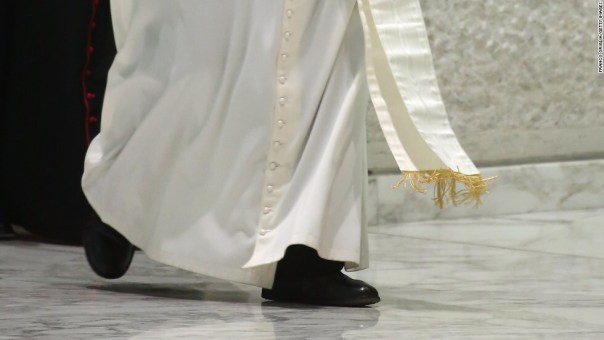
Here, Pope Francis wears a cassock. The cassock, also called a soutane, can be worn by all clerics, Beck said, but the papal one is white. According to Beck, legend has it that Pope Pius V was used to wearing a white religious habit and he wanted to keep the tradition going. “And so ever since,” Beck said, “it has remained white.”

The mantum is a long cape that popes sometimes wear as a sign of their authority, Beck said. It’s a vestment that fell out of use, but was revived by Benedict XVI, seen here. The mitre, Beck said, is a cone-like head dress worn by all bishops as a sign of their episcopacy. “Abbots can also wear it,” Beck said. “It is not unique to the pope, but it replaced the tiara on the Papal Coat of Arms with Benedict, and now Francis.”
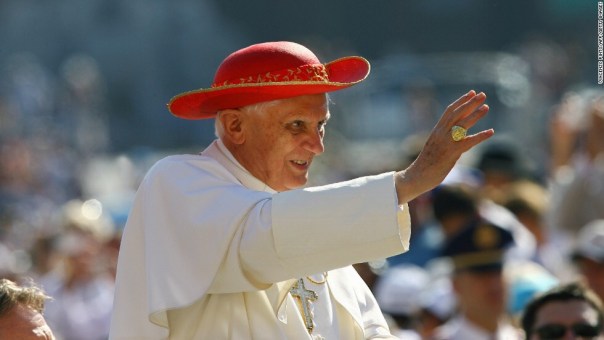
Pope Benedict XVI, seen here wearing a saturno, blesses the faithful in St. Peter’s Square at the Vatican, in 2006. The saturno is a wide-brimmed red hat that gets its name from its resemblance to the planet Saturn and its rings, Beck said. “It has been used as the summer alternative to the winter camauro, ” he said, but unlike the winter hat, it’s not not unique to the pope.

The zucchetto is a skullcap worn by clerics in the Roman Catholic Church and some other churches, Beck said. Priests wear black zucchettos and prelates wear violet or red, while white is reserved for the pope.

Rowan Williams, the archbishop of Canterbury, left, greets Pope Benedict XVI at his official residence, Lambeth Palace, in central London in September 2010. Here, Benedict XVI wears a mozzetta, a cape worn by the pope and some other religious leaders. “The winter one matches the camauro because it is also red velvet or wool and adorned with ermine,” Beck said. “This was also brought back by Benedict XVI after having fallen into disuse. There’s also a white summer version.”

Pope Benedict XVI is seen here wearing the pallium, a woolen cloak with five or six crosses. It’s worn only by the pope and archbishops as a sign of their unity to the pope, Beck said. “It is made from the wool of lambs raised by monks and woven by nuns. It is rich in symbolism, as the pope, who is shepherd, literally carries the ‘sheep’ on his shoulders, especially the lost ones,” Beck said.

Pope Benedict XVI wears a green chasuble in October, 2012. A chasuble is a liturgical vestment worn by all priests, including the pope, when saying mass, Beck said. There are a few liturgical seasons in the church, he said, each of which is associated with a color of chasuble. Green is the color worn most Sundays, known as “ordinary time,” essentially, not during Advent, Lent or Easter.
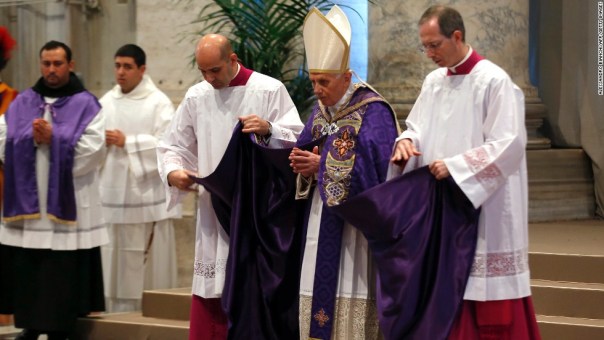
Pope Benedict XVI arrives to lead the mass for Ash Wednesday, on February 13, 2013. He wore this purple chasuble to open Lent, the 40-day period of abstinence and deprivation for the Christians, before the Holy Week and Easter. Purple is worn during the seasons of Advent and Lent.

The rose-colored chasuble is only used for two Sundays of the liturgical calendar, Beck said: Gaudete Sunday, which is the third Sunday of Advent, and Laetare Sunday, the fourth Sunday of Lent. “During both seasons,” Beck said, “the color diverges from the traditional purple as a sign that both seasons are nearing and end and rejoicing is close at hand.”

It may be hard to tell at first glance, but not all popes dress exactly alike: there are different articles of clothing for different traditions and seasons. And sometimes a pope will inject their own personal style. Pope Francis, for example, prefers a simple iron cross and plain black shoes that are notably more understated than the red pair favored by his predecessor. We spoke with Father Edward Beck, a CNN contributor and Roman Catholic priest of the Passionist order, to find out more about the pope’s wardrobe.
CLOTHES AND THE MAN: HOW POPES COMMUNICATE THROUGH CLOTHING

Satin capes. Leather shoes. Embroidered stoles. Ermine trim. Gold rings. What sounds like a list of extravagant accessories from a fashion magazine inspired much discussion during the recent papal transition. Naturally, news reports and expert analysis focused on the historic nature of Benedict XVI’s resignation and the election of a pope of firsts—first Jesuit, first Francis, first from the Americas. Woven into the media’s narratives, a parallel narrative unfolded as fabric, thread and robes provided a visual account of a church in transition. Even now, more than two months after Pope Francis’ election, the news media follows the pope’s every move to see what he will “say” next through his actions and appearance. Francis has already established himself as a pope of images and dress has proven to be an important part of his vocabulary.
The richly symbolic garments of Catholic prelates have always been infused with meaning. They speak a language that is theological, historical and structural. A “vestimentary code”—everything from the ermine-trimmed mozetta of the pope to the simple brown habit of Franciscan friars—contributes to a sort of “Catholic dialect” of clothing that communicates within the church itself and to the world at large. Shortly after the election of Pope Francis, Matt Malone, S.J., wrote a piece for America placing the attention to clothing in the context of a “sacramental worldview,” where symbols, and particularly material symbols, matter. He also reminds us that proper Catholic sartorial protocol has been meticulously legislated.
Yet, transitional times often see the challenging and relaxing of past norms, and the establishment of new ones. Clothing participates in conversations about the past and the future. It is not just that clothing matters, but who wears what and when, stitching together a grammar of transition.
The unprecedented circumstances of Pope Benedict’s abdication required new definitions. Unlike the previous two popes who resigned, Benedict was neither coerced by a council nor locked up by his successor. Though he has vowed to remain hidden to the world, he will continue to occupy a position that has not been occupied before. The Vatican spokesperson, Federico Lombardi, S.J., was dogged with questions about new definitions: What would Benedict be called? Where would he live? And what would he wear? At a press conference two days before Benedict’s resignation, Lombardi announced that the pope emeritus would continue to wear the white cassock and skullcap, but without the sash and elbow-length cape known as a mozzetta. The media also made much of Benedict’s decision to put aside his famous red shoes for brown leather loafers made in Leon, Mexico.
For a church with a long history, including a history of rival claimants to the papacy, setting careful precedents was important. The dress of the pope emeritus establishes his identity and relationship to his previous office and to his successor. The white cassock recognizes the place Benedict held in the succession of St. Peter—reverting to the black cassock or the scarlet accessories of cardinals would have been a disrespectful demotion. The absence of the mozzetta carefully distinguishes him from Francis, and from others exercising episcopal authority. Benedict’s removal of the white sash, or fascia—reserved for the reigning pope—signals that he is no longer functioning as part of the church hierarchy. Putting aside red shoes reserves the privileged combination of white and red for the new pope.
Rome’s Tailor
Moving from the clothing of the former pope to those of the future pope, the media became fascinated with Gammarelli’s, the Roman tailor shop charged with making the ensemble for the new pope’s first appearance. A Roman tradition when it comes to papal elections, the display of the papal outfit in three sizes—ready for any size pope!—served almost as a pre-conclave chimney. When the cassocks disappeared from the window, it meant the conclave was ready to begin. The empty garments invited speculation in the days between their unveiling and their disappearance. Which one would be filled and by whom? All three would enter the Vatican, but, as with the cardinals themselves, only one would remain.
Speculation abounded about which cardinals were papabili, and the international media became fascinated by some of the American cardinals. Among these was Boston Archbishop Cardinal Sean O’Malley, a Franciscan, who for a period participated in daily press briefings. Appearing dressed in his brown Franciscan habit, O’Malley was asked if he would swap his current garb for the papal white. O’Malley laughed away the sartorial question, joking that he planned no wardrobe change because he did not expect to be elected. One wonders what the Capuchin would have done if elected. When appointed cardinal in 2006, he made it clear that he would continue to wear his habit, and he joked about the vibrant red he was expected to wear, a stark contrast to his usual earthy brown. The question posed to O’Malley about his choice of clothing, though tongue in cheek, revealed the kind of speculation that accompanied this transition. He was a non-traditional candidate with a shot—not Italian, not European, not even a native Romance language speaker. To many he represented an appealing “alternative pope” and his eschewing of the traditional papal wardrobe, or at least speculation about it, revealed the hopes of some that someone like him, a candidate elected from a religious order, would introduce a new kind of papal leadership. Though O’Malley himself didn’t “expect a change of wardrobe,” in hindsight we know that this kind of speculation was not without merit.
In some more unusual moments, unauthorized clothing was used by some to challenge or disrupt the election process. Photos of a man who posed as a bishop and nearly made his way into the early pre-conclave proceedings circulated on the internet. His clothing temporarily aided him, but ultimately betrayed him. Ralph Napierski (who also went by the name Basilius) claimed to be a legitimately ordained Catholic bishop in the line of the late Archbishop Pierre Martin Ngo Dinh Thuc and head of the otherwise unknown order “Corpus Dei.” (He also has a blog called “JesusYoga.org”). Dressed in a black cassock with a fedora, sash and pectoral cross, Napierski was able to pass through Vatican security and even took pictures with some of the cardinals. But he was ejected when a close look at his clothing gave him away—his cassock was too short and his sash was actually just a scarf. In another incident, Italian police detained Janice Sevre-Duszynska who came to St. Peter’s Square dressed in a white alb and stole carrying a sign that read “Women priests are here.” Even the lack of clothing acted as a voice of protest when a group of topless women protested in the Piazza calling for women’s ordination.
Francis Speaks
From his first appearance, Pope Francis has communicated his vision of the Petrine ministry through a visual code of sartorial choices. When he first appeared on the balcony of St. Peter’s Basilica, what he was wearing—and in this case, what he was not wearing—spoke volumes before he even said his now famous “Buona sera!” That Francis chose not to wear the red mozzetta with white ermine trim and the gold embroidered papal stole—a tradition since at least the time of Pope Pius XI’s election in 1922 went unnoticed to most, but to those who understood the language of ecclesiastical garments, this was a shout. Moreover, instead of the gold pectoral cross, Francis emerged wearing the silver cross he had worn as bishop of Buenos Aires. He donned the stole for the papal blessing, then promptly removed it. Like his choice of the name of Francis, the new pope was sending several messages, not all of them immediately clear.
Even St. Francis spoke volumes through clothing. In his youth, he shocked his family and his bishop by stripping naked before them, casting aside his extravagant clothing in a public act of self-dedication to a life of poverty. Pope Francis’ act might be seen in a similar light, as a kind of Franciscan disrobing. Yet there is an ambiguity in the language of dress. Some understood the pope’s choices as indicative of the simplicity and austerity of his namesake, a vestimentary expression of a church that he proclaimed would embrace the poor. Others, however, have seen it as an assault on pre-Vatican II tradition and a renunciation of the efforts of Benedict XVI to advocate a hermeneutic of continuity for understanding the council. Benedict masterfully employed a vestimentary language in service of this vision, reintroducing luxurious papal vestments that had fallen out of use as an expression of the majesty and honor of the Supreme Pontiff. Even in the days following Francis’ election, we learned more about his wardrobe choices. No red shoes, no ornate liturgical vestments and simple mitres. A comparison of Francis’ and Benedict’s vesture at the 2013 and 2012 Easter Urbi et Orbi addresses accentuates the differences.
As a scholar of early Christianity, what brought my attention to all this recent talk about clothing is a current project of mine on the representation of clothing in early Christian literature and art. One piece of clothing in particular, the philosopher’s robe, sparked debate in the early church—was it appropriate apparel for the Christian? Some, like Justin Martyr and Tertullian, found it to be the perfect garment for the Christian sage, while others, like Pope Damasus, condemned it as the garb of the faithless. Meanwhile, images of Jesus and the apostles dressed in the robe decorated churches from west to east. This ancient debate over dress was expressed in words and images, typifying the doctrinal and cultural issues facing the young church. In the current period of transition and expectation, clothing still plays a significant role in the fabric of Catholic Christian life. From mere curiosity to ecclesial vision, papal garments in particular will continue to be observed and decoded for indications of how and where Pope Francis will lead the church.
POPE FRANCIS’ SIMPLE STYLE STATEMENT

The pope eschews many of the rich trappings of his predecessors.
Pope Francis’ personal style is as humble and simple as that of his predecessor, Benedict XVI, was traditional and rich.
Unlike his predecessors, the current pope prefers austere white cassocks to the red velvet “mozzetta,” a short hooded cape trimmed with ermine. Gone, too, are the traditional gold crosses — he wears the same iron model he has donned since his anointment as auxiliary bishop of Buenos Aires in 1992.
He also recycled a ring, known as the Ring of the Fisherman, which was not created specifically for him. According to media reports, the ring “was in the possession of Archbishop Macchi, Pope Paul VI’s personal secretary.” This is a historical departure since traditionally a new ring is cast for each pope. Pope Benedict XVI’s ring was made of gold while Francis’ is made of gold-plated silver.
Pope Benedict was also known to favor red shoes, often by Prada, but Pope Francis only wears sensible black leather shoes, understood to be made by a friend, Carlos Samaria, in Buenos Aires. His basic black watch with a white dial, reportedly a Swatch priced at around $56, has no particular functions. According to one report, when the strap broke, it took some convincing to buy a new one as Francis simply wanted to replace the strap. He agreed to the purchase only when he was assured that a new watch would not have cost more than the strap.
Similarly, Francis in September changed the lenses of his old simple frames, refusing to buy new ones. His visit to the optician in Central Rome made the news, as he was photographed checking out the lenses in the tiny store owned by Alessandro Spiezia.
Francis’ tailor Lorenzo Gammarelli is also in Rome, a sixth generation of papal tailors, near the Pantheon. According to the Web site “Il Mio Papa [My Pope],” Francis “wears exactly the same outfits” throughout the year: Cassocks in heavier, warmer woolen cloth during the winter and lighter woolen fabrics during the summer. “He wants only natural white, not optical, which is obtained only with a dye. Natural wool is cream ivory,” according to the site. Reflecting Francis’ lack of attention to appearance, one photograph earlier this year created a stir as it showed a frayed sleeve. He also wears a simple white wool scarf with fringes and a white wool double-breasted coat, with peak lapels and eight buttons, of which four are decorative.
A further sign that he shuns excess is that his sash does not feature a coat of arms.
Under the sober cassock, Francis wears a shirt, a sweater and pants. In spring time, he wears the “pellegrina,” which is a short mantel open on the front, sewn on the robe, always white.
He shaves more than once a day — even three times — out of respect for those whom he embraces on his visits. His electric shaver is one of the few possessions he carries in his vintage leather briefcase when traveling — and even boarding planes, as seen in photographs circulating in the media. The briefcase is non-branded and has bellows pockets.
“It’s normal. We must be normal…It’s strange that this photo has traveled around the world. We must get used to being normal. It’s the normality of life,” Francis said of the sensation created by the image.
SWISS GUARD MAKE A FASHION STATEMENT WITH DEBUT OF NEW HELMETS
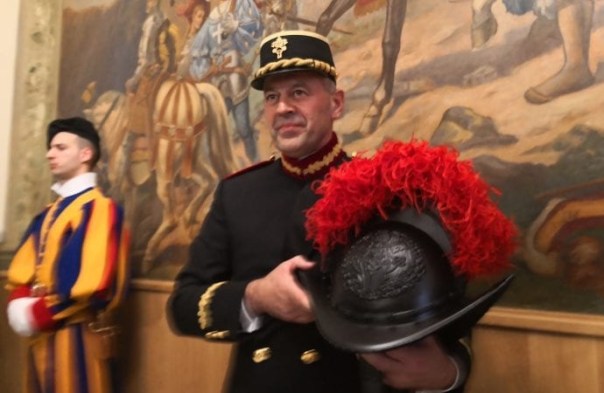
Commander Christoph Graf, of the Vatican’s Swiss Guards. (Credit: Inés San Martín.)
ROME – Just as New York readies to host the biggest night of the fashion world’s annual calendar tomorrow night at the Met Gala, this time with a Catholic theme, back in Rome the Swiss Guard made a fashion statement of its own on Friday.
Perhaps the world’s smallest army, and certainly one of its most celebrated, the Guard debuted an early look Friday at a much lighter version of their traditional cast iron helmets, which are being produced in PVC with the aid of 3D printing technology.
Designed mostly to resemble the old helmets, the new version nonetheless does sport another distinctive touch: The coat of arms of Pope Julius II, who instituted the army in 1506. They should be ready for use sometime in 2019.
Hence the stylish new helmets won’t be worn today for the Swiss Guard’s annual swearing-in ceremony, in which 33 new members will swear to “faithfully, loyally and honorably serve the supreme pontiff,” in a ceremony that, despite the absence of the pope, is usually one of Rome’s hottest tickets during the month of May.
It always takes place on the same day, May 6, on the anniversary of the sack of Rome in 1527. On that date, 147 soldiers died protecting Pope Clement VII.
The ceremony is one of pomp and circumstance. The entire army, close to 110 men on Sunday, will be in full dress uniform, accompanied in the Vatican’s St. Damaso Courtyard by religious personalities and political and military representatives of Switzerland, a country Francis will visit later this year.
The new helmets were presented on Friday in Rome during a press event ahead of Sunday’s ceremony.

The new helmet of the Swiss Guards, the pope’s personal army. Made of PVC, they’re made using 3D printing technology. (Credit: Inés San Martín.)
According to Commander Christoph Graf, the helmets have been purchased through what might be considered an informal crowdfunding campaign, led by layman Peter Portmann, introduced on Friday as a “friend of the Swiss Guards.”
The new helmets come at a price of roughly $1,000, half of what the older ones cost.
Portmann was the man behind the idea of printing this mostly ceremonial element of the uniform, as it’s been some time since a Swiss Guard actually wore one into battle. Together with his friends, he’s paying for the production.
Among the many benefits of the new helmets, which will be used when the pope welcomes a head of state, or an ambassador presenting their credential letters, is the fact that it weighs far less than those cast in iron, which guard members say would overheat during Rome’s summer days and sometimes burn their heads.
Who are the Swiss Guards?
The contingent of highly trained guards was born of an alliance between the Swiss and the Holy Roman empire, and they’ve been protecting the pontiff for more than 500 years.
To be eligible for the job, which pays $1,800 a month courtesy of the pope, one has to be male, Catholic, single, a Swiss citizen, aged between 19 and 30, at least 5’8″, and willing to be a member of the guard for at least two years.
If you run into the Swiss Guards at the Vatican, either guarding the doors or during the pope’s public events in St. Peter’s Basilica and/or Square, don’t let their colored uniforms in shades of blue, red, orange and yellow reminiscent of the Renaissance fool you: All of them have received basic Swiss military training, and are prepared in unarmed combat and small arms.
When it comes to what Graf looks for in new recruits, he said a key thing is their ability to be a part of the group. Since the guards live and work together in very small quarters, being able to get along is central.
Hence, he said, “many forge friendships that last a lifetime.”
Graf said that also fundamental in the life of the guards is their faith, even if “because of the situation in Switzerland,” not all recruits are Mass-going Catholics.
“If we only accepted guards who go to Mass every Sunday, who receive the sacraments regularly, the army wouldn’t exist anymore,” he said.
Therefore, for him, evangelizing is part of his mission: “We need to give the young men the possibility of growing in their faith. I believe that with the closeness to the Holy Father, those who have an open heart are able to discover the faith.”
“It’s part of our job, as officials, to be witness, not to be afraid to talk about our faith, something that is no longer done in Switzerland,” Graf said.
Nicolas Albert, 19, is one of the new recruits who on Sunday will swear to give his life for the pope if necessary. He told Crux that ever since he was a child he “dreamed” of becoming one of the guards with “a shiny armor.”
Eventually the dream was forgotten, but in his junior year of high school, a friend invited him to apply together, reviving that childhood passion. He joined the Swiss army and was eventually admitted to be one of the pope’s private soldiers.
“There’s also a spiritual motivation behind my joining the army, and that’s broadening my faith,” Albert s
Safety concerns, due to terrorism and the pope’s “Latin ways”
Asked about an increased security regarding the constant threats of terrorist attacks in Europe, Graf first said that he didn’t want to talk about it, because “I know what you [journalists] will write.”
However, he acknowledged it’s evident in the area surrounding the Vatican what the Italian government does to guarantee the safety of tourists and pilgrims. Though he didn’t specify, in recent years the presence of military vehicles along with large cement plant-pots blocking access to Via della Conciliazione, the famous avenue that leads to St. Peter’s Square have been obvious.
“We can say that the guards are more attentive,” he said. “I see that 10 or 15 years ago, the Swiss Guards were more at ease, but the situation has unfortunately changed in recent years.”
Despite their training, the men guarding the pope don’t have heavy artillery, tanks or planes.
“What we have is faith, hope and charity,” Graf said, listing the three theological virtues. “We cannot always speak of guns, but also about other ways to defeat war, such as faith and prayer.”
Asked about Pope Francis’s proclivity to go out of his way to greet as many pilgrims as he can wherever he goes, Graf said that at the beginning, they weren’t necessarily ready.
“We, who come from northern countries, found it to be something new. But when you think about it, it’s normal that he wants to hug a person,” he said. “After five years, we’ve gotten used to it.”

THE TRUTH BEHIND THE POPE’S RUBY RED SLIPPERS

If the clothes make the man, then the shoes make the Pope – and more specifically, his ruby red shoes. The scarlet slippers have been reincarnated for thousands of years for his Holiness, and each pair has a story to tell…

But before we delve into the Vatican’s shoe closet, we might note that the Pope usually has two kinds of red shoes: indoor “liturgical slippers” made of silk and gold brocade, and an outdoor, loafer-like pair that is often plain red.
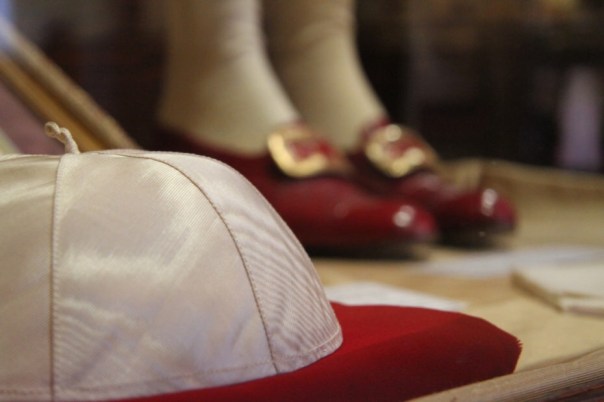
The shoes’ origins go back to Byzantine days, when they were donned by Norman kings as symbols of bloody martyrdom. Their successors, the Roman Emperors, stuck with it – in fact, they became a standard high-fashion accessory for aristocrats. If your shoes were red, you were a somebody.
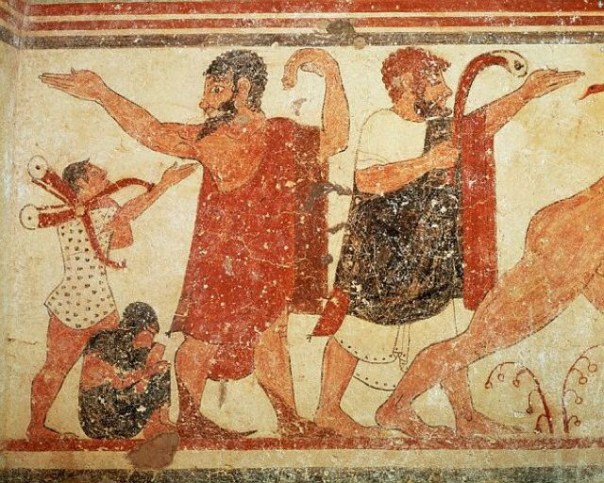
Now, historically speaking, Vatican life was pretty luxurious. Pope Martin IV spent a fortune to import his favourite delicacies of melon, and eels boiled in wine. Pope Leo X had a pet white elephant named “Hanno.” Extravagance was standard, and not even the Pope’s shoes escaped it. They became more and more ornate, and were even kissed by visitors just as one kisses the ring of the papa today…

Pope Pius X suffered from poor blood circulation, and was in a constant state of shaky health, so his sisters made him a pair of no-fuss, white slippers…

But he also had a red pair prioritising some seriously fluffy comfort.

The shoes also started their fare share of drama. In 1958, Pope John XXIII’s habit of adding golden buckles and crosses to the shoes was given the boot by his successor, Pope Paul VI, in 1969; he also did away with the papal foot kissing, and nixed the indoor slippers entirely. Although we’d sure like to hear him explain this lavish pair from his wardrobe:

As time went by, so did memories of more opulent shoes, with Pope John Paul II opting for a pair of more brownish loafers:
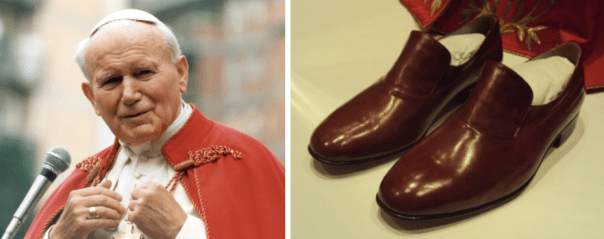
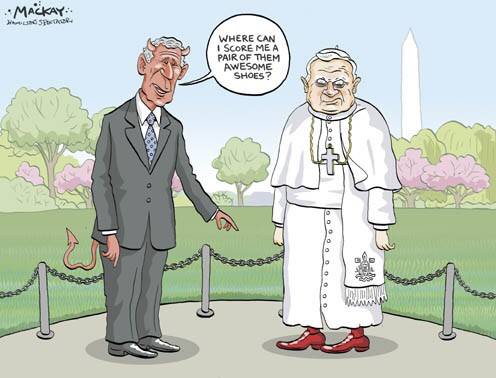
Fast-forward to 2005. Pope Benedict XVI comes on the scene with a pair of swanky, bright red slippers, and for many, their revitalisation is seen as an extension of his traditional, conservative positions within the church. Of all the popes, his may be the most fascinating relationship with the sacred slippers.


Rumour had it that his shoes were designer made, giving him the nickname “Pope Prada.” In 2007, Esquire went so far as to crown him “Accessorizer of the Year.” As it turns out, the shoes were made by Italian Adriano Stefanelli, whose other clients have included Barack Obama and Ferrari:

The media frenzy around the shoes was so nuts that a photo was (serendipitously) released of Stefanelli gifting the Pope his shoes in 2005:

Then, the unthinkable happened. In 2013, Benedict resigned — with lighting even string the Vatican moments after his announcement. “When Pope Benedict XVI left the Vatican and his papacy,” reported NPR, “he slipped out of his trademark red shoes and put on a pair of Mexican leather loafers. The shoes, actually three pairs, two burgundy and one brown, were a gift to the Pope during his trip last year to Mexico.” It was a symbolic departure from his habitual ways.

Today, we’re in the era of the less traditional Papa Francesco, who has gone back to basics with his sartorial tendencies. Instead of getting a new ring cast (as is typical practice), he chose a hand-me-down. He rides buses, and gives TED Talks. Oh, and his papal shoes? Plain black.

If you’re keen on getting pair of loafers by Stefanelli, they usually start at about €400, and are available for anyone to buy at his little shop in Novara, Italy. Though chances are, they probably won’t come with gilded buckles.
P.S. Is anyone else now itching to watch that Jude Law HBO show, “The Young Pope“?
BENEDICT XVI, THE BEST DRESSED POPE

Pope Benedict XVI, sporting a fur-trimmed hat in the rich red color of a Santa hat, waves to pilgrims upon his arrival in St. Peter’s Square at the Vatican. The red hat with white fur trimming is known in Italian as the “camauro.”(Alessandra Tarantino / Associated Press)
I’m a Catholic, but I’ll admit it (or should I say “confess” it?): When Pope Benedict XVI announced his pending resignation, my first thought wasn’t religious. It was in fact downright superficial. “There goes the best-dressed pontiff ever!”
During his nearly eight years on the throne of St. Peter, Benedict has always looked absolutely perfect, sartorially speaking, whether garbed in elaborate vestments for an Easter liturgy or clad in the simple but meticulously tailored white caped cassock (it’s called a “simar” in church lingo) that he wears on more ordinary occasions. He’s been the Duke of Windsor of popes.
My own fashion sense is nearly nonexistent, but that only makes me more appreciative of Benedict’s. Some highlights: Benedict saying Mass in 2008 at Washington’s Nationals Park stadium in a billowing scarlet satin chasuble (a priest’s outermost liturgical garment) trimmed with crimson velvet and delicate gold piping. Benedict greeting worshipers in Rome, his chasuble this time woven of emerald-green watered silk with a pattern of golden stars. Benedict on Oct. 21 canonizing Kateri Tekakwitha, the first Native American saint, while attired in a fanon, a gold-and-white striped shoulder covering, dating to the 8th century, that only popes may wear.


Benedict’s immediate predecessor, Pope John Paul II, was a saintly figure and a commanding intellectual presence, but he had little interest in clothes, tending to wear whatever was handed to him and shunning elaborate adornments. Pope Paul VI, who reigned from 1963 to 1978, started out dressing fancy, but he gradually simplified his attire, abandoning, for example, the papal tiara, the high triple crown that popes had worn since the early Middle Ages.
Benedict didn’t bring back the tiara, but he has revived many other traditional papal garments and accessories. For his public appearances he almost always wears the bright red shoes that popes have worn since Roman times (John Paul preferred brown or black footwear). Benedict also began wearing the mozzetta, a waist-length cape, and the camauro, a red velvet cap with a white fur border that reminded Americans of a Santa Claus hat. Neither of those items had been seen much on popes since the end of the Second Vatican Council in 1965.
Benedict’s sartorial revivals have offended many liberal Catholics, who argue that he has been trying to “turn back the clock,” as they often put it, on the churchly reforms of Vatican II. The cattiest critic was Hans Kung, the dissident German priest who had once been a colleague of Benedict, or Josef Ratzinger as he was then called, on the faculty of the University of Tubingen. In a 2008 op-ed article for the Italian newspaper La Stampa, Kung called Benedict’s style of dress “pompous” and compared him to Pope Leo X of the 16th century, notorious for selling indulgences and famously painted by Raphael in fur-trimmed mozzetta and camauro.
Others have used the phrases “over the top” and “major bling” to describe Benedict’s taste in vestments, deeming the pope a foppish aesthete. Still others, such as the gay blogger Andrew Sullivan, have speculated that Benedict is himself gay. Catholic conservatives counter that Benedict’s attire exemplifies a “hermeneutic of continuity,” a deliberate symbolic effort to link his 21st century papacy to centuries of Catholic tradition.
My own take on Benedict’s wardrobe is somewhat different. I don’t believe that aesthetics is mere window-dressing. In her 2005 book “The Substance of Style,” economics pundit Virginia Postrel wrote: “Aesthetics is the way we communicate through the senses…. Aesthetics shows rather than tells, delights rather than instructs. The effects are immediate, perceptual and emotional.” Plato argued that the beautiful, while not exactly the same as the good, is a kind of complement to the good that points to the good and shows off the good via sensory media.
That is what I believe is exactly Benedict’s aim. Over the last couple of decades, the Roman Catholic Church has been besmirched with ugliness, scarred by clerical sexual predation abetted by clueless and self-promoting bishops. Benedict has used beauty to demonstrate tangibly that the Catholic faith that he and the members of his church share is itself beautiful and indestructible, and that it shines through despite all human efforts to wreck it.
It is especially fitting for our time that the pope has chosen his own liturgical apparel as an aesthetic medium. In the world of what passes for sophisticated culture these days, beauty and art have become nearly unmoored from each other. Art is supposed to be transgressive, while beauty is judged merely ornamental. Paint a Madonna, and you’ve got calendar kitsch. Paint a Madonna, and add some elephant dung and pictures of female genitalia cut out from porn magazines, and you’ve got a work to be exhibited in an exclusive gallery. Only in the decorative and useful arts — jewelry, fabrics, home furnishings, clothing, the design of cars, machines, and even humble objects — are beauty and fine craftsmanship still the criteria by which we judge value.
Pope Benedict XVI has been the pope of aesthetics, the pope who plays Mozart on the piano for his own private entertainment and who can write theological books in such lucid, limpid prose that ordinary people can read them for pleasure. He has reminded a world that looks increasingly ugly and debased that there is such a thing as the beautiful — whether it’s embodied in a sonata or an altarpiece or an embroidered cope or the cut of a cassock — and that earthly beauty ultimately communicates a beauty that is beyond earthly things.
POPE FRANCIS SAYS IT’S “ABUSE” TO WEAR CRUCIFIX’S AS ACCESSORIES
Pope Francis has criticised those who wear crucifixes as fashion items, labelling it “abuse” in a recent speech.
Speaking at St Peter’s Square in the Vatican after a Sunday Angelus service, the 81-year-old said the religious symbol should be “contemplated and understood” rather than commercialised as a trendy accessory.
“The crucifix is not an ornamental object or a clothing accessory which is sometimes abused,” he said.
“The image of Jesus crucified reveals the mystery of the death of the Son as the supreme act of love, the source of life and salvation for humanity of all times.”
The Pope went on to explain how the cross should be perceived as more than just an aesthetic object, reminding listeners of its potent religious meaning by explaining what it means to him.
“How do I look at the crucifix?” he said, “like a work of art, to see if it’s beautiful or not beautiful?
“Or do I look inside, within the wounds of Jesus up to his heart?
“I look at the mystery of God annihilated to death, like a slave, like a criminal.
“Jesus wants to make it clear that his extreme affair – that is, the cross, death and resurrection – is an act of fruitfulness.
“His wounds have healed us – a fruitfulness that will bear fruit for many.”
Despite Pope Francis’ comments, the crucifix has been a popular sartorial staple for years, with the likes of Madonna, Jennifer Aniston and Naomi Campbell all sporting cross jewellery in the past, typically in the name of style rather than religion.
Madonna pictured wearing crucifix-inspired earrings (SWNS)
Controversies surrounding the growing trend came to a head in 2002, when Pope John Paul II was leader of the Catholic Church.
After noticing a rise in the crucifix’ sartorial popularity, the Vatican released a sternly-worded editorial via Fides, a charity organisation based in the Vatican, that denounced media personalities for wearing crosses as accessories, describing the trend as “the mania of the moment”.
However, just because Pope Francis disapproves of the crucifix being merchandised for sartorial gain does not mean that he’s opposed to self-expression via subversive trends.
Speaking to a group of young students in Rome on Monday, the Pope expressed his approval of tattoos, telling listeners: “Don’t be afraid of tattoos,” adding that Christians have been getting tattoos on their foreheads for centuries as markers of their allegiance to the faith.
“Of course, there can be exaggerations,” he added, “but a tattoo is a sign of belonging,” he said.
CARDINAL FASHION SHOW: THE DO’S AND DON’TS OF VATICAN WEAR THIS CONCLAVE SEASON (PHOTOS)
The Huffington Post casts a tongue-in-cheek observers eye over the 2013 conclave
The Good Book teaches us judge not, lest ye be judged. But we’re going to break that rule to pick apart the couture of 115 stylin’ high-ranking Catholic officials who’ve arrived in Rome to pick the next pope.
The 115 Roman Catholic cardinals filed into the Vatican Monday morning, readying themselves to judge the papabili — possible pontiffs — at the conclave opening tomorrow. We know they answer to a higher authority, but that didn’t stop HuffPost Weird News from filing into our New York offices to judge who’s hot and who’s not when it comes to holy attire.
Whose cassock had the best hem? Who wore the holiest hue of red? And who committed the Cardinal Sin of fashion?

DON’T
Cardinal Odilo Pedro Scherer, right, and compatriot Cardinal Geraldo Majella Agnelo wore matching outfits. They’re practically inseparable. That’s not a faux pas in itself — too bad they copied all the wrong fashions. Leave Alexander VIII’s fashion sense back in 1691, you guys.

DO
That’s the perfect sock for your cassock, Cardinal Bechara Boutros Rai. Comfortable and easy on the eyes yet it makes a bold statement at the same time.

DO
As you can see, Cardinal Gianfranco Ravasi is wearing the Jesus line of bling…
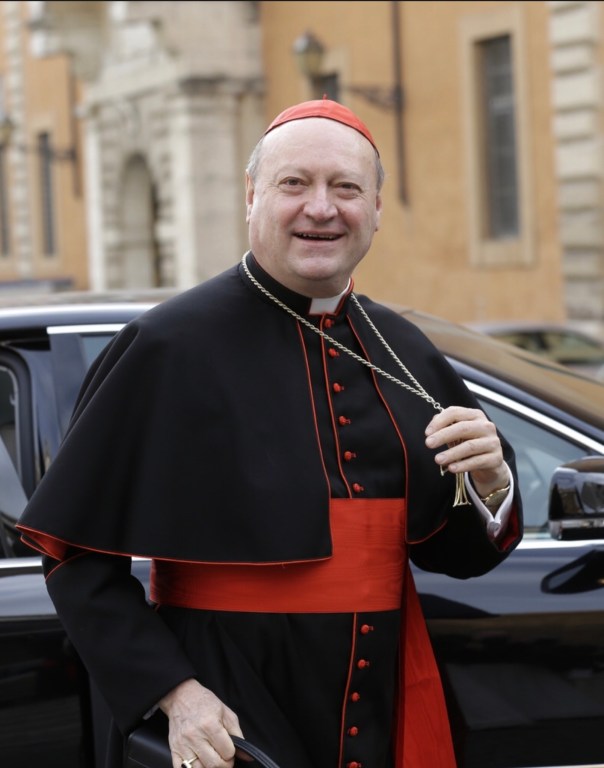
DO
… And he knows he’s lookin’ fly.
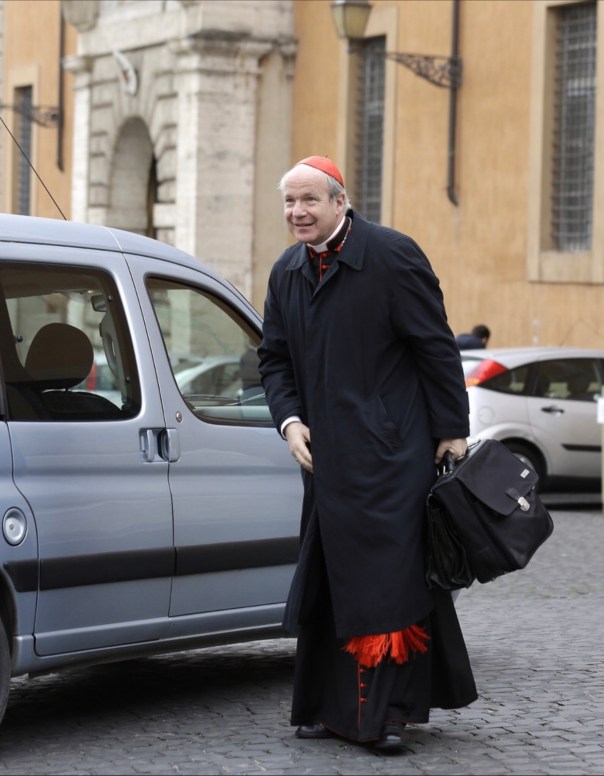
DON’T
We didn’t come all the way to the Vatican to fade away into obscurity. Rock that man-frock or bust, Cardinal Christoph Schoenborn.

DO
Ain’t nothin’ wrong with overindulging on the Blood of Christ before the pre-conclave party, Cardinal Marc Ouellet. Especially if you lookin’ good.
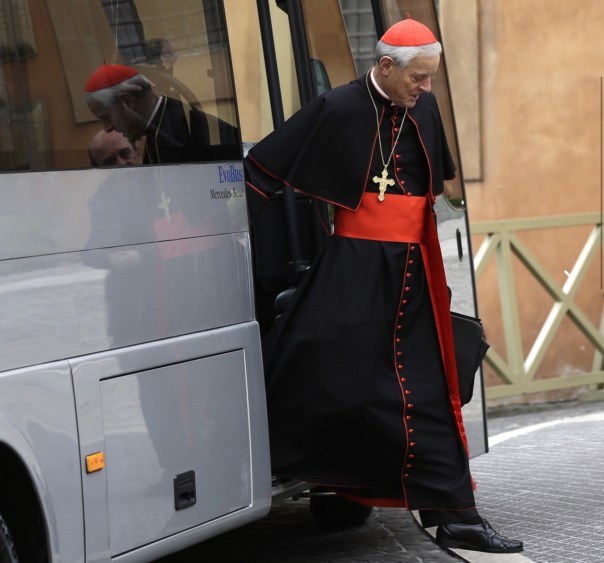
DO
Cardinal Donald Wuerl chose an interesting take on the classic cassock color scheme: black with a splash of red. Not too much, not too little. All class.
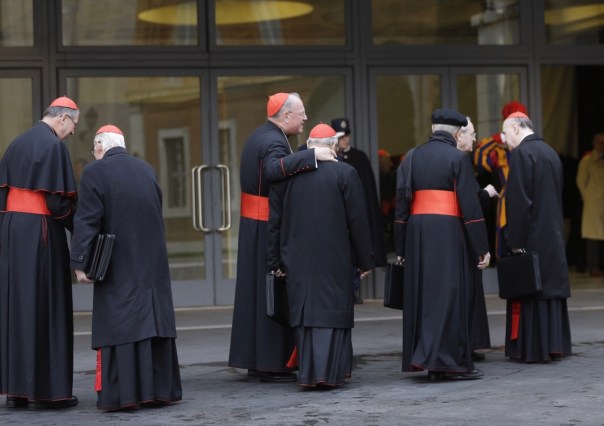
DON’T
Umm, guys… Let’s remember to coordinate next time, you’re all wearing the same thing. How embarrassing! Cardinal Sin, indeed.

DO
Cardinal Stanislaw Dziwisz’s new beanie is a power move, and is that an Alexander McQueen sash? We can’t tell.

DO
HAHAHAHAHAHA. Oh how we love you, Cardinal Reinhard Marx. You wouldn’t know the difference between a Balenciaga bag and a Gap purse, but we love you all the same. Just look at those dance moves!

DON’T
Ugh, the same cassock AGAIN, Cardinal Gianfranco Ravasi? But seriously, the dude in the back has swag. Yellow, blue and red pinstripes? Take note, Cardinal. Take note.
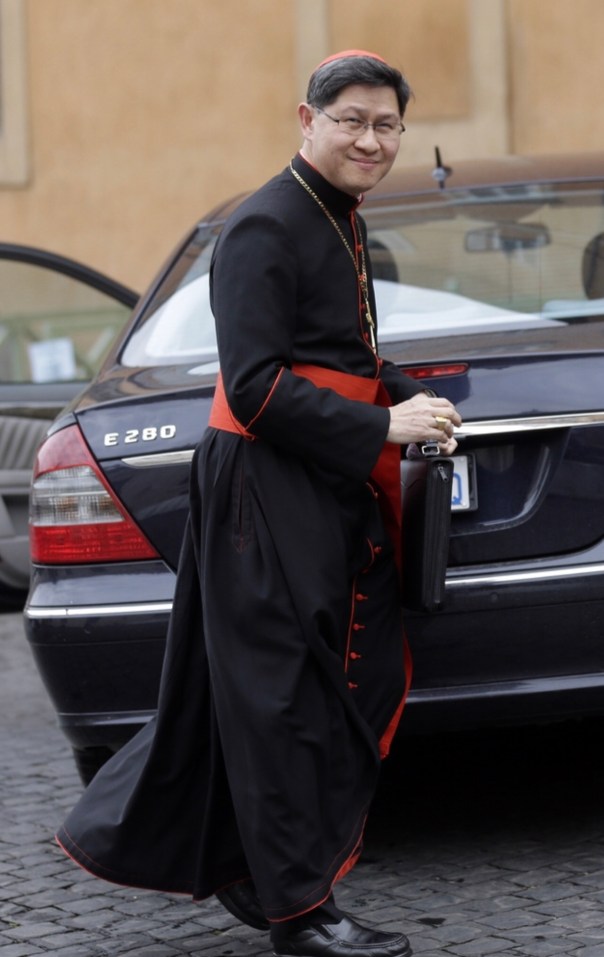
DO
Cardinal Luis Antonio Tagle knows how to be subtle with his cuts, but his colors? He’ll be standing out among the more conservative Cardinals.
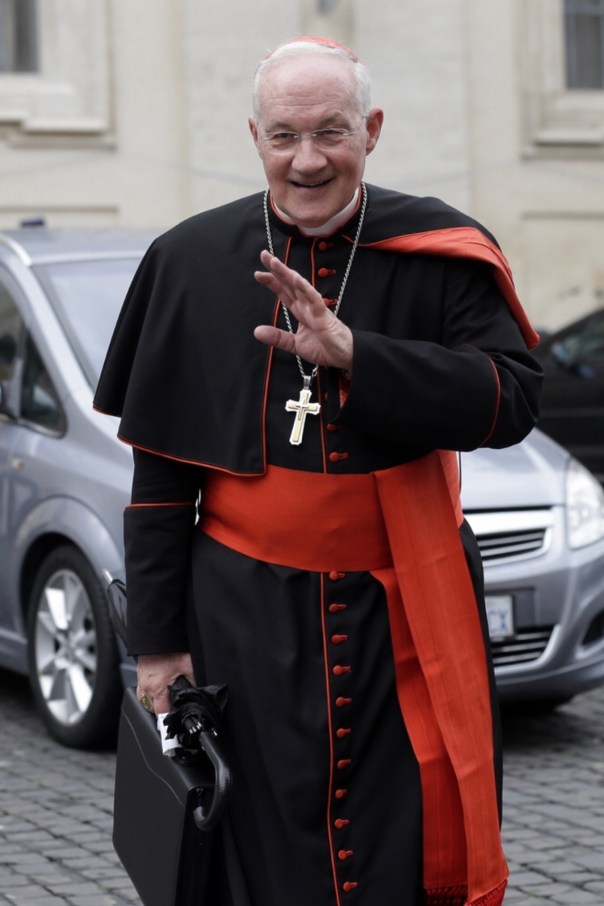
DON’T
We’re usually stunned by Cardinal Marc Ouellet’s getups. But this? We’re not even sure he ironed whatever THIS is.
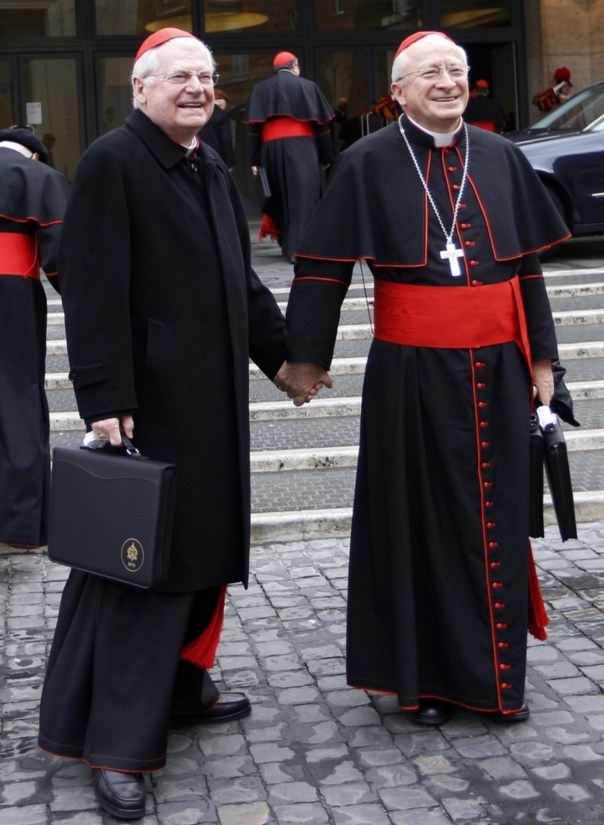
DO
Never to be outdone, Cardinals Angelo Scola, left, and Ennio Antonelli have always been fashion forward at shows. The shading in Antonelli’s tunic, the perfection in Scola’s briefcase accessorizing… It’s almost perfect.

DON’T
You can’t come to a fashion show, Cardinal Gianfranco Ravasi, and not expect to have some pictures taken. He was so reclusive this year.
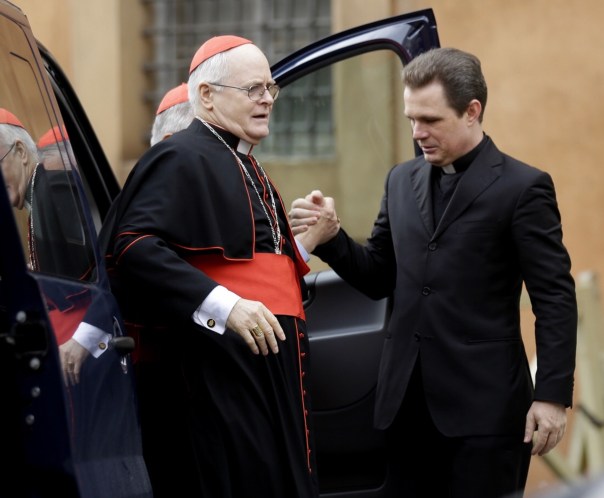
DON’T
The cape Cardinal Odilo Pedro Scherer chose clashes a little too much with his sash. And what have you done with your collar? Loosen ‘er up, the Pope isn’t here yet.
References and Sources
- Gammarelli legacy passes to sixth generation for papal tailors, Catholic News Agency, by Elise Harris, 15 July 2016 https://www.catholicnewsagency.com/news/gammarelli-legacy-passes-to-sixth-generation-of-papal-tailors-43421
- Pope socks, a favourite Roman souvenir, An American In Rome, by Natalie, December 2, 2015 https://anamericaninrome.com/wp/2015/12/pope-socks-a-favorite-roman-souvenir/
- How much does it cost to get fitted out as a cardinal? UCA News, by Andrea Tonelli, November 23, 2012 https://www.ucanews.com/news/how-much-does-it-cost-to-get-fitted-out-as-a-cardinal/66606
- From lipstick-red loafers to pontiff bling rings, the most fascinating papal fashion, Vanity Fair, by Julie Miller, March 14, 2013 https://www.vanityfair.com/style/photos/2013/03/pope-francis-jorge-mario-bergoglio-papal-fashion
- Top 10 items of papal regalia, ListVerse, by Jamie Frater, November 17, 2007 https://listverse.com/2007/11/17/top-10-items-of-papal-regalia/
- Papal vestments, Wikipedia https://en.m.wikipedia.org/wiki/Category:Papal_vestments
- Episcopal Gloves, Wikipedia https://en.m.wikipedia.org/wiki/Episcopal_gloves
- Pope doesn’t wear Prada, Vatican newspaper, Reuter’s, by Robin Pomeroy, June 27, 2008 https://www.reuters.com/article/us-pope-prada/pope-doesnt-wear-prada-vatican-newspaper-idUSL2693611620080626
- The hidden meaning behind the pope’s clothes, CNN, February 26, 2018 https://edition.cnn.com/2013/03/19/living/gallery/pope-wardrobe/index.html
- Clothes and the man: How pope’s communicate through clothing, America Magazine, by Arthur P Urbano; May 30, 2013 https://www.americamagazine.org/issue/clothes-and-man
- Pope Francis’ simple style statement, WWD, by Louisa Zargani, September 21, 2015 https://wwd.com/eye/people/pope-francis-simple-style-statement-10235021/
- Swiss guards make a fashion statement with debut of new helmets, Crux Now, by Inés San Martín, May 26,n2018 https://cruxnow.com/vatican/2018/05/06/swiss-guards-make-a-fashion-statement-with-debut-of-new-helmets/
- The truth behind the pope’s ruby red slippers, Messy Nessy, by Francky Knapp, February 7, 2018 https://www.messynessychic.com/2018/02/07/the-truth-behind-the-popes-ruby-slippers/
- Benedict XVI the best dressed Pope, Los Angeles Times, by Charlotte Allen, February 17, 2013 https://www.latimes.com/opinion/la-xpm-2013-feb-17-la-oe-allen-pope-fashion-20130217-story.html
- Pope Francis says it’s “abuse” to wear crucifix’s as accessories, Independent, Olivia Petter, March 21, 2018 https://www.independent.co.uk/life-style/fashion/pope-francis-crucifix-accessory-abuse-cross-religious-fashion-a8266591.html
- Cardinal fashion show: the do’s and don ‘Rd of Vatican wear this conclave season, Huffington Post, by Andy Campbell, March 13, 2013 https://www.huffingtonpost.com.au/2013/03/11/cardinal-fashion-show-vatican-wear-photos_n_2852944.html
- Fashion:The Pope wears Prada, Newsweek, by Barbie Nadeau, 20 November, 2005 https://www.newsweek.com/fashion-pope-wears-prada-115211
- The Pope’s new (bespoke) shoes, Esquire, by Nate Hopper, February 26, 2013 https://www.esquire.com/style/a25776/the-pope-new-shoes/
- The fable of Benedict’s Red Shoes, Eureka Street, by Philip Harvey, March 6, 2013 https://www.eurekastreet.com.au/article/the-fable-of-benedict-s-red-shoes
- Vatican tailors, cobblers try to adapt to Francis’s ‘papal athleisure’, Crux Now, by Claire Giangrave, June 12, 2017 https://cruxnow.com/vatican-at-the-met/2017/06/12/vatican-tailors-cobblers-try-adapt-franciss-papal-athleisure/