Category Archives: General Interest

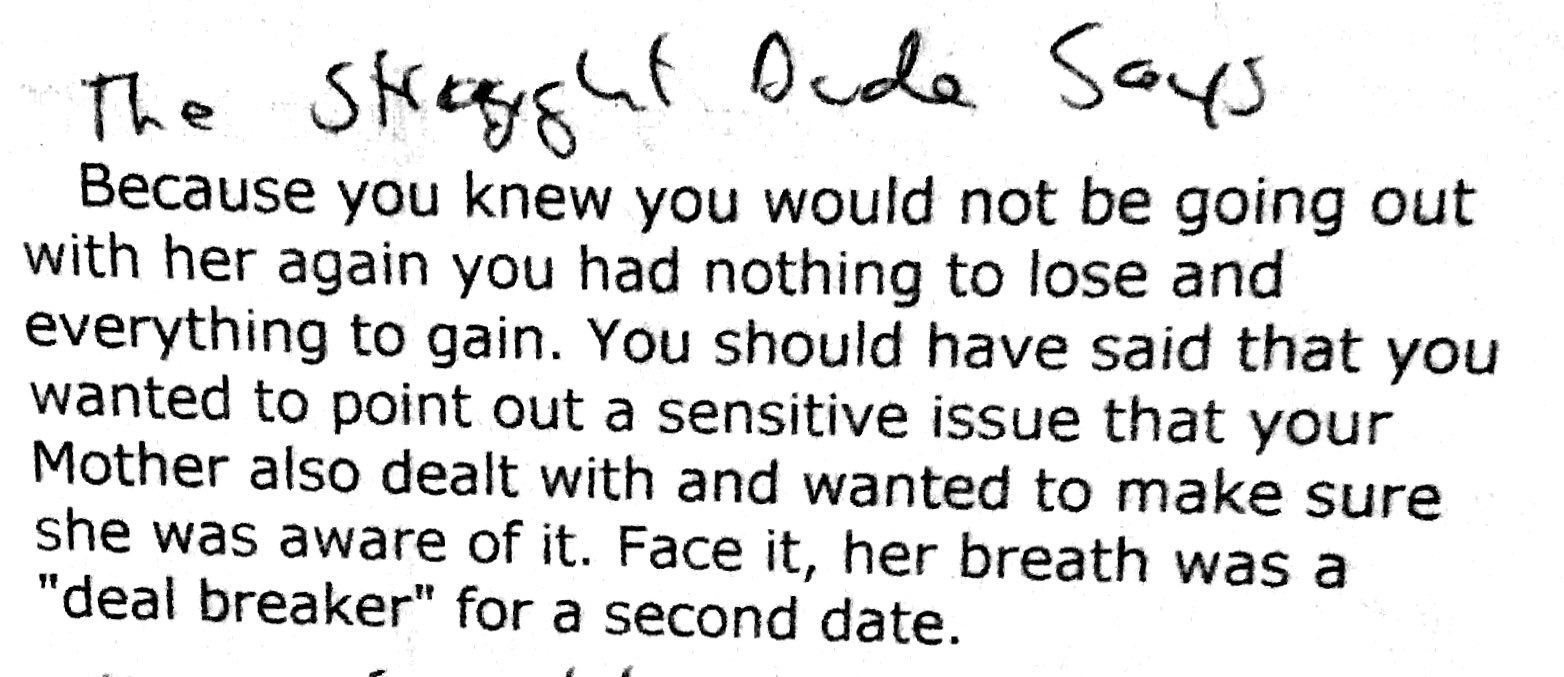
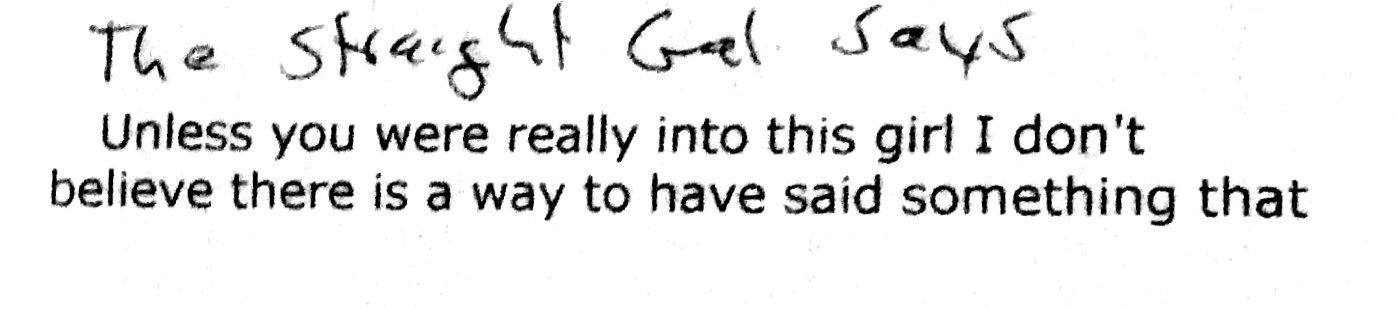
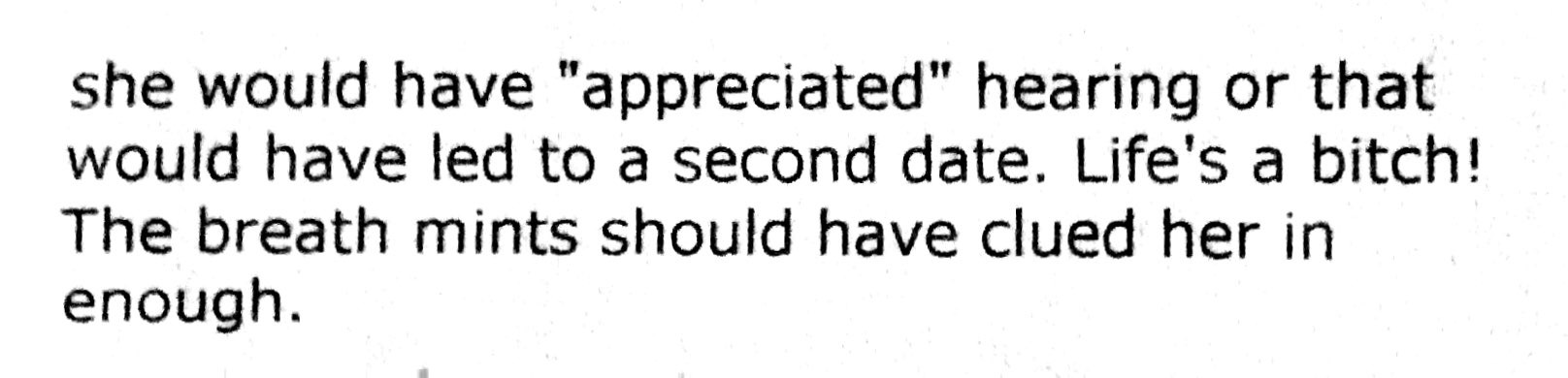
Sex Tycoon: “Sex4Cast” Agony Aunt Column, Friday 4 April 2003 *Halitosis Date Death*. 

In 2003, after making a witty, sarcastic comment on an article published in an online emagazine called “Sex Tycoon”, I was contacted by them, and asked to be “The Gay Man” commenting on a series of subscriber personal-problem-questions. The panel of “experts” consisted of a “Straight Dude”, “Straight Gal”, ‘The Gay Guy” and “The Lipstick Lesbian”, and each week, under the column title Sex4Cast, we were emailed a “problem” question with a link, which we would then write a reply, offering personal advice on solving the problem. The four panellists had no knowledge, or contact, with each other, so all advice was offered independently. As “The Gay Guy”, I never treated the questions seriously, offering – in my inimitable style – witty (I hoped), sarcastic advice, which, according to feedback from the site owners, was very popular with their subscribers. Sex Tycoon was operated by a group called FocusBlue Media LLC. Unfortunately, as was common in those days on the internet, after 14 columns the owners decided to close the site down, and that was the end of my Agony Aunt career. Sex Tycoon has disappeared into that great cyber-space graveyard, but I’ve kept copies of the columns, and publish them here for your amusement.

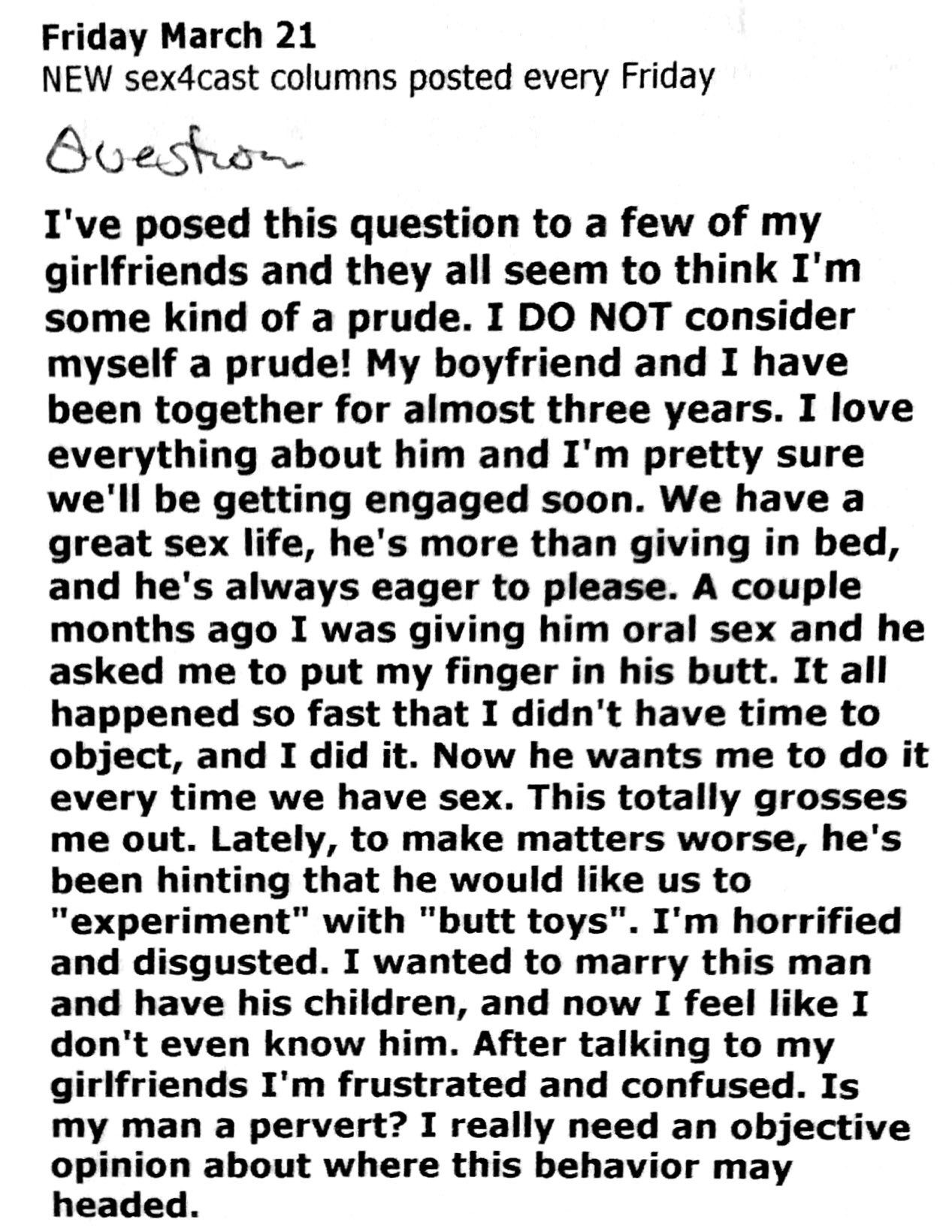
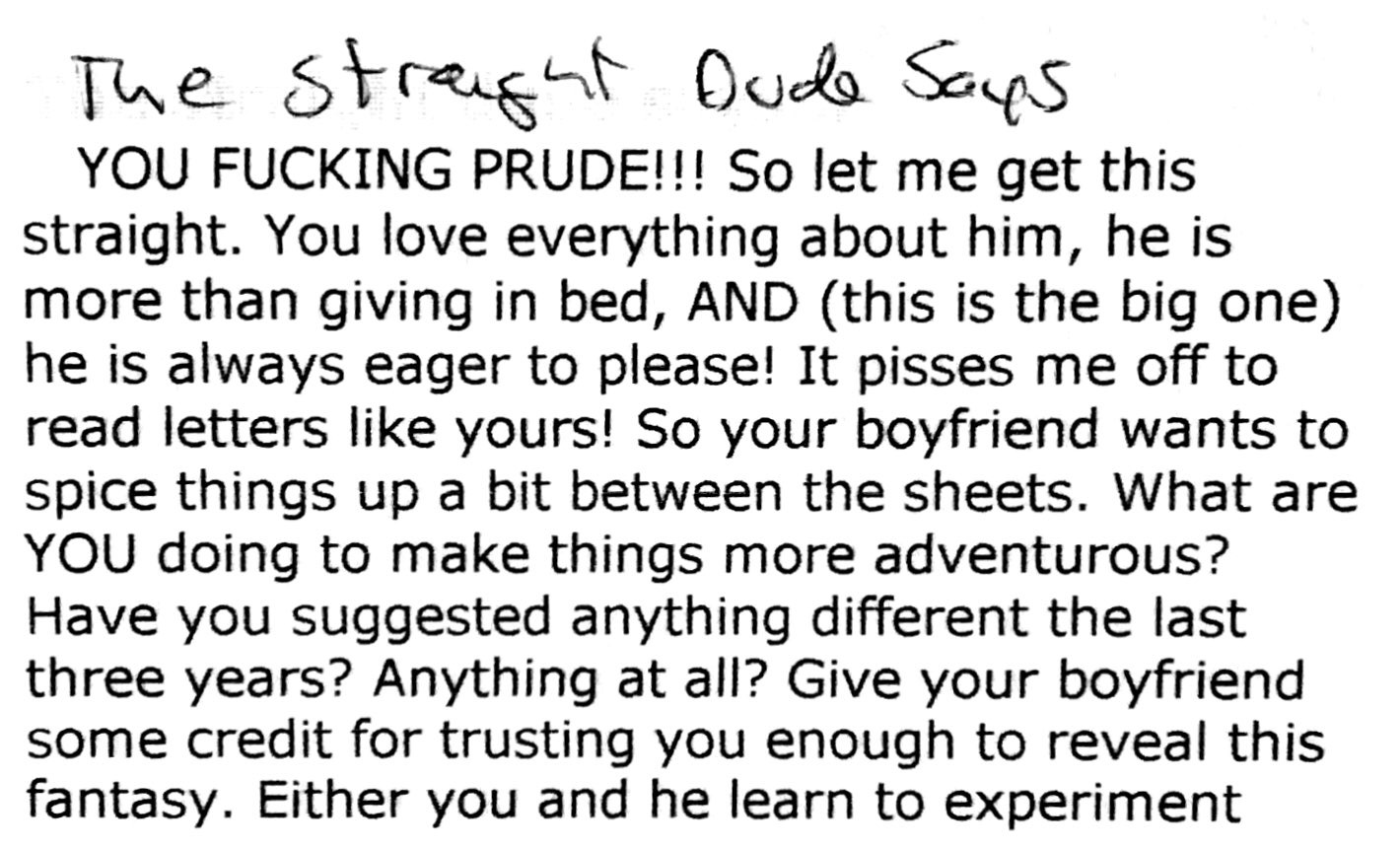
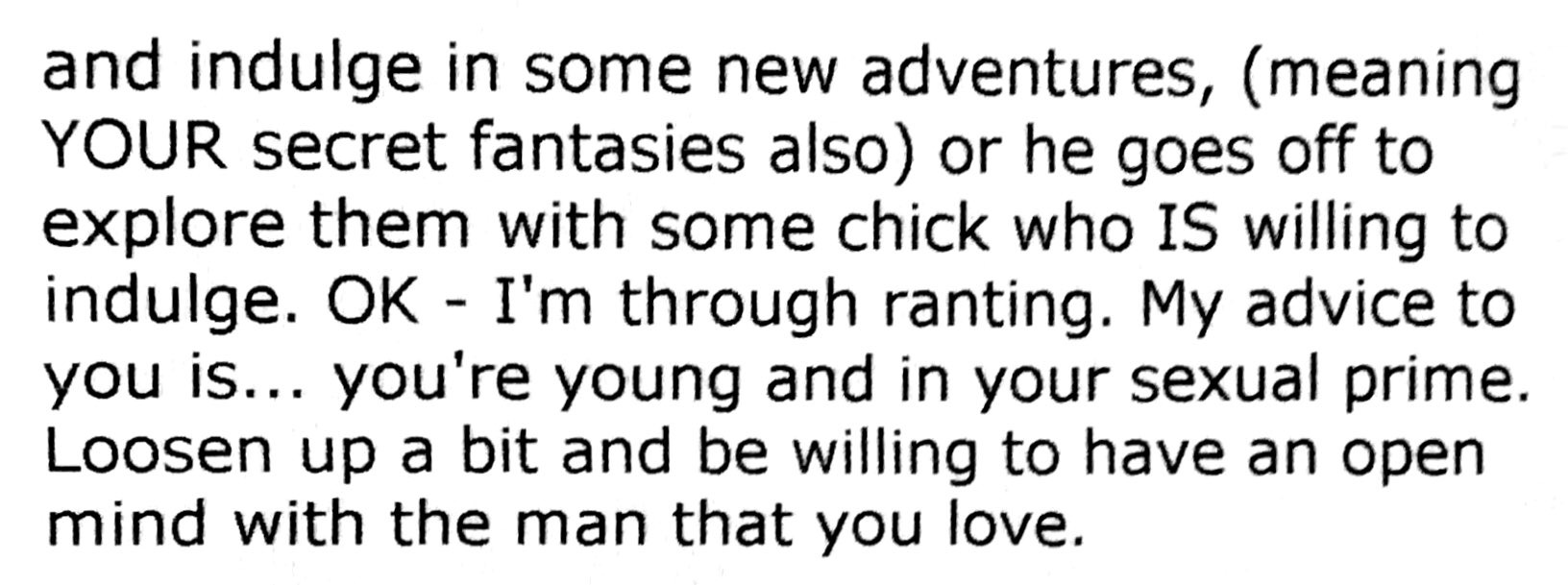
Sex Tycoon: “Sex4Cast” Agony Aunt Column, Friday March 21 2003 *Bottoms Up*.

In 2003, after making a witty, sarcastic comment on an article published in an online emagazine called “Sex Tycoon”, I was contacted by them, and asked to be “The Gay Man” commenting on a series of subscriber personal-problem-questions. The panel of “experts” consisted of a “Straight Dude”, “Straight Gal”, ‘The Gay Guy” and “The Lipstick Lesbian”, and each week, under the column title Sex4Cast, we were emailed a  “problem” question with a link, which we would then write a reply, offering personal advice on solving the problem. The four panellists had no knowledge, or contact, with each other, so all advice was offered independently.  As “The Gay Guy”, I never treated the questions seriously, offering – in my inimitable style – witty (I hoped), sarcastic advice, which, according to feedback from the site owners, was very popular with their subscribers. Sex Tycoon was operated by a group called FocusBlue Media LLC. Unfortunately, as was common in those days on the internet, after 14 columns the owners decided to close the site down, and that was the end of my Agony Aunt career. Sex Tycoon has disappeared into that great cyber-space graveyard, but I’ve kept copies of the columns, and publish them here for your amusement.


Media Pig! From The Prophetic To The Mundane!

I have always believed in having a voice, and be it right, wrong or indifferent I think people should speak up, and one of the best ways to do that is through  either letter writing, or being included in written conversations on specific issues. There is a lot of stupidity, injustice, prejudice and misinformation going on around us, and it is always important to speak out against these issues.

I have been involving myself in letters and articles since the mid-70s, and have pretty well kept the full record of my involvement. As a way of posting something a bit different, and covering, where possible, the scenario’s that provoked the letters and articles, here is a rundown of my social involvements over time. Funny how circumstances provide the fodder for letters! In my early days, it was always about gay issues – but then you settle down with someone, move to the ‘burbs, and all of a sudden it’s about your local council, or the idiots who inflict their opinions on us through the local rags! Keeps life interesting!

Published in the Catholic Weekly around 1976. I was the store manager for Pellegrini & Co Pty Ltd, in York St, Sydney. A woman had eritren to the Catholic Weekly that Australia had no patron saints, which was inaccurate, as Our Lady Help Of Christians actually was. This is under my old name of Robert Phillips.
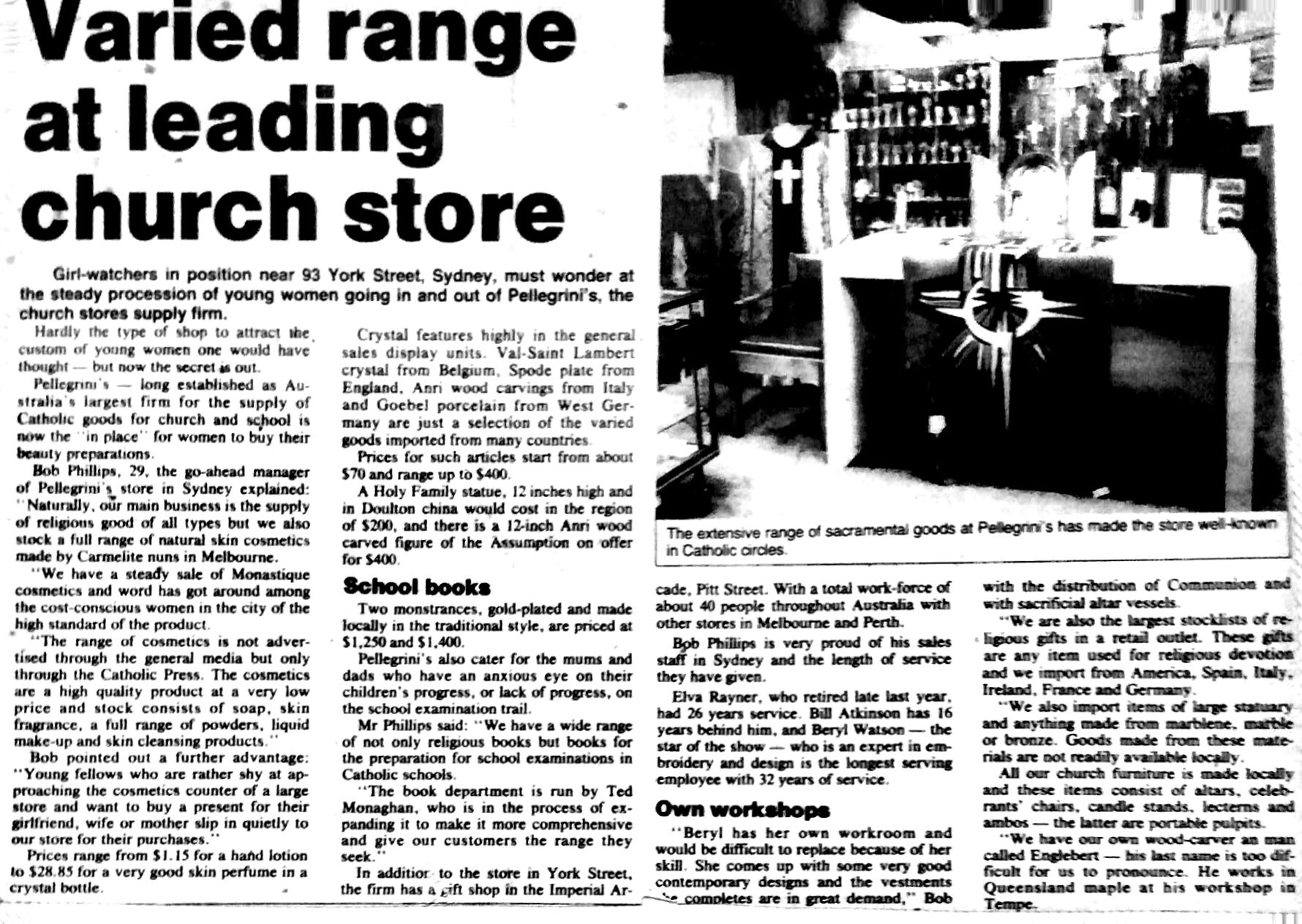
Also from around 1976, this article is an interview with the Catholic Weekly regarding the actual Pellegrini store itself. It was sround this time that we had moved the store from its original site in George St, Sydney (in Roma House) to York St.

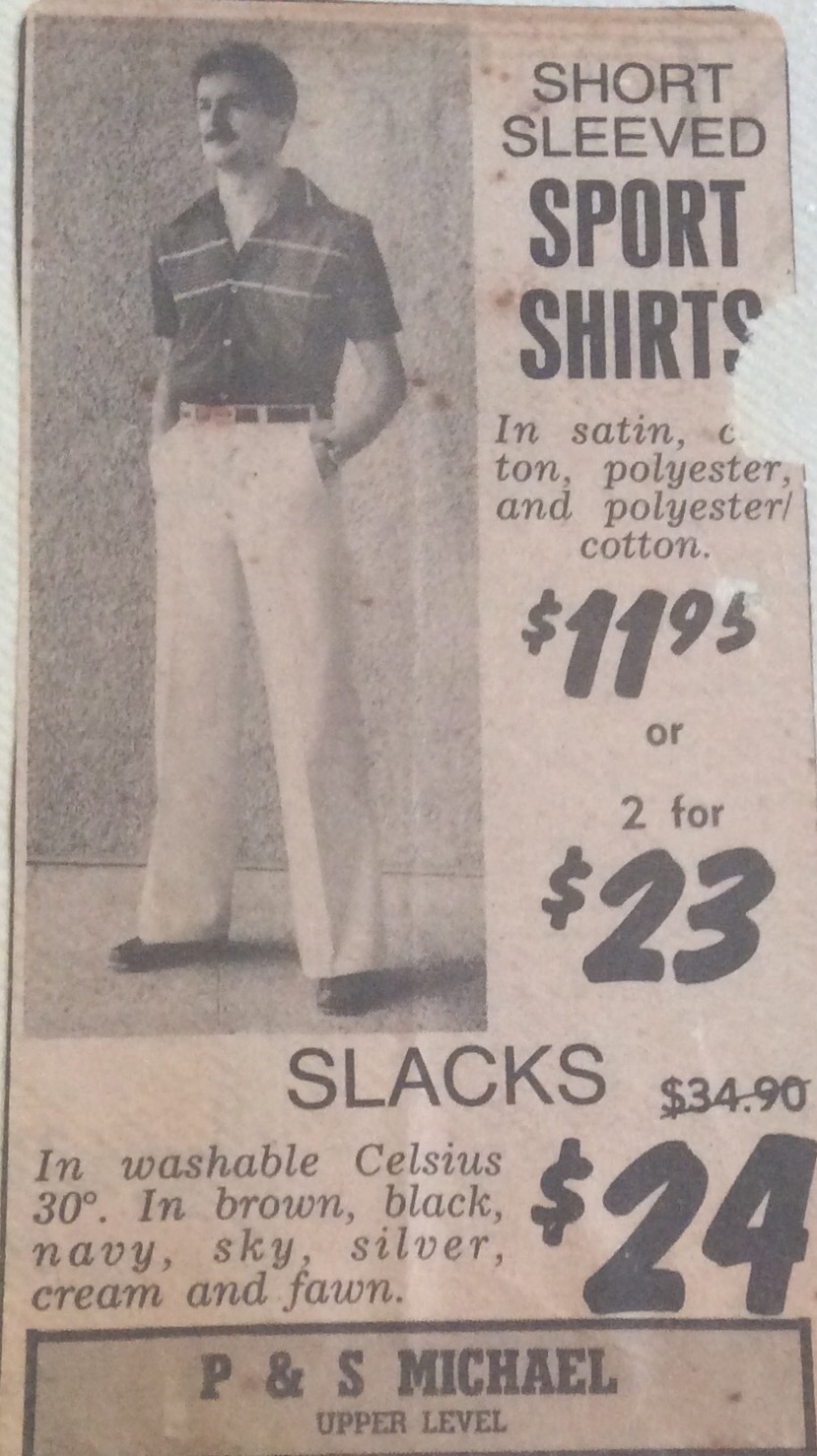
Around 1978 I left Pellegrini to work for my local menswear store, P&S Michael, who were branching out from the store in Granville, to MacArthur Square in Campbelltown. However, they employed pressure salesmanship – my pet retail hate – so it was a short-lived relationship. I returned to Pellegrini a couple of months later. This is me, modeling clothes for an advert in the local paper.


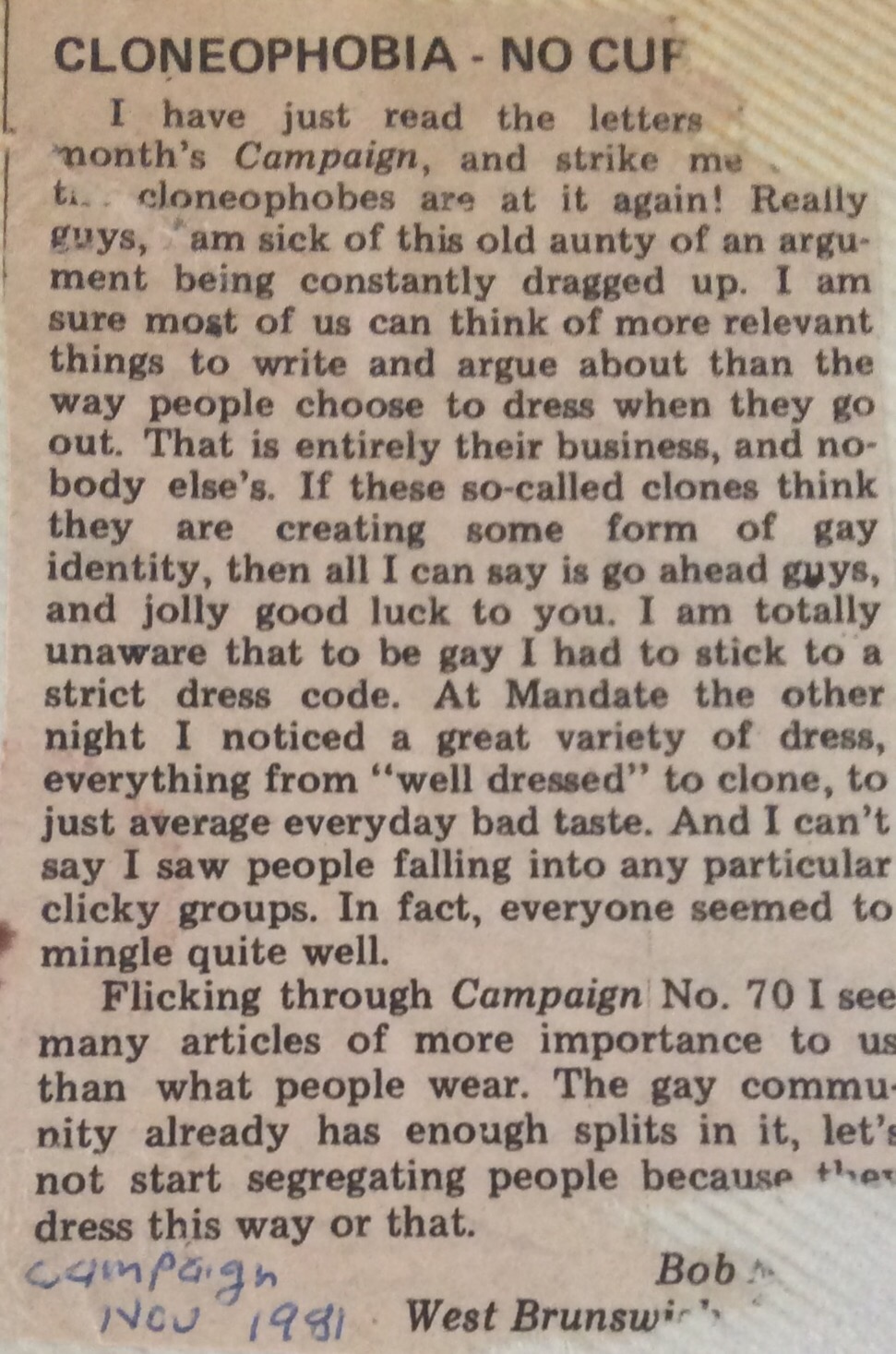
“Campaign” November, 1981. I was working for Pellegrini in Melbourne, and had just come out. I lived in West Brunswick. The gay clone phenomena had just started, and because of its “macho” imagery, a lot of old queens were whinging about how it was selling out the gay community by adopting “straight” stereotypes. I got fed up with it. My only letter from my Melbourne days.


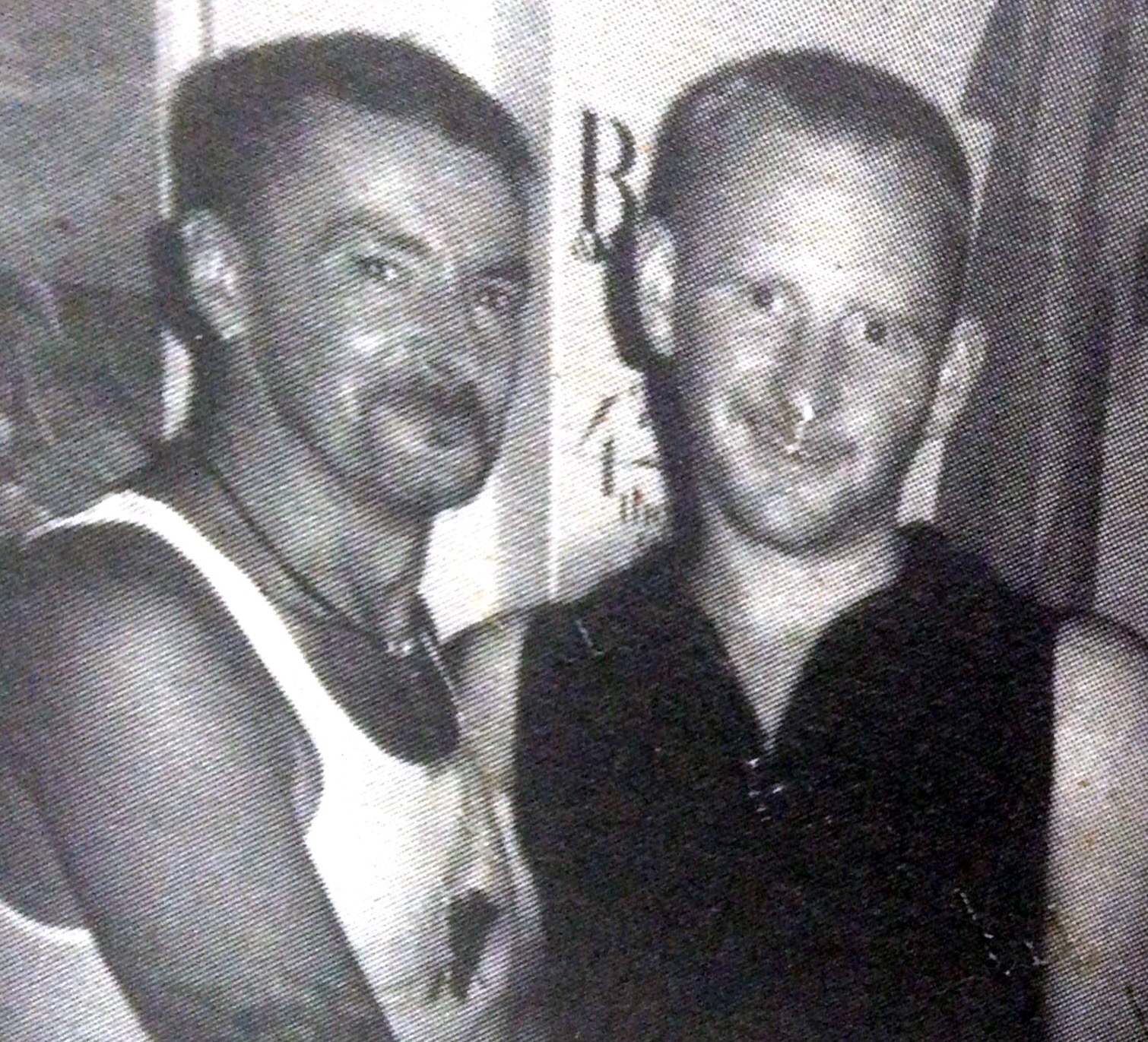
Two-in-one! Both the smsll photo of myself (right) and Barty Carter taken at the Midnight Shift, and the letter regarding ACON Safe Sex campaigns not hitting the mark would be from circa 1984. Both published probably in Sydney Star Observer.
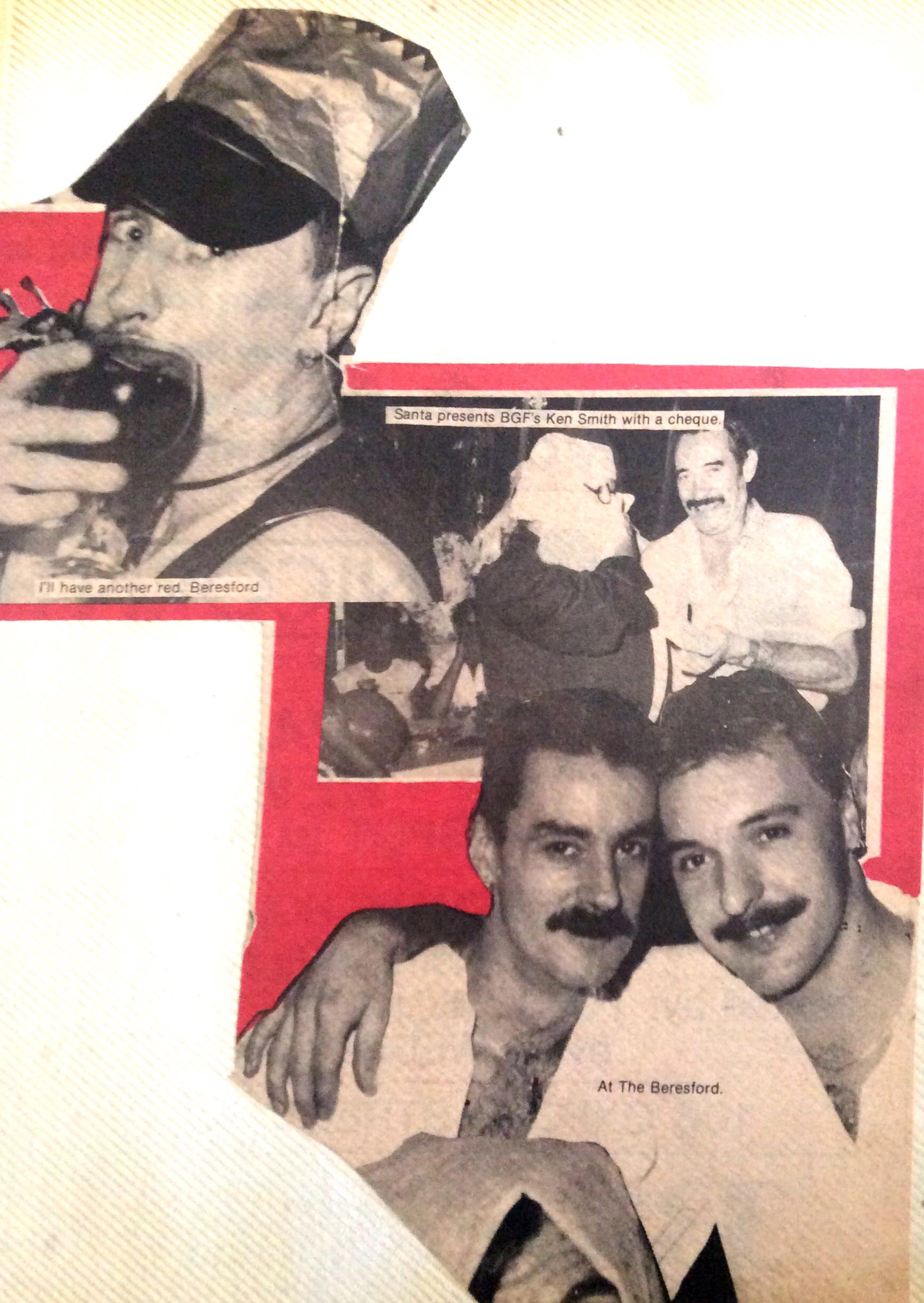

Beresford Hotel 1985. Christmas function. Photographed with Tony Kelly (right), my partner at the time. More than likely in the Sydney Star Observer.

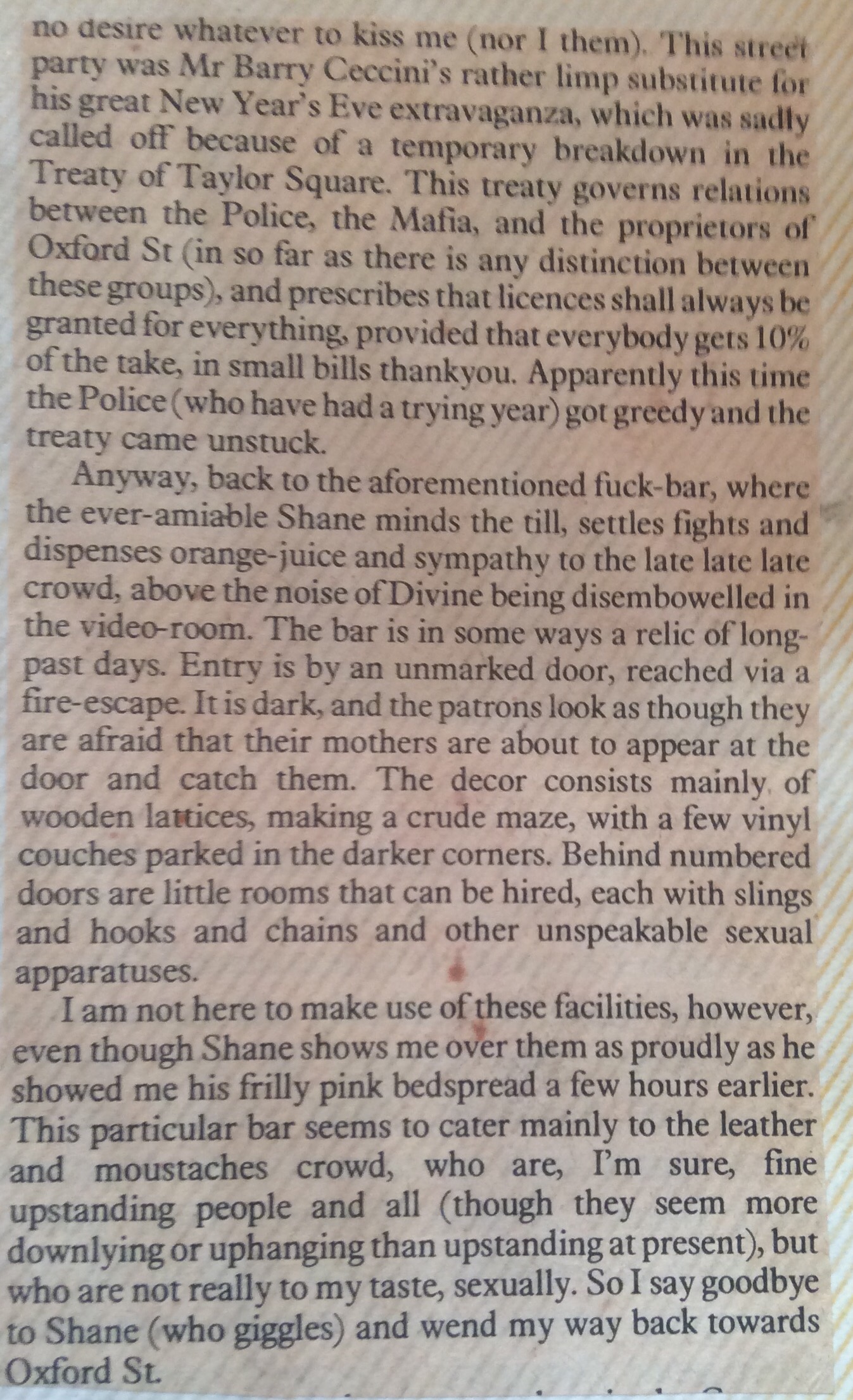
Article in “Outrage”, October 1985 by Adam Carr under his pseudonym Miles Walker. Adam had visited myself and my partner at the time, Damian, in our flat in Kellett Way, King’s Cross. He was on hus way to a street party. He decided to write a tongue-in-cheek piece about the visit. In the article, substitute Damian for Shane, and Tim for Tony. Notoriety comes in strange ways!
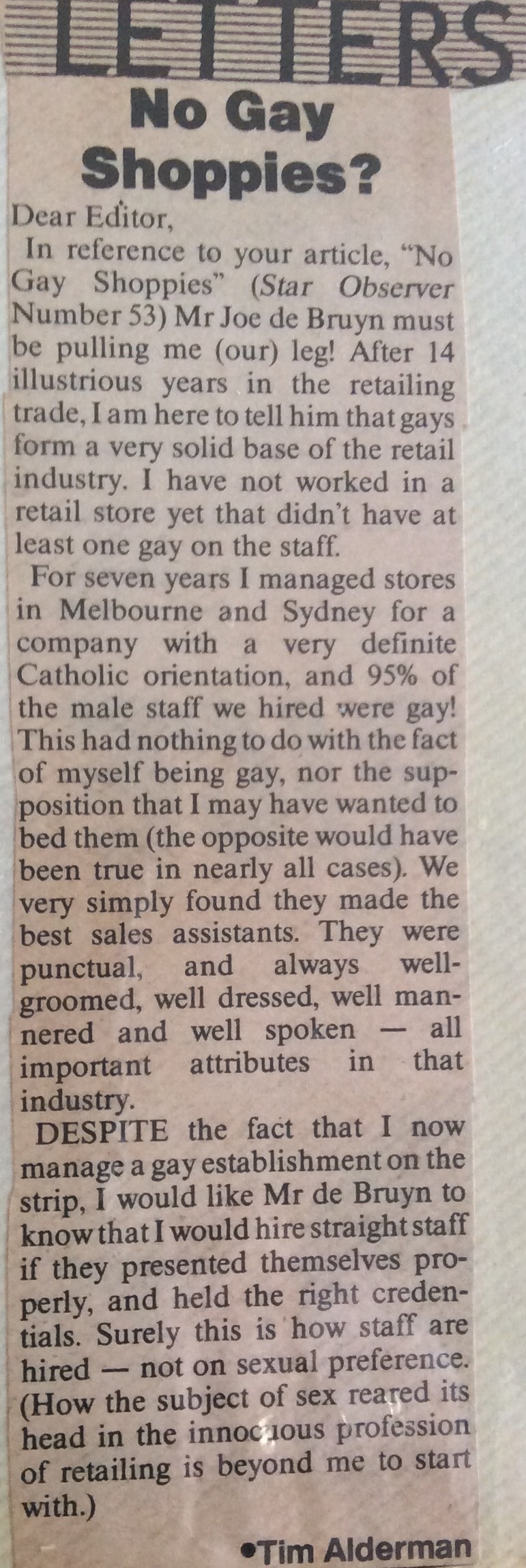
Star Observer circa 1985/86. A politician had made a rather stupid statement that gay men didn’t work in retail! Considering the retail sector relied heavily on gay staff, it just showed his general ignorance.
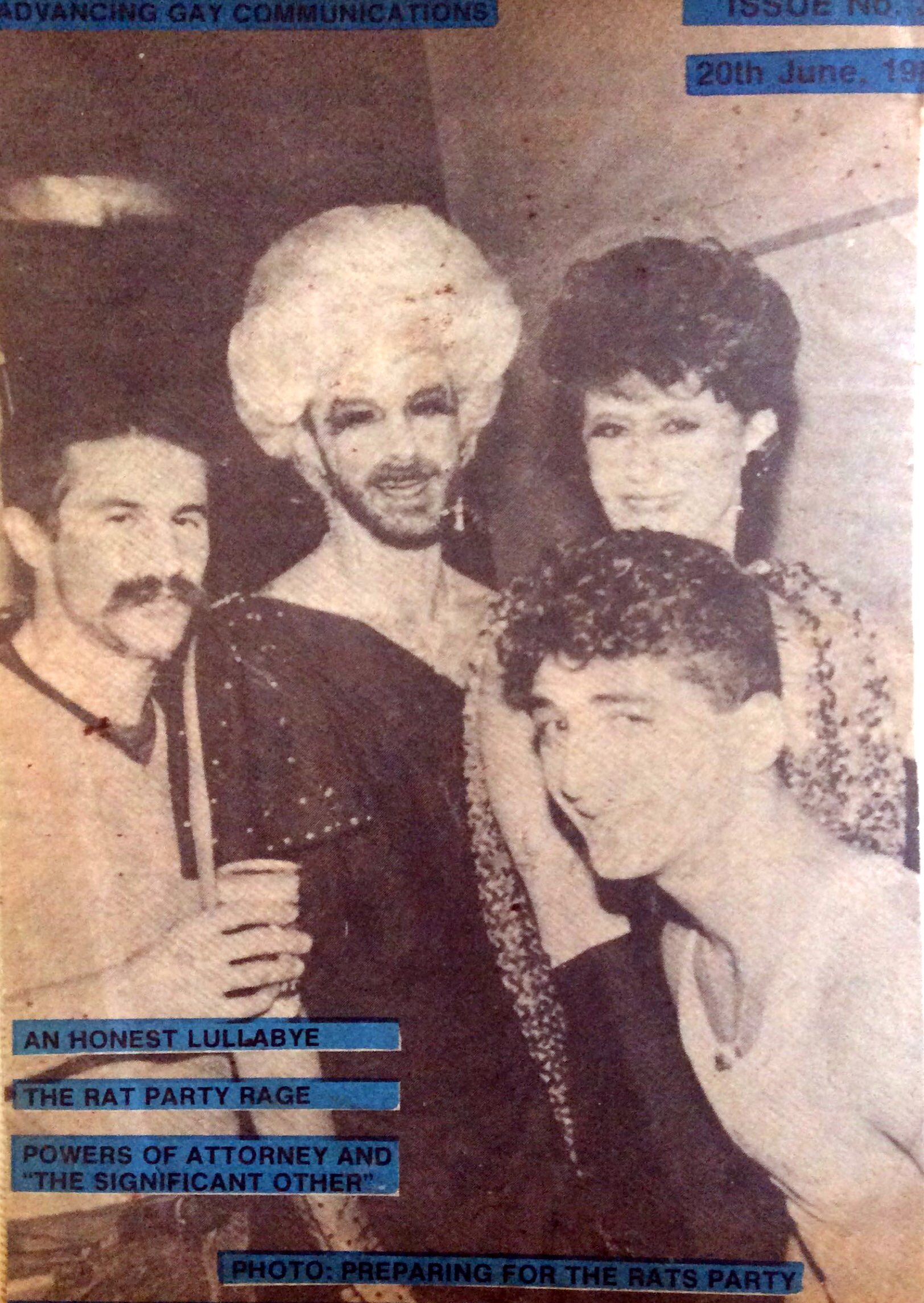
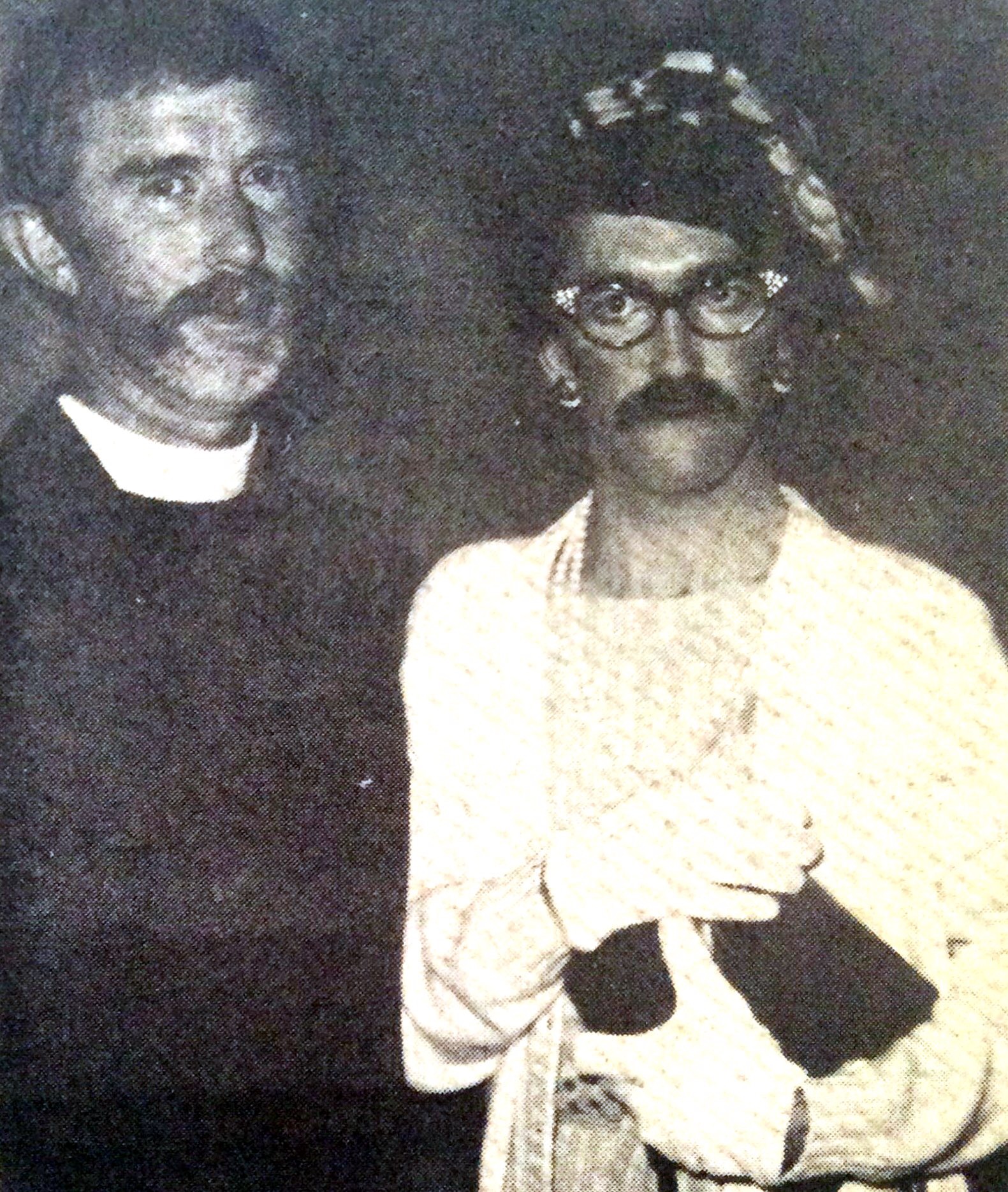
Star Observer Issue No.30, 20 June 1986. Cleo, my gutter drag persona, makes the front cover, along with Ruby Pollock (front right), and Andrew Carter. We had been to a Queens Birthday party at Geoff Smith & Steve Thompson’s home in Glebe. This photo was raken in The Oxford.

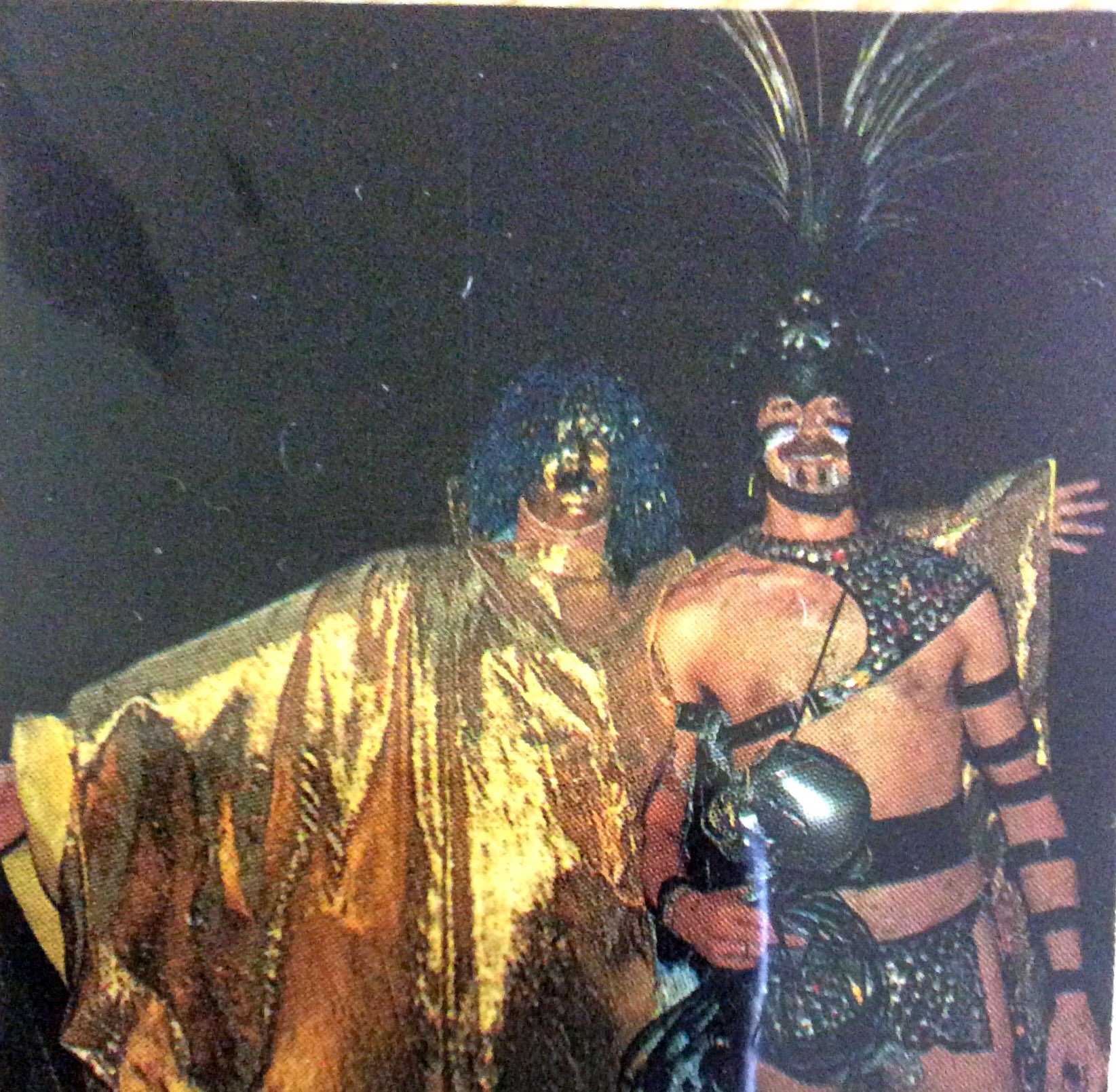
Cleo making it real in an advertising campaign for “Numbers” Bookshop in 1987. This was Cleo’s 1986 Sleaze Ball costume.

Green With Envy party, 31 August, 1986 at 38 Mona Rd, Darling Point. An annual party, put on by Sydney DJ Gareth Paull, who played regularly at The Oxford. A friend, Andrew Todd, asked me to go with him in drag, as he had never done drag before. Andrew had AIDS, and had spent most of the yesr in and out of hospital. He had a great night, and died on Boxing Day that year. I went wigless, and on the far right of this Star Observer photo.
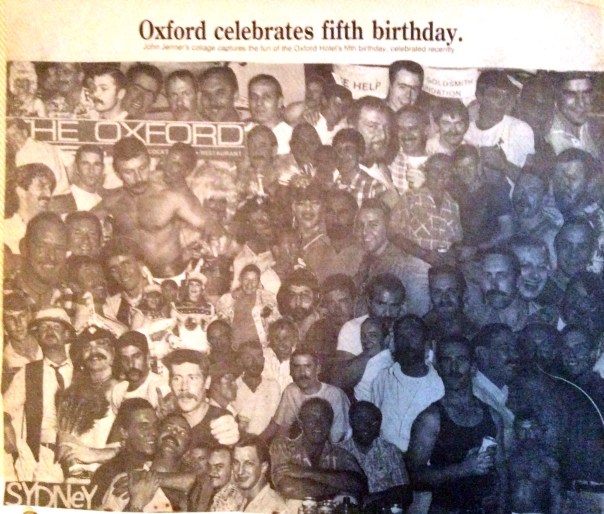
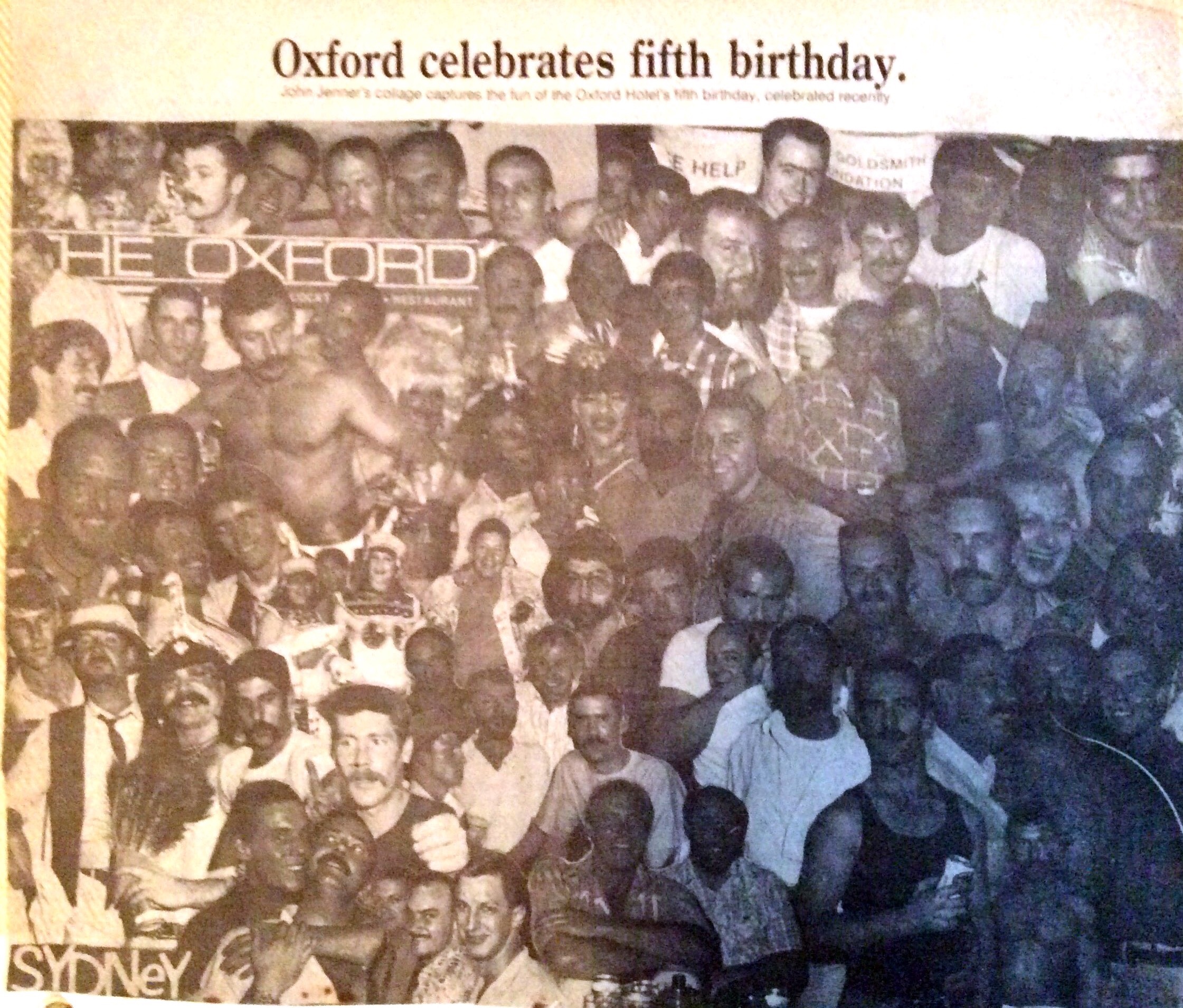
Star Observer August 1987. Montage from The Oxford’s 5th birthday party on 23 August 1987. That is Cleo’s white wig on the top left corner.

Outrage Magazine 1988. Mardi Gras photo, taken at the Art Gallery of NSW. Darby Wilcox (left) and myself about to scatter the ashes (mixed with glitter) of Don Tickle, who had died from stomach cancer earlier that year. His ashes were scattered along the parade route.

Star Observer June 1988. Montage from ANZAC Day at The Oxford, 1987. Don & I, in army drag, at bottom of photo, right hand side.


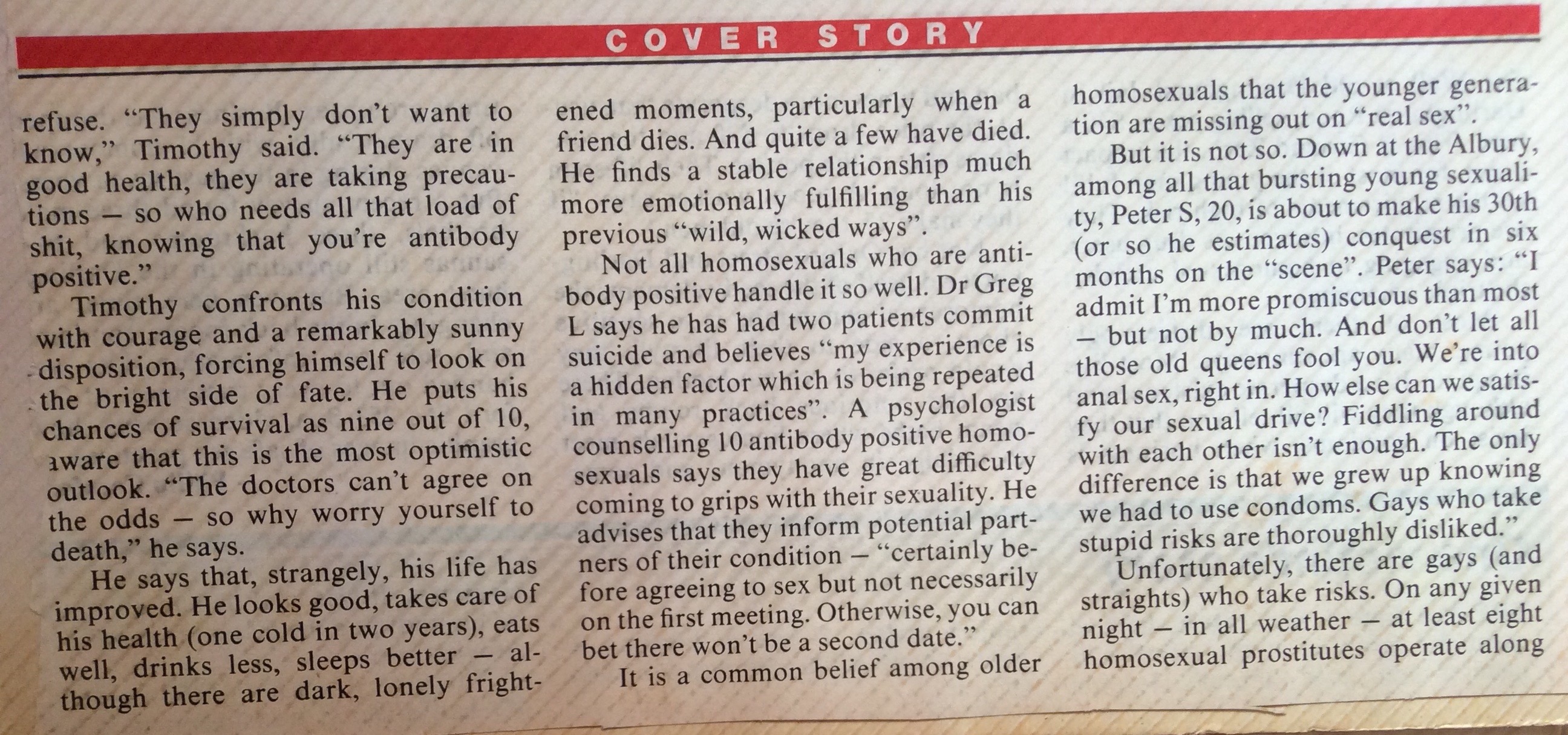
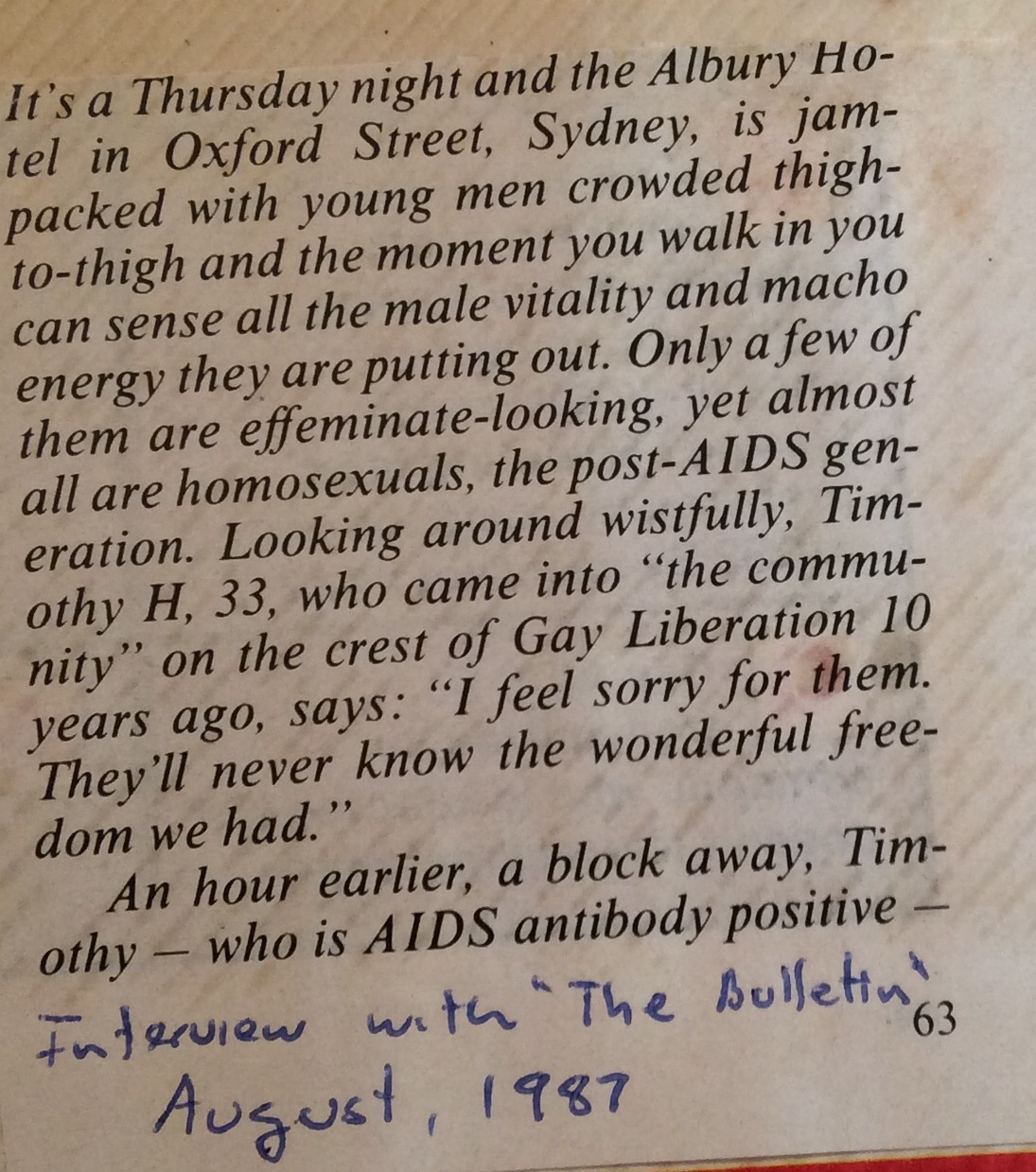
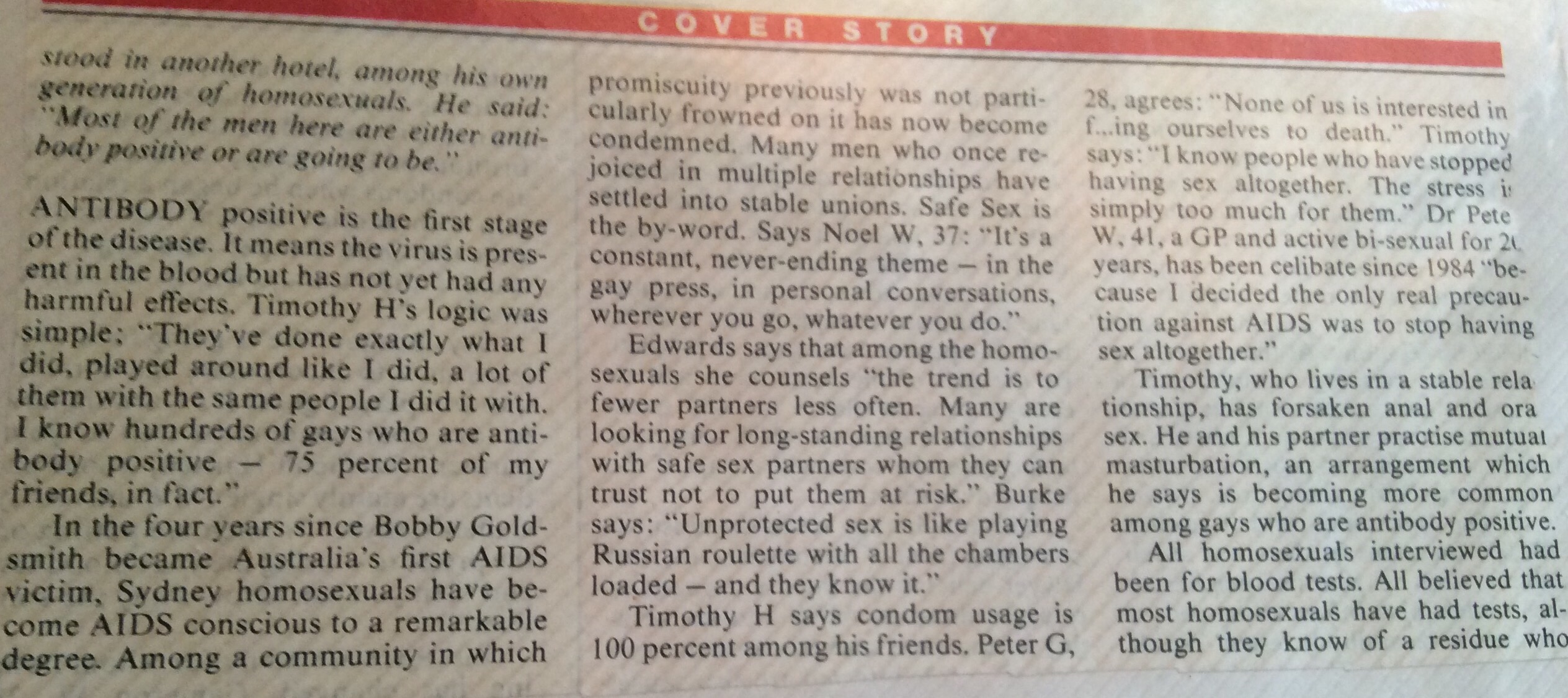
“The Bulletin” August 1987. An interview in The Oxford regarding how we felt about living with HIV. Being still early days in the history of the pandemic, this all sounds a bit naive now.

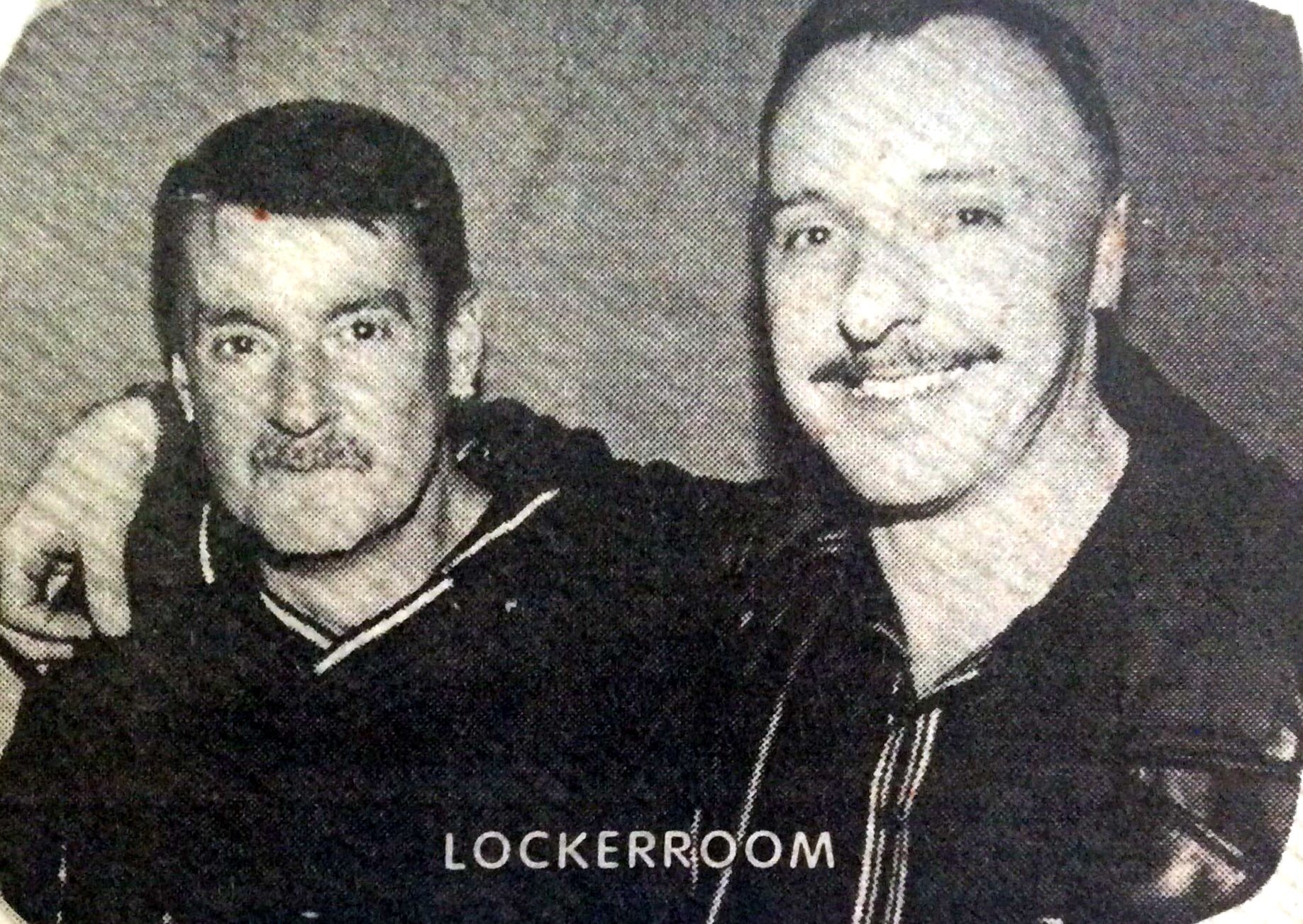
Though labelled “Locker Room”, this was actually taken in the Midnight Shift circa 1997. Tony Kelly to the right.

Circa 1986. The premier, Neville Wran, commented on cinema’s banning condom advertising due to them being perceived as not “family friendly”. Nothing like sticking your head in the sand, as far as I was concerned. Evidently I was allowed to see it on television, but not in the cinema?

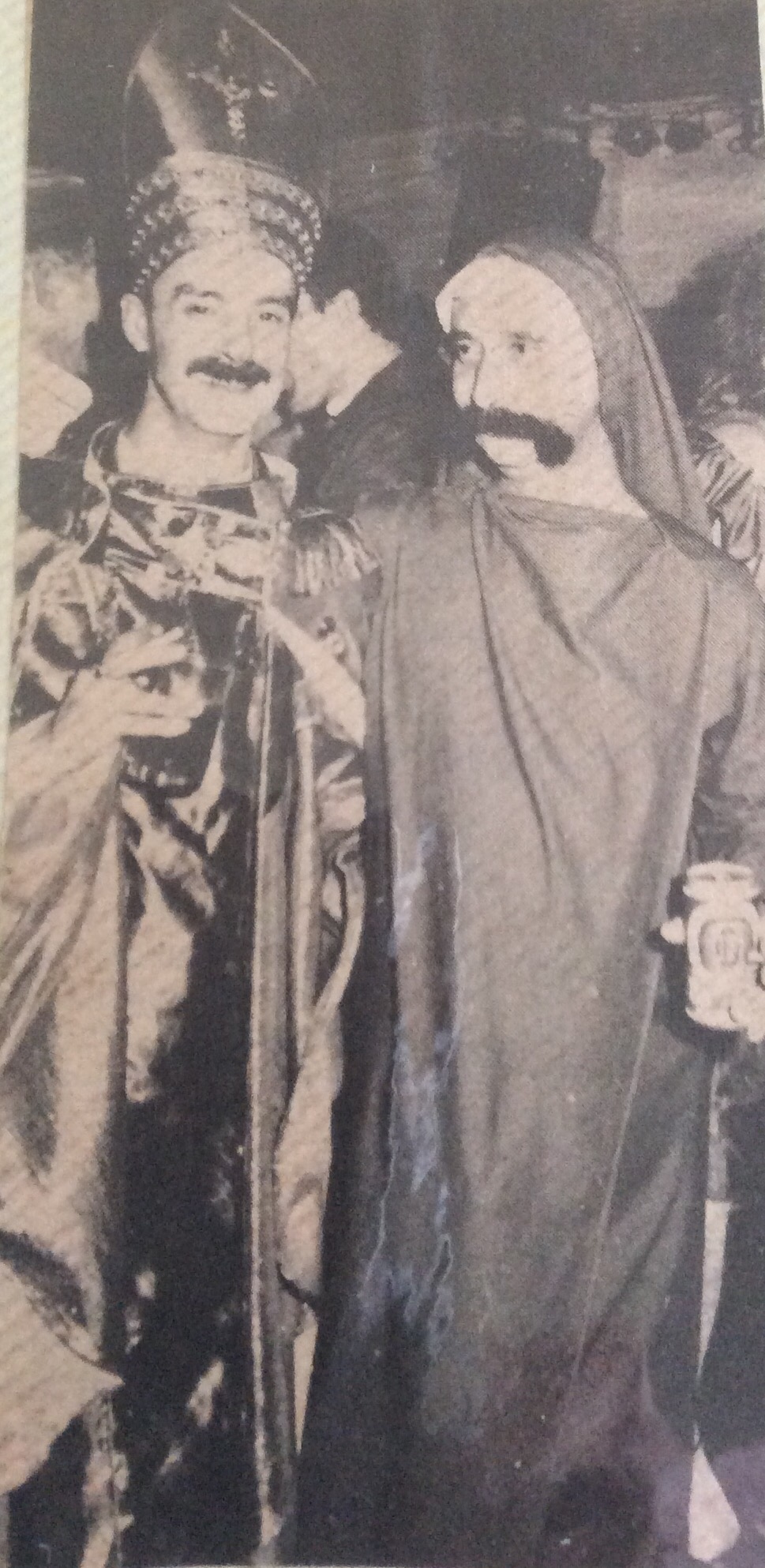
A series of photographs taken by the Sydney Star Observer circa 1987. We had a Nuns, Priests & Prostitutes party to celebrate my flatmates birthday. The patty was an afternoon affair held at our apartment in Bourke St, Darlinghurst. A group of us went out to the Oxford Hotel after the patty, where these were taken.

My backside, in leather chaps & thong, makes an appearance in – of all things – a lesbian magazine – LOTL (Lesbians On The Loose), at a Sleaze Ball. Also circa 1987.

Outrage No.63, August 1988. Someone from Adelaide was laying shit on Mardi Gras…obviously decided not to have a great time…and succeeded! The tone of the letter will give you some indication of his gripes.

Poster for “Dancing Through the Decade”, New Years Eve 1989, at the Wentworth Function Centre, University of Sydney. Put on by the Bobby Goldsmith Foundation (BGF), DJs were Rob Davis & myself.

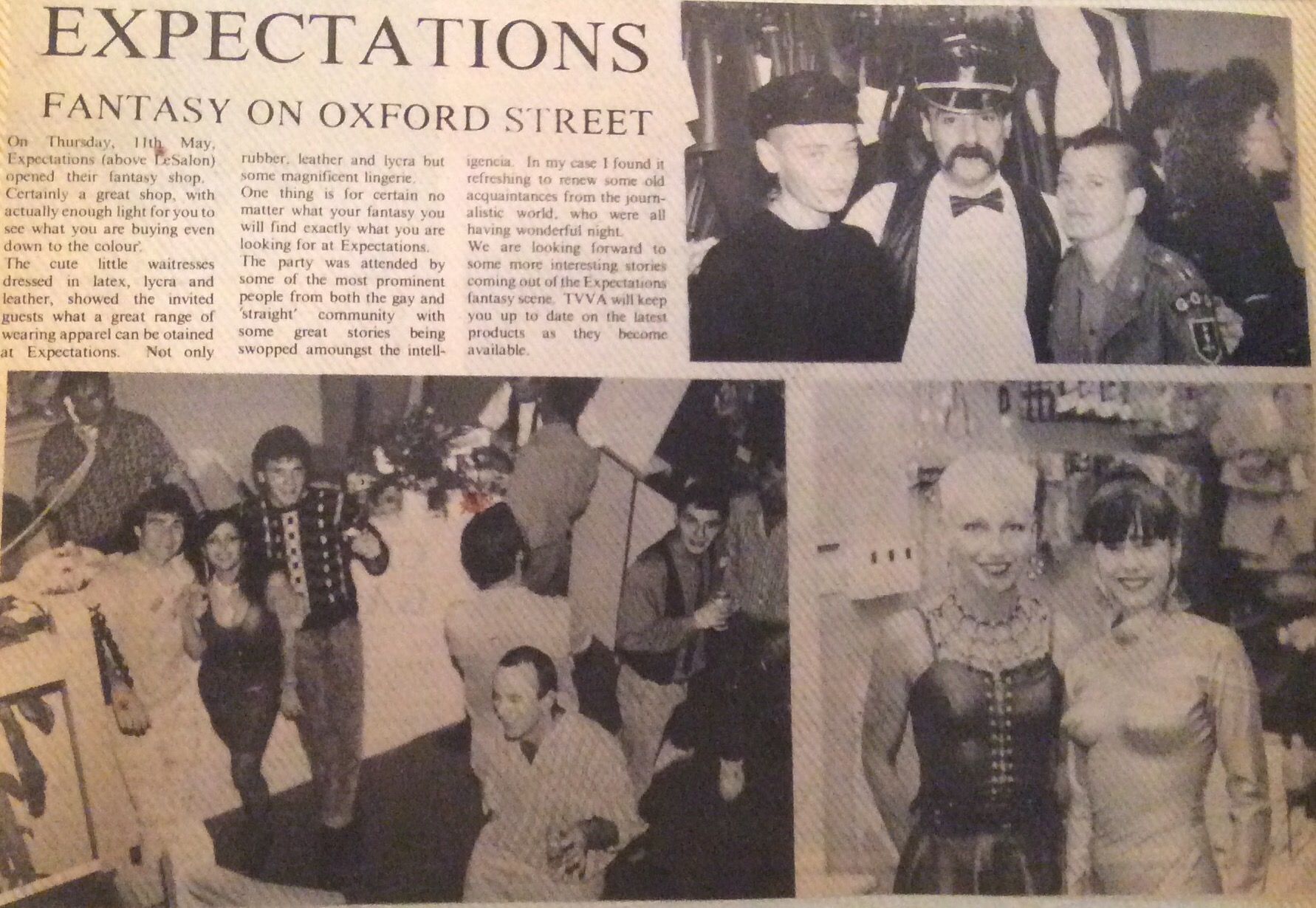
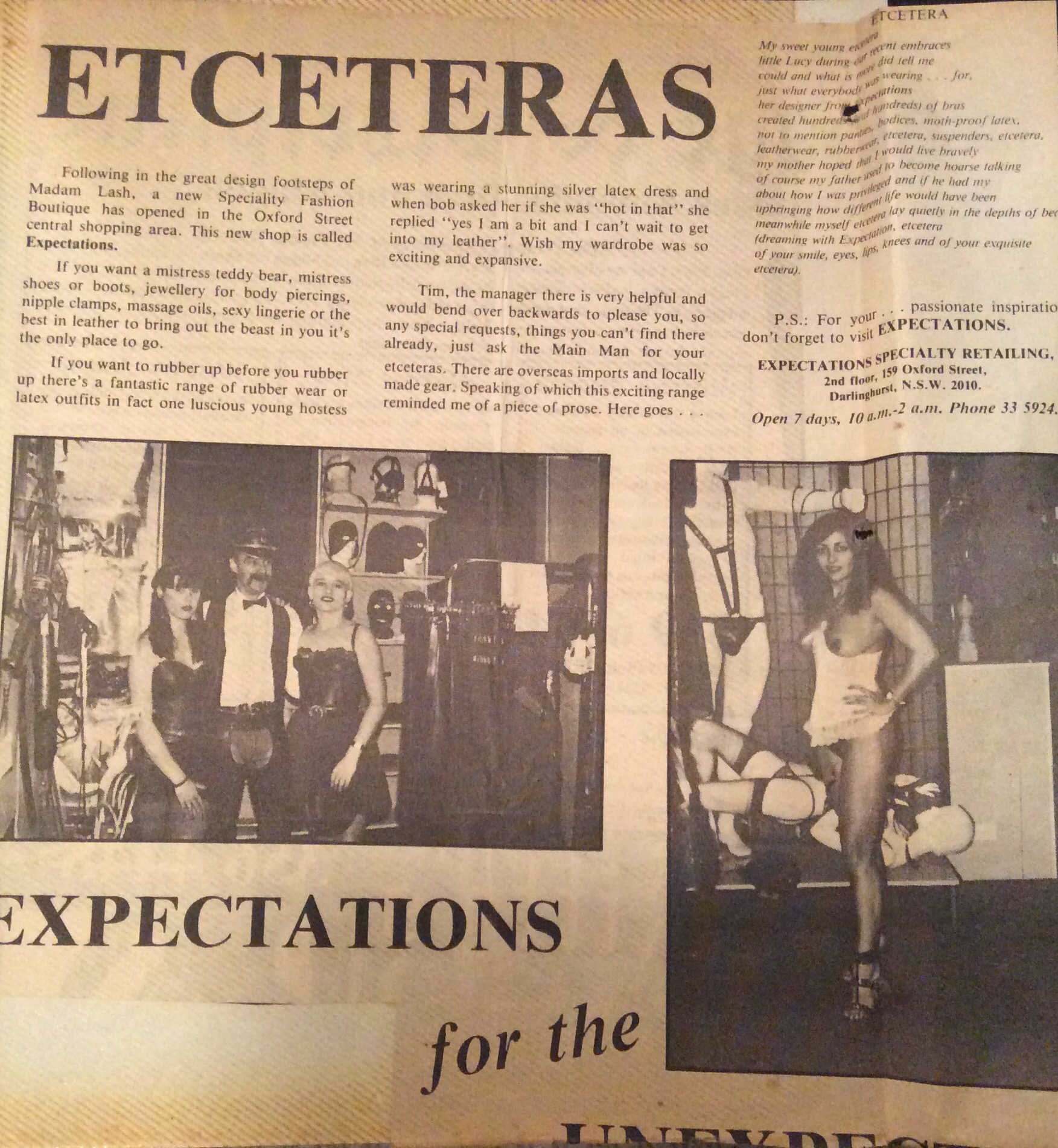
2 articles from local papers (names unknown) who reported on the opening party for “Expectations”. Expectations was a fetish store I managed for a short while, situated on the second floor of 159 Oxford St, Darlinghurst. Owned by Paul Jones, as was Numbers Bookshop, and the Den Club. In the first article I am in the top right photo, and in the second article the left side photo.

All I can remember about this photo was that it was taken in the Midnight Shift, and probably sometime between 1990-1993. I think I was in it due to my DJ work. It was published in the Star Observer.

Star Observer May 1990? (Date very difficult to read). Oxford DJ roster for what would seem to be Mardi Gras week, seeing as a Recovery Party is listed.


The Star Observer, 5 October 1990. The Oxford Hotel DJ Roster. I was a resident DJ at The Oxford from 1990-1996. This is probably the first roster I was on.
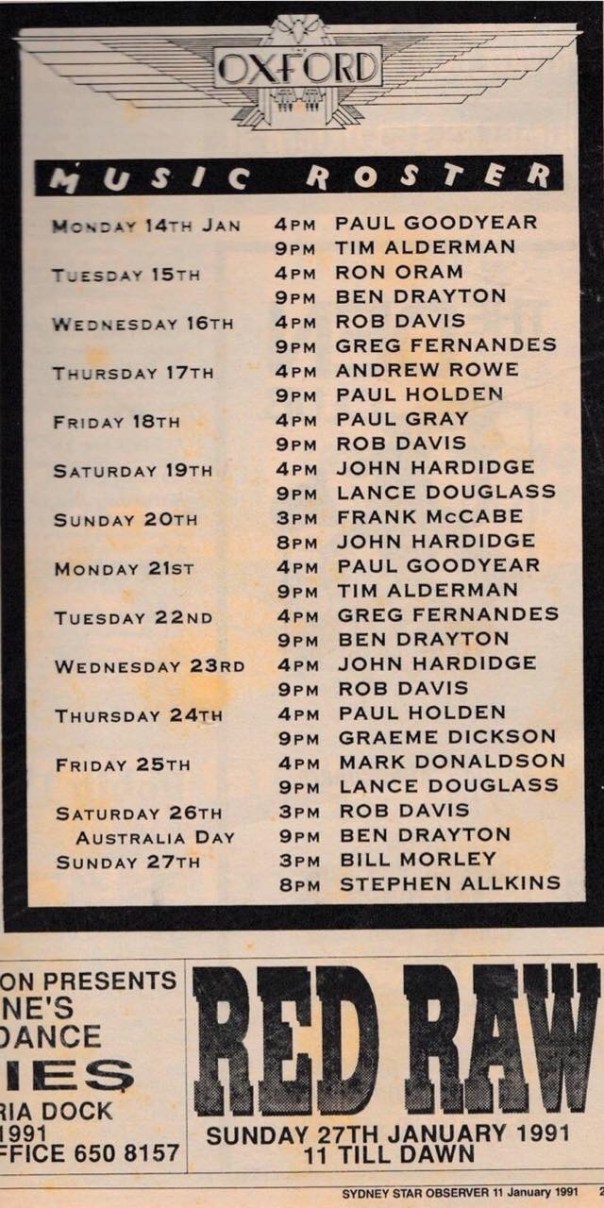
Star Observer, January 1991. Australia Day week DJ roster at The Oxford.

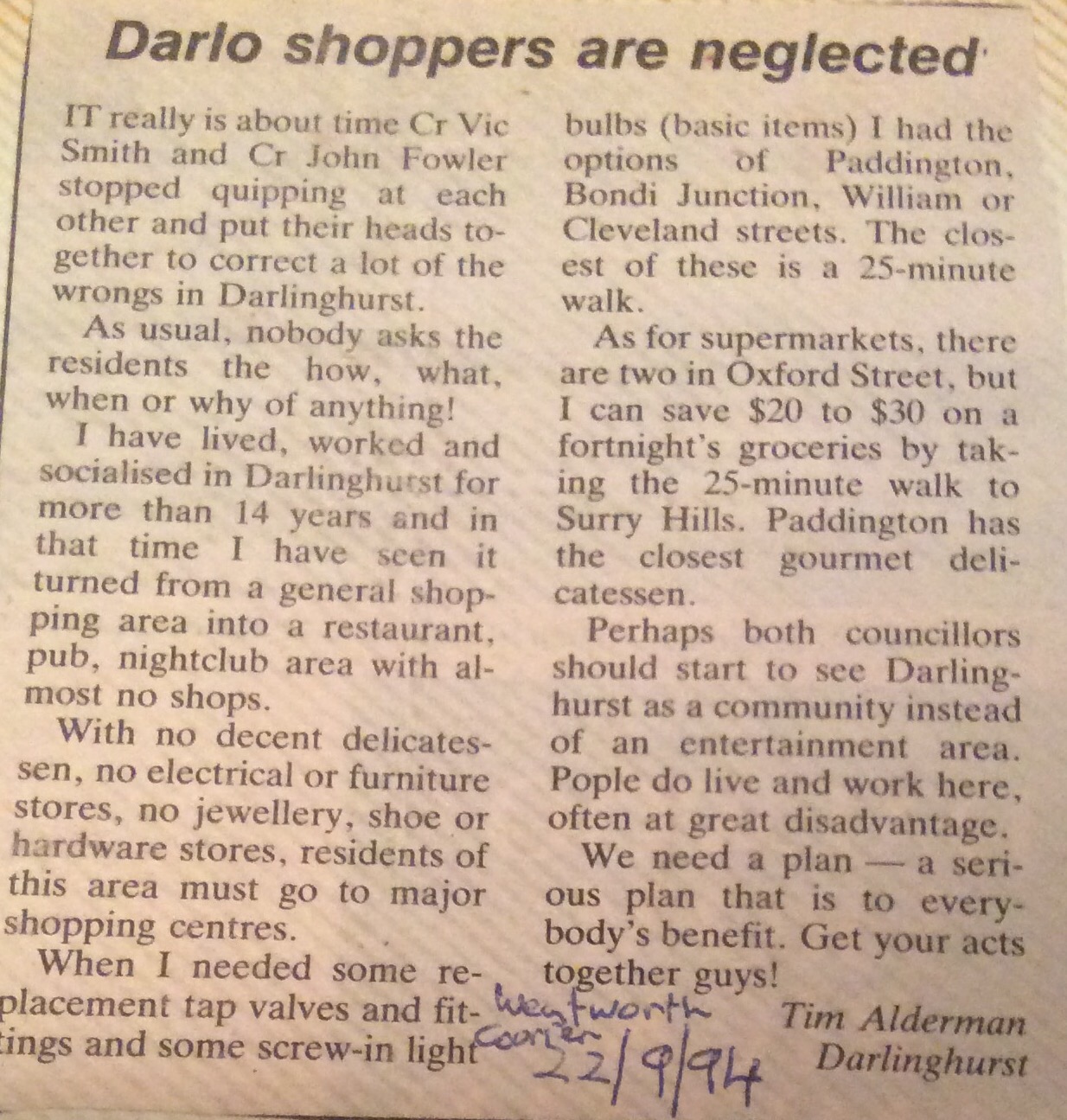
“Wentworth Courier” 22 September 1994. As usual, Oxford St as a shopping strip is going to hell on a hot rail, and everyone just seems to argue about what needs doing. The need for a retail plan for Oxford St should have been a council priority.

Star Observer, 31 January 1995. Myself & Marcus Craig (right) at the opening of his mixed-media gallery exhibition “Odyssey”. The air brush painting in the oicture was donated to the Luncheon Club.
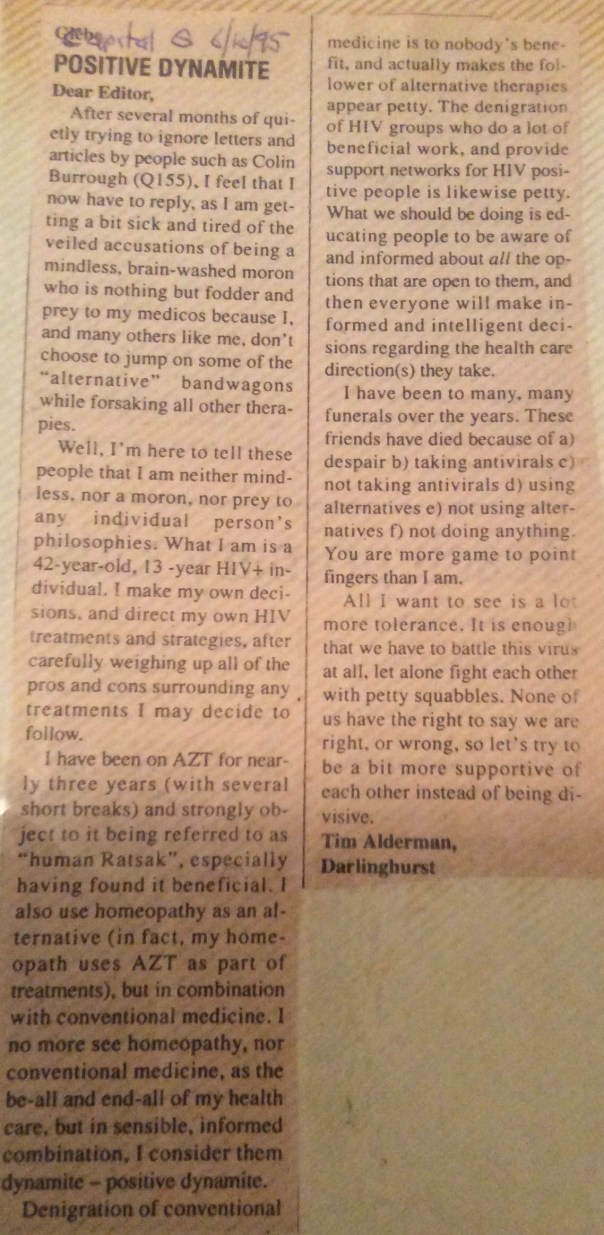
Capital Q – 6 April 1995. People having a bash at HIV people because they are not relying more on alternative therapies.
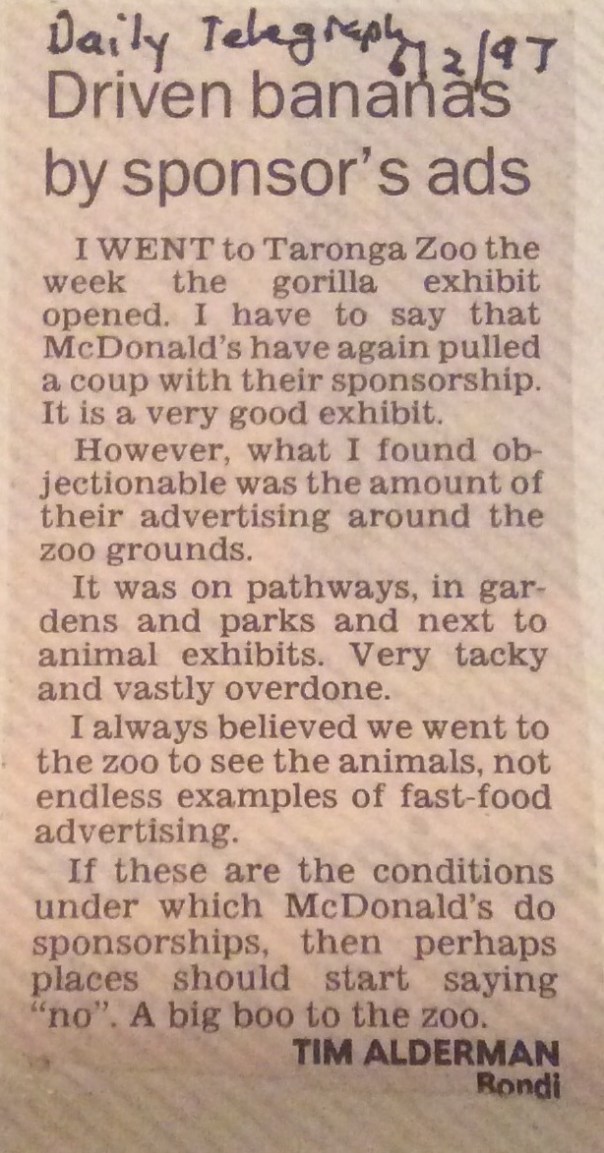
The Daily Telegraph, 6 February 1997. Having attended the opening of a gorilla exhibit at Taronga Park zoo, all I could really see everywhere was McDonald’s – the exhibits sponsor – advertising. Way over the top!

Sun Herald, 16 March 1997. Someone whinging about forms of address to customers in retail stores.
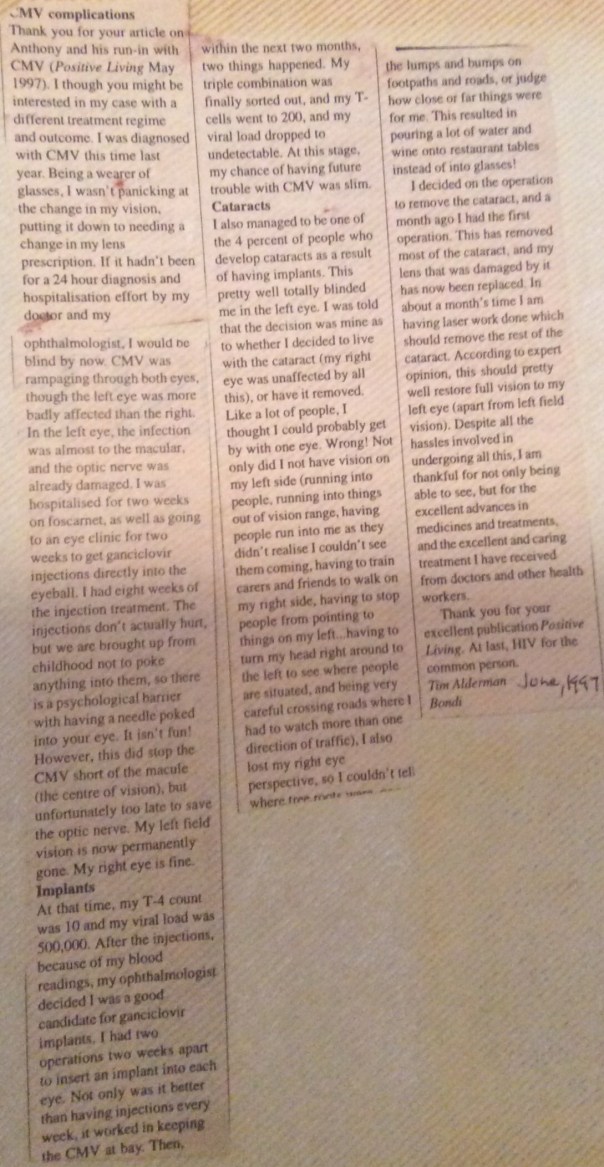
Positive Living, June 1997. My response to an article they ran on CMV Retinitis, something I was well & truly knowledgeable about.

Capital Q 1997. My one attempt to jeet a potential friend or partner through the gay classifieds. I opted for the fully out there, warts and all approach. All those that I met were either serial classifieds users, or just plain nut cases. I met Michael, from Rose Bay, who I had a brief “thing” with just proor to meeting David. I still have the letters from guys who responded…more than I expected.

Star Observer January 1998. Dawn O’Donnell’s 70th Birthday Party at Paddington Town Hall. My self & Phillip Metcalf attended as representatives of PLWHA. Photo is not clear as enlarged from a very tiny shot. I am in the rear, far tight.

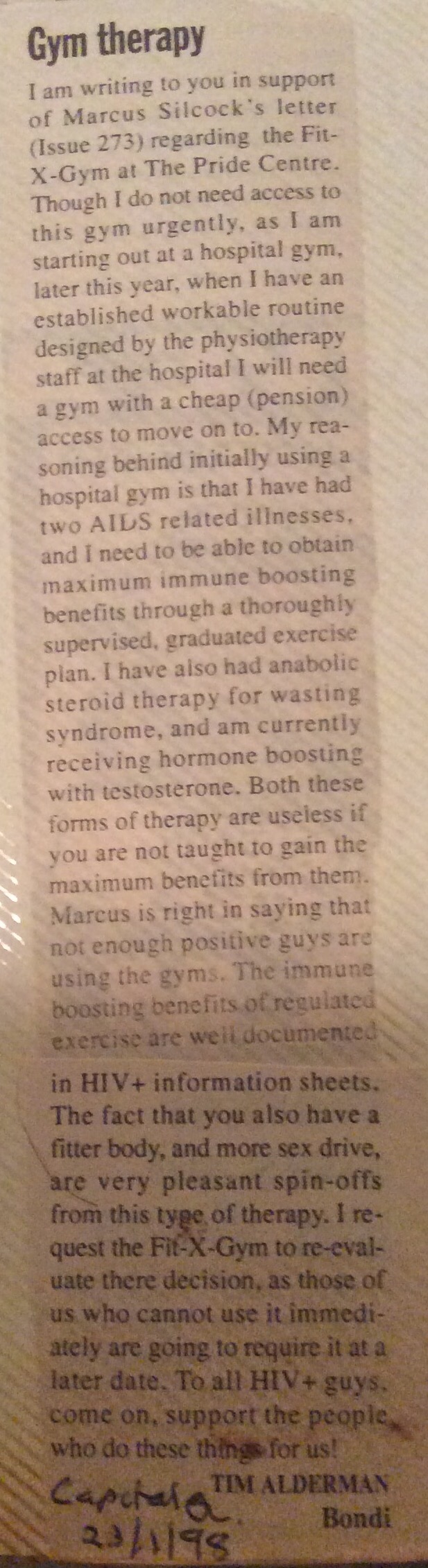
Capital Q 23 January 1998. A letter in support of my friend Marcus Craig, regarding the closure o a gym in the Pride Centre.

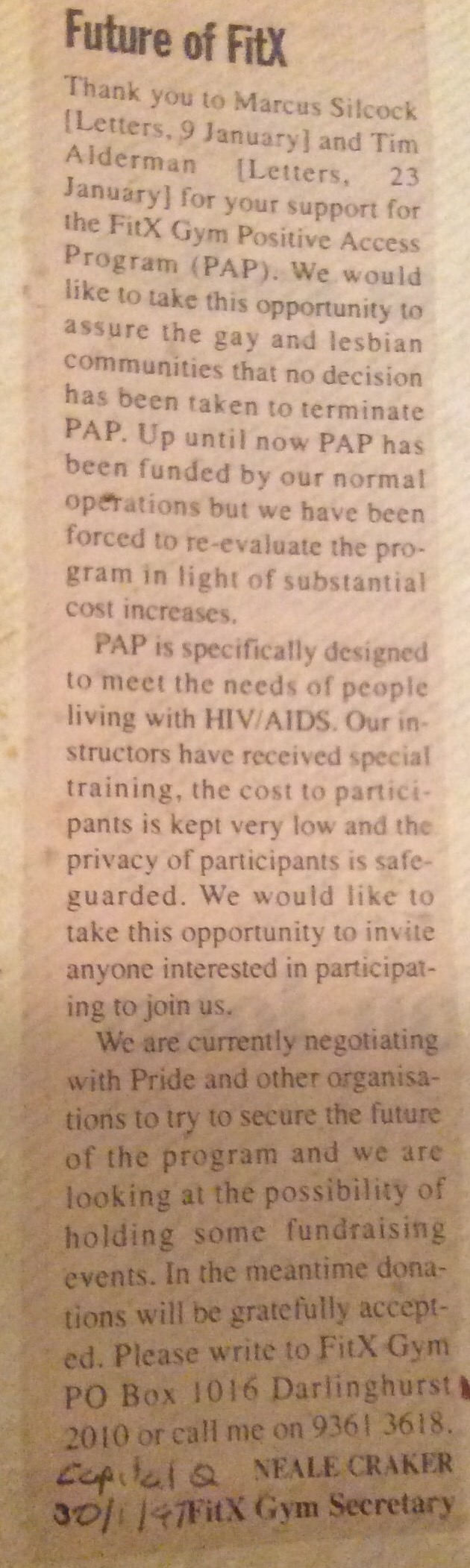
Capital Q 30 January 1997. The response of the gym owner to my and amarcus’s letter regarding its closure.

Wentworth Courier 1997. My gripes about life in Bondi! A true nightmare of a place to live in, esprcially in regards to transport & infrastructure.
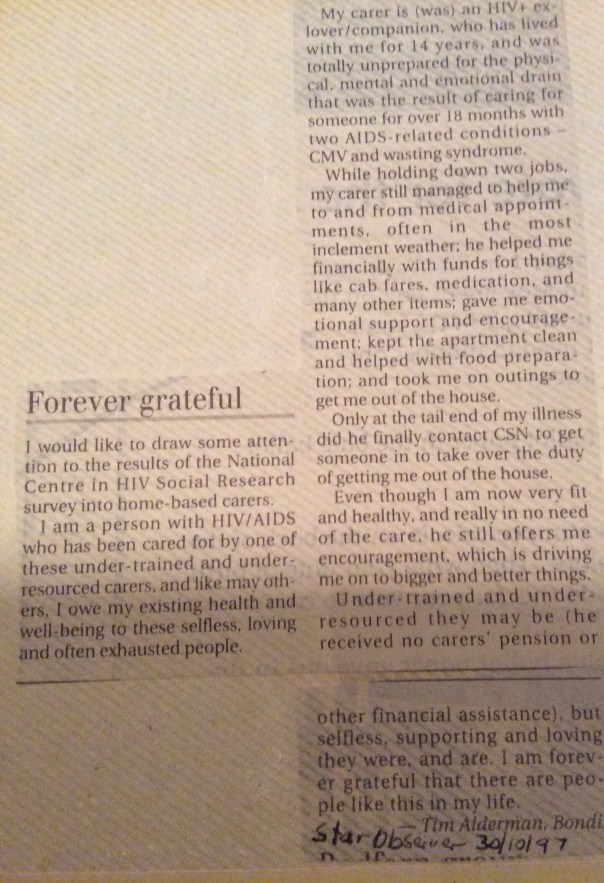
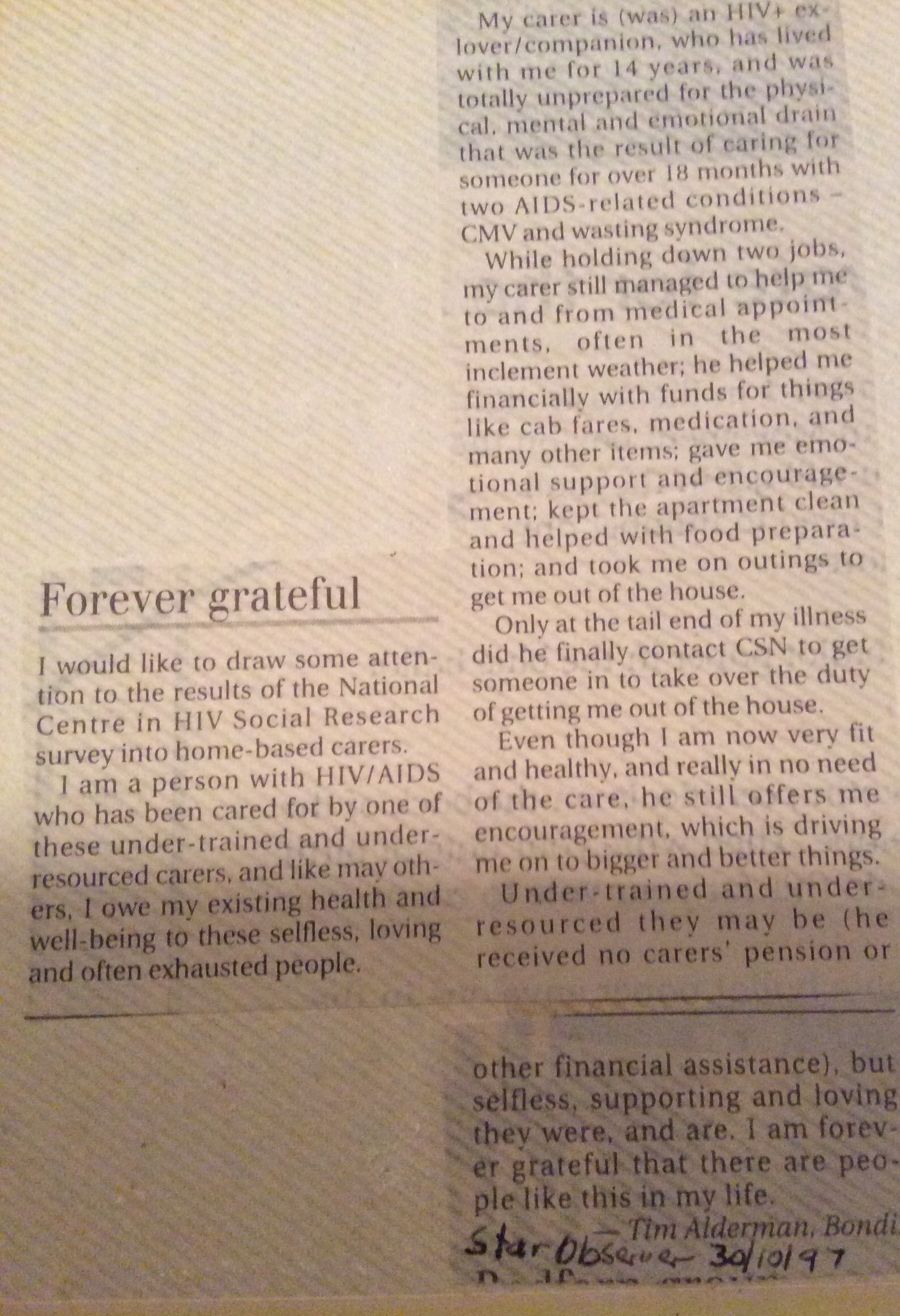
Star Observer 30 October 1997. A letter expressing my thanks HIV services.
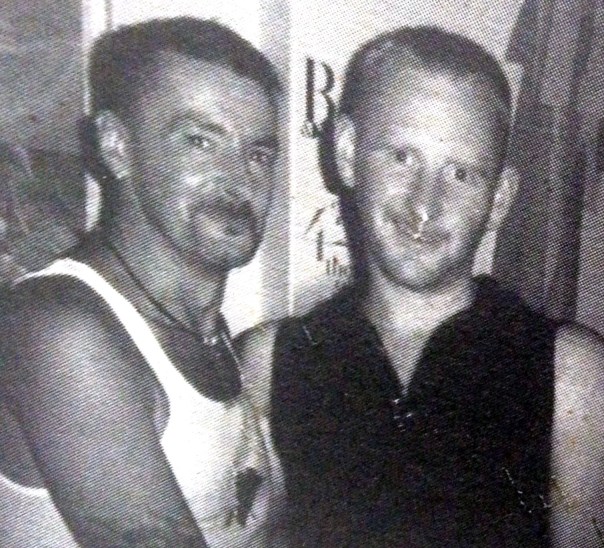

Star Observer 1998 – Myself (left) and David st the 1998 Mardi Gras Party. We had been in the parade, and are photographed here in the PLWHA Time-Out Room…a dpace set aside for guts with HIV to have a break during the party.
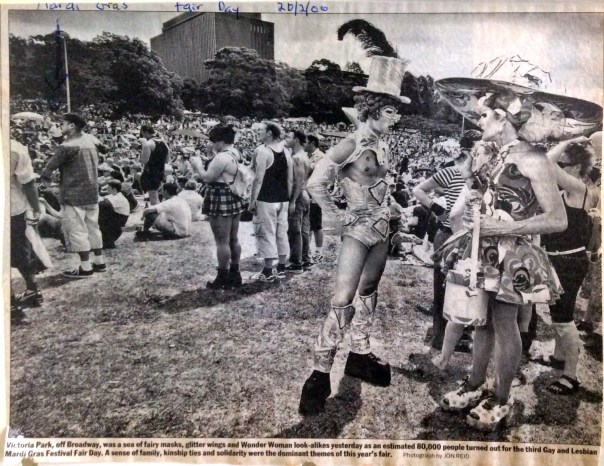
Star Observer 1998. Mardi Gras Fair Day 1998, probably the last I attended. I am to the far left of the photo in 3/4 shorts.

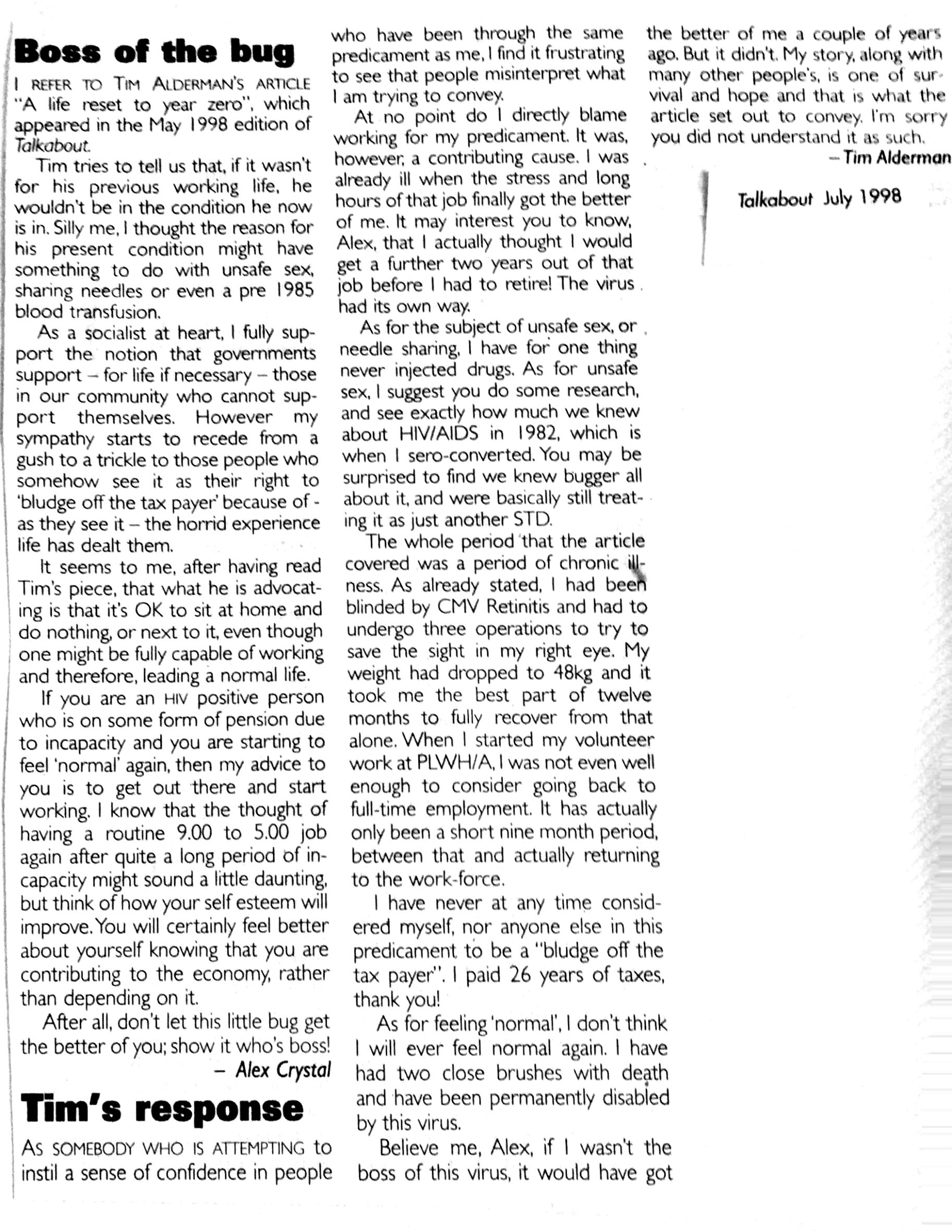
“Talkabout” July 1998. Alex Crystal had sent a letter to the editor critisizing an article I had written. Not only had this person not ever been as seriously ill as I had been in 1996, he had no empathy for the long recovery process, the psychological implications of surviving AIDS, nor coping with ongoing life with disabilities.
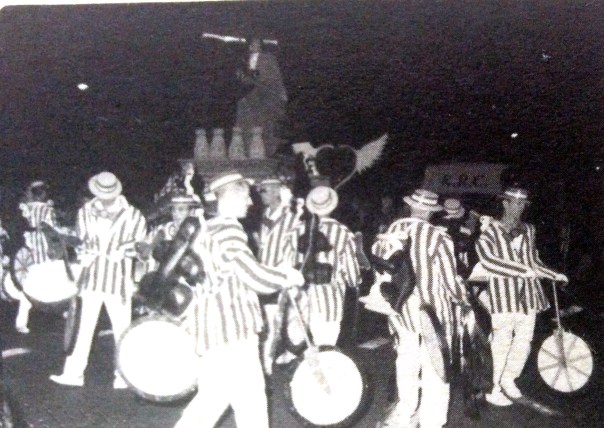
Probably Star Observer 1998. Mardi Grad parade entry for PLWHA – Dick Van Dykes on Bikes.
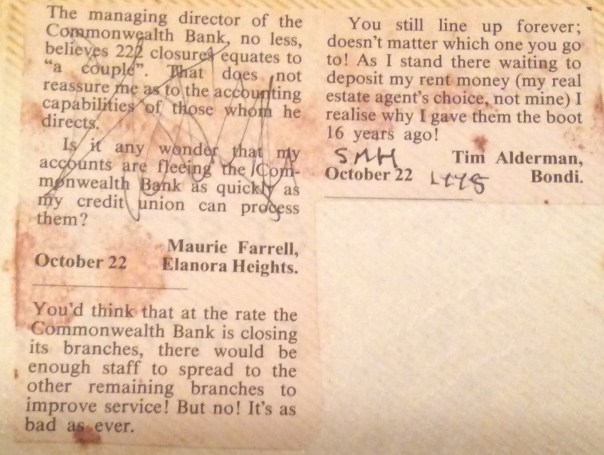
Sydney Morning Herald, 22 October 1998. A letter responding to the mass closures of banks – a trend that was soon to reverse.

“Talkabout” No.91, Octoger 1998. A esponse to a letter critisizing my friend Marcus Craig for representing gay men with pisitive body images in his art work. Some people need to get a life!.
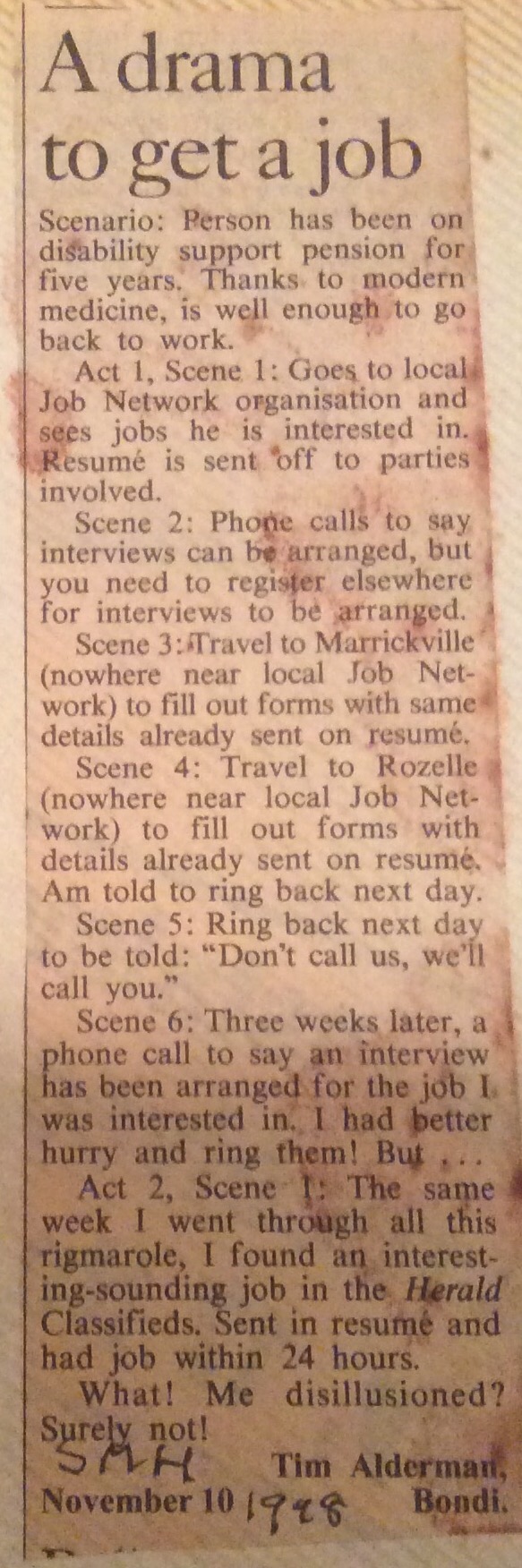
Sydney Morning Herald 10 November 1998. A letter regarding the fifficulties of obtaining work after serious illness, and when you are older.
“Net” Magazine, April 1999.,The mire everyday aspects of life, and dealing with technology.
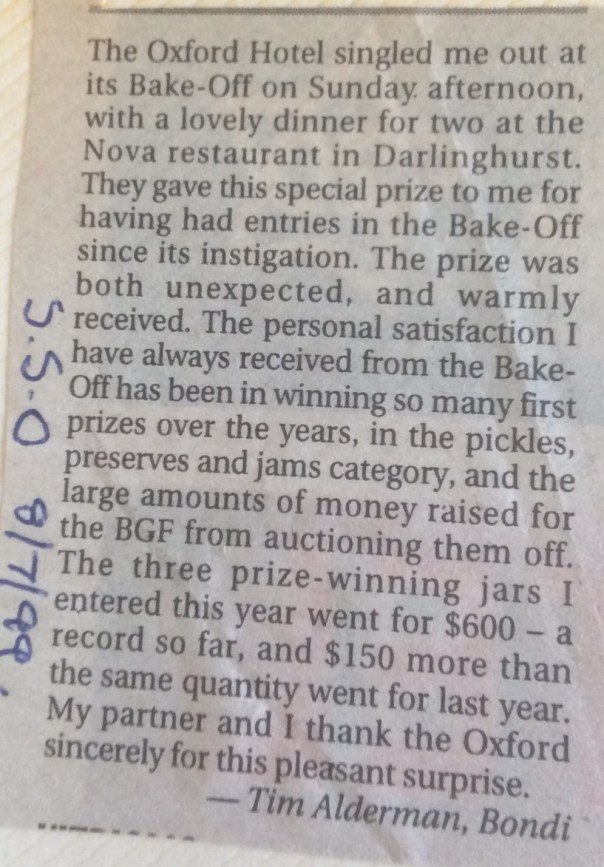
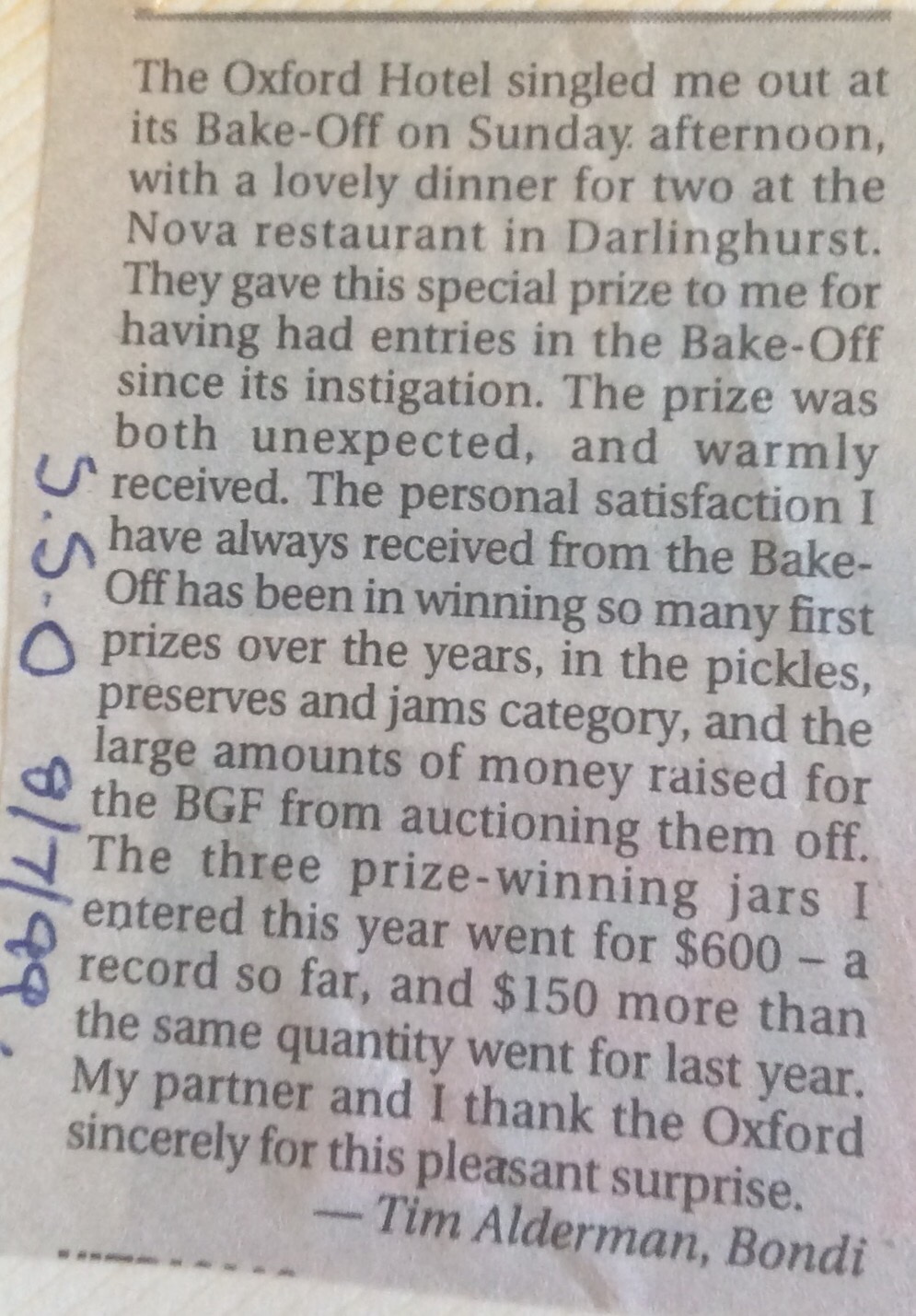
Sydney Star Observer 8 July 1999. A letter of thanks to The Oxford for awarding me a special prize for having entries in the BGF Bake-Off since its instigation.

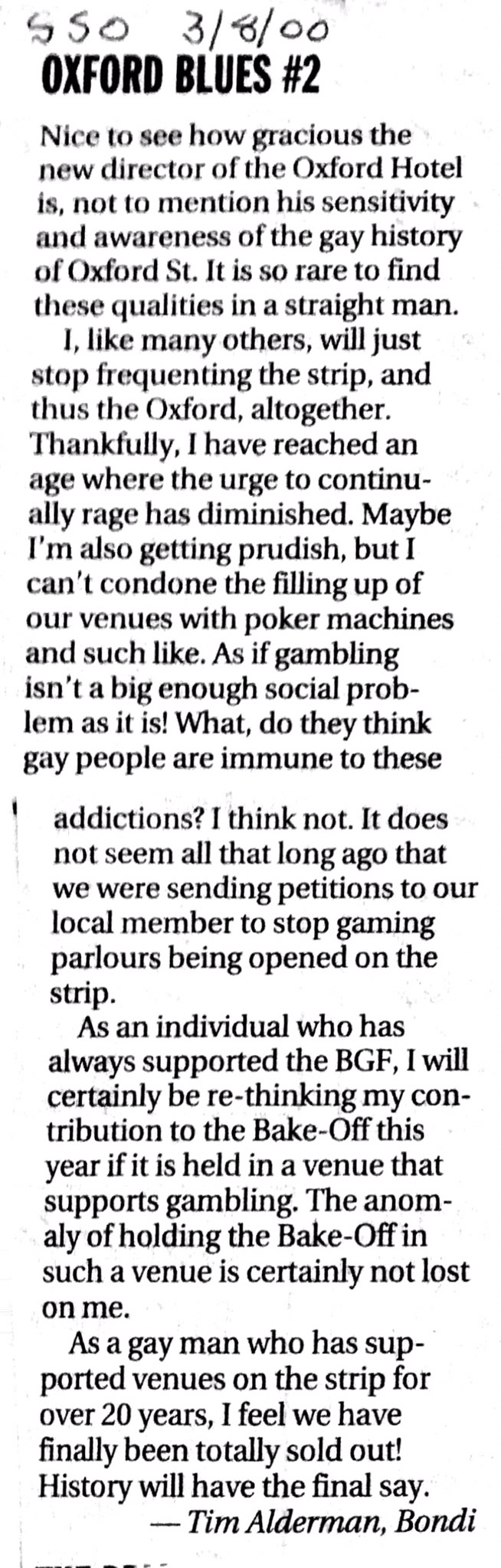
Sydney Star Observer 3 August 2000. The Oxford had undergone yet ANOTHER renovation, but this time a whole lot of poker machines had been added. Holding a charity auction in a place where money was being fed into machines was a bit ironic.

Good Weekend Magazine, 29 October 2000. A letter regarding an article they did on Stephen King, after his quite serious accident.
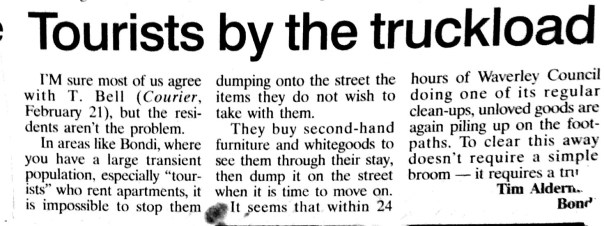
Wentworth Courier, February 2001. Letter regarding back-packers dumping inloved furniture etc on the footpath when they move on.

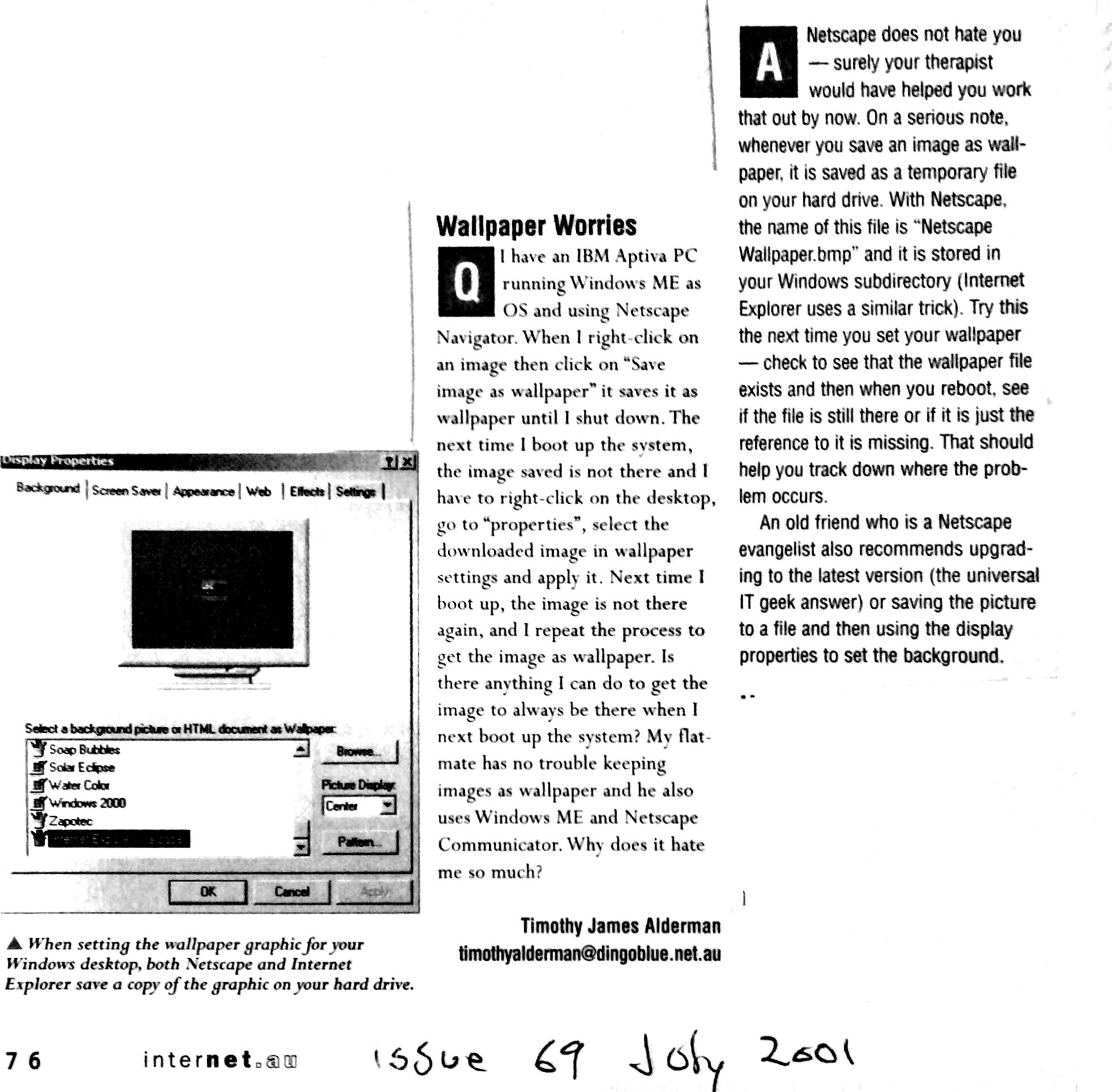
“Internet” Magazine, Issue 69, July 2002. Yet more mundane technology problems.
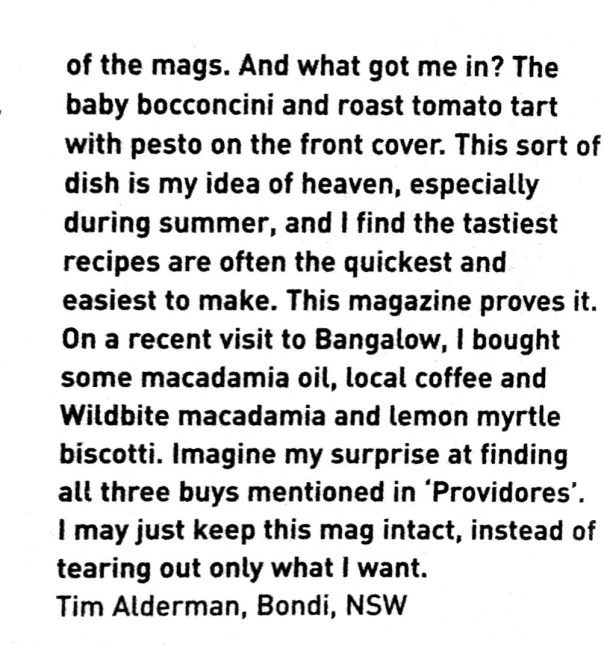
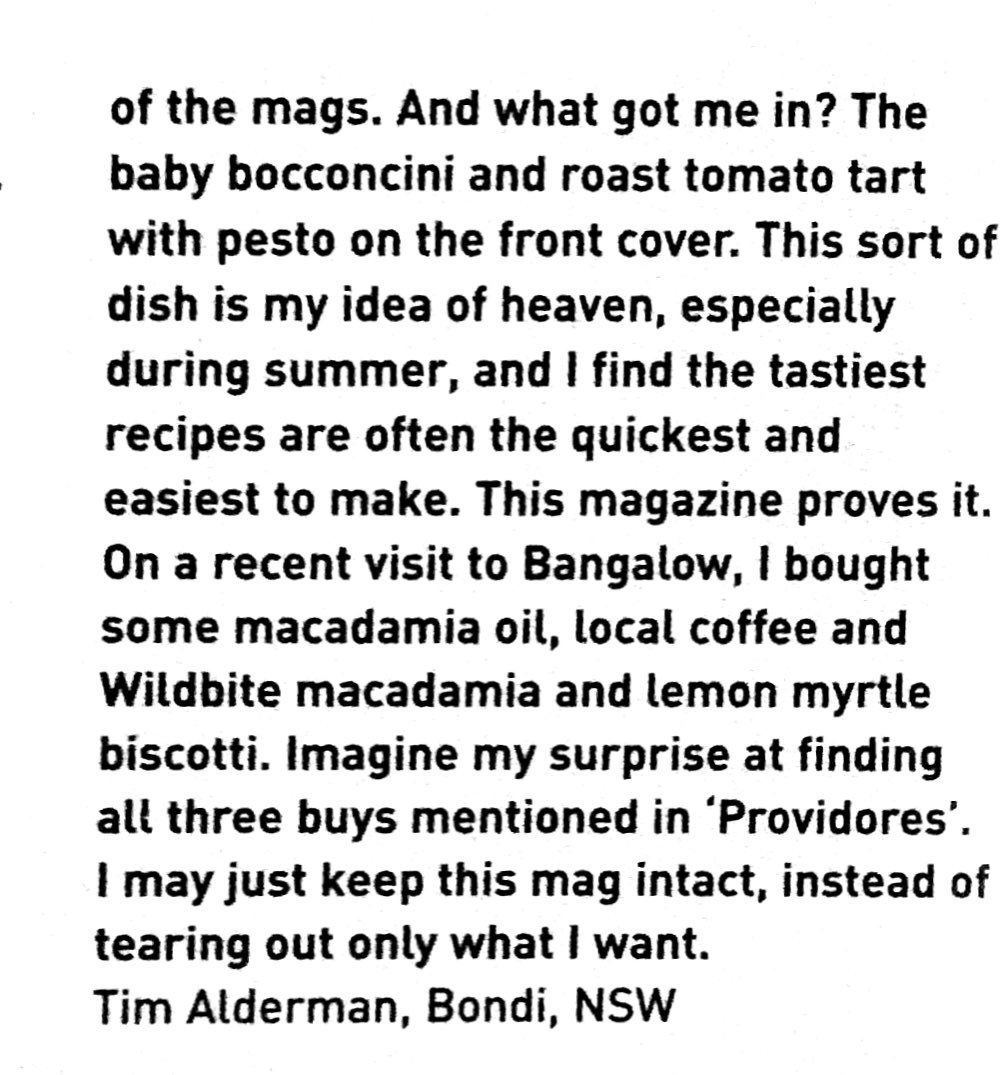
“Delicious” Magazine, February 2002. A great food magazine, if you enjoyed a LOT of tunning around to grt all the ingredients together for a recipe.


“DNA” Magazine, No.26, March 2002. A response to an article regarding gays, and religiiys dogma.
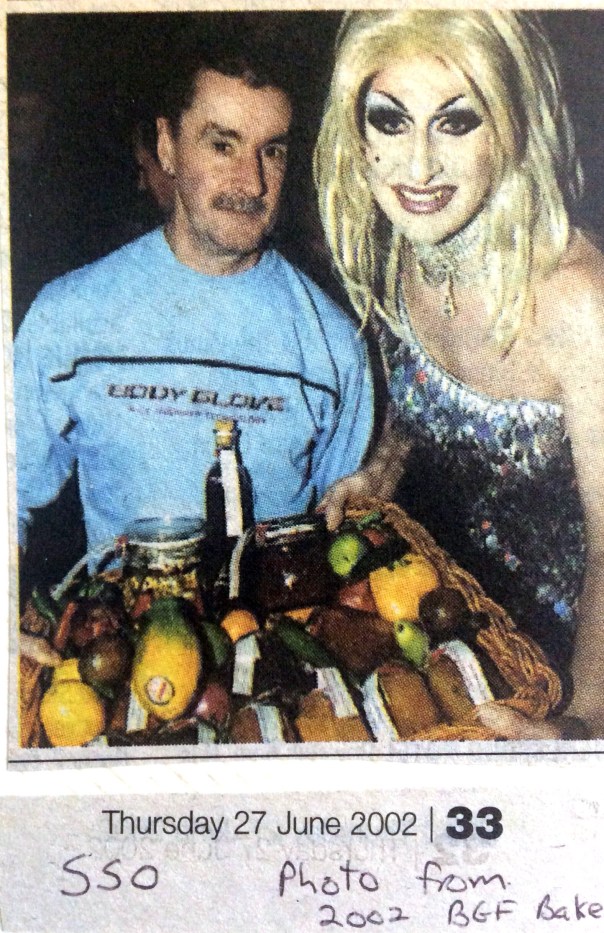
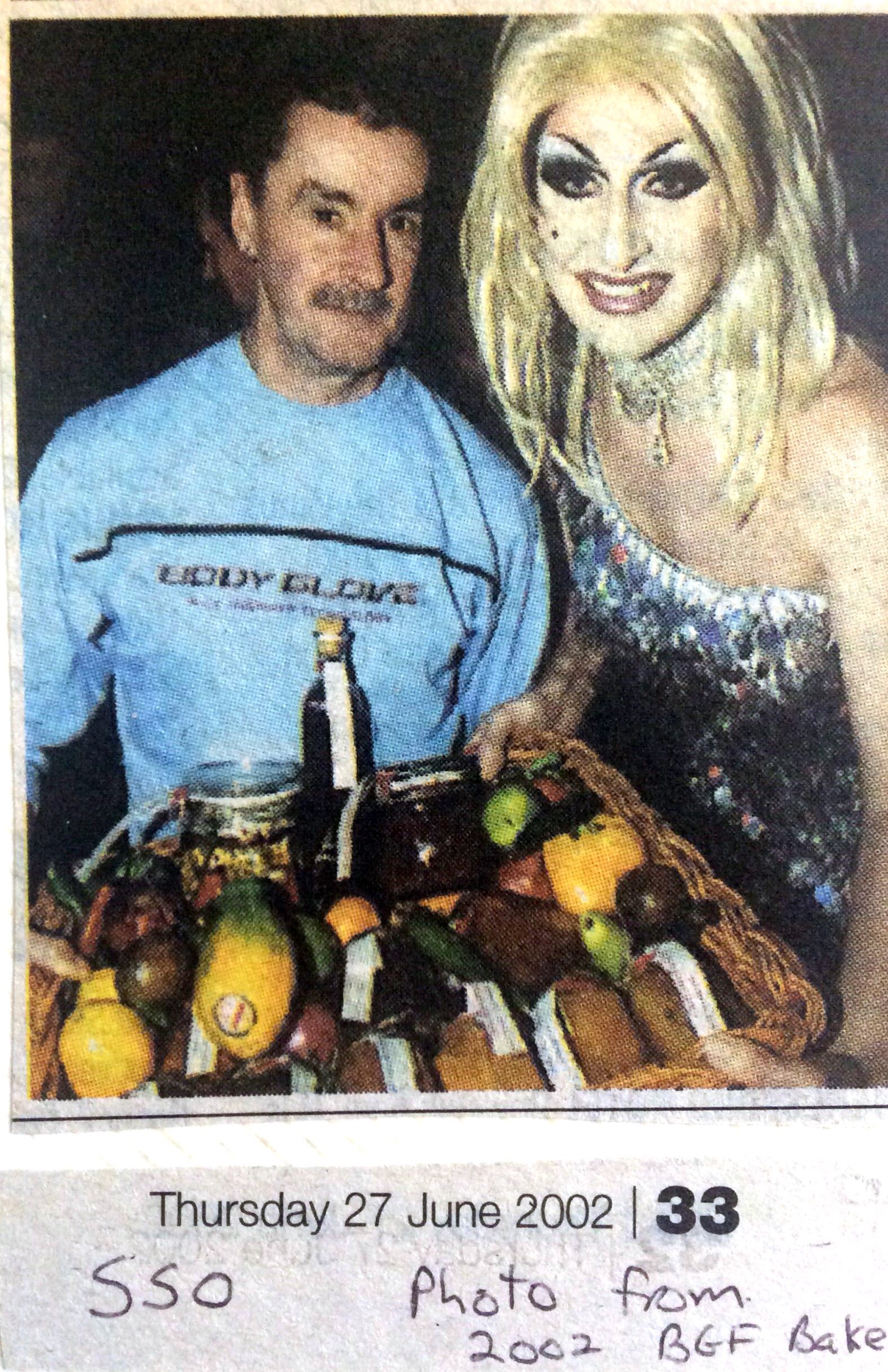
Sydney Star Observer 27 June 2002. Photographed at Arq with my winning entry in the Condiments & Preserves category, at the annual BGF Bake-Off. in 2002.

“DNA” Magazine, March 2003. A letter regarding an article in their Februarybissue regarding workplace bullying. The very start of the letter is missing.

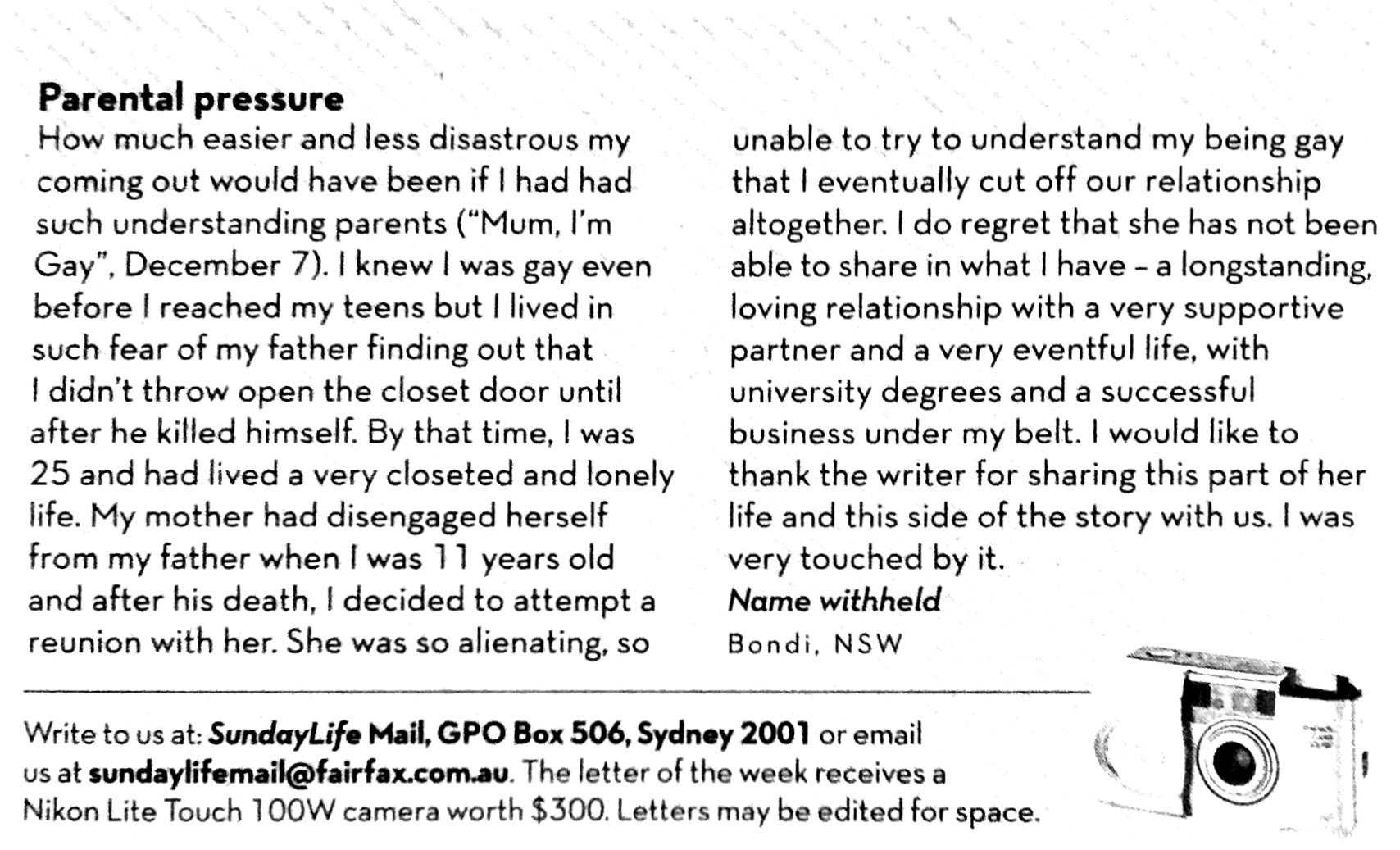
“Sunday Life” Magazine, December 2003. My response to a fery touching article on coming out as gay to ones parents.

“DNA” Magazine, February 2004. A tongue-in-cheek lettet regarding their very sexy photo shoots.

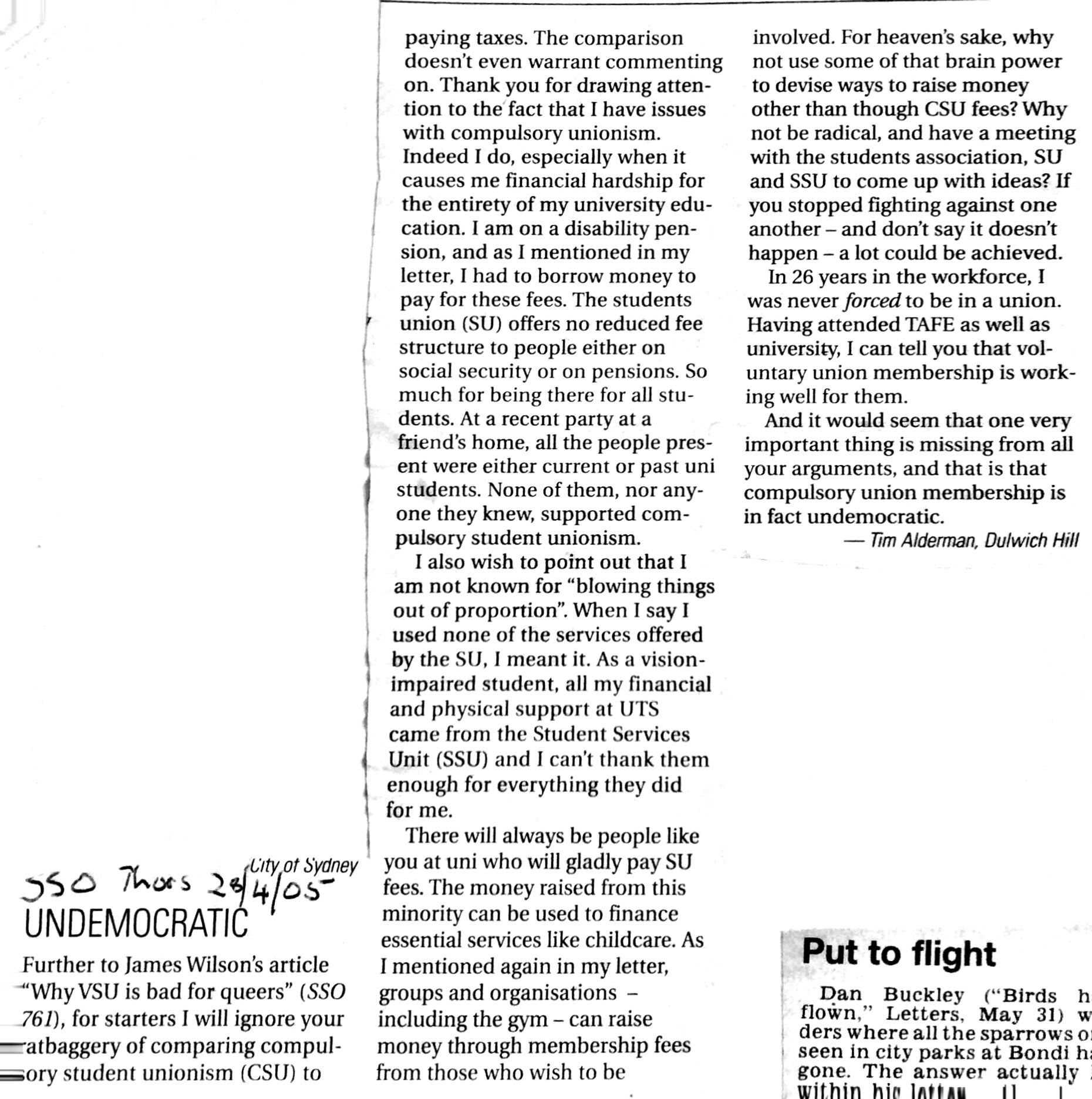
Sydney Star Observer, 28 April 2005. My having yet ANOTHER dig at the Student Services Union at UTS. I had bern at loggerheads with them for years over compulsory inion fees. Unfortunately, my original oetter regarding this is missing.
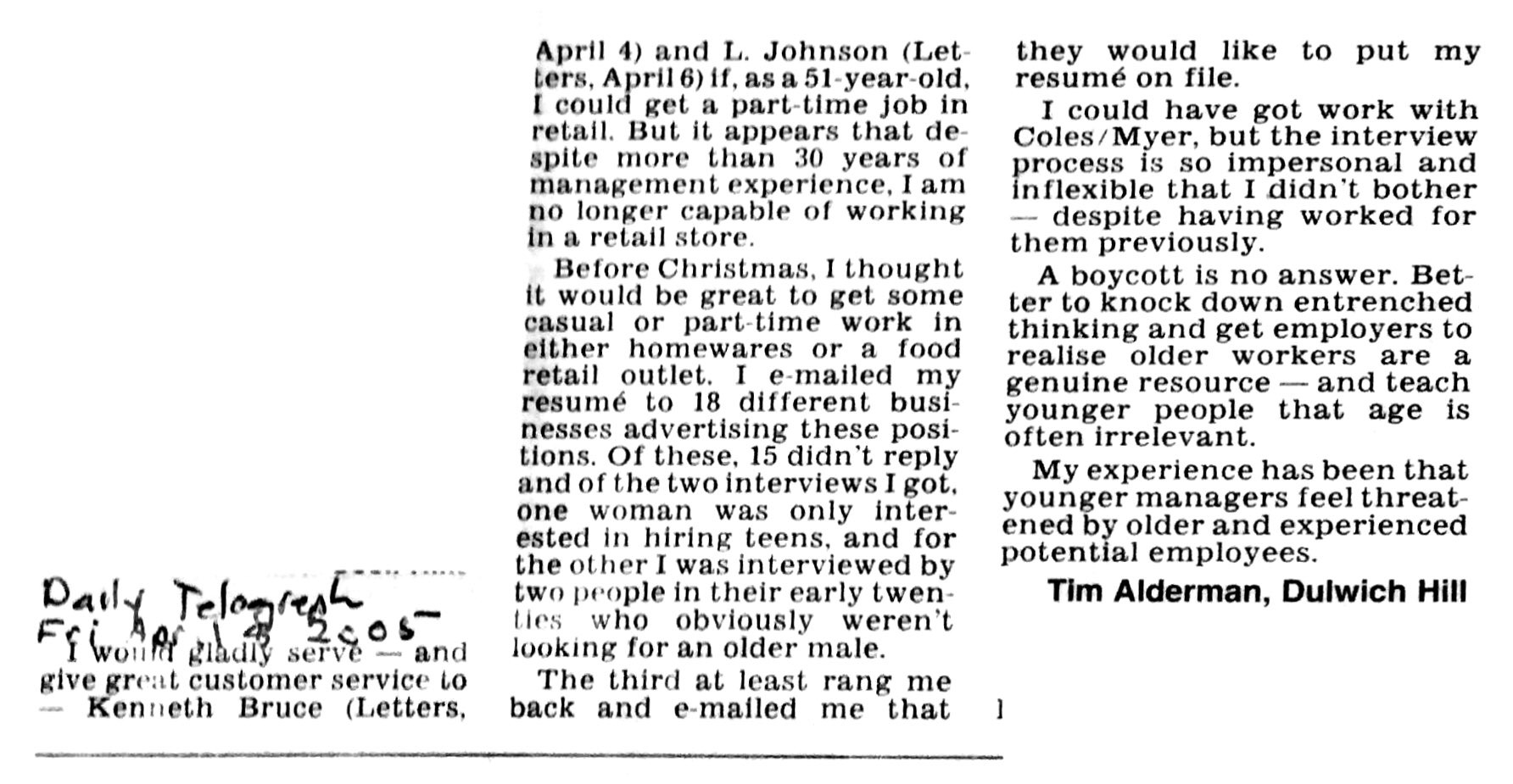
Daily Telegraph, 28 April 2005. The impossibility of getting work, even part-time, as you get older.

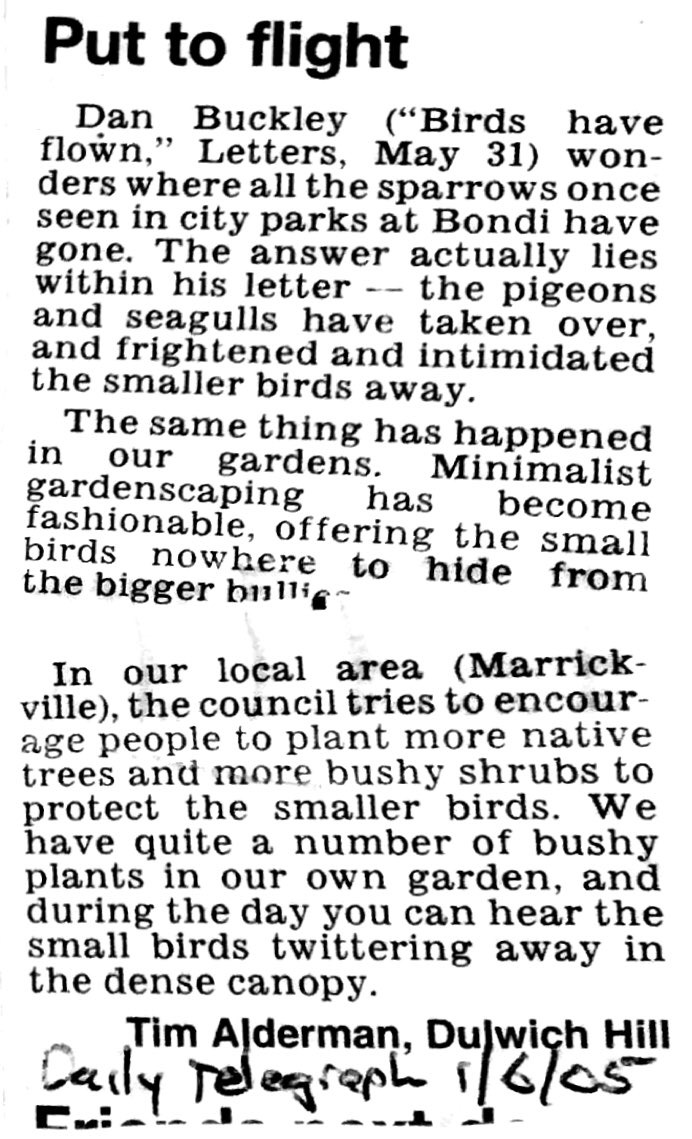
Daily Telegraph, 1 June 2005. Response to a ketter regarding the absence of small birds in our gardens.


Sydney Star Observer, 5 October 2006. David had, in a drunken moment at that years BGF Bake-Off, won an auction bid on a cake (bloody awful) and 2 Sleaze Ball tickets. We attended the party, and had an absolute ball, not at least helped along by some Ecstacy.
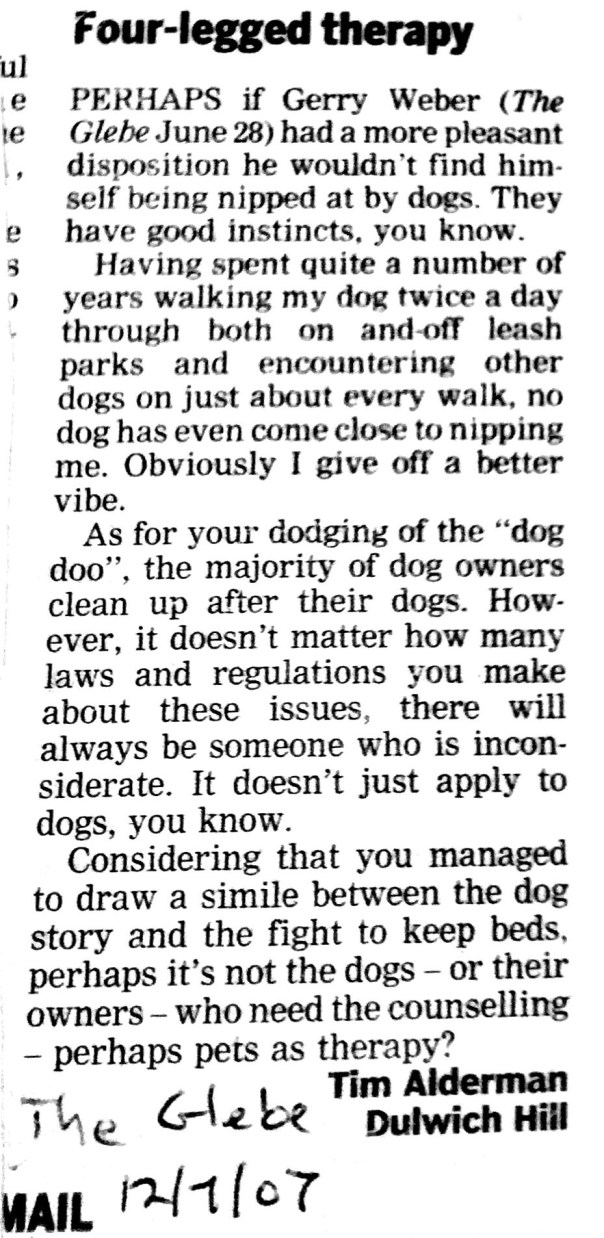

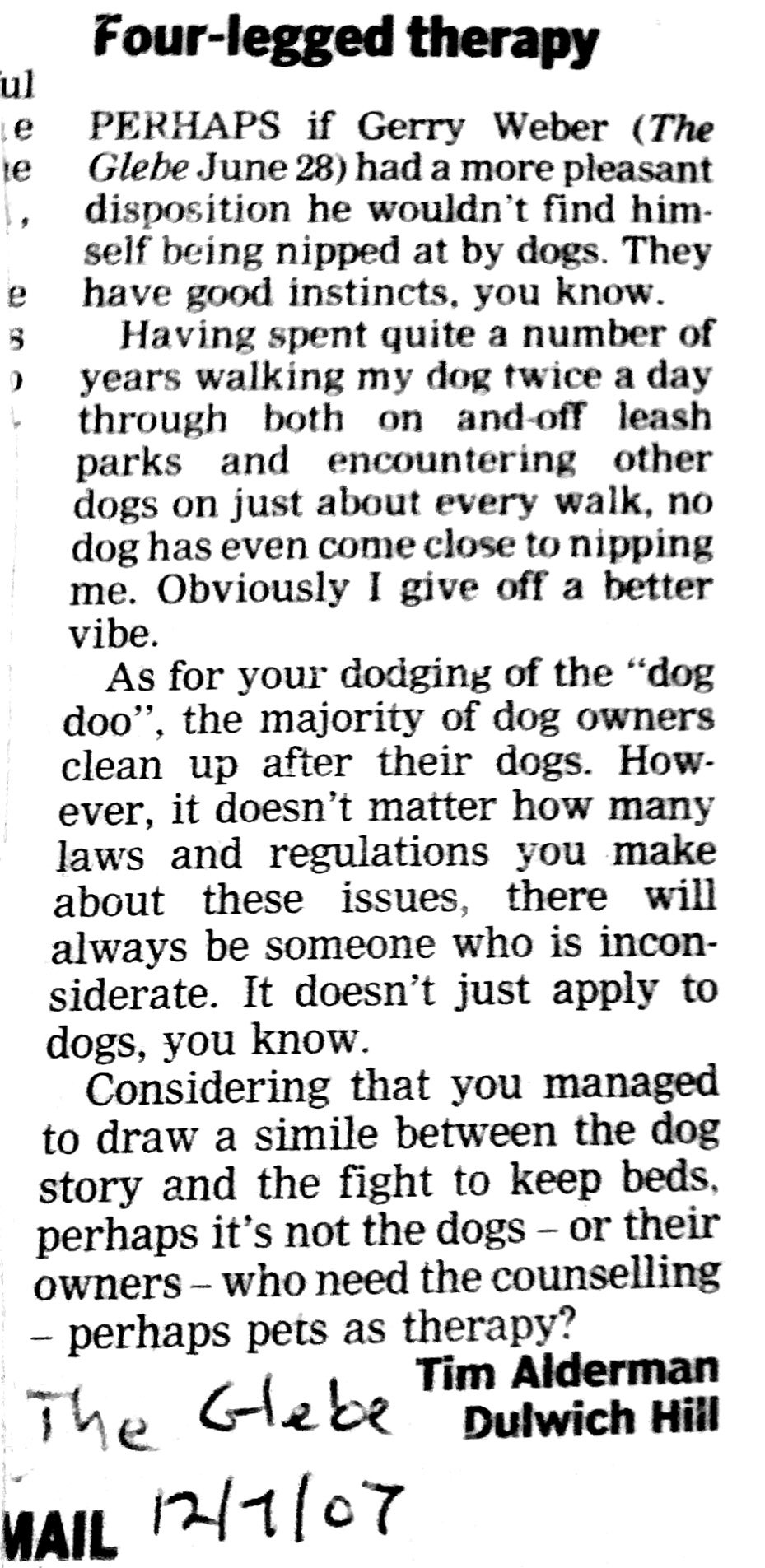
“The Glebe” 12 July, 2007. I take issue with people who are just unpleasant individuals. No wonder the dogs nipped him!

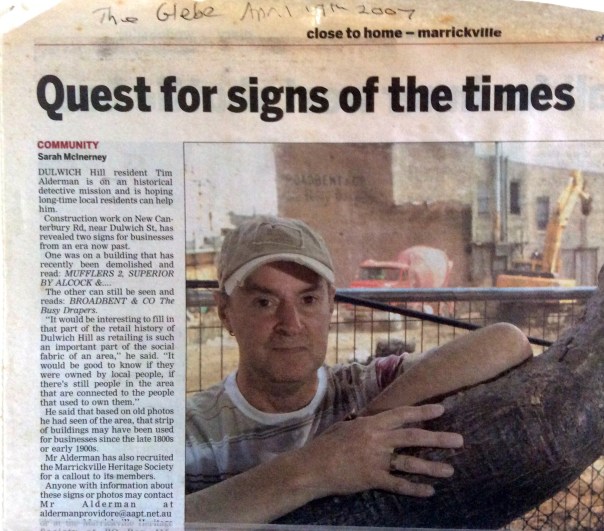
“The Glebe” April 17, 2007. After some demolition work in New Canterbury Rd, Dulwich Hill, some old painted shop signage appeared on the side of a remaining huilding, which had originally been hidden. I contacted the local paper, and they did a piece about it. The signage can be vaguely seen in the background.

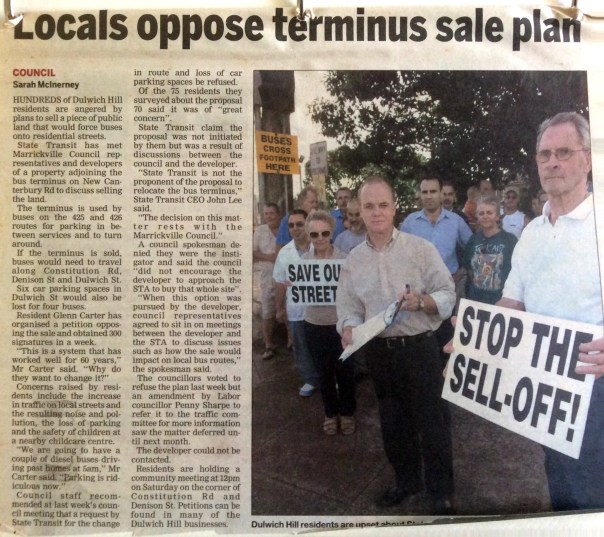
“The Glebe” 1 May, 2007. My involvement in a local protest about removing a small park at the topnof Marrickville Rd that had historical significance as a tram turning-circle. I’m in the background, dark glasses & cap to right of picture. I’m holding Benji, my dog.

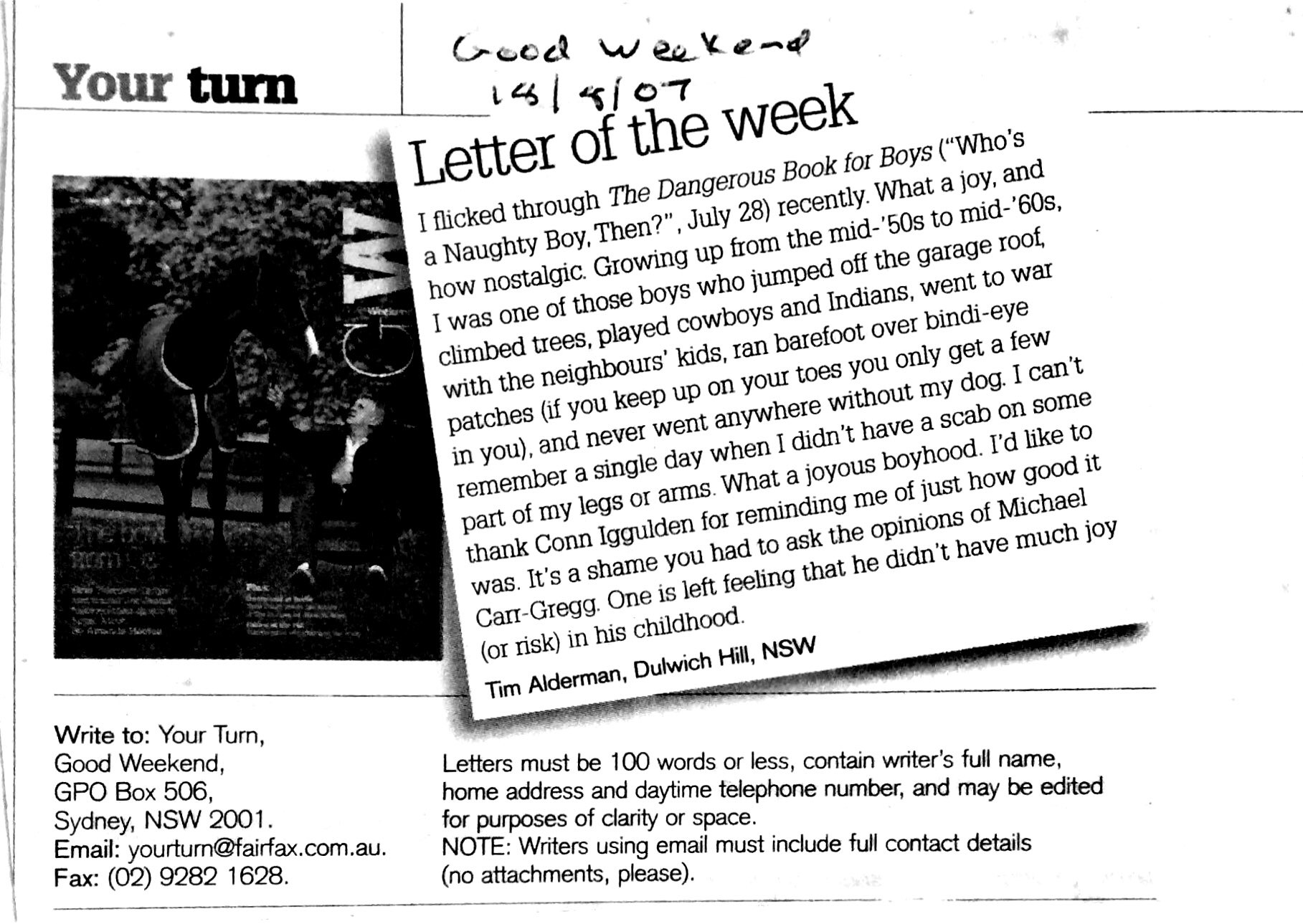
“Good Weekend” Magazine, 18 August 2007. A letter regarding the joys of childhood, which won me “Letter of the Week”, and the prize attached ton it – a weekend for 2 at Pepper’s Convent, in the Hunter Valley.
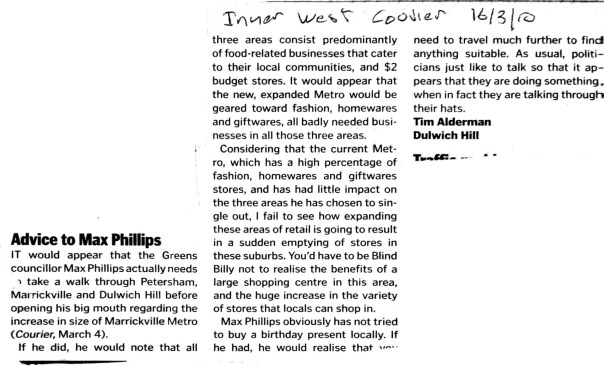
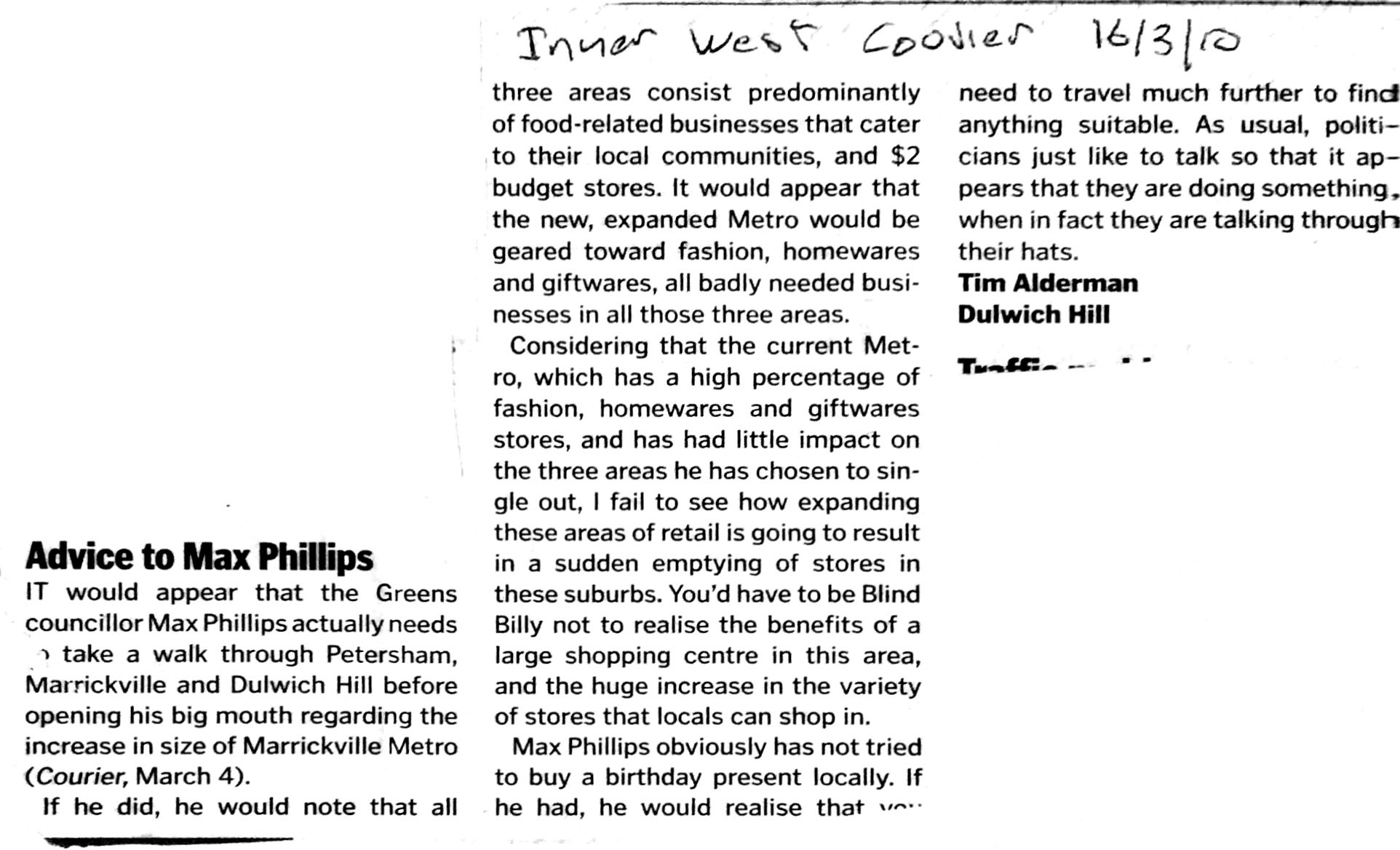
“Inner West Courier” 16 March, 2010. Local Treens rep is trying to thwart a much-needed recamp and extension to Marrickville Metro, and has obviously never shopped in our area.
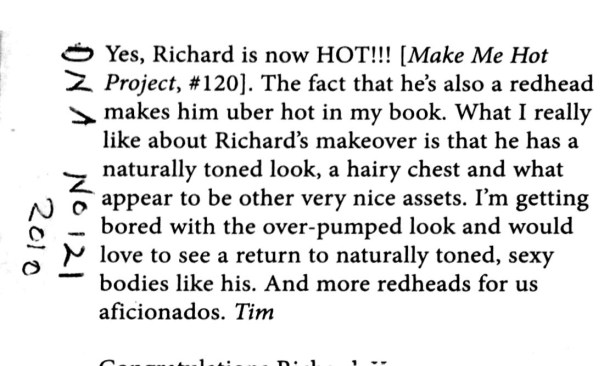
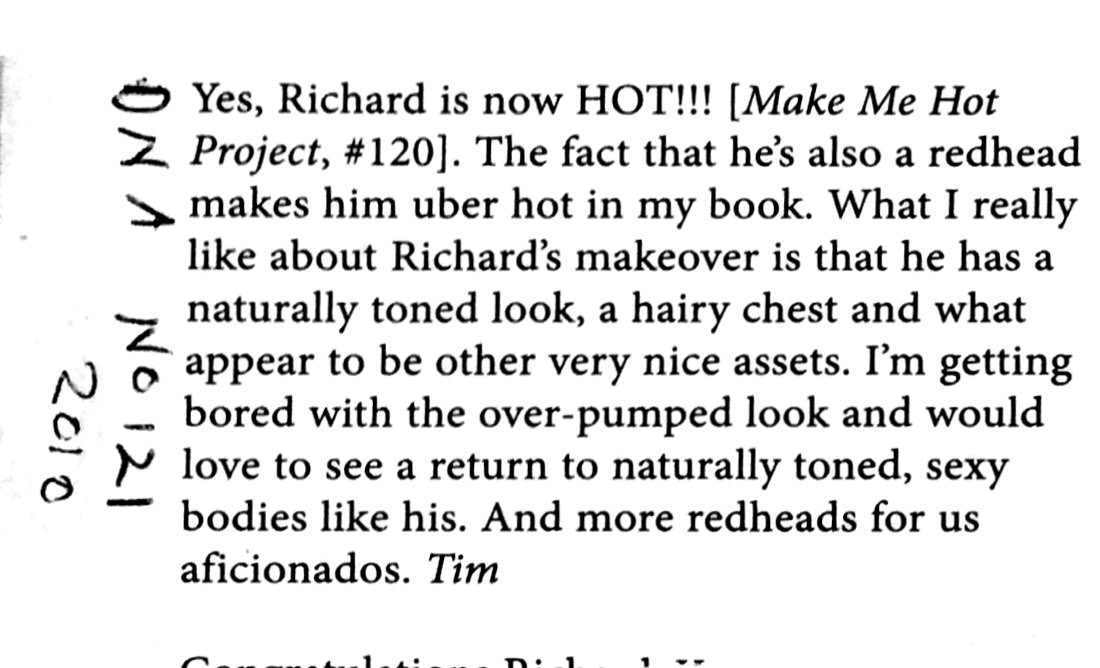
“DNA” Magazine No.121, 2010. In praise of a redhead make-over! Yum!
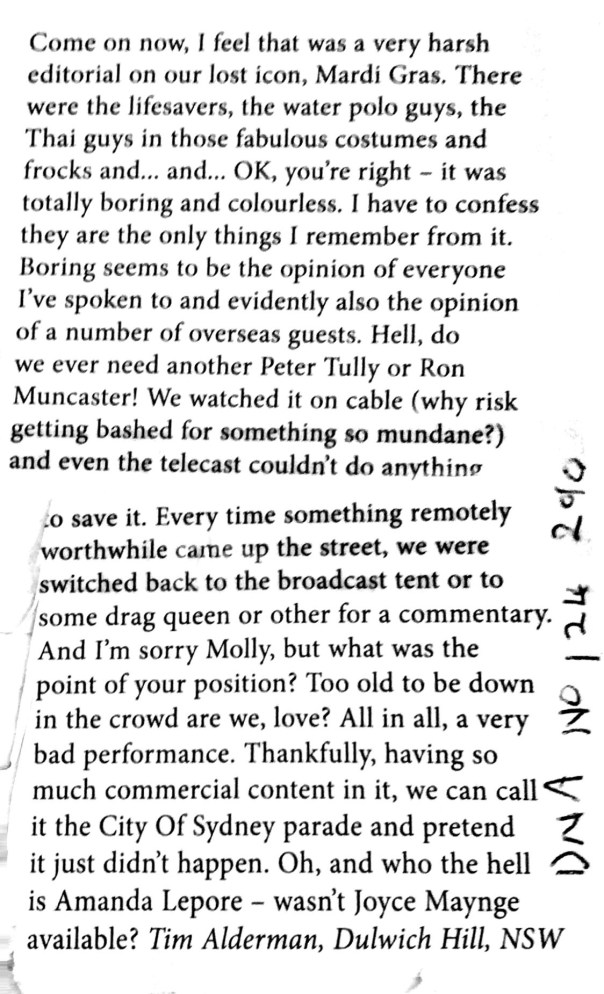
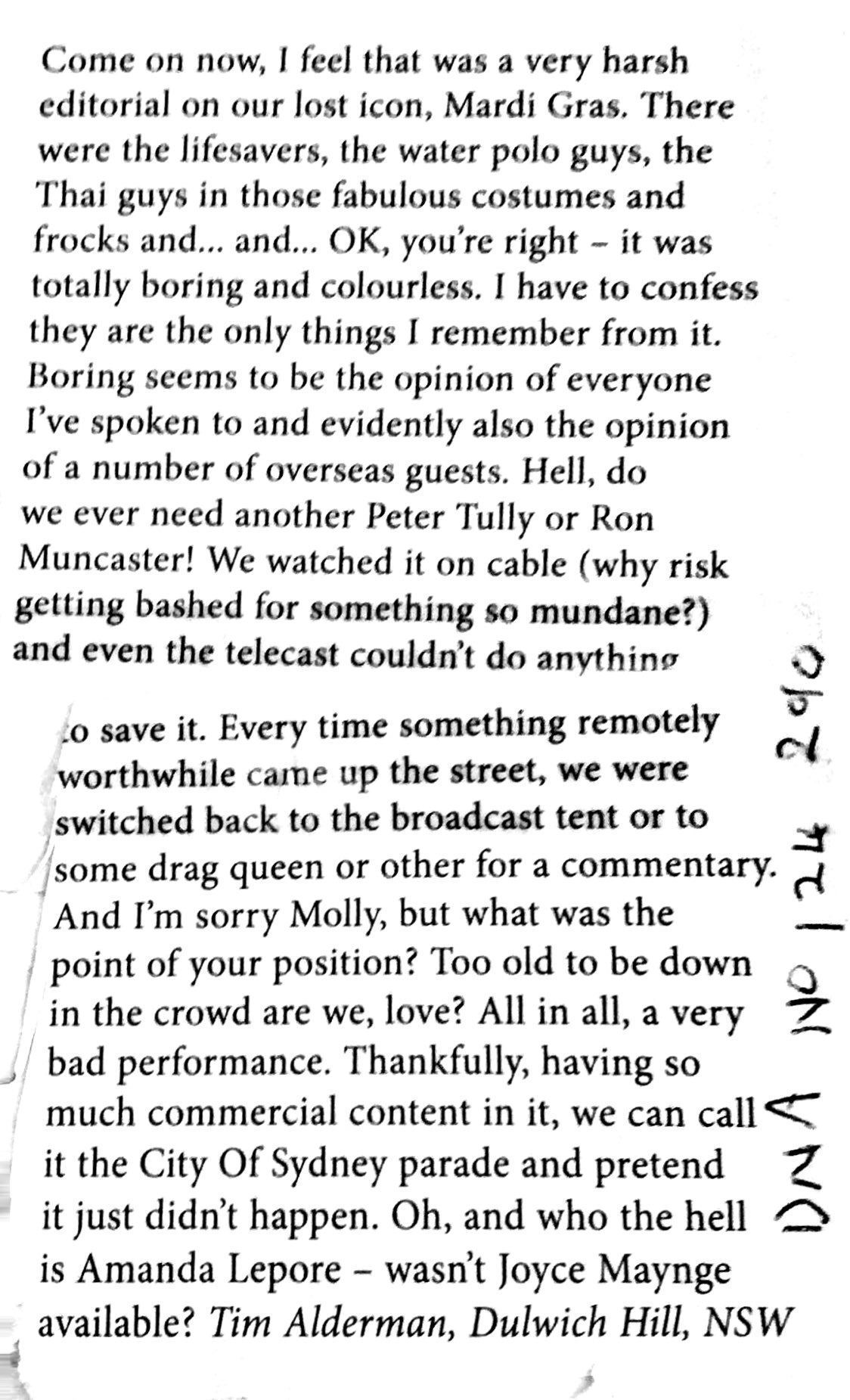
“DNA” Magazine No.124, 2010. A dig at a VERY boring Mardi Gras parade.

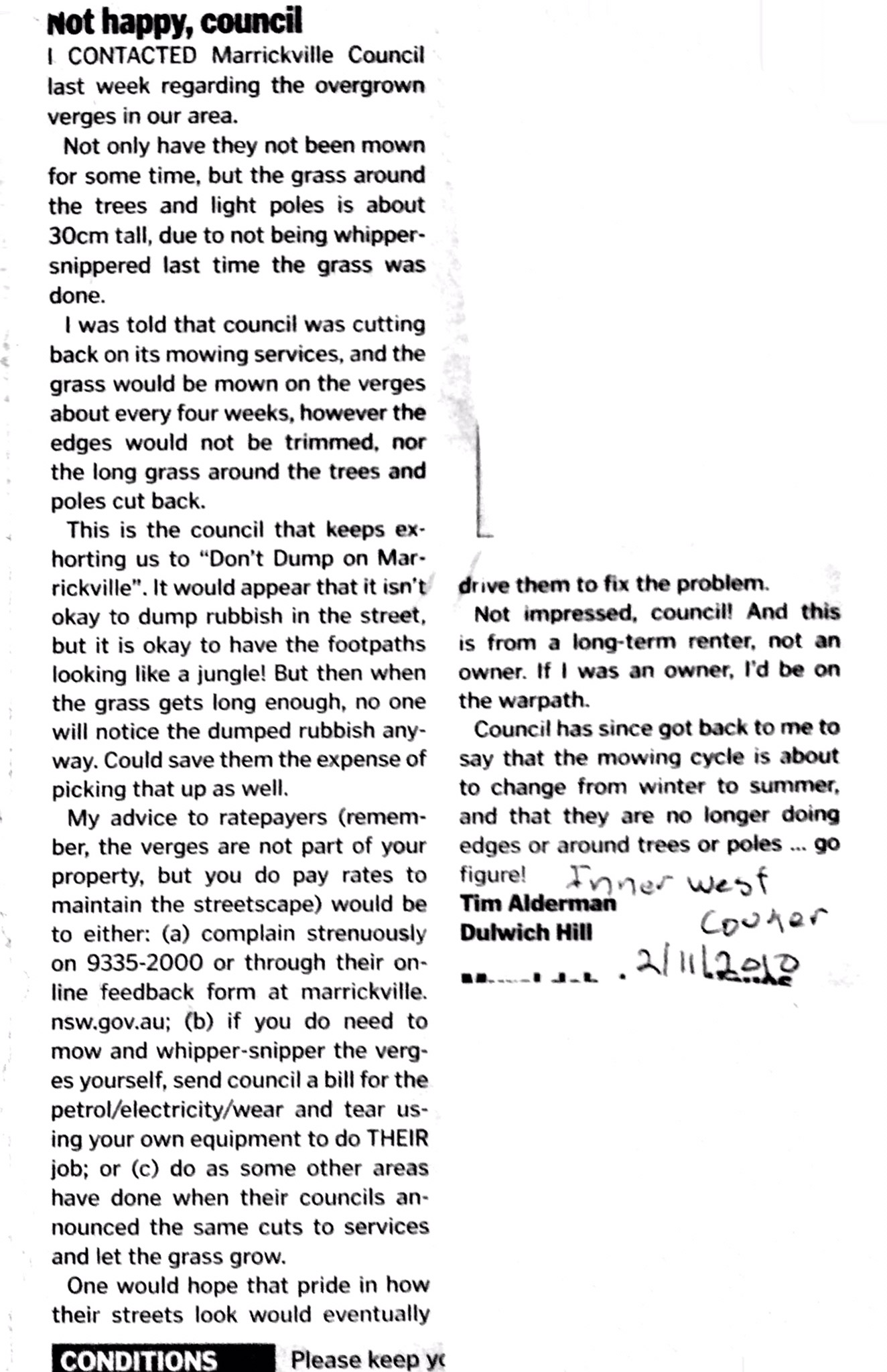
Inner West Courier, 2 November 2010. A whinge about cuts to mowing services that sre leaving yhe areas looking like jungles.
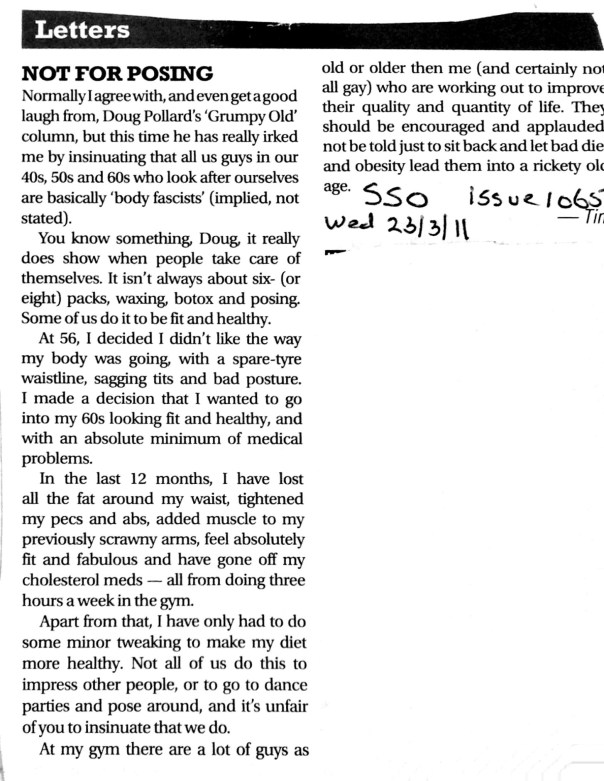

Sydney Star Observer, 23 March, 2011. A dig at a columnist who accused fit, healthy older guys of being posers.
A note to the Sydney Mirning Heralds “Column 8” about something locally amusing.

John “Happy Jack” Scaddan – Western Australia Premier 1911-1916. (Great Grand Nephew of Richard Scaddan (Convict))

Despite notes on the Scaddan family tree that “Happy Jack” Scaddan was the Prime Minister of Western Australia, he was, in fact, Premier.

John Scaddan (1876-1934), miner, engine driver, premier and businessman, was born on 4 August 1876 at Moonta, South Australia, second youngest of twelve children of Richard Scaddan, hard-rock miner, and his wife Jennifer, née Smitheram, Cornish migrants. The family moved to Woodside where John attended primary school. When he was 13 the family moved to Eaglehawk, Victoria, where he worked in the mines, read widely, attended the Bendigo School of Mines part time, and gained an engine driver’s certificate. He played football and was a Methodist Sunday school superintendent.

In 1896 Scaddan went to the Western Australian goldfields and operated a stationary steam-engine at a mine. On 9 May 1900 at Boulder he married Elizabeth Fawkner, who died on 21 September 1902 of Bright’s disease. On 1 September 1904 he married Henrietta Edwards.
A member of the Goldfields Amalgamated Certificated Engine-drivers’ Union, he won Ivanhoe for Labor at the State election of 28 June 1904, when the party’s strength in the 50-man Legislative Assembly rose from 6 to 22; he had been out of work and thought he ‘might as well have a fly’. He spoke mainly on gold-mining issues, principally mine regulation and the inspection of machinery, but by 1906 began to debate more widely. In 1906-11 he was secretary of the Australian Labour Federation (Western Australian Division); in that post he helped to arrange the building of the Perth Trades Hall.

By 1909 Scaddan was one of Labor’s main parliamentary speakers, prone to make speeches of up to three hours. On 3 August 1910 he was elected party leader, succeeding Thomas Bath. His first major controversy as leader was his attack on an electoral redistribution by Frank Wilson’s Liberal government. It was alleged to be a gerrymander, but the October 1911 election was a Labor triumph.

Scaddan campaigned on a wide-ranging radical policy, largely as laid down by the 1910 State congress. His victory, by 34 seats to 16, made him the first Australian to lead a State Labor government with a substantial majority; it has never since been equalled by a Western Australian Labor premier. At 35 he was also the youngest premier the State had seen. The government’s main strength lay in the goldfields and metropolitan working-class areas. In almost five years, the eight-man cabinet saw only one change of personnel.

Scaddan was also treasurer; he led a reformist government which did much to aid the State’s economic development, while implementing policies benefiting wage-earners. It set up a Workers’ Homes Board, modified the arbitration system to help unionists and increased workers’ compensation benefits. It abolished secondary-school students’ fees, raised the land tax, and in 1912 introduced a graduated income tax, which it greatly increased on the outbreak of World War I. It also amended the laws relating to divorce, the criminal code and irrigation. Thus its relations with the rank and file were much more harmonious than in New South Wales. Scaddan’s achievements came despite opposition from the Liberal-dominated Legislative Council, which blocked or amended at least forty bills, including one to end alienation of crown land.

The government rightly saw the wheat industry’s development as the key to the State’s growth, as gold-mining declined. The area sown to wheat trebled in 1911-16, as did production. 

Scaddan expanded facilities for technical advice to farmers, and greatly liberalized the lending terms of the Agricultural Bank. Railways were built at the highest rate—239 miles (385 km) a year—in the State’s history and most construction was in the wheatbelt. By 1914 Western Australia had a far higher ratio of mileage to population than any other State, but in 1914-15 the railways ran at a loss for the first time in twenty years. In the 1914 drought, which severely cut average wheat yield, Scaddan set up the Industries Assistance Board; seed-wheat, superphosphate and fodder were distributed to needy farmers. He was rewarded with a record harvest in 1915-16; however, heavy expenditure brought the government deficit to the unprecedented total of £1 million; Scaddan was dubbed ‘Gone-a-Million Jack’. He responded, ‘As if the workers hadn’t got the deficit in their pockets!’

Scaddan’s most spectacular move was to establish many state trading concerns, part of the party policy of creating ‘state socialism’. To circumvent the Opposition-dominated Legislative Council, he used executive rather than legislative methods. During the parliamentary recess of 1912 he spent £100,000 from the loan suspense account to set up these enterprises, principally the State Shipping Service with the purchase of four steamers. By the end of his term the government had also set up a brickworks, an agricultural-implement works, sawmills and a fishing business, and entered every phase of the meat industry from breeding stock to the retail trade. It had taken over Perth’s tramway and ferry system, and ran a dairy farm, abattoirs, a quarry, and hotels.

Premier John Scaddan toured the south east of Western Australia in 1915. His party visited the towns of Norseman, Salmon Gums, Grass Patch, Esperance, Gibson, Ravensthorpe, Kundip and Hopetoun.

Scaddan’s was a doctrinal approach to specific problems. The shipping service was to prevent northern pastoralists exploiting southern meat consumers through a shipping ring. The sawmills supplied sleepers for the transcontinental line and developed unused forest resources. The brickworks countered a price-fixing racket and provided cheaper, better bricks for workers’ homes. The agricultural-implement works were in response to farmers’ complaints about costly machinery. Dissatisfaction with Perth’s private tramways was so great that some of Scaddan’s fiercest critics strongly supported his government’s takeover, the details of which he concluded in England in 1913. The dairy farm supplied unadulterated milk to hospitals and doctors testified that it saved lives.

The formation and early life of most of these trading concerns was surrounded by controversy; opponents objected to them on principle. Most had serious operating problems and their standing suffered because they had no proper accounting system. The State Shipping Service and the agricultural-implement works were the most plagued by inefficient management, losses and shoddy work, but the implement factory was defended because it helped farmers in 1915-16. Scaddan declared that profits were of secondary importance. Even the tramway purchase caused him trouble, as services barely improved. Some Labor men saw the enterprises as unemployment relief projects. Scaddan’s cabinet became angrily disillusioned that so many of the government’s employees were lazy and unco-operative and acted as if the business had been created for their benefit, rather than the community’s.

MINISTER FOR HOME AFFAIRS MR W. O. ARCHIBALD LAYS THE FOUNDATION STONE FOR THE GENERAL POST OFFICE BUILDING CIRCA 1915. WITH HIM IS THE PREMIER JOHN SCADDAN (LEFT) AND CONTRACTOR MR C. W. ARNOTT.

One of Scaddan’s last enterprises, the Wyndham meat-freezing works, helped to destroy his government. In 1914 he had accepted an offer from S. V. Nevanas, a London financier, to build the works at a price which departmental experts insisted was unrealistically low. Nevanas had to abandon the work, receiving compensation when the contract was cancelled. As Scaddan’s ineptitude was revealed, criticism abounded; this was significant as his majority had been cut to two at the October-November election, which saw the newly created Country Party win eight seats. Labor’s only wheatbelt member, Edward Johnston, led caucus criticism of Scaddan’s handling of the issue. He was also angry at Scaddan breaking an election promise to sell farm land cheaply. Scaddan survived a caucus crisis in the spring of 1915. Then he lost his majority when J. P. Gardiner, a Labor member, mysteriously disappeared from parliament; Johnston left the party and retained his seat as an Independent; and the Country Party fashioned an alliance with the Liberals. During the January-July recess of 1916 Scaddan remained in office without a parliamentary majority. When parliament resumed on 25 July he was defeated, Wilson becoming premier again.

Scaddan lost to one of Wilson’s ministers in a metropolitan seat at the consequent ministerial by-election, then resumed his goldfields seat. Although the new government retained nearly all the state enterprises, Scaddan was prominent in the dispute over legislation which introduced proper accounting methods and made the establishment of future enterprises subject to a parliamentary veto.

He had lost office just as the controversy over conscription for overseas military service was developing. He campaigned for conscription and his deputy Philip Collier, against. After conscription was rejected at the October plebiscite, Scaddan and Collier were confirmed as leader and deputy leader of State Labor. That party, with great common sense, tried to prevent a permanent breach between conscriptionists and anti-conscriptionists, but in the eastern States the rival factions would not compromise. When Labor’s former Federal leader W. M. Hughes and new leader Frank Tudor campaigned against each other at the Federal election of May 1917, Scaddan was forced to choose between them. He had supported Hughes’s attempts to conscript men to serve in a just war; he could not now abandon him. So he resigned from the party and Collier became leader.
Grass Patch people admiring Premier John Scaddan

Scaddan formed the National Labor Party in Western Australia, negotiated with the Liberals, and joined the National Party coalition government formed by (Sir) Henry Lefroy in June, but lost his seat in the July ministerial by-election. He was again defeated (by Labor preferences) when he stood for National Labor in Albany in the Federal election later that year but represented Albany in the Legislative Assembly in 1919-24.
Turmoil in Lefroy’s government led, on 17 May 1919, to (Sir) James Mitchell becoming premier. He chose Scaddan as a minister, but he did not re-enter parliament until 31 May, ranking fifth in the ministry. His portfolios were railways, mines, police, industries and forests. In 1920 he moved from the National Party to the Country Party, becoming its de facto parliamentary leader, although loyal to Mitchell.

Scaddan improved the means of coping with miners’ phthisis; his brother had died of it in 1915. He improved working conditions in shops, factories and mines and took steps to counter the illicit traffic in gold. One of his Acts specified rules to apply if oil was discovered. He was appointed C.M.G. in 1923.

In 1924 Scaddan rejoined the National Party and left parliament at the general election. For three years he managed Westralian Motors, Perth, and then became a stock, farm and estate agent. In 1930 he returned to parliament as representative of Maylands and in Mitchell’s 1930-33 ministry held the same five portfolios as in 1919-24. He organized Depression unemployment relief, involving sustenance payments and large camps. In 1931 when the State Savings Bank was made over to the Commonwealth Bank, anxious clients stormed the bank’s Perth office. Scaddan’s booming voice addressed them: ‘If the bank fails, you can lynch me’. They did not. He complained of the neglect of Western Australia by the Commonwealth and was on a six-man committee which prepared the case for secession. The busy minister also brought in special help to men incapacitated in the mining industry and restricted the sale of firearms.

Scaddan lost his seat at the 1933 election, partly because his party stood two other candidates against him. He now had more time for bowls, homing pigeons and watching football, as his only public office was chairman of the Perth Roads Board (1931-34). He died suddenly, of cerebral haemorrhage, on 21 November 1934 and was buried in Karrakatta cemetery. His wife, daughter and son survived him; his estate was valued for probate at £132.

Despite the controversies and changes of party, Scaddan was remembered as ‘Happy Jack’, a large, jovial man of great energy who wore a flowing moustache as premier, but was later bald and clean-shaven. Although he had once declared, ‘The Trades Hall is my Church and Labour is my Religion’, he kept a lifelong allegiance to the Methodist church, advocated temperance, and was a Freemason. A good family man, he said that he disagreed with equality between the sexes, not having asked his wife to chop the wood. As early as 1909 he opposed capital punishment for murderers. He opposed the employment of Asians in his State, but was not as uncompromising as some Labor men. His industrious, pragmatic, humanitarian approach suited a pioneering State in need of industry and development.

References

  1. V. Courtney, All I May Tell (Lond, 1956)
  2. G. C. Bolton, A Fine Country to Starve In (Perth, 1972)
  3. West Australian, 22, 24 Nov 1934
  4. J. R. Robertson, The Scaddan Government and the Conscription Crisis 1911-1917 (M.A. thesis, University of Western Australia, 1958)
  5. private information.

Citation details

J. R. Robertson, ‘Scaddan, John (1876–1934)’, Australian Dictionary of Biography, National Centre of Biography, Australian National University, http://adb.anu.edu.au/biography/scaddan-john-8348/text14651, published first in hardcopy 1988, accessed online 26 July 2017.

This article was first published in hardcopy in Australian Dictionary of Biography, Volume 11, (MUP), 1988

Tim Alderman (2017)

CONVICT: Richard Scaddan – Spouse of Catherine Penhale (My Maternal GGGG Aunt)

Richard Scaddan was born in Gwinear, Cornwall, England in c1775. He was the son of Henry Scaddan & Jane Clemens. He was baptised in Gwinear on 30 July 1775. He married Catherine Penhale, in Gwinear, in 1802. They had 4 children – Richard (1803); William (1809); Sphia (1815); and James (1817).
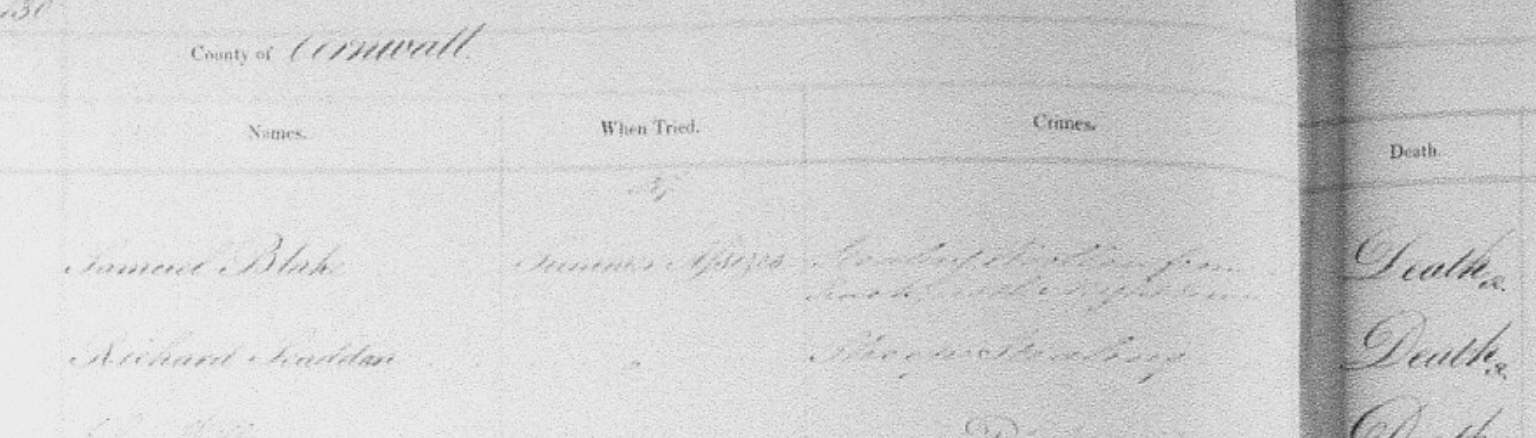
Richard  was found guilty at the Cornwall Assizes at Bodmin on 4.8.1817 of stealing “one ewe sheep of the price of twenty shillings of the goods and chattels of William Roberts”. On trial with him were John Wills and Richard Bath and the three were sentenced “to be severally hanged by the neck until they are dead”  It is reported that the judges reprieved the capital offenders and sentenced them to transportation for life. The trial papers are stored at Chancery Lane, London.

England & Wales Criminal Register 1791-1892. Richard Scaddan – Death Penalty

Richard was received onboard the Prison Hulk “Captivity”, moored at Portsmouth, on 24 October 1817. He was sent to NSW on 26 August 1818. 

UK Prison Hulk Registers & Letter Books 1802-1849


The convict ship “Globe” departed Portsmouth on 9 September 1818, and arrived in Sydney on 8.1.1819 with 140 other male convicts (139 landed). The ships Master was Joseph Blyth, and ships Surgeon was George Clayton. Convict records state that he was a native of Cornwall, his trade was ship’s carpenter, sawyer and boat builder, his age was given as 42, height 5’5″, fair to sallow complexion, brown to grey hair and grey eyes

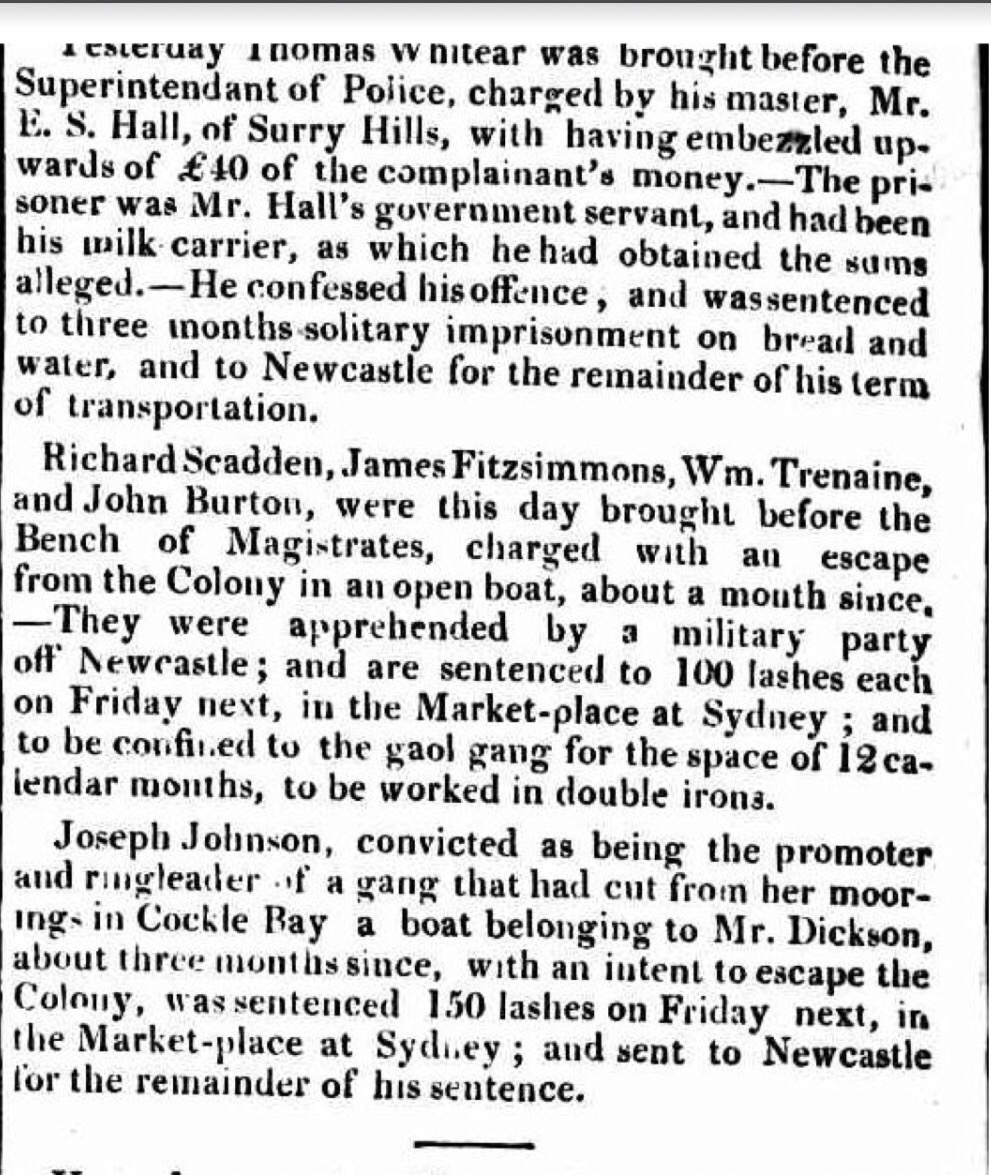
On the 3 March 1819 (Colonial Secretary’s Papers), Richard  was listed as a runaway, captured near Newcastle. He was forwarded to Sydney. Then on 3 April 1819, he absconded from a dockyard in Sydney with a J. Burton. On the 10 April 1819, he eas forwarded to Sydney. On the 17 April 1819, he was sentenced to 100 lashes, and confined to the Gaol Gang in double-irons for 12 months for escaping from the Colony in an open boat, captured off Newcastle. 

From the Sydney Gazette & NSW Advertiser, Saturday 17 April 1819, Page 2

In the convict records for 8 September1821, he is listed as a “Shopwright, victualled HM Magazines (NSW State Archives, Reel 6016′ 4/5781 p75). In 1822 the Muster of Convicts listed Richard as a government servant appointed to William Thurston of Sydney. He appears in the 1822 NSW general convict Muster. In the Colonial Secretary’s Papers, event dated 28 April 1824, it is noted that Richard “Carpenter. On return of bonded mechanics.”. The Colonial Secretary’s Papers record an event dated 1 October 1824 “On monthly return of convict’s assigned in the counties of Northumberland & Durham, to William Evans.”. 

From the Census & Population Books, noted in yhe District Constable’s Notebook, that from 1822-1824 he resided in Parramatta (Baulham Hills 1822). The 1828 Census showed that he was a government servant to William Evans at Bellevue, Pattersons Plains. His age was given as 61 and he was working as a boatbuilder. The entry in the 1828 Census is under the name of SEADON not SCADDEN but it is definitely Richard Scadden from other details given.

 In the Convict Records – Assignment & Employment of Convicts – 1810-189, and dated 13 May 1830, it is noted that due to his wife now being here he is given a “Ticket of Exemption from Govt Labour 1830-1831″.”. The same exemption is granted 6 January 1831. On the 2 January 1832 he is granted a further exemption from Govt Labour from 1831-1832. On a petition to Governor Darling in 1831 it was stated that he had been in Mr Evans’ service since November, 1823. The petition was for his son Richard & Richard’s wife Grace, and their son Thomas to join the family in the colony. It is not known if Richard came to Austealia, thiugh he appears to have died in Cornwall.

His wife Catherine, son James, and daughter Soohia, came to Australia on a ship “Lady of the Lake” which left England on 12.9.1829 and arrived in Hobart on 1.11.1829. From Hobart Catherine, James and his sister Sophia travelled on the “Calista” which arrived in Sydney on 5.12.1829. Catherine had come to Australia to join her husband Richard nearly 11 years after he had arrived in Sydney as a convict. 

It is sad to relate that Catherine, Richard, James & Sophia were not to be together for long as Richard is noted in the Convict Death Register for 1826-1879 as having died on 29.1.1833 at Matiland at the age of 65, buried in the Parish of Newcastle, County of Cumberland.


 After her husband’s death Catherine [aged 48] remarried on 27.8.1833 to William Pregnell, a widower aged 46 in the Parish of Maitland. Catherine had been born circa 1785 and was baptised in the Parish of Gwinear, Cornwall on 22nd May, 1785 the daughter of John Penhale and his wife Eleanor Hooper who were married in Gwinear on 7th February, 1785. Eleanor had been baptised in Gwinear on 26.7.1761 the daughter of John Hooper and his wife Jane. No record has been found of Catherine’s death (up to 1905).

James married Margaret Arnold on 3.9.1860 according to the rites of the Church of England at Grafton. No record of James’ arrival in Grafton is known and he died in Killean Street, Balmain on 19.5.1887. To date no arrival in Australia has been found of Margaret Arnold or her mother & father, William Arnold, a farmer, and his wife Jane Griffith[s. 

James & Margaret had 7 children, William, Jane (Sophia Jane) Emily, Bessie Martha, Sarah & Louisa, all living when their father died in 1887. The informant on the death certificate was aged 17 and gave James’ age at death at 87 but this is not correct. James was a shipwright and boatbuilder and it is assumed he worked in Grafton at this trade. Margaret Scadden married again in Balmain in 1888 to a William Green but no death date is known. Her age in 1888 was given as 43.

Sophia Scaddan married James Moy (Convict) on 20 December 1832. They had 8 children – Henry J, Rebecca, Richard, Rebecca, Eliza Jane, Eleanor C, William E & Sophia.

Tim Alderman ©2017

Cheese!


Cheese has to be one of life’s great pleasures. You can cook with it, throw it on a sandwich or crispbread, serve it in a salad, throw together a cheeseboard for a dinner party, or sit yourself down with a delicious, runny triple cream brie and a glass of wine or port. Whatever you do with it, you can be sure it will be devoured with gusto. Australia is now world-famous for its cheeses – a long way removed from the world of ‘Kraft’ cheddar and ‘Velveeta’ – a sweet, spreadable cheese packed in a similar way to ‘Kraft’ cheddar, and as my grandmother taught me, a great way to do “Vita Weet’ worms – that I grew up with.Everywhere from the Hunter Valley, to Tasmania to Western Australia – especially the Margaret River region – is doing spectacular cheddars, brie, camembert, goat’s cheese, washed rinds, ricotta, and the entire plethora of cheeses from all around the world.

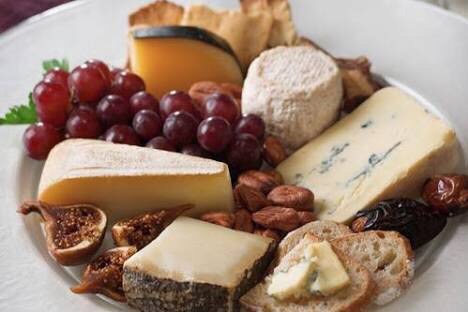
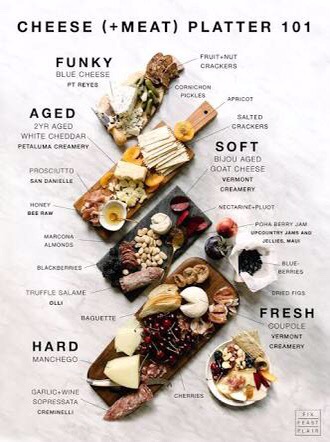
Cheeses are basically classified as soft (Mozzarella, Ricotta, Feta, Haloumi, Goat’s Cheese, Chevre, Brie, Camembert, Washed Rind cheeses); semi-soft (Taleggio, Harvarti, Port Salut, Gouda, Edam, Colby); hard (Lancashire, Red Leicester, Double Gloucester, all the Cheddars, Pecorino, Manchego, Gruyere, Emmental, Jarlsberg, Provolone, Pecorino and the world famous Parmigiano Reggiano and Grana Padano); blue (Brie, Camembert, Gorgonzola, Dolcellate, Stilton, Shropshire Blue, Jersey Blue, Gippsland Blue, Roquefort, Danish Blue); and strong (Limburger, Munster, Liptauer). Showing a total lack of modesty, I can say that I throw together the best cheeseboards, and often get asked by friends to do them for functions. I don’t go for the minimalist approach recommended by the cheese experts – I’ve never really been one for food snobbery. Eating cheese should be a pig-out experience, and this is the approach I take. I offer a variety of crackers, from basic water style to lavosh and grissini. The board will usually have 3-4 of my favourite cheeses, including: Margaret River Port Dipped Cheddar or King Island Cheddar; Persian Feta or a good Chevre or Goat’s Cheese; King Island ‘Discovery’ Washed Rind Brie or a double or triple Brie; and possibly a Port Salut. This gives a good variety of flavours and textures. Then add a sprinkling of fresh fruit, and items such as fresh dates, dried apricots, honey-glazed figs, Turkish Delight, Muscatels and chocolate coated orange peel. Believe me, there is never anything left. There is a wonderful range of accompaniments for cheeses that you can make yourself, and following are a few examples. I find that the stronger cheeses are more suitable to ports, and the creamier style cheeses compliment sweet desert wines. The supermarkets have finally woken up to the fact that fridges full of ‘Coon’, ‘Kamaruka’ and ‘Kraft’ just doesn’t hold sway anymore, and the bigger Coles and Woolworths supermarkets keep huge ranges of cheese, though some of the more specialist ones require the expertise of David Jones, or the fromagerie in Jones the Grocer or Simon Johnson Providore. There is also an excellent cheese store in the food court of the GPO Building in Martin Place in the city.

Always serve cheeses at room temperature, and please use the proper knifes, otherwise the cheese is just hacked.

Tim Alderman ©2017

Black Dog Rising! A Journey Into – and Out of – Depression!

Originally published as “Not Who They Knew” in the August 1999 issue of “Talkabout” magazine.

“Easygoing”, “Always Smiling”, “A Strong Shoulder to Lean on”, “Outgoing” may all be phrases that you are familiar with, especially if you have been pigeon-holed with them, as I have over the years. This is not to say I am not all these things, just that it puts a set of expectations upon my shoulders of how I will appear to people, irrespective of my true feelings.

Towards the end of 1996, at the end of chronic illness, I had a major emotional and psychological problem on my hands-ME. I had been on the DSP for three years, I was not exactly 100% healthy, but I was certainly no longer ill. My viral load maintained itself at undetectable, my CD 4’s were stable. Combination therapy had moved the word ‘death’ quite a way down my vocabulary list. I had always had a group of peers for support years ago, but HIV had decimated that group. I felt alone, outcast, surviving with nowhere to go. I could not see a future with me in it.

Depression is a hard word to define. Ask twenty people, get twenty different answers. To me, depression was not that dark, down twisting spiral into oblivion that it is for many. Nor was it an ongoing thing that kept re-occurring over time. It was a period of intense self-doubt, a losing of self-worth, and my own values as a functioning member of the community I moved in. I wanted so much to return to life, not the life I had known, but an entirely new one, free of all the dross I had been dragging around with me, the frustration of unfulfilled dreams, and directionless yearnings.

I started (unknown to all, except by those close to me) to have black, brooding moods, periods of long silence where I would not communicate with anyone. I had panic attacks in bed at night, and developed a fear of the dark. I could not stand to travel in the subway, and avoided crowds. I saw a black future of pensions, and struggling to get by, ageing on my own, loneliness, and pills, pills pills. I remember that late one day I really needed to talk to someone desperately. I rang two of our HIV counselling services, to be told that noone was available-would I like to make an appointment for another day! I ended up ringing a friend and frantically dumping on him.

I do not like antidepressants. This is a personal thing, I have nothing against them in general, nor the people who need to take them. I already shovel enough tablets down my throat (at the time of all this happening, around 300 per week), and have no desire to add to the load. I am also, by nature, one who is capable of intense self-analysis. I knew I had severe problems, I knew I needed help. But where to start? 

The major problems, ones I have had all my life, were impatience, and wanting to do everything at once. I was aware that I needed counselling. This was not an easy self-admission. I had never believed in them. I rang Albion St, and arranged an appointment. The first meeting almost justified my misgivings about them, being a rushed affair whereby I felt time limitations were more important than my need to talk out issues. Following appointments were not so. I then did three of the beneficial things I have ever done with my life. I started volunteer work at the offices of PLWH/A (NSW) Inc, and started group work through both the ACON HIV Living Unit, and the Coleo Project. The ACON HIV Peer Support Group put me in contact with people going through similar experiences to mine. It gave me an outlet to voice my opinions, and to gain the advice and knowledge of other people to handle these panic situations. The Coleo project taught me the value of self-motivation, and the management of long-term treatment taking. They also encouraged me to take up writing, it being a good outlet for emotions-published or unpublished. This led to me joining the Positive Speakers Bureau, which has been, for me, one of life’s most fulfilling experiences.

In 2012, I had a bad experience after eye surgery at Royal Brisbane Hospital. I had some very serious surgery on my right eye…the left was blind (and is now a prosthetic)…and they fully covered the right eye after the operation. Coming out of vety heavy anesthesia, I thought I was blind, had a massive panic attack and attempted to pull the dressing off. A young Malaysian nurse, seeing this happening, started yelling at me, just making things worse. They eventually xalmed me down, and readjusted the dressing to admit some light, but the situation wasn’t good. At home, I started having attacks of anxiety & further panic attacks. I wasn’t sleeping well, was waking up with a start at around 4-5am, and had to get up as I couldn’t stand staying in bed. In bed, I couldn’t wear jewellery, or tee-shirts with tight necks – I felt they were choking me! This went on for about 6 weeks, and I was getting to the point of dispair. I contacted an Anglican support service (non religious, otherwise I wouldn’t have) on the advice if a HIV service. They, in turn, then kept in regular contact with me, helped via some counseling, and introduced me to Acceptance & Committment Therapy (ACT), and through the meditation sessions, and breathing, I eventually, over a couple of weeks, worked my way through it. I also put an official complaint into the hospital, and just doing something affirmative about the cause of this problem helped with the process of returning to where I had been before the operation.

Then, in early 2015, just after my return to Sydney from Brisbane, I had another period of both anxiety & panic attacks. 2014 had been a year from hell! I had a dreadful 60th birthday, followed by the breakdown of my 16 year relationship. Some financial oroblems followed on from that, then my ex-partners (we were clise friends after the breakup) parents both became serioysly ill; I had a very serious, debilitating dose of Shingles; Ampy, our longest surviving dog at that time, died; then in early 2015 I had my blind eye removed. This had all been bottled up, and on my return to Sydney – a move I really didn’t want to make – everything crashed in! The difficulty sleeping, getting moody, feeling that everything was getting on top of me, a severe drop in my libido, and Restless Leg Syndrome in bed at night all pointed to a return of the black dog. So off to the doctor, a psychological evaluation, and some antidepreeants & a drug to settle my restless legs. I went back to ACT, and within a fortnight we returned to a more normal state. 

But I know the capacity for anxiety & panic attacks is there, and that I need to ensure that I deal with issues as they come along. I consider myself lucky in some respects that it never gets worse that this. I don’t get cyclic deep, dark depression, nor do I get pushed to the point of suicide…but it is still a disturbing, disorientating and horrible place to be. Depression in any ofits forms  is not a pleasant place to be in.

This is a very different person sitting at this computer today. No longer scared of the future, or what it will hold. Confident that I have both a place, and direction to move in. I cannot give answers to others going through what St. Therese called ‘the Dark Night of the Soul’, except to hang on. There is, and must be, light at the end of the tunnel.

 Links

Tim Alderman ©1999 (Revised 2017


Spiritually Faithless!

First published in “Talkabout” magazine October/November 2007. I make no secret of my intense dislike – an understatement – of organised religion! No singular institution in the history of nankind has had such a stultifying influence on mankind’s collective mind! It has caused more deaths and suffering than all our wars combined, has held back the advancement of civilisation, and is singularly responsible for the hi-jacking of common sense, logic, and free thought! It’s sheer hypocrisy on being incapable of practising what it preaches, and being unable to judge itself so, is staggering in its breadth! Right at this very instant, somewhere in this world, people are being massacred or tortured in the name of religion! This is my perspective!

“Batter my heart, three person’d God…”

John Donne Holy Sonnet XIV

I started watching “The Abbey” on ABC TV on Sunday night. What a time-trip back to when I was 23 and living in an enclosed monastery, following the Rule of St. Benedict, at Leura in the Blue Mountains. How I ended up in a monastery – and eventually left – was quite a journey. One might even say a quest, a search for identity, spirituality and this unfathomable thing called faith. I found the first, still hold onto the second and lost the third along the way.
The quest started when, as a 12-year-old Protestant boy from very Congregational Sylvania, I managed to get into one of the states leading Catholic boarding schools – St Gregory’s Agricultural College in Campbelltown. They had filled their Catholic places at the school, and were willing to take Protestants. I lucked in. I have to admit that I loved going to school there, though with most of the boys being from country regions I didn’t make any life-long friends. I learnt to really loathe sport – Marist Brothers and their bloody sports – which I had just disliked up until that time. Also had a fleeting homosexual encounter with another boy…in speedos…in the pool. 

However, it was the Catholic religion that overwhelmed me. It wasn’t just one aspect of Catholicism, it was the whole shebang! The beauty of its rituals; the whole mystery of the mass; the adoration of Mary and the saints; the dogma and theology; and the people who devoted themselves to enacting and teaching these beliefs. As someone who had come from the sparse simplicity of protestant services, it took my breath away. So much so that at the end of my first year there I converted, being baptized in the school chapel with my history teacher, Mr Higgins – who, being a chain-smoker , stank of nicotine – and one of the Year 12 boys, Tim Sheen, as my sponsors. Little did I know that the priest who baptized me was, several years later, to be arrested for molesting his altar boys. My appetite for religion, especially the theological aspects of it, was voracious. In 1969 when I finished my final year one of the brothers asked me if I would like to join the Marist Brothers. Despite the faint inklings of a vocation, the Marist order really wasn’t my cup of tea. While at St Greg’s, I had a personal confessor from a Discalced Carmelite monastery at Minto. Through him I had quite a lot of contact with the monastery, including attending vocational seminars. 

I found the contemplative lifestyle much more to my taste, though decided to wait a few years before making any decisions.
In 1976 I contacted a small enclosed monastic community in Leura called the Community of St Thomas Moore, who followed the Benedictine Rule.
The community lived in this rambling old convent originally owned by the Sisters of Charity. It had the monk’s enclosure at one end of this huge ‘H’ design, the chapel, visitors parlors and Prior’s office at the other end, and a huge retreat section in between. The community supported itself by running retreats. As the youngest novice it was my duty to rise at 5am to set up the chapel for morning Office and Mass. I would then go to the common room in the enclosure to start breakfast and set the tables, as well as turning on the heaters to warm the enclosure. At 5.30 I would circle the enclosure with a bell to raise the rest of the community to prayer. Between prayer and work the day went very fast, with grand silence starting at 9pm and going through until after breakfast the next morning. Despite it being a tough life – and don’t for one minute think that these men are uneducated or unaware of what is going on in the world – I loved it. I loved the strong sense of community, the calmness of quiet contemplation in long silences, and the daily rituals of work and the Divine Office that bind communities like these together. The church regards these communities of enclosed religious as ‘powerhouses of prayer’, and there is little doubting that if you are on the inside. 

A very strong visual image of my time there, and one that has always stayed with me, is of being in the kitchen at 5.30 one morning and looking out the window. The monastery was set on the edge of a valley, and it was an icy cold clear morning. Outside the window was a leafless tree covered in frozen water drops glistening in the sun. Beyond it, a mist was rolling up the sides of the valley. It was one of the most profoundly contemplative moments I have ever had in my life. It was as if I was the only one observing this beautiful scene, as if it had been reserved especially for me for some purpose that was yet to be revealed. I can still see it in my minds eye as I write this. Now that’s impact!

However, one of the ‘problems’ with the large periods of introspection and contemplation that is part of the monastic ideal is that you tend to look deeply into yourself. Fears and hidden truths are often revealed. This can either lead one deeper into the religious nature of their community, or alienate you personally from the community. The realisation I came to, the fear I had, the thing that I was running from was that I was gay. Hiding in a monastery is not a healthy thing to do if you are gay – though heaven knows there are enough caught in this situation. Many stay on through fear of who they are. They think that if they work themselves to the bone, and pray hard it will just go away. It doesn’t! It ends in a life of bitterness, recrimination and self-loathing. Many, like me, decided that to really live life without hypocrisy they had to leave the safety of the enclosure and go back into the world. The decision to enter a religious community is difficult enough on its own. 

The decision to leave is even harder. Driving through the gates to go home was quite devastating for me, knowing that I was leaving all peace and tranquility behind me. I hoped to carry it inside myself, but the hectic, tumultuous real world makes it difficult, if not impossible. Another world awaited me.

I still didn’t come out immediately. My family was quite formidable and I knew I would have to choose my time well. In the meantime, I worked for and eventually became manager of Pellegrini & Co Pty Ltd – not familiar with the name? It was a huge Catholic emporium, supplying not just devotional goods such as statues and rosary beads, but furniture, church plate and vestments to all the local churches – firstly in Sydney, then to Melbourne where I came out. By this time my father was dead, my family alienated. Melbourne was a safe space for me. In the way of enforcing contrasts in my life, after I left Pellegrini in the early 80’s. I became manager of a sex shop in Oxford St called ‘Numbers’. It is often joked about that I gave up ‘praying’ for ‘preying’.

I must say that at this stage my faith was going through a shaky period. The fight for gay recognition, rights and anti-discrimination was in full swing, and the Catholic Church was one of the biggest bugbears to these rights. I joined “Acceptance” Gay Catholics in Melbourne, though not initially to fight the good fight, so much as a way to meet people through the shared common ground of religion. It was through “Acceptance” – I eventually became committee secretary, as well as working on several working groups – that I realised just how discrimination could alienate a group of people. We could only go to Mass in one church in Fitzroy, and then only at a certain time of the evening. The Servite Fathers, who were an independent order and not under the auspices of the local Bishop or Archbishop were the only order who could conduct our First Friday Home Masses. At one mass at my unit in West Brunswich confessions were going to be held in my bedroom. I had all this porn attached to the back of the bedroom door – as you do when young and single – and went to considerable trouble to ensure paper was taped over it to hide it. Evidently during one of the confessions the paper suddenly gave way, and priest and confessor were confronted with all these pictures of naked men. I believe the priest didn’t bat an eye, but I have to wonder if there weren’t additional sins for the guy with him to confess. Over this time I just got angrier and angrier at the hypocrisy of it all. Coming from Protestant roots, I still carried a lot of the simpler theology with me, and often found myself arguing against the stupidity and naivety that had crept into the Catholic religion through the centuries, which we were (are?) still living with, and decrying its inability to move forward and fit into a more contemporary era. It gained me quite a few friends, and earned me a few enemies. I got so frustrated that I dropped religion altogether, and have never really found my way back.

I returned to Sydney on the tide of HIV hysteria, and religion for me became even less relevant. Hearing our dear religious brethren, especially those in politics advocating hunting us down and locking us away in quarantine; the way they flaunted the view that this was God’s retribution against the gay community fuelled my increasing hatred for religion. Despite HIV being something that should have initiated reconciliation between my lost faith, and me it just drove a wedge in.. The soul-destroying slaughter of all my friends, lovers and acquaintances over this time didn’t bring me back to faith. However, it did cause me a revaluation of my need for spirituality of some description. The free-form style of the funerals that were going on over this period made me realise that we all practiced ‘faith’ in many different ways, and that having faith wasn’t the same as being spiritual. You could have one without the other. Religion, to just about everyone I knew, was an alien concept with little tie-in to their lives. However, many were searching for spirituality. One friend in particular surprised me by returning to the rudimentaries of faith just before he died. 

He did make me wonder what I would do if faced with the same situation – would I call on a priest and fall back to my Catholic faith; would I contact someone more in tune with the simplicity of my original faith, such as MCC; or would I just continue to refute it all up to the time I died. It is something I still ponder occasionally. 

In my search for spirituality I tried a return to a more primitive religion in Wicca, but found it unsatisfying. I studied the writings of Aleister Crowley and the Golden Dawn but found it too weird – and scary; the Jewish Kabbalah – real Kabbalah, not Madonna’s version – but found it too deep and complex, and I didn’t feel I had a lifetime to study it in.
So, I guess that in some ways I am still searching. It is not an easy world to find faith or spirituality in. Certain groups in our world have distorted the concepts to such a degree that you wonder what they find in the dry, humourless, destructive force they call religion. Others go on preaching what they don’t practice – and astoundingly never realise the contradiction; intolerance and hatred is rife. The Zen ideal is possibly the closest to pure spirituality that I have found, Buddhism being the one religion that seems to be the reverse of all else that is surrounding us. Like the monastic ideal, you can find peace in contemplation and meditation, something that cuts off the noisy world around us, and causes us to withdraw into ourselves.
Over the years, and before meeting my current partner, I have asked myself what I would do…where I would go…if I found myself old and alone in this world. I thought I would eventually return to a monastery, try to find all that I had lost. There are many who would tell me that faith is easy to find – it is just a pure act of selfless belief, a mere blinkered view to all the external forces that fight against faith; submission to dogma and ritual. I can no longer do that. I question too readily, and demand answers that aren’t esoteric.

So back to “The Abbey”. The five women who have gone into the Abbey to see if they can withstand the rigours of the monastic life are all in need of some form of self-redemption. Despite renunciations and doubts they are all seeking ‘something’. It is easy to see why Sister Hilda is the superior of this monastic community. Full of faith, a sense of humour, immense amounts of understanding and compassion, she is indeed the monastic mother. Just by listening to what these 5 women say, she is, possibly unknown to her, being a counsellor. In five weeks time when these women leave the monastery to go back to their normal lives, they are going to be intrinsically changed – you can see it already. They are going to confront things that they don’t want to confront, and if they allow themselves to just sink into the life of the monastery, to let it surround them and not fight it they are going to come to an understanding of themselves that they never thought possible – and their lives will be forever changed. I know. I’ve been there. Perhaps you can take the boy out of the monastery, but you can’t take the monastery out of the boy!

And as for me…well maybe John Donne and I fight the same demons;
“…I, like an usurpt towne, to’another 

      Labour to’admit you, but Oh, to no end,

      Reason your viceroy in mee, mee should defend,

      But is captiv’d, and proves weake or untrue,

      Yet dearely’I love you,’and would be loved faine,

      But am betroth’d unto your enemie:

      Divorce mee;’untie, or breake that knot againe,

      Take mee to you, imprison mee, for I

      Except you’enthrall mee, never shall be free,

      Nor ever chaste, except you ravish me.”

John Donne; Holy Sonnet XIV
Tim Alderman ©October 2007


Gay History: A Navy Court Martial: First Lieutenant William Berry of HMS “Hazard” – 1807 

Tuesday, 6 October 1807

COURT MARTIAL.
On the 2d instant a Court Martial was held on board the Salvador del Mundo, in Hamoaze, Plymouth, on charges exhibited by Captain Dilkes, of His Majesty’s ship Hazard, atgainst William Berry, First Lieutenant of the said ship, for a breach of the 2d and 29th articles; the former respecting uncleanness, and the latter the horrid and abominable crime which delicacy forbids me to name.

     THOMAS GIBBS, a boy belonging to the ship, proved the offence, as charged to have been committed on the 23d August, 1807. Several other witnesses were called in corroboration, among whom was

     ELIZABETH BOWDEN, a little female, who has been on board the Hazard these eight months; curiosity had prompted her to look through the key hole of the cabin door, and it was thus she became possessed of the evidence which she gave. She appeared in Court dressed in a long jacket and blue trowsers.

The evidence being heard in support of the charges, but the prisoner not being prepared to enter upon his defence, begged time, which the Court readily granted,until ten o’clock on Saturday, at which hour the Court assembled again, and having heard what the prisoner had to offer in his defence, and having maturely and deliberately weighed and considered the same, the Court were of opinion, that the charges had been fully proved, and did adjudge the said William Berry to be hanged at the hard-arm of such one of his Majesty’s ships, and at such time, as the Right Hon. the Commissioner of the Admiralty shall direct. – Sir J. T. Duckworth was the President.
The unfortunate prisoner is above six feet high, remarkably well made, and as fine and handsome a man as is in the British navy. He was to have been married on his return to port.
          (Morning Chronicle; this cutting is in William Beckford’s scrapbook now in the Beinecke Library.)

[Royal correspondence: In The Later Correspondence of George III (Cambridge, 1968; vol. IV, p. 636), we learn that Lord Mulgrave informed George III of the sentence of the court martial and noted that “the full, clear & most disgusting evidence on which the Court has pronounced the awful sentence of death upon Lieutenant Berry leaves no opening for submitting any grounds for the extension of your Majesty’s mercy …” (Admiralty, 6 October 1807). George III replied that he “cannot hesitate in confirming the sentence of death passed on Lieutenant Berry of the Hazard sloop for a crime which, when fully proved, cannot admit of the interposition of the Crown. Consequently the law must take its course.” (Windsor Castle, 7 October 1807)]

Saturday, 10 October 1807
On Friday a Court Martial, at which Sir J. Duckworth presided, was held on board his Majesty’s ship Salvador del Mundo, in Hamoaze, Plymouth, on charges exhibited by Captain Dilkes, of his Majesty’s ship Hazard, against William Berry, First Lieutenant of the said ship, for a breach of the 2d and 29th articles of war; the former respecting uncleanliness, &c. the latter the commission of an unnatural crime with thomas Gibbs, a boy belonging to the Hazard, on the 23d of august, 1807. The evidence being heard in support of the charges, the prisoner not having prepared his defence, begged time, when the Court readily granted, till Saturday at ten o’clock. At that hour the Court assembled again, and having heard what the prisoner had to offer in his defence, and maturely weighed and considered the same, the Court was of opinion the charges had been fully proved, and accordingly adjudged the prisoner to be hanged at the yard arm of such one of his Majesty’s ships, and at such time as the Commissioners of the Admiralty shall direct. One of the witnesses on this awful land horrible trial was the little female tar, Elizabeth Bowden, who has been on board the Hazard these eight months. She appeared in Court in a long jacket and blue trowsers; that part of her evidence which respected the prisoner, curiosity had prompted her to observe through the key-hole of the cabin door. (Jackson’s Oxford Journal, Issue 2841)
Monday, 12 October 1807
COURT MARTIAL. – On Friday a Court Martial, at which Sir J. Duckworth presided was held on board his Majesty’s ship Salvador del Mundo, in Hamoaze, Plymouth, on charges exhibited by Capt. Dilkes, of his Majesty’s ship Hazard, against W. Berry, First Lieutenant of the said ship, for a breach of the 2d and 29th articles of war; the former respecting uncleanliness; &c. the latter for the commission of a crime we do not chuse to mention. The Court having heard what the prisoner had to offer in his defence, and having maturely considered the same, was of the opinion that the charges had been fully proved, and adjudged the prisoner to be hanged at the yard-arm of such one of his Majesty’s ships, as the Commissioners of the Admiralty shall direct. One of the witnesses was a little female Tar, Elizabeth Bowden, who has been on board the Hazard these eight months. She appeared in Court in a long jacket and blue trowsers; that part of her evidence which respected the prisoner, curiosity had prompted her to observe through the key-hole of the cabin-door. (Glasgow Herald)
22 October 1807
EXECUTION OF LIEUTENANT BERRY.
On Monday the sentence of the court-Martial was put in execution on Lieutenant Berry, late First Lieutenant of the Hazard sloop of war. The prisoner, being removed from the Salvador del Mundo, to the Hazard, lying alongside a hulk in Hamoaze, at nine o’clock uppeared, and mounted the scaffold with the greatest fortitude; he then requested to speak with the Rev. Mr. BIRDWOOD, on the scaffold; he said a few words to him, but in so low a tone of voice that he could not be distinctly heard: and on the blue cap being put over his face, the fatal bow-gun was fired, and he was immediately run up to the starboard fore-yard-arm, with a 32lb. shot tied to his legs. Unfortunately the knot had got round under his chin, which caused great convulsions for a quarter of an hour. After being suspended the usual time, he was lowered into his coffin, which was ready to receive him in a boat immediately under, and conveyed to the Royal Hospital, where his friends mean to apply for his body to inter. He was a native of Lancaster, and only 22 years of age. For the last week he seemed very penitent, and perfectly resigned.
A curious circumstance occurred while the prisoner was in the cabin with the Clergyman, receiving the sacrament. A woman came alongside the Hazard’s hulk, and handed a letter up, signed Elizabeth Roberts, addressed to the Commanding Officer, which stated that Lieutenant William Berry could be yet saved, and that the person who could do it was alongside; – it was by marriage. The woman was ordered on board, and put under the care of a sentinel. When the execution was over, Captain DILKES, with the Clergyman and others, questioned the woman: she said she had dreamed a dream last night, that if she went on board the Hazard this day, and that if Lieutenant Berry would marry her, he would not suffer death. On being asked who advsed her, she replied that she told her dream to some women where she lived in Dock, who recommended her to go, in consequence of her dream. She was admonished, and sent on shore.
          (The Times; the “curious circumstance” was also reported in the Aberdeen Journal for 28 October.)

Monday, 26 October 1807

EXECUTION OF LIEUT. BERRY.
PORTSMOUTH, OCT. 19. – This morning, at eight o’clock, the signal for an execution was made on board the Salvador del Mundo, 112, Admiral Young, in Hamaore; and repeated by the Hazard, 18, Capt. Dilkes on board which ship the execution was to take place. About nine a.m. a boat from each ship, manned and armed, attended round the Hazard. Lieut. Berry was then conveyed from the flag-ship, attended by the Provost Martial, in a boat to the Hazard, where he spent some time in prayer, attended by the Chaplain of the flag-ship. He was then conducted along the gangway to a platform erected on the forecastle: the executioner then reeved the rope round his neck, when, declaring he was ready, the fatal bow gun fired, and he was run up to the fore-yard arm. He appeared to struggle for a few moments, by the struggling soon ceased. – After hanging an hour, his remains were lowered into a shell in a boat alongside, and conveyed to the Royal Naval Hospital to be delivered to his friends for interment. – Thus perished, by the hands of the executioner, a young gentleman, in the bloom of life, for a crime not fit to be named among Christians. He was of a respectable family in Lancashire, and his father and uncle are overwhelmed with grief at the unhappy exit from this world of a favourite son and nephew. (Glasgow Herald)

Tuesday, 27 October 1807

[Report of Berry’s execution identical to that of The Times, but with the following addition:]
          For the last week he seemed penitent, firmly collected, and prepared to meet his fate. – Thus perished by the hands of the executioner, a young gentleman in the bloom of life, for a crime not fit to be named amongst Christians. – He was of a very respectable family; his father and uncle are overwhelmed with grief at the unhappy end of a favourite son and nephew. (The Hull Packet and Original Weekly Commercial, Literary and Genderal Advertiser, Issue 1085)


The interesting facts about witness Elizabeth Bowden (John Bowden) in the court martial of William Berty, HMS “Hazard”.

Women At Sea: Witness for the Prosecution

Found at http://www.paulinespiratesandprivateers.blogspot.com

Elizabeth Bowden (or Bowen) seems to have had it rough from the very beginning. Born into obscurity and poverty some time in 1793 in Truro, Cornwall, she seemed destined to a bleak life. Things went from bad to worse when she was orphaned at age twelve or thirteen.

Elizabeth had an older sister who, to the best of the girl’s knowledge, lived in that haven of the Royal Navy: Plymouth. Being nothing if not hardy, Elizabeth walked from Truro to Plymouth with the idea that she would take up residence with her sibling. Unfortunate as usual, Elizabeth could not find her sister. Elizabeth, who in our day and age would be termed a little girl, was penniless, starving and alone. Like so many nameless others of her generation, she turned to the sea.
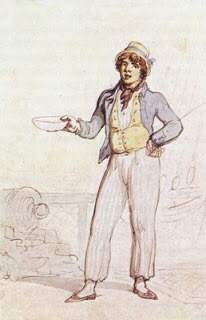
Dawning a boy’s trousers (and perhaps looking similar to this drawing by Thomas Rowlandson), Elizabeth signed aboard HMS Hazard at Plymouth in the last half of 1806 using the name John Bowden. Deemed fit to serve, she was rated a boy 3rd class and given the usual advance on her pay. Hazard left for sea not long after the new boy was taken aboard. No one seems to have questioned her sex, at least not right away.
Within six weeks something occurred, history is silent as to what, that gave Elizabeth’s gender away. One wonders if her menarche wasn’t the culprit but that is purely speculation. At any rate, rather than being turned ashore at the next port, Captain Charles Dilkes gave Elizabeth a separate sleeping space and made her an assistant to the officers’ stewards. This would have kept her out of the general ship’s population and put her more closely in contact with not only the stewards but the galley crew as well.
With all this, Elizabeth would probably have fallen through the cracks of history as did so many other women at sea. But a well publicized case of sodomy aboard HMS Hazard, and Elizabeth’s insistence that she had witnessed at least one of the incidents in question, brought her briefly into the lime light.
In August of 1807, while the ship was underway, Lieutenant William Berry was accused of regular abuse of a boy named Thomas Gibbs. Berry was twenty-two at the time but Gibbs, a ship’s boy second class, had to have been younger than fourteen as he was not charged at the court-martial. According to the trial records, Gibbs finally got fed up with Berry’s actions and told the gunroom steward, John Hoskins, what was going on. From the young man’s testimony it sounds as if there was physical as well as sexual abuse going on, although Hazard’s surgeon would say that he could “find no marks on the boy” and that Gibbs had only “complained of being sore”.
Hoskins took Gibbs to Captain Dilkes and had him repeat his story. Berry was questioned by the Captain who was evidently inclined to believe the boy. The Lieutenant was arrested and a court-martial was arranged in October, aboard HMS Salvador del Mundo, when Hazard reached Plymouth once again.
I won’t go into the details of the trial, which was presided over by Admiral John Duckworth, as that is not the focus of this post. What is interesting is that Elizabeth Bowden, known to be a girl, felt comfortable enough to step up and offer her story in the case. Even more fascinating is that the Royal Navy court took her testimony, it seems without batting an eye.
Elizabeth claimed to have seen an exchange between Berry and Gibbs by peering through the keyhole of Berry’s cabin. She was asked if she observed Gibbs entering Berry’s cabin frequently and answered yes. When asked “…and what induced you to look through the keyhole?” Elizabeth replied, quite simply, that Gibbs in Berry’s cabin seemed curious, and “…I thought I would see what he was about.” The court recorded this testimony and noted that she was “Elizabeth alias John Bowden (a girl) borne on the Hazard’s books as a Boy of the 3rd class.”
Lieutenant Berry, who called in family and friends to vouch for his good character and even had a girl come along side ship and offer to marry him, was found guilty under the 29th Article of War and hanged from the starboard fore yardarm of Hazard on October 19th.
And that is all we know about fourteen-year-old Elizabeth “John” Bowden. Whether she continued on in navy service, like the intrepid William Brown, found a husband and settled down, or came to what would then have been called a bad end is impossible to say. Her brief story, however, gives us another example of the much debated acceptance of women at sea.

Reference

Tim Alderman (2017)

Gerard Majella Society Sexual Abuse Case

As far back as the late 60s-mid 70s, I had heard rumours about the Gerard Majella Society from members of other religioys orders (themselves not beyond reproach!). The nembers were often referred to as having odd practises, in an order that was, in no uncertain terms, set up and run in an odd, almost surreptitious way. There was talk of odd “dress-up” sessions occuring in the monastery, and of a certain “sleaziness” surrounding the priests who ran things. With all the recent controversy surrounding goings-on in the Vatican, and with the supposed return of Cardinal George Pell – the third highest ranking official in the Vatican – to Australia to face historic sexual abuse charges, it came to my mind to find out what had happened to the Gerard Majella Society. It is, with a shudder, frightening to me that I have been surrounded by sexual abuse amongst Catholic brothers and other clergy for most of my life…though not directly affected personally. My experiences at Marist Brother’s St Gregory’s Agricultural College whereby my Dorm 2 dorm madter – Brother Brian – was mysteriously “transferred” after molesting boys in the dorm; the Rev Father Peter Cominsole – who baptised me at St Gregs – who was Parish Priest at St John the Evangelist church in Campbelltown, and the college chaplain, was jailed on sexual abuse charges; recent research into St Greg’s shows a headmaster charged with sexual abuse, and several others charged bith there, and at St Joseph’s, Hunters Hill; my interaction with the St John of the Cross brothers whilst having a brief stint in a monastery myself, and the outcry when it was revealed that they were sexually abusing mentally incapacitated patients in yheir care. It goes on and on! The Gerard Majella Society has now been disbanded, and the priests in charge sentenced to – in my opinion – very short prison sentences for the amount of distress, and psychological damage that they caused those who suffered the abuse. This is the story of the Gerard Majella Society as exposed by researchers at Broken Rites.


By a Broken Rites researcher

In the 1990s, Broken Rites helped to reveal sexual abuse of young people by Catholic priests in the St Gerard Majella religious order in western Sydney. Two decades later, on 15 September 2016, this religious order was mentioned at a public hearing of Australia’s national child-abuse Royal Commission. This Broken Rites article gives the background of the St Gerard Majella Society.

In the late 1990s the Sydney District Court jailed three priests who comprised the entire leadership of the St Gerard Majella Society. This society, operating in the Parramatta diocese in western Sydney, consisted of a core of three priests who recruited and “trained” a pool of young Brothers. The three priests were convicted for committing sexual offences against the trainees.
FATHER John Sweeney, then 59, head of the order, was sentenced on 18 July 1997 to 2 years 3 months jail (18 months minimum) after a jury found him guilty of three counts of indecent assault against a 19-year-old trainee Brother. Sweeney still faced further charges involving five other young males.
 FATHER Peter Harold Pritchard, then aged 53 (born on 21 May 1944), second-in-charge in the order (and known as Father “Joseph” Pritchard), was sentenced on 29 October 1997 to six years’ jail (four years minimum). Pritchard pleaded guilty to charges of buggery, intent to commit buggery; and indecent assault involving seven trainee Brothers and another young male, all aged 16 to 21, over a 19-year period.

 FATHER Stephen Joseph Robinson, the order’s novice master and “spiritual” director, was sentenced on 27 March 1998 to a minimum of 18 months’ jail after two juries convicted him for acts of indecency on two trainees. At the time of his sentencing, he was aged 51 (born in 1946).

The victims in these court cases were not the only victims, just those located by police. The sexual abuse continued for decades, right under the noses of the diocesan authorities, but the church ignored it and the victims had nowhere to go.

In sentencing, the judges said the three priests took advantage of the trainees’ naively and their vow of obedience. The trainees lived an “almost a child-like existence” in the order.
Pritchard, for example, silenced his victims by saying “nobody would believe” that Catholic priests would commit such acts.
The background
The St Gerard Majella Society was formed by Sweeney in 1958 to conduct religious classes for Catholic students in state high schools. It had the blessing of Cardinal Gilroy, the then archbishop of Sydney. Sweeney recruited like-minded men as Brothers, some being upgraded to priests. Members wore conservative neck-to-ankle clerical cassocks. It is believed that, in the 1990s, the St Gerard Majella Society comprised about eight priests, including the three who were convicted.

The Society administered the Catholic parish church at Greystanes (near Parramatta), of which Sweeney was the parish priest, and also the nearby Newman Catholic High School, where Pritchard was the principal.
The order had several monasteries where it conducted camps and retreats for secondary school students and for young military personnel, such as naval apprentices. It trained novice Brothers (some beginning as young as 16), who were bound by rules of obedience to the priests in charge.
Parents, students and parishioners complained about the St Gerard priests but nothing was done. However, the cover-up began to crumble in April 1993 when Father Pritchard pleaded guilty in Liverpool Court to indecent assault of a young naval apprentice who was in his care. Pritchard was placed on a $2,000 good behaviour bond. Although it did not attract media attention, this case prompted other St Gerard victims to think about redress.
In December 1993, after Broken Rites was mentioned in the media, Broken Rites began receiving calls from several ex-Brothers. Each caller described the St Gerard Society’s systematic sexual abuse. The callers alleged that this order was virtually a paedophile organisation, running a male harem.
The ex-Brothers also gave Broken Rites several confidential memoranda written by Bishop Bede Heather, of the Parramatta diocese, indicating that the church was going into damage control. One memo, in May 1993, said Heather had asked two Sydney priests, Rodger Austin and Peter Blayney, to gather written statements from St Gerard Society victims about the abuse. After this process, a second memo in September 1993 said Heather was suspending Sweeney, Pritchard and Robinson from priestly duties.
However, the laity were not told the truth. For example, the Greystanes parish newsletter merely announced that Father Sweeney “has elected to resign” as parish priest to have “a necessary time of renewal”.
Broken Rites advised the ex-Brothers to give statements to the NSW Police child protection unit, which they did during 1994. Detectives then located further victims.
The chief burglar
While this police investigation was proceeding, another cover-up in the Parramatta diocese became exposed. Broken Rites learned that one of the diocese’s most prominent priests, Father Richard Cattell, then 54, pleaded guilty on 19 August 1994 to five counts of indecently assaulting a 14-year-old boy. The boy had gone to Cattell (as a parish priest) in 1973-6 after being molested by a teacher.

In 1991 Bishop Heather appointed Cattell as his vicar-general to administer the 48 parishes of the Parramatta diocese (including Greystanes, where the St Gerard Society had its headquarters).
Therefore, anyone who wanted to complain about sexual abuse in the St Gerard Brothers in the early 1990s would have gone through a vicar-general who was himself a paedophile.
To report sexual crimes to the paedophile vicar-general Cattell was like reporting burglaries to a burglar. How many sex-abuse complaints were received by Cattell? And where, are the files?
[This is why Broken Rites recommends that victims should first report a church-abuse offence to the police child-protection unit, not merely to a church official. The church official is a colleague of the offender and may himself be an offender.]
Police raid
Broken Rites alerted the media to attend Cattell’s sentencing on 9 December 1994, when he was jailed for two years. Heather later wrote a letter to Cattell’s parishioners, supporting Cattell.

“He [Cattell] continues to be our brother priest,” Heather wrote.
St Gerard Society victims informed Broken Rites that four days later, on 13 December 1994, detectives asked Heather to hand over documents (including the Austin/Blayney report) relating to the St Gerard sex-abuse complaints but Heather allegedly refused. The detectives therefore returned with search warrants for both Heather’s office and the Sydney Archdiocese offices and seized the missing documents, including many written complaints that had not been forwarded to the police
Three days later, on 16 December 1994, Heather quietly announced that he was disbanding the St Gerard Society. The church evidently hoped that there would be no organisation left for the police to investigate but Broken Rites tipped off the media, and therefore in late December 1994 the Sydney and Parramatta newspapers began revealing the St Gerard scandal. Broken Rites then received more calls from informants.
The church promptly began disposing of the St Gerard Society’s property, believed to be worth millions of dollars. This was a big windfall for the church coffers.
The disposal would make it difficult for victims to tackle the St Gerard Society for damages. Innocent Brothers who had spent their teens and perhaps their twenties in the St Gerard order now had no job and no qualifications for a new one.
On 19 December 1994, Heather wrote to his clergy about the Cattell and St Gerard matters. He gave Cattell’s prison address, with suggestions for those priests “intending to visit”. He also indicated his depressed mood about all the scandals, saying that “priestly ministry has suffered a severe setback in the eyes of many people.” (That is, it was unfortunate that the scandals had become public.)
Sweeney, Pritchard and Robinson were arrested in early 1995 and their court appearances spanned three years. A week before the sentencing of Sweeney, Bishop Heather suddenly took early retirement (this could be interpreted as an attempt by the church to continue its traditional cover-up).
Several priests from the St Gerard Majella religious order, who had not been charged by police for sexual offences, were absorbed into the Parramatta diocese or other dioceses. And in 1999, Newman College Greystanes (formerly administered by the St Gerard Majella Brothers) changed its name to St Paul’s Catholic College Greystanes.
Thus, the St Gerard Majella religious order is gone — but not forgotten.
This article, based on Broken Rites research, is the most comprehensive article available about the St Gerard Majella case. Broken Rites conferred with some journalists, who wrote articles in the following newspapers: Sydney Daily Telegraph 19-7-1997, 13-11-1997, Sydney Morning Herald 13-11-1997, 3-3-1998, 4-3-1998, 28-3-1998; The Australian, 23-12-1994, p13, Sydney Sun-Herald 16-11-1997, p56.
Postscript, February 2012
In early 2012, according to several websites, Stephen Robinson is still associated with certain religious groups in Sydney (these groups are not in communion with the Vatican). For example:

 A congregation known as the “Metropolitan Community Church Good Shepherd”, at Granville, in Sydney’s western suburbs, stated that one of its contact persons is “Stephen Robinson, BTh, MA, DipTG, DCH Dip. Reflexology, cert. massage.” (This western-suburbs group is not to be confused with another Metropolitan Community Church congregation, located in inner Sydney.)

 Stephen Robinson has also had some connection with a body called Ecumenical Catholic Ministries. The National Library of Australia has a publication, by “Stephen Robinson, born 1946”, entitled The New Jerusalem Liturgy, which was produced in association with Ecumenical Catholic Ministries.

Apart from church matters, Stephen Robinson is also pursuing other interests. A website in February 2012 referred to Stephen Robinson in Sydney who is “currently in private practice as a body therapist and personal growth consultant”. And another website in February 2012 referred to Stephen Robinson running courses at the “College of Complementary Medicine” in Sydney — and his qualifications are said to include a Bachelor of Theology degree and a Diploma in Remedial Massage.

Postscript, April 2012
Stephen Robinson has been mentioned on the website of St Bernadette’s Catholic parish, Lalor Park (in the Parramatta diocese, western Sydney).

The website has stated on its “Parish History” page:

“In 2006, the Parish celebrated the 25th Anniversary of the building and dedication of their second church. The celebrations started on Friday 15th September 2006 with a Jubilee Mass for St Bernadette’s Parish School …

“New Hymn to St Bernadette and a new music Mass setting, dedicated to St Bernadette were composed by Stephen Robinson for the 25th Anniversary…

“Fr Andrew Robinson [the parish priest at St Bernadette’s] celebrated his 60th Birthday with his twin brother Stephen. The parishioners presented Father with a gift at the 10.00am Sunday Mass. After Mass the community shared a cuppa and birthday cake outside the Church to celebrate…”
“In 2008, icons of the Archangels Michael and Gabriel were painted by Stephen Robinson for the Sanctuary of the Church.”
On 13 March 2011, the St Bernadette’s parish bulletin stated:
“Our thanks are due to many people who assisted in making our Jubilee celebrations last weekend a special time at St Bernadette’s.
“…The Parish Ministry – singers, musicians who worked so passionately to learn the program of Sacred music, under the musical direction of Stephen Robinson… Thank you Stephen for composing all the hymns and Mass in honour of the Immaculate Conception for our Jubilee Year…” 

Addendum

http://www.smh.com.au/nsw/bishop-bede-heather-destroyed-documents-royal-commission-20160914-grgnxc.html
SEPTEMBER 15 2016

LICENSE ARTICLE

Bishop Bede Heather ‘destroyed’ documents: Royal Commission 

By Rachel Browne 
The former Catholic Bishop of Parramatta Bede Heather has told a royal commission he destroyed documents relating to potential legal action against a paedophile priest.

Bishop Heather told the public inquiry he destroyed documents because he was traumatised by a police search of his office as part of an earlier investigation into sexual abuse by clergy.

John Joseph Farrell (left) during a previous hearing. Photo: Barry Smith

The Royal Commission into Institutional Responses to Child Sexual Abuse heard Bishop Heather advised his lawyers Makinson & D’Apice of his actions in a 1996 letter.

“Following the police raid on our offices, shortly afterwards I took the precaution of destroying all papers of mine which could have been to the disadvantage of persons with whom I deal,” he wrote in the letter which was partly read out before the commission.

Bishop Bede Heather in 1996 Photo: Steven Siewe

“You’ve destroyed documents that might say something which could be adverse to an individual?,” commission chairman Peter McClellan asked.

“Yes,” Bishop Heather responded.

Justice McClellan: “That would include potential criminal offences?”
Bishop Heather: “It could, yes.”
The commission heard Bishop Heather destroyed material relating to a western Sydney priest who was first jailed for child sexual offences in 1994 even though he was aware there were potential further civil claims against the man.
Bishop Heather told the inquiry he became anxious about confidentiality following a police search of his office as part of a separate investigation into a local religious order, St Gerard Majella Society, which was part of the Parramatta Diocese.
“From that point onwards I became a bit cautious about what I kept on file,” he said.
“I was traumatised by the event . . . and suffered stress disorder as a result.”
Three brothers from the now defunct St Gerard Majella Society – Joseph Pritchard, John Sweeney and Stephen Robinson – were convicted of sexual offences, the commission heard.
Bishop Heather told the inquiry he did not report allegations about the brothers to the police when he first became aware of them.
“No I didn’t see that as my obligation,” he said. “I suppose I was principally concerned about the impact on the community, the church (and) the community of brothers.”
The fourth day of the hearing into how the Catholic Church responded to allegations about jailed paedophile priest John Joseph Farrell heard Bishop Heather accepted him into the Parramatta Diocese in 1990 because he wanted to “give him a fair go” despite knowing of child sexual abuse claims against him.
Bishop Heather told the commission he suspended Farrell in 1992 after learning he had behaved inappropriately with altar boys, checked to see if a school girl was wearing a bra and made a lewd comment to a teacher.
The commission heard Farrell returned to the Diocese of Armidale where he continued to work with children until at least 2000.
Former Bishop of Armidale, Luc Matthys, told the commission he did not believe people who had suffered abuse by clergy should get compensation from the Catholic Church.
The commission heard Bishop Matthys started the process of laicising Farrell on advice he posed an unacceptable risk to children.
Farrell was was sentenced to a minimum jail term of 18 years in May after being convicted of a string of child sex offences.
The hearing will resume on September 19.
Lifeline 13 11 14

Reference

Broken Rites Australia http://brokenrites.org.au/drupal/node/12

Further Reading

Barry M Coldrey: Religious life Without Integrity – The Sexual Abuse Crisis In the Catholic Church http://www.bishop-accountability.org/reports/2000_Coldrey_Integrity/integrity_23.htm

Child Sex Abuse In Australia Royal Commission http://www.tastessightssounds.com/2015/06/child-sexual-abuse-in-australia-royal.html