Was John Lennon gay? “Why are you bringing up such a ridiculous question? Who cares if he was gay? I thought this article was about John Lennon almost beating a guy to death.” Well, it is, it is, keep reading and you will see all the pieces to this incredible, little-known chapter in the life of John Lennon and how perilously close his temper came to ending the Beatles entirely, almost before they really got started. This savage beating also helped change Lennon’s life, as he said “It was the last fight I ever got into. That’s when I gave up violence, because all my life I’d been like that.”
In 1963, the Beatles’ were beginning to become famous in England and Europe. A little over a year earlier, they signed with a manager named Brian Epstein (who incidentally died of a drug overdose just four years after this). Epstein was unequivocal in his sexual preferences- he was as gay as they come. (As a point of note, being gay was actually against the law in Britain at the time, and was to remain so until 1966.)
According to Pete Best, the Beatles drummer before Ringo, Brian had tried making passes at all four Beatles (including himself) and was met, each time, with a polite but firm, rejection. Many Beatles fans knew about Brian’s “secret life” and assumed that Paul, the “cute Beatle”, and the one most of the girls liked, was the object of his affections. Nothing could be further from the truth. It was the loud, overbearing, and aggressive John Lennon who Brian was crazy about.
In April of 1963, the Beatles were now one of the hottest acts in Europe. Their records were selling like the proverbial hotcakes. The first album was sitting in the #1 spot on the charts; their concerts were selling out to capacity crowds; and within a few brief months, they would be playing the Royal Variety Performance in front of the Queen herself.
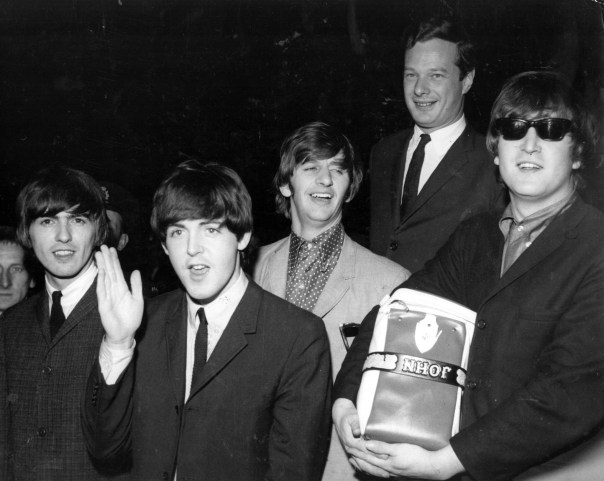
The Beatles arrived at London Airport on Sept. 22, 1964, after a tour of the United States and Canada. From left, George Harrison, Paul McCartney, Ringo Starr, Brian Epstein — the group’s original manager — and John Lennon. Credit… Keystone/Getty Images
It was at this time, out of the blue, that John and Brian decided to take a break in the Beatles’ very busy schedule and go off together for a holiday in Spain. The first suspicious thing about this amongst fans was “Why did John go on holiday, as his wife had recently given birth to a new son?” (Cynthia had gave birth to Julian, John’s first son, on March 8, 1963). John admitted, years later, what a rotten and selfish thing this was for him to have done, but nonetheless, he went with Brian, sparking rumors that it was a romantic get-a-way.
Fellow Beatle, Paul McCartney, has his own take on John’s Spain trip with Brian. According to Paul, the trip’s purpose was for John to assert who the real leader of the Beatles was with Brian. That John took Brian on the holiday “…to make sure Mr. Epstein knew who to listen to in this group”. It is interesting that even in these very early Beatles’ days, John and Paul were already jockeying for an upper hand.
Whatever the case, John and Brian spent 12 days together in Spain. “We used to sit in cafes together”, recalled John, “looking at the boys. I’d say, ‘do you like that one? Do you like this one?’ …I was rather enjoying the experience, thinking like a writer all the time.”
The details of the trip were sketchy, at best, but soon John and Brian had returned and were ready to get back to the business of making Beatles records, performing concerts, and making appearances. But in Liverpool, the “gay” rumors were now intensely swirling. Things came to a head with a disc jockey the Beatles knew named Bob Wooler (1926-2002).
Wooler was a very close friend of the Beatles and had introduced them on stage some 300 times. This incident happened at Paul’s 21st birthday party, on June 18, 1963. At the party, Wooler was joking around with John and said (with heavy gay intimations): “Come on John, what really happened with you and Brian? Everybody knows anyway, so tell us.”
John had been heavily drinking that night and Lennon was a notorious “bad drunk”. In a blind rage, John proceeded to beat the stuffing out of a very surprised Bob Wooler, literally kicking him repeatedly in the ribs as he lay on the ground in a bloody heap.
According to John, the only reason he actually stopped the savage beating was because, “I realized I was actually going to kill him… I just saw it like a screen. If I hit him once more, that’s really going to be it. I really got shocked and for the first time thought: ‘I can kill this guy.’”
Wooler was rushed to the hospital by Brian, who was also present at Paul’s party, and given treatment for a variety of things, including broken ribs. Luckily for John Lennon- and the Beatles’ future amazing run- Wooler survived the ordeal.
Incredibly, John refused to apologize. “He called me a bloody queer, and I bashed in his ribs for it”, he said defiantly. Because of this refusal to apologize, Brian had a writer for The Daily Mirror, Don Short, send a telegram on John’s behalf, apologizing. The telegram read, “Really sorry Bob. Terribly sorry for what I have done. What more can I say? -Signed, John Lennon” In addition to that, a payment of 200 pounds (around $2200 today) was also given as compensation.
Despite their very recent fame in Europe in musical circles, this incident actually got the Beatles their first national press coverage in England in an article in the Daily Mirror. (One can easily imagine what kind of coverage an incident like this would have gotten nowadays, with our current tabloids, twitter, and the blogosphere. And, of course, had Bob Wooler not been the forgiving type, he could easily have raked John over the coals, but chose not to. Or what if John had actually killed Wooler by perhaps kicking him a few more times with Wooler’s broken ribs perhaps puncturing his lungs? It would have finished the Beatles as we remember them right there, not to mention the fact that John Lennon would have been sent to prison for murder!)
Despite the severity of the incident and the coverage in the Daily Mirror, the incident was soon forgotten and the Beatles went on to conquer the musical world.
The one murky question for Beatles fans is obviously “Did John and Brian really?…” Beatles fans and aficionados have been debating the question all these years later.
In 1971, in his classic “Rolling Stone” interview, John stated that of all the Beatles he “was the closest to Brian”. (was this one of John’s inside jokes, did he really mean?…) John later briefly commented on the lingering question about Brian and himself shortly before his tragic death in 1980. “It was almost a love affair, but not quite. It was not consummated. But it was a pretty intense relationship”, he said.
About the gay accusations setting him off, Lennon went on to add, “You know, when you’re 21, you want to be a man. If someone said it now, I wouldn’t give a shit”. (1980). But at the time, John was a very macho, young rock star and he had to prove it to everyone.
One marvels when looking at the incredible, unbelievable career of John Lennon- and the Beatles- at just how close it all came to going up in smoke, because of a needless, drunken beating, all those years ago at a birthday party.
BonusFact:
While he may or may not had a romantic encounter with Brian Epstein, Lennon definitely also loved the ladies. In 1968, he confessed to his first wife, Cynthia, that he had had over 300 extra-marital affairs with women during their six-year marriage. He may have been underestimating himself.
I have not been able to locate the Newsweek actively “Straight Jacket” at the centre of this 2010 controversy…though from what I can gather this is a reproduction.
This story was first posted on the Web on April 26, 2010.
The reviews for the broadway revival of Promises, Promises were negative enough, even though most of the critics ignored the real problem—the big pink elephant in the room. The leading man of this musical-romantic comedy is supposed to be an advertising peon named Chuck, who is madly in love with a co-worker (Kristin Chenoweth). When the play opened on Broadway in 1968, Jerry Orbach, an actor with enough macho swagger to later fuel years and years of Law & Order, was the star. The revival hands the lead over to Sean Hayes, best known as the queeny Jack on Will & Grace. Hayes is among Hollywood’s best verbal slapstickers, but his sexual orientation is part of who he is, and also part of his charm. (The fact that he came out of the closet only just before Promises was another one of those Ricky Martin “duh” moments.) But frankly, it’s weird seeing Hayes play straight. He comes off as wooden and insincere, as if he’s trying to hide something, which of course he is. Even the play’s most hilarious scene, when Chuck tries to pick up a drunk woman at a bar, devolves into unintentional camp. Is it funny because of all the ’60s-era one-liners, or because the woman is so drunk (and clueless) that she agrees to go home with a guy we all know is gay?
This is no laughing matter, however. For decades, Hollywood has kept gay actors—Tab Hunter, Van Johnson, Richard Chamberlain, Rock Hudson, etc.—in the closet, to their detriment. The fear was, if people knew your sexual orientation, you could never work again. Thankfully, this seems ridiculous in the era of Portia de Rossi and Neil Patrick Harris. But the truth is, openly gay actors still have reason to be scared. While it’s OK for straight actors to play gay (as Jake Gyllenhaal and Heath Ledger did in Brokeback Mountain), it’s rare for someone to pull off the trick in reverse. De Rossi and Harris do that on TV, but they also inhabit broad caricatures, not realistic characters like the ones in Up in the Air or even The Proposal. Last year, Rupert Everett caused a ruckus when he told The Guardian that gay actors should stay in the closet. “The fact is,” he said, “that you could not be, and still cannot be, a 25-year-old homosexual trying to make it in the?.?.?.?film business.” Is he just bitter or honest? Maybe both.
Most actors would tell you that the biographical details of their lives are beside the point. Except when they’re not. As viewers, we are molded by a society obsessed with dissecting sexuality, starting with the locker-room torture in junior high school. Which is why it’s a little hard to know what to make of the latest fabulous player to join Glee: Jonathan Groff, the openly gay Broadway star. In Spring Awakening, he showed us that he’s a knockout singer and a heartthrob. But on TV, as the shifty glee captain from another school who steals Rachel’s heart, there’s something about his performance that feels off. In half his scenes he scowls—is that a substitute for being straight? When he smiles or giggles, he seems more like your average theater queen, a better romantic match for Kurt than for Rachel. It doesn’t help that he tried to bed his girlfriend while singing (and writhing to) Madonna’s “Like a Virgin.” He is so distracting I’m starting to wonder if Groff’s character on the show is supposed to be secretly gay.
This is admittedly a complicated issue for the gay community, though it is not, in fact, a uniquely gay problem. In the 1950s the idea of “colorblind casting” became a reality, and the result is that today there’s nothing to stop Denzel Washington from playing the Walter Matthau role in the remake of The Taking of Pelham 1 2 3. Jack Nicholson, by the force of his charm, makes you forget how he’s entirely too old to win Helen Hunt’s heart in As Good as It Gets. For gay actors, why should sexual orientation limit a gay actor’s choice of roles? The fact is, an actor’s background does affect how we see his or her performance—which is why the Denzels or the Tom Hanks-es of the world guard their privacy carefully.
It’s not just a problem for someone like Hayes, who tips off even your grandmother’s gaydar. For all the beefy bravado that Rock Hudson pro-jects onscreen, Pillow Talk dissolves into a farce when you know the likes of his true bedmates. (Just rewatch the scene where he’s wading around in a bubble bath by himself.) Lesbian actresses might have it easier—since straight men think it’s OK for them to kiss a girl and like it—but how many of them can you name? Cynthia Nixon had a male partner when she originated Miranda on Sex and the City, Kelly McGillis was straight when she steamed up Top Gun’s sheets, and Anne Heche went back to dating men (including her Men in Trees costar); we believed their characters before their sexuality became an issue. If an actor of the stature of George Clooney came out of the closet tomorrow, would we still accept him as a heterosexual leading man? It’s hard to say. Or maybe not. Doesn’t it mean something that no openly gay actor like that exists?
Newsweek’s Setoodeh Responds to ‘Straight Jacket’ Backlash
As BroadwayWorld has previously reported, in a recent Newsweek article, Ramin Setoodeh posed the question: “Heterosexual actors play gay all the time. Why doesn’t it ever work in reverse?”
Setoodeh went on to state that Sean Hayes, currently starring in the Broadway revival of PROMISES, PROMISES, cannot come across as straight in the role. He writes “Hayes is among Hollywood’s best verbal slapstickers, but his sexual orientation is part of who he is, and also part of his charm. (The fact that he only came out of the closet just before Promises was another one of those Ricky Martin-duh moments.) But frankly, it’s weird seeing Hayes play straight. He comes off as wooden and insincere, like he’s trying to hide something, which of course he is. Even the play’s most hilarious scene, when Chuck tries to pick up a drunk woman at a bar, devolves into unintentional camp. Is it funny because of all the ’60s-era one-liners, or because the woman is so drunk (and clueless) that she agrees to go home with a guy we all know is gay?”
The comments have drawn the wrath of many, including Hayes’ PROMISES co-star Kristin Chenoweth, who authored a strongly worded response. Writes the actress: “I was shocked on many levels to see Newsweek publishing Ramin Setoodeh’s horrendously homophobic “Straight Jacket,” which argues that gay actors are simply unfit to play straight. From where I stand, on stage, with Hayes, every night — I’ve observed nothing “wooden” or “weird” in his performance, nor have I noticed the seemingly unwieldy presence of a “pink elephant” in the Broadway Theater.”
Cheyenne Jackson and Michael Urie – openly gay actors themselves – weighed in at a Temperamentals Talk back, afterelton.com reported, calling Setoodeh an outright “asshole” and “unconscionable.”
Said Jackson, “It was infuriating on so many levels. Not only does [Setoodeh] say that a gay man can’t play straight, he got personal, picking on Sean Hayes in Promises, Promises, [pointing out] certain scenes where he thinks [Sean] is stiff and uncomfortable…It was very veiled self-loathing. Really upsetting…Everytime we go forward, some asshole like this takes us back a bit.”
Added Urie: “We’re all actors, and the audiences get it. When I saw Sean Hayes in Promises, Promises, it was a full house and everyone was completely in love with him…And to attack, to quote Ugly Betty, someone [like Groff] recently ‘hatched from the gay egg’ is unconscionable and he should strung [up]. [Groff] made everyone want him in Spring Awakening. And Cheyenne was f*cking Elvis in All Shook Up. He was sexy and hot. He’s always playing straight. And people buy tickets to see him. No straight critics accuse Sean Penn of not being able to play Harvey Milk or [criticize] Tom Hanks in Philadelphia.”
Setoodeh has just released a response on Newsweek.com in defense of his original article:
“I wrote an essay in the May 10 issue of NEWSWEEK called “Straight Jacket” examining why, as a society, it’s often hard for us to accept an openly gay actor playing a straight character. You can disagree with me if you like, but when was the last time you saw a movie starring a gay actor? The point of my essay was not to disparage my own community, but to examine an issue that is being swept under the rug…
But what all this scrutiny seemed to miss was my essay’s point: if an actor of the stature of George Clooney came out of the closet today, would we still accept him as a heterosexual leading man?…
I realize this is a complicated subject matter, but the Internet sometimes has a way of oversimplfying things. My article became a straw man for homophobia and hurt in the world. If you were pro-gay, you were anti-NEWSWEEK. Chenoweth’s argument that gay youth need gay role models is true, but that’s not what I was talking about. I was sharing my honest impression about a play that I saw. If you don’t agree with me, I’m more than happy to hear opposing viewpoints. But I was hoping to start a dialogue that would be thoughtful-not to become a target for people who twisted my words. I’m not a conservative writer with an antigay agenda. I don’t hate gay people or myself.”
The headquarters of the Catholic church is a closely guarded city-state – centuries old and resistant to change. Can Pope Francis drag it into the 21st century? (Guardian photographer Christian Sinibaldi was given unprecedented access to his world. Words by Paula Cocozza)
Renzo Cestiè, Pope Francis’s senior driver, waits as the Popemobile is refuelled. Photograph: Christian Sinibaldi
The man holding the keys might have wandered into a fairytale. He faces a pair of towering doors whose knocker is larger than his head. In his hand, the giant hoop clatters as he feels his way towards No 401; it enters the keyhole with a clear, sharp clang. The man starts to push and light from inside the room falls across his shoes.
At 6.30am, the Vatican is awakening. In a few hours, the room Alessio Censoni has just opened, the Sala Rotonda, will be packed with tourists. But, for now, the building is coming to life with workers. Chatter blows along the corridors. Together with four shift-mates, Censoni continues his round of unlocking: 300 doors to go.
Since his election in 2013, Pope Francis has repeatedly praised the dignity of labour (in Buenos Aires, he once did a stint as a bouncer). Group by group, he has invited the Vatican’s 4,800 employees to mass in Casa Santa Marta, the guesthouse where he lives. In January, he baptised Censoni’s daughter. What can his employees – hastening to the clocking-in machine, past the sleepy security guard in a North Face hoodie – tell us about working alongside the pontiff?
Keeper of the keys, Alessio Censoni. Photograph: Christian Sinibaldi
The cleverness of Pope Francis has been to advance the message of Christ simply by being human himself. He has brought divine office down to earth with a revolution in tone. Famously, he is the first pope to use the word “gay” (“If a person is gay and seeks God and has good will, who am I to judge?”). He has described the pay gap between men and women as “pure scandal”, advised Catholics that they needn’t breed “like rabbits”, and called priests who refuse to baptise the children of single mothers “animals”. He has washed the feet of young prisoners. In this sense, Pope Francis is a parable in action.
If his predecessor Pope Benedict was perceived as aloof and scholastic, this pope wears a full-faced grin and wields a thumbs-up. But while he is seen as progressive, Francis’s reform of the curia – the church’s central government, which he has castigated for its insularity and back-biting – is moving slowly. And despite the apparent liberalism of his speeches, the official teaching remains mostly intact: abortion is still “absolute evil”, homosexual acts a sin, gay marriage firmly opposed. Francis has managed to suggest a radical agenda by putting the theme of mercy at the heart of everything he does: in countless speeches, pronouncements and even the current “extraordinary jubilee” year. It’s a message that has secular appeal (who doesn’t believe in compassion?), and it has allowed the pope to sidestep a confrontation with the church’s more conservative forces, by encouraging local priests to use their own discretion.
But still the Vatican remains highly secretive, a world in miniature; packed into its 0.44 sq km is everything a state needs, only smaller. Beyond its museums and St Peter’s Basilica, the frontiers are well guarded. There are high walls, and the famous bank is housed inside an old fortress. The fire engines are the size of minibuses. Under Pope John Paul II, the cinema was busy, but the chairs are now stacked and it looks disused. There is even a tiny jail, used to detain the priest convicted in July for his part in the latest Vatileaks scandal exposing financial mismanagement and corruption at the city’s heart. Petrol costs a minuscule 40 cents a litre, compared with €1.40 over the border in Rome.
[He] says these things, catchy phrases, which are less than 140 characters, so they naturally fit on Twitter
At one of these roadside pumps, the Popemobile is being refuelled. Renzo Cestiè, chatting to the attendant, is Pope Francis’s senior driver. He was second driver for Benedict, “but we had a whole different fleet then”, he says. “We had an armoured Mercedes, an armoured Popemobile. Pope Francis doesn’t want them. He wants contact with the people. See?” He lifts a protective cover to reveal a Popemobile with tinted windows. “This was used by JohnPaul II and Benedict, but the Holy Father fears nothing.” And what about his driver? “I don’t feel fear,” he shrugs. “If it happens, we go to paradise.”
Cestiè sensed that his job was changing from day one. Sent to collect the newly elected pope from his pensione in central Rome, he waited by the entrance in a Mercedes. “An official came rushing out, saying, ‘Take it away!’ Because the pope wanted to get the bus with his cardinals. He said, ‘Do you mind if I go with my friends?’ We didn’t know then that he hated luxury. We didn’t stop to think that these cars weren’t made for him.”
Jobs as cleaners and maintenance workers are often passed down through families. Photograph: Christian Sinibaldi
For the first few weeks, Cestiè, who is 62 and has worked at the Vatican since he was 14, reported for duty in fancy cars. Then the pope visited his garage to see the options for himself, settling on a blue Ford Focus and the smallest, most open Popemobile. Cestiè thumps its bonnet. “For us it was a wonderful thing, the Holy Father so humble.” Now Benedict’s Mercedes is boxed in at the back of the garage, its roof covered with a sheet of bubblewrap.
Cestiè flips open the Popemobile’s glove box, where a white towel is stowed to dry the pope on rainy days. As a rule, he says, the vehicle should feature the papal coat of arms, but the paintwork glints with Benedict’s golden emblem. “Pope Francis doesn’t like crests.” He also insists on shutting his own door. Cestiè lets slip a reference to the pope’s “butlers”, or assistants, and then corrects himself. “He doesn’t want to call them butlers, because we are all the same. We are people who collaborate with him.”
The pope is a quiet passenger who shuns the car radio, he says. But every now and then, Cestiè will glance in his rearview mirror and find his passenger’s gaze. “I always look away,” he says. When Francis meets his eye, “it is as if, in that moment, he looks inside you and he knows who you are”. His voice cracks, the silence eventually broken by his mobile ringtone: Barry White’s Can’t Get Enough Of Your Love, Babe.
Pushed to name the biggest change since Francis was elected, Cestiè’s answer is surprisingly pragmatic: it’s his work-life balance. Unlike Benedict’s retired driver, “who was always here, every day, every holiday”, Cestiè works a six-hour shift. “The Holy Father wouldn’t want it. He is the first to say, ‘Why aren’t you resting today?’”
A team of 80 workers maintain the Vatican’s treasures. Photograph: Christian Sinibaldi
It is a five-minute walk from Cestiè’s carport to the lavish apostolic palace, past the fire engines where the firemen still lean on the bonnet. This is where Benedict lived as pope, and where Francis holds meetings. Sun pours through the windows, making latticed shadows on the wall. The galleried walkways glimmer with the clean, faint fragrance of undisturbed air. At the clip of approaching footsteps, a Swiss guard materialises around a corner. He can’t talk on duty, he says (and this afternoon he is captaining FC Guardia in a match against a Gypsy team), but he promises to meet tomorrow.
He doesn’t want to call them butlers, because we are all the same. We are people who collaborate with him
In the Sala Regia, a vast antechamber to the Sistine Chapel, workers are packing portraits of 19th-century popes into removal crates after an exhibition. Just off this room is the apostolic sacristy where Father Pavel Benedik, a taciturn Slovakian priest, is fiddling with his smartphone. He is the custodian here, and calm prevails. In an hour, the phone rings once. The room is lined with polished wardrobes, a hive of numbered wooden doors in which every item has its place, and every place has a label. Vestments are stowed by size (Pope Francis takes a 3, the most popular) and the drawers are taped with old-fashioned embossed strips: “X IL PAPA [for the pope]”, “VIMPE STOLE [shawls, stoles]”.
Helping Father Pavel is Father Jesus Polentino, 30, from Venezuela. He was ordained just as Benedict resigned, so for him the election of an Argentinian pope felt particularly auspicious. “The first Latin American pope,” he says. “They went to the end of the world to find him. That means that even we, who are from the end of the world, can arrive at the heart of this church.”
He is a volcano! This dynamism – no one expected this. Not even him,’ says Father Federico Lombardi. Photograph: Christian Sinibaldi
Or maybe the heart, its centre, is moving outwards? “Only the style changes a bit,” Father Pavel says. He withdraws a bent cross crosier from a nearby cupboard and lays it next to the original on which it was modelled. This crucifix-topped staff fell into disuse under Benedict, but it has been revived, to the distaste of some Catholics, who find its depiction of Jesus’s suffering too brutal. “Almost the same,” Father Pavel says, looking at the two. And they are, only the Christ in Francis’s version has even thinner legs. Suffering is not something from which he shies away.
A reformer
At 6pm, it is rush hour in the Vatican. Cars file along the road behind the palace of the governatorato, a sort of mayoral building opposite which Francis’s crest has been clipped out of box hedging; maybe it was planted before he made his wishes clear. Nuns unload shopping trolleys into their car boots by the supermarket, and a crowd gathers at the pharmacy where a promotional stand offers samples of Avène skincare. Outside the Swiss Guard barracks, the air is thick with sweat and deodorant. The young soldiers who guard the pope have just finished a football match.
Just beyond the Vatican gates, Father Federico Lombardi, 73, shows the way to his office, up marble stairs, through a room stacked floor-to-ceiling with boxes of paper and ink. For 10 years until this summer, he served as the pope’s spokesperson (though he rejects that title, because “the pope can speak for himself”), working with John Paul II, Benedict and the current pope.
What has Francis been like? “He is a volcano!” Lombardi says, settling into his swivel chair. “This dynamism – no one expected this. Not even him! He is very creative, he has lots of initiatives.”
These have included choosing to launch the pope’s “holy year of mercy” at Bangui cathedral in Central African Republic, rather than Rome. Then there were the 11 Syrian migrants he brought back to Rome from Lesbos in April. Not to mention the free-form press conferences, the reinvigorated synod of bishops, which is devolving power to the regions, and the council of cardinal advisers tasked with reforming the curia. Twelve times in an hour, Lombardi describes Francis as “dynamic” – but would he say the pontiff is a reformer?
“Let’s say he has given a strong impetus to putting us on the road, no? When he speaks about the church ‘going out’, he means a church that is not inside the walls defending itself, not self-referential,” Lombardi replies, cupping his hands as if to enclose a tiny city. “That definitely is a sense he has given us. The church on the road – and, in this sense, I accept the definition of reformer.”
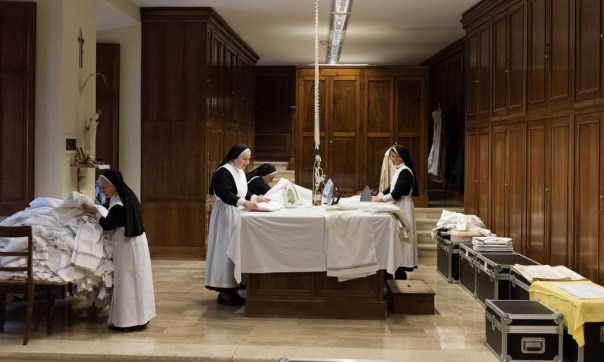
Sisters iron ceremonial robes. Photograph: Christian Sinibaldi
You can almost feel the volcano cool as Lombardi speaks, though such circumspection comes with the territory. “There is what one might call a turf war going on,” Austen Ivereigh, author of Pope Francis: The Great Reformer, explains. “The different departments have their own fiefdom. That’s what he is setting out to change.” Nine communication teams have become one. This month, the Vatican ministries of family, laity and life, which have always overlapped, will merge. Others will follow. Ivereigh calls this “the biggest redesign of the curia in 30 years. It’s radical in the sense that Francis is introducing collegiality, which is allowing the local church to have a much greater say. The reordered Vatican will be a slimmer, more focused structure.”
Crucially, there will be financial reform. Last December, the Vatican appointed PricewaterhouseCoopers as its external auditor. But in April the audit was suspended; the Vatican has since announced that its own Office of the Auditor General, created by Pope Francis, will conduct the audit with PwC in “an assisting role”.
Lombardi waves away these subjects as “very particular arguments. I am not sure it’s worth going into them. The suspension of the deal with Pricewater…” he trails off, apparently having forgotten the name. “If you do a contract for three years, that costs €3m, that looks at all the central institutions – it can happen that you need to correct the odd thing.”
He thinks Francis’s reforms have had “partial results. Certain things are already seeing positive results, but others are still a little in train.”
How difficult is it to bring about change? “Exactly like in all the organisations of the world. I have been here 25 years. I know how things are done and why they are done. If someone comes along and says, ‘Now we are changing everything’, I say, ‘Look, perhaps you haven’t yet understood what we do and why we do it.’ Perhaps I make one or two objections. Is this resistance because I don’t want to change anything, or is it because I simply want to make you understand what we have done and why?”
Florists at work. Photograph: Christian Sinibaldi
The swivel chair is in a state of agitation now, and Lombardi’s shoulders rise and fall in frustration. “I have always found it very simplistic, the way the world is divided between those who want to make things better and those who resist, because they want to conserve their power. If anyone says this about the Vatican, they are saying an idiocy. Perhaps in 3,000 people, you will have three or four who will say, ‘I lose my power!’, and lots of others who will say, ‘No, let’s discuss what we want to change.’ There should be a discussion.
“These ones here, when they came,” he says, casting around for the name of another, previous consultant. “It was very interesting for me: McKinsey. We worked with much friendship and serenity. But at the start,” he says, dropping his voice, “they knew absolutely nothing. They didn’t know about shortwave radio! They had not the least idea, while we had worked on it for 80 years. Do you understand? It’s great to draw up new plans. But there is also a dialogue to be had.” He laughs. “I had the impression I taught them more than they did me.”
As director of communications for an outspoken pope, one imagines Lombardi’s job became tougher with Pope Francis. But, no, he says, it was harder under John Paul II. “For the last five or six years, he was in a chair and didn’t say a word.” And Benedict was also “less concrete in his communication, so it was more challenging”. Pope Francis, meanwhile, has “a great gift” for speaking directly. He “says these things, catchy phrases, which are less than 140 characters, so they naturally fit on Twitter. In this type of communication, Francis is ideal. It’s as if he were made for the purpose.”
The sky is darkening through Lombardi’s office window. “Instead of going about with complete indifference, feeling the church is out of step with the times,” he adds, “Francis has made it closer, more present, with all the suffering and difficulty that humanity experiences today.”
‘Fran-cis-co! Fran-cis-co!’
In St Peter’s Square, crowds have gathered, chatting, chanting, singing a cappella. Soon Pope Francis will descend the steps and faithful hands will grasp the air around him. Renzo Cestiè’s mother will be watching on TV. A murmur rises. An elderly man is pushing a wheelchair; his son, Carmelo, who lost speech and movement after a stroke, sits with a white cap on his lap. He hopes that Pope Francis will wear it. People shout, “Carmelo! Over here!” They know that where a wheelchair is parked, Francis will come.
The Papal Audience in St Peter’s Square. Photograph: Christian Sinibaldi
A cry of “Fran-cis-co! Fran-cis-co!” breaks from the crowd. The pope is coming. Carmelo is bringing him to us. The pope looks thrilled. He is beaming as if he has been waiting for this. He stoops, eyes crinkled, and clasps Carmelo’s head so eagerly, his fingers disappear into his thick hair. Spotting the cap, he gives a magician’s grin and plucks off his own by a tassel. Ta-da! In its place he puts Carmelo’s. He presses it down, to make sure that whatever goodness rises from his head will stick to Carmelo’s cap. He smiles again – something is happening – and returns the cap; the delight on his face suggests that it is he who has met Carmelo, and not Carmelo who has met the pope. The crowd roars. People wipe their eyes. Carmelo has been hugged and it feels like a hug for all. A new chant breaks out. “Car-mel-o! Car-mel-o!” The pope climbs into his jeep, black trousers showing through his white robe. Underneath it all, they seem to say, he is just a parish priest.
Speak to those who work with Francis, and the stories of countless acts of consideration mount (though he could send the nuns help with the ironing). Alessio Censoni, the key-keeper, knows that the rumours the pope encouraged women to breastfeed in the Sistine Chapel are true: at Censoni’s daughter’s christening, when babies wailed, he turned to the mothers and asked, ‘Can’t you hear they’re crying? Feed them tranquilly.”
He asks us … if we’re hungry, if we want to sit down. On my first night shift, he offered me a biscuit
“Yes, I’ve heard that one,” says Filippo Petrignani, who works in the museum’s rights office. “But there are loads. Of him taking a coffee from the vending machine. With coins.” Petrignani rattles off the stories like jokes. “Last summer: ‘Father, it’s very hot in Rome. Would you like to go out of the city for a week?’ ‘And how many people would I have to move to go out of the city? Hmm. We’ll stay at home. What we save, we’ll give to the poor.’”
In another anecdote, Pope Francis offers a chair to a Swiss Guard. “That’s true,” says guard Nico Castelluzzo, today sitting in the visitors’ mess, just after lunch, his colourful livery peeled to the waist to protect the uniform from spatters from his pasta sauce. “It was the same when we did the night shift outside his apartment. He would always ask if we’d slept OK. It took a while for him to understand that we were on duty, that we needed to stay awake. He asks us – he’s a very human person – if we’re hungry, if we want to sit down. On my first night shift, he offered me a biscuit. It tasted good: an Argentinian biscuit.”
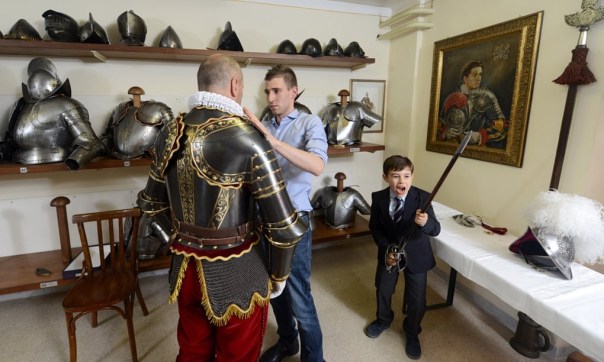
Christoph Graf, the 35th commander of the Pontifical Swiss Guard, is dressed by an assistant as his son plays. Photograph: Christian Sinibaldi
According to the Swiss Guards’ website, beneath Castelluzzo’s colourful costume “is actually a state-of-the-art trained Swiss security professional”. So it is surprising to learn that guards are not required to undertake exercise and they have a liberal curfew of 2am (though they are required to shave each day). Castelluzzo passes the solitary hours on duty with a book. “I was never a great reader. I started when I joined the Swiss Guards, so I’m still trying to work out what I like,” he says. Despite the Vatican’s disapproval of its author, he has just finished Dan Brown’s Angels and Demons. “Well,” he says, “it’s good to know the opposition.”
Has Pope Francis’s predilection for entering crowds make Castelluzzo worry? “Security is more complicated. Pope Francis is very close to the people. But he knows what risk he takes, and he still wants to do it.” The Swiss Guards work with the carabinieri, Italy’s military police. “But,” Castelluzzo says, “if someone wants to do something, they will surely find a way.” He shrugs. “You need to pray a lot.”
From the guards’ barracks, the road loops around the rear of St Peter’s to reach the basilica’s maintenance division, near the smokers’ corner and the vending machines. Here, Pietro Zander helps oversee the cleaning and maintenance workers (the job that Renzo Cestiè’s father, grandfather and great-grandfather all did). “We continue that which they who came before us started,” Zander says. The St Peter’s Zander knows is not the one most visitors see. There are 22,000 square metres of floor to be cleaned daily. When a shaft of light enters a window, Zander sees “threads of wool, hairs, all this microdust”. He knows the basilica in its vastness and its particulars. But it is also a home. “St Peter’s house,” he says. “Like a house, the door is closed with a key.”
Pope Francis, whom Zander considers “a neighbour”, likes to greet the cleaners in the basilica, but there are other examples of crossover between the devotional side of things and what Zander calls “contingent necessities”. When, for example, John Paul II required a tomb, it was Zander’s department that solved the problem of where to put him by moving the remains of Pope Innocent XI because otherwise, he says with a straight face, “There was a pedestrian traffic problem. The huge flow [of mourners] would have created jams.”
Driver Renzo Cestiè with the Pope’s Ford Focus. Photograph: Christian Sinibaldi
A colleague enters his office. “Have you seen this?” Zander asks, holding up an old chandelier. He is fascinated by the metal grid that protects the bulb. “If the bulb breaks, the glass won’t fall. And if the grid breaks, the grid won’t fall, because look…” He waggles a small metal tie that acts as a second safety catch. “One of the principles of doing things properly in St Peter’s is to look at what has been done before you. Because here perfection has happened that way.” He rests the chandelier on the table. There is an echo of Father Lombardi and his defence of the curia’s right to question change: for both men, precedent should be upheld to protect the future.
Pope Francis’s critics broadly divide into two camps: those who think he is trying to change too much, and those who would like him to do more. Reform is happening slowly, unevenly. His ad hoc gestures and comments can feel like progress, but in other areas – in confronting institutional child abuse, for example, or tackling financial reform – he can seem wanting. And, of course, devolving authority to local churches has empowered conservative as well as liberal voices. As the pope said in an address last Christmas, “We cannot do everything, yet it is liberating to begin.”
It must be hard to reform a structure when the past is seen to confer its own kind of providence. But Pope Francis’s smile has yet to slip and, at 79, he has “an energy unexpected of a person of his age”, Father Lombardi tells me. “I asked him how he did it, how he managed. He said, ‘Well, God asked me to do it and he gives me the strength to do it.’ His Argentinian friends say, ‘But we don’t recognise him! He seems 20 years younger than when he left.’ In his last years in Buenos Aires, he seemed to be preparing for retirement. Instead, he has taken off again – and he pulls us all along.”
He was not faster than a speeding bullet. He was not more powerful than a locomotive. He was not able to leap tall buildings in a single bound.
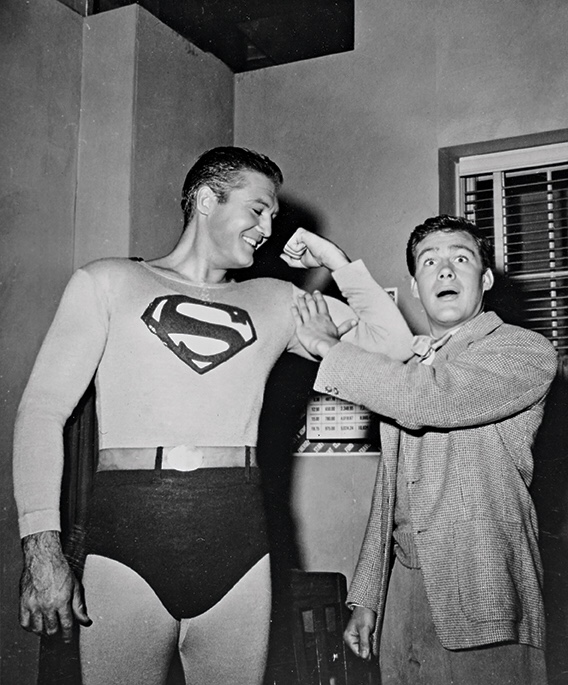
In the great pantheon of characters to emerge from the “Superman” universe — Lois Lane, Lex Luthor, Jor-El, General Zod — Jimmy Olsen probably ranks below even Richard Pryor’s wisecracking embezzler in the much-maligned “Superman III.” Jimmy just isn’t that cool. He’s often described as a “cub” reporter. He needs saving more than he saves. He says “Golly.” And he’s sometimes drawn as a redhead.
“Oh, I’m not going in there!” Jimmy whines when hustled into a secret prison after falling prey to the treacherous Von Klaven brothers, identical twins who steal radium, during the 1952 Superman adventure “Double Trouble.” Jimmy’s line when rescued by Man of Steel George Reeves: “Right now, you’re prettier to me than all the movie stars in the world!”
But in a franchise that’s seen its share of tragedy — George Reeves’s reported suicide, Christopher Reeve’s spinal injury — the woes of the actor who played Jimmy in the 1950s went underreported. Jack Larson, who died at 87 on Sunday, was a gifted writer and gay man whose talents and personal struggles were overshadowed by his role as Superman’s flunky.
Even worse: He knew it would turn out this way.
“If I won the Nobel Prize for Literature at 75 and died, they would still say, ‘Jack Larson, best remembered as Jimmy Olsen in the ‘Superman’ series,”’ he said in 1982.
Though Larson never won the Nobel, his swipes at literary greatness were more than the flailing of a teen star gone to seed. Born in California, Larson had dreams of making it big on Broadway as an actor and playwright. After being signed by Warner Brothers while still in high school and a stint in the Marines, the budding thespian found himself at a crossroads.
It was 1951. The old studio system was dying. Though just in his early 20s, Larson had done a few films, but was running out of work — and wanted to get to the Great White Way.
His agent came up with a solution: Play the terrible supporting role of Jimmy Olsen in “Adventures of Superman.”
“I didn’t want to do it,” Larson said, ”but my agent said, ‘Look, you want to get to New York. You don’t have any money. Nobody will ever see this show so take the money and run.”’
Larson did. For $350 an episode, he completed the show and went to the Big Apple. And he was living there when the show he had dismissed became one of the most iconic in TV history — even though it was pretty bad.
“Adventures Of Superman was frequently barely a superhero show — it was more like a dirt-cheap police procedural sprinkled with a few minutes of unconvincing special effects — but it still featured the most famous, popular superhero of all time,” the Onion’s A.V. Club wrote in 2013. “So what else was the nascent geek clan going to watch?”
Larson, meanwhile, became a would-be aesthete fixed in amber as a hapless hanger-on. With a terrible bowtie, no less.
“To me, it was a nightmare,” he said in 2006. “Everywhere I went, it was, ‘Jimmy! Jimmy! Hey, Jimmy, where’s Superman?’ Suddenly, I couldn’t take the bus or the subway anymore. It absolutely freaked me out.”
However, Larson rode the wave. He played Jimmy in 101 episodes of “Adventures of Superman” between 1952 and 1958. And after Reeves’s death — which Larson never believed was a suicide — they tried to get him to do more.
“I refused point blank,” he said. “It made me sick that George had died. He was Superman, and that was the show. I felt, ‘Why go on with it?’ I decided then to quit acting.”
Feeling typecast, he “took up the life of a playwright in New York,” he told the New York Times in 1976 — in a piece that identified him as a “bachelor.”
Larson was far from that. It seemed that one good thing had come of his time as Jimmy: a sexual awakening. While in Hollywood, he became involved with screen legend Montgomery Clift, and met his future longtime companion, director James Bridges (“The Paper Chase,” “The China Syndrome”).
“He realized, in retrospect, that some of his adolescent angst had been due to turmoil over his sexual orientation,” the Times wrote in 1998.
Jack Larson in 2011. (Fred Prouser/Reuters)
That turmoil would be given voice in “The Relativity of Icarus,” a dance piece that premiered at New York’s prestigious Joffrey Ballet in 1974. Larson wrote a poem that accompanied the work. Four decades ago, what some saw as an attempt to mask gay themes in the charged relationship between Daedalus and Icarus was met with controversy.
“It is strange in this day of liberation movements that a homosexual pas de deux has to masquerade as a duet between father and son,” the Times wrote.
Amid the “Icarus” publicity, Larson was outed — as Jimmy Olsen. But Jimmy, he found, was no longer repugnant to him. He began to work the TV nostalgia circuit, and was contemplating hosting a tribute show in 1982.
“I want to host it,” he said. ”I want very much to do it — join up my life with Jimmy Olsen. If you can’t beat ’em, join ’em.”
In the coming decades, he would produce films directed by Bridges and write more plays. And he would appear in what CNN called “winking roles” in “Superman” fare such as “Superboy,” “Lois & Clark” and the film “Superman Returns.”
His sexuality — once hidden — was now an asset.
“Gay fans are gushing over the fact that the director of the new ‘Superman Returns’ (opening June 28) is a gay man, Bryan Singer,” the Chicago Tribune wrote in 2006, “and that, besides the fact that Superman is a real hunk, a new trading card featuring scenes from the film shows the big guy — get this! — actually emerging from a closet.”
The paper, noting Larson’s sexual orientation, added: “What was fun about that show was just the ambiguity of it all. It wouldn’t have mattered if Clark was secretly in love with a co-worker named Lois or Louis Lane.”
Somehow, Larson had ended up with it all: a literary career bolstered by his status as a pop-culture footnote, and both inextricably linked to his life as a gay man.
In some ways, Jimmy had given it to him.
“Everywhere I go, I get the warmest feelings from people about Jimmy,” he said. “They love him, and I grew to feel that I could never have done anything more special than be Jimmy Olsen.”
Los Angeles: Actor and playwright Jack Larson (1928–2015) died yesterday at the age of 87. Best known for his role as Jimmy Olsen, Clark Kent’s boy-reporter sidekick in the 1950s television series “Superman,” Larson met his longtime partner, film producer James Bridges, in 1957; they had been a couple for nearly four decades when Bridges died in 1993.
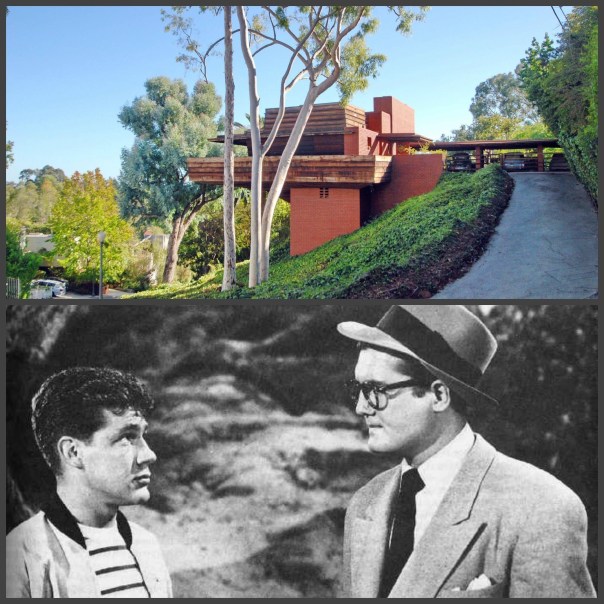
For many years, Larson and Bridges shared a home in the Brentwood Heights neighborhood. Known as the Sturges House, the structure was designed in 1939 by architect Frank Lloyd Wright. “It was obvious to anyone that since we lived together we were partners,” Larson told the Los Angeles Times in 2011. “We always went places together. We never pretended.'”
Located at 449 Skyway Road, Sturges House is formally listed as a Historic-Cultural Monument by the City of Los Angeles. Larson continued living in the house until his death.
Knowing the Sturges House
I first encountered Frank Lloyd Wright’s Sturges House in courses in the History of Architecture at the University of Wisconsin, Madison, where I was a graduate student in the 1960s. This was indisputably “FLW Country.” He had been born nearby in 1867 in Richland Center, Wisconsin and had lived as a child and teenager and had gone to high school in Madison and had then matriculated as “special student” at the University of Wisconsin. Long after that he had built “Taliesin,” his great longtime home and studio in Spring Green, Wisconsin, northwest of Madison. In 1937, also in Madison, Wright had built his first so-called “Usonian” house for Herbert and Katherine Jacobs, a small, wood and brick, two bedroom, flat-roofed, moderately-priced structure that took its name from various sources, including a play on “US-ian.” It was followed, in the late 1930s and 1940s, by other Usonians in Wisconsin, and in neighboring Illinois and Michigan. Wright’s similar, though distinctive, Sturges house (1939) in the Brentwood district of Los Angeles is generally considered to be his “California Usonian.”
Selma Sturges on the roof of the residence, 1940. Image used with permission, courtesy of the Sturges family. Photographer unknown.
When, in 1968, I received an appointment at UCLA to teach urban, architectural and cultural history, I was fortunate to live first in the 1937 Strathmore Apartments in Westwood, designed by Richard Neutra, one of Wright’s already famous former apprentices—about whom I would soon begin to write a book. At the same time, I began to explore Los Angeles architecture, including ten Neutra structures in Westwood alone and not far away, in neighboring Brentwood: Wright’s great Sturges house. Unlike the generally flat sites of the Usonians in the Middle West, I was surprised to find the Sturges residence perched high on a steep lot among rolling hills. Eager to explore this treasure, I unabashedly knocked on the door one day and was cordially welcomed by its owners, the film director James Bridges and his longtime partner, the actor and writer Jack Larson.
Bridges (1936–1993) directed such acclaimed films as: The Paper Chase (1973), The China Syndrome (1979), and Urban Cowboy (1980). Larson (1928–2015) was best known–to his eternal dismay–for his role as Jimmy Olsen, the cub reporter, in the long-developing series Adventures of Superman. He always lamented that he was not as well known for the libretto he wrote for his and Virgil Thomson’s opera Lord Byron (1972). The couple acquired the house in 1967 and lived there together until Bridges’ death in 1993. Larson continued to inhabit it alone until his death in 2015.
Jack Larson as ‘Jimmy Olsen’ and Noel Neill as ‘Lois Lane’ (Photo by ABC Photo Archives/ABC via Getty Images), c. 1951. Vintage print from the collection of Jack Larson sold to benefit The Bridges/Larson Foundation.Film Director James Bridges on location. Vintage print from the collection of Jack Larson sold to benefit The Bridges/Larson Foundation.
Jim and Jack were the first to tell me of how the Sturgeses were told that it was medically impossible for them to have children and how, as a consolation, they decided to commission a house by Wright, whom they had long admired. It was an ideal cottage for two people, but soon after they moved in, Mrs. Sturges realized that she was, in fact, pregnant. Wright altered the house design to accommodate a nursery. But after another child came along, the couple gave up their dream house and moved around the corner to a larger residence. Their name, however, would always be attached to their Wright-designed home as it went through several owners until Bridges and Larson acquired it.
Robert Imandt photograph of the residence, c. 1946. Vintage print from the collection of Jack Larson sold to benefit The Bridges/Larson Foundation.
Built of steel, concrete, brick and wood, the house is approached from the west at the rear just off the carport at the top of the hill. Visitors could either proceed around the encircling deck to enter through the living room on the eastern side or, as most did, through the small kitchen to the west. With less square footage than the Usonians in the Middle West, the house contains a relatively large living-dining room, two small bedrooms, and one bath on the main level. Tiny stairs lead up to the roof deck and down into the windowless basement, which Bridges used as a dark room and studio. In 1939, Wright had deputized his recent Taliesin disciple, John Lautner, to complete final details of the design and to supervise construction. Both Wright and Lautner created specially designed furniture and other accouterments, such as lamps. Small cabinet spaces were cleverly concealed behind fold-out wall panels. Larson and Bridges would also enjoy pointing out various movie treasures they had acquired over the years such as the actual wrench used by Charlie Chaplin in Modern Times (1936).
Sturges Residence appears on the cover of California Arts and Architecture magazine, April 1940. Vintage magazine from the collection of Jack Larson sold to benefit The Bridges/Larson Foundation.
The house was long enjoyed by such Hollywood visitors as writer Gore Vidal and director John Houseman as well as by actors Jane Fonda and Debra Winger, who starred in Bridges’ films and continued to be friends. Jack and Jim also seemed happy to open the house to admiring architecture people such as historians Vincent Scully and Colin Rowe, museum curators Arthur Drexler and Carter Brown, and architects Richard Meier, Peter Eisenman, Richard Weinstein, Jaque Robertson and Frank Israel. The house thus had several incarnations in the public imagination, first, as it was initially published in the Forties and Fifties and again in later years after it had become so famous that it seemed indispensable to any publication on Wright or on modernist Los Angeles.
It remains a vitally significant monument in the history of both.
Hijras occupy a special place in Hinduism. But their relationship to modern Mumbai, where transgender people are legally recognized, remains fraught.
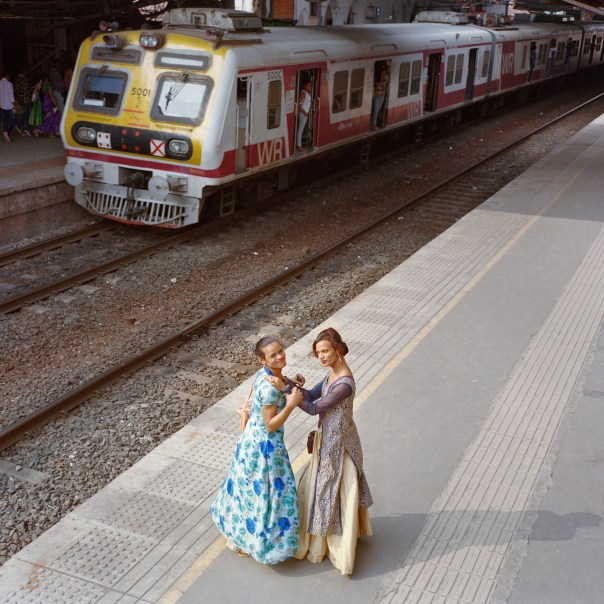
Radhika’s “daughters,” as she affectionately calls them, pose for a portrait near their shared settlement in Mumbai, India. The hijra community is hierarchical, such that more experienced and mature hijras act as guardians and superiors to younger hijras. Credit… Sara Hylton for The New York Times
MUMBAI, India — When Lord Rama was exiled from Ayodhya and his entire kingdom began to follow him into the forest, he told his disciples: “Men and women, please wipe your tears and go away.”
So they left. Still, a group of people stayed behind, at the edge of the forest, because they were neither men nor women. They were hijras, which in Urdu means something like eunuchs. Those people waited in the woods for 14 years until Lord Rama returned, which won them a special place in Hindu mythology. There’s a bit of a mystery about the story’s origin — scholars say it’s not in the early versions of ancient Hindu texts — but in the past century this folk tale about the hijras’ loyalty has become an important piece of their identity. Hijras figure prominently in India’s Muslim history as well, serving as the sexless watchdogs of Mughal harems.
Today hijras, who include transgender and intersex people, are hard to miss. Dressed in glittering saris, their faces heavily coated in cheap makeup, they sashay through crowded intersections knocking on car windows with the edge of a coin and offering blessings. They dance at temples. They crash fancy weddings and birth ceremonies, singing bawdy songs and leaving with fistfuls of rupees.
Many Indians believe hijras have the power to bless or curse, and hijras trade off this uneasy ambivalence.
Gurvinder Kalra, a psychiatrist who has studied the hijra community, recalled the time when a troupe showed up uninvited at his nephew’s birth.
“The first thing people said was, ‘Oh my God, the hijras are here.’” Then there was a nervous pause, he said. Then laughter.
“There is this mixture of negativity and positivity, a laughter, a fear, this sense they are oddities,” Dr. Kalra said.
Radhika, 24, originally from Andhra Pradesh makes a living in Mumbai by performing blessings, begging on trains and through sex work. Credit… Sara Hylton for The New York Times
Behind the theatrics are often sad stories — of the sex trade and exploitation, cruel and dangerous castrations, being cast out and constantly humiliated. Within India’s L.G.B.T. community, the hijras maintain their own somewhat secretive subculture.
Radhika, a hijra living near a railway station in Mumbai, didn’t think of herself as different until she started school, a chapter of her life that did not last long. After being teased by other children, she realized she wasn’t exactly a girl, but she wasn’t a boy either. Her mother told her not to dwell on it.
“She told me, ‘You’re a girl. Stick to it.’”
It hasn’t been easy for Radhika. Her parents split up when she was young, and her mother died soon afterward. None of her relatives wanted to take care of her. After she was essentially abandoned , an older prostitute discovered her and put her to work in a garbage-strewn park selling sex. She was 8.
A decade and a half later, Radhika is still a sex worker. She wears dark saris, chipped purple nail polish, a gold ring in her left nostril and her hair down the middle of her back.
When asked how she feels each evening as she heads off to work, to stand in a line of other prostitutes along the railway tracks, waiting for customers, she shrugged.
“Ever since I was a little girl, I learned the world runs on money,” she said. “I learned that if I don’t have money, I don’t exist.’’
Honey, 22, originally from Hyderabad, outside of the room where she has been staying for one year near the Bandra train station in Mumbai. Credit… Sara Hylton for The New York TimesMany hijras live and work around train stations in Mumbai because begging is more profitable in high-traffic areas. Credit… Sara Hylton for The New York Times
In many ways, Radhika’s story is no rougher, lonelier or more desperate than those of many other hijras. Many are engaged in sex work, locked into service for a guru who takes most of their earnings.
Radhika wouldn’t utter her guru’s name. She seemed scared to talk about her. Within the hijra world, gurus fulfill the hybrid role of den mother, godfather, spiritual leader and pimp. The gurus are hijras as well, usually in their 40s or 50s.
There is a bit of a pyramid sales scheme within the hijra community. Younger “chelas,” or disciples, are managed by midranking hijras who report up to gurus, who are often steered by their own elder mentors. For every hijra, the idea is to get as many chelas working for you as possible. The money flows up; the protection from abusive customers or police officers flows down.
Lata, 61, is known as a guru in the hijra community and has live-in disciples: younger hijras who look to her for guidance and survival. Credit… Sara Hylton for The New York TimesLata holding a picture of her guru. Credit… Sara Hylton for The New York Times
When I tried to interview a guru in Radhika’s neighborhood, the guru shook her head and said she had to get permission from her guru.
But one guru opened up. She lives on the second floor of a slum house in Mumbai, up a narrow metal ladder, like on a ship. Different from Radhika and most hijras, who spend their years in small, airless shanties with the smell of feces wafting through cracks in the walls, this guru, who calls herself Chandini, rents a relatively large apartment. She sat on a cleanly swept floor, slumped against a Whirlpool fridge.
“These days, it’s so much easier to be a hijra,” Chandini said. “Now there are doctors. When I had my sex change, we had to do it ourselves.”
In the past, she said with a sigh, countless young men died from sloppy castrations. They were often performed by people with no medical training.
India has come a long way from that. In some states, such as Kerala, in the south, a person can now get a sex change at a government hospital. A few years ago, India officially recognized transgender as a third gender, eligible for welfare and other government benefits. Not all transgender people are hijras or members of guru families.
Mita, 23, applies makeup and gets ready to go out on the trains to give blessings to passengers. In Hinduism, hijras were once revered as demigods. Credit… Sara Hylton for The New York Times
Hundreds of years ago, under traditional Hindu culture, hijras enjoyed a certain degree of respect. But Victorian England changed that. When the British colonized India in the mid-19th century, they brought a strict sense of judgment to sexual mores, criminalizing “carnal intercourse against the order of nature.” That was the beginning, scholars say, of a mainstream discomfort in India with homosexuality, transgender people and hijras.
Rajni, 20, and Puja, 23, from Orissa pose for a portrait while waiting for the train at the Bandra station. Credit… Sara Hylton for The New York TimesFeet symbolize the most impure part of the body in Hinduism. Credit… Sara Hylton for The New York TimesSapna, 23, originally from Andhra Pradesh has been living in Mumbai for six years. She went through part of a sex reassignment surgery last year: “My inside tells me I’m a woman, so now I feel nice.” She is still saving to have breast surgery which she estimates costs $1,500. Credit… Sara Hylton for The New York Times
Many hijras feel a sense of alienation, of being looked at as freaks. They complain about being heckled, harassed and assaulted. Gurus help the young hijras navigate some of this; their networks of disciples are known as “houses” or “families.” The houses operate a bit like street gangs — they fight over territory for begging and prostitution and settle disputes among themselves, sometimes violently, in the shadows of train stations and slums.
Chandini made no bones about how it worked among her 15 chelas.
“They give me what they earn,” she said.
She even keeps a stack of receipt books, heaped by her TV, so anyone making a donation to a hijra in her neighborhood can keep a record of it.
A hijra showing off a tattoo. Credit… Sara Hylton for The New York Times
Rithika, 23 and Ammu, 21, live with their Guru in the Koliwada area of Mumbai. They have adopted each other as sisters. “If we walk on the road or on the street, people watch us like an alien, as something differently created,” Ammu said. “That has to be changed, we have to be seen as an equal.” Credit… Sara Hylton for The New York Times
Puja, a 28-year-old hijra, said she felt a “sisterhood” with the other hijras in her house. Puja seemed a lighter spirit, happy in her own skin. She lives with three other transgender women and they cover their rent by dancing at temples and begging on the street.
“Personally, I don’t want to beg. Nobody wants to beg,” Puja said. “And the situation is worse now for begging. The police harass us. They don’t let us beg anymore on trains. But we aren’t given any other opportunity, and now you ask us not to beg? This is not fair. This is not justice.”
At end of interview, Puja looked at me and asked very earnestly:
“What do transgenders do in your country? Do they do sex work?”
Simran, 30, walks through the Banstand area of Bandra in Mumbai. Each day Simran visits this area and asks tourists and locals for money. She must give a portion of all the money she makes to her guru. Credit… Sara Hylton for The New York Times
(Jeffrey Gettleman is the South Asia bureau chief, based in New Delhi. He was the winner of a Pulitzer Prize in 2012 for international reporting.)
At Bill Clinton’s impeachment trial, Arkansas Senator Dale Bumpers gave an eloquent summation of why a semen-stained dress and the manifold uses of a cigar had become of such absorbing interest: “HL Mencken said one time, ‘When you hear somebody say, “This is not about money” – it’s about money. And when you hear somebody say, “This is not about sex” – it’s about sex.’”
Many of those involved in Britain’s Profumo affair, which took place 50 years ago, also liked to pretend that it wasn’t really about sex. The allegation to which they repeatedly returned was that the Secretary of State for War, John Profumo, 48 years old and married to former actress Valerie Hobson, and a Soviet naval attaché, Yevgeni “Eugene” Ivanov, were sharing the favours of Christine Keeler, a young, beautiful woman who eked out a living by combining erotic dancing and modelling with occasional sex for money. Keeler, who was raised on London’s fringes in a converted railway carriage, met both men at the Cliveden estate of Lord Astor on which her friend, society osteopath Stephen Ward, lived in a cottage. Profumo had been impressed when he and Astor encountered a naked Keeler, trying to shield herself with a towel, at the estate’s swimming pool on a warm July evening in 1961.
That a Tory minister had been involved in some naughtiness was the subject of rumour for several months. While there had been sly hints concerning that minister’s identity in the press, Profumo’s threat of a libel suit managed to keep all but a low-circulation Westminster newsletter in line. But several players in the affair – Keeler, Ward and Mandy Rice-Davies, another “party girl” – were already hawking their stories around Fleet Street. The scandal fully broke on 5 June 1963 when Profumo admitted that he had lied about his relationship with Keeler in an earlier parliamentary statement. Profumo immediately resigned as a minister.
The effect on a conservative government already seen to be reaching its use-by date was dramatic, especially after a blistering attack in the Commons by new Labour leader Harold Wilson. A bewildered Harold Macmillan, the Tory prime minister, never quite seemed to recover from the sordidness of it all, and soon resigned citing ill health (although he would live another 23 years). In the meantime, Macmillan had appointed the eminent judge Lord Denning to investigate the affair’s security ramifications. Denning took his duties seriously, to the extent of arranging for a doctor to inspect a government minister’s penis to see whether it matched one shown being fellated in a photograph. Denning’s published findings, unusually for a government report, became a bestseller.
It was a grubby little book. Richard Davenport-Hines’s fine new account of the scandal, An English Affair (HarperCollins; $35), justly describes the report as “awash with the spite of a lascivious, conceited old man”. Whereas Denning found kindly things to say about Profumo’s loyalty and Astor’s philanthropy, the best he could manage for Keeler was to acknowledge her “undoubted physical attractions”.
Denning could not ignore the fact that Profumo had enjoyed an extramarital affair with a woman less than half his age and then lied about it to both parliament and his party colleagues. Nonetheless, the war minister was spared the lashing that Ward received. An admittedly unattractive figure, whose hobbies included “collecting” aristocrats, celebrities and young, pretty working-class women, Ward served as a convenient scapegoat in the affair. Denning called him “utterly immoral” and a communist sympathiser, and elsewhere accused him of “vicious sexual activities”. In her memoirs, Keeler went so far as to claim he was spying for the Soviets. In August 1963, Ward took his own life during a trial for pimping, a trumped-up charge made to stick through police blackmail of witnesses.
Davenport-Hines has produced a lively book, more than two thirds of which is devoted to establishing the affair’s historical background and main players. Davenport-Hines has no time for the humbug that the scandal was about national security. Rather he sees it as a manifestation of a crisis in a class-bound and hypocritical Britain. In this respect, Davenport-Hines follows other recent scholarship, such as Frank Mort’s Capital Affairs. Mort puts much greater stress on the affair as a product of a changing city, but he is as insistent as Davenport-Hines that the episode was not primarily about its Cold War connections: the scandal crystallised wider apprehensions in Britain about sex, morality, crime, race and gender.
John Profumo
Anxieties about postwar immigration were a critical ingredient. Keeler had relationships with two Caribbean immigrants, “Lucky” Gordon and Johnny Edgecombe, an aspect of the affair that many would later find particularly shocking. In 1963, we are just five years away from Enoch Powell’s notorious “Rivers of Blood” speech, in which the Tory politician warned of the likely violent consequences for British society of mass non-white immigration. The presence in the story of the Caribbean men affected public judgements of Keeler, Ward and even Profumo, connecting Whitehall and Westminster with the unsavoury suburb of Notting Hill. By the early 1960s, this centre of West Indian settlement had acquired a reputation as a hub of violence, prostitution and drugs. The adventurous Keeler and Ward couldn’t resist its offerings of pot and sex. In October 1962, arguing over Keeler, Edgecombe slashed Gordon’s face with a knife in a nightclub. Later, Edgecombe fired shots at Keeler and her companion, Mandy Rice-Davies, after they refused to let him into Ward’s flat.
Keeler and Rice-Davies were not the liberated young women of second-wave feminism, yet nor were they mute and passive victims of the men who wanted to possess them. They sold access to their bodies and their stories because they understood their market value. They were true children of the consumer age. Had Keeler been born 35 years later, says Davenport-Hines, “she would have starred on Celebrity Big Brother and consulted her publicist every time her footballer boyfriend knocked her about”. But, equally, had this troubled working-class girl landed in the Swinging London of 1965 instead of the very different city of 1957, she might well have fallen into a lucrative career in the media or fashion, for she had the look that model Jean Shrimpton was already, by 1963, turning to fame and fortune.
Instead, it was her destiny to be recalled as the “tart” who helped bring down a government. There is a brief comment in Keeler’s recently updated autobiography Secrets and Lies that neatly illustrates how these women were carefully fashioning themselves for the age of celebrity. On trial for perjury, she recalled of herself and Rice-Davies: “We were having our hair done every day for the trial, trying to look our best, at Vidal Sassoon’s in Bond Street.”
This attention to image was not in vain, for the scandal produced one of the most famous photos of the century. The Lewis Morley picture of Keeler sitting naked behind the back of a chair whose lines are almost as sensual and alluring as her own hints at the sexual liberation to come, while leaving enough to the imagination to evoke the more straitlaced era being left behind.
Denning remarked that scandalous material about the famous had turned into “a marketable commodity”. That market was now global. The Australian newspapers of mid 1963 were full of the affair, while models complained about the name of their profession being attached to Keeler: “That tramp never has been and never could be a model,” trilled a former Miss Australia, Patricia Woodley. Pictures of Keeler and Rice-Davies covered the tabloids. The case was debated in serious magazines such as the Bulletin and Nation, and less earnestly among Australia’s schoolchildren, who in a witty playground rhyme calculated that a half a pound of Rice and a half a pound of Keeler added up to one pound of sexy sheila.
Davenport-Hines shows that the Profumo affair was fundamentally a media event. Some newspaper proprietors had scores to settle with the affair’s key players and many journalists were fed up with the government and the self-serving establishment it was seen to embody. Chequebook journalism, which was commonplace, fuelled the scandal, as the major protagonists sought to cash in on their stories. Journalists adopted tactics, such as burglary, that make the phone-hacking scandals of the recent past seem unexceptional.
The media used the Profumo affair as a means of attacking the whole upper class and its way of life. If journalists and newspaper owners were ruthless in their methods, collecting too many innocent victims along the way, there was at least something constructive about the outcome. Old forms of class-based deference were eroded. Women would in future would be able to exercise more independence with less risk. There would be greater sexual freedom. A country that just a few years before looked to have settled in to a decline towards comfortable mediocrity, could once again seem – if only for a few brief years – dynamic, creative and exciting.
When Hollywood mogul Merv Griffin died on Aug. 12, queer-savvy media watchers wondered whether notices of his passing would maintain his preference for passing as straight. In recent years, celebrity obituaries have continued the long tradition of burying the departed closet cases in journalistically closed coffins, taking the not-so-secret truth with them to the grave. Singer Luther Vandross, writer Susan Sontag and film director Ismail Merchant had all been accorded the privilege of “inning” by the press, however open a secret their homosexuality had been while they were alive. Nil nisi bonum appears to be the rule for editors, and noting that a deceased famous person was gay certainly seems to count as speaking evil.
In Griffin’s case, though, I was somewhat pleasantly surprised, as The New York Times, The Washington Post all noted in their obituaries that Griffin had been the target in the early 1990s of unsuccessful palimony and sexual harassment suits, both brought by men who claimed that he had done them wrong, though in different ways, and both dismissed in court. Still, these lawsuits brought out into the open, if briefly, what had long been known in Hollywood: namely, that the divorced father of one, and highly visible public escort of Eva Gabor, was also gay. In the years since his legal outing, Griffin was sometimes questioned about his sexuality and always deflected the question with a joke: “You’re asking an 80-year-old man about his sexuality right now! Get a life!” In 2005 he told The New York Times with a sly grin: “I tell everybody that I’m a quatre-sexual: I will do anything with anybody for a quarter.”
The Associated Press, however, played the game the old way, limiting its obituary to Griffin’s early marriage:
Griffin and Julann Elizabeth Wright were married in 1958, and their son, Anthony, was born the following year. They divorced in 1973 because of “irreconcilable differences.”
“It was a pivotal time in my career, one of uncertainty and constant doubt,” he wrote in [his] autobiography. “So much attention was being focused on me that my marriage felt the strain.” He never remarried.
Merv Griffin’s Beverly Hills funeral was a major Hollywood event, headlined by Nancy Reagan and Arnold Schwarzenegger and co-starring Larry King, Ellen Degeneres and a host of TV old-timers such as Dick Van Dyke, Jack Klugman and Steve Lawrence. For some, the event was reminiscent of the funeral of another famous tycoon, an occasion that played a key role in launching the controversial journalistic-political tactic that came to be known as outing.
The New York gay magazine Outweek introduced the practice of outing closeted public figures, mostly politicians and show business celebrities who were unwilling to enlist in the cause of fighting AIDS. When prominent publisher Malcolm Forbes died in February 1990, the exposure of his homosexual side was not long in coming. The March 18, 1990, cover of OutWeek showed a photo of Malcolm Forbes on his motorcycle, with the bold headline: “The Secret Gay Life of Malcolm Forbes.” The article, by Michelangelo Signorile, begins with Forbes’ funeral, noting the presence among the mourners of many prominent homophobes — Richard Nixon, William F. Buckley, Al Neuharth — and asks whether they knew “that they were coming to pay homage to someone who embodied what they ultimately detested?”
Signorile concluded his article with a defense of outing Forbes. First, he noted that, “All too often history is distorted,” and the fact that one of the most influential men in America was gay should be recorded. Second, “it sends a clear message to the public at large that we are everywhere.” The third reason Signorile gave was that this story illuminated a choice made by many gay people. In researching the story Signorile tried to interview a gay man who had been close to Forbes and his family, someone who could have shed light on “the real inner workings of Forbes’ mind.”
But, after considerable thought, he decided not to speak to me. Currently living a closeted existence with regard to his own family and business, he said, “My choice in speaking to you is between myself and the greater gay community. And — at this moment — I have to go with myself.”
The Outweek story set off a firestorm of controversy about outing, with most condemning the tactic. The L.A. Times, which also editorialized against outing, named only dead people: Forbes, Rock Hudson, Liberace, Roy Cohn, Terry Dolan, Perry Ellis and Oliver Sipple; Newsweek limited itself to Forbes (reproducing the OutWeek cover photo and headline) and Liz Smith, a “favorite target” of the outers who is quoted as saying, “I may be a gossip columnist, but I do respect the right of people not to tell me ‘everything,’ and I reserve the same right for myself.” The New York Times would refer only to “a famous businessman who had recently died.” Times spokesman William Adler took a hard line, saying that the paper would not print “hearsay” even if the subject is no longer living: “The thinking at the Times is that in most cases an individual’s private sex life should not be the subject of coverage by the newspaper unless the person wishes it to be so,” Adler said. “That perspective extends through their lifetime and even after their death.”Seventeen years later, the situation is vastly different, but celebrity closets remain dangerous journalistic territory, even when their inhabitants are deceased and therefore immune from being libeled. The day before Merv Griffin’s funeral, the Hollywood Reporter, one of the industry “bibles” read by everyone in showbiz, ran a front-page story by regular writer Ray Richmond that began, “Merv Griffin was gay.” Richmond, who had worked for Griffin in the 1980s, went on to note that “Merv’s secret gay life was widely known throughout showbiz culture, if not the wider America.” Richmond made clear why he thought it important to set the record, um, straight about Griffin’s sexuality:
He certainly didn’t owe us an explanation, but maybe he owed it to himself to remove the suffocating veil he’d been forced to hide behind throughout his adult life. Then again, Merv carved his niche in the entertainment world at a time when being gay wasn’t OK, when disclosure was unthinkable and the allegation alone could deep-six one’s career.
If you’re Griffin, why would you think a judgmental culture would be any more tolerant as you grew into middle and old age? Even in the capital of entertainment — in a business where homosexuality isn’t exactly a rare phenomenon — it’s still spoken of in hushed tones or, more often, not at all. And Merv’s brush with tabloid scandal no doubt only drove him further into the closet.
While it would seem everything has changed today, little actually has. You can count on the fingers of one hand, or at most two, the number of high-powered stars, executives and public figures who have come out. Those who don’t can’t really be faulted, as rarely do honesty and full disclosure prove a boon to one’s showbiz livelihood.
Nonetheless, the elephant that was his sexual orientation never really stopped following Griffin from room to room. He could duck it for a while, but it would always find him. It’s disheartening that Merv had to die to shake it for good.
Incoming editor Elizabeth Guider opined upon reflection that the column was not “malicious, mendacious or unfair-minded” and therefore [she] was comfortable not merely with its legality but its message as well. She understood that it’s sometimes the job of columnists to shake up the status quo as well as to “spark more discussion and deal with different viewpoints. That’s what free speech is about.”
Reuters, however, which had run the story when THR first posted it, took it down and did not put it back. Reuters explained: “This was a story from The Hollywood Reporter that ran as part of a Reuters news feed. We have dropped the story from our entertainment news feed, as it did not meet our standards for news.” Officials of the news service did not explain, however, why the article seemed to meet their standards when they originally ran it (Yahoo News, which picked up the Reuters story, kept it up even after Reuters took it down).
So, how far have we come in the years between Malcolm Forbes’ and Merv Griffin’s funerals? Quite a way, to be sure, but at least for many power-wielders, things are much the same. Hollywood, like its East Coast counterpart in image manipulation, Washington, D.C., is endlessly engaged in the selling of constructed personae on the mainstream media’s pages and screens. If, as Churchill said, in wartime truth has a bodyguard of lies, then Hollywood’s image factory is always at war. Its defensive strategy relies heavily on a fifth column within the ranks of the press: gossip writers. The progeny of Louella Parsons and heirs of Hedda Hopper follow in the footsteps of their infamous ancestors, “two vain and ignorant [columnists who] tyrannized Hollywood” in the 1940s, as they were characterized by historian Otto Freidrich. Early in the 20th century the component parts of the image-manufacturing complex were firmly in place: On the one side studio publicists, publicity agents and public relations flacks, and on the other side an array of media writers ranging from freelance stringers to writers working for supermarket tabloids and magazines, whose contemporary counterparts work for mainstream personality gossip magazines like People and US, television programs like Entertainment Tonight, syndicated gossip columnists that reach millions of readers through their local newspapers, and the latest venue, commercial and amateur websites. But despite the occasional adversarial pretense, these groups really collude in providing the sort of gossip they believe the public wants to know. Gossip may not have the journalistic respectability of “hard” news, but it is an increasingly visible feature of the media landscape.
It may be a commonplace of journalism courses that the ultimate standard for news media is honesty — never knowingly to report something that is untrue, even if the “whole” truth may not be reportable for a variety of reasons (such as protecting one’s sources). But when it comes to celebrity gossip, “The standards are different,” said Jerry Nachman, then editor of the New York Post. “That’s why I always say gossip pages should come with little warning labels: The rules of regular journalism were not followed in reporting these stories.”In the case of homosexuality, we begin with a topic that already puts a strain on the rules of journalism. Former New York Times columnist Roger Wilkins, the first black writer appointed to the paper’s editorial board, said that during his two years as the urban affairs columnist in the late 1970s, only three of his columns were killed — and two of them were on gay topics. So, it should surprise no one that one of the most common departures from the rules of regular journalism is the collusion of gossip writers, and other, more “respectable” journalists, in maintaining the security of celebrity closets.
During the outing furor of the early 1990s, gay journalist Randy Shilts, while not supporting outing, did describe the system clearly:
Hundreds of publicity agents in Hollywood and New York make their living by planting items in entertainment columns about whom celebrities are dating. Many of these items are patently false and intended only to cover up the celebrity’s homosexuality. Many newspaper writers and editors know this and cheerfully participate in the deception because the bits help fill their columns. Editors who would never reveal that a public figure was gay have no problem with routinely saying that same person is straight.
“Celebrity publications are lied to up, down and sideways,” said a longtime editor at Ladies Home Journal and US, but this is highly disingenuous and ignores the fact that celebrity writers and publications are willing participants in a process that might be called inning. The gossip writers, many of them lesbian or gay, who speculated about when Malcolm Forbes would marry Elizabeth Taylor, or when Merv Griffin would marry Eva Gabor, knew what they were doing.
When singer Luther Vandross died in 2005, the media obituaries politely ignored the widespread speculation that he was gay. Using familiar inning code in their Vandross obit, the AP reported that, “the lifelong bachelor never had any children, but doted on his nieces and nephews. The entertainer said his busy lifestyle made marriage difficult; besides, it wasn’t what he wanted.” As blogger Pam Spaulding put it:
The real problem is that the news media, which has no problem recounting the endless het romances of stars (real or alleged), is squeamish about even asking a star whether or not they are gay — how is this journalism? In Vandross’s situation (as well as in the posthumous media de-gaying cases of Susan Sontag and Ismail Merchant), the coverage bends over backwards, straining any sense of credibility, to avoid any fact-finding about the subject in question that might reveal they were gay, even if the person was openly gay in their social circles, but not to their fan base. Why is there a need to preserve a straight fantasy in death?
In the end, of course, the issue is not whether Merv Griffin’s secret would be buried with him. In the age of Wikipedia, it’s a given that anyone interested enough to Google Merv would quickly get the gist of the story, if not the gory details, or even the less savory details, such as those recounted by Michelangelo Signorile in his 1993 book, “Queer in America,” in which an unnamed Hollywood “Mogul” is described as firing men from his company for being openly gay. The real point of the episode is the enduring power of the Hollywood closet that held even a billionaire locked in its embrace, paying homage to the presumed prejudices of the public.
Have you ever wondered what sex during the Black Plague was like? It sounds sick and twisted, but life goes on, as they say, even during an epidemic. People are still people, even when a ton of people are swept away (atleast75 million died during the epidemic). Engaging in physical relationships during the Black Plague (another common name for it) was in many ways a lot like how it was during the rest of the Middle Ages, but the extreme conditions led to some extreme expressions of sexuality.
“Bedroom activity” during the Black Plague was in some ways pretty wild, with some “revelers” deciding to hump the rest of their seemingly short lives away. But doctors at the time also told people to avoid overexerting themselves in the bedroom because they thought the “bad air” would reach them easier if they did. Read on to learn more about what making love during the Black Plague was really like.
There Were “Gatherings” In Graveyards
The Black Plague was a stressful time to be alive, for obvious reasons. One way to cope, according to historian David Herlihy inThe Black Plague and the Transformation of the West, was by celebrating life in cemeteries. “Group activities” were one of the ways people celebrated life. At Avignon’s Champfleur cemetery, for example, things got so bad that a papal official had to threaten the “fornicators and adulterers” with excommunication for committing “unseemly acts” on the graves.
Street walkers even took advantage of this desire by hanging out at cemeteries. It wasn’t all fornication: revelers also dared to dance, fight, throw dice, and play other games among the graves as well.
Medical Experts Advised Limited “Physical Activity”
Medical logic at the time said that too much “physical activity” “overheated the body,” according to Joseph Patrick Byrne’sThe Black Plague, and this allowed “bad air” to enter the body through one’s pores, increasing the chances of catching the plague. Heavy breathing during the act might also lead to inhaling too much of that same “bad air.” A German physician even advised that “all physical exertions and emotions of the mind,” including running, jumping, jealousy, and promiscuity, should be totally avoided or risk catching the dreaded Black Plague. Whatcouldpeople do? They could spend their downtime “relating tales and stories and with good music to delight their hearts.”
“Selling Yourself” Was Institutionalized
As the casualty toll of the plague increased, working girls benefited more and more, according toJeffrey Richards.They began to enjoy a “seller’s market” due to a general lack of labor in the era, leading to “a general improvement of their conditions.”
Leah Lydia Otiswrote that as the Black Plague waned, there was a “quantum leap in the institutionalization of [working girls.]” Municipally-owned “parlors” were built, complete with “royal safeguards.” Otis did note, however, that the demand for girls began to wane at that time, as well.
Some Thought Immorality Helped Cause The Plague
Joseph Patrick Byrnewrote that many lawmakers at the time adopted the “Christian belief that sin angered God, who expressed his divine wrath through plague,” and they turned those beliefs into legislation. Many older “moral laws” essentially became just plain laws. This meant sexual immorality was heavily legislated. This “sanitary” legislation targeted sodomy and selling one’s body in particular. In Florence, for example, working girls were “kicked out” of the city in the waning years of the Black Plague. When the industry reemerged in the decades that followed, they were still forbidden to work on the streets. Certain establishments, however, were still allowed to legally operate.
There Was Still An Active Gay Subculture
According to theEncyclopedia of Homosexuality, Volume 2, a “vital urban subculture” of homosexuals existed during the Black Plague. It wasn’t until the Renaissance that “more detailed records of the life and attitudes of homosexual men and women” emerged, but this vital subculture was alive, despite “only fleeting glimpses of it in the literature” of the period.
A few decades before the Black Plague,King Edward IIof England was murdered, and centuries-old rumors say he was executed for homosexual activity. (Mel Gibson’sBraveheartreceived a lot of criticism for its negative portrayal of Edward.) The belief that “sexual immorality” such as “sodomy” helped cause the Black Plague surely was another factor in keeping the subculture hidden during the period.
‘Pseudo-Flagellants’ Performed Acts In Public
So-called “flagellants” during the Black Plague were, according to Professor Mark Damen ofUtah State University, “professional self-torturers” who went around whipping themselves for a fee in order to “bring God’s favor upon a community hoping to avert the bubonic plague.” They were literal whipping boys that people employed to buy “remission from sin.” The Church, of course, outlawed this behavior, but that didn’t have do much to stop the practice. There was also anothergroup of lesser-known “pseudo-flagellants”that went from town-to-town performing “physical acts” in public for a fee. The Church outlawed them, as well.
Incidents Of Incest Increased
InDomestic Violence in Medieval Texts, Eve Salisbury, Georgiana Donavin, and Merrall Llewelyn Price wrote that incest in England actually increased during the Black Plague. Why? Simple arithmetic. The plague “destroyed between one-third and one-half” of the population, making exogamy (marrying only outside their clan or community) “improbable.” The problem, Donavin wrote, wasn’tkeepingcousins from marrying, but instead “finding living cousins with whom one might preserve the patrimony.” A lot of noble families died off during the plague years, meaning “intrafamilial marriages greatly increased.”
Fines For Fornication Increased
Richard M. Smith wrote in Land, Kinship and Life-Cyclethat the severity of fines for fornication in England increased as the severity of other legal fines generally decreased in the middle of the Black Plague period (1349). Smith interpreted the high fines during this period as a punishment for acts that were seen as morally improper. The courts, essentially, decided to ramp up the punishment for immorality in response to the Black Plague. Blame the fornicators, basically. Smith did note, however, that attitudes about unseemly acts such as fornication, and thus the inclination to increase the fines for such acts, may have been changing even before the plague struck.
The Most Intense Symptoms Suffered By Victims Of 14th-Century Black Plague
Responsible for eliminating anywhere between 30 to 60% of Europe’s population between 1346 and 1353, the bubonic plague was a cause of terror. Gruesome symptoms led to mass panic and widespread fear. What happened to people with the black plague? From oozing boils to decaying skin, gross symptoms of the black plague were a common sight in Europe during the 1300s.
The disease occasionally crops up again today. While not always fatal, bubonic plague symptoms can have lasting consequences for sufferers. Early black plague signs include odd lumps and bumps, but also very common ailments. Many plague sufferers initially experience normal symptoms of a cold or flu, like a fever and chills, only to have their health start deteriorating rapidly. Learning about the black plague will leave you second-guessing waiting to see a doctor the next time you come down with a seemingly mild sickness.
Sufferers often end up with gangrene as a result of the virus, which is sometimes treated via drastic measures like amputation. Gangrene causes the skin to turn shades of blue, purple, green, red, or black. Swelling and blisters may also occur, and these emit a foul-smelling pus. Skin may also become cold and tender.
One reason amputation is often necessary is that gangrene can lead to septic shock, an often fatal complication.
Bumps And Boils Eventually Start To Ooze
After their initial appearance, the egg-sized lumps found on plague sufferers get worse. The bumps and boils spread throughout the body. Over time, they begin to rupture and emit blood and pus.
One Complication Will Promptly Shut Down Bodily Functions
Disseminated intravascular coagulation is a medical condition sometimes caused by the plague. This is a serious and potentially fatal complication in which blood clots throughout the body and – as a result – internals organs begin to shut down. This was a death sentence in the early days of the plague, and is often still fatal today.
However, the condition is sometimes successfully treated via a medically induced coma.
Bumps The Size Of An Egg Present As The First Symptom
If you’ve contracted the plague, the first symptom is a little hard to miss. You develop what are called “buboes,” which generally develop a week after you’re exposed to the virus. These are large bumps, about the size of a chicken egg, that are found around the groin, armpit, or neck. In addition to being massive, they’re sensitive.
The bumps are also warm to the touch and tender.
Sufferers Engaged In Self-Flagellating Religious Rituals
When you’re suffering intensely for unknown reasons, it’s not uncommon to look to the skies for an answer. In the 1300s, some sufferers concluded the Black Death was a punishment brought on by an angry God for the impurities in their own souls. Their solution? Intense acts of self flagellation.
Sufferers, especially those in the upper class, would march from town to town. In front of a public audience, they would beat one another and themselves with heavy straps of leather covered in shards of metal. This ritual was repeated three times a day for a 33-and-a-half-day period.
As more and more people began participating, the pope caught wind. Concerned the self flagellants could usurp his power, he condemned the practice. It fizzled out shortly thereafter.
Mutant Bacteria Was Especially Harmful
Plague bacteria spreads rapidly throughout the body, shutting down nearly every vital function. While complications like gangrene and dehydration often led to the end for sufferers, many people were more or lesspoisoned.
This is due to yersinia pestis, a mutant bacteria that causes the plague. This bacteria is particularly violent as it is unable to survive outside a host, and it can penetrate and hide in a host’s cells. In order to survive, the bacteria multiplies quickly and disables a sufferer’s immune system. Yersinia pestis bacteria then clot underneath the skin, in hopes of being picked up by a passing flea.
Even Survivors Have Lasting Side Effects From The Vomiting
Vomiting is par for the course for a wide variety of common illnesses, but this is no minor ailment when it’s related to the black plague. Depending on the duration of the infection, the consequences of months of acid reflux and vomiting can last for years.
Take the case of Katie Simon, a woman who caught the plague on a backpacking trip she took shortly after college in the early 2000s. Her stomach was afflicted that she had to stick to a strict diet comprised of mostly bland foods free of gluten, dairy, alcohol, caffeine, and processed sweeteners. Her upper digestive system was completely inflamed, and she had ulcers covering her stomach and esophagus. Recovery took two and a half years.
Sufferers Bleed Pretty Much Everywhere
In the disease’s later stages,bleeding is common. Septicemic plague occurs when plague bacteria begin multiplying in a sufferer’s body. They may bleed from the nose, mouth, rectum, or even under the skin.
After an initial infection, bacteria begins to multiply in a sufferer’s bloodstream. This can cause a number of side effects associated with more common illnesses, such as fever, chills, and diarrhea. However, one symptom distinct to the black plague is a change in body color.
Sufferers often experienced the blackening of their fingers, toes, and nose.
Overall Skin Color Sometimes Changes
Blackening of the extremities is a common side effect, but some sufferers experience complete changes in skin color.
Take the case ofPaul Gaylord, an Oregon man who contracted the plague from his cat in 2012. After the initial fever, his skin began to turn grey throughout his body. This caused his wife to rush him to the hospital, where he luckily received life-saving treatment.
The Initial Symptoms Mimic Those Of Normal Colds And Flus
One of the scariest things about the black plague is that initial symptoms aren’t really that different from the run-of-the-mill flu or cold. You may experience fever, shaking, general weakness, and increased sweating.
Next time you experience these symptoms, especially if you’ve been near rats or fleas recently, you might want to see a doctor just in case.
The WWII hero saved millions of lives before being chemically castrated for being gay. He killed himself two years later.
“[Alan Turing] was and is a hero of all time…a man who is a gay icon, who didn’t deny his nature, his being, and for that he suffered. … This is a story that celebrates him, that celebrates outsiders; it celebrates anybody who’s ever felt different and ostracized and ever suffered prejudice.”
—Benedict Cumberbatch
I usually find movie award shows to project primarily fluff and silliness, and they rarely stir deep emotions in me. But listening to Benedict Cumberbatch accept the award for Best Actor at the American Film Awards for his portrayal of Alan Turing in the film The Imitation Game two years ago brought me to tears.
This stemmed from a sense of deep pride and an endless abyss of sadness. Cumberbatch’s commitment and passion shined through on stage as he talked about transforming Turing’s story, his brilliance, and his humanity to the silver screen, helping to give Turing the long-overdue wide-scale recognition he rightly deserves.
Alan Mathison Turing was a pioneering computer scientist, and he served as a mid-20th century British mathematician, logician, and cryptanalyst who, working during World War II at England’s Government Code and Cypher School at Bletchley Park, succeeded with his team of scientists and linguists in cracking the “Enigma code” used by the Nazi command to conduct covert communication operations.
Because of Turing and his colleagues’ efforts, Cumberbatch said, there is now general agreement that they shortened the war by at least two years, saving an estimated 17 million lives. Prime Minister Winston Churchill singled out Turing as the person whose work contributed the most to defeating the Germans.
The Imitation Game also highlights the enormous obstacles placed in the way of women entering the sciences, especially mid-century. In this regard, Keira Knightley made an equally moving speech at the American Film Awards in accepting theBest Supporting Actress award for her portrayal of Joan Clarke, who worked with Turing in deciphering the code.
“Particularly now, when women are such a minority in all fields, her story and the fact that she really perseveres, and she had space and time and grace, is really inspiring,” she said.
Though initially considered a national hero in Britain, in 1952, government officials arrested and prosecuted Turing on the antiquated charge of “gross indecency” when he “admitted” to maintaining a same-sex relationship. Rather than serving time in prison, Turing chose to undergo estrogen injections then considered in men a form of “chemical castration” eliminating sex drive. Turing took his life two years later by swallowing cyanide just two weeks short of his 42nd birthday.
I find it deeply ironic that while Turing and his team helped defeat the Nazi war machine, a nation intolerant of any form of difference including same-sex relations (especially between men), the primary “allied” nations fighting Nazi Germany – United States, Britain, and the Soviet Union – all maintained laws criminalizing homosexuality.
Under King Henry VIII in 1533, England passed a “buggery” (or sodomy) law, doling out the penalty of death for “the detestable and abominable Vice of Buggery committed with mankind or beast.” Under the rule of Elizabeth I in 1564, death for same-sex acts between men became a permanent part of English law until the 1880s. British courts at the time concluded that sex between two women was impossible and, therefore, exempted women from the statute. By 1885, English Criminal Law punished homosexuality with imprisonment up to two years. This remained in effect until homosexuality was decriminalized in 1967.
In addition, Soviet dictator Joseph Stalin criminalized homosexuality with eight years imprisonment or exile to Siberia. And in the United States, consensual same-sex relations were against the law at one time in all states, and remained illegal in some states as late as 2003, when the Supreme Court finally overturned such bans in its Lawrence v. Texas decision.
In 2009, British Prime Minister Gordon Brown officially apologized to Alan Turing on behalf of the people of his nation for “the appalling way he was treated.” Parliament finally brought up a bill of “pardon” in 2013, and on 24 December, 2013, Queen Elizabeth granted Turing a posthumous pardon.
Though the English government never actually forced a physical stigma onto Turing’s body, they branded the symbol of the outsider, the pervert, the enemy deeply into his soul. This branding seriously deprived the British nation and the larger world community of his continued genius, his generosity, and the many additional gifts he could have imparted.
I agree with Benedict Cumberbatch that Turing’s wide-scale recognition is long overdue.
Americans rarely use the word “penis” in conversation. We say pecker or prick, willie or wang. Or whopper, wiener, wiggle stick, wrinkle beast, wobbly warhead, even wife’s worst enemy. “We, as humans, love to play with language, and mixing taboo language with clever wordplay to get coinages is a really common endeavor simply because it gets such a great reaction in others,” slang lexicographer Grand Barrett says. As a result, we’re always creating new slang for “penis,” and a lot of it can be traced back to these 11 words.
11 c. Sword
An instrument of death and destruction. A symbol of power and strength. A protector. An avenger. A slayer. The mighty sword is the ultimate symbol of masculinity. So, of course, it became one of the earliest slang terms for the penis, although a flaccid penis does not necessarily benefit from the comparison. Suddenly, swordplay is much less impressive.
While it’s possible that “cock” developed its sexual affiliation from its second meaning, “spout,” it’s more likely that it came from similarities to the wobbly red bits on a rooster’s neck. Just as a man’s penis reacts to arousal, an angry or excited cock’s wattles fill with blood, swell and brighten. Additionally, when a rooster crows, he arches his neck and tips his head back. Sound familiar? “Cock” eventually became so associated with the penis that the word “rooster” was created in the late 18th century to replace it.
Modern derivations: pillicock, peacock, cockroach, cockaroony, doodle
1676 Penis
“Tail” has been used to refer to both male and female genitals since the 14th century, but “penis,” the Latin word for “tail,” was not introduced to the English language until 1676. And it wasn’t until 1965 that “schwanz,” the German word for “tail,” was assimilated. The usage creates an entirely new meaning to the phrase “tail wagging the dog.”
Before its induction into the dick-tionary, “doodle” was used to denote a simpleton. In the late 18th century, this became associated with a man who thinks not with his “big brain” but with his small one. Of course, “doodle” could also be a distant cousin of “cock,” born from a rooster’s crow—cockadoodle-doo. Either way, the word is at its best from the lips of Rainn Wilson in Juno, “This is one doodle that can’t be undid, home skillet.”
More derivations: doodad, doohicky, loodle, whangdoodle, wang
1800s Roger
While Richards everywhere have borne the modern weight of the penis-name burden, they aren’t alone. In fact, “Roger” was the first in a long line of names applied to the penis. “Thomas” was second, introduced in 1811, followed by “Dick,” “Peter” and “Willie.” In general, these poor gentlemen are simply victims of having a common name. But let’s be honest, all Richards who choose to go by Dick are asking for it.
More derivations: Pete, Pepe, Rudy, Willer, Stanley, Johnson
1888 Dingus
The 19th century was a time of discretion and delicacy, not description. Americans were prone to replacing distastefully specific words with more general and thus less offensive ones. “Breasts” was replaced with “bosom,” a word that referred to a woman’s entire midsection. “Legs” was replaced with “limbs.” And “penis” was replaced with “dingus,” a word derived from Dutch dinges that simply means “thing.”
It is said that “dong” first became associated with the penis after the publication of Edward Lear’s poem “The Dong with a Luminous Nose.” As the story goes, a one-eyed creature referred to as The Dong attempts to find himself a lady using a long, red lamplike probe. Tragically, light-up noses are not great lady-finders, and all his searching is in vain. Good thing he has his flesh light to keep him company.
Wienerwursts, literally “sausages of Vienna,” became familiar in the United States in the late 19th century. But the word “wiener” was not created until the “-wurst” was dropped in 1905. The wiener was not commonly associated with the penis until five years later. This means it took more than a decade for the most phallic food in history to be officially associated with the penis. How disappointing.
More derivations: wienie, wee, weeter, wee wee, weedle, wenis, sausage
1932 Putz
German and Yiddish — both Germanic languages — share many of the same words. For example, “putz” and “schmuck” roughly translate to “ornament or decoration” in both languages. However, Jews used “schmuck” and “putz” to refer to a penis, and Germans used them to denote jewelry or Christ’s manger in a Nativity scene. Despite the inevitable miscommunications the holiday season may bring, Jews and Germans agree that there’s nothing like a good “putz” to put everyone in a festive mood.
More derivations: wantz, schmeck, schmeckel
1986 Junk
While the exact origination of “junk” is unclear, there are theories that claim “junk” was a common word for male genitalia in gay culture in the early ’80s. During that time, “junk” was usually associated with being kicked. Since then, “junk” has ameliorated; it has lost some of its potency. Today, “junk” is commonplace. It could mean anything from male or female genitalia to worthless stuff.
More derivations: package, lunch box, picnic basket
2009 Disco Stick
Although Lady Gaga’s homemade euphemism confused audiences at first, the infamous hook “I wanna take a ride on your disco stick” would carry “LoveGame” into top-ten charts in more than ten countries. Gaga cleared up any confusion on the words’ meaning in an interview with Rolling Stone, saying, “It’s another of my very thoughtful metaphors for a cock.” Barrett attributes creations like this to young people’s propensity to be “a hell of a lot more fun, which leads to lots more wordplay and goofing with language just for the heck of it.”
More derivations: meat stick, blow stick, jolly stick
Before A Penis Was A Penis: Sex Slang Throughout History
What word did people use for “vagina” in 1714? Or for “testicles” in 1300? Along with the rest of language, sex terminology has been evolving since humans started talking. Lest you assume that the vestiges of modern-day sex talk have been lost in the annals of time, the world’s foremost slang lexicographer is here to say it ain’t so. And, he should know; he can tell you exactly what a vagina was called in 1714.
Jonathon Green has dedicated his life to studying slang. His book, Green’s Dictionary of Slang, chronicles the march of English-language slang through the past five centuries — an epic Urban Dictionary for the ages that covers 10.3 million words (with citations) and has understandably solidified Green’s role as slang lexicography’s finest.
Now, Green and TimeGlider have graced us with interactive online charts that break out perhaps the most fascinating genre of Green’s research: sex slang. Humans have been “bumping uglies” since our cave days, but we certainly didn’t call it that back then. So, which period in history lays claim to the most inventive terms for genitalia and sex?
TheTimeline of Slang Words for the Vaginabegins in 1250, with the first recorded appearance of the (now-derogatory) word “cunt.” Fortunately, the vagina was eventually lavished with more poetic euphemisms, including “Venus’s honeypot” (early 1700s), “quim whiskers” (late 1800s), and, descriptively, “that thing” (early 1900s). The minds of vagina-label innovators apparently turned to food by the end of the 20th century, as evidenced by the monikers “bikini burger,” “hairy doughnut,” and “bacon sandwich.”
Thepenis slang timelinebegins with the year 1300 and the first known usage of the word “ballocks.” This term’s proved its worth via longevity; you can find it on the lips of frustrated Brits even today, with a slight vowel adjustment. And, English speakers only got more creative from there. “Fiddle,” “spindle,” and “pulling prick” all cropped up in the Middle Ages to describe the penis, while “bush-whacker,” “cranny hunter,” “fornicating engine,” and “Captain Standish” (yes, seriously) are just a few of the nicknames born at the turn of the 20th century. And, the sexy-talk walk through history doesn’t end there.
For even more linguistic amazingness, explore the charts that track the evolution of slang for intercourse, oral sex, anal sex, orgasm, bodily fluids, and contraception. In honor of this week’s #tbt, why not sprinkle some seriously old-timey diction into your sexting? While the effect would be most dramatic if you delivered your message by horse (or raven), your iPhone will do just fine. And, if your partner asks if you’d like to “navigate the windward passage,” just be sure to consult Green’s chart before you agree. It may be safer to stick with the word “fuck” — thatone’s been around since the 1500s, and still means the same exact thing.
101 Funny Slang Names for the Male Penis
Did you know that Inuit people have 50 different words for snow? It’s an indicator that snow is an important part of their lives and has been for a long time. That’s really telling when you think about how many words there are for a man’s genitals. While “penis” is the technical medical term, it’s the one we use the least. This list has 101 different names for your junk (that makes 102). You’ll get a laugh out of at least a few of them.
1. Womb Broom
Any ladies need help cleaning their closet? Ok, that might not make sense, but this is still a good one. 2. Womb Raider
We’d play all 20 installments of this game series. 3. Weapon of Ass Destruction
This one speaks for itself. 4. Vlad the Impaler
It’s a classic for a reason. 5. UncleReamus
This probably has British origins. They’re still the masters of dirty language. 6. Trouser Snake
Sometimes this is a euphemism. Sometimes it’s a terrifying camping story. 7. Tan Banana
This is only true for the bold. Some might find the prospect of a sunburned penis terrifying. 8. Sex Pistol
Which came first — the band or the slang term? 9. Russell the One-Eyed Muscle
If you can think of another name that rhymes with muscle, feel free to sub it. 10. One-Eyed Monster
There are a lot of “one-eyed” slang terms. It’s important to have variety. 11. One-Eyed Trouser Trout
Whoever decided to call a penis a trouser trout probably has an interesting story. 12.Rumpleforeskin
Be honest. You’re disappointed youdidn’t think of this first. 13. Richard and the Twins
Speaking of Richard, a kid called us a Richard Cranium once. It took us a while to get it. 14. Purple Helmeted Warrior of Love
Any reference to the dong being a purple helmet is gold in my book. 15. Puff the One-Eyed Dragon
It breathes fire when it gets puffed! Well, sort of. 16. PrinceEverhardof the Netherlands
This could also be the name of a band. Or an album! 17. Pleasure Pump
It’s accurate, simple, and effective. 18. Moby Dick
Every young boy in the world laughed the first time he heard this book title. It had to be on the list. 19. LordHardwick
Our penises are definitely nobility. How about yours? 20. Long Dong Silver
Have you ever read Treasure Island? Now you don’t have to! 21. Lap Rocket
Well, it can be explosive at times. 22.Knobgoblin
This has to be the most demeaning term you can level at another human being. 23. King Dong
I mean, obviously. Right? 24. Just-in Beaver
Easily the best thing to come from Bieber’s famed career. 25. Herman vonLongschlongenstein
Remember it’s pronounced “Stine” and not “Steen.”
26. Heat Seeking Moisture Missile If thisdoesn’t make you rethink everything about your own penis . . . 27. Frank n’ Beans It’s a weird mental image if you think about it too hard. 28. Fuck Puppet Right to the point! 29. Excalibur You’ve made this joke. Don’t lie. 30. Energizer Bunny That ad campaign has been around for a long time. So has this nickname. 31. Disco Stick This feels dated until you realize disco is still a thing in Europe. No, really. 32. TheDicktator You just chuckled, didn’t you? Welcome to your future. It’s all dad jokes from here. 33.Cocktapus If you have eight members, you need to see a doctor. Or a publicist. 34. Clam Hammer It even helps produce pearl necklaces. 35. Cave Hunter It’s not the funniest name on the list, but it still feels appropriate. 36. Blue Veined Aristocrat The little guy only has to be an aristocrat in public. Behind closed doors is another story. 37. Atomic Turtle We’re honestly not sure why it’s atomic, but it feels right. 38. Action Jackson Try not to conflate this with a Disney Channel show you watched as a young child. 39. Mutton Dagger There seems to be a recurring theme of objects that pierce and meat. 40. Yogurt Slinger An all-time classic. It’s funny. It’s gross. It has everything. 41. Meat Scepter Remember gents, mushroom stamps are a form of harassment. 42. Wedding Wrecker Oofa. This might be a little too true. 43. Spam Javelin Another meat piercer. Cool. 44. Tuna Torpedo The theme reigns. 45. Dora the Explorer It’s a joke that had to be made. But at what expense?! 46. Vagina Miner Is this a real occupation??? 47. Jurassic Pork You’ll never watch those movies the same way again. 48. Tiny Tim Hopefully, thisdoesn’t imply your Tiny Tim needs a crutch. Although, he probably has a nasty cough. 49. The Bone Ranger Hi-yo Silver! 50. Woody Womb Pecker At some point, you’re going to have to come to terms with your fear of children. 51. Ass Opener You might not believe it, but this is actually a very old nickname. It stems from the1890s. 52. Ass Wedge This is also from the1890s. It’s hard to say which is better. 53. Bayonet Does this make implications aboutBayonetta? 54. Beard Splitter Great. Now we’re associating vaginas with dwarves or some shit.
55. Best Leg of Three
This is just truth. 56. Brat Getter
Well, go get ‘em. 57. Bum Tickler
It’s ok if you giggled. It’s the right response. 58. Bush Whacker
This does not mean you should attach a hair trimmer to your penis. Put it down! 59. Creamy Hunter
Well, yeah. 60. Customs Officer
This is my new favorite. 61. Dr. Johnson
Let’s be real. The little guy has earned a title of respect. 62. Eye Opener
Sometimes it’s also an eye closer. 63. Father Confessor
If he can elicit cries to God, then this sounds about right. 64. Foreman
Yes, it’s a pun. You know you like it. 65. Lance of Love
An oldie but a goodie. 66. Leather Stretcher
Try not to associate this one withLeatherface. 67. Life Preserver
If someone is drowning, don’t throw them your penis. 68. The Heimlich
The next time someone shouts “Giver her the Heimlich!” You know what to do. 69. Love Dart
It’s important to practice your aim. 70.Manroot
This makes an odd amount of sense. 71. Master of Ceremonies
He’s good at it too. 72. Meat Skewer
This one isn’t trying too hard, is it? 73. Milkman
What does this make the milkman’s daughter? 74. Mole
He does like to burrow into a hole. 75. Pee-Wee
This got meta when Pee-Wee Herman got in trouble for showing his Pee-Wee.
76. Skyscraper You wish. 77.Tentpeg Youshouldn’t be pitching a tent right now . . . 78. Silent Flute Well, sometimes sound comes out. 79. Skin Flute But it’s not always melodic. 80. Sweetener If you tell this lie enough times it might actually work. 81. Redcap Maybepurplecapwould be better, but that’s not a pun. 82. Majesty Forget aristocracy! He’s royalty. 83. Charmer When the snake becomes the charmer . . . 84. Champion He really is. After all that abuse you’ve put him through, it’s the only right word. 85. Baby Fetcher You’re still flinching? You know where babies come from, right? 86. Axe If the female counterpart is called an axe wound, then this one has to be on the list. 87. Nightstick You can use it during the day too. It’s ok. 88. Joystick There might never have been a truer name for a man’s junk. 89. Gospel Pipe You just want to believe this one. 90. Drill I took this too literally once. I’m still dizzy. 91. Family Organ Get it? Eh? 92. Crown Jewels Also known as the family jewels. 93. Ham Bone I’ll never understand why the male member is associated with pork. 94. Old Boy This is actually the most British thing ever said. 95. Ambassador He is vital to foreign relations. 96. Organ Grinder Ouch. 97. Bald-Headed Sailor We probably don’t relate to the baldness of our penises enough. 98. One-Eyed Rattlesnake Thankfully he’s not venomous. 99. Tonsil Tickler Only on a good day. 100. Toothpick It might imply a small penis, but the oral connotation is worth it. 101. The Fantastic Four This name can be adapted to many forms: the furious five, the salacious six, the dirty dozen. The idea is that you’re implying the length of your penis in the joke. The key is to never use the same phrase twice. You want to keep people guessing.
Ten Words That Have Surprisingly Offensive Origins
While the etymology of many words we use today has faded into obscurity, there are some that are more offensive than we can ever imagine. There may be some words you use every day without a thought to their original meanings. Here are ten that it pays to be aware of.
#1 Bugger
noun | bug·ger | \ˈbə-gər, ˈbu̇-gər\
1. sodomite
2. a worthless person
3. a small or annoying thing
eg. “put down my keys and now I can’t find the buggers”
As well as being a noun as described above, Australians tend to use this word as a tamer expletive than some of its four-lettered cousins. However, though many people know its secondary meaning as ‘a sodomite’ or ‘sodomy’, not many know that the word was originally racially charged as well. Bugger comes from Middle English bougre which was derived from Medieval Latin Bulgarus — a literal translation for ‘Bulgarian’. This came by through association with a Bulgarian religious sect called the Bogomils, whose ways were so unorthodox that they were accused of sodomy.
Use instead: Depending on the context in which you’re using the word, you might instead call someone a ‘nuisance’. If you’re use it as an expletive… well, there’s really no reason not to enjoy the four-lettered classics.
#2 Uppity
adjective | up·pi·ty | \ˈə-pə-tē\
•putting on or marked by airs of superiority, eg. “uppity technicians” “a small uppity country”
The word uppity is commonly used to put down someone who is seen to be acting above their station — putting on airs and speaking out of turn, generally being a nuisance. While the word can be applied to pretty much anyone these days, its origins were in the United States’ racist heyday, during segregation. In this period, Southerners used the term “uppity” to describe black people who didn’t know their place in society. The word doesn’t sound so casual anymore when you consider that people have likely been lynched at one point in history due to being too “uppity”.
Use instead: ‘Arrogant’ and ‘pretentious’ are both great words to knock someone down a peg, without those nasty racist overtones.
#3 Gyp
noun | \ˈjip\
•cheat, swindler, eg. “Is that all they give you? What a gyp!” “we were very disappointed when the “free weekend in Las Vegas” offer turned out to be a gyp”
“Gyp” or “gypped” has universally come to mean being cheated or swindled, and though there’s no solid evidence for the origin of this slang term, it’s highly likely that it is derived from ‘gypsy’, a derogative term for the Romani people. While many people know little of “gypsies” other than what we see in Disney movies and costume shops, the Romani people have a long history of persecution — including their attempted genocide at the hands of the Nazis during World War II.
Use instead: ‘Swindled’ is an oldie but a goodie, or if you’re feeling ripped off, ‘highway robbery’ is a fun phrase without the racist undertones.
#4 Paddy wagon
noun | pad·dy wagon | \ˈpa-dē-\
•an enclosed motortruck used by police to carry prisoners, eg. “The cooperative family was being escorted into the paddy wagon”
While the racist meaning of paddy wagon is more overt to anyone who stops to think about it, it’s also so ingrained in our lexicon that it’s hard to stop and think in the first place. For those who are blissfully unaware, paddy wagon is the slang term for a police car. And where it came from? “Paddy”, short for “Patrick”, was a pejorative term for any Irishman — a group who have been the butt of many jokes for much of the last century. Whether the term came into use because there were many Irish criminals or because of a large number of Irish policemen, the association is still not the best one to be making. Interestingly enough the similar term ‘meat wagon’ seems to be used by people misinterpreting this phrase as ‘patty wagon’.
Use instead: “Police car” or “police van” should suffice.
#5 Hooligan
noun | hoo·li·gan | \ˈhü-li-gən\
%bull;a usually young man who does noisy and violent things as part of a group or gang, eg. “shouldn’t you hooligans be in school instead of threatening old ladies?”
While the term ‘hooligan’ is fairly dated these days — I can only seem to think of that crotchety old man yelling “you hooligans get off my lawn!” — other forms of the word are still in common usage. ‘Hooliganism’ in particular is one that the media seems keen to trot out as often as they can. But as in the case of ‘paddy wagon’ hooligan originally came from some poor sod’s surname — Houlihan. The name was used for a rowdy fictional Irish family in a popular drinking song, and soon after the word came to be a catchall for anyone displaying rowdy, violent tendencies.
Use instead: ‘Hoodlum’ is a word with a longer, non-racist history. ‘Hoon’ is also a uniquely Australian take on the concept.
#6 Eskimo
noun | Es·ki·mo | \ˈes-kə-ˌmō\
•a member of a group of peoples of northern Canada, Greenland, Alaska, and eastern Siberia
Far from being those cute, fur-wearing, nose-kissing people of the Arctic regions, this is actually an offensive term for the Inuit people. The reason? The word ‘Eskimo’ comes from the Danish loanword ‘ashkimeq,’ literally translated to ‘eaters of raw meat’. Calling an extensive group of different societies by such a gross generalisation is a great way to limit understanding of the entire culture.
Use instead: The proper term is Inuit, meaning “the people”. That’s it, unless you know the proper name of each individual nation.
#7 Hip hip hooray!
•an exclamation of congratulations especially in response to a call for ‘Three cheers for’ the person.
The racist origin of this common celebratory cry is controversial, but it potentially stems from the Hep Hep Riots — anti-Semetic riots conducted throughout Germany in the 19th century. The participants in these demonstrations reportedly cheered “hep hep” as they chased Jews from their homes. “Hep hep” was a traditional German call that shepherds would use while herding their sheep, but was given another meaning entirely in 1819 when it was Jews who were hunted under this rallying cry.
Use instead: ‘Hooray’ by itself is completely harmless, or the more old-timey ‘hoorah’.
#8 No Can Do
informal + humorous
•used in speech to say that one cannot do something that he or she has been asked or told to do, eg. “Can you give me a ride to work tomorrow?” “Sorry— no can do. My car is in the shop.”
The game of Chinese Whispers has been renamed in the past few years for its racist connotations, but few know that the common phrase “no can do” is a similar riff on the idea that Chinese people speak broken English. While it has since moved into common parlance, this phrase was originally used as a mimicry of a Chinese person with a heavy accent — and the same is true of ‘long time, no see’.
Use instead: Going back to the origin of the phrase “I can’t” or “I can’t do it” would be your safest option.
#9 Basket case
noun
1. a person who is very nervous, tired, etc., and is not able to think or act normally
2. something (such as a company or a government) that is in very bad condition and close to failure
eg. “I was so worried about losing my job that I was a complete basket case.”
Oddly enough the term basket case is not commonly used by its dictionary meaning today, and seems to now have connotations of someone being crazy (perhaps being mixed up with terms like head case and mental case). As it was originally used, however, a basket case refers to someone who is useless or not functioning well. The reason for this has its origins in WWI, when a ‘basket case’ was someone who had lost all four limbs and therefore had to be carried around in a basket. Not the best mental image and potentially offensive to amputees.
Use instead: ‘Nervous wreck’ or ‘bundle of nerves’ are nicely evocative terms that don’t risk making fun of quadruple amputees.
#10 Hysterical
noun | hys·te·ria | \his-ˈter-ē-ə, -ˈtir-\
1. a state in which your emotions (such as fear) are so strong that you behave in an uncontrolled way
2. a situation in which many people behave or react in an extreme or uncontrolled way because of fear, anger, etc.
eg. “A few of the children began to scream, and soon they were all caught up in the hysteria.”
Hysterical’s modern usage is problematic enough by itself, with the word most often being applied to women — looking at the first dictionary definition, you might be able to tell why that’s an issue. However the connotations behind calling a woman ‘hysterical’ have far-reaching implications beyond even the 2011 film Hysteria.
The term comes from the Greek ‘hysterikos’, meaning ‘of the womb’ or ‘suffering in the womb’. The Greeks believed that the uterus was the direct cause of a number of female ailments, based on the premise that the uterus was essentially its own organism. The womb was said to be so obsessed with creating children that it would wander the body, pressing up against other organs and causing medical havoc unless it was pregnant. Yup.
Use instead: Try ‘overwrought’, ‘frenzied’ or ‘agitated’ if you really have to call someone ‘hysterical’ without resorting to womb-based comparisons.