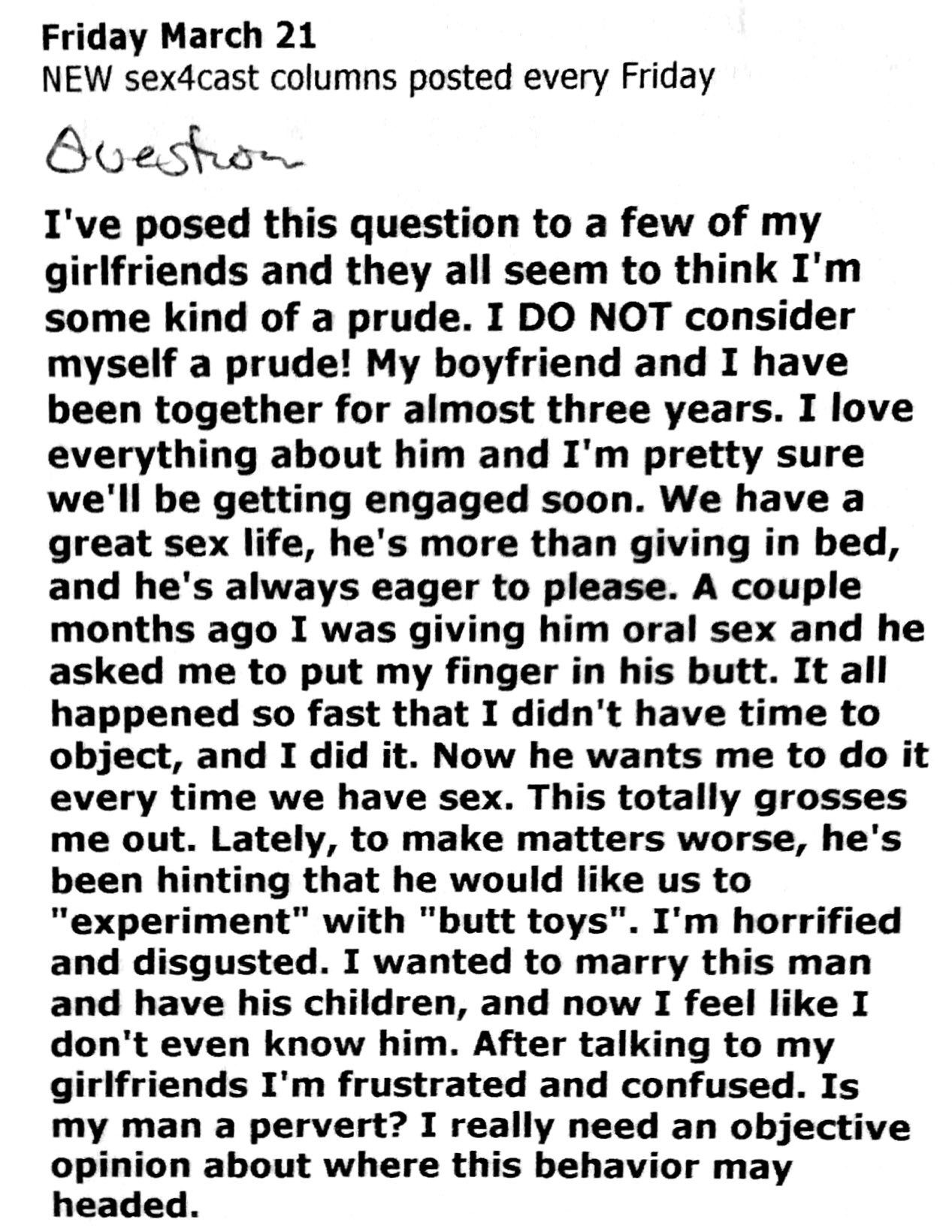
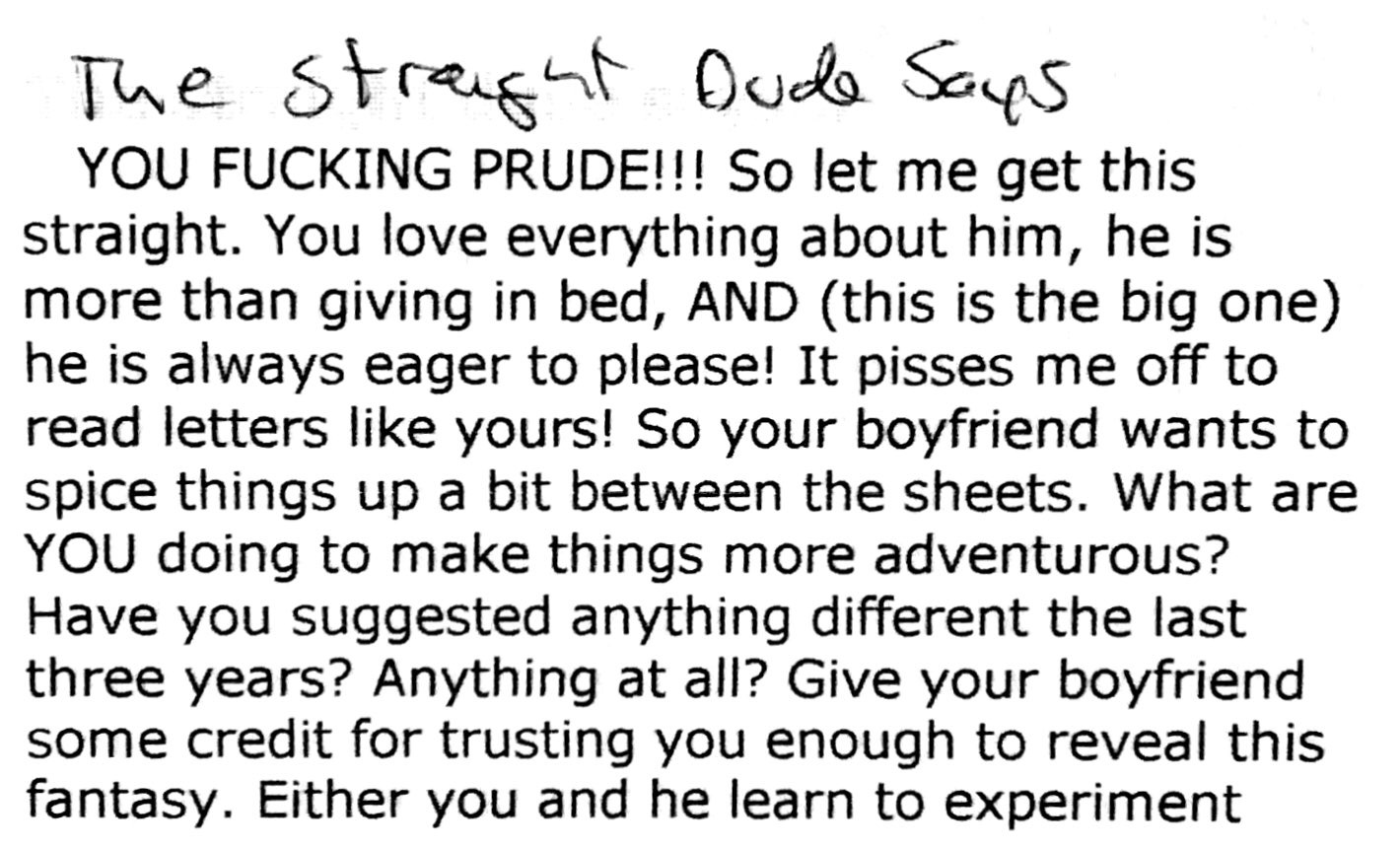
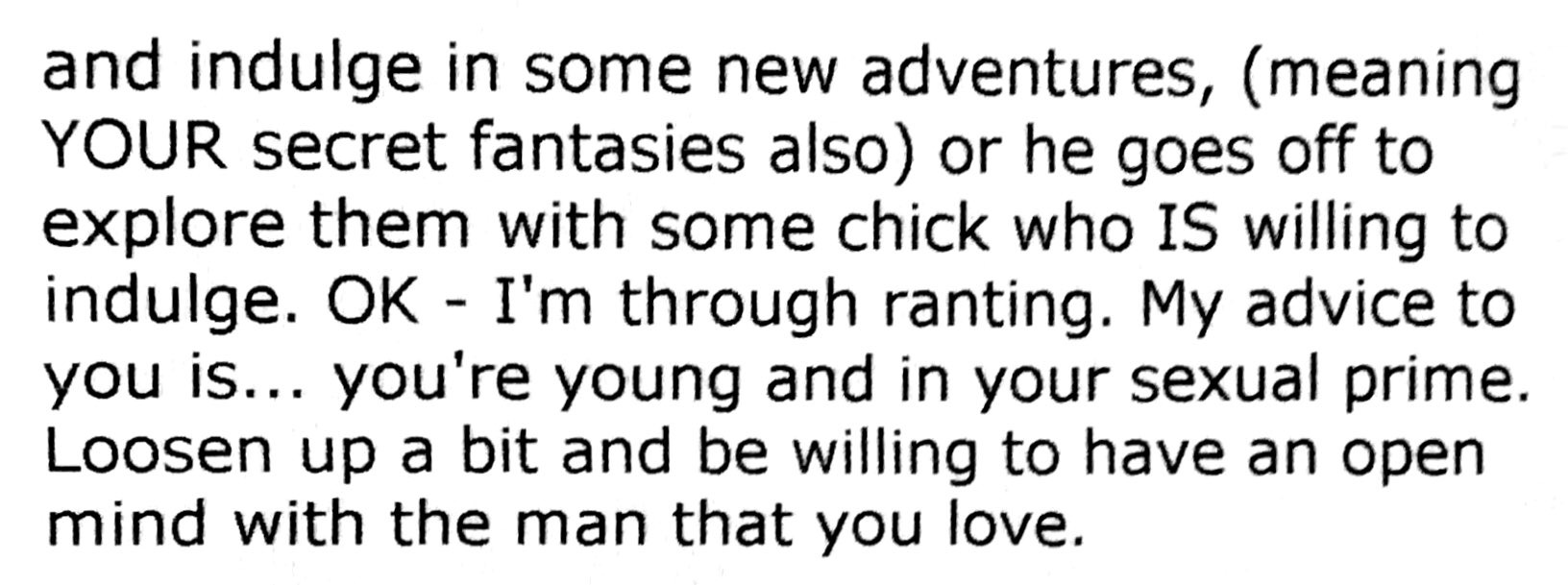
In 2003, after making a witty, sarcastic comment on an article published in an online emagazine called “Sex Tycoon”, I was contacted by them, and asked to be “The Gay Man” commenting on a series of subscriber personal-problem-questions. The panel of “experts” consisted of a “Straight Dude”, “Straight Gal”, ‘The Gay Guy” and “The Lipstick Lesbian”, and each week, under the column title Sex4Cast, we were emailed a “problem” question with a link, which we would then write a reply, offering personal advice on solving the problem. The four panellists had no knowledge, or contact, with each other, so all advice was offered independently. As “The Gay Guy”, I never treated the questions seriously, offering – in my inimitable style – witty (I hoped), sarcastic advice, which, according to feedback from the site owners, was very popular with their subscribers. Sex Tycoon was operated by a group called FocusBlue Media LLC. Unfortunately, as was common in those days on the internet, after 14 columns the owners decided to close the site down, and that was the end of my Agony Aunt career. Sex Tycoon has disappeared into that great cyber-space graveyard, but I’ve kept copies of the columns, and publish them here for your amusement.
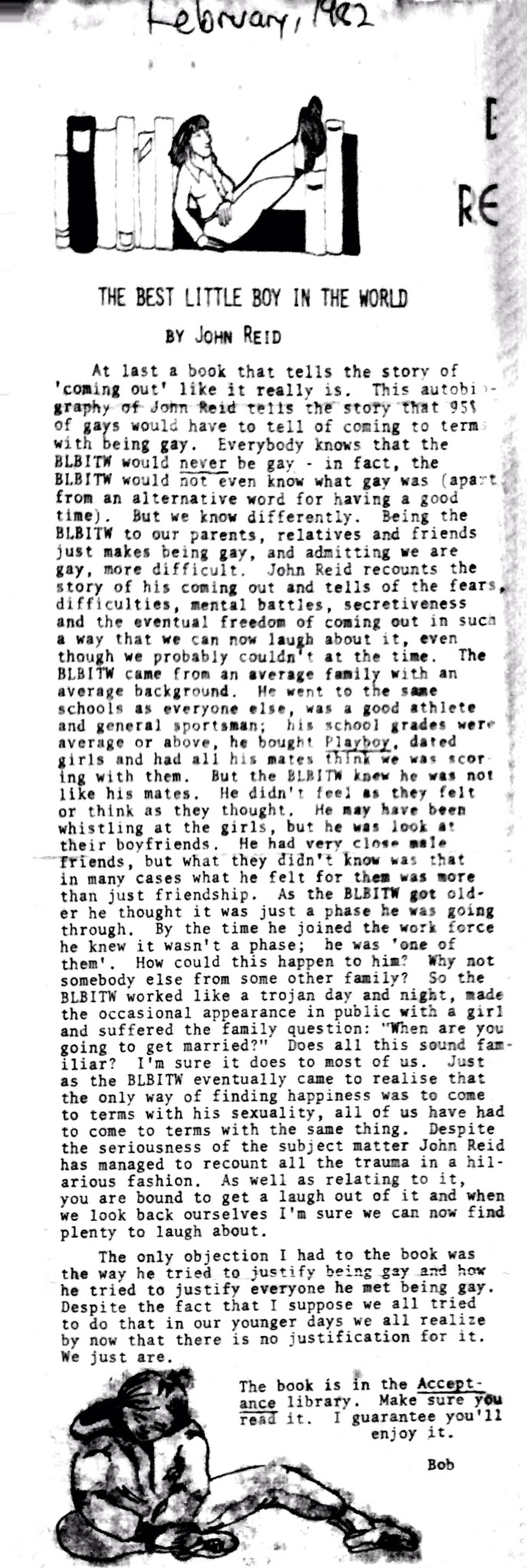
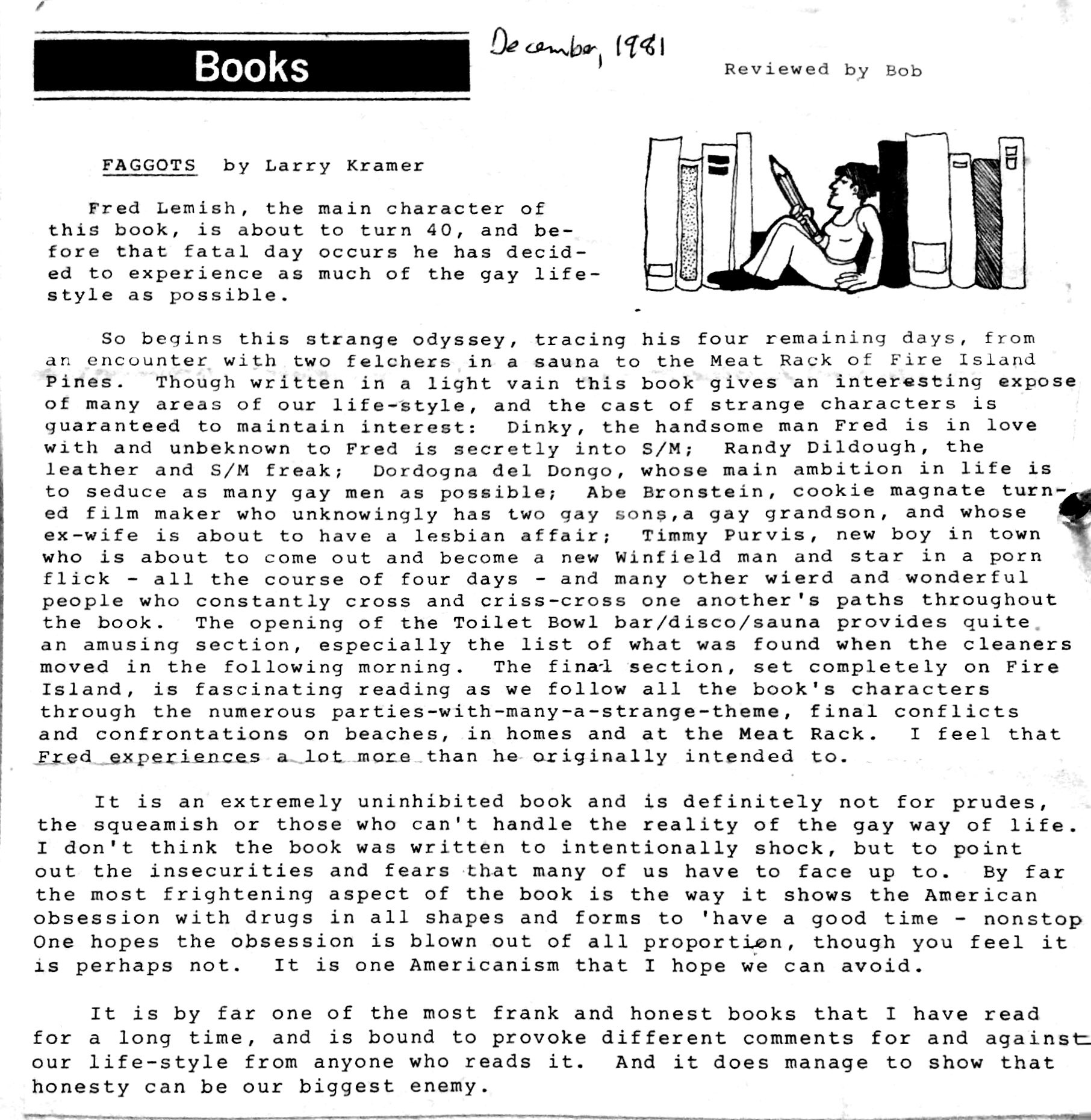
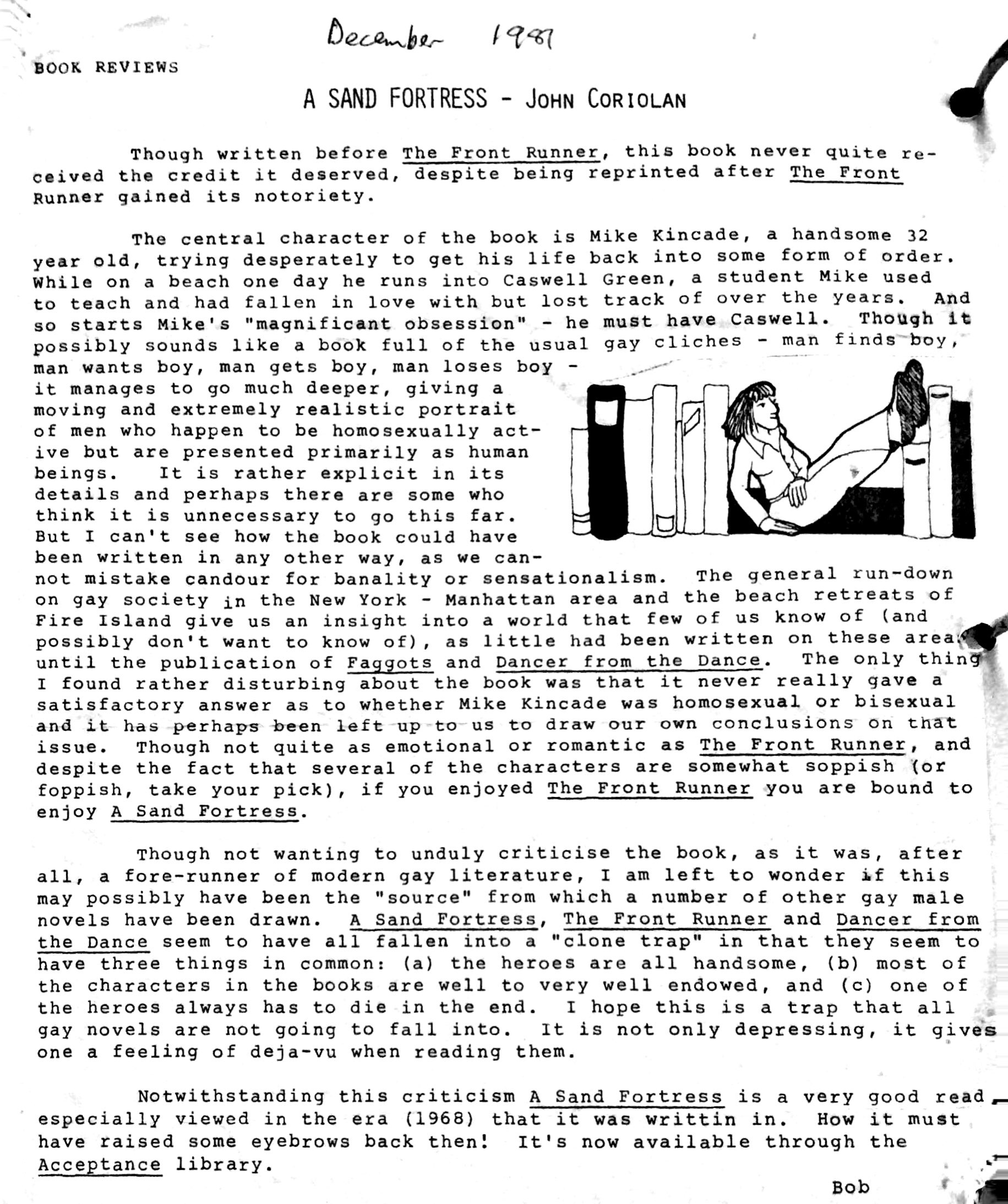
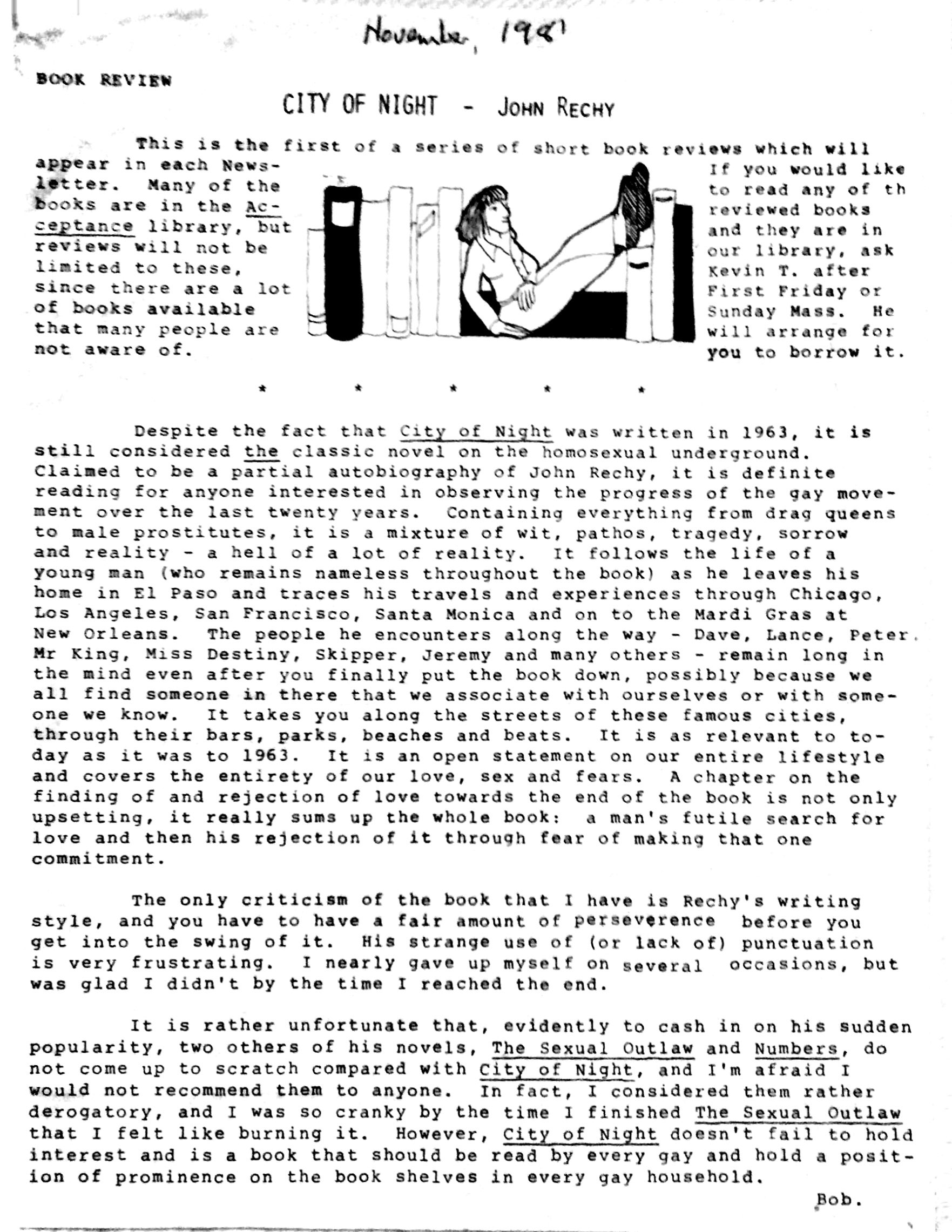
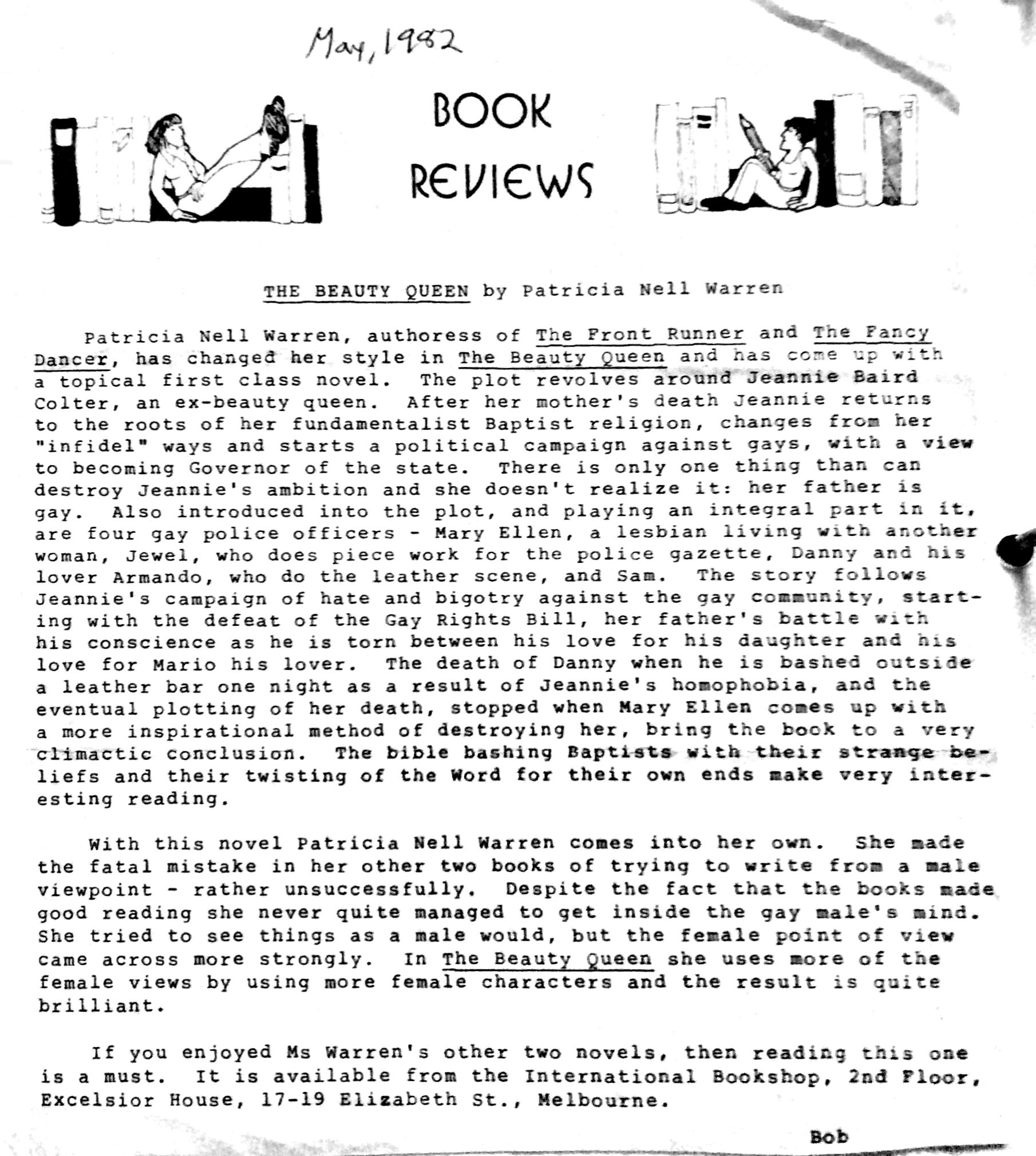
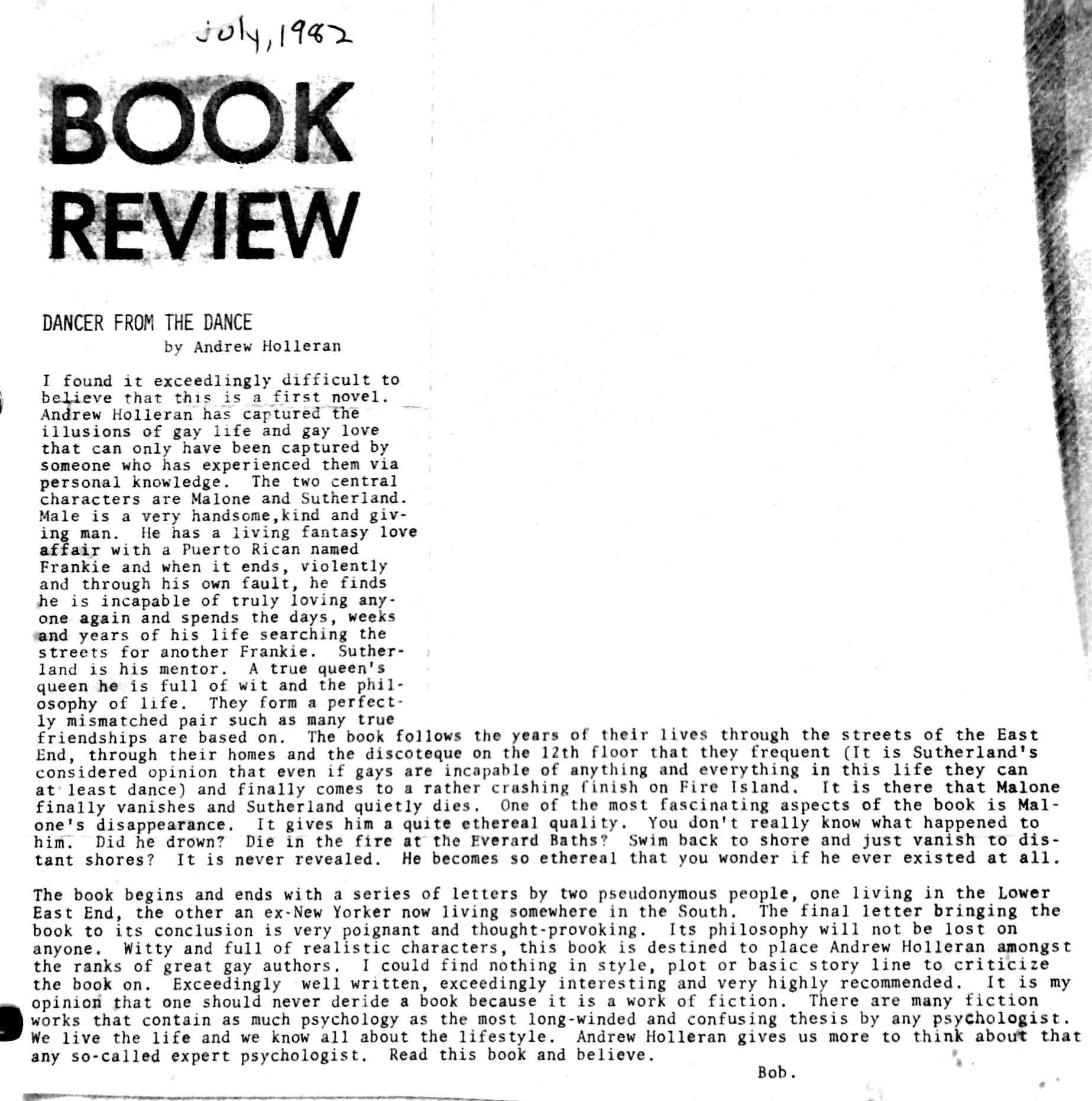
I joined Acceptance in Melbourne just after coming out there in 1981 – probably an odd thing for an Atheist to do, but I had plenty of practise at being a Catholic – as a way of meeting people, and getting introduced to the gay scene. It was a very successful move, got me a nice group of friends, and gave me a great – and very busy – sociallife…and some sexual adventures! I ended up getting more involved with Acceptance than I originally intended, becoming Secretary on their committee, and being on the fundraising working group. For a time, I was on with a member named Fred Diamond. Fred edited the Acceptance newsletter, and wrote a gossip column for it under his pseudonym Jodie A Frean. In turn, I got roped into doing book reviews for it. The interesting thing, when looking back now, is that all the books reviewed below were considered cutting-edge gay literature back then…some, like Larry Iramer’s “Faggots” controversial even! Authors like him, and Patricia Nell Warren, John Rechy, Andrew Holleran, John Reid, and John Coriolan were amongst the first to write about a somewhat subversive gay scene, warts and all. In those days, all these books would have been purchased from the Elizabeth Bookstore, in Elizabeth Street in Melbourne city. It was still an underground world in many respects.
There appears to be nothing on the internet about the G.O.D Girlgang, not even within the profiles and written accounts of its founders. This makes this article about the gang, solely from my own archived resources, an essential inclusion into the gay history of Sydney. That any groups can come and go, and be undocumented in any way concerns me, as gangs such as G.O.D were integral in the relationships between gay men and lesbians in the late 1980s, early 1990s period, as well as highlighting a movement within the lesbian community, a move away from PC dogmatic women, to a more open, diverse and inclusionist community. Despite its brief existence, it was a watershed moment in mixed relations between the two distinct sectors of the community.
“GANG
noun
a group of people who associate together or act as an organized body, esp for criminal or illegal purposes”
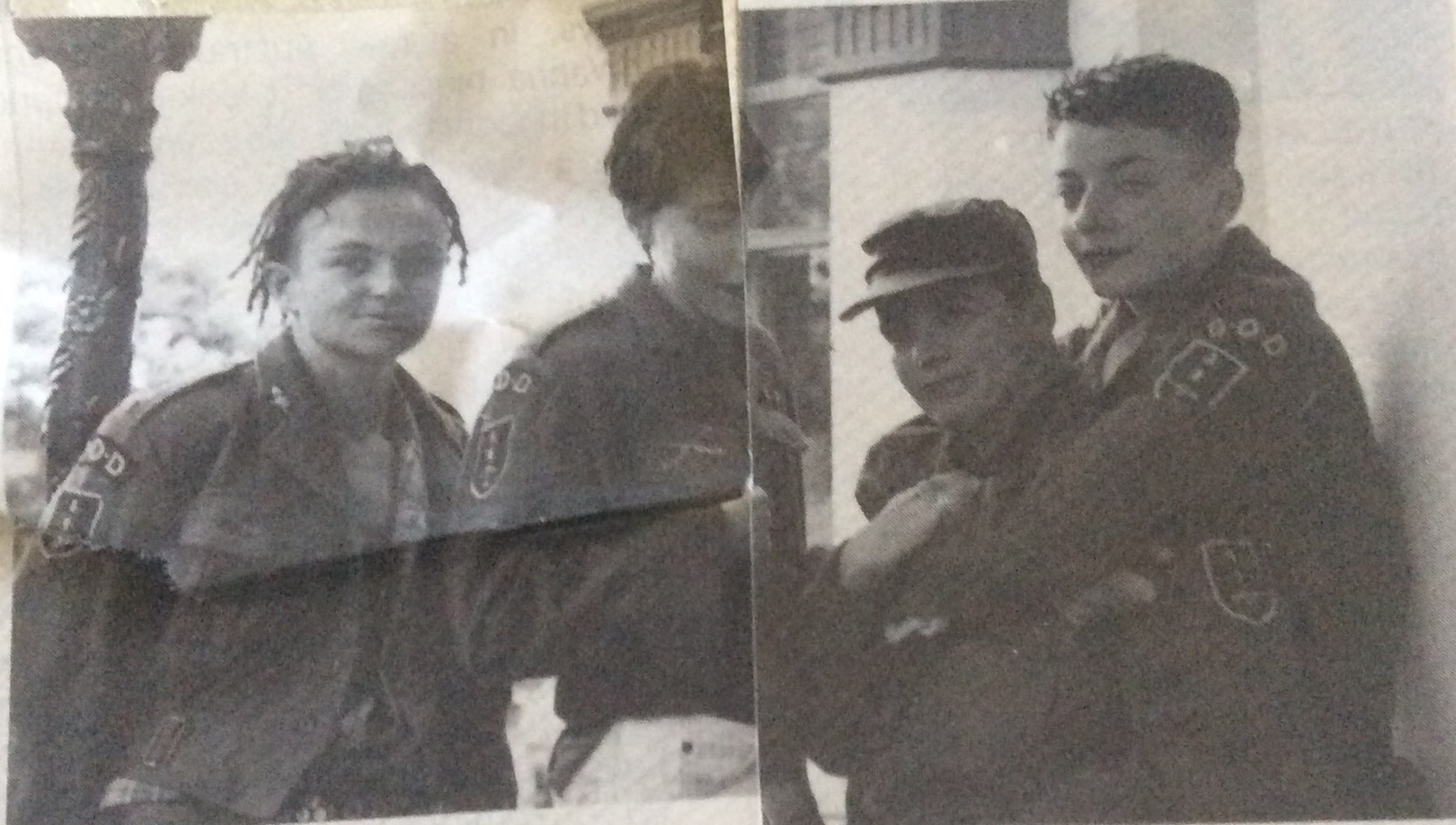
From left: Jade-snow Kemety, Unknown, Francine Laybutt, Lisa Salmon
“Girls of Disgrace, Girls of Dishonour, Girls of Desire; G.O.D. Is limited only to your steamy imagination.
G.O.D. is on a mission to spread the concept of Girlgangs, and its subsequent feelings of power through identification/unification. G.O.D. is not meant to be taken too seriously.
IN SEVEN DAYS following the creation of a name, a patch design is produced depicting a sword with a snake wound about its length. Living on the cutting edge? (Now, don’t take us too seriously).
A group of army green jackets adorned with a variety of badges, bolts, skins, and other sundry odds and ends.
G.O.D. patches grab each shoulder in splashes of red and grey. Underneath, the optional shirt harbours similar coloured emblems.
COMPRISES OF Desert Rangers, the Kiss and Make-up contingent, SM girlies, Vanilla Sluts, hard-core uniform-ists and lingerie fetishists. (But don’t take us too seriously).
ATTITUDE while in walk thirteen G.O.D. members. Watch the heads turn. Will we stop at the number fit for a witches coven?
G.O.D. is not separatist,. Guys of Disgrace have recently gained admittance complete with blue patches and leather.
AND FUN with future G.O.D. sex/bondsge/SM/porn/initiation/dance/parties a possibility? Why not!”
Such was the blurb from “Wicked Women” magazine for the first outing of G.O.D. in the media. Girls/Guys of Disgrace was founded by Francine (Jasper) Laybutt, Lisa Salmon & Jade-snow Kemety around 1989/90. Francine was a radical lesbian in every sense of the word. She walked the outer limits of the lesbian world, promoting the more butch forms of sexuality, the darker world of BD/SM. She was the founder of “Wicked Women” magazine, and used it as a platform to promote her more radical attitudes to lesbiansm. Often shunned by her own community, and with her partner, Lisa Salmon, often derided and humiliated for holding beliefs and practises contrary to what was considered the norm in that world.
That she founded G.O.D should not be surprising in the face of her views on confrontation, public outrageousness, yet inclusiveness. She advocated non-penetrative sex with gay men (slanted more towards the gay leather, BD/SM community), and after her sex reassignment surgery and becoming Jasper Laybutt, she referred to herself not just as a female-to-male transgender, but as a male lesbian…language that would have sent most mainstream lesbians into a tail spin!
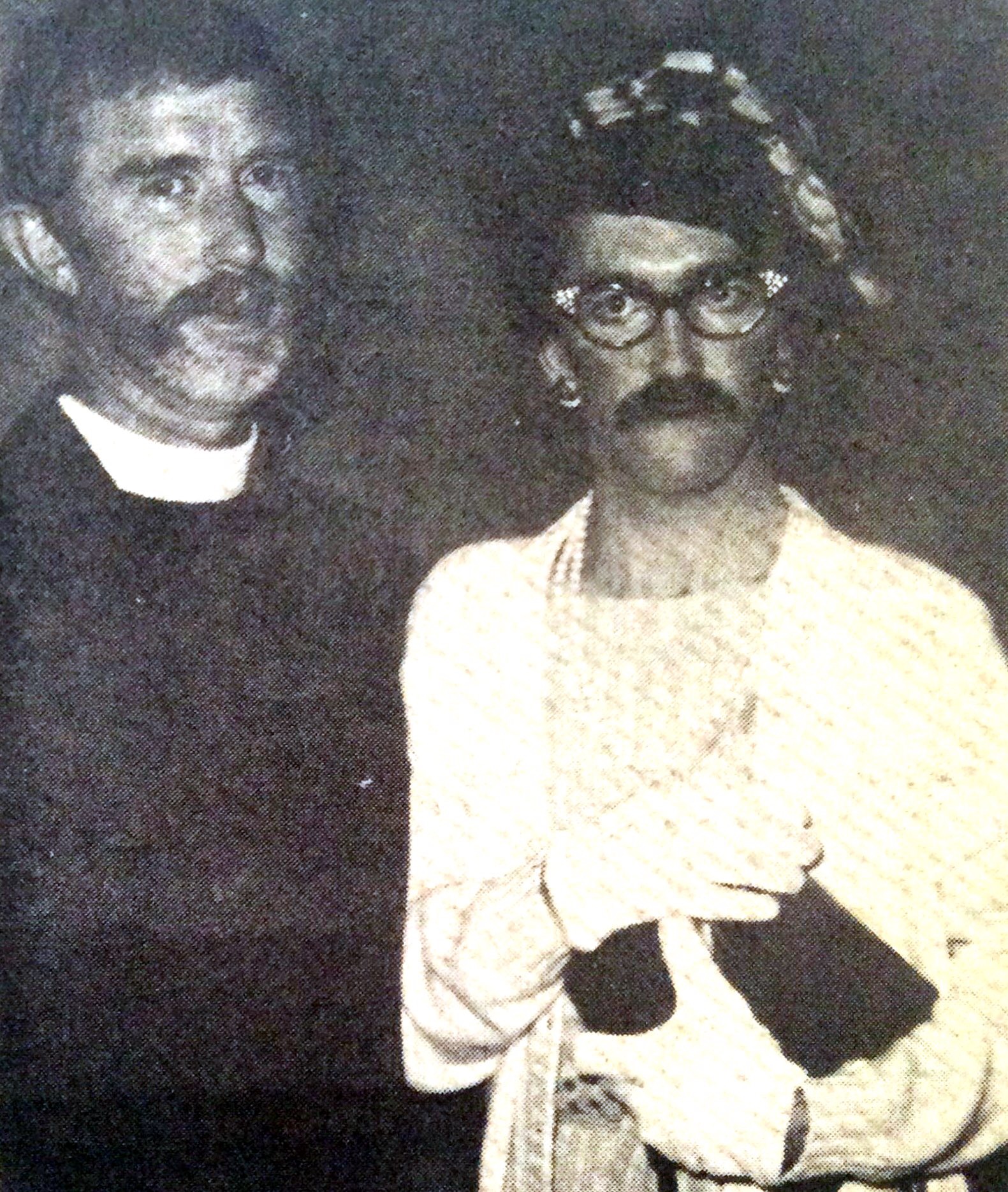
From left: Lisa Salmon, Tim Alderman, Francine Laybutt at the opening party for “Expectations” fetish store, 2nd floor, 159 Oxford St, Darlinghurst in 1989. Tim was the store manager.
In William Calder’s book “Gay Print Media’s Golden Era: Australian Magazines and Newspapers 1970-2000” he notes:
“Inspired by the American lesbian sex fetish magazine On Our Backs – its title a deliberate riposte to the feminist magazine Off Our Backs – Francine Laybutt and Lisa Salmon published Wicked Women in Sydney at the start of 1988 to fill, as they put it, the “gaping hole” in women’s erotica, and promised “a forum for erotic ideas and … hot, one-handed reading”.(138) They aimed to bring into the open lesbian sexual practices such as sadomasochism for those who silently fantasised about such activities and let their readers see there were other similarly minded women they might meet. From the start, the magazine triggered debate within the lesbian community, and Laybutt says they were “surprised and unprepared for the degree of hostility” directed against them.(139) Sadomasochism, bondage, and even dildos were seen at the time “by the lesbian feminist paradigm … as violent patriarchal constructs”.(140) The pair would get thrown out of dyke clubs for wearing fetish gear and Salmon “who didn’t usually wear much at all would have drinks thrown on her … cigarettes surreptitiously put out on her [and] spat on sometimes”.(141)
Born at the start of the 1960s,(142) Laybutt grew up in the city of Newcastle and watched drag shows at the town’s one gay pub, but soon moved to Sydney where the gay scene was bigger.(143) She worked as an art teacher but “didn’t like teaching unruly teenagers”, and switched to computer design work with a North Shore communications company. Laybutt found her “true vocation” as Dominatrix Natasha in the sex industry,(144) and shared a flat with fellow former Catholic school girl Lisa Salmon,(145) who in her early 20s worked as a performance artist and stripper.(146) The pair started a relationship and decided it would be as a “fetish couple”.(147)
The first issue of Wicked Women was a 28 page A4 black and white with a pictorial cover selling for $4. It included poetry, personal classifieds and features exploring lesbian sexual fetish in an attempt to broaden individual lesbians’ definition of their lifestyle. To produce Wicked Women they bought an old electric typewriter that ironically would not print the letter ‘w’, so they “had to manually push the letter against the page” and the pair wrote most of the articles “under a variety of pseudonyms to make it appear as though they had lots of contributors”.(148) Laybutt’s “very open-minded” boss let them use the work photocopier on the weekend to print 90 copies of the first issue. Subsequent issues grew in size and cover price, peaking at 60 pages for $8, with up to 1000 copies printed.(149) The aim was six issues a year, though usually fewer were published. The magazine that Laybutt and Salmon created “reflected” the sadomasochistic sexual activity they were doing,(150) and they hoped it would let them meet other women “sharing the same experience”.(151) Salmon says “the seventies feminist thing just ended up being girls telling each other what to do. It became really dogmatic and it took the fun out of sexuality and being a dyke”.(152) Commentator Julie Catt says Wicked Women triggered a “lesbian sexual revolution”,(153) and others say it added “many new words to the lesbian sexual vocabulary – sadomasochism, fetishism, gender fuck – to name but a few”.(154) Wicked Women ran stories about a woman who was “horny for weeks, and masturbated ferociously”,(155) one from a woman who described how she was “blindfolded and placed in standing bondage [while f]ingers pinch my skin, pull at my hairs, slap my behind, teasing”,(156) and the dominatrix who wrote how her submissive “moaned, groaned, pleaded, yelled, screamed [and] begged me to stop but the juice was flowing freely down her inner thighs. Her cunt was writhing in frustration [wanting] me to fuck her to the point of exhaustion”.(157)
The first cover had the words: “Erotica Poetry Graphics SM Classifieds Decadence” above a graphic of a naked woman with a dog collar around her neck. Photographs of usually one or two women models soon replaced graphics on the cover. The magazine though was not simply pornography for lesbians. It explored sexual themes and often used playful images. There was a blurred photo of a naked cropped hair woman wearing a dog collar and seated cross-legged on bed,(158) a photo of a sultry woman in full leather jacket and cap looking piercingly into the camera,(159) and a party girl staring at the camera while pulling open her jacket to expose her breasts.(160) Inside were photo-spreads of women in leather or at sexual fetish events, and in one issue a photo-essay of open vaginas being fist-fucked.(161)
Quite apart from the publisher’s open promotion of sadomasochism there were a series of publishing events that triggered condemnation. In an early edition Linda Dement’s photograph of a woman holding a skinned rabbit against her vagina caused an uproar,(162) and the magazine was subsequently banned from at least one Melbourne feminist bookstore. Laybutt defends the photograph as “art … a strong image, but not an anti-woman one. It was widely misunderstood”.(163) A year later the inclusion of a gay male pedophile group press release,(164) led to “a ‘girlcott’ … sold very badly and lost some readership”,(165) followed the next issue when “all hell broke loose”,(166) after publishing an article written by a self-confessed “misogynist” gay leather man.(167) The final major controversy to confront the publishers of Wicked Women was Laybutt undergoing medical procedures to become a transman. “I was a tomboy” growing up, he says,(168) and in 1991 adopted the name Jasper, instead of Francine.(169)
Supporters of Wicked Women wrote letters to say “it’s wonderful to know there are other dykes out there into ‘unsound’ sex and games”.(170) Another said it was “important that women have a space where they can be upfront and honest about who they are and what they like”,(171) and one declared “I now, most times when going out to nightclubs and such, dress in leather”.(172) Some feminists engaged directly with the sexual desire implicit in Wicked Women’s content. One supported “expressions of lesbian sexuality which are exciting, dangerous and diverse” yet maintained the utopian goals of lesbian feminism “to rethink the relationship already in play between the phallus/cock/gun and power” concluding: “we wait with quivering clits for the day a woman submits her fiction in a non-male constructed language”.(173) With time this occurred as Laybutt and Salmon invited contributions from readers who submitted articles other than ones with sadomasochistic themes but “often vanilla or romantic sex flavoured and relatively sexually ‘safe’” articles.(174)
Less obvious than its challenge to existing ideas around lesbian sexual practices, was the role Wicked Women played in building lesbian community. Its classified personals included the expected: “23 Year Old into leather, looking for experienced S/M dyke to worship”,(175) but were also used by a range of lesbians to seek partners, such as “slim 22 yr old, strawberry blonde, desperately searching for my dark earth mother”. The magazine ran contact details for local lesbian social groups, and advertisements for Sydney’s Gay and Lesbian Mardi Gras. Wicked Women organised what became a popular annual event, the Ms Wicked competition “in which lesbians stripped and performed sexual acts for enthusiastic all-female audiences”.(176) More than 500 attended a Melbourne heat in 1991.(177) Wicked Women organised a Mardi Gras dance party Be Wicked that was raided in the early hours by police with the patrons “herded out”,(178) and Girl Beat at the gay male sex-on-site venue The Den.(179)
The magazine’s editor from 1994, Kimberly O’Sullivan said the “events proved to be enormously popular and [mainstream lesbians] saw we had a role in the lesbian community. It demystified us for them”.(180) The activities of Wicked Women’s publishers also helped draw together the lesbian and gay male communities that in the 1980s lived largely separately from each other. Laybutt had always found the gay male scene “infinitely more interesting” to explore.(181) She was a member of two gay male motorcycle clubs, and even attended male only fetish events, passing as a young guy. Early support for the magazine came largely from the gay male community and the emergence of Wicked Women provided a vehicle to “bridge the gap” at least between the gay male and lesbian fetish communities.(182) In 1993 Wicked Women organised a Mr Wicked competition.
The controversial nature of Wicked Women attracted attention but its generally uncompromising stance on content alienated both potential buyers and advertisers and caused significant problems for the venture as a business. While the primary aim was to present sex radical ideas, the bills still needed to be paid and its 1993 editor, Kimberly O’Sullivan said they started “to think more seriously about the risks [of accepting] an article which will alienate half of your readership”.(183) There were difficulties from their first Catholic owned commercial printer who dumped them after they ran a photograph of a women stroking her vagina with a statue of the Virgin Mary.(184) Lesbian hotels initially refused to stock the magazine,(185) and the women’s bookshops that did stock it “kept the magazine hidden under Lesbian Network so no- one ever saw it”.(186) At first only gay male leather, and sex shops stocked Wicked Women and it was distributed by subscription to mainly Sydney women, though also to other areas around the country and overseas, and some men.(187) The only advertising support the magazine attracted initially was from leather fetish and sex product shops run by gay men as “lesbian businesses … would not touch them”.(188) Each ‘girlcott’ and refusal to display the magazine reduced sales and increased reliance on organising fund-raising events.(189)
Apart from publishing Wicked Women, Laybutt in 1990 was involved in editing the mixed gay and lesbian alternative journal of arts, culture and sexuality, Hell Bent, and in 1991 Pink Ink: An anthology of Australian lesbian and gay writers. By 1994, both Laybutt and Salmon had stepped back from the front line of editing, handing responsibility to O’Sullivan, who later described her job as “administrator, book- keeper, accountant, publicity officer, advertising manager and delivery driver – in short, doing every single thing on the magazine from beginning to end”. Two years later she resigned due to the work pressure that came on top of the need to work a second full-time paid job, bemoaning that she “had almost no social life (and felt) burnt out”.(190) When Salmon stopped organising fund-raising events the magazine became financially unsustainable. O’Sullivan was not replaced as editor with Laybutt declaring “I feel that having become a man, I’ve moved on to different things” and Wicked Women ceased publication in 1996 after 28 issues.(191) Laybutt returned to live in Newcastle and became involved in publishing New Age ideas.(192)
The publishers of Wicked Women successfully appealed to the sexually libertarian section of the lesbian community, and in doing so challenged established feminist attitudes towards sexuality. They found a market niche and expanded, creating new social infrastructure and profoundly changed broader lesbian community attitudes towards sexuality. Ultimately though the publishing venture failed to become financially self-sustaining and closed when individual publisher energies waned.”
It is against this background, and in the midst of, that the G.O.D Gang was formed. Amongst my recollections are attending a patty in the vicinity of Zetland, held in a warehouse, and consisting primaily of G.O.D & Dolphin Motor Club members. I was one of the DJ’s (who had to deal with a DJ rig suspended from the ceiling on chains, and would often swing out from the mezzanine area it was set up in – and you had to make sure you didn’t follow it). During one of my sets, I watched as Francine (she had not undergone sex reassignment surgery at this stage) opened a door in the floor of the warehouse that obviously led down to a basement area. She went down the stairs, and was followed by half-a-dozen of the male members. I have no accounts of what went on down there, but considering Francine’s stand on gender-fuck issues, and the liberality of many males in the leather scene, I dare say it would have been quite eye-ooening. In the above excerpt from the book, there is a nod to me as the manager of “Numvers” Bookstore, being one of the gay managers and businesses that advertised in, sold, and supported Wicked Women, and their events. This also indicates the divisions not just within the gay community at that time – the separist nature of gay men & lesbians, but also the divisions within the lesbian community, the strict dogmatic approach they had to women who marched “outside the square”. The same cliques existed within the gay male community – leathermen, bears, twinks, vanilla, BD/SM, clones etc – but this did not prevent guys crossing over into several cliques, and when required, they all socialised together. This possibly explains Francine’s attraction to the gay male community, along with the support it offered her, and her ventures. In many respects, G.O.D became a catalyst for a change in relationships between gay men & lesbians – well, at least those that wrre liberal minded, and not pushing agenda’s.
The two following accounts are important for several reasons – there is – sermingly – no information on the G.O.D Gang on the internet; the “So Help Me G.O.D” piece has a run-down of resolutions reached in the first group event, giving an indication of how and why the gang was created, its structure, purposes and intentions. It also shows how the gang started to get its name out there through its involvement in some of the more “out there” events that were happening, and through integration with groups like the Dolphin Motor Club, The Griffins Motorcyle Club, and Dykes On Bikes.
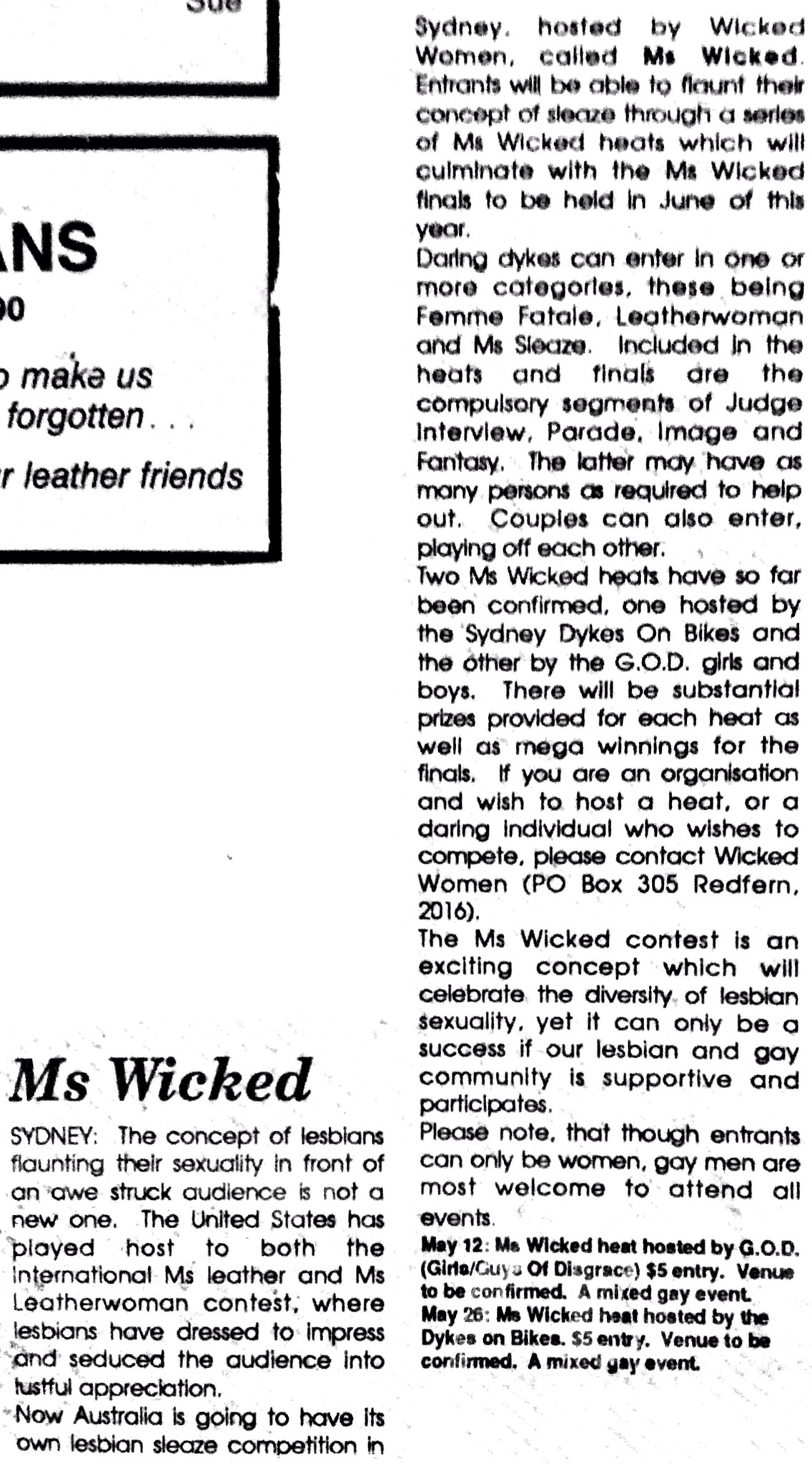
Entry criteria for the Ms Wicked Competition circa 1989/90
From the Dolphin Motor Clubs newsletter “Quid Nunc”, Volume 1, Issue IV. 1990. Both articles are from the same issue.
“So Help Me G.O.D.”
“In the beginning there were Three. And behold, the Three looked down on us and said ‘We need a Girlgang.’ And so it was done, and a Girlfang was formed. And GOD gave unto its members a symbol of their unity: a red patch, thereon emblazoned a serpent encircling a sword. Then GOD looked down on us once again, and said ‘There is disunity in our community,’ and they took a thread from the red patch, colour changed it, and came forth with a blue patch. Thus were guys brought into the unity of GOD. And the Three looked down, and said ‘This is good,’ and behold, it was very good.”
G.O.D. (Guys/Girls of Disgrace/Dishonour/Degradation/Discipline/Denigration…interpret it as you will) is a group of girls and guys who fall into the classification of a gang. Despite the connotation of the word ‘gang’ meaning a group of louts, storm-trooping all over town , fighting, maiming, and causing general discord, the word ‘gang’ actually refers to a group of people, loosely based with no constitution or club rules to bind them. There is no official hierarchy, and no regular meetings as such. Members basically have a common interest (most GOD members are into leather sex in all or sundry of its variations) and basically get together just for a good time. A meeting could be said to be happening when two or more get together for a drink and a chat.
The Dolphin’s three Special Members: Francine, Jade & Lisa, are not only GOD girls, but founders of the group. Paul Costello, Geoff Arnold, and Tim Alderman are also members of GOD, and Les Heathfield is an Honorary Member. GOD girls are all invited to Dolphin events, and in return all Dolphin members are invited to all GOD, and Wicked Women events, apart from those deemed girls only. It is hoped that in the future, GOD and the Dolphins can get together to hold functions, or jointly sponsor functions. Membership currently stands at 22 girls, and 8 guys. The patches are red for the girls, and blue for the guys, and feature a snake entwined on an upward pointing sword. Thus with the initials of our name, the symbolism can be interpreted any way you want.
Francine – front right – with Oxford St royalty. From back left – Ray Hopkins (Jayar Leather); Kevin Jackson (former Mr Drummer); Mark Adams (President Southern Pacific Motorcycle Club); and Jeff England.
The recently GOD sponsored event for the Ms Wicked Competition was a tremendous night, with Tim Alderman from DMC one of the 5 judges for the event. The more recent Slave/Master/Mistress celebrity auction (see write-up this issue) just goes to show what girls and guys working together can really do. Our first official gang meeting was held in our Clubroom in Ultimo on Wednesday 30th May. About 25 members were present, plus about 5 visitors, including 2 women connected to the Mardi Gras committee, and a number of resolutions were passed by gang members.
*We are now closing ranks. Whereas before this night it was possible to become a gang member by the purchase of patches, membership is now only possible by a written submission, the applicant then having to come before a panel of selectors to have their suitability as a gang member judged.
* The panel of selectors was set ip, consisting of two founding members (one founding member must always be on the panel), one male nember, and two other girl members. Membership of the panel will be rotated over a three-month period. As the guys membership increases, we will be granted a second position on the panel.
* We recognise that there would, in all probability, be two distinct sectors within the membership: a social sector of people who support the group and wear the regalia, but who for reasons of jobs, profile etc. would not in all probability be involved in any “disgraceful” activities: and a “hard-core” sector who would bege involved in street thestre, demonstrations, marches, and other disgraceful activities . Neither group would be condemned by other members of the gang because of their stand.
* We wish to involve ourselves in the activities of other groups, such as Act-Up, to help them achieve changes as well as having our own group identified. We would also be planning parties, competitions, auctions etc for members, friends, and the community in general.
* Any monies accrued would be used for the benefit of the group in arranging parties, promotions, events, and special meetings.
* We would maintain our loose knit structure with no formalised committee or such, to maintain our independence as a gang. However, the founding members would have the final say as regards all decisions in the gang. The panel of selectors would mert on a regular basis.
* We would, at all time, support community causes, especially in areas such as AIDS, and AIDS treatment.
* We must become noticeable, and identifiable , the patch must become identifiable as a symbol,of people who are involved at nany levels of communal help, as well as a certain degree of outrageousness.
We all left the meeting knowing something monumental was happening. Barriers between poofs and dykes were down, and together we were going to make an impact of positiveness in this city, and hopefully further afield.
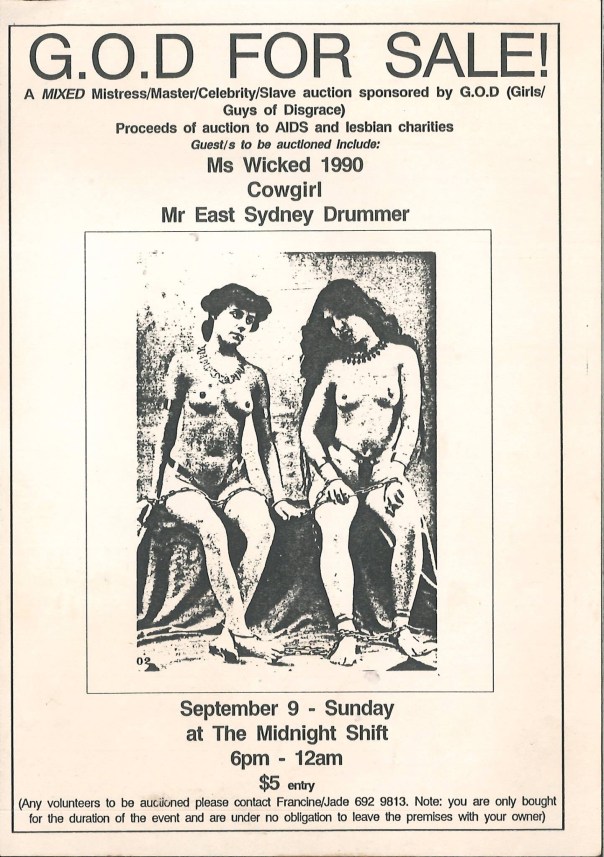
G.O.D. for sale, The Midnight Shift, 9 September 1990, Papers of Fabian LoSchiavo, Australian Lesbian and Gay Archives (ALGA)
Total darkness reigns. Through the darkness comes the opening spaceship sounds of Isao Tomita’s 2001 Theme: Thus Spake Zarathustra. The theme reaches a crashing crescendo, and fades with the same rumbling space ship sounds. Before the haunting opening bars of “Camina Burana” mixes into it, the sound of whips, much weeping, wailing and cries for mercy are heard approaching from out of the darkness. The Orff Chorus booms all around, and suddenly dazzling light fills the empty space, refracted through the incense smoke from an ancient thurible swung by a nun, as she attempts to placate and enlighten the chained throng of slaves that are being whipped into submission behind her. Struggles ensure, but the whip mistresses, Centurian guards, and the executioner keep everybody in line! Chains clank, cries get louder, and the incense smoke thickens as they encircle the herculean pillars, and the block from which they will shortly be despatched to heaven…or hell on earth. As the strains of “Carmina Burana” fade, the Centurians lead the slaves off the floor to the enmeshed holding pen. Their fatalistic cries die as the whip mistress finally subdues them into total submission.
No, not a scene from “Ben Hur” or “Quo Vardis”, but the entry procession for the G.O.D Slave/Master/Mistress Celebrity Auction, held at the Midnight Shift on Sunday 9th September (1990). We stated in the advertising that all manner of celebrities, and sleaze buckets, would be going under the hammer for charity…and we meant it!
Paul and Francine from G.O.D introduced the event, then handed the evening over to the very capable and outrageous whims of Monkey., from Tantrum Tits Lingerie, who was the evenings MC and auctioneer. Despite some early hassles with a faulty microphone, she handled the night as only Monkey can – totally over-the-top!
First to the block was Tim Vincent, Mr South Sydney Drummer who, despite a sign written on his back claiming “You can’t afford me” started the bidding off well and – sorty Tim…but someone could, and did, afford you: Matthew Cox, of the Dolphins, actually.
Monkey wasted no time in pushing the bids through, and that auctionees, and their potential owners were equally in agreement with the purchase. In rapid succession, Mr East Sydney Drummer, Bondage Boy, Toy Girl, and Slave Boy were put on the block…and dispensed with!
Many of those to be auctioned went to great lengths to add some theatre to the event, with costuming and dramatic performances. Toy Girl, and Cleopatra, were of special note, using dramatic music and great costumes. Cleopatra seduced the crowd beautifully, as only the Queen of the Nile could, though the gentleman who purchased her was quite obviously totally confused and befuddled by the whole event. The San Francisco motorcycle cop looked hot, and went for a good price. Bossy Boots was determined not to leave the block until she went for what she was worth. The two Sisters of Perpetual Indulgence were given lessons in humility from the pathetically low bids they attracted. Reverend Mother Abyss is destined for a long stay in Purgatory for her little white lies – 19years old, and still a virgin! Mea Culpa, Reverend Mother!
Jade bought her cartoon Cowgirl character to life, and despite the lack of a horse still fetched a reasonable price. Footy Girl, and School Boy, both dressed for the part, came and went. The Safe Sex Sluts decided to go as a group lot, and despire much wig pulling and stiletto throwing were eventually dispensed of. The unlikely named Captain Falafel and his sidekick Kid Sprout, looking like two flared and flowered hippies still recovering from a Sixties bad acid trip, brought some hilarity to the night, and were last seen being bullied and raped (playfully) under the DJs box.
Ms Wicked was the final official entrant to the block, and with much teasing, taunting and sexual persuasion eventually went for $800,000 ($200 in real money) after a group of girls pooled their resources.
Monkey, unbeknown to her at the time, was then grabbed by the Centurians, and led to the block. Having insulted just about everyone in the surrounds on the floor by this stage, bidding was bound to be high, and she was going for actual cash! Monkey took it all with good grace, got into the mood of the bidding by hurling out a few more insults to remind people of how much she was actually disliked, declared that she was sick of girls, and wanted a guy for a change, and eventually went for $70.
This brought the evening to a close. As the 2001 Theme again faded away, the dual DJs Gemma & Tim got the crowd onto the dance floor, and held them there until the midnight closing.
$810 was raised for the Maitraya Day Centre, and Victoria’s “Lesbian News”. The entire night was an unprecedented success.
Slave/Master/Mistress Celebrity Auction, a G.O.D event held at the Midnight Shift circa 1989/90 Kerry Bashford’s write-up of the Slave/Master/Mistress Auction circa 1989/90, published in the Sydney Star ObserverMy thank you letter as a G.O.D member, to all those attending the Slave/Master/Mistress Auction circa 1989/90, published in the Sydney Star Observer The original piece in Wicked Women about the formation of the G.O.D Gang. Circa 1989 My original patches for the G.O.D gang. The boys were blue, the girls were red.
Queering the paper trail in the more hostile world before 1970 there were no Australian gay magazines. Thirty years later, almost half a million copies of them were churned out each month with revenues that exceeded eight million dollars a year.
Despite this spectacular growth of a new industry – which continued until print was eclipsed in recent times by the internet – few publishers started newspapers or magazines with the intent to make money, and even fewer actually made any. Publishers came from the community as activist leaders, commercial venue owners or social scene participants who wanted to change their world in some way, great or small.
Various publishers used magazines to talk about what it meant to be homosexual, to challenge the views of the outside world, and to encourage a sense of gay pride. Some pushed ideas that were controversial within the gay community, such as notions of assertive gay male masculinity or lesbian sexual fetish. Some also considered it a core role for their publications to promote and build the gay scene, and foster the identity of its individuals.
Before the internet, magazines and newspapers were the dominant voice shaping gay and lesbian life in Australia. Through their need to sell advertising, they also played a part in developing the idea of the affluent gay consumer.
Historian Graham Willett describes Australia in the 1950s as a time when homosexuals were persecuted. There was active discrimination of homosexuals by state institutions in terms of employment and other rights and an increase in psychotherapies and criminal convictions, accompanied by the isolating effect of either media silence or vilification. Books and publications with even hints of homosexuality were zealously banned under strict government censorship laws, both federal and state.
But the world was changing. During the 1960s a range of predominantly youth-driven movements appeared: anti-Vietnam, New Left revolutionary radicalism, environmental concerns, the ‘get high, get laid’ counter-culture and second wave feminism, each challenging the dominant values of western society. It was these growing liberal attitudes and the gradual reform of censorship laws that made gay publishing possible.
The first gay media in Australia was activist by nature. Camp Ink was published in 1970 by gay activists from the intellectual left, and 500 copies were printed to be “a voice to the outside world”, as its key instigator John Ware later said. He was a psychology student in Sydney at the time, who clashed with his lecturers over their teachings that homosexuality was deviant behaviour. The first Camp Ink cover image was a black and white illustration that implied aversion therapy was akin to sawing off a man’s penis. The magazine became the official journal for the activist group CAMP and offered a free flow of ideas presenting homosexuality in a positive light, with debates on topics such as promiscuity, male prostitution, religion transvestites, law reform and the role of beats.
Despite the persecution of homosexuals, a gay world did exist before 1970, hidden from the public eye through friendship networks, in public parks and discreet corners of restaurants, coffee shops and bars. Catering to this private social scene, 22-year-old John Baker and his lover William Easton started the magazine William & John in 1972. They originally planned to produce a cheap newsletter to amuse their gay party set friends, but instead teamed up with a publisher to produce a more professional publication that boldly showed male nudity. Baker was not part of the formal activist movement nor the fledgling gay venue scene, and his magazine reflected the sexual libertine values of the time. Despite selling 20,000 copies an issue, William & John struggled to survive due to lingering censorship battles and personal difficulties faced by the publishers. However, a new market had been discovered and other commercially-oriented publishers then moved in to provide titillating content for gay men.
Lesbians, out-numbered and out-shouted by gay men and seen by some in the women’s movement as tarnishing that movement’s reputation, started their own separate publications. Liz Ross was active in the women’s liberation movement but critical of its publications for not providing enough coverage of lesbian issues. She became a key member of a collective that in 1976 produced the first of an unbroken line of lesbian magazines in Melbourne – the baton passed from Lesbian News to Labrys to Lesbiana. Sydney soon followed with its own publications, including Lesbians On The Loose (LOTL), which is still being published today.
Towards the end of the 1970s the gay world changed. Fueled by the mass migration of predominantly gay men from rural, suburban and interstate areas to the relative safety of the inner-city rapidly expanded the commercial venue scene, particularly in Sydney where the thriving Oxford Street precinct developed. This was accompanied by the growth of gay sporting, social and community service groups. Building and servicing this community suited the needs of media – it presented a reason to push forward gay rights, and on a practical level provided editorial content, advertising revenue and distribution outlets for the magazines.
A flurry of new publications started up. In 1975, Sydney gay bar manager Rod Stringer met with Los Angeles Advocate staffers in the US and launched a similar magazine in Australia called Campaign. He avoided overt sexual imagery, wanting to produce a respectable publication focused on gay men’s entertainment and lifestyle.
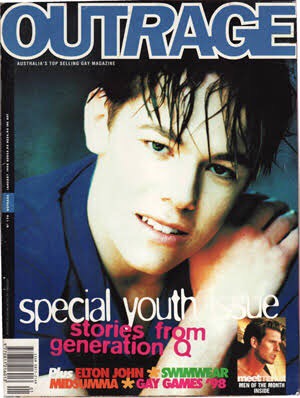
Eight years later in Melbourne, OutRage magazine shed its activist beginnings as Gay Community News to embrace a new name and a glossy presentation of entertainment and lifestyle. Its key architect was Danny Vadasz, and this dramatic shift from gay liberationist politics to gay men’s lifestyle mag mirrored his changing perception of the role gay media should play. He now saw the fight for gay social reform as achievable, rather than trying to overcome the entire capitalist/patriarchal system. Despite its shift to the commercial, OutRage stayed true to its activist origins through crucial and sustained coverage of the AIDS epidemic during the mid-1980s
Other gay men’s lifestyle publishers wanted to shake up the fledgling gay community and reshape it. Michael Glynn started the free newspaper Sydney Star in 1979 to promote an assertive masculine style and featured leather-clad men with hairy chests and moustaches. He publicly urged gay men to abandon the “limp-wristed fairy image”.
Michael GlynnThe 1988 emergence of Wicked Women by Francine Laybutt and her girlfriend Lisa Salmon was a direct challenge to prevailing feminist views in Australia. As a couple, Laybutt and Salmon explored sexual fetish and sadomasochism and the magazine focused on hardcore S&M, triggering boycotts from sections of the lesbian community. Despite this backlash, the magazine ran until 1996.
In the 1990s another key shift occurred in gay publishing with the dramatic expansion of free newspapers. Their growth into the dominant media form was driven by the fact they were free and easily-accessible, and their quick turnaround provided up-to-date news, venue gig guides and personal dating classifieds. High readership numbers attracted advertisers, which inevitably drove the search for even more readers. This led to a broadening of content to appeal to more sections of the community. More news was included, along with lesbian content and coverage of community group activities. Most advertisers were local businesses which encouraged the development of local newspapers in each city, and the market grew in Sydney, Melbourne and Brisbane to sustain competing newspapers.
This expansion was also fueled by the growth in advertising from mainstream businesses, which started to shed their fear of association with a vilified minority and instead saw potential gain from a dynamic niche group. Gay media’s constant appetite for advertising revenue beyond just local gay businesses saw it play a leading role in developing the idea of the affluent gay consumer. The massive expansion of free newspapers set the scene for an audacious takeover in 1999 when many publications were swallowed up by property development company The Satellite Group, which promised to deliver efficiency through its national scope, and to usher in the new age of the web. The venture failed due to poor management and massive debt in its property division, and the company was bankrupt 12 months later with all its publications shut down. The sector recovered, however, as ex-Satellite staffers launched Melbourne Community Voice in Melbourne and G in Sydney, soon replaced by SX. Previous publishers also launched Bnews in Melbourne, Qnews in Brisbane, QWest (later named Shout) in Perth, and Blaze in Adelaide.
All print media suffered following the rise of the internet though gay publishing was particularly affected. The internet allowed confidential explorations of sexuality, and online cruising saw a decline in venue patronage and a further decline in advertising and readership in the print market. Gay magazines continue to survive in all major cities, though most readers now access the online versions. Hard-copy print runs have been slashed by up to 80 percent.
The golden era for print may have passed but the reasons behind its emergence remain, as well as the crucial role it plays. Societal shifts toward the acceptance of marriage equality bring new debates about relationships and monogamy; as do other debates such as the increased censorship of under-age sexuality. However, individuals making their first tentative steps into exploring their sexuality still need help discovering their identity, companionship and sex. The question remains as to whether the internet is up to the task and until that is proven, a role still exists for diverse print media.
I have always believed in having a voice, and be it right, wrong or indifferent I think people should speak up, and one of the best ways to do that is through either letter writing, or being included in written conversations on specific issues. There is a lot of stupidity, injustice, prejudice and misinformation going on around us, and it is always important to speak out against these issues.
I have been involving myself in letters and articles since the mid-70s, and have pretty well kept the full record of my involvement. As a way of posting something a bit different, and covering, where possible, the scenario’s that provoked the letters and articles, here is a rundown of my social involvements over time. Funny how circumstances provide the fodder for letters! In my early days, it was always about gay issues – but then you settle down with someone, move to the ‘burbs, and all of a sudden it’s about your local council, or the idiots who inflict their opinions on us through the local rags! Keeps life interesting!
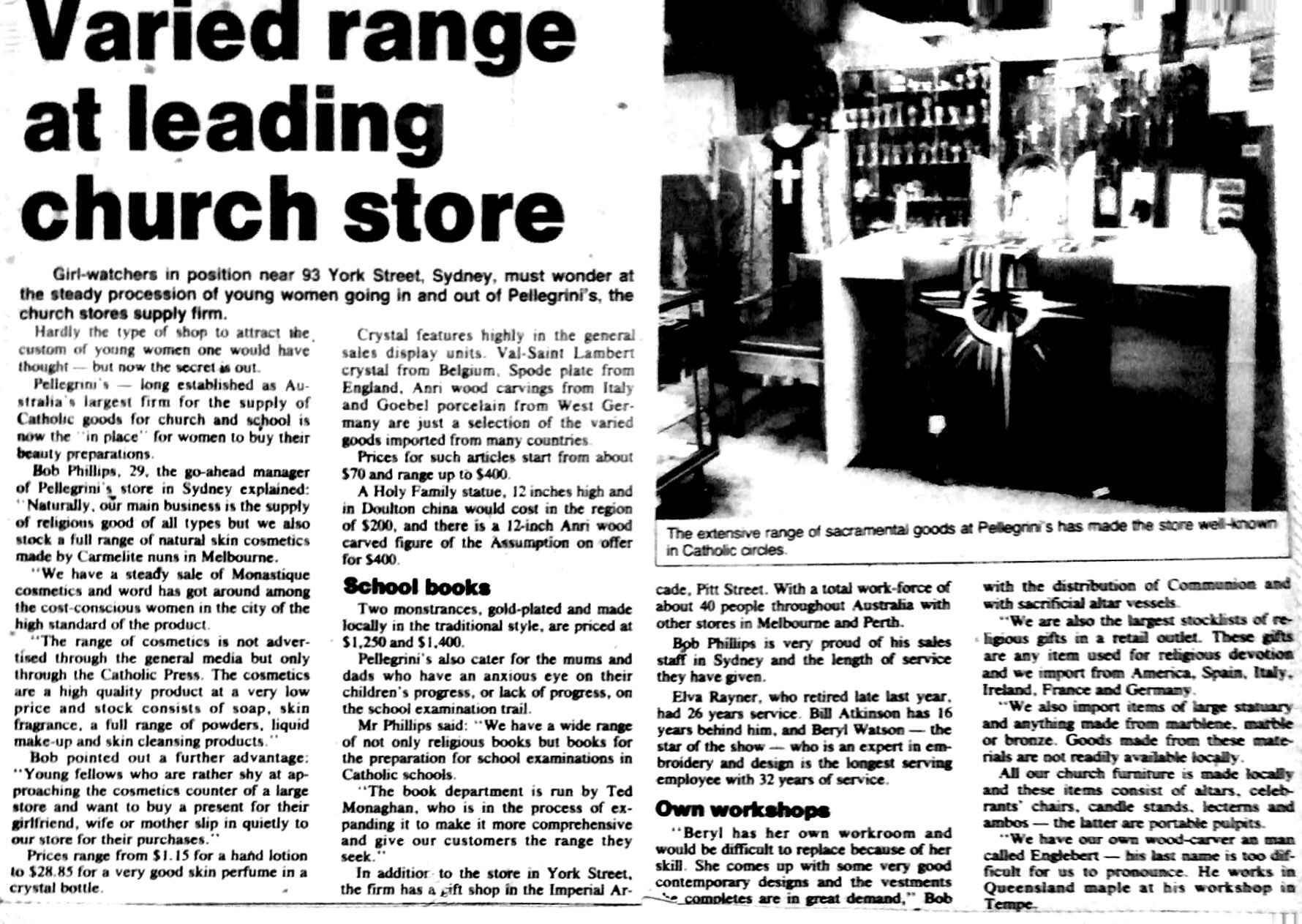
Published in the Catholic Weekly around 1976. I was the store manager for Pellegrini & Co Pty Ltd, in York St, Sydney. A woman had eritren to the Catholic Weekly that Australia had no patron saints, which was inaccurate, as Our Lady Help Of Christians actually was. This is under my old name of Robert Phillips.
Also from around 1976, this article is an interview with the Catholic Weekly regarding the actual Pellegrini store itself. It was sround this time that we had moved the store from its original site in George St, Sydney (in Roma House) to York St.
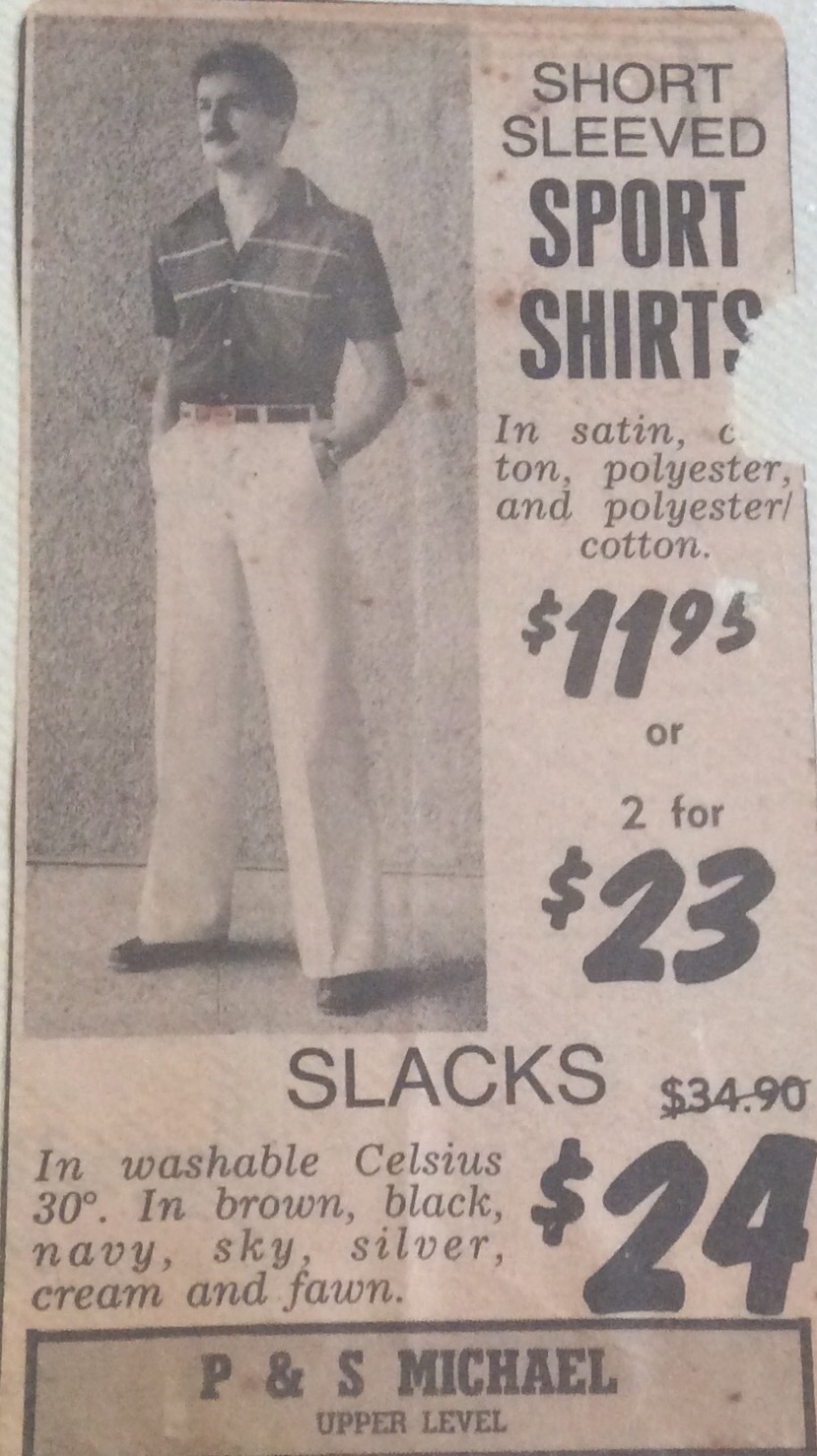
Around 1978 I left Pellegrini to work for my local menswear store, P&S Michael, who were branching out from the store in Granville, to MacArthur Square in Campbelltown. However, they employed pressure salesmanship – my pet retail hate – so it was a short-lived relationship. I returned to Pellegrini a couple of months later. This is me, modeling clothes for an advert in the local paper.
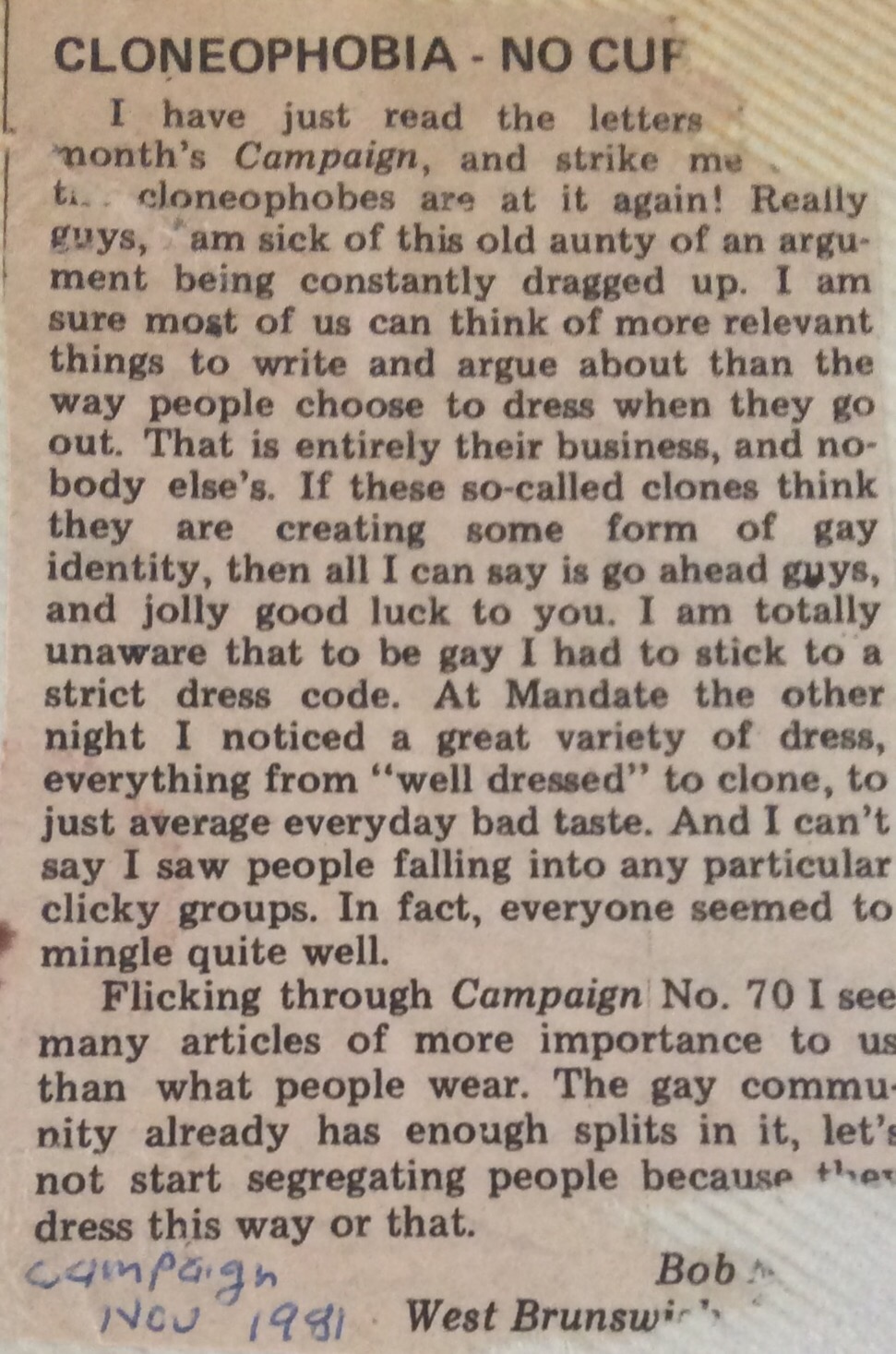
“Campaign” November, 1981. I was working for Pellegrini in Melbourne, and had just come out. I lived in West Brunswick. The gay clone phenomena had just started, and because of its “macho” imagery, a lot of old queens were whinging about how it was selling out the gay community by adopting “straight” stereotypes. I got fed up with it. My only letter from my Melbourne days.
Two-in-one! Both the smsll photo of myself (right) and Barty Carter taken at the Midnight Shift, and the letter regarding ACON Safe Sex campaigns not hitting the mark would be from circa 1984. Both published probably in Sydney Star Observer.
Beresford Hotel 1985. Christmas function. Photographed with Tony Kelly (right), my partner at the time. More than likely in the Sydney Star Observer.
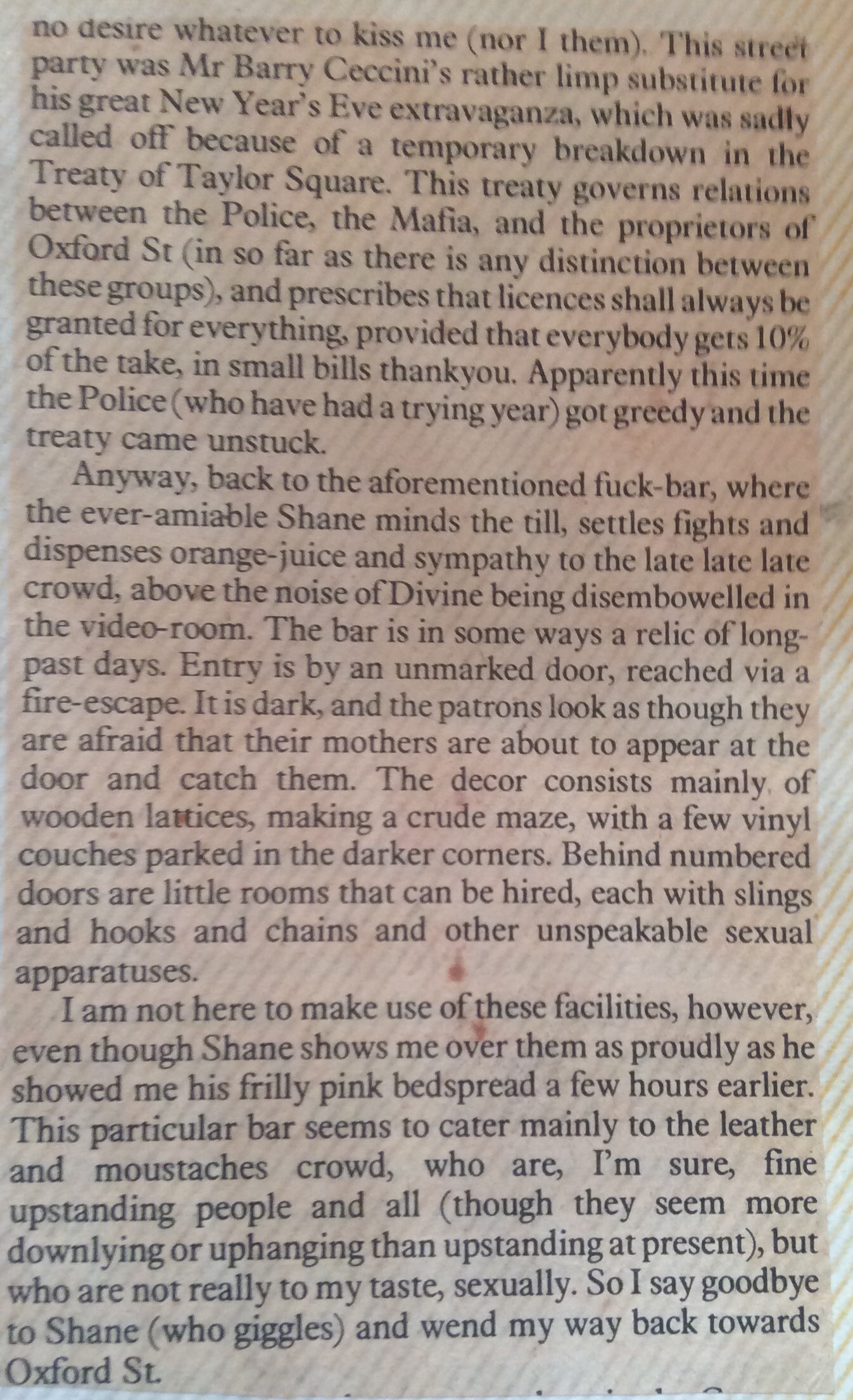
Article in “Outrage”, October 1985 by Adam Carr under his pseudonym Miles Walker. Adam had visited myself and my partner at the time, Damian, in our flat in Kellett Way, King’s Cross. He was on hus way to a street party. He decided to write a tongue-in-cheek piece about the visit. In the article, substitute Damian for Shane, and Tim for Tony. Notoriety comes in strange ways!
Star Observer circa 1985/86. A politician had made a rather stupid statement that gay men didn’t work in retail! Considering the retail sector relied heavily on gay staff, it just showed his general ignorance.
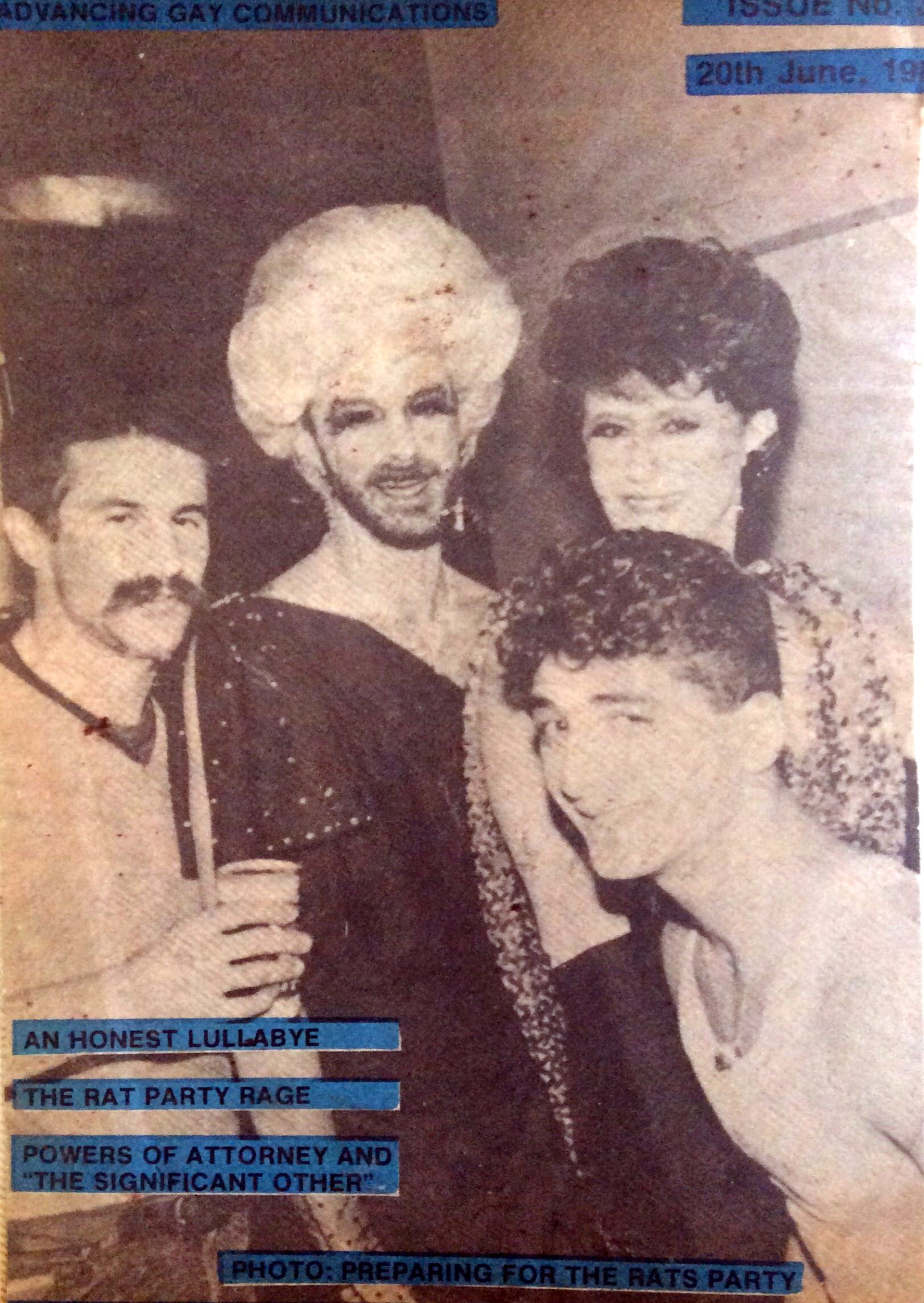
Star Observer Issue No.30, 20 June 1986. Cleo, my gutter drag persona, makes the front cover, along with Ruby Pollock (front right), and Andrew Carter. We had been to a Queens Birthday party at Geoff Smith & Steve Thompson’s home in Glebe. This photo was raken in The Oxford.
Cleo making it real in an advertising campaign for “Numbers” Bookshop in 1987. This was Cleo’s 1986 Sleaze Ball costume.
Green With Envy party, 31 August, 1986 at 38 Mona Rd, Darling Point. An annual party, put on by Sydney DJ Gareth Paull, who played regularly at The Oxford. A friend, Andrew Todd, asked me to go with him in drag, as he had never done drag before. Andrew had AIDS, and had spent most of the yesr in and out of hospital. He had a great night, and died on Boxing Day that year. I went wigless, and on the far right of this Star Observer photo.
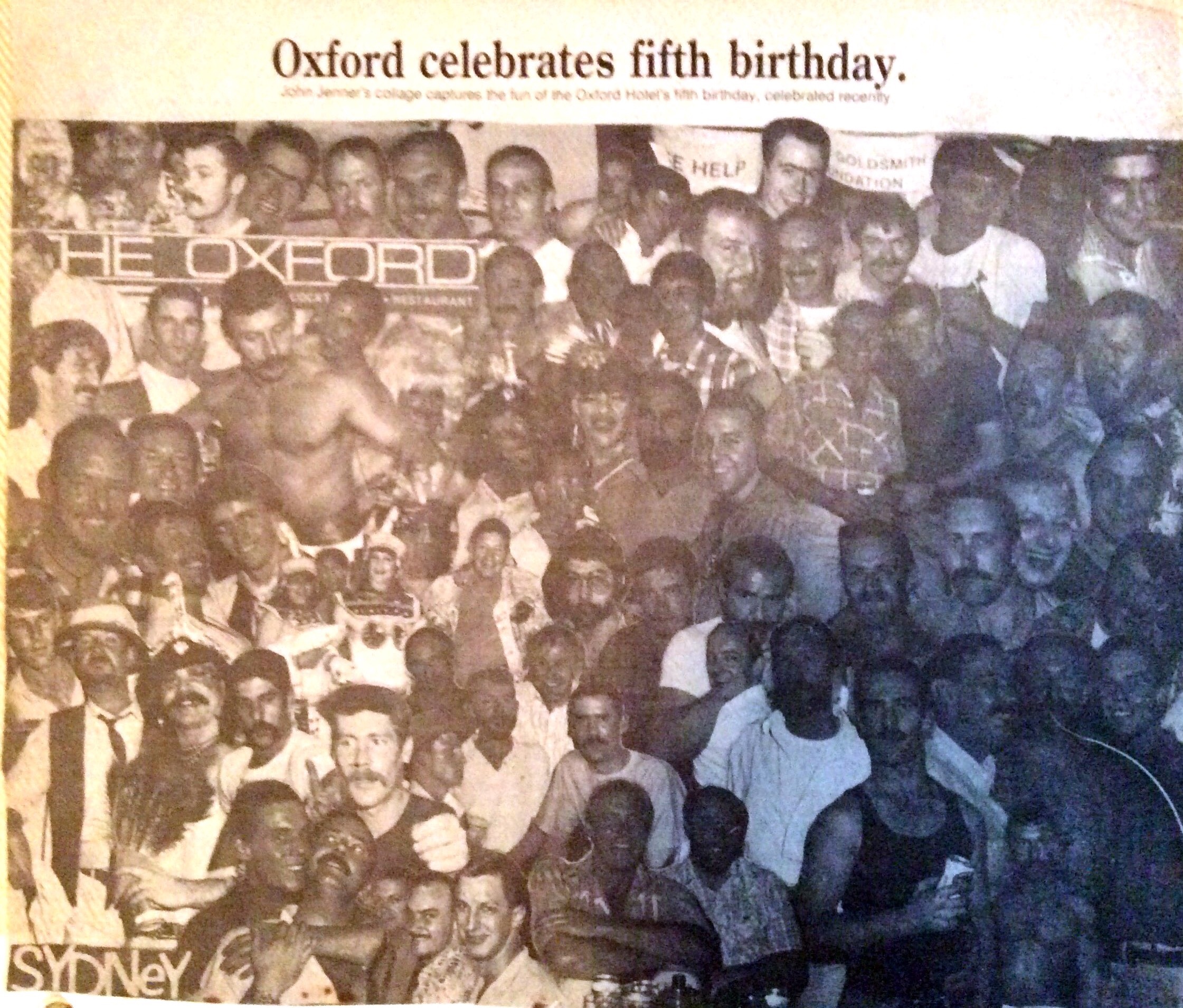
Star Observer August 1987. Montage from The Oxford’s 5th birthday party on 23 August 1987. That is Cleo’s white wig on the top left corner.
Outrage Magazine 1988. Mardi Gras photo, taken at the Art Gallery of NSW. Darby Wilcox (left) and myself about to scatter the ashes (mixed with glitter) of Don Tickle, who had died from stomach cancer earlier that year. His ashes were scattered along the parade route.
Star Observer June 1988. Montage from ANZAC Day at The Oxford, 1987. Don & I, in army drag, at bottom of photo, right hand side.
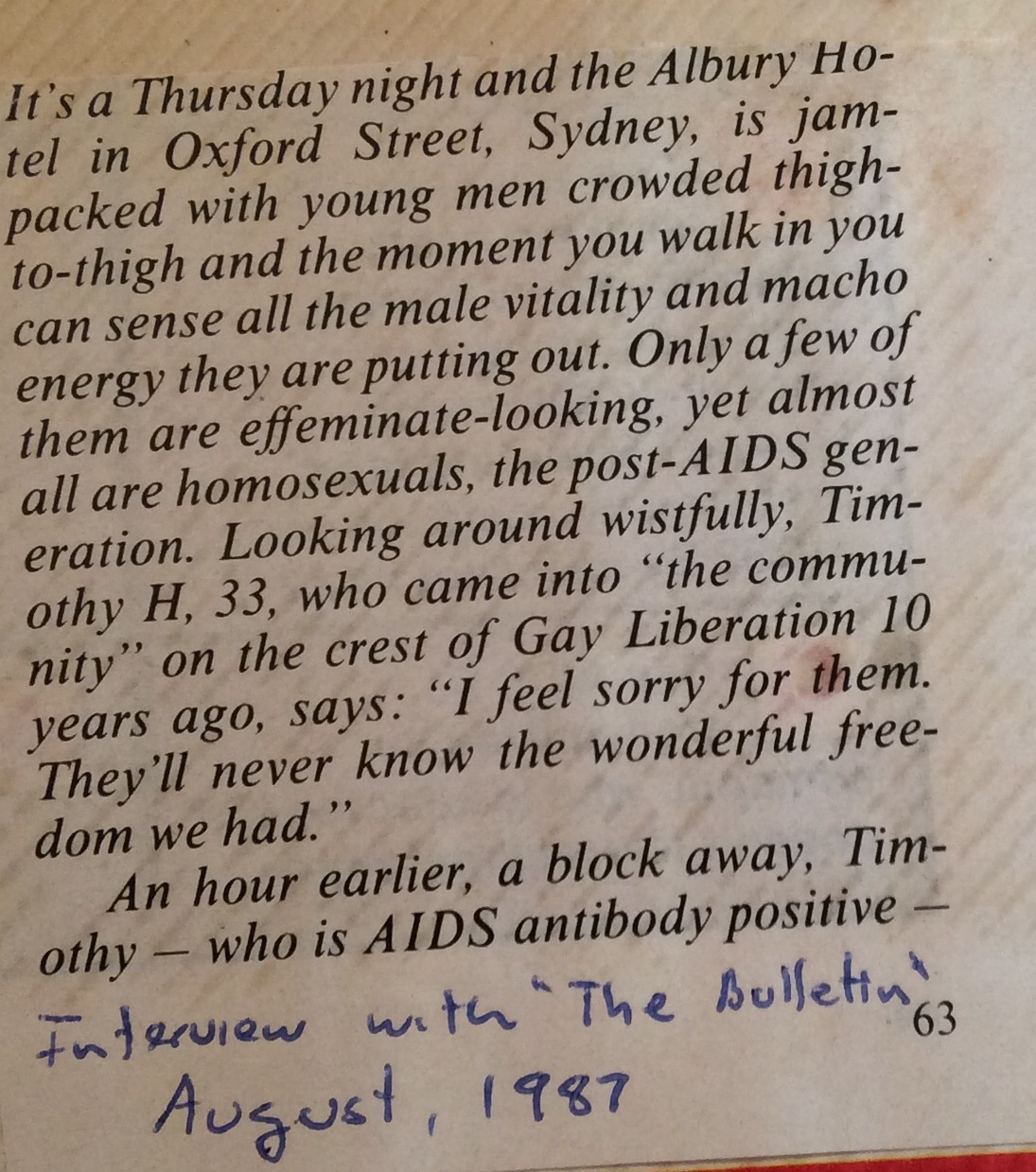
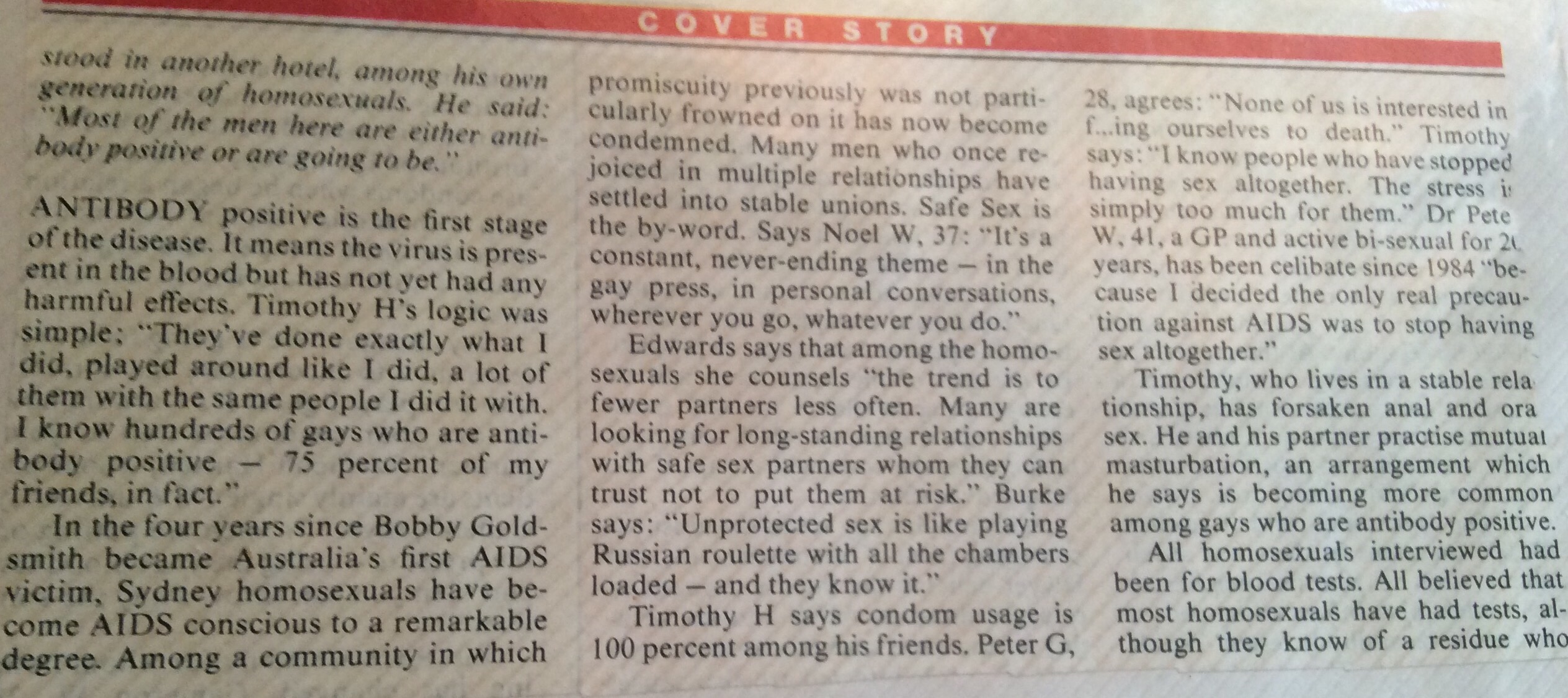
“The Bulletin” August 1987. An interview in The Oxford regarding how we felt about living with HIV. Being still early days in the history of the pandemic, this all sounds a bit naive now.
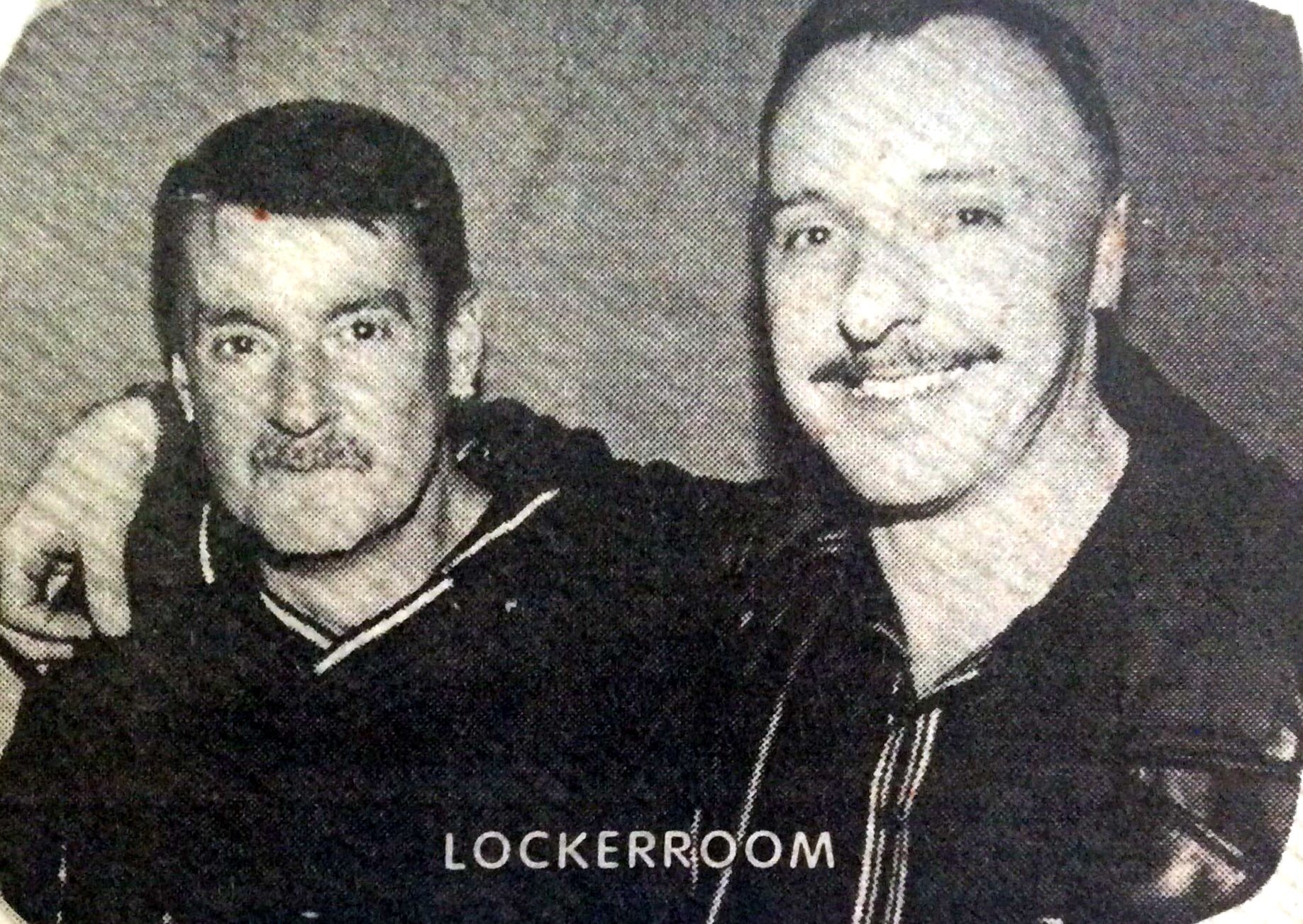
Though labelled “Locker Room”, this was actually taken in the Midnight Shift circa 1997. Tony Kelly to the right.
Circa 1986. The premier, Neville Wran, commented on cinema’s banning condom advertising due to them being perceived as not “family friendly”. Nothing like sticking your head in the sand, as far as I was concerned. Evidently I was allowed to see it on television, but not in the cinema?
A series of photographs taken by the Sydney Star Observer circa 1987. We had a Nuns, Priests & Prostitutes party to celebrate my flatmates birthday. The patty was an afternoon affair held at our apartment in Bourke St, Darlinghurst. A group of us went out to the Oxford Hotel after the patty, where these were taken.
My backside, in leather chaps & thong, makes an appearance in – of all things – a lesbian magazine – LOTL (Lesbians On The Loose), at a Sleaze Ball. Also circa 1987.
Outrage No.63, August 1988. Someone from Adelaide was laying shit on Mardi Gras…obviously decided not to have a great time…and succeeded! The tone of the letter will give you some indication of his gripes.
Poster for “Dancing Through the Decade”, New Years Eve 1989, at the Wentworth Function Centre, University of Sydney. Put on by the Bobby Goldsmith Foundation (BGF), DJs were Rob Davis & myself.
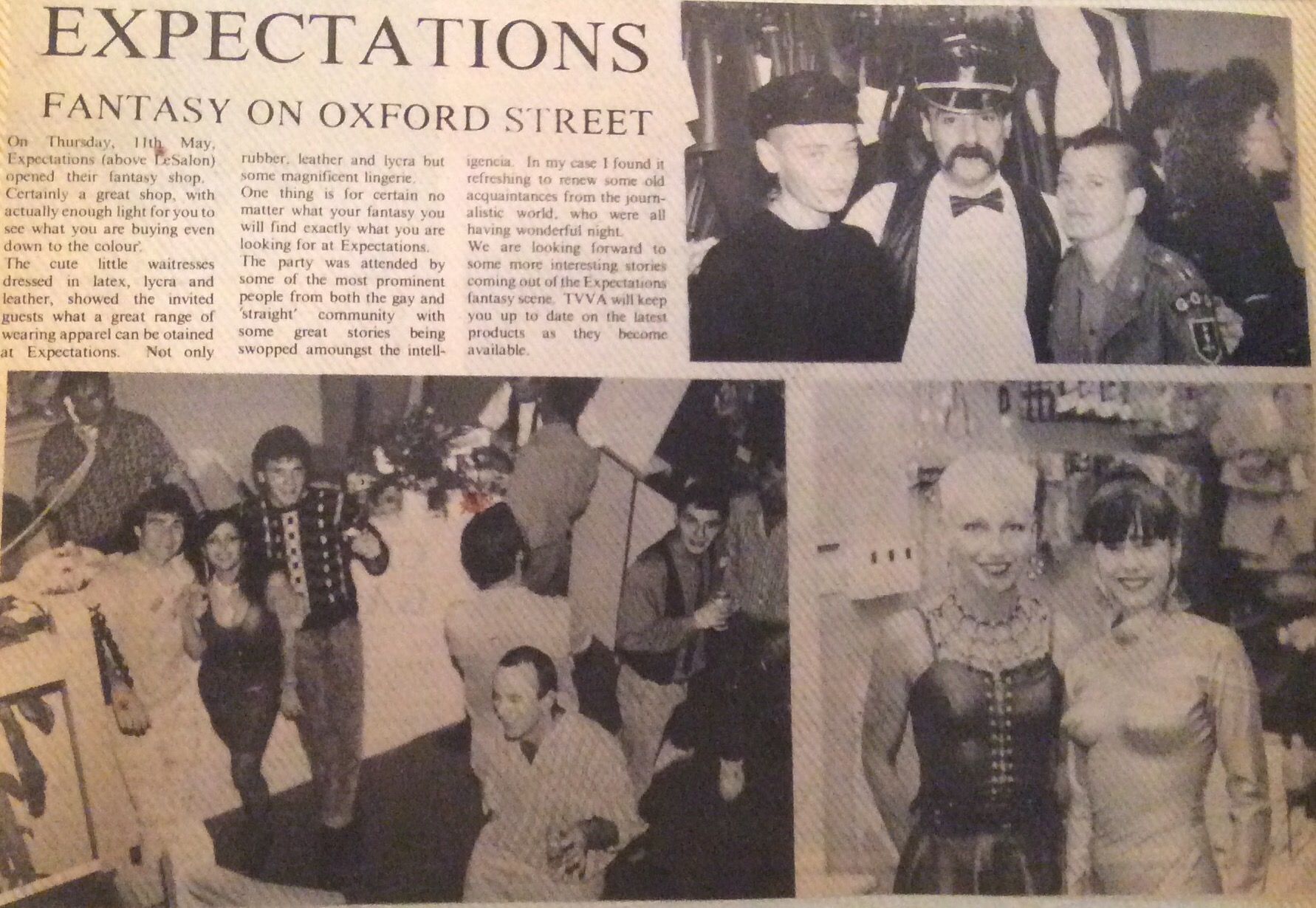
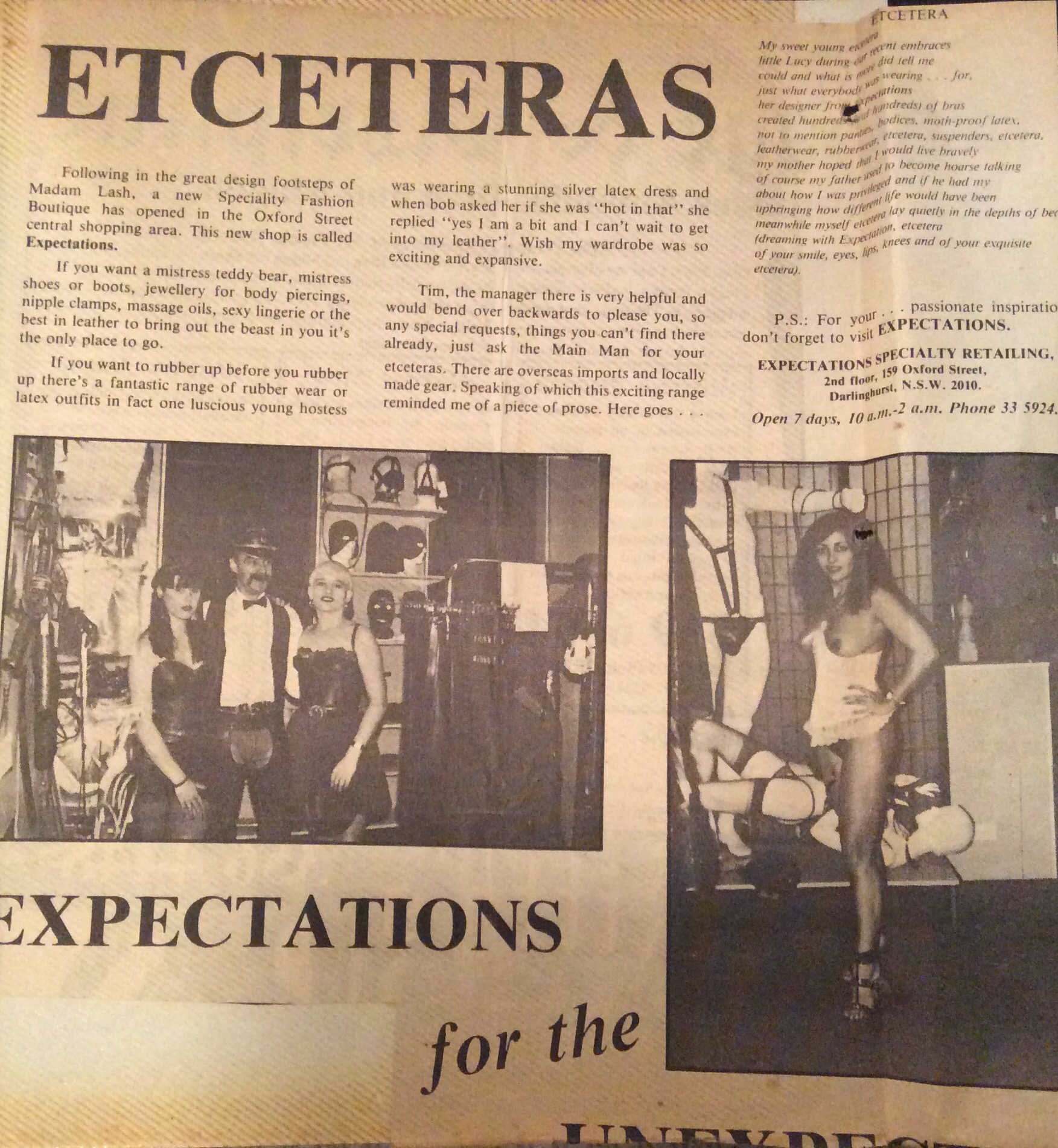
2 articles from local papers (names unknown) who reported on the opening party for “Expectations”. Expectations was a fetish store I managed for a short while, situated on the second floor of 159 Oxford St, Darlinghurst. Owned by Paul Jones, as was Numbers Bookshop, and the Den Club. In the first article I am in the top right photo, and in the second article the left side photo.
All I can remember about this photo was that it was taken in the Midnight Shift, and probably sometime between 1990-1993. I think I was in it due to my DJ work. It was published in the Star Observer.
Star Observer May 1990? (Date very difficult to read). Oxford DJ roster for what would seem to be Mardi Gras week, seeing as a Recovery Party is listed.
The Star Observer, 5 October 1990. The Oxford Hotel DJ Roster. I was a resident DJ at The Oxford from 1990-1996. This is probably the first roster I was on.
Star Observer, January 1991. Australia Day week DJ roster at The Oxford.
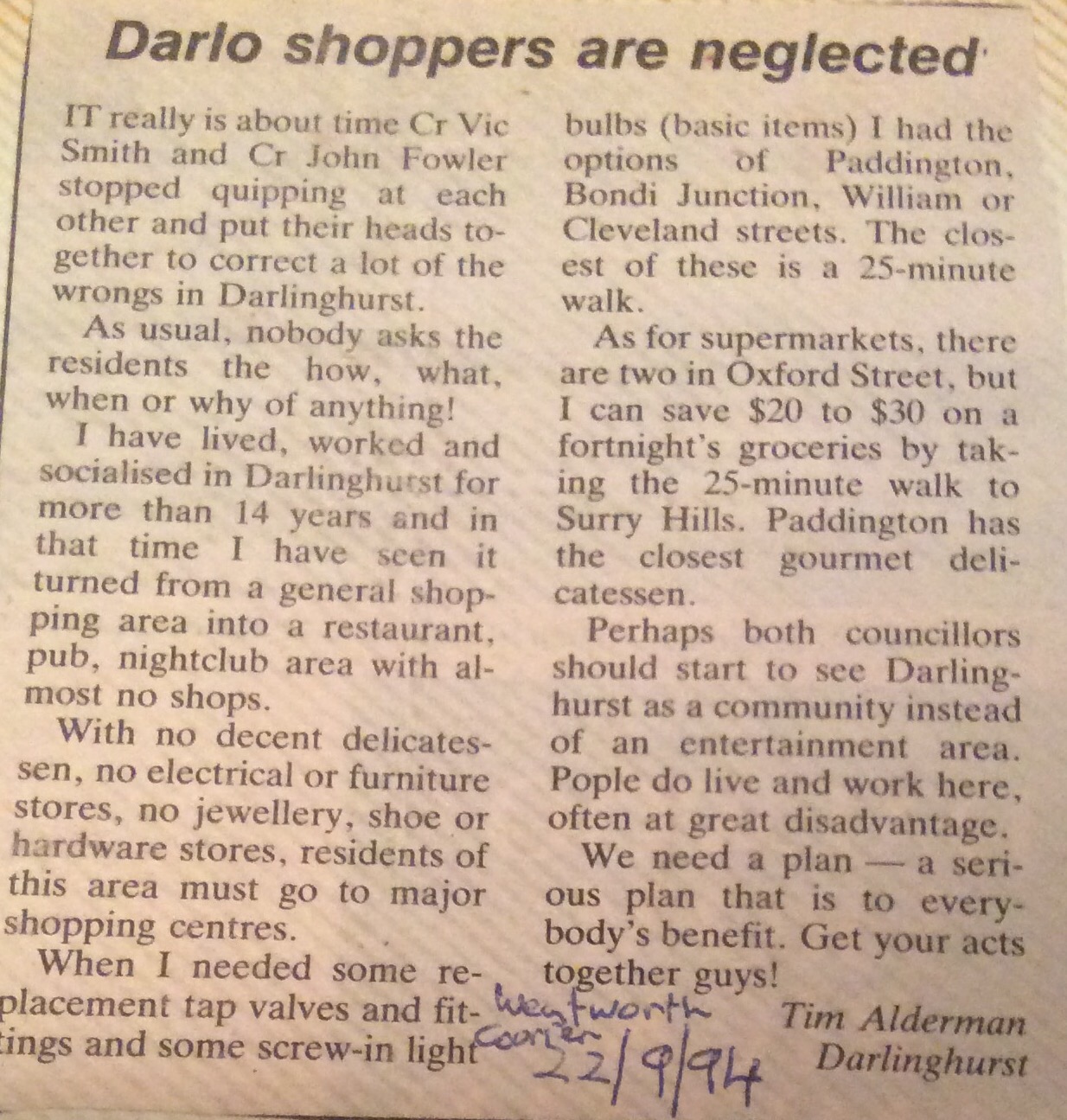
“Wentworth Courier” 22 September 1994. As usual, Oxford St as a shopping strip is going to hell on a hot rail, and everyone just seems to argue about what needs doing. The need for a retail plan for Oxford St should have been a council priority.
Star Observer, 31 January 1995. Myself & Marcus Craig (right) at the opening of his mixed-media gallery exhibition “Odyssey”. The air brush painting in the oicture was donated to the Luncheon Club.
Capital Q – 6 April 1995. People having a bash at HIV people because they are not relying more on alternative therapies.
The Daily Telegraph, 6 February 1997. Having attended the opening of a gorilla exhibit at Taronga Park zoo, all I could really see everywhere was McDonald’s – the exhibits sponsor – advertising. Way over the top!
Sun Herald, 16 March 1997. Someone whinging about forms of address to customers in retail stores.
Positive Living, June 1997. My response to an article they ran on CMV Retinitis, something I was well & truly knowledgeable about.
Capital Q 1997. My one attempt to jeet a potential friend or partner through the gay classifieds. I opted for the fully out there, warts and all approach. All those that I met were either serial classifieds users, or just plain nut cases. I met Michael, from Rose Bay, who I had a brief “thing” with just proor to meeting David. I still have the letters from guys who responded…more than I expected.
Star Observer January 1998. Dawn O’Donnell’s 70th Birthday Party at Paddington Town Hall. My self & Phillip Metcalf attended as representatives of PLWHA. Photo is not clear as enlarged from a very tiny shot. I am in the rear, far tight.
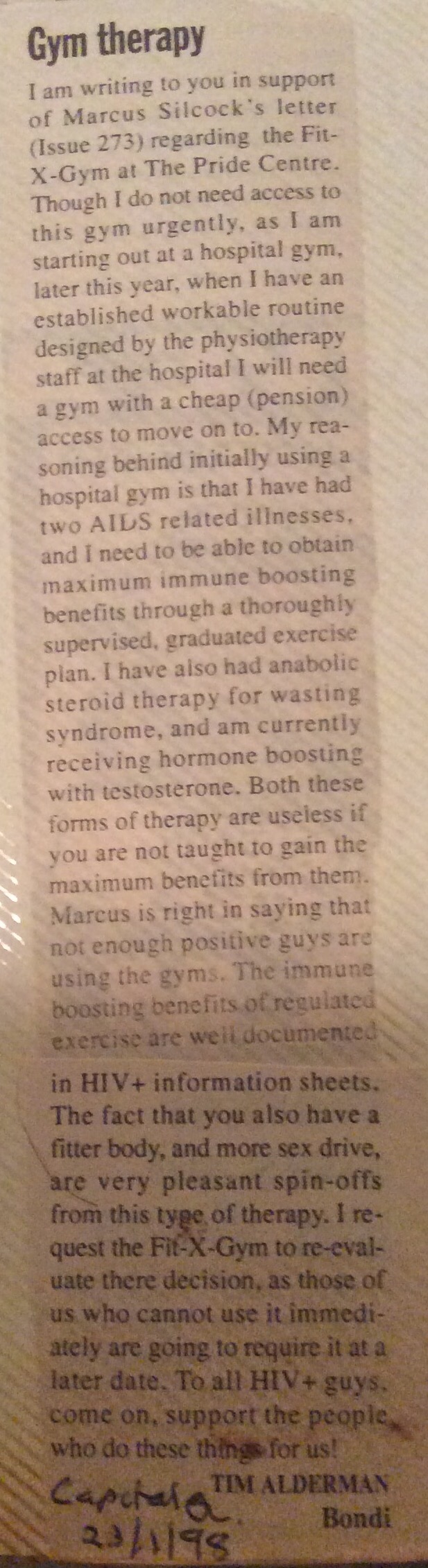
Capital Q 23 January 1998. A letter in support of my friend Marcus Craig, regarding the closure o a gym in the Pride Centre.
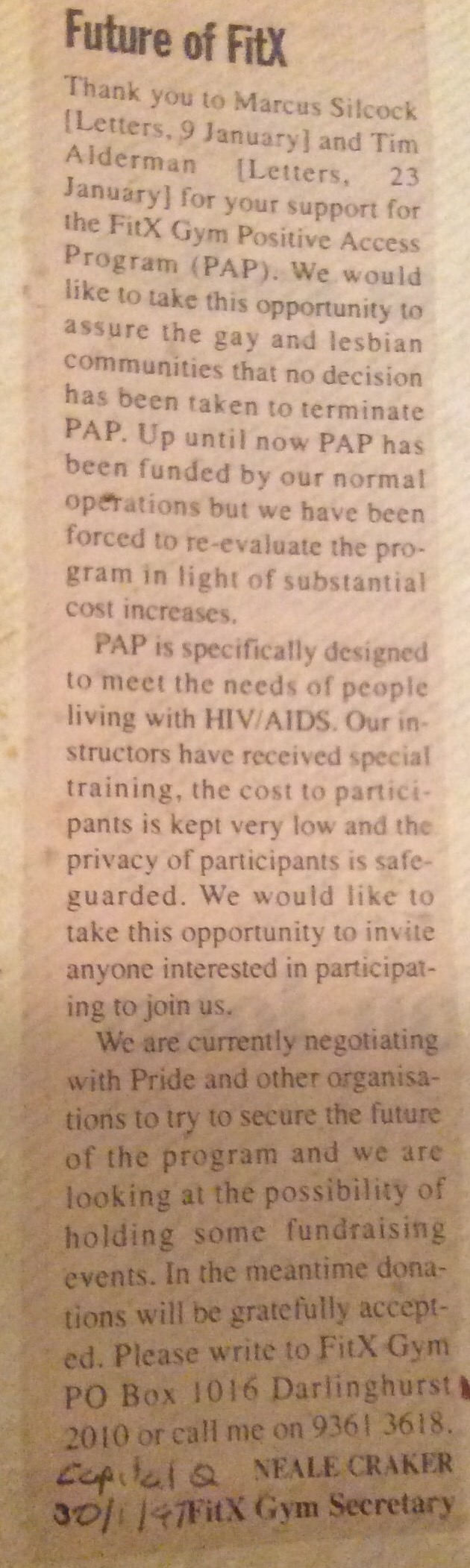
Capital Q 30 January 1997. The response of the gym owner to my and amarcus’s letter regarding its closure.
Wentworth Courier 1997. My gripes about life in Bondi! A true nightmare of a place to live in, esprcially in regards to transport & infrastructure.
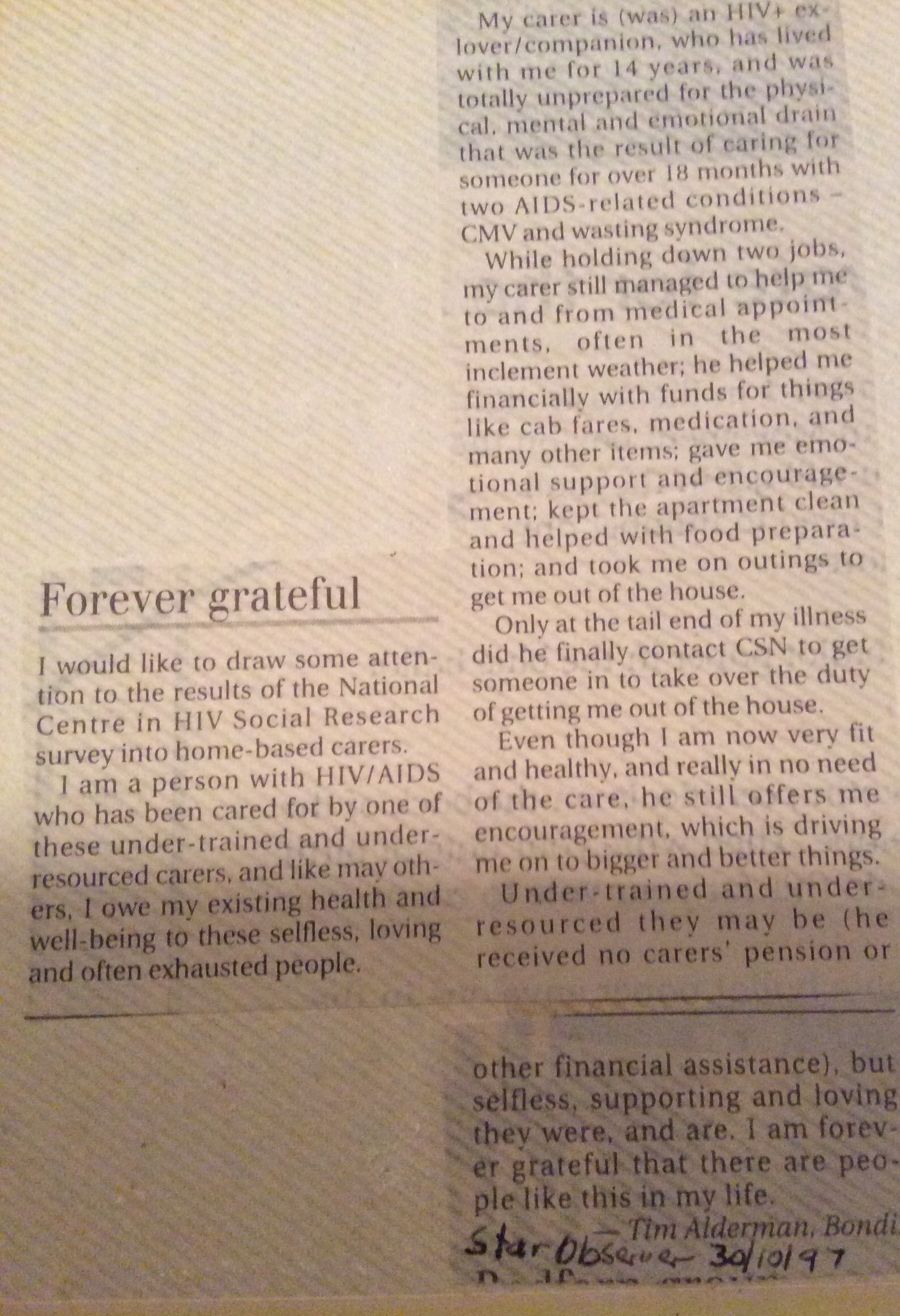
Star Observer 30 October 1997. A letter expressing my thanks HIV services.
Star Observer 1998 – Myself (left) and David st the 1998 Mardi Gras Party. We had been in the parade, and are photographed here in the PLWHA Time-Out Room…a dpace set aside for guts with HIV to have a break during the party.
Star Observer 1998. Mardi Gras Fair Day 1998, probably the last I attended. I am to the far left of the photo in 3/4 shorts.
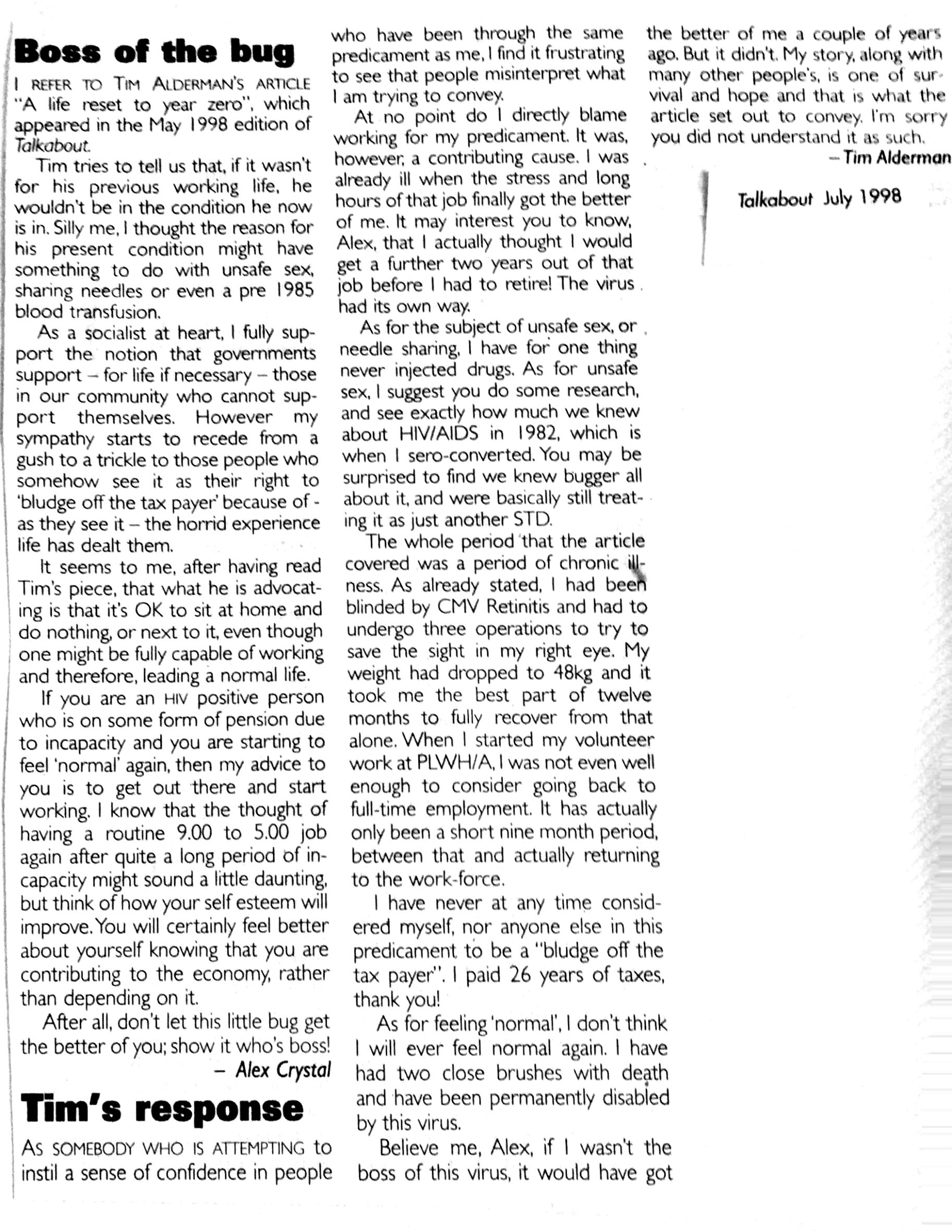
“Talkabout” July 1998. Alex Crystal had sent a letter to the editor critisizing an article I had written. Not only had this person not ever been as seriously ill as I had been in 1996, he had no empathy for the long recovery process, the psychological implications of surviving AIDS, nor coping with ongoing life with disabilities.
Probably Star Observer 1998. Mardi Grad parade entry for PLWHA – Dick Van Dykes on Bikes. Sydney Morning Herald, 22 October 1998. A letter responding to the mass closures of banks – a trend that was soon to reverse.
“Talkabout” No.91, Octoger 1998. A esponse to a letter critisizing my friend Marcus Craig for representing gay men with pisitive body images in his art work. Some people need to get a life!.
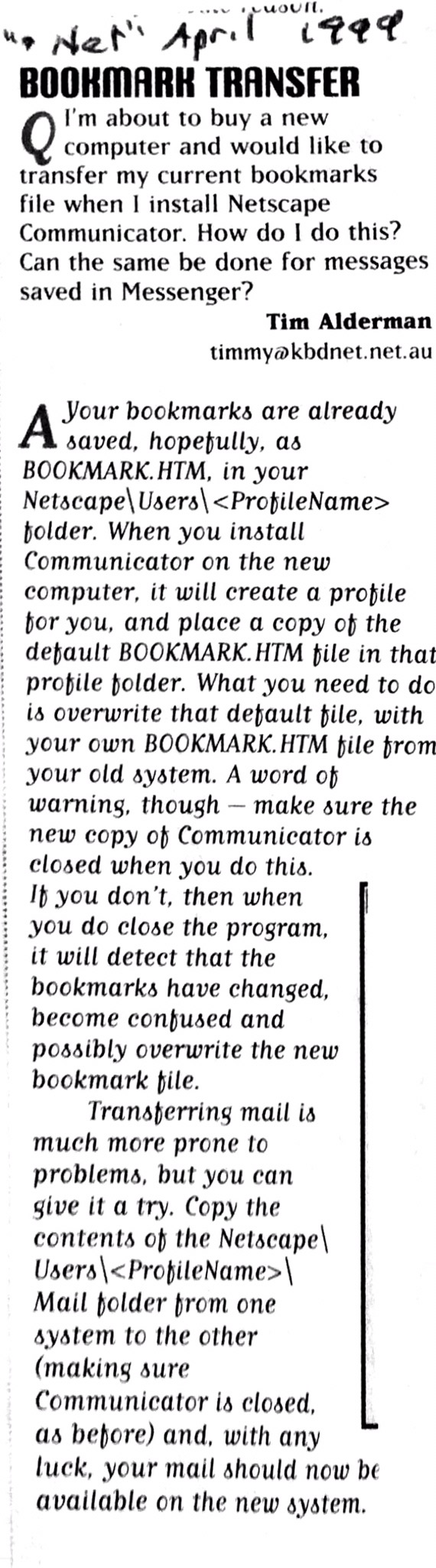
Sydney Morning Herald 10 November 1998. A letter regarding the fifficulties of obtaining work after serious illness, and when you are older. “Net” Magazine, April 1999.,The mire everyday aspects of life, and dealing with technology.
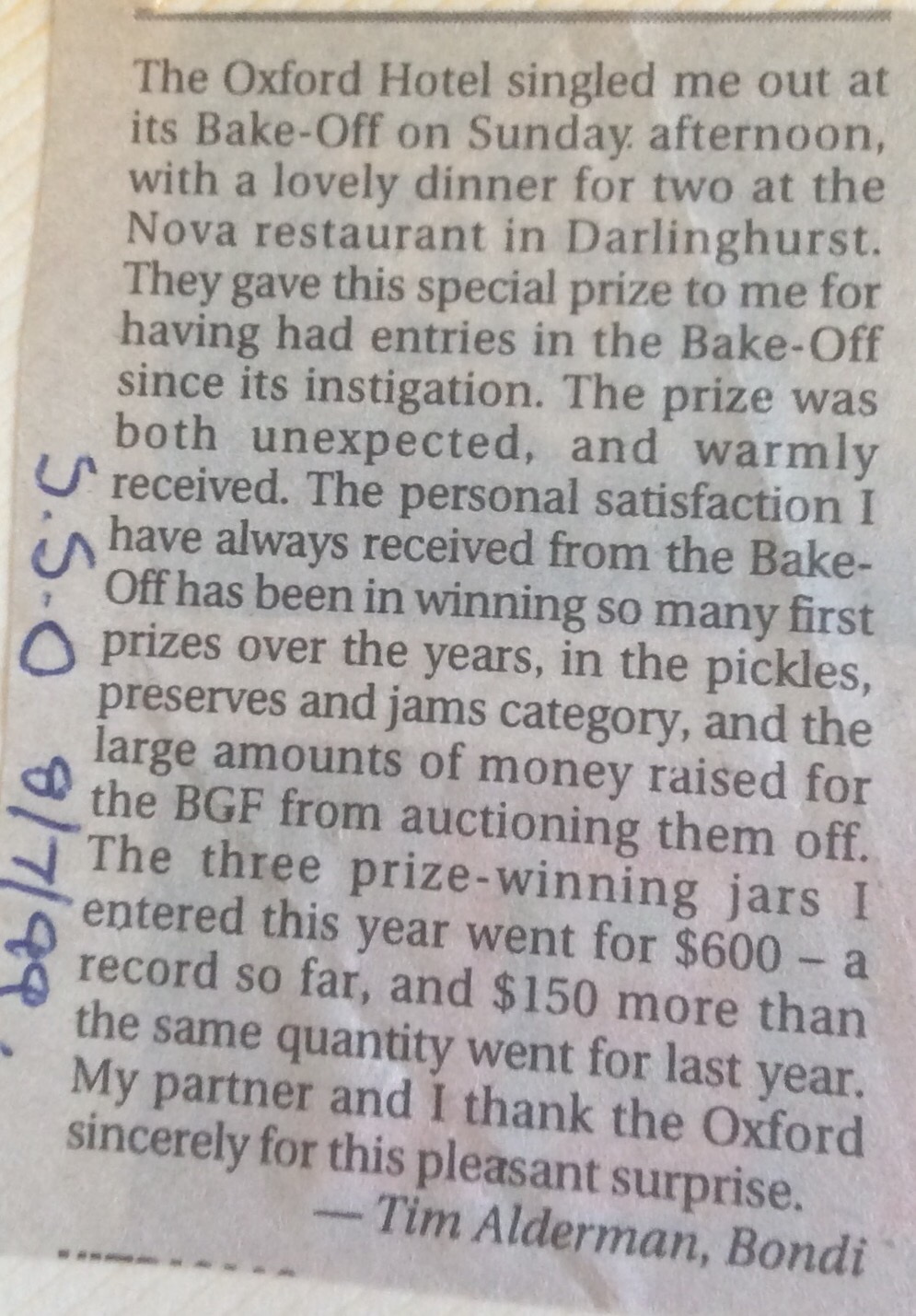
Sydney Star Observer 8 July 1999. A letter of thanks to The Oxford for awarding me a special prize for having entries in the BGF Bake-Off since its instigation.
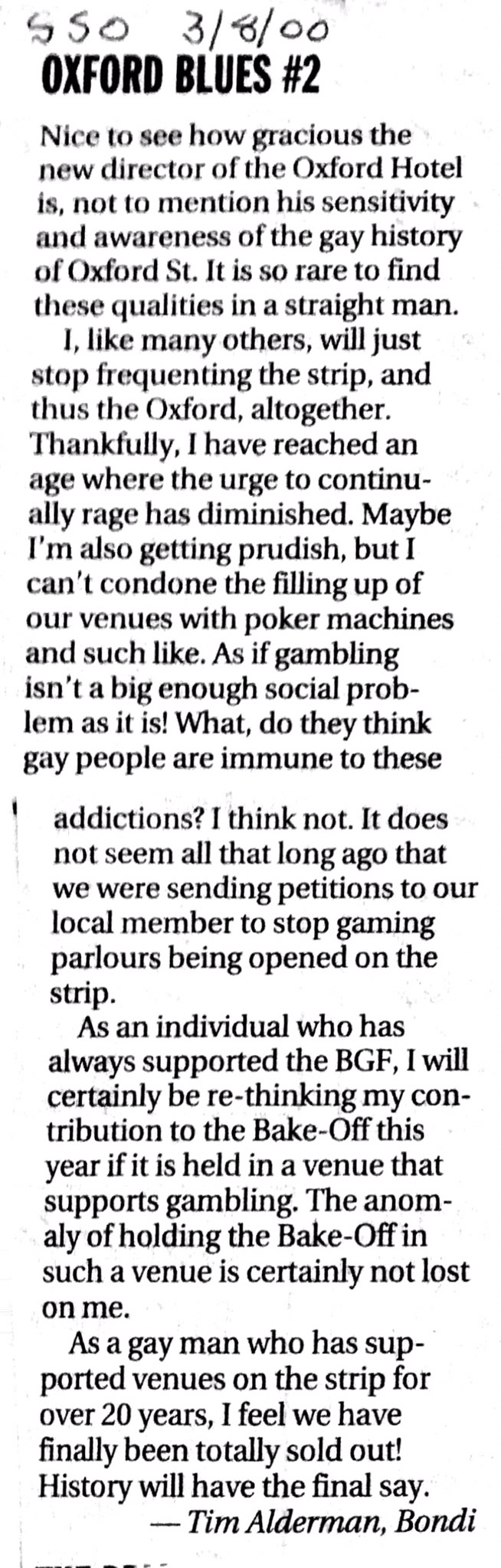
Sydney Star Observer 3 August 2000. The Oxford had undergone yet ANOTHER renovation, but this time a whole lot of poker machines had been added. Holding a charity auction in a place where money was being fed into machines was a bit ironic.
Good Weekend Magazine, 29 October 2000. A letter regarding an article they did on Stephen King, after his quite serious accident.
Wentworth Courier, February 2001. Letter regarding back-packers dumping inloved furniture etc on the footpath when they move on.
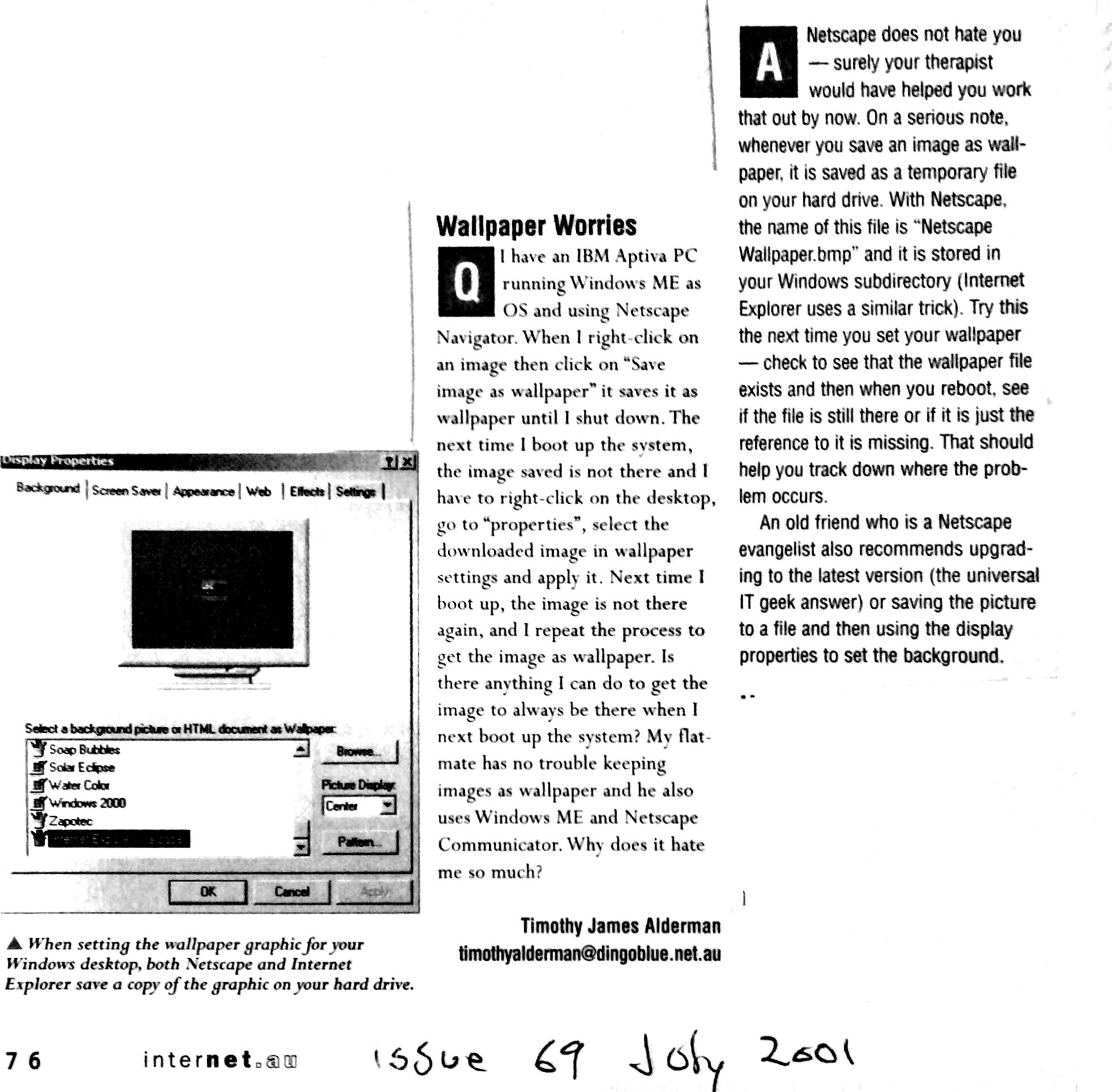
“Internet” Magazine, Issue 69, July 2002. Yet more mundane technology problems.
“Delicious” Magazine, February 2002. A great food magazine, if you enjoyed a LOT of tunning around to grt all the ingredients together for a recipe.
“DNA” Magazine, No.26, March 2002. A response to an article regarding gays, and religiiys dogma.
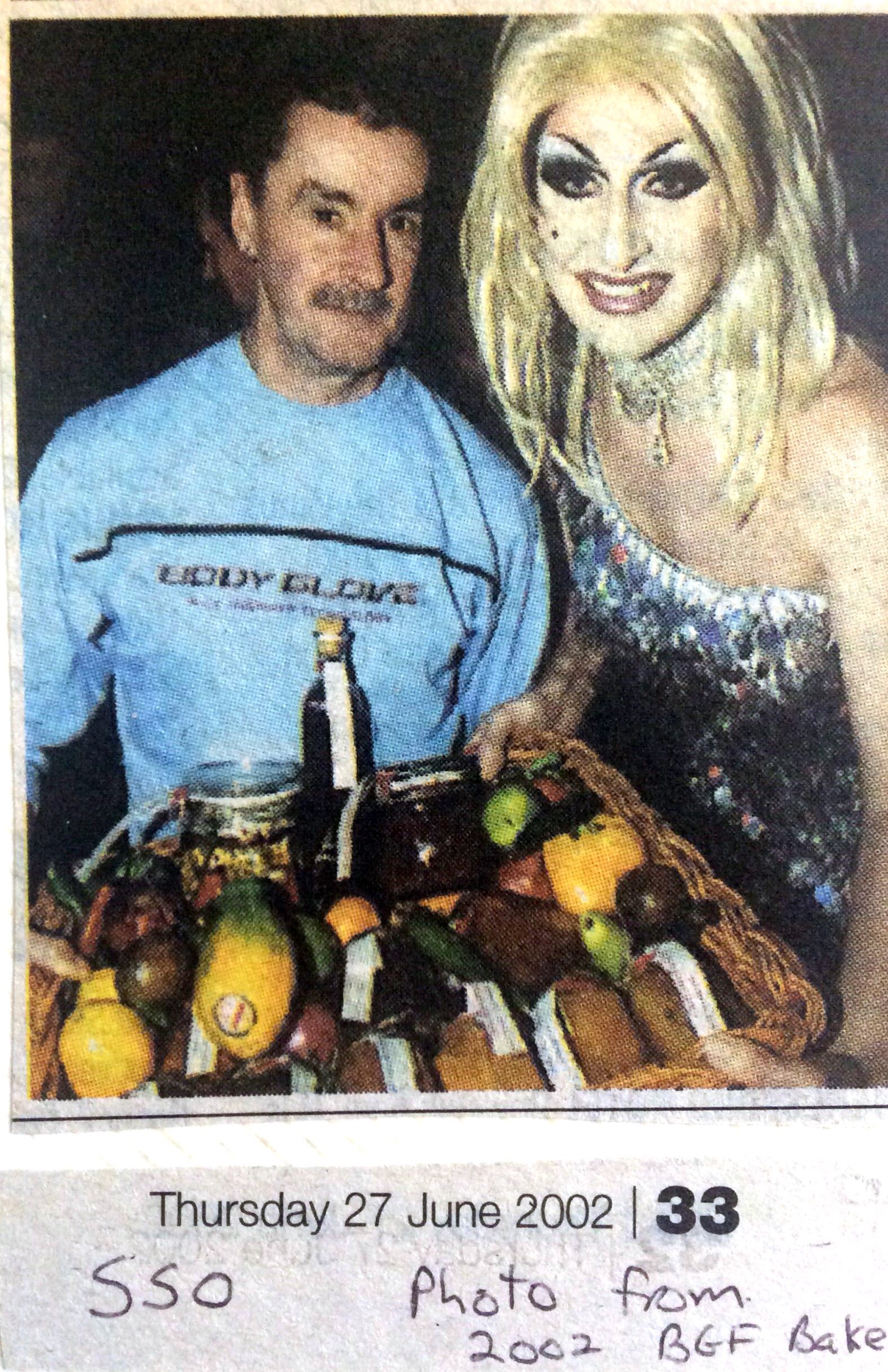
Sydney Star Observer 27 June 2002. Photographed at Arq with my winning entry in the Condiments & Preserves category, at the annual BGF Bake-Off. in 2002.
“DNA” Magazine, March 2003. A letter regarding an article in their Februarybissue regarding workplace bullying. The very start of the letter is missing.
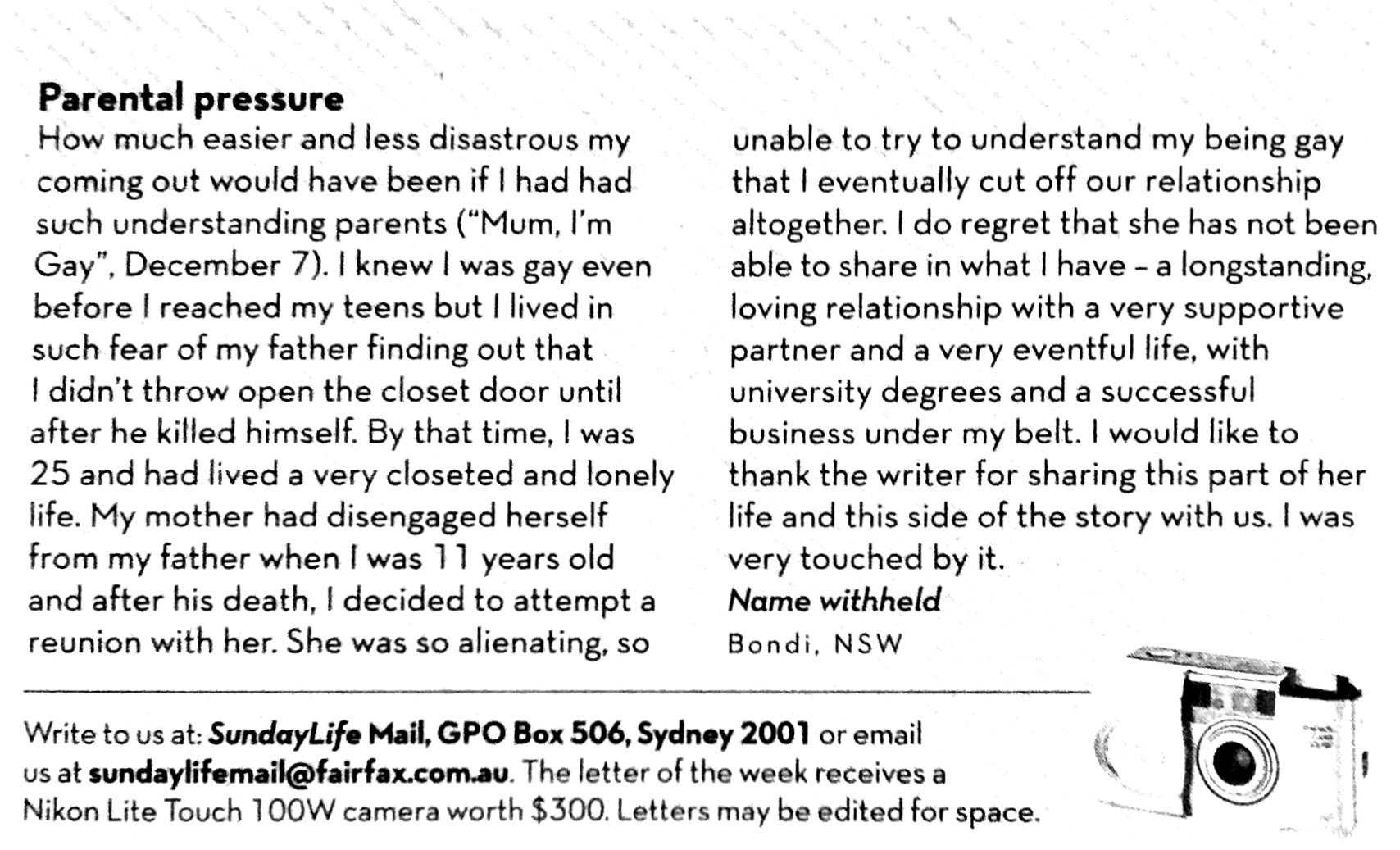
“Sunday Life” Magazine, December 2003. My response to a fery touching article on coming out as gay to ones parents.
“DNA” Magazine, February 2004. A tongue-in-cheek lettet regarding their very sexy photo shoots.
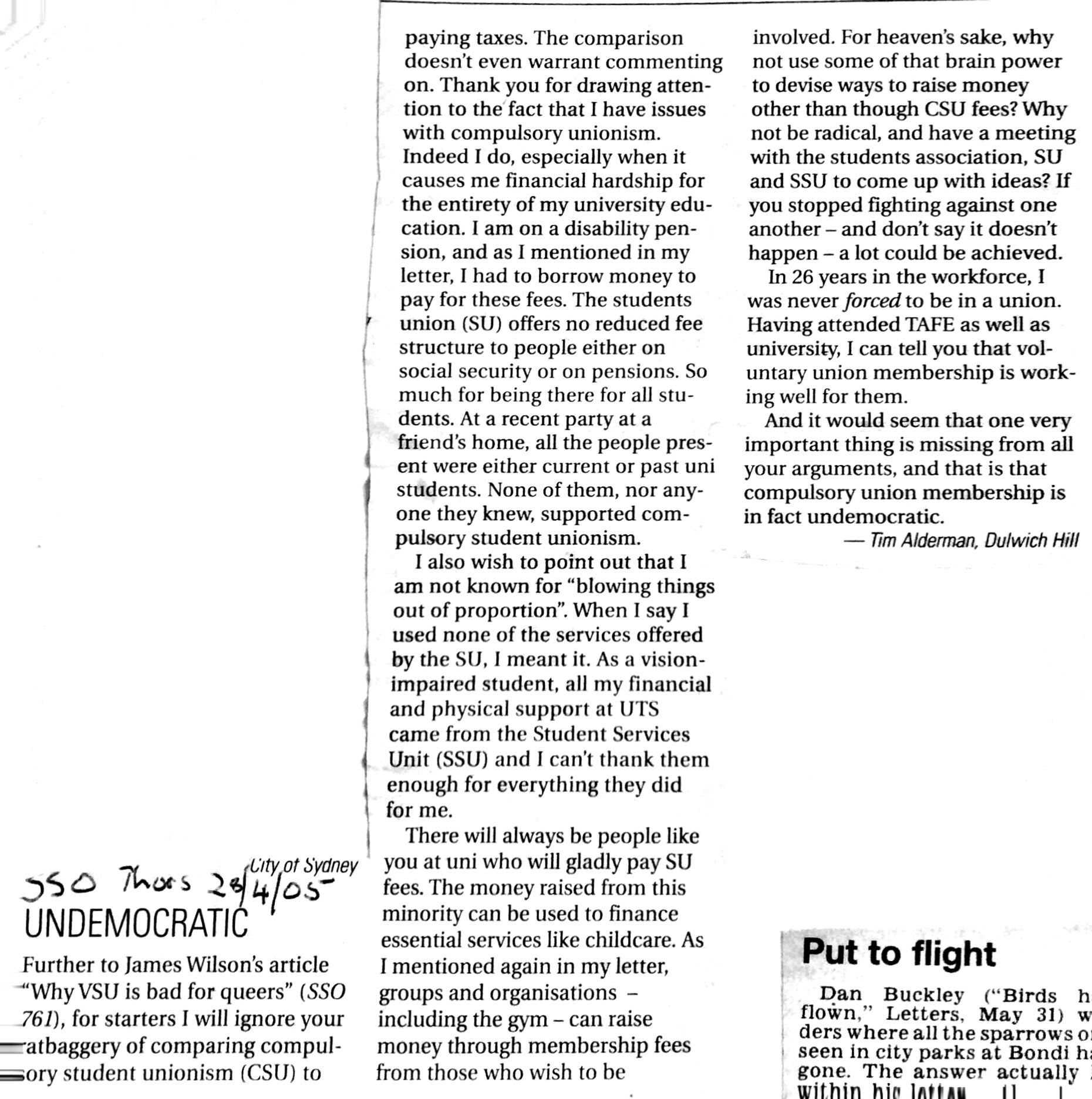
Sydney Star Observer, 28 April 2005. My having yet ANOTHER dig at the Student Services Union at UTS. I had bern at loggerheads with them for years over compulsory inion fees. Unfortunately, my original oetter regarding this is missing.
Daily Telegraph, 28 April 2005. The impossibility of getting work, even part-time, as you get older.
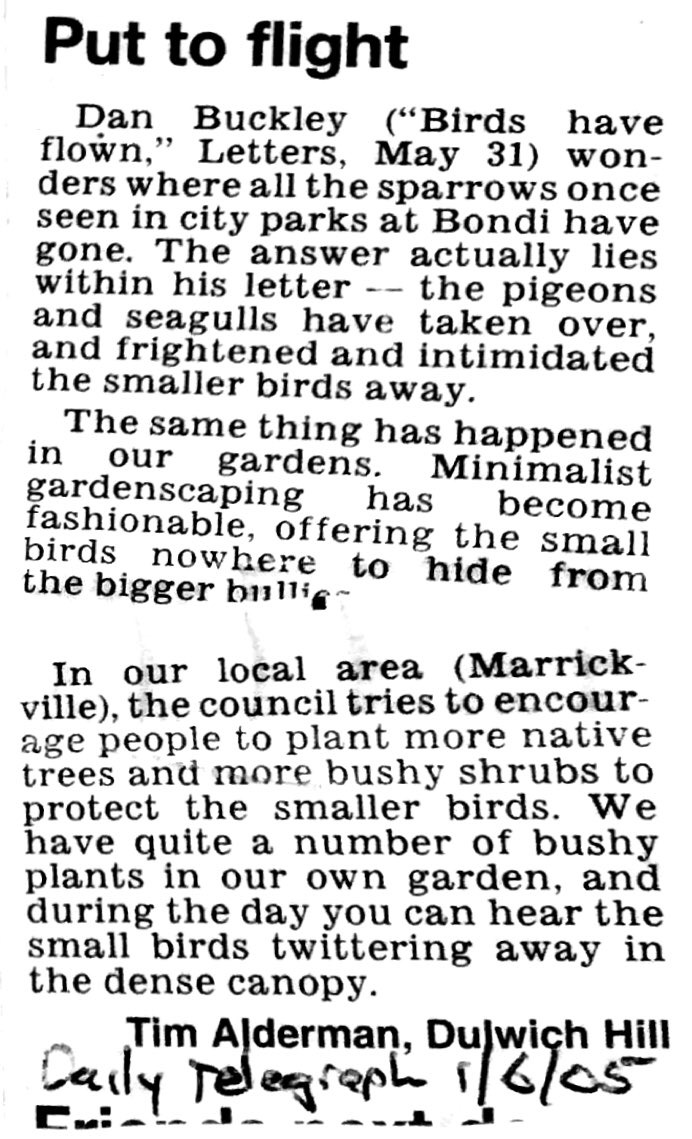
Daily Telegraph, 1 June 2005. Response to a ketter regarding the absence of small birds in our gardens.
Sydney Star Observer, 5 October 2006. David had, in a drunken moment at that years BGF Bake-Off, won an auction bid on a cake (bloody awful) and 2 Sleaze Ball tickets. We attended the party, and had an absolute ball, not at least helped along by some Ecstacy.
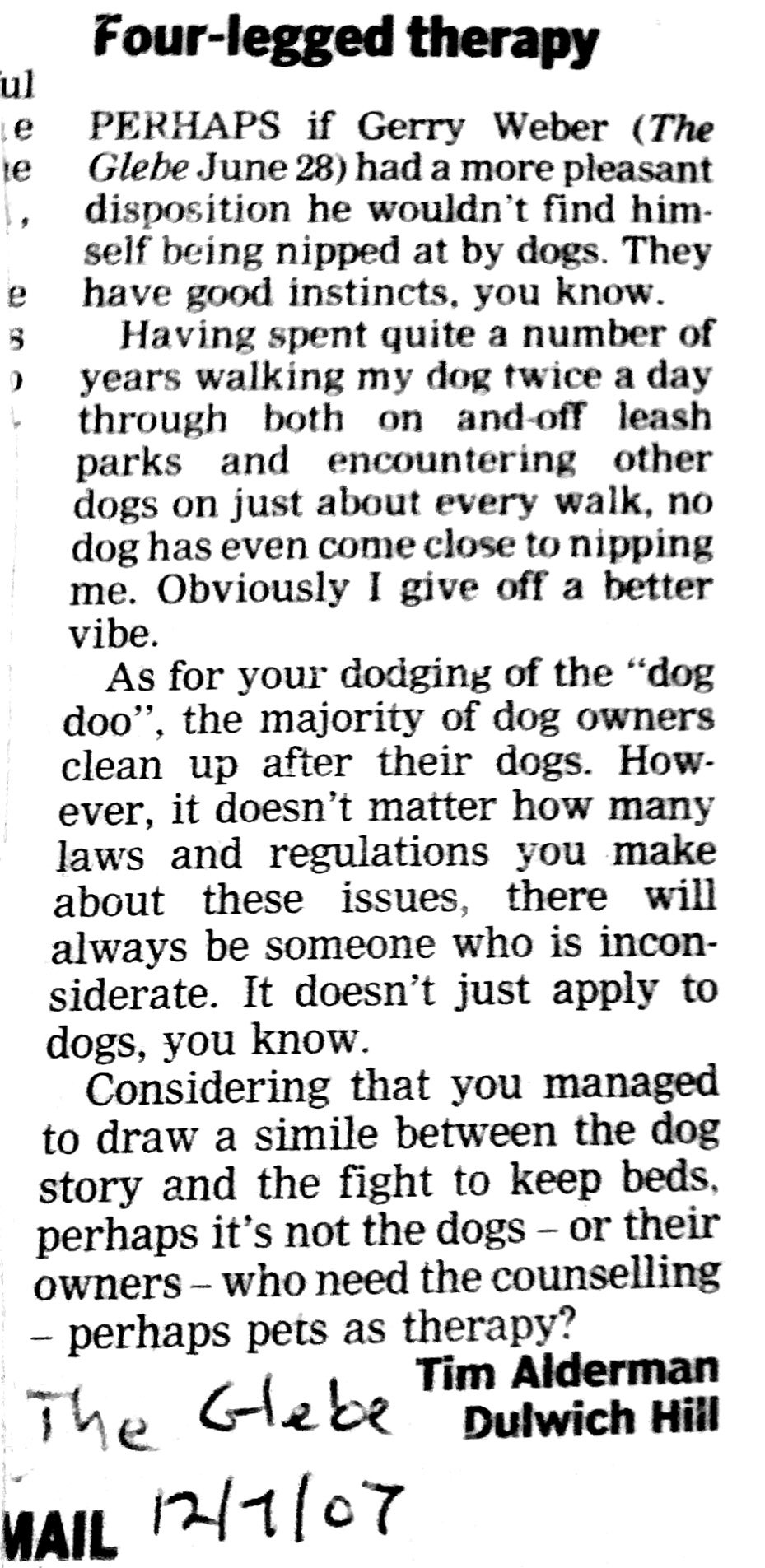
“The Glebe” 12 July, 2007. I take issue with people who are just unpleasant individuals. No wonder the dogs nipped him!
“The Glebe” April 17, 2007. After some demolition work in New Canterbury Rd, Dulwich Hill, some old painted shop signage appeared on the side of a remaining huilding, which had originally been hidden. I contacted the local paper, and they did a piece about it. The signage can be vaguely seen in the background.
“The Glebe” 1 May, 2007. My involvement in a local protest about removing a small park at the topnof Marrickville Rd that had historical significance as a tram turning-circle. I’m in the background, dark glasses & cap to right of picture. I’m holding Benji, my dog.
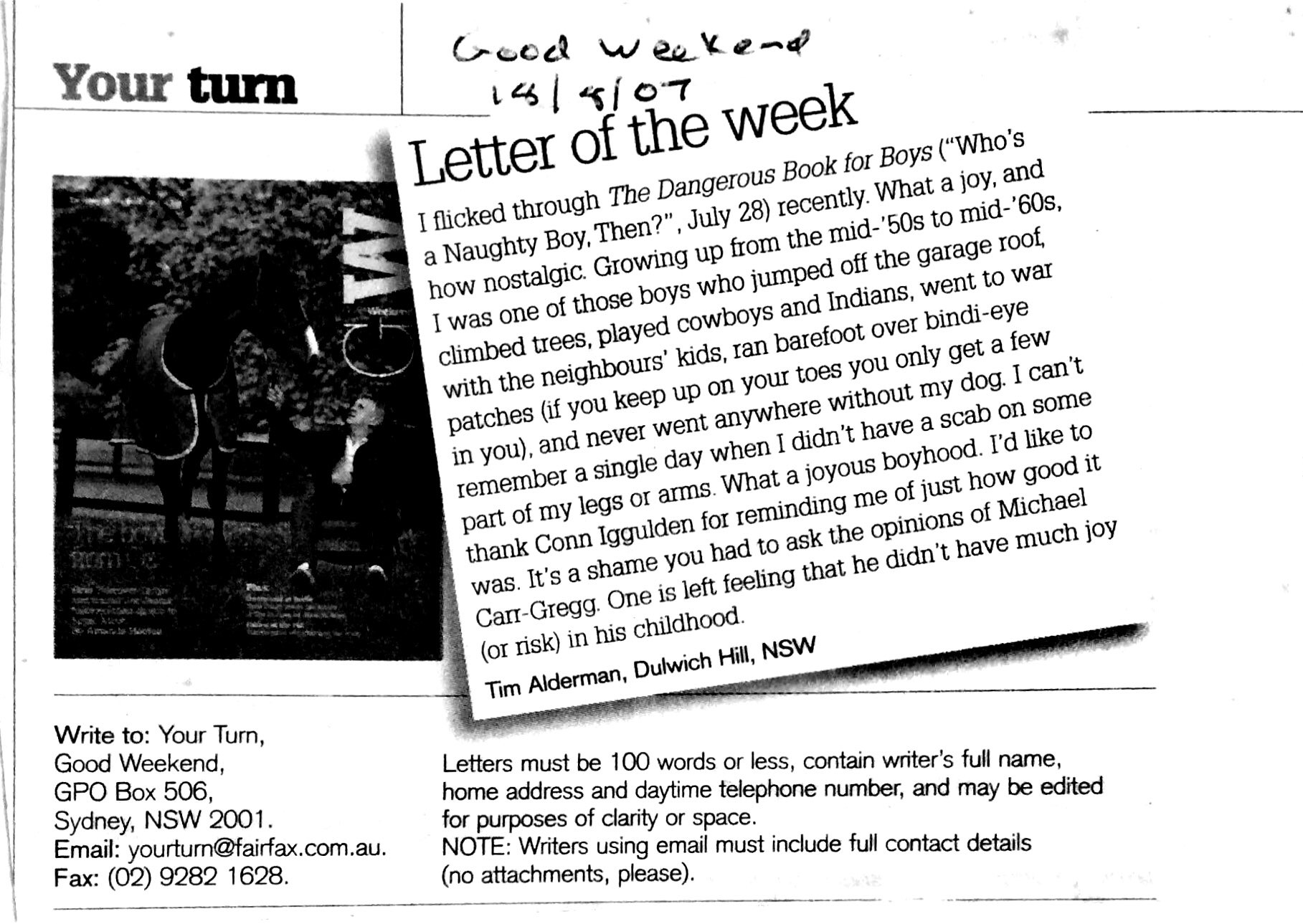
“Good Weekend” Magazine, 18 August 2007. A letter regarding the joys of childhood, which won me “Letter of the Week”, and the prize attached ton it – a weekend for 2 at Pepper’s Convent, in the Hunter Valley.
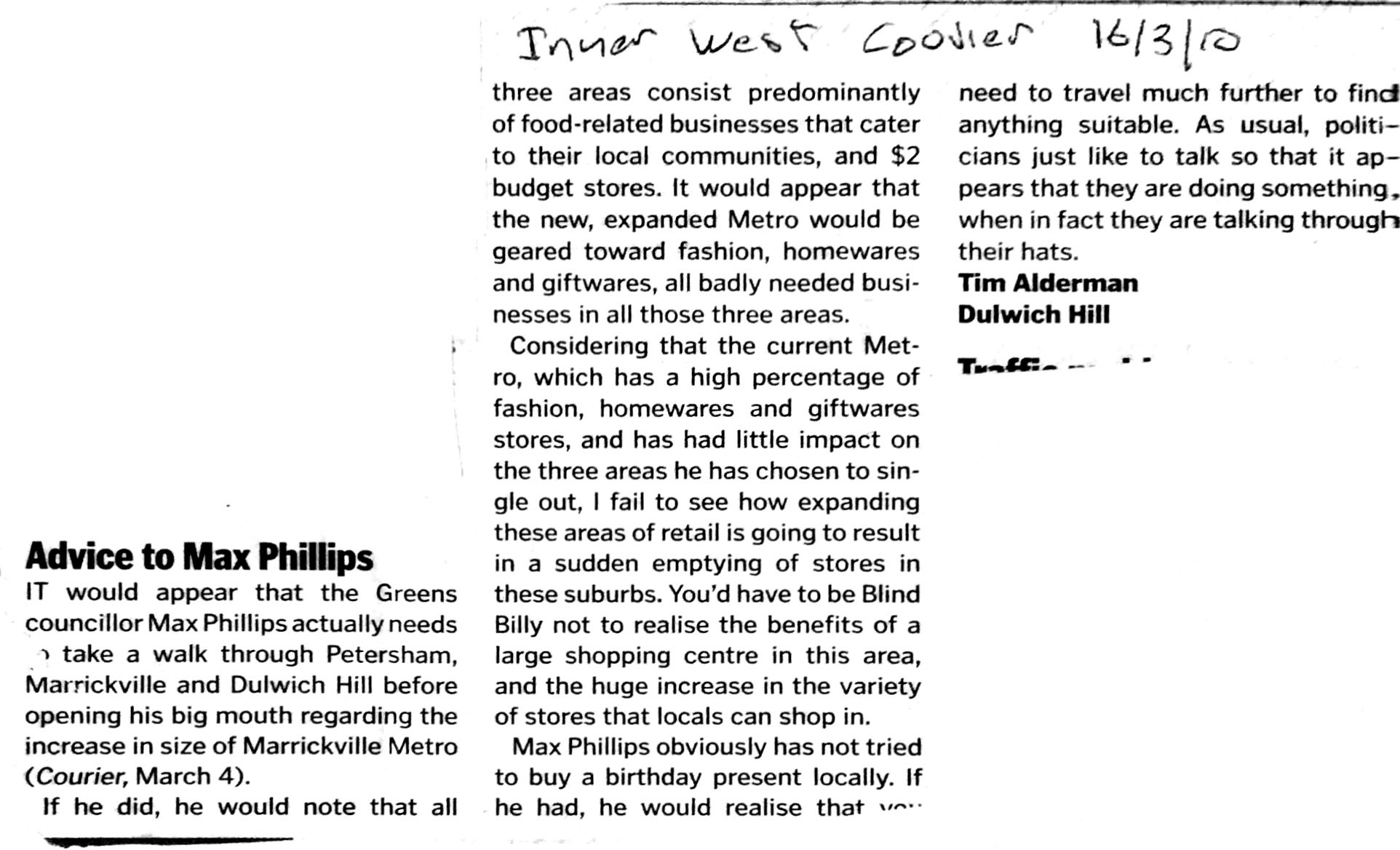
“Inner West Courier” 16 March, 2010. Local Treens rep is trying to thwart a much-needed recamp and extension to Marrickville Metro, and has obviously never shopped in our area.
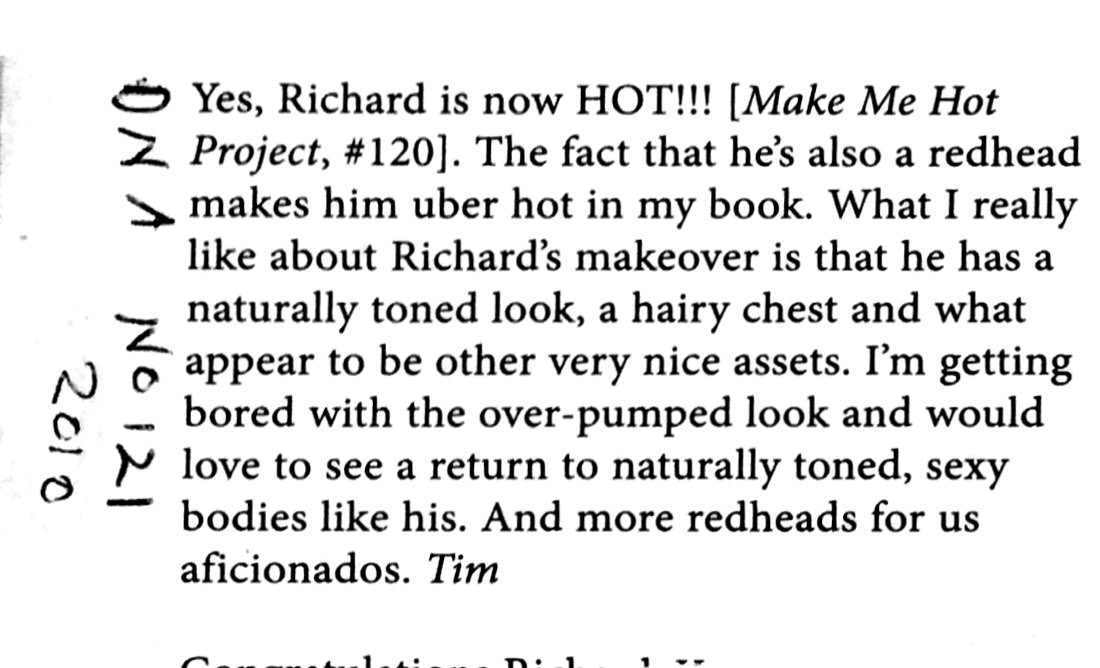
“DNA” Magazine No.121, 2010. In praise of a redhead make-over! Yum!
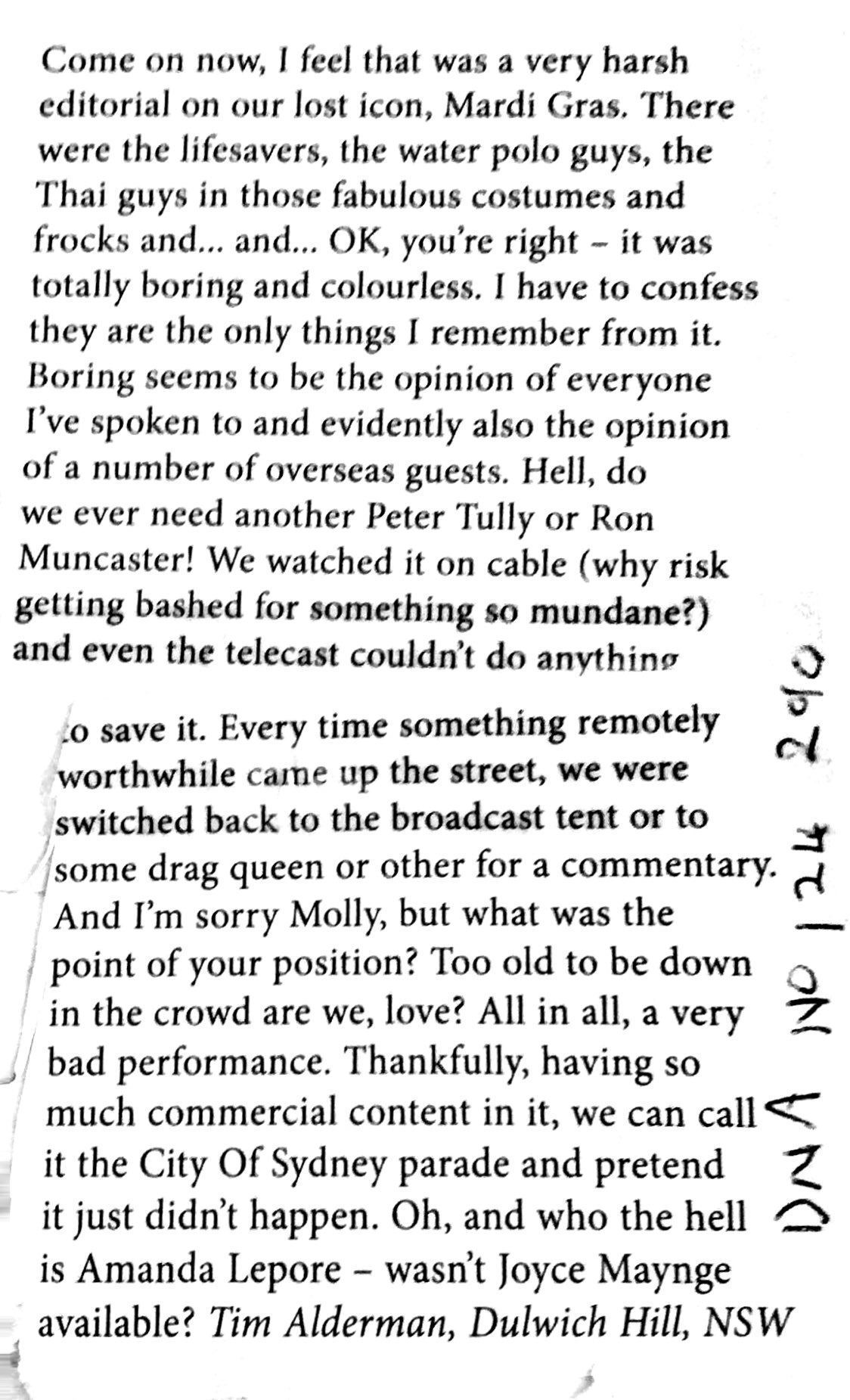
“DNA” Magazine No.124, 2010. A dig at a VERY boring Mardi Gras parade.
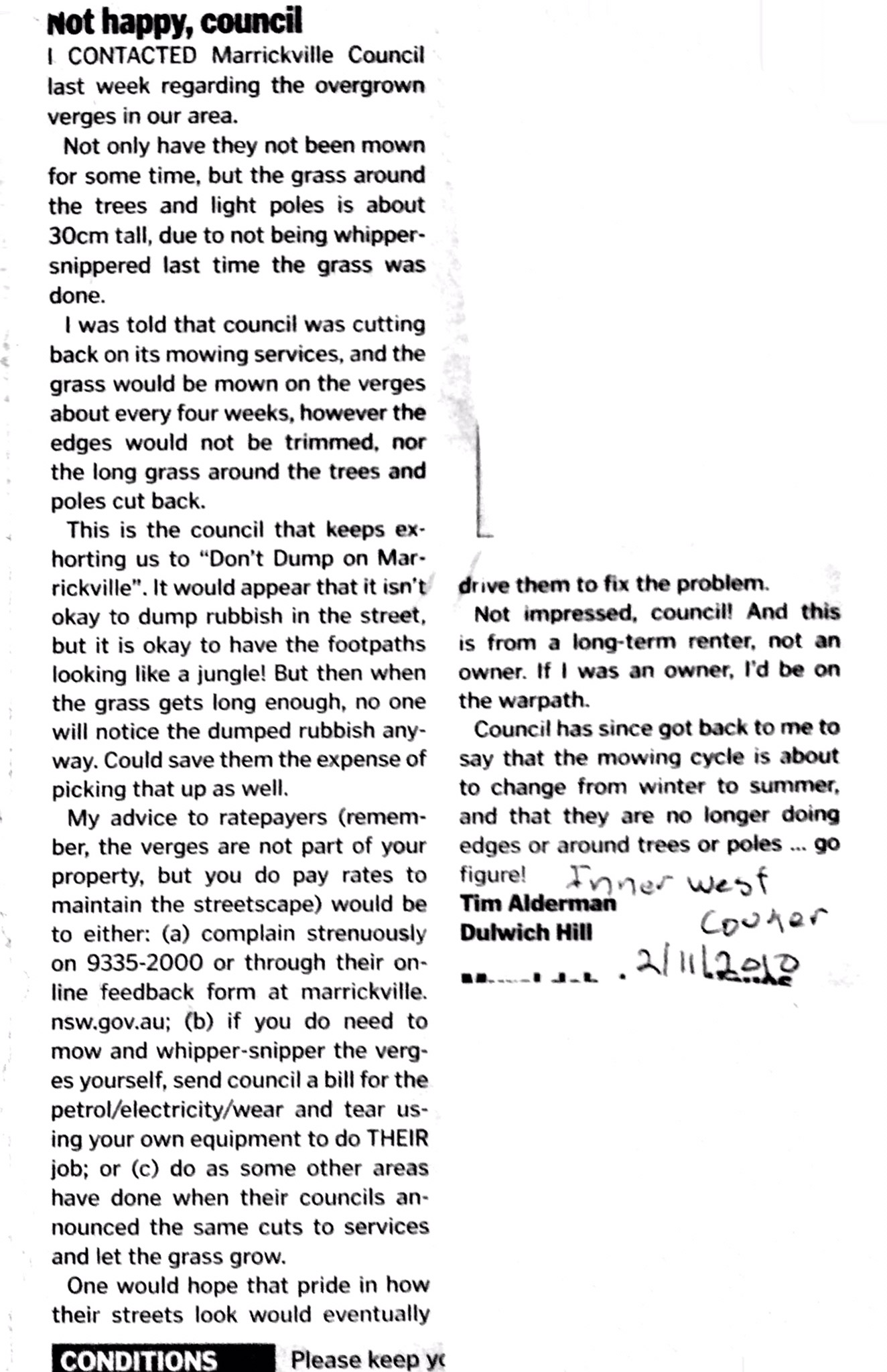
Inner West Courier, 2 November 2010. A whinge about cuts to mowing services that sre leaving yhe areas looking like jungles.
Sydney Star Observer, 23 March, 2011. A dig at a columnist who accused fit, healthy older guys of being posers. A note to the Sydney Mirning Heralds “Column 8” about something locally amusing.
1983. Gay Politics: Sydney’s Mysterious (and Dangerous) ‘Gay Army’Posted on July 21, 2014 by Colin Clews
Anyone who was around in the early 80s will remember the media’s hysterical response to AIDS and the ease with which it attributed it to gay men. It wasn’t labelled ‘the gay plague’ or ‘gay bug’ out of sympathy for us.
So it was unsurprising that, in these hostile times, gay community organisations were doing everything they could to put across a true picture of the emerging crisis. As attacks on gay men increased dramatically in light of perceptions that we had ’caused’ AIDS, an intelligent and cautious approach was the order of the day.
Or, alternatively, you could get yourself into the headlines and onto TV by claiming to be the leader of a non-existent gay organisation and making outrageous claims. Step forward Paul Dexter, self-proclaimed head of ‘the Gay Army’ in Sydney, an organisation that he claimed “represents the gay community more than others”.
Gay Army Gay ConspiracyIn May 1983 he appeared as ‘the gay community spokesperson’ on a Channel 9 report on AIDS. His credentials were never provided nor was it explained why his views were more important that an organisation like, say, the Gay Counselling Service. Indeed, no one even bothered to ask for evidence that an organisation with the ridiculous name of ‘The Gay Army’ even existed. Nonetheless, he was up there with leading AIDS doctors and commentators like Larry Kramer.
In June 1983 the Sydney Morning Herald – a newspaper that really should have known a lot better – quoted his claim that “left-wing elements” were responsible for the outcry against AIDS publicity. They didn’t even bother to explain just what that ridiculous statement actually meant.
And yet, in spite of the obvious absurdity of this man, his fictitious organisation and his groundless claims, the Herald turned to him again the following year. Under the headline Gay group slates AIDS statement, Dexter – now “official spokesman for the Gay Army” – declared that AIDS was far more infectious than health experts claimed. “The advertisement suggests that AIDS cannot be spread by sneezing, coughing, breathing or mosquitoes but according to Mr Dexter, medical experts can give no scientific assurance of this.”
Whilst Dexter was quick to challenge medical experts on their authority, he made no attempt to justify his own. And, yet again, no one asked him for any, nor evidence that his Gay Army actually existed.
But, yet again, this was to be a case of not letting the facts get in the way of a good story. Dexter, it seemed, was happy to say anything to stay in the spotlight and the media were more than happy to report it. Take, for example, another headline Call for homosexual to spot gay clients, in which the “spokesman for the Gay Army” argued that “A homosexual should be behind the counter of the Red Cross Bank to spot any gay blood donors…”
The entire article was farcical as Dexter claimed that he had seen a gay man give blood while he himself was in the Blood Bank (“Of course, I didn’t give blood…”). Dexter knew he was homosexual because “He had effeminate gestures, was wearing a bracelet and his key ring was in his right hand pocket – which is a sign of being gay.”
His statements would be hysterically funny is they didn’t have such serious consequences. After stating, “Of course, you wouldn’t be able to pick out every gay but a homosexual would have a far better chance”, he went on to reinforce the conspiracy theory that HIV+ gay men were deliberately infecting the blood supplies: “A homosexual behind the counter would also deter any resentful homosexuals from giving blood.”
It’s hard to say who is the most irresponsible here; Dexter for his blind self-promotion or the media for carrying stories about ‘conspiracies’ and health experts concealing the true facts when they didn’t even bother to do the most basic check on Dexter’s own credentials. When it comes down to it, they both share a huge amount of shame and blame.
In 1985, Channel 10 did a report titled “The Truth About AIDS in Australia” (https://youtu.be/UKiiY5JUUvU). The witch-hunt was now in full swing. Popular 2GB talj-back host Mike Carlton, joined others in suggesting that gays were deliberately donating contaminated blood out of spite! The 10 report investigated, and lent support to, accusations that gay men were deligerately spreading AIDS! The charge was made in an anonymous letter sent to a New South Wales parliamentary committee inquiring into prostitution. The author suggested that heterosexuals who had been infected vua blood transfusions were innocent victims of an “evil conspiracy” in which homosexual activists deliberately infected blood supplies, so that their calls for government funding to fund AIDS would be acred on. Furtgermore, gays were knowingly infecting other men in their community to “get even” with old boyfriends because “the gay community is notoriously bitchy” .
The letters author, a “King’s Cross Homosexual” was also angry that a “fringe group of radical homosexuals” – the NSW AIDS Action Committee led by Sydney academic Lex Watson – was claiming to speak on gehalf of the entire gay community. “They are establishing paper empires to get government funds and couldn’t care a stuff about their gay brothers and sisters” he wrote. While the Network 10 program acknowledged that it was impossible to prove these claims, it remarkably stated that it could ” prove that the AIDS blood plan was seriiysly considered” because homosexuals in America gad contemplated such an act of political terrorism, and the “intimate links across the Pacific ensured the American plan became pillow talk down under”. The report did not reveal how most American gay men regarded this terrorist actio, nor explain why Australian homosexuals would contemplate the plan when the Commonwealth and the State governments were already responding to AIDS with more urgency than politicians in the Unired States had shown during the first three years of the AIDS epidemic.
The claims made in the letter were extraordinarily similar submissions nade to the mainstream and gay press by Paul Dexter, self-proclaimed leader of the Gay Army, which, as far as other gay men were concerned, consisted only of himself! Those who knew of his antagonism towards the AIDS Action Committee, and those who had begun to view the program cynically, would not have been surprised to see Dexter soon introduced as a “spokeman for the gay community” to confirm that a fringe group of radical gays were indeed spreading AIDS. As an “unbiased” member of the gay community, he supposedly served the purpose of demonstrating that homophobia was not the basis for the program’s investigation into the “evil conspiracy”. To many Darlinghurst gay men in the audience, hiwever, his presence only confirmed their doubts about the authenticity of the letter.
It is interesting yo note that when a nan considered by Jenny Ross to be an inappropriate representative of the hemophilia community was interviewed by another television station, his comments were omitted from the program that went to air at the request of the Harmpholia Foundation. Despite the complaints of the AIDS Action Committee that Paul Dexter did not represent the general views of homosexual community, and that he was predisposed to making spiteful comments about some of its members, it was extended no such curtesy. Rather, Network Ten neglected to examine Dexter’s personal & political motives for accusing radical homosexuals of donating blood infused with HIV , just as the press had failed to challenge the factual basis of the doctor’s claims. Presumable, the print and electronic media would have been more thorough in their search and selection of their witnesses if they were to accuse National Party politicians or religious leaders into spiteful murder. Moreover, one can be certain that a public outcry would immediately follow if such accusations were made.
Paul Dexter was a small blip in the early days of HIV in Australia, but by setting himself as a self-appointed spokesman on the epidemic, and managing to gain as much exposure as he did, he created a lot of controversy, misinformation, and bias which in turn created its own problems. It is now difficult to even find any information on him…though like all bad history, he should not be forgotten!
First published in the Dolphin Motor Clubs newslatter “Quid Nunc” in 1990.
It would have been 1975. I can remember that I had just passed my 21st birthday and moved out of home to my first apartment in Allowah (thanks to a legacy from my grandmother, which allowed me to live surrounded by all life’s comforts). I hadn’t come out, but was on the brink of doing so. I had a female friend (I would love to know what has become of her – does anyone know Jo Conway?) who used to come over and play “the girlfriend” whenever my father was coming to visit. He was convinced that this was his future daughter-in-law, the girl from whose loins would spring the fruit that was to be forever stamped with the family name. Fortunately, he died before finding out that (a) she was a lesbian, (b) I was gay, and (c) I changed my name – lock, stock & barrel.
My lesbian friend was also the first to introduce me to Oxford St, which had its reputation even back then! We would catch the train from Allawah on Saturday nights and start out in Kings Cross, which back in those days still had its mixed bohemian atmosphere, unlike today. The evening would usually start at Chez Ivy in Bondi Junction, then to the Cross with the Barrel Inn, move onto the Bottom’s Up bar (strictly rough trade back in those days – not that I knew what that was…then!),Mother’s Cellar in Elizabeth Bay, then down to Jools, and up to Oxford St.
First port of call was usually Caps, followed in succession by Flo’s palace (not filled with the clientele it later became associated with), then onto the small, but popular coffee and jaffle haven in Bourke St called Nana’s (later to become Chu Bay Vietnamese restaurant).
My friend was a close friend of the proprietor, who was called Nana by everyone, and we had the privilege of being invited back to his terrace one night. Nana was the epitome of 1960’s camp – the bouffant hair, the wiggle walk, the limp wrist, the over-the-top clothes, the works. The terrace was the ultimate in Victoriana – restored and decorated so. It was like entering another time! I vividly remember sitting on the edge of an extremely dainty looking lounge, sipping Twinings tea out of giant amber Duralax cups, and nibbling on Iced Vovo’s (truly), all the time keeping a very nervous eye on Nana (who kept leering at me) and his flatmate, affectionately called Cupcake, who kept flouncing down the stairs in various flowing creations, loudly declaring that he one of Sydney’s premiere designers under the auspicious label of “Margot of Sydney”.
The final stop of our outings was Central station, at 6 o’clock in the morning for the first train back home.
Oxford St confused me in those days. I wouldn’t let Jo’s hand go all night. I thought I should have been looking at the girls, being straight for all intents and purposes, but couldn’t stop myself looking at all the men and fantasizing over how great it would be to get off with one. On my solo stints into the city, I felt too intimidated to come to Oxford St. I frequented The Zoo in William St, (I think I now know who it was that tried to pick me up there…Paul Costello!), and the Downunder Disco in the Hyatt Kingsgate, all filled to the hilt with Italian John Travolta look-alikes, who all had with them girls who looked like Maria Venutti. I always went home alone. I was almost tempted to go into the Zig Zag Disco in Darlo Rd, Kings Cross – which was reputedly gay – but nerves sent me fleeing at the last moment.
The Oxford Hotel
By 1979, I had settled for terminal, eternal celibacy! My one attempt at a straight relationship was a dismal failure. I nearly – which would have been a disaster – married her. She had a 6-year-old daughter who I thought the sun shone out of (and vice versa). She almost tipped the scales in her mothers favour. Sexually, the relationship was doomed! I could not envisage a life of making love to a woman, while orgasming to the fantasy of a man. The body shape was – to me – all wrong, anyway. And coming down from the fantasy was disillusioning. Celibacy seemed the only answer! My father also died at this time, so I had no need of pretense anymore. My company offered me a lucrative position in Melbourne – initially for 6-months, but ended up as 2 years.
In Melbourne, I came out – and not with a whimper!
Another time, another name!
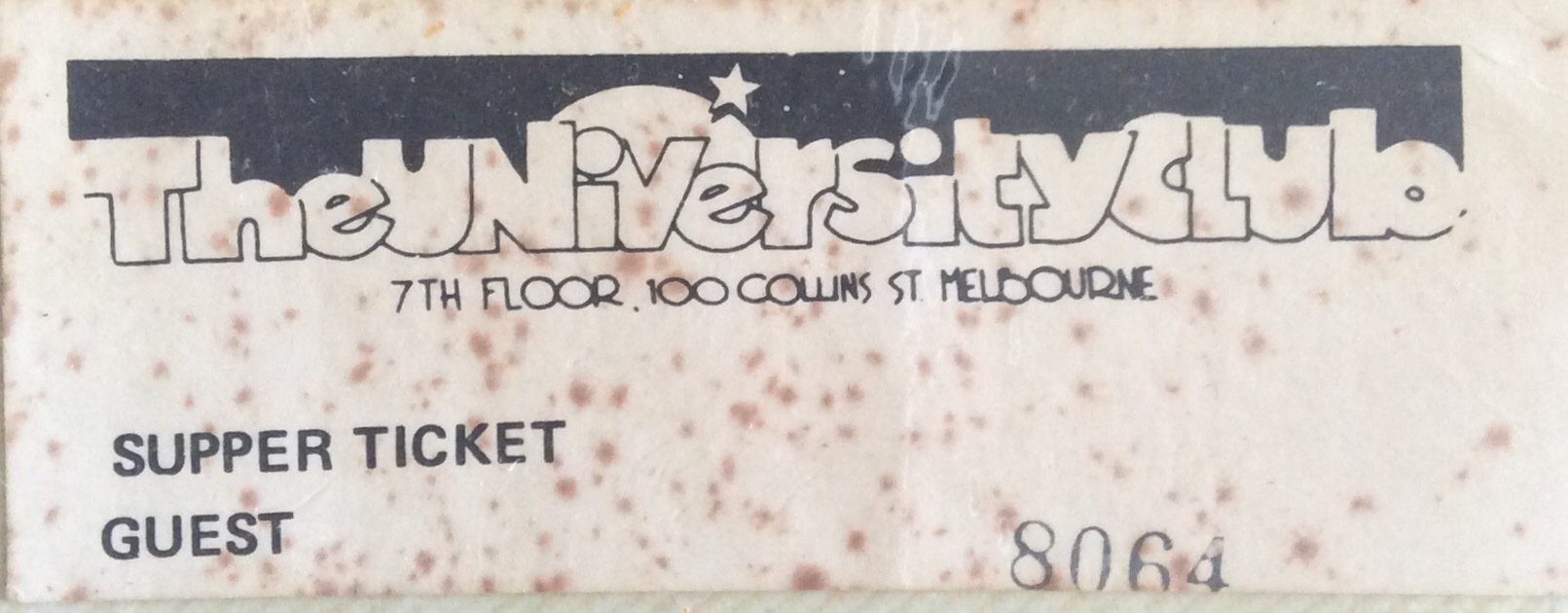
Melbourne was my chance for a new start. Nobody knew me, no family to watch me! I needed to make friends, so I joined a gay group. My very first meeting with the group, and I scored my first man. Being naive, I was an easy target for anyone. I hadn’t learnt to say no to a man at that stage, and he wasn’t exactly the most desirable of men, but what the hell – one had to start somewhere. I used him as much as he used me. He initially picked me up, after the meeting, at the old University Club, in Collins St. Shit – my first encounter with a gay group, my first solo venture to a gay venue, and my first man…all in one night!
He drove me to his place (with my dick out all the way), which was a good hours drive from Melbourne. The next morning, I had to get a train back. I wasn’t impressed! To this day, he doesn’t know he was my first. I’m a great actor!
I discovered The Laird. I discovered Mandate. I became a clone, and still am (albiet a 90s version). And bought my first leather harness, and vest, from The Beat. I fell in lust with Laurie Lane, the owner, but didn’t get to meet him until many years later. I still have a pin-up of him from a 1981 magazine. Between The Laird and Mandate, I started my tally sheet. I performed my one and only act of public sex – a blow job in the barred areas around Mandate’s dance floor. We danced to “Fade to Gray” at Smarties, drank beer at the Elizabeth Hotel, watched drag at Pokies. I discovered that trying to have a relationship with another bottom was a sure recipe for disaster. I was attracted to him, he loved me – but the beats more! My first broken heart, and one of the few times I have cried over a man! Getting drunk is a better cure! No man is worth the vile hangover the next day! I met a man from Sydney. I came back…but on my terms! This relationship was also a disaster. The fact that I had travelled 800-odd kilometres for it, made it worse. I met a friend of his, and we used to go to the 253 sauna to get off. My first intro to the baths. I disliked them, but it was convenient for both of us.
Bob – the Melbourne clone
Signal, the Barracks, and Club 80 were going strong, but not my scene. I saw the 4th Mardi Gras, and joined the parade for the 5th. I remember the first Sleaze Ball at the Paddington Town Hall, and Parties 1, 2 & 3. I drank at the Albury, Flinders, and Beresford, and danced at the Shift.
The Shift back then was clone and leather heaven! Split level dance floor, and lots of dark, wooden tables. Very barn-like, actually. The front bar was called “Charlie’s Bar”…and Charlie ruled it! The toilets were infamous, not to mention the goings-on around the dance floor. There was flesh everywhere – usually…okay, almost always, naked! People danced in Speedo’s and jockstraps, bandana and key codes meant something, and pick-ups were easy!
We often partied until 9am, falling out the door into full sunlight, then off to The Spirit Cafe in Crown St for breakfast. Home for a few hours sleep (maybe someone elses home, and not much sleep) then back out again.
We shopped at the Portuguese Deli (where Ian Roberts worked, and everyone wanted things from the top shelf just to get a rear view as he climbed the ladder); paid for over-priced groceries at Clancy’s; went clothes shopping at Daly Male (still going, though moved to a new spot), and Aussie Boys, Wheels & Doll Baby, Route 66; our leather and fetish gear from The Link, Jayar & Sax; books from The Bookshop; novelties from the Pop Shop; cakes from Pandora’s; flowers from Christopher’s Florist. We ate from the Bagel House; The Schnitzel Hut; Green Park Diner; Angkor Wat; Rockerfeller’s; Old Saigon; Billy Bunters; Betty’s Soup Kitchen; Loreto’s Larder; Raquel’s; The Californian (originally King’s coffee shop, named after the mother establishment, of the same name, in King St, Newtown); Olympic Yeeros (pizza slices on the way home from a big night out); Tin Hong (food poisoning central); La Boheme; Alfredo’s; The Balkan; Una’s (Victoria St); Oddy’s; the list was endless. We read the Sydney Star – then the Sydney Star Observer, Capital Q, SX, Campaign, Outrage, and the Village Voice; bought medical supplies from Serafim and Rely’s chemists (under-the-counter Ephedrine & Amyl); our newspaper, magazines & stationery from Pigott’s Newsagency, or the newsstand outside The Oxford; hired video’s from Video Capers, then Videorama; costume accoutrement from Dita’s Feathers; bibs & bobs from Mother Of Pearl & Sons: records from Central Station (originally in the vicinity of what became the Bagel House) and Red Eye. There was even 2 butchers and a green grocer…once upon a time! And not to forget a very brief appearance from Gowings.
The Oxford opened, and became to a whole clique for many years (until the trendy set made it too uncomfortable for us). The Flinders and Beresford sponsored street parties. Sleaze Ball became a major event (remember the one with all the wrecked cars on the dance floor?). Pete’s Beat (originally the Purple Onion) came and went (Wendy Wayne & Tiny Tina live on in memory), the Handle Bar came and went, as did The Man. The Link moved from Crown St north to Crown St south, and finally to Newtown. Jools, Signal, The Barracks, Club 80, Hip Hop, the Roman Baths, 253, The Spirit cafe, Caps, T.C’s (Crown St), the Beresford, French’s (not gay, but certainly memorable), all slowly closed and entered the realms of Gay nostalgia. Friends and lovers started to die, and it seemed that the scene was going with them. Life became abbreviated to the Oxford, the Shift, Mardi Gras & Sleaze Ball.
Tiny Tina, Wendy Wayne, Barry Costello – Mardi Gras ’86
My (our?) lives moved on also. I tested Positive for HIV, as did many others I knew. Some of us passed on (and still are), though thankfully many of us sre still hale & hearty. Eight years under a sentence is a long time! Still, most of oyr old haunts are gone, though we still have a good time – somewhat more quietly these days. Forgive us our reminiscences. We have a lot to remember, and I still claim we had the best of it! The eleven years since coming out, and now seems to have gone amazingly quickly. Lovers, friends, venues have all come and gone in the blink of an eye.
I am very hsppy now. My mother knows I’m gay, and reluctantly accepts it – evidently she always knew. My half-sister will carry on the family line, if nothing else. I chucked the rest of my family years ago. To sever those ties, I changed my name. I like the empowerment derived from beginning & ending a family line. I am in several groups, which fulfils my nerd to feel that I am doing something on the gay scene. I have made friends on the Lesbian scene, whichn takes me back to my gay roots. My social life is fulfilling enough. I am healthy, and will hopefully remain so. That is the only question mark in my life. I am in a relationship…again! Not the first since the Sydney/Melbourne episode, may I say, but certainly the most fulfilling I have ever had. I think the sun shines out of him, and he has added a dimension of happiness I don’t think he knows he has contributed. I see a lot of changes on the scene. I don’t necessarily like, or approve of, a lot of them, but I guess I’ll lesrn to live with them. It saddens me a bit to not have a venue for people in my age group who feel more comfortable with others from our generation. I won’t give up hope on this point yet.
The Beresford, Christmas ’85
I guess to some, this is just another odyssey of coming out. I see it as the encapsulation of 10 years of change on the gay scene, from someone who saw the scene as it was in the 70s, before coming out into the madness of the 80s.
As you can see, the adage of “the more things change, the more they stay the ssme” doesn’t always apply!
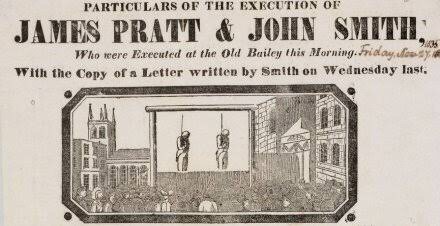
“1934. JOHN SMITH and JAMES PRATT were indicted for b—g—y at the parish of Christ Church, Surrey; and WILLIAM BONILL was indicted as an accessory before the fact.
SMITH— GUILTY.— DEATH . Aged 40.
PRATT— GUILTY.— DEATH . Aged 30.
BONILL— GUILTY . Aged 68.— Transported for Fourteen Years.
Third Jury, before Mr. Justice Williams..”
James Pratt (1805–1835)[1][2] also known as John Pratt, and John Smith (1795–1835)[1][2] were two London men who, in November 1835, became the last two to be executed for sodomy in England.[3] Pratt and Smith were arrested in August of that year after being convicted of having sex in the room of another man, William Bonill.
William Bonill, aged 68, had lived for 13 months in a rented room at a house near the Blackfriars Road, Southwark, London. His landlord later stated that Bonill had frequent male visitors, who generally came in pairs, and that his suspicions became aroused on the afternoon of 29 August 1835, when Pratt and Smith came to visit Bonill. The landlord climbed to an outside vantage point in the loft of a nearby stable building, where he could see through the window of Bonill’s room, before coming down to look into the room through the keyhole. Both the landlord and his wife later claimed they both looked through the keyhole and saw sexual intimacy between Pratt and Smith, so the landlord broke open the door to confront them. Bonill was absent, but returned a few minutes later with a jug of ale. The landlord went to fetch a policeman and all three men were arrested.[1]
Pratt, Smith and Bonill were tried on 21 September 1835 at the Central Criminal Court, before Baron Gurney,[4] a judge who had the reputation of being independent and acute, but also harsh.[5] Pratt and Smith were convicted under section 15 of the Offences against the Person Act 1828, which had replaced the 1533 Buggery Act, and were sentenced to death.[Note 1][Note 2] William Bonill was convicted as an accessory[6] and sentenced to 14 years of penal transportation.[4] James Pratt was a groom,[3] who lived with his wife and children at Deptford, London. A number of witnesses came forward to testify to his good character.[1] John Smith was from Southwark Christchurch[1] and was described in court proceedings[4] and newspaper reports as an unmarried labourer[2] although other sources state he was married and worked as a servant.[3] At the trial, no character witnesses came forward to testify on his behalf.[4]
The conviction of the three men rested entirely on what the landlord and his wife claimed to have witnessed through the keyhole; there was no other evidence against them. One modern commentator has cast doubt on their testimony, based on the narrow field of vision afforded by a keyhole and the range of acts the couple claimed to have witnessed during the brief length of time they were looking.[7]
The magistrate Hensleigh Wedgwood, who had committed the three men to trial,[8] subsequently wrote to the Home Secretary, Lord John Russel, arguing for the commutation of the death sentences, stating:
“It is the only crime where there is no injury done to any individual and in consequence it requires a very small expense to commit it in so private a manner and to take such precautions as shall render conviction impossible. It is also the only capital crime that is committed by rich men but owing to the circumstances I have mentioned they are never convicted.”
Wedgwood described the men as “degraded creatures” in another letter. Nevertheless, he argued that the law was unfair in their case as wealthy men who wished to have sex could easily afford a private space in which to do it with virtually no chance of discovery. Pratt and Smith were condemned only because they could only afford to use a room in a lodging house, in which they were easily spied upon.[9] On 5 November 1835, Charles Dickens and the newspaper editor John Black visited Newgate Prison; Dickens wrote an account of this in Sketches by Boz and described seeing Pratt and Smith while they were being held there:[10] “The other two men were at the upper end of the room. One of them, who was imperfectly seen in the dim light, had his back towards us, and was stooping over the fire, with his right arm on the mantel-piece, and his head sunk upon it. The other was leaning on the sill of the farthest window. The light fell full upon him, and communicated to his pale, haggard face, and disordered hair, an appearance which, at that distance, was ghastly. His cheek rested upon his hand; and, with his face a little raised, and his eyes wildly staring before him, he seemed to be unconsciously intent on counting the chinks in the opposite wall.”
— A Visit to Newgate
The jailer who was escorting Dickens confidently predicted to him that the two would be executed and was proven correct. Seventeen individuals were sentenced to death at the September and October sessions of the Central Criminal Court for offences that included burglary, robbery and attempted murder. On 21 November, all were granted remission of their death sentences under the Royal Prerogative of Mercy with the exceptions of Pratt and Smith.[11] This was despite an appeal for mercy submitted by the men’s wives that was heard by the Privy Council.[12]
Pratt and Smith were hanged in front of Newgate Prison on the morning of 27 November. The crowd of spectators was described in a newspaper report as larger than usual;[13] this was possibly because the hanging was the first to have taken place at Newgate in nearly two years.[14][Note 3] The event was sufficiently notable for a printed broadside to be published and sold. This described the men’s trial and included the purported text of a final letter that was claimed to have been written by John Smith to a friend.[15]
William Bonill was one of 290 prisoners transported to Australia on the ship Asia, which departed England on 5 November 1835 and arrived in Van Diemen’s Land (now Tasmania) on 21 February 1836.[16] Bonill died at the New Norfolk Hospital in Van Diemen’s Land on 29 April 1841.[17]
Newspaper Reports on the Execution
Monday 23 November 1835
On Saturday the Recorder made his report to his Majesty, at Brighton, of the undermentioned capital convicts under sentence of death in Newgate, convicted at the September and October sessions of the Central Criminal Court: – . . . Robert Swan, 28; for robbery. John Smith, 49, and James Pratt, 30, for an unnatural crime. . . . to all of whom his Majesty has extended his royal mercy, except John Smith and James Pratt, who are left for execution on Friday next. (London Standard)
Saturday 28 November 1835
RECORDER’S REPORT – On Friday the Recorder made his Report to his Majesty in Council at Brighton, of the prisoners who were capitally convicted at the September and October Sessions of the Central Criminal Court: – viz James Pratt and John Smith, for a nameless offence, committed in the borough of Southwark; Robert Swan, for extorting money from Thomas Reynolds, a Quaker, under a threat of accusing him of a nameless offence; R. Lavender, D. Ward, B. Vines, M. Collins, J. Coleman, and M. Harris, for burglary; . . . [and others] all of whom his Majesty was graciously pleased to respite, except James Pratt and John Smith, upon whom the law is left to take its course, and who were ordered for execution yesterday. The Council were in deliberation a considerable time on the case of Robert Swan, and did not break up until half-past eight o’clock in the evening. The Recorder came immediately to town by post, and made known the result of the Council to the Governor of Newgate, who lost no time in communicating it to the convicts whose cases had been reported. (Huntingdon, Bedford & Peterborough Gazette; virtually the same report appeared in the Derby Mercury for 25 Nov. 1835, the Manchester Courier for 29 Nov. 1835, and many others)
Charles Dickens, in his essay “A Visit to Newgate” published in Sketches by Boz in 1836, describes his visit to the press-room of the condemned ward of Newgate where he saw Pratt and Smith awaiting their execution, together with Joseph Swan who would eventually be transported rather than executed (for extortion involving the threat to swear sodomy against someone – see Newspaper Reports for 1835). All three men were kept separate from the other condemned men becasue of the sodomitical nature of their offences, and Swann also distanced himself from Pratt and Smith because he was a blackmailer of sodomites rather than a sodomite himself.
In the press-room below, were three men, the nature of whose offence rendered it necessary to separate them, even from their companions in guilt. It is a long, sombre room, with two windows sunk into the stone wall, and here the wretched men are pinioned on the morning of their execution, before moving towards the scaffold. The fate of one of these prisoners [Swan] was uncertain; some mitigatory circumstances having come to light since his trial, which had been humanely represented in the proper quarter. The other two [Pratt and Smith] had nothing to expect from the mercy of the crown; their doom was sealed; no plea could be urged in extenuation of their crime, and they well knew that for them there was no hope in this world. ‘The two short ones,’ the turnkey whispered, ‘were dead men.’
The man to whom we have alluded as entertaining some hopes of escape [i.e. Swan], was lounging, at the greatest distance he could place between himself and his companions, in the window nearest to the door. He was probably aware of our approach, and had assumed an air of courageous indifference; his face was purposely averted towards the window, and he stirred not an inch while we were present. The other two men were at the upper end of the room. One of them [probably Smith], who was imperfectly seen in the dim light, had his back towards us, and was stooping over the fire, with his right arm on the mantel-piece, and his head sunk upon it. The other [probably Pratt] was leaning on the sill of the farthest window. The light fell full upon him, and communicated to his pale, haggard face, and disordered hair, an appearance which, at that distance, was ghastly. His cheek rested upon his hand; and, with his face a little raised, and his eyes wildly staring before him, he seemed to be unconsciously intent on counting the chinks in the opposite wall. We passed this room again afterwards. The first man [i.e. Swan] was pacing up and down the court with a firm military step – he had been a soldier in the foot-guards – and a cloth cap jauntily thrown on one side of his head. He bowed respectfully to our conductor, and the salute was returned. The other two still remained in the positions we have described, and were as motionless as statues.
Saturday 28 November 1835
EXECUTION.
Yesterday morning, at the usual hour, the sentence of the law was carried into effect upon James Pratt, aged 32, and John Smith, aged 34, who were convicted at the September Sessions of the Central Criminal Court of a capital offence. The Sheriffs arrived at Newgate about half-past seven o’clock, and immediately proceeded to visit the prisoners, whom they found engaged in prayer with the Rev. Mr. Cotton, the chaplain of the gaol, and Mr. Baker. Both the culprits appeared in a very weak state, and when eight o’clock arrived, the hour of execution, it was found necessary almost to carry them from their cell to the press room. Pratt, especially, appeared dreadfull weak and dejected. While Smith was being pinioned, Pratt appeared to suffer dreadfully. His groans resounded through the prison, and while he was pinioning he repeatedly exclaimed, “Oh God, this is horrible, this is indeed horrible.” He at this time was so weak that the executioner’s assistants found it necessary to hold him in their arms to prevent him from falling to the ground. All the preparations having been completed the melancholy procession proceeded to the scaffold, and in the room leading from the debtors’ door, as it is called, the ceremony of delivering up the prisoners to the Sheriffs of Middlesex was performed by Mr. Cope, the Governor of Newgate. Smith was the first who ascended the scaffold, and immediately afterwards Pratt was also assisted up the seps and placed under a beam. The moment the culprits were perceived they were received with groans and hisses, which lasted during the whole of the time the hangman was making the necessary preparations. These having been performed the bolt was drawn, and after a very short struggle the culprits ceased to exist. Pratt was a married man, the other culprit was single. (Morning Post)
Sunday 29 November 1835
EXECUTION. – On Friday morning, at the usual hour, the sentence of the law was carried into effect upon James Pratt, aged thirty-two, and John Smith, aged thirty-four, who were convicted at the September session of the Central Criminal Cour, of an unnatural offence. There were very few persons present at the execution. Both the wretched men to the last moment denied their guilt; they were convicted on the testimony of their landlady. The soldier, Swan, has been respited. (The Examiner)
Monday 30 November 1835
LONDON,
MONDAY, NOVEMBER 23.
Brighton, Sunday. – On Friday, his Majesty held a Privy Council, at which the Recorder attended, when two miserable convicts, John Smith and James Pratt, was ordered for execution on Friday next. In the evening, the Ministers and a large party dined with their Majesties. – This morning, their Majesties attended Divine Service in the Palace chapel. In the afternoon, the Queen attended at St. George’s chapel. (Salisbury and Winchester Journal)
Monday 30 November 1835
LONDON,
SATURDAY, NOVEMBER 28.
The two wretched culprits, James Pratt and John Smith, suffered the last penalty of the law yesterday morning in front of Newgate. (Salisbury and Winchester Journal)
Wednesday 2 December 1835
LONDON, SATURDAY, NOVEMBER 28.
EXECUTION. – Yesterday morning, at the usual hour, the sentence of the law was carried into effect upon James Pratt, aged 32, and John Smith, aged 34, who were convicted at the September sessions of the Central Criminal Court, of an unnatural offence. Thursday night Pratt was visited by a respectable Dissenting Minister. The Rev. gentleman exhorted him to repentance, and he confessed his guilt. The Sheriffs arrived at Newgate about half-past seven o’clock yesterday morning, and immiedately proceeded to visit the prisoners, whom they found engaged in prayer. While Smith was being pinioned, Pratt appeared to suffer horribly. His groans resounded through the prison, and while he was being pinioned he repeatedly exclaimed “Oh, God, this is horrible; this is indeed horrible!” He at this time was so weak that the executioner’s assistants found it necessary to hold him in their arms, to prevent him from falling to the ground. All the preparations having been completed, the melancholy procession proceeded towards the scaffold, which was first ascended by Smith with a firm step, but his companion needed support to the last moment. The executioner with amazing celerity adjusted the ropes, and cause the plank to fall which closed the world upon them. The crowd was excessive, but exceedingly decorous. (Hereford Journal)
The following is an account of the case, with personal observations, by Father Frank Ryan & Peter Tatchell, who were convinced that the men were innocent!
Father Frank Ryan casts new doubt on the 1835 convictions
The wrongful conviction & execution of James Pratt & John Smith for ‘buggery’ in 1835
By Father Frank Ryan
The last Saturday of August 1835 was a beautiful hot day. James Pratt (30) left his wife and two young daughters in Deptford, searching for work – promising to return by 6pm. He was a labourer and needed a better job.
Pratt first visited his aunt in Holborn, before heading to Blackfriars. His aunt thought he’d had too much to drink and needed a rest, but he pressed on. In an ale house he met John Smith, a labourer aged 40, and William Bonill (sometimes spelled Bonell), aged 68. Neither could offer him a job to improve his financial situation but their company was hospitable. Bonill invited Pratt and Smith back to his rented flat and they accepted.
Little did they know as they made their way to his premises in nearby George Street, that this encounter would result in their execution – and that Bonill would be banished to the penal colony of Australia – all within a mere three months.
The landlords of 45 George Street, Southwark, Jane and George (also known as John) Berkshire, were determined to curtail the activities of their tenant, William Bonill, who they regarded as an “old villain.” He had been bringing male “couples” back to his flat on a regular basis; sometimes two a day. George was determined to put a stop to this practice and get rid of what he regarded as a disagreeable and troublesome lodger.
Shortly after the three men arrived, the suspicious, antagonistic George spied into Bonill’s room through a nearby window. A little later, over tea, he told his wife that he saw Pratt sitting on Bonill’s knees and then on Smith’s. There was much laughing and conversation, he said. Jane slipped upstairs and peeped through Bonhill’s keyhole. After a brief look, she returned to tell her husband that she had witnessed sexual acts. He became enraged, went upstairs and also looked through the keyhole. He then burst into the room to confront Pratt and Smith, who were in a compromising position, according to George Berkshire.
At this point, Bonill, who had gone out for a drink, returned and entered the room. An effort to calm down Berkshire was unsuccessful. George went off to seek the police.
Pratt, Smith and Bonill were soon arrested and taken into custody. Pratt and Smith were charged with ‘buggery’ (anal sex) and Bonill as an accessory. They went on trial for their lives before Judge Baron Gurney at the Old Bailey on 21 September 1835.
The arresting police officer had no material evidence to support the charge. The account that Jane Berkshire told the jury is improbable. She said she watched for less minute but claimed to have witnessed the alleged sex acts, from the men undressing to laying on the floor and the “appearance” of anal penetration. She said she saw the men’s private parts but did not answer when asked whether either man had an erection. It seems doubtful that the keyhole could have provided the range of vision needed to see what she claimed.
The testimony of George was very similar to Jane’s. It had a whiff of coordination. His evidence supported the charge that buggery had taken place. However, he failed to testify if the men had an erection or if he had seen actual penetration; though he claimed to have sighted their genitals and their bodies in motion.
The anatomical description of intimacy described by George Berkshire would have been very difficult to witness. As in the case with Jane’s testimony, the keyhole probably could not have provided a sufficient angle of sight to provide the evidence he imparted to the jury.
Neither James Pratt nor John Smith were allowed to give evidence at their trial. Both pleaded “not guilty” to the charge. Nevertheless, the jury returned a guilty verdict.
The law against ‘buggery’ (not repealed until 2003) was based on an interpretation of the Bible that regarded homosexual acts as an abomination and worthy of death; a particularly evil sin that must be severely punished and eradicated. It was a capital crime.
The judge had no hesitation in sentencing James Pratt and John Smith to death. He warned them their chances on appeal were hopeless and they could expect no reprieve. They had to prepare, he said, to receive God’s judgement upon departing this life. Both men left the dock in tears.
William Bonill was sentenced to 14 years transportation to Australia. He died in Tasmania in 1841.
As well as Pratt and Smith, there were many death sentences for different crimes handed down during the autumn 1835. The process of petitioning for clemency and commutation began.
While being held in Newgate Prison, Pratt and Smith were visited by Charles Dickens who wrote they “had nothing to expect from the mercy of the crown, their doom was sealed.” The turnkey whispered to Dickens that they were “dead men.”
John Smith, it seems, had no friends. But the friends of James Pratt commenced a vigorous campaign to save him. They gathered a substantial petition which included the trial prosecutor, former employers, neighbours and even George and Jane Berkshire, their accusers.
All the documents were prepared for a Privy Council meeting with the King, William IV, to be held in Brighton.
On 24 November, 12 men sentenced to death were reprieved by the King’s mercy. Pratt and Smith were not among them. Judge Baron Gurney’s warning had prevailed. In their case, the law was to be allowed to take its course.
News of the pending execution spread around London, confirmed by the erection of the scaffold outside Newgate Prison.
On Friday 27 November, the two prisoners were taken from their cells and brought to the place of execution, still protesting their innocence. Pratt was weak and had to be helped up the scaffold. The crowd began to hiss, possibly in disagreement with the execution. These were probably the last sounds the men heard. The hangman pulled the bolt and after a short struggle on the rope Pratt and Smith were dead.
They are buried in a common grave, with others executed at Newgate, in the City Cemetery, Manor Park, London E12.
In 2014, I petitioned the Secretary of State for Justice, Chris Grayling MP, to grant a posthumous pardon to James Pratt and John Smith on the grounds that even by the standards of those days their convictions were unsafe. Further, the ‘buggery’ law itself was unjust. Consenting adult homosexuality should have not been a crime.
In reply, the Justice Ministry regretted the men’s execution, acknowledging that it should never have happened, but said the conditions for granting a pardon had not been met. However, since the pardoning of Alan Turing for same-sex relations has established a legal precedent, hopefully the Justice Minister will, with further pressure, re-examine the case and grant a long overdue pardon to Pratt and Smith.
• The full story of Pratt and Smith is retold in the book, The law to take its course – Redeeming the past, securing our future. It is available as a self-printed manuscript from the author, Father Frank Ryan, for the cost of printing (about £14): fmryan33@hotmail.com
• The book and this article are based on Ryan’s original research at the National Archives, British Library and London Metropolitan Archives, plus newspapers reports.
• This article was written by Frank Ryan, with the assistance of Peter Tatchell.
And what of William Bonill?
Convicted on the 25 September, 1835 to 14 years transportation at the Old Bailey, in London. He was shipped onboard the convict shop “Asia” on the 5 November 1835, to Tasmania (Van Diemen’s Land).
He arrived in Tasmania on the 21 February 1836. He died on the 29 April 1841.
We have an entry from the Daily Sick Book, onboard the Asia “William Bonill, aged 71, Convict; disease or hurt, febris ephemera. Put on sick list, 9 November 1835. Discharged, 14 November 1835. Folio 2: ”
There does not appear to be any other records for him.
Notes
In the period from 1810 to 1835, 46 people convicted of sodomy were hanged and 32 sentenced to death but reprieved. A further 716 were imprisoned or sentenced to the pillory, before its use was restricted in 1816 (See: Lauterbach and Alber (2009), p.49).
The sentence of death was mandatory, but under the Judgement of Death Act 1823, Gurney would have had the power to commute it to imprisonment.
^Pratt and Smith were the only people to be executed at Newgate in the three year period 1834–1836; this partial, temporary moratorium may have been for political reasons and because of a change in the law. Prior to 1834, individuals had been executed for any of 20 different offences; after 1836, only convicted murderers were hanged outside Newgate, until the ending of public execution in 1868. See A history of London’s Newgate Prison
References 1
Old Bailey Proceedings Online (www.oldbaileyonline.org, version 7.0, 08 March 2013), September 1835 (t18350921)
“Execution”. The Morning Post (20273). London. November 28, 1835.
Cook et al (2007), p.109
Old Bailey Proceedings Online (www.oldbaileyonline.org, version 7.0, 26 December 2012), September 1835, trial of JOHN SMITH JAMES PRATT WILLIAM BONILL (t18350921-1934).
Hamilton, J.A. (2004). “Oxford DNB article: Gurney, Sir John (subscription needed)”. Oxford University Press. Retrieved 7 January 2010.
“Central Criminal Court, Saturday, Sept. 26.”. The Times (15906). London. September 28, 1835. p. 4.
Ryan, Frank (24 March 2015). “Pratt & Smith – Last UK men hanged for sodomy”. Peter Thatchell Foundation. Retrieved 1 December 2015.
Cocks (2010) p.38
Upchurch (2009), p.112.
Lauterbach and Alber (2009), p.49
“Multiple News Items”. The Standard (2664). London. November 23, 1835.
Cook et al (2007), p.110
“Execution”. The Times (15959). London. November 28, 1835. p. 3.
Anonymous, “The Particulars of the Execution of James Pratt & John Smith” (1835), London printed by T. Birt. OCLC 83814830, Harvard Law School Library, Historical and Special Collection
“Asia voyage to Van Diemen’s Land, Australia in 1835 with 290 passengers”. Convict Records of Australia. Retrieved 7 March 2014.
William Bonill”. Convict Records of Australia. Retrieved 14 October 2013.
Bibliography
Cocks, Dr Harry (2010). Nameless Offences, Homosexual Desire in the 19th Century. I.B.Taurus & Co. ISBN 9781848850903.
Cook, Matt; Mills, Robert; Trumback, Randolph; Cocks, Harry (2007). A Gay History of Britain: Love and Sex Between Men Since the Middle Ages. Greenwood World Publishing. ISBN 1846450020.
Lauterbach, Frank; Alber, Jan (2009). Stones of Law, Bricks of Shame: Narrating Imprisonment in the Victorian Age. University of Toronto Press. ISBN 0802098975.
Upchurch, Charles (2009). Before Wilde: Sex between Men in Britain’s Age of Reform. University of California Press. ISBN 0520258533.
Rictor Norton (Ed.), “The Last Men Executed for Sodomy in England, 1835”, Homosexuality in Nineteenth-Century England: A Sourcebook, 12 September 2014 http://rictornorton.co.uk/eighteen/1835last.htm
On 24 November 2014, the Criminal Records Act 1991 (the ‘Act’) was amended to allow historical homosexual offences to be extinguished.
Homosexuality was decriminalised in NSW in 1984, but prior to this time consensual sex between gay men was a criminal act. People with convictions for these historical offences have dealt with the stigma of a criminal conviction for a ‘sex’ offence which can affect employment opportunities, volunteering and travel. These amendments will allow a person with an eligible historical homosexual conviction to apply to the Secretary of the Department of Justice to have the conviction extinguished.
Under the changes made to the Act, the Secretary has the authority to decide that an eligible conviction should be extinguished but only if if he or she is satisfied that the other person involved in the sexual activity consented to the sexual activity and was above the age of consent. The Secretary has powers under the Act to require certain persons or bodies to provide information for the purposes of making a decision under the Act.
Applications may be made to the Department of Justice to have the following offences extinguished:
Buggery (s79 Crimes Act 1900)
Attempted Buggery (s80 Crimes Act 1900)
Indecent Assault on a male (s81 Crimes Act 1900)
Act of Indecency with another male person (or procuring) (s81A Crimes Act 1900)
Soliciting or inciting offences under ss79, 81 or 81A of the Crimes Act 1900 (s81B Crimes Act 1900)
Homosexual intercourse with a male over the relevant age (s 78K Crimes Act 1900)
Attempt or assault with intent to have homosexual intercourse with a male over the relevant age (s 78L Crimes Act 1900)
Acts of gross indecency with a male person under 18 (or procures) (s78Q Crimes Act 1900)- but only if the other person was over the relevant age
Indecent behaviour (s12 Police Offences Act 1901) or behaving in an indecent or offensive manner (s7 Summary Offences Act 1970) if the offence involved:
Sexual activity with another person of the same sex, or
Procuring another person of the same sex to engage in sexual activity.
Exposure or an indecent act committed by an adult (s43(b) Crimes Act 1900), indecent exposure (s11 Summary Offences Act 1970; s78 Police Offences Act 1901) or wilful and obscene exposure (s6 Offences in Public Places Act 1979; s12 Summary Offences Act 1970; s4(2)(d) Vagrancy Act 1902) if the offence involved:
The offender engaged in a form of sexual activity with a person of the same sex, and
The offence was not witnessed by anyone except the other person engaged in the sexual activity or a police officer, and
It was the offender’s first conviction for the offence.
The Earl of Warwick stands over the decapitated body of Piers Gaveston. From the 15th-century ‘Rous Rolls’.
Piers Gaveston Executed
By Richard Cavendish
Published in History Today Volume 62 Issue 6 June 2012
Richard Cavendish remembers the royal favourite who died on June 19th, 1312.
The Earl of Warwick stands over the decapitated body of Piers Gaveston. From the 15th-century ‘Rous Rolls’.
The Earl of Warwick stands over the decapitated body of Piers Gaveston. From the 15th-century ‘Rous Rolls’.
Soaring up from a comparatively humble background, King Edward II’s favourite flew too high and paid the penalty. Piers Gaveston was born around 1284, the son of a Gascon lord, who gave many years of loyal service to Edward I. In his early teens Piers became a member of the royal household. In 1300 he was moved to that of the Prince of Wales, the future Edward II. They were both about 16, took to each other and an extremely close friendship developed. There were many at the time who thought it was a homosexual relationship, but some modern historians see it as more like close brotherly love. The two may have been sworn blood-brothers and Edward referred to Gaveston as ‘my brother Piers’. Edward would have four children by his French queen, Isabella, but he could have been bisexual.
Whatever the exact nature of the relationship, it spelled trouble. In 1307 Edward I banished Gaveston from England, though he was to be paid an allowance while awaiting recall, but the king died soon afterwards and the new king immediately brought Gaveston back to his side, made him Earl of Cornwall and bestowed on him an extremely well-connected aristocratic wife and substantial quantities of land and money. Edward II was not remotely the man his father was and he had serious trouble with some of his father’s most powerful barons, who bitterly resented being sidelined by a man they considered an arrogant, greedy upstart.
In 1308 Edward allowed Gaveston a provocatively prominent role in his coronation and the ensuing banquet, at which he paid so much attention to the favourite that Queen Isabella’s French relatives walked out. The king was forced to send Gaveston away to Ireland later that year, but he was back in 1309 and resumed his dominant position at court as Edward’s principal adviser and controller of royal patronage. He behaved as arrogantly as ever and allegedly bestowed disparaging nicknames on leading figures in the realm. Guy de Beauchamp, Earl of Warwick was ‘the Black Dog of Arden’, Aymer de Valence, Earl of Pembroke was ‘Joseph the Jew’ and the generally much-respected Earl of Lincoln was ‘Burst Belly’. By March 1310 opposition had mounted to such a point that the king had to agree to the appointment of the Lords Ordainers, a committee of 21 earls, barons and bishops who were to draw up rules for the management of the royal household and the realm. Meanwhile the king led a military campaign in Scotland that failed to subdue Robert the Bruce.
In August 1311 the Ordainers produced their new rules and demanded that Gaveston be sent into exile and never allowed to return. The horrified Edward offered to agree to the changes if Gaveston was allowed to stay, but the Ordainers would have none of it and in November the favourite left the country. He was back in England again by the following January, however, and Edward announced that Gaveston’s exile had been unlawful, restoring all his confiscated possessions.
The country was now threatened with civil war as the barons gathered their private armies. The Earl of Lancaster (who was Edward I’s nephew) almost caught the king and Gaveston in Newcastle, but they just managed to escape and fled by sea to Scarborough, where Edward left Gaveston and went to York. Gaveston was besieged in Scarborough Castle by the earls of Pembroke and Warwick. In May Gaveston surrendered to Pembroke on condition that, if no agreement could be reached with the king by August 1st, he would be sent back to Scarborough Castle, which was not to be reinforced in the meantime. Pembroke took Gaveston to a town called Deddington, south of Banbury, and left him there for the moment. On the following day, to the dismay of Pembroke, who had guaranteed Gaveston’s safety, the favourite was seized by the Earl of Warwick and taken to Warwick, where he was paraded past a jeering crowd and put in a dungeon in the castle.
Lancaster and Warwick decided that Gaveston must die. After some pretence of a trial, apparently, he was taken to Blacklow Hill, not far from Warwick, on land that belonged to Lancaster, and run through with a sword before his head was cut off. He would have been about 28 years old.
Gaveston’s body was left lying there to rot, but was later rescued, embalmed and eventually buried in the Dominican friary at King’s Langley in Hertfordshire. In 1823 a monument was erected on Blacklow Hill by the local squire on the spot where Gaveston was thought to have been executed. The disapproving inscription describes him as ‘the Minion of a hateful King’ beheaded ‘by Barons as lawless as himself.’
“Edward II and Piers Gaveston” – detail of an engraving from a painting by Marcus Stone (1840-1921). Edward and Piers are on the left, Queen Isabella and the disapproving courtiers watch on.