All posts by timalderman

Unknown's avatar

About timalderman

Gay, visually-impaired guy writing professionally (and freelance) about disabilities, being gay, articles, opinion pieces, poems and short stories for over 15 years, mainly for small, local magazines. Obtained my Graduate Certificate in Writing from the University of Technology, Sydney in 2004.

Gay History: The Real ‘Gentleman Jack’: The Secret Life Of Anne Lister, Britain’s ‘First Modern lesbian’

Ellie Cawthorne talks to Angela Steidele about the 19th-century gay pioneer Anne Lister | Complements the eight-part BBC One drama Gentleman Jack

At 2am one night in the 1890s, amateur code-breakers John Lister and Arthur Burrell were hard at work. The pair had been up for hours poring over mysterious documents John had inherited, among swathes of ageing ledgers and paperwork, when he had become master of Shibden Hall near Halifax. Entitled the ‘Diaries and Journals of Mrs Lister’, the 24 volumes documented the business affairs, social life and travels of one of Shibden Hall’s previous owners, Anne Lister (1791–1840), who had inherited the house in 1826.

While John, a distant relation of Anne, found the diaries diverting enough, what really intrigued him were large sections tantalisingly concealed in code. He enlisted the help of Burrell, an antiquarian, and the pair set to work deciphering Anne’s code of numerical figures, Greek letters and invented symbols.

Once they had cracked it, however, “the part written in cipher turned out to be entirely unpublishable…” What had been revealed was, in the words of Arthur Burrell, “an intimate account of homosexual practices among Miss Lister and her many ‘friends’; hardly any one of them escaped her”. Burrell was so appalled by the “unsavoury” discovery that he advised his friend to burn the diaries immediately.

Thankfully, John resisted the urge to fling the volumes directly onto the fire. Instead, he sealed them into a small chamber in Shibden Hall, keen to prevent anyone uncovering such salacious family secrets. Concealed behind wood panelling, they would go undiscovered until after his death in 1933.

Sexual adventures

Although Lister and Burrell may not have appreciated it at the time, the diaries they had decoded that night would go on to become a seminal source of British LGBTQ history – one that would force historians to reassess lesbian relationships in the early 19th century.

Running to more than 4 million words, Anne Lister’s journals are densely packed with the minutiae of her everyday life. Yet buried between exhaustive entries on the political situation in Prussia, canal tolls and toenail cutting are extraordinary accounts of her romantic and sexual adventures with women.

Lister embarked on her career as a master of seduction while still at school, starting up a relationship with her friend and roommate Eliza Raine, who she later reflected was “the most beautiful girl I ever saw”. Sexual encounters with various female acquaintances followed. As Anne boasted in 1816: “The girls liked me and had always liked me. I had never been refused by anyone.” According to Angela Steidele, author of a new biography of Lister, “it was easy for Anne to find lovers because she was a very attractive character: charming, flattering, witty and well educated. She was the heart of every party and could talk you in or out of anything.”

The greatest passion documented in Anne’s diary comes from her relationship with Mariana Belcombe, the “mistress of [her] thoughts and hopes”. For almost 20 years, the pair were involved in an on-off love affair which continued even after Mariana married – an institution that Anne bitterly compared to legitimised prostitution. The relationship eventually broke down after Mariana became increasingly anxious about its true nature being uncovered, leaving Anne with a heart “almost agonised to bursting”.

Despite this crushing rejection, Anne maintained that she had as much right to love and companionship as anyone, and was not afraid to pursue it actively. “There is one thing that I wish for… one thing without which my happiness in this world seems impossible,” she wrote in 1832. “I was not born to live alone… in loving and being loved, I could be happy.”

When she was in her early 40s, Anne began what would be her last – and arguably most significant – relationship, with Ann Walker, from a wealthy neighbouring family. Although she did not inspire the same passion as Mariana once had, Ann did meet many of the criteria of what Lister looked for in a partner: she was younger, pliable, obedient and well-off. “I shall think myself into being in love with her – I am already persuaded I like her well enough for comfort,” the cash-strapped Lister concluded in 1832. “Perhaps after all, she will make me happier than any of my former flames – at all rates we shall have money enough.”

Despite this somewhat lacklustre start, the pair embarked on a relationship. Walker moved in to Shibden Hall and, in 1834, the two women exchanged rings in York’s Holy Trinity Church. They took the Communion together, which they thought to be equivalent to marriage (180 years before same-sex marriages were legalised in England), though their union was not blessed by a priest.

Anne’s conquests were multiple, but “what is clear from reading her diaries is that the biggest love of Anne’s life was Anne herself”, says Steidele. “In fact, you could read these volumes as one long love letter to herself. She truly got lost in her diary, and was writing purely for her own satisfaction.”

And satisfaction really is the right word for it. Lister’s diary is extraordinarily candid in detailing her sexual encounters, going far beyond noting who she had seduced and when. Rather, her code conceals intimate descriptions of specific sexual acts and even keeps a tally of her number of orgasms. Assessments of each encounter are frank to the point of brusqueness – while one lover is praised for “know[ing] how to heighten the pleasure of our intercourse”, another is condemned as “dry as a stick”.

Physical acts

Such explicit details don’t just make the diaries compelling reading, says Steidele, it also gives them huge historical significance. “In earlier research on sexuality in the late 19th and 20th century, there was a legend that women never desired other women physically. The term that was often used was ‘romantic friendship’, implying that while some women enjoyed very close relationships, they never engaged in any physical acts.” Lister’s diaries however, act as the ‘missing link’ in British LGBTQ studies. By speaking directly of sex between women, they reveal the idea of ‘romantic friendship’ to be a false concept. This has led her writings to be hailed as the “Rosetta stone of lesbian history”.

“There have been homosexual acts throughout history, but what makes Lister different is her awareness of her own difference,” says Steidele. “Historians tend to say an awareness of homosexuality as an identity first emerged in the late 19th century, but Lister’s journals are an earlier proof of this development. That’s why she can be seen as Britain’s ‘first modern lesbian’.”

One lover is praised by Anne for “knowing how to heighten the pleasure of our intercourse”

It wasn’t only in her choice of lovers that Anne challenged the conventions of her time, but in her expression of gender too. She rejected the usual path laid out for women of her background, and was unafraid to send out strong signals of her difference. At a time when clothing was an important marker of identity, Lister chose to dress solely in black, adopting a self-consciously masculine appearance. This unconventional attire did not go unnoticed. She was referred to locally as ‘Gentleman Jack’, and wrote in 1818 that, “people generally remark as I pass along, how much I am like a man”.

Lister’s rejection of gender norms went far beyond clothing. As well as being a landowner at a time when few women owned property, she took a keen interest in business, taking on several ambitious, if not entirely profitable, entrepreneurial ventures. She established two coal mines (naming one the ‘Walker pit’ after her lover), ran a stone quarry and even launched a hotel in Halifax.

Her wealth and status as a gentlewoman undoubtedly offered Lister a degree of freedom unavailable to many women at the time. However, it did not render her completely immune against criticism of her unconventional lifestyle choices. She was mocked with anonymous letters, while a fake wedding announcement in the local paper congratulated Ann Walker on her marriage to a “Captain Tom Lister of Shibden Hall”.

Away from Shibden Hall, Anne embarked on numerous foreign adventures, hiking the Pyrenees and travelling as far as Azerbaijan. In fact, it was during one of these adventures that she died, succumbing to a fever at Kutaisi, Georgia in September 1840, aged 49. Ann Walker, who was travelling with Lister at the time, had her lover’s body embalmed and brought back to England. She was buried in Halifax, West Yorkshire.

Sparking controversy

A century later, following the death of Anne’s relative John, Shibden Hall fell to the Halifax Corporation, and Anne’s diaries were rescued from their hiding place. However, their contents were deemed far too scandalous for public consumption, and it would be several more decades until they were shared beyond a small group of archivists and librarians – a first edition wasn’t published until 1988.

More recently, interest in Lister and her diaries has sky-rocketed. In 2016, Shibden Hall was recognised as a “historic LGBTQ venue” by Historic England, and has become an important site of LGBTQ pilgrimage. This year sees Anne’s adventures being brought to life in an eight-part TV drama, Gentleman Jack, airing on BBC One from May.

In 2018, a plaque dedicated to Lister was unveiled at York’s Holy Trinity Church. Referring to Lister as a “gender-nonconforming entrepreneur”, it sparked anger by making no mention of the word ‘lesbian’. Following a petition, the plaque was reworded to describe Anne as a “lesbian and diarist”. In Steidele’s opinion, this is an important distinction. “While Lister did not directly refer to herself as a ‘lesbian’, her diary makes it clear that a big part of her identity was derived from her sexuality. There was no guilt, no self-hatred – Anne felt she too was God’s creation and that God had shaped her nature. This is really unique. That’s why it is so important to include the term ‘lesbian’ when we celebrate Anne with that plaque.”

Two centuries on, the diaries still hold lessons for today, argues Steidele. “In many ways we’re still fighting the same battles as Anne – for equal women’s and LGBTQ rights,” she says. “Anne didn’t accept any limitation placed on her by her sexuality and gender. She refused to believe in the natural inferiority of women, and insisted on living according to her own inclinations. I think that her courage in those convictions makes her an important role model.”

Reference

Gay History: J. Edgar Hoover: Gay or Just a Man Who Has Sex With Men?

J. Edgar Hoover led a deeply repressed sexual life, living with his mother until he was 40, awkwardly rejecting the attention of women and pouring his emotional, and at times, physical attention on his handsome deputy at the FBI, according to the new movie, “J. Edgar,” directed by Clint Eastwood.

Filmgoers never see the decades-long romance between the former FBI director, and his number two, Clyde Tolson, consummated, but there’s plenty of loving glances, hand-holding and one scene with an aggressive, long, deep kiss.

So was the most powerful man in America, who died in 1972 — three years after the Stonewall riots marked the modern gay civil rights movement — homosexual?

Eastwood admits the relationship between Hoover, played by Leonardo DiCaprio, and Clyde Tolson, played by Armie Hammer, is ambiguous.

“He was a man of mystery,” he told ABC’s “Good Morning America” last week. “He might have been [gay]. I am agnostic about it. I don’t really know and nobody really knew.”

In public, Hoover waged a vendetta against homosexuals and kept “confidential and secret” files on the sex lives of congressmen and presidents. But privately, according to some biographers, he had numerous trysts with men, including a lifelong affair with Tolson.

Dissociation — denying homosexuality, but displaying sexual behavior — is “not uncommon,” according to Dr. Jack Drescher, a New York City psychiatrist who is an expert in gender and sexuality.

Men with strong attractions to other men can have different degrees of acceptance from being fully closeted to being openly gay. And even if they are homosexually self-aware, they can embrace it or reject it publicly.

“We confuse sexual orientation with sexual identity,” said Drescher. “Some men do not publicly identify as gay, regardless of their sexual behavior.”

Even the Centers for Disease Control and Prevention (CDC) tracks a group that is not labeled “gay” but “men who have sex with men.

Roy Cohn, the lawyer who served as chief counsel to Sen. Joseph McCarthy in his anti-communist campaign of the 1950s and who successfully convicted Julius and Ethel Rosenberg of espionage, denied he was gay, despite an attraction to men.

Cohn, who died of AIDS in 1986, was a contemporary of Hoover and according to one biography, the two attended sex parties together in New York in the 1950s.

Cohn was characterized in a scene from Tony Kuschner’s play, “Angels in America,” speaking to his doctor: “…you are hung up on words, on labels, that you believe they mean what they seem to mean. AIDS. Homosexual. Gay. Lesbian. You think these are names that tell you who someone sleeps with, but they don’t tell you that … Roy Cohn is a heterosexual man, Henry, who f****s around with guys.”

Hoover’s degree of self-awareness may have been the same as Cohn’s. Despite his same-sex dalliances, he occasionally sought a “Mrs. Hoover” and even courted — albeit uncomfortably — actress Ginger Rogers’ mother and actress Dorothy Lamour.

Hoover and his constant companion for decades, Clyde Tolson. Getty Images

Hoover’s neuroses were likely rooted in childhood: He was ashamed of his mentally ill father and was dependent on his morally righteous mother, Annie, well into middle age. Until her death in 1938, Hoover had no social life outside the office.

In the film, Annie chastises her powerful son as he wilted before some of his FBI critics, telling him, “I’d rather have a dead son than a daffodil for a son.”

In a 2004 biography by Richard Hack, “Puppetmaster,” which was culled from the notes of Truman Capote, who had begun interviews on Hoover and Tolson’s relationship, the author says Hoover was not gay, but suggests the man was vicariously turned on by the smut he collected on others.

One 200-page secret document was on the extracurricular activities of Capote himself, who was openly gay.

But Anthony Summers, who exposed the secret sex life of Hoover in his 1993 book, “Official and Confidential: The Secret Life of J. Edgar Hoover,” said there was no ambiguity about the FBI director’s sexual proclivities.

“What does Clint Eastwood know about it?” he asked ABCNews.com. Summers collaborated with historians and conducted 800 interviews for the book, including nieces and those who were young enough at the time to have known the man personally.

“We were able to get a close view of the man as an individual and as a human being — as close as anybody who had not been afraid of him since he died,” said Summers.

With interest in the Eastwood film, publishers in the U.S. and in Britain are issuing a remake of the book.

One medical expert told Summers that Hoover was “strongly predominant homosexual orientation” and another categorized him as a “bisexual with failed heterosexuality.”

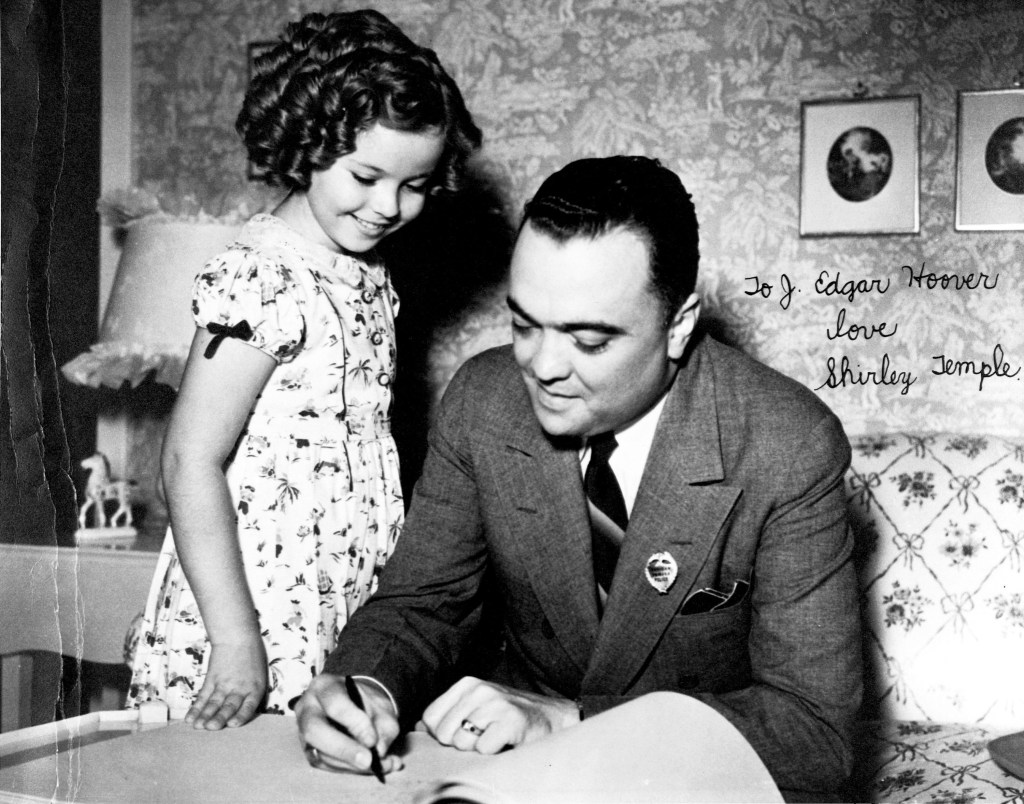
J. Edgar Hoover with child film star Shirley Temple. Getty Images

Hoover often suppressed his urges, but would break out in lapses that could have destroyed him — alleged orgies in New York City hotels and affairs with teenage boys in a limousine, according to interviews conducted by Summers.

“He was a sadly repressed individual, but most people, even J. Edgar Hoover, let go on occasion,” he said.

Hoover as a Cross-Dresser Is Controversial

One short scene in the film showed the FBI director in anguish over his mother’s death, putting on her dress and beads, a nod to Summers expose that Hoover had been a cross-dresser.

The Washington Post recently dismissed that account because of a discredited source, but Summers maintains he had two other independent sources from different periods in Hoover’s life.

Hoover often frequented New York City’s Stork Club and one observer — soap model Luisa Stuart, who was 18 or 19 at the time — told Summers she saw Hoover holding hands with Tolson as they all rode in a limo uptown to the Cotton Club in 1936.

“I didn’t really understand anything about homosexuality at the time,” said Stuart. “But I’d never seen two men holding hands. And I remember asking Art [Arthur] about it in the car on the way home that night. And he just said, ‘Oh, come on. You know,’ or something like that. And he told me they were queers or fairies — the sort of terms they used in those days.”

Hoover promoted men inclined to homosexual indiscretions, including Tolson, who had barely 18 months experience with the FBI when he became Hoover’s deputy.

The pair used to make “saucy jokes” about some of the other agents, like Melvin Purvis, who was a hero for arresting John Dillinger, according to Summers.

Purvis’s son shared his father’s 500-letter correspondence with Hoover, who teased the good-looking, blond-haired agent as “the Clark Gable of the FBI,” even though he was heterosexual.

Many were intimate and one was highly charged with innuendo, as Hoover referred to himself as the “Chairman of the Moral Uplift Squad.”

Ethel Merman, who had known Hoover since 1938, knew his sexual orientation, according to Summers. In 1978 when the actress was asked to comment on Anita Bryant’s anti-gay campaign, Merman told the reporter, “Some of my best friends are homosexual. Everybody knew about J. Edgar Hoover, but he was the best chief the FBI ever had.”

Harry Hay, founder of the Mattachine Society, one of the first gay rights organizations, confirmed that Hoover and Tolson sat in boxes owned by and used exclusively by gay men at their racing haunt Del Mar in California.

“They were nodded together as lovers,” he told Summers.

Another FBI agent who had gone on fishing trips with Hoover and Tolson revealed that the director liked to “sunbathe all day in the nude.” Even novelist William Styron told Summers that he once spotted Hoover and Tolson in a California beach house — the director painting his friends toenails.

But, according to Summers, “Nobody dared say anything, he was so powerful.”

The author interviewed the widow of respected Washington, D.C. psychiatrist Dr. Marshall de G. Ruffin, who treated Hoover in 1946 after his general practitioner had been “puzzled by a strange malaise in his patient.”

Monteen Ruffin told Summers that Hoover was “very paranoid” about anyone finding out, and he eventually stopped seeing the psychiatrist. She said her husband burned the evidence.

“He was definitely troubled by homosexuality,” she said in 1990, “and my husband’s notes would have proved that … I might stir a kettle of worms by making that statement, but everybody then understood that he was a homosexual, not just the doctors.”

As the movie depicts, after Hoover’s death, his loyal secretary Helen Gandy destroys the “official and confidential” files.

When Hoover died in 1972, President Richard Nixon ordered his “dirty tricks man” Gordon Liddy to scour the FBI director’s office for files. But when they arrived, someone had taken “drastic action,” said Summers. Nothing but tables and chairs remained.

Summers said he is often asked, but rarely answers the question about what he personally thought of Hoover as a human being.

“Yes, I had sympathy for somebody who has to bury their real preferences through a long life in the public eye,” he said. “But not sympathy for the way in which he was dictatorial, the way he behaved politically and personally to people right from the beginning in his late teens and early 20s.

“He was totally self-serving and the way in which he was a repressed homosexual didn’t require him to abuse individual rights and human liberties the way he did,” said Summers. “It does not begin to justify his behavior toward blacks and concoct an anonymous letter to Martin Luther King and suggest he end it all and kill himself.”

Psychiatrists have concluded that Hoover “no doubt” had a narcissistic personality disorder, perhaps because of his dependency on a forceful mother who had “great expectations for her son,” he said.

“Studies suggest that people with such backgrounds block their feelings and cut meaningful relationships,” according to Summers, who said Hoover would have been a “perfect high-level Nazi.”

However, Eastwood, who is a Republican, contends that J. Edgar Hoover was “probably good for the country,” and whether he was homosexual or not makes no difference.

“I don’t really know and nobody really knew,” he told ABC. “It’s definitely a love story. You can love a person and whether it goes into the realm of being gay or not, is here nor there.”

A younger generation of gays was moved by the film precisely because it portrayed such an iconic figure’s struggle with his sexuality.

“The audience I was in clearly rooted for Hoover to be gay and to have happiness in his sex and love life,” said Ben Ryan, a 33-year-old novelist from New York City. “In a pivotal scene between DiCaprio and Hammer in which the two men engage in the classic brawl-leads-to-furious-kiss, everyone got so excited when they finally locked lips.”

“Anyone in their right mind would see this movie and say, ‘Oh, well, of course Hoover was gay,'” he said. “The more suspicious among us might think that the filmmakers were still afraid of Hoover’s ghost suing them for libel if they just put it right out there that he was gay.”

Still, he said, the film is a “tragic story that should hopefully teach society lessons about how dangerous sexual repression is.”

Reference

The Knick’s Gory History Is Super Real

I have just finished a second viewing of the 2 seasons of The Knick…I saw it originally when it was first released. It is, despite the gore aspect, addictive viewing even the second time around. My only complaint is that it had no further seasons.

With cocaine-addled doctors, botched C-sections, a suicide before its first 15 minutes are up: The Knick , Cinemax’s new series from Steven Soderbergh, is only one episode old, but the 1900-set drama about the invention of modern medicine has already proved to be nearly as mesmerizing as it is gruesome. This summer has been full of ambitious scary-gross new dramas, like The Strain and The Leftovers, of which The Knick is only the latest. The Knick, however, is made all the more fascinating by the fact that its depictions of disease, gore, and immorality are all inspired by real events.

According to The Bowery Boys blog, The Knickerbocker, the hospital from which The Knick derives its name, was a real New York hospital that operated from 1862 to 1979 in Harlem. The institution went through several names throughout its existence. It started as a hospital for northern Civil War veterans known as the Manhattan Dispensary. By 1895 the building had been rechristened J. Hood Wright Memorial Hospital, and in 1913, its name was finally changed to the Knickerbocker, a moniker that stuck until a few years before its closing, when it was renamed the Arthur C. Logan Memorial Hospital.

Hello, Name & Location Change

So the Knick actually existed during the time of the Cinemax show, but it didn’t get that name until 13 years later. Beyond that, there are other differences between the fictional hospital and the actual Knick. For one, the show is set way downtown in the Village, whereas the historical hospital is located at Covent Avenue and 131st Street, at the opposite end of Manhattan. Today, the Knickerbocker building is an apartment complex for senior citizens, according to Bowery Boogie.

But There’s Plenty of Truth

But despite these editorial changes, much of The Knick is based in fact. As in the show, the Knickerbocker was a hospital serving primarily poor and immigrant patients, the Bowery Boys report. And Clive Owen’s character, Dr. John Thackery, is based in part on an actual person, Dr. William Stewart Halsted, who invented many new surgical instruments and techniques in the early 20th century and, like Thackery, was known to be addicted to cocaine and morphine, according to the Johns Hopkins Institute. Of course, these substances were not illegal at the time, but that doesn’t exactly mean they were safe to use while operating on other people.

All About Algernon Edwards

Another aspect of the show that is historically accurate is its portrayal of racism among the hospital’s staff. It is established from the first episode that Thackery opposes integration, and he refuses to work with a new black doctor, Algernon Edwards. The Bowery Boys report that the real Knickerbocker had a similar policy regarding African-Americans, often refusing to treat them, despite the hospital’s mission to serve those who could not afford to pay for medical care.

In coming episodes of The Knick we’ll see André Holland’s character, Dr. Edwards — the only black doctor at the hospital — attempt to treat African-American patients in secret. The first African-American to ever earn a medical license was James McCune Smith in 1837 — but Smith was trained at the University of Glasgow, Scotland, because no American college would admit him, according to PBS. In The Knick (which is set 63 years after Smith became a doctor) Edwards went to Harvard (which graduated its first black student, Richard T. Greener, in 1870). But before starting at the Knick, the fictional Edwards had only previously practiced medicine in Europe, because American hospitals refused to hire him, which lines up with his onscreen incarnation.

The Bottom Line

It’s still too early to tell if The Knick is worth watching all the way through, or if it doesn’t deliver the quality to justify its graphic content. But having such an extensive history behind the show’s concept does make me more interested in seeing where this season goes. And the fact that Soderbergh is at the helm can only mean good things for the show. Maybe he can even get his old pal Channing Tatumto drop by for a scene — in one of Thackery’s opium-fueled hallucinations, perhaps?

How Accurate Is The Knick’s Take on Medical History?

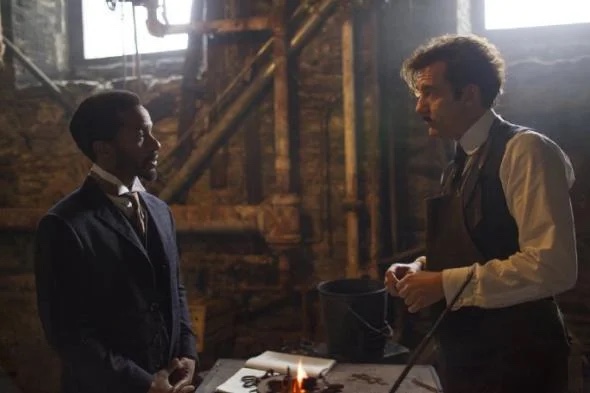
Here’s what’s fact and what’s fiction in The Knick’s take on medical history.André Holland and Clive Owen inThe Knick. Photo by Mary Cybulski.

Steven Soderbergh’s new cable series The Knickwhich premieres Friday on Cinemax, aims not so much to be a medical drama as to be a social panorama of New York in 1900. A fictional hospital, the Knickerbocker, led by its chief surgeon, John Thackery (Clive Owen), feels like both a beacon of turn-of-the-century progress and a shocking house of horror. There are three deaths within the first 10 minutes, yet it is an age of “endless possibilities,” Thackery informs us early on. “More has been learned about the treatment of the human body in the last five years than in the last five hundred.”

The show’s producers have emphasized their desire for historical authenticity and the great lengths taken to replicate surgical procedures with accuracy. Much of their staging came from consulting records in the Burns Archive, an impressive historical collection of photographs and medical history materials curated by Dr. Stanley Burns, a doctor who also served as medical adviser for the show. But the world of The Knick is better seen as an image of history refracted in a funhouse mirror than as an accurate snapshot of medical progress and society in 1900. What is accurate, and what is exaggerated on The Knick? I consulted several medical historians and papers to find out.

John Thackery (Clive Owen) and William Halsted

Left: Clive Owen in The Knick. Right: William Stewart Halsted.Photo (left) by Mary Cybulski/Anonymous Content (right) courtesy of Wikimedia Commons

Owen has said that the show’s writers based the drug-guzzling John Thackery on William Halsted, one of the most important figures in modern surgery. Halsted is credited with performing the first emergency blood transfusion in the United States, and with revolutionizing the way surgery is taught and practiced as a meticulous, scientific discipline.* In 1889, he was a founding professor, along with three colleagues, of Johns Hopkins Hospital, where he headed the department of surgery. He did struggle, as Thackery does, with cocaine addiction—the result of experimenting with the drug as an anesthetic for surgery. Still, it’s unlikely he would have been impressed with the cavalier demeanor his fictional counterpart exhibits in the operating theatre. A reclusive, somber man, “Halsted subordinated technical brilliance and speed of dissection to a meticulous and safe, albeit sometimes slow, performance,” in surgery, says the Sabiston Textbook of SurgeryHalsted’s principles for surgery—which insist on gentle, careful technique—were developed in the 1890s and are still followed today.

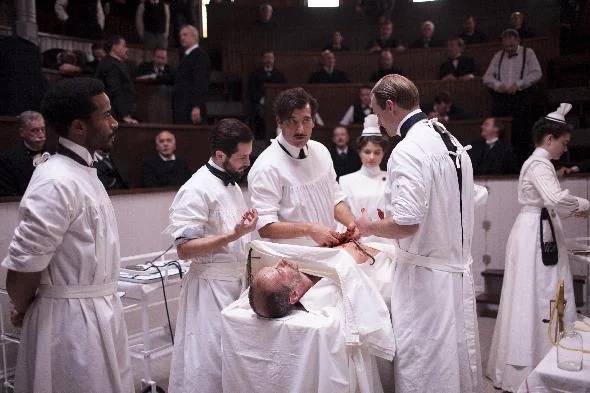
Surgery at the turn of the century

Photo courtesy Mary Cybulski/Cinemax\

By 1900, surgery had become more commonplace and acceptable than The Knick implies. In the first episode Thackery, reflecting on his beginning at the hospital, tells his predecessor: “You are legitimizing surgery, taking it out of the barbershops and into the future, and I want to be part of it.” In real-life 1900 New York, on the other hand, surgery in a top-flight hospital would probably have lost much of its old unsavory image as a practice of crude butchery. Between 1880 and 1890, approximately 100 new types of operations were conceived, made possible by progress in anesthetics and antisepsis discovered in the latter part of the 19th century. A later episode in which a man is taken to a drunken barber for an amputation seems implausibly anachronistic. Other small anachronisms seem to be included for dramatic effect. For example, the show depicts surgeons performing operations barehanded, rather than with rubber gloves, which Halsted and his colleagues began using in the late 1890s.

Hospitals at the turn of the century

The late 19th and early 20th century saw an incredible rise in the number of hospitals in the United States. Quality varied greatly, says Peter Kernahan, a medical historian at the University of Minnesota, as all that would be required was a house with some beds and funds to start one. A 1910 book written by a surgeon who had spent time at New York and Washington Heights hospitals, Medical Chaos and Crime, caused a sensation by purporting to document gross misconduct in hospitals—drunken night nurses, greedy superintendents, and incompetently trained surgeons. The money pinching and bribery depicted on The Knick might have occurred even at reputable hospitals.

The body trade

As greedy as some hospital workers may have been, a lurid black market cadaver trade could not have existed as it does on The Knick. (Not least because an early scene has a doctor declaring that “Other hospitals may frown on studying the dead, but I believe it is the only way to advance our knowledge of the living”: Human anatomical dissections date back to ancient Greece; doctors in 1900 would certainly have been doing them.) It’s true that cadavers would have been a commodity in demand, says Michel Anteby of Harvard Business School, and fresh ones were better for study than older, decaying ones. So one might think that an ambulance driver on the lookout for a business opportunity would be in a prime position to deliver (for a good fee) luckless patients who did not survive the journey to a hospital.

But Kernahan notes that it’s unlikely this happened in 1900 New York City: New York was one of the first states to pass “anatomical acts” in the mid-19thcentury, to discourage body snatching and the inappropriate sale of cadavers. Under such laws, only bodies left unclaimed by friends and loved ones could be used for medical studies. Beginning in the 1830s, these acts also helped provide anatomists with “a steady supply of free cadavers, … rescuing the profession from the taint of association with unsavory lower-class body snatchers,” writes Michael Sappol in A Traffic of Dead Bodies: Anatomy and Social Identity in Nineteenth Century AmericaFor ambulance drivers in 1900, brokering a trade in cadavers would have been a dubious way to get rich (though, interestingly enough, there is a cadaver shortage today).

Black surgeons

Algernon Edwards (André Holland) in The Knick.
Cinemax

For a hospital that is supposed to be on the cutting edge of surgical history, the Knick is a strangely conservative one with respect to many medical practices and attitudes. What’s truly (but anachronistically) progressive about the hospital is that it’s the first in New York to hire a black doctor. In real-life New York, this didn’t happen until 1920, with the appointment of Louis Wright at Harlem Hospital, on which occasion several hospital surgeons resigned in protest.

If Edwards has a historical model, it is likely Daniel Hale Williams, a pioneering cardiac surgeon, and founder of the first hospital with an integrated staff—Provident Hospital in Chicago—in 1891. In the real-life history of integration, it was a black doctor, not white benefactors, who led the charge.

Reference

Top 10 Bizarre Aspects of Catholicism

The Catholic Church claims that it is the oldest Christian Church in the world, dating back to Jesus himself. In the time that the Church has been on earth, many unusual traditions have arisen. While most of them seem perfectly normal to Catholics, to non-Catholics they often seem outright bizarre. This is a list of the ten most bizarre aspects of Catholicism. In no particular order

10: Stigmata

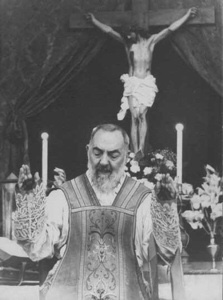
Saint Pio of Peitrelcina

Stigmata is when a person has unexplained wounds on their body that coincide with the traditional wounds that Christ had. In some cases the wounds can appear in only one or two of the areas, but there have been instances of it occurring in all five places that Christ was wounded. The wounds can cause considerable pain which has been known to worsen on certain religious feast days. There have been occasional cases of falsified stigmata in the past and some people claim that even those which are not proven to be falsified are somehow part of a hoax.

The photograph above is of Saint Pio of Pietrelcina (Canonized in 2002) who is the most recent stigmatic in the Catholic Church. Saint Pio is the latest in a long line of famous stigmatics – the most famous of whom is probably St Francis of Assisi. Writing to his spiritual director, Saint Pio said:

Then last night something happened which I can neither explain nor understand. In the middle of the palms of my hands a red mark appeared, about the size of a penny, accompanied by acute pain in the middle of the red marks. The pain was more pronounced in the middle of the left hand, so much so that I can still feel it. Also under my feet I can feel some pain.

It is also alleged that Saint Pio was able to bi-locate (appear in two places at once) and to read the sins on a person’s soul

9: The Cilice

A cilice is an item worn on the body to inflict pain or discomfort for the sake of penance (remorse for your past actions). Originally a cilice was an undergarment made of rough hair (such as a hairshirt) or cloth. In recent times it has been seen as more discreet to wear a chain which has spikes on it. Contrary to popular belief, the cilice does not break the skin – it merely causes discomfort. It is usually worn around the thigh.

The Catholic Encylopedia of 1913 says:

“In modern times the use of the hairshirt [(cilice)] has been generally confined to the members of certain religious orders. At the present day only the Carthusians and Carmelites wear it by rule; with others it is merely a matter of custom or voluntary mortification.”

In recent years the cilice has gained a great deal of publicity due to the book The Da Vinci Code in which it is worn by the main antagonist of the story – though in the story it is exaggeratedly described as causing wounds. Wearing the cilice has always been an optional practice for Catholics. Some famous people in the past to have worn them are Saint Thomas More and Saint Patrick.

8: The Flagrum

The Flagrum is a type of scourge with small hard objects attached to the length of its cords. It is traditionally used to whip oneself (self-flagellation) and is most commonly found in conservative religious orders. The flagrum is held in one hand and thrown over the shoulder in order to cause the cords to strike the flesh. The purpose of self-flagellation is voluntary penance and mortification of the flesh (a safeguard against committing further sins).

The most famous Saint to use the flagrum is probably Saint John Vianney, who would give his parishoners very light penances in confession and then flog himself in privacy for their benefit (it is believed by Catholics that acts of penance can be offered for the sins of other living people or the souls of the dead). When Saint John Vianney died, the walls of his bedroom had spatterings of blood on them from his extreme use of the flagrum.

According to the Catholic Encyclopedia:

“St. Peter Damian (died 1072) […] wrote a special treatise in praise of self-flagellation; though blamed by some contemporaries for excess of zeal, his example and the high esteem in which he was held did much to popularize the voluntary use of the scourge or “discipline” as a means of mortification and penance.”

Most Catholics who practice this form of discipline will not admit it publicly as it would be seen as a lack of humility that could lead to the sin of pride.

7: Confraternities of the Cord

The third, (and final) of the penance-related objects, the Confraternities of the Cord are groups who wear a knotted cord around their waist as a form of penance and in order to help prevent future sins. The cord can be worn loosely in remembrance of the Saint for whom the cord is named, or it can be worn tight enough to cause pain, as has been the case with numerous saints in history.

St Joseph, St Francis, St Thomas, and St Augustine, St Nicholas, and St Monica all have Confraternities of the Cord named after them. The Catholic Encylopedia says:

In the early Church virgins wore a cincture as a sign and emblem of purity, and hence it has always been considered a symbol of chastity as well as of mortification and humility. The wearing of a cord or cincture in honour of a saint is of very ancient origin, and we find the first mention of it in the life of St. Monica.

The various confraternities differ in the number of knots on the cord.

6: Relics

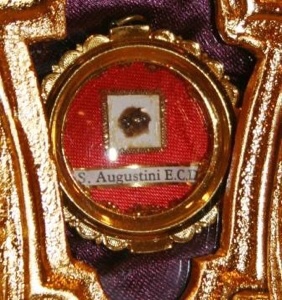
Relic of St Augustine

Relics are objects related to Saints. There are three categories of relics (from wikipedia):

1st Class

Items directly associated with the events of Christ’s life (manger, cross, etc.), or the physical remains of a saint (a bone, a hair, a limb, etc.). Traditionally, a martyr’s relics are often more prized than the relics of other saints. Also, some saints relics are known for their extraordinary incorruptibility and so would have high regard. It is important to note that parts of the saint that were significant to that saint’s life are more prized relics. For instance, King St. Stephen of Hungary’s right forearm is especially important because of his status as a ruler. A famous theologian’s head may be his most important relic.

2nd Class

An item that the saint wore (a sock, a shirt, a glove, etc.) Also included is an item that the saint owned or frequently used, for example, a crucifix, book etc. Again, an item more important in the saint’s life is thus a more important relic.

3rd Class

Anything which has touched a first or second class relic of a saint.

In order to prevent abuses, Catholic Church law (Canon Law) forbids the sale of Relics (Can. 1190 §1). Catholics venerate relics in the same way as they venerate images, statues, and saints. This is often confused for idol worship, but veneration is actually the act of giving respect, rather than the act of worshipping which is forbidden. By canon law there must be a relic in the altar stone of any altar in a Catholic Church upon which Mass is to be offered.

5: Indulgences

Catholics believe that when a person sins, they have two punishments to suffer – eternal (Hell) and temporal (punishment by suffering on earth or in Purgatory). Indulgences are special actions that a person can perform in order to reduce or remove the temporal punishment they are owed. The idea behind it is that certain acts of holiness can take the place of punishment. Indulgences must be declared by the Pope.

There are two types of indulgence: Plenary (removes all temporal punishment) and partial (removes some punishment). A partial indulgence can be for a specific number of days or years. Some indulgences only apply to the souls in Purgatory but any personal indulgences can also be offered for those souls, rather than your own. An example of an indulence is: “An indulgence, applicable only to the Souls in Purgatory, is granted to the faithful, who devoutly visit a cemetery and pray, even if only mentally, for the departed. The indulgence is plenary each day from the 1st to the 8th of November; on other days of the year it is partial.” (from the Enchiridion of Indulgences).

During the middle ages, a number of Bishops and Priests, seeking to make money, told people that they could pay for indulgences. This abuse partly contributed to the sparking off of the protestant reformation. While the Catholic Church tried to suppress this behavior, it took a great deal of time for the traffic in indulgences to stop completely.

It is quite common for the Pope to announce new indulgences from time to time, to mark special occasions – such as the Jubilee in which Pope John Paul II granted a plenary indulgence.

4: The Real Presence

The Real Presence is the term used to describe the bread and wine in a Catholic Mass. Catholics believe that after the words of consecration have been spoken by the Priest, the bread (host) and wine change their substance to become the body and blood of Jesus. It is considered by Catholics, therefore, to be appropriate to worship and adore the changed objects. This is often seen as idol worship by non-Catholics as they do not believe the change of substance has occurred.

Because of this belief, Catholics have a special ceremony called Benediction, in which a consecrated host is placed in an ornate case called a monstrance and the people are blessed with it and kneel and pray before it. you can see an image of Pope Benedict XVI blessing people with a monstrance here.

An interesting side note is that it is believed that the modern term “hocus pocus” comes from an aberration of the words used by a priest at the moment of the consecration, in which he says: “Hoc est enim corpus Meum” meaning “for this is My body”.

3: Exorcism

Exorcism is the practice of evicting demons or other evil spiritual entities from a person or place which they are believed to have possessed (taken control of). Solemn exorcisms, according to the Canon law of the church, can only be exercised by an ordained priest (or higher prelate), with the express permission of the local bishop, and only after a careful medical examination to exclude the possibility of mental illness. The Catholic Encyclopaedia says:

“Superstition ought not to be confounded with religion, however much their history may be interwoven, nor magic, however white it may be, with a legitimate religious rite”

During the ritual of exorcism, the priest commands the devils within the body of the afflicted to leave and uses a number of blessings with Holy Water and oils. To listen to two authentic recordings of exorcisms, visit the Top 10 Incredible Recordings. Of interesting note, the Catholic Church gave permission for a priest to appear in the film The Exorcist on the grounds that is was true to the methods used by the Church to determine whether an exorcism is warranted. A much more indepth article on exorcism including audio, videos, and images can be found here.

2: Papal Infallibility

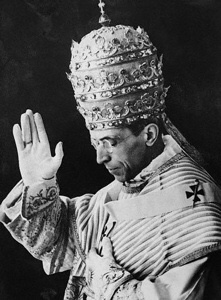
Venerable Pope Pius XII

Roman Catholics believe that, under certain circumstances, the pope is infallible (that is, he can not make a mistake). The Catholic Church defines three conditions under which the Pope is infallible:

I. The Pope must be making a decree on matters of faith or morals
II. The declaration must be binding on the whole Church
III. The Pope must be speaking with the full authority of the Papacy, and not in a personal capacity.

This means that when the Pope is speaking on matters of science, he can make errors (as we have seen in the past with issues such as Heliocentricity). However, when he is teaching a matter of religion and the other two conditions above are met, Catholics consider that the decree is equal to the Word of God. It can not contradict any previous declarations and it must be believed by all Catholics. Catholics believe that if a person denies any of these solemn decrees, they are committing a mortal sin – the type of sin that sends a person to hell. Here is an example of an infallible decree from the Council of Trent (under Pope Pius V):

If anyone denies that in the sacrament of the most Holy Eucharist are contained truly, really and substantially the body and blood together with the soul and divinity of our Lord Jesus Christ, and consequently the whole Christ, but says that He is in it only as in a sign, or figure or force, let him be anathema.

The last section of the final sentence “let him be anathema” is a standard phrase that normally appears at the end of an infallible statement. It means “let him be cursed”.

1: The Scapular

The Scapular is a type of necklace worn by many Catholics. It is worn across the scapular bones (hence its name) and it consists of two pieces of wool connected by string. One piece of wool rests on the back while the other piece rests on the chest. When a Catholic wishes to wear the scapular, a Priest says a set of special prayers and blesses the scapular. This only occurs the first time a person wears one.

For wearing the scapular, Catholics believe that Mary, the mother of Jesus, will ensure that they do not die a horrible death (for example by fire or drowning) and that they will have access to a priest for confession and the last rites before they die. As a condition for wearing the scapular and receiving these benefits, the Catholic must say certain prayers every day. The Catholic Encyclopedia says this:

According to a pious tradition the Blessed Virgin appeared to St. Simon Stock at Cambridge, England, on Sunday, 16 July, 1251. In answer to his appeal for help for his oppressed order, she appeared to him with a scapular in her hand and said: “Take, beloved son this scapular of thy order as a badge of my confraternity and for thee and all Carmelites a special sign of grace; whoever dies in this garment, will not suffer everlasting fire. It is the sign of salvation, a safeguard in dangers, a pledge of peace and of the covenant”. 

The brown scapular, known as the Scapular of Our Lady of Mount Carmel is the most commonly worn scapular, though others do exist. When the scapular is worn out it is either buried or burnt and a new one is worn in its place.

Reference

How Ireland Turned ‘Fallen Women’ Into Slaves

Until 1996, pregnant or promiscuous women could be incarcerated for life in Magdalene Laundries.

When the Sisters of Our Lady of Charity decided to sell some land they owned in Dublin, Ireland, to pay their debts in 1992, the nuns followed the proper procedures. They petitioned officials for permission to move the bodies of women buried in the cemetery at their Donnybrook laundry, which between 1837 and 1992 served as a workhouse and home for “fallen women.” 

But the cemetery at Donnybrook was no ordinary resting place: It was a mass grave. Inside were the bodies of scores of unknown women: the undocumented, uncared-about inmates of one of Ireland’s notorious Magdalene laundries. Their lives—and later their deaths—had been shrouded in secrecy.

For more than two centuries, women in Ireland were sent to institutions like Donnybrook as a punishment for having sex outside of marriage. Unwed mothers, flirtatious women and others deemed unfit for society were forced to labor under the strict supervision of nuns for months or years, sometimes even for life.

When the mass grave at Donnybrook was discovered, the 155 unmarked tombs touched off a scandal that exposed the extent and horrors of the Magdalene laundries. As women came forward to share their experiences of being held against their will in restrictive workhouses, the Irish public reacted with outrage.

The interior of the now derelict Sisters of Our Lady of Charity Magdalene Laundry on Sean McDermott St in Dublin’s north inner city on the day of The Irish Government has apologised to the thousands of women locked up in Catholic-run workhouses known as Magdalene laundries between 1922 and 1996. (Photo by Julien Behal/PA Images via Getty Images)

When the Magdalene Movement first took hold in the mid-18th century, the campaign to put “fallen women” to work was supported by both the Catholic and Protestant churches, with women serving short terms inside the asylums with the goal of rehabilitation. Over the years, however, the Magdalene laundries—named for the Biblical figure Mary Magdalene—became primarily Catholic institutions, and the stints grew longer and longer. Women sent there were often charged with “redeeming themselves” through lace-making, needlework or doing laundry.

Though most residents had not been convicted of any crime, conditions inside were prison-like. “Redemption might sometimes involve a variety of coercive measures, including shaven heads, institutional uniforms, bread and water diets, restricted visiting, supervised correspondence, solitary confinement and even flogging,”writes historian Helen J. Self. 

Ireland’s first such institution, the Magdalen Asylum for Penitent Females in Dublin, was founded by the Protestant Church of Ireland in 1765. At the time, there was a worry that prostitution in Irish cities was on the rise and that “wayward” women who had been seduced, had sex outside of marriage, or gotten pregnant out of wedlock were susceptible to becoming prostitutes. Soon, parents began to send their unmarried daughters to the institutions to hide their pregnancies. 

Initially, a majority of women entered the institutionsvoluntarilyand served out multi-year terms in which they learned a “respectable” profession. The idea was that they’d employ these skills to earn money after being released; their work supported the institution while they were there.

Nursery in the Sean Ross Abbey. (Credit: Brian Lockier/Adoption Rights Alliance)

But over time, the institutions became more like prisons, with many different groups of women being routed through the system, sometimes by the Irish government. There were inmates imported from psychiatric institutions and jails, women with special needs, victims of rape and sexual assault, pregnant teenagers sent there by their parents, and girls deemed too flirtatious or tempting to men. Others were there for no obvious reason. Though the institutions were run by Catholic orders, they were supported by the Irish government, which funneled money toward the system in exchange for laundry services.

Nuns ruled the laundries with impunity, sometimes beating inmates and enforcing strict rules of silence. “You didn’t know when the next beating was going to come,”said survivor Mary Smith in an oral history. 

Smith was incarcerated in the Sundays Well laundry in Cork after being raped; nuns told her it was “in case she got pregnant.” Once there, she was forced to cut her hair and take on a new name. She was not allowed to talk and was assigned backbreaking work in the laundry, where nuns regularly beat her for minor infractions and forced her to sleep in the cold. Due to the trauma she suffered, Smith doesn’t remember exactly how long she spent in Sundays Well. “To me it felt like my lifetime,” she said.

Survivors (left to right) Maureen Sullivan, Mary McManus, Kitty Jennette and Mary Smith, at the Law Reform Commission offices in Dublin to discuss proposed compensation packages, for those who survived Catholic-run workhouses known as Magdalene laundries. (Credit: Julien Behal/PA Images/Getty Images)

Smith wasn’t alone. Often, women’s names were stripped from them; they were referred to by numbers or as “child” or “penitent.” Some inmates—often orphans or victims of rape or abuse—stayed there for a lifetime; others escaped and were brought back to the institutions. 

Another survivor, Marina Gambold, was placed in a laundry by her local priest. She recalls being forced to eat off the floor after breaking a cup and getting locked outside in the cold for a minor infraction. “I was working in the laundry from eight in the morning until about six in the evening,” she told the BBC in 2013. “I was starving with the hunger, I was given bread and dripping for my breakfast.” 

Some pregnant woman were transferred to homes for unwed mothers, where they bore and temporarily lived with their babies and worked in conditions similar to those of the laundries. Babies were usually taken from their mothers and handed over to other families. In one of the most notorious homes, the Bon Secours Mother and Baby Home in Tuam, scores of babies died. In 2014, remains of at least 796 babies were found in a septic tank in the home’s yard; the facility is still being investigated to reconstruct the story of what happened there.

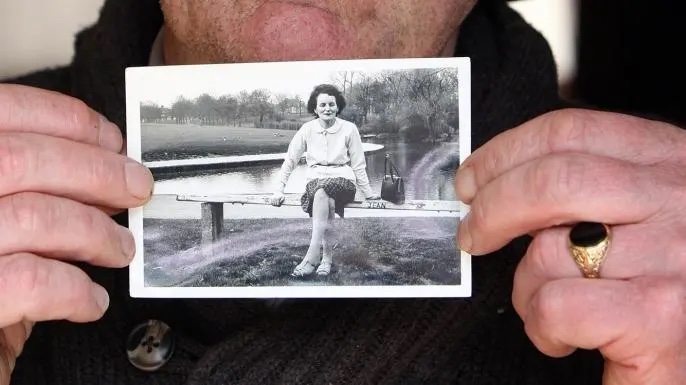
John Pascal Rodgers, who was born in Tuam, Ireland, at a home for unmarried mothers run by nuns, poses with a photograph of his mother Bridie Rodgers. (Credit: Paul FaithAFP/Getty Images)

How did such an abusive system endure for 231 years in Ireland? To start with, any talk of harsh treatment at the Magdalene laundries and mothers’ homes tended to be dismissed by the public, since the institutions were run by religious orders. Survivors who told others what they had been through were often shamed or ignored. Other women were too embarrassed to talk about their past and never told anyone about their experiences. Details on both the inmates and their lives are scant.

Estimates of the number of women who went through Irish Magdalene laundries vary, and most religious orders haverefusedto provide archival information for investigators and historians. Up to 300,000 women are thought to have passed through the laundries in total, at least 10,000 of them since 1922. But despite a large number of survivors, the laundries went unchallenged until the 1990s.

Then, the Sisters of Our Lady of Charity decided to sell some of its land in 1992. They applied to have 133 bodies moved from unmarked graves on the property, but the remains of 155 people were found. When journalists learned that only 75 death certificates existed, startled community members cried out for more information. The nunsexplained there had been an administrative error, cremated all of the remains, and reburied them in another mass grave.

Kevin Flanagan with Marie Barry, who was born at a Bessboro Mother and Baby home, at the 2014 third annual Flowers for Magdalenes remembrance event in Glasnevin cemetery, Dublin, to mark all of the women incarcerated in the Magdalene laundries. (Credit: Brian Lawless/PA Images/Getty Images)

The discovery turned the Magdalene laundries from an open secret to front-page news. Suddenly, women began to testify about their experiences at the institutions, and to pressure the Irish government to hold the Catholic Church accountable and to pursue cases with the United Nations for human rights violations. Soon, the UN urged the Vatican to look into the matter, stating that “girls [at the laundries] were deprived of their identity, of education and often of food and essential medicines and were imposed with an obligation of silence and prohibited from having any contact with the outside world.”

As the Catholic Church remained silent, the Irish government released a report that acknowledged extensive government involvement in the laundries and the deep cruelty of the institutions. In 2013, Ireland’s presidentapologized to the Magdalene women and announced a compensation fund. However, the religious groups that ran the laundries have refused to contribute to the fund and have turned away researchers looking for more information about the laundries. 

Due in part to the uproar surrounding the discovery of the mass grave, the last Magdalene laundry finally closed in 1996. Known as the Gloucester Street Laundry, it was home to 40 women, most of them elderly and many with developmental disabilities. Nine had no known relatives; all decided to stay with the nuns.

Although Smith managed to reclaim her own life, she understands the damage that long-term institutionalization can inflict. “My body went into shellshock when I went there. When that door closed, my life was over,” Smith recalled in her oral history. “You see all these women there and you know you’re going to end up like them and be psychologically damaged for the rest of your life.”

Reference

‘Dickensian’ Good Shepherd Institutions Covered Up Dysfunction In Canadian Society, As Late As The 1960s

Operated in reality as a form of incarceration, they sentenced women and girls as young as 12 or 13 to back-breaking, indefinite labour

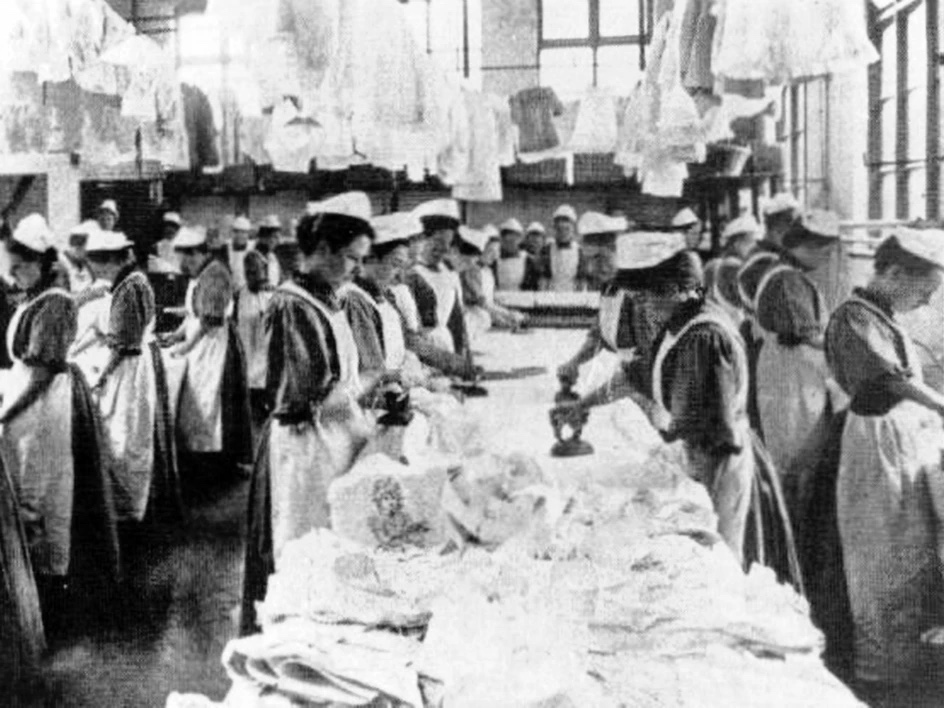
A Magdalene Laundry in England in the early Twentieth Century, from Frances Finnegan, Do Penance or Perish, Congrave Press, 2001. PHOTO BY WIKIMEDIA COMMONS

Thousands of academics gathered in Vancouver for the annual Congress of the Humanities and Social Sciences from June 1-7. They presented papers on everything from child marriage in Canada to why dodgeball is problematic. In its Oh, The Humanities! series, the National Post showcases some of the most interesting research.

If you saw the Oscar-nominated 2013 movie Philomena, you’ve heard of the Magdalene laundries — Catholic institutions that persisted in Ireland until, incredibly, 1996. They supposedly provided asylum to “fallen” women, such as former prostitutes and unwed mothers.

In reality, these institutions were understood, and operated, as a form of incarceration. They sentenced women and girls as young as 12 or 13 to back-breaking labour, living out their days boiling and stirring and rinsing and wringing and hanging laundry for the wealthy, respectable members of society

Until recently, the laundries were thought of as “an Irish phenomenon,” but they also existed in the U.K, Australia, New Zealand, the United States and, yes, Canada, says Rie Croll, associate professor of social cultural studies at Memorial University of Newfoundland and author of the new book Shaped by Silence: Stories from Inmates of the Good Shepherd Laundries and Reformatories.

The Sisters of the Good Shepherd ran more than a dozen institutions for girls and women across the country, from the Maritimes to Ottawa to Vancouver. They proliferated in the 19th century and were variously called homes, training schools, asylums, refuges, reformatories and laundries, Croll said. Of the Canadian institutions she examined, the last to close was the St. Mary’s Training School in Toronto, in 1973.

Croll presented two talks based on her research at the annual conference of the Canadian Sociological Association, part of the larger Congress of the Humanities and Social Sciences in Vancouver.

She interviewed survivors who entered institutions between the 1930s and 1960s, not long before they closed for good. Their accounts provide some of the most detailed information we have about Good Shepherd homes in Canada, which, despite being relatively recent, are now nearly forgotten. No one knows how many Canadian women were incarcerated in them or how many survive, though it’s “more than single digits,” Croll said. Few records were kept and the survivors and their families were shamed into silence. In fact, it took years for Croll to gain enough trust to sit down with survivors and hear their tales. She spoke to inmates from Canada, Australia and Ireland.

Almost to a body, the women described them as Dickensian

What she heard beggars belief. The institutions were so draconian that it seems impossible they existed within living memory, during the same period as the flappers were tearing up dance halls, as Civil Rights activists were marching, as The Beatles were scoring hits.

Their stated purposes varied and their practices were different across regions and over time. The Good Shepherd sisters had a set way of doing things that was quite uniform, Croll explained, and “almost to a body, the women described them as Dickensian.”

The day began before dawn. The nuns clapped their hands and the women jumped out of bed and dropped to their knees for prayers. They pulled their heavy, long cotton dresses and aprons over their nightgowns: It was forbidden to show their bodies even to other inmates. After a quick wash, they filed in silence into chapel for mass, in silence into the dining hall for a starchy, flavourless meal, and in silence into the heat of the workroom to do laundry, or sometimes other menial chores, all day. Depending on the institution, they may have had a few hours of basic schooling each day. For an hour before bed, they had a break. Often this time was used to make rosaries for sale.

“Everything was taken away that was a reminder of a possession of identity,” Croll said. Their street clothes were confiscated, their hair and nails chopped short and, in the laundries, they were given new names and forbidden to use their own.

This made it hard for survivors to find each other and organize in the years since — though the shame did that much more effectively.

The institutions were based on the idea of contagious “moral pollution,” Croll explained. Their purpose was not only to segregate the women and give them asylum from a cruel, judgmental society, but to keep society safe from their corrupting influence.

“They’re told that they are bad, they’re shameful, they’re sluts, that they have done something really wrong. The state has imprisoned them, and the Church has imprisoned them, and their families have abandoned them. The language that’s used to describe them is shameful — you need to clean, you need to clean, you need to clean, you need to be penitent. You are not worthy of your old name. You may not mention your former life. This is a stripping away, through ideology and words, that creates a stigma that becomes internalized and believed — believed as fact,” she said.

In one of her talks, Croll argued this breaking of the human spirit was a form of “symbolic violence,” a sociological concept articulated by the French theorist Pierre Bourdieu. “It broke their resistance to other more immediate and explicit forms of violence in their lives,” she said.

The state was working with the church and families were, too

Canadian women and girls were committed to Good Shepherd institutions for a huge variety of reasons. Their sentences could be indefinite or extended at will. Some had been involved in sex work or gotten pregnant out of wedlock, but others were simply considered “defiant,” “incorrigible,” or “wayward” because they’d been caught “lipping off to their parents, smoking cigarettes, stuff that in those days that would have been shocking,” Croll said.

None of the survivors she interviewed had done anything that would be considered a crime today. One was declared “unmanageable” and sentenced to a Toronto reformatory in 1961 for sneaking away from her abusive parents to spend the evenings with friends. Another was born into a Good Shepherd laundry in Saint John, N.B. in 1934 to a 13-year-old Indigenous girl who got pregnant after a gang rape. The two remained incarcerated together, working side-by-side from the time the girl was eight until she escaped over the fence at the age of 18.

These institutions were supposed to respond to some of the worst violence and dysfunction in society, but they ended up covering it up, Croll said, adding that adolescent girls who had been victims of incest often ended up in them. So it’s not surprising that there has been no big movement from surviving family members to get recognition and restitution for what happened.

“The state was working with the Church, and families were too,” she said.

Croll’s other academic talk was on the concept of the moral double standard. There’s the obvious, gendered double standard, in that women were committed to these institutions while men were not. Women were seen as “solely responsible for any sexual transgression that’s happening in society.”

Then there’s another layer of double standard: The gulf between the stated purpose of the institutions and their real effects.

“The very system of incarceration that was supposed to reform them, became a significant factor in shaping their lifelong inequality,” Croll said. “Those who the Church and state targeted for saving were simultaneously treated as bad, dirty and unsalvageable.”

The sisters, obviously, saw their work quite differently. Their motto then and now is, “One person is of more value than the whole world.”

The National Post’s attempts to contact the order for comment by phone, email and letter have so far been unsuccessful.

A call to the Good Shepherd office in St. Louis, Mo., was not returned by press time and a visit to the sisters’ listed address in Etobicoke, Ont. yielded nothing. A staff member at nearby St. Gregory’s church, though, remembered a nun called Sister Doris who loved to tell stories about her days working at St. Mary’s, a Good Shepherd reform school in Toronto.

Sister Doris died in 2018.

Croll argues the institutionalization of women created a lifelong loss of self-confidence and difficulty reintegrating into society. She spoke to an Irish politician who remembers the day in 1996 when the last Magdalene laundry was closed in Dublin.

“Those poor women. They staggered on to the street. He said they didn’t even know how to cross a busy, modern street. They were so institutionalized. It was heartbreaking.”

Reference

The Strange Power Of The ‘Evil Eye’

(Image credit: Alamy)

From the Eye of Horus to Gigi Hadid, ‘for thousands of years the eye has maintained its steady hold on the human imagination,’ writes Quinn Hargitai.

When it comes to warding off the mystic malevolent forces of the world, there is perhaps no charm more recognised or renowned than the ‘evil eye’. Ubiquitous in its use, the striking image of the cobalt-blue eye has appeared not only in the bazaars of Istanbul, but everywhere from the sides of planes to the pages of comic books.

This recent endorsement from A-list celebrities has resulted in the surfacing of countless online tutorials for making your own evil eye bracelets, necklaces and keychains. Though all this attention would suggest the evil eye is seeing a sudden surge in popularity, the truth is that for thousands of years the symbol has maintained its steady hold on the human imagination.

Eye idols carved out of gypsum alabaster have been excavated at Tell Brak, Syria and are believed to date from before 3500 BC (Credit: Metropolitan Museum of Art)

To understand the origins of the evil eye, one must first understand the distinction between the amulet and the evil eye itself. Though often dubbed as ‘the evil eye’, the ocular amulet is actually the charm meant to ward off the trueevil eye: a curse transmitted through a malicious glare, usually one inspired by envy. Though the amulet – often referred to as a nazar – has existed in various permutations for thousands of years, the curse which it repels is far older and more difficult to trace.

The Hamsa is an amulet in the shape of a palm with an eye in the middle embraced by Jews, Christians and Muslims in North Africa and the Middle East (Credit: Alamy)

The belief in this curse spans cultures as well as generations; to date one of the most exhaustive compilations of legends regarding the evil eye is Frederick Thomas Elworthy’s The Evil Eye: The Classic Account of an Ancient SuperstitionElworthy explores instances of the symbol in a number of cultures; from the petrifying gaze of Greek gorgons to Irish folktales of men able to bewitch horses with a single stare, virtually every culture has a legend related to the evil eye. The eye symbol is so deeply embedded in culture that, in spite of its potentially pagan connotations, it even finds a place within religious texts, including the Bible and the Quran.

Plutarch said those best at delivering the curse were blue-eyed

An eye for an eye

Belief in the evil eye has transcended mere superstition, with a number of celebrated thinkers attesting to its veracity. One of the most notable examples was the Greek philosopher Plutarch, who in his Symposiacs suggested a scientific explanation: that the human eye had the power of releasing invisible rays of energy that were in some cases potent enough to kill children or small animals. What’s more, Plutarch claims that certain people possessed an even stronger ability to fascinate, citing groups of people to the south of the Black Sea as being uncannily proficient at bestowing the curse. More often than not, those said to be most adept at delivering the curse are blue-eyed, likely due to the fact that this is a genetic rarity in the Mediterranean area.

The ancient Phoenicians put eye symbols on beads they strung together as necklaces (Credit: Metropolitan Museum of Art)

With such an ardent and widespread belief that a stare held the power to inflict catastrophic misfortune, it’s no surprise that the people of these ancient civilizations sought out a means to repel it, which led to the earliest iterations of the nazar amulet that we know today. Just how far back do these go? “The earliest version of eye amulets goes back to 3,300 BC,” Dr Nese Yildiran, an art history professor at Istanbul’s Bahçeşehir University, tells BBC Culture. “The amulets had been excavated in Tell Brak, one of the oldest cities of Mesopotamia – modern day Syria. They were in the form of some abstract alabaster idols made with incised eyes.”

The Eye of Providence, often embraced by Freemasons and meant to symbolise God’s omniscience, appears on the back of the US one-dollar bill (Credit: Alamy)

While the alabaster idols of Tell Brak seem to be one of the oldest eye amulets discovered, they are a far cry from the typical blue glass we know today, the earliest iterations of which didn’t begin appearing in the Mediterranean until around 1500 BCE. How were these early prototypes of Tell Brak distilled into the more modern versions?

“The glass beads of the Aegean islands and Asia Minor were directly dependent upon improvements in glass production,” Yildiran explains. “As for the colour blue, it definitely first comes from Egyptian glazed mud, which contains a high percentage of oxides; the copper and cobalt give the blue colour when baked.”

The eye has come to represent surveillance and the fear of being watched, as in Fritz Lang’s 1927 silent sci-fi film Metropolis (Credit: Kino)

Yildiran makes reference to several blue Eye of Horus pendants excavated in Egypt, asserting that these could in a way be seen as the most influential predecessor to the modern nazar. According to Yildiran, early Turkic tribes held a strong fascination with this shade of blue because of its connections with their sky deity, Tengri, and likely co-opted the use of cobalt and copper as a result.

It’s still a tradition in Turkey to bring an evil eye token to newborn children

The blue evil eye beads underwent a widespread circulation in the region, being used by the Phoenicians, Assyrians, Greeks, Romans and, perhaps most famously, the Ottomans. Though their usage was most concentrated in the Mediterranean and the Levant, through means of trade and the expansion of empires the blue eye beads began to find their way to all different corners of the globe.

Blind to its meaning?

What’s most fascinating about the evil eye isn’t its mere longevity, but the fact that its usage has deviated little over the course of millennia. We’re still affixing the evil eye to the sides of our planes in the same way that the Egyptians and Etruscans painted the eye on the prows of their ships to ensure safe passage. It’s still a tradition in Turkey to bring an evil eye token to newborn babies, echoing the belief that young children are often the most susceptible to the curse.

In The Lord of the Rings, the Dark Lord Sauron is a supreme intelligence that exists as a disembodied eye, holding all of Middle Earth under his gaze (Credit: Alamy)

But one can’t help but wonder if as the eye morphs along with the mediums of the modern world, its meaning and history will eventually fall by the wayside. Some current interpretations have already incited fears of cultural appropriation, especially regarding fashion’s use of the evil eye in the Hamsa, which holds a sacred place in both Judaism and Islam.

The eye’s history is far-reaching and intertwines with many peoples, so many of the modern users do in fact hold a connection to it in terms of heritage; the aforementioned Kim Kardashian and Gigi Hadid, for instance, both hail from cultures in which the evil eye is a staple.

Yildiran doesn’t believe it is an issue.“The evil eye transcends this concern because it has been a part of a rather big geography, and open to all sorts of practices. It’s not difficult to imagine we will keep seeing motifs derived from the evil eye.”

Although the symbol may have the ability to transcend boundaries – be they cultural, geographical or religious – it may be worth considering its meaning beyond a mere trinket or fashion statement. The evil eye is a remnant from the very dawn of civilisation, harking back to some of humanity’s most enduring and profound beliefs. To wear an amulet flippantly without such knowledge might not only render its protective abilities useless, but incur an even more potent curse – if that’s something you believe in, of course.

Reference

Gay History: All The Kings And Queens Who Were Allegedly LGBTQ+

For much of history, LGBTQ+ royalty needed to hide their identities. Even though some societies embraced homosexuality, most refused to accept a gay monarch. But before we talk about LGBTQ+ kings and queens, let’s start with the history of sexual identity.

The terms heterosexual and homosexual didn’t exist until the 1860s. And until the 1930s, heterosexual meant an abnormal attraction to the opposite sex. For centuries, many societies didn’t see sexuality in binary terms at all. Ancient Greeks and Renaissance Florentines took both male and female lovers. King Edward II of England openly kissed his male lover on his wedding day. And the Roman emperor Hadrian named a city after his male lover. Many kings and queens needed to keep their sexuality quiet, but others defended their lifestyle openly.

Queen Anne Was Clos4 With Her “Lady Of The Bedchamber”

Photo: Charles Jervas / Wikimedia Commons / Public Domain

The last of the Stuart monarchs, Queen Anne of Great Britain maintained a long-term relationship with Sarah Churchill in the early 1700s. Anne wrote to Sarah, “I hope I shall get a moment or two to be with my dear… that I may have one dear embrace, which I long for more than I can express.”

Anne has been called England’s lesbian queen because of her close relationship with Churchill, who served as “Lady of the Bedchamber.” But when Queen Anne pulled back, Sarah publicly accused the monarch of choosing another woman over her. Anne stayed above the fray, however, and remained popular through her death in 1714.

Pope Julius III Named His Lover A Cardinal

Photo: Girolamo Sicciolante / Wikimedia Commons / Public Doma

Pope Julius III ran the Catholic Church from 1550 to 1555. He also created a scandal thanks to his young male lover. Julius met Innocenzo, a 15-year-old beggar, in 1548, when Innocenzo was fighting with his pet ape on the street. The future pope swept the boy away and named him a cathedral provost.

When Julius became pope two years later, he convinced his brother to adopt Innocenzo, and later named his alleged lover a cardinal. Julius’s enemies called Innocenzo “Cardinal-Monkey” and complained the boy shared the pope’s bed.

Edward II Kissed His Male Lover In Front Of His Bride

Photo: Unknown / Wikimedia Commons / Public Domain

Most stories about a royal’s sexuality were only mentioned in secret and whispers. That’s not the case for King Edward II of England, who openly showed affection for his male lover, Piers Gaveston. When Edward married Isabella of France, he showered kisses on Piers in front of the entire court. 

As chroniclers wrote at the time, Edward’s affection for Gaveston was “beyond measure and reason,” “excessive,” and “immoderate.” One writer even said, “I do not remember to have heard that one man so loved another.” The relationship didn’t end well: Edward’s barons beheaded Gaveston.

Queen Elizabeth’s Partying Sister Allegedly Had A Female Lover

Photo: David S. Paton / Wikimedia Commons / Public Doma

The younger sister of Queen Elizabeth II, Princess Margaret, was known for being a party girl. In addition to multiple affairs, she married bisexual photographer Antony Armstrong-Jones, who explained, “I didn’t fall in love with boys, but a few men have been in love with me.”

Royal reporter Noel Botham claimed in his book Margaret: The Last Real Princess that Margaret had an affair with the American ambassador’s daughter, Sharman Douglas, known as Sass. One of Douglas’s close friends told Botham that Sass confessed to being the princess’s lover in the 1950s.

Richard The Lionheart Shared His Bed With France’s King

Photo: Unknown / Wikimedia Commons / Public Domain

Richard the Lionheart became King of England in 1189. Today, he’s famous for his role in the Third Crusade and his alleged association with Robin Hood. To others, though, Richard I is a gay icon. The king chose not to marry and never fathered an heir. Instead of having a queen by his side at his coronation, Richard invited his mother, Eleanor of Aquitaine, to play the role of his partner. 

According to historical documents written at the time, Richard shared a bed with King Philip II of France. One chronicler even wrote the men were so close that “at night the bed did not separate them.”

Prince George Had A Ménage A Trois With An Ambassador’s Son

Photo: Unknown / Wikimedia Commons / Public Domain

Prince George was the son of George V and the brother to Edward VIII and George VI. Called “the most interesting, intelligent and cultivated member of his generation” by biographer Christopher Warwick, George also allegedly carried on multiple bisexual affairs.

Married to Princess Marina of Greece and Denmark, Prince George never stopped partying. In the 1920s, George became addicted to morphine and cocaine during an affair with American socialite Kiki Preston – known as the girl with the silver syringe. George reportedly had a ménage à trois with Kiki and Jorge Ferrara, the son of Argentina’s ambassador. George died in 1942 in a tragic plane crash.

Hadrian Named A City After His Male Lover

Photo: Unknown / Wikimedia Commons / Public Domai

Roman emperor Hadrian is best remembered for building Hadrian’s Wall, marking the northern border of his empire. And although Hadrian married around the year 100 CE, he also had a male lover. Hadrian’s partner was a young Greek named Antinous. When his lover drowned, Hadrian founded a city in Egypt and named it Antinopolis in his honor. 

The Romans didn’t care about men taking male lovers. It was only important what part a man played during sex:

older men always needed to take a dominant, active role.

Alexander The Great Had Sex With A Eunuch

Photo: Meister der Alexanderschlacht / Wikimedia Commons / Public Domain

Alexander the Great conquered enough land to rule one of the largest empires in ancient history. During a whirlwind military campaign, Alexander toppled the Persian Empire and invaded India. But where did he fall on the spectrum of sexual identity? Historians still debateAlexander’s sexual preferences, but most agree he had sex with men and women.

Alexander’s most likely male lover was Bagoas, a eunuch. Being a eunuch, the Greeks didn’t see him as a man – instead, he was in a third category, between man and woman. Many also believe Alexander maintained a relationship with his companion Hephaestion. The ancient Greeks were very open-minded about homosexuality.

James I Defended His Right To Love Other Men

Photo: John de Critz / Wikimedia Commons / Public Domai

When James I of England took the throne in 1603 after the death of Elizabeth, he had big shoes to fill. England loved Elizabeth, and they remained uncertain of the Scottish ruler with a reputation for homosexual love affairs. In his early years, his new subjects circulated a Latin phrase which translates to “Elizabeth was King: now James is Queen.”

As James rode through the streets of London, people yelled out “Long live Queen James!” James himself defended his right to love other men in 1617, in a speech to his Privy Council: 

I, James, am neither a god nor an angel, but a man like any other. Therefore I act like a man and confess to loving those dear to me more than other men. You may be sure that I love the Earl of Buckingham more than anyone else, and more than you who are here assembled. I wish to speak in my own behalf and not to have it thought to be a defect, for Jesus Christ did the same, and therefore I cannot be blamed. Christ had John, and I have George.

The Last Medici Ruler Lost Tuscany Because He Wouldn’t Have Sex With His Wife

Photo: Franz Ferdinand Richter / Wikimedia Commons / Public Dom

The last Medici to be Grand Duke of Tuscany, Gian Gastone, knew if he didn’t issue a male heir, his domain would go to the Bourbon rulers of Spain. Gian Gastone’s sister arranged his marriage to a German princess, but she refused to move to Florence. Gian moved to her small village, but eventually ignored her and spent his time with a male groom, Giuliano Dami, who reportedly became his lover. 

Gian Gastone also allegedly paid young male prostitutes for sex. They became known as the Ruspanti, after the coins (ruspi) Gastone gave them. Needless to say, Gian Gastone never produced an heir and the Spanish seized Tuscany when he died.

Henry III Of France Was Called A Buggerer And A Sodomite

Photo: Francois Quesnel / Wikimedia Commons / Public Dom

King Henry III of France was the son of Catherine de Medici and the last Valois king of France. In 1589, one of his subjects called the king “Henry of Valois, buggerer, son of a whore, tyrant.” During his lifetime, Henry was attacked for sexual deviancy, and people blamed the calamities of his reign on his sexuality. 

Although Henry endured repeated accusations of sodomy, most historians believe they were just rumors. As Nicolas Le Roux argued, “It is less the supposed or real sexual practices of the king and those close to him that interests the historian than the image of illegitimacy conveyed by the discussion of sex.” In short, regardless of his sexual identity, Henry’s enemies used slurs to attack his masculinity.

King William II May Have Had An Affair With A Bishop

Photo: Matthew Paris / Wikimedia Commons / Public Doma

The third son of William the Conqueror became King of England in 1087. William II, also known as William Rufus, was his father’s favorite, explaining why William the Conqueror skipped over his older sons to make him king. 

For centuries, rumors swirled about William Rufus’s sexuality. The king never married or fathered a child. His close advisor, Ranulf Flambard, is considered a possible sexual partner. William appointed Flambard as the Bishop of Durham in 1099. As William’s reign was over a thousand years ago, however, historians don’t have much to extrapolate from, other than the king’s close friendship with Flambard and his reputation for surrounding himself with attractive men.

Louis XIII Of France Might Not Be The Sun King’s Father

Photo: Philippe de Champaigne / Wikimedia Commons / Public Domain

Most famous for his son, the Sun King, Louis XIII of France became king at 9 and helped transform France into a major European power. He married Anne of Austria at 14, and loathed her. Many assume Louis XIII was gay, and believe Louis XIV might not have been his son at all.

According to rumors, Louis carried on relationships with two men: Charles d’Albert, Duke of Luynes and Henri Coiffier de Ruzé, Marquis de Cinq-Mars. While little proof remains that Louis had sexual relationships with these men, many generally accept the king did not enjoy sex with women.

Reference

Victorian Party People Unrolled Mummies For Fun

Examination of a Mummy by Paul Dominique Philippoteaux c 1891. (Photo: Public Domain/ArtMight)

IF YOU WERE LOOKING TO have a great night out on January 15, 1834, Thomas Pettigrew’s sold-out event was definitely the place to be. The lucky Londoners who had managed to acquire a ticket for the Royal College of Surgeons that night, were looking forward to a rare sensation: before their eyes, Pettigrew was going to slowly unroll an authentic Egyptian mummy of the 21st dynasty–for science!

Mummy unrollings were only one symptom of the Egyptomania sweeping England in the 19th century. Europeans had been buying mummies since Shakespeare’s times to use them as medicine, pigment or even charms; now, the Napoleonic wars and England’s colonial expanse had created a renewed interest in Egypt’s past, to the point that, as the French aristocrat and Trappist monk Abbot Ferdinand de Géramb wrote to Pasha Mohammed Ali in 1833, “it would be hardly respectable, on one’s return from Egypt, to present oneself without a mummy in one hand and a crocodile in the other.”

Demand was so high that the fledgling tourist industry in Egypt transported mummies from the least visited places of the country to place in their more popular ruins, in order to satisfy foreign visitors.

Thomas Pettigrew. (Photo: Public Domain/WikiCommons)

Thomas Pettigrew was uniquely qualified to take this love affair with Egypt’s dead to the next level. A highly respected surgeon now focusing on his antiquarian interests, Pettigrew had just published his very well-received History of Egyptian Mummies (1834). As a friend to many artists and authors–including Charles Dickens–he also knew how to spin scientific theory into fascinating spectacle. While he was not the first to unroll a mummy in front of an audience, he was the one to turn the procedure into a performance.

The recipe was guaranteed to succeed: mixing Egypt, science and the macabre proved irresistible to the Victorians. The same people who thought it vulgar to take off their gloves in mixed company, delighted in having a millennia old corpse divested of its wrappings in front of them.

Gaston Maspero, French egyptologist, working on a mummy in Cairo, 1886. (Photo: Public Domain/WikiCommons)

Englishmen were not the only ones to be swept by this macabre romance with mummies. In his books The Romance of a Mummy and Egypt, French author Theophile Gautier describes one unrolling that took place in the Exhibition of 1857; he suggests that Edgar Allan Poe or E.T.A. Hoffman would find inspiration for their “weird tales” in the spectacle, but his own rendering is no less evocative.

According to Gautier, there was, of course, a storm raging outside the Anthropology Museum where the unrolling took place. Nes Khons, the woman to be de-mummified, was placed in a contraption that made it seem like she danced as her bandages unraveled around her. Slowly, as the linens were removed, a number of funerary jewels were revealed on her person (Gautier lets us know that curiosity shops were filled with their likes). Even though he is touched by the addition of the now-colorless but perfectly preserved flowers under the woman’s armpits, he also does not fail to point out that the “beautiful microscopic hawk” in her necklace would make for a “lovely watch-charm”.

An unwrapped mummy. (Photo: TIMEA Archive/CC BY 2.5)

His awe for the spectacle in front of him –a woman who, as he puts it, “walked in the sunshine, (…) lived and loved five hundred years before Moses, two thousand years before Jesus Christ”–is palpable, yet one wonders if his feeling, that the woman’s eyes look upon the living with disdain, is not rooted in a bit of guilt.


Across the channel, Thomas “Mummy” Pettigrew probably wasn’t experiencing many such qualms. It has been suggested that one of his aims was to prove through cranial measurements that the ancient Egyptians were actually Caucasian, and not of African or “Negro” origin. Even though not every unrolling went according to plan–at one point the bandages had fused with the body, at another a mummy was found to have a head filled with sand and there is even a tale of a princess who turned out to be a man–his fame grew and he was the founding treasurer of the British Archaeological Society.

Illustrations from Pettigrew’s History of Egyptian Mummies. (Photo: Internet Archive)

The Duke of Hamilton was so appreciative of his work, that he engaged him to mummify his own corpse after his death. Pettigrew obliged him, and in 1852 the Duke was interred in the sarcophagus of a nameless Princess which he had acquired years earlier in France, supposedly with the intention of donating it to the British Museum. As a result, the very British Hamilton, (who is still buried in the sarcophagus), truly earned his place in Matt Cardin’s Encyclopedia of Mummies (2014).

Egyptian mummies were not Pettigrew’s only love. In one of his most famous parties, he displayed to his guests the mummified head of Yagan, an indigenous Australian rebel who opposed colonial rule.

After Yagan was killed by bounty hunters, Pettigrew acquired exclusive use of his head for 18 months. He decorated it with cockatoo feathers and a headband, and displayed it in front of a specially commissioned painting which depicted the two cultures, British and indigenous, living in harmony. The guests were encouraged to buy the accompanying pamphlet as a memento of the evening.

A postcard from Egypt, c.1900. (Photo: TIMEA Archive/CC BY 2.5)

Eventually, mummy unrollings fell out of favor with the scientific community as the idea of preserving ancient cultures rose in popularity. One wonders, though, if their most persistent inheritance is not to be found in archaeology but in literature.

Perhaps the idea of a mummy as a vengeful monster was brought to life in one of these gatherings, as the sight of a sacred ritual reversed for the sake of science and entertainment struck a buried chord in those present. Such qualms would be hard to admit out loud, but this is what horror stories are for.

Reference

Gay History: Things You Should Never Say To Your Gay Mates

‘Which one is the man and which one is the woman?’ just isn’t cool, says The Guyliner

It’s the 21st century, so there’s a very, very good chance you already have at least one gay friend in your circle – but how do you talk to these most precious and rare of beasts? Will they still understand your banter? Does your chitchat have to be a no-fun zone, packed with PC platitudes and virtue signalling? Well, no, of course not. But if you’re going to be getting tanked up with your ‘mo mates, it might be worth remembering there are some subjects that might make them a little… prickly.

Which one is the man and which one is the woman?

If being a gay guy around straight men has taught me anything, it’s that they’re all secretly fascinated by gay sex. Usually this curiosity manifests itself in fear or suspicion that they’ll catch whatever mythical illness it is that makes you want gay sex, but occasionally straight guys will go on a fact-finding mission. The detailed machinations seemingly beyond them, one of the first questions they’ll ask – and usually the deepest level they’re prepared to go to – is who plays at being man and who is the woman. It’s like the only way they can process what happens is to apply it to what they do. The thing is, when two gay men are doing it, there is no woman present – that’s generally the whole point of it, to be honest – so this doesn’t really make sense. Also, it’s not particularly appropriate to ask anyone what they do in the sack, let alone when you’re steamrolling in there with your clumsy comparisons. Get a gay man drunk enough and he’ll tell you what they get up to. Just don’t wince when he does. We literally get to hear about your ins and outs all the time; your turn now.

When did you first decide you were gay?

It was a beautiful day, a proud day. I’d spent quite a long time planning it all, making sure I’d got everything just right. I scanned hundreds of brochures, tried on a variety of outfits, and listened to mixtapes of Ocean Colour Scene, Kylie, Madonna, PJ Harvey, Guns N Roses and Will Young – just to make sure this was what I wanted. And then I made the decision and my life changed for ever. OK, OK, you’re trying to show an interest, but very few people actually “decide” to be gay. It can be a long drawn-out process marked with self-doubt, worry and disastrous experimentation.

But don’t get the idea that it’s a touchy subject or we don’t want to talk about it. We do, even years after coming out, and most of us will be pleased a straight guy is interested in hearing it, because historically it’s been the opposite. “When did you first realise?” or “What was it like growing up gay?” might be better ways to put it. Calling our gayness a “lifestyle choice” might seem innocuous but it’s an old stealth insult used by terrible old homophobes who like to think gay people are taking over the world and are just being gay to annoy everyone. No.

Do you fancy me?

We’re not dead inside. We may have idly wondered what you might be like with no clothes on and maybe we’ve had an awkward dream about you. But the idea we’re panting and pining over you in the hope that one day you’ll clear your throat, tell us you’ve got something you always wanted to say, and then touch our bare knee – because suddenly we’re in sports gear in some locker room we’ve never seen before and oh wow it’s just like all the movies said it would be – is, frankly, way off the mark. Any man-crush we may have been harbouring vanished the first time we saw you light your own farts or cry because you lost a life on Super Mario.

Can we go to a gay club? I’m dying to know what it’s like

You’re our straight friend and we know you’re brilliant – that’s why we’re friends with you – and we know you’d enjoy yourself and be totally respectful but, and here’s the thing, everyone else in the bar or club doesn’t. They don’t know you and they don’t particularly care, but once you get too many straight guys in a gay venue, the vibe changes and the LGBT+ lot (that’s us) start getting a bit edgy that we can’t be ourselves, that we’re kind of an exhibit for your amusement. So it’s probably going to be a no for now, unless we can sneak you in somewhere relatively anonymously. Sometimes they might make you snog a man to prove you’re gay so you can get in, by the way, and we’re not offering. Don’t get mad this is closed off to you – practically the entire world welcomes you wherever you go. Let us have this.

No offence, but…

As far as I know, preceding something heinous or offensive or homophobic with “no offence” doesn’t stand up in a court of law. There is, apparently, no guarantee available to make sure whoever you’re saying this to won’t be offended. You’re right: life is unfair.

I can’t say anything these days

We live in cautious times, where many are afraid to be lighthearted or risqué in case it offends someone. We don’t want to be the killjoys in any situation, and you forcibly checking your own behaviour and sitting in furious silence because you can’t let rip is sometimes more uncomfortable for us than hearing a few poof jokes. Know your audience, be sensitive if there’s someone new and, generally, take the lead from us. We spent most of our formative years trying to laugh our way out of awkward situations, so we know how to take the piss out of ourselves – just make sure we get to set the tone. And if you really want to say a certain word or talk in a particular way and feel vexed that you can’t “be yourself”, ask yourself a couple of questions: why would you want to say it in the first place, and is this really the “yourself” you want to be?

I’ll kiss you for a dare

Don’t f*ck with us. Don’t use our sexuality as something for your own amusement, our emotions a toy for you to play with and then toss aside, like they’re meaningless. Gay men want to kiss men who are interested in them, who want our precious and passionate snogs – not guys who want to show how “cool they are with the gay thing” or how much of a man they are. If you’re that cool with it, then treat us with respect and acknowledge the fact that if we were to kiss another gay guy in public we could expect, at the very least, some verbal abuse or rancid leering from people who didn’t approve. Like the toilets in The Ivy, our tongues are for customers only – fire up Grindr if you’re determined to snog a stranger.

I hope you’re not going to try it on with me

Maaaaaate, why would we waste all this effort trying to chase after you and recruit you to our cause when there are plenty of gay men out there we wouldn’t have to try anywhere near as hard with? Gay hookup apps have rendered lusting after our straight mates all but obsolete. Seriously, we can’t even be bothered to wank over you any more. Team Straight has nothing to fear – unless you want to star in our new webcam series.

That’s so gay

When you’re using “gay” as an insult, or to describe something as inferior you are, whether you realise it or not, saying that gayness itself is equally inferior. Imagine if your name were Alex and overnight, whenever someone wanted to mock a thing, or signify that it was second-rate, they said it was “so Alex”. You might laugh it off for a bit, but if it carried on, you’d eventually feel like shit, wouldn’t you, Alex? So typical of you, Alex. What a load of Alex. If some of your gay mates use “gay” in this way, that’s very unfortunate for them and everyone else, and they should probably have a think about that – but, either way, it doesn’t mean you can.

I know a gay guy who’d be perfect for you

This is very kind of you, but gay people don’t automatically like each other. In fact, spend a good 20 minutes in a gay bar and you’ll see the reality is quite the reverse. Leave the matchmaking to characters in Jane Austen novels. We’ve probably already shagged him anyway, tbh.

Can you get me some drugs?

No.

When are you getting married?

Just because we can, doesn’t mean we want to. Anyway, your lot have booked up all the best venues years in advance, so we’ll just come to your wedding and get drunk without all the responsibility, if it’s all the same to you.

You can’t tell you’re gay!

When straight people say this to gay people it’s meant to be a compliment, but if you stop and think about it, why is the ability to “pass” as a straight person supposed to be such an honour? Why should we be pleased you didn’t notice? It suggests we should act a certain way so that you can tell us apart from everyone else. It exposes that you have a very stereotypical way of thinking about gay people. And it also hints that our behaviour is all about pleasing, or deceiving you. You can’t tell we’re gay? That’s because you’ve never seen us suck a dick. Are you offering?

Reference