Monthly Archives: June 2020

HIV Hyped

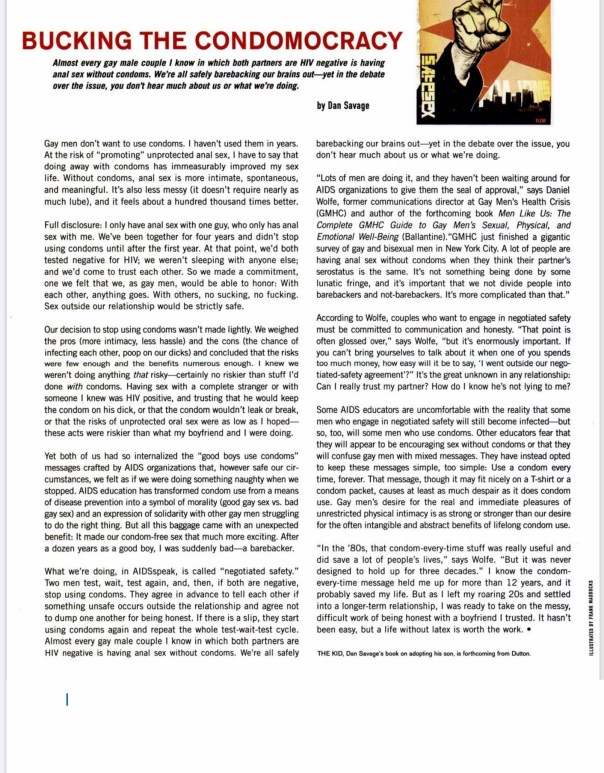
In 1999, both “Blue” magazine (the “Bucking the Condomocracy” article, also reprinted in “Out” Magazine, July 1999, Vol. 7, No.12), and “HQ” magazine (“They Shoot Barebackers Don’t They?”) published articles on barebacking, the one in “HQ” being a reprint of an article from “Poz” magazine. The latter caused a bit of a furore in both “The Sydney Star Observer”, and in the “Sydney Morning Herald”…probably understandably. Read in the context of HIV education and safe sex messages at that time, they read almost as a promotion of barebacking.

I was writing regularly for “Talkabout” magazine at the time, and was on the magazines working group. When I read both articles, I thought they elicited a response, and started to put an article about it together. However, several things were going on at “Talkabout”’ at that time, most notably was a new editor, and I was unsure of how liberal she was going to allow the writing to be, and secondly was an article I had written about the “Options” Employment Agency, which was operating on Oxford St at the time, supposedly to assist HIV/AIDS people to return to work after surviving AIDS, or to re-educate. I had written an expose of them not really doing much to actually assist people, and using said clients to do unpaid “work experience” in their offices. The editor, in all fairness, had sent the article to them… and their response was to threaten to sue the organisation (PLWHA NSW), the magazine, and myself. It was “Bring it on!” from my perspective, but obviously from the organisations…and funding…perspective, it wasn’t something they wanted..As it turned out, my accusations were accurate (I had been quite outspoken about what was going on there for some time,…and had the written testimony of a number of guys who had personally encountered the rort…and had even had the office manager of Options…whose name escapes me now…invite me into his office, and made veiled threats about what I was saying) and the agency had its funding stopped, and closed down shortly after. The article was published, but was so heavily edited that it lost all its clout. I was very disappointed.

However, this made me a bit dubious about publishing another controversial article, and being unsure about the editors response to this piece, and time then passing, I never completed the article. I have been republishing most of my “Talkabout” articles on my blog over the last couple of years…some re-edited, some not…and came across the original draft for this article. I couldn’t actually remember the content of the magazine articles, so did a bit of googling, and thanking the gods of cyberspace that nothing ever disappears completely in the ethos…I found both original articles. I will now include them in my article, to have a permanent record of them. They both make interesting reading.

About 18 months or so further down the line, and with a different editor, I wrote yet another controversial piece on bug chasing…heavily researched, so unbiased…that was totally pulled from publication by the then “Talkabout” working group. It was with great trepidation that Glenn, the then editor, rang to tell me the decision. He knew how much work had gone into it, and I cannot ever recollect an article, written by a HIV+ man, being pulled from publication before in “Talkabout”. The reasoning: it was a great article, but because “Talkabout” was funded by NSW Community Health, there was a perception that said organisation may have seen it as a “promotion of the act of bug chasing” rather than an expose. I was furious. Bug chasing was being talked about within the HIV community, the whole sex dating mentality of “breed me” was a reality…it was happening! To my thinking…it was as if they were burying their heads in the sand, and pretending this just wasn’t happening! The mentality defied me!

Such is the life of writers lol.

Here are the links for both articles

https://www.poz.com/article/They-Shoot-Barebackers-Don-t-They-1459-4936

https://books.google.com.au/books/about/Out.html?id=cmIEAAAAMBAJ&redir_esc=y

Below is my original article with the articles now included. At the end is letters published regarding the “Bucking the Condomocracy” article, and a more recent article on the same subject. My bug chasing article can be found on this blog simply by searching for “barebacking”.

HIV Hyped

My, hasn’t the HIV community been blessed this month, with both a quarterly and a bi-monthly magazine taking up the HIV cause. I wish I could think that the sort of hype they give HIV/AIDS is harmless, but unfortunately, after reading through both articles – twice – just to make sure I hadn’t miss a subtle point, my conclusion is not so.

The article in HQ magazine (They Shoot Barebackers, Don’t They?), which has also received publicity via both the Sydney Star Observer, and the Sydney Morning Herald, is a reprint of an article from the American POZ magazine in February 1, 1999. When my partner and myself (also HIV+) read the article earlier this year, we were both quite horrified. It described in quite detailed account the so-called phenomena of ‘barebacking’, a current catch-cry for unsafe sex, especially between HIV positive and HIV negative men. This is supposedly by people who are ‘over’ practising safe sex and using condoms, and desire the thrill of ‘skin-to-skin’ sex. It reports on private parties in the USA for people who wish to indulge in this type of sex, and consider the risks of catching HIV minimal, compared to the joy of unprotected sex. Needless to say, the people who run the parties make sure everyone present signs a disclaimer. Wouldn’t want to get sued by people becoming infected, would we! The phenomena has reached as far as the Internet, where there are advertisements placed by HIV negative people to get HIV positive people to supposedly ‘father’ their own HIV infection. The mere implications of this sort of mentality would be enough to frighten anybody. There are also porn sites promoting galleries of photos with guys barebacking. Make it erotic, and you make it right, or so it would seem.

Of cause, the obvious question to ask is why is this happening? Have we stretched the limits of the practice and promotion of safe sex as far as it can go? Have people become so accepting of HIV that it is no longer considered a dangerous disease? Does the fact that we now have an arsenal of drugs to control HIV infection reducing people’s fear of infection? Do younger people consider the entire AIDS issue as a ‘generational’ thing? Is it just a millennium trend? Considering the current arguments going on around compliance and drug holidays, I don’t think it is feasible to even consider that HIV is either ended, or under control. Ask anyone infected and on drug regimes what they think of this! Ask them how much they enjoy taking the handfuls of pills everyday, and how much they enjoy the side effects of same. Ask them about how secure and comfortable they feel in the knowledge of a possible ten to twenty years with such regimes; always hoping the next generation of drugs is going to be easier on us. A vaccine is still a long way off.

Likewise, I also loved the article in ‘Blue” (“Bucking the Condomocracy”) which hit you in the face with the fabulous attention grabbing statement (in bold font) ‘POST-AIDS’. Now this article isn’t quite as bad as I originally thought. In the context in which it is written, it is in many respects correct. However, it does overlook a major point. If we are living with a ‘Post-AIDS’ mentality, then why are so many people in their mid twenties seroconverting? The article tends to cover the promise given by new treatments, but not the fact that playing down HIV is a dangerous road to take. It is full of trendy language, and as someone who has lived with HIV day in and day out for the last seventeen years, I haven’t heard of any of the expressions mooted by the author. Terms such as a ‘Protease Moment’, ‘vaccine optimism’ and ‘vaccine positive’ (in respect to forth coming language in the vaccine age) are all nice terms, and factually the article is right-there is more emphasis being placed on a preventative vaccine than a therapeutic, but that possibly is still a decade away. The article is, I grant you, full of positive images, which perhaps isn’t so bad in a world where doom and gloom are never far from the headlines. But it does seem to have made it look as though HIV is no longer happening. By being so nicey nicey about HIV, I feel it tends to play down the actual dangers inherent in contracting it. Again, ask anybody HIV positive if the would change sero status if possible, and you would get an almost one hundred percent resounding yes!
I felt, when originally reading the barebacking article earlier this year that it demanded a response, but being in an American magazine, and being a phenomena that I had not heard of occurring here (not, of cause, taking into account the many unsafe sex stories one hears from the saunas and backrooms), I decided to let it lie. The fact that HQ magazine has done a sideline on the Australian reaction to barebacking does not change the fact that, having the subject announced on the front cover is irresponsible journalism, to the extreme. The editor can defend it however she likes, but then she is not working in mainstream HIV/AIDS, and obviously knows very little about the subject, or the implications of the article. Trying to make barebacking a mainstream and fashionable pastime is not funny! An article published by Capital Q the same week as the SSO had its piece on HQ, showed the possible incidence of contracting HIV through unsafe sex. Odds of 120 to 1 (for unsafe anal) may sound good to many people, but considering the sex life of your average horny gay male, that makes the risk of infection from unsafe practices highly likely very early in their lives.

I grant that freedom of the press is a much-nurtured principle, but it can go too far, and the press often plays a major role in influencing people in a particular course of action that they may not otherwise take, and are often paramount in establishing new trends (Desirable, and undesirable). Journalists must stop looking at just headline stories to sell magazines, and consider the implications of what they are publishing.

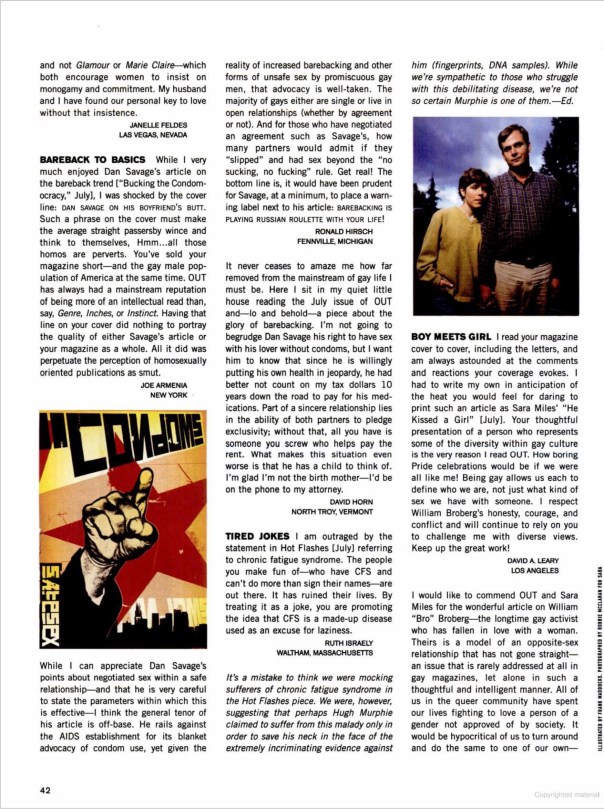
LETTERS PUBLISHED IN “OUT” MAGAZINE SEPTEMBER 1999, VOL 8, NO. 3 IN RESPONSE TO “BUCKING THE CONDOMOCRACY”.
Barebacking is Dead. Long Live Barebacking!

Treasure Island Media

Leave it to science and rational thinking to ruin a popular sexual taboo.

The “bareback” label for sex without a condom has faded in the age of pre-exposure prophylaxis (PrEP) and U=U. People not living with HIV who are taking PrEP are protecting themselves from transmission, while people living with HIV who have an undetectable viral load are unable to transmit the virus to their sex partners at all. As the very definition of HIV risk is being rearranged, the problematic term “barebacking” is finally being relegated to the dust bins of history.

We all know the nature of taboo. The naughty, furtive longing for something forbidden. As the AIDS pandemic lurched from the murderous 80s into the 90s, sexual behavior among gay men pivoted, from horror at the very thought of sex without a condom to, well, something we just might like to do. Real bad. “Barebacking” instantly became part of the lexicon, spurred by maverick porn producers who capitalized on our carnal desire to have sex without a barrier.

Sex without a barrier. Unprotected sex. Barebacking. Also known as having sex. Ask a straight person.

Gay men have always barebacked, of course (along with every other human being and their parents), certainly before HIV ever showed up and yes, even immediately after. If we all had stopped fucking without barriers we would have halted the HIV epidemic in its tracks. Instead, we kept behaving like human beings, making mistakes or getting horny or saying yes when we should have said no or getting drunk or falling in love or being young and stupid.

And sometime, even in the darkest and deadliest years of the epidemic, to unload inside our partner was an enormous “fuck you” to AIDS. You might not understand the humanity of that choice, the triumph of it, or the search it represented for some kind of spiritual and physical release in the midst of relentless mortality. I guess you had to be there.

Not long after we emerged from the 1990s, shell shocked but ready to rumble openly again now that we were armed with effective medications, a renegade porn star bottom named Dawson collected orgasms in the double digits on video and his flick was so polarizing that it was banned in gay video stores. Today, his exploits seem positively quaint, and those same video stores and the countless internet sites that followed transformed themselves from featuring a barebacking category to dropping the category and lumping everything together. Sex without condoms in porn is now customary. Condoms are the outlier.

The actual term has lost its wicked luster. These days, you rarely hear your sex partner say, “oh yeah, fuck me bareback, man.” I mean, sure I will, dude. Yawn.

And gone, too, hopefully, is the judgment of those who labeled barebacking a deviant, destructive pathology. This may be the most painful aspect of our prevention legacy; the rush to demonize those who admitted to having sex without condoms before it became agreeable again, not to mention the furor over those of us who have spoken empathetically about sex without a barrier.

Activist and writer Tony Valenzuela became a community pariah when he wrote a piece in 1995 about being a young man living with HIV who had condomless sex with his boyfriend. He thumbed his nose at his detractors when he appeared naked on a horse for an infamous 1999 POZ Magazine cover (“They Shoot Barebackers, Don’t They?”) in which he discussed how the controversy angered and confused him. Valenzuela’s personal character was questioned and his professional life was derailed for years.

The late social anthropologist and author Eric Rofes (Reviving the Tribe) nearly caused a riot at a 1996 Atlanta town hall event for gay men when he discussed the spiritual and emotional value of sharing semen with a partner. And even as recently as 2013, my essay, “Your Mother Liked It Bareback,” produced one apoplectic comment, among many others, that remains the pinnacle of my blog infamy. “You,” it said, “are a vile merchant of death.”

Maybe, with our new biomedical tools of HIV prevention, those same people who once blindly damned sexual behaviors they didn’t understand — whether out of puritanical beliefs or their fear of their own desires – have reconciled their fantasies and their HIV risk. I hope they’re enjoying totally hot sex and the fluids are flying.

It is difficult to ignore the appalling homophobia, internalized and otherwise, that runs through this aspect of HIV prevention history. We held ourselves as gay men to a more grueling standard than the countless non-queers who get an STI (several of them life-threatening) or an unplanned pregnancy every year.

I have no illusions. Sexually transmitted infections continue, even if the very thought of gonorrhea just makes me feel nostalgic. The PrEP train hasn’t reached everyone who might benefit from it and there is misinformation about its efficacy and side effects. Meanwhile, nearly half of those living with HIV in the United States have not reached viral suppression. There is still reason to be cautious about the who and the when and the how of sex. Now, as ever, we are responsible for our own bodies and the risks we take.

Frankly, behavioral change has not served us well in the grand scheme of HIV prevention. There has always been some debate, tension even, between those who believed the answer to HIV infections is behavior modification, and those who welcome the advent of biomedical interventions such as PrEP and “treatment as prevention” (TasP) that don’t rely upon sexual behavioral choices to work.

Throughout the decades, we have all witnessed the dominant, primal pull that sexual desire has exhibited over caution, so I know which prevention strategy my money is on. But hey, to each his own strategy. For that matter, condoms are a golden oldie and a perfectly legitimate choice. You do you.

What has changed are the conversations and information gathering that happen between partners. PrEP, medications, who is undetectable or not, what sexual positioning in what combination will occur, all of these exist in a more informed landscape, at least among gay men in this country.

Barebacking, as an urban phrase and a taboo, is dead. Thank god and good riddance to this divisive bit of sexual branding. Sex, meanwhile, motors happily onward, unbothered by the judgments of man.

References

Gay History: Nancy Kulp: Life In The Celluloid Closet (Miss Jane Hathaway In “The Beverly Hillbillies)

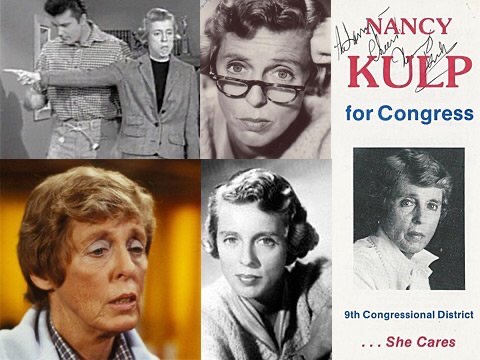
In the 1960s, it was almost unheard-of to find an out Queer person on television. Those that held a Queer identity were often forced into a ‘celluloid closet’ and made to keep their identities silent and hidden from public consumption. This was the case of Nancy Kulp, a closeted lesbian who is most remembered for her appearance as Miss Jane Hathaway in almost all of the 274 episodes of The Beverly Hillbillies, a television series airing on CBS from 1962 to 1971. Kulp would eventually come out, using her own terms, in a 1989 interview.

Nancy Jane Kulp was born in Harrisburg, Pennsylvania on August 28th, 1921 to Marjorie and Robert Kulp; the family would later move to Dade County, Florida. The only daughter of a lawyer and schoolteacher, Nancy was a bookish child from an early age and dreamed of becoming a journalist. Nancy would take the first step toward her goal when she graduated from Florida State University with a bachelor’s degree in journalism in 1943. During her years at FSU, Kulp worked as a feature writer for the Miami Beach Tropics, working on celebrity profiles.

Though she planned on continuing her education and obtaining her master’s degree, Nancy joined WAVES (Women Accepted for Voluntary Emergency Service) in 1943 to aid the US Navy during World War Two. While it was her patriotism and desire to work in an “all-female” atmosphere that led to her enlistment, Nancy determined that it was not her destiny to hold a career in the armed forces and left in 1945 after reaching the rank of junior-grade lieutenant. After leaving WAVES, Kulp took a position in Miami as a publicity director for a local radio station in 1946.

At the age of thirty, Nancy Kulp exchanged vows in an April Fool’s Day wedding celebration to Charles Dacus on April 1, 1951. While the marriage was short-lived, both parties parted on good terms and the relationship had a long-lasting impact on Nancy Kulp’s life. Nancy said that it was Charles Dacus who encouraged Kulp to leave her career as a publicist to achieve a career in acting (though she also later said that this inspiration came from director George Cukor). Following this encouragement, Nancy made her way to Hollywood where she took a position as a film publicist while she waited for her big break.

This break would come only three weeks later when she was discovered by A-list, gay, director George Cukor. Later that year, Nancy Kulp would make her big screen debut in Cukor’s 1951 film, The Model and the Marriage Broker. This role was larger than most others she would hold in movies though it was mostly silent and demeaning as she took on the role of a young woman desperately seeking matrimony from a marriage broker. This role was Kulp’s first foray into the sort of character she would often be type-cast to play- the spinster.

In 1954, Nancy would be cast in another Cukor film, the Judy Garland- led A Star is Born, though the scene in which she appeared would later be cut without the director’s knowledge or consent. Kulp would make several smaller appearances in many successful films such as Sabrina (the 1954 film starring Audrey Hepburn), The Three Faces of Eve (1957), Strange Bedfellows (1965), and The Parent Trap (1961), where Kulp played the butch troop leader.

While Nancy appeared in movies, most of her acting work was done for the small screen. She made several appearances, largely comedic, on various television shows. Her first recurring television role was as a bird-watcher named Pamela Livingstone on The Bob Cummings Show (1955-1959). The writer for The Bob Cummings Show, Paul Henning, would go on to write for The Beverly Hillbillies, and created a role specifically for Kulp. Nancy would become known across the country as Miss Jane Hathaway, a smart and confident secretary that worked for a bank. Miss Jane, as most of the characters called her, was also a character that played into Kulp’s type-casted role as a spinster. Kulp received an Emmy Award nomination in 1967 for her performance on the show.

After the final episodes of The Beverly Hillbillies, Kulp was given a regular role on the Brian Keith Show (1973-1974) and made appearances on Sanford and Son (1972-1977), The Love Boat (1977-1987), and Fantasy Island (1978-1984). Kulp also appeared on stage at summer stock and dinner theaters before eventually landing a role in Paul Osborn’s 1982 production of Mornings at Seven.

In 1984, the patriotic Nancy Kulp, who had long been interested in politics, decided to run for Congress in her district in central Pennsylvania, having settled in Port Royal. She ran as a Democrat against the Ninth District’s incumbent Republican representative, Bud Shuster. While she received an endorsement from friend and fellow showbiz personality Ed Asner, her Hillbillies costar Buddy Ebsen recorded a radio advertisement claiming that Kulp was “too liberal for Pennsylvania.” Kulp was enraged by Ebsen, a California resident, getting involved in her campaign, stating that she “was speechless at such a betrayal, and something so needless and cruel.”

Nancy Kulp would go on to be defeated by Shuster and would spend the next year at Juniata College in Huntingdon, Pennsylvania, teaching film and drama. She would later return to California to serve on the board of the Screen Actors Guild and take an active role in non-profits including the Humane Society of the Desert, United Cerebral Palsy, and the Desert Theater League.

In a 1989 interview with author Boze Hadleigh for the book Hollywood Lesbians: From Garbo to Foster, Kulp responded to Hadleigh’s “Big Question” (the question of her sexuality which she renamed the “Fatal Question”) Nancy remarked in her own words:

“As long as you reproduce my reply word for word, and the question, you may use it,” she told Hadleigh. “I’d appreciate it if you’d let me phrase the question. There is more than one way. Here’s how I would ask it: ‘Do you think that opposites attract?’ My own reply would be that I’m the other sort–I find that birds of a feather flock together. That answers your question.”

Never in the course of the interview did she refer to herself as a lesbian.

Nancy Kulp would die of cancer only two years later, on February 3, 1991, at her home in Palm desert, California. While she never actively owned a lesbian label, Nancy Kulp was hailed as being a lesbian ground-breaker in the field of acting for having portrayed her identity (though a secret) in her work.

Former “Beverly Hillbilly” Says She Didn’t Play The Political “Game″

WASHINGTON (AP) _ Nancy Kulp of ″The Beverly Hillbillies″ fame doesn’t blame fellow Hillbilly Buddy Ebsen for her election defeat last fall – but says he should have stayed out of the congressional race.

Ebsen, who starred with Ms. Kulp on the long-running television program in the 1960s and early 1970s, recorded a radio commercial for her opponent, Republican Rep. Bud Shuster. In the spot, aired several weeks before the election, Ebsen said, ″Nancy, I love you dearly but you’re too liberal for me.″

Ms. Kulp still bristles when she thinks about the ad. ″How dare he 3/8 It wasn’t his business,″ she said.

But she said there were other reasons for her defeat, notably her lack of political savvy, a shortage of campaign dollars and the popularity of President Reagan in Shuster’s sprawling rural Pennsylvania district.

“I didn’t play the game, I guess,″ Ms. Kulp, 63, said in a telephone interview from Los Angeles. She left her restored, three-story farmhouse in Port Royal, Pa., after the election and drove to California to visit friends.

While she raised $73,143 during 1984, Shuster, who was seeking his seventh House term, reported contributions of $269,597, according to campaign finance reports. Ms. Kulp reported gifts of $29,471 from political action committees, Shuster $138,817.

After years of involvement in local party politics and with the Screen Actors Guild, Ms. Kulp said seeking office was satisfying because ″you finally get to put your convictions on the line. It was one of the highlights of my life.″

But the experience left her with a helpless feeling that there was an image barrier between her and the voters that she could not surmount.

“You’re turned off by the distortions,″ she said. ″My feeling is a candidate is elected because they are perceived to be something. Ronald Reagan never talked issues; he waved the flag and the people loved it.

“I was perceived to be an ultra-liberal. If that is their perception – even if they like me – then I can’t win.″

The experience, she said, has left her ″ambivalent″ about the elective process and doubtful that she will seek public office again.

A central Pennsylvania native born in Harrisburg, Ms. Kulp began her acting career in 1952. She appeared in such films as ″Three Faces of Eve″ and ″The Parent Trap,″ and was featured on ″The Bob Cummings Show″ on television before the ″Beverly Hillbillies″ premiered in 1961.

On the ″Beverly Hillbillies,″ she played the secretary of a banker managing the account of a millionaire hillbilly, played by Ebsen. She and Ebsen used to talk politics on the set; they rarely agreed about issues, she said.

Ms. Kulp said she now is thinking about returning to the East Coast, possibly to teach. Juniata, a small liberal arts college 120 miles east of Pittsburgh, has expressed interest in her, perhaps for an ″artist-in-re sidence″ program, said college spokesman Robert Howden.

Who the F Is … Actress and Politician Nancy Kulp?

Who she was: A well-regarded character actress who eventually ran for public office and came out — rather obliquely.

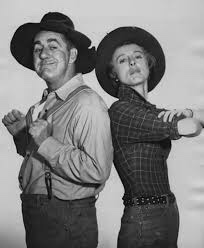
What she accomplished: Nancy Kulp (1921-1991) endeared herself to baby boomers with her role on a silly but successful TV sitcom, The Beverly Hillbillies. From 1962 to 1971, she played the prim, efficient Miss Jane Hathaway, secretary to banker Milburn Drysdale. She and Drysdale were managing the millions of the Clampett family, a backwoods clan who had relocated from Tennessee to Beverly Hills after striking oil. The comedy arose from the contrast between the beyond-unsophisticated Clampetts — who made moonshine, kept “critters,” and called their swimming pool “the cement pond” — and the upscale Southern Californians who surrounded them. Hathaway, always called “Miss Jane” by the Clampetts and their kin, was unaccountably attracted to the dim-witted Jethro Bodine, nephew of patriarch Jed Clampett. Critics had no love for the show, but viewers found it hilarious, and it had an extended life in syndication.

Born in Harrisburg, Pa., Kulp studied journalism in college, then served in the WAVES during World War II. After the war she worked as a publicist for radio and TV stations in Florida, then came to Hollywood in the 1950s with an eye to continuing in publicity. Someone encouraged her to try acting — some accounts say it was her then-husband, Charles Dacus, whom she refused to discuss in later years; others say it was esteemed director George Cukor. At any rate, she quickly won a small role in a Cukor film, The Model and the Marriage Broker, starring Jeanne Crain, Scott Brady, and Thelma Ritter. It was one of the great filmmaker’s lesser efforts, but it launched her career. She played supporting parts, often uncredited, in some noteworthy movies — Shane, Sabrina, the Judy Garland version of A Star Is Born, also directed by Cukor — and some now-forgotten ones. She also worked in TV anthology series and in guest-starring roles. Before Hillbillies, she was a regular on The Bob Cummings Show, playing a spinsterly bird-watcher named Pamela Livingstone. (Bird-watching was also one of Miss Jane’s hobbies.)

After The Beverly Hillbillies ended, she continued to guest-star on various TV series; she had a recurring role on Sanford and Son for a time, and like many aging actors she appeared on The Love Boat and Fantasy Island. She also performed on Broadway in Morning’s at Seven in the early 1980s. But she had a passion for politics, dating back to Adlai Stevenson’s presidential campaign in 1952, and in 1984 she returned to central Pennsylvania to run for Congress. She was an underdog as a Democrat in a heavily Republican district represented by a popular incumbent. She got support from showbiz friend Ed Asner, but her Hillbillies costar Buddy Ebsen, who had played Jed, did a commercial in which he called her “too liberal” and endorsed her opponent. It caused a rift between them that lasted for years, although they reportedly eventually made up. She lost the election to the incumbent, Bud Shuster. Later, she taught acting at a Pennsylvania college and made some stage appearances, including one as the Nurse in Romeo and Juliet at the 1987 Georgia Shakespeare Festival in Atlanta, then retired to the California desert, where she kept busy with volunteer work. Among other things, she served on the board of the Screen Actors Guild.

In 1989 she addressed her sexual orientation — to a degree — in an interview with Boze Hadleigh, published in his book Hollywood Lesbians. “As long as you reproduce my reply word for word, and the question, you may use it,” she said. “I’d appreciate it if you’d let me phrase the question. There is more than one way. Here’s how I would ask it: ‘Do you think that opposites attract?’ My own reply would be that I’m the other sort — I find that birds of a feather flock together. That answers your question.” Miss Jane would have appreciated the imagery. She also expressed admiration for gay congressman Barney Frank, and when Hadleigh asked if she would have come out in Congress, she said, “Not voluntarily. If I were outed, then I would not deny it.” Hadleigh waited to publish the book until 1994, when all his subjects were dead. Kulp died of cancer in 1991 at her home in Palm Desert, Calif.

Choice quotes: “If one is past 50 or 60, it’s almost like saying that most of your life you’ve been too embarrassed to admit it or to speak up.” — to Boze Hadleigh, on the possibility of coming out

“I think I’ve been successful in making the distinction between actress and politician. But there’s always someone who screams, ‘Where’s Jethro?’” — to People magazine, during her congressional campaign

10 times Miss Jane Hathaway let loose and ditched her pressed suit on The Beverly Hillbillies

Take a tour of Nancy Kulp’s silliest costumes.

At its heart, The Beverly Hillbillies was about breaking out of your comfort zone, and it wasn’t just the Clampetts experiencing the growing pains. Fans know that Miss Jane Hathaway, the snooty bank secretary who keeps an eye on the Clampetts, had as much to learn from the hillbillies about having fun as they did from her about fitting in with fine society.

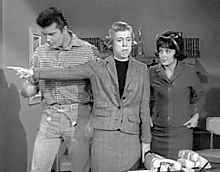
We first meet Jane Hathaway in the bank, dilligently taking notes for Mr. Drysdale, her boss, the insanely wealthy bank manager. She’s wearing her signature pressed suit, a drab number we’d see her sport throughout most of the initial seasons. But it wouldn’t take the writers, costumers and hillbillies long to wrestle Miss Jane out of those stuffy suits and neckerchiefs just to stuff her into funnier outfits that drew extra laughs precisely because she’d been set up as such a straight character. It was one of many ways the show had fun with its audience.

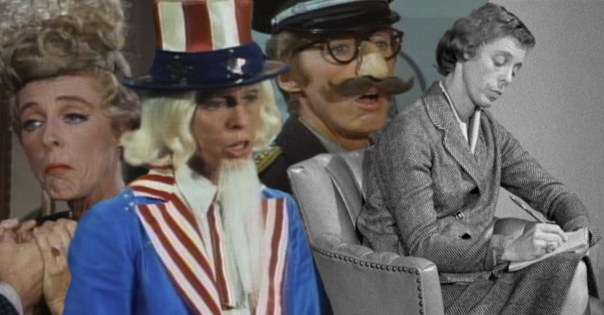
Below, we’ve gone back through our favorite episodes of The Beverly Hillbillies to offer up this tour of Miss Jane Hathaway’s most dazzling and outrageous outfits over nine seasons. Played brilliantly by Nancy Kulp, Miss Jane remains one of the show’s most memorable characters, and here’s a parade of standout moments that show us how her wardrobe helped cement her legacy.

1. Miss Jane Hathaway the Artist

It only took seven episodes before we saw Nancy Kulp slip into something sillier, this artist look that we consider her character’s first masterpiece in transformation.

2. Is that Nancy Kulp or Groucho Marx?

In the later seasons, the volume got turned up on Nancy Kulp’s costumes, and this was perhaps the height of that hilarity.

3. A hillbilly before the first season ends.

By the end of the first season, we got our first look at Nancy Kulp in hillbilly garb, and even doing a dance with the whole Clampett family! Talk about letting loose! This primed us to expect the unexpected from the typically kempt Miss Jane.

4. Remember when Miss Jane posed as Uncle Sam?

The color episodes of The Beverly Hillbillies do not disappoint when it comes to costumes, especially this red-white-and-blue suit arguably louder than any other suit she donned the whole series.

5. Miss Jane, the pageant queen.

There were many plots that involved Elly and Jane in competition for a suitor’s attention, but this beauty contest in the third season was the first time they turned that trope into a swimsuit competition!

6. Don’t think Miss Jane’s beneath a denim suit!

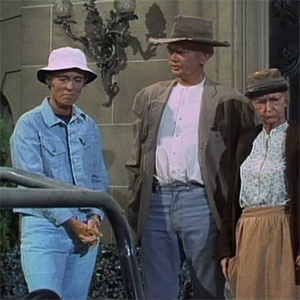
Need proof that Miss Jane Hathaway is a trendsetter? Check out this denim suit she donned at the very start of the ’70s. It was her idea of beach attire, and the bucket hat just perfects the look, don’t you think?

7. Fancy Nancy!

There were plenty of times, as we’ll get into soon, when Nancy Kulp showed up looking stunning on The Beverly Hillbillies, but we get flashes of Carol Burnett and Friends when we saw this particular evening attire and wacky updo!

8. Miss Jane’s very first evening look.

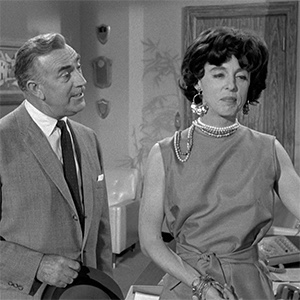
Let’s take a moment to just genuinely appreciate how Nancy Kulp completely owned silk, pearls and simplistic elegance. Bask in the very first time we saw her in a seriously stunning evening look from the first season.

9. That’s not to say she didn’t also know how to overdo it…

Between the wig, costume jewelry and dangly everything, Miss Jane almost looks as out of sorts in this outfit as Elly May did in an evening gown!

10. Proper, even in pajamas.

Last look is all the proof you need that Miss Jane even prefers to sleep in a suit, donning these neat blue pajamas in contrast to Granny’s gowns, but that changes soon when the writers get her character stuck in a sleeping bag that Granny’s trying to free her from here. It’s just one more example of all the physical humor that came just from shaking up Jane Hathaway’s wardrobe!

References

Jethrine Bodine; The Beverly Hillbillies

The television world of Paul Henning stretched from the Appalachian Mountains to the Hollywood Hills. The sitcom creator struck gold (well, oil) three times with his beloved hits The Beverly Hillbillies, Petticoat Junction and Green Acres. That trio of smash shows delivered dozens of memorable characters, many of which crossed over from series to series. 

Henning’s anything-goes brand of homespun comedy included a menagerie of clever animals, like Dog and Arnold, not to mention actors switching roles. Bea Benaderet played both Cousin Pearl Bodine on The Beverly Hillbillies and Kate Bradley on Petticoat Junction. But no role-hopping was quite so silly as Max Baer Jr. portraying both Jethro Bodine and his twin sister, Jethrine Bodine. 

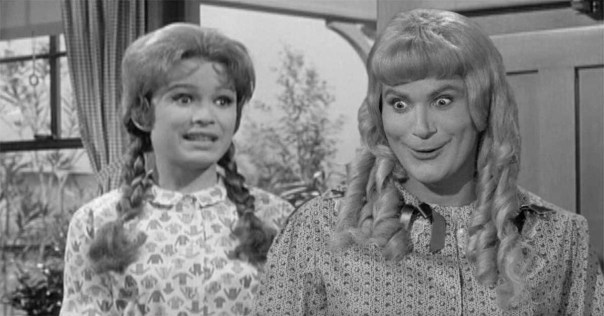
Jethrine, as you will recall, was simply Max Baer Jr. dressed up to look somewhat like Little Bo Peep. He slipped into a curly blonde wig and floral dress and hammed it up. The joke was made complete with Jethrine’s feminine voice, which was clearly not dubbed by Baer.

Henning hired his daughter, Linda Kaye Henning, to give Jethrine her voice. At the time, in 1962, Linda Kaye had just one credit to her name, a bit role in a single episode of Mister Ed which aired earlier that year. She would voice Jethrine in 11 episodes throughout the first season of The Beverly Hillbillies.

In 1963, Linda Kaye’s collaboration with her dad leaped to a new level when she joined the cast of Petticoat Junction as Betty Jo, the redhead in the trio of Bradley daughters. Betty Jo played a significant role in the series. She was the one who discovered Dog at the start of season two. Later, after a major ongoing romance, she would marry cropduster Steve Elliott, played by Mike Minor. Henning would go on to appear in more episodes of the series than any other actress, appearing in all but three. (Not to mention, she would marry Minor in real life.) 

Alas, despite all the crossovers, Betty Jo and Jethrine never shared screentime. Jethrine disappeared in ’63, just as Betty Jo first popped her head out of the water tower.