Tag Archives: Southwark stews

The Southwark Stews: Sex, Sin and the Bishop’s Brothels in Medieval London

Across London Bridge, beyond the tightly regulated streets of the medieval City of London, lay another world.

Southwark was noisy, crowded, transient and disreputable. Travellers arrived there before entering London. Pilgrims gathered in its inns before setting out towards Canterbury. Sailors and merchants came ashore along the Thames. Taverns provided drink and lodging. Entertainments flourished that respectable London preferred to keep at arm’s length.

There were gambling houses, animal-baiting arenas, inns, alehouses and, eventually, theatres.

And there were brothels.

They became known as the Southwark Stews.

Yet perhaps the most extraordinary thing about this notorious medieval red-light district was not that prostitution flourished there.

It was the identity of the landlord.

Much of the district belonged to the Bishop of Winchester.
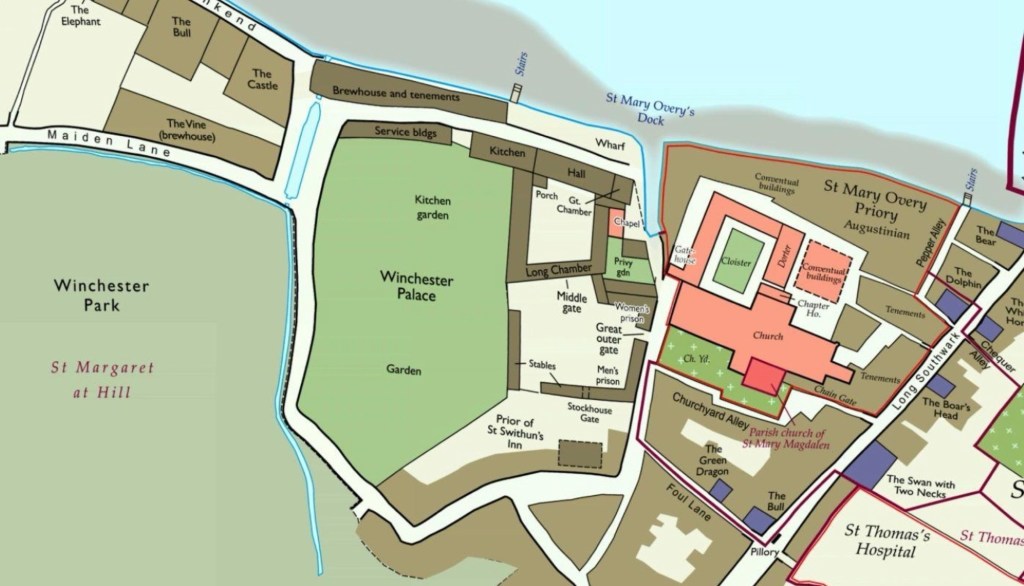
Liberty of London…Winchester Palace

For generations, therefore, an institution that preached against sexual sin simultaneously presided over a district in which commercial sex was tolerated, regulated and financially profitable.

The story of the Southwark Stews is consequently much more than a colourful footnote to London’s sexual history. It provides an extraordinary window into the compromises of medieval society: the enormous distance that could exist between religious doctrine and practical government, the precarious lives of women who sold sex, and the attempts of authorities to control sexual behaviour without ever really expecting to eliminate it.

And lurking behind the story is another intriguing question.

If heterosexual commercial sex could flourish semi-openly in medieval Southwark, what other sexual worlds existed alongside it?

That question leads eventually towards the largely hidden history of men who desired other men before Henry VIII’s Buggery Act of 1533.

But first, we must cross London Bridge and enter the Stews.

Across the Bridge

Medieval London was not one homogeneous city.

The City of London possessed its own government, courts, regulations and privileges. Immediately outside its jurisdiction, however, were numerous liberties and suburbs where different authorities exercised control.

Southwark lay across the Thames in Surrey.

The Bishop of Winchester owned extensive property there, centred upon his magnificent Winchester Palace, whose surviving ruins can still be seen near the modern Bankside.
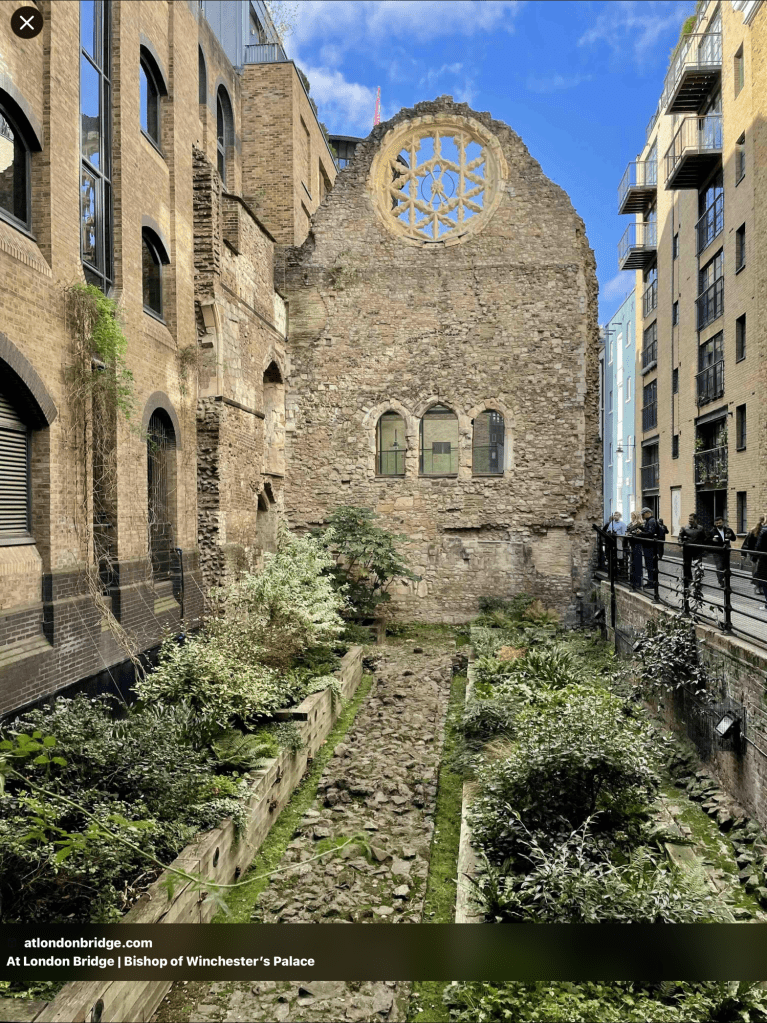
At London Bridge…the Bishop of Winchester’s Palace

His territory became associated with the Liberty of the Clink, named after the bishop’s prison. The word clink eventually became slang for prison itself.

Southwark’s position made it ideal for activities that the authorities of London either prohibited or preferred to keep away from respectable neighbourhoods.

The river provided customers.

London Bridge provided customers.

The inns provided customers.

Travellers provided customers.

And the authorities provided something equally important:

a degree of tolerance.

By the late fourteenth century, prostitution in and around London was particularly associated with two tolerated districts: Cock Lane near Smithfield and Southwark. (Wellcome Collection)

The latter would become by far the more notorious.

Why Were They Called “Stews”?

The name sounds wonderfully peculiar today.

A stew originally had associations with heated baths and bathhouses. Public bathing establishments existed throughout medieval Europe, and some acquired reputations as places where customers could obtain considerably more than hot water.

Bathhouses and prostitution became so closely associated that stew gradually developed a secondary meaning: a brothel.

Not every bathhouse was a brothel, naturally, but the linguistic association became firmly established.

By the fifteenth century, the Southwark brothels were routinely known as the stews or stewhouses. (Wellcome Collection)

The district therefore acquired a name that was simultaneously geographic, commercial and sexual.

The Bishop’s Uncomfortable Business

Here we encounter one of the great contradictions of medieval Christianity.

The Church regarded prostitution as sinful.

Yet influential Christian thinkers had also developed the idea that prostitution could constitute a “necessary evil.”

The argument was essentially pragmatic. Human sexual desire could not realistically be abolished. Suppressing prostitution entirely, some theologians feared, might merely redirect male sexual behaviour towards adultery, rape or forms of sexuality regarded as even more sinful.

The result was an uncomfortable compromise.

Prostitution could be condemned morally while being tolerated socially.

Southwark demonstrates that compromise spectacularly.

The Bishop of Winchester did not personally run brothels in the modern sense. Rather, his administration possessed jurisdiction over the territory in which the stewhouses operated, and landlords, tenants, officials and brothel keepers existed within that economic and legal structure.

And money flowed through it.

Rents could be collected.

Fines could be imposed.

Regulations could be enforced.

Sin, it turned out, could generate remarkably respectable revenue.

The Winchester Geese

The women associated with the Southwark sex trade eventually became known as the “Winchester Geese.”

It is one of those historical expressions that sounds almost affectionate until one remembers the precarious circumstances behind it.
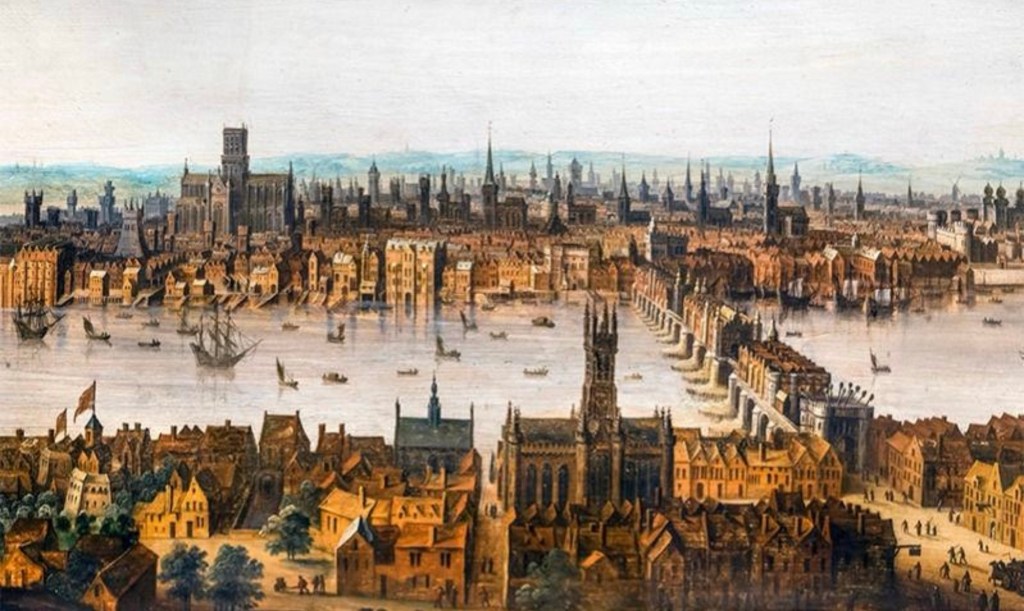
The Ferryman’s Seat, Southwark, London

A visit to a prostitute could even be described in later slang as being “bitten by a Winchester goose,” particularly in reference to contracting venereal disease.

The women themselves remain frustratingly silent in the surviving evidence.

Most records were created by men: bishops, officials, clerks, courts, landlords and moralists.

We therefore know considerably more about how authorities wanted the women controlled than about what the women themselves thought about their lives.

Historian Ruth Mazo Karras has pointed out that medieval ideas of the “common woman” were themselves revealing. A prostitute could be conceived not merely as a woman who accepted payment for sex but as a woman supposedly sexually available to men “in common.” (OUP Academic)

The terminology tells us almost as much about medieval attitudes towards female sexuality as it does about prostitution.

The Famous Ordinances

Much of what we know about the Stews comes from a remarkable surviving set of regulations generally known as the Ordinances Touching the Government of the Stewholders in Southwark.

There were dozens of provisions governing how the houses operated.

For many years an attractive story was repeated that these regulations had originated in 1161 or 1162 during the reign of Henry II.

There is a problem.

The surviving document’s claim that the regulations had been authorised by a parliament at Winchester at that time is historically impossible in the form described.

Modern scholarship instead places the customary containing these regulations in the fifteenth century. (Wellcome Collection)

It is an excellent warning about medieval history: a document can itself contain an invented history.

The authorities apparently wanted their regulations to look ancient.

Ancient custom carried authority.
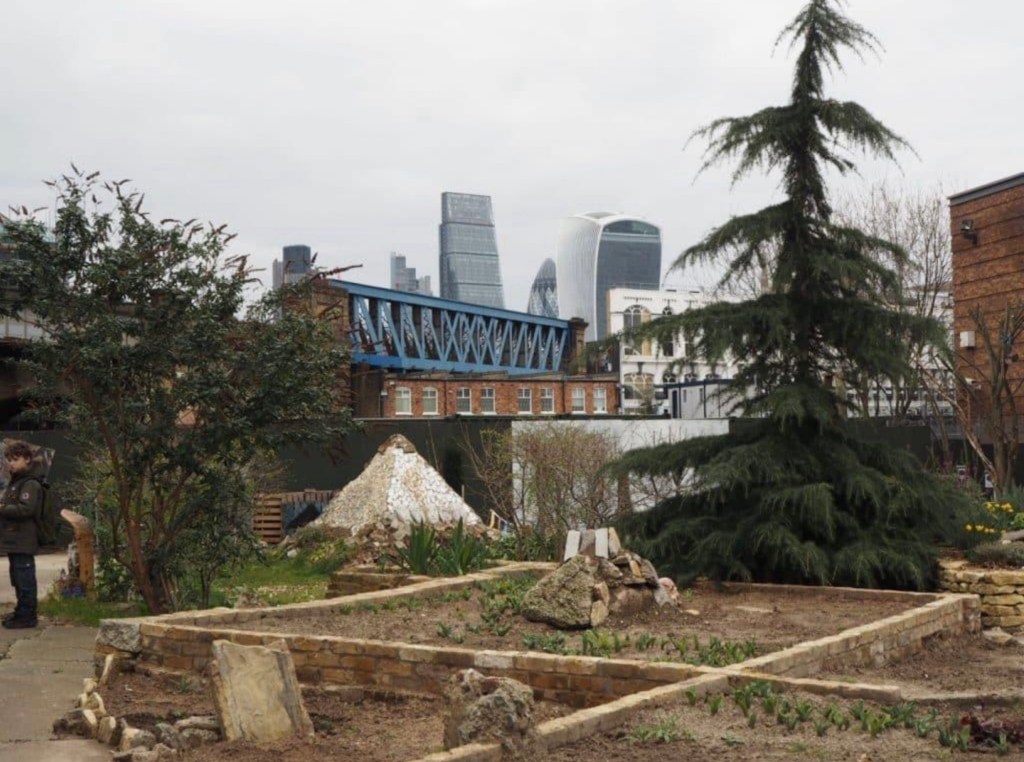
Inside Crossbones Graveyard • Look Up London Tours

Regulating Sin

The ordinances are fascinating because they reveal that the Stews were not simply an anarchic sexual free-for-all.

Rules existed concerning both customers and women.

Among the most striking provisions was one forbidding stewholders from keeping women in their houses against their will.

Officials were supposed periodically to search the houses. If a single woman was discovered being detained involuntarily, she was to be permitted to leave without interference. (OUP Academic)

This does not mean medieval Southwark had solved sexual exploitation.

Far from it.

The existence of such a regulation strongly suggests that coercion was a recognised danger.

But it does demonstrate something important: authorities understood that brothel owners could exploit and imprison women, and attempted—at least on paper—to restrict that behaviour.

There were protections for customers too.

A brothel keeper was forbidden from detaining a man because he owed money, while another provision prohibited women from physically dragging potential customers into houses from the street. (Wellcome Collection)

Health was also regulated.

Women suffering from what the ordinances called a “burning disease” were forbidden from working, almost certainly reflecting contemporary awareness of sexually transmitted infections, even though medieval medicine understood them very differently from modern medicine. (Wellcome Collection)

The Stews therefore operated inside a strange mixture of commerce, policing, public health, morality and exploitation.

It sounds surprisingly modern because governments still struggle with exactly those questions.

A Female World Governed by Men

There is an uncomfortable reality behind all these regulations.

Men controlled virtually every official aspect of the system.

Men owned the property.

Men administered the courts.

Men wrote the ordinances.

Men collected rents.

Men imposed fines.

And men formed the principal customer base.

The women generated the trade but possessed comparatively little institutional power over it.

That does not mean every woman working in the Stews was necessarily a helpless victim. Medieval women’s experiences were considerably more complicated than that.

Some undoubtedly exercised agency within the limited economic choices available to them. Others may have entered sex work temporarily. Poverty could push women towards casual prostitution alongside other occupations.

Records elsewhere in London show laundresses, servants and women working in taverns being associated with occasional sex work. Dedicated brothels represented only one part of a much larger sexual economy in which taverns, alehouses and private homes could also provide places for commercial encounters. (OUP Academic)

The neat modern division between “prostitute” and “ordinary working woman” therefore does not always fit medieval society.

For some women, selling sex may have been one activity among several methods of earning enough money to survive.
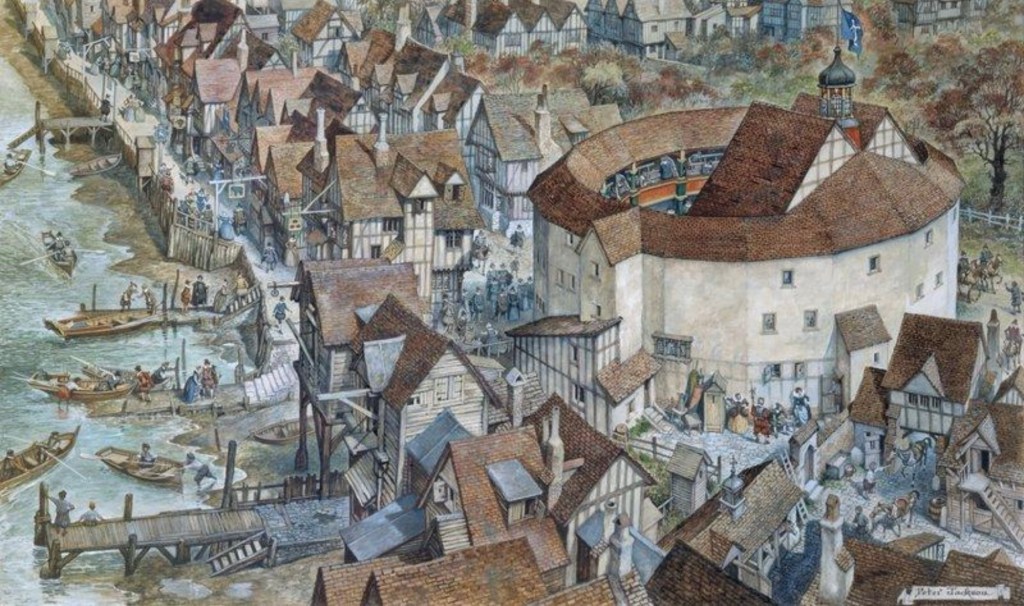
Old London reconstructed: The Rose Theatre, Southwark

Southwark’s Perfect Location

Geography explains much of the Stews’ success.

Imagine walking south across London Bridge.

Behind you stood the crowded City.

Ahead lay roads leading towards Canterbury and southern England.

Nearby were wharves filled with sailors and labourers.

Inns accommodated travellers.

Merchants arrived on business.

Pilgrims passed through.

Young apprentices and servants moved through an overwhelmingly youthful city.

Southwark consequently contained precisely the population that sustained entertainment districts throughout history:

people away from home.

And people away from home often behaved differently.

The district’s marginal legal status compounded the effect. Things restricted within the City could flourish immediately beyond its jurisdiction.

Centuries later, Bankside would become famous for another supposedly dubious entertainment:

the theatre.

The Globe, the Rose and other playhouses eventually appeared in broadly the same entertainment landscape.

Shakespeare’s audiences were therefore visiting an area already famous for centuries as London’s playground.

The Stews and the Hidden Sexual City

This is where Southwark becomes particularly important to gay history.

We must resist the temptation to describe the Stews as gay brothels. The surviving ordinances overwhelmingly concern female sex workers serving male customers.

But sexual districts create networks.

Taverns, bathhouses, lodging houses, streets, docks and entertainment venues bring strangers together.

Southwark contained all of them.

And medieval England certainly contained men who had sex with other men.

The difficulty is that those men generally did not describe themselves using identities equivalent to the modern word gay.

Authorities were usually interested in acts, not identities.

Consequently, our evidence tends to appear when something went wrong:

an arrest,

a court case,

a confession,

a scandal,

or an ecclesiastical investigation.

Successful clandestine encounters generally left no paperwork.

That creates one of the central problems of writing gay medieval history.

The archive records the men who were caught.

It rarely records the thousands who presumably were not.

Before the Buggery Act

This becomes especially important when we move towards Henry VIII’s Buggery Act of 1533.

Before that legislation, sexual acts between men were certainly regarded as sinful and could be punished through ecclesiastical or other jurisdictions.

But England did not yet possess the particular nationwide secular statute created in 1533 making “buggery” a felony punishable by death.

That does not mean men enjoyed sexual freedom before Henry VIII.

It means the machinery regulating them was different.

And that raises our next great question:

How did they find one another?

They had no gay bars.

No dating apps.

No newspapers carrying personal advertisements.

No recognised gay neighbourhood in the modern sense.

Yet human desire existed nonetheless.

Men travelled.

Men drank together.

Men slept in communal accommodation.

Men worked in overwhelmingly male environments.

Sailors lived among sailors.

Apprentices lived among apprentices.

Clergy lived among clergy.

Servants shared households.

Soldiers travelled together.

Pilgrims slept in inns.

And thousands of strangers passed constantly through places such as Southwark.

Somehow, men who desired men recognised opportunities.

That largely invisible network is the landscape we should explore next.

Crackdowns — and Survival

Tolerance of the Stews was never absolute.

Authorities periodically attempted to suppress prostitution and bawdy houses.

The early sixteenth century witnessed repeated moral campaigns around London. A 1506 attempt sought permanently to close the Southwark Stews, while authorities elsewhere prosecuted hundreds of alleged bawdy-house offences during roughly the same period. (OUP Academic)

Yet the Stews survived.

Finally, in 1546, Henry VIII ordered their closure. (Wellcome Collection)

The irony is irresistible.

Henry had broken England from papal authority.

He had dissolved monasteries.

He had transformed the relationship between Crown and Church.

He had introduced the Buggery Act in 1533.

And towards the end of his reign he also brought the famous episcopally controlled Southwark brothels to an official end.

But closing brothels did not abolish prostitution.

It simply changed its geography.

Sex workers moved elsewhere.

Customers followed.

The sexual city reorganised itself.

It always does.

The Dead of Southwark

There is one final, haunting element to the story.

Near the former Stews lies Cross Bones Graveyard.

Later tradition associated the burial ground with the “single women” of Southwark—the euphemistic description traditionally connected with the Winchester Geese.

The evidence needs careful handling. The often-repeated claim that the Bishop of Winchester formally created Cross Bones specifically as a cemetery for prostitutes is much less securely documented than popular retellings sometimes suggest.

Nevertheless, antiquarian testimony recorded a tradition that women living the “sinful life” of the Stews could be denied Christian burial unless reconciled with the Church before death.

Cross Bones subsequently became a burial ground for the poor, and archaeological investigation revealed an extraordinarily crowded cemetery. Estimates suggest around 15,000 people may ultimately have been buried within its small area before its closure in 1853. (OUP Academic)

Today the site has become a place of remembrance for people historically pushed to society’s margins.

There is something deeply appropriate about that.

The women whom respectable society condemned, used, regulated and profited from have finally acquired a memorial.

Sin on One Side of the River

The Southwark Stews expose one of history’s recurring absurdities.

Across the Thames stood respectable London.

Across the bridge stood supposedly disreputable Southwark.

But the customers crossed the same bridge.

Respectability and vice were never really separate worlds.

They depended upon one another.

The Church condemned prostitution while an episcopal estate benefited economically from the district in which it flourished.

Authorities condemned sexual immorality while accepting that it could not be eliminated.

Men demanded sexual access while women bore much of the social disgrace associated with providing it.

And beneath the documented heterosexual economy existed other sexual networks about which the records tell us frustratingly little.

That is why the Southwark Stews matter to our larger exploration of gay history.

They show us that long before the emergence of Molly Houses in the seventeenth and eighteenth centuries, London already possessed a sexual geography: places where strangers mixed, conventional supervision weakened and opportunities for clandestine encounters multiplied.

Somewhere among those taverns, inns, bathhouses, wharves, markets and crowded streets, men who desired other men were also finding each other.

Their world is harder to reconstruct.

But it was there.

And that is where we go next.

Tim Alderman ©️2026

Sources and Further Reading

Ruth Mazo Karras, Common Women: Prostitution and Sexuality in Medieval England, Oxford University Press, 1996.

Kate Lister, “The Bishop’s Profitable Sex Workers,” Wellcome Collection, examining the Southwark Stews, Winchester Geese and surviving ordinances.

Past & Present, “Homosociality, Sexual Misconduct and Gendered Violence in England’s Pre-Modern Legal Profession,” Oxford Academic, particularly useful for prostitution, bawdy houses and the sexual geography of late-medieval London.

Claire Nally, “Cross Bones Graveyard: Excavating the Prostitute in Neo-Victorian Popular Culture,” Journal of Victorian Culture, Oxford University Press, 2018.

The fifteenth-century Ordinances Touching the Government of the Stewholders in Southwark under the Direction of the Bishop of Winchester, the customary governing the Southwark Stews.
The Southwark Stews And The Black Death

John of Gaddesden, an English doctor writing in the early 14th century, had some advice for women on how to protect themselves against venereal disease. Immediately after sex with any suspect man, he said, the woman should jump up and down, run backwards down the stairs and inhale some pepper to make herself sneeze. Next, she should tickle her vagina with a feather dipped in vinegar to flush infected sperm out of her body, then wash her genitals thoroughly in a concoction of roses and herbs boiled in vinegar. (45) 
It’s hard to imagine anyone actually following this advice – let alone one of the girls in Southwark’s stews. It would have puzzled the customer she’d just serviced for one thing, and running backwards downstairs sounds an excellent way to break your neck. Other doctors writing at about the same time as Gaddesden had equally eccentric remedies of their own, but at least everyone now recognised that diseases such as gonorrhoea were spread by sexual intercourse and that in itself was a big step forward. (46) 
In 1321, King Edward II founded the Lock Hospital in Southwark as a treatment centre for “lepers”, the name then used for anyone with an eruption of sores. It was located at what’s now the junction of Tabard Street and Great Dover Street, less than a mile from the stews of Bankside and this proximity meant it soon started to specialise in VD cases. “Lock Hospital” can still be found in slang dictionaries today as a generic term for any VD clinic. 
The filthy state of Southwark in those days ensured other disease was quick to spread there too. The Borough’s streets were still unpaved and there were no sewers. Residents who were out and about relieved their bladder (and bowels) in any quiet alleyway, while stay-at-homes emptied their brimming chamber pots at the nearest window. Once again, the informal street names coined by the locals give us a clue to what their lives were like. The area’s sex trade gave it place names like Codpiece Lane, Cuckold Court and Sluts’ Hole, while the sheer amount of filth in its streets christened Dirty Lane, Foul Lane and Pissing Lane. (47, 48) 
All this made Southwark an ideal breeding ground for the bubonic plague which hit London in 1348. “Historians estimate that the Black Death killed half the population of 14th century England,” Stephen Smith says in his 2004 book Underground London. “If anything, the devastation in London was even worse. The transmission of the disease was encouraged by the narrow, busy and filthy streets, crowded houses and noisome sanitary conditions. The toll among Londoners has been variously put at between 50,000 and 100,000.” (4) 
A year into the plague, Edward III urged London’s borough authorities to combat the infection by cleaning up their streets, but was told all the street cleaners were already dead. The more people died, the fewer were left to dispose of their remains and the faster the plague spread. “London burial grounds were soon full to overflowing and new ones were hastily dug,” Smith says. “The biggest was in Southwark, where some 200 corpses were interred every day.” One of these new grounds, opened just across the river from Southwark in East Smithfield, managed to stuff 2,400 bodies into its small plot by placing them five deep in long trenches rather than using individual graves. Measures like this were the only way to get each new wave of corpses buried before the next consignment arrived. One man who lived through the plague said the stews had been busier than ever in those years

Older bodies were dug up again with indecent despatch to make more space in the ground. All over London, disinterred bones were thrown into the graveyard’s charnel house. This was either a vault beneath the church itself or a small building on the grounds, where “clean” bones – those from which all the flesh had rotted away – could be consigned. In calmer times, these bones would be treated with great reverence, perhaps even prayed over by the priest, but when the pressure on graveyards hit these heights, speed was all that mattered. (49) 
“Burial arrangements could break down during epidemics,” writes Reading University’s Professor Ralph Houlbrooke. “The Black Death compelled urban communities in particular to find new burial space quickly.” There’s no evidence that Cross Bones itself was used for burials this early, but it may well have been a later outbreak of plague in London which forced St Saviour’s parish to requisition the site. (50) 
In 1349, Edward III suspended Parliament to let MPs escape London for the relative safety of the British countryside. Anyone else rich enough to flee the capital got out too. Southwark’s brothels seem to have remained open throughout the plague years, however, despite official warnings that casual copulation with multiple partners increased the risk of infection. Henry Knighton, a 14th century historian who lived through the Black Death, says the stews were actually busier than ever during the plague years. Many Londoners adopted an attitude of fatalistic abandon, thinking it was all but certain they’d catch the plague anyway, so why not do so in the arms of their favourite Bankside whore? At least that guaranteed you a little pleasure before you died. 
In the spring of 1350, the death toll in London started to abate at last and Edward turned his attention to the anarchy that now prevailed in Southwark. Many of the Bishop’s officials had fled during the plague years, leaving the Bankside brothels and their surrounding taverns more lawless than ever. Anyone committing a crime inside the city walls knew they had only to get across London Bridge to claim sanctuary and the welcome they now found there was warmer than ever. “Those who have committed manslaughter, robberies and diverse other felonies are privily departing into the town of Southwark, where they cannot be attached by the ministers of the City and there are openly received, ” said the King in an address to London’s people. “And so, for default of due punishment [they] are emboldened to commit more such felonies.” 
If those felonies had been limited to Southwark alone, Edward might have found them easier to bear. By now, though, Southwark’s thugs had grown so bold that gangs of 200 or more youths would periodically burst over the bridge into London, rob the passers-by there, loot the shops and then dash back across the river to safety. Only London had the men and resources needed to restore law and order in Southwark, but no-one who lived there was willing to call them in if it meant surrendering their borough’s treasured independence. The result was an uneasy stand-off. 
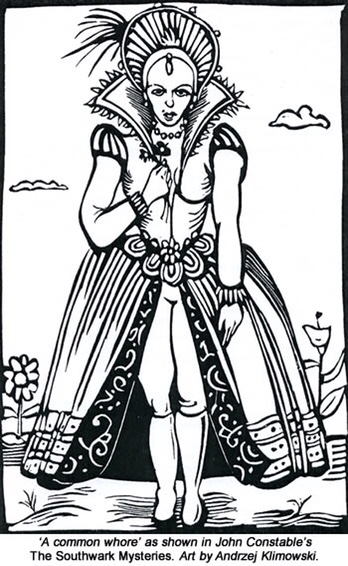
As far as London itself was concerned, the authorities concentrated on preventing prostitution within the city walls and on ensuring that the girls working designated areas like Cock Lane wore the proper clothing. This takes us back to the 1161 rules’ requirement that whores must clearly identify themselves by wearing some agreed garment. In 1351, the City of London passed an ordinance saying “lewd or common women” must wear a striped hood to identify themselves as such and refrain from beautifying their clothes with any fur trim or fancy lining. 
Any woman not of noble birth could be described as “common” in that sense and this sloppy wording made the ordinance such a wide one that it seemed to cover almost every female in the city. London’s proud womenfolk weren’t going to have men dictating what they could wear, so most simply ignored the ordinance and challenged any constable to arrest them if he dared. When Edward III put his own authority behind this law three years later, he was careful to specify it applied only to London’s “common whores”. The striped hoods and lack of decorative trim, his proclamation declared, would “set a deformed mark on foulness to make it appear more odious”. 
Some working girls continued to live inside the city walls but commuted to Cock Lane or the Liberty to earn their daily crust – perhaps finding somewhere to change on the way. But wasn’t long before they were banned from even lodging in the city and subject to very heavy penalties for doing so. A 1383 ordinance required whores caught in London to have their heads shaved and then be carted through the streets in a special wagon while minstrels played all around them to attract a crowd. The girl herself would have to wear that trademark hood as the cart carried her through town to the nearest prison, where she’d be placed in a pillory and publicly whipped. 
“The ineffectuality of all this punishment is evident in the ordinances themselves, which provide for repeated offences and increased penalties,” Burford says. Offenders caught a second time, for example, would serve ten days in jail on top of all the other penalties, while a third offence got you ten days’ prison and permanent expulsion from London. A girl in this final category would be taken to one of the city gates, where she’d be roughly thrown outside. If the authorities had been able to trace her origins to Bankside – as was often the case – she’d be escorted back there and warned to stay put. 
In 1393, these rules were tightened once again, saying no prostitute must “go about or lodge” in London or its suburbs, but “keep themselves in the places thereto assigned, that is to say, the stews on the other side of the Thames and in Cock Lane”. Offenders could face all the penalties detailed above and have their identifying hood confiscated too. Replacing this garment would presumably have been an expensive business, but the girl would be unable to resume her trade till she’d done so. 
We know there were at least two murders in the stews at around this time, because both are mentioned in the Bishop of Winchester’s court rolls for 1378. One was carried out by William Chepington of Northamptonshire, who killed a Scarborough man called John Drenge at The Cardinal’s Hat, one of the biggest brothels on Bankside. In the same year, a Flemish man was hanged for another murder in the stews. (51) 
Dutch people – then known as Flemings – had first come to Southwark as mercenaries in William the Conqueror’s army, but their relationship with the surrounding English population was sometimes thorny. Many Flemings were talented entrepreneurs and the stews they ran on Bankside operated with an efficiency and cleanliness that put their homegrown competitors to shame. We can judge their popularity by the fact that so many English whores chose to work under the Dutch name Petronella to indicate they were both fashionable and expert in their craft. 
The Dutch whorehouses may have been popular with punters, but their success did not go down well with English competitors. When Wat Tyler’s tax rebels arrived in Southwark in June 1381, one of their first targets was The Rose, a Dutch-operated whorehouse owned by William Walworth, the Lord Mayor of London. Until then, Tyler’s men had attacked only formal symbols of the King’s authority, such as prisons and the Inns of Court, so you have to wonder if it was Southwark’s resentful English brothel-keepers who suggested they burn The Rose. “It’s likely that the rebels destroyed the brothel not from outraged morality, but from hostility to the foreigners, specifically the Flemish,” says Derek Brewer in his 1978 book Chaucer and his World. Having sacked these premises, which stood near London Bridge, the rioters then went on a day-long rampage, killing as many as 160 Flemish people as they moved west through the Liberty. No doubt, a good number of Southwark folk joined in the mayhem just for a chance to kill their Flemish competitors or to eliminate a rival business. (52)

“[They] beheaded without judgement or trial all the Flemings they found,” one contemporary report tells us. “Mounds of corpses were to be seen in the streets and various spots were littered with the headless bodies of the slain. In this way, they passed the entire day, bent only on the massacre of the Flemings.” (53) 
A few months later, all the whorehouses destroyed were back in business again and the poll tax Tyler had objected to was sending out its demands for the year. That year’s returns from Southwark show seven men listed as stewholders in the Borough, all with addresses in the Bishop’s Liberty. “They evidently represent the proprietors of the Bankside stewhouses,” says Martha Carlin in her 1996 book Medieval Southwark. “All were married men, with both male and female servants; none had children aged 15 or older living at home.” (54) 
The seven stewholding couples listed, together with the tax assessed as due from each pair, are: 
StewholdersJoint assessmentWalter Shirborn & wife Christian  Six shillings & eightpenceRobert Power & wife Agnes Four shillingsYevan Wallchman & wife Isabella Four shillingsJohn David & wife Isabella Four shillings & eightpenceRobert [illegible] and wife Isabella Four shillings & sixpenceRichard Bailif & wife Margery Four shillings & sixpenceWilliam Brounes & wife Joan  [Figure missing]

The average tax payable per individual householder in Southwark that year was just one shilling, against an average of over five shillings for the stewholding couples above. That means the stewholders were being taxed at two-and-a-half times the rate of their neighbours and presumably that their earnings were that much higher too. But how much of that money actually found its way to the girls themselves? 
Of the 137 unmarried woman identified in the Southwark return, Carlin’s found a dozen who she believes worked as prostitutes. These were not the girls who worked in the Bankside stews, who’d be lumped in as “servants” with the families above, but freelance whores operating from the precinct of St Thomas’s Hospital and therefore outside the Liberty’s rule. “These women probably were independent or ‘private’ prostitutes, working from lodgings rather than from public brothels,” Carlin writes. “Their residence within the hospital precinct presumably shielded them from any interference by the officers.” 
Even among this relatively privileged group, only three of the twelve women paid assessments above the Southwark-wide average of one shilling and seven paid well under that. Their average assessment was only ninepence halfpenny – just over third of what even the poorest stewholder paid – and the richest girl of them all paid just one shilling and fourpence. Once again, it’s reasonable to assume that a much lower tax bill means a much lower income too. 
Whoever else was getting rich from the Bankside stews, then, it sure wasn’t the girls who worked there. The eminent men who owned brothels like The Cardinal’s Hat, the Boar’s Head and the rebuilt Rose did very nicely from renting them out to stewholders, some of whom were able to start building family dynasties on the trade. These families certainly weren’t in their landlords’ class, either for income or status, but they still managed to rake in a great deal more income than most other businesses in Southwark could provide. The girls’ whose sheer bloody resilience kept the whole trade going had to make do with its scraps. (55) 
Prostitution in Southwark was still officially licensed only in the Liberty’s designated Bankside area, but the seven whorehouses there couldn’t hope to satisfy total demand. At some point in the 1380s, local businessmen made a concerted effort to establish a new red light district in Southwark’s St Olave’s Parish, which lies west along the river from Bankside. The site they chose was not in the Liberty, but part of a manor still owned by the King himself, so opening unsanctioned brothels there was a risky business. Many Southwark folk joined in the mayhem just for a chance to kill their competitors

The men who owned the five new St Olave whorehouses included John Mokkyng, shown in the 1381 tax return as one of Southwark’s richest men and Robert Power, the Bankside stewholder mentioned above, who now hoped to make his own step up into the landlord class. We know this, because both men are named in a 1390 petition from the people of Southwark complaining the St Olave stews had turned their neighbourhood into a war zone and urging King Richard II to shut them down. There had always been violence and disorder on Bankside too but, with neither the 1161 rules nor the Bishop’s enforcers to keep a lid on things, St Olave’s became a hellhole. “The petitioners charged that the place had become notorious, a breeder of quarrels and homicides and a resort of thieves, to the peril of local residents,” Carlin writes. (56) 
The petitioners added that the new brothels’ customers included not only married men – who were hardly a novelty on Bankside either – but also “all manner of persons of religion, namely monks, canons, friars, parsons, vicars, priests”. Married women and female servants, they said, were being kidnapped, imprisoned at St Olaves and forced to work as whores there. The alternative was a slit throat. The King responded by demanding that all the landlords and stewholders responsible for the five new brothels appear before him and his court at Westminster on July 4, 1390. One of the landlords, John Brenchesle, who seems to have run his own St Olave stew personally, was sent to the Tower of London, as was John Osteler, his servant. Four others, all of whom were either stewholder tenant-managers or their staff, went to the Fleet Prison for ten days. (57) 
Efforts to police the stews at Southwark continued as the 15th Century got underway and it’s this period which gives us our earliest surviving records of real cases passing through the Liberty’s courts. Many of these involved the sort of minor offences which keep an English magistrates’ court busy today, like breaching the licensing laws, public drunkenness or fighting in the street. Other charges were far more serious, such as forcing a girl into whoredom against her will or officials developing selective blindness whenever a bribe was offered. The Bishop’s court convened every four to six weeks and kept its records on parchments called pipe rolls. Eight examples from the 15th Century have survived – all from the period 1446 to 1459 – and these show a steady tightening of the screw against corruption. By 1455, constables and bailiffs caught eating or drinking with the whores they policed faced a massive fine of £2.

Meanwhile, at the national level, three successive Kings – Henry IV, V and VI – each passed their own ordinances aimed at cleaning up the stews. First up to bat was Henry IV, who extended the Lord Mayor of London’s powers in 1406. For the first time, the City of London’s own police could now arrest criminals in Southwark – an area previously beyond their jurisdiction – and drag them back across the river to Newgate for trial. All this achieved was to stoke the good folk of Southwark’s customary resentment at interference from London. Any City constable brave enough to try and exercise his new powers in the Borough risked sparking a full-scale riot, as we can see from an incident that followed just a few years later.
This involved a Frenchman who murdered a Southwark widow in her own bed, then fled to St George Martyr’s church in Borough High Street to claim sanctuary. London’s authorities agreed not to arrest him on the condition that he leave England immediately and sent a constable to St George’s to escort him down to the south coast and make sure he caught the next boat out. But the outraged women of Southwark had other ideas. When the constable and his deputies came out of the church with their prisoner, they found a huge crowd waiting. “The women of that same parish where he had done the cursed deed came out with stones and canal dung,” one contemporary report tells us. “And they made an end of him in the High Street, notwithstanding the constable and the other men too. There was a great company of them and they had no mercy, no pity.” With the streets full of people like that, you can see why a lone constable might think twice before deciding to throw his weight about in Southwark. The new law was quietly shelved as a result. (58)
Henry V followed up with his own ordinance in 1417. He began by directing the Lord Mayor’s attention to “the many grievances and abominations, damages and disturbances, murders and larcenies” carried out by “lewd men and women of evil life” in the Bankside stews. Quite what the Mayor was supposed to do about it Henry didn’t say – beyond a peremptory command to sort it out.
The King’s own contribution was to ban London’s City aldermen and other respectable citizens from letting out any building they owned to tenants “charged or indicted of an evil and vicious life”. This was clearly aimed at the many churchmen, noblemen, City officials and wealthy merchants who happily rented out their property to known stewholders. There were only so many houses to be had in the Bankside’s licensed area, so anyone lucky enough to own a building there could command premium rents if he let it be turned into a brothel. Outside the licensed area – in Borough High Street, say – landlords could argue they were accepting more risk by taking an illegal stewholder on and insist the rent must be set higher to reflect this. Few other businesses in Southwark pulled in enough cash to match the rent stewholders could offer.
All this added up to a powerful financial incentive for landlords to accept stewholders as their tenants and that’s what the King’s ordinance was up against. It must have been simple enough to arrange your affairs to circumvent the new law – perhaps by renting your building out through a middleman – and like Henry IV’s measures before it, the ban had little effect in practice.Bankside jurors happily took cash to deliver whatever verdict the local gangsters required

It was Parliament’s turn to step in next and it decided to concentrate on a different problem. By the time Henry VI came to the throne in 1422, the Bankside stews were at the peak of their profitability and the money flooding in allowed many stewholders to buy themselves freehold property elsewhere in Southwark. Some used these additional properties to open inns or taverns which doubled as illegal brothels in Borough High Street, but that was only the beginning of the trouble their new riches brought. In order to serve on a 15th Century jury, you had to be a property-owner, which was taken as evidence you had a stake in society and so could be trusted to treat your responsibilities in court seriously. This gave the newly propertied stewholders a whole new opportunity for corruption. By hiring out their services to the highest bidder, stewholders on the jury could deliver whatever verdict their paymasters required.
The stews at this time were dominated by a handful of powerful families, creating a network of useful connections which every stewholder could draw on when he needed to fix a court case. The Gardiners, for example, were involved in running three of the Bankside’s 18 brothels: The Lion, The Hart’s Horn and The Boar’s Head. John Sandes’ name is found linked to both The Castle and The Unicorn, while jobbing managers like John Gray and Robert à Murray moved regularly from one establishment to the next. “The Gardiner family is so prominent that the conclusion is inevitable that they were a gang of brothleers, as also the brothers David and Robert à Murray,” Burford writes. “All seem to have been people of some substance and some of them seem to have been elected constables on occasion.”
Most the time, bent jurors were engaged to ensure a guilty man walked free, but sometimes it worked the other way round. Among the examples Carlin quotes is that of Henry Saunder, who had been taken to the Bishop’s court by a stewholder called Thomas Dyconson. Saunder asked that his case be transferred to the higher court of Chancery because the Bishop’s jury he faced was packed with stewholders who were determined to falsely condemn him. Another petitioner, Agnes Johnson, complained that she’d been falsely accused in the Bishop’s court. Her accuser, she said, was both rich and the court bailiff’s brother-in-law, which meant no juror would dare cross him and so ensured she’d never get a fair trail. A third prisoner dragged before the court described the jurors there as “bawds and watermen, the which regard neither God nor their conscience”. Only with these people in your corner, he complained, was there any hope of victory.
Parliament’s answer to this was to pass a 1433 law barring Southwark stewholders from serving on juries or accepting any other official post in the Borough. Three years later, MPs heard an urgent petition from a group of Southwark citizens complaining that illegal brothels were still operating along the length of Borough High Street. “Many women have been ravished and brought to evil living,” the petition said. “Neighbours and strangers are oft-time robbed and murdered.” Parliament responded by declaring once again that stewhouses must be restricted to the licensed area provided – but gave no clue as to how this might be achieved.
In 1460, Henry VI set up a commission of 20 respectable citizens from both Southwark and London to consider the Borough problem. Violence and thieving in Southwark had now reached such heights that its own people looked ready to accept some help from London at last. For their own part, the City authorities realised that shovelling wrongdoers across the river and hoping the Bishop’s courts could keep order there was no answer at all. Once, the fear of damnation had been enough to dampen some of the worst behaviour on Bankside, but now this ecclesiastical sanction was losing its power. “The impotence of the ministers and officers of the church was scarcely surprising,” Burford writes. “The corruption and sexual licence of that body had bred such scepticism and contempt that even the constant threats of Hell no longer deterred those who sought some little sexual pleasure in this world.”
Henry VI’s commission recommended that the City of London send men into Southwark to remove any prostitutes or stewholders found operating away from Bankside and if necessary imprison them. The King seemed sincere enough in his desire to clean up the Borough, but the War of the Roses deposed him just a few months after the commission’s report, so he had little chance to act.
The new King, Edward IV, took a more relaxed view of the stews – perhaps because his own sexual habits left him little room to criticise what went on in Southwark. The only significant measure he took to regulate them was a 1479 royal proclamation that all the licensed Bankside stews should clearly identify themselves by painting their riverside walls entirely white. Each house had its own symbol painted like a pub sign on the same wall and – as often as not – a couple of bare-breasted whores shouting from a riverside window to attract boat-bound customers. (59)
By the end of the 1400s, there was an unbroken line of 18 white-faced buildings like these lining the Thames’ south bank all the way from London Bridge to what’s now Tate Modern. Just five years later, every one of them was forcibly closed down in a 1505 crackdown launched by Henry VII. His action was prompted not by any desire to fight crime in Southwark, but by an unwelcome new guest which all the Bankside stews were now hosting. Syphilis had come to London.

Bankside’s 18 brothels & their ruling families

Court records from the 16thCentury give us an intriguing glimpse of how the Bankside brothels were then run. Stewholders were fined pretty regularly for one offence or another and the fact that so many of the family names involved pop up again and again shows the web of connections between them.
The list below shows the 18 legal Bankside brothels trading in 1500. Each stood in its own large grounds, stretching back as far as Maiden Lane on their southern boundaries. Burford estimates that they probably employed about 350 girls between them, or roughly a third of the 1,000-plus whores he believes were working Southwark at this time. The rest relied on the many illegal Borough whorehouses found in the High Street and beyond. (189)
Between them, the 18 licensed brothels formed an unbroken line along the river all the way from London Bridge to what’s now Tate Modern and that’s the east-west order I’ve given them here. (190)

The Castle: One of the two largest properties on Bankside (the other being The Unicorn). John Sandes’ name is found linked to both establishments, suggesting he may well have been the stewholders’ leader. He was also a member of the City’s Guild of Coopers.

The Gun: One of the six brothels never re-licensed after the 1505 closures. The others were The Swan, The Bull’s Head, The Rose, The Bell and The Cardinal’s Hat.

The Antelope: Managers included both David Arnold and John Gray, who’s linked at other times to The Castle and The Elephant.

The Swan: Another of the six brothels refused a new licence after the 1505 closures (see The Gun, above). Not to be confused with the Swan Theatre in nearby Paris Gardens, which opened in 1595.

The Bull’s Head: Like the other five brothels refused a new licence, The Bull’s Head probably re-opened anyway. From that point on, they had to operate outside the law, with all the risk that implies.

The Hart: Run by Margery Curson, who was fined £1 in 1500 for “living without a husband”. It was an offence for a single woman to run a stewhouse, but Margery went right on and did it anyway. She rented The Hart from the churchwardens of St Margaret’s Parish.

The Elephant: Managed at various times by Edward Wharton and Robert à Murray, whose name is also found linked to The Barge and The Antelope. Robert’s brother David was also involved in running the Bankside stews.

The Lion: At various times, both Richard Gardiner and Joan Gardiner are mentioned as running The Lion. On another occasion, Joan Gardiner’s said to be managing The Hart’s Horn.

The Hart’s Horn:Represented at a 1505 hearing by Margaret Toogood. She’s thought to be either the widow or the daughter of the Thomas Toogood pilloried for enticing women into prostitution in 1494.

The Bear: Re-opened for legal trade on August 29, 1506, under the management of Eleanor Kent.

The Rose: This is the brothel once owned by London Mayor William Walworth. By 1552, it was owned by Henry Polsted, who leased it to a manager called John Davison, who also ran The Unicorn at that time. (191)

The Barge: Re-opened for legal trade in June 1506, with Robert à Murray as its manager.

The Bell: Nothing known.

The Unicorn: The second of Bankside’s two biggest establishments and again managed by John Sandes. See The Castle.

The Boar’s Head: Run by first Agnes Gardiner and then by Annian Gardiner. Both were presumably related to the Gardiners who ran The Lion and The Hart’s Horn. A manager called William Aldersley spoke for The Boar’s Head at a 1505 hearing.

The Cross Keys:Managed in 1505 by Anna Ratclyffe.

The Fleur de Lys: Managed in 1505 by Joan Freeman and in 1664 by Robert Younger.

The Cardinal’s Hat:Mentioned by Shakespeare in Henry VI pt 1. Gloucester uses this infamous brothel’s name to taunt the Bishop of Winchester in Act I, Scene III. See main article for details.

Reference