Australian Icons: Wonderland City, Tamarama NSW. Formerly the Royal Aquarium and Pleasure Grounds.

IMG_0233

To look at Tamarama beach today, it is hard to envisage that it was once the site of the largest open-air amusement park in the southern hemisphere, nor that there were attempts in the early 20th century to ban swimmers from the area.

Originally the site for the Royal Aquarium and Pleasure Grounds (commonly referred to as the Bondi Aquarium), it was an amusement park situated in Fletcher’s Glen at Tamarama beach.
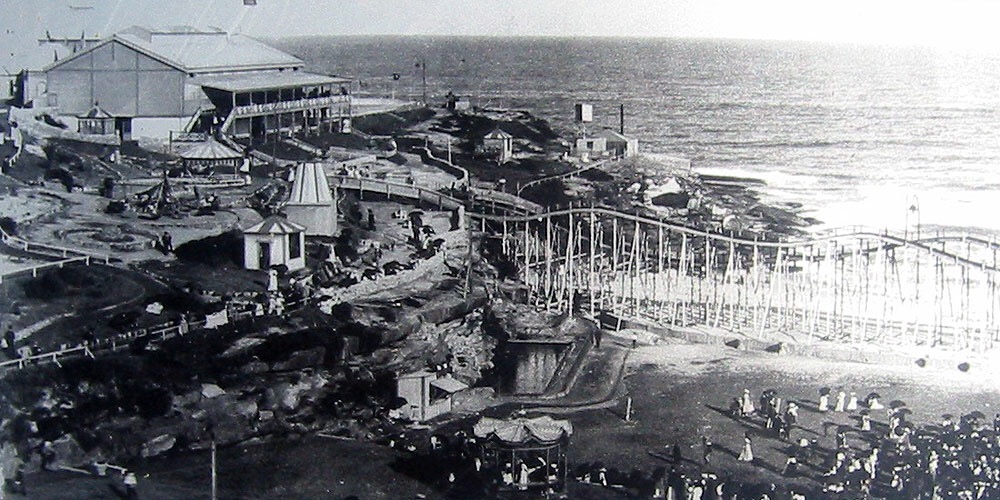

It opened on the 1st October 1887 and touted a Great Military Band, merry-go-rounds, swings, shooting gallery, water boats, Camera Obscura, Punch ‘n Judy show, and dancing in the Grand Hall.

There were huge marine aquarium tanks featuring many fish varieties, sting rays, lobsters, turtles, wobbegong and tiger sharks. Seals shared a pond with a solitary penguin. There was a switchback railway, a roller coaster ride above the sand on Tamarama beach, two roller skating rinks, which eere “illiminated by the electric light”. Every Wednesday, Pain’s Grand Fireworks exploded overhead, and there were Sacred and Classical concerts every Sunday.

In typical early 1900s tradition, feats of daring-do were a must. Alexander, an Australian wire walker, walked a wire from cliff to cliff. Captain George Drevar floated on a “cask raft” in the surf. There was a Grand Balloon Ascent and Parachute Descent. Headliners from the Tivoli Theatre perforned on the Aquarium Curcuit.


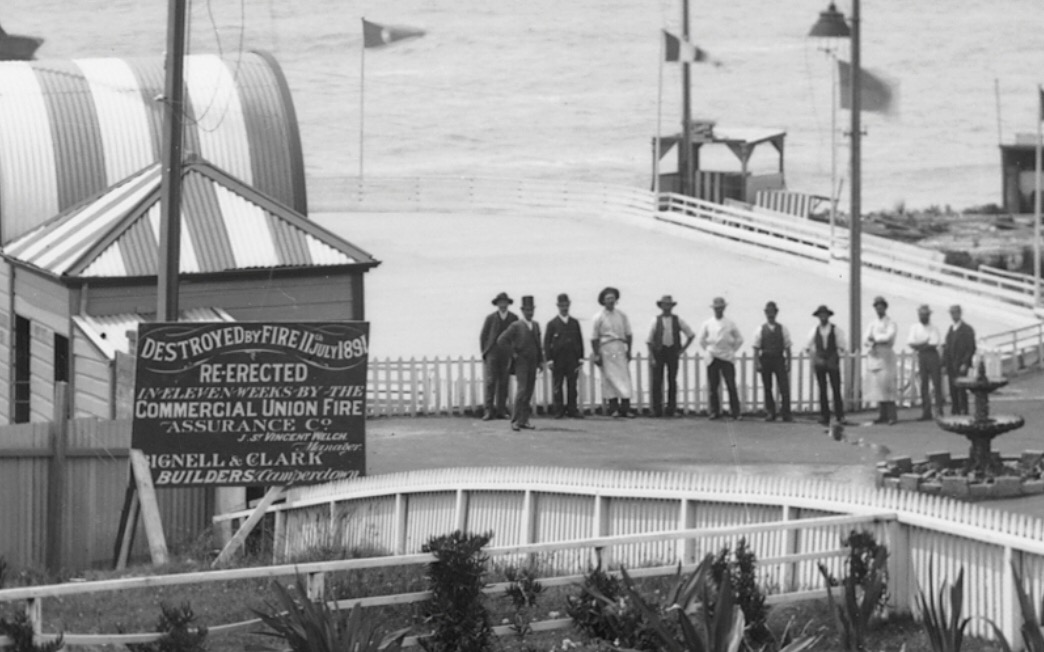
Fire destroyed the Aquarium and Pavilion on 11th July 1891, but it rose from the ashes in September the same year, and continued on. The ladt known concert there was a fund-raiser for the Waverley Benevolent Society in 1906. Ownership and management chantes several times over the coarse of its existence, and it was finally sold by Mrs Margaret J Lachaume to William Anderson in 1906. He transformed and renamed it Wonderland City.                                                                        IMG_0232
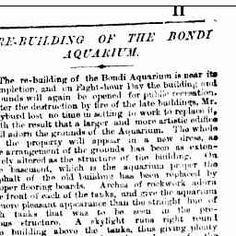
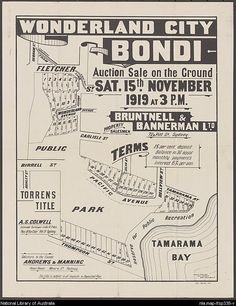
Anderson was a Prominent theatrical entrepreneur, leased the land in Tamarama Park, minus a 12-footbstrip of coastline, to allow the public access to the beach. He also leased a further 20-acres of land in Tamarama Gully – formerly Tamarama Glen, or “the Glen” – and started to transform it into an amusement park.

The main entrance was a large white weatherboard building in Wonderland Avenue near the point at which it joins Fletcher Street. The entry price was 6 pence for adults and 3 pence for children with all rides costing an additional fee.

Opening on Saturday, 1 December 1906 Wonderland claimed to equal ‘those amusement grounds… of the far famed Coney Island, New York, or White City, Chicago’. William Anderson also claimed “there weren’t sufficient trams in Sydney to transport the crowd … for the opening.” On this opening night approximately 20,00 people travelled out to Wonderland to go on fairground rides, view the novelty attractions and walk among the natural beauty of Tamarama Glen, which was lit by strings of electric lights and described as a ‘fairy city’.

Some of the attraction included an artificial lake; the first outdoor ice skating timk in Australia; a roller skating rink which doubled as a boxing ring; double-decker merry-go-round; Haunted House and Helter Skelter; steam-driven swutchback railway; maze; circus ring; fun factory; the Airum Scarum, an airship that moved on a cable from cliff to cliff, was supported at bith ends by huge wooden structures, and at high tide moved over the sea; wax works; Katzenjammer Castle; Hall of Laughter; Box Ball Alley; Alice the elephant; a sea pond and aquarium; Japanese tearooms; Alpine slide;  and The King’s Theatre – a music hall – that could seat 1,000 people.
IMG_0236

Employing over 160 people, Wonderland set a new standard for Australian outdoor pleasure grounds. Large crowds, estimated at 2,000 people came every summer weekend, with seventy turnstiles at the entrance doing a brisk trade. Wonderland was known for its novelty and ‘shocking’ acts, with William Anderson the consummate showman. He organised for a couple to be married at Wonderland, and then paraded through the grounds on the back of Alice the elephant. One daredevil performer,  Jack Lewis,  roller skated down a ramp, through a hoop of fire and landed in a tank with sharks – much to the horror of the crowd. Miraculously Jack always survived unharmed.

Unfortunately, conflict with swimmers was bound to happen. Despite the 12-foot public beach access strip being excluded from his lease, William Anderson erected a 8-foot high wire fence over it anyway, insisting it wss hecessary, as fare-evaders wrre using the strip as a way to access the park via his beachfront boundary fence.

The barbed wire fence extended down the cliff on the southern end of the beach, across the rocks and sand to the rocks at the beach’s northern end. However this wire fence also blocked access for swimmers to the beach. Some of these swimmers were influential businessmen and having their local beach cut off incensed them. The swimmers started an ongoing battle with Anderson; they would cut his wire fence, he would repair it and contact the police. The police would arrive and warn the swimmers and the following weekend the same scenario would be re-enacted. George B. Philip, the foundation President of the Tamarama Surf Life Saving Club, was one of these swimmers and he later recalled how he got around one particular wire fence gatekeeper. ‘I scaled under the barbed wire fence practically every day, I knew every nook and corner of it – until I was caught by the gatekeeper. The outcome of this was that I came to an arrangement with him whereby that if I carried his billy of tea from the kiosk to (the) main gate at 5 o’clock each day, I could walk in and out when I liked (much to the envy of my mates, who were not caught)…’

The stalemate between the swimmers and William Anderson continued, with the swimmers eventually taking a deputation to NSW Parliament. On 6 March 1907, the Minister for Lands, James Ashton, issued an order to resume the 12-foot strip of land fronting the beach to “give free access for all time to the beach at Tamarama Bay.” At the Tamarama Surf Life Saving Club’s centenary celebrations Ken Stewart, grandson of one of the original fence cutters Bill Stewart, reenacts his grandfather’s cutting of the barbed wire in 19061907 Many of these victorious swimmers formed the nucleus of a new surf club, the Tamarama Surf Life Saving Club. On 11 February 1908 the first surf ‘gymkhana’, equivalent to a surf carnival, was held at Wonderland on Tamarama Beach and was held each year until Wonderland closed.

Meanwhile, bad publicity dogged Wonderland. The conflict with local swimmers and the wire fence incident soured the public image of Wonderland, as did complaints that the animals were being poorly housed and mistreated. The occasional breakdown of the Airem Scarem airship above the dangerous surf caused accusations of safety breaches and resident opposition to the weekend revellers at Wonderland grew.

The crowd numbers dropped but Williams Anderson fought back bringing in famous entertainers and more daring acts from his national touring circuit to perform at the King’s Theatre. Anderson responded with more elaborate public exhibitions, but the public was tiring of Wonderland and the crowds dropped. It struggled on from March 1908 to December 1910 with poor crowds and low revenue, finally closing in 1911. William Anderson is said to have lost £15,000 on Wonderland City. Wonderland was the precursor of Luna Park, setting unprecedented standards for popular outdoor entertainment in Sydney. In its day it was the largest open-air amusement park in the Southern Hemisphere, and its decline does not diminish the grandeur of William Anderson’s vision.

Although little visible evidence of Wonderland survives today, with the possible exception of the two paths on the northern boundary of Tamarama Gully, the NSW Heritage Office still considers the site to be of archaeological significance. Today a mural commissioned by the Tamarama Surf Life Saving Club on the side of their clubhouse celebrates the history of Wonderland and the part it played in the formation of their club.


Published by Waverley Library from sources in the Local History Collection, 2008.


Tamarama Beach today. The beach is popular with the gay community, and is referred to as “Glamarama” due to the number of muscle boys who like to pose around there.

Australian Icons: Leyland Brothers World, Karuha, NSW.

  
The rock. or whats left of it at the long-gone Leyland Brothers World on the NSW mid coast at Karuah

http://journals.worldnomads.com/stowaway/photo/6392/171049/Australia/The-rock-or-whats-left-of-it-at-the-long-gone-Leyland-Brothers-World-on-the-NS

Mike Leyland, MBE (4 September 1941– 14 September 2009) and Mal Leyland, MBE (born 1945), also known as the Leyland brothers, were Australian explorers and documentary film-makers, best known for their popular television show, Ask the Leyland Brothers. The show ran on Australian television from 1976 until 1984.

In November 1990 the Leyland Brothers opened the theme park Leyland Brothers World (32°37′3″S 152°4′48″E), on a 40 ha property at North Arm Cove on the Pacific Highway north of Newcastle, New South Wales. It included a 1/40 scale replica of Uluru, as well as amusement rides, playground, roadhouse, museum and a 144 student capacity bush camp. In a 1997 article in the Sunday Age, Mike Leyland said that the initial A$1 million loan blew out due to rain during construction and a 27% interest rate. In July 1992 Chris Palmer of BDO Nelson was appointed receiver and manager of the park when the Leyland Brothers company failed to meet its loan commitment to the Commonwealth Bank. Auctioneers Colliers Jardine estimated the yearly attendance of the park to be about 400,000 people, with 10,000 students for the bush camp. After an auction held by the receiver on 26 November 1992 the theme park was sold for $800,000, and continues to trade successfully as the Great Aussie Bushcamp.[ The brothers went bankrupt.

After the 1992 bankruptcy, Mike and his wife Margie ran a New Lambton video store and worked for the park’s new owner. In 1997 Mike sold part of his Tea Gardens property to fund the production of a far north Queensland film for Channel Seven. Mike and his wife Margie signed a contract with Channel Seven for 12 one-hour documentaries, the first of which aired in 1998 in The World Around Us slot. On 14 September 2009 Mike Leyland died from Parkinson’s disease. He was 68 years old. Mike is survived by his wife Margie, his daughters Kerry, Sandy and Dawn, his stepdaughters Sarah and Alison, and seven grandchildren.

Mal and his wife Laraine ran a photo processing lab in Queensland and launched a travel magazine. In 1997 Mal and Laraine launched a bi-monthly magazine, Leyland’s Australia. In 2000 Mal produced the television show Leyland’s Australia, with his wife Laraine, daughter Carmen and her husband Robert Scott – travelling around Australia in a caravan. In April 2000 Channel 9 cancelled the show after 6 episodes but the series was then picked up by Network Ten.
 

Leyland Brothers: Mal Leyland reveals financial rift tore popular brothers apart

Australian Story By Brietta Hague

Updated 16 Feb 2015, 11:34am

 Mal and Mike Leyland in the Simpson Desert
  
PHOTO: Mal and Mike Leyland film in the Simpson Desert in central Australia, 1989.

MAP: NSW

Long before Steve Irwin was jumping on crocodiles, Mike and Mal Leyland were sailing down the Darling River in a chaotic dinghy without oars — all in the name of entertainment.

They were the television legends whose wild adventures captured Australia’s imagination.
Armed with a camera and a catchy song that few can forget, they pioneered a successful outback documentary format and made millions of dollars along the way.
But it was their disastrous decision to branch out into the tourism industry by building their theme park Leyland Brothers World that would end the brothers’ collaboration — and relationship.
Mike Leyland died in 2009 and his brother Mal, now 70, has now agreed to repeated requests from Australian Story to tell their story.
“This is the first time that I’ve publicly spoken about what happened to the Leyland Brothers and why Mike and I went our separate ways,” Mal Leyland said.
“We made a conscious effort to make sure that people thought we were still travelling together.
“We didn’t want people to feel as though we were actually ready to rip each other’s throats out.”
By the time the project collapsed in 1992, they had lost more than $6 million and were bankrupt.
“The receivers came in and took possession of the whole lot,” Leyland said.
Who were the Leyland Brothers?
Australian explorers and documentary film-makers
Best known for their TV show Ask the Leyland Brothers, which ran from 1976-1984

Starred in a following series called Leyland Brothers’ World

Both brothers were awarded MBEs in 1980

“In hindsight, Leyland Brothers World was a huge mistake, the biggest mistake we ever made.”

Amid the financial woes, media reports claimed the brothers had transferred more than $1 million of assets into their wives’ names over an 18-month period.
“I didn’t really mind losing the money. I objected to being treated like a criminal because I lost the money,” Leyland said.
“The partnership that Mike and I had for 29 years was crumbling before my eyes and I knew would never be the same again.
“And since there was now nothing left that we jointly owned, there was no need for us to stay in partnership, so for the first time we went our separate ways.”
Brothers were original Ten Pound Poms
Despite their quintessentially Australian characters, the brothers were born in England and arrived in New South Wales in 1950.
Even at a young age they were fascinated by the outback and all things Australian.
The Brothers first set off to explore the country with their cameras in 1961 when Mal Leyland was just 15 and television was first starting to come to Australia.
Mal Leyland speaks with Australian Story
  
PHOTO: Mal Leyland says the financial rift over the failed theme park ended up pushing the brothers apart. (ABC: Anthony Sines)

They were the first to film Uluru in the wet and first to travel the length of the Darling River in a dinghy.

“We had no idea what we were letting ourselves in for. We were so inexperienced; we had no oars and only an outboard motor,” Mal Leyland said.
The adventures grew in size and ambition.
Their decision to travel from Australia’s western-most to eastern-most point was a feat never before captured on camera.
It was this entrepreneurial take on filmmaking that led to their early success.
“We decided we would road show the film, we would take it around the country and hire town halls, cinemas if we could, and advertise it ourselves and see how we went,” Mal Leyland said.
It was a risk that paid off.
“At the end of the two-week season we’d recovered $15,000, enough money to buy three houses at the time,” he said.
And so the Leyland Brothers were born.
Before long, their quirky television program Ask the Leyland Brothers was attracting some of the highest ratings of the 1970s and 80s, and the theme song is still a familiar tune to millions of Australians.
“Their place in television history is there forever. Historically, the films are incredibly important,” said entrepreneur Dick Smith, whose decision to make his own travel documentaries was inspired by the success of the Leyland Brothers.
http://www.abc.net.au/news/2015-02-16/mal-leyland-reveals-financial-rift-tore-popular-brothers-apart/6091042


Above 2 photos taken in 2002. Private collection of Tim Alderman (Author)

Tim Alderman 2015

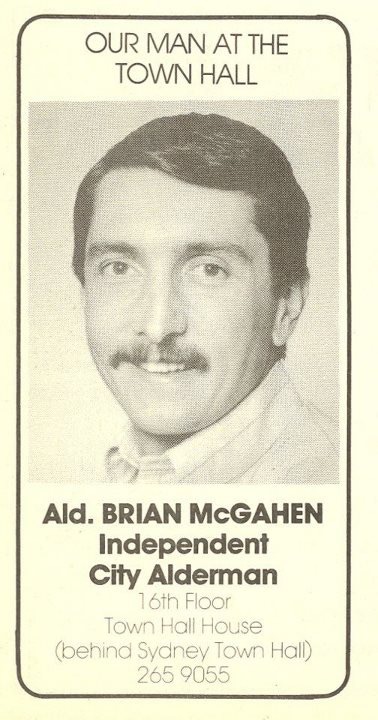
Australian Gay Icons: Brian Patrick McGahen

McGahen, Brian Patrick (1952–1990)
by Phillip Black
This article was published in Australian Dictionary of Biography, Volume 18, (MUP), 2012
Brian Patrick McGahen (1952-1990), city councillor, social worker, gay activist and social libertarian, was born on 3 March 1952 at Camperdown, Sydney, elder son of Patrick James McGahen (d.1963), hairdresser, and his wife Monica Marie Anderson, née Pettit, both born in New South Wales. Brian was educated at De La Salle College, Ashfield, and the University of Sydney (B.Soc.Stud., 1974). At the age of 17 he opposed the Vietnam War; he refused to register for conscription and was convicted of sedition for advocating draft resistance. He joined the Eureka Youth League of Australia, the Communist Party of Australia and the Draft Resisters’ Union.
In 1974-75 McGahen was employed as a social worker and drug counsellor in the methadone program of the Health Commission of New South Wales. When the Australian Social Welfare Union was created in 1976, he was a founding member. After travelling overseas that year, in 1977 he was an organiser for the Chile Solidarity Campaign. Over the next three years he worked on projects for the State Department of Youth and Community Services. With Social Research and Evaluation Ltd in the early 1980s, he reviewed the New South Wales Family Support Services Scheme.
Sexual politics had emerged as a social force worldwide by the mid-1970s. McGahen found like-minded activists in the Sydney Gay Liberation and subsequently in the Socialist Lesbians & Male Homosexuals. In 1978 he was part of a collective that organised the National Homosexual Conference on discrimination and employment. He was chairman (director) of the Sydney Gay Mardi Gras Association from 1981 to 1984, providing the young organisation with structure, direction and vision.
Remaining a member of the CPA until 1984, McGahen stood unsuccessfully in 1980 as its candidate in the election for the lord mayor of Sydney. In 1984, having campaigned as a leader of the gay community against the Australian Labor Party State government’s failure to repeal anti-homosexual laws, he was elected (as an Independent) to the Sydney City Council for the Flinders ward. A member of various council committees, he served from 14 April 1984 until the council was dismissed on 26 March 1987. Policies were implemented to prevent discrimination against homosexuals in council services.
McGahen became a director of a Sydney home care service in 1986, hoping to extend the service to people suffering from acquired immune deficiency syndrome. He was also concerned about immigration rights for the partners of gay men. Throughout the 1980s he was a consistent advocate for a permanent gay and lesbian community centre, preferably a registered club. In 1989 he joined the Pride steering committee, became treasurer, and soon gained support to set up such a club.
In 1987 McGahen was diagnosed positive for the human immunodeficiency virus. He decided to show that his carefully considered choice of voluntary euthanasia could be achieved in a dignified manner. Never married, he died on 3 April 1990 at his Elizabeth Bay home, accompanied by five close friends, and was cremated. He had fought with determination and enthusiasm for what he believed in, often against great opposition. In 1986 a homosexual social group, Knights of the Chameleons, had made him the Empress of Sydney, and in 1992 he was inducted into the Sydney Gay and Lesbian Mardi Gras Association Hall of Fame.
Select Bibliography

G. Wotherspoon, City of the Plain, 1991

R. Perdon (comp), Sydney’s Aldermen, 1995

Sydney Morning Herald, 17 September 1984, p 4

Sydney Star Observer, 6 April 1990, p 17

Sydney Morning Herald, 23 June 1990, p 69

McGahen papers (State Library of New South Wales)

Citation details

Phillip Black, ‘McGahen, Brian Patrick (1952–1990)’, Australian Dictionary of Biography, National Centre of Biography, Australian National University, http://adb.anu.edu.au/biography/mcgahen-brian-patrick-14206/text25218, published first in hardcopy 2012, accessed online 17 September 2015.

This article was first published in hardcopy in Australian Dictionary of Biography, Volume 18, (MUP), 2012


Political Snippet: Yet another Prime Ministerial spill!

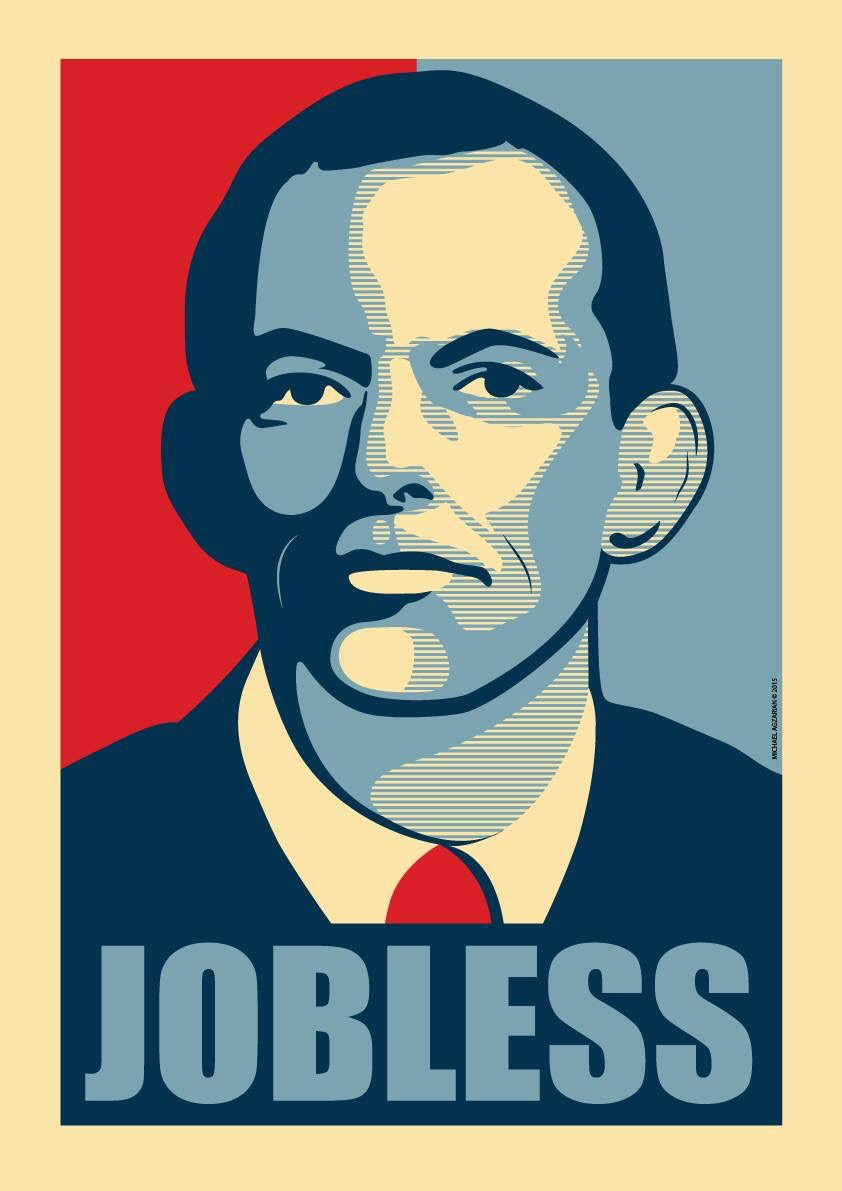
The inept and much despised Tony Abbott is NO LONGER OUR PM. You can probably hear the corks popping thousands of miles away! Five Prime Ministers in something like 8 years – a record for Guinness, undoubtedly! I can hardly believe I no longer have to look at hus ugly face, listen to his inarticulate speech, put up with any mire if his policy-on-the-run, and idiotic “Captains calls” that have nade all Austealians look like idiots on the world stage!

Already celebrations are underway on social media as the excitement ramps up at this horrid mans well-deserved demise! Never in the political history of this country has a PM been hated so much, ir a government been so inept. It had gotten so bad that his own party turned against him! You can’t run a country on three word slogans, and by pushing uour own Catholic and far right-wing agendas. Nor can you expect people to support out-dated policies, and a lack of humanity, compassion and emoathy in what you espouse. People, especially voters, deserve and exoect more.

Along with getting rid if him we also dispense of the horrendous bunch of incompetent ministers called a frontbench. At least Julie Bishop had the sense to desert the sinking ship.

And Turnbull…we’ll just have to wait and see! At leadt he has a living example of what NOT to be like!

Farewell Abbott! No one will weep for you! Now to repair all the damage you caused! Fuck off – I never want to see or hear from you EVER again!

Tim Alderman (C) 2015


Daily (Or When The Mood Takes Me) Gripe: The Dumbing-Down of Humanity 

The following commentary is from the FB page “Veganurth”:

 “Malala Yousafzai & Kylie Jenner just turned 18 – Kylie got a brand new Ferrari and spent $10,000’s on plastic surgery and botox. Malala was awarded a Nobel Peace Prize, survived a gun shot to the face by the Taliban, opened a school for Syrian refugees and is inspiring education for kids around the world. What’s upsetting is the media is only covering Kylie as “breaking news” and not mentioning a word about Malala’s powerful strength and courageous passion to change the world…. Kylie is immortalized because her parents are rich, she shops on Rodeo Drive and gets drunk at parties….. Malala is infinitely more beautiful!” 
The dumbing down of both us, and how the media treat us, has been an interesting exercise to watch over the decades. A news item during the weak was….Woolworths dropping its grocert prices! Really! News? I just laughed it was so ludicrous. Then we have Tracy Grimshaw – a journalist I USED to respect before she fell into mediocrity – and her “A Current Affair”…not! Since when are neighbourhood disputes, germs on kitchen sponges! And old people being ripped off been “current affairs”? Current affairs used to be commentary on the hews, an extension and clarification of important daily news items, but now – with the exception of non-commercial television – nothing but social drivel We see it every day now, news that is aimed at the most stupid and impressionable sector of the community. You only have to hear talk-back radio to see how it filters down to inane, racist and prejudicial argument, people babbling on about things that they know absolutely nothing about. The whole Halal issue was a very good example of social rantings from people who didn’t even know what it was! And don’t even start me on the cult of celebrity! Or our use of the word “hero”! The above is a great example of how the “news” distorts values, gives credence to the undeserving, while the people and ideals we really should value are trampled under foot, and left as footnotes! Thank heaven for unaligned, freelance journalism! These are the only ones observing our politicians, leaders, big business, and world affairs, and commentating on it in a realistic and responsible way! Commercial news services – and those owned by so-called “media magnates” who use the services to espouse their own perverted world view…Rupert Murdoch and his disgraceful Fox News is a great example – make the future of nees reportage very frightening! When truth is swallowed and exchanged for digestible drivel, those of us who think, analyse, research and voice alternative opinions to the tripe and inane diatribes that are vomited out by our daily newspapers, and television news services, truly have to be concerned.

Truth Rules! 

Tim Alderman (C) 2015

Political Snippet: Is bombing the answer?

I have to be the first to admit that my immediate gut-instinct on how to handle the whole ISOL problem is to just “bomb the bastards out of existence”! But gut-instincts rarely provide solutions! The decision by the Australian government to provide air support to the UN/US/UK air forces is a bad one. For starters, there is no end-date to the support. I have already lived through two long term wars in my lifetime, and this was exactly how they protracted out into years of warfare on a devastating  scale, hoth in terms of military and civilian – usually collateral and innocent – lives. Neither war ceased after troops were withdrawn, and I see nothing different with what is going on in Iraq. Whether this war will result in feet-on-the-ground military action remains to be seen, but we ertainly can’t get drawn once again into years of warfare that is not going yo end in a toral defeat if these obscene extremist fundamentalists. Once again, religion rears its ugly head in the world. It seems we never do really learn!

Political Snippet: Refugees

HOw quickly our Abbott government seems to be back-pedaling on its “Stop the Boats”  policies, in the face of thecurrent public backlash about the plight of Syrian refugees. Considering the claim they were voted into power  on the basis of this policy – well, in their own minds anyway – the fact that the entire Australian population may not be behind them on this issue must come as a shock! Considering they have cut back on refugee intake numbers anyway, and have tried – unsuccessfully – to legitamise their inhumane proposal shows a bit of grubbiness, as anything they do now will be seen as a grab-for-votes as the next election looms ever closer. Abbott himself has no scruples, humanity or compassion as far as the refugee situation goes. His blinkered reasoning, and immoral comments on the devastating events unfolding in Greece, Italy, Germany and Austrua at the moment shows a “leader” out of touch, and about to tumble off the world stage.

Tim Alderman (C) 2015

Exorcising Demons!

I hate my parents! No…perhaps that is a bit strong, having now written it. I dislike my parents…closer to the point, but now a little too soft.. I’m indifferent towards my parents is perhaps closer to the truth. Yes, I choose to ignore them, and in many instances, regret having to admit that they ever existed at all.

Maybe they loved each other, maybe they didn’t. God knows, love wasn’t exactly a subject openly discussed or displayed as my brother, Kevin, and I grew up. It is sad that Kevin had to be the one to pay the price for whatever did not exist (https://timalderman.com/2012/04/23/kevin-pickhills-the-unspoken-name/) and for what was not discussed, in their relationship. Did we have a happy childhood? In truth, I would have to say yes, though I’m aware that having said that, it is only myself that I speak for. Kevin may have been of another opinion, though, of course, we will never know if that is so.. He has been in his grave for the last 49 years, but I can assume that he would agree with me on that one point – a happy childhood.

It wasn’t difficult to have a happy childhood in the 50’s, and early 60’s. In fact, it appeared that childhood was destined to be that way, almost as if preordained. The weather was perfect – though there are those who say that idyllic weather is part of a co-joined memory of everyone’s childhood – we had perfect neighbour’s, perfect house, perfect pets, and apart from the fact that this is Australia we are talking about, it could almost have been a real-life episode of ‘Father Knows Best’. I was given reasonably free rein to roam Sylvania with my mates, and my dog, Trixie. Kevin in those days was a bit of a millstone around an older brothers neck, but who did not see younger siblings in that light? A necessary evil, in fact.

My childhood, like most who lived through those times was, in many respects, an urban myth. Up until the end of the first decade of our lives, the Easter bunny still delivered Easter eggs, the tooth fairy still left money for dearly departed teeth, and Santa stll came on Christmas Eve to deliver pre-ordered gifts. The only swear word I knew was ‘bloody’ – and had my backside beaten for using it – girls were definitely yucky; and when a school pal whispered into my ear one day about what I actually had to do to a girl to get her pregnant, I screamed, threw my hands in the air and ran!. Nobody would ever do anything that disgusting! Perhaps an inkling of my future lifestyle there! Anyway, I had watched a movie on television by this time, and had it on full authority – in my own mind – that women got pregnant by being kissed, which is why I went out of my way to avoid those situations.

Was it obvious that my mother was unhappy, and planned to desert our happy home? I wouldn’t say it was obvious, but I certainly knew that something wasn’t right. When I got home from school the afternoon she left, and found her gone, I can’t say I was really surprised. In later years, when I was temporarily reunited with her after my fathers suicide, she confided to me that she knew my father was having an affair.. I was more concerned with the issue of her leaving us with a father who was to prove mentally unstable. She claimed that when she left, she had no idea where she was going, or what she was going to do. She couldn’t have managed dragging two young children along with her. I accepted that explanation though must admit to never being entirely happy with it.

That my father was unfaithful to her, I never doubted. Within a fortnight of her leaving, a housekeeper named Nancy was suddenly introduced into the home. It wasn’t that she was identified as ‘housekeeper’ so much as the fact that she knew a little bit too much about us, was a little too familiar with the house. Add to this the fact that she spent the first night on the divan on the back verandah, then suddenly moved into the master bedroom – on my mother’s side of the bed – and even a twelve-year-old doesn’t have problems doing the math. Kevin and I hated her from day one. She was trying to act like a mother, but she knew she wasn’t, so discipline was a problem from the beginning. I hated her because she wouldn’t take orders – well, not from me at any rate. As far as I was concerned, housekeepers took orders. That was something else I learnt from television, and it also proved to be a lie.

For my poor brother, life became an absolute misery. You have to remember that these were still days of witchcraft, and ignorance. If my brother had lived another ten years, he would inevitably have been diagnosed with ADD (Attention Deficit Disorder). However, in a time of witchcraft, his chronic disobedience, his problems with learning, and his hyperactivity were considered to by symptomatic of mental deficiency, and that was exactly how Nancy treated him – as someone who wasn’t ‘all there’. I had no problems with him, he was my brother, and pain in the neck or not, I had the patience of a saint with him, teaching him language, and reciting nursery rhymes to him until he knew them verbatim. He spoke what my parents referred to as ‘double Dutch’, and even though they had trouble understanding a single thing he said, I was always there to translate. I could never work out why they could never understand him! He spoke quite clearly, as far as I was concerned. But Nancy wasn’t even liberal enough to want him to have a translator. She just wanted him out. She was about to get her way.

Nag! Nag! Nag! God, if Nancy could do anything, she could nag. Some women are just born to it, and she was one of them. She treated Kevin and I like criminals and outcasts. We were watched 24 hours a day, 7 days a week, and nothing crept by her – believe me, I tried. But worse than dobbing on me to my father for my occasional raids on the sacred biscuit tin, worse than alienating us from our friends and neighbours – you wouldn’t believe how many people she poisoned my father against, or in turn poisoned them against us – was that she picked on Kevin. I couldn’t protect or defend him from her. She was like an unrelenting demon from hell. If he looked at her the wrong way, if he spoke to loudly, played when she wanted him to sleep, spoke when she wanted him to be silent, she was on his case. And she made sure the old man knew all about it when he got home from work – and that was ever the threat. Finally he cracked, just caved in to what she wanted.

Fuck, he was a weak man! I think that shits me more than anything. He sprouted all the morality and principles on God’s earth, but when it came down to brass tacks, he just gave in to whatever was easiest. I could never believe that just getting rid of Nancy never seemed to be an option. Fuck knows, nobody else would have put up with her. Compared to my mother, she lived a life of royalty. I have tried to work out over the years how she
managed to stretch the money my old man gave her to do things that mum never seemed able to manage. The only conclusions I can come to are that he either gave her a hell of a lot more money than mum ever saw, or she had an income outside of what she earned housekeeping for us. It is a question that will never be answered now. Christ, she even moved her son into the house, who in turn became Demon from Hell #2. My old man even did up a car for him, and moved him into my brothers bed, which heaven knows he had no need for, being dead at this time. Which I guess brings us to Nancy’s revenge, and what was to be her downfall.

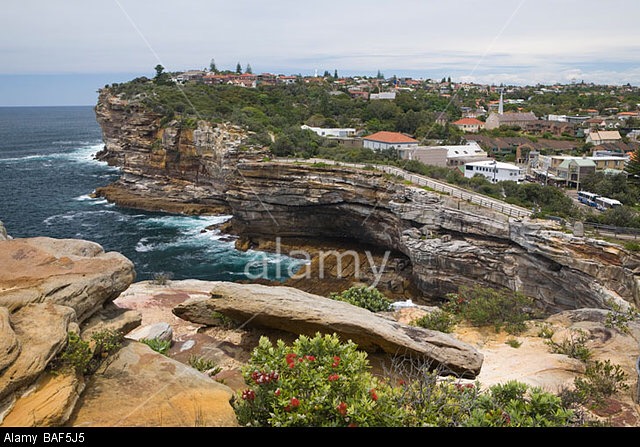
That Kevin would never have gone over The Gap at Watsons Bay, on that fateful 16 December 1965 night if Nancy had not come along is not even a debatable point. It would not have happened. Full stop! Even my mother suffered unaccountable guilt over my fathers actions, beating herself up over leaving home, leaving us in such volatile predicaments. Did Nancy herself ever feel guilt over what happened? In my observations…no! To her, a problem had been removed and life went on. Her alienation of people we knew now carried over to visiting sympathisers, close family, the media! She closed ranks, and not because it protected anyone, but because it was a further extension of her power. My curiosity at trying to come to terms with what had happened, trying to comprehend the sheer personal magnitude of it, was met with icy emotion, steel resolve that nothing and nobody was going to offer me any enrapturing arms, or sympathetic tears.

While all this turmoil went on, several other events occurred – I was, at no time, informed about what was going on with my father! I was kept completely in the dark, and apart from what I have been able to glean from press reports at the time, I am still in the dark about. I wasn’t even notified of his court cases! There was an attempt by my mother to take me back, which happened with such sudden and unexpected ferocity that it had the opposite effect on me to what it should have had…it scared the life out of me, and sent me bolting to a neighbours home for protection. And there was a custody battle between my mother and father, accompanied by threats – truly – from my fathers sisters on what I was to say to the judge to ensure my father – certainly not my parent of choice – retained custody. Nobody gave a flying fuck about what I wanted…it was all about spite, vindictiveness and control! Being a 12 year-old in the 60s was not to have any rights. You just did what you were told!

As for my fathers brief incarceration, there was one visit, and I was “encouraged” to write regularly, whether I wanted to or not.  Upon his release, Nancy stage managed his coming home to be a scene out of “Leave It To Beaver”, complete with me running up the road and into his loving arms! It was done reluctantly, I can assure you. My father and I effectively had no relationship from that time on, and when he committed suicide via carbon monoxide poisoning in 1978, there were no tears shed on my part. After his return, life’s disruptions continued, with the selling of our Melrose Ave home, moving to a shoebox flat in Kogarah – still with Nancy in tow – a name change from Pickhills to Phillips, and me having to change schools, leaving behind everything and everyone I knew. I ended up at a Marist Brothers boarding school in Campbelltown.

Still, there was one consolation – and again, it was unexpected, and came like a bolt from the blue. Dad arrived home at the flat one day, just in time to hear Nancy in one of her vitriolic tirades at me, for having helped myself to a biscuit from the Sacred Biscuit Tin! Now, whether he suspected that this may have been going on, or whether he was surprised to find it going on I will never know. Suffice it to say that, for the only time in our relationship, he stuck up for me, and bundled me into the car and took me to an aunties. I never saw Nancy again! Like ai cared!

My father and I never reconciled over Kevin’s death. Like with most of the unpleasant things that occurred in his life, he just pretended it never happened. Not Nancy, not my father, nor any of his family ever mentioned Kevin’s name again. It would be 35 years later before I felt comfortable, and able, to write about his death, to tell his story. A reconciliation with my mother just after his death likewise proved futile and fruitless. Too kuch water under the bridge by then. I believe she is still alive, and in her 80s. If my stepfathers death is any gauge, I will hear of her death several years after the event. I am not expecting to shed tears over that event, either’!

Tim Alderman (C) 2015