Padmasambhava was an 8th-century master of Buddhist tantra who is credited with bringing Vajrayana to Tibet and Bhutan. He is revered today as one of the great patriarchs of Tibetan Buddhism and the founder of the Nyinmapa school as well as the builder of Tibet’s first monastery.
In Tibetan iconography, he is the embodiment of the dharmakaya. He is sometimes called “Guru Rinpoche,” or precious guru.
Padmasambhava may have been from Uddiyana, which was situated in what is now the Swat Valley of northern Pakistan. He was brought to Tibet during the reign of the Emperor Trisong Detsen, (742 to 797). He is associated with the building of the first Buddhist monastery in Tibet, Samye Gompa.
In History
The historical narrative of Padmasambhava’s life begins with another Buddhist master named Shantarakshita. Shantarakshita came from Nepal at the invitation of Emperor Trisong Detsen, who was interested in Buddhism.
Unfortunately, Tibetans worried that Shantarakshita practiced black magic and he was kept in detention for a few months. Further, no one spoke his language. Months passed before a translator was found.
Eventually, Shantarakshita gained the Emperor’s trust and was allowed to teach. Some time after that, the Emperor announced plans to build a grand monastery. But a series of natural disasters — flooded temples, castles struck by lightning — stirred Tibetans’ fears that their local gods were angry about the plans for the temple. The Emperor sent Shantarakshita back to Nepal.
Some time passed and the disasters were forgotten. The Emperor asked Shantarakshita to return. But this time Shantarakshita brought another guru with him — Padmasambhava, who was a master of rituals to tame demons.
Early accounts say Padmasambhava divined which demons were causing the problems, and one by one he called them forth by name. He threatened each demon, and Shantarakshita — through a translator — taught them about karma. When he was finished, Padmasambhava informed the Emperor that building of his monastery could begin.
However, Padmasambhava was still viewed with suspicion by many at Trisong Detsen’s court. Rumors circulated that he would use magic to seize power and depose the Emperor. Eventually, the Emperor was worried enough that he suggested Padmasambhava might leave Tibet.
Padmasambhava was angry but agreed to leave. The Emperor was still worried, so he sent archers after Padmasambhava to put an end to him. Legends say Padmasambhava used magic to freeze his assassins and so escaped.
In Tibetan Mythology
As time passed, Padmasambhava’s legend grew. The full account of Padmasambhava’s iconic and mythological role in Tibetan Buddhism would fill volumes, and there are stories and legends about him beyond counting. Here is a very abridged version of Padmasambhava’s mythic story.
Padmasambhava — whose name means “born of the lotus” — was born at the age of eight from a flowering lotus in Dhanakosha lake in Uddiyana. He was adopted by the king of Uddiyana. In adulthood, he was driven from Uddiyana by evil spirits.
Eventually, he came to Bodh Gaya, the place where the historical Buddharealized enlightenment and was ordained a monk. He studied at the great Buddhist university at Nalanda in India, and he was mentored by many significant teachers and spiritual guides.
He went to the Cima Valley and became the disciple of a great yogi named Sri Simha, and received tantric empowerments and teachings. Then he went to the Kathmandu Valley of Nepal, where he lived in a cave with the first of his consorts, Mandarava (also called Sukhavati). While there, the couple received texts on Vajrakilaya, an important tantric practice. Through Vajrakilaya, Padmasambhava and Mandarava realized great enlightenment.
Padmasambhava became a renowned teacher. On many occasions, he performed miracles that brought demons under control. This ability eventually took him to Tibet to cleanse the site of the Emperor’s monastery from demons. The demons — the gods of indigenous Tibetan religion — were converted to Buddhism and became dharmapalas, or protectors of the dharma.
Once the demons were pacified, the building of Tibet’s first monastery could be completed. The first monks of this monastery, Samye, were the first monks of Nyingmapa Buddhism.
Padmasambhava returned to Nepal, but seven years later he came back to Tibet. Emperor Trisong Detsen was so overjoyed to see him that he offered Padmasambhava all the wealth of Tibet. The tantric master refused these gifts. But he did accept a lady from the Emperor’s harem, the princess Yeshe Tsogyal, as his second consort, provided the princess accepted the relationship of her free will.
Together with Yeshe Tsogyal, Padmasambhava hid a number of mystic texts (terma) in Tibet and elsewhere. Terma are found when disciples are ready to understand them. One terma is the Bardo Thodol, known in English as the “Tibetan Book of the Dead.”
Yeshe Tsogyal became Padmasambhava’s dharma heir, and she transmitted the Dzogchen teachings to her disciples. Padmasambhava had three other consorts and the five women are called the Five Wisdom Dakinis.
The year after Tri-song Detsan died, Padmasambhava left Tibet for the last time. He dwells in spirit in a pure Buddha-field, Akanishta.
Iconography
In Tibetan art, Padmasambhava is depicted in eight aspects:
Pema Gyalpo (Padmaraja) of Uddiyana, the Lotus Prince. He is depicted as a young prince.
Lo-den Chokse (Sthiramati) of Kashmir, the Intelligent Youth, beats a drum and holds a skull bowl.
Sakya-seng-ge (Bhikshu Sakyasimha) of Bodh Gaya, Lion of the Sakyas, is portrayed as an ordained monk.
Nyima O-zer (Suryabhasa) of Cina, the Sunray Yogi, wears only a loincloth and holds a trident pointing to the sun.
Seng-ge Dra-dok (Vadisimha) of Nalanda University, the Lion of Debate. He is usually dark blue and holds a dorje in one hand and a scorpion in the other.
Pema Jung-ne (Padmasambhava) of Zahor, the Lotus-born, wears monks’ robes and holds a skull bowl.
Pemakara of Tibet, Lotus-creator, sits on a lotus, wearing Tibetan monk’s robes and Tibetan boots. He holds a vajra in his right hand and a skull bowl in his left. He has a trident staff and a Nepalese cloth crown.
Dorje Dro-lo of Bhutan is a wrathful manifestation known as “Diamond Guts.”
Reference
O’Brien, Barbara. “Padmasambhava the Precious Guru of Tibetan Buddhism.” Learn Religions, Aug. 27, 2020, learnreligions.com/padmasambhava-450201.
Shigatse monastery in Tibet. Ratnakorn Piyasirisorost/Getty Images
The history of Buddhism in Tibet begins with Bon. The Bon religion of Tibet was animistic and shamanistic, and elements of it live on today, to one degree or another, in Tibetan Buddhism.
Although Buddhist scriptures may have made their way into Tibet centuries earlier, the history of Buddhism in Tibet effectively begins in 641 CE. In that year, King Songtsen Gampo (d. ca. 650) unified Tibet through military conquest and took two Buddhist wives, Princess Bhrikuti of Nepal and Princess Wen Cheng of China. The princesses are credited with introducing their husband to Buddhism.
Songtsen Gampo built the first Buddhist temples in Tibet, including the Jokhang in Lhasa and the Changzhug in Nedong. He also put Tibetan translators to work on the Sanskrit scriptures.
Guru Rinpoche and Nyingma
During the reign of King Trisong Detsen, which began about 755 CE, Buddhism became the official religion of the Tibetan people. The King also invited famous Buddhist teachers such as Shantarakshita and Padmasambhava to Tibet.
Padmasambhava, remembered by Tibetans as Guru Rinpoche (“Precious Master”), was an Indian master of tantra whose influence on the development of Tibetan Buddhism is incalculable. He is credited with building Samye, the first monastery in Tibet, in the late 8th century. Nyingma, one of the four major schools of Tibetan Buddhism, claims Guru Rinpoche as its patriarch.
According to legend, when Guru Rinpoche arrived in Tibet he pacified the Bon demons and made them protectors of the Dharma.
Suppression
In 836 King Tri Ralpachen, a supporter of Buddhism died. His half brother Langdarma became the new King of Tibet. Langdarma suppressed Buddhism and re-established Bon as the official religion of Tibet. In 842, Langdarma was assassinated by a Buddhist monk. Rule of Tibet was divided between Langdarma’s two sons. However, in the centuries that followed Tibet disintegrated into many small kingdoms.
Mahamudra
While Tibet was plunged into chaos, there were developments in India that would be keenly important to Tibetan Buddhism. The Indian sage Tilopa (989-1069) developed a system of meditation and practice called Mahamudra. Mahamudra is, very simply, a methodology for understanding the intimate relation between mind and reality.
Tilopa transmitted the teachings of Mahamudra to his disciple, another Indian sage named Naropa (1016-1100).
Marpa and Milarepa
Marpa Chokyi Lodro (1012-1097) was a Tibetan who traveled to India and studied with Naropa. After years of study, Marpa was declared a dharma heir of Naropa. He returned to Tibet, bringing with him Buddhist scriptures in Sanskrit that Marpa translated into Tibetan. Hence, is he called “Marpa the Translator.”
Marpa’s most famous student was Milarepa (1040-1123), who is remembered especially for his beautiful songs and poems.
One of Milarepa’s students, Gampopa (1079-1153), founded the Kagyu school, one of the four major schools of Tibetan Buddhism.
The Second Dissemination
The great Indian scholar Dipamkara Shrijnana Atisha (ca. 980-1052) came to Tibet by invitation of King Jangchubwo. At the request of the King, Atisha wrote a book for the king’s subjects called Byang-chub lam-gyi sgron-ma, or “Lamp to the Path of Enlightenment.”
Although Tibet was still politically fragmented, Atisha’s arrival in Tibet in 1042 marked the beginning of what is called the “Second Dissemination” of Buddhism in Tibet. Through Atisha’s teachings and writings, Buddhism once again became the main religion of the people of Tibet.
Sakyas and Mongols
In 1073, Khon Konchok Gyelpo (1034-l 102) built Sakya Monastery in southern Tibet. His son and successor, Sakya Kunga Nyingpo, founded the Sakya sect, one of the four major schools of Tibetan Buddhism.
In 1207, Mongol armies invaded and occupied Tibet. In 1244, Sakya Pandita Kunga Gyeltsen (1182-1251), a Sakya master was invited to Mongolia by Godan Khan, grandson of Genghis Khan. Through Sakya Pandita’s teachings, Godon Khan became a Buddhist. In 1249, Sakya Pandita was appointed Viceroy of Tibet by the Mongols.
In 1253, Phagba (1235-1280) succeeded Sakya Pandita at the Mongol court. Phagba became a religious teacher to Godan Khan’s famous successor, Kublai Khan. In 1260, Kublai Khan named Phagpa the Imperial Preceptor of Tibet. Tibet would be ruled by a succession of Sakya lamas until 1358 when central Tibet came under control of the Kagyu sect.
The Fourth School: Gelug
The last of the four great schools of Tibetan Buddhism, the Gelug school, was founded by Je Tsongkhapa (1357-1419), one of Tibet’s greatest scholars. The first Gelug monastery, Ganden, was founded by Tsongkhapa in 1409.
The third head lama of the Gelug school, Sonam Gyatso (1543-1588) converted the Mongol leader Altan Khan to Buddhism. It is commonly believed that Altan Khan originated the title Dalai Lama, meaning “Ocean of Wisdom,” in 1578 to give to Sonam Gyatso. Others point out that since gyatso is Tibetan for “ocean,” the title “Dalai Lama” simply might have been a Mongol translation of Sonam Gyatso’s name—Lama Gyatso.
In any event, “Dalai Lama” became the title of the highest-ranking lama of the Gelug school. Since Sonam Gyatso was the third lama in that lineage, he became the 3rd Dalai Lama. The first two Dalai Lamas received the title posthumously.
It was the 5th Dalai Lama, Lobsang Gyatso (1617-1682), who first became ruler of all Tibet. The “Great Fifth” formed a military alliance with the Mongol leader Gushri Khan. When two other Mongol chiefs and the ruler of Kang, an ancient kingdom of central Asia, invaded Tibet, Gushri Khan routed them and declared himself king of Tibet. In 1642, Gushri Khan recognized the 5th Dalai Lama as the spiritual and temporal leader of Tibet.
The succeeding Dalai Lamas and their regents remained the chief administrators of Tibet until the invasion of Tibet by China in 1950 and the exile of the 14th Dalai Lama in 1959.
Reference
O’Brien, Barbara. “How Buddhism Came to Tibet.” Learn Religions, Aug. 27, 2020, learnreligions.com/how-buddhism-came-to-tibet-450177.
Buddhist monks’ procession in the Loy Krathong and Yi Peng Festival on November 24, 2012, in Chiangmai, Thailand.Bidouze Stéphane / Dreamstime.com
Any history of Buddhism must begin with the life of the historical Buddha, who lived and taught in Nepal and India 25 centuries ago. This article is the next part of the history — what happened to Buddhism after the Buddha’s death, about 483 BCE.
This next chapter of Buddhist history begins with the Buddha’s disciples. The Buddha had many lay followers, but most of his disciples were ordained monks and nuns. These monks and nuns did not live in monasteries. Instead, they were homeless, wandering through forests and villages, begging for food, sleeping under the trees. The only possessions monks were allowed to keep were three robes, one alms bowl, one razor, one needle, and one water strainer.
The robes had to be made from discarded cloth. It was a common practice to use spices such as turmeric and saffron to dye the cloth to make it more presentable — and possibly smell better. To this day, Buddhist monks’ robes are called “saffron robes” and are often (although not always) orange, the color of saffron.
Preserving the Teachings: The First Buddhist Council
When the Buddha died, the monk who became a leader of the sangha was named Mahakashyapa. The early Pali texts tell us that, shortly after the Buddha’s death, Mahakashyapa called a meeting of 500 monks to discuss what to do next. This meeting came to be called the First Buddhist Council.
The questions at hand were: How would the Buddha’s teachings be preserved? And by what rules would the monks live? Monks recited and reviewed the Buddha’s sermons and his rules for monks and nuns, and agreed which were authentic.
According to historian Karen Armstrong (Buddha, 2001), about 50 years after the Buddha’s death, monks in the eastern part of North India began to collect and order the texts in a more systematic way. The sermons and rules were not written down but had been preserved by memorizing and reciting them. The Buddha’s words were set in verse, and in lists, to make them easier to memorize. Then the texts were grouped into sections, and monks were assigned what part of the canon they would memorize for the future.
Sectarian Divisions: The Second Buddhist Council
By about a century after the Buddha’s death, sectarian divisions were forming in the sangha. Some early texts refer to “eighteen schools,” which did not appear to be markedly different from one another. Monks of different schools often lived and studied together.
The biggest rifts formed around questions of monastic discipline and authority. Among the distinctive factions were these two schools:
Sthaviravada: “Sthaviravada” is Sanskrit for “the Way of the Elders.” The Sthaviavada school was conservative, adhering closely to the teachings and rules of the Pali Canon. The school lives today in parts of Asia by its Pali name, Theravada.
Mahasanghika: This school probably is a forerunner of Mahayana Buddhism. Mahasanghika developed the idea of the transcendent nature of a Buddha, the ideal of the bodhisattva, and the doctrine of shunyata, or “emptiness.” This school advocated a somewhat more liberal approach to the monastic rules.
A Second Buddhist Council was called about 386 BCE in an attempt to unify the sangha, but sectarian fissures continued to form.
The Emperor Ashoka
Ashoka (ca. 304–232 BCE; sometimes spelled Asoka) was a warrior-prince of India known for his ruthlessness. According to legend, he was first exposed to Buddhist teaching when some monks cared for him after he was wounded in battle. One of his wives, Devi, was a Buddhist. However, he was still a cruel and brutal conqueror until the day he walked into a city he had just conquered and saw the devastation. “What have I done?” he cried and vowed to observe the Buddhist path for himself and for his kingdom.
Ashoka came to be the ruler of most of the Indian subcontinent. He erected pillars throughout his empire inscribed with the Buddha’s teachings. According to legend, he opened seven of the original eight stupas of the Buddha, further divided the Buddha’s relics, and erected 84,000 stupas in which to enshrine them. He was a tireless supporter of the monastic sangha and supported missions to spread the teachings beyond India, in particular into present-day Pakistan, Afghanistan, and Sri Lanka. Ashoka’s patronage made Buddhism one of the major religions of Asia.
The Two Third Councils
By the time of Ashoka’s reign, the rift between Sthaviravada and Mahasanghika had grown large enough that the history of Buddhism splits into two very different versions of the Third Buddhist Council.
The Mahasanghika version of the Third Council was called to determine the nature of an Arhat. An arhat (Sanskrit) or arahant (Pali) is a person who has realized enlightenment and may enter Nirvana. In the Sthaviravada school, an arhat is the ideal of Buddhist practice.
A monk named Mahadeva proposed that an arhat is still subject to temptation, ignorance, and doubt, and still benefits from teaching and practice. These propositions were adopted by the Mahasanghika school but rejected by Sthaviravada.
In the Sthaviravada version of history, the Third Buddhist Council was called by Emperor Ashoka about 244 BCE to stop the spread of heresies. After this Council completed its work the monk Mahinda, thought to be a son of Ashoka, took the body of doctrine agreed upon by the Council into Sri Lanka, where it flourished. The Theravada school that exists today grew from this Sri Lankan lineage.
One More Council
The Fourth Buddhist Council probably was a synod of the emerging Theravada school, although there are multiple versions of this history, also. According to some versions, it was at this council, held in Sri Lanka in the 1st century BCE, that the final version of the Pali Canon was put in writing for the first time. Other accounts say the Canon was written down a few years later.
The Emergence of Mahayana
It was during the 1st century BCE that Mahayana Buddhism emerged as a distinctive school. Mahayana possibly was an offspring of Mahasanghika, but there probably were other influences also. The important point is that Mahayana views didn’t happen for the first time in the 1st century, but had been evolving for a long time.
During the 1st century BCE The name Mahayana, or “great vehicle,” was established to distinguish this divergent school from Theravada/Sthaviravada school. Theravada was derided as “Hinayana,” or the “lesser vehicle.” The names point to the distinction between Theravada’s emphasis on individual enlightenment and the Mahayana ideal of the enlightenment of all beings. The name “Hinayana” is generally considered to be a pejorative.
Today, Theravada and Mahayana remain the two primary doctrinal divisions of Buddhism. Theravada for centuries has been the dominant form of Buddhism in Sri Lanka, Thailand, Cambodia, Burma (Myanmar) and Laos. Mahayana is dominant in China, Japan, Taiwan, Tibet, Nepal, Mongolia, Korea, India, and Vietnam.
Buddhism at the Beginning of the Common Era
By the year 1 CE, Buddhism was a major religion in India and had been established in Sri Lanka. Buddhist communities also flourished as far west as present-day Pakistan and Afghanistan. Buddhism had divided into Mahayana and Theravada schools. By now some monastic sanghas were living in permanent communities or monasteries.
The Pali Canon was preserved in written form. It is possible some of the Mahayana sutras were written or being written, at the beginning of the 1st millennium, although some historians put the composition of most of the Mahayana sutras in the 1st and 2nd centuries CE.
About 1 CE, Buddhism began a vital new part of its history when Buddhist monks from India took the dharma to China. However, it would yet be many centuries before Buddhism reached Tibet, Korea, and Japan.
Reference
O’Brien, Barbara. “Early Buddhist History: The First Five Centuries.” Learn Religions, Aug. 25, 2020, learnreligions.com/early-buddhist-history-the-first-five-centuries-449898.
We do not know how many monks and nuns were ordained by the Buddha during his lifetime. The early accounts sometimes describe monks and nuns by the thousands, but that is possibly exaggerated.
Of these unknown numbers some outstanding individuals emerge. These are individuals who contributed to the development of Buddhism and whose names one finds in the sutras. Through their life stories we can get at least a glimpse of the first generation of men and women who chose to follow the Buddha and practice his teaching.
Ananda was the historical Buddha‘s cousin and also his attendant during the latter part of his life. Ananda is also remembered as the disciple who recited the Buddha’s sermons from memory at the First Buddhist Council, after the Buddha had died.
According to a possibly apocryphal story in the Pali Tipitika, Ananda persuaded a reluctant Buddha to accept women as his disciples.
Ruins in Sravasti, India, thought to be of the Jeta Grove retreat center. Bpilgrim / Wikimedia Creative Commons
Anathapindika was a wealthy lay disciple and benefactor of the Buddha. His generosity to the poor earned him his name, which means “feeder of the orphans or helpless.”
The Buddha and his disciples traveled for most of the year, but they stayed indoors in seclusion during the summer monsoon season. With the Buddha’s permission, Anathapindika purchased a property that would be called the Jeta Grove. He then built a meeting hall, dining hall, sleeping cells, wells, lotus ponds, and whatever else the monks might need during their solitary rains retreats. This was the first Buddhist monastery.
Today, readers of the sutras may notice that the Buddha delivered many of his discourses “in the Jeta Grove, in Anathapindika’s Monastery.”null
Devadatta Incites an Elephant to Charge the Buddha. Tevaprapas, Wikipedia Commons, Creative Commons License
Devadatta was a kinsman of the Buddha who became a disciple. According to some traditions, Devadatta became consumed with jealousy of the Buddha. After receiving a particularly harsh rebuke from the Buddha, Devadatta plotted to have the Buddha assassinated.
When his plots failed, he split the sangha by persuading many younger monks to follow him instead of the Buddha. The monks Sariputra and Maudgalyayana were able to persuade the wayward monks to return.null
Dhammadinna and Visakha as a married couple. Anandajoti / Photo Dharma / Flickr.com, Creative Commons License
Some of the early sutras of Buddhism are about enlightened women who teach men. In Dhammadinna’s story, the man was the enlightened woman’s ex-husband. The Buddha praised Dhammadinna as “a woman of discerning wisdom.
Khema
กสิณธร ราชโอรส / Wikimedia Commons
Queen Khema was a great beauty who became a nun and one of the chief women disciples of the Buddha. In the Khema Sutta (Samyutta Nikaya 44), this enlightened nun gives a dharma lesson to a king.
After the historical Buddha died, Mahakasyapa assumed a leadership position among the Buddha’s surviving monks and nuns. He convened and presided over the First Buddhist Council. For this reason, he is called the “father of the sangha.” He is also a patriarch of Chan (Zen).
Maudgalyayana
Sariputra and Maudgalyayana become disciples of Buddha. Nomu420craftsmen / Wikimedia Commons
Maudgalyayana was a lifelong friend of Sariputra; the two entered the order together. The Buddha’s instructions to Maudgalyayana as he struggled with his early practice have been valued by the many generations.
Marraige of Suddhodana and Mahapajapati. Photo Dharma from / Wikimedia Commons
Pajapati is credited with being the first Buddhist nun. She is often called Mahapajapati.
Pajapati was the Buddha’s aunt who raised the young Prince Siddhartha as her own child after the death of his mother, Queen Maya. After the Buddha’s enlightenment she and many of her court ladies shaved their heads, dressed in patched mendicants’ robes, and walked many miles barefoot to find the Buddha and ask to be ordained. In a section of the Pali Tipitika that remains controversial, the Buddha refused the request until persuaded to change his mind by Ananda.
Patacara
The story of Patacara. Anandajoti, Wikipedia Commons, Creative Commons License
Patacara was a nun who overcame unimaginable grief to realize enlightenment and become a leading disciple. Some of her poems are preserved in a section of the Sutta-pitaka called the Therigatha, or Verses of the Elder Nuns, in the Khuddaka Nikaya.
Punnika
Punnika was a slave who, by chance, heard a sermon of the Buddha. In a famous story recorded in the Pali Sutta-pitaka, she inspired a Brahmin to seek out the Buddha. In time she became a nun and realized enlightenment.
Siddhartha leaving sleeping Yashodhara and Rahula. Nomu420 / Wikimedia Commons
Rahula was the historical Buddha’s only child, born shortly before the Buddha left his life as a prince to seek enlightenment. It is said Rahula was ordained a monk while still a child and realized enlightenment at the age of 18.
Buddha with Mogallana and Sariputta. Origamiemensch / Wikimedia Commons
It was said Sariputra was second only to the Buddha in his ability to teach. He is credited with mastering and codifying the Buddha’s Abhidharma teachings, which became the third “basket” of the Tripitika.
The Upali Thein temple. Tsaetre / Wikimedia Commons
Upali was a low-caste barber who met the Buddha when he was called upon to cut the Buddha’s hair. He came to the Buddha to ask to be ordained with a group of the Buddha’s high-born kinsmen. The Buddha insisted on ordaining Upali first so that he would be their senior, and superior, in the order.
Upali became known for his faithful devotion to the Precepts and his understanding of the rules of the monastic order. He was called upon to recite the rules from memory at the First Buddhist Council, and this recitation became the basis of the Vinaya.
Reference
O’Brien, Barbara. “The Historical Buddha’s Disciples.” Learn Religions, Aug. 27, 2020, learnreligions.com/first-generation-of-buddhas-disciples-449657.
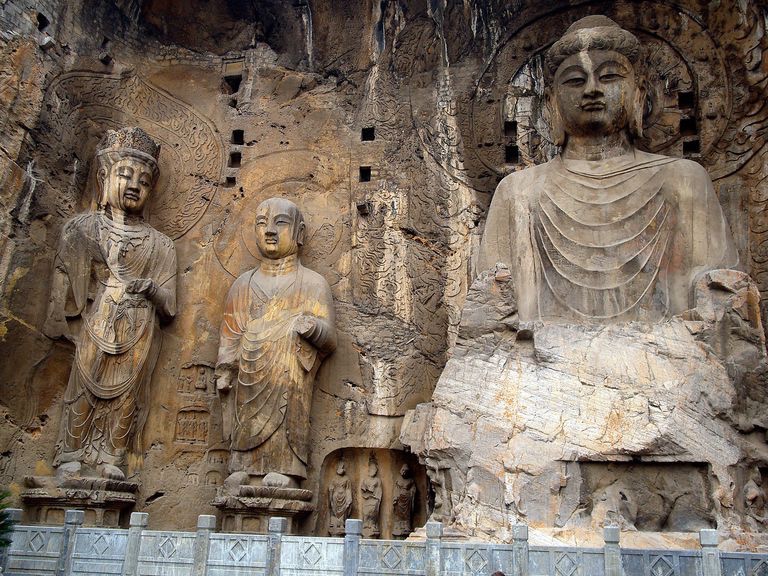
The large Vairocana Buddha with disciples Ananda and Kasyapa. Public Domain
Of all the principal disciples, Ananda may have had the closest relationship to the historical Buddha. Particularly in the Buddha’s later years, Ananda was his attendant and closest companion. Ananda also is remembered as the disciple who recited the Buddha’s sermons from memory at the First Buddhist Council, after the Buddha had died.null
What do we know about Ananda? It is widely agreed that Buddha and Ananda were first cousins. Ananda’s father was a brother to King Suddhodana, many sources say. It is thought that when the Buddha returned home to Kapilavastu for the first time after his enlightenment, cousin Ananda heard him speak and became his disciple.null
Beyond that, there are several conflicting stories. According to some traditions, the future Buddha and his disciple Ananda were born on the same day and were exactly the same age. Other traditions say Ananda was still a child, maybe seven years old, when he entered the Sangha, which would have made him at least thirty years younger than the Buddha. Ananda survived the Buddha and most of the other principal disciples, which suggests that the latter version of the story is more probable.
Ananda was said to be a modest, quiet man who was completely devoted to the Buddha. He also was said to have a prodigious memory; he could recite every sermon of the Buddha-word for word after hearing it only once. Ananda is credited with persuading the Buddha to ordain women into the Sangha, according to one famous story. However, he was slower than other disciples to realize enlightenment and did so only after the Buddha had died.
The Buddha’s Attendant
When the Buddha was 55 years old, he told the sangha he needed a new attendant. The attendant’s job was a combination of servant, secretary, and confidant. He took care of “chores” such as washing and mending robes so that the Buddha could focus on teaching. He also relayed messages and sometimes acted as a gatekeeper, so that the Buddha would not be mobbed by too many visitors at once.
Many monks spoke up and nominated themselves for the job. Characteristically, Ananda remained quiet. When the Buddha asked his cousin to accept the job, however, Ananda accepted only with conditions. He asked that the Buddha never giver him food or robes or any special accommodations so that the position did not come with material gain.
Ananda also requested the privilege of discussing his doubts with the Buddha whenever he had them. And he asked that the Buddha repeat any sermons to him that he might have to miss while carrying out his duties. The Buddha agreed to these conditions, and Ananda served as attendant for the remaining 25 years of the Buddha’s life.
The Ordination of Pajapati
The story of the ordination of the first Buddhist nuns is one of the most controversial sections of the Pali Canon. This story has Ananda pleading with a reluctant Buddha to ordain his stepmother and aunt, Pajapati, and the women who had walked with her to become the Buddha’s disciples.
The Buddha eventually agreed that women can become enlightened as well as men, and could be ordained. But he also predicted that the inclusion of women would be the undoing of the sangha.
Some modern scholars have argued that if Ananda really was more than thirty years younger than the Buddha, he would still have been a child when Pajapati approached the Buddha for ordination. This suggests the story was added, or at least re-written, a long time later, by someone who didn’t approve of nuns. Still, Ananda is credited with advocating for the right of women to be ordained.
Parinirvana
One of the most poignant texts of the Pali Sutta-pitaka is the Maha-parinibbana Sutta, which describes the last days, death, and parinirvana of the Buddha. Again and again, in this sutta we see the Buddha addressing Ananda, testing him, giving him his final teachings and comfort. And as monks gather around him to witnesses his passing into Nirvana, the Buddha spoke in praise of Ananda—”Bhikkhus [monks], the Blessed Ones, Arahants, Fully Enlightened Ones of times past also had excellent and devoted attendant bhikkhus [monks], such as I have in Ananda.”
Enlightenment and the First Buddhist Council
After the Buddha had passed, 500 enlightened monks came together to discuss how their master’s teachings might be preserved. None of the Buddha’s sermons had been written down. Ananda’s memory of the sermons was respected, but he had not yet realized enlightenment. Would he be allowed to attend?
The Buddha’s death had relieved Ananda of many duties, and he now dedicated himself to meditation. The evening before the Council was to begin, Ananda realized enlightenment. He attended the Council and was called upon to recite the Buddha’s sermons.
Over the next several months he recited, and the assembly agreed to commit the sermons to memory also and preserve the teachings through oral recitation. Ananda came to be called “The Keeper of the Dharma Store.”
It is said Ananda lived to be more than 100 years old. In the 5th century CE, a Chinese pilgrim reported finding a stupa holding Ananda’s remains, lovingly attended by nun. His life remains a model of the path of devotion and service.
Reference
O’Brien, Barbara. “The Life of Ananda, Buddha’s Disciple and Attendant.” Learn Religions, Aug. 27, 2020, learnreligions.com/life-of-ananda-449647.
When many Westerners think of “Buddha,” usually they don’t visualize the Buddha of history, meditating or teaching. This “true” Buddha is known more completely as Gautama Buddha or Shakyamuni Buddha and is almost always depicted in deep meditation or contemplation. The image is very often of a very thin individual with a serious though the sublimely peaceful expression on his face.
The Laughing Buddha
Most Westerners, though, think of a fat, bald, jolly character called “The Laughing Buddha” when they think of the Buddha. Just where did this figure come from?
The Laughing Buddha emerged from Chinese folktales of the 10th century. The original stories of the Laughing Buddha centered on a Ch’an monk named Ch’i-t’zu, or Qieci, from Fenghua, in what is now the province of Zhejiang. Ch’i-t’zu was an eccentric but much-loved character who worked small wonders, such as predicting the weather. Chinese history assigned the date of 907-923 CE to Ch’t’zu’s life, which means he lived considerably later than the historical Shakyamuni, the true Buddha.
Maitreya Buddha
According to tradition, just before Ch’i-t’zu died, he revealed himself to be an incarnation of Maitreya Buddha. Maitreya is named in the Tripitaka as the Buddha of a future age. Ch’i-t’zu’s last words were:
Maitreya, true Maitreya Reborn innumerable times From time to time manifested among men The men of the age do not recognize him.
Pu-tai, Protector of Children
The tales of Ch’i-t’zu spread throughout China, and he came to be called Pu-tai (Budai), which means “hempen sack.” He carries a sack with him full of good things, such as sweets for children, and he is often pictured with children. Pu-tai represents happiness, generosity and wealth, and he is a protector of children as well as of the poor and the weak.
Today, a statue of Pu-tai can often be found near the entrance of Chinese Buddhist temples. The tradition of rubbing Pu-tai’s belly for good luck is a folk practice, however, not a genuine Buddhist teaching. It is indicative of Buddhism’s broad tolerance of diversity that this laughing Buddha of folklore is accepted into the official practice. For Buddhists, any quality that represents Buddha-nature is to be encouraged, and the folklore of the kind, laughing Buddha is not regarded as any kind of sacrilege, even though people unwittingly may confuse him with Shakyamuni Buddha.
An Ideal Enlightened Master
Pu-tai also is associated with the last panel of the Ten Ox-herding Pictures. These are 10 images that represent stages of enlightenment in Ch’an (Zen) Buddhism. The last panel shows an enlightened master who enters towns and marketplaces to give to ordinary people the blessings of enlightenment.
Pu-tai followed the spread of Buddhism into other parts of Asia. In Japan, he became one of the Seven Lucky Gods of Shinto and is called Hotei. He also was incorporated into Chinese Taoism as a deity of abundance.
Reference
O’Brien, Barbara. “The Laughing Buddha.” Learn Religions, Aug. 25, 2020, learnreligions.com/the-laughing-buddha-449784.
By Katie Conry; Designed by Nic Buron; Photography by Lauren Crew
Out on a photo walk with friends, we spontaneously decided to climb up to the scenic vista point of Corona Heights. With my pink plastic Holga camera in hand, I snapped shots of my friends against the backdrop of brown boulders and the skyline of San Francisco, when suddenly, a giant purple caterpillar, a gnome in a ball gown carrying a purse, and a man in a fantastic blue dress and feather hat to match appeared at the top of the hill above us. In total awe, I ran up the hill to discover who these magical humans were. A group of 15 or so introduced themselves as the Feyboy Collective, a sect of a larger community called the Radical Faeries. My pals and I had happened upon them in the midst of a magazine photo shoot. A dazzling display of glitter, sass, and some sort of mock ritual sacrifice, these Feyboys were, hands down, the best thing I’ve ever found on top of a hill in San Francisco.
It turns out the Radical Faeries are more than just a handful of beautiful weirdos living in San Francisco. They’re a part of a politically radical movement of gay men who’ve been around since the 1970s, and include millions of members around the world. Through art and pagan-influenced rituals, the Faeries are all about challenging the status quo and creating a culture that celebrates the eccentric. Unsurprisingly, San Francisco harbors the largest and most active groups of these fabulous and progressive queers.
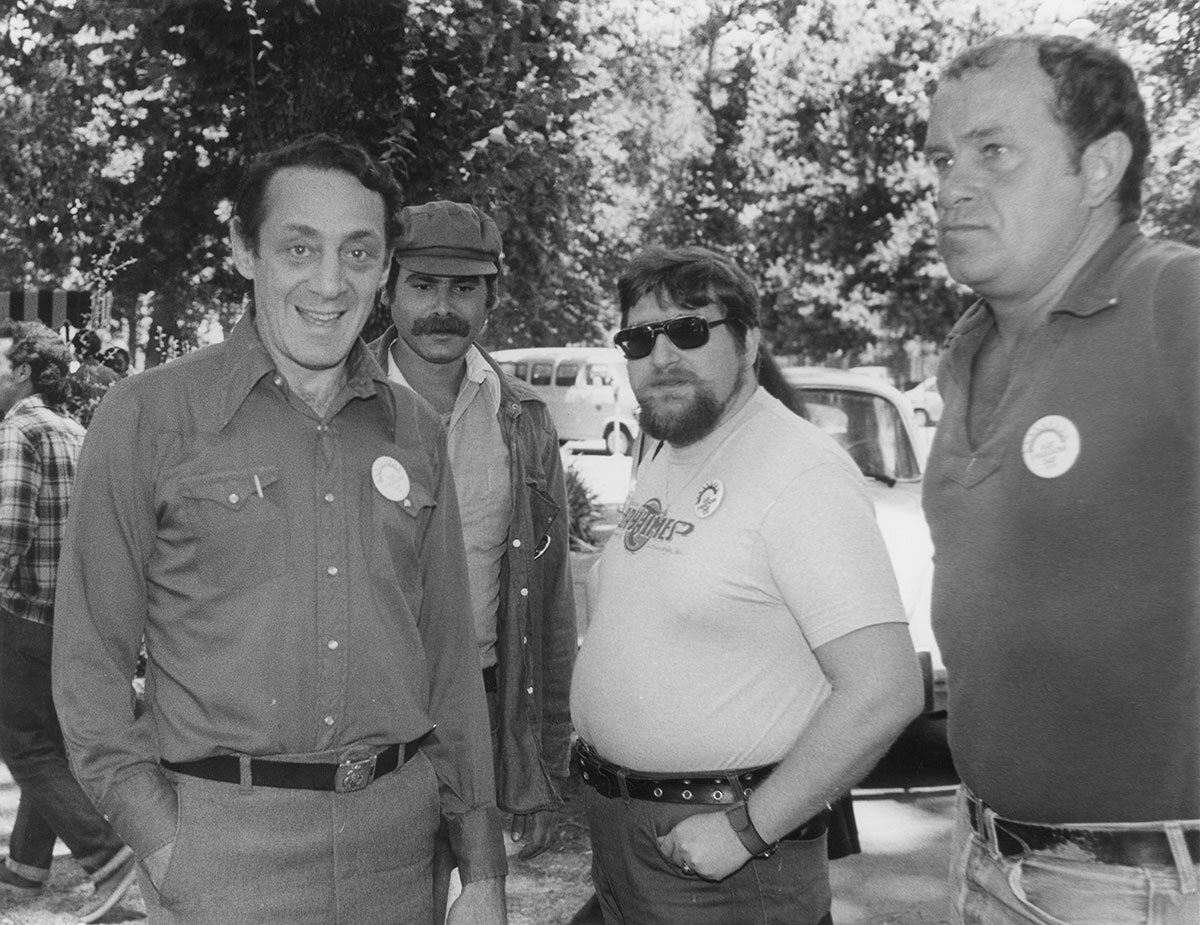
Excited to learn more, I was thrilled by the invitation to check out the HQ — the Feyboy Mansion, which was actually Pinkfeather and fellow Feyboy Kyle’s SOMA apartment. When I arrived, they welcomed me in with a hug, and we began discussing the colorful history of the Radical Faeries. In the ’70s, founder Harry Hay was the first person in the U.S. to recognize homosexuals as an oppressed cultural minority, and the first to promote being gay as a social identity. At the time, many gays thought that in order to gain acceptance, they should imitate heterosexuals. Harry founded the Radical Faeries in 1979 as a way for gays to reject society’s norms. The Radical Faeries spread their message through artistic and ritualistic gatherings and festivals, first all over the United States, and then around the world.
“There’s an aesthetic and vibe to every city. San Francisco Faeries are glittery and fantastically over the top, but also unpolished.” says Pinkfeather. “There’s a theatricality to us. In SF, gays have often been a little more outrageous, a little more gender fuck, a littler weirder.” This proud history of theatricality includes the Sisters of Perpetual Indulgence, founded by participants in a 1979 Faerie gathering that same year.
Harry Hay was also a communist, and the Faeries have always been class conscious and concerned with social justice. Kyle explained that the very nature of their community is anticapitalist. “We are working toward something more cooperative, something more about resource sharing and support; our very nature is anti-consumerist.”
All of the Faerie events are pay what you can, and no one is turned away for lack of funds. Anyone can stay for free at the Faerie sanctuaries, and Faeries can travel and stay with other Faeries all over the world for free.
DIY and thrift is a big part of the Faerie fashion aesthetic, and all goods and services are traded and bartered when possible. “Any time we can work outside of the capitalist system we do,” says Kyle.
The Feyboy Collective was founded to create an intentional community to help further the cause of the Radical Faeries for the next generation. On the collective’s website, they describe themselves as a “queerdo community center facilitating shared creative space, hosting events from D.I.Y. workshops to sex parties and acting as a launchpad for aspiring SF radical artists and activists.” Pinkfeather comments, “Weird girls like Kyle and myself are sidelined in mainstream gay culture. We moved to San Francisco to find the radical queers. We want to push boundaries of what we can get away with culturally and artistically.”
The Radical Faeries sound like the biggest thing that no one has ever heard of. Pinkfeather and Kyle say that’s somewhat on purpose. The movement, while totally inclusive, is an underground group. They want to maintain a safe space for its members, but they also want to be out in the open, interacting with the community at large. And that’s where their events come in.
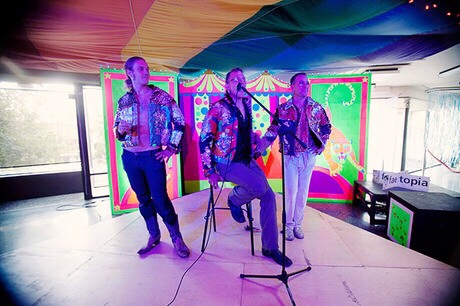
The Feyboy Collective plans and hosts Radical Faerie events and funds a variety of art projects. Several years ago they were given a large space on Market and Castro the week leading up to and including Pride. From this blank canvas, Faetopia, was born. Faetopia 2012 included queer cinema screenings, a visual art gallery, burlesque, drag, historical exhibits, a DIY fashion workshop, and sex positive seminars. On Pride Sunday, the Feyboys hosted their signature event, the Faerie Freedom Village, which is one of the largest scale Radical Faerie events of the year.
Faeries from near and far travel to attend the Faerie Freedom Village. The grassy knoll at Civic Center Plaza is walled off and turned into a magical Faerie Garden where Faeries, and anyone else who is game, are welcome to party, dance, and do whatever s/he pleases. I attended this year and surveyed what seemed to be a relaxed garden party with outrageous clothing (or none at all). Two naked kids basked peacefully in the sun with their naked parents. Things got raucous when the drag show began, courtesy of drag group Meow Mix. Nothing says San Francisco like a lip-syncing, gyrating queen a stone’s throw from City Hall.
Harry Hay promoted gay as an identity separate from heteronormativity. What I saw that day was a celebration of that identity, and any identity different from traditional culture and gender roles. The Village is an accepting space created free of any form of capitalism, where a community can come together and connect through radical expression and celebrate their beautiful freakiness.
One of those beautiful freaks celebrated that day was Crumbsnatcher, a queer musician in a little kid’s dinosaur hoodie. Crumbsnatcher strutted onto the stage accompanied by two guys in full animal costume. “This guy is a furry,” the MC declared. “Let me introduce Crumbsnatcher!” While the furry dino rapped, his animal entourage did a freak dance that grew progressively kinkier. Eventually, a partygoer from the audience joined them, until all four were writhing on the stage. This glorious display of weirdness was definitely the highlight of my day. Being yourself can be a radical thing, and performances like this encourage people to be whatever kind of person they want to be.
Later that day my friend met a cute, pixie-ish boy in a black leotard, who she insisted was her spirit animal. He invited us to follow him to the official after-party. Our adventure through wonderland continued and turned out to be a more private version of the same kind of radical expression and celebration of queerness that we saw in the Village. At first glance it seemed like a calm, grown-up party in a nice condo with a wide offering of snacks. But this was no run-of-the-mill condo party. Throughout the night, I caught snippets of heated discussions about radical politics, but it wasn’t just the conversation that was passionate. We witnessed a lot of nudity and some cuddling, and later my friends and I stumbled upon a hot tub filled with naked men and accidentally walked into a sex dungeon complete with whips, chains, swings, and even more naked men.
When my only-in-San-Francisco night ended, I thanked the hosts for helping keep our city radical. As I walked out the door, I looked back at the regalia of dressed-up fabulous freaks and remembered something one of the Radical Faeries had said to me earlier that day: “There’s more to learn from wearing a dress in one day than a suit in a lifetime.”
Gay Spirituality and the Radical Faeries
When developing gay life in America starts to surface in books about the era, gay spirituality will emerge as one of the more fascinating subjects. A significant new book that deals with the subject has just appeared. It is “The Fire In Moonlight: Stories from the Radical Faeries,” edited by Mark Thompson, assisted by Richard Nealy and Bo Young and published by White Crane Books. The book has been nominated as one of 74 LGBT Books for Adult Readers by the Gay, Lesbian, Bisexual and Transgender Round Table of the American Library Association.
Described as “the gay community’s last authentic global grassroots movement,” the Radical Faeries had their inception on a remote site of the American Southwest in 1979. The book honors two men who played a key pioneering role, Harry Hay and Don Kilhefner. That historic “First Spiritual Conference for Radical Faeries” gave Hay an opportunity to pronounce: “I am saying to everybody who will hear that now we must begin to maximize the differences between us.” In other words, Hay was talking clearly about “shedding the ugly green frog-skin of hetero imitation.”
Will Roscoe, author of “The Zuni Man-Woman,” which received the Margaret Mead Award of the American Anthropological Association, has written a brilliant Introduction to the new book. “Same-sex love is distinguished from heterosexual love by the sameness and equality of those it united,” he says. Roscoe cites Walt Whitman as a gay teacher of primary significance. He finds that Harry Hay took Whitman’s insights one step further, “giving a name to the distinct mode of awareness this love of sames and equals fosters—subject-SUBJECT consciousness.”
“The Fire In Moonlight” has many remarkable storytellers among its collection of authors. The book is staggering in its scope and depth. Robert Croonquist is a Founder and Program Director of Youth Arts New York. He describes in detail a Faerie Camp gathering. “We circle the grove and call out names.” After many names from within the Faerie community “Others called out Marilyn Monroe, Allen Ginsberg, Judy Garland, Walt Whitman, Oscar Wilde. The young Faeries, it dawned on me, didn’t know anybody who had died. I kind of felt sorry for them and kind of felt better than them. And kind of, but not really, felt they were lucky.”
William Stewart has embarked on a quest to connect with other gay men who share an aspiration to live together in collective commitment and consciousness. His contribution to this book is a prophetic piece entitled “Stewarding the Future: A Call for Sacred Witness.” He cites “typical gay traits” as “the skills of artists, healers, tricksters, ritual makers, shamans and intermediaries between the worlds.” Stewart believes that Harry Hays’ assertion “that social function rather than sexual preference should be seen as the defining characteristic of our kind is as radical now as when he first conceived of it in the dark days of McCarthyism.”
Another contributor to the book is Allen Page who describes himself as “an intuitive spiritual counselor, channeler, teacher and gay elder.” He writes: “We are fathers, artists, athletes and sissies. We do not fear gentleness and have no need to compete. We believe in the power of contradictions and the magic of laughter. That the quality of energy exchanged in lovemaking is more important than the gender of bodies.”
Mark Thompson poignantly pulls together a description of the historic 1979 Faerie Gathering in Arizona with his personal vision of the future:
“Music was played again and each man made an offering to a basket that was passed around: a feather from Woolworth’s, a stone from the Ganges River, a lock of hair, a handwritten poem. We began to dance with the music and in a few moments noticed we were being joined in our merriment by a large horned bull. Naturally shy, the animal was drawn close in. The bull stood and watched motionless, like some ancient hieroglyphic painted on a cave wall, then he just as inexplicably vanished.
Soon, we too began to drift away into the dark chill air. None of us would ever find again this particular place of red earth that had nourished us so. But even to prompt a return would be missing the point. Our journeys as a new kind of men, having been thusly inaugurated, meant that we would have many destinations, far and wide, still to attend.”
“The Fire In Moonlight: Stories from the Radical Faeries” is a boundless delight to read, a poem that stirs up magic thoughts, and a piece of history as solid as the stone Lincoln
Following the Pansy Path
Forty years after its initial publication, does The Faggots and Their Friends Between Revolutions have anything to offer the queer present?
Ned Asta/Nightboat Books
This post is part of Outward, Slate’s home for coverage of LGBTQ life, thought, and culture. Read more here.
In 1977, author Larry Mitchell formed Calamus Press to self-publish his first book, The Faggots and Their Friends Between Revolutions. The slim volume was originally conceived, according to Mitchell, as a children’s book complete with whimsical illustrations by his friend Ned Asta, a fellow member of the Lavender Hill queer commune in Ithaca, New York.
In short, simple passages, the book describes the lives of “the faggots” and their various groups of friends—the “strong women,” the “queens,” the “queer men”—as they attempt to survive and find joy, beauty, humor, pleasure, and freedom in Ramrod, an empire in decline dominated by the oppressive, militaristic “men.” In The Faggots and Their Friends,Mitchell depicted queer life as it was beginning to emerge from the shadows in the late ’60s and ’70s, as communities formed and a movement blossomed. He turned his observations of pre-AIDS gay culture into a kind of parable conveying its values and conventions—such as they were—and imparting lessons meant to sustain future generations of queer people, with the ultimate goal of guiding them toward the social and sexual revolutions Mitchell hoped to see. Here is the queer world, here are its tribes, here is how they managed to survive and even thrive within a system of oppression. Beauty is currency; sexuality is sustenance. But more valuable than that is friendship—which usually involves some degree of sexual intimacy. Pleasure will keep you going. So will humor, possibly more effectively.
Out of print since 1988, a new edition of The Faggots and Their Friendswas recently published by Nightboat Books. It is at once heartening and chilling how relevant it remains more than four decades later. The various queer tribes and their individual quirks and characteristics are likely recognizable to anyone with a passing familiarity with contemporary LGBTQ culture (though Mitchell’s characterization of all women as nurturing earth mammas could stand to be complicated). Faggots—whether we embrace the reclamation of the term or not—persist in our pursuit of pleasure. We still cruise; we still create. We still run headlong toward our fantasies and embrace those discarded by mainstream culture, sprinkling them with fairy dust and reviving them as camp. “Some of the faggots are trashy. In fact, with the inspiration of the outcast women, the faggots developed ‘trashy’ into a high form of disruptive behavior.” Yeah, that tracks with the rambunctious queer scenes in places like Bushwick.
Ned Asta/Nightboat Books
The (drag) queens, still fearlessly irreverent, are even more visible today, embraced by a generation of fan girls thanks to VH1. The (radical) faeries still have their gatherings in their mountain retreats. I don’t know that we have a term now for Mitchell’s “queer men,” but you know who they are: The gay suits who concern themselves with respectability politics, who just want to get married, a few of whom probably still think the rest of us are setting a bad example, embodying “stereotypes” with our scantily clad antics at the pride parade. Some of them, corrupted by Reagan-era neoconservatism, probably became today’s Log Cabin Republicans. And it’s hardly a stretch, within Mitchell’s woolly, loving cosmology, to read gestures toward today’s genderqueers and pansexuals of all stripes.
I want to give a Xeroxed copy to Pete Buttigieg.
As much as he relished taxonomy, Mitchell recognized the fluidity of his categories long before we spoke of sexuality and gender as spectrums. “All the men could be faggots or their friends,” he writes. And later: “There is more to be learned from wearing a dress for a day than there is from wearing a suit for a lifetime.” Mitchell is invested in dismantling boundaries—between acceptable and unacceptable behavior, between sexual categories, between gender, but most importantly between people, a project that today’s radical queers continue.
More troublingly, the descriptions of Ramrod’s disintegration and the men’s hostility toward the faggots and their friends are echoed in Trump’s America. “Everyday the faggots and their friends can see, hear, and feel Ramrod’s empire disintegrating as the men lose more and more things they never owned in the first place.” Is it even possible to read that without stressing out over the apparent failures of American democracy or the wave of illiberal populism sweeping Europe? Mitchell recognized that social progress breeds backlash: “The men’s viciousness will grow as their panic increases.” And yet, you have to wonder whether he could have predicted just how bad it would get: the upticks in anti-LGBTQ violence as pro-LGBTQ sentiment increases even among younger conservatives, the push to limit legal protections for queer and trans people post–marriage equality. “It’s been a long time since the last revolutions and the faggots and their friends are still not free.” Word.
Reading The Faggots and Their Friends for the first time in 2019, I am of two minds about the philosophy it imparts. The vision it presents of a different way of being is heartening. I want to believe that we can set aside the master’s tools and open a magic portal within ourselves, to a more peaceful, loving world. The simple language Mitchell employs to convey queer values gives queer culture the weight of wisdom passed down through the ages. In the decades since it was published, bootleg copies of The Faggots and Their Friends were passed around like an occult text. I want to give a Xeroxed copy to Pete Buttigieg.ADVERTISEMENTnull
The artist and activist Tourmaline, who wrote the preface to the new edition, has described The Faggots and Their Friends as “an invitation to be dependent and reliant on each other’s care.” Mitchell’s involvement in queer communes like Lavender Hill was a reaction to the alienation and loneliness of the closet. Before Armistead Maupin wrote his tales of “logical families” filling the void left when LGBTQ people were rejected by their biological relatives, Mitchell was turning the notion of chosen family, of radical queer communities, into a quasi-spiritual wisdom. I can’t think of a more necessary ethos at a time when social media has left us paradoxically more disconnected than ever. The Faggots and Their Friends is a timely reminder that human connection is essential for revolution, not to mention survival. As the strong women advise: “We gotta keep each other alive any way we can ’cause nobody else is goin’ do it.”
At the same time, however, I’m uncomfortable with what seems to me like Mitchell’s ultimate strategy of divestment from the world of the men. “The fairies have left the men’s reality in order to destroy it by making a new one.” When I read that, I can’t help but think of those people who want to terraform Mars instead of passing legislation that could effectively combat climate change. The closing passages of The Faggots and Their Friends seem to suggest a kind of nihilism. “They begin to know … that they cannot be free until this dance is stopped,” Mitchell writes of his queer tribes. “The faggots and their friends and the women who love women can … stop and do no-thing.”
My friend, the performance artist Dan Fishback, points out that queer culture has often flourished most in separatist environments—New York’s ball scene, the leather community, faerie communes. But in 2019, tuning in, turning on, and dropping out—doing “no-thing”—isn’t an option. It’s tempting, for sure; our individual efforts can feel futile in the face of … you know, everything. But we’ve seen what happens when we lose faith in democracy, when we sit out elections, and stop paying attention. It may seem like a revolutionary strategy to retreat to the gardens of the faeries, to unplug and go off the grid. But who gets left behind when we do that? Which of our friends suffer from our disengagement? And how long before the men find their way into those gardens?
The Faggots and Their Friends Between Revolutions reads today almost like a sacred text from the queer past. As with any sacred text, our job is not simply to receive its wisdom, but to engage with it (passionately, critically, seriously) and apply it the best way we can to the world as we find it today.
How a breakfast table staple sparked solidarity and protest in the queer community
CREDIT: ILLUSTRATION BY LAUREN KOLM
As she heeded the call to come on down, descending the Price Is Right’s audience riser wearing a headscarf with juicy swirls of lemon, tangerine, and lime, Yolanda Bowsley’s breasts jiggled out of her tube top. Producers flashed a thick blue bar over the contestant’s naked bits, people in the studio howled, but Bowsley looked neither freaked nor ashamed. Meanwhile, on ABC’s new sitcom Three’s Company—a show with double entendres about three-ways and casual lust—a pair of tangy orange throw pillows on the set’s central couch visually throbbed, the implied accoutrements of seduction. Sexual freedom in 1977 tended to express itself in fearless, provocative hues of citrus.
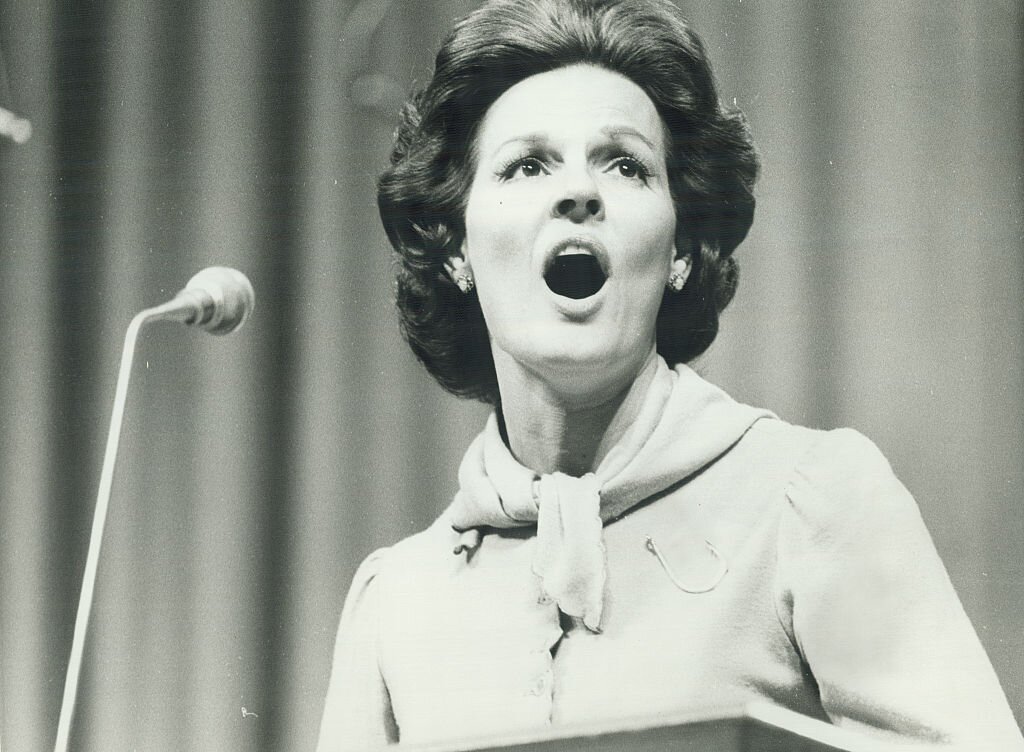
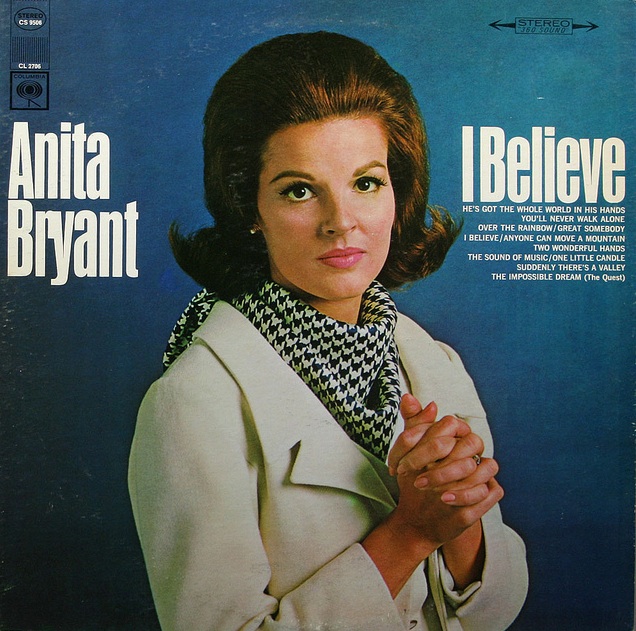
But not for the queen of orange juice herself. Not for Anita Bryant, who wore shirt-dresses the color of lemon meringue pie filling and tangerine cap-sleeve bodices as if they were the armor of the righteous in battle. Bryant saw sexual openness as a challenge to God’s order, a threat to what she liked to call “straight and normal America.” It lacked decency. It corrupted children. It had to be stopped.
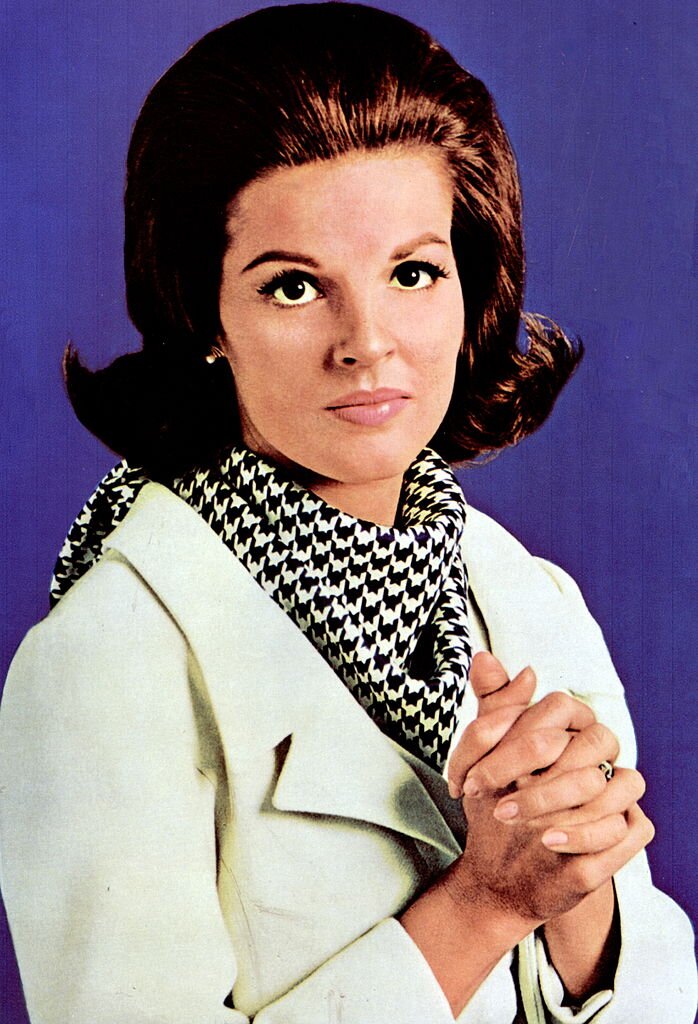
Bryant had been Miss Oklahoma once, beautiful, with pale skin and dark eyes. She was Jackie Kennedy with a hard-spray flip and a soft country twang, raised on church suppers and sticky flour gravy. As a tightly poised pop singer in the early ‘60s, she’d built a shortstack of hits, earning three gold records. She married her manager, Bob Green, a hunk with a handsome mess of sandy hair who knew how to pair a blazer with a turtleneck. They were a dream couple, country stylish like Elvis and Priscilla but without the obvious diet pills and demons. They lived in a six-bedroom mansion on Miami Beach’s North Bay Road, where palms rustled and clouds billowed like Rococo scrollwork, framing a crystal blue sky.
In 1969 Bryant began her second and most lucrative career—the Florida Citrus Commission, a politically powerful consortium of the state’s largest growers, crowned Bryant the Sunshine State’s official OJ Sweetheart. She became the star of TV spots and magazine ads, a lifestyle ambassador for frozen concentrated orange juice.
In an early commercial, Bryant strolls a sunny citrus grove, stabs a spigot in a dangling orange and sings a loping jingle, “Come to the Florida Sunshine Tree,” as a five-foot glass fills with juice. She tugs the spigot out and collects the last golden sluice in a tumbler of normal size. She sips. And in an Oklahoma drag that’s genuine, gentle, and perfect, with just enough post-production echo to make it sound infallible, Bryant drops the tagline: “Breakfast without orange juice is like a day without sunshine.”
Orange juice was, in a way, the Sun Belt’s symbol: healthy, wholesome, and optimistic, like… well, sunshine. Anita was its avatar. Then she became its avenging angel.
Per capita American OJ consumption would end up just about filling the Citrus Commission’s mighty sloshing prop glass. Houseware manufacturers like Libbey included pony-size juice tumblers in starter sets. Bars invited in a back squad of OJ party cocktails—Screwdrivers and Tequila Sunrises—to soak up the glut of concentrated juice. They invented the Alabama Slammer and the Harvey Wallbanger to keep things percolating in fern bars and fairway lounges.
CREDIT: PHOTO BY GAB ARCHIVES VIA GETTY IMAGES
There was something else bending in OJ’s favor: a cultural tilt south. Starting in 1969, the collapse of the Rust Belt—factories in the Northeast and Upper Midwest closing, towns boarding up, labor unions shrinking—became an unavoidable narrative for papers and the evening news. The Sun Belt, a made-up political projection encompassing a westward sweep of the map from Jacksonville to San Diego, was where a new conservatism was spreading like the creep of subdivisions in the desert near Phoenix. Orange juice was, in a way, the Sun Belt’s symbol: healthy, wholesome, and optimistic, like… well, sunshine. Anita was its avatar. Then she became its avenging angel.
The year Bryant stabbed that orange with a spigot, 1969, was a year of events more tumultuous billowing up north. At New York City’s Stonewall Inn, demonstrations smoldered for days following a routine bust of queers, trans women, and drag queens that set off a riot, the official start of the gay liberation movement. In spite of an ambient distaste for homosexuals and the lack of even one openly gay or lesbian elected official anywhere in the nation, by the end of 1976, legislative bodies in 40 cities and counties and one state (Pennsylvania) had passed LGBT nondiscrimination laws in some form. An enlightened consensus was jelling. It said citizens shouldn’t be fired, or evicted, or denied service because they were gay, all standard under the old rules, when America discriminated righteously to thwart sodomy and other acts of moral degeneracy. But righteousness didn’t evaporate in the heat of Stonewall. Righteousness festered, biding its time.
As 1977 dawned in South Florida, liberals on the Miami–Dade County Commission passed a pretty standard homosexual nondiscrimination ordinance. Religious conservatives, including Bryant, representing her church, drew a line in the pale, sugar-fine sand. They spoke against the ordinance at a Commission hearing, arguing that the ordinance violated her rights as a person of faith. When it passed anyway, Bryant promised retribution, spinning a metaphor that, consciously or not, conjured a vision of Florida orange groves choked by a homosexual radicalism inching its sinister tendrils toward Washington and the Constitution. “The seed of sexual sickness,” Bryant said, “that germinated in Dade County has already been transplanted by misguided liberals in the U.S. Congress.”
CREDIT: PHOTO BY BORIS SPREMO VIA GETTY IMAGES
Bryant’s retribution came weeks later, when she and her allies delivered, in an enormous bulging old suitcase wheeled into the county registrar’s office on a dolly, signatures in favor of calling a special referendum on the Miami-Dade ordinance. Bryant and her allies launched Save Our Children, to urge voters to bury the homosexual nondiscrimination ordinance with a special referendum in June. Children were the true victims of the ordinance, which enabled homosexuals (and especially gay teachers) to bend the innocent ones toward a mincing evil. “Gays can’t reproduce,” Bryant would say—often—in variations on the line, “so they have to recruit.”
Gay and lesbian political groups nationally saw what was happening: Suddenly, Miami was America’s test case for the strength of the nascent homosexual civil rights movement. And they were going up against a star, a woman with a national profile, with the strength of one of Florida’s major industries tacitly, at least, behind her. They were up against the queen of frozen concentrated orange juice herself.
Some raised money to send to activists in Miami defending the ordinance. Jim Toy, an LGBT-rights pioneer in Michigan, remembers driving from Ann Arbor to Detroit to make the round of gay bars with a donation jar. Others tried to hurt Bryant at the source of her fame. “We didn’t know any way to get back at her,” says Wayne Friday, who in 1977 was president of San Francisco’s Tavern Guild, a powerful association of gay bar owners and employees. “So we just targeted orange juice.”
CREDIT: PHOTO BY FLICKR USER CHRIS
Weeks after the Miami-Dade special referendum was called, gay bars across the U.S. were boycotting orange juice from the Sunshine State, and activists including Harvey Milk, a vocal organizer in the new queer scene in San Francisco’s Castro neighborhood, were urging people to drop it at breakfast. Consumer boycotts were a persuasive tactic of the left, starting with farm labor organizer César Chávez’s call in 1966 for shoppers to shun California grapes and lettuce. In 1977, organized labor called for a boycott of Coors beer to protest the company’s labor practices, its union-busting and alleged racism and homophobia. But the Florida orange juice boycott was the first organized by gay and lesbian activists. They called it a gaycott. And it was strongest in what was, in 1977, the gayest city in America.
In April, San Francisco’s Tavern Guild printed up notices on orange construction paper for its member bars to post. The signs didn’t state so much as throw down: “TO PROMOTE HUMAN RIGHTS this establishment DOES NOT SERVE FLORIDA ORANGE JUICE or orange juice from CONCENTRATE.”
Wayne Friday says the public boycott started at a Polk Street bar, the N’Touch. Friday tended bar there. “Bars up and down Polk Street,” Friday says, “they’d have a thing where they’d say, ‘Okay, at 11 in the morning everybody pour out your orange juice in the street.’ We even got some non-gay bars to do it. The police would get a little mad but the city would just wash down the street.”
CREDIT: PHOTO BY FRANK LENNON VIA GETTY IMAGES
In some bars you could get a Screwdriver for half price if you brought in your own sack of oranges and squeezed them yourself, on little hand squeezers set out on the bar. You could bring in your own juice, but you had to know what you were carrying. “God help you if you brought a bottle of orange juice that was from Florida,” Friday says. “I’ve seen a bartender take it off the bar, look at the label, and pour it right down the drain.” Other bars pushed Greyhounds (vodka and grapefruit juice). Dan Perlman, a member of Ann Arbor’s Gay Student Union during the boycott, remembers a horrible grapefruit Tequila Sunrise, though a grapefruit Alabama Slammer tasted better (and still tastes better, he says) than the OJ original.
In his April 14 column for the Bay Area Reporter, a weekly gay newspaper, Harvey Milk urged readers to switch to pineapple juice for breakfast. “Some say that ONE can of OJ won’t make any difference,” he wrote. “Before Bryant becomes more powerful, remember that your ONE can adds up to millions of ONE cans throughout the nation. The only way to stop this bigot is to have a fully effective economic boycott.”
A queer cottage industry of anti-Anita protest gear popped up, with oranges as symbols of active (and sometimes passive) defiance: “Anita, Dear… Cram It”; “Stop V.D. Fuck Oranges.” People wore orange buttons that said “Squeeze Anita!” “A Day Without Human Rights Is Like a Day Without Sunshine,” read a popular T-shirt in all-caps bold, under a rough-skinned orange lurking like the Death Star.
Bryant spent the five months of the Miami-Dade campaign defiant, showing up at her church school to sing “Glory, Glory Hallelujah” with kindergartners as props. “Anita Bryant was once known as an orange juice saleswoman,” the local Miami NBC affiliate reported. “Not anymore. With a religious fervor that has made her the nation’s most controversial woman overnight, she has been selling her Save Our Children group.”
CREDIT: PHOTO VIA WIKIMEDIA COMMONS
Bryant portrayed her own martyrdom at the hand of the gaycott. “They’re coming, attacking my livelihood,” Bryant told a TV reporter, “and it has undermined a 10-year relationship with Florida citrus of goodwill. But I feel strongly, and I have great faith in God, that he’s going to take care of me. I’m not afraid. I have not been moved in that respect. And I do not believe that the product and the people I represent will be intimidated by that kind of a force.” She vowed to fight on, even if what she called her livelihood (in 1977 the Florida Citrus Commission paid her $100,000; adjusted for inflation that’s a little over $400,000 today) was stripped from her.
“We’re dealing with a vile and a vicious and a vulgar gang,” a young Jerry Falwell, Bryant’s supporter, said of Save Our Children’s foes.
The gays and their allies were simply outplayed. Save Our Children hired a Republican political consultant to produce a devastating ad, contrasting Miami’s annual Orange Bowl Parade with the San Francisco Pride march. The image of a baton twirler at the Orange Bowl, a girl with rosy cheeks, in a white, stylized military uniform, gives way to washed-out footage from San Francisco of a shirtless man in worn jeans and feathered hair, pelvic-thrusting on a float with a sad-looking palm tree, then cuts to another man in a black jockstrap and studded leather halter.
“The Orange Bowl Parade,” you hear a man say in voiceover, “Miami’s gift to the nation, wholesome entertainment. But in San Francisco, when they take to the streets, it’s a parade of homosexuals, men hugging other men, cavorting with little boys. The same people who turned San Francisco into a hotbed of homosexuality want to do the same thing to Dade County.” The dystopian gay metropolis appears furtive and frantic, fueled by speed and menace.
They never really had a chance, the gays and lesbians on OJ pickets at supermarkets or arguing their case at grocery co-op meetings, squeezing oranges or passing donation jars in gay bars. They thought the cause of civil rights, pretty much alone, would rally voters of conscience. They expected easier grounds for common cause with other minorities who’d suffered oppression.
As election news from 3,000 miles away seeped in through TVs, bars bumping Thelma Houston and Donna Summer emptied onto the streets of San Francisco’s burgeoning gay neighborhood that chilly night in June. By a two-to-one margin, voters in Dade County had killed the nondiscrimination ordinance. At an event she called the Lord’s victory supper, Anita Bryant was gleamingly triumphant. She vowed to take the fight to every city, county seat, and state capitol in the nation with laws protecting gay people.
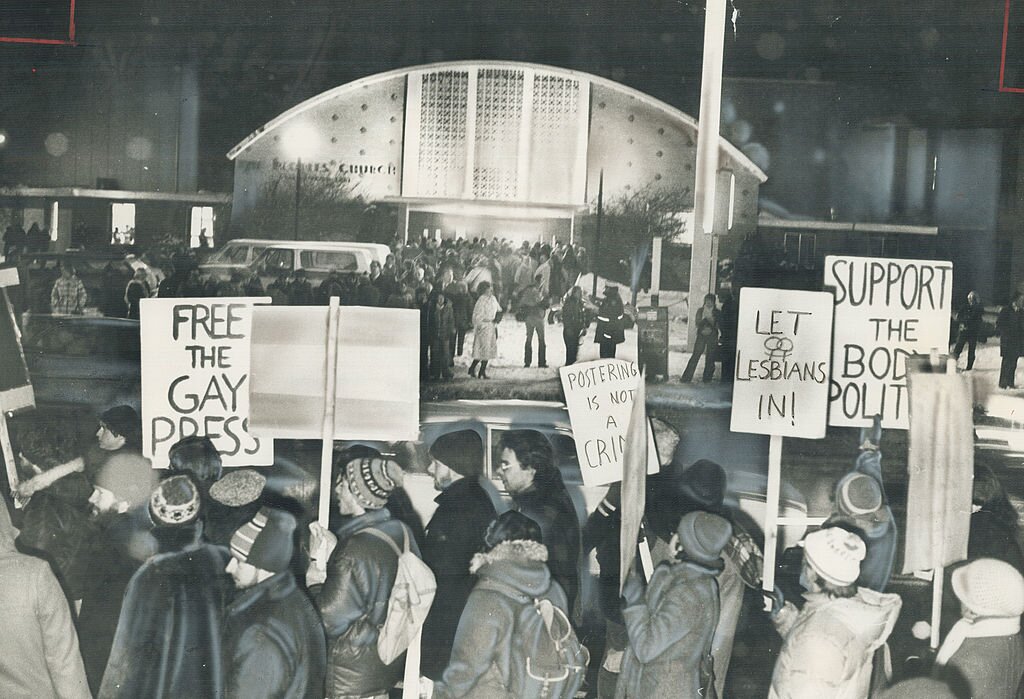
The crowd in San Francisco marched from the Castro to Polk Street, chanting, carrying candles in Dixie cups.. They milled around City Hall, returned to the Castro, and sat down in a busy intersection. Harvey Milk marched at the head of the crowd; later he spoke. Nobody had seen such a large and spontaneous takeover of the streets by so many calling themselves “faggots” and “dykes.” “I feel like the bill of rights has been wadded up on a cheap piece of paper and thrown in the wastebasket,” a woman told a radio reporter that night. You could hear her anger.
CREDIT: PHOTO BY IMAGE PRESS VIA GETTY IMAGES
Others glimpsed a measure of victory in defeat. Bob Kunst, Bryant’s opponent on the ground in Miami, said the ordinance fight had galvanized world opinion. “She gave us every access to world media,” Kunst said from the post-referendum party in a quietly reflective at the Fontainebleau in Miami Beach. “We had over 50,000 news clippings, this was the turning point where ‘gay’ became a household word, and we opened up the entire debate on human sexuality.”
For Milk, defeat was a reckoning, a reminder that gays and lesbians had to unify, to organize, and most of all to come out. Later that year, Milk would become the first openly gay person to be elected to public office in America. Just 17 months later he’d be assassinated, shot by a former cop, but not before he’d inspired a more active national LGBT movement and urged every one of the estimated 15 million queer Americans to come out to President Jimmy Carter, by letter. It wasn’t until 1998, 20 years later, that Dade County passed a new gay and lesbian rights ordinance. It’s still in effect, though conservative groups tried to repeal it in 2002.
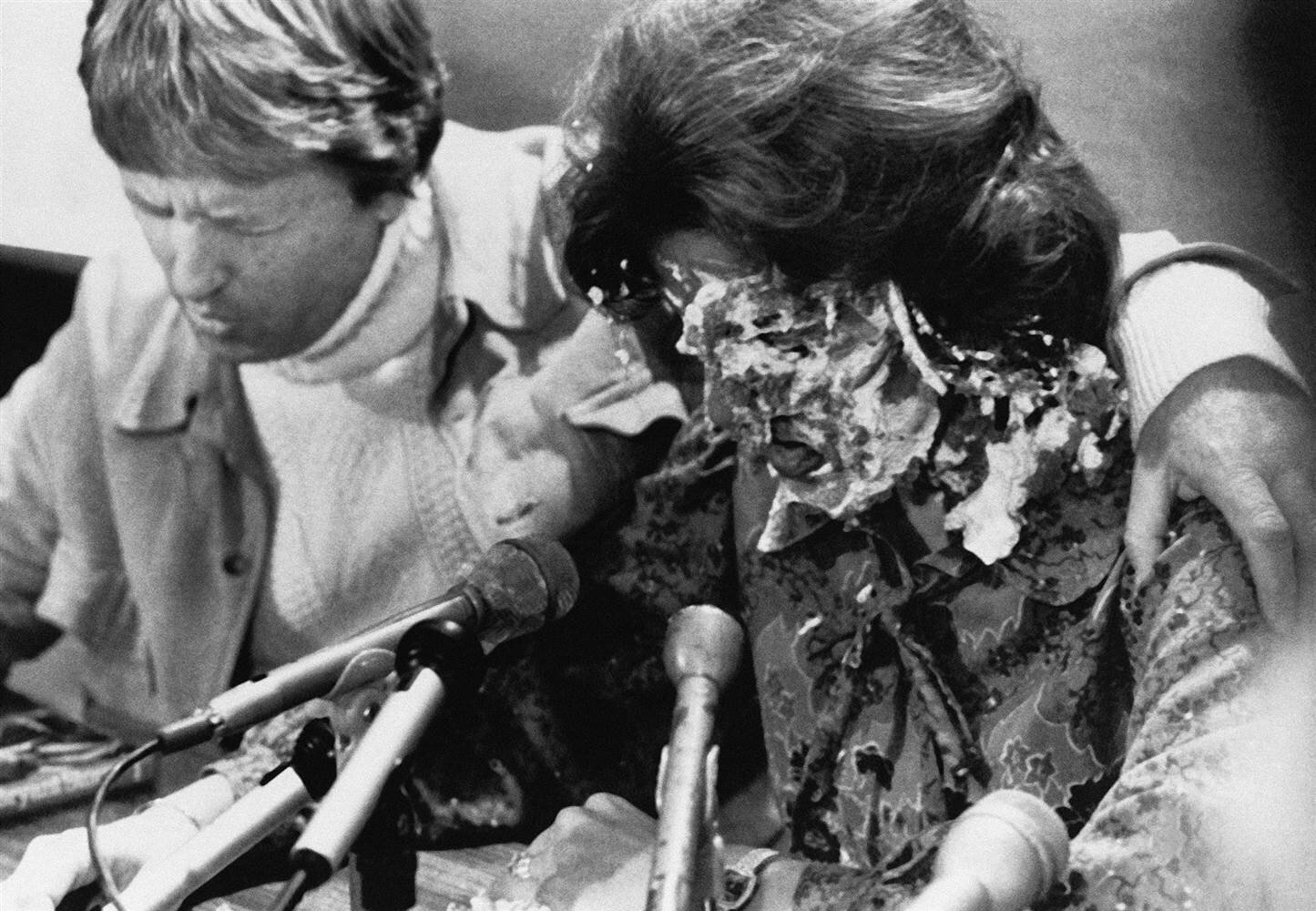
The orange juice gaycott went on after the referendum, petering out gradually. Bryant continued the work of Save Our Children; she was met with picket lines and protests everywhere she went. In Iowa, a protester nailed her with a cream pie. It is, perhaps, the enduring image of Anita, flicking pie crust out of one eye, praying for the man who threw it.
CREDIT: PHOTO VIA NBC NEWS
“At first the Florida Citrus Commission was bombarded,” Bryant told the Miami Herald after the referendum. “I guess people had nothing better to do than to write and to boycott. Then the mothers of America retaliated, I think. Sales are up 15 percent over last year. The citrus people say I’m a private citizen, that I can express my views.” It was an exaggeration, or wishful thinking. Two weeks after the referendum the public relations spokesman for Florida citrus said he wished Bryant would resign. At the end of 1978, in the same month Milk was assassinated, Bryant was fired. In 1980 she and Bob Green divorced. She experienced bankruptcy and decline. In 1990, trying to make a comeback with a new album, Bryant told Inside Story she had no regrets about what she did in Dade County in 1977. “I don’t regret it because I did the right thing.” She now lives quietly in Oklahoma.
On the night of the referendum, people called in to Fruit Punch, a gay radio show broadcast across the bay from San Francisco in Berkeley, to express their anger, fear, or despair. “I just about broke down in tears, something like this happening in our country,” a woman said in a weary tone. Another seemed almost chipper in her resolve. “I’m not gay myself,” she explained. “I just want to say that Anita Bryant has made me really mad because she’s wasting her time on negative things.”
She said she had a solution, said it with the optimism of the perpetually just. “We are giving up orange juice.”
Bob Green, Anti-Gay Bigot, Dies As Resentful As He Lived
Most people have no idea who he was. You can’t blame them. He was just a speed bump on the road toward equality of rights. Behind the scenes, however, he played an important role in creating the “culture war” that still plagues this nation.
Anita Bryant, the anti-gay crusader, was his wife. He didn’t play the role of sidekick; he was the power behind the throne.
Bryant was a would-be beauty queen, a Miss America runner-up who tried a singing career. She managed a small number of songs in the top 100 but was never star material. Green met her when he was a radio station DJ and escorted her to a music industry convention. They married in 1960, and he took control of Anita’s career.
Her career peaked when the Florida Citrus Commission hired her as a spokeswoman. Her commercials hawking orange juice made her a familiar face in American living rooms, something she used to her advantage in 1977 when she and Bob launched their anti-gay campaign. The couple trotted out all the usual anti-gay stereotypes, right down to naming their organization Save Our Children.
Their campaign resulted in numerous copycats working to repeal anti-discrimination laws around the country — but only those anti-discrimination laws that protected the LGBT community. Jerry Falwell rushed to Miami to support her but stole the lucrative anti-gay issue from under her by forming his Moral Majority.
In addition to pushing the usual stereotypes, Bryant even claimed that her “ministry” was capable of “curing” gay people through prayer. Save Our Children originated most of the talking points still used by the religious right in regard to gay people.
I made my way to Indianapolis on Oct. 7, 1977 to witness Bryant and Green in action. They were there to promote a “Right to Decency” bill introduced by Rep. Don Boys, a fundamentalist minister. Anita Bryant and Jerry Falwell were the draw for an evening rally. Earlier, her fundamentalist followers held a march in support of the bill. Some carried protest signs demanding that gay people be executed. Others seriously told me that the presence of homosexuals caused droughts. I jokingly asked if it were possible to control flooding by busing homosexuals, and one person seriously told me it would work.
Bryant had a concert/rally scheduled in South Bend on the Oct. 27, so I called the sponsoring minister and persuaded him to allow me to spend the day at the auditorium with Bryant and Green. It was eye-opening. Bryant was practicing, but between numbers she and Green would talk with me. When they weren’t talking to me, I was watching them.
Anita was plastered in make-up, though she was only 37 at time. Green, nine years her senior, dominated her completely.
Through the rehearsal he’d chastised her, pointing out every error or flaw. He wasn’t kindly, either. He barked at her. She didn’t talk back, but her body language was unmistakable. She tensed when he neared; her eyes shot barbs of contemptuous anger in his direction. Theirs was obviously a terminally ill marriage. Having experienced an abusive father at home, I was sensitive to the signs. I wondered how much worse it was behind closed doors, without a stranger watching.
At first, Save Our Children was rolling in money. But Falwell and other hate-mongers jumped into the market. Falwell’s television empire easily pushed Save Our Children out of the cash-generating limelight. Bryant’s records weren’t going to make her rich, and by publicly taking a political position, Bryant was poison as a spokeswoman. In 1979 the Florida Citrus Commission didn’t renew her expiring contract.
The final straw was a 1980 divorce. She claimed emotional abuse as the reason. Green insisted that they were still married according to the Bible and opposed her, publicly urging her to return to his side. The messy public divorce angered fundamentalists, her last source of support, guaranteeing her a well-deserved decline into obscurity. And when she was no longer in the public eye, Bob Green became a nobody. It took the media over a month to notice he had died.
Green remained bitter until the end. Bryant had told the world what I already knew, that their marriage “was never much good to begin with.” He never took responsibility for the decline and fall of Anita Bryant. He blamed gays, saying, “Blame gay people? I do. Their stated goal was to put her out of business and destroy her career. And that’s what they did. It’s unfair.” But Bob Green was the one who managed her into obscurity. He encouraged the crusade that lost her the spokeswoman career, and they couldn’t out-compete Falwell in the anti-gay market.
In The Miami Herald Steve Rothaus wrote, “For more than 30 years, Mr. Green lived quietly, alone and resentful.” He didn’t take responsibility for the choices he made. He convinced himself that it was all the fault of “the gays” and his ex-wife. Anita told Rothaus, “Bob internalized a lot of his own anger and frustration and disappointments. … I tried to be his friend, but you can only go so far.”
The Catholic Church claims that it is the oldest Christian Church in the world, dating back to Jesus himself. In the time that the Church has been on earth, many unusual traditions have arisen. While most of them seem perfectly normal to Catholics, to non-Catholics they often seem outright bizarre. This is a list of the ten most bizarre aspects of Catholicism. In no particular order
10: Stigmata
Saint Pio of Peitrelcina
Stigmata is when a person has unexplained wounds on their body that coincide with the traditional wounds that Christ had. In some cases the wounds can appear in only one or two of the areas, but there have been instances of it occurring in all five places that Christ was wounded. The wounds can cause considerable pain which has been known to worsen on certain religious feast days. There have been occasional cases of falsified stigmata in the past and some people claim that even those which are not proven to be falsified are somehow part of a hoax.
The photograph above is of Saint Pio of Pietrelcina (Canonized in 2002) who is the most recent stigmatic in the Catholic Church. Saint Pio is the latest in a long line of famous stigmatics – the most famous of whom is probably St Francis of Assisi. Writing to his spiritual director, Saint Pio said:
Then last night something happened which I can neither explain nor understand. In the middle of the palms of my hands a red mark appeared, about the size of a penny, accompanied by acute pain in the middle of the red marks. The pain was more pronounced in the middle of the left hand, so much so that I can still feel it. Also under my feet I can feel some pain.
It is also alleged that Saint Pio was able to bi-locate (appear in two places at once) and to read the sins on a person’s soul
9: The Cilice
A cilice is an item worn on the body to inflict pain or discomfort for the sake of penance (remorse for your past actions). Originally a cilice was an undergarment made of rough hair (such as a hairshirt) or cloth. In recent times it has been seen as more discreet to wear a chain which has spikes on it. Contrary to popular belief, the cilice does not break the skin – it merely causes discomfort. It is usually worn around the thigh.
The Catholic Encylopedia of 1913 says:
“In modern times the use of the hairshirt [(cilice)] has been generally confined to the members of certain religious orders. At the present day only the Carthusians and Carmelites wear it by rule; with others it is merely a matter of custom or voluntary mortification.”
In recent years the cilice has gained a great deal of publicity due to the book The Da Vinci Code in which it is worn by the main antagonist of the story – though in the story it is exaggeratedly described as causing wounds. Wearing the cilice has always been an optional practice for Catholics. Some famous people in the past to have worn them are Saint Thomas More and Saint Patrick.
8: The Flagrum
The Flagrum is a type of scourge with small hard objects attached to the length of its cords. It is traditionally used to whip oneself (self-flagellation) and is most commonly found in conservative religious orders. The flagrum is held in one hand and thrown over the shoulder in order to cause the cords to strike the flesh. The purpose of self-flagellation is voluntary penance and mortification of the flesh (a safeguard against committing further sins).
The most famous Saint to use the flagrum is probably Saint John Vianney, who would give his parishoners very light penances in confession and then flog himself in privacy for their benefit (it is believed by Catholics that acts of penance can be offered for the sins of other living people or the souls of the dead). When Saint John Vianney died, the walls of his bedroom had spatterings of blood on them from his extreme use of the flagrum.
According to the Catholic Encyclopedia:
“St. Peter Damian (died 1072) […] wrote a special treatise in praise of self-flagellation; though blamed by some contemporaries for excess of zeal, his example and the high esteem in which he was held did much to popularize the voluntary use of the scourge or “discipline” as a means of mortification and penance.”
Most Catholics who practice this form of discipline will not admit it publicly as it would be seen as a lack of humility that could lead to the sin of pride.
7: Confraternities of the Cord
The third, (and final) of the penance-related objects, the Confraternities of the Cord are groups who wear a knotted cord around their waist as a form of penance and in order to help prevent future sins. The cord can be worn loosely in remembrance of the Saint for whom the cord is named, or it can be worn tight enough to cause pain, as has been the case with numerous saints in history.
St Joseph, St Francis, St Thomas, and St Augustine, St Nicholas, and St Monica all have Confraternities of the Cord named after them. The Catholic Encylopedia says:
In the early Church virgins wore a cincture as a sign and emblem of purity, and hence it has always been considered a symbol of chastity as well as of mortification and humility. The wearing of a cord or cincture in honour of a saint is of very ancient origin, and we find the first mention of it in the life of St. Monica.
The various confraternities differ in the number of knots on the cord.
6: Relics
Relic of St Augustine
Relics are objects related to Saints. There are three categories of relics (from wikipedia):
1st Class
Items directly associated with the events of Christ’s life (manger, cross, etc.), or the physical remains of a saint (a bone, a hair, a limb, etc.). Traditionally, a martyr’s relics are often more prized than the relics of other saints. Also, some saints relics are known for their extraordinary incorruptibility and so would have high regard. It is important to note that parts of the saint that were significant to that saint’s life are more prized relics. For instance, King St. Stephen of Hungary’s right forearm is especially important because of his status as a ruler. A famous theologian’s head may be his most important relic.
2nd Class
An item that the saint wore (a sock, a shirt, a glove, etc.) Also included is an item that the saint owned or frequently used, for example, a crucifix, book etc. Again, an item more important in the saint’s life is thus a more important relic.
3rd Class
Anything which has touched a first or second class relic of a saint.
In order to prevent abuses, Catholic Church law (Canon Law) forbids the sale of Relics (Can. 1190 §1). Catholics venerate relics in the same way as they venerate images, statues, and saints. This is often confused for idol worship, but veneration is actually the act of giving respect, rather than the act of worshipping which is forbidden. By canon law there must be a relic in the altar stone of any altar in a Catholic Church upon which Mass is to be offered.
5: Indulgences
Catholics believe that when a person sins, they have two punishments to suffer – eternal (Hell) and temporal (punishment by suffering on earth or in Purgatory). Indulgences are special actions that a person can perform in order to reduce or remove the temporal punishment they are owed. The idea behind it is that certain acts of holiness can take the place of punishment. Indulgences must be declared by the Pope.
There are two types of indulgence: Plenary (removes all temporal punishment) and partial (removes some punishment). A partial indulgence can be for a specific number of days or years. Some indulgences only apply to the souls in Purgatory but any personal indulgences can also be offered for those souls, rather than your own. An example of an indulence is: “An indulgence, applicable only to the Souls in Purgatory, is granted to the faithful, who devoutly visit a cemetery and pray, even if only mentally, for the departed. The indulgence is plenary each day from the 1st to the 8th of November; on other days of the year it is partial.” (from the Enchiridion of Indulgences).
During the middle ages, a number of Bishops and Priests, seeking to make money, told people that they could pay for indulgences. This abuse partly contributed to the sparking off of the protestant reformation. While the Catholic Church tried to suppress this behavior, it took a great deal of time for the traffic in indulgences to stop completely.
It is quite common for the Pope to announce new indulgences from time to time, to mark special occasions – such as the Jubilee in which Pope John Paul II granted a plenary indulgence.
4: The Real Presence
The Real Presence is the term used to describe the bread and wine in a Catholic Mass. Catholics believe that after the words of consecration have been spoken by the Priest, the bread (host) and wine change their substance to become the body and blood of Jesus. It is considered by Catholics, therefore, to be appropriate to worship and adore the changed objects. This is often seen as idol worship by non-Catholics as they do not believe the change of substance has occurred.
Because of this belief, Catholics have a special ceremony called Benediction, in which a consecrated host is placed in an ornate case called a monstrance and the people are blessed with it and kneel and pray before it. you can see an image of Pope Benedict XVI blessing people with a monstrance here.
An interesting side note is that it is believed that the modern term “hocus pocus” comes from an aberration of the words used by a priest at the moment of the consecration, in which he says: “Hoc est enim corpus Meum” meaning “for this is My body”.
3: Exorcism
Exorcism is the practice of evicting demons or other evil spiritual entities from a person or place which they are believed to have possessed (taken control of). Solemn exorcisms, according to the Canon law of the church, can only be exercised by an ordained priest (or higher prelate), with the express permission of the local bishop, and only after a careful medical examination to exclude the possibility of mental illness. The Catholic Encyclopaedia says:
“Superstition ought not to be confounded with religion, however much their history may be interwoven, nor magic, however white it may be, with a legitimate religious rite”
During the ritual of exorcism, the priest commands the devils within the body of the afflicted to leave and uses a number of blessings with Holy Water and oils. To listen to two authentic recordings of exorcisms, visit the Top 10 Incredible Recordings. Of interesting note, the Catholic Church gave permission for a priest to appear in the film The Exorcist on the grounds that is was true to the methods used by the Church to determine whether an exorcism is warranted. A much more indepth article on exorcism including audio, videos, and images can be found here.
2: Papal Infallibility
Venerable Pope Pius XII
Roman Catholics believe that, under certain circumstances, the pope is infallible (that is, he can not make a mistake). The Catholic Church defines three conditions under which the Pope is infallible:
I. The Pope must be making a decree on matters of faith or morals II. The declaration must be binding on the whole Church III. The Pope must be speaking with the full authority of the Papacy, and not in a personal capacity.
This means that when the Pope is speaking on matters of science, he can make errors (as we have seen in the past with issues such as Heliocentricity). However, when he is teaching a matter of religion and the other two conditions above are met, Catholics consider that the decree is equal to the Word of God. It can not contradict any previous declarations and it must be believed by all Catholics. Catholics believe that if a person denies any of these solemn decrees, they are committing a mortal sin – the type of sin that sends a person to hell. Here is an example of an infallible decree from the Council of Trent (under Pope Pius V):
If anyone denies that in the sacrament of the most Holy Eucharist are contained truly, really and substantially the body and blood together with the soul and divinity of our Lord Jesus Christ, and consequently the whole Christ, but says that He is in it only as in a sign, or figure or force, let him be anathema.
The last section of the final sentence “let him be anathema” is a standard phrase that normally appears at the end of an infallible statement. It means “let him be cursed”.
1: The Scapular
The Scapular is a type of necklace worn by many Catholics. It is worn across the scapular bones (hence its name) and it consists of two pieces of wool connected by string. One piece of wool rests on the back while the other piece rests on the chest. When a Catholic wishes to wear the scapular, a Priest says a set of special prayers and blesses the scapular. This only occurs the first time a person wears one.
For wearing the scapular, Catholics believe that Mary, the mother of Jesus, will ensure that they do not die a horrible death (for example by fire or drowning) and that they will have access to a priest for confession and the last rites before they die. As a condition for wearing the scapular and receiving these benefits, the Catholic must say certain prayers every day. The Catholic Encyclopedia says this:
According to a pious tradition the Blessed Virgin appeared to St. Simon Stock at Cambridge, England, on Sunday, 16 July, 1251. In answer to his appeal for help for his oppressed order, she appeared to him with a scapular in her hand and said: “Take, beloved son this scapular of thy order as a badge of my confraternity and for thee and all Carmelites a special sign of grace; whoever dies in this garment, will not suffer everlasting fire. It is the sign of salvation, a safeguard in dangers, a pledge of peace and of the covenant”.
The brown scapular, known as the Scapular of Our Lady of Mount Carmel is the most commonly worn scapular, though others do exist. When the scapular is worn out it is either buried or burnt and a new one is worn in its place.
Tathagatagarbha, or Tathagata-garbha, means “womb” (garbha) of Buddha (Tathagata). This refers to a Mahayana Buddhist doctrine that Buddha Nature is within all beings. Because this is so, all beings may realize enlightenment. Tathagatagarbha often is described as a seed, embryo or potentiality within each individual to be developed.
Tathagatagarbha was never a separate philosophical school, but more of a proposal and the doctrine is understood in various ways. And it sometimes has been controversial. Critics of this doctrine say that it amounts to a self or atmanby another name, and the teaching of atman is something the Buddha specifically denied.
Origins of Tathagatagarbha
The doctrine was taken from a number of Mahayana sutras. The Mahayana Tathagatagarbha sutras include the Tathagatagarbha and Srimaladevi Simhanada sutras, both thought to have been written in the 3rd century CE, and several others. The Mahayana Mahaparinirvana Sutra, probably also written about the 3rd century, is considered the most influential.null
The proposal developed in these sutras appears primarily to have been a response to Madhyamika philosophy, which says that phenomena are empty of self-essence and have no independent existence. Phenomena appear distinctive to us only as they relate to other phenomena, in function and position. Thus, it cannot be said that phenomena either exist or don’t exist.
Tathagatagarbha proposed that Buddha Nature is a permanent essence in all things. This was sometimes described as a seed and at other times pictured as a fully formed Buddha in each of us.
Somewhat later some other scholars, possibly in China, connected Tathagatagarbha to the Yogacara teaching of Alaya vijnana, which is sometimes called “storehouse consciousness.” This is a level of awareness that contains all the impressions of previous experiences, which become the seeds of karma.null
The combination of Tathagatagarbha and Yogacara would become especially important in Tibetan Buddhism as well as in Zen and other Mahayana traditions. The association of Buddha Nature
with a level of vijnana is significant because vijnana is a kind of pure, direct awareness not marked by thoughts or concepts. This caused Zen and other traditions to emphasize the practice of direct contemplation or awareness of mind above intellectual understanding.
Is Tathagatagarbha a Self?
In the religions of the Buddha’s day that were the forerunners of today’s Hinduism, one of the central beliefs as (and is) the doctrine of atman. Atman means “breath” or “spirit,” and it refers to a soul or individual essence of self. Another is the teaching of Brahman, which is understood as something like the absolute reality or the ground of being. In the several traditions of Hinduism, the precise relationship of atman to Brahman varies, but they could be understood as the small, individual self and the big, universal self.
However, the Buddha specifically rejected this teaching. The doctrine of anatman, which he articulated many times, is a direct refutation of atman.
Through the centuries many have accused the Tathagatagarbha doctrine of being an attempt to sneak an atman back into Buddhism by another name. In this case, the potentiality or Buddha-seed within each being is compared to atman, and Buddha Nature — which is sometimes identified with the dharmakaya — is compared to Brahman.
You can find many Buddhist teachers speaking of a small mind and a big mind, or small self and big self. What they mean may not be exactly like the atman and Brahman of Vedanta, but it’s common for people to understand them that way. Understanding Tathagatagarbha this way, however, would violate basic Buddhist teaching.
No Dualities
Today, in some Buddhist traditions influence by Tathagatagarbha doctrine, Buddha Nature often is still described as a kind of seed or potentiality within each of us. Others, however, teach that Buddha Nature is simply what we are; the essential nature of all beings.
The teachings of small self and big self are sometimes used today in a kind of provisional way, but ultimately this duality must be fused. This is done in several ways. For example, the Zen koan Mu, or Chao-chou’s Dog, is (among other things) intended to smash through the concept that Buddha Nature is something that one has.
And it’s very possible today, depending on the school, to be a Mahayana Buddhist practitioner for many years and never hear the word Tathagatagarbha. But because it was a popular idea at a critical time during the development of Mahayana, its influence lingers.
Reference
Tathagata-garbha, O’Brien, Barbara. “Tathagata-garbha.” Learn Religions, Aug. 27, 2020, learnreligions.com/tathagatagarbha-womb-of-buddha-450013.
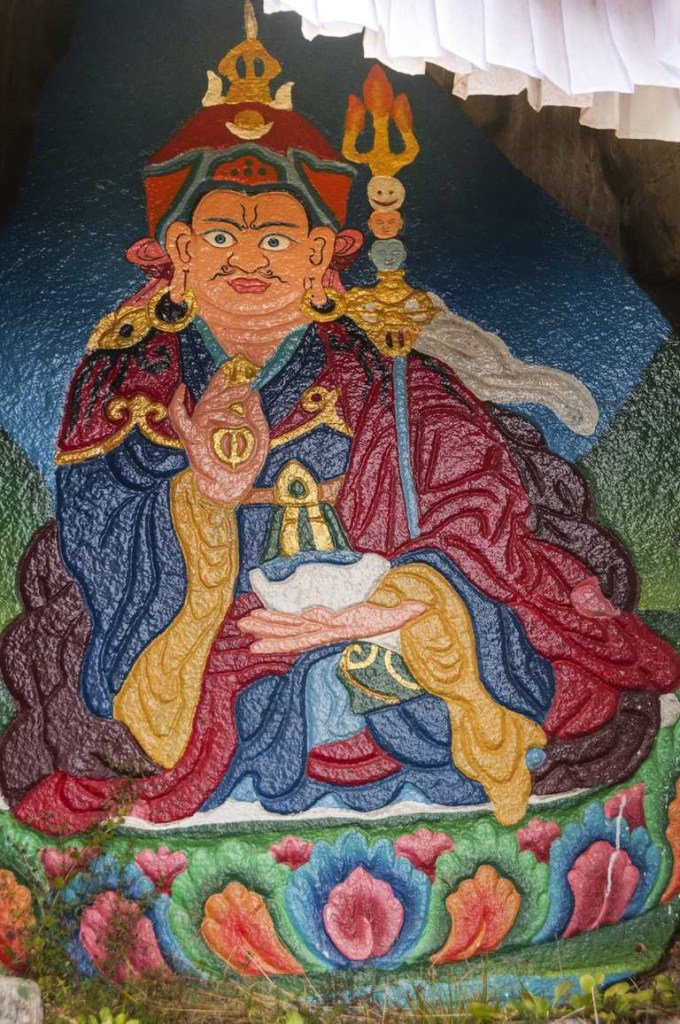
:max_bytes(150000):strip_icc()/MonasteryinTibet-5b5b9dacc9e77c004fc68ce5.jpg)


:max_bytes(150000):strip_icc()/GettyImages-152921912-56a0c56a5f9b58eba4b3ae0e.jpg)
:max_bytes(150000):strip_icc()/1280px-Jetavana-56a0c4d63df78cafdaa4dae0.jpg)
:max_bytes(150000):strip_icc()/Devadatta_-Inciting_an_elephant_to_charge_at_the_Buddha-56a0c5343df78cafdaa4de32.jpg)
:max_bytes(150000):strip_icc()/Dhammadinna-56a0c5375f9b58eba4b3ac5a.jpg)
:max_bytes(150000):strip_icc()/_._._14-5b031cb53128340037a927ee.jpg)
:max_bytes(150000):strip_icc()/The_head_of_Mahakasyapa-5b031d848e1b6e0036595607.jpg)
:max_bytes(150000):strip_icc()/Sariputra_and_Maudgalyayana_become_disciples_of_Buddha_Roundel_31_buddha_ivory_tusk-5b031e6ca474be0037acc63f.jpg)
:max_bytes(150000):strip_icc()/1024px-074_Marraige_of_Suddhodana_and_Mahapajapati_9189420589-5b031f33eb97de003dc88629.jpg)
:max_bytes(150000):strip_icc()/Bhikkhuni_Patacara-_Shwezigon-_Bagan-56a0c5353df78cafdaa4de40.jpg)
:max_bytes(150000):strip_icc()/Siddhartha_leaving_sleeping_Yashodhara_and_Rahula_Roundel_17_buddha_ivory_tusk-5b0320af119fa80037692d87.jpg)
:max_bytes(150000):strip_icc()/1024px-Buddha_mit_Mogallana_und_Sariputta-5b032172fa6bcc00363ca083.jpg)
:max_bytes(150000):strip_icc()/Upali_Thein_temple_02-5b0325dbeb97de003dc934ec.jpg)