The Forgotten Sydney of AC/DC is a must watch mini documentary by the Sydney Morning Herald’s Tom Compagnoni, featuring the combined recollections of Mark Evans (Bass), Dave Evans (Vocals), Noel Taylor (drums) and Rob Bailey.
One of the most interesting revelations is that of session drummer Tony Currenti, owner of Tonino’s Penshurst Pizzeria, who played on High Voltage but had to turn the gig down due to passport issues.
Mark Evans also relates his views on the current Sydney scene, or lack of. Lets hope that it serves as a warning and that we fight to keep our local Perth music scene alive and kicking.
The view north-west from the State Office Block construction site in about 1964. Photograph: City of Sydney Archives
Over the past two centuries Sydney’s architectural landscape has been continually transformed and many buildings have been consigned to dust. A new exhibition at the Museum of Sydney, Demolished Sydney, which opens on 19 November, remembers the city’s lost buildings from the Garden Palace to the ‘Black Stump’
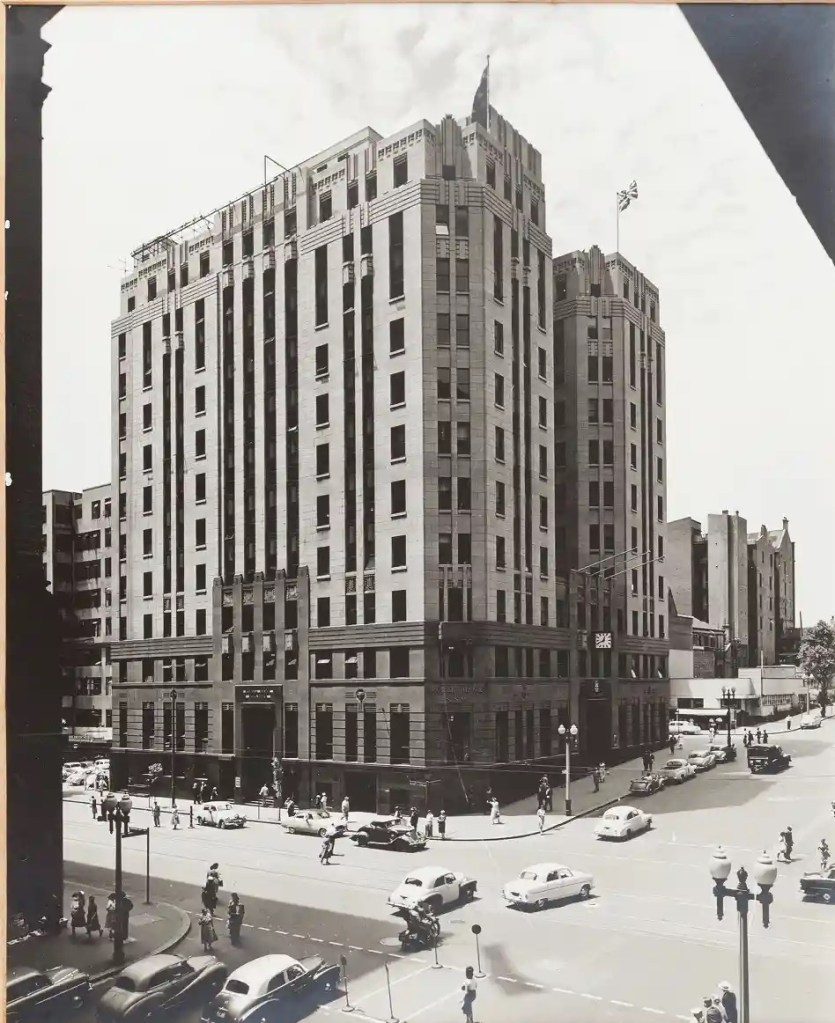
RURAL BANK OF NEW SOUTH WALES, 1936-82
The bank, pictured here in the 1950s, was torn down and replaced by the Colonial Centre in 1985, despite vehement opposition from 7,000 Sydneysiders. The building was an important element in the harmonious art deco streetscape of Martin Place, where a number of commercial buildings complemented one another in style and size. The campaign to save the Rural Bank galvanised a new appreciation of the city’s art deco architecture and saved many buildings in the central business district.
Photograph: Commonwealth Bank Archives
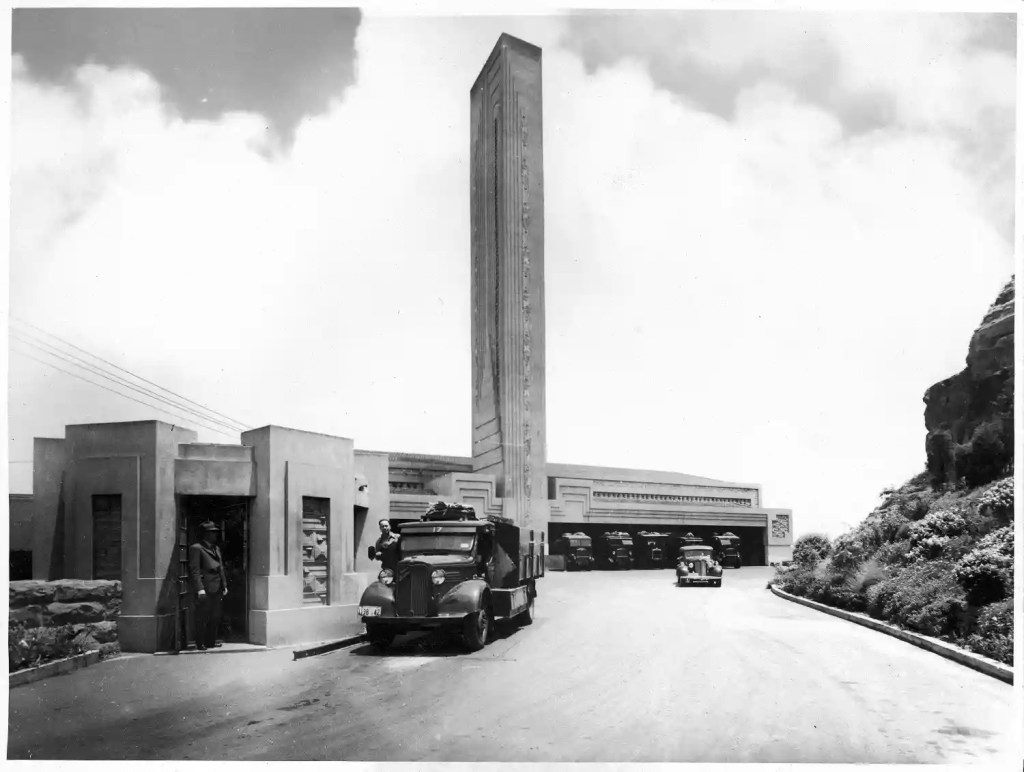
PYRMONT INCINERATOR, 1937-92
The incinerator stood on a high sandstone promontory overlooking the Blackwattle Bay, now occupied by a Meriton apartment block. Designed by the architects Walter Burley Griffin and Eric Nicholls, it was a remarkable building, as stylish as it was functional. It was decommissioned in 1971 and deteriorated until the late 80s, when the site was sold. Despite protests the incinerator was demolished in 1992 – one of many local landmarks swept away by urban consolidation.
Photograph: City of Sydney Archives
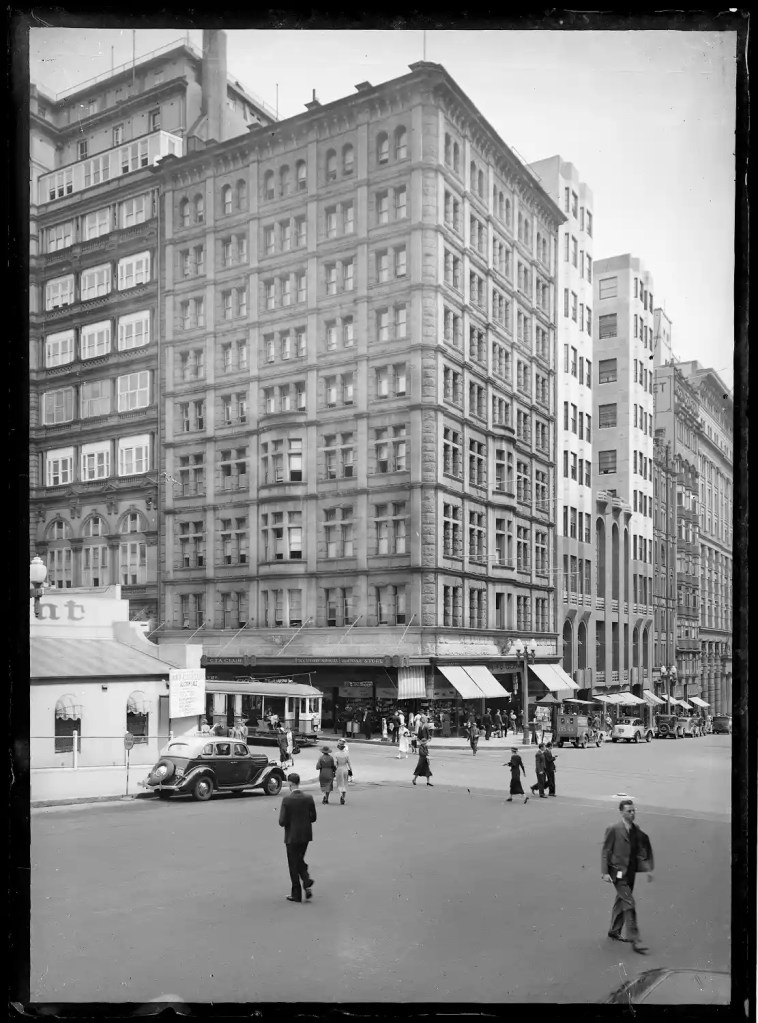
HOTEL AUSTRALIA, 1891-1971
The hotel – once the city’s grandest – was a landmark for 80 years. When it opened in 1891 its belle époque opulence ranked it with the best hotels in Europe and the US. But, as new city hotels were constructed in the 60s, the Hotel Australia went into decline, unable to compete with international ‘jet set’ standards. The last guests checked out in June 1971. Most of the buildings on the block were demolished for Harry Seidler’s award-winning MLC Centre.
Photograph: Hall & Co/State Library of NSW
REGENT THEATRE, 1928-89
The Regent Place arcade and apartment tower stand where the Regent Theatre once screened Hollywood’s finest films. This part of George Street was an amusement mecca in the 30s and 40s, with the Trocadero Palais de Dance next door, the Century and the Plaza theatres across the road and the Victory Theatre three doors down. Cinemas struggled after the arrival of television in 1956. The construction of the first Hoyts multiplex in 1976 marked the end for single-screen theatres. The Regent, the grandest of them all, couldn’t last.
Photograph: Sam Hood/State Library of NSW
GARDEN PALACE, 1879-82
The Garden Palace was built for the 1879 Sydney International Exhibition and was one of the city’s most significant buildings until it turned to ash in a spectacular fire. A southern rival to London’s Crystal Palace (built for the Great Exhibition of 1851) and a testament to the industry and resources of the colony, it was framed in timber and clad in bricks and glass. A memorial gate now stands in the Royal Botanic Gardens in Macquarie Street.
Photograph: Richards & Co/National Library of Australia
COMMISSARIAT BUILDINGS, 1809-1939
The Museum of Contemporary Art today occupies the site where once stood the two oldest government buildings in the state – the convict-hewn Commissariat buildings, built in 1809 and 1812. In 1938 The Royal Australian Historical Society urged that these heritage buildings be retained as a museum of Australian history. But they were demolished in 1939 as part of a plan to build an overhead railway and expressway at Circular Quay, along with a Maritime Services Board building.
Photograph: Eleanor Georgina Shaw/State Library of NSW
ROWE STREET, 1875-1972
Before its demolition, Rowe Street’s tiny shops with their swinging signs created a lively, artisan atmosphere. The laneway was absorbed into the plaza beneath the MLC Centre tower and most of the shops were demolished. The street’s loss continues to be mourned by many Sydneysiders, who relished its cosmopolitan ambience.
Photograph: City of Sydney Archives
FORT MACQUARIE TRAM DEPOT, 1902-58
Before the Sydney Opera House was built, Bennelong Point was the site of the Fort Macquarie tram depot. And before that, it was a place for lime production, naval defence, transport and, finally, entertainment. Earlier still, it was Point Bennelong, named for the Wangal man who befriended the British colonists. To the Gadigal people, the traditional owners of this land, this spit of sandstone is Dubbagullee.
Photograph: State Records Authority of NSW
ST STEPHEN’S CHURCH, 1857-1935
The steepled church stood cheek by jowl with Victorian terrace houses and colonial shops on Phillip Street. It was requisitioned for the creation of a broad thoroughfare that would become Martin Place. The development was envisaged in 1891 but not completed until 1935. St Stephen’s was just one of the buildings swept aside to improve traffic flow at a time when Sydney was undergoing a rapid transition.
Photograph: St Stephen’s Uniting Church
STATE OFFICE BLOCK, 1967-97
The tower was known as the ‘Black Stump’ until its demolition, when it was replaced by Aurora Place. Part of the 60s renewal and modernisation of the city, the block was, briefly, the tallest tower in Sydney. It will be remembered as one of the city’s earliest examples of modern office layout, complete with revolutionary open-plan and modular spaces and Scandinavian design. When government policy shifted to leasing office space in the late 80s, the building was sold.
THERE’S no nice way to say this. These are Sydney’s ugliest buildings. Where are Miley and her wrecking ball when you need them?
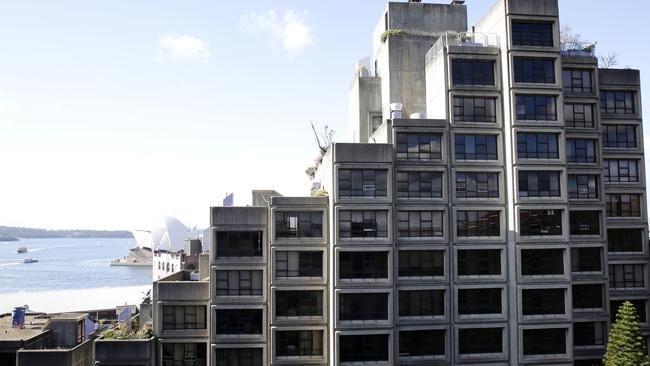
Sirius … not exactly a star amongst buildings.Source:News Corp Australia
SIMPLY being old should not guarantee buildings protection from the wrecking ball.
Jack Mundey and his union green bans saved Sydney’s The Rocks area from certain demolition, the result of which would have been a tremendous aesthetic and cultural loss. They saved buildings that meant something.
Now we save buildings of questionable character, and protect others that are downright ugly.
This week’s battle is over the striking Sirius apartments. Too ugly too stay? Too ugly to go?
And there are plenty of other eyesores in Sydney that really shouldn’t be allowed to stand the test of time.
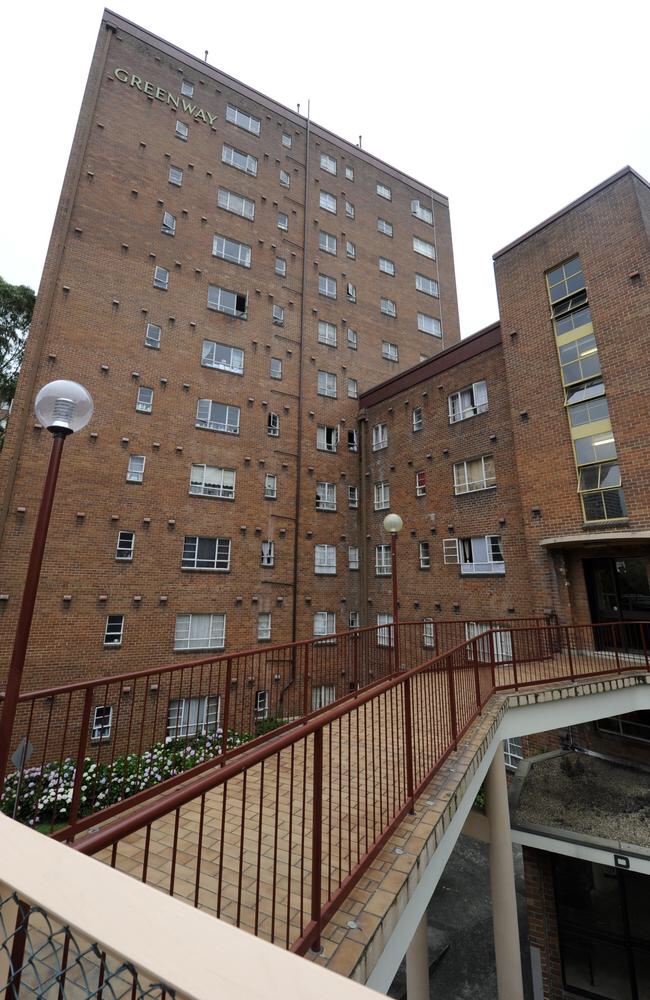
Devoid of anything attractive … Greenway Housing Commission Flats.Source:News Limited
One example is found in Kirribilli. Grounded in the housing shortages of the post-war era are the terrifyingly ugly Greenway Housing Commission Flats on McDougall Street. They are an eyesore for commuters who cross the bridge north to south each day, as deep red brick adds an unfortunate flash of colour to what should be one of the most beautiful commutes in the country.
The oddly shaped footprint was created by left-over public land after the completion of the Harbour Bridge. Perhaps inspired by the equally aggressive design elements in America, the building was completed in 1948 and its style nominated as “functionalist”.
I saw an eyesore … Greenway is in a prime harbour location.Source:News Limited
A heritage listing note conveys that the building is “devoid of decorative detailing”. No kidding.
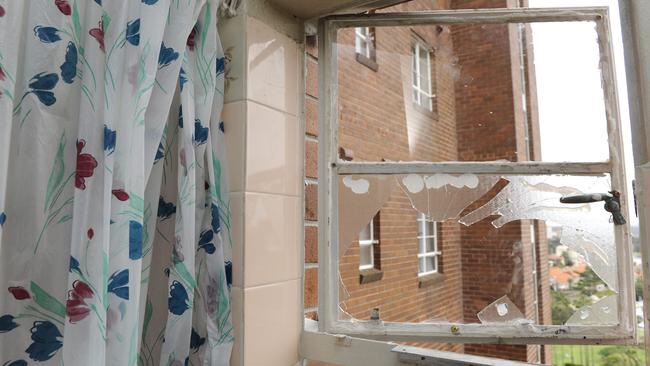
The worst part of the whole debacle, beyond the sad window coverings and slogans that appear in the windows from time to time is that the block appears to have been named after a true architectural genius — Francis Greenway, a convict turned public servant who is responsible for many of the great buildings left to us from colonial times.
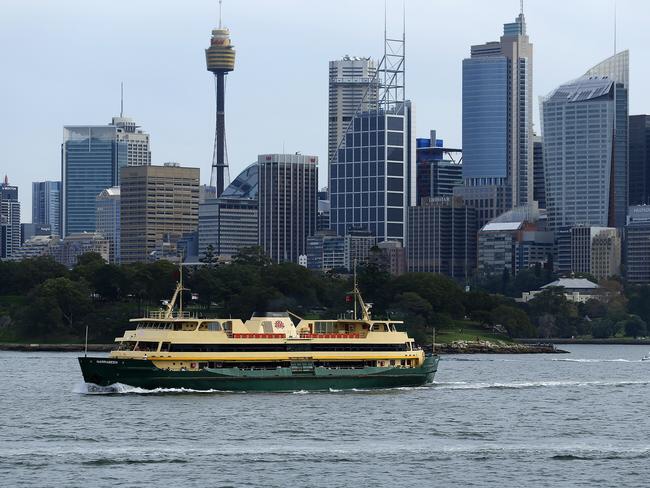
Ferry silly … the Sydney Tower looks like a pot plant on a spike.Source:News Corp Australia
There are more modern creations that many believe could be flattened without many tears shed.
Architect Vince Squillace, from the award-winning architectural firm Squillace, wouldn’t lose sleep if the Sydney Tower was dismantled.
“It looks like a plant room at the top of another building,” he said. He believes if it was a third taller, it might not be the eyesore it is today.
“Sydney has a height restriction that should be challenged,” he said.
UNIT BLOCKS: THE HORROR STORIES OF TOMORROW
Over to you, Miley … the city is yours (well, parts of it).Source:Supplied
More worrying for him is the standard of many of the unit blocks being built at breakneck speed today, that will surely be the architectural horror stories of tomorrow.
“Already you can see render cracking, and stains from tiles leeching,” he warned. But back to the bucket on a stick, the Sydney Tower. At 309 metres it’s very tall. You see, there is something good about it. And it does have the Skywalk attraction, and the restaurant, 360 Bar and Dining is really quite yummy. But the architecture is awful, and being capped off with a Westfiled sign makes Sydney appear to be one giant mall.
What might have been … Blues Point Tower apartment building.Source:News Corp Australia
Blues Point Tower, stands like a lost kid’s building block on the carpet of North Sydney’s beautiful foreshore. It was completed in the early 60s and designed by the revered Harry Seidler. It doesn’t fit, work or enhance the harbourside landscape, and stands as a monument to what might have been.
The backstory to this edifice is that the tower is just one of many that were planned in a high density proposition for the location, but a planning backflip resulted in just one coming to fruition. Over the years there have been calls to tear it down, but in 1993 it was added to a local heritage register. Its saving grace is that the apartments themselves are good, and perhaps the building does tell part of Sydney’s architectural story.
Check it out … Dr Chau Chak Wing Building at the UTS Business School is seen as a work of art.Source:Supplied
UTS architecture has had a lot of publicity over the years. Most recently headlines were made after the Frank Gehry designed campus was opened to the public. The $180m Dr Chau Chak Wing Building demands a response — as do many of the world’s great artworks. They challenge the audience, they provoke discussion, they take the architectural landscape forward.
Does that make them successful, or even acceptable as part of our city? Here is a building that polarised opinion, from those who decried the wet paper bag aesthetic, to others who felt it was exciting.
Brutal … the UTS Tower at Broadway. Understated doesn’t even touch the edges.Source:News Limited
At the very least it is a creative diversion from the other buildings in the UTS portfolio.
Who, in their right minds, could admire the brutalism (there’s that word again) of the UTS Broadway building? To say it lacks humanity is to underplay the ghastly functionality so popular in the late 60s.
It needs a makeover, as do so many of Sydney’s buildings, soon.
There was no missing these blocks of flats as you came out on the north side of the Harbour Bridge. Personally, I always thought they were a bit of an eyesore, though they undoubtedly would have been considered very contemporary living in the 1950s/60s.
‘Greenway Flats’ from Milson Park. Photograph by Zoltan Klinger, 2003. Stanton Library
When it opened in 1954, ‘Greenway’ was the largest flat complex in Australia.
Named after the colony’s first public architect, Francis Greenway, it comprised four buildings, housing 309 one and two bedroom flats. The two taller 11 storey-buildings, A and C blocks, have steel frames. The smaller B and D blocks are concrete framed. The thick brick walls helped to bear the load. Before 1957, building heights in Sydney were restricted to 150 feet. ‘Greenway’ was 130 feet high.
Materials and labour were in such short supply after World War Two that construction took six years. The few exterior design features and modest window size, despite the view across the harbour, helped to reduce cost. Flats were leased as each block was finished.
Mr and Mrs Morgan photographed on the eve of the 50th anniversary of ‘Greenway’, in the flat they moved into when the building opened in 1954. Photograph by Tony Peri 2003, Stanton Library
‘Greenway’ was designed in the modern Functionalist style, a European idiom widely adopted in Australia in the 1930s. This rejected unnecessary decoration while relating a building’s form to its function. However, the architect Percy J. Gordon of the firm Morrow and Gordon was almost certainly influenced as well by the huge housing ‘projects’ being built on the east side of Manhattan in the 1940s. ‘Greenway’ bears a striking resemblance to the post-war apartments in New York’s Bedford-Stuyvesant area.
Upon completion, the project was favourably compared to nearby Victorian-era terraces, then regarded as ‘slums’. The first tenants were delighted. When Mrs V.W.H Briggs moved into her flat in 1953 she declared ‘If I won the lottery seven times over I wouldn’t leave here. This will do me!’ (Sunday Herald, 1 March, 1953) Part of the appeal was the provision of modern appliances. Electric stoves were installed in favour of gas units, stainless steel sinks were standard and the old-style kitchen dresser gave way to built-in cupboards. ‘Greenway’ consumed so much electricity that the County Council had to install a special substation beneath the building to provide power to the many washers, dryers and lifts, as well as 2308 lights, 1666 power outlets and 309 electric stoves.
A sense of community was quick to develop. Residents came to regard others on their own floor as neighbours. However, getting to know everyone in such a large complex was difficult. For this reason, the shared laundry facilities in the basement of each block served as meeting places for women who were generally responsible for washing and cleaning.
The experiences of ‘Greenway’ residents have varied much over the five decades since its opening. At first, the Housing Commission let the flats primarily to families and couples – ‘working class’ people unable to get adequate housing in the inadequate private rental market. Tenants ‘won’ their place there in publicly announced ‘lotteries’. In the 1980s, tenants were being drawn from a wide range of groups – single parents, aged pensioners, the unemployed and the disabled. The result is an increasingly diverse body of residents. Similarly in 1954 Australia was still a predominantly Anglo-Celtic society and most of those who lived at ‘Greenway’ were English-speaking. In 2001 there were 23 language groups represented in the buildings.
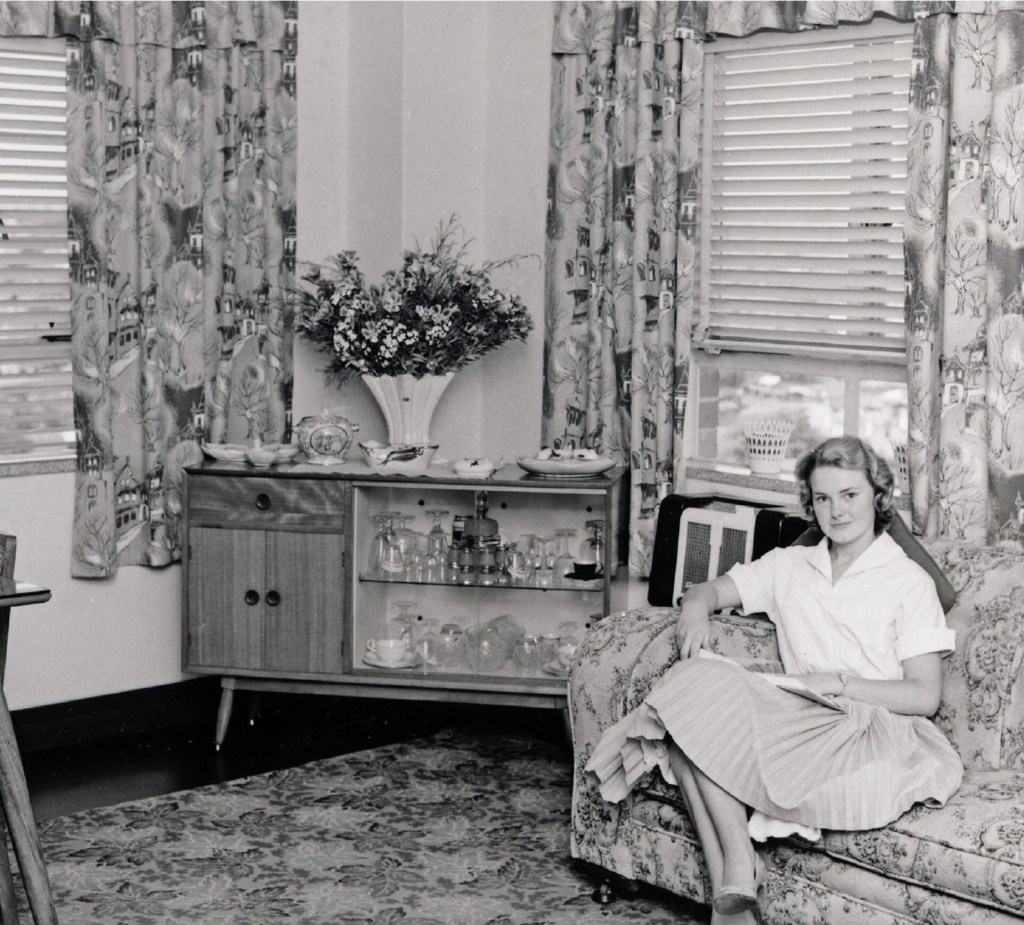
A living room in ‘Greenway’, 1954. NSW Housing Commission photograph. State Library of New South Wales
Public attitudes towards ‘Greenway’ also vary. When the building was opened, Milsons Point still had a large working class population and the tenants of the flats were of similar social background to those in the surrounding streets. Today, the harbour suburb is gentrified and the presence of community housing in such a desirable area is sometimes seen as an anomaly. However, as ex-resident Penny McKeon said in 2004, ‘There’s no reason why being of modest economic means should mean you’re not entitled to live in a place that just happens to have harbour views’.
In 2004 the Greenway Tenants Group and North Sydney Council commemorated the 50th anniversary of their home with ceramics and photography workshops and the publication of two books on the history of the buildings. Then, resident and historian Geoffrey Barrett wrote from direct experience: ‘I’m sure that the people responsible for the construction of Greenway… would be delighted, if not amazed, to know that their efforts are still providing decent housing half a century on, and within their building is a proud, neighbourly community – a community that has survived. (Greenway the great survivor: Fifty Years in the Life of a Public Housing Estate, 2004)
Audio: Listen to Penny McKeon’s memories of growing up at ‘Greenway’ in the 1960s from an interview with historian Ian Hoskins in 2004. Merle Coppell Oral History Collection, OH303
Sydney is today touted as a ‘festival hub’ and as one of the best festival cities in the world. Not a week seems to go by without a cultural festival taking place. But 60 years ago, Sydney (and indeed the rest of Australia) was a very different place; it was much more culturally conservative.
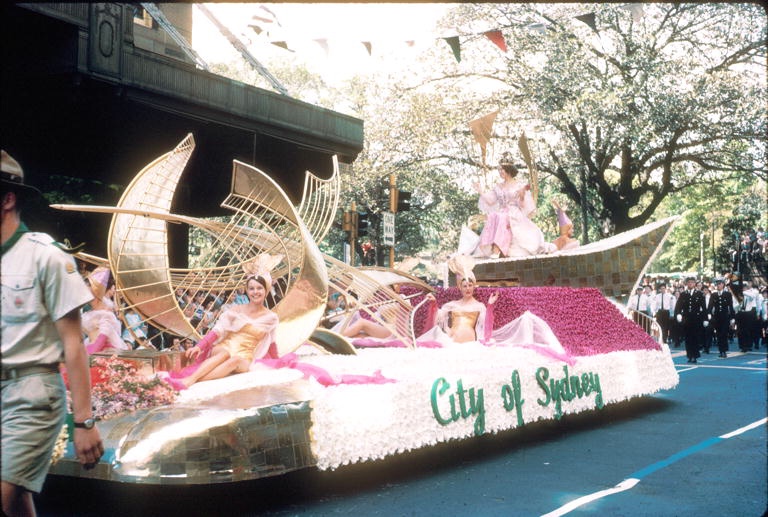
Waratah Princess lording it over some nymphettes aboard the City of Sydney float, 1965 (City of Sydney Archives, SRC18952)
The visit of Queen Elizabeth II to Australian shores in 1954marked a change in Australian cultural life. Her visits to the capital cities around the nation, in particular Sydney and Melbourne, attracted record crowds who gathered in the city centres to watch the royal spectacle. In the aftermath of her visit, civic forefathers in both cities saw an opportunity to attract people into the city centres with an annual festival.
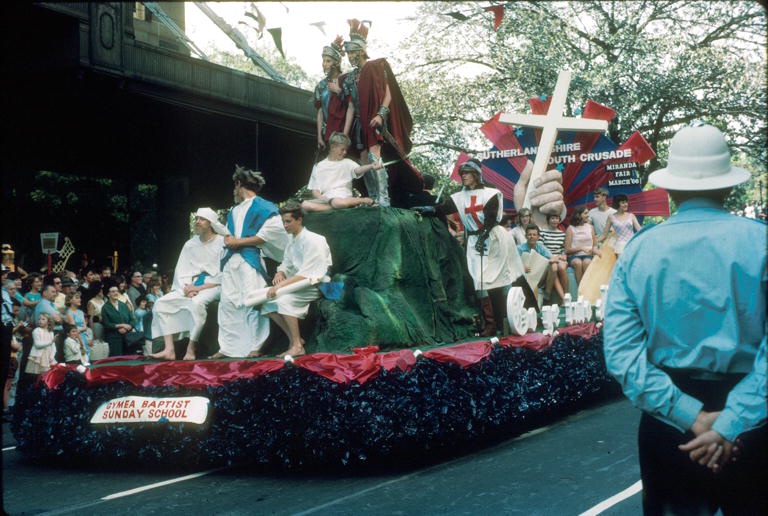
Sutherland Shire Youth Crusade Gymea Baptist Sunday School float, 1965 (City of Sydney Archives, SRC18949)
Marching band in the Waratah Spring Festival procession, 1950s (City of Sydney Archives, SRC18287)
The festival was initiated by the Sydney Committee led by the NSW Premier and the Mayor of Sydney Municipal Council; it was organised by the Council.
An estimated 250,000 spectators lined up to watch the first Waratah Spring Festival procession in 1956 – there were 140 decorated floats, 26 bands and 5,000 ‘marchers’. It was a spring festival – so it was held in October – and because the theme was ‘spring’, over two million flowers (both natural and artificial) were used to decorate the floats. Every year, there was a Waratah Pageant and a ‘Waratah Princess’ was crowned. The first Waratah Princess was Colleen Pike from Newtown.
Sydney County Council’s float featuring a large plug, 1950s (City of Sydney Archives, SRC18258 )
In 1964, there were 45 decorated floats and up to 5,000 people took part in the procession, which extended almost two miles.
Eighteen Waratah Spring Festivals were held between 1956 and 1973. In addition to the public spectacle of the street parades, the festival grew to encompass other events including an art competition, a decorative floral competition in the lower town hall and cultural events including ballet and theatre.
Waratah Princess 1963 (City of Sydney Archives, SRC17470)
By the early 1970s, the Waratah Festival was attracting ever fewer visitors to the centre of Sydney, and was gaining the reputation of being ‘tatty’.
The final Waratah Spring Festival was held in 1973, to coincide with the opening of the Sydney Opera House. In a report prepared in 1974, the Sydney Committee noted that the major sponsors had withdrawn their support and that the Festival had outlived its usefulness as a major attraction. The event was abandoned.
When Hachikō’s owner failed to come home from work one day, the faithful dog returned to his master’s train station the day after just to wait for him. He did this every day for nearly a decade.
Hachikō the dog was more than a pet. As the canine companion to a university professor, Hachikō patiently waited his owner’s return from work at their local train station each evening.
But when the professor died suddenly one day at work, Hachikō was left waiting at the station — for nearly a decade. Every day after his master passed, Hachikō the dog returned to the train station, often to the chagrin of the employees who worked there. But his fidelity soon won them over, and he became an international sensation and a symbol of loyalty.
This is his story.
When Hachikō Met Ueno
This statue commemorates the meeting of Hachikō and his master.
Hachikō the golden brown Akita was born on Nov. 10, 1923, on a farm located in Japan’s Akita Prefecture.
In 1924, Professor Hidesaburō Ueno, who taught in the agriculture department at Tokyo Imperial University, acquired the puppy and brought him to live with him in the Shibuya neighborhood of Tokyo.
The pair followed the same routine every day: In the morning Ueno would walk to the Shibuya Station with Hachikō and take the train to work. After finishing the day’s classes, he would take the train back and return to the station at 3 p.m. on the dot, where Hachikō would be waiting to accompany him on the walk home.
Shibuya Station in the 1920s, where Hachikō would meet his master.
The pair kept up this schedule religiously until one day in May 1925 when Professor Ueno suffered a fatal brain hemorrhage while teaching.
That same day, Hachikō showed up at 3 p.m. as usual, but his beloved owner never got off the train.
Despite this disruption in his routine, Hachikō returned the next day at the same time, hoping that Ueno would be there to meet him. Of course, the professor failed to return home once again, but his loyal Akita never gave up hope.
Becoming A National Sensation
Hachikō was only one of 30 purebred Akitas on record at the time.
Hachikō was reportedly given away after his master’s death, but he regularly ran off to Shibuya Station at 3 p.m. hoping to meet the professor. Soon, the lone dog began to draw the attention of other commuters.
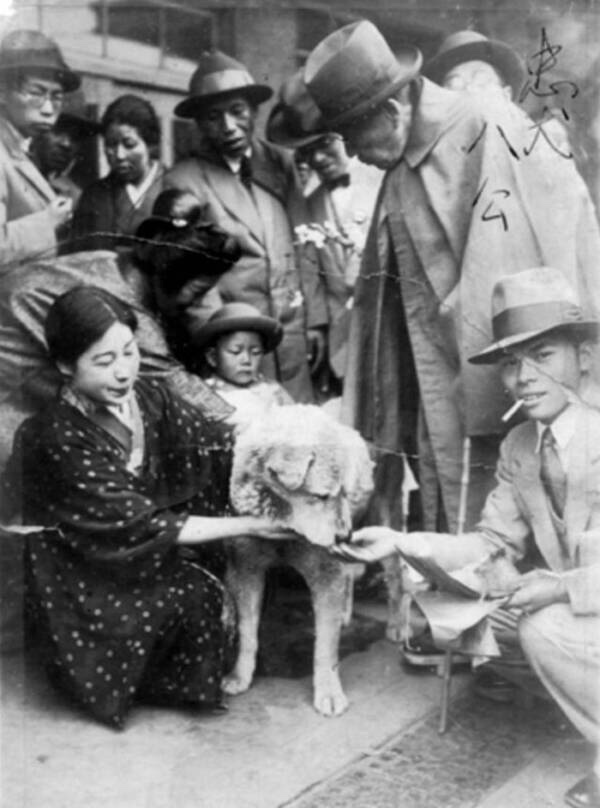
At first, the station workers were not all that friendly to Hachikō, but his fidelity won them over. Soon, station employees began to bring treats for the devoted canine and sometimes sat beside him to keep him company.
The days turned into weeks, then months, then years, and still Hachikō returned to the station each day to wait. His presence had a great impact on the local community of Shibuya and he became something of an icon.
In fact, one of Professor Ueno’s former students, Hirokichi Saito, who also happened to be an expert on the Akita breed, got wind of Hachikō’s routine.
He decided to take the train to Shibuya to see for himself if his professor’s pet would still be waiting.
When he arrived, he saw Hachikō there, as usual. He followed the dog from the station to the home of Ueno’s former gardener, Kuzaburo Kobayashi. There, Kobayashi filled him in on the story of Hachikō’s life.
Visitors came from far and wide to meet Hachikō, a symbol of loyalty.
Shortly after this fateful meeting with the gardener, Saito published a census on Akita dogs in Japan. He found that there were only 30 documented purebred Akitas — one being Hachikō.
The former student was so intrigued by the dog’s story that he published several articles detailing his loyalty.
In 1932, one of his articles was published in the national daily Asahi Shimbun, and Hachikō’s tale spread throughout Japan. The dog quickly found nationwide fame.
People from all over the country came to visit Hachikō, who had become a symbol of loyalty and something of a good-luck charm.
The faithful pet never let old age or arthritis interrupt his routine. For the next nine years and nine months, Hachikō still returned to the station every day to wait.
Sometimes he was accompanied by people who had traveled great distances just to sit with him.
A Legacy Of Loyalty
Since his death, a number of statues have been erected in his honor.
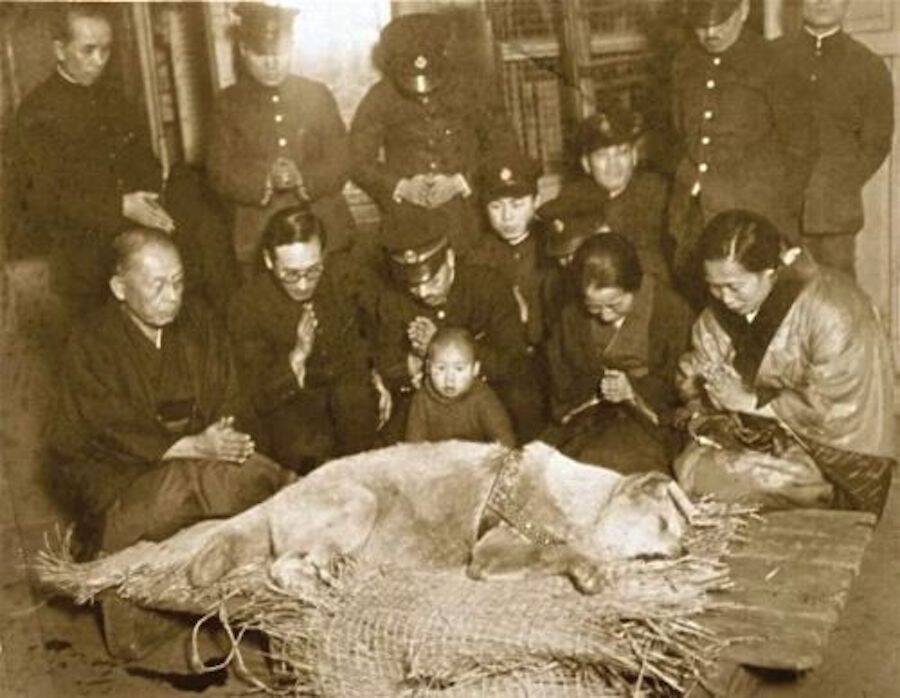
Hachikō’s great vigil finally came to an end on March 8, 1935, when he was found dead in the streets of Shibuya at the age of 11.
Scientists, who weren’t able to determine his cause of death until 2011, found that the dog Hachikō likely died of a filaria infection and cancer. He even had four yakitori skewers in his stomach, but researchers concluded that the skewers were not the cause of Hachikō’s death.
Hachikō’s passing made national headlines. He was cremated and his ashes were placed next to Professor Ueno’s grave in Aoyama Cemetery in Tokyo. The master and his loyal dog had finally reunited.
His fur, however, was preserved, stuffed, and mounted. It’s now housed in the National Museum of Nature and Science in Ueno, Tokyo.
The dog had become such an important symbol in Japan that donations were made to erect a bronze statue of him in the exact spot he had faithfully waited for his master. But soon after this statue went up, the nation became consumed by World War II. Consequently, Hachikō’s statue was melted down to use for ammunition.
But in 1948, the beloved pet was immortalized in a new statue erected in Shibuya Station, where it remains to this day.
As millions of passengers pass through this station daily, Hachikō stands proud.
Hidesaburo Ueno’s partner Yaeko Ueno and the station staff sit in mourning with the deceased Hachiko in Tokyo on March 8, 1935.
The station entrance near where the statue is located is even devoted to the beloved canine. It’s called Hachikō-guchi, simply meaning the Hachikō entrance and exit.
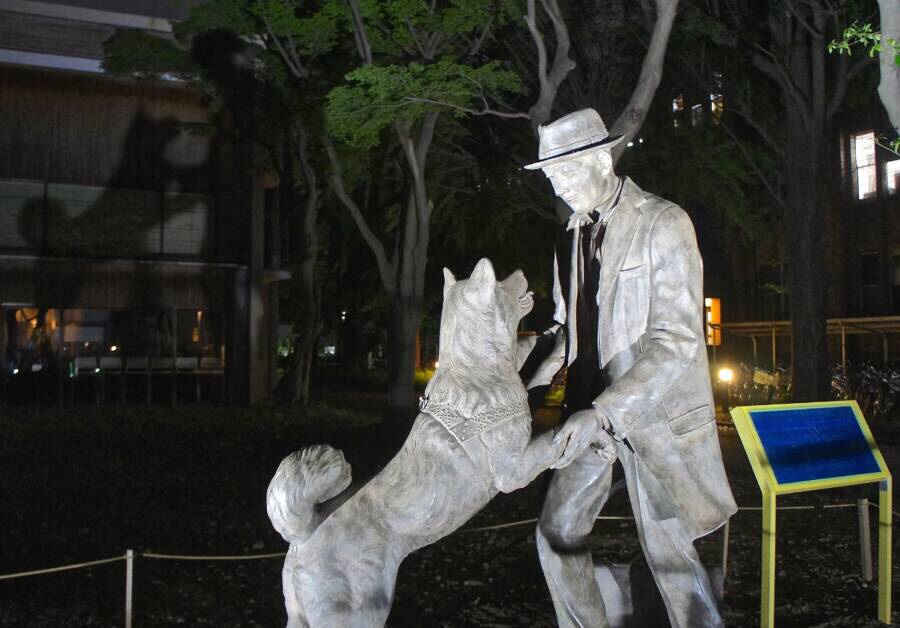
A similar statue, erected in 2004, can be found in Odate, Hachikō’s original hometown, where it stands in front of the Akita Dog Museum. And in 2015, the Faculty of Agriculture at the University of Tokyo erected yet another brass statue of the dog in 2015, which was unveiled on the 80th anniversary of Hachikō’s death.
In 2016, Hachikō’s story took yet another turn when his late master’s partner was buried alongside him. When Yaeko Sakano, Ueno’s unmarried partner, died in 1961, she explicitly asked to be buried alongside the professor. Her request was rejected and she was buried in a temple far from Ueno’s grave.
This stuffed replica of Hachikō is currently on display at the National Science Museum of Japan in Ueno, Tokyo.
But in 2013, University of Tokyo professor Sho Shiozawa, found a record of Sakano’s request and a buried her ashes beside both Ueno and Hachikō.
Her name was also inscribed on the side of his tombstone.
Hachikō’s Story In Pop Culture
Hachikō’s story first made it to film in the 1987 Japanese blockbuster titled Hachiko Monogatari, directed by Seijirō Kōyama.
The movie trailer for Hachi: A Dog’s Tale.
It became even more well-known when the tale of a master and his loyal dog served as the plot to Hachi: A Dog’s Tale, an American movie starring Richard Gere and directed by Lasse Hallström.
This version is loosely based on the story of Hachikō, though set in Rhode Island and centered on the relationship between Professor Parker Wilson (Gere) and a lost puppy that had been freighted from Japan to the United States.
The professor’s wife Cate (Joan Allen) is initially opposed to keeping the dog and when he dies, Cate sells their house and sends the dog to their daughter. Yet the dog always manages to find his way back to the train station where he used to go to greet his former owner.
The stuffed Hachikō on display at the National Museum of Nature and Science.
Despite the different setting and culture of the 2009 movie, the central themes of loyalty remain at the forefront.
Hachikō the dog might have symbolized the quintessential values of Japan, but his story and faithfulness continue to resonate with humans around the world.
Classic cartoon enemy musclemen Popeye and Bluto haven’t kissed but they have made up in this animated campaign behind Minute Maid orange juice. The two have overcome their differences to such a degree that some in the gay community (and the straight media too, such as Slate.com ad reviewer Rob Davis) have wondered if the sailors are supposed to suddenly be romantic partners.
The two play like school children on a swing, a see-saw, bury each other in sand on the beach, and get tattoos together that say “Buddies for Life.” At the end, they ride a two-person bicycleùpassing usual romantic interest Olive Oyl, who calls out “Oh, boys!” and they ride past her without notice. She offers a confused, if not suspicious, look as they pedal away.
An ironic development for Minute Maid, given the anti-gay “Save Our Children” crusades by former Florida Orange Juice spokeswoman Anita Bryant in the 1970s.
Before the campaign was conceived, Dave Linne, the Popeye ad’s creative director at ad agency Leo Burnett Co says the concept is “the opposite of the clich? of getting up on the wrong side of the bedö where people wake up in a good mood.
Linne came up with about 12 conceptual examples of people acting out of character and being nicer than normal, including an elementary school cafeteria line that resembles a Depression-era soup kitchen — except for one cheery server. Another example has a husband doing “wifely” weekend activities such as laundry and brings breakfast in bed to his wife to her surprise as she wakes up.
They also wanted an example of classic enemies who become friends. “We looked at movie villains and there are so many arch enemies, so we thought, ‘Let’s do an animated spot.’ We looked at lots of cartoon characters and we liked Popeye and Bluto for two reasons: I haven’t seen them in a commercial before, and they’re human characters instead of animals.”
So as they were making the ad, the creative team decided to put Popeye and Bluto in various playful situations. “The only reason we put them on a two-person bicycle was because it seemed so stupid,” Linne says. As they pass Olive Oyl, who Linne notes “is usually the catalyst to make them fight” not even she can get between them this time.
Linne says gay innuendo was not intentional but is intrigued about its possibility. “I think it’s interesting if you can read it both ways. I guess it’s working on all kinds of levels,” he mused.
While Linne seems impressed that his work can be read into by the gay community, the same cannot be said for officials at Minute Maid headquarters. “We’re not going to go there,” says Dan Shafer, a spokesman for Houston-based Minute Maid. “Any intent to draw a (gay relationship) parallel would be wrong. Anyone who knows Popeye and Bluto understands that’s not the case, there’s no intent like that.”
Commercials: Out of the Closet
Is Popeye gay? An ad company using the cartoon sailor’s likeness says no, but the commercial is still being featured on a new site of gay-themed ads.
POPEYE AND BLUTO may be the most recent celebrity couple to be outed by the media.
In a recent Minute Maid orange juice ad, the pair is seen palling around on a swing-set, burying each other in sand on the beach and riding a bicycle built for two as they gleefully pass by a scorned Olive Oyl. They even get matching tattoos that say “Buddies for Life.”
The animated spot, created by the ad agency Leo Burnett, is one of the latest additions to The Commercial Closet, an online museum of gay-themed ads from around the world, which launched Monday.
CommercialCloset.org compiles video clips and storyboard stills of hundreds of commercials featuring gay characters or themes, including several that never made it on the air. The archive includes ads representing 150 different ad agencies and 250 major advertisers, including American Express, Coca-Cola, Nike and the Gap.
Ranging from innocuous to offensive, the ads are grouped into four major categories: positive, negative, neutral and gay vague; and 50 subcategories such as “hustlers/ pornographers/murderers/pedophiles” and “sissies and queens.”
Michael Wilke, a former reporter for Advertising Age, created the site to promote awareness of the “evolution in the portrayal of lesbians and gays in advertising as it reflects the public’s perception of them,” and to raise money for a documentary film he’s making to further explore that theme.
Over the past 30 years, “there’s been an evolution from complete invisibility to popular stereotypes to more neutral and positive portrayals of gays in advertising,” Wilke said.
While there’s an increasing number of gay-themed ad campaigns cropping up today, according to Wilke, it’s still a mixed bag. “There’s definitely an increase in gay-positive ads, but the negative stereotypes continue to be a popular source of comedy in commercials,” he said.
Transgendered individuals in particular almost always end up the butt of the joke in commercials, which earned them their own sub-category in Wilke’s archive, called “(Straight) Dude Looks Like A Lady.”
But not all ads in this category are negative. Some manage to cast transgender characters in funny situations without making them out to be villains or clowns.
A 1996 Australian commercial for air-freshening spray Domestos, for instance, riffs off the cult classic Priscilla: Queen of the Desert, featuring a Terrance Stamp look-alike who asks to use the ladies’ room in a roadside bar. Finding it filthy, she pulls Domestos out of her purse and clears the air. Later she proclaims the bathroom “fit for a queen.”
“It’s not that transgendered people can’t be funny,” Wilke said, “but there’s a difference between laughing at someone and laughing with them.”
Although there may be more gay-themed ads on the air today, there’s a popular misconception in the media about who gay people are and what motivates them as consumers, according to Kathy Renna, a director at the media advocacy organization Gay & Lesbian Alliance Against Defamation (GLAAD).
“There’s the perception that gays and lesbians are very affluent, own three cars and buy 100 CDs,” Renna said. “That’s not reflective of the whole gay community. One thing that is true is that it’s a very loyal demographic.”
Companies with gay-positive reputations include American Airlines, Absolut vodka and Coors, she said.
But while marketing to gays and lesbians is an important priority for many corporations, advertisers and ad agencies must still walk a fine line when depicting them in ads.
Today, ads featuring gay people among other minorities in a happy-people world are relatively safe bets for corporations wanting to project a multicultural image.
A 1994 Ikea ad about a gay couple buying a dining table together, for instance, was controversial as one of the first gay-positive commercials by a major corporation.
Part of a three-part ad campaign depicting people in alternative lifestyles buying furniture -– the other two being a single mom and a white couple with an adopted Asian baby -– the ad was meant to “reflect real life and real people and not the middle-of-the-road all-American family,” according to Kathy Delaney, the executive creative director at Deutsch, the agency that made the ad.
But while homosexuality remains a touchy subject fraught with political correctness, that doesn’t mean advertisers should only approach it with kid gloves, Wilke said. Still, many agencies and advertisers would rather avoid the topic altogether than open a can of worms.
Then there’re companies such as Calvin Klein, Diesel and Benetton that, instead of shying away from controversy, promote a fashion-forward or youth-oriented brand and deliberately provoke people with their ads.
A notorious example is Benetton’s 1992 “Pieta” print ad depicting AIDS activist David Kirby on his deathbed. The emaciated Kirby, surrounded by his friends and family, bore an eerie resemblance to Jesus, which sparked controversy among Christian groups and AIDs activists who were uncomfortable with the religious tone used in association with the disease and, ultimately, to sell clothes.
On the other hand, the ad was also one of the first in many countries to show AIDs in the context of real human suffering and compassion. Although it was singularly criticized, the ad was part of a larger, ongoing campaign for AIDs prevention and awareness that included the distribution of condoms in Benetton stores.
Some companies, by contrast, seem reluctant to acknowledge any controversy their ads may create.
The Popeye and Bluto spot, for instance, is included in the “Gay Vague” category, because the advertiser’s message related to gay people isn’t very clear. In fact, there’s no substantial proof that the two adversaries are in fact lovers, as they are never seen kissing.
In a interview with Wilke, the creative director for the Popeye ad seemed pleasantly surprised at the suggestion that it implied a relationship between the two erstwhile foes, and that the spot was simply meant to show two enemies who become friends, supposedly transformed by drinking Minute Maid orange juice.
Minute Maid, meanwhile, firmly denied that Popeye and Bluto are an item.
“Any intent to draw a (gay relationship) parallel would be wrong,” Minute Maid spokesman Dan Shafer told Wilke. “Anyone who knows Popeye and Bluto understands that’s not the case, there’s no intent like that.”
Ad Report Card: Minute Maid Makes You Gay! (Happy, That Is)
Some months ago the Ad Report Card devoted not one but two installments to commercials that turned on references (oblique or otherwise) to homosexuality. Often the reference served as a punch line of one sort or another, and in some cases I was critical of the way in which this or that advertiser used gayness as a joke. Responses were many and spirited. Some suggested I was being ridiculous, seeing gay themes where there were none. Others, some claiming to have inside knowledge of the ad business, argued I was naïve, overlooking the benign influence of gays who work in “ad creative.” I have no way of checking the latter claim, but both critiques came to mind when a couple of people e-mailed me recently about a Minute Maid orange juice spot featuring Popeye and Bluto. The ad is part of a series, the theme of which is that drinking Minute Maid makes you gay.
As in happy.
Now, some observers have suggested that, in addition to promoting the happy-making power of Minute Maid, the Popeye spot might just be an example of “gay vague,” along with another commercial that I haven’t seen, which is airing in Europe—read this for more. You can see the spots in the U.S. campaign below: the Popeye one, another featuring Bobby Knight, a third about a “helpful hubby,” and a fourth centered on a suspiciously cheerful lunch lady. My main focus is the Popeye spot.
Popeye The ad: Here they are, two of the most famous rivals in cartoondom, playing happily together on a swing and then a seesaw. Popeye good-naturedly pats sand over Bluto on the beach; sappy pal music plays. The pair gets matching “Buddies for Life” tattoos. What’s going on? An announcer says cheerfully: “Somebody had their Minute Maid this morning. It takes a minute, but the feeling”—the unbridled joy and affection we’re seeing here—“lasts all day.” Popeye and Bluto pedal along on a tandem bike. Olive Oyl waves (“Oh boys!” she calls), but they ride straight past, blithely ignoring the object of their traditional erotic rivalry.ADVERTISEMENThttps://39598048fe002d9e70fc861e576fdf63.safeframe.googlesyndication.com/safeframe/1-0-38/html/container.html
CoachHmmm. Perhaps it’s ridiculous of me to ask, but what exactly is it that’s preventing these Minute-Maid-drunk boys from including Olive in their fun? On the other hand, what is it that makes it inevitable that almost any prominent male pair is inevitably subject to some kind of what-if-they-were-gay speculation—good-natured, homophobic, or somewhere in between? (Perhaps you’ve heard spurious gossip about the relationship between Ben Affleck and Matt Damon. Or read my Slatecolleague David Plotz’s exploration of the fan fiction subgenre devoted to the imagined couplings of Kirk and Spock, among others. Or recall a New Yorkercartoon that one of my correspondents remembers, featuring none other than Popeye and Bluto holding hands, having finally figured out “where all that anger was coming from.”)
Bed What about the other Minute Maid spots? You could say that they all play it straight. Hothead basketball coach Bobby Knight, having had his Minute Maid, coddles and dotes on his players, bursting into the post-game locker room to ask “Who wants a treat?” A spot featuring a surprisingly helpful husband has him forsaking football to bustle around neatening things up, heading off to “market,” and setting his iron for chiffon. A chipper lunch lady minces through a school cafeteria asking, “Who wants tiramisu?”
School Anyway, subtext or no subtext, this is a pretty good campaign. All the spots, but especially the Popeye one, are attention-getting and make a clear case for the alleged powers of a morning glass of Minute Maid. The helpful hubby installment is the weakest, but the Bobby Knight one is hilarious. Mushing together grades for all four into one composite score, I’d give them a solid B. When I watch these ads, I feel … happy.
More than six decades after his untimely death, James Dean remains one of Hollywood’s most enduring and enigmatic icons.
It’s been more than 60 years since his tragic death and still Hollywood is looking for “the next James Dean.” The young actor made only three movies in his career – East of Eden (1955) where he played the bad boy brother in the “Cain and Abel” retelling, his signature role as an angst-fueled teen in Rebel Without a Cause (1955), and Giant (1956) where he stepped into the cowboy boots of a nonconformist ranch hand. All of his movies became Hollywood classics, but he only saw one, East of Eden, completed.
He was only 24 years old on September 30, 1955, when he was driving down Route 466 in his Porsche 550 Spyder and a car collided with his, killing him almost instantly. The young star’s life and career was cut short, but his premature death contributed to the legend he would become. Rebel Without a Cause and Giant were released posthumously, and Dean came to epitomize the sensitive, troubled rebel who fans still connect with today. Who was the man behind the brooding Hollywood sex symbol? Here are 7 revealing facts that might give you a clue.
He had family issues
Dean was born in Marion, Indiana on February 8, 1931. Dean’s father Winton left farming to become a dentist and moved the family to Santa Monica, California. But when Dean’s mother died from cervical cancer when he was 9, the family broke apart. His father sent him back to Indiana to live on his aunt and uncle’s Quaker farm, and this was the beginning of an estrangement between father and son that would haunt them for the rest of their lives.
Dean had some dirty habits
He was the symbol of sexy cool onscreen, but off-camera the 5’8,” 135-pound star had some quirky and dirty (as in unwashed) habits. Dean supposedly didn’t care much about his public appearance and went for the disheveled look. At one formal luncheon, he showed up barefoot and in filthy jeans and was known to appear at rehearsals in pants held together with safety pins. He was also known for having pretty extreme mood swings, according to friends, who said he also had the habit of calling or visiting them late at night. “He’d be up one minute, down the next. He was uncomfortable in his own skin,” one of them said.
Just hours before his crash, James Dean takes a cigarette break at a gas station next to his beloved silver Porsche 550 Spyder that he named Little Bastard. Photo: Bettmann/Getty Images
He looked up to Marlon Brando
Dean respected another brooding actor of the day, Marlon Brando. While Dean was just emerging in Hollywood, the slightly older Brando had major success as Stanley Kowalski in A Streetcar Named Desire (1951), his iconic role as a motorcycle gang leader in The Wild One (1953), and he won an Oscar for On the Waterfront (1954). Dean attempted to call Brando and see him socially, but Brando rebuffed his attempts at a friendship. “I gave him the name of a [psycho]-analyst, and he went. At least his work improved,” Brando said.
Dean wanted to be Billy the Kid
In his short career, Dean played fictional non-conformists who played by their own rules, but if he had lived he may have taken on the role of a real-life outlaw. He read and re-read the book The Authentic Life of Billy the Kid and frequently spoke of wanting to portray the Wild West gunslinger in a film.
He confused Ronald Reagan with his acting method
Before he made it in the movies, Dean worked a lot on live television. A fan of improvising, he went off-script on one show and threw a few ad-libs at one of his co-stars, actor and future president Ronald Reagan, who was totally confused by Dean’s acting method. Reagan wasn’t the only one who disliked Dean’s spontaneity. “Just make him say the lines as they’re written,” one actor said once.
His sexuality has been a matter of debate
Although Dean was briefly engaged to actress Pier Angeli, his sexuality has been a matter of debate. A number of biographers doubt his relationship with Angeli was a physical one. Some biographers believe he was bisexual; others characterize him as a homosexual who had one or two brief affairs with women. It was rumored that his first sexual experience occurred as a teenager when a local minister seduced him.
Dean liked to perform magic tricks
When he wasn’t acting or racing cars, Dean liked to practice magic tricks. A smoker, who was often photographed with a cigarette dangling from his mouth, Dean put a magical spin on his tobacco habit: he would put an unlit cigarette and a flaming match into his mouth and then pull out a burning cigarette. Another reason why Dean was smoking hot.
James Dean’s Death: Inside His Tragic Passing at Age 24
Though he only released one film before his dying in a car crash, the actor became a lasting figure in pop culture.
At the time of his sudden death on September 30, 1955, at age 24, James Dean had starred in only one motion picture released in theaters. He would become a cultural icon to generations and a touchstone for the burgeoning youth movement of the era, due largely to his shocking demise in a car accident that would make international headlines in a pre-digital world, and the subsequent movies that would be released posthumously in which he portrayed inward-looking, disaffected adolescents on the verge of adulthood.
When the word “teenager” was still in relatively new usage, Dean’s brief life — on- and of-screen — and sudden death from injuries sustained in a car accident would come to represent a symbol of modern masculinity in the mid-to-late 1950s, a precursor to the counter-culture movement of the 1960s and 1970s.
“Jimmy represented something that was happening in the States after the Second World War. Until that moment in time, grown-ups — adults — set the style for clothing, set the styles for music, set the styles for everything that was going on,” Dean’s acting contemporary Martin Landau once saidof his friend’s cultural legacy.
Dean got his start acting in commercials and TV shows
Born James Byron Dean on February 8, 1931, in Marion, Indiana, his father was a farmer-turned-dentist father who moved his family to Santa Monica, California, where his son attended Brentwood Public School. An only child, Dean’s adored mother died of cancer when he was age 9 and he was sent to live on his aunt and uncle’s Quaker farm. He returned to California after graduating high school, studying theater at the University of California, Los Angeles.
After dropping out of college, the aspiring actor first appeared on television in a Pepsi advertisement followed by uncredited parts in minor Hollywood pictures before heading to New York City in 1951, where he studied at the Actors Studio under Lee Strasberg. Television roles followed in Danger, Omnibus and General Electric Theater and he appeared on Broadway in See the Jaguar and The Immoralist before Hollywood took notice of his talent and brooding good looks.
Dean on the set of ‘Rebel Without a Cause’ Photo: Sunset Boulevard/Corbis via Getty Images
He filmed his three most-famous films shortly before his death
Dean was soon cast as Cal Trask in the 1954 film adaptation of the John Steinbeck novel East of Eden. It would be the only film released prior to the actor’s death and for which he would be nominated posthumously for Best Actor in a Leading Role at the 1955 Academy Awards. As misunderstood, rebellious Cal, the role foreshadowed Jim Stark, the late-adolescent, angst-ridden character he portrayed in Rebel Without a Cause(1955) alongside Natalie Wood, which would become a teen favorite of the era and forever be identified with the image and legacy of Dean, the tragic movie star.
Fearing he would be typecast as an angry, rebellious teen, Dean’s next role was as a rags-to-riches Texan ranch hand in Giant (1956), co-starring Elizabeth Taylor and Rock Hudson. It would be his final film and would garner him another posthumous Academy Award nomination, making him the only actor ever to be nominated twice following death.
It was soon after wrapping shooting on Giant that Dean returned to his other love – motorsport, in which he first competed professionally prior to filming Rebel Without a Cause. With reported ambition of one day competing in the Indianapolis 500 race, Dean’s financial success from East of Eden had allowed him to purchase a Triumph Tiger motorcycle and Porsche 356 speedster, the latter he traded in on the more powerful convertible Porsche 550 Spyder.
Dean in his Porsche 550 Spyder. Photo: Bettmann/Getty Images
Dean was ticketed for speeding hours before his deadly crash
German Porsche-trained mechanic Rolf Wütherich encouraged Dean to drive the Porsche from Los Angeles to Salinas to get a feel for the new automobile, rather than tow it on a trailer behind the Ford station wagon in which he originally planned to make the journey. Dean was ticketed for speeding at 3:30 p.m., just over two hours before his untimely death.
Dean was killed when the 550 Spyder he was driving collided with a Ford Tudor sedan along then-U.S. Route 446 near Cholame, California. The Ford, driven by 23-year-old Cal Poly student Donald Turnupseed, was turning at an intersection when the two cars hit almost head-on, resulting in massive damage to Dean’s Porsche. The actor died almost instantly while his passenger, Wütherich, was badly injured but survived.
His left foot crushed between the clutch and brake pedal, Dean’s neck was broken and he suffered massive internal injuries. Along with Wütherich, he was transported to the Paso Robles War Memorial hospital 28 miles away where he was pronounced dead on arrival at 6:20 p.m. As well as a broken neck, both his arms were broken, he had fractures of the upper and lower jaw and massive internal injuries. Wütherich suffered a fractured jaw, fractured hip and body lacerations. Turnupseed received only minor injuries and after being interviewed by attending California Highway Patrol officers at the scene, was released.
Dean’s legacy has grown in the decades since his death
An inquest into the crash in the days following found Dean at fault due to speeding, though a 2005 article in the Los Angeles Times cited an attending Highway Patrol Officer who recalled the wreckage and position of Dean’s body indicated a speed around 55 mph, not the 90 mph that had been widely reported.
Following the tragic collision, rumors spread over the years and decades that Dean had not really died but was living a secret, hidden life; that he was a closeted homosexual; that the Porsche in which he was driving on that fateful day was cursed. Alongside such rumors, the myth of Dean — the man and the actor — only grew as the years passed. “An actor must interpret life,” Dean once said. On screens and in photographs he remains forever on the cusp of adulthood, a representation of anti-establishment teenage disillusionment and social estrangement, an enduring representation generations have looked to as an interpretation and projection of their own inner lives.
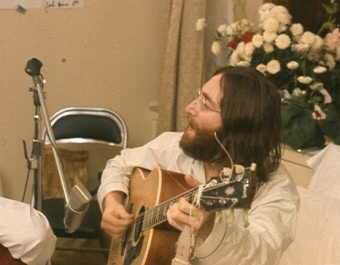
Was John Lennon gay? “Why are you bringing up such a ridiculous question? Who cares if he was gay? I thought this article was about John Lennon almost beating a guy to death.” Well, it is, it is, keep reading and you will see all the pieces to this incredible, little-known chapter in the life of John Lennon and how perilously close his temper came to ending the Beatles entirely, almost before they really got started. This savage beating also helped change Lennon’s life, as he said “It was the last fight I ever got into. That’s when I gave up violence, because all my life I’d been like that.”
In 1963, the Beatles’ were beginning to become famous in England and Europe. A little over a year earlier, they signed with a manager named Brian Epstein (who incidentally died of a drug overdose just four years after this). Epstein was unequivocal in his sexual preferences- he was as gay as they come. (As a point of note, being gay was actually against the law in Britain at the time, and was to remain so until 1966.)
According to Pete Best, the Beatles drummer before Ringo, Brian had tried making passes at all four Beatles (including himself) and was met, each time, with a polite but firm, rejection. Many Beatles fans knew about Brian’s “secret life” and assumed that Paul, the “cute Beatle”, and the one most of the girls liked, was the object of his affections. Nothing could be further from the truth. It was the loud, overbearing, and aggressive John Lennon who Brian was crazy about.
In April of 1963, the Beatles were now one of the hottest acts in Europe. Their records were selling like the proverbial hotcakes. The first album was sitting in the #1 spot on the charts; their concerts were selling out to capacity crowds; and within a few brief months, they would be playing the Royal Variety Performance in front of the Queen herself.
The Beatles arrived at London Airport on Sept. 22, 1964, after a tour of the United States and Canada. From left, George Harrison, Paul McCartney, Ringo Starr, Brian Epstein — the group’s original manager — and John Lennon. Credit… Keystone/Getty Images
It was at this time, out of the blue, that John and Brian decided to take a break in the Beatles’ very busy schedule and go off together for a holiday in Spain. The first suspicious thing about this amongst fans was “Why did John go on holiday, as his wife had recently given birth to a new son?” (Cynthia had gave birth to Julian, John’s first son, on March 8, 1963). John admitted, years later, what a rotten and selfish thing this was for him to have done, but nonetheless, he went with Brian, sparking rumors that it was a romantic get-a-way.
Fellow Beatle, Paul McCartney, has his own take on John’s Spain trip with Brian. According to Paul, the trip’s purpose was for John to assert who the real leader of the Beatles was with Brian. That John took Brian on the holiday “…to make sure Mr. Epstein knew who to listen to in this group”. It is interesting that even in these very early Beatles’ days, John and Paul were already jockeying for an upper hand.
Whatever the case, John and Brian spent 12 days together in Spain. “We used to sit in cafes together”, recalled John, “looking at the boys. I’d say, ‘do you like that one? Do you like this one?’ …I was rather enjoying the experience, thinking like a writer all the time.”
The details of the trip were sketchy, at best, but soon John and Brian had returned and were ready to get back to the business of making Beatles records, performing concerts, and making appearances. But in Liverpool, the “gay” rumors were now intensely swirling. Things came to a head with a disc jockey the Beatles knew named Bob Wooler (1926-2002).
Wooler was a very close friend of the Beatles and had introduced them on stage some 300 times. This incident happened at Paul’s 21st birthday party, on June 18, 1963. At the party, Wooler was joking around with John and said (with heavy gay intimations): “Come on John, what really happened with you and Brian? Everybody knows anyway, so tell us.”
John had been heavily drinking that night and Lennon was a notorious “bad drunk”. In a blind rage, John proceeded to beat the stuffing out of a very surprised Bob Wooler, literally kicking him repeatedly in the ribs as he lay on the ground in a bloody heap.
According to John, the only reason he actually stopped the savage beating was because, “I realized I was actually going to kill him… I just saw it like a screen. If I hit him once more, that’s really going to be it. I really got shocked and for the first time thought: ‘I can kill this guy.’”
Wooler was rushed to the hospital by Brian, who was also present at Paul’s party, and given treatment for a variety of things, including broken ribs. Luckily for John Lennon- and the Beatles’ future amazing run- Wooler survived the ordeal.
Incredibly, John refused to apologize. “He called me a bloody queer, and I bashed in his ribs for it”, he said defiantly. Because of this refusal to apologize, Brian had a writer for The Daily Mirror, Don Short, send a telegram on John’s behalf, apologizing. The telegram read, “Really sorry Bob. Terribly sorry for what I have done. What more can I say? -Signed, John Lennon” In addition to that, a payment of 200 pounds (around $2200 today) was also given as compensation.
Despite their very recent fame in Europe in musical circles, this incident actually got the Beatles their first national press coverage in England in an article in the Daily Mirror. (One can easily imagine what kind of coverage an incident like this would have gotten nowadays, with our current tabloids, twitter, and the blogosphere. And, of course, had Bob Wooler not been the forgiving type, he could easily have raked John over the coals, but chose not to. Or what if John had actually killed Wooler by perhaps kicking him a few more times with Wooler’s broken ribs perhaps puncturing his lungs? It would have finished the Beatles as we remember them right there, not to mention the fact that John Lennon would have been sent to prison for murder!)
Despite the severity of the incident and the coverage in the Daily Mirror, the incident was soon forgotten and the Beatles went on to conquer the musical world.
The one murky question for Beatles fans is obviously “Did John and Brian really?…” Beatles fans and aficionados have been debating the question all these years later.
In 1971, in his classic “Rolling Stone” interview, John stated that of all the Beatles he “was the closest to Brian”. (was this one of John’s inside jokes, did he really mean?…) John later briefly commented on the lingering question about Brian and himself shortly before his tragic death in 1980. “It was almost a love affair, but not quite. It was not consummated. But it was a pretty intense relationship”, he said.
About the gay accusations setting him off, Lennon went on to add, “You know, when you’re 21, you want to be a man. If someone said it now, I wouldn’t give a shit”. (1980). But at the time, John was a very macho, young rock star and he had to prove it to everyone.
One marvels when looking at the incredible, unbelievable career of John Lennon- and the Beatles- at just how close it all came to going up in smoke, because of a needless, drunken beating, all those years ago at a birthday party.
BonusFact:
While he may or may not had a romantic encounter with Brian Epstein, Lennon definitely also loved the ladies. In 1968, he confessed to his first wife, Cynthia, that he had had over 300 extra-marital affairs with women during their six-year marriage. He may have been underestimating himself.
He was not faster than a speeding bullet. He was not more powerful than a locomotive. He was not able to leap tall buildings in a single bound.
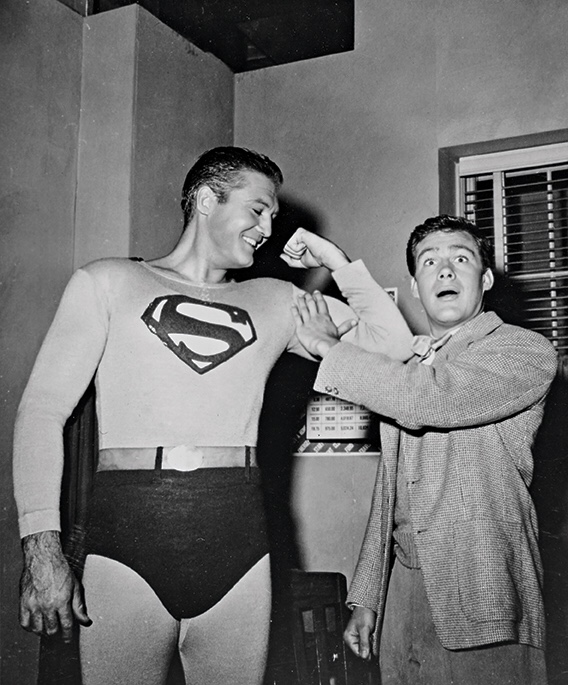
In the great pantheon of characters to emerge from the “Superman” universe — Lois Lane, Lex Luthor, Jor-El, General Zod — Jimmy Olsen probably ranks below even Richard Pryor’s wisecracking embezzler in the much-maligned “Superman III.” Jimmy just isn’t that cool. He’s often described as a “cub” reporter. He needs saving more than he saves. He says “Golly.” And he’s sometimes drawn as a redhead.
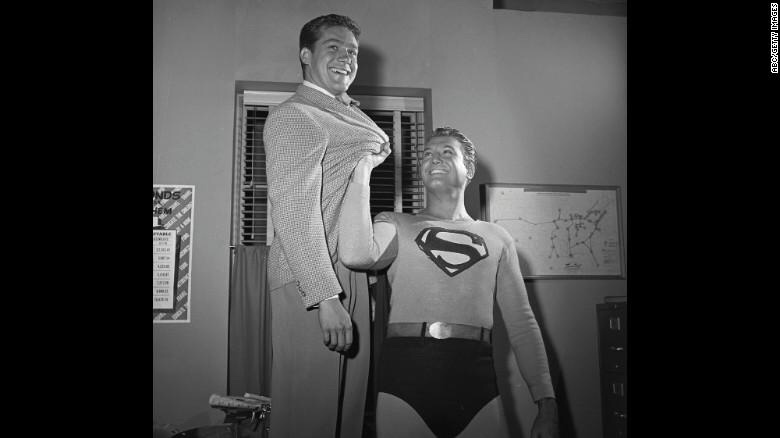
“Oh, I’m not going in there!” Jimmy whines when hustled into a secret prison after falling prey to the treacherous Von Klaven brothers, identical twins who steal radium, during the 1952 Superman adventure “Double Trouble.” Jimmy’s line when rescued by Man of Steel George Reeves: “Right now, you’re prettier to me than all the movie stars in the world!”
But in a franchise that’s seen its share of tragedy — George Reeves’s reported suicide, Christopher Reeve’s spinal injury — the woes of the actor who played Jimmy in the 1950s went underreported. Jack Larson, who died at 87 on Sunday, was a gifted writer and gay man whose talents and personal struggles were overshadowed by his role as Superman’s flunky.
Even worse: He knew it would turn out this way.
“If I won the Nobel Prize for Literature at 75 and died, they would still say, ‘Jack Larson, best remembered as Jimmy Olsen in the ‘Superman’ series,”’ he said in 1982.
Though Larson never won the Nobel, his swipes at literary greatness were more than the flailing of a teen star gone to seed. Born in California, Larson had dreams of making it big on Broadway as an actor and playwright. After being signed by Warner Brothers while still in high school and a stint in the Marines, the budding thespian found himself at a crossroads.
It was 1951. The old studio system was dying. Though just in his early 20s, Larson had done a few films, but was running out of work — and wanted to get to the Great White Way.
His agent came up with a solution: Play the terrible supporting role of Jimmy Olsen in “Adventures of Superman.”
“I didn’t want to do it,” Larson said, ”but my agent said, ‘Look, you want to get to New York. You don’t have any money. Nobody will ever see this show so take the money and run.”’
Larson did. For $350 an episode, he completed the show and went to the Big Apple. And he was living there when the show he had dismissed became one of the most iconic in TV history — even though it was pretty bad.
“Adventures Of Superman was frequently barely a superhero show — it was more like a dirt-cheap police procedural sprinkled with a few minutes of unconvincing special effects — but it still featured the most famous, popular superhero of all time,” the Onion’s A.V. Club wrote in 2013. “So what else was the nascent geek clan going to watch?”
Larson, meanwhile, became a would-be aesthete fixed in amber as a hapless hanger-on. With a terrible bowtie, no less.
“To me, it was a nightmare,” he said in 2006. “Everywhere I went, it was, ‘Jimmy! Jimmy! Hey, Jimmy, where’s Superman?’ Suddenly, I couldn’t take the bus or the subway anymore. It absolutely freaked me out.”
However, Larson rode the wave. He played Jimmy in 101 episodes of “Adventures of Superman” between 1952 and 1958. And after Reeves’s death — which Larson never believed was a suicide — they tried to get him to do more.
“I refused point blank,” he said. “It made me sick that George had died. He was Superman, and that was the show. I felt, ‘Why go on with it?’ I decided then to quit acting.”
Feeling typecast, he “took up the life of a playwright in New York,” he told the New York Times in 1976 — in a piece that identified him as a “bachelor.”
Larson was far from that. It seemed that one good thing had come of his time as Jimmy: a sexual awakening. While in Hollywood, he became involved with screen legend Montgomery Clift, and met his future longtime companion, director James Bridges (“The Paper Chase,” “The China Syndrome”).
“He realized, in retrospect, that some of his adolescent angst had been due to turmoil over his sexual orientation,” the Times wrote in 1998.
Jack Larson in 2011. (Fred Prouser/Reuters)
That turmoil would be given voice in “The Relativity of Icarus,” a dance piece that premiered at New York’s prestigious Joffrey Ballet in 1974. Larson wrote a poem that accompanied the work. Four decades ago, what some saw as an attempt to mask gay themes in the charged relationship between Daedalus and Icarus was met with controversy.
“It is strange in this day of liberation movements that a homosexual pas de deux has to masquerade as a duet between father and son,” the Times wrote.
Amid the “Icarus” publicity, Larson was outed — as Jimmy Olsen. But Jimmy, he found, was no longer repugnant to him. He began to work the TV nostalgia circuit, and was contemplating hosting a tribute show in 1982.
“I want to host it,” he said. ”I want very much to do it — join up my life with Jimmy Olsen. If you can’t beat ’em, join ’em.”
In the coming decades, he would produce films directed by Bridges and write more plays. And he would appear in what CNN called “winking roles” in “Superman” fare such as “Superboy,” “Lois & Clark” and the film “Superman Returns.”
His sexuality — once hidden — was now an asset.
“Gay fans are gushing over the fact that the director of the new ‘Superman Returns’ (opening June 28) is a gay man, Bryan Singer,” the Chicago Tribune wrote in 2006, “and that, besides the fact that Superman is a real hunk, a new trading card featuring scenes from the film shows the big guy — get this! — actually emerging from a closet.”
The paper, noting Larson’s sexual orientation, added: “What was fun about that show was just the ambiguity of it all. It wouldn’t have mattered if Clark was secretly in love with a co-worker named Lois or Louis Lane.”
Somehow, Larson had ended up with it all: a literary career bolstered by his status as a pop-culture footnote, and both inextricably linked to his life as a gay man.
In some ways, Jimmy had given it to him.
“Everywhere I go, I get the warmest feelings from people about Jimmy,” he said. “They love him, and I grew to feel that I could never have done anything more special than be Jimmy Olsen.”
Los Angeles: Actor and playwright Jack Larson (1928–2015) died yesterday at the age of 87. Best known for his role as Jimmy Olsen, Clark Kent’s boy-reporter sidekick in the 1950s television series “Superman,” Larson met his longtime partner, film producer James Bridges, in 1957; they had been a couple for nearly four decades when Bridges died in 1993.
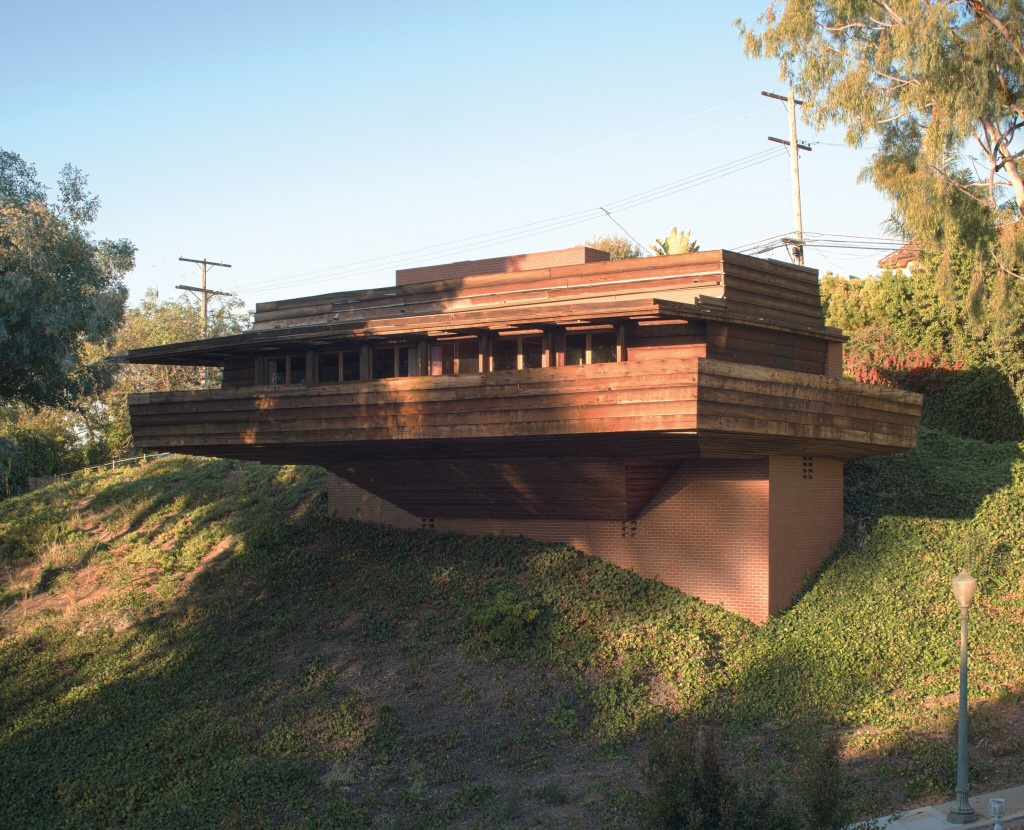
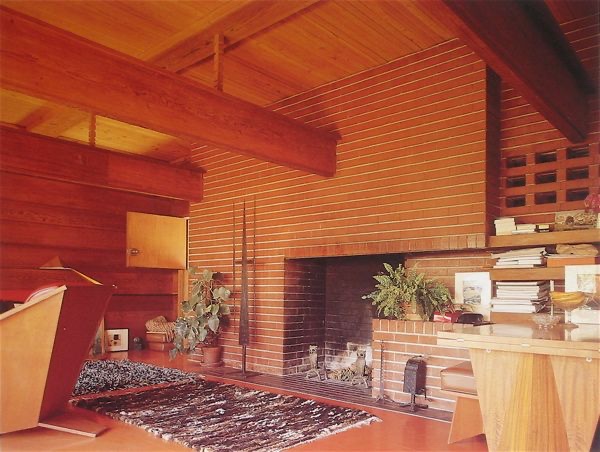
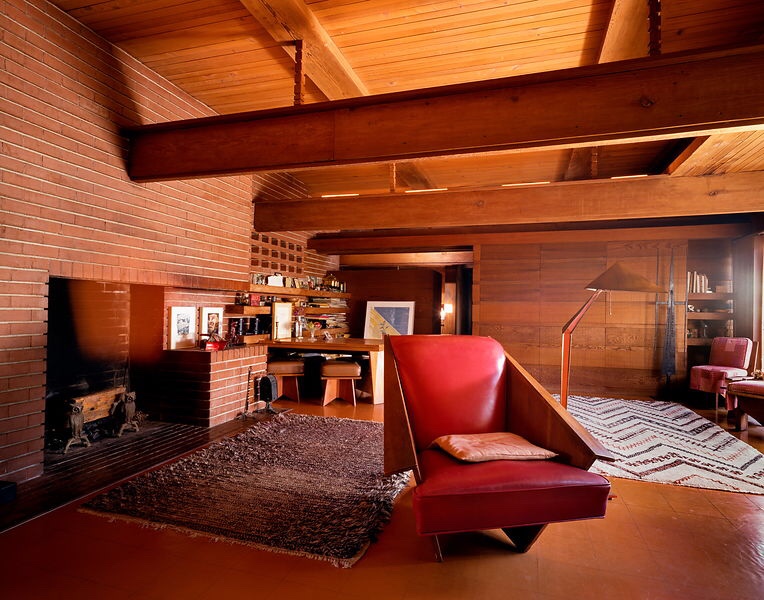
For many years, Larson and Bridges shared a home in the Brentwood Heights neighborhood. Known as the Sturges House, the structure was designed in 1939 by architect Frank Lloyd Wright. “It was obvious to anyone that since we lived together we were partners,” Larson told the Los Angeles Times in 2011. “We always went places together. We never pretended.'”
Located at 449 Skyway Road, Sturges House is formally listed as a Historic-Cultural Monument by the City of Los Angeles. Larson continued living in the house until his death.
Knowing the Sturges House
I first encountered Frank Lloyd Wright’s Sturges House in courses in the History of Architecture at the University of Wisconsin, Madison, where I was a graduate student in the 1960s. This was indisputably “FLW Country.” He had been born nearby in 1867 in Richland Center, Wisconsin and had lived as a child and teenager and had gone to high school in Madison and had then matriculated as “special student” at the University of Wisconsin. Long after that he had built “Taliesin,” his great longtime home and studio in Spring Green, Wisconsin, northwest of Madison. In 1937, also in Madison, Wright had built his first so-called “Usonian” house for Herbert and Katherine Jacobs, a small, wood and brick, two bedroom, flat-roofed, moderately-priced structure that took its name from various sources, including a play on “US-ian.” It was followed, in the late 1930s and 1940s, by other Usonians in Wisconsin, and in neighboring Illinois and Michigan. Wright’s similar, though distinctive, Sturges house (1939) in the Brentwood district of Los Angeles is generally considered to be his “California Usonian.”
Selma Sturges on the roof of the residence, 1940. Image used with permission, courtesy of the Sturges family. Photographer unknown.
When, in 1968, I received an appointment at UCLA to teach urban, architectural and cultural history, I was fortunate to live first in the 1937 Strathmore Apartments in Westwood, designed by Richard Neutra, one of Wright’s already famous former apprentices—about whom I would soon begin to write a book. At the same time, I began to explore Los Angeles architecture, including ten Neutra structures in Westwood alone and not far away, in neighboring Brentwood: Wright’s great Sturges house. Unlike the generally flat sites of the Usonians in the Middle West, I was surprised to find the Sturges residence perched high on a steep lot among rolling hills. Eager to explore this treasure, I unabashedly knocked on the door one day and was cordially welcomed by its owners, the film director James Bridges and his longtime partner, the actor and writer Jack Larson.
Bridges (1936–1993) directed such acclaimed films as: The Paper Chase (1973), The China Syndrome (1979), and Urban Cowboy (1980). Larson (1928–2015) was best known–to his eternal dismay–for his role as Jimmy Olsen, the cub reporter, in the long-developing series Adventures of Superman. He always lamented that he was not as well known for the libretto he wrote for his and Virgil Thomson’s opera Lord Byron (1972). The couple acquired the house in 1967 and lived there together until Bridges’ death in 1993. Larson continued to inhabit it alone until his death in 2015.
Jack Larson as ‘Jimmy Olsen’ and Noel Neill as ‘Lois Lane’ (Photo by ABC Photo Archives/ABC via Getty Images), c. 1951. Vintage print from the collection of Jack Larson sold to benefit The Bridges/Larson Foundation.
Film Director James Bridges on location. Vintage print from the collection of Jack Larson sold to benefit The Bridges/Larson Foundation.
Jim and Jack were the first to tell me of how the Sturgeses were told that it was medically impossible for them to have children and how, as a consolation, they decided to commission a house by Wright, whom they had long admired. It was an ideal cottage for two people, but soon after they moved in, Mrs. Sturges realized that she was, in fact, pregnant. Wright altered the house design to accommodate a nursery. But after another child came along, the couple gave up their dream house and moved around the corner to a larger residence. Their name, however, would always be attached to their Wright-designed home as it went through several owners until Bridges and Larson acquired it.
Robert Imandt photograph of the residence, c. 1946. Vintage print from the collection of Jack Larson sold to benefit The Bridges/Larson Foundation.
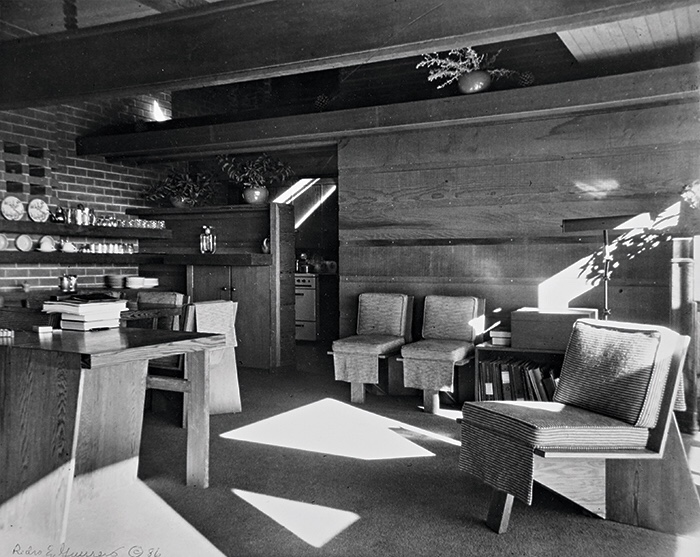
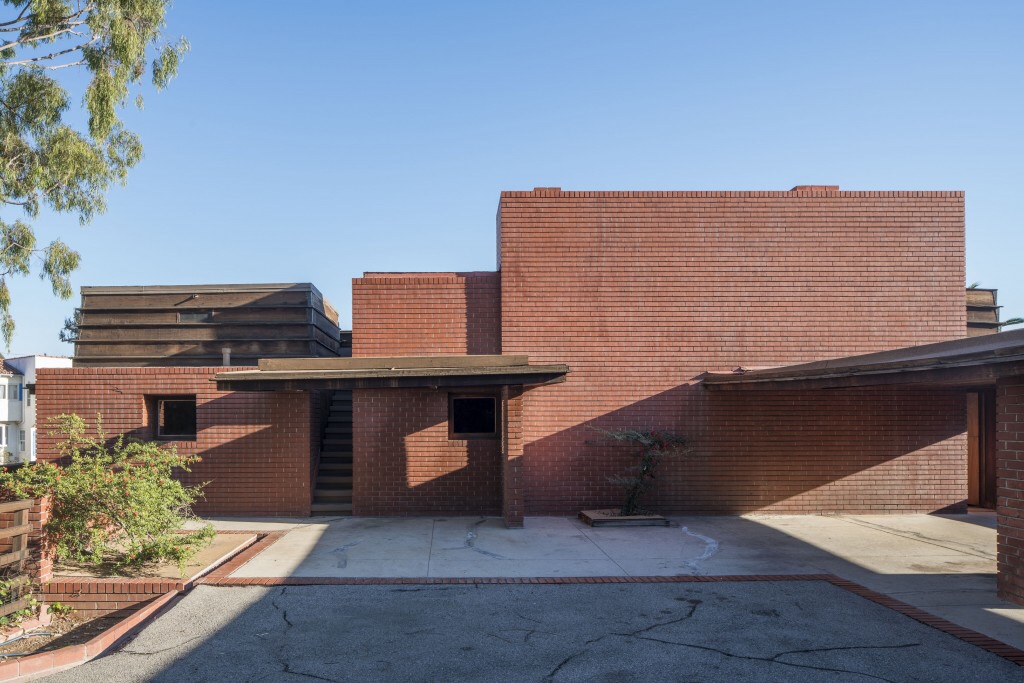
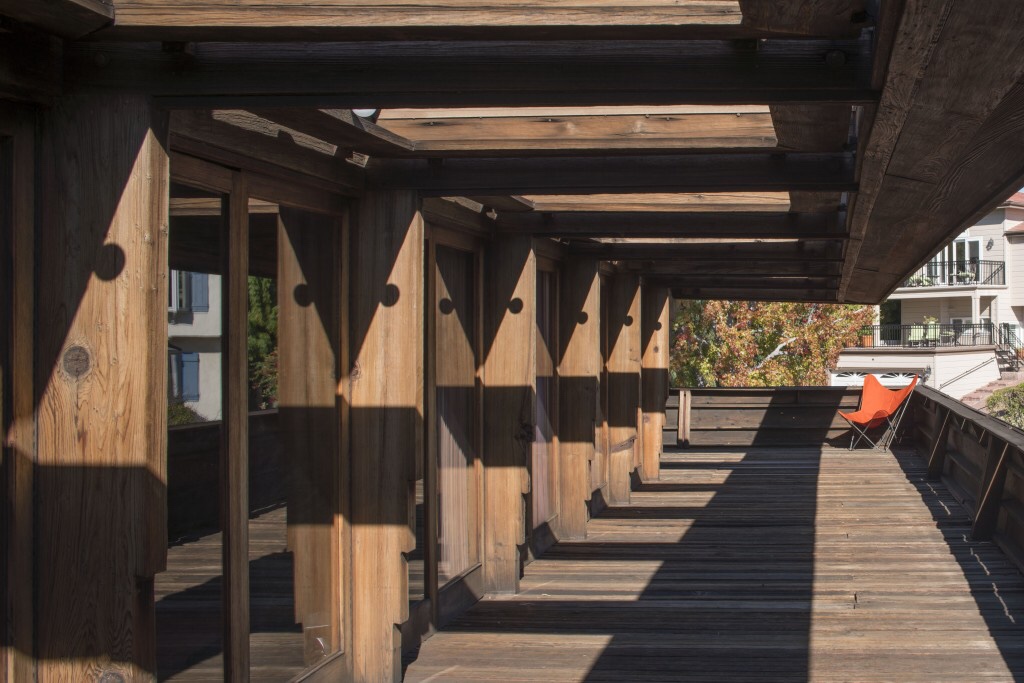
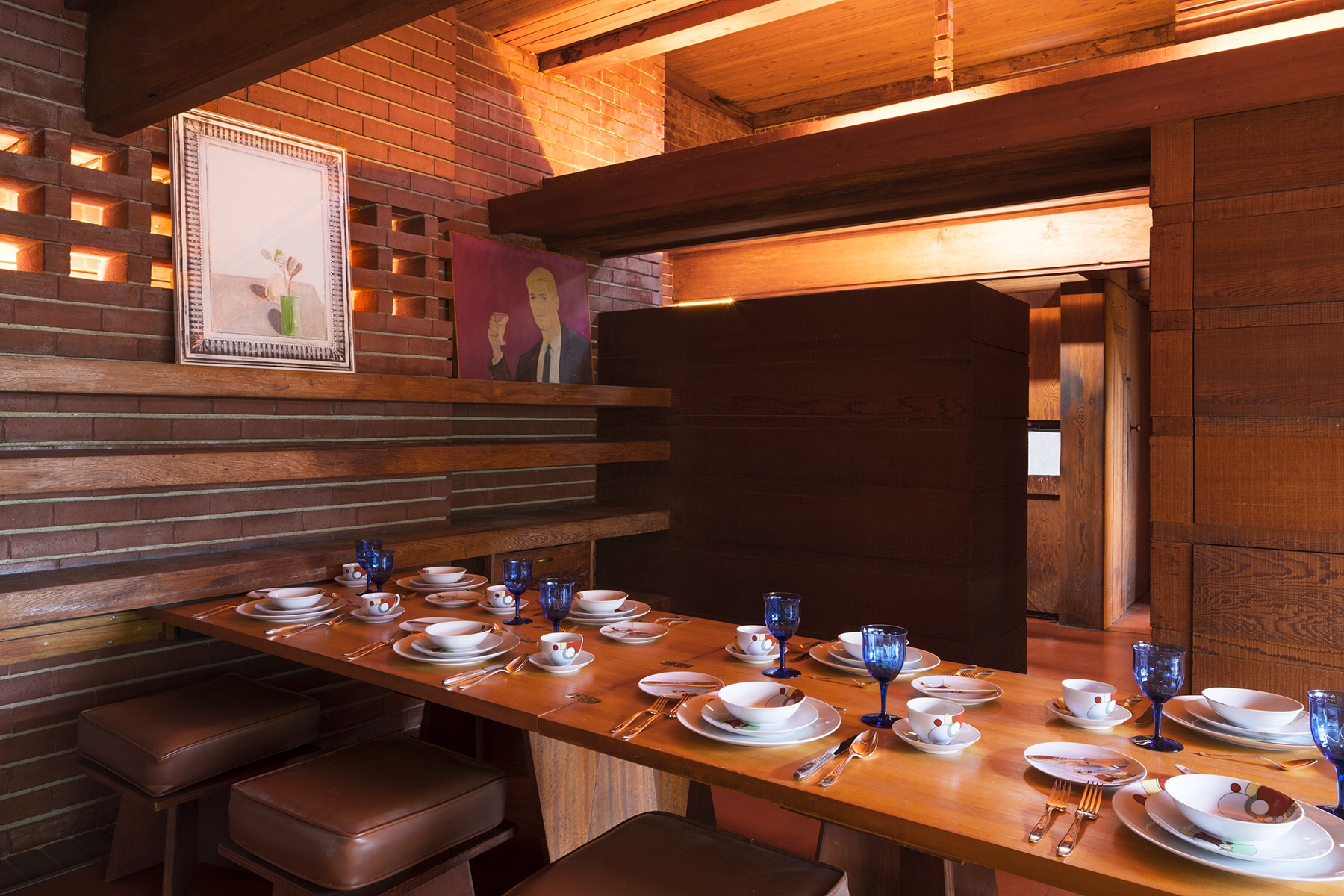
Built of steel, concrete, brick and wood, the house is approached from the west at the rear just off the carport at the top of the hill. Visitors could either proceed around the encircling deck to enter through the living room on the eastern side or, as most did, through the small kitchen to the west. With less square footage than the Usonians in the Middle West, the house contains a relatively large living-dining room, two small bedrooms, and one bath on the main level. Tiny stairs lead up to the roof deck and down into the windowless basement, which Bridges used as a dark room and studio. In 1939, Wright had deputized his recent Taliesin disciple, John Lautner, to complete final details of the design and to supervise construction. Both Wright and Lautner created specially designed furniture and other accouterments, such as lamps. Small cabinet spaces were cleverly concealed behind fold-out wall panels. Larson and Bridges would also enjoy pointing out various movie treasures they had acquired over the years such as the actual wrench used by Charlie Chaplin in Modern Times (1936).
Sturges Residence appears on the cover of California Arts and Architecture magazine, April 1940. Vintage magazine from the collection of Jack Larson sold to benefit The Bridges/Larson Foundation.
The house was long enjoyed by such Hollywood visitors as writer Gore Vidal and director John Houseman as well as by actors Jane Fonda and Debra Winger, who starred in Bridges’ films and continued to be friends. Jack and Jim also seemed happy to open the house to admiring architecture people such as historians Vincent Scully and Colin Rowe, museum curators Arthur Drexler and Carter Brown, and architects Richard Meier, Peter Eisenman, Richard Weinstein, Jaque Robertson and Frank Israel. The house thus had several incarnations in the public imagination, first, as it was initially published in the Forties and Fifties and again in later years after it had become so famous that it seemed indispensable to any publication on Wright or on modernist Los Angeles.
It remains a vitally significant monument in the history of both.