Category Archives: History

Bad Eggs, Weirdos, and Heroes: A Story of Families

There is an adage that you can choose your friends, but you can’t choose your family…and fortunately – or unfortunately – it’s true. And oddly, as distinct from family groups in centuries past where family history and lineage was often passed down through word-of-mouth, these days we seem to know very little about our family history, or who we are, and how we are related to others in our “group”.

I attempted to trace my family roots in the early 80s. I had the basics – mothers parents and grandparents, brothers and sisters and their families. My fathers sisters and their families, but that was about it. Tracing family history back then, in the dark ages, wasn’t as easy as it is now. There was no internet, no Ancestry or Family Search, no apps for tracing BDM, graves or potential record matches for family members. No little leaves popping up against names. I contacted my mother with a list of dates and relationships I required to move forward, only to find she wasn’t interested in family, and could only supply limited family information. With my father deceased, and his family alienated, my chances of getting very far looked grim. I entered up what info I had in a large family bible – the only thing that had family tree pages – and put it all on the backburner.

Fast forward to ten years ago. The internet is in full bloom, and Mr Google is a knight-mine of information. I put Pickhills into a search engine, and suddenly all this information came to light through the newly published sets of census from England. A full, colourful family history, hidden from a blinkered families sight, came into full bloom. My family had no idea what they had missed by cutting themselves off from the curiosity to know what their forebears had done! No one knew of my Great Great Grandmother (Paternal) Elizabeth Pickhills nee Appleyard, who was dragged all over Yorkshire by her husband, Rickinson, gave birth to 12 children and had most of them die in her lifetime, who visited her 2 sons in South Australia, was arrested twice, was shipped back to England (presumably) because she was too much of a handful for her kin), and died of “senile decay” – dementia – in Tooting Bec Mental Asylum in London. Nor of my Great Grand Aunt Clara who married into the prestigious De Bomford family in Tasmania, nor my Great Grand Uncles who captained steamers up and down the Darling, Murrumbidgee and Murray Rivers. One of these uncles led such a prolific life that I have a whole arch-folder dedicated to him, and it is suggested that the book “Dreadnought of the Darling” by the famous Australian war correspondent Charles Bean was based on the recollections of Captain George Rickinson Swan Pickhills’ life on the Darling River. Nor would they know that my Great Great Great Geandmother, Clara Pickhills nee Rickinson, was related to the very old and prominent Rickinson family from Robin Hood’s Bay in Yorkshire. What a shame that all this colourful heritage was lost to my family, caught up as they were in the dross of their own lives!

The family tree currently stands at around 8,500 people, related either through blood or marriage. Lineages grow exponentially, so in reality there are no ends, and finding beginnings can be difficult. I am sure the tree is 95% accurate, and I am currently working on sorting out a couple of messy lines. It has proven an interesting experience, and many characters involved have had a hand in world history. We have Cornish miners (my mothers family) who travelled all the way here, hoping for a getter life than that offered in Cornwall and established themselves in South Australia, Broken Hill and Cobar; a Rickinson who was an engineer on Ernest Shackleton’s exprdition to Antartica; many who died in mining accidents; those who fought in WWI and are buried in Villers-Brettoneux; there are several protestant ministers; at least four convicts; bankrupts; relatives in England, Wales, Ireland, the Channel aislands, America, Canada, Germany and New Zealand. We are related to the Henschke – yes, the South Australian wine people – family in South Australia. We have humour, like Happy Victoria Morris marrying Spencer Lemon, thus becoming a Happy Lemon. And, as described below, a host of cads to keep everyone on their toes. Welcome to the world of family!

Errant Family

Elizabeth Pickhills nee Appleyard (my Great Great Grandmother) arrived here after the death of her husband Rickinson. They had 12 children within a short space of time, and of the 12, Edward, Jane, Frederick William 1, Walter and Mary died either in infancy or within a few years of birth. Henry Moorsom joined the Admiralty at 14 and died of Cholera in Bengal when he was about 21. Frederick George, George Rickinson Swan and Clara all moved to Austrlia at a fairly young age, and Charles Edward died while visiting his brothers here. Whether she intended originally to emigrate or just visit is unknown, but her stay was memorable! Anyway, she did ship herself here, and for a while probably lived with George Ruckinson and his wife, Ellen in Goolwa, South Australia. According to the South Austrlian Police Gazette, June 21, 1876 ” .A warrant has been issued at Yankalilla for the apprehension of Elizabeth Pickhills, a widow, and mother of Captain Pickills, of the Goolwa, for larceny of 2lbs. of butter from Messrs. Smith & Swan, sheep farmers, Bullapabaringa. Offender is said to be living at Mr. Luffin’s, Goolwa.” Not quite the thing you can imagine GG Gran doing. We know nothing more about the case except for this note in the South Australian Police Gazette, May 1, 1878 “re – Larceny from Smith and Swan – The warrant for Elizabeth Pickhills has been withdrawn.”. One has to wonder if George hadn’t had a few words to Smith and Swan about his mothers mental condition, and got them to be lenient. It didn’t end there. A writ appears with the Goolwa police dated 2nd May, 1889 against Elizabeth Pickhills . She appeared before a Justice of the Peace, Thomas Goode, charged with that on the 28th April 1889 she did “unlawfully use abusive words in a certain public place, to wit The Parade in North Goolwa, with intent to invoke a breach of the peace”. She had to pay a fine of £2. This incident received a mention in “A Land Abounding – A History of the Port Elliot and Goolwa Region, South Australia” by Rob Linn, chapter 5, page

On the evening of 16 December 1965 at Sylvania, Frederick Lindsay Pickhills – my father – .took his 7-year-old son Kevin out to The Gap at Watsons Bay, and jumped over with him. Frederick survived, but Kevin’s body was found 3 days later by fishermen, floating in Broken Bay.

Colin Edward Campbell...gaoled sheep stealing.

William Thomas Onions went missing whilst supposedly leaving Broken Hill and heading to SA or WA, leaving his wife, Agnes, and 5 children in destitute circumstances.

Above listed as. Cess-pit attendant in the 1895 Wagga Wagga borough expenses.

19 jul 1851 Joseph Onions charged with larceny
25 January 1928 William Joseph Onions (25) indecently assaulted Edna May Hollis (14) and committed for trial at Goulburn Quarter Sessions. On 15 February 1928 was acquitted.

James Greenwood broke into home of Rickenson Pickhills and stole some dresses and a firearm.

John Magg – family convict ancestor. Convicted in Surrey Quarter Sessions in 1822, and sentenced to 7 years in NSW. Arrived here onboard the Surry in 1823.

Richard Blinksell – a wife-basher and thief: Transcription of article from the Queanbeyan Age dated 18 May 1883; “THREATENING LANGUAGE; Richard Blinksell was brought up in custody charged with threatening the life of his wife Sarah Blinksell, of Molonglo. The prisoner had been arrested on this charge by Constable Goodhew, having been given into custody by his wife. After the evidence of the arresting constable, Sarah Blinksell, on oath stated – I am the wife of the defendant now before the court. I gave him into custody of the police on the 11th of the present month for threatening to do me some harm. On Sunday evening, the 6th inst. defendant accused me of stealing his mare, and said to me, If the mare is not brought back to-night I will jump your ____ out. This occurred between one and two o’clock. I said, I never touched your mare. Defendant said, You are a ____ liar; and whatever row we have had before it will be nothing to what there will be to-night. He then went and laid down on the bed. While he was lying there I ran away. I stayed at my father’s house (John Edmonds) for three days. I then came home to my husband again, and brought my daughter and son-in-law with me. As soon as I came in the door the defendant jumped up and asked me why I did not bring his mare back that night. I told him I had never touched her. He told me I was a ____ liar, for he saw me take her. I told him then that I did not want to live with him any longer; I only wanted my three little children. Defendant told me I could take the ____. I called my children together and gathered up their things. As I was going out of the door with them, he called them all back again. I told him he could keep his children, but I did not intend to stop myself. He caught hold of me and was pushing me about to bring me back again. When my daughter found he would not let me go she went for the police. I mean she went to Carwoola and telegraphed to Queanbeyan for the police. I went into the house with my son-in-law; but when the latter went out defendant got up and barred the door against him. I remained with him all night. After staying there some time he told me to take my frock off and go to bed. I did so. After I was in bed some time he asked me if I was asleep. I was not, but did not answer him. He said, You had better enjoy it for it may be the last ____ sleep you’ll ever have. He kept using unbecoming language to me all night. I got up in the morning and prepared his and the children’s breakfast. On leaving to go to my father’s place to do some ploughing defendant walked up to me and spat in my face, making use of some expression which I forget. When he left the house I ran away into the bush and stayed there until the policeman came. I then went with the policeman to my father’s house and gave him in charge. From all that has passed I am afraid to live with him, fearing he might do me some bodily harm. I therefore pray that he may be required to find sureties to keep the peace towards me. To the Bench – I never laid my hands on the mare since the 18th of April last when I rode her home from my daughter’s place. Defendant has often struck me before – both me and my daughter. The last time he struck me was on the 20th of April. To the defendant – I was lying on the bed with my little child when you ordered me to take my frock off. I was trying to get the child to sleep, and did not wish to go to sleep myself. Defendant was then sworn, and stated – I am a farmer and live at Molonglo. On last Sunday week my wife went away from the place and told the children she was going to meet the little boys with the sheep. That led me astray. She had not returned at dark, and when I got my little children asleep I went to look for her, fearing something had happened to her. It was raining hard and I got off and washed my feet in the floods. I heard the next day that she was at her father’s place, and I sent her two messages to come home for an hour or two. She never came home till late on Thursday evening. I asked her how she came to go away in such a clandestine manner without telling me. The daughter then said something; she was there with her husband, Anderson; they came with my wife. I got Anderson and his wife out of the house, and shut them outside, and my wife, my children, and I remained in the house altogether that night. I told my wife she would not be obliged to herself for fetching her son-in-law there. I never that night attempted to raise my hand to her. I did say something to her, but I ‘disremember’ what it was”.

January 19, 1857 at Wheeo. William Apps charged with theft of two cows & 2 heifers.

March 29 1854. Narrawa. William Apps cautions people not to harbour his daughter Ellen, who has abandoned her family home without cause.

William Apps: William was tried at Canterbury on 7th April 1826 on a charge of stealing corn. Found guilty, he was sentenced to seven years transportation to NSW, arriving at Port Jackson on 26th November 1826 on the vessel “Speke”. In 1831 William was granted his Ticket-of-Leave only to have it cancelled on December the same year for receiving a blanket under false pretences from his former master, Mr. William Broughton. For this misdemeanour Apps was sentenced to a week on the treadmill at Hyde Park Barracks. This punishment completed he was re-assigned, but his spirit was unbroken and within days he escaped from his new assignment. His re-capture was notified in the Sydney Gazette on 22nd December 1831. Finally Apps received his Ticket-of-Leave in 1833. From Convict Indents it is known that he was a short man, standing 4 feet, 11 inches tall with a fresh, unmarked complexion, brown eyes and hair. In April 1935 William Apps, aged 32, made application to marry Margery Campbell. Following their marriage, William and Margery Apps continued to live in the vicinity of Sydney and were in Parramatta in 1837 when their oldest daughter, Ellen, was born in that year. By 1849 the family moved to Wheeo, being among the earliest in that district.

Margery Campbell (wife of William Apps), from Sligo, Ireland, was the daughter of William Campbell. When she was 23 she was tried in County Down for receiving stolen goods. For this offence, her first, she was sentenced to seven years transportation. She sailed on the “Palambam” from Cork on 23rd March 1830 arriving in Sydney on 31st July the same year. Margery was 4 feet 11 inches tall with a ruddy, freckled complexion and hazel to grey eyes. On her disembarkment in the colony she was assigned to Mr. James Taylor of Sutton Forest.

Jane Langley – Jane’s story begins on the 14th of September 1785 when she was tried at the Old Bailey with Mary Finn for stealing five guineas from a Robert Robinson, on the 29th of July 1785. Jane’s parentage is unclear but she was possibly the daughter of Edward and Elizabeth Langley, at St George Parish Hanover Sq The birth occurred on the 16th of September 1761 at the Holborn lying in hospital in Endell St. At the time of her trial Jane was a Tambour worker and was described as a tall dark girl with very curly hair, she appeared to be self supporting and doubt exist as to her need to be involved in crime. On the 6th of January 1787 she was boarded on the “Lady Penrhyn” during the Voyage to Australia Jane Langley had the first of her children a daughter Henrietta born on the 23rd of October 1787. There is some speculation regarding Henrietta’s father, Phillip Scriven or Shewring who was a seaman on the The Lady Penrhyn or Thomas Gilbert the ships Master on the Charlotte was also throught to be her father.

Henrietta Shewing (1787—1828) Married to Edward Fletcher 1807 Henrietta, one of twenty little souls born on the convict transports known as the First Fleet, was to be always known as English, and never in England. Henrietta is the only child born on the First Fleet known to have Australian descendants [1]. Henrietta was born on board the Lady Penrhyn at Capetown Harbour, South Africa on 23rd October 1787 [2]. Three of the women convicts on the ship were known to be midwives: Mary Parker, Ann Colpits and Sarah Burdo. The ship’s surgeon Arthur Bowes Symth was definitely not present, and even recorded later Henrietta in the surgeon’s log as male. The ship’s log at least got the sex correct! Rev. Richard Johnson came on board to baptise the baby on the 4th November 1787, an event well liked by the crew because they received an extra ration of grog. The sailors who also had fathered children had the opportunity to buy tea and other little extras at Cape Town for their women [3]. Henrietta arrived on the shores of Port Jackson 6th February 1788, a sultry stormy evening. The next two years were hard and famine was severe in the colony, taking its toll especially of the small children. It was decided to send five of the surviving children and their mothers to Norfolk Island. That in itself was an adventure, as they arrived in high seas and were only at great peril able to be landed at Cascade with the seas breaking into the boat which was very frightening and caused much panic and screaming. That night the Sirus was swept on to rocks and shipwrecked. Henrietta lived on Norfolk Island for the next five years and in that time her mother married the marine Thomas Chipp. A brother Robert was born (and died) and a sister Ann, and a third child is recorded. I think this could have been little Thomas Chipp whose death is recorded early 1795 but most members of the family think the evidence is too flimsy. There were school classes taken by a number of individuals and eventually in 1792 Thomas McQueen was appointed schoolmaster and Susannah Hunter his assistant for seventy five pupils. We could imagine Henrietta would have been one of the pupils. Norfolk Island had passed from its early idyllic days to a wilder rougher life, and Thomas Chipp and his family decided to leave there and return to Sydney Town which had also become a pretty wild and rough place. The Governor’s wife Mrs. King started an Orphan School to house the homeless girls living on the streets of Sydney. This first Orphan School stood on the corner of Bridge and George Street. Not all the girls in the institute were orphans. In two of her letters Henrietta refers to having been in the Orphan School. The family was on record as being “on stores” in 1804. Stores were the equivalent of social security. On the 23rd March 1807 nineteen year old Henrietta was married to the convict Edward Fletcher by the Reverend Henry Fulton at St. John’s Parramatta. Edward had been working for the Knights as a servant, as was her thirteen year old sister Mary Chipp, so we assume they met through mutual acquaintances. This is the period of time Henrietta’s stepfather would have had land at Toongabbie (Seven Hills, later to be known as Bella Vista) and Isaac Knight had the adjoining farm. Henrietta applied for a land grant and a cow on the grounds she had been an inmate of the Orphan School and was granted a thirty acres at Bankstown. Today the land is occupied by Liverpool Hospital. Governor Macquarie revoked all the land grants made by the Rum Corp after the overthrow of Governor Bligh and Henrietta reapplied and was granted the Liverpool land again. The annual rent was to be 2 shillings a year after 5 years. Thomas Moore [4] apparently wanted the grant Henrietta had at Liverpool but probably helped her to obtain the grant at Narellan plus an extra ten acres, which became known as Fletcher’s Farm, and today is the land near Springs Road, Narellan. Henrietta had six children: Edward born 8th March 1808 in Campbelltown, baptised at St. Luke’s Liverpool; John born the 10th May 1810 at Cowpastures and baptised by the Reverend Samuel Marsden at St Luke’s on 15th May 1810. Eliza was born at 12th August 1812 at Campbelltown. Susanna was born on the 12th May 1815 at Fletcher’s Farm, Campbelltown; Blanche was born 17th December 1823 and Elizabeth 26th April 1828. Since 1810 Edward had been employed as a constable in the Cowpastures District. Henrietta’s health had declined over the years and by the time she died at the age of forty-one years, she was blind and crippled. Thirteen year old Susanna was working for the Rev Thomas Hassall as a maidservant on a nearby property, but William Boyle Henrietta’s nephew was living with the family, his father having died. William’s mother Mary was not coping with the change in her circumstances and her sisters took in her children. Edward had a reputation for drinking, but it was said he was always kind and thoughtful to his wife and children, and Henrietta was described as “an exceedingly reputable woman who bestowed great pains in bringing up her children”. In 1828 there was the first outbreak of whooping cough in the colony and two thousand people died as a result of it. One could be excused for wondering if Elizabeth and Henrietta were two of the victims. Henrietta and Edward Fletcher are buried in St. Peter’s churchyard Campbelltown in a well-cared-for grave, which also has a First Fleeter’s plaque for Henrietta. Though Henrietta never lived to see her grand children she had thirty six grand children. There are other family graves St Peters churchyard including Susanna Chapman’s Henrietta and Edward’s daughter. Thomas Chipp always accepted Henrietta as part of his family, and Henrietta was involved in her sisters’ marriages and lives. Thomas was the only grandfather her children knew. NB Surname: Henrietta is variously quoted with the surnames Scriven, Shewring, Skirwin, Chipp and Langley before marriage. Grandson: MH has also written a piece about William Henry Fletcher who was a grandson of Henrietta. Notes [1] A number of children born to marines on the journey, returned with their families to England. (‘Orphans of History —The Forgotten Children of the First Fleet’ by Robert Holden). [2] The baby was born at 1pm so in navy parlance was dated the 23rd as their dates changed at noon. She was also recorded as the child of T..G.. which 198 years later was to cause speculation on who was T..G.. With the passing of sailing ships the navy parlance for calling sailors after their job had been forgotten. Philip Scriven was the foremast man responsible for the Top Gallant sail.[3] As recorded in Jonathan King’s book ‘The First Fleet’.[4] This is the same Thomas Moore who is credited with founding Moore Theological College. He was a land dealer in the early colony.NMargaret Hardwick, 2009


Lynn Shepherd
was indicted for robbery in 1838, found guilty and sentenced to life on Norfolk Island

Addison Mitchell was indicted for murdering William Ablett on 8 Nov 1856 at the old Lachlan Road. John Collins testified at the trial before Mr Justice Therry at Bathurst Circuit Court] “John Collins, lives at No. 1 Swamp, near Carcoar, I recollect on 7th of November, 1856, being in company with Ablett, and prisoner; in answer to an inquiry made by prisoner, he said his name was Ablett, and he was a native of Cambridgeshire ; I should say he was about 20 years of age, 5 feet 9 inches in height, fair complexion, without whiskers, light hair, dressed in a light tweed cap, plaid jumper, fustian trousers, and watertight boots ; in prisoner’s presence, he told me that if he could find an old horse he would buy it to carry his swag to the Ovens ; I sold him an old bay horse, saddle, and bridle, for £6 ; he paid me in prisoner’s presence, with two £5-notes ; prisoner drew out the receipt; Ablett had a tent with him, and I noticed a shingling hammer (hammer found near fire shown) ; I believe this is the hammer deceased Ablett had; I noticed the boots he wore, and noticed that nails were out in front of the left boot ; to the best of my belief the boots I now see in Court are those I saw on Ablett ; the bridle now produced (found in prisoner’s bundle) is the one I sold to Ablett; I saw Ablett last at Radburn’s, 1 mile and a half from my house; he started, leading the horse with his swag placed across the saddle ; this was on Saturday ; he went in the direction of the junction of the Wagoola and Grabine roads with the Lachlan road; the horse might travel 20 or 25 miles a day ; after I left deceased, and on my return home, prisoner complained of his hands being sore from blisters ; I said we would spell that day, and commence again on Monday morning ; prisoner afterwards went out in the same direction that Ablett took ; about an hour afterwards; I did not see him again until next day, Sunday, about 2 p.m ; he was then very dirty ; he washed himself, and shortly afterwards I received information that my horse that I sold Ablett was near my house ; I went out and found the horse hobbled close at hand; I said, in prisoner’s presence, that the horse had been brought back ; prisoner said he had strayed back ; in the evening I told prisoner that it was no use in saying he did not bring the horse back, as he had been seen riding him ; he said, “well what of it, you don’t know Ablett as well as I do, he is a bolter, and there are constables after him in all directions ; that he was within a quarter of a mile of the place, but was afraid to come in ;” whilst I was sitting near the fire with prisoner, I saw the remains of a pocket-book in the ashes ; it had a clasp like the one I saw with Ablett ; I was frightened to put it in my pocket as I was alone with the prisoner; after prisoner left my house I searched for it, but could not find it ; I identify the handkerchief now produced, found in prisoner’s bundle, as one I gave to Ablett with flour in it, also the saddle and bridle sold by me to Ablett, and found concealed near my hut; on the Monday morning I discharged prisoner being suspicious of him; as he left I saw him pick up the bridle now produced; I identify it as the one sold by me to Ablett; I gave information to the police. Constable McFadden re-called : In consequence of information given by last witness prisoner was apprehended for horse-stealing: it was in looking for and making enquiries about Ablett that I found the camping ground on the old Lachlan road ; there were appearances of a tent having been pitched, there, and about half a mile distant in the scrub I found the ashes of the fire in which I found the bones, buttons, shingling hammer, hair, and buckles, which have been produced ; I made enquiries in the neighbourhood of the camp, but could find no traces of any person answering to Ablett’s description being seen in that neighbourhood. Thomas Radburn, of Carcoar, recollects Collins coming to his hut on 8th November, to change a 5 pound note ; he was accompanied by a young man; witness’s description tallied with that already given by Corby, Wood, and Collins. James Bradburn, son of last witness, gave the same evidence as to appearance and dress of Ablett ; two and a half hours afterwards saw prisoner following in the direction taken by Ablett ; when Collins told prisoner next day that he had been seen riding the horse, prisoner replied, well, what of it ? Katherine Radburn gives same description to that already given of Ablett, and thinks that the prisoner was the man she saw going in the same direction to that taken by Ablett two hours after. Richard Byrne, knows, the prisoner ; saw him on Sunday morning, 9th of November, between eleven and twelve a.m., at a place on the Lachlan road; about two and a half miles from the junction of the Wagoola and Grabine roads with the old Lachlan road; he was riding on a short brown-tailed horse, it was very thin, he had a bundle before him as full as it could hold ; I saw the horse prisoner was riding afterwards at the Court House ; prisoner was very dirty, like a man after a long journey. William Mulaly lives at Black Hill Creek, on the left of the Lachlan road, about quarter of a mile off the road; on Sunday, the 8th of November, prisoner came to my house between 11 and 12 a.m.; he-had a very poor brown horse with him ; I asked him whom the horse belonged to ; he said it was Collins’s he lent it me so that I could come over to you to get employment ; I asked him if his name was Mitchell; he said, yes ; there was neither saddle nor bridle on the horse when I saw him, prisoner’s appearance was that of a man after a hard day’s work, he was very dirty. Cross examined by Mr. Dalley: No appearance of having been engaged about a fire; his clothes were not burnt; he looked like a man after a hard day’s work. John Radburn identified the saddle as being found by him concealed at the foot of a tree near Collins’s hut. John Meiklejohn, constable in Carcoar police: On Sunday morning, the 9th of November, I was on the Lachlan Road, near the junction of the Wagoola and Grabine roads; I saw a fire in the distance, off the road about half a mile. I afterwards was taken to the place by McFadden, and I then recognised it as the place where I had seen the fire on the 9th November; looked for tracks at the junction, but could not find any. James Grant, the prisoner, was in my employment as a shepherd; he knew the country well in the neighbourhood of the junction of the roads to Wagoola and Grabine with the Lachlan road. On Sunday, 23rd November, McFadden and I found remains of a fire in a scrub, half a mile off the road; we found bones, buttons, a hammer, and portions of hair there; at the junction a tent had been pitched ; this was half a mile from the fire in the scrub. ………………The jury, after a short absence, found the prisoner guilty; and the Judge; in a most impressive manner, passed sentence of death upon the prisoner.This case occupied the whole day from 10 a.m. to 8 p.m.

Doris Olive Irene Nunns charged Thomas Henry Roy Jackson of attempted rape on 14 July 1920. He was acquitted.

Richard Cole Seaton charged with stabbing his wife with a knife and inflicting serious wounds, and also assaulting his niece.

John Henry Theodore Merrion was killed when falling from a roof during a demolition in Ngahauranga, NZ.

On 11/5/1903 Ellen Prest was remanded in gaol at Murrumburrah for 8 days due to “unsound mind”

Private Alfred Sydney Polglase deserted the army on July 21, 1916 and there was a warrant out for his arrest

Thomas Henry Roy Jackson charged with the attempted rape of Doris Olive Irene Nunns nee Polglase on 14 July 1920. Acquitted.

Squire Brooks – convict ancestor on my maternal grandmothers side – the Collins family

1924 Horace William Brooks, 9yo, drowned in Eastern Creek along with an 11 yo friend.

Sat 28 Sep 1867 at Braidwood Police Court. Thomas & Eliza Hobbs daughter Esther, 10yo, (born out of wedlock) was being prostituted by her father – a drunkard – and his wife – a drunkard and prostitute. Frederick Stephens, a witness, recollected that on Christmas Day saw Esther and a man named Dean naked together in a waterhole..the details here being too lurid to print. He had heard that it was common for liberties to be taken with the girl. Dean was known as a regular with the girl, and had been arrested for sexually assaulting her, but had been acquitted. Her parents received her earnings. The parents were known to often leave all the children on their own for long periods, to fend for themselves. The object of having the girl in court was to save her from her parents. She was sent to the industrial School. The Hobbs family members were regularly in court for drunkenness and foul language…and never argued the charges.  On Friday 18th sep 1874 at Braidwood, the above Dean was admitted to hospital, having been brutally beaten, and died that night. He was found about a mile and a half from the Hobbs house, after having been out drinking. The Coroners Court jury found that death had been caused by person or persons unknown.

1884 Lynn David Nettleton had a warrant for his arrest issued for disobeying an order to financially support his illegitimate child.

Ada Camden was excited to be marrying Harris Horder...so excited, so it seems, that she forgot to divorce Roland Watts. Henry had their marriage dissolved on the basis of bigamy.

In 1885 Richard Camden alias Crib alias Snow was accused of stealing two horses belonging to James Hemsley and Thompson Ross. He was described as being 5’10”-11″, no age given, stout build, sandy complexion, and sporting Dreadweary whiskers. He was thought to have gone to Tambar Springs. No warrant was issued.

In 1919, Horace Horder (17) and a group of boys were charged with breaking and entering the home of William Clement and stealing jewellery etc to the value of £10 (part recovered). The boys were committed for trial, bail allowed.

Baptism Certificate for Sarah Camden in 1852 seems to have some difficulty deciding whether the surname should be Jones, or Camden. The transcriber made a note at the end of the certificate that the minister had added after the mothers name, on the original, that the child was born as the result of adultery. It would appear that the 17yo Richard had a dalliance with the 37yo Elizabeth Hale…with the predictable result. Sarah ended up a Camden.

In 1883, Gertrude Agnes Finke (the future Mrs Catherine Agnes Bottrill), was admitted to the Adelaide Destitute Asylum, along with 6-month old David. David died shortly after.

In 1773, at Helston Cornwall, Robert Barwick Scadden and his wife Anne were excommunicated. No clear reason is given.

24 December 1890, Thomas Ironfield charged with breaking & entering three homes in Leichhardt & Balmain. Jewellery & watches stolen. Later charged with pick-pocketing crowds in The Domain. His wife later charged him with desertion, claiming he had assaulted her for no good reason, then throwing her and her children out of the house. He also had her tossed out of a lodging house. He, in turn, said he had no desire to live with her. He was gaoled in 1898 for the robberies.

Mining Accidents – CLEAVES William

Name: CLEAVES William
Age: 0
Date: 05/02/1845
Year: 1845
Occupation:
Colliery: Hayeswood Coalworks
Owner: S.S.P. Samborne and Co.
Town: Timsbury
County: Somerset
Notes: Adjoining were old workings which had lain unused for many years and were filled with water. About 100 men descended for the day shift at about 5 a.m. Mr Evans, the overseer noticed there was an unusual appearance of damp but initially he did not become too alarmed as he thought it was only “the bleeding of the coal”. William’s body, along with that of George Palmer was not recovered until the following October. Two weeks later John Flower was brought out. Later another body was found and was buried in the name of Joseph Gullick. The mistake was discovered when the body of Joseph Gullick was found. 11 killed. Left a wife and 6 children.

17 Feb 1952 Adolphus Stead reversed over Margarey Ann Gould, aged 4, in his car at Broken Hill. She suffered fatal head injuries.

1903, Elizabeth Stead dies after inadvertently taking strychnine after an afternoon of consuming alcohol. 

Tim Alderman (C) 2015

Another Coming Out Story!

“Life’s not worth a damn till you can shout out – I am what I am!”
Gloria Gaynor – I am What I Am

There is nothing worse than being 9 years-old in the 1960s, knowing that you are different to all the other boys around you, and not knowing how or why, or even having a word to describe it. I was just “Different”!

My father had a word for it though..poofter, though I could never quite work out who or what these poofter people were…perhaps from a country I hadn’t heard of…maybe! In the car one day with dad in the passenger seat, and Uncle Peter…a mate of dads…driving. There was a guy walking along the footpath in a pink shirt. My fathers window was quickly opened, and in unison both father and uncle screamed “POOFTER” out the window. On observing the guy through the back seat window…I could see nothing to help me define that word! However, I have a word to describe my father! It came into my vocabulary shortly after that age. Cunt! As you can already see…this was not a family who would facilitate…or appreciate…my coming out as gay!

Now let me see…what qualities singled me out as “Different”; playing with the girls in the school yard for starters. And unlike the boys, they accepted me into their girls clique with no recrimination or name-calling. I was an excellent skip-roper, and picked up the intricacies of French skipping (done with elastic) very quickly. It could have been my playing with dolls, which my mother actually bought for me…secretly of course! Or my penchant for hiding away in quiet corners and reading books…or my total dislike of sports…my keen eye for fashionable ladies wear…my creative science fiction inspired composition (essay) writing… my artistic streak…my perchant for playing “dress up” in my mothers clothes (which perhaps lead to the evolution of my gutter drag persona…Cleo…in the 1980s)…even my over-active imagination all kept me apart from the other boys I knew. At the beach I was attracted to…and stared at…guys in Speedo swimwear. This was the era of nylon Speedo briefs, and the young men hung very nicely out of them, to say the least. Even the nylon briefs with a “modesty panel” across the front did nothing to hide their manly virtues, as the panels tended to ride up, further emphasising their manliness! And I tore adverts for men’s underwear or photos of lifesavers or any other scantily dressed males out of magazines and newspapers. These adverts, for underwear such as Jockey y-fronts, or Bonds horizontal fly s’port briefs showed no real bulges…but I could imagine them, so to me they were erotic (and now my underwear fetish). I imagined a bulge on the lycra-clad comic strips heroes of the time…The Phantom, Superman, and Batman and Robin.

I also had my first orgasm at 9…and that was something I wasn’t prepared for. I can remember it like it was yesterday. I wasn’t even looking at anything that I fancied…just sitting class, gazing out a window. An erection…which I knew nothing about…just happened. Slightly moving backwards and forwards produced this pleasing sensation…and within seconds I blew. Confusion reigned, as it was such an unexpected occasion. I never mentioned it to anyone, though there was a thorough examination of my cock at bath time to make sure everything was okay. It was! I also started growing pubic hair, which I used to pull out as quickly as it appeared as I was embarrassed by its growth. A discreet viewing of the other boys in the change room revealed no hair on them, so this was obviously a freakish thing happening just to me. My parents weren’t great with the birds and the bees stuff! However, it must have clicked with them that something was going on…perhaps a discolouration in my Jockeys…or the fact that I learnt to masturbate by rolling onto my stomach, and rubbing my cock on the sheet until I came, thus unknowingly creating stiff patches on the sheets…may have been a hint that puberty had started. Nothing like a Christian sex pamphlet discreetly left by the bedside to educate you in the dynamics of sex. I was horrified! No wonder I was confused! Thank heaven for my little stash of adverts!

So I guess I just tucked all my “Different” away. After leaving school, and starting work, I hung out with a large group of people, so I came into contact with other gay guys who were included in our group, and as with many other things in my life, I accepted them on face value. However, they were nearly all in the display areas of Grace Brothers (in Roselands shopping centre), and were very effete…something I couldn’t relate to, so I guess it sort of added to the confusion I was already going through. If gay=effete…then I mustn’t be gay. It seemed logical at the time, especially with no other role models to help guide me through the confusion. So I went through the 70s dating girls, though never making sexual advances to them. It wasn’t even something I considered doing. The girls, in turn, loved going out with me because they felt safe, and knew I wouldn’t go in for the quick grope…and I often helped them buy their clothes. Jo was a girl I used to date who was kind of my “beard” (a term used to describe girls who used to act as girlfriends to stop family from asking difficult questions). She was quite a beautiful girl and I think my old man thought she was a potential marriage mate for me. She did try to seduce me one night, but when I fought off her advances…things must have clicked with her.

The next thing I know, she’s taken me out to Oxford Street in Darlinghurst, pointing out all the gay venues to me and taking me to a gay coffee lounge called “Nana’s” in Bourke St (which became a very popular Vietnamese restaurant in the 80s) where I was introduced to the owner, Nana, and his partner Cupcake.

Author in thev1970s on a solo vacation to Magnetic Island.

Yet there was one occasion when something almost happened. I would have been about 17, and worked for a menswear company at Roselands called E.L. Downes. There was a Clark Rubber store on the lower ground floor, and the manager there, named Barry, who was quite a handsome older man, served me on several occasions. I used to wave as I passed the store, and he used to sit next to me on the bus after work, as we both lived in Kogarah, though on opposite sides of the railway line. As I passed the store one lunchtime, he grabbed me and asked if I would like to go out with him. Without even a blink, I said yes! Told my workmates, and they just encouraged me…and it just didn’t dawn on me that obviously THEY knew I was gay! Talk about naive! Anyway, that weekend I met him at the station…at this time I was living with just my father (my mother left home in 1965), and there was no way I was telling him I was going out with a guy…and we cabbed it into The Cross to this VERY ritzy restaurant called “Mrs Beeton’s Tent”. I’d never been to such a sophisticated…and expensive… place, so was a bit dazzled by it all. Anyway, we got a cab to go home, and he was holding my hand in the back seat. All I could think was…what’s going to happen from here…what am I expected to do! If he asks me home, I’ll go…just to see what happens! The cab got back to Kogarah, and dropped us off at a small park in the main street. He grabbed me by the arm, and started pulling me towards the toilet block, telling me he couldn’t take me home, as he lived with his mother! A toilet block for my first sexual experience with a guy was NOT the romantic experience I was expecting, so broke his grip, said “my father’s expecting me home!” and fled up the street. Missed opportunities! Oh well, such is the life of the shy and naive! Not surprisingly, Barry never spoke to me again, and caught a later bus home from that time on.. When I think about it now, I just shake my head. Considering how outrageous I was to become…I can’t believe my actions that night!

Just after this I started renting with friends in Granville. It was around this time that I started buying bits and pieces of gay porn, and buying “Campaign” newspaper (it became a magazine at a later date). One old closeted gay guy I worked with at Pellegrini & Co knew I was gay, and he evidently wasn’t the only one. My flatmates took me to a party at the home of two gay guys they knew…John & Ray. They had me sussed out in the blink of an eye, but I ignored their innuendo and sly comments and continued to deny it. My flatmates found out by mistake when I went to Campbelltown in the latter half of the 70s to help my step-brothers (he also later turned out to be gay) wife who had had a stroke. I asked my housemates to bring up some clothes for me as I was staying a while, and…much to my horror, and despite a phone plea to ignore the magazines in the drawer (like that was going to happen!)…they unearthed my stash of gay porn mags, and actually kept hush about it until after I came out. In the interim, I had sex with one girl…Veronica…a friend of my female housemate, and who had a young daughter who actually idolised me…just to make sure I wasn’t straight!After having to fantasize about a man to get to orgasm with her, I think the dye was pretty well set…though Barry may have seen Kharma at work, as I shouted her a very expensive meal at the Millionaires Club in Darlinghurst on our first date, and she said no to sex as she wasn’t on the pill…that came after our second date. Yet I still didn’t come out, despite knowing for sure.

Me just before leaving for Melbourne at the Capitan Torres restaurant in Sydney circa 1978

However, circumstances were about to present me with the window of opportunityI needed, and the wherewithal to come crashing out of my closet!

In late 1978 my father committed suicide in bushland near his home in Vincentia, on the NSW south coast.. I am not going to go into details of life with my father, but suffice it to say it was tense. I cried a few crocodile tears, then clicked my heels and rejoiced. My sense of freedom at last was overwhelming! I don’t know what I would have done if this situation hadn’t presented itself. I could never have openly come out to him, as the repercussions could have been dire. As it was, I was moving further and further away…in a relationship sense…from all my family (I am not going into the complexities here, but…oh boy!) so it is possible that to live my own life, and be who I had to be, I would have cut them all off earlier than I did…or maybe Melbourne would have happened anyway, irrespective of anything, and I would just have cut them out of my life. I guess the simple fact was that I was an outcast…the black sheep of my family. One way or another…I really didn’t give a fuck!

In the middle of 1980, the retail company I worked for – Pellegrini & Co Pty Ltd – asked me if I would be interested in going to Melbourne and troubleshooting two stores they had down there. I jumped at the chance. So I flew to Melbourne, set up house in Cumming St, West Brunswick, and started to set in motion the cogs that would change my life, starting a whole new phase that would take me in directions I could never have imagined.

Now, this was no easy matter. Cogs can be complicated mechanisms. The two stores – one in the Myer Centre and one in Hardware Street were in a mess, and by the time Christmas 1980 rolled around, I had not even started having any social life, let alone coming out and banging my way through Melbourne! That was to come! After spending that Christmas and Boxing Day on my own with a bottle of whisky, I decided I needed to do something about it! But what? I went through the classifieds and social group listings in the gay press, mentally started ticking or crossing them out, then going through a process of elimination with the ticked ones, according to where I thought I might or might not fit in. One group seemed to stand out – Acceptance Gay Catholics. I knew not only all the ins and outs of the Catholic Church…but I managed businesses for a Catholic retailer. Seemed like a match made in heaven, so to speak! So I made a phone call, found out whose home the next First Friday Mass was held at, and the next First Friday found me heading out to suburbia to Max’s house for my first gay outing. I told no one I was not yet out, and not being from Melbourne they wouldn’t know if I was or not. Right up to the day I left Melbourne no one I knew was any the wiser.

So the guys all started piling in…and not exactly a pack of spunks, though a couple of lookers amongst them. Turns out the Servite Fathers conducted the masses for them. Not being under the jurisdiction of the local bishop, they were free to do what they liked.

A clone is born…Cumming St West Brunswick 1981.

After the mass there was a meal, then we hit Melbourne for a night out. My first gay club…The University Club in Swanston St. It was gay there every Friday and Saturday night. Started dancing with the guys from the group, and decided to play it safe by dancing with, then going home with, one of the older, plainer guys. At the grand age of 25 I was about to have my first gay sexual experience. It wasn’t the bells, whistles and fireworks I was expecting! In fact…it was a total dud!

Frank, naturally thrilled to bits to have a quite handsome bit of fluff come on to him (actually he made the first move – on the dancefloor! I wasn’t experienced enough to know that if you weren’t really interested, you said a polite “no thanks” and moved onto the next). I didn’t want to seem rude, so said yes when he invited me home, despite fancying a couple of the younger guys more. A steep learning curve here! So, Frank had a car and offered me a night at his place. I can’t remember where he lived now, but it was quite a drive out of the Melbourne CBD. No sooner was I in the car than he had my cock out, and out it remained all the way to his place, despite several near misses due to his…distraction! I often wonder what other drivers thought as Frank’s head disappeared from sight at every red light! Once we got indoors, I decided the ball was in his court and I would leave it up to him to drive proceedings. He assumed I was a young slut and would know how all the mechanisms of gay sex unfolded. Frank was also a bit old and stale, and not the most sexually adventurous person to go home with. From my perspective, I wouldn’t even be leaving the starters blocks with this one. Not an auspicious beginning to my gay sex life, having held myself back for so long. The next morning, it was breakfast, then finding out that I would be getting myself back into the city…on a train. Well, fuck you too, Frank!

At an Acceptance function just prior to returning to Sydney. Fred Diamond (left), Max (Centre) and me.

I started attending not just the First Friday Masses, but Sunday Evening masses as well, held in the Holy Trinity Catholic Church in North Fitzroy, and any of the other Acceptance social occasions that cropped up on the calendar. Thankfully, Frank attended pretty well none of these with any regularity, so it was quite a long time before I ran into him again. In the interim, I found out from Fred – we’ll get to Fred shortly – that he and the other young guys at the University Club that night were quite surprised to see me go home with him. Learn to say no is the first rule of survival on the gay scene!. So over the next few months I met the other members of Acceptance through the masses, or parties in their homes, and get-togethers in a few local eateries, and gay venues such as The Laird Hotel in Collingwood, Smarties Nightclub in North Melbourne, and Pokies, a Sunday night drag venue in St Kilda. My evil plan was working…I was starting to lead a gay life!

In the meantime, I wanted the world to know I was gay. I wrote to my ex-Granville flatmates and ‘fessed up…only to find out that they had known since the night they packed my luggage for Campbelltown. They had met my mother, who I had only just been reunited with prior to coming to Melbourne. On a visit to see her, they notified me by mail, they had accidentally outed me, thinking that I had notified her at the same time as them! They also informed me that she already suspected that I was gay, though she never brought the subject up with me. Years later, back in Sydney, I made no effort to hide my sexuality from her, though on a mother/son lunch in the city one day, she informed me that she blamed herself for it. It became a moot point between us, and she has never really reconciled herself to it. Tough shit! I wasn’t taking a step back for anyone!

After my rather unsettling encounter with Frank, where nothing more exciting than some oral happened, things went from bad to worse. I fell in love with Fred, who edited the Acceptance newsletter, and did a gossip column under the pseudonym of Jodi A Frean. Fred and I had a difficult sex life for the 6 months we were together, and being the innocent I was, I never picked up on the signals about his sexuality. Firstly, he was into light S&M…at least I knew that was, thanks to reading “The Joy Of Gay Sex” before venturing into the Gay void…and secondly…he was a beat quean! He, Danny (who was the second man to fuck me, and went to it like a rabbit on heat) and Jim (who gave me a handjob in the shower, after a swim at a beach house we went to for an overnight stay) were the only three Acceptance members I got off with. Another, Tony, who I should have been more attuned to, as he was more my type, had a crush on me, which I suspected, but unfortunately never followed up on.

At a Mass at my flat in West Brunswich, a very handsome man…Barry (I know…the same names seem to keep cropping up in my life)…caught my eye. He stayed after everyone else left. We chatted, he helped clean up, we drank some more wine, and ended up in the bedroom, where he had the great distinction of being the first man to fuck me. The sheer eroticism and intensity of getting fucked blew my mind! I took to it like a duck to water, and never looked back!

So, that was the start of my sex life. The next thing to do was to expand my horizons. A lot of thought went into it…I wasn’t a risk-taker so the beats held no appeal, no did the shadowy world of the sauna. I had been…unnecessarily… steeling and prodding myself to go to a nightclub in St Kilda called “Mandate”. It was to be another life-changing experience! I was terrified when I ventured there for the first time. It was unlike any nightclub I had been to before in that it didn’t have an entry where you just walked in. The door was closed, so I went and stood on the oppisite side of the street to see what was going on. It didn’t take long for it to dawn on me that, after watching several patrons arrive, that one knocked to gain entry. A security measure, obviously. So, over I go, knock on the door to find that a tiny window in the door opened, and I was being scrutinised by a drag queen. In my clone gear I obviously passed muster, as the door opened, I paid my entry, and up the stairs I went (NOTE: it was a good deal later that I found out that there were also under-stairs activities…though not my scene).

With Glenn W, the Sydney guy, at an Acceptance function. I foolishly allowed him to talk me into returning to Sydney…a mistake for both of us!

Here, I entered a world of men, and music, that set my heart blazing. There was a bar area to the left of the stairs, to the right was a communal area with a barred cruising area surrounding it, and to the rear was a copper dance floor that was to be pretty well my sole obsession over many, nany visits there. I loved Mandate. I loved its masculinity,  its testosterone-charged atmosphere, the pure maleness of it. If I had to imagine Nirvana in these early coming out days, Mandate was it and in the not too-distant future, the Midnight Shift in Sydney when I returned to my roots. I had my first pick-ups there, had my first public blow-job on the edge of the dance floor, met some wonderful men including a man called Brian Pryke who I had the most esoteric sexual experience with (and communicated with for a while after returning to Sin City), and some of my worst sexual experiences including a Dutch pilot who had the most disgusting dose of smegma I have ever encountered, and left me with the gift of anal warts. We live and learn! At Mandate I was introduced to dance floor filling icons such as Lime, Phyllis Nelson, Carol Jiani, 202 Machine, Shirley Lites, Tantra, KC and the Sunshine Band, Patrick Cowley, Sylvester, Divine, Paul Parker, Seventh Avenue, Peter Griffin, Hall & Oates, and many other artists who started my ongoing love for dance music. The wonderful nights I had in Mandate will live in my memory forever.

I continued my work and socialising with Acceptance (including some cross-denominational “spiritual shenanjgans” with a member of Angays (the Anglican version of Acceptance) until I returned to Sydney. They gave me a wonderful set of friends that kept me ocvupied constantly, and a rather frantic social life. I think that what disturbed me the most about being an out gay man in a Catholic social group was the “subtle” stigmatisation that we just seemed to accept. Though the Servite Fathers, who celebrated our home masses, were unequivocal in their support for the gay community, the particularly internalised discrimination and alienation that was integral within the Catholic church itself,  seemed to be tolerated more so than finding ways to support us. I always felt that much of the support came more from obligation than caring and understanding.

And while talking of the Servite Fathers, I must relate a home mass story here. First Friday Masses were shared amongst the various homes of Acceotance members. When I volunteered my flat in West Brunswick for one, I found I faced a dilemma. Confessions before mass were usually held in a private room, and the only one in my flat was the bedroom. The entire back of my bedroom door was covered in pictures of men in various poses and states of undress…mainly naked…and erect! In my wisdom, I decided that this was not an appropriate thing to have on display in a room where gay men were confessing their sins. Rather than remove all the pictures, I decided to tape a large sheet of brown paper over them.  Evidently during one of the confessions, the tape gave way, causing the paper to fall to the floor. Evidently there was a brief pause in the confession as the priest eyed off the door full of naked males, then continued on as if nothing had happened. The exposition was the cause of much hilarity for the rest of the night, with the priest commenting on my “good taste in art” as he departed.

The only other churches that catered to us were St Francis in Lonsdale St, and Holy Trinity Church in North Fitzroy. And even then we could only attend masses at certain times on Sundays. It felt very alienating, and was one of the reasons for me joining the Gay Rights Lobby when I returned to Sydney. For me personally, well….I was an Athiest disguised as a Catholic…just to secure myself a social life, though going through the actions of being a Catholic, and arguing stronly against the banality of much of Catholic belief and doctrine at every opportunity, which caused me no qualms. Only once was I dressed down regarding my staunchly held opinions, and I was stronly supported by the group I was with, as they did not believe in blind faith. There is hope yet in the world.

I went on to become Secretary on the Acceptance committee, and also a member of their social activities sub-committee. But I was about to make a really fucked-up decision that was about to yet again change my life’s direction.

It was at an Acceptance barbecue that I was to meet Glenn W, who was visiting Melbourne, and lived in Waverton in Sydney. It was a period where the Pellegrini head office in Sydney were quietly hassling for my return. Glenn quite swept me off my feet, and after several months of correspondence and with a position as assistant to the General Manager offered to me back in Sydney I rather foolishly decided to return.

So ended my wonderful, unforgettable life in Melbourne. Plans were afoot for a massed goodbye for me at Tullamarine, but to avoid what would have been a very tearful occasion, I quietly flew out the night before.

Glenn W turned out to be a psychopath! Another disastrous love encounter! Would I never learn! But that is a Sydney story! As is the early days of HIV, already being hinted at in the Melbourne gay press. Hard times ahead…and just as I was starting to enjoy the life that “coming out” was presenting to me. The Sydney story was about to begin!

Tim Alderman

(C) 2015

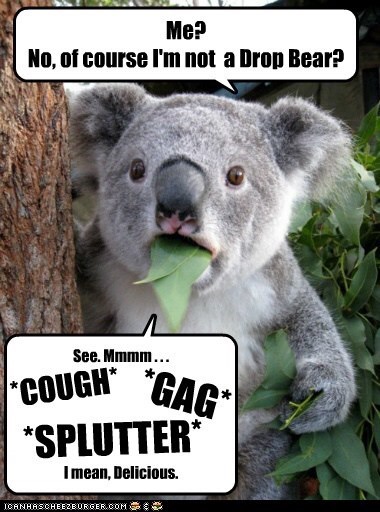
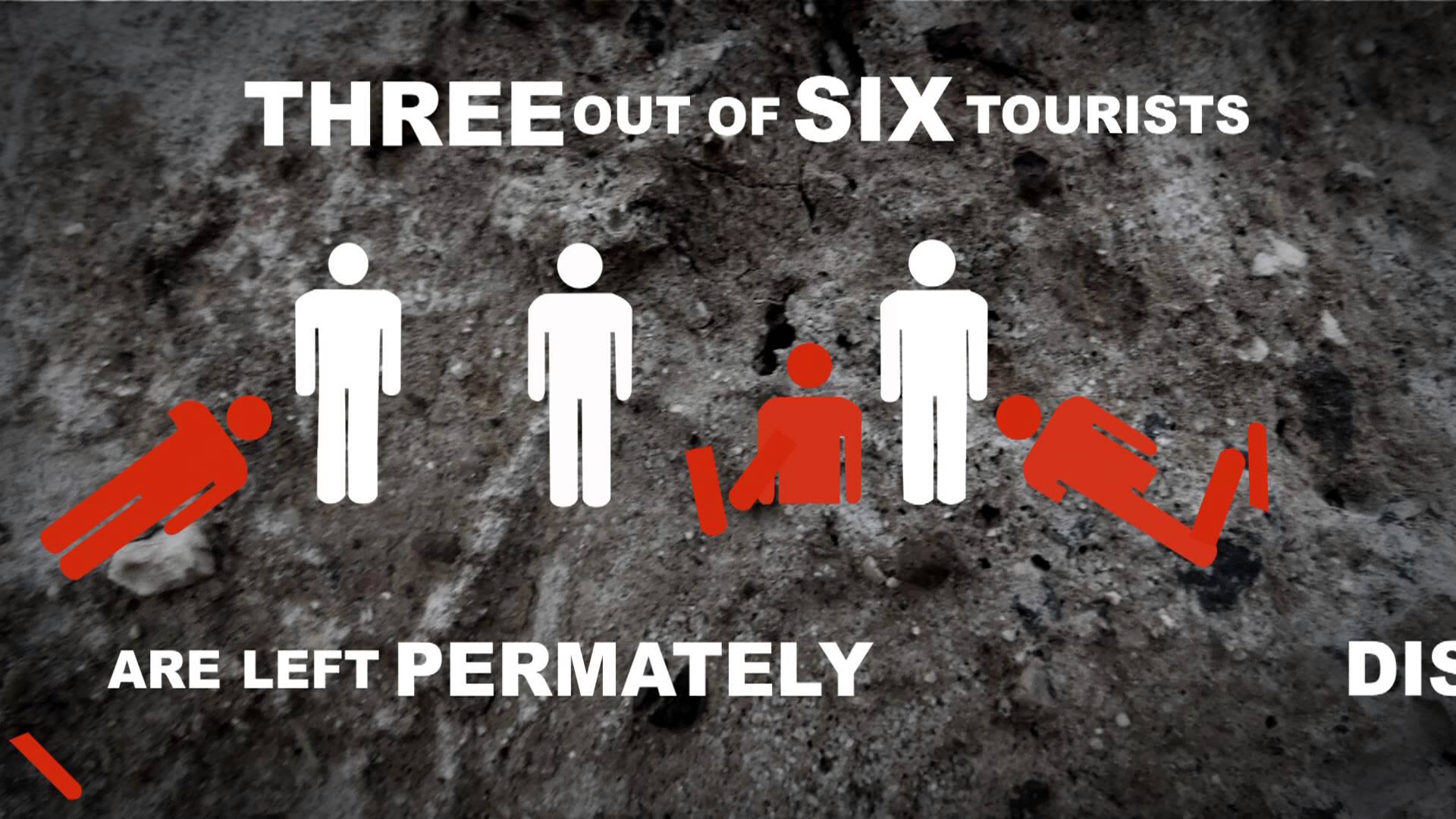
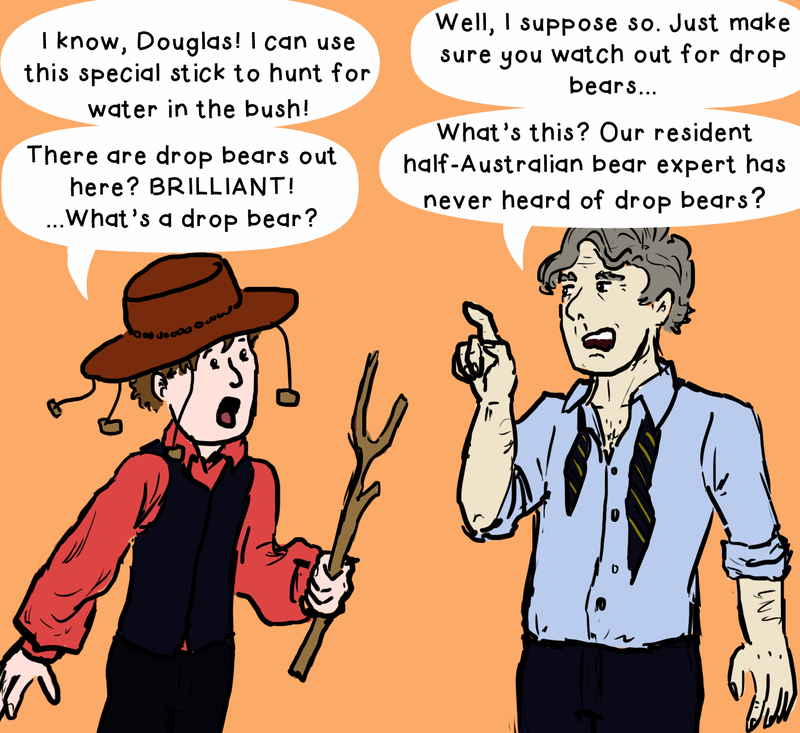
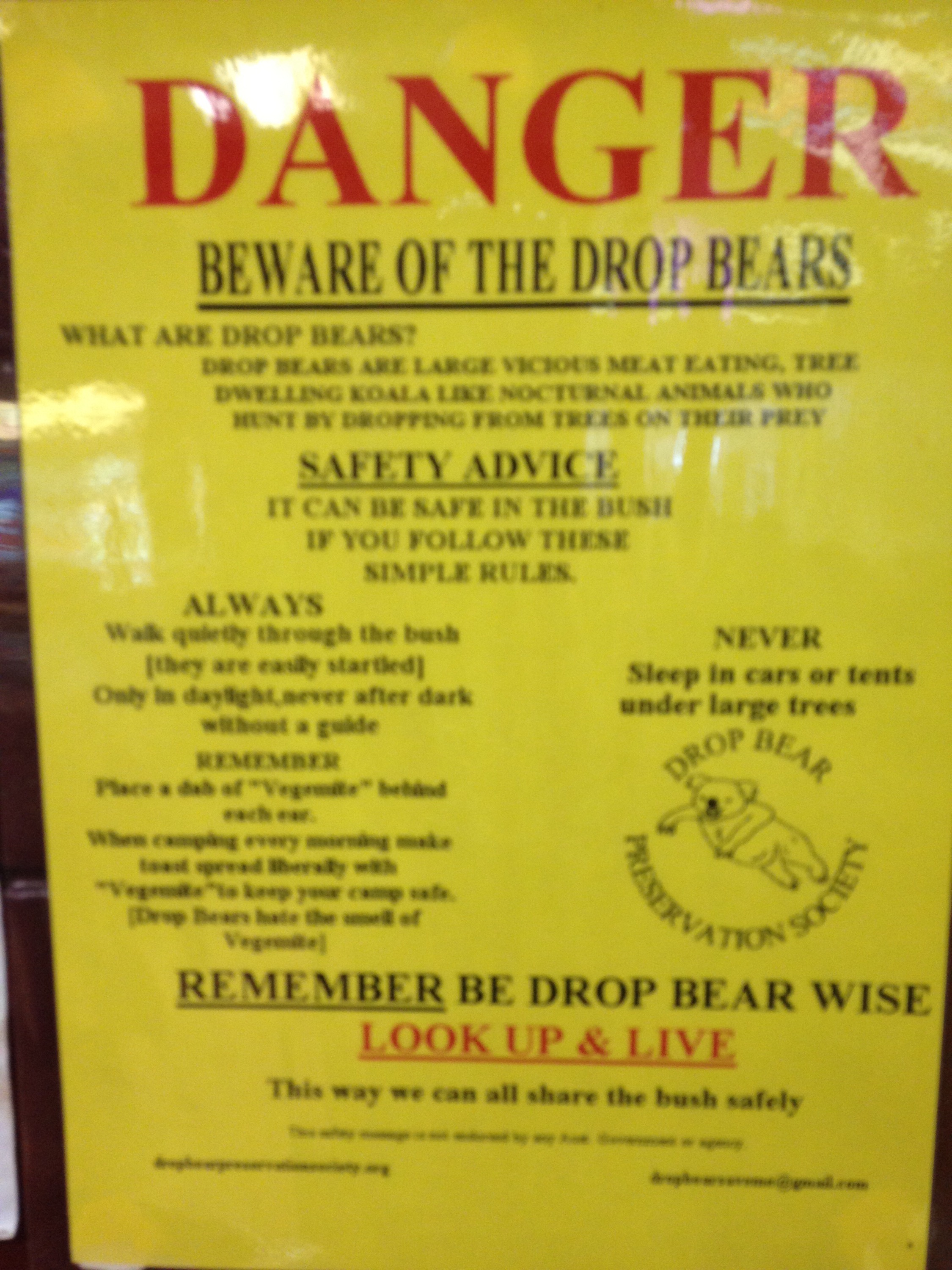
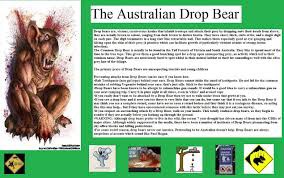
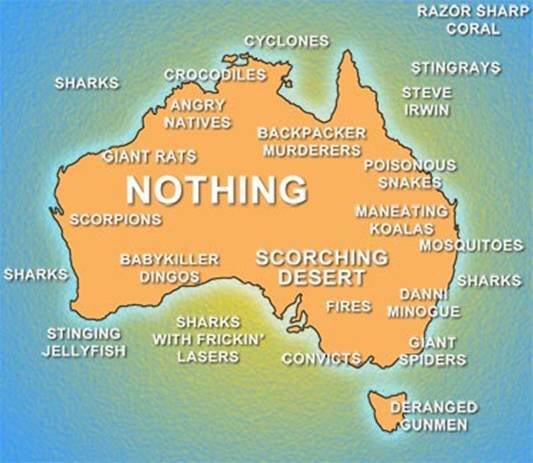
Australian Icons:The Ferocious Australian Drop Bear

phascolarctos malum or Thylarctos plummetus, depending on what area they are from.

According to Wikipedia (http://en.m.wikipedia.org/wiki/Drop_bear) “A dropbear or drop bear is a fictitious Australian marsupial.[1] Drop bears are commonly said to be unusually large, vicious, carnivorous marsupials related to koalas (although the koala is not a bear) that inhabit treetops and attack their prey by dropping onto their heads from above.[2][3] They are an example of local lore intended to frighten and confuse outsiders and amuse locals, similar to the jackalope, hoop snake, wild haggis or snipe.

Various methods suggested to deter drop bear attacks include placing forks in the hair, having Vegemite or toothpaste spread behind the ears or in the armpits, urinating on oneself, and only speaking English in an Australian accent.”

I have never really looked into the lore behind our local super marsupial…the drop bear. However, this morning – it being Australia Day here – I jokingly made a reference to them in a Facebook post, saying to be careful, as I had seen them heading into the bush with a slab (carton of beer). Then my writer instinct kicked in, and I wondered just how had this mythology around the drop bear started, and just how ingrained into our iconology had it become.

Us Aussies find the whole tourist scare “campaign” about drop bears hilarious. I have a friend – an Australian – who lives in NYC and has a lot of American friends. He gets great delight out of scaring them to death, relating stories about the dangers of drop bears if touristing here, backed up with comments from us over here. I tend to wonder about the gullibility of people.

The wonderful thing about the drop bear myth is how it has come to be backed up with some pretty credible research from believable organisations and publications. It would seem that everyone wants to be in on the joke. This from the Australian Museum:

http://australianmuseum.net.au/Drop-Bear

If ever there was an institution to give legitimacy to a subject, anything with the word “museum” in it would be right up there. Also, some “serious” research work from the “Australian Geographic”:

http://www.australiangeographic.com.au/news/2013/03/drop-bears-target-tourists,-study-says/

The research, done in a NSW drop bear Hot-Spot, has found that talking with an Australian accent helps keep them at bay.

Needless to say, spoof sights for drop bears have cropped up as well, and one has to wonder just how many overseas tourists have clicked on this link and booked a Drop Bear Adventure. Too funny.

http://www.dropbearadventures.com.au/drop-bear/

And this from Buzzfeed:

http://www.buzzfeed.com/cconnelly/10-terrifying-facts-about-the-australian-dropbear-s3x

There are also three apps to play games of Drop Bear.

Drop Bears are a great example not only of the often perverse Australian sense of humour, but is one of our endearing qualities…not taking ourselves too seriously, and liking to laugh at ourselves.

This link has someone even creating a history for them:

https://picsandstuff.wordpress.com/tag/drop-bear/

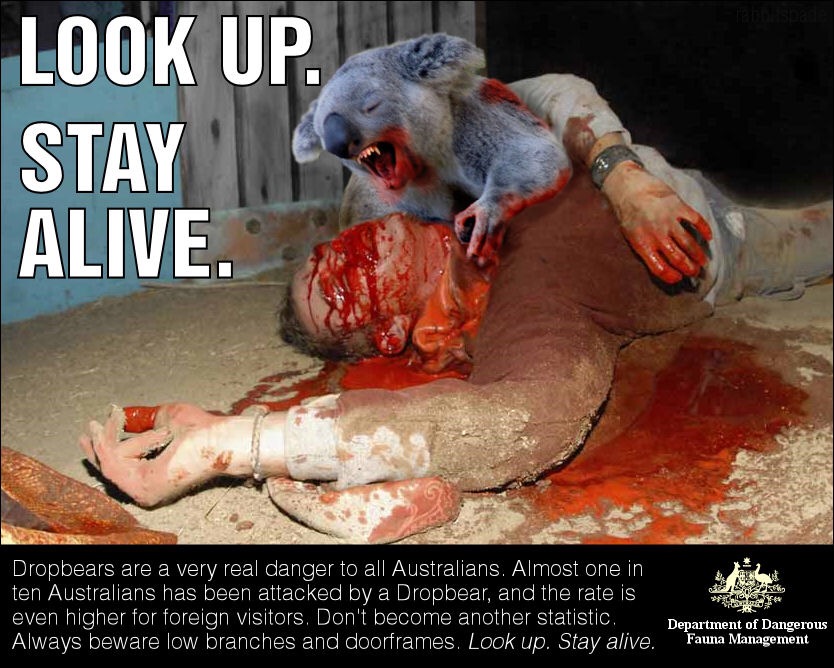
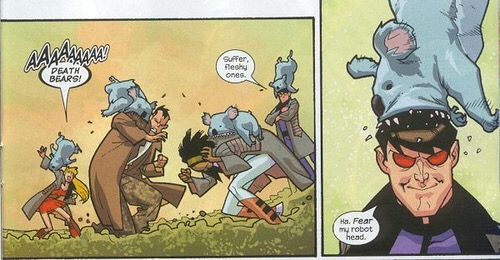
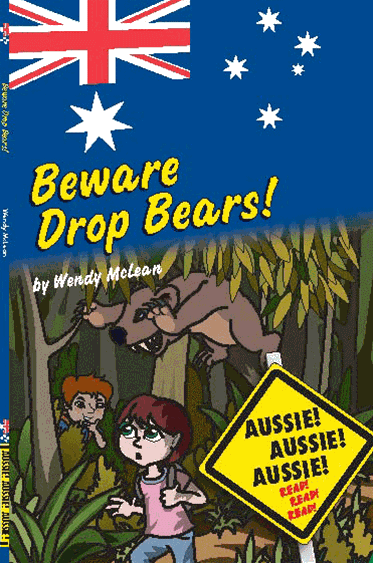
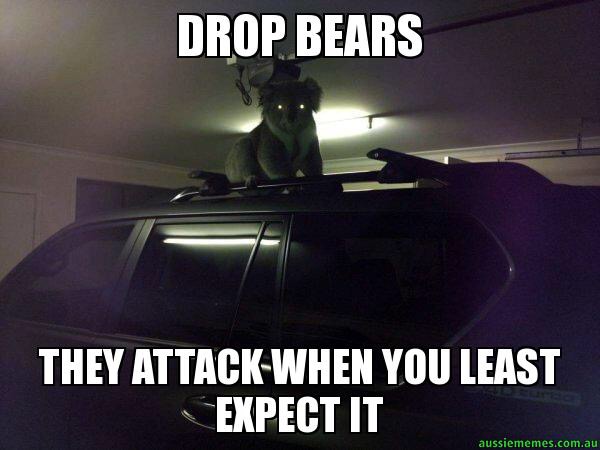
But perhaps more than anything is the proliferation of photos and graphics that depict drop bears. You can never say Australians don’t have a sense of humour!

2015/01/img_3136.jpg

2015/01/img_3134.jpg

2015/01/img_3135.jpg

2015/01/img_3138.png

2015/01/img_3139.jpg

2015/01/img_3140.jpg

2015/01/img_3141.jpg

2015/01/img_3142.jpg

2015/01/img_3143.jpg

2015/01/img_3145.jpg

2015/01/img_3144.jpg

2015/01/img_3147.jpg

2015/01/img_3146.gif

2015/01/img_3148.jpg

2015/01/img_3151.jpg

2015/01/img_3153.jpg

2015/01/img_3149.jpg

2015/01/img_3150.png

2015/01/img_3152.jpg

2015/01/img_3154.jpg

2015/01/img_3155.jpg

2015/01/img_3157.jpg

2015/01/img_3156.jpg

2015/01/img_3158.png

2015/01/img_3163.jpg

2015/01/img_3161.jpg

2015/01/img_3162.jpg

2015/01/img_3160.jpg

2015/01/img_3159.jpg

Tim Alderman
(C) 2015

Destroyed (or Almost) Icons: The Sad Life and Demise of a Majestic Cinema.

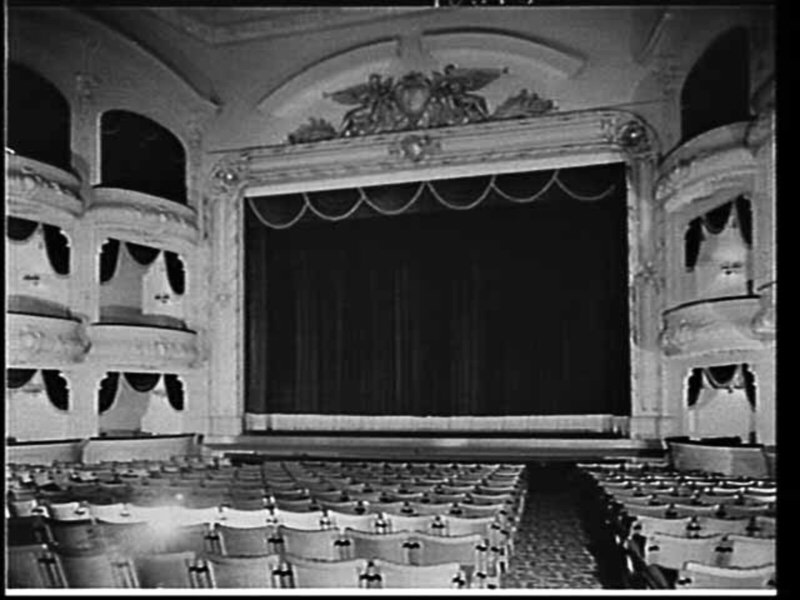
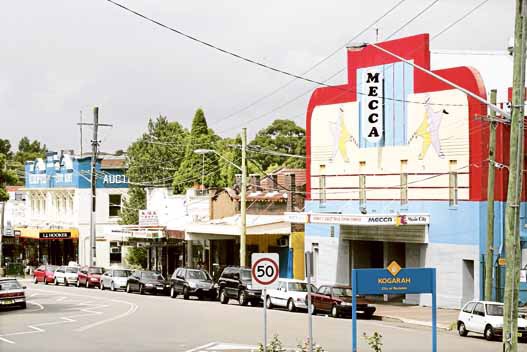
What a sad story on the life of what was a majestic cinema. The old Mecca cinema in Kogarah, New South Wales, which was affiliated to the Mecca cinema (originally The Savoy) in Hurstville, New South Wales.

I used to go the beautiful Savoy cinema in Hurstville, as I’m sure my cousins Donna and Jeffrey would have done, as they wereliving in Riverwood at the time. My father moved us to Ocean St in Kogarah – the ugly apartment building is still there on the corner – in 1966, and I went to the Mecca there to see movies. In fact, I had a dispute with the ticket-seller on one occasion, after the new decimal currency had been introduced, and some of the coinage…I can’t remember which – had a double value until the coins went out of circulation. As a business they took the coins at the lower value. As a consumer I took them at the higher, and by law they had to take the coins at the higher value. She was trying to tell me I didn’t have enough for the ticket, and I was arguing that my handful of mixed currency was enough -to the cent/penny. I won! Lol

http://pastlivesofthenearfuture.com/2014/09/29/mecca-theatreresidential-kogarah-nsw/
That the two cinemas ended up in the hands of a “cinema Paedophile – follow the links from the first story – is indeed disturbing, though in a way adds to the colourful history of the cinemas.
Originally The Savoy in Hurstville – which became The Mecca – shows the very sad demise of the Grand Dames of Art Deco cinemas as the advent of television put a temporary halt – or rather a slowing – on cinema audiences. This was the Savoy on its opening night in 1937…

http://pastlivesofthenearfuture.com/2014/07/29/opening-night-at-the-hurstville-savoy-1937/
And this, sadly, is what it became…

http://pastlivesofthenearfuture.com/2015/01/22/intencitytarget-hurstville-nsw/
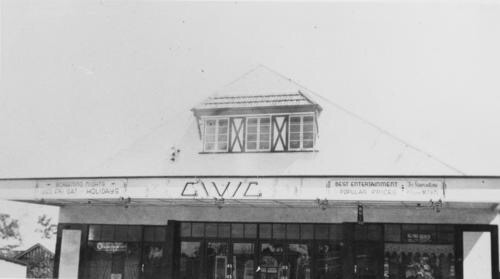
Just as an aside, right next to my home in Samford Rd, Gaythorne, there is a building that used to be a Civic cinema, but which is now a row of nearly all “For Lease” business premises. Another sad loss.

2015/01/img_3056.jpg

Tim Alderman (C) 2015

2015/01/img_3055.jpg

Daily (Or When The Mood Takes Me) Gripe : Let The Sydney Gay Ghetto Go!

Some people just can’t let the past go, or have an inability to see when something has passed it’s use-by date! I have too many friends who keep reiterating that they wish the Sydney gay ghetto was still intact and functioning.

Let’s have a look at the (unspoken) history behind the formation, growth and death of the gay ghetto in Sydney. Historically, Kings Cross and Darlinghurst have always been protective enclaves for the dispossessed, eccentric, minority groups and the unclassifiable citizens of Sydney. Perhaps, initially, because of its foundations in working class and poverty-stricken populations, and later on the underworld, gangsters and prostitution – including transgender – it has always had its roots in notoriety!

In the 70s and early 80s in Sydney, the gay citizens were looking for a space to band together, to avoid the illegalities of being homosexual, and the social stigmatisation that happened at that time as we became more brazen and outspoken about our sexuality. I remember visiting there with a female friend in the 70s – before my own coming out – and the roots of the community were there already with nightclubs and cafes, though homophobic attacks and vitriol were  prevalent as well. It was a wall-less ghetto in the making.

By the time the 80s rolled around, it was firmly established as a gay ghetto, ambling along Oxford St and its immediate environs, from Elizabeth St through to Paddington. The legalising of gay rights in 1982 brought around a boom in the area. The ghetto formed very much as a means for us to squeeze out the undesirables by a sheer force of numbers…and it worked. Any straight troublemaker coming onto our turf would have immediately felt threatened, and though violent attacks did occur, they were rare.

At its height, you could live within the ghetto and never move outside it. We had our nightclubs, pubs, cafes, restaurants, newspapers, magazines, bookstores, supermarkets, small businesses, doctors, dentists, optometrists, saunas, post office, houses, apartment buildings. A night out would involve a meal in a local cafe or restaurant, a visit to your pub of choice – about 9 in its heyday – then off to your nightclub of choice. In the early hours of the morning you could either stagger home via your favourite takeaway, or do a trip to your favourite sauna or backroom without ever being harassed. The ghetto was a security blanket.

During the HIV/AIDS epidemic of the 80s and 90s, it was a true blessing. Once again, you could live as a HIV person within the ghetto and be safe and protected. Within the boundaries of the ghetto were established our hospital and hospice care, our HIV/AIDS specialists and GP practices, our support groups such as ACON (AIDS Council of NSW), BGF (Bobby Goldsmith Foundation), CSN (Community support Network), ANKALI (emotional support), and the Positive Living Centres, as well as our advocacy groups such as PLWHA (People Living With HIV/AIDS), NAPWA (National Association of People with AIDS), our funeral directors, our church. We did our own fund-raising, and we supported each other through our pain and sorrow. Once again, it was a safety zone where the emaciated frames of those luving with AIDS could wonder without fear of derogatory remarks, hatred and harassment. In that zone we mourned, held our wakes, and looked for material and emotional support. Those religious groups such as the Festival of Light, who preached and promoted hatred towards us learnt the hard way about the strength and communication within the ghetto.

Fred Nile’s Cleansing March in the80s was a good example. Thinking his band of supporters would march unchallenged up Oxford St, he and they were in for a rude shock! From early in the morning on the day of the march, protestors, the gay community and its supporters started lining the length of the march. By the time the Rev Fred – with his cross-on-wheels – started marching up there, the footpaths, awnings and buildings along the route were packed to capacity with his detractors! The march, from his prospective, was an overwhelming humiliation, and failure! I remember seeing a car full of Tiwi Islanders who had evidently not been warned about how unpopular their beloved reverend was. They looked terrified for their very lives, overwhelmed as they were by the booing and vitriol of the massed ghettoites. I actually felt sorry for them!

However, in the midst of all this, other changes were taking place that were to instigate the downfall of the gay ghetto. Anti-discrimination laws came into play and all-male/female venues became – temporarily – illegal. Nightclubs like the Midnight Shift had to start letting women in, and once they started bringing their boyfriends and other straight male friends, the ambience of the clubs changed forever! And not in a good way! Many ghettoites who had been in the centre of the HIV/AIDS bonfire scattered to other states or to the far north of NSW. Indeed, by the time highly effective HIV antiretroviral regimes started in 1996, it was very much a decimated community, though the epidemic itself had moved on to the straight community, to drug-users and those that had the double-whammy of HIV and hepatitis. The myth of the “gay plague” was laid to rest for good!

But perhaps the greatest enemies of the ghetto was generational changes, social acceptance, and a movement away from the boundaries of the ghetto, a realisation the we no longer needed the safety and protection of the ghetto to live our lives. We dispersed to Newtown, Enmore, Erskinville, Camperdown, Leichhardt, Annandale, Alexandria, Pyrmont, Zetland, Moore Park, Surry Hills, Redfern and Summer Hill. We transformed areas into “Trendy” and moved away, in our hordes, from Oxford St. Yet, some pieces of our lives remained there – a few pubs and nightclubs, a few medical practices, but all-in-all, we moved on.

Darlinghurst and much of Paddington are now mere shadows of their former selves. A stroll down Oxford St now will reveal dozens of empty businesses, and those that do remain struggle for customers during the day. The nightclubs and pubs are now the enclaves of straight people, and a general feeling of desolation, violence, uncomfortable vibes, and unrest permeates the air. It is now, once again, a place where unsolicited violence can occur irrespective of your sexuality.

So the ghetto has outlived its usefulness, and is, to all intended purposes, dead! I can understand nostalgia, even fleeting yearnings. What I don’t get is an inability to accept the ravages of time, the changing dynamics of an area, the growth and development of populations, indeed diaspora! To those who wear blinkers, want the past to live on, the “good old days” to be a mantra for days gone by, I say…let it go! Enjoy the memories, but don’t wish for them to return. To deny yourself the insights of living in the “now” is to root yourself in a past that can never be repeated. Allow the ghetto to be swallowed by history, to takes its place in our memories as somewhere that we lived and enjoyed IN ITS TIME…and leave it there! Never let your yearning for the past, cause you to overlook the reality of now.

Tim Alderman
(C) 2015

/home/wpcom/public_html/wp-content/blogs.dir/9c0/31345085/files/2015/01/img_2169.jpg

An Outsiders Overview of the HIV “Industry”

This year marks, for me, 33 years of living with HIV/AIDS…though now it is just HIV. I consider it a landmark, as back in 1996 I was admitted to Prince Henry hospital with chronic CMV retinitis, chronic candida, chronic anaemia, wasting syndrome (48 kg and going down), 10 CD 4 cells, and no immune system, and was not supposed to leave…at least not under my own steam. I did, thanks to advances in medications at that time, very aggressive treatment and a lot of will power. I don’t give a fuck how negative many HIV+ guys are about life with HIV. For me, this was the great singular event of my life, a pivotal point that resulted in life-altering decisions, a mental overhaul, and the knowledge that there was a hell of a lot more to life than HIV. It altered the course of my life, and for better or worse I have never looked back.

I was a speaker for the Positive Speakers Bureau for 12 years before realising that when you continually tell a story you start doing it by rote. The time came to opt out before it becomes totally meaningless. I have also written for “Talkabout” magazine (the flag ship publication of Positive Life NSW – formally PLWHA NSW Inc) for 15 years, as a features writer and a columnist. I also spent many years on the Publications Working Group. As a writer I see my role as not only to inform people, but to provoke debate, at times to be opinionated, to raise questions, to address abuses and unfairness and to be, when required, controversial. Unfortunately, my time with “Talkabout” taught me that to get published in a HIV publication you need to walk the safe road. To be controversial is to be tolling your own death knell. Mind you, this censorship has nothing to do with the editors who, in my experience, have been nothing but supportive. Community Health and a certain AIDS council provide funding to the magazine, so to poke your nose into sensitive areas will ensure your censure and non-publication.

As a HIV+ person writing about HIV issues I have always found my hands tied. I have written two extremely controversial articles on HIV Issues over the years. One, on Options Employment Services using HIV clients as a free work force in the guise of “work experience” was so watered down after threats of suing PLWHA, the editor and myself (I truly wish they had) that by the time of publication was a mere shadow of its original fiery tirade…despite the fact that I had evidence of this going on.The manager even took me aside and “suggested” that I quieten down my opinions as they were providing a service to the HIV community. Shortly after, they went broke and disappeared. The second article was amongst the best pieces I have ever written, and covered the controversial area of bug-chasing (HIV- guys who deliberately have unprotected sex with HIV+ guys in the hope of contracting HIV). The magazines working group deemed that by writing about bug-chasing I may have been promoting it amongst a certain sector of the community. Considering that the practice is well documented, is acknowledged and exists I failed to see how being informative about it was in any way promoting it…oh shit! I forgot that community health and certain HIV organisations wanted to keep their heads buried in the sand about the issue…and they held the purse-strings. Censorship is alive and well within the HIV community and always has been. Want to tell the truth about what is going on or want to expose something? Not on their watch!

But despite this I continue to write, though I keep it to the more nondescript these days. I do enjoy being published! Since moving to Brisbane I have been phasing out my writing for “Talkabout” (which after 15 years of being published in pretty well every issue, has gone unacknowledged by the organisation itself, though not by the editors), and have started writing for QPP “Alive”, the magazine of Queensland Positive People. Same story, different place as far as funding goes, I’m afraid. Nothing controversial will be coming out of here either.
33 years ago at the start of the HIV shit fight, people never questioned anything about treatments, definitions, philosophies, or courses-of-action. We were in crisis mode and anything was better than nothing. We let a lot happen that in more sane times, in more accountable times, would never have been allowed to happen. This far down the line it is time to start asking questions, time to demand investigations and redefinition into many aspects of treatment, time to look back at some of the historical record and say “we were wrong”, and set the record straight. I no longer allow my doctor, or the HIV establishment, or the drug companies to dictate my path to health for me. I follow my own path, which is dictated to by knowledge and experience. 11 years ago I made a decision to halve my daily medications, and dose myself once a day only. Considering the negative impacts of huge amounts of HIV medication on the body I decided to take a risk. Well, this far down the line my health has never been better (though diet and exercise also contribute to that), my viral load has remained at undetectable, and not only has my CD4 count remained stable, it has in fact risen considerably. In fact, on my blood tests all other readings – except CD4/CD8 – are within range. Considering the recent emphasis on drug regime “compliance”, and considering my own circumstances, I am forced to ask – controversially, naturally – if the compliance issue is being driven by HIV specialists, or by the drug companies who stand to make a fortune out of HIV drugs. I will leave that question in the air for you to mull over and answer for yourself. This is a personal opinion, and one I am entitled to.

With the release of the brilliant “Dallas Buyers Club” the truth about AZT is finally out there. Pressured by my doctor to go on it in the latter part of the 80s, it is the one decision of my HIV care that I regret. I had read the report from the “Concorde” study in France, I knew it was described as “Human Ratsac”, yet I still finally gave in, and witnessed the immediate decline of my health as it bashed my immune system into submission. Needless to say, the long-term affects are disabling, and were not worth the risk. I still hear those who work in the HIV “Industry” – as indeed it was and still is – banging on about how it kept the wolf from the door – it didn’t! It poisoned and destroyed our immune systems, and left us vulnerable to opportunistic infection! It effectively killed many of us. As a drug to assist with maintaining CD4 counts it was a total and complete failure! And I am not the only one to say so! Ask any one who survived AIDS their opinion on AZT! Minor control of HIV did not start AZT situation. How the FDA in America handled the AZT situation and allowed wed the drug companies to dictate treatment options, block other drugs put out by rival companies, and chose to ignore or acknowledge research from overseas was a disgrace.

Even now in 2014 ignorance lives on. I continually hear, read and see HIV being described as AIDS! It is NOT AIDS – it Is HIV or HIV+! For fuck sake get your facts right! HIV is a viral infection, and AIDS are as the initials infer – Acquired IMMUNE Deficiency Syndrome! They are infections contracted by a breakdown of the immune system! The two do not necessarily go hand in hand, and you can have one without having the other. People undergoing aggressive cancer treatments which knock the immune system around are left vulnerable to the same infections triggered by AIDS in the plague years. Drug addicts also.

There are – and I am not being unkind nor ungrateful – those who have worked in the HIV Industry for too long. They are burnt out, and out of touch. If you only wander in HIV circles, you will only know that singular perspective. These people are indoctrinated, lacking in vision, and single-minded in their approaches to HIV and its management. They are blinkered, and only ever spiel forth statistics and the same information that we have heard for the last 30-odd years. They seem incapable of acknowledging different perspectives, new ideas, or revisiting and re-evaluating the old philosophies and education. Without an insurgence of new blood, HIV is in danger of stagnating and just at a dead end. Their current publicity of “Ending HIV” is a fantasy, and they know it. As long as HIV is in Africa, and in countries like Russia and China where education is almost non-existent or played down, HIV will never end. Empty words to seem to appear to be doing something, is just a waste of money. The HIV Industry seems to be very good at this. Always about 2-years behind actual need – just look at the employment needs of AIDS survivors in 1997/98 – when services were introduced they were way off course. You can only have so many programs that teach you how to write a resume, or attend an employment interview. Every single return-to-work session I went to do talks at had the same people in them. They just moved from one group to another, never putting the teaching into action. Where was the advice for people who wanted to be re-educated, or start a business, or upgrade a hobby,or buy into a franchise? It was non-existent. These people were the ones who fell through the cracks for lack of support and services. This has always been an ongoing problem. Naturally, the lack of funding is always blamed – though enough money to pay huge salaries – when really it is a lack of foresight, and imagination. Of course, everything is now wrapped up under the umbrella of Community Health, so any hope of imaginative thinking is now out the window. Those who hold the purse-strings control everything. It is a sad state of affairs. Groups like “Positive Life” no longer acknowledge their roots, nor do they move in the directions set down by the original founders. They are out of touch with their memberships, are indeed losing them. In the race to save money they are dropping resources that keep everyone active within the group. Even Positive Speakers Bureau inductees are now told what to talk about, and bang on about the same old messages and sprout the same old statistics. The trouble is…no one gets sick any more, so there is nothing to talk about for an hour. Perhaps it has outlived its use.

If one has to be totally frank, service delivery, information and services are no better now than they were 20 years ago! In many cases, they are worse. One friend of mine complains of the lack if easy access to HIV meds, and he has to spend a lot of time travelling to obtain them. He also comments on how he and his partner feel isolated and-reclusive due to no social groups to mingle with, and the constant heed to continually go through your medical record every time you change providers. Pretty sad state of affairs considering he only lives in Canberra.

Being my 33rd anniversary of life with HIV, and with World AIDS Day approaching I have written a personal retrospective of that period hopefully for publication around that time. It is 2,500 words long…not a lot of words for 33 years. If you are interested, follow the link. Not quite as controversial as this!

Getting On With It! A 33-Year Retrospective of Life with HIV/AIDS

For information on the Concorde Trial – http://aidsinfo.nih.gov/news/5/concorde-trial
Tim Alderman
(C) 2014

IMG_0682.JPG

Walking In Time

Like most people, I take the city I live in for granted. Having always lived in and around Sydney, I don’t really give much thought to what makes it the city it is, what endears me so much to it, what creates this strange love affair with bricks, concrete, glass and steel.

I have always had a pretty good knowledge of the history of Sydney, and have walked much of its historic paths, and many lesser known alleys over the years. I travelled, at least for a while, over the Harbour Bridge on an almost daily basis. I have walked the pathways of the bridge many times, and have traversed it also in trains, and as a vague recollection, in trams. The bridge pylon has long been a favourite haunt as a place to escape the madding crowd – at least on weekdays – and as a place to meditate the beauty of my city, and be constantly in awe of the majesty of its harbour. The recently started climb up the actual span has added another dimension to it again, and a view of the harbour and city that is so beautiful it makes you weep. In my many journeys across it over the years, how often I wondered why I could not climb that arch! That dream is now available to all.

It is only as I have grown older that I have really started to get into the feeling of walking through time as I move about the city. Many others before me have walked streets that I walk, they are named after those who used them as far back as the first settlement. Suburbs are named the same way, as are homes, parks, bays, beaches, hills and mountains. Tongue-twisting Aboriginal names confuse many a tourist, and the buggerisation of their language is evident in many spellings of place names around the city. They have become not just names, but a patchwork of living history. I now go to Balmain knowing that at one time, the whole suburb was sold for five shillings. I know that Millers Point is just not a name, but an activity that occurred there, and that Brickfield Hill is named for the same reason. The Rocks is so because of rocks, Rushcutters Bay because they cut rushes there, Cockle Bay was renowned for its cockles and Double Bay because it is – yes – two bays.

The very trees and gardens in the Eastern suburbs hold history. Rocks bare graffiti from 1788. Archeology is all around, at places such as the dig at Suzannah Place in The Rocks, and more recently at Walsh Bay, and when the Conservatorium of Music was being restored (the old Government House stables). We no longer cringe at the suggestion of being from convict stock. There are many like me, whose families came out as free settlers in the mid-eighteen hundreds, who would beg, borrow or steal to have a convict history. It is only now that books are revealing the true facts of our past, the real people who were on the first fleet, the true conditions they endured to become the first white inhabitants of this land. This is a truth we no longer shrink from, but accept as part of our cultural colour. It is a shame we cannot be as proud of our treatment of indigenous cultures.

Up until I read John Birminghams ‘Leviathan’, I had always thought that John Macarthur died back in England. I had no concept of the hard time he had given his wife, nor that he died being declared insane. I had no knowledge of the back biting and factioning that went on between Governors, settlers and the Rum Corp, nor of the workings of the Unemployed Workers Movement of more recent history. I would not have known that free-settlers built homes in the highest areas of The Rocks, and that those living below them were engulfed by the sewerage running down the hills. Digging trenches around the lower homes did little to alleviate the problem – the sewerage just overflowed the trenches, and proceeded to boil and fester in the heat.
That I would never have been taught any of this at school does not surprise me. Growing up in the fifties and sixties in Sydney was a lot different to growing up here in the nineties and beyond. ‘Going to Town’ is no longer the event it used to be, where parents and children were dressed in their Sunday best, as though making a pilgrimage to the centre of their culture. My parents could not have imagined the squalor of the late nineteenth century, nor the depressions earlier in that time. Their parents lived on the legacy left to them from the depression of the twentieth century, and expected their children to carry the
same values forward. My apologies to them but they are wrong. I will not carry that guilt for them!

I love my city for having survived the warring factions, the depressions, the plagues, the demolitions, and the cultural and architectural history destroyed by a string of uncaring governments. I love her crowded streets, her bastard mix of architecture, and crooked, crazy alleys and lanes. Yes, she has grown as an old whore, but oh, a whore with so much class.

I was unbelievably impressed by the Olympic site at Homebush, and how much it was a measure of how far we have come. We have taken a toxic dumping ground and rejuvenated it into a suburban paradise. Twenty years ago, nobody would have given a damn about the Green and Gold Frog becoming extinct, let alone contemplating creating a space for it to thrive in. We now think about the spaces we are creating. No more just throwing up buildings as though there was no tomorrow – well, perhaps east Circular Quay is an exception to that rule. I see history being restored, and put to modern use. I trust we have got over the facadism of the eighties, and now choose to preserve buildings in their entirety, breathing into them a new life which they richly deserve.

Now when I walk up Palmer Street or Campbell Street in Darlinghurst, or drive down Old South Head ŷRoad, the names invoke a sense of history to me. They are not just boulevards, they are lives that have been lived, and continue to live as long as people care.

Tim Alderman
Copyright ©2014

IMG_9696.JPG

The Reverend Alfred Pickles

The Rev Alfred Pickles
I have been researching my family tree for over 15 years now. In the early days it wasn’t so easy, and I probably had the sum total of about 10 names. The advent of the Internet has changed all that, and I now have four large arch files of information, including one entire file dedicated to one family member – more on him in a later post. I have gone as far back as the late 1500’s in Fylingdales and Robin Hood’s Bay in Yorkshire (the further you go back, the more difficult it gets), and can pretty well trace the family right down the male line to now, with a recent start being made on tracing the maternal lines back from my mother, and my Great Great Great Grandmother. A surprising find, in a site of graveyard inscriptions, were the names of not only my long searched for Great Great Great Grandmother (Clara Pickhills nee Rickinson), but also her husband (Joseph Pickhills), one son (Seth Pickhills) and daughter (Priscilla Pickhills). This was a great find as it connected me further back than my Great Great Grandfather (Rickinson Pickhills) and filled in a few blanks. I had to use a research company to find details, as the trace is difficult if you live in Australia. Clara’s son Seth Pickhills had one son – Alfred – who is important for two reasons (he is my first cousin three times removed). Firstly that he took off down his family line using Pickles instead of Pickhills – and I guess we will never know why. For a while in Rochdale (Lancashire) he lived with his aunt (Priscilla) and she was a Pickhills. Secondly, and the very last thing I would ever have expected to find in my family, after a stint at being a watchmaker he became a Baptist Minister in Rochdale. And here I was thinking that we had always been Catholics! I don’t know when religious affiliations changed, but I suspect it was after the families arrival in Australia, and probably after some Irish heritage had been added by way of the lineages of the Fanning’s and the McConnell’s. With Catholic’s being unable to marry outside the faith, potential spouses of other religions would have had to convert. Thankfully, my family never cared one way or the other, and despite being christened a Congregational, I am now a devout Atheist.

Anyway, this much we do know about Alfred. He was born in the rapidly growing West Riding textile town of Bradford, Yorkshire, in 1843. The son of Seth Pickhills and Jane Bracher, we know little of their actual lives except that they were working class. Seth was a journeyman printer (journeymen, after serving their apprenticeship, were able to move amongst employers), and according to the 1851 census the family were living in Belgrave Place in Bradford, and 8-year-old Alfred was a scholar. Moving on 10 years to the 1861 census, we know that he was 18-years-old, and living with his aunt, Priscilla (Seth’s sister) at 46 Belgrave Place, Bradford, and that he is listed as being a watchmaker. Seth had died in 1859, and it would appear that his sister had taken over the running of the household, though we are unsure of what had happened to Jane. His next mention in the records is in the 1871 census, and both he and Priscilla had moved to 95 Mitchell St in Rochdale, and he was listed as being a Baptist Minister.

We know from his memoir printed in “Memoirs of Ministers and Missionaries who died between 15th January 1917 and 31st October 1919” that he was involved with the Baptist church from a young age, and he became a member of Westgate Church in Rochdale under the pastorate of Henry Dowson, whose teachings had a lifelong influence on him.

On the 19th August, 1864 the following article appeared in the “Bradford Observer” regarding his ordination; “Ordination of a Bradford gentleman at Rochdale – On Tuesday, Mr A. Pickles, son of the late Mr. Seth Pickles, of Belgrave Place, Bradford, was ordained pastor of the Lyceum Baptist Church, Rochdale. A prayer meeting was held in the morning, the ordination followed in the afternoon, when a sermon eas preached. In the evening there was a tea meeting in the Milton Congregational School, presided over by the Rev. A. Pickles. Amongst those who were present at the ceremony were the Rev. E. Parker, Farsley; Rev. J. Smith, Bacup; Rev. H. Dowson, President of the Baptist Theological Institute, Bury; Rev. J. Home, Waterbarn; Rev. L. Nuttal, Ogden; Rev. J. Williams, Oldham; Rev. J. Bloomfield, Bradford; Rev. J. Wilkinson;  Rev. A. Pitt; Rev. A. C. McCoffin; Rev. A. H. Drysdale, and several friends from Bradford. The Rev. A. Pickles was formerly a scholar at the Bradford Grammar School, and afterwards pursued his studies at Bury College under the Rev. H. Dowson.”

In 1874 he married Margaret Elizabeth Shepherd, who was born in Waterbarn, Lancashire in 1844. The couple had two children whilst living in Rochdale – George (1876) and Henry Shepherd (1878). Initially, Alfred’s ministry consisted mainly of cottage and outdoor meetings. He became one of the earliest students of the Baptist Theological Institute, which at the time was newly established at Chamber Hall in Bury, and under the presidency of Henry Dowson. In 1866 the Institute moved from Bury to Manchester and became the Manchester Baptist College, founded on strict Baptist communion lines. The College was to become a founding member of the Theological Faculty of Manchester University. Alfred’s name was the first on the roll of minister’s trained at the college. His pastoral work began in 1870 at the Lyceum in Rochdale, and soon afterwards at the church purchased in Water Street, Rochdale.

Manchester College
This was to become the Water Street Ebenezer Baptist Chapel. During the pastorate of Alfred the congregation grew and prospered. On the evening of February 10, 1878 the Reverend gave a long lecture to his congregation entitled “Turkey, Russia, England and the Jews” which was published in booklet form shortly after. He was also secretary of the local branch of “The Liberation Society”.

The society had been formed by Edward Miall (8 May 1809 – 30 April, 1881) who was a Portsmouth-born journalist, apostle of disestablishment and a Liberal politician. He was also a Congregational minister at Ware, Hertfordshire (1831) and Leicester (1834), and in 1841 founded ”The Nonconformist”, a weekly newspaper in which he advocated the cause of disestablishment.
Miall saw that if the programme of Nonconformity was to be carried through it must have more effective representation in Parliament.
One of the first fruits of his work was the entrance of a John Bright into parliamentary life; and by 1852 forty Dissenters were members of the House of Commons.
This was due largely to the efforts of the British Anti-State-Church Association, which Miall was instrumental in founding in 1844. It was renamed in 1853 as the Society for the Liberation of Religion from State Patronage and Control, known for short as the “Liberation Society”. The Society was never able to secure a parliamentary majority for the disestablishment of the Church of England, but the long fight for the abolition of Compulsory Church Rates was finally successful in 1868. In 1870 Miall was prominent in the discussions aroused by the Education Bill. He was at this time Parliamentary member for Bradford (Yorkshire) from 1860-1874, having previously sat for Rochdale (where Alfred would undoubtedly have encountered him in person) in 1852-1857. In 1874 he retired from public life, and received from his admirers a gift of 10,000 guineas. He died in 1881 at Sevenoaks in Kent
.

After ten prosperous years at Water Street Chapel, throat problems forced Alfred to accept a call to Towcester, in Northamptonshire, which was more rural and had a milder climate. He officially became pastor after a three month trial period. However, it would seem that this move to the North End Baptist Chapel was to have its own trials and tribulations. The chapel at Towcester was opened on 3 October, 1853. There appears to be little interaction with other churches in the area, though the Towcester Baptist Church does record that after re-forming in 1871, it received a letter from the North End Chapel to “renew contacts severed with the old church, as the basis for fellowship was now seen to be biblically established”. What was often referred to as “the Baptist Church”, almost as though it were a separate denomination, later came to be known as the South End Church, though there appears to be no desire to unite the two churches on the part of North End. Most of what we know of Alfred’s pastorate is from the Church Book. The Church Book was used to record baptisms, reception of people previously baptized by the laying on of hands, expulsions, and rebukes of a serious nature. Under the previous pastorate of Samuel Cooper Tite, the book had not been filled out prior to the 1880’s, and he had in fact taken the book with him when he left the church. He returned the Church Book to Alfred in 1886, after his return to the Baptist church. There was a fairly small congregation, possibly due to it being a sect of the Baptist church commonly referred to as Johnsonian Baptists. Founded by John Johnson (1706-1791) who was a Baptist Minister of High Calvinist views, he taught that faith was not a duty required of God, but a grace which it is impossible to convert into a duty. Want of faith, therefore, is no sin. He was repudiated by the local association for “bizarre ideas” , as he questioned whether the Incarnation would have been necessary if man had not sinned, he denied the doctrine of the Trinity, and was highly insular and exclusive. Johnsonian’s were not even allowed to associate with other Baptists, which would have explained the division between the two Baptist churches in Towcester. Other Johnsonian churches were founded in Blackburn, Norwich, Chesterfield, Halifax, Bromley, Duncote and Dublin.

In Towcester, for the 64 years leading up to Alfred’s appointment, about 80 people were associated with the church at one time or another. In 1886 there were 37 members, and Alfred baptized 20 in the 6 years since he became pastor. With the return of the Church Book, he started to record church meetings and one or two other “events”. There is a record of a visit from a person from a nearby congregation to communion “at the Lord’s Table October 2nd 1887 Mr Davidson a Member of the Church of Christ at Banbury requested and was allowed to commune. At the request of the Church he also preached in the evening from 1 Cor 15c 1 – 4 vs”. This is obviously an “Event” and reveals the small congregations isolation. The Churches income was about ₤20 per year, which appeared to cover their expenses. A welcome gift mentioned in the Church Book is of an amount of ₤100, which was on its way in five installments from the sale of a church in Comus Street, Liverpool.

In the meantime, Alfred and Margaret had another two children – Thomas Edward (1881) and Ruth (1884). The family first appear in Towcester in the 1881 census, living in High Street. Alfred and Margaret are listed along with George who is 5-years-old; Henry who is three; infant Pickles (Thomas, and just born); a Maude Clegwidden who is 12-years-old and occupation given as nurse maid (at 12?) born in London, Middlesex; and a Margaret Taylor, 68-years-old and a visitor. Alfred appears to have left his position as pastor of North End Chapel in 1891. The church may have been too small to warrant a pastor at that point, as thirteen members passed the following resolution at a Church Meeting towards the end of 1891 “that in harmony with the suggestion of the Trustees, we request Mr Fidler to preside at our Church Meetings and to advise and assist so that the Services at North End & Duncote Chapels may be maintained in as orderly and efficient manner as possible. Signed by Alfred Pickles. Pastor.” William Fidler accepted the invitation. By July 1893 there was obvious concern about the viability of the Church. Many of the church members had been elderly and had died. The Sunday School had just 11 pupils. A church meeting was held with 8 people present which decided to try to carry on for another few months. “There appeared no disposition to unite with the South End Church. Still the prospects of continuing as at present were doubtful. Mr Garlick was specially anxious that they should try to revive the work by prayer and united effort”. Early in 1894, after the services had been held in the vestry for all winter to save money, the church was officially closed on March 25. There were 16 members listed, 4 of which were discovered to have died. The contents were distributed between the Duncote Chapel, and Towcester Baptist. Church (South End Chapel). Obviously they weren’t too proud to take a donation from a church with opposing views to theirs.

In the 1891 census, Alfred and Margaret are listed as living at 19 The Drapery, Northampton. George is now 15 and an apprentice; Henry is 13 and a school boy; Thomas is 10 and a school boy; and Ruth, the new addition since the last census, is 7 and listed as a “school boy”. Margaret Lyack, 66-years-old, is living with them as a boarder living on her own means. 19 The Drapery (a store) is still there, and currently occupied by Oxfam. I think Alfred would like that.

For the following 6 years, after the official closure of North End Chapel, Alfred travelled from Northampton back to Towcester every Sunday in order to break the bread of life for the Towcester Church, this being done for no renumeration.

Another interesting item that came out of the 1891 census is that Alfred’s occupation is listed as a “Hatter & Hosier” at 19 The Drapery, and he is also listed as a Hatter in two directories of Northampton for that period. However, I am led to the thinking that this was the year they moved to London, possibly in the latter half of that year.. A notice appeared in the “Edinburgh Gazette” dated August 4, 1891 whereby in a listing taken from the “London Gazette” he was listed as bankrupt whilst living in Northampton. We know that at the time of the first meeting and first examination regarding his bankruptcy that he was residing at 160 Regents Park Rd, London, though he returned to Northampton for these meetings. He was still at the Regent’s Park Road address in 1893, when the Public Trustee Alfred Lister Blow was acting on his behalf. It is open to suggestion as to why he declared himself bankrupt. One reason may be that he used all his available cash trying to keep the North End Chapel viable. Another reason might be that with the church being so poor, and with him having to resign his position as pastor (and receiving no pension or renumeration) that there was just no money left for him and his family to survive on until he either obtained work, or started his own business. Who knows! I have tried researching the prevalence of bankruptcy in the 19th century with little success. Alfred is the second family member to have declared bankrupcy. He also started work for the Baptist Tract and Book Society, where he worked for some years. still preaching whenever and wherever he was needed. By the time the 1901 census rolled around, he was residing at 10 Oppidans Road in Hampstead. He is listed as a “Tay Dealer” which I can find nothing about, and suspect it is a deciphering error. Margaret is still listed, as are George (now 25, single and a clerk); Henry (now 23, single and a printer); Ruth (now 17, single and a shop assistant); and Thomas (now 20, single and a printer). They still have a boarder, now an Edward Gounersall, a 24-year-old single electrical engineer. By now Alfred’s eyesight was failing, and The Memoir notes that for several years before his death he was quite blind, and bore it with great patience. It would appear that he did continue to work, possibly as a hatter and hosier seller (perhaps Ruth was a shop assistant in his store), as well as continuing an occasional ministry for as long as his failing eyesight allowed.

Margaret died in 1911, and I think this would have devastated him, as he had described her as “a true help in all his labours”. At the time of the 1911 census he is living at 23 Ainger Road, St Pancras in London. He is listed as a Baptist Minister Retired. Thomas Edward is still with him at 30, and it would seem still single and now a Painter Machine Manager. Ruth is also still listed as being with him at 27, and it would seem that she also is still single and now a costumier.

Alfred died in his sleep (according to The Memoir, which can tend to prettify things) on the 20 February 1920, aged 72, at Hendon. He left behind a family who cherished his memory. “He was a man of faith and prayer, and faithful to the principle, even when fidelity meant loss. His one passion was to preach the gospel and he has now gone to hear his Lord’s “well done” and receive the reward of many soul’s for his hire”. It would appear from The Memoir that he was a very committed and devout man.

Although research continues into this side of the family, it would appear that only two of Alfred’s children married. The 1911 census lists at 10 Oppidans Road in Primrose Hill in London a George Pickles. He is now 35, in the Motor Accessory Trade, and head of the household. His wife is Mary Ellen Pickles who is 39, and born in Co Kildare, Ireland (a resident of Clonkeeran). They have been married for 8 years, though no children mentioned. Thomas Edward appears in the 1917 register of marriages for St Savior in Hampstead. He is 35 and marrying a Mary Turner who is 29. There is a listing for Thomas E Pickles Death in 1965 in Greater London, though if this is indeed Thomas Edward is yet to be verified. He was 84 at the time of his death. There is a death registration for Ruth Pickles, aged 81, at Sidcup in Kent. Again, this needs to be verified.

Further to the Water Street Ebenezer Baptist Chapel in Rochdale. The Water Street Chapel was demolished in 1915, and the demolition was witnessed by a parishioner by the name of “Owd Dob “who was inspired to write an account of his personal memories of the chapel in a short treatise entitled “Th’ Owd Chapel”, for private circulation. It is difficult to read as it is written in the Lancashire dialect, though with perseverance an interesting account of the chapel (including a mention of the pastorate of Alfred Pickles at the beginning) unfolds, and includes a picture of the Church, its banner, a sketch of its interior, and photographs of pastors, the choir and the woman’s class – all looking very “Baptist” in their 19th century severity.

This biography has been put together using information gleaned from census records, Alfred’s memorium in The Memoir, and various newspaper reports from the time. Some suppositions have had to be made, and I hope that some of my conjectures at least are correct. It has been an interesting exercise cobbling someones life together from whatever information is still available. At this time I am still waiting to hear from Northamptonshire Archives of any information they may have on file for Alfred. NB: they never got back to me. There is a payment request for searches on their web site, but I am nit willing to pay money to find they either have nothing, or I already have what they hold. A request to know if they have any information on Alfred before I pay has been ignored. This is the first archive in England to be unhelpful with an information request.

I would personally like to thank Emily Burgoyne from Regent’s Park College Library at the University of Oxford for abridging the “Memoirs of Ministers Who Died Between 15th January 1915 and 31st October 1919” and sending it to me (the Memoir itself is the only copy and is in to fragile a state to scan. It was compiled by the Baptist Union after they decided to stop printing the Baptist Union Handbook during the First World War, as paper was scarce, and printing expensive), along with scanning in his lecture “Turkey, Russia, England and the Jews”. It has all been an invaluable aid in helping to trace my long-lost cousin.

Tim Alderman (formerly Robert John Pickhills)

Note: Ebenezer Baptist Chapel, Water Street (pp 139-140)

This church was formed of members formerly in connection with the West-street Church, and met at first for divine worship in Baillie-street, on the 8th of January, 1867; it continued there up to the time of its removal to the chapel in Water-street. The last mentioned place was built in 1834, by the New Connexion Methodists, and was purchased from them by the Baptists, and re-opened for divine service on the 1st of May, 1870. [a little more]