From archaic toilet paper to moats made of feces, using the bathroom in the Middle Ages was no picnic.
For those familiar with an outhouse, the medieval toilet is its massive stone-built predecessor. Relegated to the private alcoves of a fort, medieval toilets were nothing but openings that led into a latrine or castle moat below.
Designed mainly with function in mind, the medieval toilet was otherwise known as a garderobe or privy chamber and was often located on several floors of most castles and no bigger than the restroom of a modern-day coffee shop.
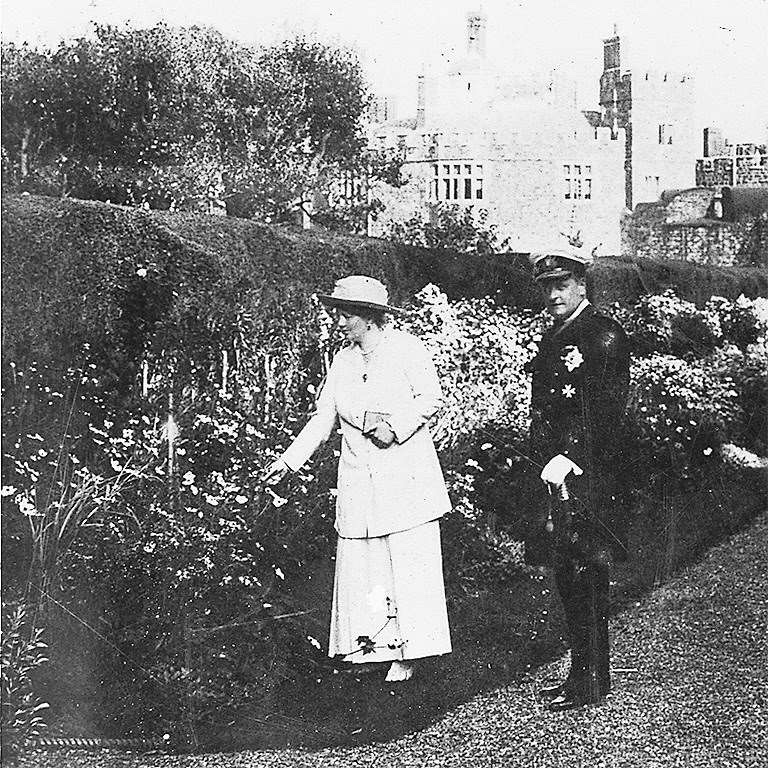
The exterior of a castle wall featuring a medieval toilet (left), and and an illustration of how the toilet emptied into the moat below (right).
The medieval toilet was a product of its time, before the advent of indoor plumbing refined the bathroom experience. How it came to be and meet its end, however, is worth a gander.
The History Of The Medieval Toilet
Despite the name, the Middle Ages were no mere intermediary between eras. This long and strenuous period in European history began with the fall of the Roman Empire in 467 A.D. and charged through the 14th-century Renaissance.
With the fall of the Roman Empire, Europe largely became feudal. Disbanded nations and a general scarcity of resources saw wealthy lords take power and war with one another from the lofty castles they built for themselves.
Most average people were just lucky to eat and survive, but this time saw some luxuries were created as well, including the medieval toilet.
An exterior view of the privy, or “garderobe,” at Peveril Castle in Derbyshire, England.
Building castles was a lofty endeavor and could take up to 10 years, not to mention constructing them was rather expensive. At the tail-end of the Middle Ages, King Edward I nearly bankrupted the crown’s treasuries by using 100,000 pounds on his Walsh fortifications, with toilets being a major design priority.
There were a couple of different designs for these commodes. The waste shafts of some medieval toilets ran down the exterior of a fort into moats or rivers, while others were designed with internal castle channels that funneled waste into a courtyard or cesspit.
Other privy chambers, meanwhile, protruded out from the castle wall. Openings hung above open-air, allowing gravity to do the rest. Usually, a wooden bench separated the stone-carved hole from a user’s rear.
Building toilets within the palace walls, however, wasn’t just for convenience. Indeed, they also served as a hindrance to potential enemies.
By building toilets with shafts that emptied into courtyards or cesspits around the palace, invaders could be kept relatively at bay.
However, these shafts had to be built high enough off the ground that enemies couldn’t sneak in through the hole in the privy chamber. This is exactly what happened in 1203, when King Richard I’s French palace, Château Gaillard, was sieged.
Keiss Castle in Scotland was resourcefully built atop a cliff, allowing for waste to fall directly into the ocean.
Ideally, of course, waste would simply fall into a river where no one had to deal with it, and so some castle toilets were built jutting out over a steep cliff.
Without that luxury, there had to be someone tending to the excrement, removing it, or making sure it was properly mixed with the surrounding moat. In Tudor England, this job was known as a gong farmer, and these unfortunate souls had to work only at night so others couldn’t be put off by their grisly job.
Though they were forced to live in isolated homes, they reportedly received decent pay per ton of excrement that they removed.
Why Garderobes Met Their End
A medieval toilet, or garderobe, was merely a hole that directed the user’s discharge into the moat below
The largest downside to the medieval toilet was the fact that there was almost no practical way to avoid the stench. It was unfortunately not always the case that medieval toilets were situated in privy chambers containing a window, in which case aromatization through herbs was relied on.
Some garderobes were also made without privacy, with no doors or dividers
Additionally, washing a medieval toilet was burdensome. Those unfortunate enough to be tasked with the duty threw buckets of water down the toilet shaft or rerouted rain from the gutters.
As for the waste being collected down below, local farmers would often amass this human fecal matter as fertilizer.
Meanwhile, medieval toilet paper consisted of a bunch of hay. This was rarely an issue when it came to clogging or cleanliness, though 12th-century monk Jocelin de Brakelond recounted that this once nearly caused a fire.
While it would take until the advent of indoor plumbing in the mid-1800s to standardize the marvelous innovation of toilets, the medieval toilet was certainly an ingenious — and necessary — step toward that historic invention.
The idea was to show the royal family in their day-to-day lives. The results were mixed.
A well-groomed, staid British family sit around the breakfast table. Two young adult children and their middle-aged parents are dressed formally, without a hair out of place. In a high-pitched voice, the mother tells a funny story about her great-great grandmother, while everyone listens with their backs remarkably straight.
But this is no ordinary English family. The storyteller is Queen Elizabeth II, and the subject of her tale is Queen Victoria. The scene was one part of a 105-minute color documentary named simply, “Royal Family,” that was broadcast across England on June 21, 1969.
The concept behind the documentary was to soften and modernize the royal image. But members of the royal family, including the Queen, were reportedly dubious about the idea from the start. After its premiere, Buckingham Palace greatly limited the film’s circulation, at least in its entire form.
Lord Mountbatten’s Son-in-Law Suggests TV Special
Queen Elizabeth II and Prince Philip fly back from a visit to Yorkshire in an Andover of the Queen’s Flight, in a photo taken during the filming of the documentary ‘Royal Family.’ Bettmann Archive/Getty Images
It was Lord Brabourne, the son-in-law of the royal cousin Lord Mountbatten, who suggested using the medium of television to provide the Queen’s subjects a sense of her personality. By the 1960s, the times were rapidly changing, and the shy, dutiful Queen and her young family were seen as increasingly irrelevant. A TV special, Brabourne suggested, could also introduce British subjects to 21-year-old Prince Charles, ahead of his investiture as Prince of Wales.
At the urging of Palace press officer William Heseltine, who was convinced that offering a humanized view of the royal family would strengthen the monarchy, Prince Philip agreed. The Queen cautiously gave her consent, while other family members were decidedly not on board.
“I never liked the idea of ‘Royal Family,’ I thought it was a rotten idea,” Princess Anne later recalled, according to an account in the 2015 book, Queen Elizabeth II and the Royal Family. “The attention which had been brought upon one ever since one was a child, you just didn’t need any more.”
But the Mountbatten camp won the day and filming began in 1968. Richard Cawston, the chief of the BBC Documentary unit, was put in charge of shooting the royals at work and play. For months, he shot 43 hours of unscripted material at Buckingham Palace, Windsor Castle, on the royal yacht, the royal train, and even at the Queen’s beloved Balmoral Castle in Scotland.
Understandably, the royal family had a difficult time adjusting to the presence of the crew in their personal space. Peter Conradi writes in his 2012 book, Great Survivors: How Monarchy Made it into the Twenty-First Century, that during a film day at Balmoral, Philip snapped at the crew, “Get away from the Queen with your bloody cameras!”
Endearing—And Controversial—Scenes
Christmas at Windsor Castle is shown here with Queen Elizabeth II and Prince Philip putting finishing touches to their Christmas tree, in a photo made during the filming of the documentary. Bettmann Archive/Getty Images
While the documentary was meant to show the human side of the monarchy, its narration carried an official tone. The voice-over, read by English actor and broadcaster Michael Flanders, ruminated on the importance of the Crown to the country in florid terms like, “Monarchy does not lie in the power it gives to the sovereign, but in the power it denies to anyone else.”
The finished documentary claimed to show a year in the life of the royal family. Queen Elizabeth was featured tirelessly working and making small talk with world leaders like U.S. President Richard Nixon. During his state visit, she asked him, “World problems are so complex, aren’t they, now?” To which Nixon replied, “I was thinking how really much more complex they are than when we last met in 1957.”
There were also sweet scenes, like one where the Queen takes her youngest son, Edward, to a candy store, paying for his treats herself even though the monarch is technically never supposed to carry money.
The royal family’s genuine sportiness was also highlighted—Prince Charles was shown waterskiing and fishing, Prince Philip flew an airplane and the Queen drove her own car surprisingly fast.
But there were also strained moments, according to detractors. At one point Prince Philip describes an instance when King George VI the Queen Mother’s late husband, took out his rage with a pruning knife on a rhododendron bush, screaming curse words while hacking it to bits. “He had very odd habits,” Philip deadpanned. “’Sometimes I thought he was mad.”
Then there was when Queen Elizabeth jokes: “How do you keep a regally straight face when a footman tells you: “‘Your Majesty, your next audience is with a gorilla?… It was an official visitor, but he looked just like a gorilla.”
Millions Tuned in for 1969 Premiere
Cawston let Philip see a rough cut of the documentary before showing it to the Queen. “We were all a little bit nervous of showing it to the Queen because we had no idea what she would make of it,” the film’s editor Michael Bradsell told the Smithsonian channel in a 2017 special. “She was a little critical of the film in the sense she thought it was too long, but Dick Cawston, the director, persuaded her that two hours was not a minute too long.”
Princess Margaret is shown with her two children, Viscount Linley and Lady Sarah Armstrong-Jones at Windsor Castle, during filming of the documentary. Bettmann Archive/Getty Images
The public was, in fact, intrigued—more than 30 million viewers in Britain alone viewed the premiere. It was said that during an intermission, toilets flushed all over London, causing a water shortage.
Less than a month later, on July 1, Prince Charles was invested at Caernarvon Castle in a carefully filmed spectacle organized by the photographer Lord Snowdon, Princess Margaret’s soon to be ex-husband.
This double-whammy of royal TV was seen by some as a rousing success. “It redefined the nation’s view of the Queen,” Paul Moorhouse, former curator of the National Portrait Gallery, told Daily Telegraph in 2011. “The audience were amazed to be able to hear the Queen speaking spontaneously, and to see her in a domestic setting.”
Lifting the Veil on the Royal Family
The royal family at Windsor, (from left) Prince Edward, the Duke of Edinburgh, Queen Elizabeth II , Princess Anne, Prince Charles and Prince Andrew. Fox Photos/Getty Images
But to many, the royal family had opened Pandora’s box, lifting the veil and making them easy targets for criticism and intrusive paparazzi activity.
“They were criticized for being stuffy, and not letting anybody know what they were doing, and my brother-in-law helped do up a film, and now people say, ‘Ah, of course, the rot set in when the film was made,’”royal cousin Lady Pamela Hicks and daughter of Lord Mountbatten told an interviewer. “You can’t do right; it’s catch-22.”
“Royal Family” was shown only once more in full, in 1977. And in 2011, Buckingham Palace gave the National Portrait Gallery a 90-second clip of the breakfast scene during the Diamond Jubilee celebration. The palace allowed a few more brief clips to be included in the 2011 documentary “The Dukeat 90.”
If you venture down Redcross Way, a quiet backstreet in SE1 running parallel to the busy Borough High Street, you’ll undoubtedly come across a large vacant plot of land. This is Cross Bones Graveyard, an unconsecrated memorial to the thousands of prostitutes who lived, worked and died in this once lawless corner of London.
This is, at least, how it started out in the late medieval period. During this time, the local prostitutes were known as “Winchester Geese”. These prostitutes were not licensed by the City of London or Surrey authorities, but by the Bishop of Winchester who owned the surrounding lands, hence their namesake. The earliest known reference to the Graveyard was by John Stow in his Survey of London in 1598:
“I have heard ancient men of good credit report, that these single women were forbidden the rights of the Church, so long as they continued that sinful life, and were excluded from Christian burial, if they were not reconciled before their death. And therefore there was a plot of ground, called the single woman’s churchyard, appointed for them, far from the parish church.” Over time, Cross Brones Graveyard started to accommodate other members of society who were also denied a Christian burial, including paupers and criminals. With Southwark’s long and sordid past as “the pleasure-garden of London”, with legalised bear-baiting, bull fighting and theatres, the graveyard filled up extremely quickly.
By the early 1850’s the graveyard was at bursting point, with one commentator writing that it was “completely overcharged with dead”. Due to health and safety concerns the graveyard was abandoned, and subsequent redevelopment plans (including one to turn it into a fairground!) were all fought off by local residents.In 1992, the Museum of London carried out an excavation on Cross Bones Graveyard, in collaboration with the ongoing construction of the Jubilee Line Extension. Out of the 148 graves they excavated, all dating from between 1800 to 1853, they found 66.2% of the bodies in the graveyard were aged 5 years or younger indicating a very high infant mortality rate (although the sampling strategy used may have overindexed this age group). It was also reported that the graveyard was extremely overcrowded, with bodies piled one on top of each other. In terms of the causes for death, these included common diseases of the time including smallpox, scurvy, rickets and tuberculosis.
John of Gaddesden, an English doctor writing in the early 14th century, had some advice for women on how to protect themselves against venereal disease. Immediately after sex with any suspect man, he said, the woman should jump up and down, run backwards down the stairs and inhale some pepper to make herself sneeze. Next, she should tickle her vagina with a feather dipped in vinegar to flush infected sperm out of her body, then wash her genitals thoroughly in a concoction of roses and herbs boiled in vinegar. (45) It’s hard to imagine anyone actually following this advice – let alone one of the girls in Southwark’s stews. It would have puzzled the customer she’d just serviced for one thing, and running backwards downstairs sounds an excellent way to break your neck. Other doctors writing at about the same time as Gaddesden had equally eccentric remedies of their own, but at least everyone now recognised that diseases such as gonorrhoea were spread by sexual intercourse and that in itself was a big step forward. (46) In 1321, King Edward II founded the Lock Hospital in Southwark as a treatment centre for “lepers”, the name then used for anyone with an eruption of sores. It was located at what’s now the junction of Tabard Street and Great Dover Street, less than a mile from the stews of Bankside and this proximity meant it soon started to specialise in VD cases. “Lock Hospital” can still be found in slang dictionaries today as a generic term for any VD clinic. The filthy state of Southwark in those days ensured other disease was quick to spread there too. The Borough’s streets were still unpaved and there were no sewers. Residents who were out and about relieved their bladder (and bowels) in any quiet alleyway, while stay-at-homes emptied their brimming chamber pots at the nearest window. Once again, the informal street names coined by the locals give us a clue to what their lives were like. The area’s sex trade gave it place names like Codpiece Lane, Cuckold Court and Sluts’ Hole, while the sheer amount of filth in its streets christened Dirty Lane, Foul Lane and Pissing Lane. (47, 48) All this made Southwark an ideal breeding ground for the bubonic plague which hit London in 1348. “Historians estimate that the Black Death killed half the population of 14th century England,” Stephen Smith says in his 2004 book Underground London. “If anything, the devastation in London was even worse. The transmission of the disease was encouraged by the narrow, busy and filthy streets, crowded houses and noisome sanitary conditions. The toll among Londoners has been variously put at between 50,000 and 100,000.” (4) A year into the plague, Edward III urged London’s borough authorities to combat the infection by cleaning up their streets, but was told all the street cleaners were already dead. The more people died, the fewer were left to dispose of their remains and the faster the plague spread. “London burial grounds were soon full to overflowing and new ones were hastily dug,” Smith says. “The biggest was in Southwark, where some 200 corpses were interred every day.” One of these new grounds, opened just across the river from Southwark in East Smithfield, managed to stuff 2,400 bodies into its small plot by placing them five deep in long trenches rather than using individual graves. Measures like this were the only way to get each new wave of corpses buried before the next consignment arrived. One man who lived through the plague said the stews had been busier than ever in those years
Older bodies were dug up again with indecent despatch to make more space in the ground. All over London, disinterred bones were thrown into the graveyard’s charnel house. This was either a vault beneath the church itself or a small building on the grounds, where “clean” bones – those from which all the flesh had rotted away – could be consigned. In calmer times, these bones would be treated with great reverence, perhaps even prayed over by the priest, but when the pressure on graveyards hit these heights, speed was all that mattered. (49) “Burial arrangements could break down during epidemics,” writes Reading University’s Professor Ralph Houlbrooke. “The Black Death compelled urban communities in particular to find new burial space quickly.” There’s no evidence that Cross Bones itself was used for burials this early, but it may well have been a later outbreak of plague in London which forced St Saviour’s parish to requisition the site. (50) In 1349, Edward III suspended Parliament to let MPs escape London for the relative safety of the British countryside. Anyone else rich enough to flee the capital got out too. Southwark’s brothels seem to have remained open throughout the plague years, however, despite official warnings that casual copulation with multiple partners increased the risk of infection. Henry Knighton, a 14th century historian who lived through the Black Death, says the stews were actually busier than ever during the plague years. Many Londoners adopted an attitude of fatalistic abandon, thinking it was all but certain they’d catch the plague anyway, so why not do so in the arms of their favourite Bankside whore? At least that guaranteed you a little pleasure before you died. In the spring of 1350, the death toll in London started to abate at last and Edward turned his attention to the anarchy that now prevailed in Southwark. Many of the Bishop’s officials had fled during the plague years, leaving the Bankside brothels and their surrounding taverns more lawless than ever. Anyone committing a crime inside the city walls knew they had only to get across London Bridge to claim sanctuary and the welcome they now found there was warmer than ever. “Those who have committed manslaughter, robberies and diverse other felonies are privily departing into the town of Southwark, where they cannot be attached by the ministers of the City and there are openly received, ” said the King in an address to London’s people. “And so, for default of due punishment [they] are emboldened to commit more such felonies.” If those felonies had been limited to Southwark alone, Edward might have found them easier to bear. By now, though, Southwark’s thugs had grown so bold that gangs of 200 or more youths would periodically burst over the bridge into London, rob the passers-by there, loot the shops and then dash back across the river to safety. Only London had the men and resources needed to restore law and order in Southwark, but no-one who lived there was willing to call them in if it meant surrendering their borough’s treasured independence. The result was an uneasy stand-off. As far as London itself was concerned, the authorities concentrated on preventing prostitution within the city walls and on ensuring that the girls working designated areas like Cock Lane wore the proper clothing. This takes us back to the 1161 rules’ requirement that whores must clearly identify themselves by wearing some agreed garment. In 1351, the City of London passed an ordinance saying “lewd or common women” must wear a striped hood to identify themselves as such and refrain from beautifying their clothes with any fur trim or fancy lining. Any woman not of noble birth could be described as “common” in that sense and this sloppy wording made the ordinance such a wide one that it seemed to cover almost every female in the city. London’s proud womenfolk weren’t going to have men dictating what they could wear, so most simply ignored the ordinance and challenged any constable to arrest them if he dared. When Edward III put his own authority behind this law three years later, he was careful to specify it applied only to London’s “common whores”. The striped hoods and lack of decorative trim, his proclamation declared, would “set a deformed mark on foulness to make it appear more odious”. Some working girls continued to live inside the city walls but commuted to Cock Lane or the Liberty to earn their daily crust – perhaps finding somewhere to change on the way. But wasn’t long before they were banned from even lodging in the city and subject to very heavy penalties for doing so. A 1383 ordinance required whores caught in London to have their heads shaved and then be carted through the streets in a special wagon while minstrels played all around them to attract a crowd. The girl herself would have to wear that trademark hood as the cart carried her through town to the nearest prison, where she’d be placed in a pillory and publicly whipped. “The ineffectuality of all this punishment is evident in the ordinances themselves, which provide for repeated offences and increased penalties,” Burford says. Offenders caught a second time, for example, would serve ten days in jail on top of all the other penalties, while a third offence got you ten days’ prison and permanent expulsion from London. A girl in this final category would be taken to one of the city gates, where she’d be roughly thrown outside. If the authorities had been able to trace her origins to Bankside – as was often the case – she’d be escorted back there and warned to stay put. In 1393, these rules were tightened once again, saying no prostitute must “go about or lodge” in London or its suburbs, but “keep themselves in the places thereto assigned, that is to say, the stews on the other side of the Thames and in Cock Lane”. Offenders could face all the penalties detailed above and have their identifying hood confiscated too. Replacing this garment would presumably have been an expensive business, but the girl would be unable to resume her trade till she’d done so. We know there were at least two murders in the stews at around this time, because both are mentioned in the Bishop of Winchester’s court rolls for 1378. One was carried out by William Chepington of Northamptonshire, who killed a Scarborough man called John Drenge at The Cardinal’s Hat, one of the biggest brothels on Bankside. In the same year, a Flemish man was hanged for another murder in the stews. (51) Dutch people – then known as Flemings – had first come to Southwark as mercenaries in William the Conqueror’s army, but their relationship with the surrounding English population was sometimes thorny. Many Flemings were talented entrepreneurs and the stews they ran on Bankside operated with an efficiency and cleanliness that put their homegrown competitors to shame. We can judge their popularity by the fact that so many English whores chose to work under the Dutch name Petronella to indicate they were both fashionable and expert in their craft. The Dutch whorehouses may have been popular with punters, but their success did not go down well with English competitors. When Wat Tyler’s tax rebels arrived in Southwark in June 1381, one of their first targets was The Rose, a Dutch-operated whorehouse owned by William Walworth, the Lord Mayor of London. Until then, Tyler’s men had attacked only formal symbols of the King’s authority, such as prisons and the Inns of Court, so you have to wonder if it was Southwark’s resentful English brothel-keepers who suggested they burn The Rose. “It’s likely that the rebels destroyed the brothel not from outraged morality, but from hostility to the foreigners, specifically the Flemish,” says Derek Brewer in his 1978 book Chaucer and his World. Having sacked these premises, which stood near London Bridge, the rioters then went on a day-long rampage, killing as many as 160 Flemish people as they moved west through the Liberty. No doubt, a good number of Southwark folk joined in the mayhem just for a chance to kill their Flemish competitors or to eliminate a rival business. (52)
“[They] beheaded without judgement or trial all the Flemings they found,” one contemporary report tells us. “Mounds of corpses were to be seen in the streets and various spots were littered with the headless bodies of the slain. In this way, they passed the entire day, bent only on the massacre of the Flemings.” (53) A few months later, all the whorehouses destroyed were back in business again and the poll tax Tyler had objected to was sending out its demands for the year. That year’s returns from Southwark show seven men listed as stewholders in the Borough, all with addresses in the Bishop’s Liberty. “They evidently represent the proprietors of the Bankside stewhouses,” says Martha Carlin in her 1996 book Medieval Southwark. “All were married men, with both male and female servants; none had children aged 15 or older living at home.” (54) The seven stewholding couples listed, together with the tax assessed as due from each pair, are: StewholdersJoint assessmentWalter Shirborn & wife Christian Six shillings & eightpenceRobert Power & wife Agnes Four shillingsYevan Wallchman & wife Isabella Four shillingsJohn David & wife Isabella Four shillings & eightpenceRobert [illegible] and wife Isabella Four shillings & sixpenceRichard Bailif & wife Margery Four shillings & sixpenceWilliam Brounes & wife Joan [Figure missing]
The average tax payable per individual householder in Southwark that year was just one shilling, against an average of over five shillings for the stewholding couples above. That means the stewholders were being taxed at two-and-a-half times the rate of their neighbours and presumably that their earnings were that much higher too. But how much of that money actually found its way to the girls themselves? Of the 137 unmarried woman identified in the Southwark return, Carlin’s found a dozen who she believes worked as prostitutes. These were not the girls who worked in the Bankside stews, who’d be lumped in as “servants” with the families above, but freelance whores operating from the precinct of St Thomas’s Hospital and therefore outside the Liberty’s rule. “These women probably were independent or ‘private’ prostitutes, working from lodgings rather than from public brothels,” Carlin writes. “Their residence within the hospital precinct presumably shielded them from any interference by the officers.” Even among this relatively privileged group, only three of the twelve women paid assessments above the Southwark-wide average of one shilling and seven paid well under that. Their average assessment was only ninepence halfpenny – just over third of what even the poorest stewholder paid – and the richest girl of them all paid just one shilling and fourpence. Once again, it’s reasonable to assume that a much lower tax bill means a much lower income too. Whoever else was getting rich from the Bankside stews, then, it sure wasn’t the girls who worked there. The eminent men who owned brothels like The Cardinal’s Hat, the Boar’s Head and the rebuilt Rose did very nicely from renting them out to stewholders, some of whom were able to start building family dynasties on the trade. These families certainly weren’t in their landlords’ class, either for income or status, but they still managed to rake in a great deal more income than most other businesses in Southwark could provide. The girls’ whose sheer bloody resilience kept the whole trade going had to make do with its scraps. (55) Prostitution in Southwark was still officially licensed only in the Liberty’s designated Bankside area, but the seven whorehouses there couldn’t hope to satisfy total demand. At some point in the 1380s, local businessmen made a concerted effort to establish a new red light district in Southwark’s St Olave’s Parish, which lies west along the river from Bankside. The site they chose was not in the Liberty, but part of a manor still owned by the King himself, so opening unsanctioned brothels there was a risky business. Many Southwark folk joined in the mayhem just for a chance to kill their competitors
The men who owned the five new St Olave whorehouses included John Mokkyng, shown in the 1381 tax return as one of Southwark’s richest men and Robert Power, the Bankside stewholder mentioned above, who now hoped to make his own step up into the landlord class. We know this, because both men are named in a 1390 petition from the people of Southwark complaining the St Olave stews had turned their neighbourhood into a war zone and urging King Richard II to shut them down. There had always been violence and disorder on Bankside too but, with neither the 1161 rules nor the Bishop’s enforcers to keep a lid on things, St Olave’s became a hellhole. “The petitioners charged that the place had become notorious, a breeder of quarrels and homicides and a resort of thieves, to the peril of local residents,” Carlin writes. (56) The petitioners added that the new brothels’ customers included not only married men – who were hardly a novelty on Bankside either – but also “all manner of persons of religion, namely monks, canons, friars, parsons, vicars, priests”. Married women and female servants, they said, were being kidnapped, imprisoned at St Olaves and forced to work as whores there. The alternative was a slit throat. The King responded by demanding that all the landlords and stewholders responsible for the five new brothels appear before him and his court at Westminster on July 4, 1390. One of the landlords, John Brenchesle, who seems to have run his own St Olave stew personally, was sent to the Tower of London, as was John Osteler, his servant. Four others, all of whom were either stewholder tenant-managers or their staff, went to the Fleet Prison for ten days. (57) Efforts to police the stews at Southwark continued as the 15th Century got underway and it’s this period which gives us our earliest surviving records of real cases passing through the Liberty’s courts. Many of these involved the sort of minor offences which keep an English magistrates’ court busy today, like breaching the licensing laws, public drunkenness or fighting in the street. Other charges were far more serious, such as forcing a girl into whoredom against her will or officials developing selective blindness whenever a bribe was offered. The Bishop’s court convened every four to six weeks and kept its records on parchments called pipe rolls. Eight examples from the 15th Century have survived – all from the period 1446 to 1459 – and these show a steady tightening of the screw against corruption. By 1455, constables and bailiffs caught eating or drinking with the whores they policed faced a massive fine of £2.
Meanwhile, at the national level, three successive Kings – Henry IV, V and VI – each passed their own ordinances aimed at cleaning up the stews. First up to bat was Henry IV, who extended the Lord Mayor of London’s powers in 1406. For the first time, the City of London’s own police could now arrest criminals in Southwark – an area previously beyond their jurisdiction – and drag them back across the river to Newgate for trial. All this achieved was to stoke the good folk of Southwark’s customary resentment at interference from London. Any City constable brave enough to try and exercise his new powers in the Borough risked sparking a full-scale riot, as we can see from an incident that followed just a few years later. This involved a Frenchman who murdered a Southwark widow in her own bed, then fled to St George Martyr’s church in Borough High Street to claim sanctuary. London’s authorities agreed not to arrest him on the condition that he leave England immediately and sent a constable to St George’s to escort him down to the south coast and make sure he caught the next boat out. But the outraged women of Southwark had other ideas. When the constable and his deputies came out of the church with their prisoner, they found a huge crowd waiting. “The women of that same parish where he had done the cursed deed came out with stones and canal dung,” one contemporary report tells us. “And they made an end of him in the High Street, notwithstanding the constable and the other men too. There was a great company of them and they had no mercy, no pity.” With the streets full of people like that, you can see why a lone constable might think twice before deciding to throw his weight about in Southwark. The new law was quietly shelved as a result. (58) Henry V followed up with his own ordinance in 1417. He began by directing the Lord Mayor’s attention to “the many grievances and abominations, damages and disturbances, murders and larcenies” carried out by “lewd men and women of evil life” in the Bankside stews. Quite what the Mayor was supposed to do about it Henry didn’t say – beyond a peremptory command to sort it out. The King’s own contribution was to ban London’s City aldermen and other respectable citizens from letting out any building they owned to tenants “charged or indicted of an evil and vicious life”. This was clearly aimed at the many churchmen, noblemen, City officials and wealthy merchants who happily rented out their property to known stewholders. There were only so many houses to be had in the Bankside’s licensed area, so anyone lucky enough to own a building there could command premium rents if he let it be turned into a brothel. Outside the licensed area – in Borough High Street, say – landlords could argue they were accepting more risk by taking an illegal stewholder on and insist the rent must be set higher to reflect this. Few other businesses in Southwark pulled in enough cash to match the rent stewholders could offer. All this added up to a powerful financial incentive for landlords to accept stewholders as their tenants and that’s what the King’s ordinance was up against. It must have been simple enough to arrange your affairs to circumvent the new law – perhaps by renting your building out through a middleman – and like Henry IV’s measures before it, the ban had little effect in practice.Bankside jurors happily took cash to deliver whatever verdict the local gangsters required
It was Parliament’s turn to step in next and it decided to concentrate on a different problem. By the time Henry VI came to the throne in 1422, the Bankside stews were at the peak of their profitability and the money flooding in allowed many stewholders to buy themselves freehold property elsewhere in Southwark. Some used these additional properties to open inns or taverns which doubled as illegal brothels in Borough High Street, but that was only the beginning of the trouble their new riches brought. In order to serve on a 15th Century jury, you had to be a property-owner, which was taken as evidence you had a stake in society and so could be trusted to treat your responsibilities in court seriously. This gave the newly propertied stewholders a whole new opportunity for corruption. By hiring out their services to the highest bidder, stewholders on the jury could deliver whatever verdict their paymasters required. The stews at this time were dominated by a handful of powerful families, creating a network of useful connections which every stewholder could draw on when he needed to fix a court case. The Gardiners, for example, were involved in running three of the Bankside’s 18 brothels: The Lion, The Hart’s Horn and The Boar’s Head. John Sandes’ name is found linked to both The Castle and The Unicorn, while jobbing managers like John Gray and Robert à Murray moved regularly from one establishment to the next. “The Gardiner family is so prominent that the conclusion is inevitable that they were a gang of brothleers, as also the brothers David and Robert à Murray,” Burford writes. “All seem to have been people of some substance and some of them seem to have been elected constables on occasion.” Most the time, bent jurors were engaged to ensure a guilty man walked free, but sometimes it worked the other way round. Among the examples Carlin quotes is that of Henry Saunder, who had been taken to the Bishop’s court by a stewholder called Thomas Dyconson. Saunder asked that his case be transferred to the higher court of Chancery because the Bishop’s jury he faced was packed with stewholders who were determined to falsely condemn him. Another petitioner, Agnes Johnson, complained that she’d been falsely accused in the Bishop’s court. Her accuser, she said, was both rich and the court bailiff’s brother-in-law, which meant no juror would dare cross him and so ensured she’d never get a fair trail. A third prisoner dragged before the court described the jurors there as “bawds and watermen, the which regard neither God nor their conscience”. Only with these people in your corner, he complained, was there any hope of victory. Parliament’s answer to this was to pass a 1433 law barring Southwark stewholders from serving on juries or accepting any other official post in the Borough. Three years later, MPs heard an urgent petition from a group of Southwark citizens complaining that illegal brothels were still operating along the length of Borough High Street. “Many women have been ravished and brought to evil living,” the petition said. “Neighbours and strangers are oft-time robbed and murdered.” Parliament responded by declaring once again that stewhouses must be restricted to the licensed area provided – but gave no clue as to how this might be achieved. In 1460, Henry VI set up a commission of 20 respectable citizens from both Southwark and London to consider the Borough problem. Violence and thieving in Southwark had now reached such heights that its own people looked ready to accept some help from London at last. For their own part, the City authorities realised that shovelling wrongdoers across the river and hoping the Bishop’s courts could keep order there was no answer at all. Once, the fear of damnation had been enough to dampen some of the worst behaviour on Bankside, but now this ecclesiastical sanction was losing its power. “The impotence of the ministers and officers of the church was scarcely surprising,” Burford writes. “The corruption and sexual licence of that body had bred such scepticism and contempt that even the constant threats of Hell no longer deterred those who sought some little sexual pleasure in this world.” Henry VI’s commission recommended that the City of London send men into Southwark to remove any prostitutes or stewholders found operating away from Bankside and if necessary imprison them. The King seemed sincere enough in his desire to clean up the Borough, but the War of the Roses deposed him just a few months after the commission’s report, so he had little chance to act. The new King, Edward IV, took a more relaxed view of the stews – perhaps because his own sexual habits left him little room to criticise what went on in Southwark. The only significant measure he took to regulate them was a 1479 royal proclamation that all the licensed Bankside stews should clearly identify themselves by painting their riverside walls entirely white. Each house had its own symbol painted like a pub sign on the same wall and – as often as not – a couple of bare-breasted whores shouting from a riverside window to attract boat-bound customers. (59) By the end of the 1400s, there was an unbroken line of 18 white-faced buildings like these lining the Thames’ south bank all the way from London Bridge to what’s now Tate Modern. Just five years later, every one of them was forcibly closed down in a 1505 crackdown launched by Henry VII. His action was prompted not by any desire to fight crime in Southwark, but by an unwelcome new guest which all the Bankside stews were now hosting. Syphilis had come to London.
Bankside’s 18 brothels & their ruling families
Court records from the 16thCentury give us an intriguing glimpse of how the Bankside brothels were then run. Stewholders were fined pretty regularly for one offence or another and the fact that so many of the family names involved pop up again and again shows the web of connections between them. The list below shows the 18 legal Bankside brothels trading in 1500. Each stood in its own large grounds, stretching back as far as Maiden Lane on their southern boundaries. Burford estimates that they probably employed about 350 girls between them, or roughly a third of the 1,000-plus whores he believes were working Southwark at this time. The rest relied on the many illegal Borough whorehouses found in the High Street and beyond. (189) Between them, the 18 licensed brothels formed an unbroken line along the river all the way from London Bridge to what’s now Tate Modern and that’s the east-west order I’ve given them here. (190)
The Castle: One of the two largest properties on Bankside (the other being The Unicorn). John Sandes’ name is found linked to both establishments, suggesting he may well have been the stewholders’ leader. He was also a member of the City’s Guild of Coopers.
The Gun: One of the six brothels never re-licensed after the 1505 closures. The others were The Swan, The Bull’s Head, The Rose, The Bell and The Cardinal’s Hat.
The Antelope: Managers included both David Arnold and John Gray, who’s linked at other times to The Castle and The Elephant.
The Swan: Another of the six brothels refused a new licence after the 1505 closures (see The Gun, above). Not to be confused with the Swan Theatre in nearby Paris Gardens, which opened in 1595.
The Bull’s Head: Like the other five brothels refused a new licence, The Bull’s Head probably re-opened anyway. From that point on, they had to operate outside the law, with all the risk that implies.
The Hart: Run by Margery Curson, who was fined £1 in 1500 for “living without a husband”. It was an offence for a single woman to run a stewhouse, but Margery went right on and did it anyway. She rented The Hart from the churchwardens of St Margaret’s Parish.
The Elephant: Managed at various times by Edward Wharton and Robert à Murray, whose name is also found linked to The Barge and The Antelope. Robert’s brother David was also involved in running the Bankside stews.
The Lion: At various times, both Richard Gardiner and Joan Gardiner are mentioned as running The Lion. On another occasion, Joan Gardiner’s said to be managing The Hart’s Horn.
The Hart’s Horn:Represented at a 1505 hearing by Margaret Toogood. She’s thought to be either the widow or the daughter of the Thomas Toogood pilloried for enticing women into prostitution in 1494.
The Bear: Re-opened for legal trade on August 29, 1506, under the management of Eleanor Kent.
The Rose: This is the brothel once owned by London Mayor William Walworth. By 1552, it was owned by Henry Polsted, who leased it to a manager called John Davison, who also ran The Unicorn at that time. (191)
The Barge: Re-opened for legal trade in June 1506, with Robert à Murray as its manager.
The Bell: Nothing known.
The Unicorn: The second of Bankside’s two biggest establishments and again managed by John Sandes. See The Castle.
The Boar’s Head: Run by first Agnes Gardiner and then by Annian Gardiner. Both were presumably related to the Gardiners who ran The Lion and The Hart’s Horn. A manager called William Aldersley spoke for The Boar’s Head at a 1505 hearing.
The Cross Keys:Managed in 1505 by Anna Ratclyffe.
The Fleur de Lys: Managed in 1505 by Joan Freeman and in 1664 by Robert Younger.
The Cardinal’s Hat:Mentioned by Shakespeare in Henry VI pt 1. Gloucester uses this infamous brothel’s name to taunt the Bishop of Winchester in Act I, Scene III. See main article for details.
When the first Chippendales male revue opened in 1979, it was an instant hit. But the male strip show hid a dark secret: its founders were murderers who treated the business like an organized crime syndicate.
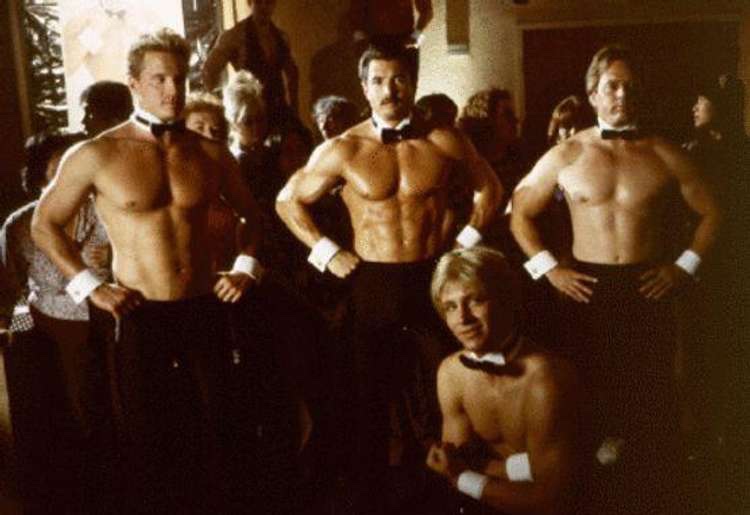
How did Chippendales start? In the 1970s, Somen Banerjee owned a failed Los Angeles disco, and a nightclub promoter named Paul Snider suggested he begin the first all-male strip club for women. The original Chippendales dancers adopted their signature bow tie and cuffs at the suggestion of Snider’s girlfriend, Playboy Playmate of the Year Dorothy Stratten. The idea was a hit, and soon Banerjee began opening other locations and added a touring show.
But the Chippendales show was more than flirty fun. Only a year after opening, Snider murdered Stratten and killed himself, and Banerjee started hiring hitmen to take out his rivals and burn down other clubs. He even sent a hitman to New York City to kill the original Chippendales choreographer. Much like male strippers describing what really happens at bachelorette parties, the history of Chippendales has a dark side that you just don’t see portrayed in photos or movies like Magic Mike.
The Founder Of Chippendales Murdered The Choreographer
Nick De Noia played a major role in the early success of Chippendales. De Noia, an award-winning choreographer, staged the original routines for the dance troupe. And in 1987, De Noia was found dead in his New York office, shot in the face.
The murderer was someone De Noia knew well—Somen Banerjee, the owner of the Chippendales nightclub. By the mid-80s, De Noia had moved to New York to open an east coast Chippendales location, and the two had a falling out. Banerjee later confessed that he hired a hitman to kill De Noia. The hitman, posing as a messenger, successfully carried out the murder-for-hire by coming into De Noia’s office in the middle of the day and shooting him in the face. But Banerjee didn’t get away with it. The U.S. Attorney filed charges, arguing that Banerjee ordered the hit “to enhance the business of Chippendales, or to gain revenge from persons who had caused injury to the business.”
The Cofounder Sexually Assaulted And Murdered His Girlfriend
Cofounder Paul Snider had the idea to turn Banerjee’s failing club, which featured female mud wrestling in addition to male dancers into an all-male strip show. He also discovered and later brutally murdered Dorothy Stratten, Playboy’s 1980 Playmate of the Year.
Snider and Stratten were married, but as her career took off, Snider couldn’t handle the competition. Just after Stratten broke up with Snider, he attacked his ex, sexually assaulted her, and shot her in the face. According to the police investigation, Snider also had sex with Dorothy’s dead body before shooting himself in the head.
Hugh Hefner had his own view about why Snider killed Stratten. “A very sick guy saw his meal ticket and his connection to power, whatever, slipping away. And it was that that made him kill her.”
Somen Banerjee didn’t want any competition. In 1984, he hired an arsonist to burn down a rival club called the Pearl Harbor. It wasn’t his first brush with arson, however. In 1978, Banerjee paid someone to burn down another club called Moody’s.
Banerjee’s attempted arson, combined with hiring hitmen to take out his rivals and even his former partner, Nick de Noia, led the federal government to charge Banerjee under the Racketeering Influenced and Corrupt Organizations Act (RICO), typically reserved for organized crime.
Somen Banerjee, one of the founders of Chippendales, refused to let anyone else capitalize on male dancers. He was willing to commit murder to make sure that Chippendales was the only male dance troupe in the world. When Banerjee learned of a rival group named Adonis, he contacted a hitman to kill the show’s leaders, including their choreographer.
The hit was supposed to happen in Blackpool, England, and Banerjee paid the hitman an advance of $8,000 to carry out the three murders. But before the hitman killed the men, he confessed to U.S. authorities and turned on Banerjee.
The Hitman Had Enough Cyanide To Poison Over Two Thousand People
When Banerjee hired hitmen to kill his rivals in the male strip troupe Adonis, he made sure the men would get the job done. One of the hitmen, Lynn Bressler, testified that he was taken to an expensive house in Los Angeles, where he was given a canvas bag marked with a skull and crossbones.
Inside, Bressler found a container of cyanide—it contained enough poison to kill 2,300 people. The hitman’s instructions were clear: he was to inject the poison into the men running Adonis, including Read Scot, a former Chippendale employee who Banerjee saw as a traitor.
One Of Banjeree’s Colleagues Narrowly Escaped A Hit
Banjeree also planned to murder his partner and former law student, Bruce Nahin. Nahin was supposed to be killed at the same time and in the same manner as De Noia, but his trip to New York City to visit De Noia was delayed because of a family illness. The charges leveled against Banjeree in court included the attempted hit on Nahin.
In 1994, a federal prosecutor charged Somen Banerjee with racketeering, attempted arson, and the murder of his former partner, Nick De Noia. He was denied bail because according to witness testimony, Banerjee said he planned to hire a private pilot and pay them $25,000 to fly him to India without a passport, where he’d “get a new wife and kids.” He said he’d commit suicide if he were arrested again. After months in prison, Banerjee pled guilty to the charge and arranged a plea bargain with the federal court.
But Banerjee was never officially sentenced for his crimes, because hours before his sentencing hearing, he committed suicide in a Los Angeles jail cell. Banerjee hanged himself with his prison bed sheet and was found dead in his cell around 4 am the day of his sentencing hearing. He was expected to receive a sentence of 26 years in prison.
Dorothy Stratten’s brutal murder shook Hollywood. She was on her way to a major film career when her ex and Chippendales founder Paul Snider brutally murdered her. In Hugh Hefner’s press release after Dorothy Stratten’s murder, he wrote, “The death of Dorothy Stratten comes as a shock to us all… As Playboy’s Playmate of the Year with a film and a television career of increasing importance, her professional future was a bright one. But equally sad to us is the fact that her loss takes from us all a very special member of the Playboy family.”
Stratten played a major role in the success of Chippendales––she’s the one who designed the signature bow tie and cuffs still worn by Chippendales dancers today.
The Chippendales dancers often go on tour, taking their moves on the road. But tours can get even wilder than regular shows. During one memorable Chippendales tour, a bomb threat was called into the theater where the dancers were performing. The theater was evacuated, and the Chippendales were escorted back to their tour bus.
But everything changed when the fans surrounded the bus, cheering on the male dancers. Rather than let down their admirers, the Chippendales climbed of the roof of the bus and started performing. Not even a bomb threat can stop the Chippendales dancers.
Banerjee severely violated overcrowding laws and had a number of citations from federal agencies. An inspector from the fire department said that Chippendales was the most extreme violator he had seen in years and that the owner severely endangered patrons with blocked exits. One night, the establishment, which could hold a maximum of 299 patrons, contained 435 people.
Another run-in with government regulations occurred when Chippendales was charged with sexual discrimination for not allowing male patrons into the club. The Department of Alcoholic Beverage Control revoked the establishment’s liquor license as a result.
n the early years, Chippendale dancers assumed the club would quickly be shut down. The atmosphere was wild, and women in the audience sometimes showed up with scissors to cut the g-strings off of the male dancers.
Michael Rapp, an original cast member, said, “When we first started, we thought that we could have been closed down any day. We thought it would be a fad that wouldn’t last that long.” And because of that, Rapp added, “We were going to have as much fun as we could while we had it.”
Ben Stiller And Dev Patel Are In Talks To Make A Movie Called ‘Chippendales’
The history of Chippendales in the 1980s was so dark that a true crime movie based on the early years of the male strip club is currently in the works. According to Variety, Ben Stiller and Dev Patel are in talks to play two of the partners who founded Chippendales, Nick De Noia and Somen Banerjee.
The theory of evolution, as presented by Charles Darwin and others, was a controversial concept in many quarters, even into the 20th century.
Concerted anti-evolutionist efforts in Tennessee succeeded when in 1925, the Tennessee House of Representatives was offered a bill by John W. Butler making teaching evolution a misdemeanor. The so-called Butler Act was passed six days later almost unanimously with no amendments.
When the ACLU received news of the bill’s passage, it immediately sent out a press release offering to challenge the Butler Act.
John Scopes
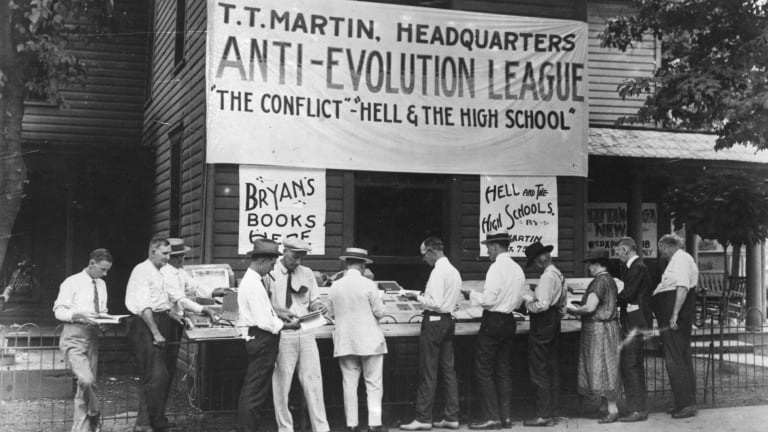
What became known as the Scopes Monkey Trial began as a publicity stunt for the town of Dayton, Tennessee.
A local businessman met with the school superintendent and a lawyer to discuss using the ACLU offer to get newspapers to write about the town. The group asked if high school science teacher John Scopes would admit to teaching evolution for the purposes of prosecution.
Scopes wasn’t clear on whether he had precisely taught the subject, but was sure he’d used materials that included evolution. Scopes taught physics and math, and while he said he accepted evolution, he didn’t teach biology.
It was announced to newspapers the next day that Scopes had been charged with violating the Butler Act, and the town wired the ACLU to procure its services. The Tennessee press roundly criticized the town, accusing it of staging a trial for publicity.
Clarence Darrow, left, and William Jennings Bryan at the Scopes trial in 1925 (Associated Press)
William Jennings Bryan
A preliminary hearing on May 9, 1925, officially held Scopes for trial by the grand jury, though released him and didn’t require him to post bond.
Three-time presidential nominee William Jennings Bryanvolunteered to present for the prosecution. The politician was already well-known as an anti-evolution activist, almost single-handedly creating the national controversy over the teaching of evolution and making his name inseparable from the issue.
Clarence Darrow
Author H.G. Wells was approached early on to present the case for evolution, but he turned down the offer.
Clarence Darrow – a famous attorney who had recently acted for the defense in the notorious Leopold and Loeb murder trial – found out about the Scopes trial through journalist H.L. Mencken, who suggested Darrow should defend Scopes.
Darrow declined since he was preparing to retire, but news of Bryan’s involvement caused Darrow – who was also a leading member of the ACLU – to change his mind.
Darrow and Bryan already had a history of butting heads over evolution and the concept of taking the Bible literally, sparring in the press and public debates.
Darrow’s goal in getting involved was to debunk fundamentalist Christianity and raise awareness of a narrow, fundamentalist interpretation of the Bible. It was the only time in his career he offered to give free legal aid.
Bryan and Darrow set the tone by immediately attacking each other in the press. The ACLU attempted to remove Darrow from the case, fearing they would lose control, but none of these efforts worked.
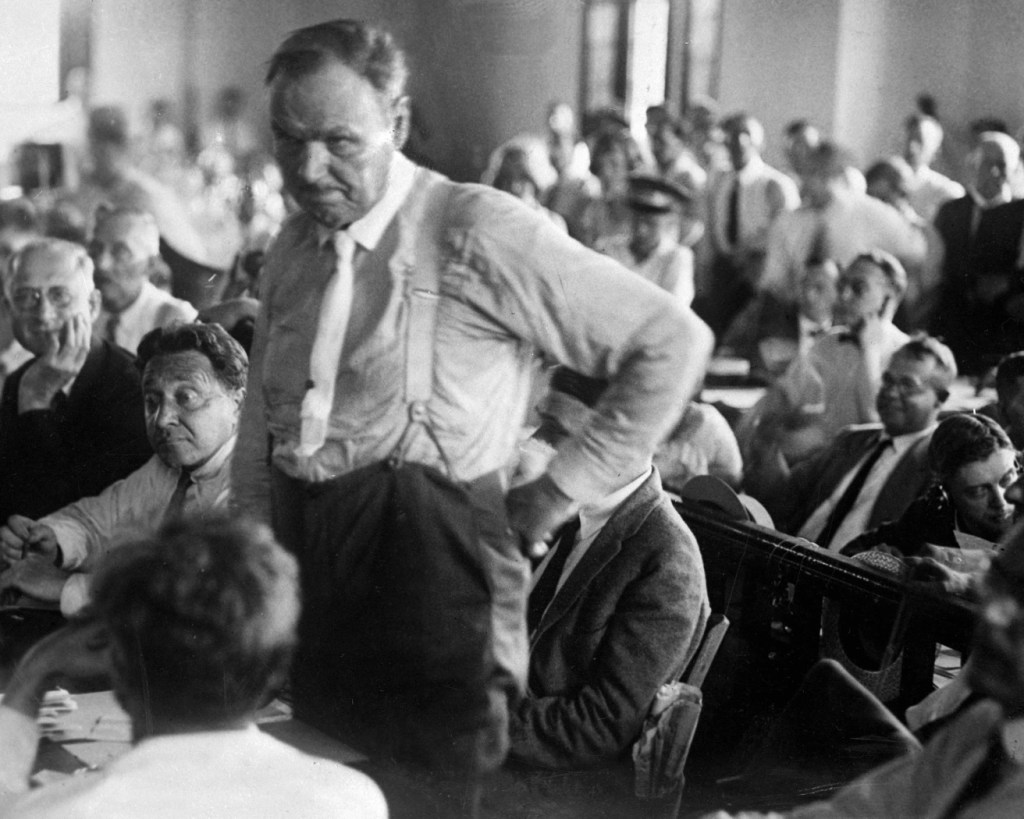
Attorney Clarence Darrow consults with Judge Raulston about procedure in the Tennessee courts during the trial of John T. Scopes. New York Daily News/Getty Images
William Jennings Bryan Arrives
The grand jury met on May 9, 1925. In preparation, Scopes recruited and coached students to testify against him. Three of the seven students attending were called to testify, each showing a sketchy understanding of evolution. The case was pushed forward and a trial set for July 10.
Bryan arrived in Dayton three days before the trial, stepping off a train to the spectacle of half the town greeting him. He posed for photo opportunities and gave two public speeches, stating his intention to not only defend the anti-evolution law but to use the trial to debunk evolution entirely.
Darrow, meanwhile, arrived into Dayton the day before the trial to little fanfare.
Scopes Monkey Trial Begins
The trial day started with crowds pouring into the courthouse two hours before it was scheduled to begin, filling up the room and causing onlookers to spill into the hallways. There was applause when Bryan entered the court and further when he and Darrow shook hands.
The trial began – somewhat ironically – with a lengthy prayer. The first day saw the grand jury being reconvened and repeating testimony from Scopes’ students who had appeared in that trial and jury selection.
Outside the courthouse a circus-like atmosphere reigned, with barbecues, concessions and carnival games, though that died down as the trial was adjourned for the weekend, over which Bryan and Darrow sparred through the press and tensions mounted.
Clarence Darrow’s Speech
It was to a packed courthouse on Monday that arguments began by the defense working to establish the scientific validity of evolution, while the prosecution focused on the Butler Act as an education standard for Tennessee citizens, citing precedents.
Darrow responded by laying out the case in an aggressive way, part of a strategy related to the defense planning to waive their closing argument and preventing Bryan’s own carefully prepared closing argument.
The statement Darrow made is considered an example of his best passionate public speaking. Darrow’s chief argument was that the Butler Act promoted one particular religious view and was therefore illegal. He spoke for over two hours.
Clarence Darrow’s Plan
The trial itself began on Wednesday with opening statements. Witnesses followed, establishing that Scopes had taught evolution and zoologist Maynard M. Metcalf gave expert testimony about the science of evolution, a signal that Scopes himself would not take the stand during the trial.
Subsequent days saw prosecutors argue about the validity of using expert witnesses. This provided Bryan with the opportunity for an extended speech on the subject. Defense attorney Dudley Field Malone then countered with a speech of his own and received a thunderous standing ovation.
The next day, the judge ruled that any experts on the stands could be cross-examined. That night, Darrow quietly prepared to call Bryan as an expert witness on the Bible.
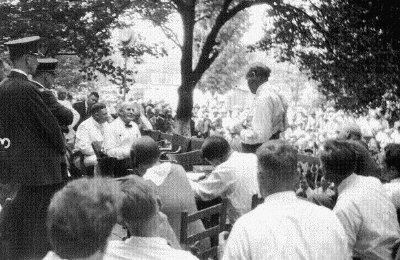
Darrow questions Bryan during the Scopes Trial (July 20, 1925)(Smithsonian)
William Jennings Bryan on the Stand
Calling Bryan to the stand was a shock for the court. Darrow interrogated him on interpreting the Bible literally, which undercut his earlier sweeping religious speeches. It also cornered him into admitting that he didn’t know much about science since the Bible didn’t provide any answers.
When the judge ruled Bryan’s testimony be taken from the record, Darrow suggested that to save time his client should be found guilty. This prevented Bryan from making a closing statement.
The jury took nine minutes to pronounce Scopes guilty. He was fined $100.
After the Scopes Trial
After the trial, Bryan immediately began to prepare his unused closing statement as a speech for his rallies. He never got to use that speech, since he died in his sleep in Dayton the following Sunday.
Scopes was offered a new teaching contract but chose to leave Dayton and study geology at the University of Chicago graduate school. He eventually became a petroleum engineer.
Intelligent Design
Supporters of both sides claimed victory following the trial, but the Butler Act was upheld, and the anti-evolution movement continued.
Mississippi passed a similar law months later, and in 1925 Texasbanned the theory of evolution from high school textbooks. Twenty-two other states made similar efforts but were defeated.
The controversy over the teaching of science and evolution has continued into the 21st century. In 2005, the case of Kitzmiller v. Dover Area School District battled over the constitutionality of teaching “intelligent design” in Pennsylvania schools alongside evolution.
The court ruled against intelligent design – now largely discredited as a pseudoscience – as a legitimate topic suitable for education.
It was the best-selling single of 1998 and signalled a radical change of musical direction for Cher — complete with bizarre vocal processing. Yet, surprisingly, it was produced in a small studio in West London. Sue Sillitoe relates the astonishing tale of ‘Believe’.
For most of last year, it looked as though Celine Dion’s track ‘My Heart Will Go On’ was going to be the best-selling single of 1998 — but this accolade was snatched from the Canadian Queen of AOR at the 11th hour by another female vocalist who not only launched a successful challenge for the title, but did so with a song that was massively different from anything she had ever done before.
For those of you who’ve been stuck on a radio-less desert island for the last two months, the single in question is Cher’s dance hit, ‘Believe’, which spent seven weeks at the top of the UK charts and — at the time of going to press — had already achieved sales of 1.5 million and rising. What’s less well-known is that it was produced by two London-based producers Mark Taylor and Brian Rawling, in their own studio.
Together, Mark and Brian run Metro Productions, a production and publishing company which operates from Dreamhouse, a three-studio complex in Kingston, Surrey. According to Mark, despite the track’s mainstream commercial success, the story behind the creation of ‘Believe’ is a strange one. As released, the single incorporates the work of six different songwriters, two producers and executive producer Rob Dickins (the erstwhile chairman of Warner Brothers, who has now left the company for pastures new).
Mark, whose previous production credits include Gina G and Danni Minogue, says the fact that the single happened at all is down to a series of lucky breaks, which began when Metro’s songwriters were asked by Rob Dickins to submit a song for possible inclusion on Cher’s new album.
He explains: “Thanks to the work we had done with Gina and Danni for Warners, we had a good relationship with Rob, and that’s why we got the opportunity to work with Cher. Rob asked us to write a song and we came up with the song ‘Dov’é L’Amore’ [now a track on Cher’s new album, also entitled Believe]. Initially, he wanted Junior Vasquez to produce it, which we were delighted about, because it was quite a coup to have the song accepted in the first place.”
‘Dov’é L’Amore’ was duly sent over to Vasquez in New York, but when he sent back his version, it was rejected by Rob, who decided instead to give the production of the track to Taylor and Rawling as well.
“It was one of those scenarios where lucky breaks, chance and other people’s bad luck come into play,” says Mark. “We were only meant to do one song, but in the end we were responsible for the bulk of the Believe album — six tracks in total including ‘Believe’ itself. Vasquez did another and producer Todd Terry did three.”
The starting point for ‘Believe’ was a song by Brian Higgins, Matt Gray, Stuart McLennen and Tim Powell, which had been knocking around the Warner offices in demo form for months. “Everyone loved the chorus but not the rest of the song,” says Mark. “As we were already writing other songs for Cher, Rob asked us if we could sort it out. Two of our writers, Steve Torch and Paul Barry, got involved and eventually came up with a complete song that Rob and Cher were happy with.”
Mark says Torch and Barry were given a DAT with a programmed demo in a firmly eurobeat style, which they weren’t too keen on, so they sat down with guitars and began to rewrite it. In the end, they kept only the chorus, which went through some minor chord changes but basically remained intact. “The lyrics for the chorus were already there, but our guys added the lyrics, melody and chords for the verses and middle eight, then put the whole thing back together again. We sent it over to Rob Dickins and he highlighted a few changes. Then Cher heard it and she liked it straight away.”
Once the demo version was agreed, Mark and Brian took over for the actual production, working at Dreamhouse, which has Mackie consoles in every room. Mark says, “We knew the rough direction to take, because Rob had said he wanted to make a Cher dance record. The hard part was trying to make one that wouldn’t alienate Cher’s existing fans. We couldn’t afford to have anyone say ‘I hate this because it’s dance’ — then we would have turned off loads of people who are used to hearing Cher do rock ballads and MOR songs. I think we can safely say we succeeded in maintaining the balance, because kids on their own will buy a certain type of record, and adults on their own will buy another. The only way you can achieve sales of 1.5 million is to appeal to both camps. Getting that right was the most difficult part — and was the reason why I ended up doing the track twice!”
Mark got halfway through the first version before consigning it to the bin without having played it to anyone else. “It was just too hardcore dance — it wasn’t happening,” he says. “I scrapped it and started again, because I realised it needed a sound that was unusual, but not in a typical dance record sort of way. This was tricky, because dance music is very specific. To get what I was after I had to think about each sound very carefully, so that the sound itself was dance-based but not obviously so.
“It was really a question of finding, say, a kick drum that didn’t sound like a typical TR909 dance kick drum — and instead, using something that had the right sound but wasn’t so clichéd. I ended up using all kinds of sounds mixed together. The drums are all samples, but samples that have been mutated, EQ’d and compressed. The kick drums in particular were heavily compressed to give them a weird, pumping, smacky sound.”
Mark believes one doesn’t need expensive technology in order to make a hit record, and adds that ‘Believe’ exemplifies this philosophy. “Don’t forget I was only using a Mackie desk, and the rest of the equipment involved was the sort of thing any Sound On Sound reader could aspire to. Having a really expensive piece of kit doesn’t mean you’ll make hit records. My view is that the end result is what matters — not how you get there.”
Co-producer Mark Taylor.With this attitude, it’s not so surprising that Mark used nothing fancier than Cubase VST on a Mac G3 to assemble the entire track, including the vocals (although these were initially recorded to Tascam DA88s — see later). The G3 contains a Korg 1212 I/O card, but in fact a stand-alone Soundscape converter unit provides the main audio interfacing with the rest of the Metro kit, particularly their DA88s (via TDIF).
“The sampler was an Akai S3000, and for other sounds we used several of our synths, including the Clavia Nord Rack, Oberheim Matrix 1000 — for the white-noise wind effect at the very beginning of the track — and the Moog Progidy for some sub-bass. A lot of the time I was just fiddling around to see what came out! The samples were a combination of sample CDs and ones I’ve collected myself over the years. As I’ve said, I wanted the samples to sound different, so that the track didn’t sound like any old dance hit. We did this by using the EQ in the Akai sampler, from our little ART Tube EQ and on the desk to really crunch things up, and compressing and squashing sounds to give them an unusual edge. The great thing about the S3000 is that you can put four different samples on each note in a keygroup — so for the kick drum, for example, I used four different kick samples from my own collection playing together. One was just a noise, one was a splat, one had all the bottom end and so on. By mixing everything together I was able to create something unique.”
Cher’s vocals were recorded onto three Tascam DA88s with a Neumann U67, at her suggestion, as she had just finished a recording with George Martin using that mic and was particularly pleased with the results. From the DA88, the vocals were loaded straight into Cubase VST on the Mac, and nearly everything else was then done on the computer’s hard disk.
Mark: “There’s also some guitar in the chorus, which we ran through a Sessionette amp miked with an AKG C414. Then we put it through a Zoom to add tremolo and severely EQ’d it to make it sound a bit odd. For the piano we used an Emu Vintage Keys sound which I really like. It’s based on a Yamaha CP80 electric piano which we slightly modified to make it cut through the track better. Then we compressed it quite hard to give it a definite ringing sound. We also added lots of delay using a Roland SDE330, which sounds really spacious and adds ambience without cluttering the track — although the really obvious delay on the vocal phrase ‘after love, after love’ at the very beginning wasn’t done using that — we just sampled that phrase and repeated it with the S3000’s internal filter on it, so that it fades in very dull and brightens up.”
Mark explains that the main synth pad remained the same throughout the recording of the track, and was the only element that survived from his first version. “It’s a very distinctive, core part of the record — the song hinges on it. I combined two sounds to get that — one from my old Roland Juno 106 and another from the Korg TR-Rack. There is something about the way the pad and melody work together that gives the whole track a sort of hanging feeling. When I started putting the song together for the second time, I had the pad running, and I rebuilt the drums to make the pad and the drums sound like they were driving everything along. Then I added the other instrumentation — the guitar and the piano.”
Cher’s ‘Believe’ (December 1998) was the first commercial recording to feature the audible side-effects of Antares Auto‑Tune software used as a deliberate creative effect. The (now) highly recognisable tonal mangling occurs when the pitch correction speed is set too fast for the audio that it is processing and it became one of the most over-used production effects of the following years.
In February 1999, when this Sound On Sound article was published, the producers of this recording were apparently so keen to maintain their ‘trade secret’ process that they were willing to attribute the effect to the (then) recently-released Digitech Talker vocoder pedal. As most people are now all‑too familiar with the ‘Cher effect’, as it has become known, we have maintained the article in its original form as an interesting historical footnote. Matt Bell
Everyone who hears ‘Believe’ immediately comments on the vocals, which are unusual, to say the least. Mark says that for him, this was the most nerve-racking part of the project, because he wasn’t sure what Cher would say when she heard what he’d done to her voice. For those who’ve been wondering, yes — it’s basically down to vocoding and filtering (for more on vocoders and the theory behind them, see the ‘Power Vocoding’ workshop in SOS January 1994).
Mark: “It all began with a Korg VC10, which is a very rare, very groovy-looking analogue vocoder from the ’70s, with a built-in synth, a little keyboard and a microphone stuck on top”, he enthuses. “You must mention this, because SOS readers will love it — and I know, because I’ve been reading the mag for years!
“Anyway, the Korg VC10 looks bizarre, but it’s great to use if you want to get vocoder effects up and running straight away. You just play the keyboard to provide a vocoder carrier signal, sing into the microphone to produce the modulator signal, and off you go. The only drawback is the synth — you can’t do anything to change the sound, so the effects you can produce are rather limited.
“I played around with the vocals and realised that the vocoder effect could work, but not with the Korg — the results just weren’t clear enough. So instead, I used a Digitech Talker — a reasonably new piece of kit that looks like an old guitar foot pedal, which I suspect is what it was originally designed for [see review in SOS April 1998]. You plug your mic straight into it, and it gives you a vocoder-like effect, but with clarity; it almost sounds like you’ve got the original voice coming out the other end. I used a tone from the Nord Rack as a carrier signal and sequenced the notes the Nord was playing from Cubase to follow Cher’s vocal melody. That gave the vocals that ‘stepped’ quality that you can hear prominently throughout the track — but only when I shifted the Nord’s notes back a bit. For some reason, if you track the vocal melody exactly, with the same notes and timing, you hardly get any audible vocoded effect. But I was messing about with the Nord melody sequence in Cubase and shifted all the notes back a fraction with respect to the vocal. Then you really started to hear it, although even then it was a bit hit-and-miss — I had to experiment with the timing of each of the notes in the Nord melody sequence to get the best effect. You couldn’t hear an effect on all the vocals by any means — and on others it made the words completely impossible to understand!
“In the end, we only used vocoded sections where they had the most striking effect and didn’t make the lyrics unintelligible. To do that, I had to keep the vocoded bits very short. So for example, when Cher sang ‘Do you believe in life after love?’, I think I only cut the processed vocals into the phrase on just the syllables ‘belie‑’ from ‘believe’ and ‘lo‑’ from ‘love’ — but that was enough to make the whole phrase sound really arresting. I made sure throughout that the last word of each vocal phrase was unprocessed, because again, I found it sounded too bubbly and hard to understand when it was vocoded.”
Mark spent time alone in the studio painstakingly processing Cher’s vocals in this way, and by the following morning, he was convinced he didn’t have the nerve to play her what he’d done. “It was a bit radical,” he laughs. “Basically, it was the destruction of her voice, so I was really nervous about playing it to her! In the end, I just thought it sounded so good, I had to at least let her hear it — so I hit Play. She was fantastic — she just said ‘it sounds great!’, so the effect stayed. I was amazed by her reaction, and so excited, because I knew it was good.”
Although the vocoder effect was Mark’s idea, the other obvious vocal effect in ‘Believe’ is the ‘telephoney’ quality of Cher’s vocal throughout. This idea came from the lady herself — she’d identified something similar on a Roachford record and asked Mark if he could reproduce it.
He explains, “Roachford uses a restricted bandwidth, and filters the vocals heavily so that the top and bottom ends are wound off and the whole vocal is slightly distorted. It took a while to work out exactly what it was that Cher liked about this particular Roachford song, but in the end we realised it was the ‘telephoney’ sound. I used the filter section on my Drawmer DS404 gate on the vocal before it went into the Talker to get that effect.”
‘Believe’ took approximately 10 days to record. Once it was completed, Mark ran a monitor mix onto DAT and sent it to Rob Dickins for clearance. To Mark’s surprise, Rob was so pleased with the sound that the monitor mix basically became the final version, with only the most minor of tweaks. “The vocals were much too loud, because I was trying to clear the track,” he laughs. “But apart from that, it worked fine, and everyone was really happy with it. It just goes to show that you don’t need to spend days mixing in order to get a hit. With ‘Believe’, I was adjusting things as I went along and running everything live on the computer, which meant I could save just about everything, apart from the effects and EQ hooked up to the desk. All the level changes in the mix were already recorded in the sequencer, so the finished mix just kind of grew in an organic way as we worked on the track.”
The single was mastered at Townhouse, although very little was actually changed at this stage. “It was very straightforward,” says Mark. “Just the fades and the odd dB of cut and boost here and there — standard mastering stuff.”
Looking back, Mark says the most satisfying part of the project was getting to know Cher who spent six weeks at the studio working on the album. “The first day was incredibly nerve-racking,” he admits. “I thought she might think our setup was a bit small, and that she would turn out to be a bit ‘Hollywood’. But she was really great and easy to get on with. These days, artists like Cher are used to working with producers who have their own studios — and these are not necessarily big, just well equipped.”
With such a massive hit to their credit, it’s not surprising that the eight-man team at Metro is now in great demand. They are currently finishing a Gypsy Kings album (which was started after the group guested on the ‘Dov’é L’Amore’ track), and other high-profile projects are in the pipeline, such as the first single from Gary Barlow’s new solo album, and the next Tamperer release. Whether they will continue their relationship with Cher, however, remains to be seen.
“She’s said she wants to work with us again, but you know how record company politics can be,” says Mark. “I hope it does happen, because it was a great project and one we all thoroughly enjoyed. We certainly never expected the single to do so well — let alone seven weeks at number one. But when I listen to it now I can see why it worked. It’s a great song with a fantastic chorus, and the weird vocoder effect on the vocals makes it special.”
Hideki Tojo was the leader of Japan for much of World War II.(Supplied: Wikipedia)
“Accused Hideki Tojo, on the counts of the indictment of which you have been convicted, the International Military Tribunal for the Far East sentences you to death by hanging.”
With those words on November 12, 1948, a judge of the High Court of Australia unwillingly passed a death sentence on the wartime leader of one of the major Axis powers.
As president of the International Military Tribunal for the Far East, Sir William Webb presided over one of the two multinational tribunals established to prosecute the Axis crimes of World War II (the other being the International Military Tribunal at Nuremberg).
No Australian jurist before or since has ever held such responsibility, yet his part and Australia’s key role in the prosecution of hundreds of accused Japanese war criminals throughout the Asia-Pacific are little remembered today.
Webb’s scruples about the death sentence did not come from sympathy for Tojo or the other six defendants also sentenced to hang.
Rather, it was the joint decision of the Allied Governments to grant Emperor Hirohito immunity in exchange for his cooperation.
“It would be a travesty of justice, seriously reflecting on the United Nations, to hang or shoot the common Japanese soldier or Korean guard while granting immunity to his sovereign perhaps even more guilty than he,” Webb had written in September 1945.
Having spent three years investigating war crimes in the Pacific, he was convinced that responsibility for Japanese atrocities needed to be pursued all the way to the very top.
The Australian Government came around to his view, but its British and American Allies did not. The Emperor was left in power, used as a buffer to soften Japan’s rough and rapid transition to democracy. As a consolation prize, perhaps, General Douglas Macarthur appointed Webb as president of the tribunal.
Sir William Webb was a judge of the Supreme Court of Queensland and the High Court of Australia.(Supplied: Queensland State Archives)
Webb out of his depth
Webb was a diligent and effective investigator, but he was out of his depth in Tokyo. Balancing the competing legal and political objectives of the cosmopolitan court would have required a subtle and confident judge, extremely knowledgeable in international law and able to deal effectively with the international bench and the Japanese defendants.
Webb was not such a man. New Zealand judge Erima Harvey Northcroft described him as “brusque to the point of rudeness. He does not control the court with dignity, he is pre-emptory and ungracious in his treatment of counsel and witnesses, and instead of giving shortly the legal justification which in most cases exists for his decisions, he leaves everyone in the court with the impression his rulings are dictated by petulance or impatience and an impression, which may easily develop in the future, of prejudice.”
Nuremberg was wrapped up and the death sentences carried out by the end of October 1946. Tokyo, afflicted with administrative troubles, translation difficulties, and the incompetent management of the prosecution case by lead prosecutor Joseph Keenan, limped on into late 1948.
Hermann Goering sits in the dock at the Nuremberg trial in 1946.(www.freeinfosociety.com)
Carrying on without the president
Webb’s authority with the court, already weak, suffered a fatal blow in early 1947 when the Australian Government, in a breathtakingly parochial decision, summoned him to home to sit on the High Court for the bank nationalisation case.
By the time he returned to Tokyo in December, he was president of the court in name only.
Three judges — Northcroft, Lord Patrick of the United Kingdom, and Edward Stuart McDougall of Canada — had decided to take matters into their own hands.
All three men had served in one world war, seen a second, and had become determined that there should not be a third.
They knew that the prosecution’s case was struggling, particularly following Tojo able handling of Keenan’s botched cross-examination. And they also knew that two of the other judges, Bert Roling of the Netherlands and Henri Barnard of France, had serious reservations about convicting men under laws which they believed the court was making up as it went along.
Northcroft, Patrick and McDougall succeeded in pulling together a solid but not overwhelming majority of seven judges out of 11.
As president, it still fell to Webb to read the majority judgement, even though he played no role in writing it.
Reading the judgement and the sentences took him eight days; the sentences were read on November 12.
Tojo accepted his fate with characteristic stoicism. Taking off the headphones through which he had heard a translator announce Webb’s sentence in Japanese, he stood up, smiled at Webb, nodded, and bowed very deeply. Turning sharply, he walked out of the courtroom.
War crimes court presided over by the Australian High Court judge Sir William Webb.(Suppled: State Library of Victoria)
‘He has lost his belief in war’
Five of the judges wrote partial or full dissents of their own, although these were not read to the court and were only published later.
Most controversially, openly pro-Axis judge Radhabinod Pal of India wrote a massive and inflammatory dissent where he suggested that Japan had fought a justified war against Western imperialism, implied that evidence of Japanese war crimes against Asian civilians had been exaggerated for propaganda purposes, compared the atomic bombings of Hiroshima and Nagasaki to the Holocaust, and argued that all of the defendants should have been acquitted of all of the charges.
In a short partial dissent, Webb agreed with the majority on their interpretation of the law but expressed reservations about the sentencing: “I do not suggest the Emperor should have been prosecuted. That is beyond my province. His immunity was, no doubt, decided upon in the best interests of all the Allied Powers. Justice requires me to take into consideration the Emperor’s immunity when determining the punishment of the accused found guilty: that is all.”
This mild statement still inflamed Macarthur, who believed Webb was cynically exploiting anti-Hirohito feeling to boost his popularity in Australia, and compelled the prosecution to issue a statement affirming that there had been no grounds to prosecute the Emperor.
In his final public statements before his execution on December 23, 1948, Tojo repeated his satisfaction that the Emperor had escaped prosecution, confirmed his faith in the people of Japan, and called for world peace.
He was now under the guidance of a Buddhist priest, Dr Hanayama, who was pleased with the progress his pupil was making.
“Since he embraced the Buddhist faith six months ago, he has lost his belief in war,” Dr Hanayama told the media in a press conference in early December.
“A devout belief in Buddhism, together with the knowledge of the suffering the war has caused the world’s peoples, has convinced him that there are other, better means of solving world’s problems.”
That, at least, is a good lesson.
Adam Wakeling is the author of The Last Fifty Miles: Australia and the End of the Great War and Stern Justice: Australia in the Pacific War Crimes Trials.
The Beauchamp Hotel in Darlinghurst is named after this former governor of NSW.
Built in 1540 to guard the English coast against foreign invasions, Walmer Castle is one of Kent’s most prominent landmarks. Since the 18th century it has been the official residence of the Lord Warden of the Cinque Ports. During the 1920s Walmer was home to William Lygon, 7th Earl of Beauchamp, who held lavish homosexual parties at the castle. This led eventually to his dramatic fall from grace, the break-up of his family, and the inspiration for Evelyn Waugh’s most famous novel, Brideshead Revisited.
CABINET MINISTER AND FAMILY MAN
Born in 1872, William Lygon was a well-known public figure from a young age. Succeeding his father as Earl Beauchamp in 1891, he became mayor of Worcester at the age of 23, and was appointed governor of New South Wales, Australia, in 1899. A high-flying figure in the Liberal Party, he rose to become a senior cabinet minister in 1910. He was also appointed First Commissioner of the Office of Works (later English Heritage), in charge of works to royal residences and government buildings.
In 1913, Beauchamp was appointed Lord Warden of the Cinque Ports. He enjoyed the pomp and ceremony that came with the role of Lord Warden: one of his duties was to welcome visiting foreign dignitaries at Dover on behalf of the king. Equally, however, he spent time at Walmer Castle with his family. In 1902, he had married Lettice Grosvenor, sister of Hugh Grosvenor, 2nd Duke of Westminster. Family photographs show Beauchamp, Lettice and their seven children enjoying their surroundings and each other’s company at Walmer.
Beauchamp’s family life appeared conventional. However, during the 1920s he is known to have thrown some rather racy parties at Walmer, to which he invited his high-class friends, along with local fishermen and youths. A hint of their nature is given in the memoirs of Lady Christabel Aberconway, who wrote that:
One Sunday, my host, Lord Jowitt, asked my husband if he and I would like to see one of the famous castles of the Cinque Ports. Delightedly we accepted. … We arrived [at Walmer] and were shown into a garden surrounding a grass tennis court. There was the actor Ernest Thesiger, a friend of mine, nude to the waist and covered with pearls.
The gardens at Walmer Castle
CAUGHT OUT
In 1930 Beauchamp became embroiled in a scandal that would prove disastrous to his career and personal life. He had embarked on a round-the-world tour in August that year, spending two months in Sydney, Australia. He was accompanied by a young valet, who lived with him as his lover. This did not go unnoticed, and Beauchamp’s tastes were reported in the Australian Star newspaper:
The most striking feature of the vice-regal ménage is the youthfulness of its members … Rosy cheeked footmen, clad in liveries of fawn, heavily ornamented in silver and red brocade, with many lanyards of the same hanging in festoons from their broad shoulders, [who] stood in the doorway, and bowed as we passed in … Lord Beauchamp deserves great credit for his taste in footmen.
Following this report, Beauchamp’s brother-in-law, the Duke of Westminster, hired detectives and began to gather evidence of Beauchamp’s activities.
The Duke of Westminster was reported to be a bullying, womanising, angry man, once described as ‘nothing but a fatuous, spoilt, ageing playboy’. He had always disliked Beauchamp, jealous of his brother-in-law’s public office and apparent domestic happiness. In addition, the duke was a staunch Tory, whereas Beauchamp was the Liberal Party’s leader in the House of Lords. To ruin Beauchamp would not only satisfy Westminster’s personal vendetta, but would also be politically advantageous.
In 1931 Westminster publicly denounced Beauchamp as a homosexual to George V, who reportedly responded, ‘Why, I thought people like that always shot themselves’. Westminster insisted that Beauchamp be arrested, forcing him into exile.
Beauchamp fled first to Germany, where he contemplated suicide, but was dissuaded from it by his son Hugh. He later split his time between Paris, Venice, Sydney and San Francisco – four cities that were relatively tolerant of his sexual orientation.
Meanwhile, Westminster presented his evidence to his sister Lettice, who suffered a nervous breakdown at the news. She submitted a petition for divorce, moved to her brother’s Cheshire estate and took to her bed. The divorce petition described Beauchamp as:
A man of perverted sexual practices, [who] has committed acts of gross indecency with male servants and other male persons and has been guilty of sodomy … throughout the married life … the Respondent habitually committed acts of gross indecency with certain of his male servants.
Westminster ordered Beauchamp’s children to testify against their father, but they all refused. Though his wife had deserted him, his children’s support never wavered. They shunned their mother and never made peace with her (except the youngest son, Dickie). Westminster became their worst enemy and he let it be known that anyone dealing with the Lygons would be dropped from society. In an extraordinary display of spite, Westminster wrote Beauchamp a short letter, simply stating:
Dear Bugger-in-Law, You got what you deserved. Yours, Westminster.
Cut off from the rest of society, Beauchamp’s children took turns to visit their father abroad. According to Beauchamp’s daughter Sibell, he never grumbled, nor mentioned Westminster again, but grew resigned to his exile.
It was not until George VI came to the throne in 1936 that the warrant for Beauchamp’s arrest was lifted. Beauchamp returned to England in July 1937. He moved back to Madresfield, the family home, and wasted no time in painting out his wife’s image from a fresco in their personal chapel. The family threw her bust into the house’s moat.
Beauchamp died of cancer in 1938. His various misfortunes inspired Evelyn Waugh’s 1945 novel Brideshead Revisited – the character of Lord Marchmain was based on Beauchamp himself, while his son Hugh proved the inspiration for the ill-fated Sebastian Flyte.
Go-Set was the first Australian weekly newspaper which focused on Australian teenage popular music, culture and fashion. Its role was to bring these aspects of Australian life to its readership, Australian youth aged between 14 and 20 years old. In performing this role it also established and developed as an institution through which rock music journalists and writers in popular culture could flourish. Go-Set was able to provide this environment while being produced and published independent of the other mainstream presses at the time.
It was the first sixties newspaper to explore an emerging and developing Australian popular music industry. Go-Set did not remain locked in its 1960s persona and shifted its appearance and musical tastes to keep up with the changes that were taking place within its areas of interest. The dynamics of these changes were so strong that by the early seventies Go-Set was a significantly different paper in appearance to what it had been in 1966. Its decline and demise in 1974 was as much a condition brought on by crisis as had been its life in keeping in touch with, and reporting on the state of the Australian and overseas music and fashion.
It was because Go-Set’s life was short and crisis filled that we can use developmental psychologist Erik Erikson’s model for the childhood development as a means of explaining its history. Erikson theorised that as a child develops, it goes through a series of crises that allow it to mature and reach adulthood. These crises are psychosocial in nature. As they get older, human beings, by nature of their physical, intellectual and emotional growth become ready to face new life tasks. These new life tasks present an outcome that can be a successful graduation or a gradual impairment of the life cycle. Each crisis is a preparation for the next stage and so the child develops into adulthood (Erikson, 1958, 248). Erikson is saying that child defines itself in terms of the crises it experiences in growing older. Go-Set defined itself in terms of the crises it experienced as a result of being the only magazine in Australia covering the Australian popular music scene and its associated industries. Go-Set’s ego might be defined in terms of the personalities who produced its features, news and gossip columns
Go-Set provided the training ground for some Australian musicians and non-musicians to get into rock magazine journalism and book writing. Among these were, ex-Valentines singer, Vince Lovegrove, author of a book on nineties rock group INXS lead singer Michael Hutchence. Vince Lovegrove describes the founder of Go-Set, Phillip Frazer, as the man who “gave us opportunities to work at something we loved”. (Lovegrove, 25/8/99). Of the magazines earliest feature writers, writer Lily Brett, is now an established author of fiction books living in New York. Sydney film producer, David Elfick, started the Go-Set’s Sydney office under instructions from Phillip Frazer (Frazer, 26/8/99), and was later significant in keeping the magazine running (McLean, 1999). Ian “Molly” Meldrum was the “talent co-ordinator” for Countdown, the ABC’s long running music show in the mid 70’s to mid 80’s. He has been regarded by some as Australia’s “rock music guru”. Ed Nimmervoll, works as a freelance journalist in Melbourne, his career began producing national top 40 music charts for Go-Set and eventually moved into music industry analysis. Over the nine years of Go-Set‘s existence it employed many up-and-coming writers and journalists.
Go-Set played an important role in the development of Australian pop and rock music, it was also the nurturing center for pop and rock music journalists. Yet Go-Set‘s history has remained submerged within the music industry. Go-Set gave many artists and writers the exposure they needed in order to succeed. This paper presents a disjointed, but chronological first view of Go-Set‘s life. It focuses on the crisis stages of the development of the magazine. Selective use of Erikson’s childhood ego development model is used where it matches those aspects of magazines history chosen for this paper.
Beginnings (1966 and 1967)
According to Erikson, the first stage crisis determines the innermost mood of the child in which, “the baby must establish basic trust as ‘he’ takes in’ the society that surrounds him. This is through eating (the mother plays the key role here), and through the development of the senses of sight, hearing, and touch. Crisis occurs when child realises that mother cannot devote all the time that is needed. The outcome of this crisis will be determined largely through the sense of trust built up between the child and the mother” (Beringer, R.E., 1978, 94).
Erikson is saying is that at the beginning of a childs’ life, it is stimulated by its surroundings and develops a trust with its mother. When the childs’ needs are not met it will may not develop an appropriate bond with its mother, and unless it determines another coping strategy may be weakened by the crisis. Applying this analogy to the magazine, we could infer that after its initial creation, Go-Set sought the trust and support of its readers, failure to gain this trust could be catastrophic for future of the magazine.
Go-Set Weekly-A-Go-Go was created at 4 Grace Street, Malvern, the shared rental accommodation for two Monash University students, Phillip Frazer and Tony Schauble (Frazer, 8/9/99). They were editors of the Monash University student paper, Lot’s Wife (Frazer, 28/9/99). Go-Set was initially published through a credit arrangement with the Waverley Press, the company that was printing Lot’s Wife (Frazer, 1999). Borrowing ideas off English and American popular music and fashion magazines, Go-Set began life as a teenage fanzine.
A fanzine is “a magazine dedicated to the journalistic coverage of one artist or one type of music, obviously derived from ‘fan magazine’” (Cable, 1977, 211). Go-Set‘s initial market was the Australian teenagers aged 14 to 16 years old (Hawkes, 1999) with a focus on teenage girls. It included a female fashion column edited by Prue Acton; pictures, comments and views of Australian and overseas pop music stars; beauty hints; pen pal columns; and personal columns all point to this target group. Go-Set was able to establish itself as \ul the teenage magazine covering the Australian youth culture in all Australian states without the support of the other mainstream publishing houses including Frank Packer’s Everybody’s magazine whose market was exactly the same as Go-Set‘s (O’Brien, 1982, 143).
As a fanzine, Go-Set gave its readers insights into many musicians and performers. Major international artists such as Tom Jones (Go-Set, 2/2/66, 2) and The Rolling Stones (Go-Set, 21/2/66, supplement) lent their words and opinions to the magazine. Local artists, focusing on Melbourne at first but eventually spreading to all the major capitals and large parts of Victorian and NSW country, were to be found within its pages. Australia’s biggest singing star, Normie Rowe (Go-Set, 6/7/66, 1) appeared on the cover in one form or another more than other Australian recording star. Pop group, The Easybeats (Go-Set, 7/3/66, 3) appeared within the magazine many times as one of Australia’s proud international exports. Pop singing duo, Bobby & Laurie (Go-Set, 6/4/66, 9) appeared in many issues, and continued to do so as solo stars after they disbanded.
The inclusion of Ian Meldrum a few months after the magazine began added a new pop music viewpoint. He was a pop fan who liked to mix with pop stars (Charles, 2000). He would add more to the fanzine aspects of Go-Set. His stories would make the front cover of Go-Set many times during his first three years with the magazine. The first time was a news report on band, The Twilights winning the 1966 annual “Battle of The Sounds” band competition (Go-Set, 27/7/66,1). Ian Meldrum would travel with 1967 winners of this same competition, The Groop, to England (Charles, 2000). Ian Meldrum covered the local Melbourne and Australian music scene while Go-Set star reporter Lily Brett and photographer Colin Beard travelled to London to cover the overseas scene first hand on the BOAC World Pop Tour (Go-Set, 1/3/67, 5). Popular singer Normie Rowe, was already in England hoping for success (Go-Set, 6/7/66, 1) Lily Brett and Colin Beard reported on Normie’s progress for Go-Set’s readers. Normie Rowe was already enormously popular with young Australian girls 13 to 15 years old who tried to rip the clothes from his body during a concert in December 1965 (Cockington, ???, 135).
Fashion was important to Go-Set and it catered this to the female part of its audience. In providing these fashion columns Go-Set provided a reason for its audience to trust it. Prue Acton provided the first fashion column introduced readers to overseas fashions dominant in England (Go-Set, 2/2/66, 9). She departed the pages of Go-Set in August 1966. Staff writer, Sue Flett, who doubled as “Dear Leslie Pixie” also contributed a beauty and fashion column called “Beauty Notes” dealing with appearance and looks (Go-Set, 6/7/66, 9). Readers returned Go-Set‘s trust by writing to the magazine.
Readers could write to Go-Set in three separate columns. “Go-Gos and No-Gos” was a form of immediate and instant means of expressing an opinion. “Postbox” was a letters to the editor type column. The third type was the “Dear Leslie Pixie”, or the personal column.
“Go-Gos & No-Gos” was introduced early in 1966, and was a column by which readers could tell other readers what they thought of rock music groups or even Go-Setwriters journalists. The format remained the same until the column finished in February 1970. Go-Set did not just feature successful pop groups in these columns but many bands whose fame and recognition never went beyond the magazines pages. The column gave readers the chance to state why they liked or disliked artists or personalities within the music scene.
Go-Set also used more formal formats within its pages. Reader trust in Go-Set was also expressed through readers letters section, under the 1966 column heading “Postbox”. Readers could express their opinions, concern or admiration for artists or groups. For a short while in 1966, readers also provided review of concerts and events they had witnessed. One issue that caused great concern was the way in which Australian bands in England expressed their nationalism.
While on the one hand, singer Normie Rowe had travelled to England in order to break into the English charts and be a successful artists in the mother country (Go-Set, ??,??), the Easybeats whose origins were England, Scotland and Holland expressed doubts about the Australian music scene (Go-Set, ?1967, ?). In her letter to “Postbox”, reader, Irene Hany of Melbourne discussed the issue of why bands travel overseas:
“Dear GO-SET, In reference to your article “Easybeats Knock Australia”, I think people who take offence at this are being over sensitive. A columnist in a magazine can say we are behind England in the pop field, but let the Easybeats say it and they’re being big-headed. If you don’t think we are a bit behind, how come none of the Australian records take off overseas? An Australian artist has to go overseas first before he or she can make it there. Usually they study other artists there and find out what is popular, then they try and mould their image to fit into the English or American scene. Anyway, so far none of the teenagers are complaining about the pop scene in general here, so why worry about what anyone says about it.” (Go-Set, 7/12/66, 6).
Readers’ personal problems were answered in Go-Set. The service was provided by staff writers often with little experience in the field of psychology (Nimmervoll, 1998). The “Dear Leslie Pixie” were written by Sue Flett, an ex girlfriend of Go-Set founder, Phillip Frazer. Most of the letters to Sue Flett related to issues of getting, keeping, or dropping boyfriends or girlfriends. “Dear Leslie Pixie” answered questions until 1969 when the column was taken over by Melbourne based blues singer Wendy Saddington. By late 1969 with Wendy Saddington running the column, the letters were of a more sexual nature:
“Dear Wendy, I have an older brother who plays soccer and often he brings his team-mates home. e have a tree house in the bush out the back of our house and we often go there. No girls go except me as no other girls live around our way. At the tree house the boys used to take turns at stripping me. I was about four years younger than I am now. (I am 13 now.) Now they still come and threaten to take me out and try to do something to me and as I am in the position to get into trouble I don’t want to go. They say they will tell my parents what I did a few years ago. I don’t want my parents to know as they would be very disappointed in me and also very upset. What can I do – become pregnant or never be able to face my parents again?” Trust or Pregnant (Go-Set, 4/2/70, 18)
It was not only the readers who had a critical voice. Radio personality disk jockey Stan “The Man” Rofe wrote for Go-Set through a reciprocal arrangement between Go-Set and 3UZ. Under the arrangement 3UZ would provide radio time for Go-Set in return for advertising of the station within the magazine (Frazer, 1999). Stan Rofe’s first year of columns followed a gossip style format until April 1967. Stan moved to more serious commentary with “Stan Rofe’s Tonic” in April 1967. An example of some of his criticism related to the axing of the TV shows Kommotion and Go!! by Channel 0. He wrote:
“It was a bleak dark day when Channel “0” announced the shutdown on Kommotion and Go!! The value both these shows had in promotion of young Australians was inestimable and the effects will not only be felt severely by the end of 1967, but could be the cause of a complete collapse in the ready risky teenage entertainment business. It will initially be felt more in Melbourne than anywhere else in Australia, but eventually all States will suffer by the loss of these outlets for teenage promotions” (Go-Set, 6/9/6)
During this period Go-Set did not run an editorial column, that is the editor did not define an issue of concern or point to which the readers could respond. Stan Rofe appeared to fall into the role, the “Tonic” column provided criticism of musicians, social issues, concert performances and music industry decisions. Readers responded to negative columns about favoured pop through the “Postbox” and “Go-Gos & No-Gos”. “Stan Rofe’s Tonic” would continue as a regular item until March 1971.
The horoscope was a fanzine item that survived in one form or another till late in Go-Set‘s history. “Your Stars As I See Them” was prepared by Evelyn King and lasted until the end of 1966. It was replaced with “What’s In The Stars For You” which lasted for another year and was anonymously written. The horoscopes last incarnation was “This weeks [sic] super Go-Set-Oscope” which was shortened to just “Go-Set-Oscope”. Terry Cleary was the outgoing and talkative staff member who sold the magazines advertising space. Terry Cleary was not an experienced fortune-teller (Nimmervoll, 1998). If Evelyn King appeared to know something about fortune telling, then Terry Cleary hasd little or no idea at all. Compare Evelyn King, (Go-Set, 1/6/66, 16)
“A week of upheaval is in store. Overcome tendencies to give up. Make the best of all situations and maintain enthusiasm for new plans. Highlight personality, charm. An eligible newcomer will be impressed. Luck in the family. Lucky number 7. Lucky day: Tuesday.”
with Terry Cleary, (Go-Set, 6/2/71, 23)
“Gemini (May 21 – June 20) Geminis! Your morning exercises! Step (1) Stand before mirror: (2) Smile ‘till it hurts: (3) Say “I am friendly, chatty, nice to know: (4) Clean teeth (and mirror): (5) Go out and make a friend (It’s the only way to get to know them): (6) Shower: (7) Face the mirror and try not to say ‘If they want me they’ll have to pay’.”
From Erikson, the next crisis of childhood, the child begins to develop the sources of what will become its human will, and its sense of individual autonomy (Beringer, ?,?). Erikson is saying that development of a self will occurs slowly, but the real self can only be achieved when individual autonomy or self-controlled self motivated guidance is achieved.
21 March 1970
For Go-Set, the beginning of a sense of self occurred when the magazine began being critical and analytical of the music that was being listened to. Between August 1966 and February 1967, three changes occured that would determine Go-Set individuality as a magazine. In August it dropped the “-weekly a-go-go” from its title. It represented a move away from its relationship with its teenage audience. In October 1966, it developed its first national top 40 chart. In February 1967, Go-Setstarted publishing a new national top 40 chart developed by music analyst and architecture student, Ed Nimmervoll.
The top 40 music chart has always been an important part of the pop music industry. The chart allows readers to see where their favourite song is, a sense of how popular the song is. Until October 1966 there had never been a national top 40 chart, they were always State or radio station based. When Ed Nimmervoll joined Go-Set he brought with him an intellectual view on music. He took the top 40 charts seriously, studying the progress of songs in the English and American charts through the magazines he had on overseas subscription (Nimmervoll, 1998). Nimmervoll added a sense of criticism that had not been clearly visible till then. His commentary on songs and artists within the top 40 charts through the notes he included (Nimmervoll, 1998) gave the magazine a more serious sense of purpose. From 1967 and 1973 he provided record reviews and provided critical analysis of the music scene (Nimmervoll, 1998). His integrity, intellect and love of music would help the magazine through its next crisis which did occur until the end of 1968.
Autonomy through addressing social issues also helped Go-Set. In June 1967, the magazine addressed the important social issue of the discotheque. Important because discotheques were for many Melbourne and Sydney teenagers the place where they went on a Friday or Saturday night. “We Need Disco’s [sic]”: There is no argument – Police’. (Go-Set, 6/7/67, 3). Go-Set presented an educated view on discotheques, saying that most had healthy atmospheres in which teenagers could be safe. Go-Set wrote from the perspective of being part of the discotheque scene, with the maturity of an adult or as the parent of the teenager who might visit these clubs. Along with this social conscience, Go-Set started to get critical, it did this through the writings of 3UZ radio personality Stan Rofe.
A sense of autonomy was also being developed for Go-Set through Stan Rofe’s column which grew more critical in late 1967. One issue he took on was censorship. He observed that the older generation and authorities were questioning the values and behaviour of teenagers. Go-Set raised this issue and others with its readership. In doing so it became a force in making rock and pop music more respectable as a source of critical comment, both to the teenagers who read the magazine and to their parents.
While Go-Set was developing its sense of self, an American magazine called Rolling Stone entered the American scene in October 1967. Rolling Stone took a more serious approach, and did not venture into fanzine territory. In America it quickly became the cultural bible of American youth (Nimmervoll, 1999), by providing insights and analysis into the American music scene (Draper, 1990). In Australia it did not to have an immediate impact in terms of the style of journalistic coverage Go-Set applied to the Australian music scene. It took two years for Go-Set to respond to the influence of Rolling Stone. In the end Rolling Stone would provide the motivation for the shift of Go-Set away from the fanzine role it had played between 1966 and 1968.
Mid-life Crisis and Transition (End 1968 to Early 1971)
Erikson’s next stage leading to an end of childhood is vital in that it is the search for ego identity and concerns defining social roles, or the niche that they will fit as adults. They seek a sense of belonging and of knowing that their existence is meaningful for others. The crisis during this stage is one of identity or identity diffusion. Most frequently this occurs when young people are uncertain of their future occupations (Berringer, 1978, 95). Erikson is telling us that in order to leave childhood, a child must develop a sense of identity so that it can enter the adult world. Go-Set sought to leave its teenage beginnings behind and be seen as a more mature form a music journal. Acceptance as a more mature type of journal would mean it would have to change.
The transition from fanzine to more serious music journal took from the end of 1968 to the beginning of 1972. During the change period, Go-Set went through many crises. It changed its name, generated two new magazines and reinventing itself internally.
* * *
While Go-Set‘s initial and prime audience had grown older by three years. In order to keep hold of the new 14 to 16 year old market it was necessary to develop a new magazine. Gas was created originally to take advantage of the Monkees tour of Australia in later 1968 (Frazer, 1999). Gas was a fanzine aimed at the late 1960s teenage market interested in posters and pin-ups. Its full title included the sub-heading “Australia’s Greatest Pin-up Magazine”. Ian Meldrum’s specialisation in gossip and news now ran to three years. He was in contact with many of the pop stars (Nimmervoll, 1998) and was aware of the music trends. He became editor and compiler (Frazer, 1999) of Gas.
Go-Set introduced “Core” in mid-December 1969. Its role was to provide analysis and intelligent well written articles on bands and groups that comprised the rock music scene and was edited by Ed Nimmervoll. It represented his view on what a rock magazine should be (Nimmervoll, 1998). The section was characterised by detailed histories and in-depth studies of Australian and overseas groups sometimes running to two full pages in length.
One structural change to the Go-Set infrastructure situation was the creation of a separate magazine with a different focus satisfying Phillip Frazer’s need to produce a radical political paper (Hawkes, 1999). Revolution was a radical underground political paper that also covered rock groups that were not listened to by the Go-Setreaders (Frazer, 1999). It was edited by Phillip Frazer and more closely represented his views on what a paper should be (Nimmervoll, 1998). It incorporated a Rolling Stone magazine supplement (Brown, 1981, 197).
The Australian music industry also experienced great upheaval with the record ban of 1970. For Go-Set the record ban was significant as the magazine came out in support of the Australian musicians who were affected by the non-playing of their music on radio (Nimmervoll, 1999). The basis of the record ban lay in the record companies argument that since the radio stations made a profit from the music they played and that it was the record companies supplying the talent, the record companies were owed a percentage of the profits made by the radio stations. In response, the radio stations argued that they were actually promoting the music provided by the record companies (Nimmervoll, 1999). Go-Set‘s identity as a music industry watcher was put in crisis by the ban.
Go-Set took the side of the musicians who were affected by the ban. The effect on the public was explained by Ian Meldrum who was seen by this time as an authority on Australian music. Writing from the perspective of the effects of the ban he commented that:
“From this week on you won’t be hearing any more of your favorite Australian or English records on commercial radio unless some last minute agreement is reached between radio stations and record companies.” (Go-Set, 23/5/70,3)
Two weeks later and writing as a radio station insider Stan Rofe explained the situation to readers that the record ban could be worked out through negotiation. He also took the opportunity to criticise other parts of the media industry saying that:
“As was to be expected segments of our daily and week-end press have blown the radio/record company dispute out of all proportion. Let it be said here and now, that radio stations and record companies will negotiate further and that both parties are on friendly speaking terms.” (Go-Set, 6/6/70, 19).
In Erikson’s terms, this criticism from Go-Set is a sign of taking its growth and maturity seriously. It was capable of taking a stand and standing up for its principles.
One final issue would seal the future direction of Go-Set, and define the role of Rolling Stone magazine in Australia. Jann Wenner, editor and publisher of Rolling Stone had managed to get an interview with ex-Beatle John Lennon then living in the United States. It was the most important and controversial interview of the early 1970s (Nimmervoll, 1998). In it, John Lennon burst the bubble around the Beatles, he discussed his experiences with the drug LSD. He belittled other Beatle members including Paul McCartney who had been his partner in writing many of the Beatles songs. The interview was eventually published over a five week period in January and February 1971. One difficulty with the interview was its length. Go-Set‘s articles were generally of only half to one page and occasionally longer. After this incident Go-Set started printing articles of two to three pages. Soon after Revolution became Australian Rolling Stone, and Go-Set continued down the path to becoming a serious rock music journal.
Decline and Death (May 1972 to August 1974)
In the adulthood – ego integrity stage, the full acceptance of one’s self and one’s inevitable fate is realised. The ‘one and only life cycle’ is understood ‘as something that had to be and that, by necessity, permitted of no substitutions’; resignation and wisdom mark the realisation ‘that an individual life is an accidental coincidence of but one life cycle with but one segment of history’ (Beringer, 1978, 97). Erikson is saying that upon reaching this “ego integrity” stage that the adult has accepted the decisions it has made and is now tied to a particular life path, along with this comes the acceptance that this is their destiny. For Go-Set this acceptance of role seems to have been established after its mid-life crisis period 1968 to 1971. Having established itself as the only pop and rock magazine in Australia, it could have continued down this path for many years, but further crises were still to come.
By May 1972 Go-Set was a veteran of the pop music scene in Australia. It had gained the experience and knowledge of having been around during the growth of the Australian music scene. It still owed money to Waverly Offset. The debt was something the magazine could not afford (Nimmervoll, 1998), along with a scandal associated with printing some material from Abbie Hoffman’s Steal This State resulted in Phillip Frazer finally selling Go-Set to Waverly Press (Frazer, 4/10/99). As a result of the sale Waverley Offset’s placed their advertising manager, Gavan Disney as the national general manager of Go-Set. From 1972, in order to reduce costs, articles were being printed in full from New Musical Express and Melody Maker, both IPC publications. Go-Set now presented a world-view of the music industry, even if it was limited to American and English overseas artists. Some ex Go-Set staffers believe that the magazine died when Phillip Frazer sold it to Waverly Offset at the end of 1972 (Williams, 1999, MacLean, 1999).
After the sale Phillip Frazer left to start a new political magazine. Editorial control of Go-Set went to Ed Nimmervoll. In February 1973, Go-Set was sold to Sungravure Press of Regent Street, Sydney. Go-Set was now being controlled from Sydney, and while it meant financial stability, it meant that it was no longer totally free of editorial control (Nimmervoll, 1998).
Ed Nimmervoll states that as editor in 1973, he had independence but was occasionally asked to justify items within the paper to the new publisher (Nimmervoll, 1998). This period also saw the critical commentary side of the magazine take on a new meaning. (With) the knowledge, maturity and experience of music industry analyst Ed Nimmervoll, Go-Set gained the confidence to seriously criticise the industry it had helped nurture Editorials expressed both praise and disappointment at the rock music industry. Go-Set was now ready to play the role of guide, and help the industry re-invigorate itself. Invigoration of the music industry required some hard questions to be put.
From July 1973, national editor Ed Nimmervoll used the editorial to put these questions. He identified issues such as the price of records in Australia (“Our Records Are Too Dear” Go-Set, 18/8/73, 2); a Senate inquiry into Payola in Australia (“Is There Payola In Australia” Go-Set, 4/8/73, 2). His very first editorial questioned the validity of the Australian music scene:
Over and over we’ve told ourselves “our turn must come” , told the fairy-tale in which a struggling overseas music scene searching for something new and fresh finds the suppressed potential of Australia’‘ rock music, the brilliant new rock revolution ready to pounce and sweep the world charts.
He then addresses the record companies, writing that they:
“… don’t help the acts in the slightest and the acts don’t help the record companies AT ALL. What SHOULD happen is that agency, management and record company should get together and organise ATTRACTIVE promotion tours. But we muddle on.”
Finally, after addressing the uselessness of the musicians union, he addresses the radio stations:
“But what’s crippling this industry most of all is radio, with its single rock network, turning down records left and right, having the scene wide open to one set of radio programmers pointing the scene wherever they see fit, to whoever gets closest to them. And being a “high-rotation” station they’re waiting for the other straight” stations to “break” records. How dangerous, too, to have a radio chain connected with a publishing concern.” (Go-Set, 28/7/73, 3)
There is a sense of frustration associated with his comments. They are critical of the process and the struggle that Australian bands had to go through.
In the last issue of 1973, the Ed Nimmervoll’s editorial announced that Go-Set was moving to Sydney. He wrote that Melbourne had both loved and hated Go-Set. The question was now whether Sydney would care about it in the same way (Go-Set, 29/12/73, 2).
Bloggers note: Back in the 1979s, my group of friends socialised with Helen Wilson, wife of Ed Wilson, one of the founders of the Daly Wilson Big Band
Erikson does not deal with the issue of old age except with the reference “one’s inevitable fate”. This could be considered as a reference to death. Yet in Go-Set‘s case it had little control over its future.
There is some confusion as to which company actually owned Go-Set. Michele O’Driscoll (aka Mitch) returned to Australia from England in 1974 and took up a writing/editorial position with Go-Set. She believes that at the time she was working for the English publishers IPC (Williams, 1999). Rock music journalist Christie Eliezer, who supplied articles to Go-Set in 1974, believes he was working for Sungravure. Phillip Frazer believes that IPC bought out Sungravure, possibly as a means of killing off Go-Set (Frazer, 15/12/99).
The 1974 magazine took on a new format. It combined the old gossip and news sections, with the fanzine photo-feature, and long in-depth two to three page articles courtesy of New Musical Express. Ian Meldrum’s gossip column fitted the format of the magazine desired by the new owners, he too, returned to his roots, he became the voyeur, with his “Keyhole News” (Go-Set, 2/2/74, 10). Go-Set also revisited the photo-feature style of its past with staff photographer, Phillip Morris, visiting venues and recording the action. Now the feature was called “Scene Around with Philip Morris” (Go-Set, 2/2/74, 11), not “The Seen, The Scene” (Go-Set, 2/2/66, 10-11).
Irrespective of who owned Go-Set, it was was compiled alongside Dolly in an office at 57-59 Regent Steet, Sydney. There were now just two full time staff members, Michele O’Driscoll, still writing as Mitch, and editor Jenny Irvine (Williams, 1999). There were other writers who submitted work but were not resident in the IPC office.
In losing its independence Go-Set lost control of its direction. Go-Set was already decaying as it shifted to Sydney. Sungravure’s intentions for Go-Set may not have been destructive, but according to Michele Williams, they placed an editor in charge who was unfamiliar with rock music journalism (Williams, 1999). Sungravure had its own four-year old, a magazine known as Dolly, whose target audience was teenage girls around the age of 12 to 15. It is Ed Nimmervoll’s belief that Go-Setbecame Dolly (Nimmervoll, 1998). There is some evidence to show that it is more likely that Go-Set became RAM magazine.
According to Michele Williams, IPC policy dictated that no staff could be replaced. Around the end of the first week of August 1974, Michele decided that Go-Set was not the magazine she remembered, and so she left (Williams, 1999). It is likely that the result of her resignation was that there was no-one to work on the magazine, IPC therefore had no choice but to close Go-Set down.
Go-Set‘s demise was not without long term benefits for rock music journalism in Australia. Out of the ashes of Go-Set came a new revitalised rock music journalism industry. Go-Set was stripped of its depth, knowledge, experience and dignity. Six months later Sungravure became active in the music press. A new magazine called RAM (Rock Australia Magazine) came into existence. It retained some of Go-Set’s format, and appeared to have the publishing rights to New Musical Express, one of the magazines Go-Set had published articles from. RAM was distributed by Sungravure, and printed by Waverly Offset. Early in 1975, Ed Nimmervoll started Juke magazine in Melbourne. His magazine would last until the 1990s. He is the currently working as an independent rock music chronicler in Melbourne (Nimmervoll, 1998).
References
Beringer, R.E., 1978, Historical Analysis – Contemporary Approaches to Clio’s Craft, John Wiley & Sons, New York.
Brown, A., (Ed.) 1982, The History of Rock, Volume 1, Issue 11, Orbis Publishing, London.
Brown, M., 1981, Idealism, Plagiarism, and Greed – The Rock Music Press, in Beilby, P. & Roberts, M. (Eds.) 1981, Australian Music Directory, 1st Edition, Australian Music Directory Pty Ltd, Melbourne.
Charles, R., 2000, Interview 20 February 2000.
Cockington, J, 1992, Mondo Weirdo: Australia In The Sixties, Mandarin, Melbourne.
Draper, R, 1990, Rolling Stone Magazine – The Uncensored History, Doubleday, New York.
Erikson, E.H., 1958, Young Man Luther – A Study in Psychoanalysis and History, Faber and Faber, London.






 In 1992, the