A man was walking his dog through Centennial Park in Sydney on the morning of February 7, 1986 when he noticed the body of a woman floating in Busby Pond. After police were alerted, two uniformed constables rowed out and dragged her in.
When detectives rolled her over on the riverbank, they realised it was 31-year old Sallie-Anne Huckstepp – the high-profile police whistle-blower and sex worker.
Huckstepp knew her days were numbered when she appeared on 60 Minutes in 1981and accused NSW detective sergeant Roger Rogerson of being a cold-blooded killer. The man she claimed Rogerson had killed was her boyfriend, heroin dealer Warren Lanfranchi.
The Lanfranchi hit
After robbing another dealer, Lanfranchi fired shots at a young policeman. To avoid facing charges, he asked his associate, notorious standover man Neddy Smith, to negotiate a price with Rogerson.
At the time, Rogerson had a sterling reputation in the force, and was slated to potentially become the next police commissioner.
Rogerson arranged for Neddy to drop Lanfranchi at Dangar Place in Chippendale, where he was waiting with 18 police officers.
He then shot Lanfranchi twice, later claiming it was in self-defence. Subsequent investigations found that while Rogerson may not have acted in self-defence, he had not done anything untoward. Rogerson was commended for his bravery.
Lanfranchi was the third man Rogerson had shot dead in a public place in five years.
Whistle-blowing
Two weeks later, Huckstepp turned up at police headquarters with her father and detailed a string of allegations against NSW police.
The claims included that Rogerson had executed her boyfriend, and stolen the $10,000 Lanfranchi had turned up to bribe the officer with. Huckstepp also gave details of payments she had been making to Vice and Drug Squad detectives for the past 10 years, while she had been a sex worker on Darlinghurst Road.
A life on the wild side
Huckstepp was born into a middle-class Jewish family and grew up in Sydney’s Eastern Suburbs. She attended the exclusive Dover Heights High School. But there was trouble at home. She didn’t get on with her step-mother and her behaviour became unruly.
At 14, she was sent to the Minda Remand Centre in Lidcombe. After being released, she found a job as a waitress at the Kings Cross club Whiskey A Go Go. She then got into heroin, and to support both her and her boyfriend’s habits, she started working the streets.
It was through her associations in Sydney’s underworld that Huckstepp became keenly aware that NSW police were heavily involved in criminal activities, and that Rogerson was one of the kingpins.
Partners in crime
In 1980, when Rogerson was moved to the Darlinghurst police station, he was the star detective of the Armed Holdup Squad. At the time, the heroin market was going through the roof in Kings Cross, and the opportunity to make some extra cash was hard to resist.
Neddy Smith was one of the top heroin distributors in the city, and he was raking it in. He and Rogerson formed a mutually-beneficial association.
Smith became a police whistle-blower in the early 1990s, testifying at the Independent Commission Against Corruption that Armed Holdup Squad detectives had been supplying information that enabled him to carry out a string of holdups.
However, Smith refused to name Rogerson during the hearing.
Society pages
Huckstepp had always lived a charmed, and somewhat tragic life. She shot to stardom after her television appearance, coming across as an articulate and engaging figure. And she had a significant impact in alerting the public to the high level of corruption amongst NSW police.
Penguin publishers gave her an advance to write an autobiography, and author Richard Neville arranged for her to move into artist Martin Sharp’s house.
Many believe her notoriety prevented Huckstepp from being knocked-off straightaway.
A life cut short
But by the time her body was dragged out of the water, five years had passed. She was using again and back working the streets. No one was paying attention anymore.
On the night she was murdered, Huckstepp received a phone call from heroin dealer Warren Richards: an associate of Rogerson and Smith. She told her flatmate that she had to step out for a moment, and would be back in 10 minutes. That was the last time she was seen alive.
False confessions
Smith ended up serving two life sentences for beating a tow truck driver to death, and for shooting brothel-keeper Harvey Jones. Police suspected that Smith was connected with a string of drug-related murders, so they bugged his cell and got his cellmate to chat with him.
Sure enough, Neddy bragged about killing seven people, one of which was Sallie-Anne. He outlined how he strangled her to death, and held her head under the water. His confession led to her body being exhumed from Rookwood Cemetery for DNA testing.
Smith later claimed he’d made up the story, as he knew he was being recorded. He went to trial for her murder, but was acquitted in 1999.
He claimed Rogerson wanted Huckstepp dead because she was “bugging” him by “ringing him up and leaving messages that he was a dog.” He said it was an associate of Rogerson who strangled Huckstepp, performing the deed to get on the good side of the detective. He said the man had never been to prison.
Smith added that the reason Huckstepp was left floating in the pond was that Rogerson wanted to leave a message.
Just desserts
Rogerson had an alibi for the night of the murder – he was drinking with police prosecutor Mal Spence in a Merrylands pub.
But Rogerson had no alibi when he stood trial earlier this year for the murder of 20-year-old UTS student Jamie Gao, as he was captured on CCTV footage.
In June, he was found guilty of murdering Gao during a drug deal at a Padstow storage facility in May, 2014. In September, he was sentenced to life in prison.
When Hachikō’s owner failed to come home from work one day, the faithful dog returned to his master’s train station the day after just to wait for him. He did this every day for nearly a decade.
Hachikō the dog was more than a pet. As the canine companion to a university professor, Hachikō patiently waited his owner’s return from work at their local train station each evening.
But when the professor died suddenly one day at work, Hachikō was left waiting at the station — for nearly a decade. Every day after his master passed, Hachikō the dog returned to the train station, often to the chagrin of the employees who worked there. But his fidelity soon won them over, and he became an international sensation and a symbol of loyalty.
This is his story.
When Hachikō Met Ueno
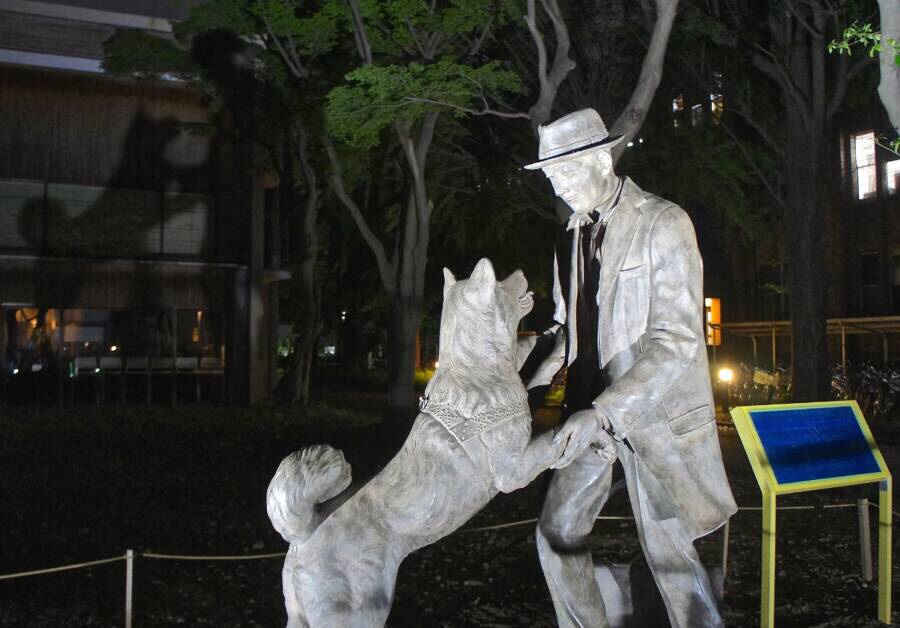
This statue commemorates the meeting of Hachikō and his master.
Hachikō the golden brown Akita was born on Nov. 10, 1923, on a farm located in Japan’s Akita Prefecture.
In 1924, Professor Hidesaburō Ueno, who taught in the agriculture department at Tokyo Imperial University, acquired the puppy and brought him to live with him in the Shibuya neighborhood of Tokyo.
The pair followed the same routine every day: In the morning Ueno would walk to the Shibuya Station with Hachikō and take the train to work. After finishing the day’s classes, he would take the train back and return to the station at 3 p.m. on the dot, where Hachikō would be waiting to accompany him on the walk home.
Shibuya Station in the 1920s, where Hachikō would meet his master.
The pair kept up this schedule religiously until one day in May 1925 when Professor Ueno suffered a fatal brain hemorrhage while teaching.
That same day, Hachikō showed up at 3 p.m. as usual, but his beloved owner never got off the train.
Despite this disruption in his routine, Hachikō returned the next day at the same time, hoping that Ueno would be there to meet him. Of course, the professor failed to return home once again, but his loyal Akita never gave up hope.
Becoming A National Sensation
Hachikō was only one of 30 purebred Akitas on record at the time.
Hachikō was reportedly given away after his master’s death, but he regularly ran off to Shibuya Station at 3 p.m. hoping to meet the professor. Soon, the lone dog began to draw the attention of other commuters.
At first, the station workers were not all that friendly to Hachikō, but his fidelity won them over. Soon, station employees began to bring treats for the devoted canine and sometimes sat beside him to keep him company.
The days turned into weeks, then months, then years, and still Hachikō returned to the station each day to wait. His presence had a great impact on the local community of Shibuya and he became something of an icon.
In fact, one of Professor Ueno’s former students, Hirokichi Saito, who also happened to be an expert on the Akita breed, got wind of Hachikō’s routine.
He decided to take the train to Shibuya to see for himself if his professor’s pet would still be waiting.
When he arrived, he saw Hachikō there, as usual. He followed the dog from the station to the home of Ueno’s former gardener, Kuzaburo Kobayashi. There, Kobayashi filled him in on the story of Hachikō’s life.
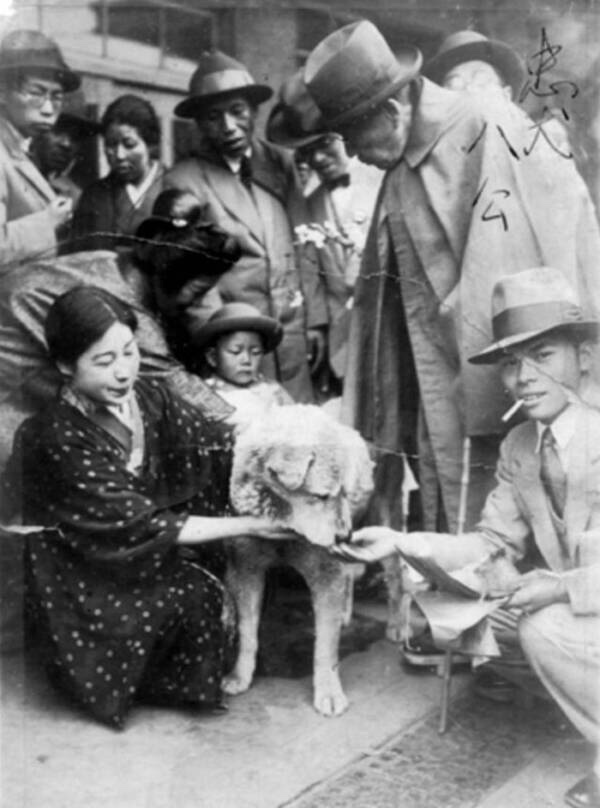
Visitors came from far and wide to meet Hachikō, a symbol of loyalty.
Shortly after this fateful meeting with the gardener, Saito published a census on Akita dogs in Japan. He found that there were only 30 documented purebred Akitas — one being Hachikō.
The former student was so intrigued by the dog’s story that he published several articles detailing his loyalty.
In 1932, one of his articles was published in the national daily Asahi Shimbun, and Hachikō’s tale spread throughout Japan. The dog quickly found nationwide fame.
People from all over the country came to visit Hachikō, who had become a symbol of loyalty and something of a good-luck charm.
The faithful pet never let old age or arthritis interrupt his routine. For the next nine years and nine months, Hachikō still returned to the station every day to wait.
Sometimes he was accompanied by people who had traveled great distances just to sit with him.
A Legacy Of Loyalty
Since his death, a number of statues have been erected in his honor.
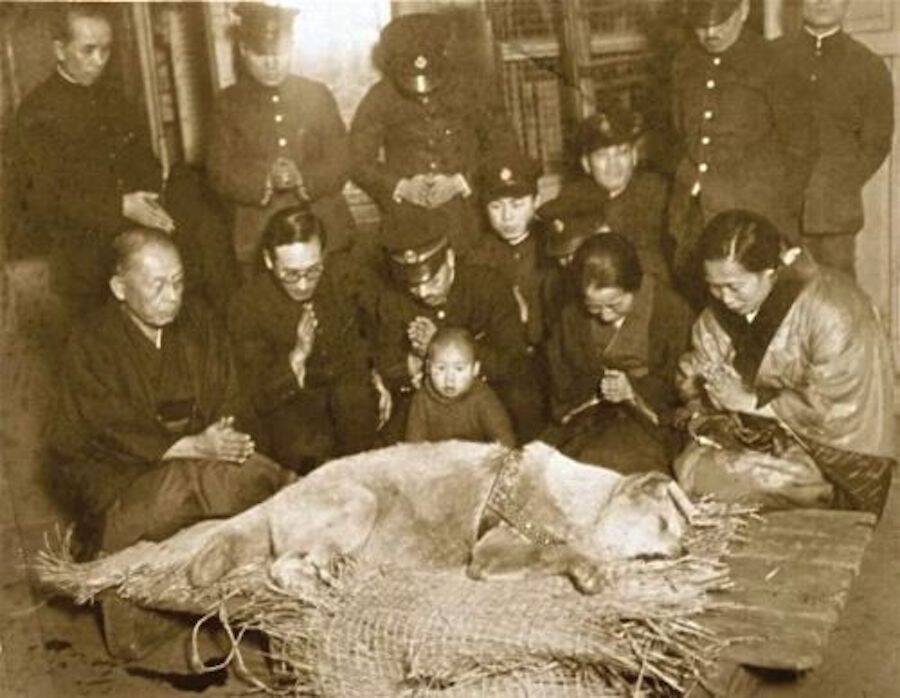
Hachikō’s great vigil finally came to an end on March 8, 1935, when he was found dead in the streets of Shibuya at the age of 11.
Scientists, who weren’t able to determine his cause of death until 2011, found that the dog Hachikō likely died of a filaria infection and cancer. He even had four yakitori skewers in his stomach, but researchers concluded that the skewers were not the cause of Hachikō’s death.
Hachikō’s passing made national headlines. He was cremated and his ashes were placed next to Professor Ueno’s grave in Aoyama Cemetery in Tokyo. The master and his loyal dog had finally reunited.
His fur, however, was preserved, stuffed, and mounted. It’s now housed in the National Museum of Nature and Science in Ueno, Tokyo.
The dog had become such an important symbol in Japan that donations were made to erect a bronze statue of him in the exact spot he had faithfully waited for his master. But soon after this statue went up, the nation became consumed by World War II. Consequently, Hachikō’s statue was melted down to use for ammunition.
But in 1948, the beloved pet was immortalized in a new statue erected in Shibuya Station, where it remains to this day.
As millions of passengers pass through this station daily, Hachikō stands proud.
Hidesaburo Ueno’s partner Yaeko Ueno and the station staff sit in mourning with the deceased Hachiko in Tokyo on March 8, 1935.
The station entrance near where the statue is located is even devoted to the beloved canine. It’s called Hachikō-guchi, simply meaning the Hachikō entrance and exit.
A similar statue, erected in 2004, can be found in Odate, Hachikō’s original hometown, where it stands in front of the Akita Dog Museum. And in 2015, the Faculty of Agriculture at the University of Tokyo erected yet another brass statue of the dog in 2015, which was unveiled on the 80th anniversary of Hachikō’s death.
In 2016, Hachikō’s story took yet another turn when his late master’s partner was buried alongside him. When Yaeko Sakano, Ueno’s unmarried partner, died in 1961, she explicitly asked to be buried alongside the professor. Her request was rejected and she was buried in a temple far from Ueno’s grave.
This stuffed replica of Hachikō is currently on display at the National Science Museum of Japan in Ueno, Tokyo.
But in 2013, University of Tokyo professor Sho Shiozawa, found a record of Sakano’s request and a buried her ashes beside both Ueno and Hachikō.
Her name was also inscribed on the side of his tombstone.
Hachikō’s Story In Pop Culture
Hachikō’s story first made it to film in the 1987 Japanese blockbuster titled Hachiko Monogatari, directed by Seijirō Kōyama.
The movie trailer for Hachi: A Dog’s Tale.
It became even more well-known when the tale of a master and his loyal dog served as the plot to Hachi: A Dog’s Tale, an American movie starring Richard Gere and directed by Lasse Hallström.
This version is loosely based on the story of Hachikō, though set in Rhode Island and centered on the relationship between Professor Parker Wilson (Gere) and a lost puppy that had been freighted from Japan to the United States.
The professor’s wife Cate (Joan Allen) is initially opposed to keeping the dog and when he dies, Cate sells their house and sends the dog to their daughter. Yet the dog always manages to find his way back to the train station where he used to go to greet his former owner.
The stuffed Hachikō on display at the National Museum of Nature and Science.
Despite the different setting and culture of the 2009 movie, the central themes of loyalty remain at the forefront.
Hachikō the dog might have symbolized the quintessential values of Japan, but his story and faithfulness continue to resonate with humans around the world.
Born Eric Clinton Kirk NewmanClassification: MurdererCharacteristics: Cannibalism – Necrophilia – Dismemberment – Snuff movieNumber of victims: 1Date of murder: May 24, 2012Date of arrest: June 4, 2012 (in Berlin)Date of birth: July 24, 1982Victim profile: Jun Lin, 33 (Chinese university student)Method of murder: Stabbing with an ice pick and a kitchen knifeLocation: Griffintown, Montreal, Quebec, CanadaStatus: In prison awaiting trial
Newman’s Grade 10 yearbook photo from 1999. (Jon Hembry/CBC)
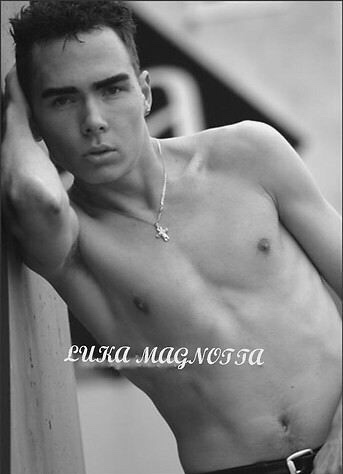
Luka Magnotta
Police remove a bag containing a human foot that was delivered to the Conservative Party of Canada’s headquarters in downtown Ottawa.
Montreal police said the grisly garbage discovery was the city’s 11th homicide of the year.
Interpol released images reportedly showing suspect Luka Magnotta passing through security at an airport. (Interpol)
Here, CCTV footage from the café shows Magnotta, second from left, being taken into custody by police on June 4, 2012 (Associated Press)
Kadir Anlayisli, who identified Luka Rocco Magnotta and warned police, stands next to the Berlin internet café where the suspect was arrested. (Markus Schreiber/Associated Press)
Mugshot of Luka Magnotta, taken by German police after his arrest in Berlin on June 4, 2012.
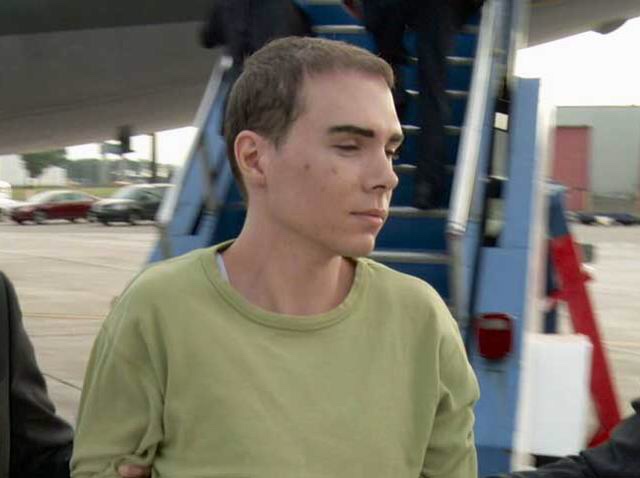
Luka Magnotta is taken from plane in Canada.
Lin (30 December 1978 – May 2012) also known as Justin Lin, was an international student from Wuhan and an undergraduate in the engineering and computer science faculty at Concordia University.
Luka Rocco Magnotta (born Eric Clinton Kirk Newman; July 24, 1982) is a Canadian pornographic actor and model accused of killing and dismembering Lin Jun, a Chinese international student, then mailing his severed limbs to political parties and elementary schools.
After a video allegedly depicting the murder was posted online, Magnotta fled the country, becoming the subject of an Interpol Red Notice and prompting an international manhunt. He was apprehended at an Internet café in Berlin while reading news about himself.
He was previously sought by animal rights groups for allegedly uploading videos of himself killing kittens.
Biography
Eric Clinton Kirk Newman was born in July 24, 1982 in Scarborough, Ontario. He attended I. E. Weldon Secondary School in Lindsay. He legally changed his name to Luka Rocco Magnotta on August 12, 2006.
In 2003, he began to appear in gay pornographic videos, occasionally working as a stripper and a male escort. He appeared as a pin-up model in a 2005 issue of Toronto’s fab magazine using the pseudonym “Jimmy”. In 2007, he was an unsuccessful competitor in OUTtv’s reality series COVERguy. Magnotta had multiple cosmetic surgeries and auditioned for Slice network show Plastic Makes Perfect in February 2008.
In 2005, he was convicted of one count of impersonation and three counts of fraud (against Sears Canada, The Brick, and 2001 Audio Video) after impersonating a woman to apply for a credit card and purchasing over $10,000 worth of goods. He pleaded guilty and received a nine-month conditional sentence with 12 months of probation.
Magnotta declared bankruptcy in March 2007, owing $17,000 in various debts. The bankruptcy was fully discharged in December 2007.
Rumors emerged in 2007 claiming Magnotta was in a relationship with Karla Homolka, a high-profile Canadian murderer, though he denied this in an interview with the Toronto Sun. During the murder investigation, Montreal police initially announced the pair had dated but subsequently retracted the statement and acknowledged that they had no evidence to corroborate the claim.
Many profiles on various internet social media and discussion forums were created over several years to plant false or unverified claims about Magnotta. Magnotta himself repeatedly dismissed such accounts as hoaxes and part of a campaign of cyber stalking against him. According to police, Magnotta set up at least 70 Facebook pages and 20 websites under different names.
Murder of Lin Jun
Lin Jun (Chinese: 林俊; pinyin: Lín Jùn) (30 December 1978 – May 2012) also known as Justin Lin, was an international student from Wuhan and an undergraduate in the engineering and computer science faculty at Concordia University. He worked part-time as a convenience store clerk in Pointe-Saint-Charles. Lin had been studying in Montreal since July 2011. Lin moved into a Griffintown-area apartment with a roommate on May 1. He was last seen on May 24, 2012 and his friends reported getting a text message from his phone at 9 PM. His boss became suspicious when he didn’t show up for his shift the next day. Three of his friends went into his apartment on May 27. He was reported missing to police on May 29.
On May 25, 2012, an 11-minute video titled 1 Lunatic 1 Ice Pick was uploaded to Bestgore.com depicting a naked male tied to a bed frame being repeatedly stabbed with an ice pick and a kitchen knife, then dismembered, followed by acts of necrophilia. The perpetrator uses a knife and fork to cut off some of the flesh and gets a dog to chew on the body.
During the video, the 1987 New Order song “True Faith” plays in the background, and a poster for the 1942 film Casablanca is visible on the wall. Canadian authorities were able to obtain a “more extensive” version of the video and confirmed that cannibalism may have been performed. Materials promoting the video appeared online at least 10 days before the murder took place.
On May 26, an attorney from Montana attempted to report the video to Toronto Police, his local Sheriff, and the FBI, but the report was dismissed by officials. Bestgore viewers also attempted to report the video. Police later confirmed it as authentic and identified the victim, an Asian male, as the same one whose body parts were sent to Ottawa.
At 11 AM on May 29, 2012, a package containing a left foot was delivered to the national headquarters of the Conservative Party of Canada. The package was stained with blood and had a foul smell. It was marked with a red heart symbol. Another package containing a left hand was intercepted in a Canada Post processing facility, addressed to the Liberal Party. A janitor discovered a decomposing torso inside a suitcase, left in a garbage pile in the alley behind an apartment building in the Snowdon area of Montreal. He first saw the suitcase on the 25th, but it was not picked up due to the large amount of garbage that day.
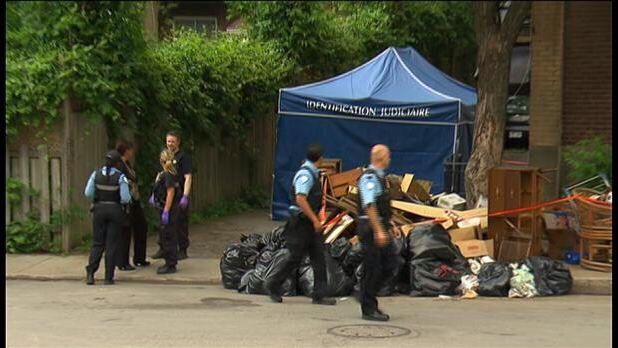
After searching the scene, police recovered human remains, bloody clothes, papers identifying the suspect, as well as “sharp and blunt objects” from the back alley. Footage from surveillance cameras inside the building showed a suspect bringing numerous garbage bags outside, and the images matched a suspect captured on video at the post office in Côte-des-Neiges.
At 23:33 EDT (03:33 UTC), police searched apartment 208, which Luka Rocco Magnotta was renting. He moved in four months prior, and his rent was paid up to June 1. The apartment had been mostly emptied before he left. Blood was found on different items including the mattress, the refrigerator, the table, and the bathtub. “If you don’t like the reflection. Don’t look in the mirror. I don’t care.” was written in red ink on the inside of a closet.
On May 30, 2012, it was confirmed that the body parts belonged to the same individual, later identified as Lin Jun. The suspect in the case was quickly identified as Magnotta, who had by then fled.
A note was found with the package sent to the Conservative Party, stating that a total of six body parts have been distributed and that the perpetrator would kill again. Notes were also included in the other three packages, but police declined to disclose their contents, citing concerns about possible copycats.
On June 5, 2012, a package containing a right foot was delivered to St. George’s School and another package containing a right hand to False Creek Elementary School in Vancouver. Both schools opened as normal the following morning. It was confirmed that both packages were sent from Montreal.
On June 13, the four limbs and the torso were matched to Lin Jun using DNA samples from his family. On July 1, his head was recovered at the edge of a small lake in Montreal’s Angrignon Park after police received an anonymous tip.
Lin’s body was cremated on July 11 and his ashes were buried on July 26 at Notre-Dame-des-Neiges cemetery in Montreal.
Luka Magnotta with his mother.
Luka Magnotta
Luka Magnotta
Luka Magnotta
Manhunt
An arrest warrant for him was issued by the Service de police de la Ville de Montréal (SPVM), later upgraded to a Canada-wide warrant by the Royal Canadian Mounted Police (RCMP), accusing him of the following crimes:
1.First degree murder; 2.Committing an indignity to a dead body; 3.Publishing obscene material; 4.Mailing obscene, indecent, immoral or scurrilous material; and 5.Criminally harassing Canadian Prime Minister Stephen Harper and several (unnamed) members of Parliament.
On May 31, 2012, Interpol issued a Red Notice for Magnotta at the request of Canadian authorities, and for several days before and after his arrest his name and photo were displayed prominently at the top of the homepage of the Interpol website. The Red Notice requested that Magnotta be provisionally arrested pending extradition back to Canada by any Interpol member state.
Magnotta flew from Montreal to Paris on May 26, using a false passport under the name Kirk Trammel. His cell phone signal was traced to a hotel in Bagnolet, but he had left by the time police arrived. Pornographic magazines and an air-sickness bag were found in the hotel room. He had contacts in Paris from a previous visit in 2010, and police were following a large-framed man who had been in contact with Magnotta. Another man he stayed with for two nights did not realize who he was until he had left. Magnotta then boarded a Eurolines bus at the Bagnolet coach station bound for Berlin, Germany.
On June 4, 2012, Magnotta was apprehended by Berlin Police at an Internet café in the Neukölln district while reading news stories about himself. He tried giving fake names before admitting who he was. His identity was confirmed through fingerprint evidence. Magnotta appeared in a Berlin court on June 5, 2012. According to German officials, he had not opposed his extradition. There was sufficient evidence to keep him in custody until extradition, and he agreed to a simplified process.
On June 18, 2012, Magnotta was delivered to Canadian authorities in Berlin and flown aboard a Royal Canadian Air Force CC-150 Polaris to Mirabel International Airport, north of Montreal. A military transport was necessary due to safety concerns with using a commercial flight and potential legal difficulties if the plane was diverted to another country. He was placed into solitary confinement at the Rivière-des-Prairies detention centre.
Aftermath
Reactions in China were highly critical, with some believing the murder was racially motivated. Some Chinese questioned public safety in Canada, as the killing was the second high-profile murder of a Chinese student there in slightly over a year. Foreign Affairs Minister John Baird called Chinese ambassador Zhang Junsai to convey his condolences.
On June 4, 2012, Canadian Prime Minister Stephen Harper said he was pleased that the suspect was arrested and congratulated the police forces on their good work in apprehending him. Interim Liberal Party leader Bob Rae said that Canadians should mourn the victim rather than “in any way, shape or form” celebrate Magnotta’s notoriety.
Two days later, Lin Jun’s family arrived at Trudeau Airport in Montreal. The Chinese Students and Scholars Association of Concordia University established a fund to defray expenses incurred by Lin’s family while in Canada and an award was created in his honor. A candlelight vigil was held in Montreal.
Magnotta was named Canadian Newsmaker of the Year by Canadian media, which caused controversy.
On July 16, 2013, Edmonton police charged BestGore.com owner Mark Marek with “corrupting morals”, a rarely used obscenity charge, for posting the 1 Lunatic 1 Icepick video online.
Luke Magnotta
Legal proceedings
Preliminary hearing
On June 19, Magnotta appeared in court by video link to plead not guilty to all charges through his lawyer. On June 21, Magnotta appeared in person at a high-security Montreal courtroom to request a trial by jury.
A preliminary hearing began on March 11, 2013. The evidence presented is subject to a publication ban. Magnotta’s defence team requested the media and the public be barred entirely from the hearing; this was declined the next day. Lin Jun’s father, Lin Diran, travelled from China to attend the hearing. On March 13, one of Magnotta’s lawyers resigned, due to a possible conflict of interest. Expert witnesses testified, including a forensic pathologist, a forensic toxicologist, a forensic odontologist, a bloodstain analyst, data recovery specialists and an Internet investigations officer. The prosecution also displayed video evidence. Both Magnotta and Lin physically collapsed at separate times during the proceedings.
On April 12, 2013, Luka Magnotta was indicted on charges of first degree murder, offering indignities to a human body, distributing obscene materials, using the postal service to distribute obscene materials and criminal harassment.
Trial
Following committal for trial, the preliminary inquiry judge set a tentative trial for the fall of 2014 on April 29, 2013. Magnotta elected to be tried by judge and jury.
Investigation into other possible crimes
Magnotta is alleged to be the person behind a series of videos of animal cruelty involving cats which were posted to YouTube beginning in 2010, including one titled “1 boy 2 kittens” which showed a man deliberately suffocating two kittens with a vacuum cleaner.
In January 2011, professional model and animal rights activist Sia Barbi joined a private Facebook group who had identified Magnotta as the person in these videos; subsequently animal rights activist groups offered a $5,000 reward for bringing him to justice.
In February 2011, Toronto police began investigating Magnotta in connection with the videos after receiving a complaint from the Ontario Society for the Prevention of Cruelty to Animals The OSPCA also contacted the Royal Society for the Prevention of Cruelty to Animals in England, the FBI, and police in Montreal due to the suspect’s extensive travels.
Alex West, a journalist for British tabloid newspaper The Sun, met Magnotta while he was living in London in 2011, following claims that he had made “Python Christmas”, an online video showing a kitten being eaten alive by a Burmese Python. The Sun contacted Scotland Yard, which denied that the python video incident had occurred within its jurisdiction, stating that the video had been “posted from somewhere in North America.” Following his meeting with Magnotta, Alex West said he received a threatening email, which he believed was sent by Magnotta.
On June 8, the Los Angeles Police Department announced they were in contact with Montreal police to determine if Magnotta was involved in the unsolved murder and decapitation of Hervey Medellin, known as the “Hollywood Sign Murder” but later announced that they did not believe he was involved in the crime. The animal rights group Last Chance for Animals claimed responsibility for posting YouTube videos linking him to the Hollywood Sign Murder in an attempt to lure Magnotta into contacting them. LCA offered a $7500 reward for information leading to his arrest while he was on the run.
The case also drew comparisons across North America to Mark Twitchell, a convicted murderer inspired by Dexter, who used social media in his crimes and to self-promote his work.[98] Author Steve Lillebuen, who wrote a book on the case, described a new trend in crime where social media allows killers to become “online broadcasters” and have direct, instant access to a global audience they may crave.
Wikipedia.org
Luka Magnotta: Owner of gore website rearrested in Edmonton
The Canadian Press
July 26, 2013
EDMONTON – Police in Edmonton say they have arrested a website owner who faces charges over a grisly video at the centre of the Luka Magnotta murder case.
A warrant was issued Thursday for Mark Marek on a charge of breaching conditions of his bail, which a judge granted last week.
Police say the 38-year-old was picked up at a gas station after they received a tip that led them to a nearby Edmonton-area storage facility.
Marek was originally charged with one count of corrupting morals for allegedly posting a video from Magnotta while knowing it depicted a real killing.
The video allegedly showed the killing and dismemberment of Chinese university student Jun Lin in Montreal.
Magnotta has pleaded not guilty to murder and is to stand trial in September 2014.
At Marek’s bail hearing, the Crown opposed his release, pointing out he had no Edmonton address and had made it clear to police that he planned to go back to his native Slovakia. Police had said he had been living out of his car since he returned to the city.
The defence said Marek had planned to visit family in the eastern European country in September, but didn’t intend to run away from his legal problems.
Marek told the judge that officers had already seized his passport.
Why Luka Magnotta’s trial won’t happen until 2014
Judge, courtroom availability key factors
By Daniel Schwartz, CBC News
May 7, 2013
Luka Magnotta’s murder trial is set for Sept. 15, 2014. Although that date is more than two years after his arrest in connection with the death of Jun Lin, that is not an unusual amount of time for a high-profile murder case to reach the trial stage.
Some have questioned why it takes so long for cases like Magnotta’s to get to court. Lukatrial.com, for example, the popular website that has been following the case from the beginning, says, “I will never understand how we can delay justice for so long in a case like this.”
The key determinant in most cases has to do with judicial resources, rather than issues related to the defence or the prosecution.
Ottawa criminal lawyer Ian Carter told CBC News that the 16-month delay between the preliminary hearing and Magnotta’s trial before judge and jury is not unusual. A trial like Magnotta’s “is normally set that far in advance because they need to find a courtroom and a judge.”
The Magnotta trial is expected to last six to eight weeks, a relatively big block of court time. The court facilities, the judge, the lawyers and the witnesses all need to be available at the same time, and there are always other trials in the queue competing for timeslots.
In the Magnotta case, his lawyer, Luc Leclair, had requested an earlier start date — April 2014 — but last week Justice Andre Vincent said September was the earliest possibility. “It’s a busy courthouse,” Leclair told reporters, adding, “I’m not completely surprised.”
Reasonable time
There are others factors as well that play a role in setting the date. The starting point is the Charter of Rights and Freedoms, which states, “Any person charged with an offence has the right … to be tried within a reasonable time.”
Section 11 of the Charter is also the one that says anyone charged should “be presumed innocent until proven guilty.”
A defendant who is to be tried by a superior court judge alone or a judge and jury usually has the right to a preliminary hearing. Magnotta’s wrapped up April 12 with an order to stand trial for first-degree murder and four other charges.
Carter says Magnotta’s preliminary hearing happened relatively quickly. “In terms of judicial resources, there’s a longer period of delay from the initial charge to the preliminary inquiry than there is between the preliminary and the superior court trial.”
“Technically, the preliminary is there to serve as a screening mechanism to see if there is some evidence of the offence you’ve been charged with, [but] in the vast majority of cases there’s no argument about committal to stand trial,” Carter said.
Where that does happen, sometimes, is in murder cases, with an argument over whether the charge should be first- or second-degree murder or manslaughter. Leclair argued unsuccessfully that Magnotta should be tried for second-degree.
However, Carter explained that the reality with preliminary inquiries is that, “In the vast majority of cases it’s used by the defence as discovery-type process, to get information about certain parts of the crown’s case,” and to get an idea of how witnesses will perform in the courtroom.
The Crown can avoid a preliminary inquiry by getting the attorney general to approve a direct indictment.
The decision to do so is made unilaterally by the prosecutors and the defence has no ability to argue against it. Last year, the Crown got a direct indictment in a terrorism case in which Carter is representing one of the accused, Misbahuddin Ahmed, who was arrested in 2010. In that case, the jury trial won’t begin until April 2014.
The availability of the lawyers for both sides, and the witnesses, is also taken into account when setting a trial date. Once the available date for a judge and courtroom are known, the two sides usually work out which option to choose.
After a trial date is set
Once the trial date is set, both sides have more work to do. Although most of the investigative materials should have been handed over to the defence ahead of the preliminary hearing, both sides will study the transcripts from the hearing.
The prosecution probably won’t put forward its full case at the inquiry, and “it’s a much bigger task doing it in front of a jury,” Carter explains.
The defence has to work out their strategy, line-up expert opinion, get extra evidence, and prepare to cross-examine witnesses, which Carter says will be different in front of a jury compared to the preliminary. And it’s likely there will be additional witnesses called.
“In a jury trial, there is always more work to be done,” he said. “As defence counsel you don’t necessarily want to show your entire hand at the preliminary.”
Pickton, Shafia, Bernardo murder trials
Compared to some other high profile murder trials in Canada, the expected timeline for the Magnotta trial appears to be about average. As a comparison:
For Robert Pickton, who was charged in 2002 in connection with the disappearance of dozens of women in Vancouver, it was four years, 11 months before his murder trial began.
For the three accused in the 2009 Shafia family murder case, two years and three months would elapse between the arrests and the start of the trial.
Paul Bernardo was arrested in 1993 for the murders of school girls Leslie Mahaffy and Kristen French. His trial began two years, three months later.
Magnotta’s trial is set to begin two years, three months after his arrest.
Luka Magnotta & his troubled history
CBC.ca
November 2012
Most of the world first learned of Luka Magnotta on May 30, 2012, when he was named as a suspect in a grisly Montreal killing involving the shipping of body parts to the headquarters of two political party.
But some online communities had taken notice of the man long before that. Over the years, Magnotta had littered the internet with information about himself – both untrue and true – using dozens of pseudonyms, all in an effort to attract the worldwide fame he craved.
Over time, friends, acquaintances and family members became concerned that something was amiss with the Scarborough, Ont.- born man.
Troubling signs
The following is a timeline of Magnotta’s life, the troubling signs that emerged and how an online community tracked him down, based on exclusive interviews and information obtained by CBC’s the fifth estate.
July 24, 1982
Born in Scarborough, Ont.
Magnotta is born Eric Clinton Kirk Newman in Scarborough, a suburban community on the eastern outskirts of Toronto, to mother Anna Yourkin and father Donald Newman. He is the eldest of three kids. His parents split while Eric is still young. Newman later goes to live with his grandmother, Phyllis.
1998
Attends high school
1998-2000: At some point, Newman’s grandmother and grandfather also divorce. Newman is home schooled for a period of time; in one blog post, he later writes that it was because he was told the world is a dirty and dangerous place. However, for at least two years, from 1998 to 2000, he does attend I.E. Weldon Secondary School in Lindsay, a rural community in the Kawartha Lakes region of southeastern Ontario. Former teachers and classmates remember him for his vanity and preoccupation with looks. He changes his hair colour often.
2002
Starts stripping
Around 2002 or 2003, Newman begins stripping at Remingtons, a nightclub in Toronto. By 2003, he has appeared in his first two pornography films, both as a straight man turned gay. The following year, he appears in at least two other pornographic films, including one where he appears as Jimmy – a name he would also adopt while working as a male escort.
2004
Allegations of sexual assault
Newman catches the attention of the Toronto Police after he befriends a 21-year-old woman with the mental capacity of a child eight to 12 years of age, convinces her to apply for credit cards and then racks up $10,000 in unpaid bills. He is charged with fraud. Initially, police allege he sexually assaulted the woman and videotaped it, but the Crown drops the charge before the case goes to trial. Newman’s lawyer at the time, Peter Scully, now says that the decision changed the course of Newman’s life “immeasurably, with huge ramifications to our society eventually.”
2005
Convicted of fraud
June 2005: Newman pleads guilty and is convicted of four fraud charges. Before sentencing, Newman’s lawyer shows the court a medical report revealing his client has “significant psychiatric issues.” In handing down the sentence, Madam Justice Lauren Marshall issues a stern warning: “You have a medical problem and you need to always take medication. If you do not, your life is going to get messed up.” Newman is given a nine-month community-service sentence and 12 months of probation.
2005
Dreams of policing
Newman continues to appear in low-level porn films. He also appears in Fab Magazine, a gay bi-weekly in Toronto, on the “Fab Boy” page as “Jimmy.” There, he describes himself as a “22-year-old soccer fan” born in Russia and living in Toronto who hopes to become a vice or homicide police officer.
2006
Changes name
Early in 2006, Newman meets Barbie, a transgendered woman, and they begin dating. “He said he wanted to be famous one day,” Barbie told the fifth estate in a recent interview. She recalls his apartment looking like a shrine dedicated to himself. “He would always beg me to take pictures of him,” she says. In April, several months after meeting Newman, Barbie breaks up with him. That summer, Newman legally changes his name to Luka Rocco Magnotta.
2007
Bankruptcy
March 2007: Magnotta files for bankruptcy, listing the cause as “illness, lack of employment and insufficient income to pay off debts.” He claims that he had to pay $200 each month in expenses relating to an unspecified medical condition.
2007
Reality show auditions
2007-2008: Throughout 2007, Magnotta continues his attempts to make a name for himself. In the summer, he auditions for the reality show Cover Guy, telling the judges, “Some people say I am devastatingly good-looking.” The judges reject him. In February of 2008, he also tries out for the reality show Plastic Makes Perfect. “I’ve had my nose done. I’ve had two hair transplants,” he tells them. “And I’m planning on having muscle implants in my pecs and my arms.”
September 14, 2007
Denies Homolka rumours
The Toronto Sun publishes a story by reporter Joe Warmington about how Magnotta had dropped by the newspaper’s headquarters to deny online rumours he was dating notorious schoolgirl killer Karla Homolka. The rumours were likely started by Magnotta himself. In later years, a tribute video to Homolka was created by a Luka Magnotta alias account on YouTube; all the videos uploaded/favourited are Magnotta- or Homolka-related.
2008
Online personas
Magnotta continues to try to garner attention online, posting comments about himself to create rumours and then using other profiles to deny them. Twice this year, he loses battles with Wikipedia to keep a page up about himself. He also posts an online escort ad under the alias Jimmy. One client posts an unflattering review describing him as cold and remote.
October 2009
A travel companion
Magnotta meets a 70-year-old man in Toronto who ends up becoming his travel companion. Together, they visit Russia, Italy and France. Henry, a fake name used to protect his identity, told the fifth estate they met at the Pickle Barrel restaurant located near Toronto’s Yonge and Eglinton intersection. “He walked as if he was on a stage or as if he was on a ramp for modeling clothes,” said Henry.
2010
Darker postings
Fall of 2010: In 2010, Magnotta’s online postings get progressively darker. On his Facebook page, he posts a link to a video called, 3 guys 1 hammer that shows a man being viciously beaten to death. The video was not by Magnotta. The myth about Magnotta’s relationship with killer Homolka grows. In one posting about Magnotta and Homolka, the user — likely Magnotta — writes, “Luka is unable to live unless there is chaos in his life, it makes him feel as though he matters.”
2010
Kitten-killing video
Dec. 21, 2010: Shortly before Christmas, a video called 1 guy – 2 kittens started circulating on discussion boards. Posted on Dec. 21, the video depicts an unidentified man, whose face is concealed, placing two kittens in a sealed bag and then sucking out the air with a vacuum to suffocate them. Though the video is quickly removed from YouTube, animal activists learn of it.
December 2010
Group seeks kitten killer
Soon after, Ryan Boyle, a former U.S. soldier who uses the online name Save Kitty, forms a Facebook group called “Find the Vacuum Kitten Killer for Great Justice.” About 4,000 people sign up. “These were not people who were doing it for money,” said Boyle, referring to the online activists. “They all had the same thing in mind: we want to catch this guy.” The group believes Magnotta joined the group under an alias, based on certain users’ online patterns of behaviour. When the group goes astray in its search for the kitten killer, they believe that Magnotta himself anonymously went on a message board frequented by the group and posted pictures from the video with the face no longer blurred.
December 28, 2010
$5,000 award posted
Rescue Ink, an animal protection group, posts a $5,000 reward for information leading to the arrest of the Vacuum Kitten Killer (VKK). “It’s a gateway crime, animal abuse,” Joe Panz, a founding member of the group, told the fifth estate. “Once somebody starts to open that door, that’s when things start to get really dangerous.”
2011
Contacts N.Y. lawyer
Jan. 4, 2011: Magnotta, now in New York, makes contact with lawyer Romeo Salta, expressing alarm about the firestorm over the kitten killer. “He was convinced the animal activists were closing in,” said Salta. Magnotta asks whether any arrest warrants are pending on him. There aren’t any.
2011
New online hunt starts
Early 2011: A new 11-member online group, called the Animal Beta Project or the AB Project, emerges in early 2011 with the goal of stopping Magnotta before he kills again. “We felt he would continue, that he would harm other animals and eventually move onto something even more violent, like hurting a person,” said John Green, an online alias. He spoke to the fifth estate on the condition of anonymity. The amateur sleuths analyze the kitten-killing videos frame by frame. They claim that furnishings and the kitten killer’s clothing in the videos are the same as those in other images of Magnotta posted on the web.
February 2011
Police file opened
Though the secretive AB Project group discovers a wealth of information about Magnotta online, they struggle to track down his physical location. The AB Project had been using exif (exchangeable image file) data from pictures posted of Magnotta online that told them when and where photos were taken. One innocuous photo from October 2010 taken on a cellphone stamped with a GPS locator finally suggests to them that Magnotta was in Toronto. The group contacted the Ontario Society for the Prevention of Cruelty to Animals with all their findings, who then reach out to the Toronto Police. The police open a file on Magnotta in February of 2011.
November 2011
New kitten videos
Late November and early December 2011: A year after the original kitten-killing videos appear online, more videos are posted. A man wearing a Santa hat is shown feeding a live kitten to a python. In another, a kitten is duct taped to a broom handle then drowned in a bathtub. “He was basically saying, ‘Look, I’ve done it again. You’re not going to catch me,'” said AB Project member John Green.
December 8, 2011
London encounter with reporter
After The Sun in London, U.K., publishes a story about the kitten killer, Magnotta turns up at their office to deny that he had killed a kitten. The paper has not asked about him and reporter Alex West describes the behaviour as “highly suspicious.” West wrote, “But behind the denials it seemed he was getting some sort of bizarre pleasure out of the attention.” Two days later, threatening emails are sent to the Sun’s offices, believed to be from Magnotta. “Next time you hear from me it will be in a movie I am producing that will have some humans in it, not just pussies,” the email says. The London police are notified but say it was outside their jurisdiction.
2012
Ties to Montreal
Early 2012: Investigators with the AB Project receive a tip in early 2012 that Magnotta might have moved to Montreal. The project members then begin searching through their archive of Magnotta pictures looking for any that connects him to the city. One photo with unique streetlights catches their attention. The online sleuths begin systematically looking at Montreal intersections using Google’s Street View and track the one in the picture to a neighbourhood in Montreal. Around this time, Magnotta’s online activity begins to accelerate with blog postings about necrophilia and sedatives.
May 15, 2012
New video promoted
May 15-16, 2012: Over the course of two days, from May 15 to 16, repeated references are made online to a new video, 1 Lunatic 1 Ice Pick, that hasn’t even been posted. One reference depicts a person in a purple hoodie with a fist holding an ice pick. On one site, a user asks, “Where can I watch the 1 lunatic 1 ice pick video?” Ryan Boyle, a former soldier who started a Facebook group looking for the kitten killer, believes this is similar to earlier patterns where Magnotta would build buzz about a video via aliases before actually releasing the video.
May 24, 2012
Silence, then a disappearance
After a flurry of online postings, Magnotta’s online activity appears to go black for a few days.
On May 24, Concordia University student Jun Lin fails to show up for his job.
May 25, 2012
Video posted
On May 25, a video titled, 1 Lunatic 1 Ice Pick, is posted on the web. It depicts a young male bound on a bed, initially alive and then lifeless. Then someone is seen repeatedly stabbing the corpse with an ice pick and dismembering the body with a knife. There are also acts of necrophilia and cannibalism.
May 29, 2012
1st body parts found
Staffers at Conservative Party HQ in Ottawa call police after receiving a package containing a foot. Ottawa police later say they found a second package containing a hand. Montreal police confirm they’re investigating a human torso found in a garbage pile in that city.
May 30, 2012
Suspect named
Montreal police say Luka Rocco Magnotta is wanted in the homicide investigation stemming from the body parts. He’s been on their radar since the day before, and can be seen on surveillance video of his apartment building and a Canada Post outlet.
May 30, 2012
Video analyzed
A video allegedly showing the murder and dismemberment of a man had appeared on a website days before. Mark Marek, the owner of the website, tells CBC News members of his site identified Magnotta. Police view the video for the first time this morning.
June 2012
Victim identified
Authorities identify the victim of the gruesome killing and dismemberment as Jun Lin, a Chinese national who was studying at Concordia University in Montreal. Meanwhile, police announce that Magnotta left Canada for France on May 26.
June 3, 2012
Magnotta spotted in Paris
Now at the centre of a global manhunt, Magnotta, who has been dubbed the “Butcher of Montreal” by French media, may have been spotted in a Paris café, according to eyewitness accounts being investigated by local police.
June 4, 2012
Magnotta arrested
Luka Rocco Magnotta is arrested at an internet café in Berlin, where he was reportedly reading stories about himself.
June 5, 2012
Magnotta awaiting extradition
Suspect Luka Rocco Magnotta is held in a Berlin jail awaiting extradition to Canada on charges of first-degree murder and other offences, after a global dragnet tracked him down in the German capital.
June 5, 2012
Hand & foot sent to B.C.
Staff opening the mail at two Vancouver elementary schools discover a human hand and a foot, and it’s later determined they came from Montreal — prompting speculation about a Magnotta link.
June 7, 2012
Link to L.A. homicide rejected
Law enforcement sources in California confirm there is no link between Magnotta and a case in which severed hands, feet and a head were found near the Hollywood sign, according to the L.A. Times.
June 8, 2012
Jun Lin Award created
Concordia University announces the creation of an award commemorating the life of Jun Lin, the Chinese student who was killed in late May and dismembered.
June 12, 2012
Jun Lin was family’s ‘pride and joy’
The family of Chinese student Jun Lin, who was brutally murdered and dismembered in Montreal last month, says his death was a “destructive blow” that left them physically and psychologically spent.
June 13, 2012
Vancouver body parts belong to Jun Lin
Montreal police Cmdr. Ian Lafrenière says DNA test results confirm that body parts delivered to Vancouver schools last week belong to Jun Lin.
June 18, 2012
Magnotta arrives home to face Canadian justice
Magnotta arrives at Quebec’s Mirabel airport by military plane in a highly controlled and secretive extradition operation orchestrated to minimize media attention on his return from Germany
June 19, 2012
Magnotta pleads not guilty
Appearing via teleconference at a Montreal courthouse, Magnotta pleads not guilty to a number of charges including first-degree murder, committing an indignity to a human body, posting obscene material, mailing obscene material and criminally harassing Stephen Harper and other members of Parliament.
June 21, 2012
Magnotta back in court for possible psychiatric evaluation
Luka Rocco Magnotta will appear in Montreal court via video-link today for a possible psychiatric evaluation request.
July 2, 2012
Investigators follow tip to remains in park
A tip led police to a Montreal park where remains were discovered near a small lake. Montreal police have not publicly linked the remains, which have yet to be confirmed as coming from a human, to the case.
July 4, 2012
Head found in Montreal park belongs to Jun Lin
Quebec authorities have confirmed that a severed human head found in Angrignon Park over the weekend belongs to Chinese student Jun Lin.
July 21, 2012
Jun Lin honoured at Montreal memorial
The parents of Jun Lin took part in an emotional and often tearful public memorial, as Montreal’s Chinese community gathered to remember the student two months after he was brutally killed.
Luke Magnotta
Luka Rocco Magnotta arrested in Germany
CBC News
June 4, 2012
Luka Rocco Magnotta, suspected of killing a Chinese university student in Montreal and mailing the dismembered body parts to Canadian political parties, has been arrested at an internet café in Berlin where he was reportedly reading stories about himself.
Magnotta, 29, is wanted by Montreal authorities on first-degree murder and other charges, including threatening Canadian politicians, in a case that has drawn international attention and spawned one of the largest manhunts in Montreal police history.
Montreal police Cmdr. Ian Lafrenière said Magnotta’s identity was confirmed through fingerprint evidence.
“The investigation is far from being over. We’ve got to bring the suspect down to Canada to face justice,” said Lafrenière, who added that some of the dead student’s body parts are still missing.
“There will be tons of questions to answer,” he said.
Magnotta was arrested in Berlin on an Interpol “red notice,” which under German law is considered a “provisional request from Canada for his extradition,” Julie Di Mambo, press secretary for Justice Minister Rob Nicholson said in a statement.
Canada is now required to submit a formal request for Magnotta’s extradition, accompanied by “documentation outlining the evidence supporting the request,” the statement said.
It’s unclear, however, when Magnotta will actually set foot on Canadian soil.
“It could take a very long time,” said Rene Verret, a spokesman for Quebec’s bureau of prosecutions.
Verret said his office will send a request in the coming days to Nicholson for Magnotta’s extradition, asking that it be forwarded to German officials. However, the legal process could extend for months if the extradition is contested.
Investigators are scheduled to hold a news conference Tuesday to provide more details on the case. It is their priority to return the accused killer to Canada.
Magnotta is suspected of killing Jun Lin — a 33-year-old Chinese university student with whom he had a relationship — recording video of the attack and mailing the victim’s dismembered body parts to federal political parties in Ottawa.
Berlin police spokesman Chief Supt. Stefan Redlich told CBC News that authorities arrested Magnotta at 2 p.m. Berlin time (8 a.m. ET) at the Helin Café on Karl Marx Street.
Seven officers were involved in the arrest, which was made after police were tipped off.
“As far as I know he was arrested alone, and there was no struggle,” Redlich said.
There is no doubt about the suspect’s identity, and “he is the person Canada is looking for,” he added.
Magnotta ‘went quietly’
The café’s owner, who spoke on condition of anonymity, said he witnessed the arrest.
“A colleague recognized him from his photo, because he’d just read the newspaper,” said the owner. “Nothing happened, it all went very quietly,” he said.
Kadir Anlayisli, the man who recognized the suspect and called police, works in the after-hours tobacco shop of the café. Berlin police confirmed that the arrest was mostly straightforward, but added that Magnotta initially denied his identity. Eventually he admitted, “OK, you got me.”
Magnotta is being held at the Berlin prison and is expected to be brought before a German judge on Tuesday.
But he likely won’t be questioned about the alleged crimes in Montreal, as “this is a Canadian case,” Redlich said.
Montreal police say they learned of Magnotta’s arrest at 12:40 p.m. ET, and the news came as a great relief for many investigators, said Lafrenière.
“We thank the media who broadcast his photo, and information on the web also had a part in coming to this result,” said Lafrenière.
Police will hold a full briefing on the case on Tuesday morning. Magnotta, dubbed the “Butcher of Montreal” by European media and “Canadian Psycho” at large, was spotted in Paris on the weekend, at a local café and in a hotel, after fleeing Montreal last week.
Magnotta had been reading stories about himself
Berlin-based freelance reporter Allan Hall said Anlayisli, who identified Magnotta, immediately recognized the man.
The café employee said Magnotta had been seated at computer number 25 reading stories about himself online. Anlayisli ran outside to flag down police.
“Anlayisli said the first police car stopped and the guy didn’t take him seriously,” Hall told CBC News in a telephone interview. “He had to stop another police car, then come into the internet café. The second police car called for backup.”
Hall added that Magnotta left his hotel in Paris on Friday and paid €100 to travel 14 hours from Paris to Berlin. Magnotta did not have to show a passport due to open border policies, he added. Police are working to reconstruct the timeline of Magnotta’s movements.
If investigators discover that Magnotta committed crimes while in Germany, the extradition process may become more complicated, reported Hall.
Harper congratulates police
Prime Minister Stephen Harper, who is in London for the Queen’s jubilee celebration, told reporters he is “pleased” Magnotta has been arrested.
“I just want to congratulate the police forces on their good work,” Harper said.
he prime minister is named, along with other Canadian politicians, in the police arrest warrant issued after Lin’s murder.
Magnotta is accused of criminally harassing Harper and other members of Parliament.
Interim Liberal Leader Bob Rae asked Canadians to remember the victim.
“Let’s not forget that a young man was killed in the most terrible of circumstances. He came to Canada to improve himself, and to improve his life, and he is dead.
“His family in China is mourning, and his friends are in mourning, and all of Canada should be mourning for the person who died, rather than … celebrate the notoriety of Mr. Magnotta.”
Magnotta also faces charges of first-degree murder, committing an indignity to a dead body, publishing an obscene thing, and mailing obscene matter.
Body parts suspect focus of global manhunt
Interpol joins search for Luka Rocco Magnotta after torso, foot, hand found
CBC News
May 31, 2012
Police say the intense media spotlight and international search for Luka Rocco Magnotta, the 29-year-old suspect in the grisly slaying and dismemberment of a victim whose body parts were sent in the mail, will make it difficult for him to remain on the lam.
Interpol posted a picture and information on Magnotta, a Montreal resident, on its website Thursday among a group of nine international suspects wanted for crimes including homicide, kidnapping and organized crime.
Interpol’s involvement came after Montreal police issued a worldwide warrant for first-degree murder.
Clues at the Montreal crime scene led police to expand their search abroad.
“We found some evidence,” said Montreal police Cmdr. Ian Lafrenière. “We found, also, a letter that was posted on a website making us believe he might be gone out of the country.”
He said the suspect may have fled to a different continent — but he would not confirm a report that the possible destination was France.
“There is no country in the world that is not talking about him,” Lafrenière said. “There’s a lot of heat on him. There’s a lot of pressure on him, so we believe that it’s going to be hard for him.”
“If you look on different websites, you see the appearance of that person could change dramatically — from a male to a female, wearing and things like that — so that’s the reason we’ve put a lot of effort trying to locate this suspect,” Lafrenière said.
Magnotta has family in the Toronto area, so investigators are still working with domestic police agencies in case, he said.
Victim likely in a relationship with suspect
Magnotta is wanted in connection with the slaying of a man whose body parts were sent through the mail and found stuffed in a suitcase behind a low-rise apartment in west-end Montreal, near the Décarie Expressway.
Police believe Magnotta was in “a relationship” with the victim, said to be a man in his 30s.
Investigators haven’t released the victim’s name and are awaiting autopsy results to confirm his identity.
However, Montreal police said they believe the victim was reported missing in Montreal several days earlier.
“There’s no family in Montreal, that’s why it’s going to be even more complicated,” Lafrenière said.
He said police believe the victim was killed last week. The property manager at the Montreal building where a torso was discovered stuffed in a suitcase in a trash pile said he first saw the luggage out on Friday.
Montreal police said they had received 15 solid tips about Magnotta’s whereabouts within two hours of releasing his photo Wednesday afternoon.
“We received many calls because a lot of people were shocked about this story,” Lafrenière said.
He said police are holding some information back to weed out false leads from the public.
Online investigation
Police said much of their investigation has been focused on the internet, because Magnotta did not have an extensive criminal record.
“There’s a heck of a history on the website now,” Lafrenière said. “We’re finding all kinds of images, all kinds of information.” Several websites show pictures of the suspect in modelling poses.
Sources have told CBC News that police believe they have evidence of the suspect videotaping the killing and dismembering the victim.
Police said they’re being careful in their release of images and video to help find the suspect, but cautioned this could be the kind of attention he is after.
“That type of suspect, I call him a suspect but a very deranged man, is looking for publicity,” Lafrenière said.
U.S. lawyer says he warned police about graphic video
A lawyer based in Montana told CBC News that he notified Toronto authorities over the weekend about a graphic online video that appears to depict the stabbing and dismemberment of a man.
Roger Renville, a civil litigation lawyer, said he came across the 10½-minute video Saturday morning on a website that showcases gory footage. Renville said he believes the video documents the killing and dismemberment of a man.
There isn’t any confirmation that the victim in the video is the same one that Magnotta is alleged to have killed.
But Renville said he is “extremely frustrated” at how Toronto police handled his weekend call.
“I kept insisting, and he told me that my story didn’t make sense,” he said in a Skype video interview Thursday. “Why would a killer film himself and then put it on the internet?”
Toronto police denied that they ignored Renville’s tip.
Remains still unaccounted for
The full scope of the crime came to light Tuesday when a torso was discovered in Montreal and the hand and foot surfaced in Ottawa.
The foot was sent to Conservative headquarters and a hand found at a Canada Post terminal that was addressed to the Liberal Party of Canada headquarters.
Montreal police said there are still remains that are unaccounted for, but they have no reason to believe they were also sent in the mail.
Magnotta, believed to be originally from Toronto, is also known as Eric Clinton Newman and as Vladimir Romanov. Montreal police give this description of Magnotta:
Five feet 10 inches tall. 135 pounds. Black or dark brown hair. Blue eyes.
Building manager Eric Schorer said Magnotta had lived there for four months but hadn’t been seen around in a while. He said there were never any complaints about noise in the unit, and that Magnotta passed a credit test to rent there.
Police in masks combed through the blood-soaked apartment Wednesday, having zeroed in on the source of a stench locals described as rotting meat, said a building resident.
A neighbour said police were showing neighbours pictures of two men — the suspected victim and the homicide suspect.
Montreal police said Magnotta was not known to them and had no criminal record. CBC News has learned, however, that he was convicted on four counts of fraud in Ontario in 2005. He served 16 days in pre-trial custody and was given a further nine-month conditional sentence and 12 months probation.
The suspect’s name has also come up in association with videos showing the killing of kittens. A CBC News source said police are also investigating a possible connection between the suspect and Karla Homolka.
Lafrenière said he would not substantiate internet rumours about the suspect.
Staff Sgt. Marc Habgood of the Peterborough Lakefield police service said they were contacted by Montreal investigators looking for Magnotta on Thursday.
“They advised us that they had a warrant for the arrest of a male party for [murder] and that he had family members in Peterborough, so he asked us to check a couple of residences,” he told CBC’s Peterborough affiliate, CHEX.
“We spoke to two family members and they hadn’t seen or heard of him in over a year… His family is here. They really stress that they’ve had nothing to do with him for over a year. They’re not anticipating hearing from him or seeing him.”
‘Horrible’ crime scene
The hand and foot mailed to Ottawa were sent from a fake Montreal address, police said.
Lafrenière described the scene of the alleged crime as “horrible” but said investigators would be releasing few details for now.
“The most important thing for us is to nab the suspect, and to make sure we don’t jeopardize a future trial. I’d have a lot of trouble, as a father, to sleep if that happened.”
Police find 2nd body part after foot mailed to Tory HQ
Reports of severed hand found after human foot delivered to Conservative HQ
CBC News
May 29, 2012
Ottawa police say they have found a second body part in a package as they investigate the delivery of a human foot to the Conservative Party of Canada’s headquarters in downtown Ottawa.
Police would not say what the body part was, nor where it was found, though they did say it was not found at the Conservative Party offices on 130 Albert St. where the foot was sent.
Media reports said the second package, containing a human hand, was not addressed to the Tory headquarters. Police said the major crime unit continues to investigate.
Police were called to the building at 11:20 a.m. ET after a suspicious package was delivered there. Police called for the hazardous materials unit after they noticed what appeared to be blood on the package.
The Hazmat Unit and Emergency Operations Section inspected the package and determined that there was possibly a human foot in the box. A coroner later confirmed it was a human foot.
Package delivered through Canada Post
Major Crimes Staff Sgt. Bruce Pirt said the suspicious package was delivered through Canada Post and conceded it’s possible it was sent as a “gruesome message.”
The foot was decomposing and there was a stench when a CPC employee opened it, said Pirt. He would not say whether the foot belonged to a male or female.
Police found the second package in the course of the investigation, but would not reveal any more details.
Police are working with Canada Post to determine the origins of the packages and said they may also be in touch with morgues and funeral homes to see if they are missing any body parts.
Ottawa police are also checking to see if their case is connected with an RCMP investigation in Montreal after police there found a human torso in a pile of garbage in the Côte-des-Neiges borough.
News shocks MPs
Sgt. Steve Hodgson said Conservative Party staff members were shaken up by the incident.
Conservative Party spokesman Fred DeLorey said Ottawa police are investigating and all questions should be referred to them.
Several members of Parliament said they were caught off guard by the news.
“It’s shocking for somebody to do that,” said Labour Minister Lisa Raitt. “I’d hate to be the one opening that.”
Torso found in Montreal garbage pile
Suitcase stuffed with human remains
CBC News
May 29, 2012
The major crimes unit of the Montreal police is investigating the discovery of a torso in a pile of garbage in the Côte-des-Neiges borough, west of Décarie Boulevard.
Police said a suitcase holding the human remains was found behind an apartment building at the corner of Place Lucy and the Décarie.
The building’s janitor made the grisly discovery Tuesday morning at about 10:15 a.m.
Mike Nadeau told CBC News he first noticed the suitcase in a large garbage pile last week, but only opened it Tuesday after people complained about a stench in the air.
He said there were maggots crawling all over the suitcase.
“As soon as we opened it, we just saw the body, with no head, and said, ‘We’re out of here, call the cops.'”
Police in Ottawa are working with Montreal police to see if a human foot dropped off at Conservative party headquarters Tuesday belongs to the same body.
Montreal authorities aren’t releasing any details about the age or gender of the body, but say it’s too soon to tell whether the torso belongs to a man or a woman.
They say more information will be available after an autopsy is performed.
Betty Makoni is a former teacher who lives and works in Zimbabwe, where she directs the Girl Child Network, which she herself set up. In a 2007 article entitled “Giving Zimbabwe’s Girls a Voice”, she explained the reasons that led her to give up her official teaching job and devote herself to protecting and supporting the young girls of her country. “It is my own personal story that led me to do what I have done. I had been raped at the age of six by a man who raped young girls without any embarrassment and, at the age of nine, my mother died due to an act of violence in my family. When I was eight, I had rebelled and tried to convince my mother to report the violence she suffered at the hands of my father, but she had placed a finger against my mouth to stop me broaching that subject in public. That order, so common all over Africa, is precisely what I was determined to reject when I grew up. It was not only I and my mother that suffered but virtually every girl or woman that saw such abuse ‘hidden under the carpet’. That was the norm”. As an adult Betty chose to work as a teacher. She used part of the money she earned selling fruit and vegetables in the street markets to pay for her studies. Having graduated in socio-linguistics and with various specializations, she was assigned a teaching job in Chitungwiza, a densely populated suburb of Harare. In her position as a teacher, she frequently heard about abuse being committed against her pupils and she was frustrated to see how many girls dropped out of the education system at the beginning of each school year. In 1998 she decided to set up a group with nine girls, in which they all shared their stories and problems and tried to find solutions to them together. In 1999 she founded the “Girl Child Network” (GCN), with the aim of providing school-age girls with economic support, assisting them psychologically, offering them hospitality and advice, rehabilitating those who had suffered abuse and placing cases of violence and sexual abuse against children into the public domain. Betty sees to the material needs of the girls she takes in, but above all ensures them an education. Since GCN was first set up, Betty has rescued over 7,000 girls from child labour, forced marriages, abuse, human trafficking and sexual aggression. By 2007 there were 500 such groups in 49 of Zimbabwe’s 58 districts, providing services to some 30,000 girls. One of Betty’s commitments is to denounce sexual abuse committed by high-ranking members of society, who expect impunity thanks to their power of blackmail. In a context like the one in which Betty Makoni works, hers is a high-risk occupation, as demonstrated by the constant threats and acts of intimidation against her, as well as arbitrary arrests. Over the years Betty Makoni has received awards and acknowledgements from numerous children’s rights and human rights organizations.
“We can say that even if we do not know anything about Rykener’s self-identification, hir life as a male-bodied woman was “transgender-like.” — Ruth Mazo Karras and Tom Linkinen
There is a fine line historians must walk between being thoughtful in using contemporary language for historical figures and erasing queer people from history. While someone from ancient Sumer wouldn’t have used the word “bisexual”, for example, we can discuss how their sexuality and experiences fit this modern term. We walk that line with every article, and we try to do so respectfully. There are, however, those who act under the guise of historical accuracy only to deny queer persons our history, particularly those stories of trans women.
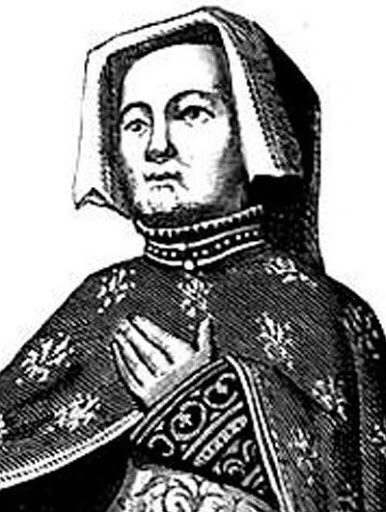
Eleanor Rykener is often presented as, well, John Rykener. Little is known about her before her arrest in 1395; everything we know comes from her interrogation. Some years before her arrest, Rykener met a woman named Elizabeth Brouderer. Whether Eleanor was approached by Elizabeth or sought her out is, like many aspects of her life, unknown. There she was given her name and taught embroidery; that’s also where she got into sex work.
Elizabeth had developed an elaborate ruse in which she would trick the men her daughter slept with into believing they had slept with Eleanor. It’s likely that though she forced both women into this work, Elizabeth did not want her daughter to have the poor reputation of a sex worker. That reputation instead went to Eleanor. Another sex worker named Anna later taught Eleanor to have sex “as a woman”, as Eleanor called it.
Eleanor eventually left London for Oxford where she tried to find work as an embroideress. It’s important to note that embroidery was traditionally women’s work; Eleanor continued to dress, work, and live as a woman after leaving London. After finding less embroidery work than she had hoped, she focused on sex work. After a time, finding little to keep her there, she moved on to Burford.
There she found work as a barmaid, another profession held almost exclusively by women. While she continued doing sex work, we know that she was only paid by half of the men she slept with in Burford. Whether she expected payment or had a relationship with any of the men is, again, unknown.
We must pause here to mention how her relationships here have been read by modern historians. Often, we find the issue of straight historians erasing queer identities out of discomfort. Eleanor’s relations with these men cannot be denied—she herself talked at length about several of the men she slept with—so instead they are used to invalidate her gender. She is just a gay man who crossdressed.
Of course, the other side of the coin still exists, and we see that after Eleanor’s move to Beaconshire. Though she slept with two men there, she also slept with a woman named Joan. Though she undoubtedly slept with more men than women, their claim is that she only slept with men for work. Eleanor Rykener is then, in fact, a straight man who crossdressed.
Historians are quick to say that she was a crossdresser and a sex worker, though they aren’t as averse to using slurs when they describe her. They do, however, find the term bisexual problematic. Not because Eleanor didn’t have sex with men and women; we know for a fact that she slept with enough men and women that she wasn’t sure of the number. If we apply this modern label—bisexual—we may then have to acknowledge that in today’s language Eleanor would be called a trans woman. The idea that Eleanor was actually a man who tricked people into sex falls more in line with the idea that trans women are just men in dresses, that they are threats. Her sexuality is leveled against her to prove that she is a man, and that is still very much an issue for trans women today.
These historians also ignore the very real possibility that she presented herself as Eleanor, as a woman, to both the men and women she slept with. The original text of the interrogation mentions “ut vir concubuit cum” and ” concubuerunt ut cum femina”. While it explains that Eleanor had sex with Joan (active), it is careful to say that the two men had sex with her (passive). It’s assumed by most historians that Eleanor had sex with Joan as John, as a man, and had sex with the men as a woman. We don’t actually know this. There is, in fact, very little of the details of her relations that we do know. The interrogation is in Latin, having been translated from Middle English she would have spoken, and therefore does not contain quotes from her as she said things. Because Eleanor didn’t give her testimony in Latin, the intricacies of her testimony are lost.
In December of 1395, bundled against the frigid London winter, Eleanor caught the eye of one John Britby. He propositioned her, and the two made their way behind a nearby church. They were then caught by city officers and taken in for interrogation. She introduced herself as Eleanor Rykener. She readily admitted to everything, agreed with Britby’s account of the events, and hid nothing. She told them of her time with Elizabeth and Anna and her many moves throughout England. She told them of the many men and women she slept with; some married, some nuns and priests. She held nothing back, and she introduced herself as Eleanor.
There is a danger in applying modern labels to historical people. To call Eleanor Rykener a gay man is just as harmful as calling her a straight man. Erasing a queer person’s identity, even for the sake of another queer identity, is harmful. The case of Eleanor Rykener was actually revisited in recent years with the admission that transgender may be a more accurate term for Ms. Rykener. To simply call Eleanor Rykener a crossdresser is reductive; it ignores her life as she lived it. Often, we cannot say exactly how someone would describe themself, because we aren’t able to ask them. Eleanor, however, was asked over and over again. The only document of her life is her take on her womanhood and sexuality. Eleanor Rykener slept with both men and women, she worked as an embroideress, barmaid, and sex worker, and she was a woman.
The Questioning of John Rykener, A Male Cross-Dressing Prostitute, 1395
This document was brought to light by David Lorenzo Boyd and Ruth Mazo Karras in 1995 . It is apparently the only legal process document from late medieval England on same-sex intercourse. Since copyright law precludes presentation of such a recently published text, it was necessary for this web text to secure a copy of the manuscript source, transcribe it, and newly translate it. This has presented an interesting opportunity to show how historians acquire documents: here are presented: first, a translation; second, a transcription of the document; third a facsimile of the document itself.
Karras and Boyd recount how this text escaped notice. A. H. Thomas’ Calendar of Select Please and Memoranda of the City of London A.D. 1381-1412. 3 Vols. (Cambridge: Cambridge University Press, 1924-32) is the standard reference work on these particular records. It is a detailed calendar with a massive amount detail about each case. In Vol 3. Thomas began recording only “select pleas and memoranda”, but no longer records, for example, small debt actions. For the Rykener case Thomas recorded only “Examination of two men charged with immorality, one of which implicated several persons, male and female, in religiou orders” (p. 228). This is the only case in which anything but a will or formulaic document is summarized so briefly. And, of course, Thomas succeeds in hiding the homosexual subject matter of the case. Thus this case stands not only as a rare source for the history of tranvestite and homosexually active people in late Medieval England, but as evdience of the suppression of that history by scholarly historians in the 19th and 20th centuries.
As to the outcome of this case, it is not known. Nor is it know if the case was also prosecuted as sodomy in Church courts (since no records survive from the period). It is not even clear that a formal charge was made. For a discussion of the context, see the longer article by Karras and Boyd in Premodern Sexualities.
I: The Questioning of John Rykener 1395: Translation
On 11 December, 18 Richard 11. were brought in the presence of John Fressh, Mayor. and the Aldermen ofthe City of London John Britby of the county of York and John Rykener., calling [himself] Eleanor, having been detected in women’s clothing, who were found last Sunday night between the hours of 8 and 9 by certain officials of the, city lying by a certain stall in Soper’s Lane” committing that detestable unmentionable and ignominious vice. In a separate examination held before the Mayor and Aldermen about the occurrence, John Britby confessed that he was passing through the high road of Cheap on Sunday between the abovementioned hours and accosted John Rykener, dressed up as a woman, thinking he was a woman, asking him as he would a woman if he could commit a libidinous act with her. Requesting money for [his] labor, Rykener consented, and they went together to the aforesaid stall to complete the act, and were captured there during these detestable wrongdoings by the officials and taken to prison. And John Rykener, brought here in woman’s clothing and questioned about this matter, acknowledged [himself] to have done everything just as John Britby had confessed. Rykener was also asked who had taught him to exercise this vice, and for how long and in what places and with what persons, masculine or feminine, [he] had committed that libidinous and unspeakable act. [He] swore willingly on [his] soul that a certain Anna, the whore of a former servant of Sir Thomas Blount, first taught him to practice this detestable vice in the manner of a woman. [He] further said that a certain Elizabeth Bronderer first dressed him in women’s clothing; she also brought her daughter Alice to diverse men for the sake of lust, placing her with those men in their beds at night without light, making her leave early in the morning and showing them the said John Rykener dressed up in women’s clothing, calling him Eleanor and saying that they had misbehaved with her. [He] further said that certain Phillip, rector of Theydon Garnon, had sex with him as with a woman in Elizabeth Bronderer’s honse outside Bishopsgate, at which time Rykener took away two gowns of Phillip’, and when Phillip requested them from Rykener he said that [he] was the wife ofa certain man and that if Phillip wished to ask for them back [he] would make [his] husband bring suit against him. Rykener further confessed that for five weeks before the feast of St. Michael’s last [he] was staying at Oxford, and there, in women’s clothing and calling himself Eleanor, worked as an embroideress; and there in the marsh three unsuspecting scholars – of whom one was named Sir William Foxlee, another Sir John, and the third Sir Walter – practiced the abominable vice with him often. John Rykener further confessed that on Friday before the feast of St. Michael [he] came to Burford in Oxfordshire and there dwelt with a certain John Clerk at the Swan in the capacity of tapster for the next six weeks, during which time two Franciscans, one named Brother Michael and the other Brother John, who gave [him] a gold ring, and one Carmelite friar and six foreign men committed the above-said vice with him, of whom one gave Rykener twelve pence, one twenty pence, and one two shillings. Rykener further confessed that [he] went to Beaconsfield and there, as a man, had sex with a certain Joan, daughter of John Matthew, and also there two foreign Franciscans hall sex with him as a woman. John Rykener also confessed that after [his] last return to London a certain Sir John, once chaplain at the Church of St. Margaret Pattens, and two other chaplains committed with him the aforementioned vice in the lanes behind St. Katherine’s Church by the Tower of London. Rykener further said that he often had sex as a man with many nuns and also had sex as a iman with many women both married and otherwise, how many [he] did not know. Rykener further confessed that many priests had committed that vice with him as with a woman, how many [he] did not know, and said that [he] accommodated priests more readily than other people because they wished to give [him] more than others.
II: The Questioning of John Rykener 1395: Transcription
Corporation of London Records Office, Plea and Memoranda Roll A34, m.2 (1395)
Undecimo die Decembris anno regni regis Ricardi secundi decimo octavo, ducti fuerunt hic coram Johanne Fressh maiore et aldermannis civitatis Londoniensis Johannes Britby de comitate Eboracum et Johannes Rykener, se Elianoram nominans veste muliebri detectus. Qui die dominica ultimo preterita per quosdam dicte civitatis ministros noctanter inter horas octavam et nonam super quoddam stallum in venella vocata Sopereslane inventi fuerunt iacentes, illud vitium detestabile, nephandum, et ignominiosum committentes, pro seperali examinatione coram dictis maiore et aldermannis super premissa fienda et audienda etcetera. Qui quidem Johannes Britby inde allocutus fatebatur quod ipse per vicum regium de Chepe die dominica inter horas supradictas transiens, dictum Johannem Rykener vestitu muliebri ornatum, ipsumque mulierem fore suspicantem fuerat assecutus, petens ab eo, tanquam a muliere, si cum ea libidinose agere possit. Qui ab eo argentum pro labore suo petens sibi consentiebat, invicem transeuntes ad illud complendum usque stallum predictum. Ipsi tamen tunc ibidem per ministros predictos in eorum maleficiis detestabilibus capti fuerunt, carcere vero mancipati hucusque, etcetera. Et predictus Johannes Rykener in veste muliebri hic adductus de materia predicta allocutus cognovit se fecisse in omnibus prout idem Johannes Britby superius fatebatur etcetera. Quesitum fuit ulterius a prefato Johanne Rykener quis ei docuit dictum vitium exercere et quanto tempore, in quibus locis, et cum quibus personis masculis sive feminis illud actum libidinosum et nephandum commisit. Qui in animam suam sponte iuravit et cognovit quod quaedam Anna, meretrix quondam cuiusdam famuli domini Thome Blount, primo docuit ipsum vitium detestabile modo muliebri exercere. Item dixit quod quaedam Elizabeth Brouderer prius vestivit ipsum veste muliebri; quae etiam conduxit quandam Aliciam filiam suam diversis hominibus luxuriae causa, ipsam cum eisdem hominibus in lectis eorum noctanter absque lumine reponens et eandem summo mane ab eisdem recedere fecit, monstrando eis dictum Johannem Rykener veste muliebri ornatum ipsum Alianoram nominantem, asserens ipsos cum ipsa sinistre egisse. Item dixit quod quidam Philippus, Rector de Theydon Gernon, concubuit cum eodem Johanne Rykener ut cum muliere in domo cuiusdam Elizabeth Brouderer extra Bisshoppesgate, quo tempore dictus Johannes Rykener asportavit duas togas ipsius Philippi. Et quando idem Philippus illas petiit a prefato Johanne Rykener, ipse dixit quod fuit uxor cuiusdam hominis, et si ipse illas repetere vellet faceret maritum suum versus ipsum prosequi. Item dictus Johannes Rykener fatebatur quod per quinque septimanas ante festum santi Michaelis ultimo elapsum morabatur apud Oxonium et operatus est ibidem in veste muliebri in arte de brouderer nominans ipsum Alianoram. Et ibidem in marisco tres scolares ignotos, quorum unus nominatur dominus Willielmus Foxlee, alius dominus Johannes, et tertius dominus Walterus, usi fuerunt sepius cum ipso abominabile vitium supradictum. Item fatebatur prefatus Johannes Rykener quod ipse die veneris proximo ante festum sancti Michaelis supradictum venit apud Burford in comitate Oxonium. Et ibidem fuit commorans cum quodam Johanne clerc atte Swan in officio de tapster per sex septimanas proximas sequentes, infra quod tempus duo fratres minores, quorum unus nominatur frater Michael et alius frater Johannes Barry, qui sibi dedit unum anulum aureum, et unus frater carmelitus et sex diversi homines extranei commiserunt cum illo vitium antedictum. Quorum quidem fratrum et hominum supradictorum quidam dabat dicto Johanni Rykener .xii. d, quidam .xx. d, quidam .ii. s. Item fatebatur idem Johannes Rykener quod fuit apud Bekenesfeld et ibidem idem ut vir concubuit cum quadam Johanna filia Johannis Mathew, et etiam ibidem cum ipso concubuerunt ut cum femina duo fratres minores alienigenae. Item fatebatur dictus Johannes Rykener quod post eius ultimum adventum Londoniae quidam dominus Johannes quondam capellanus ecclesiae sanctae Margaretae Patyns et alii duo capellani in venellis retro ecclesiam sanctae Katerinae iuxta turrim Londoniensem commiserunt cum illo illud vitium antedictum. Item dixit dictus Johannes Rykener quod ipse sepius concubuit cum quampluribus monialibus ut vir, et etiam concubuit modo virili cum quampluribus mulieribus, tam maritatis quam aliis, quarum numerum ignorat. Item fatebatur dictus Johannes Rykener quod quamplures presbiteri fecerunt illud vitium cum illo ut cum muliere, quorum numerum ignorat, et dixit quod citius cepit presbiteros quam alios quia plus vellent sibi dare quam alii.
David Lorenzo Boyd and Ruth Mazo Karras, “The Interrogation of of a Male Transvestite Prostitute in Fourteenth Century London”. GLQ 1 (1995), 459-465
David Lorenzo Boyd and Ruth Mazo Karras, “`Ut cum muliere”: A Male Transvestite Prostitute in Fourteenth Century London”. In Premodern Sexualities. Edited by Louise Fradenburg and Carl Freccero. (London: Routledge, 1996), 99-116
Darlinghurst Gaol record of AG Scott, alias Captain Moonlite, November 1879. Image courtesy of State Records NSW
The tale of Captain Moonlite
I first learned of Captain Moonlite from the historian Graham Willett. In Secret Histories of Queer Melbourne, a book Willett co-edited, Moonlite features “as the bushranger most likely to qualify as queer”.
Andrew George Scott – George to his friends – was born in 1845 (some records say 1843) to a wealthy family in Ireland. He emigrated with them to New Zealand in 1861, where his father served as a clergyman and magistrate. Arriving in Australia six years later, the young Scott, too, became a lay preacher, before turning to crime. In 1879, he held up a cattle station in New South Wales. Two of his associates were killed when the police arrived, as was a constable – and Scott was hanged in Sydney at the start of the following year.
But it was Scott’s relationship with James Nesbitt, one of his gang members, that attracted Willett’s attention. “Nesbitt and I were united by every tie which could bind human friendship,” wrote Scott (underlining and all) during his final incarceration. “We were one in hopes, one in heart and souland this unity lasted until he died in my arms.” Awaiting execution, Scott wore a ring made from Nesbitt’s hair, and pleaded with his gaolers to bury him with the younger man in the graveyard at Gundagai.
“I long to join him where there shall be no more parting,” he wrote.
The request wasn’t granted, of course, but Willett’s account concludes by explaining how, in 1995, “a group of [Scott’s] admirers persuaded the government to surrender Moonlite’s body to be re-interred in the Gundagai cemetery”.
That struck me as entirely remarkable. Exhumation requests are seldom granted. Given the context, I’d assumed Moonlite’s “admirers” to be queer agitators. One of them was a woman called Christine Ferguson, who was definitely an activist – but her activism centred on the National Party, of which she’d been federal president until earlier this year.
What was going on? Why had a leader of a staunchly socially conservative party gone to such trouble to re-bury an executed murderer next to the man he loved?
I found the phone number of the cattle and sheep station Ferguson runs near Gundagai. Oh, yes, she said, she’d love to talk about Moonlite.
When Scott landed in Victoria in 1868, he may well have been fleeing a scandal concerning his military service in New Zealand. Regardless, the Bishop of Melbourne offered the well-spoken newcomer a plum post as a lay preacher in the Bacchus Marsh settlement. At the time, worshippers there were still gathering each Sunday in a building known as the Iron Church, one of many pieces of prefabricated infrastructure imported during the Victorian gold rush. In archival photos, it looks like a corrugated-iron shed, unflatteringly supplemented with a steeple.
Such was the colony at the time: a still fluid society in which the stone certainties of Anglicanism were replicated with ersatz materials entirely unsuited to the local climate. The setting suited Scott, who emerges from Paul Terry’s authoritative biography In Search of Captain Moonlite as charming, self-centred, and almost entirely amoral.
The Reverend WH Cooper of Bacchus Marsh presented the recruit to his flock “as a young warrior who now has a firm grip on the sword of righteousness”. And, at first, Scott justified Cooper’s faith. The archivist at Bacchus Marsh’s present-day Holy Trinity Church showed me a weathered ledger where Scott’s beautiful copperplate signature repeatedly appeared alongside the number of parishioners he attracted – generally, close to 100 each week.
But in early 1869 a man called Robert Crook faced the Bacchus Marsh Court House accused of breaking a neighbour’s fences and stealing his cattle. Scott had ingratiated himself with the Crook clan, one of the grandest families in the parish, and obligingly provided the young squire with an alibi. Unfortunately, it was immediately contradicted by one of his Sunday school students, who swore she’d seen Scott and Crook loitering near the crime scene.
Naturally, the court believed a churchman over a teenage girl. But the acquittal did not quell the Anglican hierarchy’s unease about its lay preacher, who was abruptly banished to the isolated mining town of Mount Egerton.
The remains of the Iron Church were sold for scrap in the 1870s to make way for a stone chapel, but the archivist directed me to a decaying house on the corner of Waddell and Graham streets where pieces had been dumped. In the knee-high grass of the backyard I found rusted slabs of iron – remnants of the church – now crudely fashioned into a garden shed. Wasps were nesting on one panel; there was a strong smell of rot coming from inside.
It felt, perhaps fittingly, like a crime scene.
In dusty Mount Egerton, Scott befriended the few respectable people he could find, including a 17-year-old banker, Ludwig Julius Wilhelm Bruun, and the town’s schoolteacher, James Simpson.
On 8 May 1869, Bruun told authorities that a masked man had forced him to open the bank’s safe and hand over its gold. The intruder left a note: “I hereby certify that LW Bruun has done everything within his power to withstand this intrusion and the taking of money which was done with firearms.”
It was signed “Captain Moonlite”.
The whole implausible story was probably a fabrication, a scam cooked up by Scott, Bruun and Simpson. Their friendship, however, had soured, and Bruun said he recognised the gunman as his former friend, tying Scott to the Moonlite moniker. Scott hotly denied the charge and threw the blame back at Bruun and Simpson, who were sent to trial (and later acquitted); Scott departed hurriedly, taking himself to Fiji and then to Sydney, where he began spending the wealth he’d mysteriously acquired.
James Nesbitt
In late 1870, he was arrested for passing bad cheques. Confined in Maitland Gaol, he feigned madness and was transferred to the more comfortable Parramatta Lunatic Asylum, where the medical registry described him as a “civil but … unprincipled fellow without a spark of honour or decency to him”.
Upon his release in 1872, Scott was charged with the Mount Egerton robbery. While on remand, he dug through the brickwork in his cell and scaled the walls of the gaol. He was quickly recaptured. Redmond Barry (the judge who later sentenced Ned Kelly to death) sentenced Scott to ten years in Melbourne’s Pentridge prison for the robbery, adding one for his attempted escape.
As a criminal, Scott was always more urban hustler than highwayman. But he was handsome and athletic, had reportedly seen heavy combat in the so-called Maori Wars, and was a skilled rider and crack shot. The Captain Moonlite sobriquet, with its irresistible hint of midnight romance, took on a life of its own. His attempted escape further popularised the reputation of the bold and dashing Moonlite. “Brave to the verge of recklessness,” a journalist wrote, “cool, clear-headed and sagacious, and with a certain chivalrous dash, he is the beau ideal of a brigand chief.”
The press thought him a bushranger – and a bushranger he would become.
It was a long drive from Bacchus Marsh to Gundagai. The spring rain had left the wheatfields a deep green and those of canola garishly yellow. The landscape tramped by George Scott and James Nesbitt and their four young companions, in drought-stricken 1879, must have been very different.
Scott met Nesbitt – a petty criminal from Carlton – in Pentridge, where the younger man was once disciplined for “taking tea to Prisoner Scott”. As biographer Terry says, it’s an affectingly tender infraction.
Upon Scott’s release in March 1879, the men shared a rundown house in Fitzroy. But how would they live? Scott tried lecturing on prison reform but, though he drew huge crowds, theatres often refused to book him, particularly with the press linking the notorious Moonlite with every unsolved crime. Police warned potential employers against him; he was dragged in for questioning about the most preposterous allegations.
Scott resolved to walk to New South Wales in search of work and a new start. He took with him a coterie of young men from the slums of inner Melbourne. Like Nesbitt, Thomas Rogan was 21. Frank Johns, Graham Bennett and Augustus Wernicke were in their teens. Exiled from polite society, the 34-year-old Scott basked in the admiration of these youths, to whom, as an urbane intellectual, he seemed like a visitor from another world.
The journey proved an utter disaster, a weary trudge along a hot and inhospitable track. The privations were exacerbated by constant police harassment.
“As long as our money lasted,” Scott explained later, “we bought bread, and when our money was gone we sold our clothes and bought bread, with what we obtained for them. We tried to get work, but could not, and we fasted day after day.”
They’d been living on damper and tea and koala meat – and then no food at all – when they approached Wantabadgery Station, near Gundagai. The property was known for its hospitality but, unbeknown to Scott, it had recently changed hands and the new owner harboured little sympathy for itinerants.
Abruptly ordered to leave, Scott snapped.
“Misery and hunger produced despair,” he wrote later, “and in one wild hour we proved how much the wretched dare.” He retreated into the bush and then returned with gun in hand – transforming, at last, into the persona that had been created for him.
The men with Scott had never previously left the city, let alone ridden a horse. Suddenly, though, they too were bushrangers.
Scott acquired nothing of value at the station. Instead, he demanded food and drink. Leaving his men, he then bailed up the Australian Arms Hotel and detained everyone inside before forcing them back to Wantabadgery: he was more concerned about playing the gentlemanly host than planning an escape.
Inevitably, the police arrived; inevitably, a gunfight ensued.
Scott and his small gang then decamped to a nearby farmhouse, which was soon surrounded by troopers. “Come and fight!” Scott yelled, even though the rest of his gang could barely hold a rifle. Poor Tom Rogan spent the whole shootout hiding under a bed.
Wernicke was mortally wounded. “I am only fifteen,” he cried. A short time later, Nesbitt was shot in the head. A journalist of the time described how, as Nesbitt died, Scott “wept over him like a child, laid his head upon his breast, and kissed him passionately”.
In the exchange of fire, Senior Constable Edward Webb-Bowen took a bullet in the spine – his subsequent death sealed Scott’s fate. The surviving “bushrangers” were tried for murder. With the Kelly Gang still at large, the court set an example, handing down death sentences to all. Johns and Bennett received an eventual commutation on the grounds of their youth; Scott and Rogan (who hadn’t even fired a shot) walked to the gallows on 20 January 1880 and were buried at Sydney’s Rookwood Cemetery.
I drove to Kimo Estate, about 20 minutes from Gundagai, where a troop of dogs romped up to greet me. A minute later, Christine Ferguson roared into view on a ride-on mower. She was wearing a pullover emblazoned with a Captain Moonlite logo.
“G’day,” she said, wiping clean her hands. “You find the place all right?”
Kimo’s house dates back to the 1870s, and is pleasantly weathered. In spite of recent renovations for the bed-and-breakfast trade, Kimo is still a working farm. We sat in a lounge room crowded with books and framed photos, and talked about the exhumation in 1995.
Ferguson confirmed that disinterring a corpse wasn’t easy.
“We were actually the first people who weren’t relatives or the state to get a body exhumed. The only reason it was possible was because of Moonlite’s last letter, in which he wished to be buried in Gundagai next to his friends.”
But why had Ferguson gone to such trouble? “Here you are putting money and time into re-burying a convicted murderer who seems to have been involved in a same-sex relationship. It does seem, well, a bit strange.”
“Well, it was really only after the whole event that people raised that he might be gay,” Ferguson explained. “For a long time, we said, ‘Look, we believe they were just good mates, good friends.’ Just recently Sam Asimus, my partner in crime in the whole affair, told me she’d done some more research and she thinks Scott might have been bisexual. But who knows?”
As well as exhumation approval from the state, the women needed permission from the Anglican Church – eventually, both were granted. Ferguson’s team enlisted a local undertaker (“He was terribly excited!”), and they brought an ornate horse-drawn hearse to Gundagai on the back roads. The pallbearers wore period costumes.
“The locals here aren’t terribly excited about anything much,” Ferguson said, shrugging. “But when it was all done and it didn’t cost them any money, they did get into the swing of things. We had people lining the roads to watch.”
I still wanted to talk about sexuality. I’d learned about Moonlite from Willett and other gay historians, I explained. “Here was someone saying in those last letters, ‘I love this man, I want to be buried with him.’”
“He actually didn’t say that,” Ferguson said, then corrected herself. “Well, he did say it – in a way. But it was a long time ago, and mates were mates. We don’t know if he was gay or not. It comes down to your interpretation of ‘mate’ and what ‘mateship’ would have meant at the time.”
Fair enough. But mateship was a lot queerer than most people thought. In his 1958 book The Australian Legend, which popularised the concept as a national trait, Russel Ward suggested that, in the masculine environment of the frontier, the typical bushman satisfied himself sexually with prostitutes and indigenous women, then assuaged his “spiritual hunger” with “a sublimated homosexual relationship with a mate, or a number of mates”.
Was that how to think about Scott? In Bacchus Marsh, he seems to have been involved with a woman named Mrs Ames, who felt strongly enough about Scott to visit him regularly before his execution. Yet she barely registers in Scott’s death-cell writings, in which he returns again and again to Nesbitt.
“He died in my arms,” Scott wrote. “His death has broken my heart.”
That didn’t seem sublimated.
In one of his letters, Scott ended his plea for burial alongside Nesbitt with a quotation:
Now call me hence by thy side to be: The world thou leavest has no place for me. Give me my home on thy noble heart, Well have we loved – let us both depart.
The lines came from a Felicia Hemans poem entitled ‘The Lady of Provence’.
“The original was about the feelings of a woman for her dead lover,” I mentioned to Ferguson. “So here’s Scott including what seems to me clearly a love poem to a man.”
“Well, that was never brought up at the time,” she said. “But, again, we don’t have the evidence. Do homosexuals now write poems to each other? It’s an odd thing to do, writing poems – not something people do these days.”
Until quite recently, I’d been the editor of Overland, a literary journal that regularly publishes poetry. Nevertheless, I took the point. The more I read about sexuality in the 19th century, the more it seemed both strikingly familiar and disconcertingly strange.
During Scott’s criminal career, the police in Victoria had been led by Chief Commissioner Frederick Standish. He was a gambler and libertine, who, at one notorious dinner, decorated the room with naked women seated on black chairs to better show off their white bodies. When Prince Alfred, the second son of Queen Victoria, toured Melbourne in 1867, Standish acted as royal pimp, escorting the prince to Sarah Fraser’s brothel in Stephen Street.
But, as Willett says in Secret Histories of Queer Melbourne, the commissioner was also infatuated with men – in particular with Frank Hare, another policeman chasing the Kellys. “It was almost pathetic to see …” wrote one of their contemporaries, “how restless and uneasy [Standish] became were Hare out of his company. I have seen Standish on the top rail of a fence watching anxiously for Hare’s return from a short ride.”
And then there was the story of Edward Feeney, who, eight years before Scott’s execution, was put to death at Melbourne Gaol for his part in a bizarre suicide pact.
In March 1872, Feeney had accompanied Charles Marks into Melbourne’s Treasury Gardens, where, according to a pre-arranged plan, they attempted to shoot each other. Feeney’s gun fired; Marks’ didn’t. This left Feeney on trial for murder.
Feeney refused to offer any explanation. But the court heard that he and Marks exchanged letters about their passionate love for each other. A bar owner testified that they regularly cuddled in his premises, sometimes laying their heads on each other’s laps. In her article about the case, historian Amanda Kaladelfos points out that while the proprietor believed their behaviour unusual, “he expressed no malice toward Marks and Feeney; nor did he give evidence that he ever asked them to stop showing their affections in his place of business”.
“Men often slept together in the same beds,” historian Clive Moore explains in his study of sexuality on the frontier, “without raising the slightest suspicion that they were involved in what we would call a homosexual affair, were physically affectionate, had romantic crushes, wrote lovingly to each other and fretted when they were apart … For most of the 19th century there was no clear social, medical or legal concept of homosexuality; homosexual acts were recognised, particularly sodomy, but not a personal disposition or social identity.”
Today, of course, matters are very different.
“Is there a gay community in Gundagai?” I asked Christine Ferguson.
“Hmm. I know one who’s come here, used to be with Qantas and he’s here … I’ve only met him once but I know he’s here. A couple of others in town who are probably bachelors but most people say they are [gay]. But that’s about it.”
“Do they have a hard time?”
“No, I don’t think so. You really wouldn’t know. They’re not openly living with a bloke or anything. Gundagai is conservative but I don’t think it’s really bothered by homosexuality.”
“Would the town be open to the tourist potential of Moonlite as a gay icon?”
“No, I didn’t think Gundagai would be into that,” Ferguson replied. “A lot of the old people want to keep Gundagai how it is and how it has been in the past. They don’t see … they’re not very progressive.”
She told me that she and Samantha Asimus had wanted to establish a bushrangers and police museum in the old gaol, when a property there became available. They’d had plans for holograms; they’d spoken to the Justice & Police Museum in Sydney about borrowing exhibits.
“We thought it would be fabulous for the town. But no, no one was interested.”
We talked for a little while about politics in general – Ferguson is close friends with Tony Abbott and struggled to sound enthusiastic about Malcolm Turnbull – and then she showed me through the station.
“I like to have a project,” she said. “I like to keep myself busy.”
And that, it seemed, helped to explain her involvement in the re-burial, a cause she’d taken on almost because of its inherent difficulty.
In his cell, Scott had described the headstone he wanted:
[A] rough unhewn rock would be most fit, one that skilled hands could have made into something better. It will be like those it marks, as kindness and charity could have shaped us to better ends.
The words were now carved into a suitably craggy stone located at the very edge of the North Gundagai Cemetery.
In some ways, the sentiment seemed less apposite for Scott (who, in his early life at least, had scarcely been deprived of opportunities) than for the slum kids who died with him.
Ever since I stumbled upon Edward Feeney and Charles Marks’ story, I’d been thinking about the inner-city origins of Moonlite’s unhappy gang, and the strange visual connection between the past and present. Before Marks and Feeney went to the Treasury Gardens to kill each other, they’d posed for final portraits in a Bourke Street photographer’s studio. The resulting images are utterly compelling. In one picture, they’re holding hands – and, with their bushy whiskers and cloth trousers, they look disconcertingly contemporary. You would not blink an eye to see them strolling in Fitzroy or Carlton today.
On the scaffold, Feeney had issued a statement denying he’d been “improperly intimate” with Marks. The doctors who dissected his body inspected his rectum for signs of sodomy. In that posthumous indignity, we can detect, Amanda Kaladelfos says, the beginning of the modern science of sexuality, which in the decades to come would establish “homosexuality” as a distinct and all-consuming pathology.
A second photo of Marks and Feeney depicts them with pistols against each other’s breast. The photographer had suggested they pose as “bushrangers”, a comment that made me wonder if, by the 1870s, the life of the outlaw gang was seen as representing a kind of male intimacy that the cities were beginning to exclude.
Was Feeney gay? Was Moonlite? In one sense, asking such questions is almost silly, the projection of contemporary categories onto a past where they did not belong. Yet, in another sense, the rediscovery of men who loved other men (as both Feeney and Moonlite clearly did) matters a great deal.
I’d also asked Christine Ferguson whether, in today’s Gundagai, men who wrote love poems to other men would be welcome in the local pub.
“Yeah, they probably wouldn’t go to the pub,” she replied, amused at the thought. “The pubs in here are pretty blokey.” She didn’t drink in them much herself, and nor did many women.
Surely that was the value of the Moonlite story. It revealed the traditional masculinity enforced in public bars, sporting clubs and other bastions of heterosexuality to be neither innate nor eternal.
Scott had designed his own epitaph. He’d wanted it to read “This stone covers the remains of two friends”. He’d then written Nesbitt’s name and his own, with Nesbitt’s death listed as the date the pair were “separated”, and his own execution recorded as when they were “united by death”.
The exact location of Nesbitt’s body in this cemetery is no longer known. When Scott’s body was re-buried, the tombstone noted that he had been “laid to final rest near his friends James Nesbitt and Augustus Wernicke who lie in unmarked graves close by”.
The inscription diffused Scott’s passion for one man into a more conventional friendship with two.
The morning was starting to warm, but Scott’s grave was pleasantly shaded by a beautiful old gum tree. Its slight separation from the rest of the cemetery gave it an unmistakeable prominence – a gesture that the always-vain Scott would have liked.
Why bushranger Captain Moonlite died with a lock of hair in his hand
HISTORY Moonlite: The True and Tragic Love Story of Captain Moonlite and the Dying Days of the Bushrangers Garry Linnell Michael Joseph, $34.99
In the annals of bushranging, Andrew George Scott (aka Captain Moonlite) is not as familiar a name as Ned Kelly, though arguably he was just as complex and interesting a character as well as being similarly accomplished as a horseman. Scott was Irish – technically more so than Kelly, having been born there – but he came from a very different background from the leader of the Kelly Gang, being well-educated and Protestant. But both had occasion to be tried in a courtroom presided over by Sir Redmond Barry, also an Irishman.
The grave of Captain Moonlite. CREDIT:LUKE WATSON
The story of the life and misadventures of Captain Moonlite is recounted with gusto in this book.
The front cover boldly announces “A New Era of Australian Storytelling”, with Garry Linnell explaining that he tried to write a work of non-fiction “in a style that borrows heavily from novels and movies – using character development, pacing, dialogue and sub-plots” to enliven material drawn exclusively from archival sources.
Linnell consciously departs from the conventions of popular history by declaring “I despise footnotes” and questioning whether anyone ever reads them.
The armour notwithstanding, Kelly was not as showy as Scott, who created the legend of Captain Moonlite, dressing himself in a black crepe mask and cape-like coat as though he was a stage villain in some provincial melodrama.
Captain Moonlite was frank about his feelings for James Nesbitt.
For all its theatricality, the criminal persona was somewhat effective in obscuring Scott’s true identity. The performance was designed to instil fear and awe in Moonlite’s victims though it did have an absurd aspect, since Scott had a limp that tended to give him away no matter how impressively he tried to present himself to the world as a swashbuckling land pirate.
These days Kelly is regarded by many Australians as a prototypical bogan who, if he had been born a century or more later, would have worn flannelette and performed burnouts in a stolen Commodore. By contrast, Captain Moonlite was the nearest thing to a dandy highwayman in the tough yet surprisingly sentimental frontier culture that produced the bushrangers and their networks of supporters. We can imagine Kelly enjoying AC/DC while Scott might have preferred to listen to Adam and the Ants.
Like so many of the misfits and ne’er-do-wells from privileged families in Britain and Ireland that fetched up in far-flung colonies, Scott tried different careers but could not settle down to anything respectable. Linnell speculates that Scott, who pleaded insanity at a trial for fraud and was confined to the Parramatta Lunatic Asylum, was bipolar. The authorities concluded that Scott was feigning mental illness while plotting to escape and had him transferred to a regular prison.
Like Kelly, Scott’s career as a bushranger was curtailed in part by the then new modern technology of the telegraph and the railway, as well as more effective policing.
Perhaps the most compelling section of Moonlite features the extraordinary tenderness with which Scott regarded his last partner in crime and the love of his life, James Nesbitt, whom he met while both men were doing time in Pentridge. Scott was disarmingly frank about his feelings for the younger man, especially in an era during the 19th century when sex was not discussed publicly and homosexuality was harshly suppressed by the state.
Scott was captured following a deadly shootout and condemned to be executed. Linnell writes that at the end of his troubled life he thought only of Nesbitt, who had died in his arms during the last stand of Captain Moonlite.
“When they finally hauled Scott to his feet, handcuffed him and led him away, Scott took with him a lock of Nesbitt’s hair. In the years to come, as legend and myth and fact all merged into one, it would be said that Captain Moonlite went to the gallows with that lock of hair forming a ring on the wedding finger of his left hand.”
Reference
A queer bushranger, The Monthly, November 2015, by Jeff Sparrow
Ronnie and Reggie Kray had a secret incestuous relationship with each other so criminal rivals would not discover they were gay according to author John Pearson who interviewed them both
Kray Twins
Vicious gangster twins Ronnie and Reggie Kray had an incestuous sexual relationship with each other as they were growing up.
The pair, who ran a cruel and violent criminal empire in London’s East End in the 1960s, were terrified of their secret coming out.
They were worried that rivals would see their sexuality – Ronnie was a homosexual and Reggie was bisexual – as a sign of weakness so only had sex with each other in order to keep the secret.
Author John Pearson who extensively interviewed the brothers and their associates has made the revelation as a new film comes out on the twins.
John said: “Homosexuality was nothing to be proud of in the East End.
“But as they became more notorious, Ronniebecame quite shameless about it.
“According to Ron in the early days they had sex with each other because they were terrified about people finding out.”
Smart: Twin brothers and organised crime bosses Ronnie and Reggie Kray (Image: Getty)
It has long been known that Ronnie was a homosexual and Reggie was bisexual but the news they had a sexual relationship with each other gives a telling insight into their close connection.
Actor Tom Hardy stars as both brothers in a new film , Legend, based on the lives of the murderous pair as told in a book by John.
Actor: Tom Hardy in his latest roles as Ronnie (left) and Reggie Kray in the film, Legend (Image: PA)
John has written three books on the brothers and says Ronnie told him the twins dark secret during one of their chats.
He says while he knew about the the incest he waited until the brothers were both dead before revealing it for fear of retribution.
Ronnie died in Broadmoor secure hospital of a heart attack in 1995 and Reggie died of cancer in 2000 having been released from prison on compassionate grounds.
In his book Notorious: The Immortal Legend of the Kray Twins , John said the pair were spoilt by their mother Violet, Grandma Lee and their two aunties, May and Rose, while their father was soon dominated by the increasingly violent brothers.
Brotherly love: Amateur boxers Reggie (left) and Ronnie Kray with their mother Violet Kray (Image: Getty)
John wrote: “All of which conformed, of course, to a classic pattern; and with their warm, indulgent mother, their ineffectual father, and their surrounding cast of loving women, it was not surprising that, with adolescence, the Twins discovered that they were gay.
Given their identical genetic make-up, it was virtually inevitable that if one twin was, the other would be too.”
Tome: Author John Pearson’s book on the Kray Twins
However there was a problem for the twins as back in the macho world of 1950s East End it was seen as a weakness to be gay.
John wrote: “So it was hardly surprising that, for the time being, both the twins kept their sexual preferences to themselves.
Claims: Author John Pearson says the brothers had an incestuous relationship(Image: Twitter)
The brothers ran a notorious criminal network in the 1960s building up an empire of nightclubs though hijacking, armed robbery and arson.
Fighters: Ronnie and Reggie during their amateur boxing days in their youth
As they moved from the East End to the West End their became big names rubbing shoulders with Frank Sinatra and Judy Garland and being photographed by David Bailey.
Eventually the police got them and the Krays went to prison for murdering fellow gangsters George Cornell and Jack McVitie.
The book “Jack and Lem: John F. Kennedy and Lem Billings: The Untold Story of an Extraordinary Friendship,” details the extraordinary relationship between two unlikely friends.
JFK, or ‘Jack’ as he was known by his close friends and family, had a gay best friend named Lem Billings, who he met in prep school when Kennedy was 15 and Lem was 16.
The pair became the best of friends who wrote letters to each other when they were apart, traveled to Europe together and were so close that Joseph Kennedy Sr. thought of Billings as another son, according to GregInHollywood.
The book details JFK’s angry reaction to Lem after he made a sexual advance towards him, saying: “I’m not that kind of boy.” But this misunderstanding did not end the duo’s relationship.
From the time he and Kirk LeMoyne “Lem” Billings met at Choate, until the President’s assassination thirty years later, they remained best friends.
Lem was a virtual fixture in the Kennedy family who even had his own room at the White House.
The book about their friendship draws on hundreds of letters and telegrams between the two, Billings’s oral history and interviews with family and friends like Ben Bradlee, Gore Vidal, and Ted Sorensen.
It was a friendship that endured despite an era of rampant homophobia.
Billings was a graduate of Princeton University and Harvard Business School and was an advertising executive at the Manhattan advertising firm Lennen & Newell. He put his business career on hold to work on Kennedy’s campaign for president.
Bradlee says in the book: “I suppose it’s known that Lem was gay….It impressed me that Jack had gay friends.”
Billings obviously never came out but did once say: “Jack made a big difference in my life. Because of him, I was never lonely. He may have been the reason I never got married.”
Kenneth Hill of WoolfAndWilde, conducted a fascinating interview with David Pitts, the author of ‘Jack and Lem’, to uncover some more details about the extraordinary relationship between the two unlikely friends: Kenneth Hill: How would you characterize the friendship between JFK and Lem Billings?
David Pitts: The way I would characterize it is that is was a very close, deep, friendship across sexual orientation lines.
KH: You said that this was the story of a friendship that crossed sexual orientation lines, which I think is really an interesting element of it, but talk a little bit about the depth of this friendship. The fact that it started when they were very young and, from what I read in the book, they were basically inseparable for the rest of their lives except when circumstances had them in distant cities.
DP: Yes, indeed. I think there were a number of elements to it. First of all, there were a series of bonding events early on. One was the fact that they both hated that school [Choate] in which they met. And were engaged in all kinds of pranks which almost got them expelled twice. That was obviously a bonding phenomenon. Secondly, they roomed together for part of the time at the school.
Thirdly, and I think this is really important, John Kennedy was so sick most of his life, far earlier than when most people think, including when he was at Choate, and Lem was the person at boarding school — his mother and father did not come to the school when he was ill; Lem was there. Lem was the person who was always there for him and took care of him. And then fourthly, there was the two month trip to Europe that they took, just before WWII in 1937, just the two Americans at that pivotal time, I think that was obviously a very strong bonding event.
And then over and above these issues, I would say this — and this is kind of a complicated thought because we really don’t have language to express these kinds of relationships — and that is, I’m firmly convinced after working on this book that John Kennedy’s sexual interests were in women. We don’t need much evidence of that, the evidence is all over the place. But his strongest emotional attachments were to men — and principally, to Lem. We don’t have a word for that, right? Somebody who prefers the opposite gender for sexuality, and the same gender for deep, emotional attachments.
KH: We don’t really have a word for that. I guess “man’s man” used to sort of mean that, but JFK took it so much further in a way because he loved being around men, he knew some men were attracted to him and even seemed to enjoy it. He liked the stimulation of those relationships, there was nothing sexual about it, but there was something about that male-male dynamic that fed him.
DP: I think that’s exactly right. There was one reviewer who wrote, “What’s the big deal here? This guy’s writing that JFK was comfortable with gay men, so big deal, we all knew that.” But of course it’s not the fact that he had a friend named Lem Billings who was gay. This was the closest person in all the world to him outside of his family for 30 years. He wasn’t just “a gay friend” on the side.
KH: One of the very surprising facts that comes out in this book is that Lem had his own room at the White House? DP: Yes, that’s one of the revelations in the book that’s really surprising. And actually some of the people who were working in the White House very close to JFK didn’t know it. For example, Ted Sorensen whom I interviewed for the book, perhaps the closest aide to JFK, saw Lem around the White House all the time, but he told me he didn’t know that he’d had his own room there and was staying there so much of the time. But yeah, that’s another indication of the depth of the attachment.
One thing I was intent on doing when I wrote this book, because I thought it would be open to various forms of attack, is that I never went beyond what the documents said. The book is a lot of quotes from documents, or that interviewees said. This friendship might have contained a lot of things that I wasn’t able to find out because I didn’t want to enter the area of speculation. KH: It seems without a doubt that Lem was in love with JFK. But it’s never stated explicitly because you don’t have any record of his ever saying that. DP: No, I think the closest … I mean, these were more sedate times, especially where homosexuality is concerned. Even in the various documents, Lem is never overt in his statements. But there was one statement from one of the documents, and I have it in front of me here, that I think is just expresses his feelings. Here’s the quote: “Jack made a big difference in my life. Because of him, I was never lonely. He may have been the reason I never got married.”
This is somewhat of a difficult thought as well, but I think gay people had a way back then of telegraphing to future generations what their feelings were that they could not express candidly at the time. And anybody who reads some of these words today would have no doubt what Lem’s feelings were, but in the context of that time it was not obviously understood.
More than six decades after his untimely death, James Dean remains one of Hollywood’s most enduring and enigmatic icons.
It’s been more than 60 years since his tragic death and still Hollywood is looking for “the next James Dean.” The young actor made only three movies in his career – East of Eden (1955) where he played the bad boy brother in the “Cain and Abel” retelling, his signature role as an angst-fueled teen in Rebel Without a Cause (1955), and Giant (1956) where he stepped into the cowboy boots of a nonconformist ranch hand. All of his movies became Hollywood classics, but he only saw one, East of Eden, completed.
He was only 24 years old on September 30, 1955, when he was driving down Route 466 in his Porsche 550 Spyder and a car collided with his, killing him almost instantly. The young star’s life and career was cut short, but his premature death contributed to the legend he would become. Rebel Without a Cause and Giant were released posthumously, and Dean came to epitomize the sensitive, troubled rebel who fans still connect with today. Who was the man behind the brooding Hollywood sex symbol? Here are 7 revealing facts that might give you a clue.
He had family issues
Dean was born in Marion, Indiana on February 8, 1931. Dean’s father Winton left farming to become a dentist and moved the family to Santa Monica, California. But when Dean’s mother died from cervical cancer when he was 9, the family broke apart. His father sent him back to Indiana to live on his aunt and uncle’s Quaker farm, and this was the beginning of an estrangement between father and son that would haunt them for the rest of their lives.
Dean had some dirty habits
He was the symbol of sexy cool onscreen, but off-camera the 5’8,” 135-pound star had some quirky and dirty (as in unwashed) habits. Dean supposedly didn’t care much about his public appearance and went for the disheveled look. At one formal luncheon, he showed up barefoot and in filthy jeans and was known to appear at rehearsals in pants held together with safety pins. He was also known for having pretty extreme mood swings, according to friends, who said he also had the habit of calling or visiting them late at night. “He’d be up one minute, down the next. He was uncomfortable in his own skin,” one of them said.
Just hours before his crash, James Dean takes a cigarette break at a gas station next to his beloved silver Porsche 550 Spyder that he named Little Bastard. Photo: Bettmann/Getty Images
He looked up to Marlon Brando
Dean respected another brooding actor of the day, Marlon Brando. While Dean was just emerging in Hollywood, the slightly older Brando had major success as Stanley Kowalski in A Streetcar Named Desire (1951), his iconic role as a motorcycle gang leader in The Wild One (1953), and he won an Oscar for On the Waterfront (1954). Dean attempted to call Brando and see him socially, but Brando rebuffed his attempts at a friendship. “I gave him the name of a [psycho]-analyst, and he went. At least his work improved,” Brando said.
Dean wanted to be Billy the Kid
In his short career, Dean played fictional non-conformists who played by their own rules, but if he had lived he may have taken on the role of a real-life outlaw. He read and re-read the book The Authentic Life of Billy the Kid and frequently spoke of wanting to portray the Wild West gunslinger in a film.
He confused Ronald Reagan with his acting method
Before he made it in the movies, Dean worked a lot on live television. A fan of improvising, he went off-script on one show and threw a few ad-libs at one of his co-stars, actor and future president Ronald Reagan, who was totally confused by Dean’s acting method. Reagan wasn’t the only one who disliked Dean’s spontaneity. “Just make him say the lines as they’re written,” one actor said once.
His sexuality has been a matter of debate
Although Dean was briefly engaged to actress Pier Angeli, his sexuality has been a matter of debate. A number of biographers doubt his relationship with Angeli was a physical one. Some biographers believe he was bisexual; others characterize him as a homosexual who had one or two brief affairs with women. It was rumored that his first sexual experience occurred as a teenager when a local minister seduced him.
Dean liked to perform magic tricks
When he wasn’t acting or racing cars, Dean liked to practice magic tricks. A smoker, who was often photographed with a cigarette dangling from his mouth, Dean put a magical spin on his tobacco habit: he would put an unlit cigarette and a flaming match into his mouth and then pull out a burning cigarette. Another reason why Dean was smoking hot.
James Dean’s Death: Inside His Tragic Passing at Age 24
Though he only released one film before his dying in a car crash, the actor became a lasting figure in pop culture.
At the time of his sudden death on September 30, 1955, at age 24, James Dean had starred in only one motion picture released in theaters. He would become a cultural icon to generations and a touchstone for the burgeoning youth movement of the era, due largely to his shocking demise in a car accident that would make international headlines in a pre-digital world, and the subsequent movies that would be released posthumously in which he portrayed inward-looking, disaffected adolescents on the verge of adulthood.
When the word “teenager” was still in relatively new usage, Dean’s brief life — on- and of-screen — and sudden death from injuries sustained in a car accident would come to represent a symbol of modern masculinity in the mid-to-late 1950s, a precursor to the counter-culture movement of the 1960s and 1970s.
“Jimmy represented something that was happening in the States after the Second World War. Until that moment in time, grown-ups — adults — set the style for clothing, set the styles for music, set the styles for everything that was going on,” Dean’s acting contemporary Martin Landau once saidof his friend’s cultural legacy.
Dean got his start acting in commercials and TV shows
Born James Byron Dean on February 8, 1931, in Marion, Indiana, his father was a farmer-turned-dentist father who moved his family to Santa Monica, California, where his son attended Brentwood Public School. An only child, Dean’s adored mother died of cancer when he was age 9 and he was sent to live on his aunt and uncle’s Quaker farm. He returned to California after graduating high school, studying theater at the University of California, Los Angeles.
After dropping out of college, the aspiring actor first appeared on television in a Pepsi advertisement followed by uncredited parts in minor Hollywood pictures before heading to New York City in 1951, where he studied at the Actors Studio under Lee Strasberg. Television roles followed in Danger, Omnibus and General Electric Theater and he appeared on Broadway in See the Jaguar and The Immoralist before Hollywood took notice of his talent and brooding good looks.
Dean on the set of ‘Rebel Without a Cause’ Photo: Sunset Boulevard/Corbis via Getty Images
He filmed his three most-famous films shortly before his death
Dean was soon cast as Cal Trask in the 1954 film adaptation of the John Steinbeck novel East of Eden. It would be the only film released prior to the actor’s death and for which he would be nominated posthumously for Best Actor in a Leading Role at the 1955 Academy Awards. As misunderstood, rebellious Cal, the role foreshadowed Jim Stark, the late-adolescent, angst-ridden character he portrayed in Rebel Without a Cause(1955) alongside Natalie Wood, which would become a teen favorite of the era and forever be identified with the image and legacy of Dean, the tragic movie star.
Fearing he would be typecast as an angry, rebellious teen, Dean’s next role was as a rags-to-riches Texan ranch hand in Giant (1956), co-starring Elizabeth Taylor and Rock Hudson. It would be his final film and would garner him another posthumous Academy Award nomination, making him the only actor ever to be nominated twice following death.
It was soon after wrapping shooting on Giant that Dean returned to his other love – motorsport, in which he first competed professionally prior to filming Rebel Without a Cause. With reported ambition of one day competing in the Indianapolis 500 race, Dean’s financial success from East of Eden had allowed him to purchase a Triumph Tiger motorcycle and Porsche 356 speedster, the latter he traded in on the more powerful convertible Porsche 550 Spyder.
Dean in his Porsche 550 Spyder. Photo: Bettmann/Getty Images
Dean was ticketed for speeding hours before his deadly crash
German Porsche-trained mechanic Rolf Wütherich encouraged Dean to drive the Porsche from Los Angeles to Salinas to get a feel for the new automobile, rather than tow it on a trailer behind the Ford station wagon in which he originally planned to make the journey. Dean was ticketed for speeding at 3:30 p.m., just over two hours before his untimely death.
Dean was killed when the 550 Spyder he was driving collided with a Ford Tudor sedan along then-U.S. Route 446 near Cholame, California. The Ford, driven by 23-year-old Cal Poly student Donald Turnupseed, was turning at an intersection when the two cars hit almost head-on, resulting in massive damage to Dean’s Porsche. The actor died almost instantly while his passenger, Wütherich, was badly injured but survived.
His left foot crushed between the clutch and brake pedal, Dean’s neck was broken and he suffered massive internal injuries. Along with Wütherich, he was transported to the Paso Robles War Memorial hospital 28 miles away where he was pronounced dead on arrival at 6:20 p.m. As well as a broken neck, both his arms were broken, he had fractures of the upper and lower jaw and massive internal injuries. Wütherich suffered a fractured jaw, fractured hip and body lacerations. Turnupseed received only minor injuries and after being interviewed by attending California Highway Patrol officers at the scene, was released.
Dean’s legacy has grown in the decades since his death
An inquest into the crash in the days following found Dean at fault due to speeding, though a 2005 article in the Los Angeles Times cited an attending Highway Patrol Officer who recalled the wreckage and position of Dean’s body indicated a speed around 55 mph, not the 90 mph that had been widely reported.
Following the tragic collision, rumors spread over the years and decades that Dean had not really died but was living a secret, hidden life; that he was a closeted homosexual; that the Porsche in which he was driving on that fateful day was cursed. Alongside such rumors, the myth of Dean — the man and the actor — only grew as the years passed. “An actor must interpret life,” Dean once said. On screens and in photographs he remains forever on the cusp of adulthood, a representation of anti-establishment teenage disillusionment and social estrangement, an enduring representation generations have looked to as an interpretation and projection of their own inner lives.
Ellie Cawthorne talks to Angela Steidele about the 19th-century gay pioneer Anne Lister | Complements the eight-part BBC One drama Gentleman Jack
At 2am one night in the 1890s, amateur code-breakers John Lister and Arthur Burrell were hard at work. The pair had been up for hours poring over mysterious documents John had inherited, among swathes of ageing ledgers and paperwork, when he had become master of Shibden Hall near Halifax. Entitled the ‘Diaries and Journals of Mrs Lister’, the 24 volumes documented the business affairs, social life and travels of one of Shibden Hall’s previous owners, Anne Lister (1791–1840), who had inherited the house in 1826.
While John, a distant relation of Anne, found the diaries diverting enough, what really intrigued him were large sections tantalisingly concealed in code. He enlisted the help of Burrell, an antiquarian, and the pair set to work deciphering Anne’s code of numerical figures, Greek letters and invented symbols.
Once they had cracked it, however, “the part written in cipher turned out to be entirely unpublishable…” What had been revealed was, in the words of Arthur Burrell, “an intimate account of homosexual practices among Miss Lister and her many ‘friends’; hardly any one of them escaped her”. Burrell was so appalled by the “unsavoury” discovery that he advised his friend to burn the diaries immediately.
Thankfully, John resisted the urge to fling the volumes directly onto the fire. Instead, he sealed them into a small chamber in Shibden Hall, keen to prevent anyone uncovering such salacious family secrets. Concealed behind wood panelling, they would go undiscovered until after his death in 1933.
Sexual adventures
Although Lister and Burrell may not have appreciated it at the time, the diaries they had decoded that night would go on to become a seminal source of British LGBTQ history – one that would force historians to reassess lesbian relationships in the early 19th century.
Running to more than 4 million words, Anne Lister’s journals are densely packed with the minutiae of her everyday life. Yet buried between exhaustive entries on the political situation in Prussia, canal tolls and toenail cutting are extraordinary accounts of her romantic and sexual adventures with women.
Lister embarked on her career as a master of seduction while still at school, starting up a relationship with her friend and roommate Eliza Raine, who she later reflected was “the most beautiful girl I ever saw”. Sexual encounters with various female acquaintances followed. As Anne boasted in 1816: “The girls liked me and had always liked me. I had never been refused by anyone.” According to Angela Steidele, author of a new biography of Lister, “it was easy for Anne to find lovers because she was a very attractive character: charming, flattering, witty and well educated. She was the heart of every party and could talk you in or out of anything.”
The greatest passion documented in Anne’s diary comes from her relationship with Mariana Belcombe, the “mistress of [her] thoughts and hopes”. For almost 20 years, the pair were involved in an on-off love affair which continued even after Mariana married – an institution that Anne bitterly compared to legitimised prostitution. The relationship eventually broke down after Mariana became increasingly anxious about its true nature being uncovered, leaving Anne with a heart “almost agonised to bursting”.
Despite this crushing rejection, Anne maintained that she had as much right to love and companionship as anyone, and was not afraid to pursue it actively. “There is one thing that I wish for… one thing without which my happiness in this world seems impossible,” she wrote in 1832. “I was not born to live alone… in loving and being loved, I could be happy.”
When she was in her early 40s, Anne began what would be her last – and arguably most significant – relationship, with Ann Walker, from a wealthy neighbouring family. Although she did not inspire the same passion as Mariana once had, Ann did meet many of the criteria of what Lister looked for in a partner: she was younger, pliable, obedient and well-off. “I shall think myself into being in love with her – I am already persuaded I like her well enough for comfort,” the cash-strapped Lister concluded in 1832. “Perhaps after all, she will make me happier than any of my former flames – at all rates we shall have money enough.”
Despite this somewhat lacklustre start, the pair embarked on a relationship. Walker moved in to Shibden Hall and, in 1834, the two women exchanged rings in York’s Holy Trinity Church. They took the Communion together, which they thought to be equivalent to marriage (180 years before same-sex marriages were legalised in England), though their union was not blessed by a priest.
Anne’s conquests were multiple, but “what is clear from reading her diaries is that the biggest love of Anne’s life was Anne herself”, says Steidele. “In fact, you could read these volumes as one long love letter to herself. She truly got lost in her diary, and was writing purely for her own satisfaction.”
And satisfaction really is the right word for it. Lister’s diary is extraordinarily candid in detailing her sexual encounters, going far beyond noting who she had seduced and when. Rather, her code conceals intimate descriptions of specific sexual acts and even keeps a tally of her number of orgasms. Assessments of each encounter are frank to the point of brusqueness – while one lover is praised for “know[ing] how to heighten the pleasure of our intercourse”, another is condemned as “dry as a stick”.
Physical acts
Such explicit details don’t just make the diaries compelling reading, says Steidele, it also gives them huge historical significance. “In earlier research on sexuality in the late 19th and 20th century, there was a legend that women never desired other women physically. The term that was often used was ‘romantic friendship’, implying that while some women enjoyed very close relationships, they never engaged in any physical acts.” Lister’s diaries however, act as the ‘missing link’ in British LGBTQ studies. By speaking directly of sex between women, they reveal the idea of ‘romantic friendship’ to be a false concept. This has led her writings to be hailed as the “Rosetta stone of lesbian history”.
“There have been homosexual acts throughout history, but what makes Lister different is her awareness of her own difference,” says Steidele. “Historians tend to say an awareness of homosexuality as an identity first emerged in the late 19th century, but Lister’s journals are an earlier proof of this development. That’s why she can be seen as Britain’s ‘first modern lesbian’.”
One lover is praised by Anne for “knowing how to heighten the pleasure of our intercourse”
It wasn’t only in her choice of lovers that Anne challenged the conventions of her time, but in her expression of gender too. She rejected the usual path laid out for women of her background, and was unafraid to send out strong signals of her difference. At a time when clothing was an important marker of identity, Lister chose to dress solely in black, adopting a self-consciously masculine appearance. This unconventional attire did not go unnoticed. She was referred to locally as ‘Gentleman Jack’, and wrote in 1818 that, “people generally remark as I pass along, how much I am like a man”.
Lister’s rejection of gender norms went far beyond clothing. As well as being a landowner at a time when few women owned property, she took a keen interest in business, taking on several ambitious, if not entirely profitable, entrepreneurial ventures. She established two coal mines (naming one the ‘Walker pit’ after her lover), ran a stone quarry and even launched a hotel in Halifax.
Her wealth and status as a gentlewoman undoubtedly offered Lister a degree of freedom unavailable to many women at the time. However, it did not render her completely immune against criticism of her unconventional lifestyle choices. She was mocked with anonymous letters, while a fake wedding announcement in the local paper congratulated Ann Walker on her marriage to a “Captain Tom Lister of Shibden Hall”.
Away from Shibden Hall, Anne embarked on numerous foreign adventures, hiking the Pyrenees and travelling as far as Azerbaijan. In fact, it was during one of these adventures that she died, succumbing to a fever at Kutaisi, Georgia in September 1840, aged 49. Ann Walker, who was travelling with Lister at the time, had her lover’s body embalmed and brought back to England. She was buried in Halifax, West Yorkshire.
Sparking controversy
A century later, following the death of Anne’s relative John, Shibden Hall fell to the Halifax Corporation, and Anne’s diaries were rescued from their hiding place. However, their contents were deemed far too scandalous for public consumption, and it would be several more decades until they were shared beyond a small group of archivists and librarians – a first edition wasn’t published until 1988.
More recently, interest in Lister and her diaries has sky-rocketed. In 2016, Shibden Hall was recognised as a “historic LGBTQ venue” by Historic England, and has become an important site of LGBTQ pilgrimage. This year sees Anne’s adventures being brought to life in an eight-part TV drama, Gentleman Jack, airing on BBC One from May.
In 2018, a plaque dedicated to Lister was unveiled at York’s Holy Trinity Church. Referring to Lister as a “gender-nonconforming entrepreneur”, it sparked anger by making no mention of the word ‘lesbian’. Following a petition, the plaque was reworded to describe Anne as a “lesbian and diarist”. In Steidele’s opinion, this is an important distinction. “While Lister did not directly refer to herself as a ‘lesbian’, her diary makes it clear that a big part of her identity was derived from her sexuality. There was no guilt, no self-hatred – Anne felt she too was God’s creation and that God had shaped her nature. This is really unique. That’s why it is so important to include the term ‘lesbian’ when we celebrate Anne with that plaque.”
Two centuries on, the diaries still hold lessons for today, argues Steidele. “In many ways we’re still fighting the same battles as Anne – for equal women’s and LGBTQ rights,” she says. “Anne didn’t accept any limitation placed on her by her sexuality and gender. She refused to believe in the natural inferiority of women, and insisted on living according to her own inclinations. I think that her courage in those convictions makes her an important role model.”