“Life’s not worth a damn till you can shout out – I am what I am!”
Gloria Gaynor – I am What I Am
There is nothing worse than being 9 years-old in the 1960s, knowing that you are different to all the other boys around you, and not knowing how or why, or even having a word to describe it. I was just “Different”!
My father had a word for it though..poofter, though I could never quite work out who or what these poofter people were…perhaps from a country I hadn’t heard of…maybe! In the car one day with dad in the passenger seat, and Uncle Peter…a mate of dads…driving. There was a guy walking along the footpath in a pink shirt. My fathers window was quickly opened, and in unison both father and uncle screamed “POOFTER” out the window. On observing the guy through the back seat window…I could see nothing to help me define that word! However, I have a word to describe my father! It came into my vocabulary shortly after that age. Cunt! As you can already see…this was not a family who would facilitate…or appreciate…my coming out as gay!
Now let me see…what qualities singled me out as “Different”; playing with the girls in the school yard for starters. And unlike the boys, they accepted me into their girls clique with no recrimination or name-calling. I was an excellent skip-roper, and picked up the intricacies of French skipping (done with elastic) very quickly. It could have been my playing with dolls, which my mother actually bought for me…secretly of course! Or my penchant for hiding away in quiet corners and reading books…or my total dislike of sports…my keen eye for fashionable ladies wear…my creative science fiction inspired composition (essay) writing… my artistic streak…my perchant for playing “dress up” in my mothers clothes (which perhaps lead to the evolution of my gutter drag persona…Cleo…in the 1980s)…even my over-active imagination all kept me apart from the other boys I knew. At the beach I was attracted to…and stared at…guys in Speedo swimwear. This was the era of nylon Speedo briefs, and the young men hung very nicely out of them, to say the least. Even the nylon briefs with a “modesty panel” across the front did nothing to hide their manly virtues, as the panels tended to ride up, further emphasising their manliness! And I tore adverts for men’s underwear or photos of lifesavers or any other scantily dressed males out of magazines and newspapers. These adverts, for underwear such as Jockey y-fronts, or Bonds horizontal fly s’port briefs showed no real bulges…but I could imagine them, so to me they were erotic (and now my underwear fetish). I imagined a bulge on the lycra-clad comic strips heroes of the time…The Phantom, Superman, and Batman and Robin.
I also had my first orgasm at 9…and that was something I wasn’t prepared for. I can remember it like it was yesterday. I wasn’t even looking at anything that I fancied…just sitting class, gazing out a window. An erection…which I knew nothing about…just happened. Slightly moving backwards and forwards produced this pleasing sensation…and within seconds I blew. Confusion reigned, as it was such an unexpected occasion. I never mentioned it to anyone, though there was a thorough examination of my cock at bath time to make sure everything was okay. It was! I also started growing pubic hair, which I used to pull out as quickly as it appeared as I was embarrassed by its growth. A discreet viewing of the other boys in the change room revealed no hair on them, so this was obviously a freakish thing happening just to me. My parents weren’t great with the birds and the bees stuff! However, it must have clicked with them that something was going on…perhaps a discolouration in my Jockeys…or the fact that I learnt to masturbate by rolling onto my stomach, and rubbing my cock on the sheet until I came, thus unknowingly creating stiff patches on the sheets…may have been a hint that puberty had started. Nothing like a Christian sex pamphlet discreetly left by the bedside to educate you in the dynamics of sex. I was horrified! No wonder I was confused! Thank heaven for my little stash of adverts!
So I guess I just tucked all my “Different” away. After leaving school, and starting work, I hung out with a large group of people, so I came into contact with other gay guys who were included in our group, and as with many other things in my life, I accepted them on face value. However, they were nearly all in the display areas of Grace Brothers (in Roselands shopping centre), and were very effete…something I couldn’t relate to, so I guess it sort of added to the confusion I was already going through. If gay=effete…then I mustn’t be gay. It seemed logical at the time, especially with no other role models to help guide me through the confusion. So I went through the 70s dating girls, though never making sexual advances to them. It wasn’t even something I considered doing. The girls, in turn, loved going out with me because they felt safe, and knew I wouldn’t go in for the quick grope…and I often helped them buy their clothes. Jo was a girl I used to date who was kind of my “beard” (a term used to describe girls who used to act as girlfriends to stop family from asking difficult questions). She was quite a beautiful girl and I think my old man thought she was a potential marriage mate for me. She did try to seduce me one night, but when I fought off her advances…things must have clicked with her.
The next thing I know, she’s taken me out to Oxford Street in Darlinghurst, pointing out all the gay venues to me and taking me to a gay coffee lounge called “Nana’s” in Bourke St (which became a very popular Vietnamese restaurant in the 80s) where I was introduced to the owner, Nana, and his partner Cupcake.

Author in thev1970s on a solo vacation to Magnetic Island.
Yet there was one occasion when something almost happened. I would have been about 17, and worked for a menswear company at Roselands called E.L. Downes. There was a Clark Rubber store on the lower ground floor, and the manager there, named Barry, who was quite a handsome older man, served me on several occasions. I used to wave as I passed the store, and he used to sit next to me on the bus after work, as we both lived in Kogarah, though on opposite sides of the railway line. As I passed the store one lunchtime, he grabbed me and asked if I would like to go out with him. Without even a blink, I said yes! Told my workmates, and they just encouraged me…and it just didn’t dawn on me that obviously THEY knew I was gay! Talk about naive! Anyway, that weekend I met him at the station…at this time I was living with just my father (my mother left home in 1965), and there was no way I was telling him I was going out with a guy…and we cabbed it into The Cross to this VERY ritzy restaurant called “Mrs Beeton’s Tent”. I’d never been to such a sophisticated…and expensive… place, so was a bit dazzled by it all. Anyway, we got a cab to go home, and he was holding my hand in the back seat. All I could think was…what’s going to happen from here…what am I expected to do! If he asks me home, I’ll go…just to see what happens! The cab got back to Kogarah, and dropped us off at a small park in the main street. He grabbed me by the arm, and started pulling me towards the toilet block, telling me he couldn’t take me home, as he lived with his mother! A toilet block for my first sexual experience with a guy was NOT the romantic experience I was expecting, so broke his grip, said “my father’s expecting me home!” and fled up the street. Missed opportunities! Oh well, such is the life of the shy and naive! Not surprisingly, Barry never spoke to me again, and caught a later bus home from that time on.. When I think about it now, I just shake my head. Considering how outrageous I was to become…I can’t believe my actions that night!
Just after this I started renting with friends in Granville. It was around this time that I started buying bits and pieces of gay porn, and buying “Campaign” newspaper (it became a magazine at a later date). One old closeted gay guy I worked with at Pellegrini & Co knew I was gay, and he evidently wasn’t the only one. My flatmates took me to a party at the home of two gay guys they knew…John & Ray. They had me sussed out in the blink of an eye, but I ignored their innuendo and sly comments and continued to deny it. My flatmates found out by mistake when I went to Campbelltown in the latter half of the 70s to help my step-brothers (he also later turned out to be gay) wife who had had a stroke. I asked my housemates to bring up some clothes for me as I was staying a while, and…much to my horror, and despite a phone plea to ignore the magazines in the drawer (like that was going to happen!)…they unearthed my stash of gay porn mags, and actually kept hush about it until after I came out. In the interim, I had sex with one girl…Veronica…a friend of my female housemate, and who had a young daughter who actually idolised me…just to make sure I wasn’t straight!After having to fantasize about a man to get to orgasm with her, I think the dye was pretty well set…though Barry may have seen Kharma at work, as I shouted her a very expensive meal at the Millionaires Club in Darlinghurst on our first date, and she said no to sex as she wasn’t on the pill…that came after our second date. Yet I still didn’t come out, despite knowing for sure.
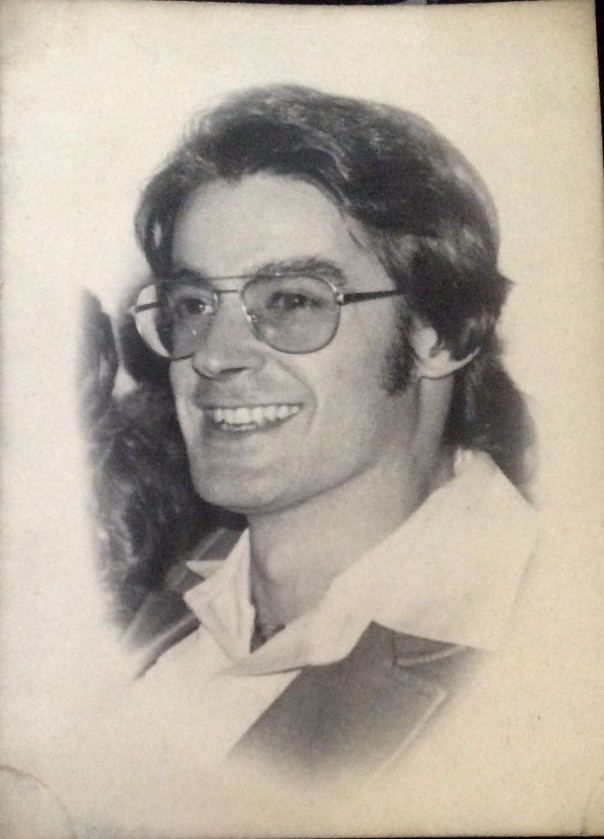
Me just before leaving for Melbourne at the Capitan Torres restaurant in Sydney circa 1978
However, circumstances were about to present me with the window of opportunityI needed, and the wherewithal to come crashing out of my closet!
In late 1978 my father committed suicide in bushland near his home in Vincentia, on the NSW south coast.. I am not going to go into details of life with my father, but suffice it to say it was tense. I cried a few crocodile tears, then clicked my heels and rejoiced. My sense of freedom at last was overwhelming! I don’t know what I would have done if this situation hadn’t presented itself. I could never have openly come out to him, as the repercussions could have been dire. As it was, I was moving further and further away…in a relationship sense…from all my family (I am not going into the complexities here, but…oh boy!) so it is possible that to live my own life, and be who I had to be, I would have cut them all off earlier than I did…or maybe Melbourne would have happened anyway, irrespective of anything, and I would just have cut them out of my life. I guess the simple fact was that I was an outcast…the black sheep of my family. One way or another…I really didn’t give a fuck!
In the middle of 1980, the retail company I worked for – Pellegrini & Co Pty Ltd – asked me if I would be interested in going to Melbourne and troubleshooting two stores they had down there. I jumped at the chance. So I flew to Melbourne, set up house in Cumming St, West Brunswick, and started to set in motion the cogs that would change my life, starting a whole new phase that would take me in directions I could never have imagined.
Now, this was no easy matter. Cogs can be complicated mechanisms. The two stores – one in the Myer Centre and one in Hardware Street were in a mess, and by the time Christmas 1980 rolled around, I had not even started having any social life, let alone coming out and banging my way through Melbourne! That was to come! After spending that Christmas and Boxing Day on my own with a bottle of whisky, I decided I needed to do something about it! But what? I went through the classifieds and social group listings in the gay press, mentally started ticking or crossing them out, then going through a process of elimination with the ticked ones, according to where I thought I might or might not fit in. One group seemed to stand out – Acceptance Gay Catholics. I knew not only all the ins and outs of the Catholic Church…but I managed businesses for a Catholic retailer. Seemed like a match made in heaven, so to speak! So I made a phone call, found out whose home the next First Friday Mass was held at, and the next First Friday found me heading out to suburbia to Max’s house for my first gay outing. I told no one I was not yet out, and not being from Melbourne they wouldn’t know if I was or not. Right up to the day I left Melbourne no one I knew was any the wiser.
So the guys all started piling in…and not exactly a pack of spunks, though a couple of lookers amongst them. Turns out the Servite Fathers conducted the masses for them. Not being under the jurisdiction of the local bishop, they were free to do what they liked.
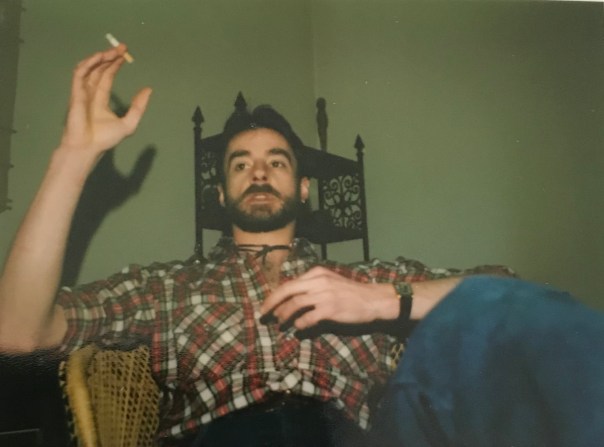
A clone is born…Cumming St West Brunswick 1981.
After the mass there was a meal, then we hit Melbourne for a night out. My first gay club…The University Club in Swanston St. It was gay there every Friday and Saturday night. Started dancing with the guys from the group, and decided to play it safe by dancing with, then going home with, one of the older, plainer guys. At the grand age of 25 I was about to have my first gay sexual experience. It wasn’t the bells, whistles and fireworks I was expecting! In fact…it was a total dud!
Frank, naturally thrilled to bits to have a quite handsome bit of fluff come on to him (actually he made the first move – on the dancefloor! I wasn’t experienced enough to know that if you weren’t really interested, you said a polite “no thanks” and moved onto the next). I didn’t want to seem rude, so said yes when he invited me home, despite fancying a couple of the younger guys more. A steep learning curve here! So, Frank had a car and offered me a night at his place. I can’t remember where he lived now, but it was quite a drive out of the Melbourne CBD. No sooner was I in the car than he had my cock out, and out it remained all the way to his place, despite several near misses due to his…distraction! I often wonder what other drivers thought as Frank’s head disappeared from sight at every red light! Once we got indoors, I decided the ball was in his court and I would leave it up to him to drive proceedings. He assumed I was a young slut and would know how all the mechanisms of gay sex unfolded. Frank was also a bit old and stale, and not the most sexually adventurous person to go home with. From my perspective, I wouldn’t even be leaving the starters blocks with this one. Not an auspicious beginning to my gay sex life, having held myself back for so long. The next morning, it was breakfast, then finding out that I would be getting myself back into the city…on a train. Well, fuck you too, Frank!
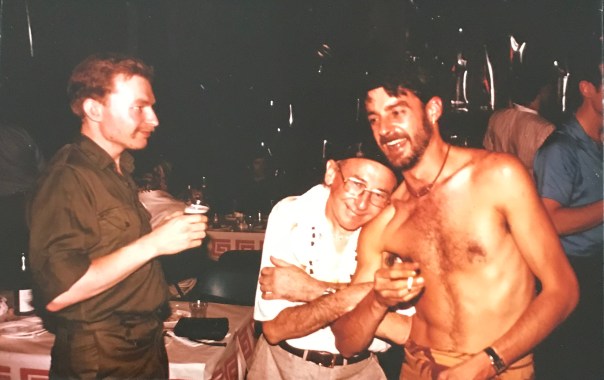
At an Acceptance function just prior to returning to Sydney. Fred Diamond (left), Max (Centre) and me.
I started attending not just the First Friday Masses, but Sunday Evening masses as well, held in the Holy Trinity Catholic Church in North Fitzroy, and any of the other Acceptance social occasions that cropped up on the calendar. Thankfully, Frank attended pretty well none of these with any regularity, so it was quite a long time before I ran into him again. In the interim, I found out from Fred – we’ll get to Fred shortly – that he and the other young guys at the University Club that night were quite surprised to see me go home with him. Learn to say no is the first rule of survival on the gay scene!. So over the next few months I met the other members of Acceptance through the masses, or parties in their homes, and get-togethers in a few local eateries, and gay venues such as The Laird Hotel in Collingwood, Smarties Nightclub in North Melbourne, and Pokies, a Sunday night drag venue in St Kilda. My evil plan was working…I was starting to lead a gay life!
In the meantime, I wanted the world to know I was gay. I wrote to my ex-Granville flatmates and ‘fessed up…only to find out that they had known since the night they packed my luggage for Campbelltown. They had met my mother, who I had only just been reunited with prior to coming to Melbourne. On a visit to see her, they notified me by mail, they had accidentally outed me, thinking that I had notified her at the same time as them! They also informed me that she already suspected that I was gay, though she never brought the subject up with me. Years later, back in Sydney, I made no effort to hide my sexuality from her, though on a mother/son lunch in the city one day, she informed me that she blamed herself for it. It became a moot point between us, and she has never really reconciled herself to it. Tough shit! I wasn’t taking a step back for anyone!
After my rather unsettling encounter with Frank, where nothing more exciting than some oral happened, things went from bad to worse. I fell in love with Fred, who edited the Acceptance newsletter, and did a gossip column under the pseudonym of Jodi A Frean. Fred and I had a difficult sex life for the 6 months we were together, and being the innocent I was, I never picked up on the signals about his sexuality. Firstly, he was into light S&M…at least I knew that was, thanks to reading “The Joy Of Gay Sex” before venturing into the Gay void…and secondly…he was a beat quean! He, Danny (who was the second man to fuck me, and went to it like a rabbit on heat) and Jim (who gave me a handjob in the shower, after a swim at a beach house we went to for an overnight stay) were the only three Acceptance members I got off with. Another, Tony, who I should have been more attuned to, as he was more my type, had a crush on me, which I suspected, but unfortunately never followed up on.
At a Mass at my flat in West Brunswich, a very handsome man…Barry (I know…the same names seem to keep cropping up in my life)…caught my eye. He stayed after everyone else left. We chatted, he helped clean up, we drank some more wine, and ended up in the bedroom, where he had the great distinction of being the first man to fuck me. The sheer eroticism and intensity of getting fucked blew my mind! I took to it like a duck to water, and never looked back!
So, that was the start of my sex life. The next thing to do was to expand my horizons. A lot of thought went into it…I wasn’t a risk-taker so the beats held no appeal, no did the shadowy world of the sauna. I had been…unnecessarily… steeling and prodding myself to go to a nightclub in St Kilda called “Mandate”. It was to be another life-changing experience! I was terrified when I ventured there for the first time. It was unlike any nightclub I had been to before in that it didn’t have an entry where you just walked in. The door was closed, so I went and stood on the oppisite side of the street to see what was going on. It didn’t take long for it to dawn on me that, after watching several patrons arrive, that one knocked to gain entry. A security measure, obviously. So, over I go, knock on the door to find that a tiny window in the door opened, and I was being scrutinised by a drag queen. In my clone gear I obviously passed muster, as the door opened, I paid my entry, and up the stairs I went (NOTE: it was a good deal later that I found out that there were also under-stairs activities…though not my scene).
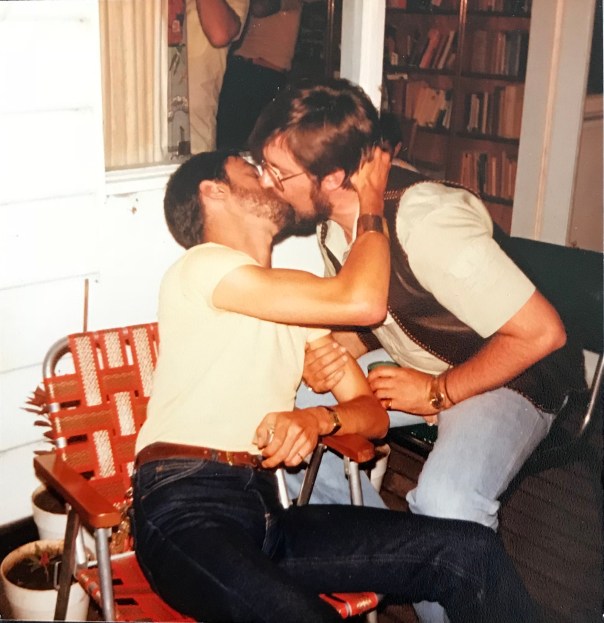
With Glenn W, the Sydney guy, at an Acceptance function. I foolishly allowed him to talk me into returning to Sydney…a mistake for both of us!
Here, I entered a world of men, and music, that set my heart blazing. There was a bar area to the left of the stairs, to the right was a communal area with a barred cruising area surrounding it, and to the rear was a copper dance floor that was to be pretty well my sole obsession over many, nany visits there. I loved Mandate. I loved its masculinity, its testosterone-charged atmosphere, the pure maleness of it. If I had to imagine Nirvana in these early coming out days, Mandate was it and in the not too-distant future, the Midnight Shift in Sydney when I returned to my roots. I had my first pick-ups there, had my first public blow-job on the edge of the dance floor, met some wonderful men including a man called Brian Pryke who I had the most esoteric sexual experience with (and communicated with for a while after returning to Sin City), and some of my worst sexual experiences including a Dutch pilot who had the most disgusting dose of smegma I have ever encountered, and left me with the gift of anal warts. We live and learn! At Mandate I was introduced to dance floor filling icons such as Lime, Phyllis Nelson, Carol Jiani, 202 Machine, Shirley Lites, Tantra, KC and the Sunshine Band, Patrick Cowley, Sylvester, Divine, Paul Parker, Seventh Avenue, Peter Griffin, Hall & Oates, and many other artists who started my ongoing love for dance music. The wonderful nights I had in Mandate will live in my memory forever.
I continued my work and socialising with Acceptance (including some cross-denominational “spiritual shenanjgans” with a member of Angays (the Anglican version of Acceptance) until I returned to Sydney. They gave me a wonderful set of friends that kept me ocvupied constantly, and a rather frantic social life. I think that what disturbed me the most about being an out gay man in a Catholic social group was the “subtle” stigmatisation that we just seemed to accept. Though the Servite Fathers, who celebrated our home masses, were unequivocal in their support for the gay community, the particularly internalised discrimination and alienation that was integral within the Catholic church itself, seemed to be tolerated more so than finding ways to support us. I always felt that much of the support came more from obligation than caring and understanding.
And while talking of the Servite Fathers, I must relate a home mass story here. First Friday Masses were shared amongst the various homes of Acceotance members. When I volunteered my flat in West Brunswick for one, I found I faced a dilemma. Confessions before mass were usually held in a private room, and the only one in my flat was the bedroom. The entire back of my bedroom door was covered in pictures of men in various poses and states of undress…mainly naked…and erect! In my wisdom, I decided that this was not an appropriate thing to have on display in a room where gay men were confessing their sins. Rather than remove all the pictures, I decided to tape a large sheet of brown paper over them. Evidently during one of the confessions, the tape gave way, causing the paper to fall to the floor. Evidently there was a brief pause in the confession as the priest eyed off the door full of naked males, then continued on as if nothing had happened. The exposition was the cause of much hilarity for the rest of the night, with the priest commenting on my “good taste in art” as he departed.
The only other churches that catered to us were St Francis in Lonsdale St, and Holy Trinity Church in North Fitzroy. And even then we could only attend masses at certain times on Sundays. It felt very alienating, and was one of the reasons for me joining the Gay Rights Lobby when I returned to Sydney. For me personally, well….I was an Athiest disguised as a Catholic…just to secure myself a social life, though going through the actions of being a Catholic, and arguing stronly against the banality of much of Catholic belief and doctrine at every opportunity, which caused me no qualms. Only once was I dressed down regarding my staunchly held opinions, and I was stronly supported by the group I was with, as they did not believe in blind faith. There is hope yet in the world.
I went on to become Secretary on the Acceptance committee, and also a member of their social activities sub-committee. But I was about to make a really fucked-up decision that was about to yet again change my life’s direction.
It was at an Acceptance barbecue that I was to meet Glenn W, who was visiting Melbourne, and lived in Waverton in Sydney. It was a period where the Pellegrini head office in Sydney were quietly hassling for my return. Glenn quite swept me off my feet, and after several months of correspondence and with a position as assistant to the General Manager offered to me back in Sydney I rather foolishly decided to return.
So ended my wonderful, unforgettable life in Melbourne. Plans were afoot for a massed goodbye for me at Tullamarine, but to avoid what would have been a very tearful occasion, I quietly flew out the night before.
Glenn W turned out to be a psychopath! Another disastrous love encounter! Would I never learn! But that is a Sydney story! As is the early days of HIV, already being hinted at in the Melbourne gay press. Hard times ahead…and just as I was starting to enjoy the life that “coming out” was presenting to me. The Sydney story was about to begin!
Tim Alderman
(C) 2015