Category Archives: Article

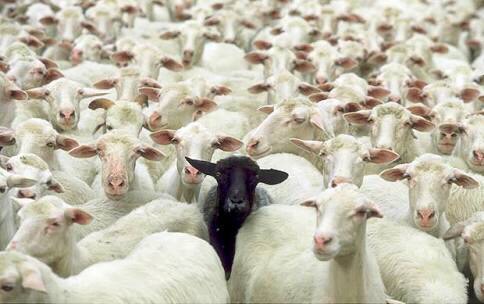
On Being A Black Sheep!

“Regrets? I’ve had a few! But then again…too few to mention! I did what I had to do, and saw it through without exemption…but more, much more than this – I did it my way!”

“In the English language, black sheep is an idiom used to describe an odd or disreputable member of a group, especially within a family.”

I never planned to be the black sheep of my family. Perhaps genes had something to do with it; perhaps environment; or we can poke a finger at the times we grow up in – all are likely causes! But sure as hell, life experience, that need to survive (stronger in some of us than others, I’ve noticed) is a very definite cause.
I’m not the first in my family. My Great Grand Uncle, George Rickinson Swan Pickhills, was another. For the times he grew up in (the mid-1800s up), he was not a conformist. Outspoken, openly critical of others including governing bodies,  had no tolerance for idiots, and went about things with an actions-speak-louder-than-words attitude that gained him respect amongst his peers, and set him firmly against the establishment. A true role model if ever there was one! My cousin Dianne was also one who bucked the fitting-in trend, and did things her own way. I think she saw aspects of me that no one else in the family noticed. 

Even for someone growing up through the 50s& 60s, I don’t think I ever really conformed. It wasn’t an obvious choice to not fit in, but more like a realisation that if I didn’t stand up for myself, I would always be doing that which I didn’t want to do. Surprisingly, I always seemed to be accepted as an individual, even in a world where individuality was not an accepred norm. Perhaps the most difficult aspect of it, and certainly would have caused the most frustration in my family – oblivious to me, of course – was that I had a definite leaning towards the more creative side of life, rather than a sporting or physically active side. This showed up in various ways in my pre-teen years – I avoided sports for starters, much to my fathers frustration. He tried initially to get me to play soccer – I loathed it, and did everything possible to avoid contact with the ball. After that…tennis – but no, not interested. I managed to avoid sports for the entirety of my school life – no mean feat – by hiding, wagging it with other boys who felt the same, or volunteering for other duties. Truth be told, I didn’t hate sports altogether. My experiences with softball were very positive – but it’s not an Aussie sport, is it! And I loved athletics. I was a fery good runner, triple jumper and high jumper, but no one ever offered athletics as a viable alternative within sports, nor offered any encouragement to be trained in or follow such a path, so it went by the boards. Over the years, I’ve had cause to reflect on that!

I had a furtive imagination, which showed itself in my essay writing, my love of reading science fiction, and my ability to invent games to play at home. I loved nothing more than to be tucked out of sight, in a quiet corner with my hound, devouring a book. In high school, I was active in the choirs, theatrical productions, and writing – successfully, and often  with hilarious results – my own twisted interpretations of Shakespearean classics, performed during parent & teacher occasions at the schools. 

But of all the driving forces that create black sherp, the three singular and most significent events were the ones that had the potential to destroy me, but instead hardened me, radicalised me, and instilled the survival instinct in me. The acquired abilities to see through all the bullshit of others around me; to cut those out of my life who either let me down, or disappointed me; to realise early in my life that I was different to most around me, to embrace the difference, and despite making some very bad decisions along the way, always remaing true to myself; going against the grain, which created its own sets of problems; defying authority – ditto for creating problems; and the ability to live alone, to be able to be a solitary individual yet never let it drown me, has served me well all my life, has given me a tough exterior (and often interior) that has helped ne survive even bigger issues as life has trundled along. 

The first toughening came when, in early 1965, with me at the grand age of eleven, my mother left home. I can’t say I didn’t understand why she left. I was an intuitive child, and had, on occasion, seen and heard things I oerhaps shouldn’t have, and drew my own conclusions on things happening around me. This created, at home, a first taste of independence. Years of watching my mother do things around the house paid off, and with the help of neighbours we scraped by. I learnt not to iron nylon socks. The second thing that happened – bringing Nancy Thompson in as a housekeeper – was a catalyst for the third – the death of my 7 year-old brother, Kevin. Nancy taught me real survival skills, however not enough to prevent my brothers fate. Enough has been written about his death – there is a long article on my blog here “Kevin Pickhills – The Unspoken Name” – for me not to go into it here, however the effects on my life from this catastrophic event were to have repercussions for decades to come. To stand up to Nancy, you had to be tough – she was a bitch of the first degree – and she unintentionally taught me mental toughness – something one really shouldn’t have to learn at 11 going on 12 – and to alienate myself from all that was going on around me. She was the first to publicly acknowledge – in a newspaper –  that there was an “effeminate” side to my nature. I don’t know how I would have reacted if I’d known of it at the time. Perhaps I would have breathed a deep sigh of relief! She taught me survival against all odds!

My relationship with my father – not the best at any time, as I and Kevin had both been bullied by his hair-trigger temper, and the leather strap he weilded in the name of discipline – was fraught with tension, distance and disassociation after Kevin’s death. My final toughening had been invoked, and from that time on, whatever was thrown at me rolled off…at least on the exterior. From that time on, I was at war with my father, his family, and the world. He hated rock music…so I played heavy rock. He told me not to drink…so I drank…to excess. He told me not to smoke…I smoked. He forbade me growing my hair…I grew my hair. He told me to finish school…I left at 4th form. He told me to get a trade…I ended up in retail. Whatever he wanted, I did the opposite. At one stage, he threatened to “knock my block off”…I left home, and never went back. When he committed suicide in 1978 (carbon monoxide poisoning, in his car, in the bushland around Vincentia) I went through the motions of grief, but inside I was glad. Not only had Kevin’s horrendous death been avenged, but I no longer had to fear whatever retribution would have happened by finally fully living my own life. I could publicly acknowledge my sexuality as a gay man, and get on with it! It was exhilerating! 

I don’t know that contracting HIV in 1982 really impacted my life as much as it should have. I have always thought that I had fought tougher battles, and indeed when asked about it in an interview in the late 90s, I stated that despite everything I had been through with HIV and AIDS, the death of my brother had impacted my life more. By this time, I had found ways to be a black sherp in the community. My years of managing a sex shop in Darlinghurst, my forays into “gutter” drag, my taking charge of many aspects of my health care, my defiance at taking drug regimes the way I want to take them, instead of how they should supposedly be taken, my refusal to allow HIV to be a “secret” part of my life, my refusal to see the negatives of a very negative disease, by empowering jyself by not becoming a victim, all pointed me in different directions to what most others were taking. I made one atrempt to return to jy old trade of retail, hut it felt like a step back, a return to a world that I had now left behind. I went to university, I went to TAFE. I started my own husinesses, took my life off into directions that I wanted…and fuck the world, and fuck anyone who thought they could tell me what to do! Even my vision-impairment has pushed me into black sheep territory. I learnt to use a white cane, then refused to use it because it can be as much of a hindrance as a help. I still do things my own way, and despite sometimes being my own worst enemy, at least I feel like an individual. There is not a single thing I do that my father – or mother – would approve of…but then, I’m happy. I don’t know that they ever were!

Back in the late 70s I reconnected with my mother. It was as much a curiosity thing as anything else. She had remarried, and I had a half-sister, with 18 years between us. I didn’t particularly like my step-father, but I didn’t have to live with him, so didn’t much care. With so much water under the bridge, my mother and I had little in common. By the time I reconnected, I was on the verge of coming out (after my fathers death), and by the time I returned from Melbourne in 1982, not only had some friends accidently outed me to her anyway, but I was well and truly an out gay man. She tried the “Oh, it’s all my fault” victimised mother line, but I told her to get over it. In many respects I hever clicked into her family (or her into mine, I have to say). She was hospitalised to have her bladder remived – due to cancer – in late 1997. No one rang to tell me she was in hospital. Being a bit peeved at not being notifued, I rang to enquire why. I was told that there just wasn’t time to ring everyone – though mind you, the rest of the family knew. Made me realise just how far down the pecking order I was in her new family. I rang her in Westmead Hospital on Christmas eve, wished her a happy Christmas – and that was the last time we spoke. She made no attempt to contact me, nor I her. The last I heard she was still alive, and in her 80s. When asked recently if I shouldn’t contact her, being as she possibly won’t be around much longer, and I might have regrets if I didn’t – I replied…no, and I won’t! We all make our own beds!

I’ve lived most of my life on the outer edges of things. I have no regrets about that. If being a black sheep makes me an individual; if it gives me unrestrained freedom to express myself; if it means I don’t quite fit in; that I can just be me – then I luxuriate in it. Life took the 11 year-old child, and bashed (figuratively) and moulded him into the adult I became, and the senior (who still refuses to be what society expects me to be) that I am developing into. Its led me down some dark allies, crossed some roads against the lights, and balanced on the edges of many cliffs – but at all times there was light, safety and balance at the end of it. I have walked in the illustrious company of others who also follow the outer paths of life. It us never the easy road, though perhaps the more satisfying. 

I don’t know that a black sheep can ever be white, or even a shade of grey – but then…perhaps we don’t want to be! 

Tim Alderman (C) 2016
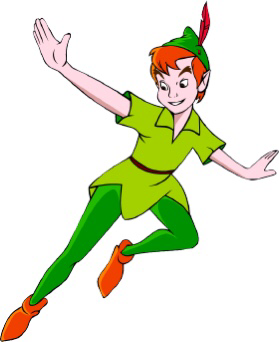
Peter Pan Syndrome – I Don’t Ever Want To Grow Up!

“Puer aeternus

is  for eternal boy, used in mythology to designate a child-god who is forever young; psychologically, it is an older man whose emotional life has remained at an adolescent level. The puer typically leads a provisional life, due to the fear of being caught in a situation from which it might not be possible to escape. He covets independence and freedom, chafes at boundaries and limits, and tends to find any restriction intolerable.

Peter Pan syndrome

See also: Boomerang Generation

Peter Pan syndrome is the pop-psychology concept of an adult (usually male) who is socially immature. The category is an informal one invoked by laypeople and some psychology professionals in popular psychology. It is not listed in the Diagnostic and Statistical Manual of Mental Disorders, and is not recognized by the American Psychiatric Association as a specific mental disorder.”

We’ve all seen them, on our odd, occasional visit to a nightc lub. Guys we saw on the scene 20 years ago. As in the old days, shirts off, steroid-enhanced musculature, obviously on “something”, dancing around with a  botoxed, permanent I’m-having-the-time-of-my-life semi assinine grin on their spray tanned faces, making sure everyone is watching them, amyl bottle STILL being screwed into one nostril or the other. They know everyone, from the doorman, to the bartender, to the DJs, and every other individual who lives their life in this nighttime world. Our first reaction is “That’s a bit sad at their age!”, followed by a twinge of guilt that you may, perhaps, be envious of them. But the question lingers…is it just that they can’t let their youth pass them by, and settle into a time of their life that is easier to msintain!

As gay men, we have seen these guys around for what seems like forever, and wondered – just when are they going to grow up! These are not – as many inaccurately define them – gay guys who at 45, or 55, or 65, or older, throw som drugs down their throat and have a big night out at the pubs and nightclubs on an impulsive urge. That is just going out for a good time. For these guys, this is serious lifestyle, and one that they can’t give up. Like the recreational drugs that they need to prolong and enhance these nightly nightclubbing rituals…they are addicted to the life. It is not so much living life, as having to compulsively  go through the actions, and strive to maintain it, irrespective of the cost.

Life does have its stages, and how we live and interact with the world is driven very much by our attitudes, perspectives, and personality.  I have an inate fear of turning into what I call “a beige elder” whereby I suddenly throw all dress sense overboard and adopt a singular colour – usually beige- as my uniform of choice. To counteract this, I don’t go out and buy outfits that an 18 year-old would wear. That would be just stupid, and the old “mutton dressed as lamb” commentaries would follow me wherever I went. So, you choose the middle road, whereby you dress well, and fashionably, but keep it appropriate to age.

That’s the lesson the Peter Pan brigade haven’t learnt. The need to be seen, to be liked, to be seen as “younger than their years” is a driving force in their lives. It is a psychological need to be seen as young and vibrant, irrespective of anything. It is even a recognised anomalynin other countries – in Japan, for example, Pītā Pan Shindorōmu (ピーターパン♠症候群?, lit. Peter Pan Syndrome).

According to a 3007 article in “Science Daily” https://www.sciencedaily.com/releases/2007/05/070501112023.htm overproctective parenting can lead to children developing “Peter Pan Syndrome”. The syndrome is not currently considered a psychopathology, given the World Health Organization has not recognized it as a psychological disorder. However, an increasingly larger number of adults are presenting emotionally immature behaviors in Western society. They are unable to grow up and take on adult responsibilities, and even dress up and enjoy themselves as teenagers when they are over 30 years old.

Humbelina Robles Ortega, professor of the Department of Personality, Evaluation and Psychological Treatment of the University of Granada and an expert in emotional disorders, warns that the overprotection of parents can lead children to develop the Peter Pan Syndrome, given “it usually affects dependent people who have been overprotected by their families and haven’t developed the necessary skills to confront life.” The ‘Peter Pans’ of present society “see the adult world as very problematic and glorify adolescence, which is why they want to stay in that state of privilege.”
More men than women affected
Peter Pan Syndrome can affect both sexes, but it appears more often among men. Some characteristics of the disorder are the inability of individuals to take on responsibilities, to commit themselves or to keep promises, excessive care about the way they look and personal well-being and their lack of self-confidence, even though they don’t seem to show it and actually come across as exactly the opposite.
The UGR professor declares that these people are usually scared of loneliness, which is why they try to surround themselves with people who can meet their needs. “They become anxious when they are evaluated by their work colleagues or their superiors, given they are completely intolerant towards any criticism. Sometimes they can have serious adaptation problems at work or in personal relationships.”
Another characteristic of people suffering from the ‘Peter Pan Syndrome’ is that they are constantly changing partners and looking for younger ones. “Whenever the relationship starts to ask for a high level of commitment and responsibility, they become afraid and break it up. Relationships with younger women have the advantage of being able to live by the day without any worries, and they also involve less future plans, therefore less responsibilities.”
Other causes are:!Link with Narcissism. Peter Pan Syndrome is related to narcissism, but not in the egotistical sense. They tend to be absorbed with imaginative comfort in their minds which attractes them to introspection. This leads them to be imprisoned by childhood fantasy, not the realities and difficulties of life that they need to overcome.

Genetics. Peter Pan Syndrome is not a genetically inherited syndrome. It is acquired by: Environmental influences, in which an individual may inhibit it by how they were raised by their parents.

Factors such as the so-called “Wendy Syndrome”.(female Peter Pans).

To put a gay perspective on it, this article appeared in Gyguts.commin August 2014 http://www.gayguys.com/2014/08/gay-men-curse-peter-pan-syndrome/ and titled “Gay Guys and the Curse of the Peter Pan Syndrome – Gay Men are Great at Everything Except Growing Up” by Dalton Heinrich. “The gay community is great at a lot of things. We are experts at fashion, we are brilliant at design, we are flawless in social networking, and we are professionals when it comes to throwing a party. As a community we thrive under pressure. As a whole we have beaten the odds with almost everything thrown our way. But one thing I have realized in my social note taking is that we are absolutely horrible when it comes to growing up.

Since the beginning of my social existence a large portion of my friends had been older than myself. I had always just assumed that I was mature for my age when in actuality I think most of the gay men I associated with had never mentally passed the age of 25. From boyfriends, to just friends, to acquaintances, to people I would repeatedly bump into at gay bars; a large portion of them were at a dead end when it came to maturing.
Why is it a social norm of ours to be in our late forties and going clubbing and bar hopping multiple times a week? Of the hundreds of grown men I know, why are so few of them actually grown up? Was I doomed to a life of bottle service and boyfriends half my age because I couldn’t settle down and start a family at an appropriate time? Of all the scary turns my life could take, ending up as one of the middle aged party men cruising the night clubs for a one night stand that concluded with me having breakfast alone and hung-over the next morning, was by far one of the worst.
Is it a personal choice each one of us makes or do the majority of us just have no role model to push us in the right direction? As a young gay man whom does not have a single parental figure to aspire to be, I only have the wisdom of the adults around me to sway my decisions. Why are there so few gay men in my life that look at the next generation as someone to mentor and coach rather than a new addition to their dating pool?
Are Gay Men Cursed with the Peter Pan Syndrome?
It is as if all gay men are terrified to grow up. The abundance of thirty and forty something’s that attend nightclubs persistently and dress like they are going to a college frat party is astounding. Instead of the Botox, barhopping and H&M wardrobes; why as a culture, are the majority of us not having children and planning our futures.
This portion of grown men clinging to the wild nights and serial dating of their twenties seem to live in a secret Neverland. It is this category of men that I have personally diagnosed with Peter Pan Syndrome. These Lost Boys that are terrified of actually looking their age and are always fighting off time instead of aging gracefully and being something helpful for the young gay man to idolize?
Is it because so many gay men were robbed of a gay adolescence that they seem to never leave it once they are able to experience the youth they missed out on?
The sad, thirsty man haunting the shadows of 18 and up clubs is slowly killing our culture. When my generation of gays gets older are we going to think that is the normal thing to do with our nights? Are we all destined to be ghosts of our youth, dramatically hunting down a thrill rather than being man enough and brave enough to go toward the light and move on to actually being an adult?
I think it is time to fight off this trend of a permanent youth. We all need to realize how to act our age and how to play our part in our community. It is time to be a role model for the next group of young men. It is time to tell Peter Pan that you want to go home and as much as it may not be the funniest thing to do, it is time to grow up.
Young, lost, and cynical but still yours,” 
It all sounds very familiar, doesn’t it! Frighteningly so!

In a follow on article “Peter Pan: Deconstructed – Clearing Up the Confusion” http://www.gayguys.com/2014/08/peter-pan-deconstructed/ he goes on to say – after evidently received a mixed bag of comments on his original (and very good) article “I 

I would like to start this article off by thanking everyone who took the time to read my last piece Gay Guys and the Curse of the Peter Pan Syndrome, whether you agreed or disagreed. Knowing that so many people have seen my work is a huge and unexpected experience. I now would like to address the reactions I have gotten to my writing. Queerty and Instinct magazine are a couple of the main sites that have posted articles calling me ageist and telling everyone that I believe ‘Men over 30/Men over 40, should not be allowed in gay bars’.

When I read that I was fairly disappointed that such established and respected websites would have to resort to name calling and lying to create controversy. I never once in my entire article suggest that men of any age should refrain from going to bars or clubs; the focus of my article was how the men out at clubs acted. If I am to be expected to respect my elders, than I expect my elders to stop acting like my peers. My article was an opinion piece on lack of role models in the nightlife scene that I personally am a part of, not the entire gay world. Granted, the clubbing and bar setting is not the best place to seek out a role model, but my piece was based off the point that for a lot of younger guys it is their only outing to see older gay men before going back home to a very limited gay environment. It was an opinion piece based off personal experience. I understand if my harsh opinion hit close to home or if my few admittedly general statements pissed people off but both the articles that were about me only seemed to copy and paste my article and throw a few unimaginative lies in for color.
The definition of ageist is a tendency to regard older persons as debilitated, unworthy of attention, or unsuitable for employment. The closest characteristic I have to being deemed an ageist is my belief that men and women over the age of 70 should not be allowed to drive during rush hour for obvious traffic and safety reasons.
As a young gay man I absolutely respect and pay homage to my elders. I know the struggles and strength they have had to endure to make it possible for my generation of gays to be proudly gay and part of a community at all. The point of my article was not to alienate, attack, or insult men over any age and I honestly don’t think it came off that way. My opinion was merely focused on addressing the lack of social responsibility and good examples that I personally am subjected to along with other gay men my age in my community. I know that whom I surround myself with is my choice and not a representative of the entire worlds gay population. My article was not attacking any age of person; my article was displaying my disdain for the attitude of a portion of them.
Agree to Disagree
I stand by my opinion that in the nightlife scene the way a large amount of gay ‘adults’ act is a sad reflection of a culture. I know there are people who make a living off of the nightlife scene and there are successful and mature people who frequent it. There are bar owners, promoters, drag performers, bartenders, event hosts, and much more and I will absolutely admit that my post was NOT referring to them. It was referring to the men who make partying a priority in a desperate attempt to cling to a fraction of their youth and the men that portray immature social attitudes.
I have received an abundance of hate messages and personal insults via twitter and comments on my article from men all over the world. So many of these men were calling me stupid, ugly, badly dressed, and a handful of other petty insults. One of my personal favorites was a guy attacking the color of my roots. Ooh, you sure showed me buddy, kudos to you.
Of all the people who disagreed with me, not a single one of them reached out to me trying to show I was wrong with valid points, a calm reaction, an educated lecture, or even a rational attempt to clarify that I was mistaken. Instead, insecure grown men called me names, harassed me, and wished bad things upon me as if they were 13-year-old girls starring in a Lifetime original. If anything, this onslaught of middle aged cyber bullies only proved my point. There is no better way to judge someone’s maturity than to see the reaction they have to being called immature.
I find it sad that these men more than twice my age who no doubt are extremely well educated and hold wisdom that I could definitely benefit from chose to attack my appearance and throw insults my way rather than guide me back from the mistake they clearly think I have made. I have no problem with men of any age going to bars or clubs whenever they feel like it. I have no problem with large age gaps in gay relationships, since the majority of men I have dated were well over 30 I think my opinion on that is obvious. I don’t see any issue with men of any age group dancing on tables and enjoying life however they want. I not only support older men in bars, I endorse it. Most of you have had to fight like hell to be free enough to do any of that. My issue only lies with the fact that the younger generations of gay men who will one day be the adults in our community are watching you. We are looking at you and we are seeing your behavior toward one another and toward us.
You are in a sense our teachers and parents. Some of you may have not wanted the responsibility of having kids but it’s too late for that. Congratulations, it’s a boy! You are our teachers, you are our coaches, and you are our fathers. How you react to conflict is recognized, how you deal with issues is important, and what you do with your life is valuable.
The widespread, international reaction I have gotten shows that I have blatantly offended a large amount of people with my observations. If this many people are upset by the opinion of one person then doesn’t that suggest that there is something deeply wrong on a larger scale? If my article were just some bogus trash thrown onto the Internet by an uneducated kid, would so many people be offended by my words? If I am so off base, why are so many people retaliating on a personal level and if it did not ring even slightly true would it warrant a response at all?
Regardless of my opinion and personal beliefs every single one of you is blazing a trail that men my age will follow one day. Every single one of you is holding the steering wheel of our community. I understand you getting upset with me for saying that some of you can’t drive but for Christ’s sake, pay attention to the road. You have kids in the car.
Even when you don’t want me, I’m still yours,”
Gay men also like to run around with their heads in the sand, and any attemots to create humour, or to point out anomalous aspects of the community are always met with cries of internalised homophobia, or discrimination,mor misinformation. It’s time to face facts guys – we are not a unique species who are exempted from the problems and foibles of the general community. As a small enclaved community, there can be a tendency for conditions such as Peter Pan Syndrome to be more blatant and obvious. Like Dalton, I am not suggesting that guts of any age shouldn’t go out and enjoy themselves and party on in the bars and nightclubs. That us just having fun – it is not the addiction and personality disorder that this article is about. As a gay community, we need to recognise that these conditions exist, and that our very lifestyle actually encourages and exaggerates same. In a community of vibrant, colourful, creative people…the Peter Paners still stick out.

Perhaps we need to create a Neverland!

Tim Alderman (C) 2016

Henry Moorsom Pickhills (1840-1866)

We kniw very little about our early family histories, other than what we can glean from records. From these, we have to try to piece together some sort of story of their life. Some records are too-the-point, others sketchy – but very occasionally they can be gems that give us very intimate glimpses into who they were. My Great Grand Uncle, Henry Moorsam Pickhills, is one such. He lived for a very short 25 years, yet I feel I know him well.

Henry was born in Halifax, Yorkshire in 1840, just in time to be included in the very first census held in England. The second-born son of Rickinson Pickhills & Elizabeth Appleyard, he was given his  Great Grandmothers maiden name – Moorsom – as a middle name. Apart from being included in the 1851 census, where he resided in Manningham, Yorkshire along with two additions to the family – Catherine, and Charles Edward, this is all we know of his first ten years of life.

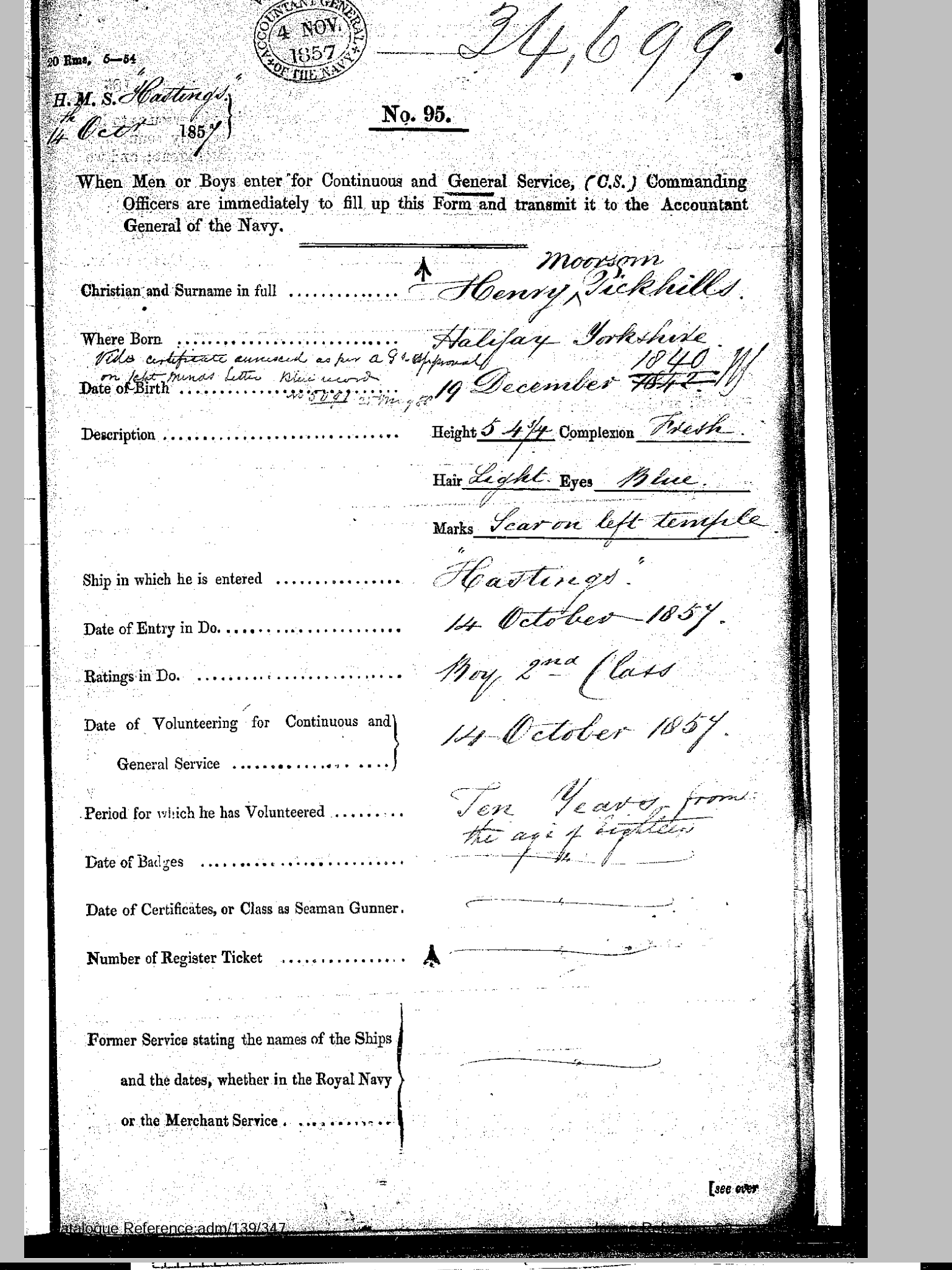
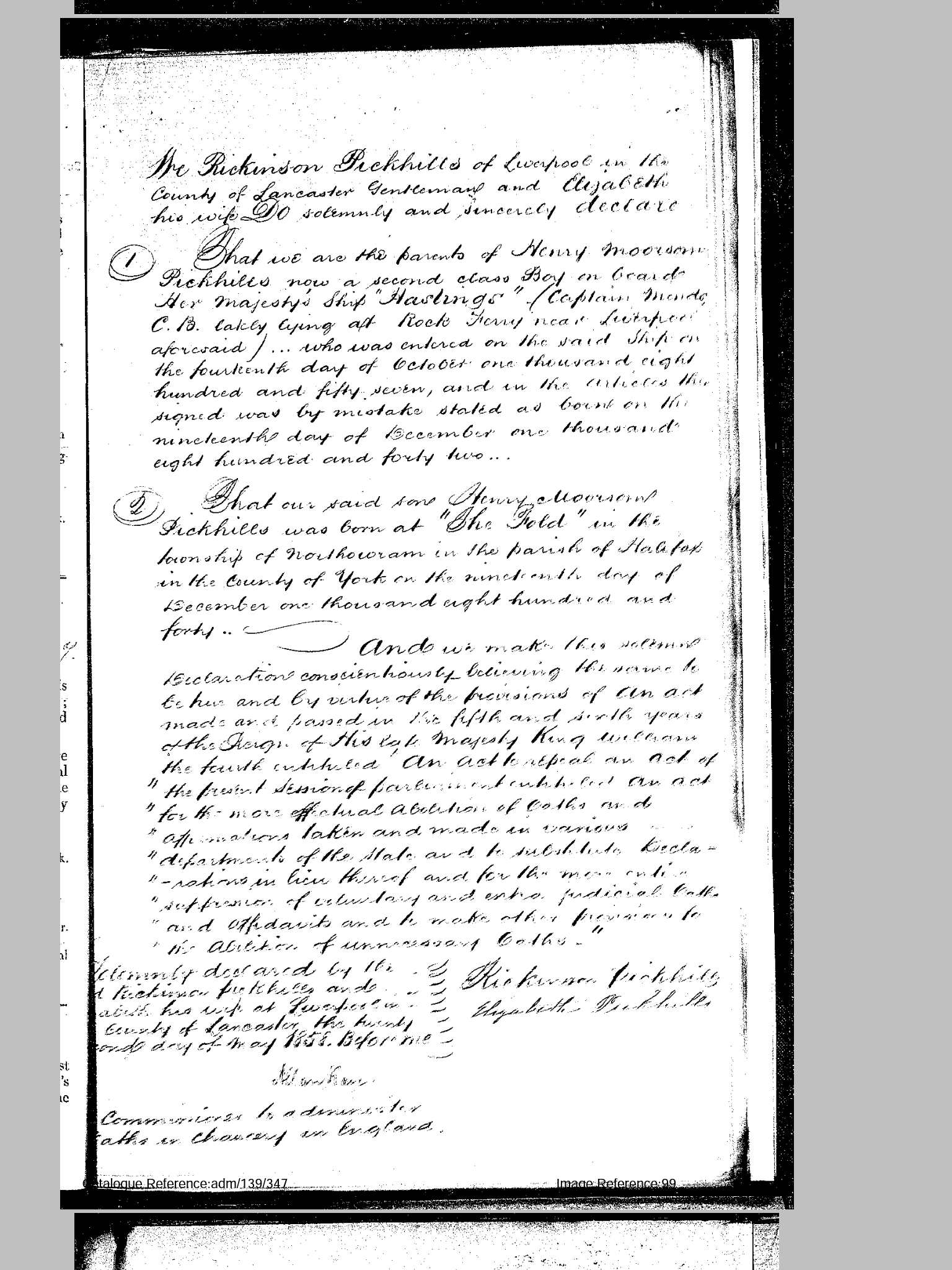
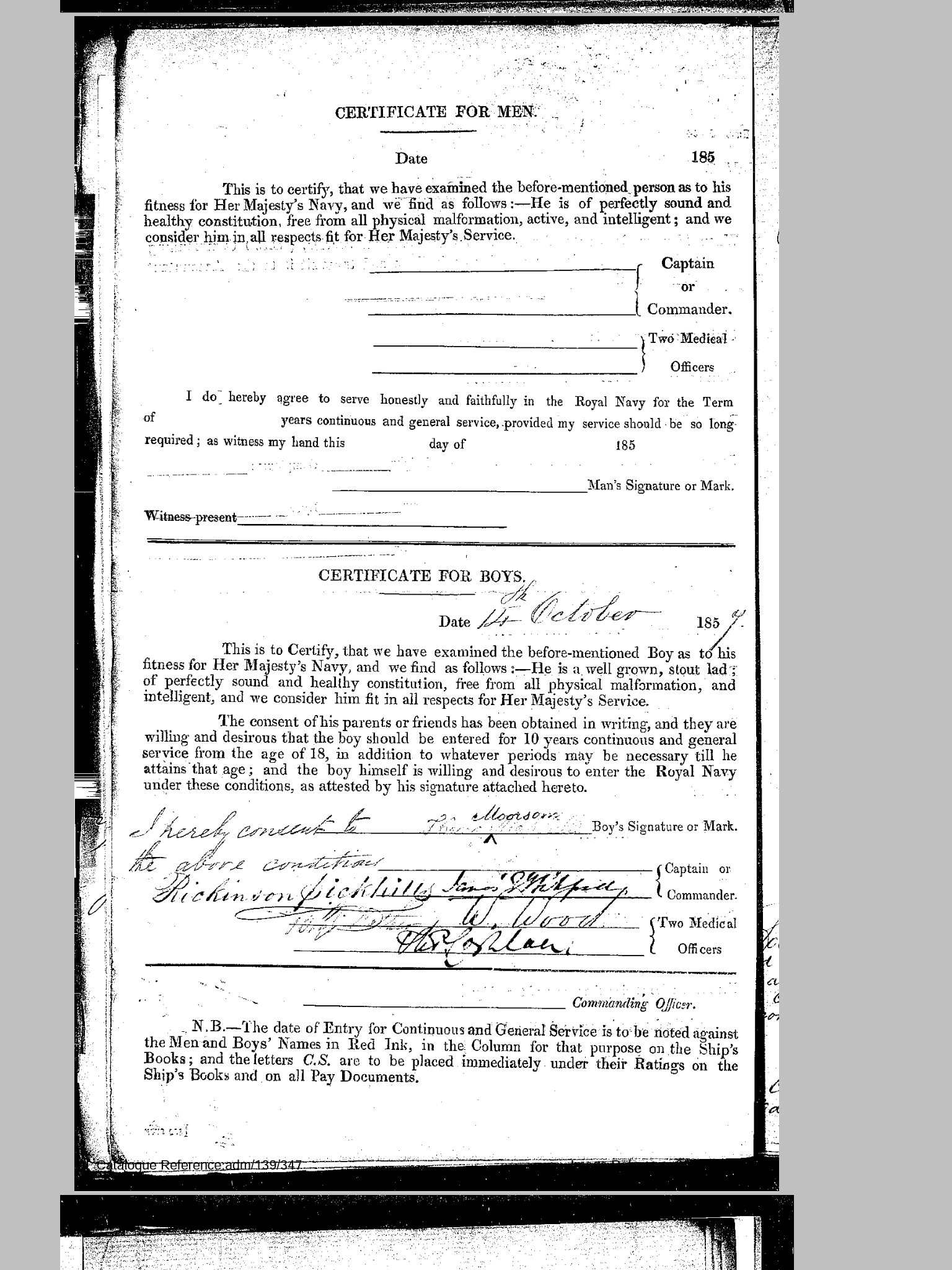
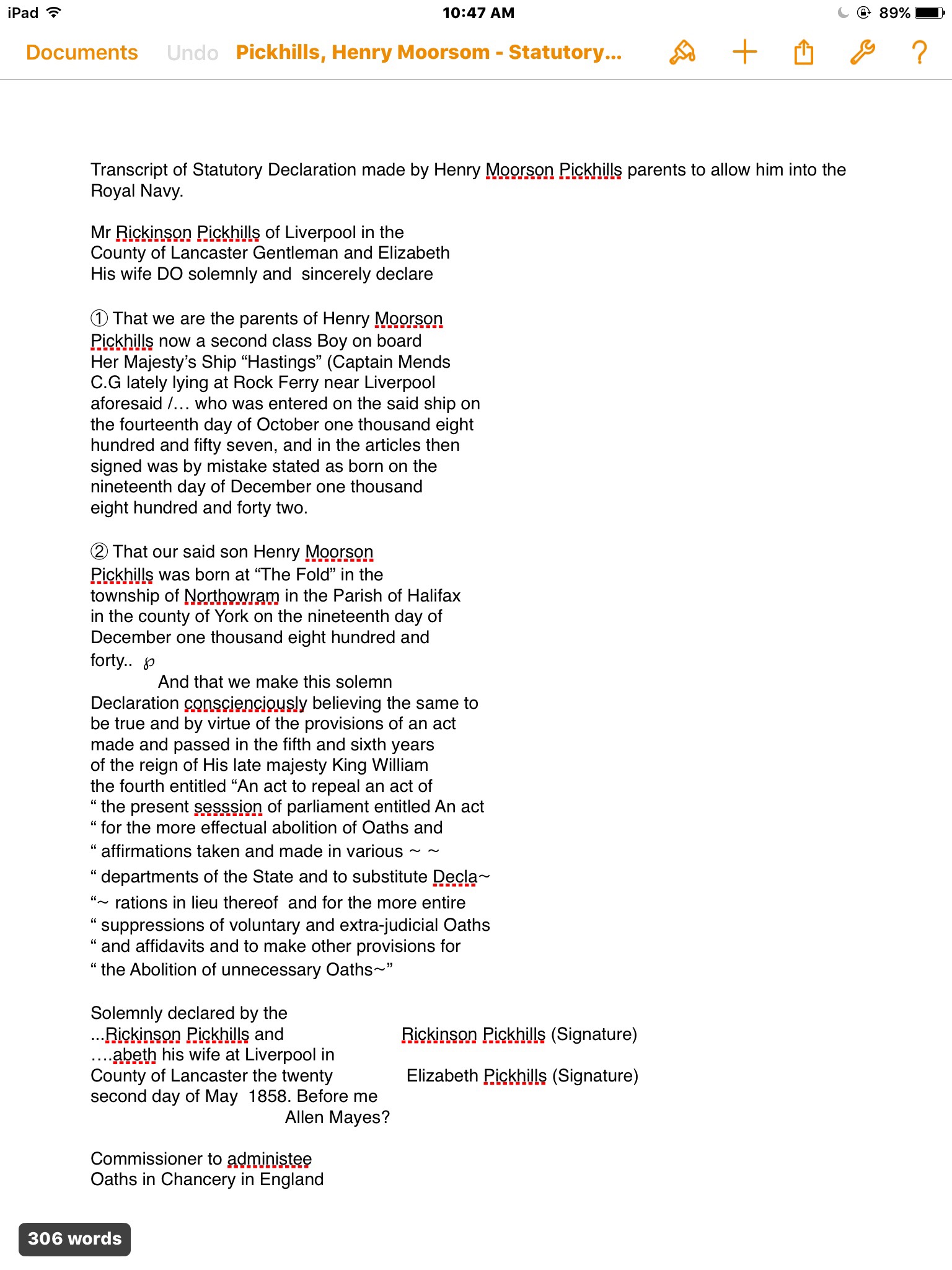
We hear nothing more about him until 14 October, 1847, when he volunteered for service with the Admiralty. Getting Henry’s Admiralty papers was a true find for several reasons – it gives us a description of him,, tells us his ranking and ship, who the captain was – and a statutoty declaration from Rickinson & Elizabeth, written in Rickinson’s hand, giving him permission to join, Henry being only 16 years-old at the time.

We know from this record of 3 pages that he enlisted on HMS Hastings. He was born on the 19 December 1940. He was 5’43/4″ tall, with a fresh complexion, light hair, and blue eyes. He has a scar on his left temple. His ranking is Boy, 2nd Class, and he has joined for 10 years from the age of 18. The actual Boy Certificate is signed by Rickinson, Henry, the Captain and 2 medical officers.The statutory declaration gives the Captains name as Captain Mends (William Robert, as per research). It tells us, rather unnecessarily, that at that time the ship was lying at Rock Ferry near Liverpool. Rickinson had mistakenly given Henry’s birth year as 1842. Henry was born at The Fold, in Northowram (Yorkshire). Rickinson goes into quite a starement in legalese towards the end of the declaration. Was he showing off? As an Articled Clerk training to be an Attorney did he want the readers of the declaration to know that he was a learned man? The reasoning is unknown, though it seems a quite unnecessary addition to the statement.

Our next encounter with Henry is on the 19 December 1858, in the UK Royal Navy Registers of Seaman’s Service, where he is noted on the Hastings. 

We next hear of Henry at the 1861 census, where he is counted amongst those “at sea”. 

We finally encounter Henry on the 8th April 1866. He had died onboard the SV Aracan, from Cholera, at Calcutta, Bengal. He was buried on the 9th October 1866 in Calcutta. £3/13/1 is owing to the family. Other goods sold. He was 25 years-old.

Notes

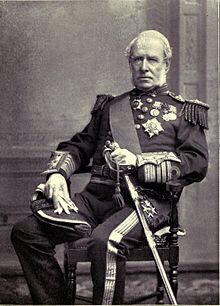
  • Captain William Robert Mends GCB (27 February 1812 – 26 June 1897), was a British admiral of the Royal Navy, son of Admiral William Bowen Mends[1] and nephew of Captain Robert Mends. William Mends was born at Plymouth into a naval family. He married Melita, daughter of Dr Joseph Stilon R.N. on 6 January 1839. From 3 April 1857 to 1 February 1860 he was captain of HMS Hastings on Coast Guard service. He moved to take command of HMS Majestic on 1 February 1860 when she replaced Hastings on coast guard service and was then appointed deputy controller general of the coast-guard in 1861. He spent May 1862 to February 1883 as Director of Transport at the Admiralty. Mends retired at the rank of rear-admiral on 1 January 1869, was promoted to vice-admiral on 1 January 1874 and then a full admiral on 15 June 1879.
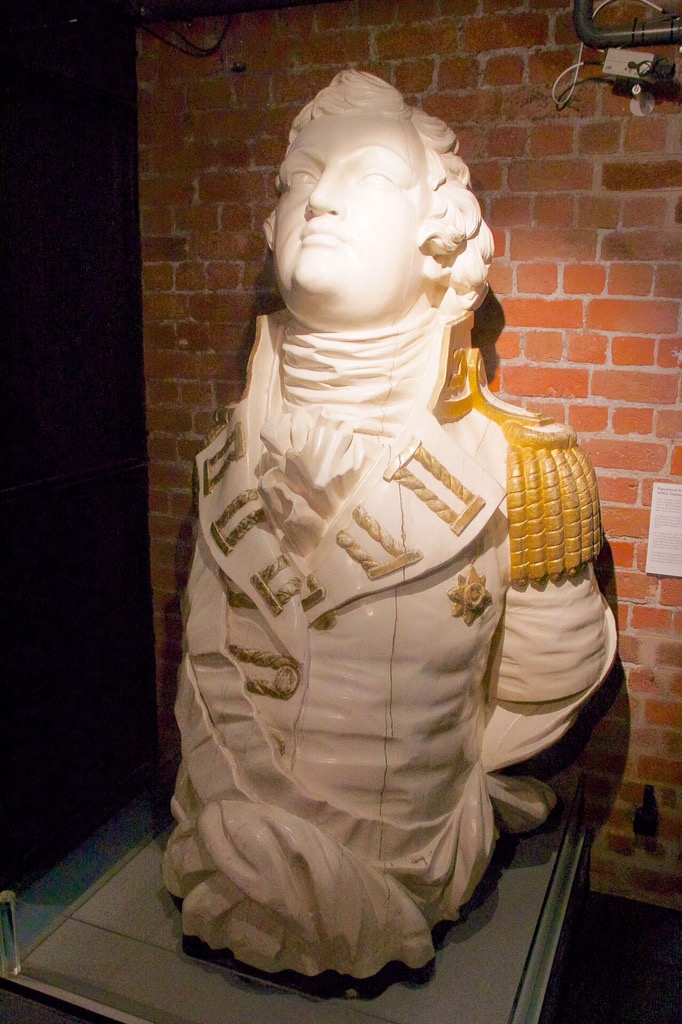
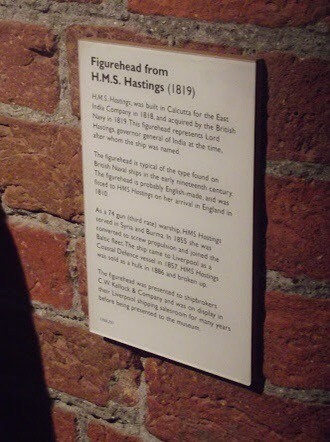
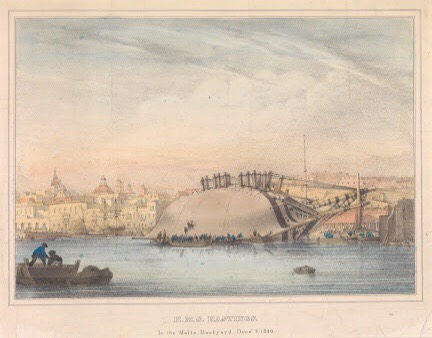
  • HMS Hastings was a 74-gun third rate ship of the line of the Royal Navy. She was built in Calcutta for the Honourable East India Company, but the Royal Navy purchased her in 1819. The Navy sold her in 1886. Hastings was built of the highest quality “saul”, “sissoo”, “Pegue”, and “Java” teak wood, following Sir Robert Seppings’s principles, which resulted in a vessel both longitudinal and transverse support. Her construction cost Sicca ruppees (Sa.Rs.) 8,71,406 (£108,938), which the merchants of Calcutta and other patriotic individuals subscribed via shares. The full cost of getting her ready for sea was Sa.Rs. 8,71,406 (£116,375). Captain John Hayes sailed Hastings from Calcutta on 28 March 1818. She reached Madras on 13 April, and Port Louis on 2 July. From there she reached St Helena on 15 September, and arrived at The Downs on 3 November. The Ship’s figurehead is now on display at the Merseyside Maritime Museum.
  • SV Aracan; nationality: British; purpose: transport; type: fully rigged ship; propulsion: sailing ship; date built: 1854; tonnage: 864 grt; dimensions: 56.8 x 9.8 x 6.6 m; rigging: 3 masts full rigged; IMO/Off. no.: 1080; call sign: HGMW H G M W; about the loss cause lost: collision; date lost: 09/03/1874; casualties: 0; builder: Whitehaven Shipbuilding Co. Ltd., Whitehaven; owner:   Brocklebank T. & J. Ltd. – Thomas & John; captain: Charles Hartwood. 
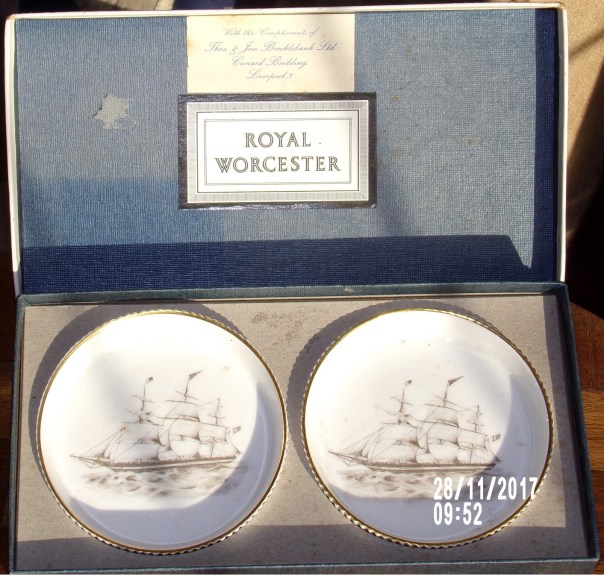
  • The Brocklebank family who owned the Aracan that traded between England, India and China from the opening of Chinese ports in 1858. She was sunk in collision with the SS American at 10 p.m. on 9th March 1874, 16 miles off Portland Bill, England, with 116 men on board. All survived and were taken on board the SS Syria that was being towed by the American on a 0.25 mile long hawser. I still have a presentation case containing two Worcester dishes, as was given to 1st class passengers, and a copy of the newspaper articles about the accident and the subsequent court cases that found the captain of the American solely to blame.The Aracan was for many years known as the unknown vessel as it took 18 years after the wreck was found in 1996 by diver Grahame Knott of Weymouth. The wreck is now a prime dive site and attracts many divers. Unfortunately it sits in the middle of a military bombing range and can only be accessed during cease-fire periods.

Photo curtesy of Jonathan Clarke-Irons

  • Rock Ferry is an area of Birkenhead on the Wirral Peninsula, England. Administratively it is a ward of the Metropolitan Borough of Wirral. Before local government reorganisation on 1 April 1974, it was part of the county of Cheshire. At the 2001 Census, the population of Rock Ferry was 13,676 (6,444 males, 7,232 females),[2] increasing to 14,298 (6870 males, 7,428 females) at the Census 2011.[3]. In the 17th century Derby House, an occasional seat of the Minshull family, covered most of the grounds covered by present-day Rock Ferry. Thomas Oakshott, Mayor of Liverpool, lived there in the 19th century. The house, located on Rock Lane West close to the New Chester Road, was demolished in the early 20th century. Residential building did not really happen until the early part of the 19th century, the rise of the ferry and the railway, and the establishment of the Royal Rock Hotel and bath house in 1836. Between then and 1870, the area received an influx of luxurious housing, the villas of Rock Park and many other large houses around the Old Chester Road making Rock Ferry one of the most desirable addresses in the North West.[citation needed] In the later part of the 19th century, Rock Ferry expanded due to the need to house the increasing population of workers, especially at Birkenhead’s Cammell Laird shipyard. By 1901, the population stood at 2,971. In 1910, the Olympian Gardens were opened adjacent to the Royal Rock Hotel. These pleasure gardens were considered a great attraction and customers travelled from the whole of Wirral and, using the nearby ferry terminal, from Liverpool. The gardens hosted classical piano concerts and also slapstick comedy shows, with performers including Arthur Askey and Tommy Handley. At times the gardens held a prestige similar to the more famous Vauxhall Gardens in London. Shows were held in a large tent set amongst the trees and shrubs of land owned by Charles Boult. The gardens closed in the late 1920s after Mr Boult’s death. The decline of local industries in the 1950s took its toll. Many of the splendid buildings were dilapidated and unrestored. This decline was reflected in the loss of the Royal Rock Hotel, as well as many of the shops in the Old Chester Road and Bedford Road; whereas before Bedford Road had supported a wine merchant, a jeweller, two tailors, three banks, and two bookshops, most shops stood vacant. Large-scale regeneration work in the 1990s, which involved the demolition or restoration of many such derelict properties, and the building of new housing, means that the area has improved considerably, although many buildings of considerable character have been lost.

Tim Alderman 2016


    Captain William Robert Mends
    Figurehead from HMS Hastings

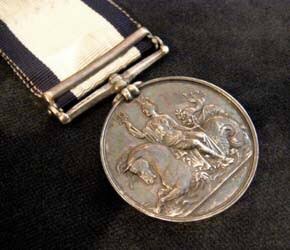
    General Service Medal HMS Hastings
    HMS Hastings
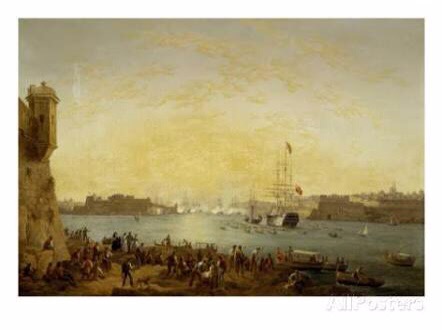
    HMS Hastings
    HMS Hastings
    HMS Hastings
    Newspaper piece on the collision and sinking of SV Aracan

    Gay History: The UpStairs Lounge Arson Attack.

    http://www.patheos.com/blogs/friendlyatheist/2013/06/24/remembering-the-upstairs-lounge-the-u-s-a-s-largest-lgbt-massacre-happened-40-years-ago-today/
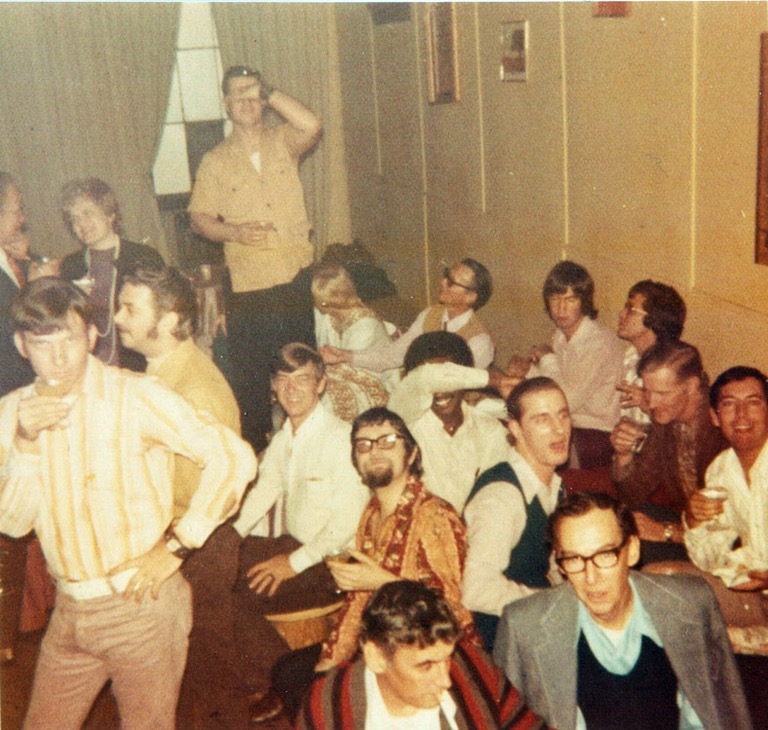
    The 24th of June in 1973 was a Sunday. For New Orleans’ gay community, it was the last day of national Pride Weekend, as well as the fourth anniversary of 1969’s Stonewall uprising. You couldn’t really have an open celebration of those events — in ’73, anti-gay slurs, discrimination, and even violence were still as common as sin — but the revelers had few concerns. They had their own gathering spots in the sweltering city, places where people tended to leave them be, including a second-floor bar on the corner of Iberville and Chartres Street called the UpStairs Lounge.

    That Sunday, dozens of members of the Metropolitan Community Church (MCC), the nation’s first gay church, founded in Los Angeles in 1969, got together there for drinks and conversation. It seems to have been an amiable group. The atmosphere was welcoming enough that two gay brothers, Eddie and Jim Warren, even brought their mom, Inez, and proudly introduced her to the other patrons. Beer flowed. Laughter filled the room.


    Just before 8:00p, the doorbell rang insistently. To answer it, you had to unlock a steel door that opened onto a flight of stairs leading down to the ground floor. Bartender Buddy Rasmussen, expecting a taxi driver, asked his friend Luther Boggs to let the man in. Perhaps Boggs, after he pulled the door open, had just enough time to smell the Ronsonol lighter fluid that the attacker of the UpStairs Lounge had sprayed on the steps. In the next instant, he found himself in unimaginable pain as the fireball exploded, pushing upward and into the bar.

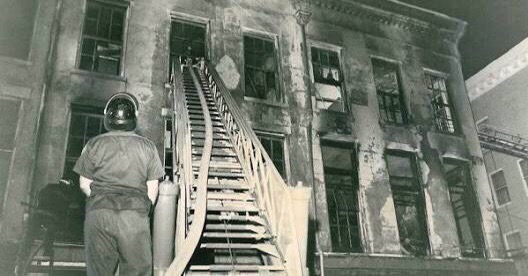
    The ensuing 15 minutes were the most horrific that any of the 65 or so customers had ever endured — full of flames, smoke, panic, breaking glass, and screams.

    MCC assistant pastor George “Mitch” Mitchell escaped, but soon returned to try to rescue his boyfriend, Louis Broussard. Both died in the fire, their bodies clinging together in death, like a scene from the aftermath of Pompeii.

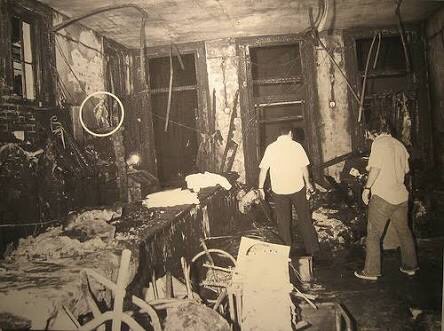
    Metal bars on the UpStairs Lounge windows, meant to keep people from falling out, were just 14 inches apart; while some managed to squeeze through and jump, others got stuck. That’s how the MCC’s pastor, Rev. Bill Larson, died, screaming, “Oh, God, no!” as the flames charred his flesh. When police and firefighters surveyed and began clearing the scene, they left Larson fused to the window frame until the next morning.

    This news photo is among the most indelible I’ve ever seen

    Thirty-two people lost their lives that Sunday 40 years ago — Luther Boggs, Inez Warren, and Warren’s sons among them.

    Homophobia being what it was, several families declined to claim the bodies and one church after another refused to bury or memorialize the dead. Three victims were never identified or claimed, and were interred at the local potter’s field.

    When the Rev. William Richardson, of St. George’s Episcopal Church, agreed to hold a small prayer service for the victims, about 80 people attended, but many more complained about Richardson to Iveson Noland, the Episcopalian bishop of New Orleans. Noland reportedly rebuked Richardson for his kindness, and the latter received volumes of hate mail.

    The UpStairs Lounge arson was the deadliest fire in New Orleans history and the largest massacre of gay people ever in the U.S. Yet it didn’t make much of an impact news-wise. The few respectable news organizations that deigned to cover the tragedy made little of the fact that the majority of the victims had been gay, while talk-radio hosts tended to take a jocular or sneering tone: What do we bury them in? Fruit jars, sniggered one, on the air, only a day after the massacre.

    Other, smaller disasters resulted in City Hall press conferences or statements of condolence from the governor, but no civil authorities publicly spoke out about the fire, other than to mumble about needed improvements to the city’s fire code.

    Continuing this pattern of neglect, the New Orleans police department appeared lackluster about the investigation (the officers involved denied it). The detectives wouldn’t even acknowledge that it was an arson case, saying the cause of the fire was of “undetermined origin.” No one was ever charged with the crime, although an itinerant troublemaker with known mental problems, Rogder Dale Nunez, is said to have claimed responsibility multiple times. Nunez, a sometime visitor to the UpStairs Lounge, committed suicide in 1974.

    The following Wikipedia article goes into more detail, and provides a huge list of references for anyone who wants to read more on this tragedy.

    https://en.m.wikipedia.org/wiki/UpStairs_Lounge_arson_attack

    The UpStairs Lounge arson attack took place on June 24, 1973, at a gay bar located on the second floor of the three-story building at 141 Chartres Street in the French Quarter of New Orleans, Louisiana, in the United States.[1] Thirty-two people died as a result of fire or smoke inhalation. The official cause is still listed as “undetermined origin”.[2] The most likely suspect, a gay man who had been thrown out of the bar earlier in the day, was never charged.[3] Until the 2016 Orlando nightclub shooting, it was the deadliest known attack on a gay club in U.S. history.

    INCIDENT

    On Sunday, June 24, 1973, the final day of Pride Weekend,[4] members of the Metropolitan Community Church, a pro-LGBT Protestant denomination, held services inside the club, located on the second floor of a three-story building at the corner of Chartres and Iberville Streets. The MCC was the United States’ first gay church, founded in Los Angeles in 1968.[5] After the service, the club hosted free beer and dinner for 125 patrons. At the time of the evening fire, some 60 people were listening to pianist David Gary perform[6] and discussing an upcoming MCC fundraiser for the local Crippled Children’s Hospital.At 7:56 p.m., a buzzer from downstairs sounded, and bartender Buddy Rasmussen, an Air Force veteran, asked Luther Boggs to answer the door, anticipating a taxi cab driver. Boggs opened the door to find the front staircase engulfed in flames, along with the smell of lighter fluid.[3] Rasmussen immediately led some twenty patrons out of the back exit to the roof, where the group could access a neighboring building’s roof and climb down to the ground floor. The others were accidentally locked inside the second-floor club,[7] some attempting to escape by squeezing through barred windows. One man managed to squeeze through the 14-inch gap, only to fall to his death while burning. Reverend Bill Larson of the MCC clung to the bars of one window until he died, and his charred remains were visible to onlookers for hours afterwards. MCC assistant pastor George “Mitch” Mitchell managed to escape, but then returned to attempt to rescue his boyfriend, Louis Broussard. Both died in the fire, their remains showing them clinging to each other.[8]

    Firefighters stationed two blocks away found themselves blocked by cars and pedestrian traffic. One fire truck tried to maneuver on the sidewalk but crashed into a taxi. They arrived to find bar patrons struggling against the security bars and quickly brought the fire under control.[9] Twenty-eight people died at the scene of the sixteen-minute fire, and one died en route to the hospital. Another 18 suffered injuries, of whom three, including Boggs, died.
    AFTERMATH

    The official investigation failed to yield any convictions. The only suspect for the attack was Rodger Dale Nunez, a local hustler and troublemaker who had been ejected from the bar earlier in the evening after fighting with another customer.[3] Police attempted to question Nunez shortly after, but he was hospitalized with a broken jaw and could not respond. When questioned later on, police records show that he did not appear nervous at all. Nunez had a witness who claimed that he had been in and out of the bar during the 10–20 minutes before the fire, and that he had seen nobody enter or leave the building. Because police observed that the witness was stressed, and had lots of nervous tension, they dismissed the witness as a liar.[10]

    Nunez had previously been diagnosed with “conversion hysteria” in 1970 and had visited numerous psychiatric clinics. He had been released from a treatment facility in the year before the fire.[11] After his arrest, Nunez escaped from psychiatric custody and was never picked up again by police, despite frequent appearances in the French Quarter. A friend later told investigators that Nunez confessed on at least four occasions to starting the fire. He told the friend that he squirted the bottom steps with Ronsonol lighter fluid bought at a local Walgreens and tossed a match. He did not realize, he claimed, that the whole place would go up in flames.[3] Nunez took his own life in November 1974.[9]
    In 1980, the state fire marshal’s office, lacking leads, closed the case.[9]
    MEDIA COVERAGE

    Coverage of the fire by news outlets minimized the fact that LGBT patrons had constituted the majority of the victims, while editorials and talk radio hosts made light of the event.[6] No government officials made mention of the fire: as Robert L. Camina, writer/director of a documentary about the fire (Upstairs Inferno), said in 2013, “I was shocked at the disproportionate reaction by the city government. The city declared days of mourning for victims of other mass tragedies in the city. It shocked me that despite the magnitude of the fire, it was largely ignored.”[7]

    CHRISTIANS’ REACTIONS

    Reverend William P. Richardson of St. George’s Episcopal Church, agreed to hold a small prayer service for the victims on June 25. Approximately 80 people attended the event. The next day, Iveson B. Noland, the Episcopal bishop of New Orleans, rebuked Richardson for hosting the service. Noland received over 100 complaints from parishioners concerning the service, and Richardson’s mailbox filled with hate mail.[12]

    Soon after two additional memorial services were held on July 1 at a Unitarian church and St. Mark’s United Methodist Church, headed by Louisiana’s Methodist bishop Finis Crutchfield and led by MCC founder Reverend Troy Perry, who came from Los Angeles to participate. Mourners exited through the church’s main door rather than an available side exit, a demonstration of a new willingness to be identified on camera.[9] Several families did not step forward to claim the bodies of the deceased. A few anonymous individuals stepped forward and paid for the three unknown men’s burials, and they were buried with another victim identified as Ferris LeBlanc in a mass grave at Holt Cemetery.[5] LeBlanc’s family would not learn of his death in the arson attack until January of 2015.[13]
    In June 1998, the 25th anniversary of the fire, as part of Gay Pride celebrations, a memorial service was organized by Rev. Dexter Brecht of Big Easy Metropolitan Community Church (also known as Vieux Carre MCC) and Toni J. P. Pizanie.[7] It was held at the Royal Sonesta Hotel Grand Ball Room and attended by New Orleans Councilman Troy Carter, Rev. Carole Cotton Winn, Senior Rabbi Edward Paul Cohn of Temple Sinai, Rev. Kay Thomas from Grace Fellowship in Christ Jesus, Rev. Perry, and 32 members of the New Orleans community representing the victims. Carter then led a jazz funeral procession to the building on the corner of Chartres and Iberville Streets, the site of the club, and members of the local MCC laid a memorial plaque and wreaths. Among the attendees was the niece of victim Clarence McCloskey.[14]

    LEGACY

    • In 1998 the reconstituted MCC congregation in New Orleans (Big Easy Metropolitan Community Church, since renamed again to MCC of New Orleans) held a 25th anniversary service to commemorate the arson and its 32 deaths. This event is significant because, unlike the one it memorialized, the 300 members of the congregation refused to hide their faces and instead insisted on entering and leaving the event through the church’s front doors.
    • In 2008 The North American Convocation of Pro-LGBT Christians planned to hold its “Many Stories, One Voice” event in New Orleans to commemorate the 25th anniversary of the conference (and the 35th anniversary of the tragedy), but eventually canceled the conference for the year due to Hurricane Gustav.[15]
    • In 2008 local artist Skylar Fein constructed an art installation titled Remember the Upstairs Lounge.[16] The New Orleans Museum of Art has since acquired Fein’s art exhibit, which includes a reproduction of the bar.[7]
    • A TAPS group in episode 15, Season 8 of Ghost Hunters visited the lounge to encounter alleged ghosts of the fire’s casualties. The episode identified the event as the “Jimani Lounge Massacre.”[17]
    • In 2013, noting the 40th anniversary of the fire, the Roman Catholic Archbishop of New Orleans, Gregory Michael Aymond, issued a statement of regret that his predecessor, Archbishop Philip Hannan, and the local church leadership ignored the arson attack. Aymond wrote to Time magazine that “In retrospect, if we did not release a statement we should have to be in solidarity with the victims and their families … The church does not condone violence and hatred. If we did not extend our care and condolences, I deeply apologize.”[18]
    • In 2013, Royd Anderson wrote, directed, and produced a documentary about the tragedy titled The UpStairs Lounge Fire.[19][20][21]
    • Also in 2013, Wayne Self (a playwright and composer from Natchitoches, Louisiana), first presented a musical called Upstairs about the tragedy.[22]
    • In 2014, McFarland & Company released the Clayton Delery-Edwards-penned account of the arson The Up Stairs Lounge Arson: Thirty-two Deaths in a New Orleans Gay Bar, June 24, 1973. The book was selected as one of the Louisiana Endowment for the Humanities 2015 Books of the Year.[23]
    • In 2014, Melange Dance Company of New Orleans performed a tribute show as part of the New Orleans Fringe Festival. ‘The UpStairs Lounge’ show aimed to uplift with a combination of dance and film that celebrate the Lounge, its patrons, and the strides taken towards Human Rights since the incident.[24]
    • In 2015, Melange Dance Company of New Orleans presented an extended performance of ‘The UpStairs Lounge’ show originally performed as part of the 2014 New Orleans Fringe Festival.[25]

    RELATED

    • The space on the second floor formerly known as the UpStairs Lounge now contains business offices and a kitchen for the Jimani Lounge (established 1971), which is located on the first floor. The current owner, Jimmy Massacci, and his father, the former owner, personally witnessed the arson and its aftermath.[5] The third floor, then owned by the UpStairs Lounge, remains unused and partially damaged. The building itself dates back to at least 1848, when the earliest-known sale of the building is documented.[26]
    • The fire was the third arson attack to affect the MCC,[27] following a January 27, 1973, arson at the church’s headquarters in Los Angeles (resulting in the destruction and collapse of the building with no injuries) and another 1973 arson at an MCC church in Nashville, Tennessee (also with complete destruction of the church and its furnishings but no injuries).[28][29]

    REFERENCES

    1.  “Upstairs Lounge Fire Memorial, 40 Years Later – NOLA DEFENDER”. Retrieved September 21, 2014.
    2. “The Up Stairs Lounge Arson: Thirty-Two Deaths in a New Orleans Gay Bar. By Clayton Delery-Edwards. P.118
    3. a b c d Townsend, Johnny (2011). Let the Faggots Burn: The UpStairs Lounge Fire. BookLocker.com, Inc. ISBN 9781614344537.
    4. “The Tragedy of THE UPSTAIRS LOUNGE”. The Jimani Lounge.
    5. a b c Alyne A. Pustanio (2010). “The Haunting Tragedy of the UpStairs Lounge”. AlynePustiano.com.
    6.  a b Erik Ose (July 3, 2008). “Gay Weddings and 32 Funerals: Remembering the UpStairs Lounge Fire”. Huffington Post.
    7. a b c d Diane Anderson-Minshall (November 15, 2013). Remembering the Worst Mass Killing of LGBT People in U.S. History. The Advocate.
    8. Eric Newhouse, Associated Press (1973-06-25). “Arson Eyed in New Orleans Fire”. Abilene Reporter-News, Texas.a b c d Freund, Helen (June 22, 2013). “UpStairs Lounge fire provokes powerful memories 40 years later”. New Orleans Times-Picayune. Retrieved June 26, 2013.
    9. The Up Stairs Lounge Arson: Thirty-Two Deaths in a New Orleans Gay Bar. By Clayton Delery-Edwards. P.122
    10. The Up Stairs Lounge Arson: Thirty-Two Deaths in a New Orleans Gay Bar. By Clayton Delery-Edwards. P.127
    11. William P. Richardson – Profile – LGBN-RAN
    12. The New Orleans Advocate. Family solves mystery after learning uncle died in infamous UpStairs Lounge Fire 40-plus years ago in New Orleans. June 6, 2015. Retrieved June 20, 2016.
    13.  “The Upstairs Fire – June 24, 1973 – 25th Anniversary Memorial Service”. Retrieved September 21, 2014.
    14. “Pro-LGBT Christians to mark 35th anniversary of deadliest fire in New Orleans’ history”.
    15. Doug MacCash (November 2, 2008). “Skylar Fein: Installation reignites memory of a deadly fire”. The Times-Picayune.
    16. “Ghost Hunters – Season 8, Episode 15: French Quarter Massacre”. Syfy. September 19, 2012.
    17. “The Upstairs Lounge Fire: The Little Known Story of the Largest Killing of Gays in US History”. Time. June 21, 2013. Retrieved June 25, 2013.
    18. “Mass killing at New Orleans gay lounge remembered 40 years later”. Nicole, Erin. WGNO-ABC. June 24, 2013.
    19. “The UpStairs Lounge Fire (2013 trailer)”. Royd Anderson Productions. Retrieved June 16, 2013.
    20. “Acadiana Pride Festival, “a celebration of culture””. Berry, Brheanna. KLFY-CBS. March 29, 2015.
    21. Wayne Self. “Upstairs”.
    22. The Advocate: Book of the Year: Biography Documenting Worst Mass Killing of Gays in U.S. History
    23. “Melange Dance Company Events”. November 20, 2014.
    24.  “Melange Dance Company Events”. March 27, 2015.
    25. “The Building”. The Jimani Lounge.
    26. Vicki Lynn Eaklor (2008). Queer America: A GLBT History of the 20th Century. p. 136.
    27. Dudley Clendinen; Adam Nagourney (June 5, 2001). Out For Good: The Struggle to Build a Gay Rights Movement in America. Simon and Schuster. p. 181. ISBN 978-0-684-86743-4. Retrieved December 13, 2012.
    28. The Rev. Elder Troy D. Perry; The Rev. Elder Nancy Wilson (November 1, 1997). Report to the President for the White House Conference On Hate Crimes (PDF). UFMCC.


    Handbag! Does Any DJ Really Play That?

    “Dance music is my love, is my passion, is my life. I live for my fans and take my art very seriously.” Steve Aoki 


    Well, this one does, and though I know I’m going against the grain – I’ll always do so.
    I work at alternative ends of the spectrum as far as dance music goes, and though I play and do mixes of Handbag music, my preferred dance genre is Uplifting Vocal Trance. My roots lie in a mix of Handbag and House music in the 90s, and HI-NRG in the 80s.

    I started DJing as  resident DJ in the Oxford Hotel in Sydney’s Golden Mile (the gay ghetto) of Darlinghurst in 1990, and had a resident Sunday night spot at The Stronghold Bar (a leather bar), situated in the Clock Hotel in Crown Street, Surry Hills from 1992-1996. I will be the first to admit that back in the day, my muxing wasn’t all that great…but I was saved by selecting great music that gave me a following, and a certain popularity. The dance style that really made me popular was – Handbag.

    The Urban Dictionary defines Handbag House dance music as “A type of House music. Handbag house consists of the obligatory disco diva lyrics, simple four-on-the-floor TR-909 kick drums, hi-hats on the upbeats, Basic synth stabs in a minor key, and sometimes a snare on beats two and four. Videos often feature the singer in a leather costume dancing around while a sculpted bald black man gyrates his hips whilst also attempting to look threatening. Its name comes from the phenomenon of a group of women dancing around a pile of their handbags.

    Damn son this handbag house shit is GAY!” Perhaps a bit cliche…but close to the truth.

    It is often referred to as trash or cheese music due to its “fluffy” style, and artists such as Kylie Minogue, Madonna, Jason Donovan, Bananarama, Mel & Kim, Pepsi & Shirley, Dead or Alive, Rick Astley, Paul Lakakis et al, and music labels such as SAW, PWL, and Almighty specialised in its production. 

    “Serious” DJs hated it – with a passion! Wikipedia is a lot kinder in its description, and historical background. They use the “Diva House” terminology, and assert “The term “handbag house” appears to be particularly popular on British dancefloors and refers to the notion of a group of female club-goers dancing around a pile of their handbags.[3] Dance culture’s usage of the word ‘handbag house’ started life as a derogatory term.

    In the 1990s, as gay clubs and gay culture became more mainstream so did house music. The accessibility of diva house lead to the mainstreaming of gay club music. In the UK especially, handbag house became emblematic of the clubbing culture. According to music historians Bill Brewster and Frank Broughton, by the mid-1990s handbag house had helped to make clubbing into a “mainstream leisure activity.”[4] With the mainstreaming of gay culture in the 1990s, “diva” was the word that bound house music to the gay dance scene, which was previously only defined by Italo disco compositions.
    Music critic Simon Reynolds asserts that handbag house was “initially a disparaging term, coined by condescending cognoscenti vis-à-vis the anthemic, chart-penetrating house tunes that allegedly appealed to women, and above all to the folk-mythic construct of Sharon and Tracy.” [5] According to electronic music producer Ewan Pearson and academic Jeremy Gilbert, “handbag house” is often derided as “plastic disco” by dance music fans who prefer “the more esoteric sound of musics which eschew the ‘mainstream’ musical priorities of melody and verbal language.” [6] The mainstream appeal of handbag house caused underground dance music purists to flock to the spin-off genres of hardbag, progressive house, deep house, and garage house.[5] Sociologist Dunja Brill argues that criticism of handbag house carries a “misogynist slant in club cultural representations of the denigrated mainstream of ‘Handbag House’ against which Ravers define their subculture.”[7] Brill maintains that bias against handbag house “is expressed most clearly in a femininisation of the denigrated ‘mainstream’ of pop culture against which subcultures define themselves.”[8]”
    Despite being considered “plastic” , and the term Handbag being used in a derogatory way, it continues to be popular, especially amongst gay males across all age groups. When DJing at The Oxford Hotel, its popularity was instantly noticeable by the bopping around of clientele, miming the words and a general feeling of  fun, which yas always geen associated with the genre. I was initially introduced to Handbag through Stock Aitken Waterman, and despite often disparaging their music…I still played it, as I knew that despite every track sounding pretty well exactly the same – it was popular. In the 90s I was exposed to the covers and remixes released through the British “Almighty” label (“Call Me Tonight” by Destiny Love was my first exposure to the label – a track I played to death), and which I primarily still,play now, as they have covered and remixed many popular gay dancefloor hits from the 80s – an era I have a particular affection for. Again, the purists are aghast that anyone would dare cover the music of that era. But to je, it is all about keeping the music alive, and relevant – despite who is doing it.

    Handbag is, at its very heart, fun party music. If you were to put on a 2 hour mix of handbag tracks at a party at home you would ve watching nearly everyone there moving to the tracks, miming the words, and talking about memories the tracks invoked. Isn’t this what, in some respects, the music should be about? Does it always have to be serious and esoteric, existing on strobed dancefloors amongst a drug culture that needs a continual mind-fuck!

    I upload all my mixes – both Trance & Handbag – to an online DJ service called Mixcloud. Of everything I upload, the most favourited, and most shared, mixes are the Handbag ones. Indeed, within minutes of going up, any mix with the word “Handbag” in the title will be shared. Because they are so popular, I continue to do them. I can’t say I don’t enjoy mixing them…because I do. They are a lot of fun to compile. 

    Instead of pigeonholing and denigrating any form of dance music, perhaps we need to pose the question – why is it popular? Surely that a form of music like Handbag can initiate sensations of fun and frivolity, girlishness, and just getting people dancing can’t be a bad thing! It’s about a feeling, an atmosphere, a scene of jubilation and nostalgia. At its heart is the intention to…just make people smile!

    Tim Alderman (C) 2016


    References

    3^ “handbag house@Everything2.com”. Everything2.com. 2001-12-14. Retrieved 2011-02-10.
    4^ Brewster, Bill; Frank Broughton; Frank Broughton (2000). “Last Night a DJ Saved My Life: The History of the Disc Jockey”. Last Night a DJ Saved My Life: The History of the Disc Jockey. Headline Book Publishing. p. 396. Retrieved 28 December 2014.

    5^ a b Reynolds, Simon (August 21, 1998). Energy Flash: A Journey Through Rave Music and Dance Culture. Picador. Retrieved 23 October 2012.

    6^ Gilbert, Jeremy (September 19, 1999). “Discographies: Dance Music Culture and the Politics of Sound”. Discographies: Dance Music Culture and the Politics of Sound. Routledge. p. 70. Retrieved 23 October 2012.

    7^ Brill, Dunja (Dec 15, 2008). Goth Culture: Gender, Sexuality and Style. Bloomsbury Academic.

    8^ Brill, Dunja; Deicke, Wolfgang; Hodkinson, Paul (2007). “”Gender, status and subcultural status in the goth scene.””. Youth Cultures: Scenes, Subcultures and Tribes. Routledge. p. 122.

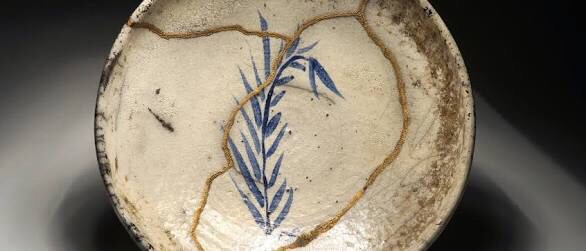
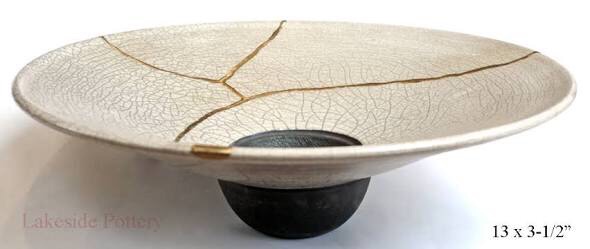
    Kintsukuroi “golden mend”

    “More beautiful for having been broken”

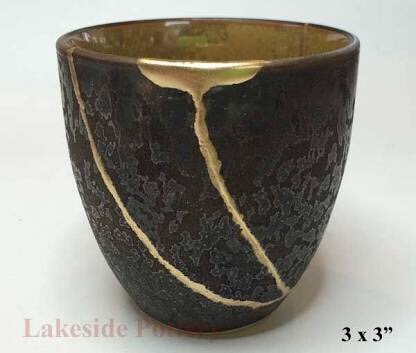
    kintsukuroi tea bowl

    Kintsukuroi (“golden mend”) is the Japanese art of mending broken pottery using lacquer resin laced with gold or silver. As well as a nifty form of repair, kintsukuroi has a deeper philosophical significance. The mended flaws become part of the object’s design, and some people believe the pottery to be even more beautiful having gone through the process of being broken and repaired.
      

    Through kintsukuroi, the cracks and seams are merely a symbol of an event that happened in the life of the object, rather than the cause of its destruction.


    Like pots, bowls, cups, and plates, we endure our own bumps and scrapes. We experience drops from a dizzying height and unexpected knocks.


    Sometimes we experience things that plant the seeds of shame: rejection, betrayal, abandonment, failure. So we try to avoid experiences that leave us vulnerable to these feelings as much as possible, lest the people around us see the evidence of just how imperfect, flawed, and “not good enough” we really are.


    In other words, we stay hidden in the cupboard, right behind the best silver, because we don’t want to get a chip, a crack, or a complete break.


    That’s not to say that I believe trauma or tragedy automatically makes us more beautiful—I don’t. I’ve known people who have dealt with these things and come out on the other end about as ugly as it gets.


    I do believe these experiences change us though—and I think we have a choice.


    We can choose to reject our bitter experiences and flaws, to wish and will them away, to regret, to pine, and to live in the land of “If only…” We can disguise with false-self personas, cover up with defences, distract with busyness.


    Or we can choose to see these experiences for what they are: our golden seams.


    The times when we get scratched, chipped, cracked and broken can feel totally shitty, but there can also be a strange beauty in the way we process them and the lessons we take from them afterwards… if we want.


    Our experiences don’t define us, but they do influence us. We can decide to hide, or we can decide to embrace these experiences that have shaped us in some small way, the experiences to which we’ve applied our own special coating of gold-laced resin. We can decide to cover up, or we can decide to walk out into the world as ourselves, mended breaks and all.


    Your story is yours to be told. Embrace the experiences that have influenced you. 
    http://www.becomingwhoyouare.net/japanese-pottery-can-teach-us-feeling-flawed/

    THE FABLE OF KINTSUKUROI

    Once upon a time, in the far, far east, east even of Eden, lived a great emperor, in a great palace, gorgeously stocked with the richest of goods. It was early spring, and the season of royal visits, when kings and princes called on one another and admired each others’ choicest possessions, gave wonderful gifts and enjoyed bountiful banquets. And this year was special, because the visitors would see the investiture of his beloved son Kintsukuroi as Crown Prince of the empire.
    The emperor was excited this year because he had a new and beautiful bowl to show to his friends, specially made for him by the finest of craftsmen from the finest of materials. Imagine then his horror when on going to his cabinet he discovered that it was broken apart, into a hundred pieces. How could it have happened? No-one knew. What could be done about it before the first visitors arrived? No-one could offer any idea, for the time was too short to start again and make another one.
    The emperor was dismayed, sad that he could not show off his beautiful bowl, but even sadder that something so beautiful should have broken. He retired into his private apartments with only his beloved son to share his sorrow, and they talked long into the night together.
    Next morning the emperor woke to the sound of a great commotion. His senior ministers demanded to see him urgently. The cabinet of treasures had now been broken into, and this time the great new golden diadem that has been made for his beloved son, ready for the investiture, was quite simply gone – along with the broken pieces of the broken bowl, but who cared about those now.
    What is more, the thief had been seen, but not recognized, since he was covered in dirt and scars, with nothing to distinguish him from a thousand other down-and-outs who hung around the palace, for the emperor – to the annoyance of his ministers – refused to turn them out but shared his food with them.
    No-one knew for sure where the thief had gone, but he had, they thought, run off towards the princes apartments. There the doors were most unusually now locked and there was no answer to their knocking, though they could hear sounds inside. Would the emperor give his permission for them to break down the door: they dare not act without it.
    The emperor was silent for many minutes. On his face his ministers saw sadness but not anger, lament but also love. What was going on? Eventually the emperor spoke. “Leave the prince and his apartments alone. If he is ready to rule, he must be allowed to act. His will and my will are as one.” The ministers were not at all sure just what this meant, but the message was clear. They were to do precisely nothing.
    So the day passed. The emperor remained in his private apartments. Those of the prince remained locked, though smoke could be seen coming out of the chimney and a fire had obviously been lit. And eventually the ministers tired of their waiting and went to bed. The important guests were expected the very next day.
    Imagine now their surprise in the morning when they went to the treasure cabinet to prepare its items for display and found the precious bowl back in its place, whole again, but glistening with veins of gold where the cracks had been. Its beauty seemed all the greater. And by it the prince’s crown, a slim band now, but speaking in its simplicity of a strength, an authority all the more striking, because it had given itself away and given glory to another, but was the greater itself for it. The investiture could go ahead.
    A smile of secret understanding passed between the emperor and the son whose newly scarred hands had shown him worthy to come into the kingdom.
    https://philipchircop.wordpress.com/2013/11/10/the-fable-of-kintsukuroi/

    A Mineral Worth Its Salt

    3/4/2010 The Sydney Morning Herald

    Author: Helen Greenwood

    Section: Good Living

    Page: 8

    This often-maligned compound now comes in a dazzling array of flavours and textures from countries across the globe, writes Helen Greenwood.

    We all know too much salt is bad for us. Yet we can’t live without the ionic compound known as sodium chloride or NaCl. Remove salt from the diet and you die. What’s more, your food tastes better with salt.
    Thomas Keller writes in The French Laundry Cookbook: “The ability to salt food properly is the single most important skill in cooking … Salt opens up flavours, makes them sparkle. But if you taste salt in a dish, it’s too salty.”
    The question is, which salt? In the past few years, Sydney cooks have been deluged with a flood of artisan salts. They are extracted from the Himalayas in Pakistan, skimmed at Halen Mon in Wales, drawn from pans in Brittany in France or evaporated from the sea at Trapani in Sicily. We are now inundated with choices. And colours. And textures.
    Gourmet salts can be white (Maldon), pink (Murray River), black (Cypriot), red or green (Hawaiian) and grey or natural (Italian). They can be flaky or grainy, pyramid- or crystal-shaped. They can be damp, dry or powdery.
    More importantly, these gourmet salts have different mineralities that give each one a different flavour. They have depth, power and pungency and need only to be used sparingly to great effect.

    At Rock Restaurant in the Hunter Valley, chef and owner Andrew Clarke has been playing with gourmet salts. “We use anywhere up to 12 different salts in the restaurant,” he says. “We use the vanilla Halen Mon with balmain bugs after they’ve been grilled. We use a coarse-grain curing salt for meats. We use iodised salts to flavour blanching water. We use the Cyprus black salt to finish off our wood-roasted goat. We put Maldon on the table because it’s clean and has a soft sea-saltiness.”
    All salt comes from the sea, whether it’s mined high in the Himalayan mountains or collected from salt flats in Bolivia. Yet this inorganic mineral carries the flavour of the environment in which it was formed. In the case of the famous French fleur de sel, or flower of the salt, which is “young” crystals that form on the surface of salt evaporation ponds, the flavour varies from region to region – like fine wines.

    Alderman Providore is a specialist online food retailer that sells Himalayan, Hawaiian, Bolivian and French sea and rock salts. Former co-owner Tim Alderman maintains salts from different countries impart different flavours. “Each one has a different minerally quality, as distinct from Saxa,” he says. “The grey salt has a distinct mineral taste, the pink and rose salts tend to be more subtle and are different the Murray River salt. The textures change, too.”
    This is a contrast to the traditional view of salt as a mono-flavouring. Most of us grew up with an iodised salt that just tasted, well, salty. It was mined and refined to remove most of its minerals and took away bitter – and any other – tastes. Plain table salt was also available but most people preferred iodised salt, which manufacturers starting producing in the 1920s after US studies found people were suffering from goitre, an enlargement of the thyroid gland caused by iodine deficiency. It is believed Australians’ consumption of iodine has dropped considerably in the past few decades.
    Humans need less than 225 micrograms of iodine a day. The mineral is found in seafood and sea salts, both natural replacements for refined salt.
    Sea salts are harvested from salt pans, ponds or marshes, or by channelling ocean water into large clay trays and allowing the sun and wind to evaporate it naturally. Sea salts are less treated than other commercial salts so they retain traces of iron, magnesium, calcium, potassium, manganese, zinc and iodine. Sea salts’ fans rave about their bright, subtle flavours.

    Gourmet salts can be used for cooking or for finishing a dish and sometimes both. Like a spice or herbs, different salts lend themselves to being used at different times as you cook.
    Kala Namak, or Indian black salt or sanchal, is an unrefined mineral salt that, despite it’s name, is a pearl-pink grey. It’s strong, sulphuric odour dissipates when used in Indian cooking and is magic with eggplant. You can also sprinkle it on melon or yoghurt as a final seasoning.

    Italian sea salts, such as Ravida from Trapani, is produced from the low waters along the coast of Sicily. They are rich in iodine, fluorine, magnesium and potassium with a lower percentage of sodium chloride than regular table salt. Delicate but with a defined flavour, they are finishing salts that bring a salad or a sauce to life.
    Both these salts were part of a tasting held by The Salt Book. A dozen gourmet, plain and flavoured salts were lined up and paired with a variety of foods.
    The exercise was fascinating. Strips of rare, grilled sirloin fared better or worse depending on which salt you used.

    The coarse rock crystals of pink Himalayan salt looked pretty but the Ravida sea salt from Sicily made the meat jump in your mouth. The green Hawaiian salt was recommended with yellow fin tuna but added a polish to prawns.
    James Ballingall, program director at the William Blue College of Hospitality Management in North Sydney, which hosted the tasting, used a brine made from Olsson’s macrobiotic salt to cure a chicken before roasting. The wonderful, tender, firm flesh tasted more like chicken than most birds, apart from organic chooks.
    Good all-rounders, favoured by chefs and home cooks, are the Maldon sea salt and the home-grown Murray River salt. Guerande Fleur de Sel stood out as a pure, light seasoning that should only be used at the table.
    Fleur de sel is a soft, moist salt that looks like sea foam and surprises consumers who are used to their salt being dry and grainy. Italian salts such as those from Trapani are also moist and often off-white.
    The wonderful Riserva Camillone from Cervia in the Emilia Romagna region is strangely sweet. Flavoured salts such as Netherlands smoked salt, Tetsuya’s truffle salt, Cyprus lemon salt flakes and vanilla fleur de sel figured in the tasting, too.
    They overpowered the plain ones and need to be used carefully.
    Suggestions include salmon, kipfler potatoes, poached prawns and desserts respectively.
    The key to a healthy diet is to cook fresh produce and then season it with a salt that has personality and provenance.

    The Salt Book, Arbon Publishing, by Fritz Gubler and David Glynn, $34.99.
    PROCESSED FOODS: THE REAL SINNERS
    About 20 per cent of the world’s salt production is used in food. The remainder is used in the chemical industry and applications such as de-icing roads.
    Most of the 20 per cent we consume is “hidden salt” in manufactured foods, from breakfast cereals to instant soups.
    The Australian division of World Action on Salt and Health (AWASH) has reported many Australians consume 10 times the amount of salt they need for a healthy diet. The recommended daily intake for salt is four grams but many Australians regularly consume up to 40 grams.
    The chairman of AWASH, Professor Bruce Neal, has asked manufacturers of processed food to reduce the salt content of their products by 5 per cent a year.
    AWASH’s research has shown excessive consumption of salt comes mainly from eating processed food and can lead to high blood pressure, kidney damage and stomach cancer.
    A leading nutritionist, Rosemary Stanton, (pictured), advises people to avoid such products in the first place. “The problem is we eat so much of it,” she says. “That’s why our salt intake has increased so much in the past few decades.”

    KNOW YOUR SODIUM CHLORIDE

    COOKING SALTS

    Kala namak (also known as sanchal) Use in Indian cooking, on raw tropical fruits and cooked vegetables. It’s sold at Indian grocery stores.
    Celtic salt, French grey sea salt Use for general purpose, soups, stews and sauces. Buy Coarse Guerande Salt.
    Coarse salt Use for salt crusts on meat or fish, curing and flavouring in soups, stews and sauces. Buy Himalayan Pink, La Baleine, Esprit du Sel.
    Rock salt Use for curing and brining. Not ideal for the table.

    FINISHING SALTS

    Flake salt Use as an all-round general salt in cooking or at the table. Buy Maldon, Murray River, Halen Mon, Pyramid.
    Fleur de Sel (Flower of Salt) Use for salads, cooked fresh vegetables and grilled meats. Buy Le Paludier.
    French sea salt Use in salads and on cooked fresh vegetables and grilled meat. Buy Le Paludier.
    Grey salt (sel gris, Celtic sea salt) Use at the end of the cooking process or on the table. Good for casseroles and stews. Buy Le Paludier, Riserva Camillone sale di Cervia, Trapani.
    Hawaiian sea salt (alaea, Hawaiian red salt) A natural mineral called alaea (volcanic baked red clay) adds iron oxide and imparts a mellow flavour. Used to preserve and season native Hawaiian dishes. Good for meats. Buy Alaea.
    Italian sea salt Use for salads and to finish roasts and sauces. Great as a garnish on bruschetta. Buy Ravida.
    Organic salt Standards include purity of the water, cleanliness of salt beds and how the salt is harvested and packaged. Certifiers include Nature et Progres (France), BioGro (New Zealand), Soil Association Certified (Wales). Buy Halen Mon, Olsson’s.

    SUPPLIERS

    GJ Food The Fine Food Connection (Le Paludier Fleur du Sel and others from Guerande).
    Cantarella Bros (Ravida).
    Lario Imports (Trapani, Riserva Camillone sale di Cervia).
    Alderman Providore, aldermanprovidore.com.au (Himalayan Pink, Alaea, Bolivian Rose, Sel Gris de Guerande).
    Simon Johnson (Halen Mon).
    F. Mayer Imports (Maldon).
    The Essential Ingredient (Murray River Salt).
    Waimea Trading, 0409 219 280 (Cyprus Black sea salt).
    Olsson Industries, olssons.com.au (Olsson’s Pacific Salt).
    HBC Trading, 9958 5688 (Himalayan Pink).
    Kirk Food (Pyramid).

    Salts


    A Ghost of a Business

    The original font & graphics for Alderman Providore

    The ghosts of my business still survive in cyber-space. Alderman Providore started in 2006 as the next step along from Alderman Catering – a truly exhausting, though exciting business doing top-end party catering. The Providore was designed as an online business – still a very daring and risky step to take in 2006. It was started with $5000 that I begged, borrowed and stole (not really) and was originally a small store on Ebay, created from Ebay templates. 
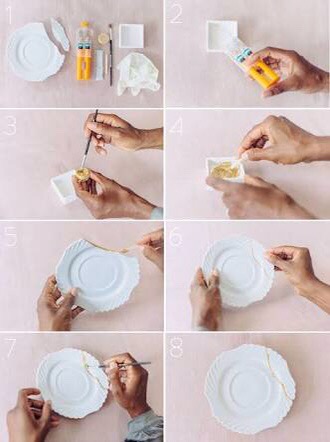
    By the end of 2006, I paid a website designer to create a site for a business, registered the name and domain, used a friend who is a graphic artist to design the typeface and graphic, and aldermanprovidore.com.au hit the internet. I bought gourmet grocery products from all sorts of rare and unique mum ‘n dad, hobby, localised, unknown businesses and created a unique space for their products. The sales started as a small trickle, but grew exponentially over time. David & I introduced product tasting parties, and along with some targeted advertising the business grew and grew. 

    At the end of 2008, due to a personal interest in tea and teawares, and due to the rapid expansion of that area, I launched a second web site TeaCoffeeChocolate using the same premise as for the providore, along with a very large range of organic and free-trade products. 

    Alderman Providore products in a magazine Christmas gift guide

    By this time I had altered the business plan to embrace products from outside Australia IF it was a product that could not be sourced from within Australia. At this time an overhaul of the Alderman Providore site resulted in a fresher, more contemporary look. Magazines started approaching us for both advertising, and to supply products to use as props and in gift guides. Reps from companies contacted me about stocking their products. Sales grew and grew, and we had built a reputation for service, quality, uniqueness, pricing, and product delivery. Ideas were added – and subtracted ,often through being impractical. 

    As Christmas 2009 approached, I started early purchasing preparations, and started to stock up on what should gave been our biggest Christmas ever. Like all small retail businesses, I purchased 20% more stock each year, which usually just covered growth, and ensured I wasn’t stuck with stick at the end of the season. If you didn’t get in early, and the product sold out…then bad luck. And the stock rolled in. Cakes, puddings, glacé fruit, sauces, relishes, fruit mince, biscuits and more. I was excited, and pumped for the excitement to come.


    Then greed came to town. People who abuse the systems, deal illegally and fraudulently, who use other peoples money to satisfy their own selfish need. They created a monster that came to be known as the Global Financial Crisis (GFC). Everyone stopped buying. Online purchasing, in a growth phase at that time, was the first to be hit. That Christmas I sold…nothing. Thousands of dollars tied up in stock…and no market. By the time Christmas Eve rolled around, I was effectively broke. Money the business earned was sunk back into it. There was no excess. I remember ringing David, and a pudding supplier in tears, because, thanks to somebody else’s greed my business, my dream, was destroyed.
    Early 2010 I put the business, good will, and web sites on the market. It sold to a mum in Brisbane who had an interest in food (but as I was to see…not a passion), and so it changed hands, and eventually a new name. Before we moved from Dulwich Hill to Brisbane, we had a HUGE market in our backyard to clear out the remainder of the stock. Anything left from that went to Vinnies.
    So, for some unknown reason, today I searched for the ghost of my business. And it’s still there. A lot more than I expected, in fact. And a story of a past glory came out of it. Who knows what the future holds, as dreams do live on!

    http://www.homemadefood.com.au/index.php?option=com_sobi2&sobi2Task=sobi2Details&catid=40&sobi2Id=676&Itemid=73

    http://newsstore.fairfax.com.au/apps/viewDocument.ac;jsessionid=A5A960B20A0BA88AA9B4AFAA81406D95?sy=afr&pb=all_ffx&dt=selectRange&dr=1month&so=relevance&sf=text&sf=headline&rc=10&rm=200&sp=brs&cls=2353&clsPage=1&docID=SMH1004131I1G64QPB2R

    The Alderman Providore masthead

    Tim Alderman (C 2016)

    So! Just WHO Owns Your Family History?

    This is a question I have been asking myself, especially in the light of a recent experience.

    I had started using the app for Find-a-Grave to locate any family members listed, and to add family that I have details of. I became a member of the group, but after finding that someone had added death details and pictures of the memorial for my Pickhills grandparents, and finding I couldn’t edit it to add birth details I enquired why. These two people are, after all, my family. A reply to my enquiry informed me “Hello Tim, Thank you for contacting Find A Grave. In order to update a memorial, please go to the memorial on the website, http://www.findagrave.com Click on the edit tab located in the upper right of the memorial page. Choose an option to update the memorial. The update will be sent to the manager of the memorial page. If you are related within transfer guidelines, http://www.findagrave.com/cgi-bin/fg.cgi?page=listFaqs#79 you may ask for a transfer with the edit tab under “suggest any other correction or addition”.Sincerely, (name withheld)”. 

    In othe words, someone who is not a member of my family, and doesn’t know them from a bar of soap, currently has the management of grave details for my family in this app/web site! Okay, I can request that management be transferred to me, but the point is…if I hadn’t wanted to edit the details, and request the teansfer as a relative of the deceased, this person would have had control of my grandparents details at this sire permanently! 

    These are the guidelines for requesting a teansfer “How do I get a relative’s memorial transferred to me? First, Determine if you really need the memorial transferred to you for management. Only request transferring of management if you have extensive changes to make to a memorial. You can add photos and suggest corrections without having to request management. Simply having someone in your family tree is not grounds for a management transfer request. With hundreds of thousands of contributors, we have many overlapping family trees and it would be impossible for all contributors to manage their entire tree. 

    Second, Transfer requests will be for direct relatives within four generations. This would be your siblings, parents, grandparents, great-grandparents, children, grandchildren, and great-grandchildren. 
    Third, If you have extensive additions/changes to make to a memorial, please contact the Find A Grave member who created the memorial via the “Suggest a Correction” link under the “Edit” tab on the memorial in question with your request to have the memorial management transferred to you. This will send an email request to the contributor, even if there is not an email address listed on their contributor page.
    Fourth, Explain your relationship in the request! Any non-direct relatives (aunts, uncles, cousins, etc) are not required to be transferred. Keep in mind that the original contributor may also be related to the memorial and may not make the transfer. Again, always include your relationship to the memorial on a transfer request, in order for it to be considered. You may also want to include your specific interest in the memorial. Bulk surname requests must not be made. Be advised that memorials listed as famous or maintained by Find A Grave will not be transferred. 
    Fifth, The “Suggest a correction” feature may also be used to submit corrections, an original biography, and family links to memorials that do not fall under the above definition. (Be sure to include the memorial ID#s for the family links and how they are related, father, mother or spouse. The original contributor will make any corrections and add any additional information you have for that memorial, such as links to parents and spouses, provided the information is accurate. 
    Sixth, Please note that it is not appropriate to request a transfer and then, after receiving the transfer, delete that page and substitute it with a new memorial that you have created. This practice denies credit to the original contributor. Please use the original memorial page to make updates and add information.
    NOTE: If you are unable to edit a memorial after it has been transferred to your account, try logging out of Find A Grave then logging back in.” 

    The same applies to a memorial for one of my mother’s brothers. Personally, I find this a bit distressing. I have, needless to say, requested the memorials be transferred to my name.

    The second incident involved a photograph of my great grandparents headstone. Yes, I did request through Find-a-Grave that someone photograph the memorial for me – though in the future I’ll organise it myself – and a photographer snapped it for me. When checking out the shot, I noticed that to the right, and in shot, another Barron memorial. I cropped the picture, and added the edited photograph to his memorial on the site. Naturally, within the hour, the photographer contacted me, reminding me that the photo was hers, and I was in breach of the apps photographs policy. I apologised, and removed the “offending” photo’s. But then I started thinking about it. I am the first to acknowledge the intellectual property rights of artists, and perhaps that is what niggles me! It s not as though she had photographed her own families graves. Again, this was a memorial with no connection to her whatsoever, total strangers who are nothing more than hames carved into stone. In a just world, the copyright on these types of ohotographs would be turned over – lock, stock & barrel – to the family of the graves photographed. I feel it is only just to do so, instead of blithly crying thief, and grasping control of the material.

    Everybody involved in the distribution of family history information and documents greedily has their hands out these days. Anything advertised as “free” will only give you the bare bones. If you want the body and soul…fork out the money, honey!  Even to look and see if there is any material pertaining to your family will cop you a fee on some sites. If there are records being held, it will cost you even more. Subscriptions to genealogy sites like Ancestry don’t come cheap, and often come with a catch 22. I subscribe to record collections of Australia and United Kngdom on Ancestry. Very little of my family history resides in America, and to add America to my subscription adds a lot to its cost, with little value, in my view. So I get my records from Australa and the UK within my monthly fee, but for any of the rest of the world I pay per record – which can be anything from $1.49 to $2.49 per record. In the meantime, Ancestry has access to all the information that goes onto my tree – for which they pay…zilch! 

    So, it would appear that we don’t own any of our family history, except that that can be added from personal or family recollection. It would appear that our families are owned by bureaucrats, big business, ancestry sights, photographers, apps, and just about anyone else who can make a quid out of it. There are even people with family tree’s who think that those accessing information from it should pay! For the record – if you want information from mine…help yourself. If others can benefit from my research, then good!

    In many respects, it us appalling that others can lay claim to our family name, our family history. It is appalling that we often have to say “no” to accessing a snippet of information, as the cost is too high. Unfortunately, we live in a greedy, grasping world. Our relatives would literally “turn in their graves” if they knew. Just as well they don’t!

    Tim Alderman (C 2016)

    PS I am not the only person to have had bad experiences with Find-a-Grave. Read Julie’s story hear https://itsabeautifultree.com/2015/04/14/confessions-of-a-grave-robber/

    Political Snippet: Donkey Votes

    “A donkey vote is a ballot cast in an election that uses a preference voting system, where a voter is permitted or required to rank candidates on the ballot paper, and ranks them based on the order they appear on the ballot paper. The voter that votes in this manner is referred to as a donkey voter.”

    Could we, like America, be heading into a donkey vote election? Given the current sad lack of choice – both in major parties, minor parties and Independents – could the voters, fed up with over a decade of bad government, and potentially nothing to look forward to in the political arena, just decide to vote for…anyone! It is not a good scenario, I know that, but noone could blame them. The last term of Howard, followed by the Rudd/Gillard/Rudd/Abbott/Turnbull fiasco has worn everyone out, and made us a country of cynics in the democraric process. What a joke this has made of our political system! No educated voter – probably becoming a rare species with education cuts – takes our current batch of politicians seriously. Our choice of likeable, decent, fair-minded, secular politicians is about…zero. With the likes of Morrison, Joyce, Pyne, Abbott (the bad smell that just won’t go away! The man’s delusion is staggering!) et al has taken politics to a new low in this country. The opposition is no better, and the minor parties are just that – minor, and even that they are there at all makes one question the often dubious nature of our voting system.

    So, maybe we should all do a donkey vote on July 2. Who knows – Fiona Patten for PM?…

    Tim Alderman (C2016)