Monthly Archives: November 2014

The Troll Affair

This was a comic story I started when writing at UTS. It is an ongoing story and obviously not finished.

‘Bloody trolls!’ Cadfel muttered, slamming the front door behind him and entering the small dining room.
‘What are they up to now?’ Fingel asked, putting the morning edition of ‘Gnome News’ on the table, glancing at Cadfel as he plonked himself into a chair opposite.
‘They’s got the bleedin’ Fairies up in arms, they has,’ he said, thumping the table, making the teapot, cups and saucers jump several inches. ‘Tryin’ to take over the garden fountain, filthy creatures that they is!’ he yelled, thumping the table again. The teapot moved precariously towards the edge of the table. ‘Fairies ain’t happy at all. You know how they feel about the fountain, especially after all the wand tapping and sprite spells they’ve used to get it right.’ He folded his hands on the table and peered at Fingel over the top of his glasses. ‘They’s talking about a strike! They want the trolls out, and I can’t says I blame them. Where goin’ to have to talk this out with them.’ He tapped his fingers on the table, suddenly giving it another thump. This was too much for the teapot. It teetered for a second, then crashed to the floor. Steam emanated from its remains, tea leaves splattering the table legs, and the shoes of the gnomes seated at the table.
Fingel jumped, a look of exasperation crossing his wrinkled face. ‘Please Cadfel, not another meeting. You know trolls and fairies can’t be in the same room together. Shit, can’t we find some other way to negotiate? Bloody trolls will stink the place out! They only want the fountain out of spite. You know that!’
‘Yeah, I knows,’ Cadfel answered, bending down and starting to collect the pieces of broken china scattered over the floor. ‘Bloody rotters never wash, so I don’t know what they ’s wantin’ with the bleedin’ fountain. Probably just want to muck it up, just to give them fairies the shites.’
‘Reckon you’re right’ Fingel replied. ‘Best we go and see the fairies and try to sort this out right now. I don’t want a meeting if I can help it. Bloody fairies flitting all around the room, tapping their bloody wands on everything, and making out they’re so bloody high and mighty.’ He rolled his eyes. ‘Then the trolls humping and grumping everywhere, shaking their fleas over the fairies just to give them the shits, scratching and moulting everywhere. Hell, Cadfel, we have to sort this out without a meeting.’ He headed towards the door.
‘Come on, let’s go and see if we can calm Pookie and her lot down a bit!’
Cadfel dropped the pieces of the broken pot in the garbage tin, and followed Fingel out, slamming the door behind him.
The cup and saucer crashed to the floor.

Leaving the gum tree, they waddled down the path towards the dell. Elves, now resident in the plots of Kangaroo Paw that had been planted in groupings down the path edge, peered out at them as they passed, tittering to each other in elf-talk. Pretending that nobody could see them was one of their favourite games, though Cadfel occasionally ventured the opinion that is was pretty stupid pretending no one could see you when they were looking straight at you. Still, that was elves, and like everything else they did, none of it made sense.
Continuing down the path, a group of six fairies floated toward them – you could tell they were fairies from the gossamer wings on their backs – bearing placards with ‘GIVE US BACK OUR FOUNTAIN’, ‘DOWN WITH TROLLS’ and ‘FAIRY POWER’, rounding a bend that led around to the wishing well. Pookie, the lead fairy, was in a tizz, buzzing backward and forward through the group, yelling rousing chants and trying hard to get the group agitated. They halted when Cadfel and Fingel approached, grouping tighter together to form a barrier across the pathway.
‘Okay Pooks! What’s going on?’ Fingel asked, ducking his head to avoid a shower of fairy dust aimed straight at him. ‘Can we try to keep this civilised. We don’t want any trouble from you lot.’
‘Don’t talk to us about trouble,’ Pookie warbled, swooping over his head, swishing her wand and sending out another shower of dust. ‘It’s those awful trolls. It’s not enough that they go around stinking up the garden. They’re now leaving tide marks in the fountain, splashing around in it like they owned it. The waters polluted, Fingel! Polluted, I tell you!’ she grabbed a ‘TROLLS LEAVE TIDE LINES’ placard off the fairy closest to her, and shook it in their faces. ‘No more favours from the fairies, boys! We’re on strike! No pleasant dreams, no magic mushroom rings, and no fairy bread, fairy floss or fairy cakes until we get our fountain back!’ She thrust the placard back at the fairy she had grabbed it from, and with a heave-ho of her tiny hand, ushered the hovering, glittery group straight through the middle of the two gnomes.
‘Shite!’ said Cadfel, watching them as they vanished up the path, thrusting the placards at the elves as they passed by, as if the elves would care! Too bloody busy pretending nobody could see them, as usual. ‘What we gunna do now, Fingel?’ Cadfel asked, turning back to his friend.
‘Guess we’d better go and see what the trolls are up to,’ Fingel replied. ‘Let’s go and see what damage they’ve done, and try to negotiate a peace.’ He started to work his way down the path, ‘Shit Cadfel, they threatened no fairy bread. We can’t have this! We can’t go without fairy bread!’
Cadfel sighed, following him towards the wishing well.

They continued on down the path, kicking up fairy dust litter as they went. Turning a bend just past a bed of Aster daisies, the tiny-pitched roof of a wishing well came into view. A light plume of steam rose from behind the well, then suddenly a small dragon appeared, nipping at their heels and singeing their shoelaces with tiny licks of fire emitting from its mouth.
‘Calm down, Scales,’ A tiny water sprite appeared from the bucket suspended over the opening to the well. ‘It’s only the gnomes! Don’t carry on so. I’m sorry guys,’ the tiny figure replied, climbing out of the bucket and standing on the edge of the well. ‘Scales is still a baby, and a bit on the naughty side. You know what these Australasian dragons are like. They either say bugger-all, or you can’t shut them up!’
‘What’s ya doin’ in the well?’ Cadfel inquired, peeking over the edge.
‘Hiding from the bleeding fairies. Cor, ain’t they on the warpath,’ the sprite replied, grabbing the dragons lead, and attempting to bring it to heel, without much luck. A small shrub near the edge of the path went up in flames, causing Fingal to jump.
‘Well, trolls will be trolls,’ Fingal said, blowing on the small fire in an attempt to put it out. He gave up, turning back to the sprite, who was walking back from the well with a pail of water in his tiny hand. He threw it over the flames.
‘Bad boy!’ he shouted at the dragon, shaking a finger. The dragon ignored him, singeing a patch of grass as he snuffled around.
‘The fairies are a bit upset, losing their fountain and all. We’re on our way to negotiate with the trolls. We’ll try to broker some sort of agreement. Want to join us, Gaddy?’
‘Naw, don’t think so, Fingal. Got my hands full with Scales at the moment. Anyway, never have liked that Pookie. A bit high and mighty for my liking,’ he replied, finding himself being dragged back towards the well by Scales. ‘Good luck, all the same. It’s time those trolls were put in their place. Always causing trouble.’
The dragon was on its back, and Gaddy was rubbing its belly. Steam puffed out the dragon’s mouth as it rolled around, obviously enjoying the attention.
‘Yeah, we understand. Cute dragon!’ Fingal said, starting to move back down the path. A sudden whoosh caused them to look back. Gaddy was stamping his feet, a puff of smoke rising up from his shoes.
‘Can we gets a dragon?’ Cadfel asked. ‘They sure looks like fun!’

The sound of splashing water and raucous laughter reached them before the fountain even came into view. As the gnomes came out from behind a poinsettia tree, a stream of water hit them, knocking them to the ground. They stood, wiping water from their faces. A grizzled figure stood a short distance from them, watching the shenanigans going on in the fountain. Five trolls jumped and splashed about in the murky water.
‘Your boys enjoying themselves, Wiggat?’ Fingel asked. The troll towered over him.
‘And what can we do for you nosey gnomes,’ Wiggat replied, guffawing as one of the swimmers did a double somersault, knocking a concrete frog off the edge of the fountain. The frog smashed, green concrete spraying in all directions.
‘This is Pooky’s territory,’ Fingel said, bending down and picking up some shards of concrete that had skittered as far as his feet. ‘She’s not happy about you boys dirtying up her fountain, and I can’t say that I blame her. Just look at it! It’s a right disgrace.’
The usually blue fountain water was dark grey, a scum mark noticeable where the water had retreated to, as the trolls frolicked about.

To be continued…

IMG_9565.JPG

Seeing In Time

This article – now edited – was written in 2001. I intended to sue St Vincent’s for causing my loss of sight by not testing me for CMV in 1996. I had been given a list if solicitors by HALC (HIV/AIDS Legal Centre), and had picked one out. It was pro bono, and I had several discussions with him. However, charges such as searches and photocopying etc were my responsibility and when the first bill for $1500 came in, I just had to drop it. 13 years on, the predicted retinal detachment has happened and a lot if other shit besides. I am now contemplating having my left, totally blind eye, removed and replaced with a prosthetic. What happened here was just an introduction!

I have come to realise, perhaps a bit late in life, that you spend far too much time bending in the general direction of things instead of sticking up for yourself and saying no, this is not what I want, or the way I want things to go!

I have decided to sue a local hospital. That I have chosen to do this has come as a tremendous shock to me, though those around me seem to have been waiting for me rectify what has been, for me, a life changing event.

By 1996 I had accepted that sooner or later, AIDS was going to get me. What I hadn’t counted on was that St. Vincent’s hospital was going to assist in my chances of survival! – and in the one ward they had where I always felt I would be safe – Ward 17, the dedicated HIV/AIDS ward.

It was a sudden change in health status that delivered me to the A&E department. I had collapsed outside my apartment building, gasping for breath, clutching my chest, thinking that a heart attack was going to beat AIDS to the crunch, or that PCP had finally caught up to me, as it seemed to do to all in my state. It turned out to be neither – I had a collapsed left lung, though being HIV, they moved me into Ward 17 after inserting a tube to keep the lung inflated. Most of us assume that we go into hospital to be cured of health problems, or at least receive a better standard of medical care to assist you to a slightly higher standard of health than you have when you enter. Well…I have to tell you it doesn’t always happen that way!

I firmly believe that some people go into health care because they truly believe in what they are doing. They truly believe they can make a difference, that they can benefit people who are ill or are disabled. These people are not professors of medicine, do not have a fancy examination room with a prestigious address, and are not heads of departments. The well-heeled medico’s who share these attribute have strings of initials after their names. They do ward rounds with a string of nose-in-the-air arse lickers and sycophants. St Vincent’s at this time had more than its fair share of the latter, and unfortunately, some of them were in HIV medicine!

Now, I don’t want to give the impression that I was just in hospital with a collapsed lung – it was more complicated than that. I was in the midst of changing doctors, so didn’t actually have a GP when I was admitted to Ward 17. My scripts for AZT had just run out, I had chronic anaemia, chronic Candida, and weighed in at about 50-something kilos. In other words, I was a very sick boy. Now, under normal circumstances, with a CD4 count of about 10, they would test and examine you for ALL AIDS related illnesses – PCP, CMV, MAC, neurological and psychological problems. For some unknown reason. Sure, they treated – and eventually repaired – the collapsed lung. They tested me for PCP – negative result – and gave me a blood transfusion, but that was it. No eye examination, no dietician, no occupational therapist – no, that’s a lie, I did have one session with an OT, and though she promised other sessions – she never quite madeit back.

So I lay there for 10 days, drifting in and out of sleep, as you tend to do when you are in this bad a condition, suffering in silence the daily ward rounds with a
professor who seemed more interested in prestige than care, with his little band of sycophants, who seemed to assume that this was what was expected of theM. No one seemed to particularly care, so I was thankful for friends, for without them I think I would have gone mad.

Death seemed pre-ordained at this time I felt I had outlived everyone else anyway, and that my time was drawing to a close. I had predicted 2 years when I quit work to go on the pension in 1993, and had managed 3, so in many respects I felt I had survived beyond expectation, and short of a miracle, I was going through the final stage of my life. I was, to all intended purposes, fulfilling expectation.

So, with a repaired lung, a couple of pints of fresh blood, and some Candida medication, I was discharged 10 days later. No HIV medications, no doctor. I had my discharge papers sent to a local HIV GP, who I didn’t know from a bar of soap, hoping that she would feel sorry for me, and rush me through the waiting list. Thankfully, she did just that!

Two days out of hospital, and her receptionist rang to say my discharge papers had arrived, and that even though they didn’y know who I was, the doctor wanted to see me. I would like to think, in hindsight, that this was almost like some sort of sign, as having my hospital discharge sent to her was an act of providence that probably saved my life.
As soon as I mentioned to her that my vision had been ‘greying over’ for a couple of weeks, she was immediately on the phone to the Prince of Wale’s Hospital Eye Clinic at Randwick. They promised that somebody would stay back at the end of clinic until I arrived to have my eyes checked. They thought at that stage that I had CMV retinitis, but could not be certain enough to confirm the diagnosis. I had to travel to Hurstville the next day to see a leading ophthalmologist, an expert in CMV. He confirmed the diagnosis, and by the time I arrived home that afternoon, their was a message to ring the doctor. She wanted me admitted to Prince Henry Hospital straight away.

Prince Henry added other health items to the list St Vincent’s had. On top of chronic anaemia and Candida, and my 10 CD4 cells, they added chronic bilateral CMV retinitis, and Wasting Syndrome. Pandemonium was about to strike, but at least this time I felt as though people cared. Prince Henry was much more grounded in reality than St Vincent’s, and whatever my prognosis may have been – mortality was never discussed – they went out of their way to help me. Sure, I had a drip in both arms, was being transported to Prince of Wales twice a week for intraocular injections of ganciclovir, and I was a bit of a guinea pig because of my condition – medical students must love people like me, as we become a living text book – but they did care. I had a dietician who planned meals and snacks for me, and nurses on hand to help me during my night sweats. I even had a reporter from Japan interview and photograph me, as he was doing a piece to be published in Japan. After seeing me, he was concerned that the Japanses ‘head-in-the-sand’ attitude to HIV/AIDS was something to be seriously concerned about.

To be honest, the two weeks in Prince Henry gave me a different perspective on many aspects of life. There was the guy in the room next to mine – I had a huge room to myself in Marks Pavilion, and the windows looked out over Beauty Bay – who had terminal cancer. Not once, despite whatever he may have been going through, did I hear him complain or whinge about his lot. He virtually lived in the hospital, and even had his own stereo moved in with him. And the young guy who was at the opposite end of the ward to me. He also had CMV, but fuck, he was so young, so innocent! We sat together in the eye clinic one day, and he grasp[ed my hand, cuddled up to me, and cried. I wanted to give him some hope, but I would have felt like such a hypocrite. I didn’t know if their was hope for me at that stage, let alone try to give it to someone else who I knew was worse off than I was.

Well, they saved my sight – sort of! The injections, and eventually $10,000 worth of ‘Vitrasert’ ganciclovir implants managed to save the sight in my left eye. As for my right eye, the optic nerve was damaged by the CMV, and despite efforts on everyones part, I lost 80% of the vision in it, and the impact on my life has been…disconcerting. I have regular checks every few months now, and I have to be careful not to bump my head hard on anything. The scar tissue in the left eye is so dense that they are concerned now about me ending up with a detached retina. I’ve also had two operations to remove cataracts caused by the implants. They originally estimated a 4% chance of cataracts from the implants, but 12 months later this prediction was upgraded to a 100% chance. Some odds you can’t beat.

But this has been the least of my worries. Sure, my right eye has, in some respects, compensated for the loss of vision in my left, but not entirely. It took me twelve months to adjust, but that twelve months was not without incidents, such as tripping over some tree roots in Crown Street, and landing flat on my face in front of some people coming in the opposite direction. I also tripped and stumbled a great deal as my vision tried to compensate for a change in everything, including perspective. Stairs with contrasting edging strips became ramps – at least from my perspective – and ‘I’m sorry!’ became part of my everyday vocabulary as I bumped and staggered my way around. That is something that even 5 years down the line, I have never quite gotten used to. This would not be the first time I have stated that in some respects, it would have been easier to have ended up completely blind. At least that way, I would have a white cane, or a dog, and people would know I was definitely blind, and not give me condescending looks every time I run into someone. For some unknown reason, it has always ended up my fault. I just accept.

Rules of our household – don’t leave anything sitting low on the floor, or hanging to my left when I don’t know it is there. When walking down the street, keep to my right. If you don’t keep to that side, expect me to keep moving to ensure you are there. Go into the city? Not on my own these days. As much as I love the city, and love to watch it grow, it is a place for people in a rush, not a place for people who are visually impaired. Too many people, too many doorways for them to rush out of, and too many people crushing into confined spaces. I miss it very much, but it is not a place for me anymore. I shop locally, and that is hazardous enough for me. Do anything during the peak hour rush? Not likely these days. I had to meet David at 6.00 at the Entertainment Centre, to attend a couple of concerts. I actually mapped out a way to get there that would have a minimum of people that I would have to avoid. I go to daytime lectures and tutorials at UTS to avoid travelling too and fro during peak hours. I’m also trying to get them to contrast edge-strip the black granite stairs in the Tower Building, so that visually impaired people can see where the stair edges are. That is one fight I may yet win. Oh, and I shouldn’t forget that I kick small children.
David, who is my partner, and I went for a walk down Hall Street, leading to Bondi Beach, for one reason or another – we were probably looking for somewhere to eat breakfast. Sure enough, for a split second, I wasn’t watching where I was going and the next thing I knew, this kid had run straight onto my foot as I took a step forward. He just came out of nowhere, as kids do, and I managed to literally lift him into the air with the forward motion of my step, and launched him off to the side of the footpath. Thankfully, he landed in the grassed area around some trees growing on the footpath. I would hate to think what may have happened if he had landed on the footpath itself. I don’t know who got the biggest fright – the kid, myself, the kid’s father, or David. The father came running as I picked the kid up to make sure he was okay, but the look on the father’s face said it all – It was my fault, and I should have been watching where I was going. Even an explanation that I was
partially blind, and hadn’t seen the kid coming didn’t seem to sit well with him, nor did a multitude of apologies. Now, I dare say the kid probably forgot the incident 10 minutes after it happened, but It is still a nightmare with me. Whenever I think about the state of my eyes, that is the one instant that comes straight to mind. It’s not just the incident with the kid – I’m aware of that. It is that in some way, these sorts of things happen to me everyday, though fortunately with larger adults, not small kids. Despite all my precautions, despite taking my time getting around, despite walking metres up a street to use crossings or lights, despite great care at intersections I feel it is only a matter of time before I either seriously hurt somebody, or they seriously hurt me.

So I’m not just going to sit back and cop it sour anymore. Somewhere along the line, in a hospital, on a particular time on a particular day, somebody, for whatever reason, decided not to do something, and now I’m paying the price. Well, it’s time for someone to pay for their oversight, and the time to pay is NOW! My health is as good as it’s going to get at the moment, and with it being unlikely that I will ever return to full-time work, or to any job that requires me to get stressed, it is time to take action. I’m not going to ignore it anymore, or pretend that it just didn’t happen. It did, and my life has never been the same since.

Personally, I think that they, like Prince Henry, and certainly me, never expected me to live, so just doing a minimum of care in 1996 may have been acceptable practise, especially in an area of medicine that has always been cash strapped. But I didn’t die! I am well and truly alive, and the time for revenge is at hand. I hope that at the end of the day, they will learn several lessons. Never assume anything; never underestimate the strength of the human will, and mind; and never think people are just going to forget about it! We Don’t!

Tim Alderman
Copyright ©2001

IMG_9546.JPG

The Hidden Side of Sex Offences

As a kid who spent three years in a Catholic boarding school I was exposed to an underworld of dark sex offenses without realising what was going on around me. When I think back on it now, it was quite scary…

In 1967, due to some family problems – a book of stories on it’s own – and with moving the family home from Sylvania to Kogarah, it was decided that instead of sending me to James Cook High School, I would be taken out of the public school system, and sent to a private school. Mind you, being the era it was, I didn’t have a lot of say in this decision.

As a late applicant – and Protestant – to Marist Brothers St Gregory’s Agricultural College at Campbelltown, I had to wait for all the Catholic applications to be processed first, to see if there were any vacancies available. I was to eventually spend three years there, attaining my School Certificate un 1969. There are two events that occurred in my time there that are quire disturbing, and probably part of the current investigations and Royal Commissiom into child sexual abuse.

Being a boarding school, we all spent our mornings and nights in large open dormitories – just called dorms. Brother Brian was the Dorm Master of Dorn 2, and had an enclosed bedroom just off the entry to the dorm. He was also the Instructor for the school swimming team. As with most school swimming teams, we had our own swimming trunks – burgundy and blue – especially made. With the arrival of the swim trunks, along came their time for distribution. It took me a while to work out what was going on. As I lay in bed after lights-out, there would be a stream of kids on the swimming team individually visiting Brother Brian in his room at night. Evidently, Brother was giving the boys specialised fitting of their swim trunks, getting them to strip off, and try the trunks on to “ensure the correct fit”. Shortly after this event, Brother Brian mysteriously disappeared…transferred to somewhere or other. I had just, unwittingly, observed my first instance of sexual abuse. In keeping with the era, no explanation was given, and the incident was never discussed.

Being a Protestant – Congregational – in a Catholic environment, and voluntarily not exempting myself from Mass , rosary, Station of the Cross. Retreats etc, eventually the religion rubbed off on me. Being raised in the simplicity of Protestantism, I found the rituals, devotions and customs of the Catholic church overwhelming, and in 1969 I converted.

Reverend Father Peter Comensoli was the Parish Priest of St John the Evangelist Church in Campbelltown, and St Gregory’s College Chaplain. As such, he baptized me in the college chapel, and in fact bestowed on me his Christian name Peter as my baptismal name, and later that year I was confirmed in the Parish Church in Campbelltown. Yet another name – Francis – to add to my collection. Father Comensoli spent a lot of time at the college, and was very friendly to all the boys.

So you can only imagine my total lack of surprise, when watching the news many, many years later, at seeing Father Cominsole being arrested for molesting his altar boys.

Both incidents made me realise just how close I could have been to being a victim of sexual abuse myself!

http://www.abc.net.au/7.30/content/2013/s3810321.htm
http://www.brokenrites.org.au/drupal/node/194
http://www.christianchat.com.au/christian-chat-articles/1996/4/16/police-were-slow-to-act-on-clergy-sex-assault-claim/

Please – if you have been a victim of sexual abuse, or know of instances of sexual abuse please report it to authorities.

Tim Alderman (C) 2014


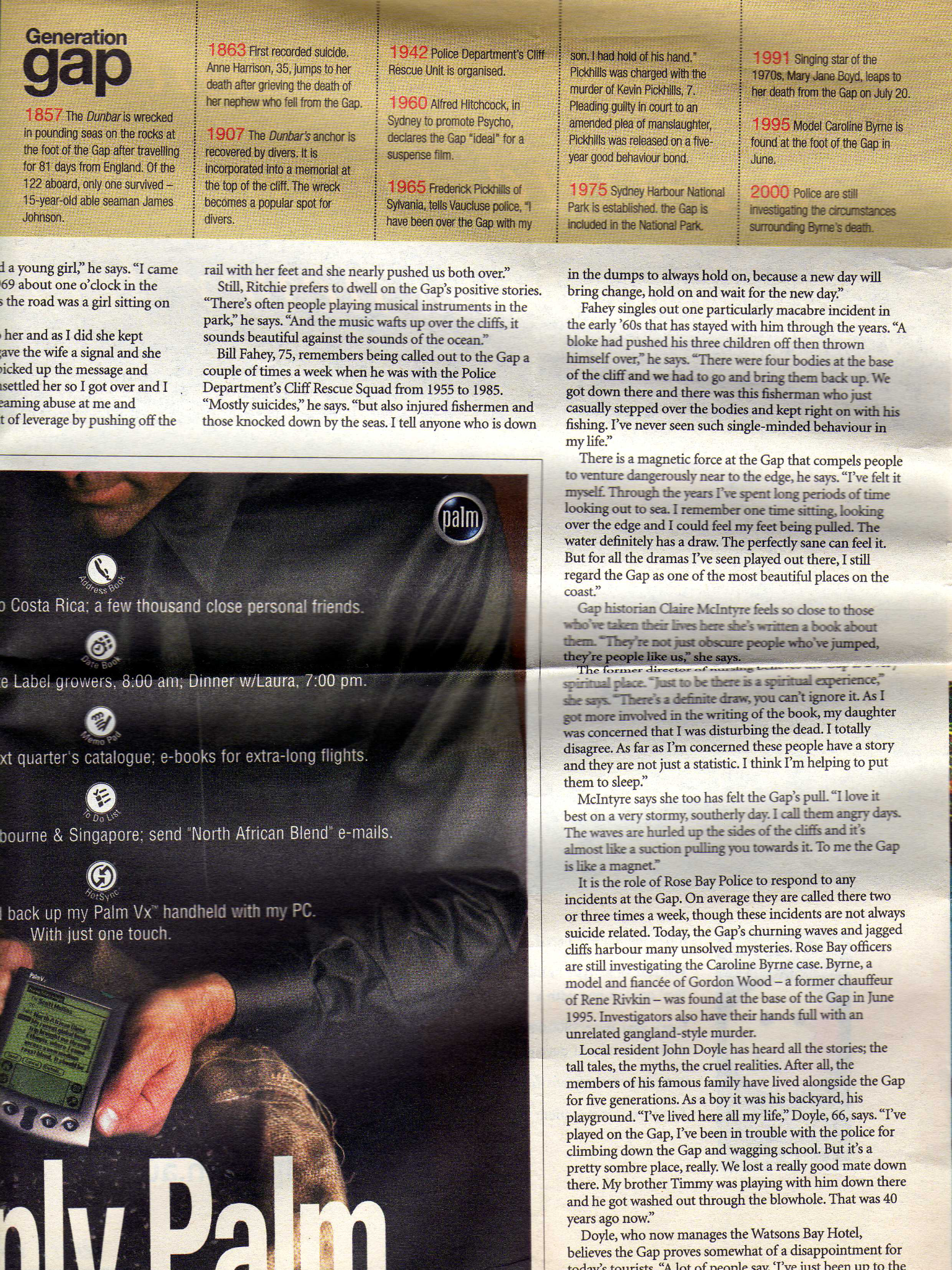
Mind The Gap – Sun Herald, Sunday May 28, 2000

The 1965 incident with Frederick Pickhills was my family, and my brothers death. I have covered the case in my article “Kevin Pickhills – The Unspoken Name.”


Words by Glen Williams
Like the Opera House and Harbour Bridge, Bondi and the beaches, the Gap is a must-see for tourists and locals alike – a place of shattered deams, unsolved mysteries and dramatic beauty.

You are lured here by the view – high above a seething ocean, veiled by sea spray and circled by noisy gulls. The final 25 steps rise from a road that winds back toward the city and all of a sudden here you are – white knuckled, clutching the safety rail, yet drawn closer to the edge. Free-spirited sightseers and single-minded fishermen have all looked down from this spot, captivated by the churning sea and beckoning rocks below. To get this far you must turn your back on Sydney and when you do, its soaring towers and sparkling harbour disappear – replaced by a vast, distant and empty horizon. See the tourists turn their backs to take a photo, of a windswept spot where others before them turned their backs on life.

This is the Gap, Sydney’s infamous “drop off” point, a sweeping arc of wave-blasted sandstone gouged into South Head. Long before there was a Bridge to climb and way before the Opera House welcomed its hordes, this majestic sweep of coastline, in places more than 100m high, played lively in the imaginations of locals. It still does.

It is a place of intense contrasts. Stand at the safety rail, look straight out to sea, and the full brunt of nature hurtles toward you. The noise, a screaming fury, almost knocks you over. Turn around and the harbour and city skyline are displayed in all their glory. And, like the contrasting views, life and death manage to co-exist here.

Ask a Sydneysider their impressions of the Gap and they’ll tell you it’s lunch at Doyles, and a beer at the Watsons Bay Hotel. They’ll say it’s the best vantage point from which to catch the start of the Sydney to Hobart yacht race. And, either in hushed tones or with insensitive grins they’ll tell you, “It’s where people go to jump.”

Howard Courtney will tell you about the night out with his wife and friends which began with dinner at Doyles. One moment he was enjoying the company, the next, he was over the cliff’s edge. “We’d just finished eating and decided to take a walk up there to show our friends what the place looked like in the dark,” he recalls. “We got up to the safety rail and there we found a pair of shoes and a handbag. I looked over the Gap, and down on a ledge was a woman. I could see she was ready to go again. She was crawling out towards the edge. It was dark but I could clearly see her.”

Overcome by the woman’s plight, Courtney kicked off his shoes and socks and, calling to his stunned wife and friends to run for help, leapt over the safety rail and out of sight.

“I didn’t think,” he says with a laugh. “I don’t remember how I got down, and I suppose had it been light, and I’d seen the reality of the drop, I might not have gone. I only know my wife wasn’t too pleased. I managed to make it to the girl. She was crying and I held her and tried to pacify her until the police came. I clearly remember she had scars on her wrists.”

It was March 1973 and newspapers reported how Courtney had clambered 40 feet (12.9m) down the cliff face to reach the 21-year-old woman. She was taken to St Vincent’s Hospital in a satisfactory condition despite a broken leg, internal injuries and shock. Police said the narrow ledge had stopped the woman from plunging 200 feet (60.96m).

“I’ve often wondered what happened to her. Where she ended up,” Courtney, 65, says. “I haven’t been back to the Gap since, but I remember it as a place of dramatic beauty.”

A fence – a sturdy hardwood affair mostly, waist-high and wrapped in cyclone mesh – is intended to prevent people from getting too close to that “dramatic beauty”. But as Woollahra Council carpenters Stuart McKinlay and Bill McLeary know only too well, those wanting to be at one with the view will find a way over the barrier. “There’s a lot of maintenance work,” says McLeary, 56. “We’re often up here fixing the fence. We can’t really stop anyone,” adds McKinlay. “Most are just trying to get a closer look.”

The cheerful tradesmen double as unofficial tour guides of the area and are well-versed in the Gap’s history. As the tourist buses pull up, sometimes 72 in one day, the amiable pair will don their second hat. They’ll point tourists to the rusted anchor from the ill-fated Dunbar, wrecked in 1857 after surviving an 81-day journey from England. Before it could reach the shelter of Port Jackson the ship hit enormous seas and a gale force wind smashed it onto the rocks below. Of the 122 people aboard, only one, Able Seaman James Johnson, 15, survived. “Imagine coming all that way to die here,” says McLeary. “It’s just not fair, is it?”

The men will also gladly help tourists take what they believe is the perfect Gap photograph. “A bus will come along and disgorge a whole heap of Japanese tourists,” McKinlay says. “They’ll race to the rail and take a photo straight out to sea. I mean that photo could be of any sea, any horizon. I tell them to look behind them at one of the best views they’ll ever see. So we’ll take a photo for them, we usually try and line up the Bridge, something that says ‘Sydney’. We’re like ambassadors for tourism.”

Ask them to explain the Gap’s attraction and their initial answer is the view. “Well, as you can see, it is spectacular,” says McKinlay. “It’s also such a well-known place for the obvious reason,” he says, then falls silent. “Um … people like to jump. It still goes on but it’s kept real quiet.”

Indeed, the great unspoken has been associated with the Gap since the mid 1800s. The first recorded case of someone taking their own life here was of 35-year-old Anne Harrison, a publican’s wife who leapt to her death in 1863, after grieving for her nephew who fell from the cliff top. But the two men, who recently nailed plaques detailing the telephone numbers of Lifeline and The Salvos onto the fence, are reminded of more recent tragedies.

There was the man who, in 1993, murdered his former girlfriend then tried to end his own life by driving off the Gap at great speed. “He meant business,” McLeary says. “He tore down here at a million miles an hour, smashed through the fence and became airborne over Jacob’s Ladder – that part of the Gap where the rock fishermen clamber down.”

The car flipped mid-flight and became wedged on a ledge. Miraculously the man survived. “He’s in jail now. They called us straight away to fix the fence.”

Neither man underestimates the dangers of their work, especially McLeary, who admits to being scared of heights. “I’ll climb over the fence, no worries,” he says. “But there’s some spots where you’re right up on the edge. Stu does those.”

Residents of the area moved here to enjoy the ceaseless roar of the ocean and that view. They didn’t intend to be caught up in the broken lives of others or to become heroes. But that is what has happened to some over the years. In the 1960s, Mrs Eve Bettke and her husband Anthony were known as “The Guardians Of the Gap”. Together they brought scores of people back from the edge. In one week alone they dragged back 27 people. News reports from the time tell how the Bettkes, who once lived across the road, kept a vigil from their house, scouring the cliffs for anyone lurking too near the edge. Often they’d invite potential suicides back to their house for a comforting chat.

Don Ritchie, 73, has lived in Watsons Bay all his life and has been involved in several rescues at the Gap. Some of the people he’s saved have actually sent him thank-you cards and gone on to enjoy life. Like the Bettkes before him, he keeps watch over the Gap from his house and has climbed over the fence to talk to people who are contemplating taking their own lives.

Ritchie has lost count of the number of rescues in which he’s been involved. He was awarded a Bravery Medal from the Royal Humane Society in 1970. “That involved a young girl,” he says. “I came home from a function in 1969 about one o’clock in the morning and straight across the road was a girl sitting on the edge in the dark.

“I went over and talked to her and as I did she kept moving close to the edge. I gave the wife a signal and she called the police. The press picked up the message and arrived first. Their arrival unsettled her so I got over and I pulled her back. She was screaming abuse at me and kicking like hell. She got a bit of leverage by pushing off the rail with her feet and she nearly pushed us both over.”

Still, Ritchie prefers to dwell on the Gap’s positive stories. “There’s often people playing musical instruments in the park,” he says. “And the music wafts up over the cliffs, it sounds beautiful against the sounds of the ocean.”

Bill Fahey, 75, remembers being called out to the Gap a couple of times a week when he was with the Police Department’s Cliff Rescue Squad from 1955 to 1985. “Mostly suicides,” he says. “but also injured fishermen and those knocked down by the seas. I tell anyone who is down in the dumps to always hold on, because a new day will bring change, hold on and wait for the new day.”

Fahey singles out one particularly macabre incident in the early ’60s that has stayed with him through the years. “A bloke had pushed his three children off then thrown himself over,” he says. “There were four bodies at the base of the cliff and we had to go and bring them back up. We got down there and there was this fisherman who just casually stepped over the bodies and kept right on with his fishing. I’ve never seen such single-minded behaviour in my life.”

There is a magnetic force at the Gap that compels people to venture dangerously near to the edge, he says. “I’ve felt it myself. Through the years I’ve spent long periods of time looking out to sea. I remember one time sitting, looking over the edge and I could feel my feet being pulled. The water definitely has a draw. The perfectly sane can feel it. But for all the dramas I’ve seen played out there, I still regard the Gap as one of the most beautiful places on the coast.”

Gap historian Claire McIntyre feels so close to those who’ve taken their lives here she’s written a book about them. “They’re not just obscure people who’ve jumped, they’re people like us,” she says.

The former director of nursing believes the Gap is a very spiritual place. “Just to be there is a spiritual experience,” she says. “There’s a definite draw, you can’t ignore it. As I got more involved in the writing of the book, my daughter was concerned that I was disturbing the dead. I totally disagree. As far as I’m concerned these people have a story and they are not just a statistic. I think I’m helping to put them to sleep.”

McIntyre says she too has felt the Gap’s pull. “I love it best on a very stormy, southerly day. I call them angry days. The waves are hurled up the sides of the cliffs and it’s almost like a suction pulling you towards it. To me the Gap is like a magnet.”

It is the role of Rose Bay Police to respond to any incidents at the Gap. On average they are called there two or three times a week, though these incidents are not always suicide related. Today, the Gap’s churning waves and jagged cliffs harbour many unsolved mysteries. Rose Bay officers are still investigating the Caroline Byrne case. Byrne, a model and fiancee of Gordon Wood – a former chauffeur of Rene Rivkin – was found at the base of the Gap in June 1995. Investigators also have their hands full with an unrelated gangland-style murder.

Local resident John Doyle has heard all the stories; the tall tales, the myths, the cruel realities. After all, the members of his famous family have lived alongside the Gap for five generations. As a boy it was his backyard, his playground. “I’ve lived here all my life,” Doyle, 66, says. “I’ve played on the Gap, I’ve been in trouble with the police for climbing down the Gap and wagging school. But it’s a pretty sombre place, really. We lost a really good mate down there. My brother Timmy was playing with him down there and he got washed out through the blowhole. That was 40 years ago now.”

Doyle, who now manages the Watsons Bay Hotel, believes the Gap proves somewhat of a disappointment for today’s tourists. “A lot of people say, ‘I’ve just been up to the Gap and I couldn’t find it’. Or they’ll tell you they’ve seen bigger Gaps in their own backyards.”

Master of suspense inspired by the Gap

How appropriate that the master of the cliffhanger, Alfred Hitchcock, should find himself drawn to the ominous cliffs of the Gap.

It was Friday, 6 May, 1960, and Hitch was in Australia to promote what has become an all-time classic motion picture, Psycho.

“Alfred Hitchcock thinks Sydney’s Gap would be ‘ideal’ for a suspense movie,” David Burke reported in The Sun-Herald, on 8 May, 1960.

He took an umbrella with him. “Just in case I decide to float over the edge,” he explained. “Before I make a picture I must always experience the hero’s emotions myself.”

“He poised his roly poly figure on a railing of the safety fence and looked down on the rocks hundreds of feet below,” Burke wrote. “The westerly blew his umbrella inside out; the renowned chins and jowl quivered with the cold. But his eyes lit up to saucer-like proportions.

“Ah, yes, ideal,” beamed the master of suspense. “I can see it all. The villain has the hero on the edge of the cliff and is slowly pushing him over backwards. We have close-up shots of their faces. Then we have close-ups of their feet, scuffling on the brink. The wind is shrieking … the waves are boiling far beneath … we know how far the hero has to fall.

“At the last moment he wrenches himself free and the villain goes over the Gap. Yes, a really ideal setting for suspense.”

Generation gap

1857 The Dunbar is wrecked in pounding seas on the rocks at the foot of the Gap after travelling for 81 days from England. Of the 122 aboard, only one survived – 15-year-old able seaman James Johnson.

1863 First recorded suicide. Anne Harrison, 35, jumps to her death after grieving the death of her nephew who fell from the Gap.

1857 The Dunbar is wrecked in pounding seas on the rocks at the foot of the Gap after travelling for 81 days from England. Of the 122 aboard, only one survived – 15-year-old able seaman James Johnson.

1907 The Dunbar’s anchor is recovered by divers. It is incorporated into a memorial at the top of the cliff. The wreck becomes a popular spot for divers.

1942 Police Department’s Cliff Rescue Unit is organised.

1960 Alfred Hitchcock, in Sydney to promote Psycho, declares the Gap “ideal” for a suspense film.

1965 Frederick Pickhills of Sylvania, tells Vaucluse police, “I have been over the Gap with my son. I had hold of his hand.” Pickhills was charged with the murder of Kevin Pickhills, 7. Pleading guilty in court to an amended plea of manslaughter, Pickhills was released on a five-year good behaviour bond.

1975 Sydney Harbour National Park is established. the Gap is included in the National Park.

1991 Singing star of the 1970s, Mary Jane Boyd, leaps to her death from the Gap on July 20.

1995 Model Caroline Byrne is found at the foot of the Gap in June.

2000 Police are still investigating the circumstances surrounding Byrne’s death.

© 2000 Sun Herald