Tag Archives: Magdalene laundries

How Ireland Turned ‘Fallen Women’ Into Slaves

Until 1996, pregnant or promiscuous women could be incarcerated for life in Magdalene Laundries.

When the Sisters of Our Lady of Charity decided to sell some land they owned in Dublin, Ireland, to pay their debts in 1992, the nuns followed the proper procedures. They petitioned officials for permission to move the bodies of women buried in the cemetery at their Donnybrook laundry, which between 1837 and 1992 served as a workhouse and home for “fallen women.” 

But the cemetery at Donnybrook was no ordinary resting place: It was a mass grave. Inside were the bodies of scores of unknown women: the undocumented, uncared-about inmates of one of Ireland’s notorious Magdalene laundries. Their lives—and later their deaths—had been shrouded in secrecy.

For more than two centuries, women in Ireland were sent to institutions like Donnybrook as a punishment for having sex outside of marriage. Unwed mothers, flirtatious women and others deemed unfit for society were forced to labor under the strict supervision of nuns for months or years, sometimes even for life.

When the mass grave at Donnybrook was discovered, the 155 unmarked tombs touched off a scandal that exposed the extent and horrors of the Magdalene laundries. As women came forward to share their experiences of being held against their will in restrictive workhouses, the Irish public reacted with outrage.

The interior of the now derelict Sisters of Our Lady of Charity Magdalene Laundry on Sean McDermott St in Dublin’s north inner city on the day of The Irish Government has apologised to the thousands of women locked up in Catholic-run workhouses known as Magdalene laundries between 1922 and 1996. (Photo by Julien Behal/PA Images via Getty Images)

When the Magdalene Movement first took hold in the mid-18th century, the campaign to put “fallen women” to work was supported by both the Catholic and Protestant churches, with women serving short terms inside the asylums with the goal of rehabilitation. Over the years, however, the Magdalene laundries—named for the Biblical figure Mary Magdalene—became primarily Catholic institutions, and the stints grew longer and longer. Women sent there were often charged with “redeeming themselves” through lace-making, needlework or doing laundry.

Though most residents had not been convicted of any crime, conditions inside were prison-like. “Redemption might sometimes involve a variety of coercive measures, including shaven heads, institutional uniforms, bread and water diets, restricted visiting, supervised correspondence, solitary confinement and even flogging,”writes historian Helen J. Self. 

Ireland’s first such institution, the Magdalen Asylum for Penitent Females in Dublin, was founded by the Protestant Church of Ireland in 1765. At the time, there was a worry that prostitution in Irish cities was on the rise and that “wayward” women who had been seduced, had sex outside of marriage, or gotten pregnant out of wedlock were susceptible to becoming prostitutes. Soon, parents began to send their unmarried daughters to the institutions to hide their pregnancies. 

Initially, a majority of women entered the institutionsvoluntarilyand served out multi-year terms in which they learned a “respectable” profession. The idea was that they’d employ these skills to earn money after being released; their work supported the institution while they were there.

Nursery in the Sean Ross Abbey. (Credit: Brian Lockier/Adoption Rights Alliance)

But over time, the institutions became more like prisons, with many different groups of women being routed through the system, sometimes by the Irish government. There were inmates imported from psychiatric institutions and jails, women with special needs, victims of rape and sexual assault, pregnant teenagers sent there by their parents, and girls deemed too flirtatious or tempting to men. Others were there for no obvious reason. Though the institutions were run by Catholic orders, they were supported by the Irish government, which funneled money toward the system in exchange for laundry services.

Nuns ruled the laundries with impunity, sometimes beating inmates and enforcing strict rules of silence. “You didn’t know when the next beating was going to come,”said survivor Mary Smith in an oral history. 

Smith was incarcerated in the Sundays Well laundry in Cork after being raped; nuns told her it was “in case she got pregnant.” Once there, she was forced to cut her hair and take on a new name. She was not allowed to talk and was assigned backbreaking work in the laundry, where nuns regularly beat her for minor infractions and forced her to sleep in the cold. Due to the trauma she suffered, Smith doesn’t remember exactly how long she spent in Sundays Well. “To me it felt like my lifetime,” she said.

Survivors (left to right) Maureen Sullivan, Mary McManus, Kitty Jennette and Mary Smith, at the Law Reform Commission offices in Dublin to discuss proposed compensation packages, for those who survived Catholic-run workhouses known as Magdalene laundries. (Credit: Julien Behal/PA Images/Getty Images)

Smith wasn’t alone. Often, women’s names were stripped from them; they were referred to by numbers or as “child” or “penitent.” Some inmates—often orphans or victims of rape or abuse—stayed there for a lifetime; others escaped and were brought back to the institutions. 

Another survivor, Marina Gambold, was placed in a laundry by her local priest. She recalls being forced to eat off the floor after breaking a cup and getting locked outside in the cold for a minor infraction. “I was working in the laundry from eight in the morning until about six in the evening,” she told the BBC in 2013. “I was starving with the hunger, I was given bread and dripping for my breakfast.” 

Some pregnant woman were transferred to homes for unwed mothers, where they bore and temporarily lived with their babies and worked in conditions similar to those of the laundries. Babies were usually taken from their mothers and handed over to other families. In one of the most notorious homes, the Bon Secours Mother and Baby Home in Tuam, scores of babies died. In 2014, remains of at least 796 babies were found in a septic tank in the home’s yard; the facility is still being investigated to reconstruct the story of what happened there.
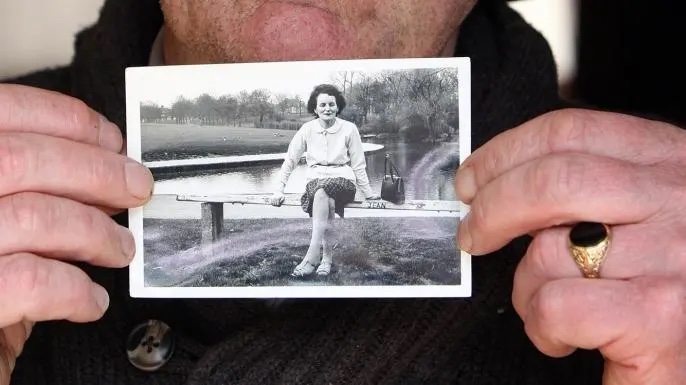
John Pascal Rodgers, who was born in Tuam, Ireland, at a home for unmarried mothers run by nuns, poses with a photograph of his mother Bridie Rodgers. (Credit: Paul FaithAFP/Getty Images)

How did such an abusive system endure for 231 years in Ireland? To start with, any talk of harsh treatment at the Magdalene laundries and mothers’ homes tended to be dismissed by the public, since the institutions were run by religious orders. Survivors who told others what they had been through were often shamed or ignored. Other women were too embarrassed to talk about their past and never told anyone about their experiences. Details on both the inmates and their lives are scant.

Estimates of the number of women who went through Irish Magdalene laundries vary, and most religious orders haverefusedto provide archival information for investigators and historians. Up to 300,000 women are thought to have passed through the laundries in total, at least 10,000 of them since 1922. But despite a large number of survivors, the laundries went unchallenged until the 1990s.

Then, the Sisters of Our Lady of Charity decided to sell some of its land in 1992. They applied to have 133 bodies moved from unmarked graves on the property, but the remains of 155 people were found. When journalists learned that only 75 death certificates existed, startled community members cried out for more information. The nunsexplained there had been an administrative error, cremated all of the remains, and reburied them in another mass grave.
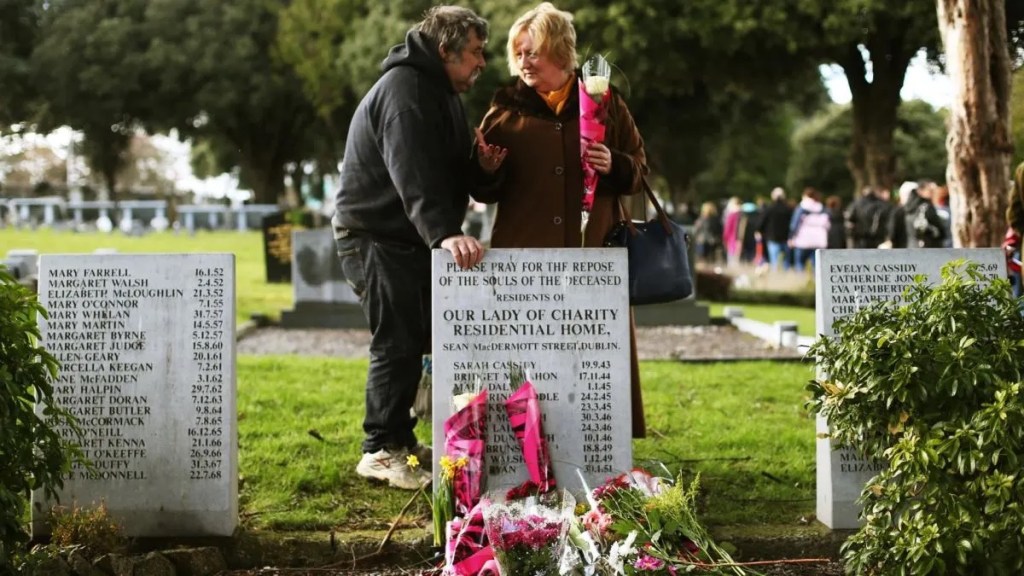
Kevin Flanagan with Marie Barry, who was born at a Bessboro Mother and Baby home, at the 2014 third annual Flowers for Magdalenes remembrance event in Glasnevin cemetery, Dublin, to mark all of the women incarcerated in the Magdalene laundries. (Credit: Brian Lawless/PA Images/Getty Images)

The discovery turned the Magdalene laundries from an open secret to front-page news. Suddenly, women began to testify about their experiences at the institutions, and to pressure the Irish government to hold the Catholic Church accountable and to pursue cases with the United Nations for human rights violations. Soon, the UN urged the Vatican to look into the matter, stating that “girls [at the laundries] were deprived of their identity, of education and often of food and essential medicines and were imposed with an obligation of silence and prohibited from having any contact with the outside world.”

As the Catholic Church remained silent, the Irish government released a report that acknowledged extensive government involvement in the laundries and the deep cruelty of the institutions. In 2013, Ireland’s presidentapologized to the Magdalene women and announced a compensation fund. However, the religious groups that ran the laundries have refused to contribute to the fund and have turned away researchers looking for more information about the laundries. 

Due in part to the uproar surrounding the discovery of the mass grave, the last Magdalene laundry finally closed in 1996. Known as the Gloucester Street Laundry, it was home to 40 women, most of them elderly and many with developmental disabilities. Nine had no known relatives; all decided to stay with the nuns.

Although Smith managed to reclaim her own life, she understands the damage that long-term institutionalization can inflict. “My body went into shellshock when I went there. When that door closed, my life was over,” Smith recalled in her oral history. “You see all these women there and you know you’re going to end up like them and be psychologically damaged for the rest of your life.”

Reference

‘Dickensian’ Good Shepherd Institutions Covered Up Dysfunction In Canadian Society, As Late As The 1960s

Operated in reality as a form of incarceration, they sentenced women and girls as young as 12 or 13 to back-breaking, indefinite labour

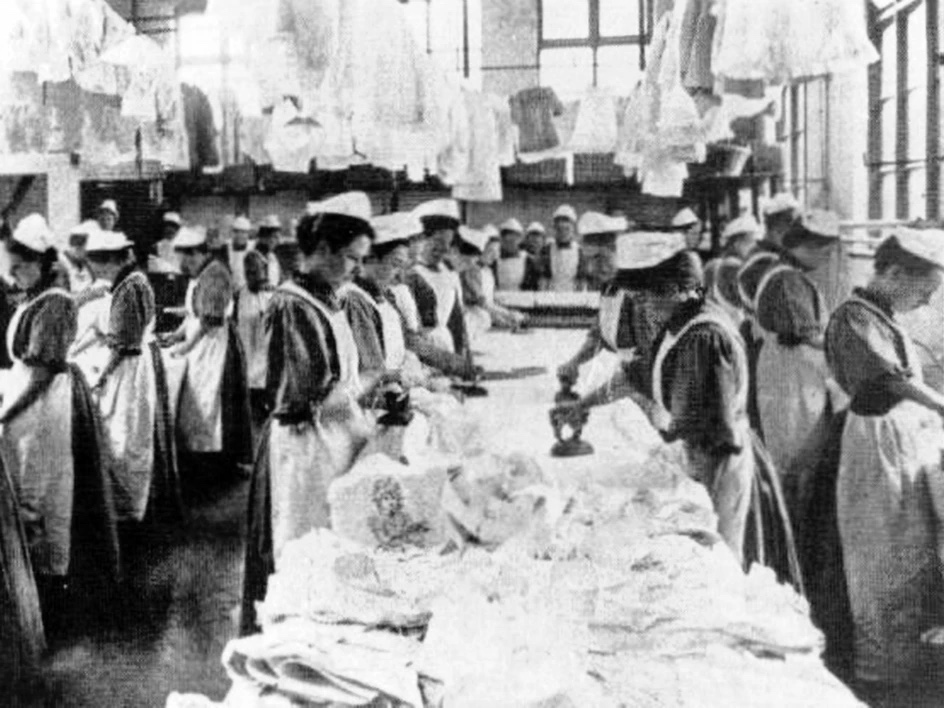
A Magdalene Laundry in England in the early Twentieth Century, from Frances Finnegan, Do Penance or Perish, Congrave Press, 2001. PHOTO BY WIKIMEDIA COMMONS

Thousands of academics gathered in Vancouver for the annual Congress of the Humanities and Social Sciences from June 1-7. They presented papers on everything from child marriage in Canada to why dodgeball is problematic. In its Oh, The Humanities! series, the National Post showcases some of the most interesting research.

If you saw the Oscar-nominated 2013 movie Philomena, you’ve heard of the Magdalene laundries — Catholic institutions that persisted in Ireland until, incredibly, 1996. They supposedly provided asylum to “fallen” women, such as former prostitutes and unwed mothers.

In reality, these institutions were understood, and operated, as a form of incarceration. They sentenced women and girls as young as 12 or 13 to back-breaking labour, living out their days boiling and stirring and rinsing and wringing and hanging laundry for the wealthy, respectable members of society

Until recently, the laundries were thought of as “an Irish phenomenon,” but they also existed in the U.K, Australia, New Zealand, the United States and, yes, Canada, says Rie Croll, associate professor of social cultural studies at Memorial University of Newfoundland and author of the new book Shaped by Silence: Stories from Inmates of the Good Shepherd Laundries and Reformatories.

The Sisters of the Good Shepherd ran more than a dozen institutions for girls and women across the country, from the Maritimes to Ottawa to Vancouver. They proliferated in the 19th century and were variously called homes, training schools, asylums, refuges, reformatories and laundries, Croll said. Of the Canadian institutions she examined, the last to close was the St. Mary’s Training School in Toronto, in 1973.

Croll presented two talks based on her research at the annual conference of the Canadian Sociological Association, part of the larger Congress of the Humanities and Social Sciences in Vancouver.

She interviewed survivors who entered institutions between the 1930s and 1960s, not long before they closed for good. Their accounts provide some of the most detailed information we have about Good Shepherd homes in Canada, which, despite being relatively recent, are now nearly forgotten. No one knows how many Canadian women were incarcerated in them or how many survive, though it’s “more than single digits,” Croll said. Few records were kept and the survivors and their families were shamed into silence. In fact, it took years for Croll to gain enough trust to sit down with survivors and hear their tales. She spoke to inmates from Canada, Australia and Ireland.

Almost to a body, the women described them as Dickensian

What she heard beggars belief. The institutions were so draconian that it seems impossible they existed within living memory, during the same period as the flappers were tearing up dance halls, as Civil Rights activists were marching, as The Beatles were scoring hits.

Their stated purposes varied and their practices were different across regions and over time. The Good Shepherd sisters had a set way of doing things that was quite uniform, Croll explained, and “almost to a body, the women described them as Dickensian.”

The day began before dawn. The nuns clapped their hands and the women jumped out of bed and dropped to their knees for prayers. They pulled their heavy, long cotton dresses and aprons over their nightgowns: It was forbidden to show their bodies even to other inmates. After a quick wash, they filed in silence into chapel for mass, in silence into the dining hall for a starchy, flavourless meal, and in silence into the heat of the workroom to do laundry, or sometimes other menial chores, all day. Depending on the institution, they may have had a few hours of basic schooling each day. For an hour before bed, they had a break. Often this time was used to make rosaries for sale.

“Everything was taken away that was a reminder of a possession of identity,” Croll said. Their street clothes were confiscated, their hair and nails chopped short and, in the laundries, they were given new names and forbidden to use their own.

This made it hard for survivors to find each other and organize in the years since — though the shame did that much more effectively.

The institutions were based on the idea of contagious “moral pollution,” Croll explained. Their purpose was not only to segregate the women and give them asylum from a cruel, judgmental society, but to keep society safe from their corrupting influence.

“They’re told that they are bad, they’re shameful, they’re sluts, that they have done something really wrong. The state has imprisoned them, and the Church has imprisoned them, and their families have abandoned them. The language that’s used to describe them is shameful — you need to clean, you need to clean, you need to clean, you need to be penitent. You are not worthy of your old name. You may not mention your former life. This is a stripping away, through ideology and words, that creates a stigma that becomes internalized and believed — believed as fact,” she said.

In one of her talks, Croll argued this breaking of the human spirit was a form of “symbolic violence,” a sociological concept articulated by the French theorist Pierre Bourdieu. “It broke their resistance to other more immediate and explicit forms of violence in their lives,” she said.

The state was working with the church and families were, too

Canadian women and girls were committed to Good Shepherd institutions for a huge variety of reasons. Their sentences could be indefinite or extended at will. Some had been involved in sex work or gotten pregnant out of wedlock, but others were simply considered “defiant,” “incorrigible,” or “wayward” because they’d been caught “lipping off to their parents, smoking cigarettes, stuff that in those days that would have been shocking,” Croll said.

None of the survivors she interviewed had done anything that would be considered a crime today. One was declared “unmanageable” and sentenced to a Toronto reformatory in 1961 for sneaking away from her abusive parents to spend the evenings with friends. Another was born into a Good Shepherd laundry in Saint John, N.B. in 1934 to a 13-year-old Indigenous girl who got pregnant after a gang rape. The two remained incarcerated together, working side-by-side from the time the girl was eight until she escaped over the fence at the age of 18.

These institutions were supposed to respond to some of the worst violence and dysfunction in society, but they ended up covering it up, Croll said, adding that adolescent girls who had been victims of incest often ended up in them. So it’s not surprising that there has been no big movement from surviving family members to get recognition and restitution for what happened.

“The state was working with the Church, and families were too,” she said.

Croll’s other academic talk was on the concept of the moral double standard. There’s the obvious, gendered double standard, in that women were committed to these institutions while men were not. Women were seen as “solely responsible for any sexual transgression that’s happening in society.”

Then there’s another layer of double standard: The gulf between the stated purpose of the institutions and their real effects.

“The very system of incarceration that was supposed to reform them, became a significant factor in shaping their lifelong inequality,” Croll said. “Those who the Church and state targeted for saving were simultaneously treated as bad, dirty and unsalvageable.”

The sisters, obviously, saw their work quite differently. Their motto then and now is, “One person is of more value than the whole world.”

The National Post’s attempts to contact the order for comment by phone, email and letter have so far been unsuccessful.

A call to the Good Shepherd office in St. Louis, Mo., was not returned by press time and a visit to the sisters’ listed address in Etobicoke, Ont. yielded nothing. A staff member at nearby St. Gregory’s church, though, remembered a nun called Sister Doris who loved to tell stories about her days working at St. Mary’s, a Good Shepherd reform school in Toronto.

Sister Doris died in 2018.

Croll argues the institutionalization of women created a lifelong loss of self-confidence and difficulty reintegrating into society. She spoke to an Irish politician who remembers the day in 1996 when the last Magdalene laundry was closed in Dublin.

“Those poor women. They staggered on to the street. He said they didn’t even know how to cross a busy, modern street. They were so institutionalized. It was heartbreaking.”

Reference