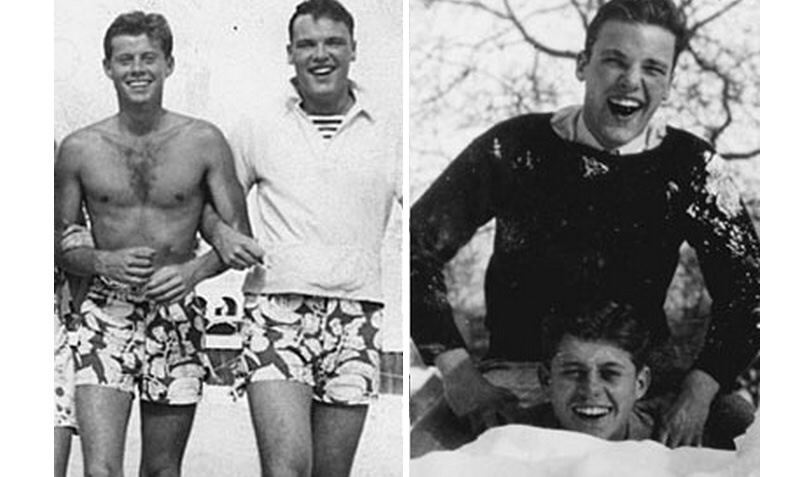
The book “Jack and Lem: John F. Kennedy and Lem Billings: The Untold Story of an Extraordinary Friendship,” details the extraordinary relationship between two unlikely friends.
JFK, or ‘Jack’ as he was known by his close friends and family, had a gay best friend named Lem Billings, who he met in prep school when Kennedy was 15 and Lem was 16.
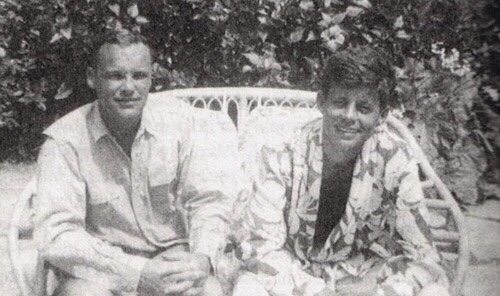
The pair became the best of friends who wrote letters to each other when they were apart, traveled to Europe together and were so close that Joseph Kennedy Sr. thought of Billings as another son, according to GregInHollywood.

The book details JFK’s angry reaction to Lem after he made a sexual advance towards him, saying: “I’m not that kind of boy.” But this misunderstanding did not end the duo’s relationship.
Writes GregInHollywood:
From the time he and Kirk LeMoyne “Lem” Billings met at Choate, until the President’s assassination thirty years later, they remained best friends.
Lem was a virtual fixture in the Kennedy family who even had his own room at the White House.

The book about their friendship draws on hundreds of letters and telegrams between the two, Billings’s oral history and interviews with family and friends like Ben Bradlee, Gore Vidal, and Ted Sorensen.
It was a friendship that endured despite an era of rampant homophobia.
Billings was a graduate of Princeton University and Harvard Business School and was an advertising executive at the Manhattan advertising firm Lennen & Newell. He put his business career on hold to work on Kennedy’s campaign for president.

Bradlee says in the book: “I suppose it’s known that Lem was gay….It impressed me that Jack had gay friends.”
Billings obviously never came out but did once say: “Jack made a big difference in my life. Because of him, I was never lonely. He may have been the reason I never got married.”

Kenneth Hill of WoolfAndWilde, conducted a fascinating interview with David Pitts, the author of ‘Jack and Lem’, to uncover some more details about the extraordinary relationship between the two unlikely friends:
Kenneth Hill: How would you characterize the friendship between JFK and Lem Billings?
David Pitts: The way I would characterize it is that is was a very close, deep, friendship across sexual orientation lines.
KH: You said that this was the story of a friendship that crossed sexual orientation lines, which I think is really an interesting element of it, but talk a little bit about the depth of this friendship. The fact that it started when they were very young and, from what I read in the book, they were basically inseparable for the rest of their lives except when circumstances had them in distant cities.
DP: Yes, indeed. I think there were a number of elements to it. First of all, there were a series of bonding events early on. One was the fact that they both hated that school [Choate] in which they met. And were engaged in all kinds of pranks which almost got them expelled twice. That was obviously a bonding phenomenon. Secondly, they roomed together for part of the time at the school.
Thirdly, and I think this is really important, John Kennedy was so sick most of his life, far earlier than when most people think, including when he was at Choate, and Lem was the person at boarding school — his mother and father did not come to the school when he was ill; Lem was there. Lem was the person who was always there for him and took care of him. And then fourthly, there was the two month trip to Europe that they took, just before WWII in 1937, just the two Americans at that pivotal time, I think that was obviously a very strong bonding event.
And then over and above these issues, I would say this — and this is kind of a complicated thought because we really don’t have language to express these kinds of relationships — and that is, I’m firmly convinced after working on this book that John Kennedy’s sexual interests were in women. We don’t need much evidence of that, the evidence is all over the place. But his strongest emotional attachments were to men — and principally, to Lem. We don’t have a word for that, right? Somebody who prefers the opposite gender for sexuality, and the same gender for deep, emotional attachments.
KH: We don’t really have a word for that. I guess “man’s man” used to sort of mean that, but JFK took it so much further in a way because he loved being around men, he knew some men were attracted to him and even seemed to enjoy it. He liked the stimulation of those relationships, there was nothing sexual about it, but there was something about that male-male dynamic that fed him.
DP: I think that’s exactly right. There was one reviewer who wrote, “What’s the big deal here? This guy’s writing that JFK was comfortable with gay men, so big deal, we all knew that.” But of course it’s not the fact that he had a friend named Lem Billings who was gay. This was the closest person in all the world to him outside of his family for 30 years. He wasn’t just “a gay friend” on the side.
KH: One of the very surprising facts that comes out in this book is that Lem had his own room at the White House?
DP: Yes, that’s one of the revelations in the book that’s really surprising. And actually some of the people who were working in the White House very close to JFK didn’t know it. For example, Ted Sorensen whom I interviewed for the book, perhaps the closest aide to JFK, saw Lem around the White House all the time, but he told me he didn’t know that he’d had his own room there and was staying there so much of the time. But yeah, that’s another indication of the depth of the attachment.
One thing I was intent on doing when I wrote this book, because I thought it would be open to various forms of attack, is that I never went beyond what the documents said. The book is a lot of quotes from documents, or that interviewees said. This friendship might have contained a lot of things that I wasn’t able to find out because I didn’t want to enter the area of speculation.
KH: It seems without a doubt that Lem was in love with JFK. But it’s never stated explicitly because you don’t have any record of his ever saying that.
DP: No, I think the closest … I mean, these were more sedate times, especially where homosexuality is concerned. Even in the various documents, Lem is never overt in his statements. But there was one statement from one of the documents, and I have it in front of me here, that I think is just expresses his feelings. Here’s the quote: “Jack made a big difference in my life. Because of him, I was never lonely. He may have been the reason I never got married.”
This is somewhat of a difficult thought as well, but I think gay people had a way back then of telegraphing to future generations what their feelings were that they could not express candidly at the time. And anybody who reads some of these words today would have no doubt what Lem’s feelings were, but in the context of that time it was not obviously understood.
Reference
- John F. Kennedy Had A Gay Best Friend Who Even Had His Own Room At The White House, The Gaily Grind, 23 November 2013, by Adrian Garcia https://thegailygrind.com/2013/11/23/john-f-kennedy-gay-best-friend-even-room-white-house/


 timalderman