Tag Archives: HIV/AIDS

A Brief (Personal) Memoir of HIV & AIDS

I discovered this older article recently while rummaging through my article archives. I present it here with some edits and newspaper inclusions. HIV & AIDS (note the separation of the two) has an intricate, but morbidly fascinating, national & international history. I watched “The Normal Heart” again only a couple of days ago, and the hospital scene where Felix is in the hospital ward with the meal sitting outside the door of his KS infected friend, and being told not to go in without contagion gear raised a whole plethora of unpleasant memories with me. To understand where HIV is now, you need to understand where it was! 


I can’t believe it has been about thirty seven years since we first started hearing about HIV/AIDS. I find it even harder to believe that I have been infected for thirty five years. Over half my life has been lived with this virus! In personal retrospection, I could say that compared to the bad, bad old days of 1981, life is a bed of roses today. But then I am aware that quite a lot of people would still not share that sentiment, so out of respect to them, I will avoid such romanticism.


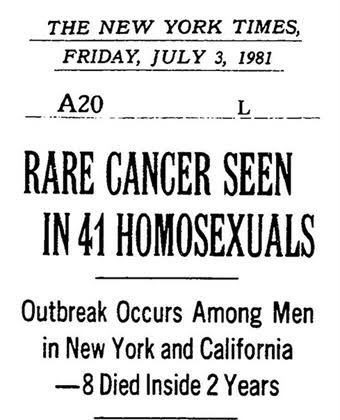
I was living in Melbourne at that time, and I believe that HIV/AIDS got its first mention in the gay press a little earlier than 1981, though I could be wrong. There were only snippets, overseas briefs if you like, of a strange STD that seemed to be selectively attacking the San Francisco gay community, or more specifically, those members of that community who frequented the baths and back rooms of the famous city. I know that no one here was particularly concerned. We thought it was just another of ‘those American things’, or just a mutated form of the clap. Nothing that a pill wouldn’t fix! By the time I returned to Sydney in 1982, we had started to think quite differently. Some of us were getting very scared!

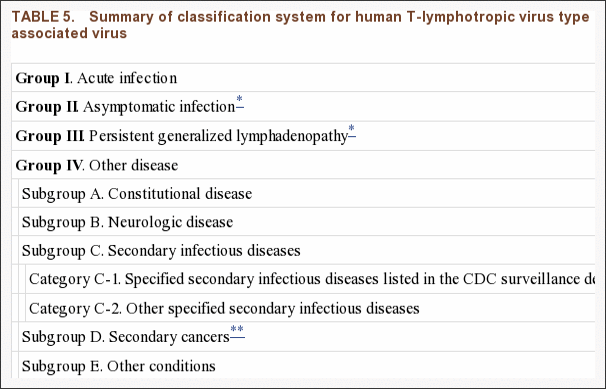
The media began drowning us in information, mainly from the United States. There was the dramatic scenario of ‘Patient 0’, from whom it was assumed the whole epidemic had spread like an out of control monster. The USA and France argued over who had discovered the virus, and made the link between HIV infection and AIDS (watch “Dallas Buyers Club” for an inkling of what this was all about!). A debate raged as scientists tried to decide what to call it and which acronym to use. We had GRID (Gay Related Immune Disease) and HTLV 1 & 2 (Human Transmitted Lymphoma Virus – if memory serves me well). They eventually settled on HIV for initial viral infection, and AIDS for any subsequent illnesses that resulted from the breakdown of the immune system. The original Center for Disease Control (CDC) classification system for the various stages of HIV and AIDS progression was so complicated that you really needed a university degree to be able to decipher them. To make things more manageable they finally settled on four classifications.

Then came ARCs (AIDS Related Conditions) but that was considered politically incorrect, so we settled on OIs (Opportunistic Infections).

The argument over names and classifications wasn’t half as frightening as the reality of the disease itself, which started to hit home in 1985. Official testing began in that year, and is still the earliest date that medicos will accept as a point of diagnosis with HIV. Any date earlier than that is declared to be a ‘self-report’. Like many others, I assumed I was HIV+ long before testing started. Virgin and chaste were not words to be found in my life resume. Sydney’s Albion Street Centre was the first here to begin testing, and it was done very discreetly and anonymously. We all used an assumed first name, and were issued with a number to identify who we were. (In 1996, when I needed to tap into my first HIV test results done at Albion Street, they were still there.) Counseling was atrocious. You were given your HIV+, or HIV- (if you were lucky) status very bluntly, then quickly shunted over to a counsellor before the shock had a chance to set in. You were also told, almost apologetically, that you probably had about two years to live. That was HIV diagnosis circa 1985.

A number of our conservative politicians, and some of our outraged Christian clergy started to say that they wanted us placed in quarantine. It was very specifically a gay disease, according to them, and they truly believed that fencing off the gay areas of Sydney and leaving it to run its course could contain it. These people wondered why we got tested anonymously!

By 1985 people were starting to die. There were no dedicated HIV wards in any of our hospitals, and patients were shuttled between temporary beds in wards and the emergency department. Reports started to filter through of hospital staff wearing contagion suits around patients with HIV. Worse still, meals were being left outside the doors of rooms, and would often be cold by the time the patient managed to get them. Cleaners refused to clean the rooms. There were scares of infection by contact with everything from a toothbrush, to a glass, to cutlery, so patients were offered very disposable forms of hygiene. Even mosquito’s copped some of the blame.

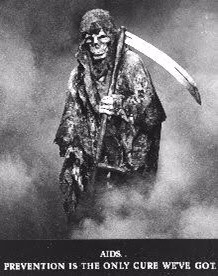
Then, of course, we had the living daylights frightened out of all of us with the “Grim Reaper”television ads. From 1985 to 1995, death lived with us on a daily basis. If you weren’t visiting sick friends, lovers, or partners in hospital, you were visiting them at home, or attending their funerals and wakes. Most of us lost the majority of our friends, and for most of us those friendships have never been replaced.

Around that time, the gay community took charge of what was quickly becoming an out-of-control situation. Tired of seeing friends dying in emergency wards, and getting only the minimum of care at home and in hospitals, we established our own care, support and advocacy groups. Out of the pub culture grew groups as diverse as BGF, CSN, ANKALI, ACON, and PLWHA. Maitraya, the first drop in centre for plwha was founded, and we raised the first quarter of a million dollars through an auction at “The Oxford” Hotel to start to improve ward conditions at St. Vincent’s Hospital. The gay community can forever take great pride in itself for bringing about great changes, not only in the care of plwha, but in the way the disease was handled, both politically and socially..

The Department of Social Security streamlined people with HIV/AIDS through the system and onto Disability Support Pensions, and the Department of Housing introduced a Special Rental Subsidy so that those on a Pension, and unable to wait interminable amounts of time for housing, were able to live in places of their own choice, at greatly subsidised rent. Home care became available through CSN, which, at that time, was not a part of ACON. By 1992, there was a perceived need for improved dental services for HIV patients, especially considering the high incidence of candida. The United Dental Hospital led the way with a HIV Periodontal Study, which at last provided reasonable dental care to plwha.

The first vaccine, p24VLP, was trialled with absolute zero results. There were quite a number of scares with HIV contaminated blood, and screening of blood donors was tightened. Discrimination reared its ugly head in the Eve van Grafhorst case, which forced this poor little girl to not only leave her school because of the hysterical reaction to her HIV infection, but to flee the country with her family.

In 1987, the first therapy for AIDS – azidothymidine (AZT) – was released in the USA, and its use in patients with HIV/AIDS was fast-tracked through the approval process here. In France a huge trial called ‘The Concord Trial’ was conducted – unethically – and its findings were found to be inaccurate. The resulting announcement that AZT was ineffective in the control of HIV, and the drug nothing more than ‘human Rat Sak’, caused a universal outcry. The damage was done. Many had no faith in the new drug at all, and local activists and proponents of alternative therapies tried to encourage people not to use the drug. Many of us chose otherwise. True, the effects of AZT were short-term only – maybe six to twelve months – but many saw it as a way to keep the wolf from the door long enough for some other drugs to come along. And come along they did. AZT was quickly followed by what are referred to as the ‘D’ drugs – d4T, ddi, ddc, and the outsider 3TC. However, these were all drugs from one class called Nucleoside Analogues and all had short effectiveness. Some doctors tried giving them in double combinations, but the effectiveness wasn’t much better. Despite their short life span, these drugs were being prescribed in enormous doses, which resulted in problems such as haematological toxicity, anemia, and peripheral neuropathy. We needed a miracle! Add travel restrictions in many countries, blood transfusion infections, and some babies dying as a result of this and things weren’t looking good!

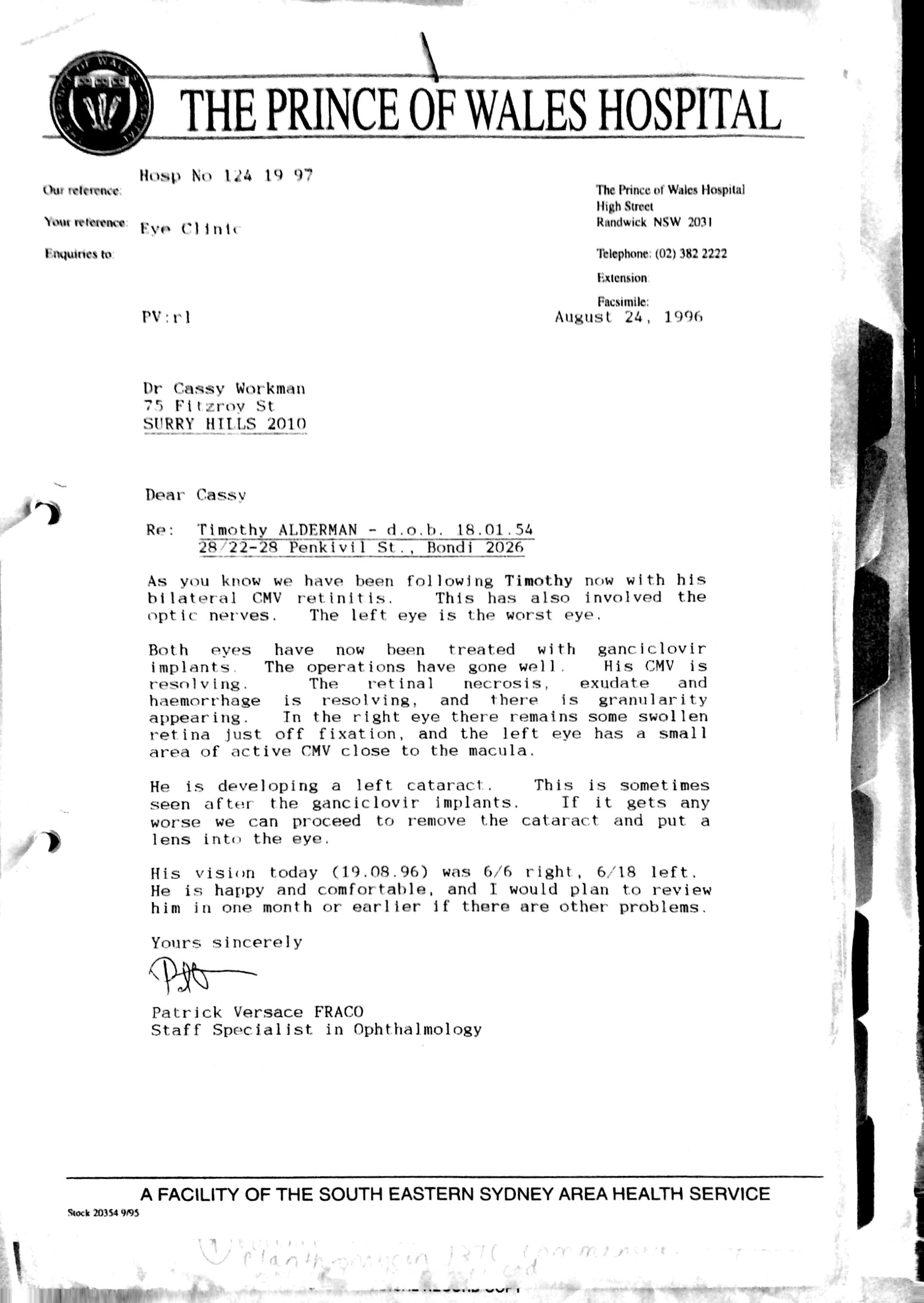
Those of us who had managed to survive to 1996 were starting to give up hope. Most of us were on a pension, had cashed in and spent our superannuation and disability insurance, had a declining health status, and didn’t hold out much hope for a longer survival time. Prophylaxis for illnesses such as PCP, CMV, MAC and candida had helped improve most people’s lives, but they didn’t halt the progress of the virus. The first of the Protease Inhibitors, Saquinavir, was introduced that year, and evidence started to emerge of the effectiveness of combining the two classes of drugs into what came to be known initially as ‘combination therapy’ and later as HAART (Highly Active Antiretroviral Therapy). The results were astounding; those close to dying suddenly found their CD4 counts rising, accompanied by a return to reasonable health. Viral Load testing was introduced and people were finding not just a raising of their CD4 counts, but a drastic lowering of their viral load, often to the point of its being undetectable. This became known amongst doctors as ‘the gold standard’. Ganciclovir Implants to assist with the control of CMV retinitis were trialled the same year, and Albion Street Clinic started a trial using decadurabolane, a steroid, to assist in controlling Wasting Syndrome. The new drug combinations (NNRTI’s – Non-Nucleoside Reverse Transcriptease Inhibitors – a third class of drugs, were introduced shortly after) were not without their complications and problems. Most combinations still required huge quantities of pills to be taken daily, not just of the HAART drugs, but also prophylaxis and drugs to help control side effects such as nausea and diarrhoea. Their use required time and dietary compliance. Other problems such as lipodystrophy, lipoatrophy, and renal problems appeared, but we were, despite any drawbacks, a lot better off than we had been ten years, hell even two years earlier.

People’s health changed drastically, and suddenly new services started to take prominence. Some people required lots of counselling to help them reconnect with the life they thought had been taken from them. Others went to peer support groups or turned to treatment management groups, and some to the larger range of support services being provided by The Luncheon Club, The Positive Living Centre, NorthAIDS and other similar groups. There was recognition that there was a need for services to assist people with an improved health status, as some of them were contemplating returning to work. Despair had, to a large extent, been replaced by hope. Organisations concerned with people’s changing needs reassessed and changed their services to meet the demand. Those that changed have survived, and are still prominent in our community.

The war is far from over. New generations require new strategies, and while everyone seems happy that infection rates for HIV have remained steady in Australia (despite rampaging out of control in Third World countries), many feel it is still not good enough that, at this stage of 37+ years into HIV/AIDS, countries like Australia with high levels of education and accessibility to media and information should be seeing a decline in infections. Remembering my own youth I find it difficult to comment on the attitudes of young people. I grew up through the very worst that HIV/AIDS had to throw at us, and the lessons it taught are not easy to forget. I have to ask myself had I not had that experience, how would I be viewing it? It is no longer just the responsibility of the gay community to guard against new infections. Responsibility also rests with the straight community, and the IDU community, as infection rates remain at their current level. Some scaremongers have ventured forth theories of a ‘third wave’ of infection, but I trust we are too wise, and too educated to allow that sort of irresponsibility to happen.
Many of us (certainly not all) are going on to lead relatively normal lives. Many have returned to work either as volunteers, or in casual, part-time or full-time employment. Many like myself have returned to tertiary education, determined not to leave this world without at least fulfilling some gnawing ambition. However, we are not living in a ‘post-AIDS’ world, and to think so would be foolish. Even if the battles have been won at home, they still need to be fought elsewhere. We still need new drugs, and we still need people to trial both the emerging antiviral and opportunistic infection drugs and the immune-based therapies. We now have a fourth class of drugs in the form of Nucleotide Analogues. Many medical practices have adopted a holistic approach to medicine, and this can be judged to be a direct spin-off from the HIV/AIDS wars. Hopefully, soon please, a new vaccine will appear.

I really don’t know how much longer I will live now. Certainly with the standard of health care I get, and the close monitoring, I may live out whatever my allotted time was to be. Time will be a better judge of that than I will. For me, HIV/AIDS has been a two-edged sword. It has taken good health from me, I have permanent disabilities from AIDS, and I have seen far too many friends, lovers and partners die from this hideous disease. At the same time, it has presented me with opportunities I would never have grasped if it had not come along. I am re-educating myself, taking myself off along strange paths. It has given me a whole new understanding not just of HIV, but of disabilities in general, and a great respect for those who overcome difficulties and recreate their lives.

At a university tutorial last semester, a young woman asked me if I thought every day about having HIV. I don’t! It may have taken thirty five years, but it is now so integrated into my life, that I have trouble remembering the time when I didn’t have it. The pills are just pills now (and thankfully a lot less of them than even 4 years ago), and most of my current medical problems have more to do with ageing than with HIV.

I can tell you, that really gives me something to think about!

Tim Alderman (C © Revised 2017)

The Storyteller

Many have gone before me
Just a few remain.
Stories of hopes and dreams
Of fun and laughter
Bravery and love.
Stories to be told,
Lives that have lived and loved,
Entwined into mine and yours
Inextricably binding us together through time.
Yet I remain.
Am I the storyteller?
Am I the one who remembers
And holds together
All these peoples lives?
Who holds within my heart their love?
Am I the one
Who lives out their dreams?
For indeed dreams they had and held
Before the thread was broken.
Am I he who tells the tales
Of hopes, and bravery
Of fun and laughter
And love?

Tim Alderman
(C) 2013

2015/01/img_2350.jpg

Daily (Or When The Mood Takes Me) Gripe : Let The Sydney Gay Ghetto Go!

Some people just can’t let the past go, or have an inability to see when something has passed it’s use-by date! I have too many friends who keep reiterating that they wish the Sydney gay ghetto was still intact and functioning.

Let’s have a look at the (unspoken) history behind the formation, growth and death of the gay ghetto in Sydney. Historically, Kings Cross and Darlinghurst have always been protective enclaves for the dispossessed, eccentric, minority groups and the unclassifiable citizens of Sydney. Perhaps, initially, because of its foundations in working class and poverty-stricken populations, and later on the underworld, gangsters and prostitution – including transgender – it has always had its roots in notoriety!

In the 70s and early 80s in Sydney, the gay citizens were looking for a space to band together, to avoid the illegalities of being homosexual, and the social stigmatisation that happened at that time as we became more brazen and outspoken about our sexuality. I remember visiting there with a female friend in the 70s – before my own coming out – and the roots of the community were there already with nightclubs and cafes, though homophobic attacks and vitriol were  prevalent as well. It was a wall-less ghetto in the making.

By the time the 80s rolled around, it was firmly established as a gay ghetto, ambling along Oxford St and its immediate environs, from Elizabeth St through to Paddington. The legalising of gay rights in 1982 brought around a boom in the area. The ghetto formed very much as a means for us to squeeze out the undesirables by a sheer force of numbers…and it worked. Any straight troublemaker coming onto our turf would have immediately felt threatened, and though violent attacks did occur, they were rare.

At its height, you could live within the ghetto and never move outside it. We had our nightclubs, pubs, cafes, restaurants, newspapers, magazines, bookstores, supermarkets, small businesses, doctors, dentists, optometrists, saunas, post office, houses, apartment buildings. A night out would involve a meal in a local cafe or restaurant, a visit to your pub of choice – about 9 in its heyday – then off to your nightclub of choice. In the early hours of the morning you could either stagger home via your favourite takeaway, or do a trip to your favourite sauna or backroom without ever being harassed. The ghetto was a security blanket.

During the HIV/AIDS epidemic of the 80s and 90s, it was a true blessing. Once again, you could live as a HIV person within the ghetto and be safe and protected. Within the boundaries of the ghetto were established our hospital and hospice care, our HIV/AIDS specialists and GP practices, our support groups such as ACON (AIDS Council of NSW), BGF (Bobby Goldsmith Foundation), CSN (Community support Network), ANKALI (emotional support), and the Positive Living Centres, as well as our advocacy groups such as PLWHA (People Living With HIV/AIDS), NAPWA (National Association of People with AIDS), our funeral directors, our church. We did our own fund-raising, and we supported each other through our pain and sorrow. Once again, it was a safety zone where the emaciated frames of those luving with AIDS could wonder without fear of derogatory remarks, hatred and harassment. In that zone we mourned, held our wakes, and looked for material and emotional support. Those religious groups such as the Festival of Light, who preached and promoted hatred towards us learnt the hard way about the strength and communication within the ghetto.

Fred Nile’s Cleansing March in the80s was a good example. Thinking his band of supporters would march unchallenged up Oxford St, he and they were in for a rude shock! From early in the morning on the day of the march, protestors, the gay community and its supporters started lining the length of the march. By the time the Rev Fred – with his cross-on-wheels – started marching up there, the footpaths, awnings and buildings along the route were packed to capacity with his detractors! The march, from his prospective, was an overwhelming humiliation, and failure! I remember seeing a car full of Tiwi Islanders who had evidently not been warned about how unpopular their beloved reverend was. They looked terrified for their very lives, overwhelmed as they were by the booing and vitriol of the massed ghettoites. I actually felt sorry for them!

However, in the midst of all this, other changes were taking place that were to instigate the downfall of the gay ghetto. Anti-discrimination laws came into play and all-male/female venues became – temporarily – illegal. Nightclubs like the Midnight Shift had to start letting women in, and once they started bringing their boyfriends and other straight male friends, the ambience of the clubs changed forever! And not in a good way! Many ghettoites who had been in the centre of the HIV/AIDS bonfire scattered to other states or to the far north of NSW. Indeed, by the time highly effective HIV antiretroviral regimes started in 1996, it was very much a decimated community, though the epidemic itself had moved on to the straight community, to drug-users and those that had the double-whammy of HIV and hepatitis. The myth of the “gay plague” was laid to rest for good!

But perhaps the greatest enemies of the ghetto was generational changes, social acceptance, and a movement away from the boundaries of the ghetto, a realisation the we no longer needed the safety and protection of the ghetto to live our lives. We dispersed to Newtown, Enmore, Erskinville, Camperdown, Leichhardt, Annandale, Alexandria, Pyrmont, Zetland, Moore Park, Surry Hills, Redfern and Summer Hill. We transformed areas into “Trendy” and moved away, in our hordes, from Oxford St. Yet, some pieces of our lives remained there – a few pubs and nightclubs, a few medical practices, but all-in-all, we moved on.

Darlinghurst and much of Paddington are now mere shadows of their former selves. A stroll down Oxford St now will reveal dozens of empty businesses, and those that do remain struggle for customers during the day. The nightclubs and pubs are now the enclaves of straight people, and a general feeling of desolation, violence, uncomfortable vibes, and unrest permeates the air. It is now, once again, a place where unsolicited violence can occur irrespective of your sexuality.

So the ghetto has outlived its usefulness, and is, to all intended purposes, dead! I can understand nostalgia, even fleeting yearnings. What I don’t get is an inability to accept the ravages of time, the changing dynamics of an area, the growth and development of populations, indeed diaspora! To those who wear blinkers, want the past to live on, the “good old days” to be a mantra for days gone by, I say…let it go! Enjoy the memories, but don’t wish for them to return. To deny yourself the insights of living in the “now” is to root yourself in a past that can never be repeated. Allow the ghetto to be swallowed by history, to takes its place in our memories as somewhere that we lived and enjoyed IN ITS TIME…and leave it there! Never let your yearning for the past, cause you to overlook the reality of now.

Tim Alderman
(C) 2015

/home/wpcom/public_html/wp-content/blogs.dir/9c0/31345085/files/2015/01/img_2169.jpg

An Outsiders Overview of the HIV “Industry”

This year marks, for me, 33 years of living with HIV/AIDS…though now it is just HIV. I consider it a landmark, as back in 1996 I was admitted to Prince Henry hospital with chronic CMV retinitis, chronic candida, chronic anaemia, wasting syndrome (48 kg and going down), 10 CD 4 cells, and no immune system, and was not supposed to leave…at least not under my own steam. I did, thanks to advances in medications at that time, very aggressive treatment and a lot of will power. I don’t give a fuck how negative many HIV+ guys are about life with HIV. For me, this was the great singular event of my life, a pivotal point that resulted in life-altering decisions, a mental overhaul, and the knowledge that there was a hell of a lot more to life than HIV. It altered the course of my life, and for better or worse I have never looked back.

I was a speaker for the Positive Speakers Bureau for 12 years before realising that when you continually tell a story you start doing it by rote. The time came to opt out before it becomes totally meaningless. I have also written for “Talkabout” magazine (the flag ship publication of Positive Life NSW – formally PLWHA NSW Inc) for 15 years, as a features writer and a columnist. I also spent many years on the Publications Working Group. As a writer I see my role as not only to inform people, but to provoke debate, at times to be opinionated, to raise questions, to address abuses and unfairness and to be, when required, controversial. Unfortunately, my time with “Talkabout” taught me that to get published in a HIV publication you need to walk the safe road. To be controversial is to be tolling your own death knell. Mind you, this censorship has nothing to do with the editors who, in my experience, have been nothing but supportive. Community Health and a certain AIDS council provide funding to the magazine, so to poke your nose into sensitive areas will ensure your censure and non-publication.

As a HIV+ person writing about HIV issues I have always found my hands tied. I have written two extremely controversial articles on HIV Issues over the years. One, on Options Employment Services using HIV clients as a free work force in the guise of “work experience” was so watered down after threats of suing PLWHA, the editor and myself (I truly wish they had) that by the time of publication was a mere shadow of its original fiery tirade…despite the fact that I had evidence of this going on.The manager even took me aside and “suggested” that I quieten down my opinions as they were providing a service to the HIV community. Shortly after, they went broke and disappeared. The second article was amongst the best pieces I have ever written, and covered the controversial area of bug-chasing (HIV- guys who deliberately have unprotected sex with HIV+ guys in the hope of contracting HIV). The magazines working group deemed that by writing about bug-chasing I may have been promoting it amongst a certain sector of the community. Considering that the practice is well documented, is acknowledged and exists I failed to see how being informative about it was in any way promoting it…oh shit! I forgot that community health and certain HIV organisations wanted to keep their heads buried in the sand about the issue…and they held the purse-strings. Censorship is alive and well within the HIV community and always has been. Want to tell the truth about what is going on or want to expose something? Not on their watch!

But despite this I continue to write, though I keep it to the more nondescript these days. I do enjoy being published! Since moving to Brisbane I have been phasing out my writing for “Talkabout” (which after 15 years of being published in pretty well every issue, has gone unacknowledged by the organisation itself, though not by the editors), and have started writing for QPP “Alive”, the magazine of Queensland Positive People. Same story, different place as far as funding goes, I’m afraid. Nothing controversial will be coming out of here either.

33 years ago at the start of the HIV shit fight, people never questioned anything about treatments, definitions, philosophies, or courses-of-action. We were in crisis mode and anything was better than nothing. We let a lot happen that in more sane times, in more accountable times, would never have been allowed to happen. This far down the line it is time to start asking questions, time to demand investigations and redefinition into many aspects of treatment, time to look back at some of the historical record and say “we were wrong”, and set the record straight. I no longer allow my doctor, or the HIV establishment, or the drug companies to dictate my path to health for me. I follow my own path, which is dictated to by knowledge and experience. 11 years ago I made a decision to halve my daily medications, and dose myself once a day only. Considering the negative impacts of huge amounts of HIV medication on the body I decided to take a risk. Well, this far down the line my health has never been better (though diet and exercise also contribute to that), my viral load has remained at undetectable, and not only has my CD4 count remained stable, it has in fact risen considerably. In fact, on my blood tests all other readings – except CD4/CD8 – are within range. Considering the recent emphasis on drug regime “compliance”, and considering my own circumstances, I am forced to ask – controversially, naturally – if the compliance issue is being driven by HIV specialists, or by the drug companies who stand to make a fortune out of HIV drugs. I will leave that question in the air for you to mull over and answer for yourself. This is a personal opinion, and one I am entitled to.

With the release of the brilliant “Dallas Buyers Club” the truth about AZT is finally out there. Pressured by my doctor to go on it in the latter part of the 80s, it is the one decision of my HIV care that I regret. I had read the report from the “Concorde” study in France, I knew it was described as “Human Ratsac”, yet I still finally gave in, and witnessed the immediate decline of my health as it bashed my immune system into submission. Needless to say, the long-term affects are disabling, and were not worth the risk. I still hear those who work in the HIV “Industry” – as indeed it was and still is – banging on about how it kept the wolf from the door – it didn’t! It poisoned and destroyed our immune systems, and left us vulnerable to opportunistic infection! It effectively killed many of us. As a drug to assist with maintaining CD4 counts it was a total and complete failure! And I am not the only one to say so! Ask any one who survived AIDS their opinion on AZT! Minor control of HIV did not start AZT situation. How the FDA in America handled the AZT situation and allowed wed the drug companies to dictate treatment options, block other drugs put out by rival companies, and chose to ignore or acknowledge research from overseas was a disgrace.

Even now in 2014 ignorance lives on. I continually hear, read and see HIV being described as AIDS! It is NOT AIDS – it Is HIV or HIV+! For fuck sake get your facts right! HIV is a viral infection, and AIDS are as the initials infer – Acquired IMMUNE Deficiency Syndrome! They are infections contracted by a breakdown of the immune system! The two do not necessarily go hand in hand, and you can have one without having the other. People undergoing aggressive cancer treatments which knock the immune system around are left vulnerable to the same infections triggered by AIDS in the plague years. Drug addicts also.

There are – and I am not being unkind nor ungrateful – those who have worked in the HIV Industry for too long. They are burnt out, and out of touch. If you only wander in HIV circles, you will only know that singular perspective. These people are indoctrinated, lacking in vision, and single-minded in their approaches to HIV and its management. They are blinkered, and only ever spiel forth statistics and the same information that we have heard for the last 30-odd years. They seem incapable of acknowledging different perspectives, new ideas, or revisiting and re-evaluating the old philosophies and education. Without an insurgence of new blood, HIV is in danger of stagnating and just at a dead end. Their current publicity of “Ending HIV” is a fantasy, and they know it. As long as HIV is in Africa, and in countries like Russia and China where education is almost non-existent or played down, HIV will never end. Empty words to seem to appear to be doing something, is just a waste of money. The HIV Industry seems to be very good at this. Always about 2-years behind actual need – just look at the employment needs of AIDS survivors in 1997/98 – when services were introduced they were way off course. You can only have so many programs that teach you how to write a resume, or attend an employment interview. Every single return-to-work session I went to do talks at had the same people in them. They just moved from one group to another, never putting the teaching into action. Where was the advice for people who wanted to be re-educated, or start a business, or upgrade a hobby,or buy into a franchise? It was non-existent. These people were the ones who fell through the cracks for lack of support and services. This has always been an ongoing problem. Naturally, the lack of funding is always blamed – though enough money to pay huge salaries – when really it is a lack of foresight, and imagination. Of course, everything is now wrapped up under the umbrella of Community Health, so any hope of imaginative thinking is now out the window. Those who hold the purse-strings control everything. It is a sad state of affairs. Groups like “Positive Life” no longer acknowledge their roots, nor do they move in the directions set down by the original founders. They are out of touch with their memberships, are indeed losing them. In the race to save money they are dropping resources that keep everyone active within the group. Even Positive Speakers Bureau inductees are now told what to talk about, and bang on about the same old messages and sprout the same old statistics. The trouble is…no one gets sick any more, so there is nothing to talk about for an hour. Perhaps it has outlived its use.

If one has to be totally frank, service delivery, information and services are no better now than they were 20 years ago! In many cases, they are worse. One friend of mine complains of the lack if easy access to HIV meds, and he has to spend a lot of time travelling to obtain them. He also comments on how he and his partner feel isolated and-reclusive due to no social groups to mingle with, and the constant heed to continually go through your medical record every time you change providers. Pretty sad state of affairs considering he only lives in Canberra.

Being my 33rd anniversary of life with HIV, and with World AIDS Day approaching I have written a personal retrospective of that period hopefully for publication around that time. It is 2,500 words long…not a lot of words for 33 years. If you are interested, follow the link. Not quite as controversial as this!

Getting On With It! A 33-Year Retrospective of Life with HIV/AIDS

For information on the Concorde Trial – http://aidsinfo.nih.gov/news/5/concorde-trial
Tim Alderman
(C) 2014

IMG_0682.JPG

Have I Missed the Joke?

This article was written in 2001, but the sad thing is that HIV quackery, cons and bogus inventions are still going on. There is no end to the lengths some low-life’s will go to to make money, and it is not just the HIV community they target. This is a few of the rorts going on back when this was written.

Type the query “HIV/AIDS+hoaxes” into the Yahoo search engine and see what comes back. You may be surprised to find that it will come back with 187 matches, and that is just for HIV/AIDS.

To follow all these links, or only to select a couple for investigation takes you into another world. You can look into fraud on a one-to-one basis by people who are simply unscrupulous, treatments and therapies that are on the verge of frightening, an underground antiretroviral drug trade, suspect complementary therapies, internet and email chain letter HIV/AIDS hoaxes, and urban myths.

The home page of the ‘Texas AIDS Health Fraud Information Network’ (TAHFIN(1)simply states that “The HIV epidemic has created business opportunities for many people. In many cases, people and companies pursue these opportunities with the sincere intention of helping while staying within the bounds of the law and maintaining fiscal integrity. The same motives can sometimes lead to harm even with the best of intentions. In some cases, the motive is to simply make a buck regardless of the consequences to those affected. The latter is what opens the door to fraud.” The Quackwatch site expands this further by saying that “The fact that HIV causes great suffering and is deadly has encouraged the marketing of hundreds of unproven remedies to AIDS victims. In addition, many companies in the ‘health food’ industry have produced concoctions claimed to ‘strengthen the immune system’ of healthy persons…many of the expert quacks in arthritis, cancer and heart disease have now shifted into AIDS” and that “…every quack remedy seems to have been converted into an AIDS treatment.”(2)

To explore all these areas, and the much vaunted question of ‘Does HIV cause AIDS?” debated on sites such as ‘Nexus’(3), ‘Is AIDS man-made?’ and the hoax of a new air-borne strain of HIV would require a lot more than the word allotment for this article.

The ‘cures’ observed on the Quackwatch site have included processed blue-green algae (pond scum), BHT (an antioxidant used as a food preservative), pills derived from mice given the AIDS virus, herbal capsules, bottles of “T-cells,” and thumping on the thymus gland. There is also Autohemotherapy – a worthless procedure in which a sample of the patient’s blood is withdrawn, exposed to hydrogen peroxide and then replaced. Add to this the entrepreneurs who have marketed covers for public toilets and telephone receivers with claims that this will prevent you from contracting the AIDS virus, and you have some idea of exactly what to expect.

Over at the “Educate-Yourself”(4) site, you will find yourself in for a real education. There are articles on ‘low voltage electricity’ to make HIV inactive. Dr Bob Beck designed the blood electrifier. The site claims to have seen laboratory reports and Institutional Review Board studies that seem to clearly support claims made by Dr Bob Beck that his blood electrification device has caused ‘complete spontaneous remission’ in literally thousands of AIDS patients, cancer patients, and chronic fatigue sufferers, to name just a few. There appears to be a lot of ‘claims’ and no documentation to support them. The two methods used to treat AIDS patients consist of either removing a small amount of blood, electrifying it then returning it to the body, or sewing a miniature electrifying power supply along with two tiny electrodes directly into the lumen of an artery. The small unit had to be moved every 30-45 days, as scar tissue and calcification occurred around the implant unit, and could lead to artery blockage. The site also reports that hundreds of HIV sero-positive patients have been converted to HIV sero-negative with the use of ‘Ozone Therapy’. “Help is available to AIDS patients right now but the medical establishment is ignoring it” the site informs us. It does state, however, that ‘no evidence for the claims exists in RELIABLE scientific literature.

On December 22, 2000 the FDA(5) issued a safety alert on unapproved ‘Goat Serum Treatment” for HIV/AIDS. This unapproved product, produced in goats as an antiserum against HIV/AIDS, was already the subject of a ‘clinical hold’ by FDA, prohibiting its use until previously existing safety questions are resolved. (Since researching this article, this hold has now been lifted, and the Goat Serum Treatment is undergoing clinical trials).

In 1999, the FTC (Federal Trade Commission)(6) issued a warning about bogus Home-Use Test Kits for HIV. The kits were advertised and sold on the Internet for self-diagnosis at home. The kits showed a negative result even when testing a positive sample. The kits could give someone who was actually HIV+ a false impression that he/she was not infected. Some of the ads stated that the World Health Organisation and the FDA had approved the kits for use.

As far as AIDS urban legends go, the one about ‘AIDS Mary’(7) is probably the most famous. The legend is that the morning after a one-night fling, a man walks into his bathroom and finds the words ‘WELCOME TO THE WORLD OF AIDS’ scrawled on the mirror in lipstick. The legend is also known as ‘AIDS Harry’ (obviously depending on who is telling the story), and it was begun back in 1986, and basically expressed the fears surrounding HIV/AIDS at the time. This legend was actually used as a defense in a criminal trial in 19908. Jeffrey Hengehold murdered Linda Hoberg after sleeping with her, then being told by her that she had AIDS. There was no evidence to support the allegation, as Hoberg had been cremated, and Hengehold had never tested positive. In a similar vein, a 1998 Internet urban legend stated that AIDS-infected blood is being injected into unsuspecting moviegoers and young people dancing in bars or at raves(9). Somebody’s (no name mentioned) co-worker went to sit in a seat at the cinema, felt a prick and found a needle poking up out of the chair with a note on it saying “Welcome to the real world, you’re HIV POSITIVE”. “It’s all false,” said Sgt.Jim Chandler, a Dallas police spokesman. “This has not happened, and we would ask people to stop forwarding this message to their friends because it’s creating situations where police departments and emergency personnel are having to respond to inquiries about this hoax.”(10) Other reports of needle sticks at bars and raves were investigated, and found to be false.

Even the seemingly innocuous world of email communication has not been spared its share of AIDS hoaxes. On the 7th December 1995, the following email chain-letter was sent to J.Beda(11) by several of his acquaintances. It had an email address at SYR.EDU, and in the SUBJECT: aids.
>For a class project, I was wondering if this could be passed on to prove
>a point. In my human sex class, we learned that if somebody has received
>the HIV disease, and they don’t know about it, they could pass it onto
>people who they don’t even know.
> Could you all pretend that I have HIV, and I gave it to you.
>Then could you pass it onto your friends? Let’s see if the entire
>email population could get infected by me alone.
> Please remember that this is a lab experiment. I have to say that I am not intending to offend any one in any way.
> By the way, don’t erase this or the forwards from your computer.
>
>Thank you
>Young Bradley
People pointed out the parallels between receiving this sort of email and having nonconsentual, unprotected sex with a knowingly infected partner. This is commonly known as rape, and potentially as murder. The recipient pointed out to the sender some of the faults of the project, not the least of which is that chain-letters are a BAD THING no matter what the cause. The project also had problems with its implementation in other areas. It never ends. When is the school project finished? It contains no instructions on where to look for more information. It contains nothing indicating who was responsible, or who to contact if there are problems. It does not offer any education on HIV/AIDS. Apart from anything else, sending out this sort of email is against the terms of service of every computer system ISP.
Generally, emails of this type take one of two forms: those that promise/threaten good/bad luck, and illegal pyramid-scheme letters that promise to make you lots of money.

The most recent scam is one to come out of Thailand, and notified to all TAHFIN(12) subscribers on 27th August 2001. It tells of 5,000 HIV-stricken people sitting a soccer stadium for several hours to collect a drug called V-1, a supposed cure for HIV/AIDS. Unlike conventional HIV/AIDS cures, it works on the digestive system instead of within the blood stream. The apparent food supplement is distributed free. There are a reported 755,000 AIDS patients in Thailand, which is one of the major reasons the scam has managed to succeed in a country where the average earnings are $2,000 per annum. Distributors are touting the cure as ‘an oral vaccine’. The Thai Ministry of Public Health tested the drug on 50 people, and found it to have no effect whatsoever, positive or negative. V-1s creators rebuffed Ministry officials who requested the drug be tested by the CDC in the USA. It is feared that soon V-1 will be marketed in other emerging nations who are being overwhelmed by AIDS, and have few resources. It is felt that if governments are put under pressure by the mass-hysteria these sorts of cures create, they will just allow nothing to be done to halt the distribution. Salag Bannag, the distributor of the little pink pill claims that over 100,000 people will have received the drug by the end of this year.

Now, we haven’t touched Low Frequency Sound, Induced Remission Therapy, Colloidal Silver, Bio-Engineering, T-Up or a plethora of other products available on the internet, and through quacks masquerading as practitioners. This article is not attempting to stop people trying alternative therapies. What it is saying is please be careful! Do not part with your precious money for anything unless you have investigated any claims thoroughly. Don’t be taken for a sucker. In Australia, any drug or item that is promoted for use by the general public must not only contain details about what the product actually does, but also what side-effects it can cause. The most blatant element of a lot of the products that are advertised on the Internet is that they only state the positive effects of the drug or devise, and that no side-effects are reported. This sort of situation should automatically make you think twice about the efficacy of a product.

In an attempt to tighten up legislation, and make people aware of their responsibilities when promoting drugs or gadgets, in 1998 the FDA proposed to issue new regulations pertaining to the dissemination of information on unapproved uses for marketed drugs, including biologics, and devices.

Of cause, this only becomes relevant if you are caught!

Tim Alderman
Copyright ©2001

1 http://www.tahfin.org
2 http://www.quackwatch.com
3 http://www.nexusmagazine.com
4 http://www.educate-yourself.org
5 http://www.fda.gov
6 http://www.ftc.gov
7 http://www.snopes.com/horrors/madmen/aidsmary.htm
8 Ibidem
9 Ibidem
10 Ibidem
11 http://pobox.com/~j-beda/chain-letter.htm
12 http://www.tahfin.org

IMG_9569.JPG

Functionally Dysfunctional – The Storyteller Part 2

If tears could pay our debts
If with our tears we could buy you an indulgence from all pain
If by weeping now we could do all your weeping for you
Then we would cry until our eyes were washed away

Excerpt from Wilbur Smith novel

For World AIDS Day 2003 I wrote a piece titled “The Storyteller – Stories Almost Lost In Time”.It was a synopsis of the lives of three close friends who had died from AIDS before successful treatments – as we know them now.

As someone who is accustomed to writing – in fact have a university degree in it – I find that writing flows quickly and naturally from the smallest of seeds. I have to admit that writing “The Storyteller” was one of the two toughest pieces of writing I have ever done. It took me a month to nut together 750 words, a month of anguish and more tears than I have cried for some time. It was an emotionally difficult piece to write. It was hard enough trying to decide whose lives to use for my stories, let alone revisiting photos and eulogies.. The prologue to the piece came easily, but I delayed the writing about Andrew, Stuart and Geoff for as long as possible. It made me realize just how unreconciled to their deaths I actually was, that despite everything that had gone on over the twenty seven years since the deaths started, I had never really allowed myself a period of mourning – not just for them but for all the people I knew during that period who had passed on. The unfolding of the AIDS Quilt had, for many years, served as an outlet for grief during this intense time, a way to ‘get it out of your system’, but that doesn’t happen anymore, so I store the grief, hide it away in a dark corner where it sort of sits and mocks me. The writing of “The Storyteller” was almost like a venting of 20 years of grief. I can’t go back and read it, despite being its author. It hurts too much, and I end up crying – yet again!

What I found very empowering from the experience of writing that story was the reaction of people to it. It was almost like giving people permission to grieve, almost like telling them “It’s okay to cry even now, it’s okay to relive these people’s memories, it’s okay to tell their stories”. Some found the article profoundly beautiful, some used it as a way to communicate to partners and friends exactly how that period of HIV had affected their lives. Some, like my partner David didn’t even know the people in the stories yet related so strongly to it through his own experience that he could not read past the first story. Others said they wished I had warned them I was going to do it. It cut deep, it opened wounds not just for them but also for me. I wish I could have written about every single person I knew over that time who had died, but articles do have their limitations.

In fact, the writing of this piece and a piece I did in university for an assignment in personal writing made me aware of my own mental and emotional toughness, my own ability to cope with intense grief by just cutting myself off emotionally and putting up a wall to block it out. Of course, these things always creep up on you in the dead of night, but there is never anyone to witness that vivid flash of memory, that tear that hides behind the eye, to catch you in a moment of weakness.
My capacity to block out these things is, in many regards, a product of my upbringing, and the experiences of life in my younger days.

Like many of my generation I was raised in the dysfunctionality of families recovering from the effects of World War II. My parents – let’s call them Joe and Betty, as mum and dad are now alien words – raised me in the conservative ways of parents of that period, in the idyllic environment – at least at that time – of Sylvania. Lots of skeletons rattling around in Sylvania, I can assure you! Joe never came to terms with the post-war period of the 50’s and 60’s, and despite a thin veneer of normality in our household, as I grew older I realized all wasn’t as it appeared. I had a younger brother, Kevin. He was to be the subject of a university assignment 40 years after his death.

When I was 11, Betty up and left. No word of warning, no hint of departure. There in the morning making breakfast, gone when Kevin and I arrived home from school. Within several months of her going, Joe bought his mistress into the house under the guise of a housekeeper – we must retain a respectable appearance, despite anything that was happening. Joe had a seriously bad temper, and both Kevin and I experienced his wrath with a strap huddled in a corner. The housekeeper – herein referred to as the bitch from hell – hated Kevin and I almost as much as we hated her. Kevin was five years younger than me and suffered from ADHD. This was enough for the bitch from hell to make him her direct target, and she made his life a total misery. There was little I could do to protect him. Her vengeance for taking her on was to go to Joe with exaggerated stories of misdemeanors, and as we knew – punishment for transgressions was severe. She finally pushed too far, and on the evening of the 8th December 1965 Joe took Kevin out to The Gap at Watson’s Bay and jumped over with him in his arms. Joe survived. Kevin’s body was found two days later floating towards the sea near Broken Bay.

From that day to the time of my university assignment 40 years later this subject was never discussed within my family or otherwise. It was like it never happened. Joe got off on a plea of manslaughter. I had to live with him for another 10 years, but any vestige of trust or feeling had been destroyed.that December night. I never trusted him again, and always guarded what I said, and how much I let him know about my life. I closed off. I became hard. This affected my life for a long time after, and gave me the capacity to survive. The bitch from hell never shed a tear or displayed any emotion regarding Kevin’s death. It was as though he had never existed. By the time we left Sylvania at the end of 1966 we had changed the family name. The bitch from hell had managed to alienate us from all our friends and neighbours, even our direct family. Joe committed suicide in 1978. I shed the obligatory tears and moved on. I’ve never forgiven him, and I never will.

Writing the university assignment in 2003 opened a whole Pandora’s Box for me. I had never investigated Kevin’s death, had never wanted to revisit the wound. However, in June 2000 “Sunday Life” magazine ran an article on The Gap, and the bones in the closet rattled very loudly. Among the synopsis of sad events that surround The Gap was a brief entry for 1965 – “Frederick Pickhills of Sylvania, tells Vaucluse police, “I have been over the gap with my son. I had hold of his hand.” Pickhills was charged with the murder of Kevin Pickhills, 7. Pleading guilty in court to an emended plea of manslaughter, Pickhills was released on a five-year good behaviour bond.” (NB there have been two name changes in the family over time. One to Phillips, which was initiated by Joe so his past wouldn’t follow him, and the second to Alderman by me so that my family could never track me down after the fiasco they called a funeral). For the assignment I scanned all the papers from the time – my tutor was quite concerned about the emotional impact of following up such a closeted and traumatic event – and pieced together a nightmare I had all but blocked from my memory. It was almost a feeling of freedom to finally piece it all together, and lay the bones to rest.

After Joe died, I came out. I was 25, a very later bloomer. I came out with a bang, not a whimper. I had always wondered what Joe would have done if I had told him I was gay, and sort of knew that it wouldn’t have had a good outcome. I may have left it late, but at least it was safe. I reunited with my mother. We communicated for 19 years until 1997, when I finally severed the threads of what turned out to be a futile attempt to try to reconcile some sort of relationship with her. It was never destined to be. Another set of bones laid to rest.

What I wasn’t to know when I came out was that my life as a gay man, and my life as a HIV+ man were going to run in a parallel line, were going to be intrinsically tied together. So this was what the hardening, the hiding away of all emotions had prepared me for. It proved handy I have to say. Always a strong shoulder to lean on at funerals, and to cry on at wakes. I sort of prided myself on this toughness, on this capacity to turn off. But I payed in other ways, as I found out when I wrote “The Storyteller”.

Not only have I given other people permission to grieve, I’ve given myself permission to grieve, to flush out 20 years of pent up emotion and sorrow. But not just that either – I’ve finally given myself permission to grieve for many things. I have finally relaxed the hardness, finally given in to the emotions. I’ve already ruined enough relationships with my inability to give – though mind you, it wasn’t always just me – and when I met David after a 18 month break from the gay scene due to recovering from AIDS I was at a point where I realized I needed to rely on other people, and I needed to give. I needed support, I needed to love and I needed to share. This is the relationship that is making up for all the shit. This is totally open but very secure ground for me. No more secrets, no more closet rattling skeletons from the past. I’m not quite sure if my experiences have made me functionally dysfunctional, or dysfunctionally functional. Whatever the answer, I’m now taking better care of myself emotionally, allowing these feelings to spill out rather than bottling them away, or pretending they didn’t happen. When I get to write my families story, its going to be a hell of an account.

So light a candle at home for all your lost loved ones on World AIDS Day, and tell their stories. And cry! And grieve! You have permission to perform this act of love and remembrance. After all, we don’t want them forgotten. They deserve better than that.

There is the full story of my brothers death, in all its frightening facts, at the end of my blog, titled “Kevin Pickhills – The Unspoken Name” should you be interested.

Tim Alderman
Copyright 2013

Hand writing storytelling

Epiphany

“No one wants to die. Even people who want to go to heaven don’t want to die to get there. And yet death is the destination we all share. No one has ever escaped it. And that is as it should be, because Death is very likely the single best invention of Life. It is Life’s change agent. It clears out the old to make way for the new. Right now the new is you, but someday not too long from now, you will gradually become the old and be cleared away. Sorry to be so dramatic, but it is quite true.


Your time is limited, so don’t waste it living someone else’s life. Don’t be trapped by dogma — which is living with the results of other people’s thinking. Don’t let the noise of others’ opinions drown out your own inner vonice. And most important, have the courage to follow your heart and intuition. They somehow already know what you truly want to become. Everything else is secondary.”

Extract from Steve Jobs’ Commencement address, Stanford University, June 14 2005

In June 1996 I was admitted to Prince Henry Hospital. I weighed in at 48kg, had 10 CD4’s, chronic anaemia, chronic candida and chronic CMV retinitus. Prognosis was not good, and I truly never expected to walk out of the hospital. In fact, it was thought that I would not last longer than about 2 weeks, especially with the CMV diagnosis, which was a very serious problem, and as I knew only too well, a very unpleasant way to die.

I think what surprised me the most was how calm I was about the whole situation. There was no panic, no despair. Just an acceptance that this was the way it was, and there was little I could do to change it. There was a certain inevitability about it, a knowledge that I had already beaten the odds to get this far with no serious illnesses, and it was just “my turn”. In some respects I had begun thinking that things were starting to get very lonely anyway, with so many I knew already dead, and still more to die before things started to get better. It was a time of reflection, introspection and recollection that was in its own way very calming, and I think I found a certain strength within myself that I wasn’t expecting to find, and a set of beliefs that have stayed with me since.

I underestimated modern medicine. This was a time of miracles! Intensive and aggressive treatment for the problems I had – gancyclovir injections into the eyes to halt the CMV, blood transfusions for the anemia and very aggressive dosing with the then new protease inhibitor class of drugs as part of my new combination. Miracles did indeed happen! Two weeks later, though still very thin and very weak, I walked (sort of) out of Prince Henry, and very much into a new life. And the new life was not what myself, nor anyone else, may have expected it to be.

I guess one would expect that after a close brush with death that one would undergo a huge epiphany, a movement towards God, many humble and pliant prayers (and much rattling of rosary beads) to the Power’s-That-Be to thank them for this great deliverance, and to invoke them through bible-bashing, church-going and good deeds to show Them that I was moving myself into a world of piety and religious zeal unequaled since Martin Luther or the Spanish Inquisition. Nah! None of that happened. There was no great enlightenment, no being filled with the Spirit and babbling in tongues. No overwhelming desire to drag myself into the confessional and plead for forgiveness for my sins (whatever they might be) and do 200 Hail Mary’s as penance, nor a need to robe myself in sack-cloth and ashes and disappear into a Cistercian Monastery for the remainder of my life. Was I even disappointed that this didn’t happen? Not really! I was too busy getting my health (and my weight – thanks to decadurabalin) back together and trying to work out what one was supposed to do, when one didn’t die as expected, to worry too much about the spiritual mine-field that I may have been in, but wasn’t. Get my drift!

In fact, with the exception of one (who surprised me, I must say), no one I knew gravitated towards religion as they lay in hospital, or closer to the moment in a hospice. No one! Nought! Zero! Well, except for the one! So did this (or should it) have made me wonder about my own mortality, or about the spiritual desert that I should supposedly have been in? Nah! That didn’t happen either. So exactly what is it that I felt about the great mystery that we call life, what is above and below us – and does it really matter at all? If you are broad-minded, read on. If not, stop here.

Now, before I go into details about my own religious upbringing, it may interest you to know that I come from a background of Yorkshire Wesleyan Baptists. Yes, that came as a shock to me too. In fact one of my first cousins, twice removed up, was the Reverend Alfred Pickles. Alfie (this far down the line I feel I can be familiar) appeared in the 1861 UK census as a watchmaker, then lo and behold 10 years later in the 1871 census he is suddenly a Baptist minister. He preached his way around Rochdale in Lancashire for a while until being made Pastor of North End Baptist Chapel in Towcester, Nothamptonshire frpm 1880 to 1891. It appears that a dwindling congregation forced his resignation, and he and his wife and brood ended up at Dallington in Northhamptonshire as a hatter and hosier. My, how the mighty fall.

I was raised in a household of mixed religion, with my father being Catholic (non-practising), and my mother a Methodist (or Presbyterian or something or other, also non-practising) and religion was something that was never discussed in any shape or form at home. The great wonder to me is why they felt the need to baptise me in the Congregational Church (talk about confusing the issue) at Sylvania. Perhaps, being the newbies in an already close knit commnity, they felt the need to fit in. The fact that we were surrounded on all sides by Congregationals may have had something to do with it (and it is, after all WASP territory), as our neighbours over the road ended up being my Godparents. They were Godly people, but thankfully not preachy so I guess religion was sort of left up to me to work out for myself. I did attend Sunday School, but saw it more as a way to collect scripture cards (“I’ve got more than you”) than to live by the precepts printed on them, and it was a good way to get to blow out birthday candles on the plaster cake used for such occasions even when it wasn’t your birthday (I plead guilty to relieving my boredom one Sunday by saying it was my birthday when it wasn’t – then packing shit that my parents may have found out – or even worse, that one of the other kids may have told his parents it was my “wasn’t” birthday and they would embarrass me by wishing me happy birthday. It caused quite a quandry! I never did it again). I was then sent to a Catholic boarding college at Campbelltown. Now for a while this did induce in me great piety and religious zeal (not to mention the first time I was groped by another guy, even if it was in the swimming pool), as like many other new converts to Catholicism I got caught up in all the rigmorole, ritual and razzamattaz that this religion inspires. What sort of budding gay boy can’t get caught up in all the shiney vestments, the candlelabra, the incense, the sprinkling of holy water, and devotion to Mary and all the saints (well, until they decided that some of them were fairy tales and not pulling their weight, and decided to chuck them out…go figure!). I certainly was inspired, and within 18 months of starting school there I converted, and was baptised in the school chapel by a priest (who later turned out to be a child molester – truly!), and my math teacher (who absolutely reeked of cigarette smoke) and the School Captain (a bit of a spunk) as my Sponsors. It was truly a moment to treasure. I didn’t think much of telling the priest in the confessional that I spanked the monkey like crazy (though truth be told he probably got off on it), but that was the only real drawback. Six months later I was Confirmed by the then Bishop of Wollongong, and started off on a quite short but vigorous religious life as a Catholic. I started hanging
around with the Carmelite Fathers who visited the college for weekly Masses and Confession and decided that I may have had a vocation. Truth be told, I think I just got caught up in the romantic appeal of monastic life (yes, you read that right – just ask any Catholic!), the dedication of my life within a totally male-dominated community devoted to God (I did the male community thing later, but God had nothing to do with it), the thought that I was entering an institution that had been around for centuries, and hey…I got to wear a frock, as uninspired as it may have been. I did enter the religious life for a while about seven years later (yes, into an enclosed community), and I guess this may have been the start of my doubts and probably accelerated my move to Athieism. A small start-up community with a Prior who was an egotist and loved the power trip, doling out penances that were almost medieval, and not one iota of support for new or struggling novices was the order of the day. I gave up out of sheer frustration and moved on. Needless to say, the community didn’t last long.

By this stage I had studied religion and found it wanting. I looked at all the hatred and hypocrisy; all the wars caused by; all the cultures destroyed by; the Catholic church burning and killing people who dared to believe otherwise; all the fundamentalist religions who seem to despise everybody and everything yet insist in ramming down your throat how Godly & Righteous they are; King Henry deciding he was God, and beheading or burning anyone who defied him; all the history and architecture and books and art destryed by same religions; all the lives twisted and destroyed by molestation and lies (and which the Church still tries to deny); all the doomsday and suicide cults who,unbelievably, manage to suck people in until it is too late to get out; attitudes to celibacy, contraception and sex that are so outdated that we may as well be living in the 13th century; the way women are treated in many religions; and the Catholic church being totally unable to reconcile itself to the modern era, and remaining in the past by electing conservative & ancient Popes…and decided it was all bullshit. The whole fucking lot of it! I have recently been reading a series of Historical Fiction novels by C.J.Sansom about a lawyer called Matthew Shardlake, set in the reign of Henry VIII. Everybody, irrespective of social rank or standing or occupation is terrified to express any religious view other than what the King tells them to believe. It delves into the sheer egotism of the time, the Catholic Church forcing itself onto everyone as the ONLY faith that one could have, Henry VIII as the ultimate egotist and dictator saying no, he should be the religion that everyone follows, and the reformists who were at heart no better than either, as they also thought they were right and everybody else was wrong. To be contrary was to be dead. It is a rather terrifying insight into the medieval mind, made more so by the fact that we know this actually happened.

Next, I “came out” at the grand age of 25. I managed to have a total of two years as an active gay man before contracting HIV. Didn’t that make me wish I’d defied everyone and come out a lot earlier! So, did I blame God for this plague on my life? Nah! Unfortunately I had to admit to contracting it from being newly out, and a trash bag. I slutted my way around the scene quicker and more thoroughly than the flu virus spreads through an office. I could sniff out a Yank at 5 metres, and would stalk him until he relented and bedded me…little knowing! It was prolific sex…and wonderful. I have no regrets about that. Though I didn’t know it at the time, over the next 10 years I was to see enough death, desolation and despair to last me the rest of my life. I saw incredible bravery in the face of adversity; I experienced people taking their own lives to avoid the misery of AIDS; the hope on the faces of guys being guinea pigs in an attempt to try to help both themselves and others (and I am indeed in that group); a community coming together and showing that there is power in numbers; and we did gain a voice that was loud and radical and took no compromise in the face of everything that was going on. Oh yeah, and we had the Rev.Fred Nile and his ilk, screaming out in true Christian sympathy, love and compassion that this was a plague from God on the gay lifestyle, that we deserved it (in a Christian way), and that everyone with HIV should be quarantined and locked away from all the “good” members of society (but in a Christian way, of course). Any single, solitary vestige of religion I had left in me (and there would have been very little left) went out the window at this stage. I have never looked back and regretted that.

So, at this point we come back to Prince Henry Hospital, and me being thrust back into the real world, with no tools to get me back on my feet, spiritually, emotionally or psychologically. I guess I could have seen religion as an easy way to acknowledge my survival from what should have been death; as a way of celebrating living and being given a second chance. Nah! Not for this boy. I have never regained any respect or love for religion, and I don’t imagine that I ever will. Some people gravitate towards it as they get older and the prospect of death looms. They seem to join the ratbag fringes for some reason – they start ‘speaking in tongues (also known as glossolalia), or join Opus Dei or call themselves Charismatic, Pentecostal’s or Born-Again’s (to be avoided at all costs! I dislike people who preach without listening). Fear of death obviously causes a lot of people to lose the plot.

So, what then do I believe? Well, I don’t delude myself to start with – Athieism is a belief. Okay, it’s a belief in not believing which in itself is a bit contrary, but perhaps that is getting closer to where I am anyway. I don’t really want to die, but I’m not afraid of it. Perhaps I should consider being truly radical and joining the Baha’i, or Zoroastrian religions. Now, that could be interesting. I guess if I was to go back to any religion – and the arguments would have to be truly convincing – it would be a religion where I was just left to decide my depth of faith for myself. No theology, no liturgy, no preaching, no dictating, no churches, no ministers. Give me the bare-bones of belief (whatever that may mean) and let me devise it for myself. I don’t believe there is any afterlife. No heaven, no hell. It makes no sense to me why we should live this life for something that comes after – one way is good, one way is bad. It’s just stupid and illogical. If heaven and hell do exist, why is it that the Christian religions (and many of them are new arrivals to the religious scene) are the only ones who believe in this concept? Yes, other eligions do believe in an afterlife (and many don’t) but nowhere is it so clearly delineated by pearly gates and streets of gold in one direction, and nothing but flames and misery in the other – like living here and now can’t be misery enough! Does this mean that everybody else is wrong, or irrelevant? If heaven and hell do exist, are the millions who don’t believe in it excluded from this exclusive club? How ridiculous that people actually believe they are so above everyone else that only they are right and deserve this deliverance! And how typical of the superiority of Christian religions that they are ‘holier than thou’ and everyone else be buggered! I belive in the theory of “the right place at the right time” for our evolutionary process, that we are here simply ‘because’. Everything has its time and wears out, as we do, and just passes away and becomes part of the Earth’s recycling process. I don’t see why there should be anything greater or higher, and I don’t know why this imaginery being we call God should be any better than me, nor why I should worship something that can’t even be proved. It is all so ethereal and…silly.

I must admit to finding Buddhism very tantalising. The Dalai Lama is the most amazing man, and far surpasses any leader of any faith that I have ever encountered. His compassion, his piety and his dedication to Buddhism despite being in exhile from his own homeland is truly inspiring. Let’s hope he never gets sucked into doing “Masterchef” again! Having said that, the thought of having to turn vegetarian is definitely a put-off for me, though recently I have found myself putting spiders and other creepy-crawlies that appear in the house back outside…so maybe I’m considering who it might be. I watched Judith Lucy’s recent program on the ABC about her spiritual search (she didn’t find anything that changed her perspective) and at one stage she interviewed a Buddhist nun. This woman had the best attitude to Buddhism, claiming that you didn’t need to follow it in it’s purist form, but you could draw from it the parts that suited you and create your own form of Buddhism around that base. Now, that has almost converted me. If only Christianity had learned such wisdom, understanding and humility. Perhaps it would not have lost me in the first place.

As an ageing HIV+ man, I don’t feel any real need to negotiate with a God. I don’t need to justify my existence, nor do I need to create an afterlife so that I have something comfortable to believe in as death approaches. I don’t know how or when I will die, though I do believe that the time is not yet, and that there are still a few kilometres on the speedo. I used to be concerned that I was not going to leave a legacy behind when I died – something that said to future generations “I’ve been here and I’ve done something”. I do hope that I have done no one true harm, and that somewhere along the line I may have had a positive influence on somebody. Just one would do! It’s not important, but it would be nice. As for a legacy? I hope my writing is my legacy. I hope that at some stage someone will read what I have written, or quote it, or even contemplate it and think to themselves “what an interesting man”. That would be nice indeed!

Tim Alderman
Copyright 2012

IMG_3364

Reclaiming the G-A-Y

It’s gone!

I don’t know if somebody snuck into my bedroom while I slept and stole it, or if I have just forgotten where I put it! Checked the spare room. Not there! Checked under the house. Not there! Even checked the dog kennel, but no, not there either! One day here, the next day – gone! And just what is this mystery that I am running around, trying to find? well, I hate to admit it, but somewhere along the line I have lost G-A-Y. I’m really missing it, so if you do happen to see it, PLEASE grab it for me, and bring it back. I spent the majority of my life putting G-A-Y together, making it a thing that I showed off with immense pride. Indeed, some said I flaunted it. And as quickly as it was gained, so it has disappeared.

Just as an example of how serious losing G-A-Y is, I tried this morning to do a very G-A-Y thing – swish my hips. Now, this used to happen naturally. I’d take a step – swish! Take another step – swish! Do a little mincey run – swish-swish-swish-swish. Didn’t have to ponder it. It just was! But today….they wouldn’t swish! To be honest, it looked as though something very uncomfortable was stuck up my bum! Like that horrible bum-creep you get from badly cut undies. In fact I couldn’t even get them to do a jiggle. But as much as this was bad, worse was to come. I tried to limp my wrist. I even hunted down a photo of both Boy George and Quentin Crisp to make sure I was doing it right – now how fucking bad is that. Even thinking I need to learn it is really serious shit! Now, you know the limp I am talking about; that flourishy thing that true queens are really good at! Well, it just didn’t happen. It just looked as though I had a broken wrist, or worse still that I had just dropped a handful of small change. And let’s not forget the lisp, something that even Ita has never lost. That slight but obvious distortion of the S sound, making it more like STH, as in sthweetie. Yes, I know, I know – I never had a lisp. My plum-in-the-mouth way of speaking was the result of a private education – absolutely nothing to do with the G-A-Y gene!. But I should at least have been able to fake a lisp! FFS I’m G-A-Y!

I was distraught! How could this had happened, how could it have snuck up on me so quickly, like an unwanted dose of the flu. It was bad enough that I attended a nightclub a couple of weekends ago, and thought the constant thump of instrumental music was abysmal. “Whatever happened to vocals!”, I screamed at my partner over the bass. Well, whatever happened to handbag when it comes to that! We did try to dance; Even my father could have done better. Fuck, now I’m doing dad dancing. Very sad! But then you can’t outrightly dismiss things. You have to give them a go. But a shuffle isn’t a dance. On top of all this we had taken an ‘E’ that had very much decided that it was not going to kick in – well, not this week anyway. We wandered back to the balconies.

To make things worse, there were some very sexy men roaming around without their shirts on. Now I have to admit to a twinge of jealousy in having to acknowledge, to myself, that there was not even a remote hope in hell that one of them would even throw me a glance,, let alone try to pick me up. That’s one sure way for an ageing queen to feel really unG-A-Y.. It’s not that I’ve lost the ability to be a slut – hell, that comes naturally to all of us – it’s more a matter of never being caught up in the gym culture, and though certainly not overweight, I’m definitely not a six-pack on legs.. And watching them, one has to wonder just what significance do brains have for these torqued bodies anyway? Are they taking each other home to solve “Scrabble” grids, or watch Q&A on the ABC? I think not! Who needs brains when you have a body.

I had a lot of G-A-Y in my younger days. I’m sure there are those who would say perhaps too much. I was both singularly and plurally – a nightclub pig; a minor druggie – though more so if there was good acid around; a big slut; no, a very big slut; a party animal; a clone; a pseudo leatherman; – and would take any opportunity to dress G-A-Y; speak G-A-Y; act G-A-Y; eat G-A-Y and just generally be…G-A-Y.

I would attend protest rallies for all things G-A-Y – though as often as not be there just to cruise (refer to my note on being a big slut). I would attend any group or party, and read any paper that was said to support anything G-A-Y. I have done gutter drag. I have supported and done my fair share for all things HIV/AIDS…and herein, perhaps, lies the crux of the matter, pointing the way to where G-A-Y disappeared to.

Twenty years of – being; living; fighting; writing; reading; talking and surviving – and don’t you dare rob me of the use of that word – HIV/AIDS has in some part stolen that iota of me that was G-A-Y. Let’s be honest about HIV/AIDS – it wore us all out. It was at our throats day and night. We lived it, and breathed it, day in and day out 24/7. We nursed it, cajoled it, hated it, and then hated it even more as we buried it. And Instead of being G-A-Y males who just happened to be HIV+, we became HIV+ males who just happened to be G-A-Y.

So back on track in my search for G-A-Y. Oh sure, I still read the papers – takes me all of five minutes these days – and if the parties were still even basically G-A-Y I might, at least on occasion, attend one or two. But they are not, nor ever will be again. The days of la grande party are over. Just as our streets and clubs have been sacrificed to the straight community in the name of political correctness and assimilation, so the community has slowly sold itself out to other, less G-A-Y concerns. Some say the day of the G-A-Y ghetto are over, and I’m not going to argue that, as all things mature and evolve. But did we really need to annihilate it!

Even if I wanted to revert to the G-A-Y stereotype of old – not that I object to that stereotype – I doubt anyone would recognise what I was attempting to do. A sad attempt to regain that which I had had, and lost in the wake of a greater cause. The only way I can really try to regain the G-A-Y in my life these days is to have a fashionable home – seen only be close friends; dress a little bit twink – I just get away with it; have my hair spiked – yes, I still have it all and it is not dyed; and throw dinner parties – again, which only close friends attend. As far as everything else goes – well, now it takes me a week to recover from a night out on a single ‘E’; I love modern dance music – especially Trance – just don’t ask me who the artist is, I can enjoy bars still – if I can get past the bouncer on the door; I get cranky at Mardi Gras trying to be ‘big business’; I’m sick of the sight of standoffish six-packs on roids; and I want to go to bed at midnight. What sort of G-A-Y person does that!

Perhaps the secret is not to get G-A-Y back. Perhaps the memories and my few remaining friends should be enough to reminisce with about what G-A-Y used to be like. Perhaps once having lost G-A-Y you can never get it back! Fuck, now there is a terrifying thought! Or perhaps I just heed to step back from it all for a while. Ruminate on where I fit into it all now. One thing I do know for sure…having been spewed out of the arse-end of HIV, I no longer view it all through rose-coloured glasses.

Now don’t misunderstand me. I don’t hate G-A-Y. But neither does it hold the great fascination that it once enthralled me with. I don’t want to be a 50-year-old G-A-Y man trying to look – and fit into – a 20-year-olds world. That would be just fooling myself. I want to be able to be just who I am; with those who think like me and act like me and are also now…old and G-A-Y. I hate feeling cut off and alienated, and that is not a road I am walking alone. The truth is that G-A-Y has not been lost. G-A-Y has in fact been found. G-A-Y has metamorphosed.

G-A-Y has come home

So perhaps the best I can hope for is – NOT to end up like my parents! Now that would be reclaiming G-A-Y!

Tim Alderman
Copyright ©2001

IMG_3363