Tag Archives: HIV history

A 40 Year Journey Into (And Out Of) Fear Part 3

We create our own memorials for a growing list of names of friends, acquaitenances, partners, and family members swept away in this new tide, a tide of grief. I attended my first AIDS Candlelight Rally and Vigil…it was the first held… in October 1985. My friend Dietmar Hollman was a reporter for 2SER Gaywaves, and reported from the rally and AIDS Candlelight Vigil,,organised by Sydney City councillors Brian McGahen (died 1990, using voluntary euthanasia) and Craig Johnston. The recording, which can be found on the Australian Film & Sound Archive, includes discussion of the 1985 Public Health Proclaimed Diseases Amendment Act, speeches from Brian McGahen, Craig Johnston, Dorothy McRae-McMahon (Dean of the Pitt Street Uniting Church), Dennis Scott, a performance from Judy Glen and vox pops from the crowd, including Robert French, and Mother Inferior (Sisters of Perpetual Indulgence). The candlelight walk down Oxford Street started in Green Park, had the vigil in Hyde Park…there weren’t many names to read out at that stage, but as the years rolled by the list got longer and longer…and finished with a rally at Parliament house in Castlereagh Street. Along the way, there was a brief halt to remember Michael Stevens, a young gay man who had been bashed to death two months earlier, caught up in the tide of gay hate and hysteria brought about by media reports on the HIV/AIDS pandemic at that time. The whole event was solemn, and tearful.

The other equally emotive memorial was the AIDS quilt. The panels were created as part of the Australian AIDS Memorial Quilt Project, which was founded in September 1988 by Andrew Carter OAM (the brother of Don Carter, known as Dodge Traffic) and Richard Johnson in Sydney. It was formally launched on World AIDS Day, 1 December 1988 by Ms Ita Buttrose. Quilt unfolding started in 1988 with 35 panels, now 122 quilt blocks with 8 panels per block. This was the most powerful of the AIDS memorials, due to its panels being designed and partially put together by friends and family of the deceased. Wandering around the blocks of panels…with conveniently placed boxes of much needed tissues…and hearing the names being read out was a truly moving experience, and no one left with dry eyes, and feeling emotionally drained. Myself and a group of friends assisted with the beautiful, quiet unfolding of the panels at both the Commonwealth Pavilion (in the old Sydney Showgrounds) and the Conference Centre in Darling Harbour. I was also a names reader, and despite the solemnity of the occasion, there was the occasional lapse

Above photo…Peter McCarthy, Peter Gilmore (Deceased), Bevan (Deceased),,Steve Thompson and myself at an AIDS Quilt unfolding (we were in folders) at the Government Pavilion (Sydney Showgrounds ) around 1988/89. The tee-shirts bear the Quilts Insignia, and “Remember Their Names”

into humour when the names of the Sisters if Perpetual Indulgence were read out. It was hard to keep a straight face. It is the one singular AIDS ritual that I miss, and feel that the panels are wasted hanging on a museum wall.

In August 1987, I was approached by The Bulletin to gather some HIV+ friends together for an interview (unfortunately I can’t remember the reporters name). The interview was held in The Oxford Hotel. I still have a copy of it, and when I read it now, I cringe. There was so much naivety back then, as we were still “filling in the gaps” in our knowledge base, so to speak. There was a mixture of positive and negative attitudes about how we rated our chances of survival, but the general feeling amongst all interviewees 3as…we will be killed by it, so let’s party while we can!

Then, despite all this solemnity going on around us, we still managed a bit of dark humour with the publication of “The Daily Plague”. This was a fanzine that had no regular publication dates…it just seemed to pop up out of nowhere. It’s tongue-in-cheek satirical approach to the AIDS pandemic came at a time when it was needed. I also can’t overlook the huge role played by the Sisters Of Perpetual Indulgence. Despite what seemed to be a bit of flippancy, both with their over-the-top names, and the irreligious n and interpretation of Catholic ritual, they were in fact outspoken radicals, and would be seen at most rallies and vigils. I always have great admiration for those who don’t take themselves too seriously.

Much to my amazement, by this stage I was still very healthy. By 1987 I was already four years into the fray, with no sign of illness, though my CD4 counts had slowly started dropping This was the year that the controversial…most toxic and most expensive ever… drug Retrovir (AZT, Zidovudine) was introduced. A failed cancer drug, it was thought that it might “keep the wolf from the door” with HIV huts…yeah, right! Despite several flawed trials, and some evidence to show that it pretty well did nothing, they fostered it onto us.,I wanted nothing to do with it, due to the bad press around its side effects, and the results from the Concorde trial in 1991.. Patients on zidovudine should be monitored closely for nausea, vomiting, diarrhea, headaches, myalgias, insomnia, bone marrow suppression, peripheral myopathy, lactic acidosis, elevated liver enzymes, and hepatotoxicity…oh…and suppression of their immune systems! I fought my doctor on this one. Some patients flatly refused to go on it. They were the lucky ones. My doctor won that battle…and I reluctantly started on it, with massive dosing. I, and many others, paid the price for that decision.

Shortly after my return to Sydney from Melbourne in mid 1082, I met my first partner, Frank. We had an apartment over;poking the harbour in Neutral Bay. We split up around the time I seroconverted, and left my retail job in the city to take up the then far more lucrative jobs…we were paid huge amounts of money under the counter back then…as a bar useful in the Midnight Shift, and doing the graveyard shift in Numbers Bookstore. It 3as an amicable breakup and we remained flat mates. Frank also seroconverted around this time, though we both had a lot of casual sex back then, so it was impossible to pinpoint any one person for causing it. Frank died in the early 90s. While working at Numbers, I met my second partner, Damien. At that time he worked at “Dudes”, a male brothel in Goulburn Street (which later became Kulture In Hair). Damien also worked at the Den Club in Oxford Street. He was also HIV+, and died in October 1991. At the time I was officially flagged as HIV+ in 1985, my partner was Tony. He was HIV-, and the two differing status put what was already a shaky relationship on a downward spiral. We split shortly after, though have remained friends…and occasional housemates…through to the present day. Tony is still HIV-.

As we entered the 90s, things were about to come yo a head.

Tim Alderman ©️ 2025

A 40 Year Journey Into (And Out Of) Fear Part 2

New words were added to our vocabulary, a series of acronyms that would imprint themselves forever into our memories…PCP (Pneumocystis pneumonia); KS (Kaposi sarcoma); CMV (Cytomegalovirus…one I’m intimately familiar with))… MAC (Mycobacterium avium complex); candidiasis (Thrush), toxoplasmosis, to name a few. When we asked how people were, we were really asking what did they have…and what was the prognosis! Meanwhile, the Australian nightmare was well and truly hitting home.

In 1986, my first close friend, Andrew Todd, died. At that time there was no dedicated AIDS ward, and Andrew was shifted between wards as beds were needed for other cases. On Christmas Day, we visited him in what was called St Christopher’s ward (due to patients travelling into and out of it), in Sydney’s St Vincent’s emergency department. He was very thin, and frail, but we had brought gifts for him, including sheet sets, and books. We were going to a friends place in Glebe for Christmas lunch. When the time came to leave, Andrew said to us, something that was quite upsetting for us, I have to say, that he ‘wouldn’t die that day, and ruin everyone’s Christmas lunch’. It unintentionally did, as we waited all day on edge, for a phone call. True to his word, he didn’t pass away on Christmas Day. He died on Boxing Day. It was my unpleasant duty to ring everyone at a party, and inform them. Party pooper status acknowledged!

His funeral at Eastern Suburbs Crematorium, a place we were to visit on far too many occasions, was several days later. His father had travelled from South Australia to oversee it. Myself and Sandro, both close friends of Andrew’s, ended up being the middle men between those of us who wanted a funeral that was honest and respectful, and the leather community who wanted what we considered an over-the-top leather funeral. We won that one.

Towards the end of the crematorium service, as the curtains were closing over the coffin, every door in the chapel suddenly, and very loudly, slammed close. The silence after was eerie. We could say it was just the wind, but one was left wondering. Andrew got the last laugh anyway. I had lent him many novels during his hospital stays, and in his will he bequeathed them all back to me.

Sex became a conundrum. As soon as it was found that HIV was sexually transmitted, the dynamics of sex changed, at least temporarily. Some guys went celibate. Others cut out anal sex altogether. Others went to odd extremes, like standing well apart and just mutually masturbating. For a culture that was heavily geared towards sex, it was a real blow. The dynamics of “picking up” changed significantly. Condoms became the new order of the day, and condom and lube “safe sex” packs were everywhere, from sex venues to pubs and nightclubs.

ACON created the Safe Sex Sluts, who at least put a bit of fun into what was now a serious subject. This, over time, created some reverse, and some dark situations. On the dark side, terms like “bug chasing” came into being. This phrase described those who deliberately sought out HIV+ guys and indulged in unsafe sex on the purely weird chance that they would get infected. “Breed me” could often be seen on sex sites, placed there by guys who wanted to become infected. It was strange times.

Then there were guys like me who just hated sex with condoms. They ruined spontaneity, and were just passion killers. Naturally, this meant we were seeking out guys to have unsafe sex. To this end, I restricted my sex life to sex with HIV+ guys only. It was politely referred to as “negotiated unsafe sex”. I could never have lived with myself if I knowingly passed on HIV to another guy, but the thinking was that it was impossible to infect a guy already infected. Talk of the risk of creating a HIV mutated “super bug” came to nothing.

Of course, this meant constantly outing yourself as HIV+, but that has never greatly concerned me, and by this time I was working on the scene so it wasn’t a risky thing to do. For the record, I had a very fulfilling sex life. There was no shortage of HIV+ guys hunting for skin-on-skin sex. Another term spawned by the era of safe sex was “barebacking”…known as normal sex (or condom-less sex) in earlier times. Yet despite all the restrictions, self imposed or otherwise, the sex-on-premises places such as Numbers Bookstore which I managed in Darlinghurst, the Toolshed, the Hellfire Club (later to become the Den Club), Club 80 (initially thought to be Ground Zero for the Sydney epidemic) and various others, and the saunas such as 253, the Roman Baths, KKK and the Steamworks, and other notorious sites such as the beat in the Green Park toilet block, and The Wall on Darlinghurst Road, thrived.

In 1984, Ward 17 South was established at St Vincent’s Hospital, Sydney which became the dedicated AIDS ward. For the next 10 years it was never empty. Palliative care was through the Sacred Heart Hospice. With the support services in place, pubs and nightclubs started running events to raise money. I think if there was ever a time where I was proud to be a member of the Sydney gay community, it was seeing the huge amounts of money raised at auctions, raffles, and events. Tens of thousands of dollars were raised from the pockets of the grassroots community, and was either spread around the various support groups, or was used to buy things like televisions for Ward 17.

In 1987, Colin Crewes, seeing the need for basic lifestyle support, such as meals, a place to meet and interact with others in the same situation, massages, hair cuts, access to magazines and newspapers, counselling services etc started the “Maitraya Day Centre” in Surry Hills (it later morphed into the “Positive Living Centre”). It had a constant stream of guys socialising there. At Milton’s Point, NorthAIDS (Myrtle Place Centre) offered the same services to those living on Sydney’s northside.

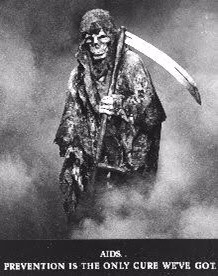
Hospitals such as Westmead, hit the headlines for all the wrong reasons; full contamination clothing for those working with HIV patients, rooms not being cleaned, meals left outside doors. According to the rumourmongers, you get HIV from using plate/cups/cutlery/glasses/toothbrushes/towels/bed linen that any infected person had used. It was anathema despite it being washed, despite all information stating that you could not contract HIV through this means. Even the poor old mosquito copped a hiding as a means of contamination. An advertising campaign in 1987 featuring the Grim Reaper bowling down people indiscriminately, created an apocalyptic vision of HIV that scared the life out of everyone. It was quickly withdrawn three weeks into its six week run.

By this stage, my two years prognosis had become four years…became six…became eight. That was great for me, but not for so many others. The obituary columns in the gay rags went from scattered memoriums to pages as the death toll mounted. My life became a haze of alcohol and cigarettes, not shared alone. Our coping mechanisms were being stretched to their limit. Funerals were a daily occurrence, as were wakes. I attended as many as I could, but I just got to a stage where I was burnt out by the continuing relentless onslaught, and stopped going.

In the 80’s, I held a lot of parties with anywhere from 40-60 friends attending. By 1996, if I had tried to hold a party I would have been lucky to have dug up 10 friends to attend. In the blink of an eye, my social circle was effectively wiped off the face of the earth. In 1997, having finally recovered from AIDS, and thinking it was time to reconnect to the community, I went out one Saturday night to The Beauchamp. For the first time in my life on the gay scene, in a crowded pub, I stood in a bar and could see NOBODY I knew. It was an incredibly lonely sensation.

Tim Alderman 2024

Above photo…Peter McCarthy, Peter Gilmore (Deceased), Bevan (Deceased),,Steve Thompson and myself at an AIDS Quilt unfolding (we were unfolders) at the RHI Pavilion (Sydney Showgrounds ) around 1992. The tee-shirts bear the Quilts Insignia, and “Remember Their Names”

A Brief (Personal) Memoir of HIV & AIDS

I discovered this older article recently while rummaging through my article archives. I present it here with some edits and newspaper inclusions. HIV & AIDS (note the separation of the two) has an intricate, but morbidly fascinating, national & international history. I watched “The Normal Heart” again only a couple of days ago, and the hospital scene where Felix is in the hospital ward with the meal sitting outside the door of his KS infected friend, and being told not to go in without contagion gear raised a whole plethora of unpleasant memories with me. To understand where HIV is now, you need to understand where it was! 
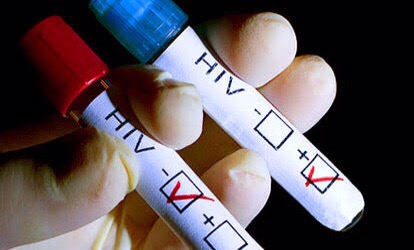

I can’t believe it has been about thirty seven years since we first started hearing about HIV/AIDS. I find it even harder to believe that I have been infected for thirty five years. Over half my life has been lived with this virus! In personal retrospection, I could say that compared to the bad, bad old days of 1981, life is a bed of roses today. But then I am aware that quite a lot of people would still not share that sentiment, so out of respect to them, I will avoid such romanticism.
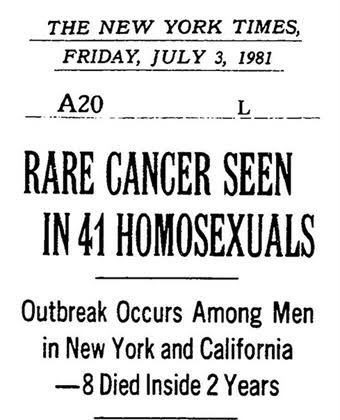

I was living in Melbourne at that time, and I believe that HIV/AIDS got its first mention in the gay press a little earlier than 1981, though I could be wrong. There were only snippets, overseas briefs if you like, of a strange STD that seemed to be selectively attacking the San Francisco gay community, or more specifically, those members of that community who frequented the baths and back rooms of the famous city. I know that no one here was particularly concerned. We thought it was just another of ‘those American things’, or just a mutated form of the clap. Nothing that a pill wouldn’t fix! By the time I returned to Sydney in 1982, we had started to think quite differently. Some of us were getting very scared!

The media began drowning us in information, mainly from the United States. There was the dramatic scenario of ‘Patient 0’, from whom it was assumed the whole epidemic had spread like an out of control monster. The USA and France argued over who had discovered the virus, and made the link between HIV infection and AIDS (watch “Dallas Buyers Club” for an inkling of what this was all about!). A debate raged as scientists tried to decide what to call it and which acronym to use. We had GRID (Gay Related Immune Disease) and HTLV 1 & 2 (Human Transmitted Lymphoma Virus – if memory serves me well). They eventually settled on HIV for initial viral infection, and AIDS for any subsequent illnesses that resulted from the breakdown of the immune system. The original Center for Disease Control (CDC) classification system for the various stages of HIV and AIDS progression was so complicated that you really needed a university degree to be able to decipher them. To make things more manageable they finally settled on four classifications.
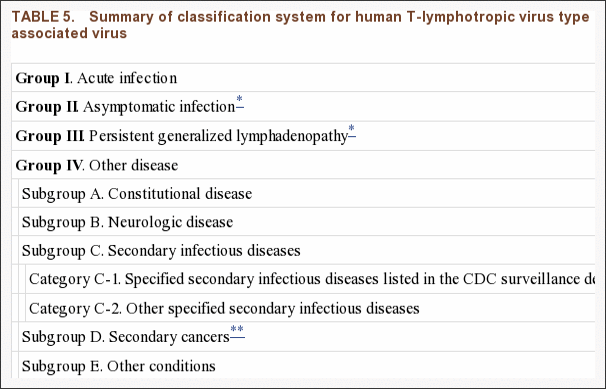
Then came ARCs (AIDS Related Conditions) but that was considered politically incorrect, so we settled on OIs (Opportunistic Infections).

The argument over names and classifications wasn’t half as frightening as the reality of the disease itself, which started to hit home in 1985. Official testing began in that year, and is still the earliest date that medicos will accept as a point of diagnosis with HIV. Any date earlier than that is declared to be a ‘self-report’. Like many others, I assumed I was HIV+ long before testing started. Virgin and chaste were not words to be found in my life resume. Sydney’s Albion Street Centre was the first here to begin testing, and it was done very discreetly and anonymously. We all used an assumed first name, and were issued with a number to identify who we were. (In 1996, when I needed to tap into my first HIV test results done at Albion Street, they were still there.) Counseling was atrocious. You were given your HIV+, or HIV- (if you were lucky) status very bluntly, then quickly shunted over to a counsellor before the shock had a chance to set in. You were also told, almost apologetically, that you probably had about two years to live. That was HIV diagnosis circa 1985.

A number of our conservative politicians, and some of our outraged Christian clergy started to say that they wanted us placed in quarantine. It was very specifically a gay disease, according to them, and they truly believed that fencing off the gay areas of Sydney and leaving it to run its course could contain it. These people wondered why we got tested anonymously!

By 1985 people were starting to die. There were no dedicated HIV wards in any of our hospitals, and patients were shuttled between temporary beds in wards and the emergency department. Reports started to filter through of hospital staff wearing contagion suits around patients with HIV. Worse still, meals were being left outside the doors of rooms, and would often be cold by the time the patient managed to get them. Cleaners refused to clean the rooms. There were scares of infection by contact with everything from a toothbrush, to a glass, to cutlery, so patients were offered very disposable forms of hygiene. Even mosquito’s copped some of the blame.

Then, of course, we had the living daylights frightened out of all of us with the “Grim Reaper”television ads. From 1985 to 1995, death lived with us on a daily basis. If you weren’t visiting sick friends, lovers, or partners in hospital, you were visiting them at home, or attending their funerals and wakes. Most of us lost the majority of our friends, and for most of us those friendships have never been replaced.
Around that time, the gay community took charge of what was quickly becoming an out-of-control situation. Tired of seeing friends dying in emergency wards, and getting only the minimum of care at home and in hospitals, we established our own care, support and advocacy groups. Out of the pub culture grew groups as diverse as BGF, CSN, ANKALI, ACON, and PLWHA. Maitraya, the first drop in centre for plwha was founded, and we raised the first quarter of a million dollars through an auction at “The Oxford” Hotel to start to improve ward conditions at St. Vincent’s Hospital. The gay community can forever take great pride in itself for bringing about great changes, not only in the care of plwha, but in the way the disease was handled, both politically and socially..

The Department of Social Security streamlined people with HIV/AIDS through the system and onto Disability Support Pensions, and the Department of Housing introduced a Special Rental Subsidy so that those on a Pension, and unable to wait interminable amounts of time for housing, were able to live in places of their own choice, at greatly subsidised rent. Home care became available through CSN, which, at that time, was not a part of ACON. By 1992, there was a perceived need for improved dental services for HIV patients, especially considering the high incidence of candida. The United Dental Hospital led the way with a HIV Periodontal Study, which at last provided reasonable dental care to plwha.
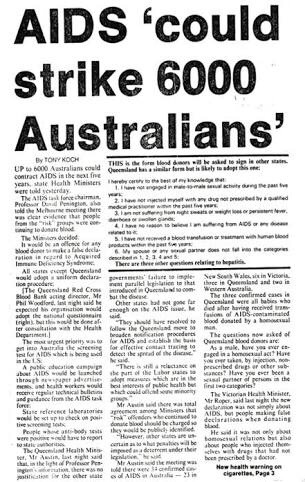
The first vaccine, p24VLP, was trialled with absolute zero results. There were quite a number of scares with HIV contaminated blood, and screening of blood donors was tightened. Discrimination reared its ugly head in the Eve van Grafhorst case, which forced this poor little girl to not only leave her school because of the hysterical reaction to her HIV infection, but to flee the country with her family.

In 1987, the first therapy for AIDS – azidothymidine (AZT) – was released in the USA, and its use in patients with HIV/AIDS was fast-tracked through the approval process here. In France a huge trial called ‘The Concord Trial’ was conducted – unethically – and its findings were found to be inaccurate. The resulting announcement that AZT was ineffective in the control of HIV, and the drug nothing more than ‘human Rat Sak’, caused a universal outcry. The damage was done. Many had no faith in the new drug at all, and local activists and proponents of alternative therapies tried to encourage people not to use the drug. Many of us chose otherwise. True, the effects of AZT were short-term only – maybe six to twelve months – but many saw it as a way to keep the wolf from the door long enough for some other drugs to come along. And come along they did. AZT was quickly followed by what are referred to as the ‘D’ drugs – d4T, ddi, ddc, and the outsider 3TC. However, these were all drugs from one class called Nucleoside Analogues and all had short effectiveness. Some doctors tried giving them in double combinations, but the effectiveness wasn’t much better. Despite their short life span, these drugs were being prescribed in enormous doses, which resulted in problems such as haematological toxicity, anemia, and peripheral neuropathy. We needed a miracle! Add travel restrictions in many countries, blood transfusion infections, and some babies dying as a result of this and things weren’t looking good!

Those of us who had managed to survive to 1996 were starting to give up hope. Most of us were on a pension, had cashed in and spent our superannuation and disability insurance, had a declining health status, and didn’t hold out much hope for a longer survival time. Prophylaxis for illnesses such as PCP, CMV, MAC and candida had helped improve most people’s lives, but they didn’t halt the progress of the virus. The first of the Protease Inhibitors, Saquinavir, was introduced that year, and evidence started to emerge of the effectiveness of combining the two classes of drugs into what came to be known initially as ‘combination therapy’ and later as HAART (Highly Active Antiretroviral Therapy). The results were astounding; those close to dying suddenly found their CD4 counts rising, accompanied by a return to reasonable health. Viral Load testing was introduced and people were finding not just a raising of their CD4 counts, but a drastic lowering of their viral load, often to the point of its being undetectable. This became known amongst doctors as ‘the gold standard’. Ganciclovir Implants to assist with the control of CMV retinitis were trialled the same year, and Albion Street Clinic started a trial using decadurabolane, a steroid, to assist in controlling Wasting Syndrome. The new drug combinations (NNRTI’s – Non-Nucleoside Reverse Transcriptease Inhibitors – a third class of drugs, were introduced shortly after) were not without their complications and problems. Most combinations still required huge quantities of pills to be taken daily, not just of the HAART drugs, but also prophylaxis and drugs to help control side effects such as nausea and diarrhoea. Their use required time and dietary compliance. Other problems such as lipodystrophy, lipoatrophy, and renal problems appeared, but we were, despite any drawbacks, a lot better off than we had been ten years, hell even two years earlier.

People’s health changed drastically, and suddenly new services started to take prominence. Some people required lots of counselling to help them reconnect with the life they thought had been taken from them. Others went to peer support groups or turned to treatment management groups, and some to the larger range of support services being provided by The Luncheon Club, The Positive Living Centre, NorthAIDS and other similar groups. There was recognition that there was a need for services to assist people with an improved health status, as some of them were contemplating returning to work. Despair had, to a large extent, been replaced by hope. Organisations concerned with people’s changing needs reassessed and changed their services to meet the demand. Those that changed have survived, and are still prominent in our community.

The war is far from over. New generations require new strategies, and while everyone seems happy that infection rates for HIV have remained steady in Australia (despite rampaging out of control in Third World countries), many feel it is still not good enough that, at this stage of 37+ years into HIV/AIDS, countries like Australia with high levels of education and accessibility to media and information should be seeing a decline in infections. Remembering my own youth I find it difficult to comment on the attitudes of young people. I grew up through the very worst that HIV/AIDS had to throw at us, and the lessons it taught are not easy to forget. I have to ask myself had I not had that experience, how would I be viewing it? It is no longer just the responsibility of the gay community to guard against new infections. Responsibility also rests with the straight community, and the IDU community, as infection rates remain at their current level. Some scaremongers have ventured forth theories of a ‘third wave’ of infection, but I trust we are too wise, and too educated to allow that sort of irresponsibility to happen.
Many of us (certainly not all) are going on to lead relatively normal lives. Many have returned to work either as volunteers, or in casual, part-time or full-time employment. Many like myself have returned to tertiary education, determined not to leave this world without at least fulfilling some gnawing ambition. However, we are not living in a ‘post-AIDS’ world, and to think so would be foolish. Even if the battles have been won at home, they still need to be fought elsewhere. We still need new drugs, and we still need people to trial both the emerging antiviral and opportunistic infection drugs and the immune-based therapies. We now have a fourth class of drugs in the form of Nucleotide Analogues. Many medical practices have adopted a holistic approach to medicine, and this can be judged to be a direct spin-off from the HIV/AIDS wars. Hopefully, soon please, a new vaccine will appear.

I really don’t know how much longer I will live now. Certainly with the standard of health care I get, and the close monitoring, I may live out whatever my allotted time was to be. Time will be a better judge of that than I will. For me, HIV/AIDS has been a two-edged sword. It has taken good health from me, I have permanent disabilities from AIDS, and I have seen far too many friends, lovers and partners die from this hideous disease. At the same time, it has presented me with opportunities I would never have grasped if it had not come along. I am re-educating myself, taking myself off along strange paths. It has given me a whole new understanding not just of HIV, but of disabilities in general, and a great respect for those who overcome difficulties and recreate their lives.

At a university tutorial last semester, a young woman asked me if I thought every day about having HIV. I don’t! It may have taken thirty five years, but it is now so integrated into my life, that I have trouble remembering the time when I didn’t have it. The pills are just pills now (and thankfully a lot less of them than even 4 years ago), and most of my current medical problems have more to do with ageing than with HIV.

I can tell you, that really gives me something to think about!

Tim Alderman (C © Revised 2017)