Category Archives: History

Gay History: Francis Richard Shackleton, and the Theft of the Irish Crown Jewels.

Article taken from http://homepage.eircom.net/~seanjmurphy/irhismys/

Introduction
          The theft of the Irish Crown Jewels by a person or persons unknown in 1907 is one of the most famous and puzzling mysteries of Irish history, and has been the subject of numerous books and articles. (1) The Jewels were worn during functions of the Order of St Patrick and were entrusted to the care of Ulster King of Arms, Ireland’s chief herald and genealogist. Many and various are the theories which have been advanced over the years to explain what happened to the Jewels, with allegations that they were stolen by insiders, or by Unionist conspirators eager to derail Home Rule, or by Republican plotters seeking to embarrass the British government. On the occasion of the hundredth anniversary of the issue of the report of an official commission of investigation into the loss of the Jewels, (2) it might be worthwhile to revisit the affair.

          As an historian, genealogist and heraldist the present writer has taken upon himself the task of compiling this centenary report, and the following were set as the terms of reference:
(1) To examine as much as possible of the surviving documentary evidence relating to the theft of the Irish Crown Jewels in 1907.
(2) To review the proceedings of the Viceregal Commission of investigation into the circumstances of the theft of the Jewels which was published in 1908.
(3) To evaluate various theories advanced over the years as to who might have been responsible for the theft, and in the light of the available evidence to try and identify the most likely culprit or culprits.
          The Theft of the Jewels

          It should be pointed out firstly that the ‘Irish Crown Jewels’ were not the equivalent of the English Crown Jewels in the Tower of London, but were in fact the regalia or insignia of the Order of St Patrick. This was a chivalric order founded by the government in 1783, designed to be the Irish counterpart of the British Order of the Garter, and equally a source of honour and patronage. The first Grand Master was the Third Earl Temple, who was Lord Lieutenant of Ireland and the prime mover in founding the Order. The Jewels or regalia were presented to the Order by King William IV in 1831, and are believed to have been made up from diamonds belonging to Queen Charlotte. The Jewels were crafted by Rundell, Bridge and Company of London, and consisted of a Star and a Badge composed of rubies, emeralds and Brazilian diamonds, mounted in silver, which were to be worn by the Lord Lieutenant as Grand Master on formal occasions. The membership of the Order was composed of leading peers titled Knights Companions. The Ulster King of Arms, the state heraldic and genealogical officer in charge of the Office of Arms, was made responsible for registering the Order’s membership and caring for its insignia. (3)

          The statutes or rules of the Order of St Patrick were revised in 1905, and it was ordered that the jewelled insignia of the Grand Master and the collars and badges of the members should be deposited in a steel safe in the strongroom of the Office of Arms. The Office of Arms was located in Dublin Castle, and in 1903 moved from the Bermingham Tower to the Bedford Tower. The serving Ulster King of Arms was Sir Arthur Vicars, who had been appointed in 1893. Other, largely honorary office-holders under Vicars were Pierce Gun Mahony, Cork Herald, Francis (Frank) Shackleton, Dublin Herald, and Francis Bennett Goldney, Athlone Pursuivant. Mahony was a nephew of Vicars, while Shackleton, the brother of the famous explorer Sir Ernest Shackleton, was a housemate of Vicars. After fitting out of the new premises in the Bedford Tower had been completed, it was found that the Ratner safe in which the Order’s insignia were to be kept was too large to fit through the door of the strongroom. By agreement with the Board of Works it was therefore decided to leave the safe in the Library until a more suitably-sized safe could be obtained, but this was never done. While seven latch keys to the door of the Office of Arms were held by Vicars and his staff, there were only two keys to the safe containing the insignia, both held by Vicars. (4)

          The last occasion on which the Jewels were seen in the safe was on 11 June 1907, when Vicars showed them to John Crawford Hodgson, the librarian of the Duke of Northumberland. On the morning of Wednesday 3 July there was a strange occurrence, when Mrs Farrell the office cleaner found the entrance door unlocked, told William Stivey the messenger, who on informing Vicars received the rather offhand reply, ‘Is that so?’, or ‘Did she?’. On the morning of Saturday 6 July there was an even more alarming occurrence, when Mrs Farrell found the door of the strongroom ajar, and on being informed by Stivey, Vicars again replied casually, taking no further action.

          At about 2.15pm on the same day, 6 July, Vicars gave Stivey the key of the safe and a box containing the collar of a deceased knight, asking him to deposit it in the safe. This was most unusual, as Stivey had never before held the safe key in his hand. Stivey found the safe door unlocked and immediately informed Vicars, who came and opened the safe to find that the Jewels, five Knights’ collars and some diamonds belonging to Vicars’s mother were all gone. The police were called, and in the subsequent investigation lock experts established that the safe lock had not been tampered with, but had been opened with a key. While Mahony was not in the Office of Arms from April until 4 July, except one day in May, Shackleton and Goldney appeared not to have visited the premises or indeed been in Ireland between 11 June and 6 July. (5)

          The discovery of the theft of the Jewels caused great concern to government, and indeed King Edward VII was particularly angered, as he was within days of visiting Ireland and intended to invest a knight of the Order of St Patrick. Apparently largely on the King’s insistence, it was decided to reconstitute the Office of Arms and replace Vicars. Vicars, however, refused to resign, being supported by his half-brother, Pierce O’Mahony, father of Pierce Gun Mahony and a self-styled Gaelic Chief titled The O’Mahony. (6) O’Mahony senior became the most prominent figure in a campaign for a public enquiry which it was hoped would vindicate Vicars.
          The Viceregal Commission of Investigation

          Lord Aberdeen, the Lord Lieutenant of Ireland, decided to appoint a Viceregal Commission of inquiry in January 1908, whose terms of reference were ‘to investigate the circumstances of the loss of the regalia of the Order of St Patrick’, and ‘to inquire whether Sir Arthur Vicars exercised due vigilance and proper care as the custodian thereof’. (7)

          The examination of witnesses was led by the Solicitor General, Redmond Barry. The members of the Commission were Judge James J Shaw, Robert F Starkie and Chester Jones. The Commission commenced its sittings on 10 January 1908 in the Library of Ulster’s Office, the very room from which the Jewels had been removed, and would complete its hearings fairly quickly on 16 January. A problem arose immediately, in that it was found that the Commission was to sit in private and would not have power to compel the attendance of witnesses or take evidence on oath. Vicars wanted a sworn public enquiry, and therefore withdrew from the proceedings with his counsel, so that the Commission had to continue without its most important witness. However, the Commission was able to use written statements made by Vicars to the police, as well as oral statements made by him to the police and various witnesses. (8)

          Some twenty-two individuals agreed to give evidence when called. These included firstly members of the staff of Ulster’s office, including George D Burtchaell, Vicars’s secretary, the trio of unpaid assistant heralds, Pierce Gun Mahony, Cork Herald, Francis Shackleton, Dublin Herald, and Francis Bennett Goldney, Athlone Pursuivant. Then there were various policemen and officials, including M V Harrel, Assistant Commissioner of the Dublin Metropolitan Police, Superintendent John Lowe of the same force, Chief Inspector John Kane of Scotland Yard, and Sir George C V Holmes, Chairman of the Board of Works. Joining Vicars in refusing to give evidence were Sydney Horlock, his clerk, and Mary Gibbon, the office typist. (9)

          Burtchaell was examined on three occasions and his evidence elucidated the workings of Ulster’s Office, as well as giving the impression that Vicars perhaps was not as careful as he should have been in his custody of office keys, and that he was in habit of proudly showing off the Jewels to a wide range of people. Burtchaell also confirmed that of the three heralds, Goldney had not been in the office since May, Shackleton since early June, but that Mahony had been present in the period immediately before the discovery of the loss of the Jewels in July 1908. The testimony of Peirce Mahony junior was taken at two sittings and was largely taken up with establishing his role in Ulster’s Office, his access to keys and his attendance at Ulster’s Office, but was not otherwise very informative.

          Goldney was examined at two sessions, and his evidence in contrast was very lively. The drift of his testimony became evident when Goldney stated that on one occasion when Vicars was displaying the Jewels to callers there were ‘some strange gentlemen in the room’. While claiming to have no idea as to who might have taken the Jewels, Goldney coyly referred to ‘another matter’, which after some hesitation the Commission decided to enter on the record. This other matter turned out relate to complicated and strange financial relationships between Vicars, Shackleton and Goldney. Vicars had guaranteed two bills for Shackleton, which it was beyond his means to support, and accordingly he persuaded Goldney to take responsibility, a task which involved dealings with a money lender associated with Shackleton. This aspect of Goldney’s evidence certainly did not have the effect of presenting Vicars in a good light.

          Of the policemen who gave evidence, Chief Inspector Kane was the most interesting. Kane stated that he believed that the theft of the Jewels had been carried out by an insider, and that it had occurred before 5 July. Kane explained the doors found open in Ulster’s Office as a deliberate device ‘to precipitate an investigation’. Kane also testified that Vicars and Goldney had stated to him that they believed Shackleton to have been responsible for the theft, a charge he rejected emphatically:
I have repeated to Sir Arthur Vicars and his friends over and over again, and I desire to say that now, when they pestered me with not only suggestions, but direct accusations of Mr Shackleton, that they might as well accuse me, so far as the evidence they produced went to justify them. (10)
Unfortunately, Kane’s report on the loss of the Jewels is among the official documentation now missing, and this might have thrown further light on just why he was so certain that the man who remains the prime suspect was innocent.

          Shackleton was among the final witnesses to give evidence, travelling back to Dublin from San Remo in Italy for the purpose. Shackleton gave the impression of being a helpful and composed witness, which of course might not have been the case had Vicars’s counsel been there to cross-examine him. He candidly outlined his connection with Vicars, stating that he had made his acquaintance through his heraldic and genealogical work, that he was a co-tenant with him of a house in Clonskeagh, that indeed Sir Arthur had guaranteed bills for him when he was in some temporary financial difficulties. He admitted that he had in the past spoken of the Jewels as being likely to be stolen, but took every opportunity to claim that the suspicions against him were groundless. Read into the record was a letter from Vicars to Shackleton, sent on 25 August 1907 from Goldney’s residence Abbots Barton in Canterbury, in which Vicars commented:
Now that you evidently know the whereabouts of the Jewels, from what you have said to both Frank [Goldney] and me, I hope that you have told Mr Kane everything calculated to facilitate matters. (11)
Shackleton indicated that this exchange was based on nothing more than his reference to a newspaper report that the Jewels had been recovered, which turned out to be incorrect. In answer to direct questions as to whether he or a confederate had taken the Jewels, Shackleton replied:
I did not take them; I know nothing of their disappearance; I have no suspicion of anybody. . . . . . I had no hand in it, nor do I know anybody that took them, nor have I the least suspicion. (12)
Taking advantage of his social contacts, Shackleton dropped many prominent names, and referred several times to his poor health and the distance he had travelled from San Remo to give evidence. At one point Shackleton stated that he had even been accused of aiding Lord Haddo, Lord Aberdeen’s son, in taking the Jewels, whereupon the Solicitor General intervened quickly to indicate that he ‘need not mention that’. (13)

          The Viceregal Commission issued its report on 25 January 1908, and the key finding was as follows:
Having fully investigated all the circumstances connected with the loss of the Regalia of the Order of St Patrick, and having examined and considered carefully the arrangements of the Office of Arms in which the Regalia were deposited, and the provisions made by Sir Arthur Vicars, or under his direction, for their safe keeping, and having regard especially to the inactivity of Sir Arthur Vicars on the occasions immediately preceding the disappearance of the Jewels, when he knew that the Office and the Strong Room had been opened at night by unauthorised persons, we feel bound to report to Your Excellency that, in our opinion, Sir Arthur Vicars did not exercise due vigilance or proper care as the custodian of the Regalia. (14)
While admitting it was not part of their terms of reference, the Commissioners also stated that as Francis Richard Shackleton had been more than once named as the ‘probable or possible author of this great crime’, they though it only due to that gentleman to say that
. . . he appeared to us to be a perfectly truthful and candid witness, and that there was no evidence whatever before us which would support the suggestion that he was the person who stole the Jewels. (15)
          The Viceregal Commission hearings had in effect been converted into a trial in absentia of Sir Arthur Vicars, and his own withdrawal together with his counsel had left the field clear for his accusers. Although the Viceregal Commission’s terms of reference specified both the circumstances of the loss of the Jewels and the conduct of Vicars, it would seem that highlighting the latter’s failings took precedence over trying to establish just who had purloined the Jewels. The Commission’s findings were couched in terms of allocating most blame for the loss of the Jewels to Vicars, indeed on making him a scapegoat, and in this the Commissioners could not really be accused of failing to do what was expected of them. There can be a level of cynicism attached to official reports, in which while no palpable untruths are told, certain facts can be manipulated and others ignored in order to arrive at a predetermined result. While the Commission’s finding that Vicars was careless in his custody of the Jewels was essentially accurate, the exculpation of Shackleton seems remarkable when not accompanied by closer analysis of the alleged exploit of Lord Haddo, or the security failings of other Castle staff, for example. Another factor explaining the kid gloves with which Frank Shackleton was treated may have been the status of his brother Sir Ernest as a national hero and favourite of King Edward VII. Although it would appear that Ernest’s own finances were in a parlous state due to the expenses of his polar expeditions, he felt obliged to borrow £1,000 in order to help his brother Frank repay the above mentioned debts. (16) It would not be unjust to conclude that the Viceregal Commission report was in essence a whitewash designed to draw a veil over an intensely embarrassing episode for the establishment and to allocate most of the blame to Vicars.

          On 30 January 1908 Vicars was informed that his appointment as Ulster King of Arms had been terminated, and Captain Nevile Rodwell Wilkinson was appointed in his place. As the disgruntled Vicars refused to hand over the keys to the Office of Arms strongroom, Wilkinson found himself obliged to stage another break-in in order to gain entry! Shackleton too and Goldney were removed, but Pierce Gun Mahony perhaps unexpectedly was left in place. Pierce Mahony senior responded to the Commission’s report with an even more robust and public defence of his half-brother Vicars. In early February 1908 he released to the press copies of his copious correspondence with members of the Irish administration, in which he alleged that while officially Vicars was charged only with negligence, graver charges relating to his character were being circulated in secret. In particular, Mahony alleged that he had been informed by Lord Aberdeen and the Chief Secretary Augustine Birrell that Vicars stood accused of introducing into his office ‘a man of very bad character’, and while the name of the individual was deleted in the press report, it is considered that this must have been a reference to Frank Shackleton. Mahony and Vicars continued to press for a full public and judicial enquiry so that the dismissed Ulster could clear his name. A letter sent to the press by Vicars on 1 February 1908 provided his initial response to the charges of the Viceregal Commission: he declared that the Board of Works were responsible for not providing a safe which would fit in the strong room of his office, and explained his failure to react to the reports of open doors by reference to his being overwhelmed with work in advance of the royal visit. Government was unmoved, considering that the matter had been resolved by the report of the Viceregal Commission and the replacement of Vicars as Ulster. (17)
          Shackleton, Goldney and Other Suspects

          The Viceregal Commission clearly provided the official view of the Jewels theft, but a much murkier account of the whole affair found its way into the public domain in July 1908 via an article in an Irish-American nationalist newspaper the Gaelic American. Based apparently on information provided by Vicars’s half-brother Pierce O’Mahony, this article asserted that drunken parties had been held in the Office of Arms, with an implication of homosexual activity (‘nightly orgies’, ‘unnatural vice’). It was claimed that Shackleton and a disreputable associate named Captain Richard Gorges (for some reason disguised as ‘Captain Gaudeons’ in the article), were responsible for stealing the Jewels, and the two had escaped punishment by threatening to expose the scandalous conduct in the Castle. The article also alleged that there had been a secret Dublin Metropolitan Police enquiry operating in parallel with that of the Commission, which had subjected Shackleton to a less benign interrogation when he had completed his evidence before the commissioners. Although the authorities allegedly knew the identities of those who had stolen the Jewels, they could not secure hard evidence against them or persuade them to reveal the whereabouts of their booty. In consequence of this, and out of a desire to avoid further scandal and revelations, it was said that the police contented themselves merely with ordering Shackleton and Gorges to leave the country. (18)

          The author of the Gaelic American article, the Irish Republican Brotherhood member Bulmer Hobson, had a chance encounter some years later with Gorges, who essentially verified the main points in the story. Gorges reportedly added some further details, stating that the Jewels had once been taken as a joke during a drinking party by Lord Haddo, and returned the next day. This is said to have inspired Shackleton and Gorges to repeat the theft, but this time there was to be no return of the Jewels. According to Hobson, Shackleton disposed of the Jewels in Amsterdam, stipulating that they were not to be broken up for three years, perhaps indicating that some sort of ransom back of the stolen goods was intended. (19)

          This whole account has the merit of plausibility, even though of course it comes from a biased source and is uncorroborated in its details. It would not be unreasonable to suggest that Shackleton’s reference to Haddo in his evidence to the Viceregal Commission was clearly calculated, a scarcely veiled threat that he was in a position to reveal embarrassing details about prominent individuals if pressed too hard by his interrogators. The public exculpation of Shackleton by the Viceregal Commission is at odds with the exploitation of his association with Vicars in order to blacken the latter’s name, and points to a remarkable degree of cynicism on the part of the Government.

          It is generally agreed that the doors and safe in Ulster’s Office were left open deliberately in order to force discovery of the robbery. It is possible that it was Vicars himself who orchestrated these events when he realised that the Jewels were not going to be returned, and was thus desperately trying to arrange that someone other than himself should be on record as discovering the theft, as it happened, the unfortunate Stivey, who was also to lose his job in the Castle.

          Of course it should be noted that Shackleton was not in Ireland in the period leading up to the theft, and it is suggested that Gorges may have been the one who actually removed the Jewels, acting on a plan conceived by Shackleton, with both men sharing in the proceeds of the crime. If this is what happened, it is likely that Shackleton exploited his intimacy with Vicars to borrow temporarily one of the keys to the safe, and either the original or a copy may have been used by Gorges to remove the Jewels. Vicars kept one key on his person and the other concealed in his house in Clonskeagh, which as already noted he shared with Shackleton. It is only fair to record that members of the Shackleton family today are not convinced of Frank’s guilt, pointing to his absence from the country at the time of the theft of the Jewels and to Chief Inspector Kane’s declaration that no evidence could be found to show that he was involved. (20) If Shackleton and Gorges were guilty, then they got clean away with the theft, although both men were later to end up in prison for unconnected cases involving fraud and manslaughter respectively. Following his release from prison Shackleton changed his surname to Mellor and died in 1941 in Chichester, while Gorges appears to have boasted about his role in the Jewels theft in prison but was not believed, and after his release survived until 1944, when he lost his life after being struck by a train in London. (21)

          Understandably embittered and believing that he had been made a scapegoat for the theft of the Jewels, Vicars retired to County Kerry, and spent the remainder of his life in Kilmorna House, which had been made available to him by his sister, Mrs Edith de Janasz. Vicars married Gertrude Wright in 1917, and on 14 April 1921 he was shot dead by a local IRA unit after it had set fire to Kilmorna. (22) It is not known whether Vicars was just an incidental victim of the Troubles, or whether he had actually been providing intelligence on the IRA in an effort to win back official favour, but it is believed that the killing was a local initiative rather than an act sanctioned by Republican headquarters. While Shackleton and Gorges were relatively long-lived, others involved in the Jewels affair came to premature ends: Pierce Gun Mahony was found shot through the heart in 1914 what appears to have been a hunting accident, although suspicions of murder were voiced, while Francis Bennett Goldney died in France in 1918 as a result of a motoring accident. (23)

          The full text of Vicars’s last will and testament was not released for public examination until 1976, as the following rather sensational passage was obviously considered too incendiary:
I might have had more to dispose of had it not been for the outrageous way in which I was treated by the Irish Government over the loss of the Irish Crown Jewels in 1907, backed up by the late King Edward VII whom I had always loyally and faithfully served, when I was made a scapegoat to save other departments responsible and when they shielded the real culprit and thief Francis R Shackleton (brother of the explorer who didn’t reach the South Pole). My whole life and work was ruined by this cruel misfortune and by the wicked and blackguardly acts of the Irish Government. (24)
It is not usual to employ a will to make such serious accusations effectively from beyond the grave, and this rather sad and bitter document has certainly helped to fix the idea of Shackleton’s guilt in the minds of many, without of course providing any conclusive evidence that he was the culprit.

          It should be noted that Francis Bennett Goldney has also come under suspicion in relation to the Jewels theft, in that after his death in 1918 he was discovered to have been something of a thieving magpie, and among his possessions were found ancient charters and documents belonging to the City of Canterbury, as well as a painting by Romanelli which was the property of the Duke of Bedford. (25) Goldney’s opportunities and inside knowledge were much less than Shackleton’s, but we are now aware of his track record, and the theft of the Jewels occurred just five months after his appointment as Athlone Pursuivant in February 1907. Goldney’s testimony to the Commission is certainly a masterpiece of deflection and obfuscation, although it is not possible to say whether this proceeded from elements of his character or a desire to hide something sinister. It must be pointed out as well that like Shackleton, Goldney was not in Ireland for some months before the discovery of the loss of the Jewels, but again this does not rule out a possible organisational involvement in the crime.

          Something of Goldney’s style can be seen in an episode when he borrowed two silver communion cups from Canterbury Cathedral supposedly for exhibition in America, and on being asked about their return after some months, he claimed coolly that he been given them to sell, and they are now to be found in the possession of the Metropolitan Museum of Art in New York. (26) Audrey Bateman, the principle chronicler of Goldney’s misdeeds, has located Canterbury lore which shows that there was local suspicion that the mayor had been involved in the theft of the Irish Crown Jewels. J A Jennings, proprietor of the Kent Herald, recalled that he had been told by the chauffeur of an American millionaire staying with Goldney in the Autumn of 1907 that a bigger petrol tank had been fitted to his car before he and his employer travelled via Dover to Amsterdam, and he was convinced that this provided the means for the Irish Crown Jewels to be smuggled away. While Jennings declined to reveal the name of the American, Bateman noted that the famous and fabulously wealthy art collector John Pierpont Morgan attended Cricket Week in Canterbury with Goldney in early August 1907. (27) Again it must be stressed that while there are good grounds for suspicion, there is no conclusive evidence that Goldney was responsible for stealing the Jewels. Neither should we hastily convict Morgan, even though there is an indication that he may have been involved with the export of looted antiquities in the early 1900s, as it has recently been alleged that he purchased and shipped to New York an Etruscan chariot, which interestingly is now also in the Metropolitan Museum of Art, and whose return to Italy has been demanded. (28)

          The fate of the stolen Crown Jewels remains a subject of speculation and controversy to the present day. In 1976 an intriguing Irish Government memorandum dated 1927 was released, indicating that ‘the Castle Jewels are for sale and that they could be got for £2,000 or £3,000′. (29) Gregory Allen has interpreted these words to mean that the stolen Jewels were still intact in 1927 and that the thieves or their agents were effectively endeavouring to ransom them to the Irish Government. Allen then proceeded to put forward a rather implausible theory that the Jewels may have been stolen by patriots intent on furthering Arthur Griffith’s plan to secure Irish independence through the device of a ‘dual monarchy’. (30) Some commentators have followed Allen in believing that the 1927 memorandum was referring to the stolen Jewels, (31) but the present writer is not so sure. Might not the reference have been to the elements of the regalia of the Order of St Patrick not stolen in 1907, the last remnants of which were returned to England as late as the 1940s? (32) If this interpretation is correct, the belief that the stolen Jewels survived intact for many years after 1907 appears to be unsupported. As against this, Myles Dungan has written that a Dublin jeweller, James Weldon, was contacted in 1927 by Shackleton offering to provide information on the location of the Jewels in return for money, but this story is based only on Weldon family recollections and is not documented. (33)

          Of course facts or the absence of same should not be allowed to get in the way of a good yarn, and rumours and legends have abounded over the years, with claims that the Jewels may still be hidden in Ireland, or somewhere in England, or alternatively are in the possession of a wealthy collector in America or elsewhere abroad. The theft of the Irish Crown Jewels has been made the subject of a sexually graphic novel, which concludes with a mischievous hint that diamonds from the Jewels may have been incorporated in a magnificent brooch worn by Queen Elizabeth II. (34) A field in the foothills of the Dublin Mountains was dug up in 1983 by the Gardaí, acting on information received from the granddaughter of an old republican who had claimed to have been involved in stealing the Jewels, but nothing was found. On a visit to Listowel some years back the present writer was shown a clearly forged letter referring cryptically to the Jewels and allegedly written by Vicars, and an account of strange nocturnal activities among the ruins of Kilmorna appeared in a newspaper in 1998. (35) The latter shenanigans appear to have been organised by local jokers for the benefit of two researchers working on the case, whose account of the Crown Jewels affair has since been published. The authors claim that the 1907 theft was organised by a Unionist conspiracy in order to undermine attempts to introduce Home Rule, and that the Jewels were eventually secretly returned to King Edward. While the authors have uncovered some hitherto unknown or little used documentation, the present writer does not find the evidence presented in support of this interpretation of events to be convincing. (36)

          Sir Arthur Vicars’s brother, Harry Vicars, featured very little in the story of the Irish Crown Jewels, and then only in the context of supporting his brother in trying times. It has recently been suggested to the present writer that Harry Vicars also should be a suspect in the case, in that there is family lore that he was basically a crook who cheated his wife Edith Long of her possessions, including having stones in her jewellery replaced by paste copies. (37) This is interesting information which deserves further investigation, but again nothing has been proven.
          Missing Documents

          Reconstructing the story of the Irish Crown Jewels is rendered more difficult by the fact that a good part of the relevant documentation is wanting or difficult to access. Thus it is recorded that eight British Home Office files relating to the theft were officially destroyed, and there is a gap in Ulster’s Office official correspondence between 1902 and 1908. (38) As noted above, the key report of Chief Inspector Kane cannot be located. Ulster’s Office actually survived the achievement of Irish independence in 1922 by some decades, until it was transferred to the College of Arms in London in 1943 and replaced in the twenty-six counties by the Genealogical Office/Office of the Chief Herald of Ireland. The surviving records of Ulster’s Office and the Office of the Chief Herald are combined in a series titled Genealogical Office Manuscripts in the National Library of Ireland, Kildare Street, Dublin. (39) Although permitted to other researchers, access to the unsorted elements of Ulster’s Office records was refused to the present writer until the intervention of the Ombudsman resulted in the opening of a proportion only of the material in 2006. Bamford and Bankes wrote in 1965 of the ‘cloak of secrecy and evasion’ then still surrounding the Irish Crown Jewels case, (40) and while most officials approached were glad to assist the present writer’s research, it seems that old attitudes have not entirely died out in certain quarters. (41)

          From my necessarily constrained research in Ulster’s Office records, I can confirm that there may well have been contemporary official weeding of material relating to the theft of the Jewels, which tends to support the view that this was no ordinary crime, but a wider scandal drawing in members of the establishment and their connections. One is also struck by the disorder in which the surviving Ulster’s Office correspondence of the period remains, which problem is complicated by the chaos into which some of the records of the Office of the Chief Herald collapsed in the course of the Mac Carthy Mór scandal, a more recent event which bears not a few passing similarities to the Irish Crown Jewels affair. (42) Thus the volumes of copies of Ulster’s outward correspondence are not all clearly dated and numbered, while files of inward correspondence are very disordered (the writer was intrigued to find inserted among correspondence of the early 1900s a 1983 letter to Chief Herald Donal Begley from the bogus Irish chief Terence MacCarthy!). (43) All of this puts National Library staff to considerable trouble to produce specific material, as well as multiplying the number of visits which a researcher must make. The writer has recommended to the Library Board that it should remedy without further delay the long-standing problem of the inadequately catalogued and sometimes disordered state of Genealogical Office manuscripts. These are important records historically as well as in relation to heraldry and genealogy, and until they are properly arranged and catalogued one cannot be certain that they do not contain any additional information relating to the theft of the Irish Crown Jewels in particular.

          It is a commonplace observation that the relentless development of Dublin in recent decades, and particularly during the Celtic Tiger boom, has seen the destruction of much of the old fabric of the city. Yet remnants and relics of the past sometimes surprisingly survive, and this is certainly true in the case of the Irish Crown Jewels. For a start, despite the internal reconstruction of the Bedford Tower in Dublin Castle as a conference centre, still effectively intact is the old Ulster’s Office Library in which stood the safe from which the Jewels were stolen in 1907. The Ratner safe itself was transferred to Kevin Street police station in 1908, remaining there until returned in December 2007 to Dublin Castle, where it may be viewed in the Garda Museum now occupying the Bermingham Tower (ironically this was where the safe was first located before Ulster’s Office moved to the Bedford Tower in 1903). The house shared by Vicars and Shackleton still stands in St James’s Terrace, Clonskeagh. There was formerly a display case containing a police reward poster and other items relating to the Irish Crown Jewels in the State Heraldic Museum in the National Library in Kildare Street, but the Museum was removed during the very centenary of the theft in 2007 to make way for a new National Library exhibition on the Irish in Europe, and it has not been possible to clarify the fate of the display case. Of the Irish Crown Jewels themselves no trace of course can be found, and the writer inclines to the view that whoever stole them, they would have been broken up and sold on at some point subsequent to the theft.
          Conclusions

          In the light of the foregoing analysis of documentary evidence relating to the theft of the Irish Crown Jewels in 1907 and study of various accounts of the crime, the conclusions of this report are as follows:
(1) While considerable documentation relating to the loss of the Irish Crown Jewels survives, certain key official records appear to have been deliberately destroyed, making it difficult if not impossible to establish exactly what happened.
(2) The Viceregal Commission of investigation into the loss of the Irish Crown Jewels was more concerned with scapegoating Sir Arthur Vicars than uncovering the full facts relating to the affair, and was in essence a whitewash.
(3) Those accounts of the theft of the Irish Crown Jewels which postulate that it was probably an inside job are most likely correct, and while the identity of the mastermind behind the crime has not and may never be proven conclusively, the prime suspect remains Francis Shackleton, with Francis Bennett Goldney a strong suspect number two.

Sean J Murphy

25 January 2008, last updated 29 April

References
(1) The present report is a development of the author’s Irish Historical Mysteries series article, ‘The Theft of the Irish Crown Jewels’, which it now replaces. Thanks are due to the staffs of the National Library of Ireland, the National Archives of Ireland, Dublin Castle, the Garda Museum, the National Archives (Kew) and other individuals mentioned in the notes below. The best general chronicle of the affair remains Francis Bamford and Viola Bankes, Vicious Circle: The Case of the Missing Irish Crown Jewels, London 1965, and the author has also made use of other accounts as cited below. 

(2) Report of the Viceregal Commission Appointed to Investigate the Circumstances of the Loss of the Regalia of the Order of St Patrick, London 1908, hereafter cited as Crown Jewels Commission (Ireland). The National Archives of Ireland has placed online copies of the Commission’s report (excluding the appendices) and a range of official records relating to the Irish Crown Jewels affair at http://www.nationalarchives.ie/topics/crown_jewels/gallery.html. The most important National Archives file is CSORP/1913/18119, portions of which are included in the online reproductions.

(3) Peter Galloway, The Most Illustrious Order of St Patrick 1783-1983, Chichester, Sussex, 1983, page 96.

(4) Crown Jewels Commission (Ireland), Report, page iv.

(5) Same, pages vi-viii.

(6) Séamus Shortall and Maria Spassova, Pierce O’Mahony: An Irishman in Bulgaria, [2002].

(7) Crown Jewels Commission (Ireland), Report, page ii.

(8) Same, page iii.

(9) Same, Appendix, Minutes of Evidence.

(10) Same, page 79.

(11) Same, page 70.

(12) Same, page 76.

(13) Same, page 77.

(14) Same, Report, page xi.

(15) Same.

(16) Roland Huntford, Shackleton, London 1996 edition, page 184.

(17) Irish Times, 1 and 3 February 1908, retrieved from http://www.ireland.com/search, 17 January 2008.

(18) ‘Abominations of Dublin Castle Exposed’, Gaelic American, 4 July 1908.

(19) Bulmer Hobson, Ireland Yesterday and Tomorrow, Tralee 1968, pages 85-88.

(20) Communications from two members of the Shackleton family, January 2008. It was not long before the reputations of Shackleton and Gorges came to the attention of the authorities, for example, the Earl of Kilmorey sent Lord Aberdeen a letter (undated, pre-December 1907?) in which he described the two as ‘unspeakable scoundrels’ of ‘filthy character’, accusing them of responsibility for the theft (Public Record Office of Northern Ireland, D2638/D/46/4, copy courtesy of Kevin Hannafin).

(21) David Murphy, Letter to History Ireland, 10, Number 1, 2002, page 11; death certificate of Richard Gorges 1944 (copy courtesy of Kevin Hannafin).

(22) Bamford and Bankes, Vicious Circle, pages 189, 197-201.

(23) Audrey Bateman, The Magpie Tendency, Whitstable, Kent, 1999, page 80.

(24) Will and Probate of Sir Arthur Vicars, 1922, National Archives of Ireland.

(25) Bateman, Magpie Tendency, pages 82-83, 85 and generally.

(26) Same, page 85.

(27) Bateman, An account by J A Jennings, proprietor of the Kent Herald at the time the Irish Crown Jewels were stolen, unpublished, 2004 (copy courtesy of Arthur Evans).

(28) ‘Umbrian Umbrage: Send Back That Etruscan Chariot’, New York Times, 5 April 2007, http://www.nytimes.com, visited 24 January 2008; it has since been claimed that the chariot is in fact a fake.

(29) Portion of Memorandum 1 June 1927, National Archives of Ireland, S 3926 A.

(30) Gregory Allen, ‘The Great Jewel Mystery’, Garda Review, August 1876, pages 16-22.

(31) Tomás O’Riordan, ‘The Theft of the Irish Crown Jewels, 1907′, History Ireland, 9, Number 4, 2001, page 27.

(32) Galloway, Illustrious Order of St Patrick, page 72.

(33) Myles Dungan, The Stealing of the Irish Crown Jewels: An Unsolved Crime, Dublin 2003, pages 250-51.

(34) Robert Perrin, Jewels, London and Henley 1977, page 269.

(35) The Kerryman, 21 August 1998.

(36) John Cafferky and Kevin Hannafin, Scandal and Betrayal: Shackleton and the Irish Crown Jewels, Cork 2002, pages 216-234 and passim.

(37) Information of Ian Macalpine-Leny, November 2007.

(38) Susan Hood, Royal Roots, Republican Inheritance: The Survival of the Office of Arms, Dublin 2002, pages 62-63. The surviving documentation on the Irish Crown Jewels in the English National Archives is substantial but clearly weeded , for example, HO 144/1648/156610, marked ‘Closed until 2022′, yet inspection now permitted (copy of file ordered online at http://www.nationalarchives.gov.uk).

(39) Of particular interest is Ulster’s Office Correspondence, bound volumes (outward) and files (inward), Genealogical Office Manuscripts, National Library of Ireland, not fully sorted or referenced. GO MS 507, a useful scrapbook of newspaper cuttings and correspondence relating to the loss of the Irish Crown Jewels, compiled by J C Hodgson and presented to Ulster’s Office in 1942, compensates in some measure for removed or misplaced official documentation. See also Fuller Papers 1904-15, NLI microfilm POS 4944, which contains correspondence of Vicars, some of it relating to the Irish Crown Jewels.

(40) Bamford and Bankes, Vicious Circle, page 202.

(41) While National Library desk staff have been consistently helpful in relation to the writer’s Irish Crown Jewels research, e-mail queries sent on 17 December 2007 to the Office of the Chief Herald and on 14 January 2008 to the Director of the National Library and the Chairman of the Library Board, have not been dealt with (as of April 2008).

(42) Sean J Murphy, Twilight of the Chiefs: The Mac Carthy Mór Hoax, Bethesda, Maryland, 2004; see also ‘The Mac Carthy Mór Hoax’, http://homepage.eircom.net/%7Eseanjmurphy/irhismys/maccarthy.htm.

(43) The writer’s initial examination of the newly released Ulster’s Office material among the Genealogical Office manuscripts has uncovered evidence that the removal of records may have been unauthorised as well as official, in that one volume of correspondence dated 1901-02 has a note attached to the flyleaf which reads, ‘Bought from Townley Searle, 30 Gerrard Street W I for 10s, 10.10.1941′. Searle appears to have been a London author and bookseller, and his possession of this volume and perhaps other records simply adds another layer of mystery (one might point to the coincidence that 1941 was also the year of Frank Shackleton’s death).
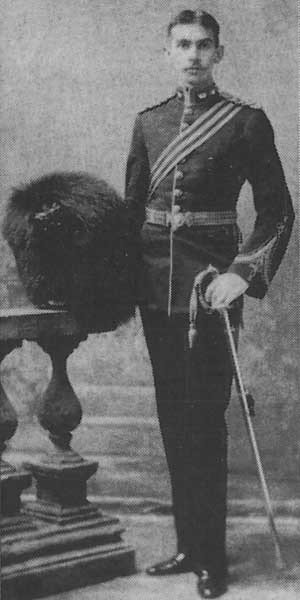
 

Francis R (Frank) Shackleton, Dublin Herald


http://www.independent.ie/irish-news/shackleton-jr-stole-crown-jewels-26344304.html
‘Shackleton Jr ‘stole crown jewels’

A CENTURY has passed since the Irish Crown Jewels were stolen from Dublin Castle in what is still considered one of the most bizarre and baffling mysteries in Irish criminal history, but a new review of the evidence suggests that Francis Shackleton, the disreputable brother of polar explorer Ernest, should be considered the prime suspect.

Historical researcher and author Sean J Murphy will later this month publish his findings, which will finger Shackleton as the probable thief. The theft of the jewels, worth €1m in today’s money, was discovered on July 6, 1907.

The jewels, encrusted with rubies, emeralds and Brazilian diamonds, were the regalia, or insignia, of the Order of St Patrick. The safe had been opened with a key and the theft was clearly an inside job.

Last month, after 101 years, the empty safe was returned to Dublin Castle, having been kept in Kevin Street Garda Station since the theft.

The jewels were discovered to be missing four days before the state visit of King Edward VII and Queen Alexandra and angered the monarch, though the visit went ahead.

In 1903, the jewels had been transferred to a safe, which was to be placed in a newly constructed strongroom, but the new safe was too large for the doorway to the room.

Instead Arthur Vicars, the Officer of Arms of Dublin Castle, stored the jewels in his office. Seven people had keys to the office, but the two safe keys were in the sole possession of Vicars.

Vicars came under intense pressure following the theft, but refused to resign or appear at a Viceregal Commission into the incident. He argued for a public royal inquiry and accused his second in command, Francis Shackleton, who had been staying at his house. The Commission concluded Vicars “did not exercise due vigilance or proper care as the custodian of the regalia”, but Vicars believed he had been made a scapegoat.

Mr Murphy, whose new research coincides with the centenary of the publication of the Viceregal Commission of Enquiry, points out the Commission’s report also contained an unusual paragraph specifically stating that there was no evidence that Shackleton, who had severe money worries at the time, had stolen the jewels.

However, “having reviewed the evidence, my view is that Francis Shackleton is the prime suspect”, he says.

Mr Murphy said there is another possible suspect, Francis Bennett Goldney, who had access to the castle and the room where the safe was stored. After his death Goldney was found to be, as Mr Murphy puts it, “a thieving magpie”, stealing artefacts and documents from various institutions.

The case against Shackleton is stronger, however. Mr Murphy points out that Shackleton’s criminal leanings were confirmed when he was convicted of fraud in 1913. Following his release from prison, Shackleton assumed the surname Mellor and died in 1941 in Chichester.

The unfortunate Vicars retired to Kerry and was shot be the IRA in 1921. They also burned down his home, Kilmorna House, near Listowel.

In his will, Vicars condemned the authorities and King Edward for shielding “the real culprit and thief”, who he named as Francis Shackleton.

Vicars’ bitterness is clear, though the full contents of his will were not made available for public inspection until 1976.

The censored excerpt follows his various bequests and states: “I might have had more to dispose of had it not been for the outrageous way in which I was treated by the Irish Government over the loss of the Irish Crown Jewels in 1907, backed up by the late King Edward VII, when I was made a scapegoat to save other departments responsible and when they shielded the real culprit and thief, Francis R. Shackleton (brother of the explorer who didn’t reach the South Pole).

“My whole life & work was ruined by this cruel misfortune and by the wicked and blackguardly acts of the Irish Government.

“I had hoped to leave a legacy to my dear little dog Ronnie, had he not been taken from me this year — well we shall meet in the next world.”

Compiled by Tim Alderman 2016

Sodom And Begorrah

Case Of The Crown Jewels, The Courtiers And A Gay Cover-Up

By David McKittrick, Ireland Correspondent, The Independent – UK

11-12-3

Now it can be told: a huge scandal involving the disappearance of valuable royal goods, coteries of gay courtiers, drunken parties, inquiries that lead nowhere and a cover-up at the very highest level.
 And all this is on a scale big enough to rock the monarchy and appal the citizenry, with an amazing cast of characters, some of whom end up disgraced, in prison or meeting sudden mysterious ends.

 It all happened in the Ireland of 1907, when Edward VII went ballistic after somebody stole the Irish Crown Jewels from Dublin Castle. The extraordinary details of the theft, and the facts that the jewels have never been recovered and the culprits never found, have given rise to a rich crop of theories about what really happened.

 Last night, RTE, the Irish state television station, aired a documentary on the topic, which suggested investigations into the theft had been pursued with less than maximum vigour. One theory is that the King hastily ended inquiries after being informed of a homosexual network based at the castle, which included Frank Shackleton, the disreputable brother of the polar explorer Ernest Shackleton, and the Duke of Argyll, the King’s brother-in-law, who had a known fondness for Guardsmen.

 The King, though himself no model of marital rectitude, had seen the German monarchy damaged by a homosexual scandal and certainly would have wanted things hushed up. He reportedly declared: “I will not have a scandal. I will not have mud stirred up and thrown about – the matter must be dropped.”

 The historian Owen Dudley Edwards commented in last night’s programme, The Strange Case of the Irish Crown Jewels: “The very same people who may condemn homosexuality – maybe if not necking themselves with attractive footmen in the conservatory – may certainly be on the very best of terms with people whom they know are.”

 The Irish Crown Jewels consisted of a star and a badge encrusted with diamonds, emeralds and rubies. They had great symbolic value, as well as being worth millions at today’s prices.

 They went missing on the eve of a visit to Dublin by the King in 1907. No doors or locks were forced during the burglary, indicating an inside job.

 A Scotland Yard detective was brought in to investigate, but his reports have gone missing. Another inquiry laid the blame on the hapless Sir Arthur Vicars, Ulster King of Arms. He was blamed not because he had taken the gems but because he was responsible for their safety. He was dismissed, and years later killed by the IRA for entertaining British officers at his home in Co Kerry.

 He always maintained his innocence, complaining in his will that he had been treated in an “outrageous way by the Government backed up by the late King Edward VII when they shielded the real culprit and thief, Francis Shackleton.”

 Shackleton, Vicars’ assistant, remains the prime suspect. He was one of a number of homosexual residents and employees at the castle, some of whom had colourful pasts. There were said to be drunken parties on the premises, with decades of rumours of “unnatural vice” going on behind its well-guarded walls. One nationalist politician intent on emphasising British corruption, referred to it as “Sodom and Begorrah”. The fact that Shackleton was a friend of the Duke of Argyll is one reason George VII may have been his protector. Certainly someone up there liked Shackleton: one official report was generally inconclusive but made a point of declaring his innocence.

 Any protection ended after the King’s death, with Shackleton sentenced to 15 months’ hard labour for fraud. Some say the jewel theft was Frank’s way of helping Ernest, who was short of money to finance his polar expedition.

 Frank’s friend Richard Gorges, also homosexual, is suspected of being the man who took the jewels. He was later jailed for the manslaughter of a policeman in London. Another suspect died when he accidentally shot himself in the chest with his shotgun while climbing over a fence.

 Today, the Crown Jewels remain unrecovered. Some say they were offered for sale to the Irish government in 1927; some say they are buried somewhere in Ireland; others say they were discreetly returned and that some of them are worn today by Queen Elizabeth. The official assumption, outlined recently by Jeremy Bagwell Purefoy of the Central Chancery of the Orders of Knighthood, is that they were broken up and sold in the Netherlands.

 But every decade or so, an anonymous phone call or letter arrives, and Irish police dig up a piece of land in search of them. Whatever the true fate of the jewels, the episode continues to provide a rich vein of royal and Irish folklore.

 © 2003 Independent Digital (UK) Ltd

 http://news.independent.co.uk/europe/story.jsp?story=462876

FOOTNOTE

Irish Times June 15, 2017

Viceroy of Ireland’s jewels found in London bank vault
http://www.irishtimes.com/news/ireland/irish-news/viceroy-of-ireland-s-jewels-found-in-london-bank-vault-1.2226609 

Daily (OrWhen The Mood Takes Me) Gripe: Religion!

Only a month or so ago, a 15-year-old Muslim boy left his home, paid a fleeting visit to his local Mosque, chaned his clothes from everyday wear to a robe, then walked to the Parramatta Police Centre, and shot a non-police pencil pusher as he left the building to go home, all the time yelling religious quotes. Police officers shot him dead. Good tiddance, I say! Appears that he had been indoctrinated online by ISOS. 

The real horror of this is…RELIGION! That a 15-year-old…caught at the most confused and influential time of his life…can be turned into a religious fanatic through technology is frightening! As usual, we are told it’s a solitary event, and to get on with our daily lives without letting it frighten us…but even liberal-minded lefties like myself are getting concerned. I’m not frightened in the literal sense of the word…it’s more like a nagging, unsettled feeling. That I am now expecting all attacks like this to beMuslim-centric speaks heaps about the worrying changes in my thinking – from tolerance and acceptance, to actually siding withthose  fighting the building of Mosques in their communities. And I hate myself for even beginning to think that way. Why is it that the examples of this type of terror are becoming the predominant face of the Islam religion! Yet, now we have the Paris attacks! Even more innocent bystanders! People out for a meal in a cafe, or attending a concert are now dead, and the sheer barbarity of the attacks harks back to the dark days of the Crusades.

And therein, once again, lies the crux of the problem…RELIGION! What is it about religion that promulgates so much hate, intolerance, discrimination and death – the EXACT opposite of everything it is supposed to stand for…according to those who lead and preach it, anyway!

I’m an Athiest, as is just about everyone I know. I’m an intelligent, thinking, analytical man. After many years of blindly following theologies, tenets, doctrines, philosophies and faith that I was always sort of suspicious about, I sat down and had a good, long think about it. After getting up from this self-imposed think tank, I tossed it all overboard! What intelligent, thinking person could actually fall for that crap! A man wandering around a desert with 12 other men; dying, coming back to life (after creating a mysterifying shroud), moving a stone wighing many tons and just toddling off; flying up to heaven on a cloud; popping back down occasionally for a visit; likewise for his mother..a virgin impregnated by a spirit (a hortor movie in the making there); she seems to keep her dead self busy by appearing at the most unlikely places, usually to neurotic women or fanatical men; a Jew and Jewess who are depicted as anything but; a fierce, sadistic, demanding,  megalomaniacal God  who evidently has a very long beard, and sits around all day listening to a lot of griping, and judging people – whilst seated up amongst the clouds on a throne, reached through some pearly gates and along a gold road. He’s surrounded by all these winged people playing harps and blowing trumpets – who are also busy popping down to earth and creating a bit of havoc – and whose arch-enemy lives in this fiery place under the eath, where he is busy torturing people, wearing red outfits topped off with forked tail, horns and a pitchfork. If you believe the bible – which all true creationists do – then the earth was made in 7 days, Adam and Eve played with snakes under apple trees, and had two SONS from whom we all came…and to think – the people who follow these fairy tales obstruct marriage equality…mmmm! Then we have huge floods with two of EVERY animal, bird and insect cramned onto a boat…with no deaths, or fights…or preying. We have wine being created from water, 5,000 people being fed from one loaf of bread and a fish, some walking on water, healing some lepers and blind people by touching them…and these are just the biblical foundations of belief! No wonder I’m Athiest!

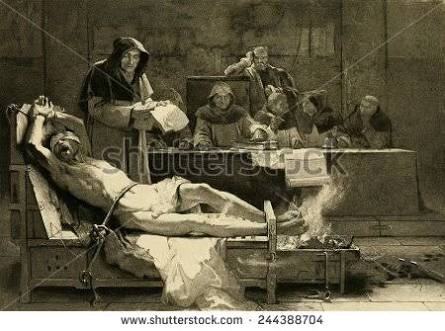
Mind you, the Muslim religion – which I confess to knowing bugger-all about – is not the first religion to try to claim world domination. The Catholic religion had dibs on that long before they came along. If you didn’t follow all the tenets of the One Holy Roman Catholic and Apostolic Church..then….well, lets have a look at that! As soon as anyone started to think outside the square – take the Cathars as an example – then the church got antsy and sent out a group of very umpleasant men called the Inquisition (or Spanish Inquisition, depending on where you lived) who, as a way of helping you back to the one true faith, would judge, torture and burn you at the stake…unless you recanted your heretical ways! Henry VIII got a bit jack of not being able to divorce his wife – who was his brothers wife originally, and who he married to keep the peace – and told the same One Holy Catholic etc etc to go to buggery, as he was starting his own church, which was going to be way better than theirs, and he’d divorce and marry anyone he liked, even if he had to lop their heads off to do it. The Catholic church got a bit miffed. And as a way of getting his revenge Henry tore down all the monasteries – who, by the way, provided most of the assistance to the poor and dispossessed, so he just added to any social problems they already had – and stripped the churches, cashed in all the art, artifacts and building materials, and killed or burnt anyone who defied him. For the next couple of hundred years, including the rise and fall of the religiously fanatical (Protestant) Thomas Cromwell, England swung between Catholicism and extremist Protestantism, with thousands of people being killed as they tried to keep up with the latest religious trend. What a fuck-up…all in the name of God! 

But that wasn’t even the worst of it! The Holy Roman etc etc Church was intent on displaying just how Holy and Apostolic it really was…not! One hardly knows where to start here. Well, on top of forcing itself on the poor folk of Britain, France, Spain, Portugal, Italy, Greece, Holland etc etc, it decided it needed to be totally inclusive, and force any other infidels to come into the fold. Jerusalem looks good, as does Byzantium. Those pesky Muhammad-pushers are also interested..so, let’s have a war, but we’ll call it a Crusade. That way, everyone can get involved, and have a jolly good time raping and pillaging their way across Europe, and take Jerusalem away from both the Jews AND the Turks. This went on for about 200 years (1095-1291), with no clear outcome, though once again many thousands died in the name of The One Holy etc etc. Naturally, both Popes and Kings had nothing better to do with their time, and got involved. Holy indeed!

This broughts heaps of money, art and treasure into the hands of the One Holy Roman etc etc, so it got richer and richer, greedier and greedier. The richer and greedier it got, the more demanding and controlling it got. It created prelates and princes. Popes married, or were just licencious, fucked around, had kids…but…don’t do what I do, do what I say. All these Popes, and prelates and princes covered themselves in gold bling, ran around in silk damask robes lined with ermine furs…drag taken to its most devout degree! To make even more money, they promised that if you parted with some cash and bought some of their recently released indulgences…hey presto! You get to skip purgatory! Feeling a bit bored? Hey..,go for a pilgrimage to some far flung corner of the earth to pray in front of some fake blood, or fake “saints” bones, or a rigged statue that bleeds. Don’t forget to buy some souvenirs! Part with that hard-earned cash, and buy your way into heaven. Let’s create an institution….no, we’ll make it a sacrament…called “marriage”. It has no legality as it is just a ritual, but we’ll hijack it anyway, and use it as another way to control people! We’ll bedazzle you with rites and splendour, intone ceremonies in ancient language, convince you that sin is bad, gulit is good! Make women a sub-class, and deny our priests a fulfilling life by enforcing celibacy. Want to molest some children as an outlet for repeessed sexuality and control? That’s fine, as long as no one finds out. After all, you are a Cardinal, or a Bishop, or a Monsignor, or a monk, or a nun. You are way beyond reproach! Let’s totally confuse you with rhetoric and theology…words like “transubstantiation” sound so much better than “cannabilism”, don’t you reckon! Want to become a saint by becoming a martyr in defence of all this “faith”? Then get yourself spit-roasted, or pack-raped, or see visions, or get frenetic enough about it all to develop stigmata, or get burnt at the stake, or whatever…then off you go! In 200 years, after appearing on a fence post and curing someone of something you’ll be sainted! 

Books? Don’t try and educate yourself, or read anything alternative or progressive! We’re burning all those, and if we catch you reading it…we’ll burn you too! 

And with all our Catholic humanity and compassion, we realise that there are primitives and cannibals around. Look at all those tiny islands, South America and Africa…full of them! We need to make them all Catholic or Protestant so they have something genuine to believe in! Destroy their culture? Don’t be silly…they never had a culture, fucking little pagans! Some nice missionaries will knock dome sense into them! They must be saved from themselves!

Even in more enlightened times we remain in the past, locked in a time when we could influence the gullible, instil fear, create guilt. Want to take the pill, or use a condom? Of course you can’t! Nothing quire like a religion that promotes STDs, and unwanred children! Sex for PLEASURE! Who are you to even think that! Missionary position, everyone…and NO pleasurable sounds, please! This is your duty!

And that was just the Catholics! The Protestants – who broke away from Catholicism for all these reasons – were no better!  Subjugate everyone with excessive guilt! Rob them of every single pleasure and joy life has! Convince them that deprivation, hardship, blandness and fanatical devotion and zeal were the sure paths to heaven! Thousands died so that these beliefs could be upheld. 

There is not one single, solitary off-shoot of Chritianity that is redemptive, or lives up to the so-called precepts of said religion. We have Opus Dei; evangelicals; glossolalia; snake charming; Jim Jones and Jonestown; Hillsong (sing alleluia and pass the plate); Mormons…who are themselves divided; Scientologists…yeah, lets base a cult (it is NOT a religion) on science fiction; Baptists; Methodists; Uniting Church; Church of Christ; Unitarians; Westboro Baptist Church…where hate and intolerance is openly preached; Right to Life movements…who ignore the most basic of human rights…choice;  Jehovah’s Witnesses; Bahai..the list just goes on…and on…and on! A whole raft of idealogical theologies that do NOTHING but promote hate, intolerance, injustice, prejudice, stigma, discrimination…and yet blame everyone else for their own shortfallings. It  disgusts me! 
The most blatant lies of all…that the bible has the answers for starters! This heavily quoted tome is a collection of stories passed down through word of mouth, and eventually put into writing by civilisations and lifestyles long dead. And should remain so! Every single Christian religion has added and subtracred from this book…depending on what met their needs, or what was surplus to requirements. It is so corrupted, distorted and misquoted for all the wrong reasons that I just laugh when I read it being quoted…usually by half-witted fundamentalists. The other lies belie and degrade the true nature of our humanity, of how we would be if we were just left to sort out right and wrong for ourselves. After all, Christianity is only 2000 years old, and does not have the history to define the most basic of human precepts. Civilisations were doing just that LONG before the Christians came along. You see, we do not need Christianity, or any other religion, to prescribe morals and ethics. We can do that…and indeed have, in times past..as a society. We all intrinsically know what is right, and what is wrong! What we need to do to live in harmony and peace, to respect each other, to not judge, to not pontificate. Religion seems to think that without them, there would be no charity, no humanity, no help for the dispossessed or those in need. It would appear to the unthinking that we need obscure Jews wandering the deserts of the Middle East, bearded men in the sky, and fanatical prophets to achieve these things. Wrong!

If we cannot achieve morals and ethics through our own humanity, through our own sense of self worth,through a sense of justice that is all encompassing, through our collective belief in the good that is inherent in all of us (and acknowledge that aberrations exist, for better or worse), that I cannot help and support my friends and family as part of a living, thriving society that does not need to resort to fallacy, misconceptions and gobbledygook for its existence…then perhaps we don’t deserve to exist at all!

I am not sure why we fail to acknowledge that almost every single genocide, mass instances of torture, sadistic, unnecessary deaths, indeed most wars are religion-based. Millions have died in the name of religion! Millions! And still are! Isn’t it time we grew up, and admitted that as an institution, religion has failed! The current Royal Commission into institutionalised child abuse is one of the most horrifying instances of religious and secular abuse imaginable. All the disgraceful hush-ups, turning a blind eye, shuffling the problems around, and disbelieving everything that was being said by the victims is staggering! Many committed suicide, many others live every day with the aftermath of this abuse. It hasn’t been going on for decades, it has been happening for hundreds of years! Every single religion, every single religious order, every single charity is involved! To be on the commission panel must be heartbreaking! To sit through every day listening to that horror!

It is time to say…enough is enough! Begone religion! Leave us in peace!

Tim Alderman (C) 2015


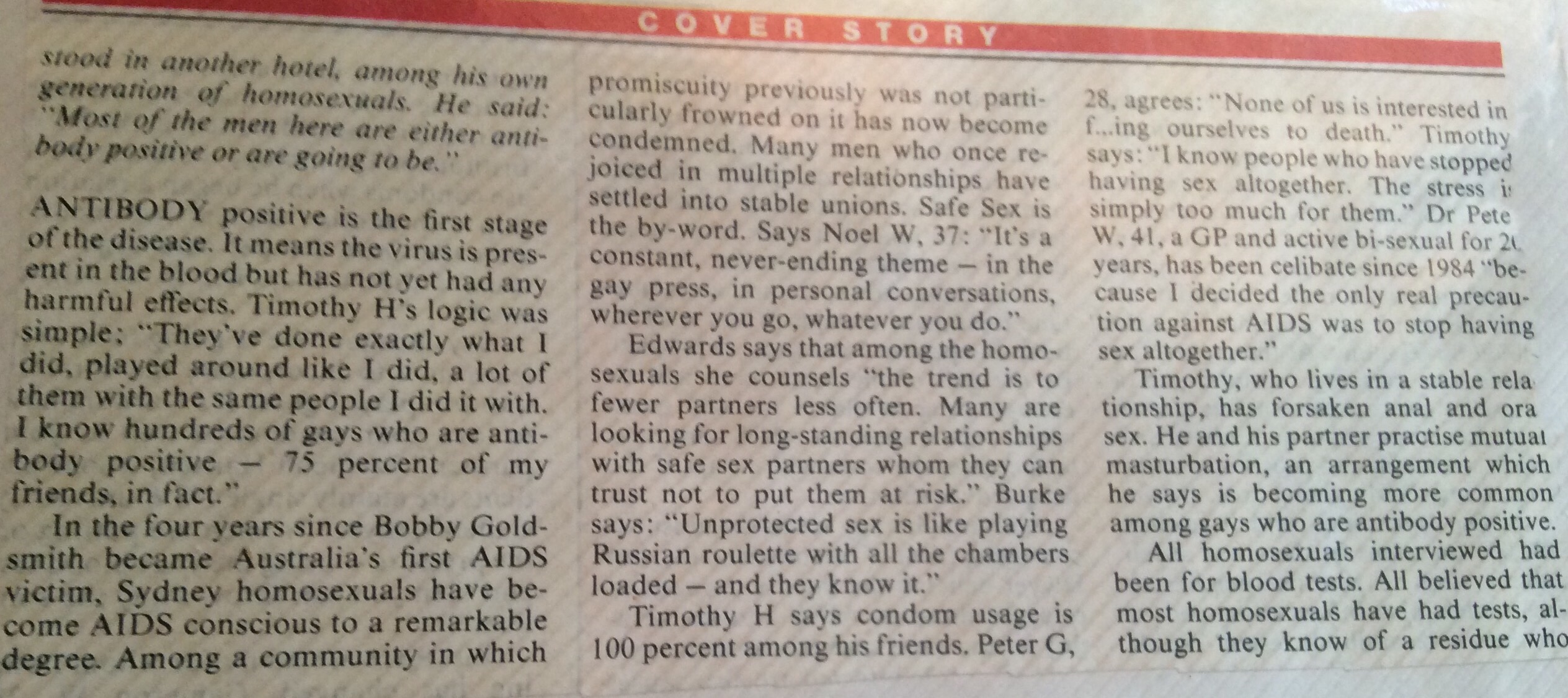
Living with HIV – 1987 Style.

This is an interview on “life” with HIV that I did back in 1987 with “The Bulletin”. When I read it now, I cringe, as it seems so naive. The reporter, whose name I can’t remember now, knew absolutely nothing about HIV…or the gay lifestyle! As you can tell, his grasp of it was no better after talking to us, and editorial license is in full bloom, with distortions, misrepresentations, and fact twisting the order-of-the-day. However, the thinking of the time is evident if you read between the lines. At two years after official testing was introduced, none of us really expected to survive. It was party, party, party! At this time, I had already lost several friends. It was very scary times. Just part of my lived history now.
   
   
Tim Alderman (C) 2015

Gay History: The Society for the Reformation of Manners.

This group hold their place in gay history due to their two-years surveillance of Margaret “Mother” Clap’s coffee shop (Molly House), thus bringing about its closure in 1726, after a police raid in which  about 40 customers were arrested.

Society for the Reformation of Manners[1] was founded in the Tower Hamlets area of London in 1691.[2] Its espoused aims were the suppression of profanity, immorality, and other lewd activities in general, and of brothels and prostitution in particular.

One of many similar societies founded in that period, it reflected a sea-change in the social attitudes in England following the Glorious Revolution of 1688, and a shifting from the socially liberal attitudes of the Restoration period under Charles II and James II to a more moral and censorious attitude of respectability and seriousness under William and Mary. Although inspired and fed by the moral excesses of London, branches were set up in towns and cities as far afield as Edinburgh, where Daniel Defoe was a member, though the societies never flourished in rural areas.

"A woman of all trades from Covent Garden". The caption on this engraving is a euphemism for a prostitute
“A woman of all trades from Covent Garden”. The caption on this engraving is a euphemism for a prostitute
The Society was arranged in four tiers, with the “Society of Original Gentlemen” at the top. These eminent professionals (lawyers, judges and MPs) along with the original founders, provided the expertise and financing to enable prosecutions to proceed. The next tier was the “Second Society” which consisted mainly of tradesmen, and whose role it was to suppress vice. Among other methods, the “Second Society” employed a blacklist which they published annually to shame the alleged offenders. Below the tradesmen was the “Association of Constables” who took a more active role in arresting the miscreants who offended the public morality. Finally the fourth layer consisted of informers: a network of “moral guardians” throughout the City of London, with two stewards in each parish, to gather information about moral infractions.[2] The central committee of “Original Gentlemen” collected the information with a view to passing the information to the local magistrates, so the malefactors could be prosecuted and punished. The Society would pay others to bring prosecutions, or bring prosecutions on its own account.[2]

A prominent supporter of the Society was John Gonson, Justice of the Peace and Chairman of the Quarter Sessions for the City of Westminster for 50 years in the early 18th century. He was noted for his enthusiasm for raiding brothels and for passing harsh sentences, and was depicted twice in William Hogarth’s A Harlot’s Progress series of paintings and engravings. In around 1770, the Society denounced Covent Garden as:
“…the great square of VENUS, and its purlieus are crowded with the practitioners of this Goddess. One would imagine that all the prostitutes in the Kingdom had decided on this neighbourhood…”[3]
The Society sought and gained the patronage of both Church and Crown: John Tillotson, the Archbishop of Canterbury between 1691 and 1694 actively encouraged the Society and his successor Thomas Tenison commended them to his bishops, while Queens Mary and Anne both issued Proclamations against Vice at the Society’s urging. The Society also had influence within the House of Lords, demonstrated by a declaration of support signed by 36 of the members. While there were undoubtedly MPs that shared the Society’s viewpoint and some which were members, there was little relevant legislation passed during the period of the Society’s activities and the Society paid little attention to the House of Commons. Jonathan Swift wrote a supportive tract in his A Project for the Advancement of Religion, and the Reformation of Manners (1709), although some detect satirical intent in the otherwise serious proposal.[citation needed]
The Society also brought lawsuits against playwrights whose plays were perceived to contain insufficient moral instruction. The new attitude to the theatre may be judged from the anti-theatre pamphlet Short View of the Immorality and Profaneness of the English Stage by Jeremy Collier, from 1698, who attacked the lack of moral instruction contained in contemporary plays, such as Love For Love (1695) by William Congreve and The Relapse (1696) by John Vanbrugh, signalling the end of the popularity of Restoration comedy.
The Society flourished until the 1730s, with 1,363 prosecutions in 1726-7.[4] There was a series of raids on “molly houses” (homosexual brothels) in 1725. One prominent victim of the Society was Charles Hitchen, a “thief-taker” and Under City Marshal. He acted as a “finder” of stolen merchandise, negotiating a fee for the return of the stolen items, while extorting bribes from pickpockets to prevent arrest, and leaning on the thieves to make them fence their stolen goods through him. His business may have been undermined by the success of his competitor Jonathan Wild. In 1727, Hitchen was accused of sodomitical practices, and tried for sodomy (a capital offence) and attempted sodomy. He was sentenced to a fine of 20 pounds, to be put in the pillory for one hour, and then to serve six months in prison. He was badly beaten while in the pilory, and died soon after being released from prison.
The Society was revived for a period in the 1750s, triggered by the libertine excesses of the Hellfire Club, and was recognised by George II. A later successor was William Wilberforce’s Society for the Suppression of Vice, founded following a Royal Proclamation by George III in 1787, “For the Encouragement of Piety and Virtue, and for the Preventing and Punishing of Vice, Profaneness and Immorality”.

From Wikipedia

1 ^ In 17th century English, “manners” meant “morals” rather than etiquette.
2 ^ a b c Reformation Necessary to Prevent Our Ruin, 1727, Rictor Norton.
3 ^ Burford p.192
4 ^ Commentary on Conjugal Lewdness (1727) by Daniel Defoe, from the Literary Encyclopedia.

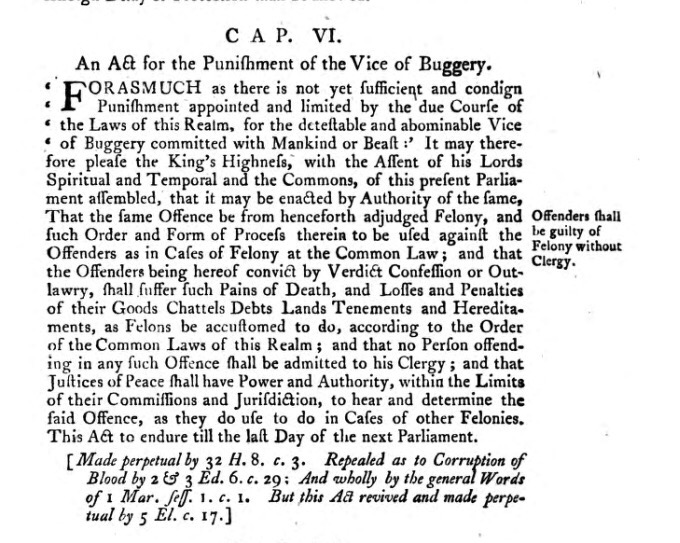
Gay History: Henry VIII’s Buggery Act of 1533

Buggery Act 1533

Actual text:

Forasmuch as there is not yet sufficient and condign punishment appointed and limited by the due course of the Laws of this Realm for the detestable and abominable Vice of Buggery committed with mankind of beast: It may therefore please the King’s Highness with the assent of the Lords Spiritual and the Commons of this present parliament assembled, that it may be enacted by the authority of the same, that the same offence be from henceforth ajudged Felony and that such an order and form of process therein to be used against the offenders as in cases of felony at the Common law. And that the offenders being herof convict by verdict confession or outlawry shall suffer such pains of death and losses and penalties of their good chattels debts lands tenements and hereditaments as felons do according to the Common Laws of this Realme. And that no person offending in any such offence shall be admitted to his Clergy, And that Justices of the Peace shall have power and authority within the limits of their commissions and Jurisdictions to hear and determine the said offence, as they do in the cases of other felonies. This Act to endure till the last day. of the next Parliament.”
Thomas Cromwell, House of Commons

 
Note: This act was extended through Parliament three additional times. Notable convictions under the act included: Walter Hungerford, 1st Baron Hungerford or Heytesbury in 1540; Mervyn Tuchet, 2nd Earl of Castlehaven in 1631; John Atherton, Bishop of Waterford in 1640; Vere Street Coterie in 1810; and Percy Jocelyn, Bishop of Clogher in 1822.

Thomas Cromwell - God's executioner
Thomas Cromwell – God’s executioner

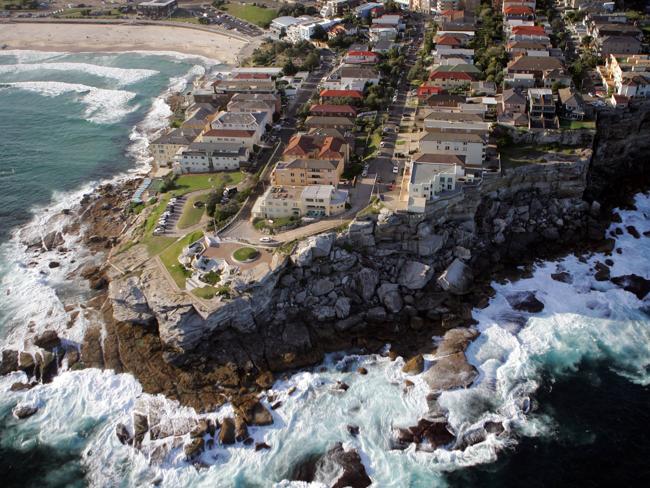
Australian Icons: Big Rock; The Mermaids; Aboriginal Rock Carvings; Gun Battery; 16th Century Spanish Visitor? – Ben Buckler/North Bondi, NSW.

To many tourists, Bondi, in Sydney’s Eastern Suburbs, is just a beach, a long expanse of sand and surf. However, Bondi beach itself is divided between the suburbs of Bondi and North Bondi – and don’t try to tell any local they are all the same area! North Bondi us partly situated on a long point of land creating the northern head of Bondi Bay. Wrapped around the point are steep cliffs, and rugged rocks that are lashed by the full fury of the surf. This barren area is known as Ben Buckler.

Map of North Bondi/Ben Buckler
Ben Buckler is the name of the northern headland of Bondi Bay. There are many conflicting stories about how a headland came to have a male name, but what is undisputed is that the first recorded use of the name was in 1831, when a land grant to Richard Hurd at North Bondi was described as being ‘…to a point called Ben Buckler’. The three most common theories about its naming are:

• It was named for a convict Benjamin Buckler or Ben Buckley, who lived locally with the Aboriginal people from 1810. His friend and fellow convict James Ives claimed he was killed near the point now bearing his name when the rock shelf on which he was standing collapsed. He also claims that the headland was formerly known as ‘Ben Buckler’s leap’.

• A variation on the story has a bushranger called Ben Buckley who, after taking part in many adventures and after obtaining his liberty, lived in a cave in the rocks at the northern end of Bondi Beach and was a known local character.

The rugged cliffs and rocks of Ben Buckler
• Obed West (1807-1891) claimed that it was a corruption of an Indigenous word ‘benbuckalong’. Others have claimed that the Indigenous word was originally ‘baal-buckalea’.

But is there a Governor Lachlan Macquarie connection? This was first raised in an anonymous letter to the Sydney magazine the Australian Town and Country Journal on 25 May 1878. The writer, using the nome de plume, ‘Old Colonist’ claimed that the name Ben Buckler was a corruption of a name bestowed upon the headland by Macquarie. He went on to argue that Macquarie named it ‘Benbecula’ in honour of the island of the same name located in the remote Outer Hebrides off the west coast of Scotland.

Macquarie was born on one of the Hebridian Islands, Ulva, and would have been familiar with other islands in this group. The west coast of Benbecula has golden sand beaches, including one long sweep of beach Poll na Crann, with sand dunes behind them, the same coastal environment as Bondi Beach had before its development. Macquarie was born on island of Ulva in the Inner Hebrides, Scotland in 1762 and may have visited Benbecula, although this cannot be confirmed.

Macquarie would have travelled along the South Head Road, (now Old South Head Road) which had been constructed in 1811 and along parts of this Bondi Beach and its northern headland would have been visible. Did it look like Benbecula from a distance?

In 1906 the discussion began again in a local paper The Bondi Weekly when a land subdivision on the headland, known as the Queenscliffe Estate, began rumours that Ben Buckler’s name was to be changed to Queenscliffe.

On 29 June 1915 Captain J. W. Watson of the Australian Historical Society decreed that ‘the name of Ben Buckler is a corruption of Ben-becula, the name given by Macquarie.’ There is no primary evidence for any of the claims for the name Ben Buckler, making the debate about it all the more fascinating.

Published by Waverley Library from Local History source material, 2012.

The Big Rock

The Big Rock aka Mermaid Rock
On the flat rock platform below the cliffs of Ben Buckler, Bondi’s northern headland, sits a huge boulder. Attached to its side is a brass plate which reads:

“Municipality of Waverley. This rock weighing 235 tons was washed from the sea during a storm on 15 July 1912. January 1933. J. S. MacKinnon. Town Clerk.”

It was fixed to the rock on 16 March, 1933. On Saturday 13 July, 1912 Sydney was under the influence of monsoonal activity resulting in a steady downpour of rain. Conditions deteriorated the following day and the weather was described by The Daily Telegraph as ‘a cyclonic storm – a bleak southerly gale raging, with fierce rain squalls. During the afternoon the rough weather on the coast continued with, if anything, greater fury.’

The Sydney Morning Herald described the weather as coming ‘from a cyclonic disturbance between Lord Howe Island and the central coast of NSW’ reporting that the wind was up to 113 k.p.h. along the coast, from Manly to Long Bay, beaches sustained serious damage. The wild weather continued over the weekend with newspaper reports describing waves at Tamarama as ‘rolling in like mountains’ and sea spray breaking at points ‘which had previously been unvisited by the waters of the Pacific’. Bronte Baths were damaged by this storm and the force of the sea threw huge boulders into the Bogey Hole.

Plaque placed by Waverley Council
On Bondi Beach the ocean had washed up to the edge of the concrete wall which then ran behind the beach, completely covering the sand. At Bondi Baths a gigantic plank, probably a diving board, described as being ‘about a foot in thickness’ was snapped in half.

The Watts family who lived in the old ‘Castle’ Pavilion, the forerunner to the current Bondi Pavilion, right on Bondi Beach reported being terrified by the storm as the south-facing beach bore the full front of the weather. It was after this wild weather subsided that a giant boulder on the North Bondi rock platform was first noticed. It was reported that the force of the mountainous seas which swept along the beaches during these storms had thrown up this enormous submerged sandstone rock from the ocean onto the rock platform. In November, 1932 it was grandly titled ‘Bondi’s Gibraltar’ by the Sydney Morning Herald which reported on Waverley Council’s decision to put a ‘tablet’ on the rock twenty years after its presence was first recorded, in order to record its history.
Cover of the Bondi View, June/July 2002.

Did it fall down – or was it thrown up? The long-accepted position on how The Big Rock came to be sitting on the North Bondi rock platform was that the boulder had been thrown up during the wild storms of July 1912, something that those who witnessed it had no trouble in believing. Soon after the storms a scientist, Carl A. Sussmilch, took measurements of the rock, talked to locals and calculated its weight at 232 tons. He noted deep eroded grooves near it which ran along the rock platform toward the sea and deduced that the force of the storm lifted the rock up from under the sea, flipped it over and with the aid of the strong wind skimmed it along the surface of the platform.

Cover of the Bondi View, June/July 2002
He believed it had been turned over, leaving a new surface on top and marinegrowth on the underside. Local residents were divided; some believed the rock had always been there, claiming that they had frequently changed into their swimming costumes behind it. Another view was that there used to be many smaller rocks around this huge one and it was these smaller ones which were washed away during the storms, leaving The Big Rock exposed and prominent in a way it hadn’t been before and leading to the belief that it had suddenly appeared.

Regardless of some views to the contrary, the position that The Big Rock was washed up in the July 1912 became the accepted one and this position is repeated in most histories of Bondi Beach. In mid-2002 Bondi resident Lee Cass, then editor of local paper The Bondi View disputed the long accepted theory that The Big Rock was thrown up by the sea. His detailed rebuttal analyses the accepted wisdom about The Big Rock and finds it all wanting. He proposed an alternative view, that The Big Rock fell from the headland at Ben Buckler and furthermore that it was in place as long ago as 1888. His article ‘The Big Rock: exploding the myth’ appears in The Bondi View June-July 2002 edition a copy of which is available in Waverley Library in the Reference, i.e. non-lending, serial collection.

The Big Rock becomes Mermaid Rock in  April 1960. For decades afterwards, despite having no mermaids, the rock continued to be referred to as Mermaid Rock. However that name, along with the memory of the mermaids who made it their rocky throne, has now almost disappeared and the boulder has gone back to its first, and basically self-descriptive title The Big Rock.

In  June 2012, almost 100 years since the ferocious storm which is generally believed to have thrown up The Big Rock from its former watery home, extraordinarily powerful weather hit the east coast of Australia. This battered our beaches and the accompanying wild winds caused extensive damage. At Bondi huge seas rolled in, covering the sand and sending enormous waves crashing against the breakwater at the northern end of the beach and overrunning the promenade. Emergency service workers described it as possibly a ‘one-in-100-year storm’ it seems well-timed indeed.

Published by Waverley Library from Local History source material, 2012. Reference: ‘The Big Rock: exploding the myth’ from the Bondi View June-July 2012 ed,

The Mermaids

Mermaids looking out to sea
There were originally two Bondi mermaids who sat on the Big Rock at Ben Buckler.Because the mermaids used to sit there this rock is also often referred to as Mermaid Rock. Only the remains of one of the mermaids is still in existence. She is on permanent display in a special perspex case on the 1st floor, Waverley Library, 32-48 Denison Street, Bondi Junction. The mermaid statues were modelled on two local women:

• Jan Carmody, who was Miss Australia Surf, 1959

• Lynette Whillier, champion swimmer and runner-up in the Miss Australia Surf, 1959

The Mermaids
The Mermaids
Sculptor Lyall Randolph created the mermaids from bronze-coloured fibreglass that he filled with cement. He first tried to sell the idea of the mermaids to Waverley Council, but the Council refused to pay for them.

So Lyall erected them on the Big Rock at his own expense. He claimed that because they were placed a certain distance offshore the space they occupied was not under the jurisdiction of Waverley Council, but the Department of Lands. He claimed that the Department had approved his statues. The mermaids were installed on 3 April 1960.

One month after they appeared university students chiselled mermaid Jan from the Big Rock and removed her as part of a Commemoration Day prank! She was later recovered under mysterious circumstances at the Engineering School, Sydney University. Repaired, she was restored to the Big Rock to rejoin her fellow mermaid Lynette. The cost of repair met by public subscription – the public loved the mermaids so much that they paid for Jan to be put back together again.

The surviving mermaid in Waverley Library
Heavy seas claimed Lynette in 1974; swept off the Big Rock in a storm she disappeared forever. Jan lost an arm and her tail in the same storm. For two years Jan sat alone on her rocky throne until Waverley Council removed what was left of her in 1976, storing her in a Council Depot where she was forgotten for many years. Re-found in the late 1980s she was moved to Waverley Library, where, in 1999, the Friends of Waverley Library paid for her remains to be preserved by Sydney Artefacts Conservation.

image


Aboriginal Rock Carvings

Contemporary Bondi Beach is popular with surfers and sun-lovers. In earlier years, Aboriginal people also found it an attractive place, with its abundant nearby fresh water, fish and rocky shores full of shellfish. The name Bondi, also spelt Bundi, Bundye and Boondye, comes from the Aboriginal ‘Boondi’. According to some authorities, this means ‘water tumbling over rocks’, while the Australian Museum records its meaning as ‘a place where a fight with nullas took place’.
Early British arrivals identified Aboriginal pathways running from Port Jackson to the coast. In 1882, Obed West described Aboriginal men walking from Sydney harbour to Coogee or Bondi with bark canoes on their heads, looking for the best fishing spots. A midden of shellfish debris and artefacts at the edge of the dunes has now disappeared under modern development.
In 1899, a large cache of stone artefacts that came to be known as Bondi points were found at the northern end of the beach. These long thin blades were shaped to use as spear points and barbs and were first called ‘chipped-back surgical knives’ because they are shaped like scalpels.

image

Situated on the southern or sea side of Bondi Golf Course, adjacent to a sewerage treatment plant, there stands a substantial panel of Aboriginal rock carvings depicting various fish species. They are carved into the flat sea-cliff at a fishing rock known to the Indigenous people as Murriverie or Marevera. They were formed by pecking at the rock surface with pointed stones or shells, and extended over 60 metres southwards.
The largest group shows an eight-metre figure of a shark that appears to be attacking a male figure that could be an iguana or lizard. This could be the first record of a shark attack at Bondi. It was earlier thought to be a whale, as there are two other rock engravings of whales at Bondi, but the dorsal and pectoral fins identify it as a shark.

image
A separate panel shows two fish and a boomerang. The southernmost portion of the group has been cut deeper and is probably of an older date, possibly up to 2,000 years old. Ancestral footprints (mundoes) that once led to the site have now faded. It is assumed that the carvings were linked to a ceremonial ground overlooking the ocean.
A low chain fence now encloses the site. The carvings were retouched and fenced in 1951. A plaque commemorates a misguided attempt in 1964 by Waverley Council to preserve the engravings by re-grooving them. They are listed on the State Heritage Inventory but are poorly drained, blistering, and in danger of being damaged. They deserve serious attention as evidence of the Aboriginal occupation of Bondi long before the blonde-haired surfers arrived.

image

The Ben Buckler Gun Battery

The Ben Buckler Gun Battery was constructed in 1892 as one of a set of three coastal defence fortifications for Sydney Harbour, the other two being Signal Hill Battery at Watsons Bay and the Shark Point Battery in Clovelly. These fortifications were the last link in Sydney’s outer defence perimeter, which was intended to defend Sydney from bombardment by an enemy vessel standing off the coast. The fortifications built in the 1890s around Sydney’s eastern suburbs were the culmination of some twenty years of construction of harbour defense installations that reflected the changing policy of the time to meet new technologies, threats and styles of warfare.

Gun emplacemen
The Ben Buckler Battery is a rare, intact concrete 1890s gun emplacement, which was designed and developed for the new BL 9.2 inch (234 mm) Mk VI breech-loading ‘counter bombardment’ British Armstrong ‘disappearing’ gun. The Australian colonies bought 10 of these, three for Sydney, plus an extra barrel, four for Victoria at Fort Nepean and Fort Queenscliff, and two for Adelaide, South Australia, purchased in 1888. The Adelaide guns were never installed at Fort Glenelg and the British government bought them back in 1915. The barrel of the gun that had been installed at Signal Hill Battery survives on public display at the Royal Australian Artillery Museum at North Fort, North Head.[citation needed]

The Ben Buckler gun, Serial Number 7319, is the only complete 9.2-inch in Australia and was the largest gun in New South Wales. The gun barrel weighed 22 tons and it took a total of thirty-six horses to transport the barrel from Victoria Barracks in Darlinghurst to the battery in North Bondi; the transit took over three weeks.
Soon after its arrival, the gun was installed on a hydraulically operated disappearing mount. The gun was located below ground level and beneath a domed iron shield set into a wall of reinforced concrete that was ten meters in diameter. The domed metal shield that covered the pit was intended to protect the gun from incoming shells.
Once the gun was loaded, the hydropneumatic action shunted it forward and up through a slot in the shield. After discharging, the recoil mechanism forced the gun back into its pit. This protected the gun crew while loading and made the gun a very difficult target for an enemy ship to hit.
Sometime in the 1950s the army vacated the site. The government was unsuccessful in finding a scrap metal buyer to remove the gun, so it buried the gun and gave the site over to parkland. The gun’s existence was forgotten until it was rediscovered in the mid-1990s by Water Board engineers planning a new pipeline. It is now classed as an architectural relic and is under the protection of the Heritage Council.

image
The “Spanish Proclamation”
From The Secret Visitors Project   

High above Bondi Beach with spectacular views out to sea you will find a small rock engraving which became one of the proofs used by aviation pioneer Lawrence Hargrave in support of his theory that the Spanish had landed in eastern Australia in 1595. He thought that the Spanish had made this carving as their official record of their presence and possession of the land, and termed it the Spanish Proclamation. Hargrave’s argument convinced very few people and the story associated with the engraving remains largely forgotten.

Hargrave is best known for his aeronautical experimentation, for which he is rightly recognised as a pioneer. Much of this took place in the late 19th century; once the Wright brothers flew successfully his work was superseded by others. Perhaps in part driven by relevance deprivation, during mid 1906 Hargrave was inspired by the discovery of a cannon in Torres Strait and his own memories of work in the same area in the 1870s to develop a theory that the Spanish mariner Lope de Vega in the ship Santa Isabel [or Ysabel] had been separated from Alvaro de Mendana de Neira’s expedition to settle the Solomon Islands and had instead travelled as far south as Sydney Harbour, where they stayed for perhaps 3 years before being rescued.

image

Figure 1. Hargrave’s recording of the ‘Spanish Proclamation’.

Hargrave presented his theory to newspapers and in a lecture to the Royal Society of NSW in June 1909. The second part of his talk was presented in December 1909 to strong negative reaction. The published Royal Society papers, and later self-published documents and newspaper letters introduced a range of evidence to support his theory. One of his key proofs was the engraving at Bondi.


The engraving
Description
The engraving [Figure 1] is located on the headland to the north of Bondi Beach, known since at least the 1830s as Ben Buckler. Later it was also called Meriverie [various spellings, earliest being Meriberri], which was also the name of the quarry that mined a basaltic dyke on the headland. The engraving is on exposed rock near the edge of the cliff, partly within a shallow natural depression that holds a few centimetres of rainwater. About 50 metres to the south is a large rock exposure that contains a number of Aboriginal rock engravings, later re-cut by Waverley Council. Immediately to the northwest is the tall chimney of the Bondi Ocean Outfall Sewer. The engraving is currently surrounded by a small chain fence.
The engraving shows two sailing ships in profile. Around and over them are a series of letters – BALN ZAIH – and other engravings such as a cross within a circle. They are engraved into the surface of the sandstone. They are oriented to be read from the west.
The full set of motifs are:
Ship 1 – port side view, curved hull, suggestion of rudder, sterncastle and two part forecastle, bowsprit. Measures 660 mm long by 220 mm high.
Ship 2 – starboard side view, curved hull, delineated keel, sterncastle, bowsprit, about 12 portholes marked by dots. Has deteriorated too much to allow measurement, but scaled from existing drawings is about 1000 mm long by 250 mm high.
Lettering – first line B A L N, second line Z A I H, third line W O. The O is divided into quarters with a vertical cross. Lettering height ranges from 135 mm for the Z to 150 for the B. The first two lines are about 500 mm long.

Line – a line 400 mm long with a small triangle at either tip.
The engravings were first noted by Campbell in his 1899 recording of the nearby Aboriginal engravings. He mentioned that these engravings looked much less weathered than the Aboriginal motifs [Campbell 1899: 11]. Watson and Vogan [Watson 1911] detected two different hands at work, while Hargrave conceded that the N, I and H were scratched rather than chiselled in [Hargrave 1914: 34]
When inspected in March 2010 the engraving was found to be in poor condition. Recent wet weather had resulted in part of the engraving being covered with standing water. The lettering is clear, as is Ship 1 at the bottom of the panel. The outline of Ship 2 to the right had all but disappeared, and could only be faintly detected.
Parts of the rock platform surface are exfoliating, where the hardened surface rind of stone had detached from the bedrock and popped off completely, exposing softer stone. The chains that had been erected around the panel are also dragging on the rock and abrading the stone.
Interpretation
Hargrave read the motifs as being a single coherent and purposeful message, cut into the shallow depression in one episode. In his scheme it was the semi-official proclamation of the survivors of Lope de Vega’s expedition, made after their rescue by the Santa Barbara in c.1600. In his reading the two ships are the Santa Isabel [or Ysabel] and the Santa Barbara. The lettering Hargrave interprets as Santa BArbara, Santa YZAbel for the ships and ‘L‘, ‘N‘, ‘H‘ being initials of the senior men present. ‘W‘ was the name they gave to this country. The cross in the circle was Spain’s symbol for conquest in the name of God.
Read together the symbols and letters meant, ‘We in the Santa Barbara and the Santa Ysabel conquered W… from point to point. By the sign of the Cross.’ The initials represent Lope de Vega and his three witnesses, N, I and H. This version appeared in his 1911 booklet and he maintained it essentially as is until his death. One variation that appeared in his later thoughts is that he thought W… referred not more generally to the eastern Australian coast but to an island formed from the higher land between Randwick to South Head, believing that this was separated by swamp or open water from the rest of Sydney in 1595.
Hargrave also believed that the name Meriverie itself was Spanish in origin, being Mare-y-ver-e = ‘Sea view’ [Hargrave 1914: 34].
History of the engraving
Hargrave’s interest
The headland at Ben Buckler had already been the scene of significant European activities before Hargrave’s attention was drawn to it. Quarrying the ‘white metal’ basaltic dyke at O’Brien’s Bondi Quarry began in 1860-61 and continued for decades. In 1888 a sewer vent was installed near the engravings as part of the Bondi Sewer. In 1910 it was replaced with the current sewer tower.
The engraving first came to notice when Aboriginal carvings were being recorded by WD Campbell, who produced a detailed corpus of engravings in the Sydney district for the Geological Survey of NSW. After describing the Aboriginal engravings immediately to the south he noted:
[s]ome clue as to the slow rate of decomposition of the rock surface is afforded by a small carving which has been done with a chisel, by a white man evidently. It is one chain north-easterly from the north end of this group; it represents the hulls of two small vessels with the old-fashioned high poop and forecastle in vogue at the time of the founding of the Colony. Although this is considerably weathered, it is not anything like so much as that which the group above has undergone [Campbell 1899: 11].
The earliest mention of the Spanish Proclamation by Hargrave is a 1:1 tracing that he made of the engravings onto linen sheet. The annotation that the engravings sat in a shallow depression that may have prevented ‘wanton vandalism’ is dated 12.3.1910 [Hargrave 1914: unnumbered]. Apart from this there is a note in his personal papers held in the Powerhouse Museum Archives dated to 18.4.1910, which follows the form Hargrave used when he had a bright idea and wanted to document it properly within his files. The note identifies the lettering and their equivalents which he would later propose as the translation. Other undated material in his papers includes comparative hull profiles of the Santa Barbara, Santa Isabel and Columbus’s Santa Maria.
The President of the Royal Australian Historical Society James H. Watson had already disagreed with Hargrave publicly over the origin of engravings of human and animal figures at Woollahra Point, suggesting that rather than being of Spanish origin they were done by convicts early in the colonial period. In Watson’s view the outstretched arms were meant to show a convict tied to a whipping frame [Watson 1909]. When Hargrave ventured more public comments in 1911 Watson issued a strong critique in a newspaper letter.
Regarding the Ben Buckler engravings the carvings on the Bondi cliffs, to my mind-and also to that of Mr. A. J. Vogan, who accompanied me when I inspected them have been done at different periods, the larger ship being much older than the other. The royal-forecastle of the smaller appears to have been added, as also the bowsprit, and is not a part of the original. The letters look much more recent than the ships. [Watson SMH 15.9.1911 p. 5]
The letter is interesting in several ways. Clearly, Watson was systematically examining the evidence Hargrave put forward in support of his theory. Secondly, he mentions Arthur J. Vogan, who was to shortly embark on his own even more fanciful analysis of Aboriginal engravings and evidence for prehistoric migrations into Australia and the Pacific.
In 1911 Hargrave wrote to the Spanish Consul seeking support to protect the engravings at Woollahra Point and Ben Buckler but without success. Around this time he also approached the Mitchell Library to see if they could fund the recovery of ‘the most important document in Australian history’ as he called the Bondi carving. They declined, suggesting instead the Australian Museum [1914: unnumbered]. An upset Hargrave wrote to his two daughters in Britain, saying that this was unacceptable, as the Australian Museum staff were wedded to the Aboriginal engravings idea. Hargrave was at the same time working with Museum staff to excavate a midden on one of the Woollahra Point blocks near his home, in the hope of finding evidence to support his theory. His exasperation at the treatment of the Spanish Proclamation spilled over into an angry letter to the Sydney Morning Herald, in which he says
Your liberal-minded readers will understand better what “discredited” means when I tell them that the Mitchell Library declines to preserve the oldest document in Australia, the Spanish proclamation at Meriveries; that the Australian Museum tells me the few things that I say relate to Spain are all rubbish; that the Historical Society, through their president and secretary, ascribe the industry of certain in telligent convicts as being accountable for things I render reasons for being Spanish. [Hargrave SMH 12.9.1911, p. 7]
One possible convert that Hargrave made in this debate was Norman Lindsay, then an illustrator at the Bulletin magazine. Lindsay was deeply interested in historical ships and was a proficient model-maker, as well as being a very competent craftsman and artist in a range of media, a trait that probably endeared him to Hargrave who admired practical skills. In the magazine The Lone Hand in 1913 Lindsay wrote his own appreciation of the Lope de Vega story, illustrating it himself. The illustrations of the Lope de Vega story cover the ship, the carving of the Spanish Proclamation [see Figure 2 below], the last castaway making the bamboo figure een by Hargrave on Ugar Island in Torres Straits and the alleged shipwreck on Facing Island.
Lindsay’s belief in the story was qualified. In discussing the Spanish Proclamation he says ‘What the lettering accompanying these carvings means I prefer to leave out of this discussion. Mr Hargrave has his theory, which is very ingenious and may be right.’ [Lindsay 1913: p. 274].

image

Figure 2. Norman Lindsays depiction of the engraving of the Spanish Proclamation

Hargrave maintained his belief in the inscriptions and his overall theory until his death in early 1915. Almost no-one later admitted to having followed and supported his belief, something that Hargrave himself did not find a concern:

Still, it is better to be always in a minority of one and state your views as plainly as your ability allows than to have the support of a majority who do not know the meaning of the things you have attempted to portray. [Hargrave SMH 12.9.1911, p. 7]
After Hargrave
Hargrave’s death effectively ended the speculation about these engravings. The inter-war period generally was very quiet in terms of speculations about secret visitors, a phenomenon we have yet to fully understand. Some significant new information did appear that helps us to understand the possible origin of the engravings.
A letter was published in the Sydney Morning Herald by CW Peck in 1928. Peck had written a number of books and newspaper articles on Aboriginal legends and was involved in the Anthropological Society of NSW. While he was generally sympathetic to Aboriginal people and their past he strongly disagreed with the idea that they were necessarily responsbile for the rock engravings around Sydney. He believed this on the basis of no recorded evidence by early European settlers. It was in this context that he critiqued others who believed that Aboriginal engravings were authentic, arguing that some at least were the work of whites.
There are at the present time living in or near Sydney two brothers, both over 70 years old, and both native born. … Out Palm Beach way there are aboriginal rock carvings (sic) done by these brothers in the days of their youth. … I think they sat back and laughed when Lawrence Hargreaves found out so much about the visits of some old Spaniard to Ben Buckler, and they certainly laugh at the naming of the high pooped ships crudely drawn. … Will it not be funny when the Ben Buckler drawings are fenced in, and school children are marched down to see the pictures of the Spanish ships that came here in the sixteenth century. [Peck SMH 4.10.1928: 6]
He went even further in a letter in the Sydney Sun:
The Spanish galleons on the rocks at Ben Buckler were cut by two employees of the Dredge Service who were ardent fishermen about 60 years ago. [Peck Sun 11.9.1929].
Michael Terry wrote of the engravings, uncritically accepting them as part of a broader range of evidence for Spanish or Portuguese voyaging down the east coast [Terry 1969]. The next advocate for European voyagers was Kenneth Gordon McIntyre who, although he provides evidence in support of his claim that Spanish sailed down the eastern coast, does not mention any of Hargrave’s sites.
Gilroy featured the engravings in Mysterious Australia [1995: 237-239] although he mistakenly referred to them as being on the north head of Botany Bay. The tone of his description is also equivocal about their authenticity, which is unusual as Gilroy often embraces even quite implausible anecdotal accounts of discoveries.
This part of the headland has now become a golf course which is reasonably compatible with the retention of the engravings. The Aboriginal engravings were deepened to make the images stand out in 1951 and again in 1964, a practice that has severely affected their appearance. In 1986 the Spanish Proclamation engraving was recognised and added to the Waverley Council Local Environment Plan as an item of environmental heritage. There has been subsequent vandalism and addition of new graffiti but most remain clearly legible. The protective fencing however is now doing more damage than good.
Analysis
How do we critique Hargrave’s reading of the engravings? It almost is too outlandish to even know how to start and how would we convince Hargrave that it was suspect? Clearly from 1910 Hargrave had lost all perspective on his Lope de Vega theory and was unable to rationally assess any arguments or evidence contrary to his scenario. He had delivered his second Lope de Vega talk to the Royal Society of NSW in December 1909 and the reaction was so negative that they declined to hear a third instalment. Hargrave was keen to find evidence that proved his argument, and the engravings at Ben Buckler seemed to fit the bill.
Unlike Hargrave’s reading of the Woollahra Point engravings as being non-Aboriginal there is no dispute regarding the European origin of these engravings. Hargrave went to great lengths to compare the ships with other more-or-less contemporary illustrations, such as those of Columbus’s voyages. While moderately successful in showing that they were not typical of late 19th century built ships the conclusion could not be pushed too much further.
The explanation of the lettering, however, really strains credulity. Turning a bunch of letters into an elaborate message conveying information about ship names, conquest and the names of witnesses simply does not work. At different times Hargrave pleaded the illiteracy of the crew and the Peruvian slave miners but this is at odds with the importance he places on the message as Lope de Vega’s parting memorial. The idea that such an important message would be so poorly composed was one he could never surmount, and made even sympathetic supporters, such as Norman Lindsay, question this fundamental basis for his theory.
Peck’s information about these being either deliberate fakes or simply old graffiti is very specific and places their creation at about 1870. Watson and Vogan [Watson 1911] noted that the two ship engravings were of different depth, which is now borne out by the almost complete disappearance of Ship 2, and Campbell also stated they were clearly much fresher cutting than the Aboriginal engravings immediately to the south, consistently with Peck’s claim. The earliest reference I have to O’Brien’s Bondi Quarry operating is 1861, which also allows for the possibility of quarry workmen being implicated in their creation as well.
Conclusion
In conclusion there is second-hand but reasonable evidence that the engravings were done in about 1870, by known individuals. The condition of the engravings is consistent with a post-European date, and certainly not in the order of four centuries. The differing engraving of the motifs suggests a number of hands, and it is reasonable to suppose that they are a palimpsest made over time rather than representing, as Hargrave thought, a coherent group with a single meaning. Hargrave’s interpretation of the meaning of the engraving cannot be supported in any way. It stretches the limited content to fit his desired theory of Lope de Vega’s presence in Sydney. The reading is illogical and pushes credibility. In the face of alternative plausible explanations Hargrave’s interpretation cannot be accepted as the explanation for the engravings.

References

Gilroy, R. 1995
Mysterious Australia, Nexus Publishing, Mapleton.

Hargrave L. 1909
‘Lope de Vega’, Journal and proceedings of the Royal Society of New South Wales, 43, pp. 39-54, 412-425

Hargrave, L. 1911
‘Australia’s discovery’ [Letter], Sydney Morning Herald, 12 September 1911, p. 5.

Hargrave, L. 1914
‘Lope de Vega’ annotated manuscript, amendment dated 23 February 1914, ML MSS 3119, Mitchell Library, Sydney.

Lindsay, N. 1913
The end of Lope de Vega’, The Lone Hand, 1 August 1913, pp. 271-277.

Peck, C.W. 1928
‘Rock carvings at Ben Buckler’ [Letter], Sydney Morning Herald, 4 October 1928, p. 6.

Peck, C.W. 1929
[letter to Editor], Sun [Sydney], 11 September 1929.

Watson, J.H. 1909
‘Supposed Spanish occupation of Woollahra Point’ [Letter], Sydney Morning Herald, 14 August 1909, p. 16.

Watson, J. H. 1911
‘Australia’s discovery’ [Letter], Sydney Morning Herald, 15 September 1911, p. 5.

To be checked
Campbell – unpublished original field recordings of the 1899 survey – held in Mitchell Library
Figures
Figure 1 – Published in Hargrave’s self-published booklet – Lope de Vega [1911]. This recording was made in March 1910, using a full-size tracing of the engraving, which was later both photographically reduced and redrawn to scale using a reduction grid. The copyright on this image has expired.
Figure 2 – One of the drawings created by Norman Lindsay to illustrate his article on Hargrave and Lope de Vega in The Lone Hand [1913]. The copyright on this image has expired.
https://secretvisitors.wordpress.com/2011/03/20/the-spanish-proclamation/

image

Australian Icons: Wonderland City, Tamarama NSW. Formerly the Royal Aquarium and Pleasure Grounds.

IMG_0233

To look at Tamarama beach today, it is hard to envisage that it was once the site of the largest open-air amusement park in the southern hemisphere, nor that there were attempts in the early 20th century to ban swimmers from the area.

Originally the site for the Royal Aquarium and Pleasure Grounds (commonly referred to as the Bondi Aquarium), it was an amusement park situated in Fletcher’s Glen at Tamarama beach.


It opened on the 1st October 1887 and touted a Great Military Band, merry-go-rounds, swings, shooting gallery, water boats, Camera Obscura, Punch ‘n Judy show, and dancing in the Grand Hall.

There were huge marine aquarium tanks featuring many fish varieties, sting rays, lobsters, turtles, wobbegong and tiger sharks. Seals shared a pond with a solitary penguin. There was a switchback railway, a roller coaster ride above the sand on Tamarama beach, two roller skating rinks, which eere “illiminated by the electric light”. Every Wednesday, Pain’s Grand Fireworks exploded overhead, and there were Sacred and Classical concerts every Sunday.

In typical early 1900s tradition, feats of daring-do were a must. Alexander, an Australian wire walker, walked a wire from cliff to cliff. Captain George Drevar floated on a “cask raft” in the surf. There was a Grand Balloon Ascent and Parachute Descent. Headliners from the Tivoli Theatre perforned on the Aquarium Curcuit.


Fire destroyed the Aquarium and Pavilion on 11th July 1891, but it rose from the ashes in September the same year, and continued on. The ladt known concert there was a fund-raiser for the Waverley Benevolent Society in 1906. Ownership and management chantes several times over the coarse of its existence, and it was finally sold by Mrs Margaret J Lachaume to William Anderson in 1906. He transformed and renamed it Wonderland City.                                                                        IMG_0232
Anderson was a Prominent theatrical entrepreneur, leased the land in Tamarama Park, minus a 12-footbstrip of coastline, to allow the public access to the beach. He also leased a further 20-acres of land in Tamarama Gully – formerly Tamarama Glen, or “the Glen” – and started to transform it into an amusement park.

The main entrance was a large white weatherboard building in Wonderland Avenue near the point at which it joins Fletcher Street. The entry price was 6 pence for adults and 3 pence for children with all rides costing an additional fee.

Opening on Saturday, 1 December 1906 Wonderland claimed to equal ‘those amusement grounds… of the far famed Coney Island, New York, or White City, Chicago’. William Anderson also claimed “there weren’t sufficient trams in Sydney to transport the crowd … for the opening.” On this opening night approximately 20,00 people travelled out to Wonderland to go on fairground rides, view the novelty attractions and walk among the natural beauty of Tamarama Glen, which was lit by strings of electric lights and described as a ‘fairy city’.

Some of the attraction included an artificial lake; the first outdoor ice skating timk in Australia; a roller skating rink which doubled as a boxing ring; double-decker merry-go-round; Haunted House and Helter Skelter; steam-driven swutchback railway; maze; circus ring; fun factory; the Airum Scarum, an airship that moved on a cable from cliff to cliff, was supported at bith ends by huge wooden structures, and at high tide moved over the sea; wax works; Katzenjammer Castle; Hall of Laughter; Box Ball Alley; Alice the elephant; a sea pond and aquarium; Japanese tearooms; Alpine slide;  and The King’s Theatre – a music hall – that could seat 1,000 people.

IMG_0236

Employing over 160 people, Wonderland set a new standard for Australian outdoor pleasure grounds. Large crowds, estimated at 2,000 people came every summer weekend, with seventy turnstiles at the entrance doing a brisk trade. Wonderland was known for its novelty and ‘shocking’ acts, with William Anderson the consummate showman. He organised for a couple to be married at Wonderland, and then paraded through the grounds on the back of Alice the elephant. One daredevil performer,  Jack Lewis,  roller skated down a ramp, through a hoop of fire and landed in a tank with sharks – much to the horror of the crowd. Miraculously Jack always survived unharmed.

Unfortunately, conflict with swimmers was bound to happen. Despite the 12-foot public beach access strip being excluded from his lease, William Anderson erected a 8-foot high wire fence over it anyway, insisting it wss hecessary, as fare-evaders wrre using the strip as a way to access the park via his beachfront boundary fence.

The barbed wire fence extended down the cliff on the southern end of the beach, across the rocks and sand to the rocks at the beach’s northern end. However this wire fence also blocked access for swimmers to the beach. Some of these swimmers were influential businessmen and having their local beach cut off incensed them. The swimmers started an ongoing battle with Anderson; they would cut his wire fence, he would repair it and contact the police. The police would arrive and warn the swimmers and the following weekend the same scenario would be re-enacted. George B. Philip, the foundation President of the Tamarama Surf Life Saving Club, was one of these swimmers and he later recalled how he got around one particular wire fence gatekeeper. ‘I scaled under the barbed wire fence practically every day, I knew every nook and corner of it – until I was caught by the gatekeeper. The outcome of this was that I came to an arrangement with him whereby that if I carried his billy of tea from the kiosk to (the) main gate at 5 o’clock each day, I could walk in and out when I liked (much to the envy of my mates, who were not caught)…’

The stalemate between the swimmers and William Anderson continued, with the swimmers eventually taking a deputation to NSW Parliament. On 6 March 1907, the Minister for Lands, James Ashton, issued an order to resume the 12-foot strip of land fronting the beach to “give free access for all time to the beach at Tamarama Bay.” At the Tamarama Surf Life Saving Club’s centenary celebrations Ken Stewart, grandson of one of the original fence cutters Bill Stewart, reenacts his grandfather’s cutting of the barbed wire in 19061907 Many of these victorious swimmers formed the nucleus of a new surf club, the Tamarama Surf Life Saving Club. On 11 February 1908 the first surf ‘gymkhana’, equivalent to a surf carnival, was held at Wonderland on Tamarama Beach and was held each year until Wonderland closed.

Meanwhile, bad publicity dogged Wonderland. The conflict with local swimmers and the wire fence incident soured the public image of Wonderland, as did complaints that the animals were being poorly housed and mistreated. The occasional breakdown of the Airem Scarem airship above the dangerous surf caused accusations of safety breaches and resident opposition to the weekend revellers at Wonderland grew.

The crowd numbers dropped but Williams Anderson fought back bringing in famous entertainers and more daring acts from his national touring circuit to perform at the King’s Theatre. Anderson responded with more elaborate public exhibitions, but the public was tiring of Wonderland and the crowds dropped. It struggled on from March 1908 to December 1910 with poor crowds and low revenue, finally closing in 1911. William Anderson is said to have lost £15,000 on Wonderland City. Wonderland was the precursor of Luna Park, setting unprecedented standards for popular outdoor entertainment in Sydney. In its day it was the largest open-air amusement park in the Southern Hemisphere, and its decline does not diminish the grandeur of William Anderson’s vision.

Although little visible evidence of Wonderland survives today, with the possible exception of the two paths on the northern boundary of Tamarama Gully, the NSW Heritage Office still considers the site to be of archaeological significance. Today a mural commissioned by the Tamarama Surf Life Saving Club on the side of their clubhouse celebrates the history of Wonderland and the part it played in the formation of their club.


Published by Waverley Library from sources in the Local History Collection, 2008.


Tamarama Beach today. The beach is popular with the gay community, and is referred to as “Glamarama” due to the number of muscle boys who like to pose around there.

Australian Icons: Leyland Brothers World, Karuha, NSW.

  
The rock. or whats left of it at the long-gone Leyland Brothers World on the NSW mid coast at Karuah

http://journals.worldnomads.com/stowaway/photo/6392/171049/Australia/The-rock-or-whats-left-of-it-at-the-long-gone-Leyland-Brothers-World-on-the-NS

Mike Leyland, MBE (4 September 1941– 14 September 2009) and Mal Leyland, MBE (born 1945), also known as the Leyland brothers, were Australian explorers and documentary film-makers, best known for their popular television show, Ask the Leyland Brothers. The show ran on Australian television from 1976 until 1984.

In November 1990 the Leyland Brothers opened the theme park Leyland Brothers World (32°37′3″S 152°4′48″E), on a 40 ha property at North Arm Cove on the Pacific Highway north of Newcastle, New South Wales. It included a 1/40 scale replica of Uluru, as well as amusement rides, playground, roadhouse, museum and a 144 student capacity bush camp. In a 1997 article in the Sunday Age, Mike Leyland said that the initial A$1 million loan blew out due to rain during construction and a 27% interest rate. In July 1992 Chris Palmer of BDO Nelson was appointed receiver and manager of the park when the Leyland Brothers company failed to meet its loan commitment to the Commonwealth Bank. Auctioneers Colliers Jardine estimated the yearly attendance of the park to be about 400,000 people, with 10,000 students for the bush camp. After an auction held by the receiver on 26 November 1992 the theme park was sold for $800,000, and continues to trade successfully as the Great Aussie Bushcamp.[ The brothers went bankrupt.

After the 1992 bankruptcy, Mike and his wife Margie ran a New Lambton video store and worked for the park’s new owner. In 1997 Mike sold part of his Tea Gardens property to fund the production of a far north Queensland film for Channel Seven. Mike and his wife Margie signed a contract with Channel Seven for 12 one-hour documentaries, the first of which aired in 1998 in The World Around Us slot. On 14 September 2009 Mike Leyland died from Parkinson’s disease. He was 68 years old. Mike is survived by his wife Margie, his daughters Kerry, Sandy and Dawn, his stepdaughters Sarah and Alison, and seven grandchildren.

Mal and his wife Laraine ran a photo processing lab in Queensland and launched a travel magazine. In 1997 Mal and Laraine launched a bi-monthly magazine, Leyland’s Australia. In 2000 Mal produced the television show Leyland’s Australia, with his wife Laraine, daughter Carmen and her husband Robert Scott – travelling around Australia in a caravan. In April 2000 Channel 9 cancelled the show after 6 episodes but the series was then picked up by Network Ten.
 

Leyland Brothers: Mal Leyland reveals financial rift tore popular brothers apart

Australian Story By Brietta Hague

Updated 16 Feb 2015, 11:34am

 Mal and Mike Leyland in the Simpson Desert
  
PHOTO: Mal and Mike Leyland film in the Simpson Desert in central Australia, 1989.

MAP: NSW

Long before Steve Irwin was jumping on crocodiles, Mike and Mal Leyland were sailing down the Darling River in a chaotic dinghy without oars — all in the name of entertainment.

They were the television legends whose wild adventures captured Australia’s imagination.
Armed with a camera and a catchy song that few can forget, they pioneered a successful outback documentary format and made millions of dollars along the way.
But it was their disastrous decision to branch out into the tourism industry by building their theme park Leyland Brothers World that would end the brothers’ collaboration — and relationship.
Mike Leyland died in 2009 and his brother Mal, now 70, has now agreed to repeated requests from Australian Story to tell their story.
“This is the first time that I’ve publicly spoken about what happened to the Leyland Brothers and why Mike and I went our separate ways,” Mal Leyland said.
“We made a conscious effort to make sure that people thought we were still travelling together.
“We didn’t want people to feel as though we were actually ready to rip each other’s throats out.”
By the time the project collapsed in 1992, they had lost more than $6 million and were bankrupt.
“The receivers came in and took possession of the whole lot,” Leyland said.
Who were the Leyland Brothers?
Australian explorers and documentary film-makers
Best known for their TV show Ask the Leyland Brothers, which ran from 1976-1984

Starred in a following series called Leyland Brothers’ World

Both brothers were awarded MBEs in 1980

“In hindsight, Leyland Brothers World was a huge mistake, the biggest mistake we ever made.”

Amid the financial woes, media reports claimed the brothers had transferred more than $1 million of assets into their wives’ names over an 18-month period.
“I didn’t really mind losing the money. I objected to being treated like a criminal because I lost the money,” Leyland said.
“The partnership that Mike and I had for 29 years was crumbling before my eyes and I knew would never be the same again.
“And since there was now nothing left that we jointly owned, there was no need for us to stay in partnership, so for the first time we went our separate ways.”
Brothers were original Ten Pound Poms
Despite their quintessentially Australian characters, the brothers were born in England and arrived in New South Wales in 1950.
Even at a young age they were fascinated by the outback and all things Australian.
The Brothers first set off to explore the country with their cameras in 1961 when Mal Leyland was just 15 and television was first starting to come to Australia.
Mal Leyland speaks with Australian Story
  
PHOTO: Mal Leyland says the financial rift over the failed theme park ended up pushing the brothers apart. (ABC: Anthony Sines)

They were the first to film Uluru in the wet and first to travel the length of the Darling River in a dinghy.

“We had no idea what we were letting ourselves in for. We were so inexperienced; we had no oars and only an outboard motor,” Mal Leyland said.
The adventures grew in size and ambition.
Their decision to travel from Australia’s western-most to eastern-most point was a feat never before captured on camera.
It was this entrepreneurial take on filmmaking that led to their early success.
“We decided we would road show the film, we would take it around the country and hire town halls, cinemas if we could, and advertise it ourselves and see how we went,” Mal Leyland said.
It was a risk that paid off.
“At the end of the two-week season we’d recovered $15,000, enough money to buy three houses at the time,” he said.
And so the Leyland Brothers were born.
Before long, their quirky television program Ask the Leyland Brothers was attracting some of the highest ratings of the 1970s and 80s, and the theme song is still a familiar tune to millions of Australians.
“Their place in television history is there forever. Historically, the films are incredibly important,” said entrepreneur Dick Smith, whose decision to make his own travel documentaries was inspired by the success of the Leyland Brothers.
http://www.abc.net.au/news/2015-02-16/mal-leyland-reveals-financial-rift-tore-popular-brothers-apart/6091042


Above 2 photos taken in 2002. Private collection of Tim Alderman (Author)

Tim Alderman 2015

Australian Gay Icons: Brian Patrick McGahen

McGahen, Brian Patrick (1952–1990)
by Phillip Black
This article was published in Australian Dictionary of Biography, Volume 18, (MUP), 2012
Brian Patrick McGahen (1952-1990), city councillor, social worker, gay activist and social libertarian, was born on 3 March 1952 at Camperdown, Sydney, elder son of Patrick James McGahen (d.1963), hairdresser, and his wife Monica Marie Anderson, née Pettit, both born in New South Wales. Brian was educated at De La Salle College, Ashfield, and the University of Sydney (B.Soc.Stud., 1974). At the age of 17 he opposed the Vietnam War; he refused to register for conscription and was convicted of sedition for advocating draft resistance. He joined the Eureka Youth League of Australia, the Communist Party of Australia and the Draft Resisters’ Union.
In 1974-75 McGahen was employed as a social worker and drug counsellor in the methadone program of the Health Commission of New South Wales. When the Australian Social Welfare Union was created in 1976, he was a founding member. After travelling overseas that year, in 1977 he was an organiser for the Chile Solidarity Campaign. Over the next three years he worked on projects for the State Department of Youth and Community Services. With Social Research and Evaluation Ltd in the early 1980s, he reviewed the New South Wales Family Support Services Scheme.
Sexual politics had emerged as a social force worldwide by the mid-1970s. McGahen found like-minded activists in the Sydney Gay Liberation and subsequently in the Socialist Lesbians & Male Homosexuals. In 1978 he was part of a collective that organised the National Homosexual Conference on discrimination and employment. He was chairman (director) of the Sydney Gay Mardi Gras Association from 1981 to 1984, providing the young organisation with structure, direction and vision.
Remaining a member of the CPA until 1984, McGahen stood unsuccessfully in 1980 as its candidate in the election for the lord mayor of Sydney. In 1984, having campaigned as a leader of the gay community against the Australian Labor Party State government’s failure to repeal anti-homosexual laws, he was elected (as an Independent) to the Sydney City Council for the Flinders ward. A member of various council committees, he served from 14 April 1984 until the council was dismissed on 26 March 1987. Policies were implemented to prevent discrimination against homosexuals in council services.
McGahen became a director of a Sydney home care service in 1986, hoping to extend the service to people suffering from acquired immune deficiency syndrome. He was also concerned about immigration rights for the partners of gay men. Throughout the 1980s he was a consistent advocate for a permanent gay and lesbian community centre, preferably a registered club. In 1989 he joined the Pride steering committee, became treasurer, and soon gained support to set up such a club.
In 1987 McGahen was diagnosed positive for the human immunodeficiency virus. He decided to show that his carefully considered choice of voluntary euthanasia could be achieved in a dignified manner. Never married, he died on 3 April 1990 at his Elizabeth Bay home, accompanied by five close friends, and was cremated. He had fought with determination and enthusiasm for what he believed in, often against great opposition. In 1986 a homosexual social group, Knights of the Chameleons, had made him the Empress of Sydney, and in 1992 he was inducted into the Sydney Gay and Lesbian Mardi Gras Association Hall of Fame.
Select Bibliography

G. Wotherspoon, City of the Plain, 1991

R. Perdon (comp), Sydney’s Aldermen, 1995

Sydney Morning Herald, 17 September 1984, p 4

Sydney Star Observer, 6 April 1990, p 17

Sydney Morning Herald, 23 June 1990, p 69

McGahen papers (State Library of New South Wales)

Citation details

Phillip Black, ‘McGahen, Brian Patrick (1952–1990)’, Australian Dictionary of Biography, National Centre of Biography, Australian National University, http://adb.anu.edu.au/biography/mcgahen-brian-patrick-14206/text25218, published first in hardcopy 2012, accessed online 17 September 2015.

This article was first published in hardcopy in Australian Dictionary of Biography, Volume 18, (MUP), 2012