Category Archives: General Interest

Looking Ahead with AI for Blind & Vision Impaired

Artificial intelligence is rapidly transforming accessibility, offering powerful new tools that enhance independence, safety, and quality of life for people who are blind or vision impaired. Once limited to assistive devices like canes or guide dogs, support systems are now increasingly digital, intelligent, and deeply integrated into everyday life.

One of the most significant breakthroughs lies in computer vision—AI systems that can interpret and describe the visual world. Applications like Seeing AI and Be My Eyes use smartphone cameras and AI to narrate surroundings in real time. These tools can identify objects, read printed text aloud, recognize faces, and even describe scenes such as a busy street or a grocery shelf. For someone with vision impairment, this transforms a smartphone into a powerful, pocket-sized assistant that bridges the gap between sight and sound.

Navigation is another area where AI has made profound improvements. Traditional GPS systems often lack the precision needed for safe pedestrian travel, but AI-enhanced navigation apps now provide detailed, context-aware guidance. For example, Google Maps has introduced features tailored for visually impaired users, offering voice guidance that includes landmarks, intersections, and alerts for obstacles. Combined with wearable devices like smart glasses, AI can provide spatial awareness, helping users navigate unfamiliar environments with greater confidence and independence.

Text recognition and speech synthesis have also evolved dramatically. Optical Character Recognition (OCR), powered by AI, allows users to scan books, menus, mail, and labels, converting them into spoken words instantly. This removes reliance on others for reading everyday materials. Meanwhile, advances in natural-sounding text-to-speech systems mean that information is delivered in more human-like, less robotic voices, making long listening sessions more comfortable and engaging.

AI is also reshaping education and employment opportunities. Students who are blind or vision impaired can now access textbooks, diagrams, and digital content through AI-driven platforms that convert visual information into accessible formats. In workplaces, tools that transcribe meetings, describe visual presentations, or assist with screen navigation are leveling the playing field. Software like JAWS screen reader and NVDA screen reader have incorporated AI features to better interpret complex web content, making it easier to browse the internet, manage documents, and communicate professionally.

Social inclusion is another powerful benefit. AI-powered accessibility tools enable greater participation in social media, entertainment, and communication. Image description features on platforms like Instagram and Facebook automatically generate alt text, allowing users to understand shared photos. Streaming services are also improving audio descriptions using AI, giving richer context to movies and television shows. This ensures that people with visual impairments can engage in shared cultural experiences more fully.

Healthcare is also being transformed. AI can assist in early detection of eye diseases such as Glaucoma and Diabetic Retinopathy by analyzing retinal images more quickly and accurately than traditional methods. Early diagnosis can prevent or slow vision loss, highlighting AI’s role not just in accessibility, but in prevention and treatment as well.

Despite these advances, challenges remain. Accessibility tools can be expensive, and not all technologies are universally designed with inclusivity in mind. There is also a learning curve associated with adopting new tools, particularly for older users. However, as AI continues to evolve and become more widespread, costs are likely to decrease and usability will improve.

Ethical considerations are equally important. Developers must ensure that AI systems are trained on diverse datasets to avoid biases that could limit their effectiveness. Privacy is another concern, especially for applications that rely on cameras and real-time data processing. Ensuring that users maintain control over their data is essential for building trust.

Looking ahead, the future of AI for the blind and vision impaired is incredibly promising. Emerging technologies such as real-time object tracking, emotional recognition, and advanced wearable devices could further enhance independence. Imagine a world where AI not only describes the environment but anticipates needs—alerting a user to a friend approaching, a bus arriving, or a hazard ahead before it becomes a problem.

In conclusion, AI is not just a technological advancement; it is a tool for empowerment. By breaking down barriers to information, mobility, and communication, it is helping people who are blind or vision impaired lead more independent, connected, and fulfilling lives. As innovation continues, the focus must remain on inclusivity, ensuring that these benefits are accessible to all who need them.

Tim Alderman ©️ 2026

Ageing…Gay…HIV…Invisible

I was lying in bed recently listening to an audiobook, part of a gay series, revolving around the staff in a gay cafe in Cornwall, England. One of the younger waiters had just met, and was having a “thing” with an older cafe patron, who was in a relationship that was just no longer working. They were having sex in the waiters home, and the author described their lovemaking in such a realistic, but romantic way that I found myself contemplating my current solo life.

I had to stop the story for a bit. W…T…F was this all about! The fact was that while listening to the lovemaking description in the book…in my head I was thinking…will this ever happen to me again…will I, at this stage of my life, ever have sex with another man again…and no, I don’t think I ever will…and I really miss it…both the sex…and the intimacy!

You see, if I had to write a formula for this stage of my life, it would be; ageing+gay+hiv=invisible!

At 71, I’m probably a bit harsh with my self-assessments!HIV+ (and undetectable)…severely vision-impaired, and with mobility problems stemming from huge doses of AZT in the early 90s, mixed in with AIDS in 1996. I no longer have my own teeth, and the proud owner of one prosthetic eye. I keep myself relatively fit, but have a bjt of fat around the middle, brought about by HIV meds, and which I can’t seem…despite some pretty intensive attempts…to get rid of.

I live in a world that is ostensibly driven by vanity, an obsession with body image, and if you’re male… looks! I can’t get away from it! It follows me around, mocking me. It’s on Facebook, It’s on Instagram, it’s in every magazine I pick up, every television show, movie, advertisement, and gym visit (in past years). At my age, I’m supposed to be past all this, but should I be? I do question the apparent notion that I’m “past it” and if I want to have an ongoing sex life…and I laugh hysterically here…I should be labelling myself as a “Bear” or a “Daddy” or a “Silver Fox”! This is stereotyping at it’s very worst, telling me that to be desirable I have to give up being “me”.

Ageing is a bit of a convoluted thing, in my experience. One minute you are desirable…then you get hit by that reality stick whereby you go out, and no one pays attention to you, or approaches you. Guys walk past you like you just don’t exist. You sink into the wallpaper and furnishings. As a gay guy who was active on the scene, I found ageism to be rife, and was often thrown in your face by younger guys. You were made to feel that you WERE old, and thus no longer desirable. And you were often just in your 40s, so not old at all in the real world.There has always been the joke…that is not a joke on the gay scene…that once you hit 40 you are considered too old to be desirable any more! Well trying hitting 50, 60 or 70! I remember being at the bottom bar in The Midnight Shift one night with a guy who had bought me a drink. We were chatting away, and I mentioned I was HIV+. He just stood up and walked out. One of the few times I have ever felt “unclean”! It is not a nice feeling!

The one thing that drove home to me the real impact of ageism, invisibility, and HIV stigma was the sex apps…euphemistically referred to as “dating” apps! When my 16-year partner and I called it quits in 2014, these apps and web sites were new territory for me. I approached them positively, thinking…foolishly, as it turned out…they would assure me an ongoing sex life. I was totally honest in my profile…both my age (at that time), and my HIV status Well, maybe if I lied about my age, didn’t reveal my HIV status, and uploaded a not-recent flattering profile photo I may have scored a sex life! If you want to feel degraded and humiliated, these are the places to go! Honesty doesn’t reap rewards on these sites! I waited for the messages for fun times to roll in…and waited. Evidently the appeal of sex with a 60-year old didn’t appeal to many, especially someone with HIV!

As well as not going the way I planned, it was my introduction to the language of stigma…phrases like “are you clean?” and “I want you to breed me!” left me feeling deflated! Were these really gay men interacting with me! Did they not know about HIV! Or just choosing to live in ignorance! This is not language you would use with non-HIV guys, so what is it that makes HIV+ guys “unclean”…and have you never heard of undetectable viral loads? Has the entire U=U campaign gone right over your head! Gay men putting other gay men down is not cool!

So I gave up on the apps, after only one contact. And I got tired of guys lining up dates, then just not turning up…not even a message. I don’t need things that put me down!

So 10 years later, I’m living alone with my dog. I have a great social life, but I’m 71 now, and a lot of guys have their own assumptions about that. At this stage, I’m not interested in a relationship…I’ve had enough of those over my time on the scene. As mentioned earlier, it’s not the sex I miss, so much as the intimacy, the sensations of touch, the security of a cuddle. My vision is pretty bad, as is my mobility, and I live on my own…all things I can live with (curtesy of both HIV and AIDS) which brings about certain insecurities in the dating game. I would not want a stranger knocking on my door for “fun times” these days Having disabilities means I am aware of my vulnerability., that if someone attacked me, or tried to take advantage of my situation to, say, rob me, I would have put myself in great danger, and could end up beaten up…or worse! It is a scenario I’m too aware of! Already the odds of meeting people aren’t good!

So let’s drop the assumptions…I am still sexually active! I don’t feel “old”, nor do I look or dress “old”. I’m pretty well adjusted to modern living. Yes, my social circle is quite different these days, as tags such as “gay” and “HIV+” no longer define who I am. It isn’t denial…if anyone asked I’d be quite out about it…it’s more that first and foremost these days, it’s more about just being a person, an individual! Funny how things that used to be important, become less so as time passes.

However, there are still those moments where to be enveloped in another man’s arms, the squeeze, the contact, just the feel and smell of another man would be a nice way to be rocked to sleep. So let’s stop defining people by how they look, or stigmatising them because of their age, or their status, or even their sexuality. We are visible! We are thriving, vibrant, engaging, life-experienced beings, still capable of everything that once made us young and desirable, with a breadth of experience, and life, that suffocates all predetermined notions of being the person YOU think we are. Push our boundaries, and expand your own! To finish with a cliche… there is treasure to be found.

Tim Alderman ©️ 2024

Searching For The Body Positive

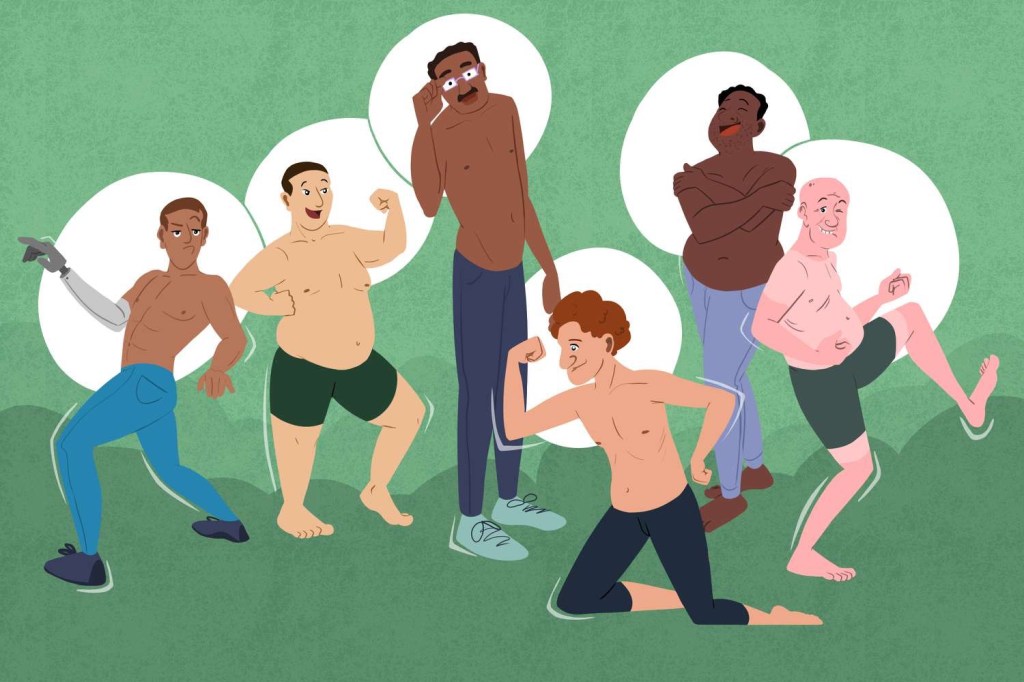
Macho, Mota: Why It’s High Time Body Positivity Movement Included Men

I’ve always considered myself a broad-minded person, and certainly not caught up in the worlds of discrimination, exclusion, or enabling others in these areas. Well, it seems I’ve had a bit of a reality check, quite unintentionally being a hypocrite…something I don’t readily admit to.

Recently, I watched a local documentary called “Shape” (on Tubi if you are interested to view). The documentary maker interviewed a cross-section of local gay men…an Asian twink, bear, muscle guy (who identifies as a nerd), drag queen, elder (who I identified with)…prompting their reactions and opinions on the current trend of male body obsession, and how its tentacles are reaching into many areas of our lives, such as social media, advertising (both print and video/television/streaming), movies, celebrities, and at gay parties, as well as the pub and club scene. It points out how this current trend is encouraging both discrimination, and exclusion.

Like many, I had an Instagram feed that was full of muscle eye candy. I never really thought about it, I guess it was just a gay male thing to do. I have to admit…they did pretty much all look like clones…all pecs and 6-pack abs, all posing with their arms held to show of all the biceps, all in briefs or boxer briefs, or gym gear, or just a towel, making sure attention was drawn to the nether regions, or butt shots either fully naked or in very tight briefs…or doing gym workouts. There really wasn’t much to differentiate one from another. What really made me sit up, and start rethinking WHY was I addicted to this was when the documentary brought up one very simple fact…that these guys didn’t care one iota about me. All they were interested in was accumulating “Followers”, and getting “Likes”. To them it is a competitive business, getting one-upmanship on the other guys doing the same thing. And though obviously posing for a gay audience, many are straight, and don’t care where the likes and comments are coming from. Not a single one of them ever liked,or commented on my posts. When they have anything from 45K upwards of followers, any posts from followers would just be left in the storm of images on their feeds. We really didn’t matter! Yeah, SOCIAL media…NOT!

I will say…which makes my unintentional obsession with muscle boys a bit contradictory…that for some time now, I have expressed to friends my concerns that this over emphasis on the muscled body image must be having a negative impact on young guys, especially those going through puberty, or coming out of it, and becoming aware of body Image. It was sending out the wrong messages about what a healthy, active life was, about excessive exercising, about diet, and about how they viewed their bodies. Body Dysmorphia Disorder was something we used to associate with women, and led to things such as anorexia, and bulimia, and amongst schoolgirls could lead to suicide as a result of bullying, and being excluded from peer groups, especially in late developers. However, this has now crossed the gender divide, and has become a big problem with men, especially gay men.where body image can be seen to determine your desirability, and sexual attractiveness. One in four persons with DDS will commit suicide…a sobering statistic.

Love your male body

Another concerning aspect of the documentary was getting the interviewees to read out typical gay profiles from Tinder. All participants were quite shocked to finds terms such as “no fats or fems”, “no Asians”, “no guys over (whatever age group) and specifying age groups was prevalent. Discrimination, stigma, prejudice and ageism were rife. One guy stated that it made him feel ashamed. Personally, I was horrified at so much internalised homophobia. One could only see it as toxic masculinity. I ditched the apps over ten years ago after encountering discrimination, and ageism.

As gay, HIV+ men, we are only too aware of the ravages to,our bodies from HIV and AIDS. My personal run in with AIDS in 1996 saw my weight (due to Wasting Syndrome) drop to 46kg. That was not a good look. As part of my recovery I was in a trial involving regular injection of Deca-Durabolin (an anabolic steroid) to restore my weight loss. After initially going to the other extreme and turning into a 86kg bear, my weight returned to my normal 68kg after the trial ended. But many of us have endured lipoatrophy, and lipodystrophy as a result of lifesaving drug routines. Even with newer, simpler treatment options now, many of us are still seeing weight gains that affect our bodies, giving many of us (like me) bellies, and dad bods. And no amount of diet or exercise will solve the problem. I guess that counts us out as muscle-bound posers on Instagram! Yet despite this, there is still an attitude of body positivity among this group, guys who unashamedly flaunt their bodies as a way of gaining control, and empowering themselves, in a world dominated by the male body beautiful.

Which brings things back to me, and my muscle guy dominated feed. The “Shape” documentary gave me a real kick up the behind, made me see these guys for what they were…narcissic posers. Even before seeing the doco, I had reached a point of boredom with it, just scrolling and double tapping from habit…and the algorithm that just presented me with more of the same. I intentionally went back to my feed, and started unfollowing the muscle guys, in particular those with a “K” after their followers count. To be honest, it felt really good! Instead, I ignored the algorithms suggestions, and alternatively searched out the guys who hid in the Instagram shadows, showing bodies that were often dressed, bodies that were proudly Bears, or had dad bods, or just ordinary everyday bods. Even older guys who were displaying their sags and wrinkles, espousing the doctrine of body positivity.…”this is who I am, I’m not ashamed of it, and feel proud in my normality”. And in return, more guys are visiting my profile, and liking my fairly mundane everyday life posts. When I flick through my feed now, I see the everyday bodies of everyday guys. And you know what? It feels really good!

Tim Alderman ©️ 2025

The Alternative Christmas

The Christmas happy families scenario is certainly shoved down our throats as we go through the lead up to Christmas Day. I have never really gotten into the whole traditional family thing at this time of the year…it holds too many sad memories. The death of my younger brother, the deaths of friends during the HIV years have all led to a certain melancholy during the “festive” season, and I’m not alone in that. Add in those of us getting older who have lost all their family, or those from alienation or dysfunctional backgrounds, and for many it is a lonely time of the year.

I spent my one and only Christmas Day on my own just after moving…temporarily…to Melbourne. It was a maudlin day, ending up in a haze of scotch drinking. I swore it would never happen again. Like many from dysfunctional backgrounds, my alternative “gay family” have always filled the missing gaps in my life, always in a more caring way than I otherwise would have spent it.

So what can we do to alleviate the loneliness of Christmas? When I lived in Darlinghurst, chats with friends at the pub made me realise how many had nowhere to go on Christmas Day, so we started organising “Orphans Christmas” at our apartment in The Dorchester. It was a totally open invitation, spread by word-of-mouth. We usually hosted a dozen-odd people on the day, with others coming later in the day from family gatherings that just got “too much”! In the early days I catered until the expense got too much, so it became a bring-a-plate-and-a-small-gift thing. I loved those days. They were a lot of fun. These days I go to my local club with a couple of close friends, though not the cheapest of ways to celebrate. Many local charities put on Christmas Day spreads, and a visit from Santa, for those who find themselves on their own. These are generally either no cost, or low cost events, and can be a fun way to meet new people from diverse backgrounds.

If you do have to spend the day alone, don’t let the loneliness get the better of you. Celebrate in your own company…make an occasion of it. Decorate your space, prepare yourself a full 3-course feast, buy and wrap yourself a gift…or many, or keep gifts given to you to unwrap on the day. Move yourself past what the day used to represent, and embrace it as a celebration of self, and indulge yourself.

Merry Christmas everyone

Tim Alderman ©️ 2024

A 40 Year Journey Into (And Out Of) Fear Part 1

I love history. Always have, and excelled at it at school. Not just local and world history in general, but individuals personal history as well. Though often distorted, edited to fit the times, world history is fixed. There is only one truth to it, no matter what narrators may say. Personal histories are quite a different thing. A hundred people will produce a hundred histories, each distinctly individual, never duplicated by anyone else. I have written much about my experiences with HIV over the last 25 years, most of it via “Talkabout”. Though personal, and often intimate, none have really gotten into the nitty-gritty of my personal, lived experience. This reflective piece is to rectify those omissions, giving both a factual and lived insight into a period in gay history that should never be forgotten. The recent Covid experience really drove home to me how HIV, its past, and still present history, was no longer of any consequence. Covid was being spoken about as though it is the only pandemic of recent time. It would be interesting to see where Covid sits in 40 years time. So this is my history with HIV/AIDS. It is more detailed, and more anecdotal than my previous writings…which also means it’s much longer. It is, with no strutting involved, a story of survival, but if survival is the gauge of one’s strength and tenacity, then I have come out at the end of it with flying colours, the glass half full, so to speak.

Over 40 years has passed since I sero-converted to HIV. I remember it well…I was managing a retail store in Sydney and was due to go on leave in August 1983. My last day before going off on my break was hellish. Temperature, diarhhea, extreme lethargy, disorientation…I couldn’t wait for the day to end. As it turned out…for the fortnight it went on for to end. I had only been out for 3 years…a late closet jumper…and I have to admit to being very trashy, making up for lost time as it was. I have wondered over the years, as have many, just who it was that infected me…and where! Was it that hot American boy who was staying in The Connaught in Darlinghurst, who picked me up one night just after my return from Melbourne (very likely!) or was it a Melbourne or Sydney local who had returned from a holiday in the USA, or, like me, gotten off with American boys (the flagour of the month) here. Of course, I’ll never know, but the speculation remains anyway!

Since that time, both as a writer, and as a 12-year public speaker with the Positive Speakers Bureau, I have told of my journey with HIV/AIDS. But the story has always had constraints…either in word length with articles, or time restrictions in talks. There is a lot more to the story than I tell in these…often done by rote…sessions.

I have just finished reading Cheryl Wares “HIV Survivors In Sydney – Memories Of The Epidemic”, an oral history project that I was part of, contributing a 21/2 hour interview with Cheryl when I lived in Gaythorne, Queensland in 2014. I was disappointed in the book, for as much as Cheryl wanted it to be a story of ordinary gay men surviving HIV/AIDS, and how it affected their lives both then, and now, it really came across as a voice for…and was hijacked by… HIV activists, rather than just us bar crawling gays-on-the-Golden-Milers. I was left feeling that both my contribution, and the contribution of others like me who weren’t part of the activist community was largely overlooked…again. I know it sounds like sour grapes, and mine is only one of a thousand survivor stories, but like many others I want there to be some sort of public record of many aspects of the HIV/AIDS survival story that doesn’t make it into many articles, or talks. The one thing Cheryl’s book did do was to invoke memories of so many personal experiences…and feelings…that made my personal HIV journey…MY journey.

This is not the first time I’ve contributed to interviews and photo sessions on HIV/AIDS survival, and either been left out in the cold, or had my story overshadowed by activists…or academics. But more on that as we go along. Because this is a personal transcript, I am not putting a word limit on it, so it’s going to be long. I want all this unknown or forgotten information to be in one article. It’s not a soul-cleansing, so don’t get me wrong. I see it more as an addendum to HIV history. I want it in writing before I either forget it, or confuse it in the fog of ageing. Luckily, I am a bit of a hoarder, so have copies of a lot of the things I will be referencing as the story unfolds. To make sense of it, I guess I need to go back to the beginning.

I have written a lot on my family, the dysfunctionality of my growing up, in my blog (http://timalderman.com), so I am not going to rehash already told stories here. In a nutshell, I was born in St. George Hospital, in Kogarah (NSW) on the 18th January 1954. I had one younger brother, Kevin, who was born in 1959. My childhood was pretty uneventful until I was 11, where with my mother deserting the family home, when my brother and I were at school. My father was a difficult man, trapped in a past that had long gone! Yet, he managed to find the housekeeper from hell…to this day I have no idea where he found her, though her move from the bed in the sunroom of our Sylvania home to the bed in the master bedroom occurred within a week, so I am left to wonder… entering our lives. Her persecution of my ADHD brother was relentless, and led to the death of him, at my father’s hands, in the waters below the cliff top known as The Gap. This blew my innocence all to the shit. My knowledge of “being different” at age 9, and my eventual coming out after my father’s suicide are also on my blog, so let’s move it all along.

1980 finds me in Melbourne, where I had just come out as a 26 year-old. A HIV story begins. Little did I know that both my life as a gay man, and my life as a HIV+ man were to walk the same road.

So what was it really like in 1982 to be reading snippets in our local gay press about this mysterious illness (KS, or Kaposi Sarcoma), rearing its ugly head in the gay ghetto’s of America, that seemed to be targeting gay men who frequented the saunas, and quickly killed them? Well, cynicism and disbelief to start with, and the surety that within a short period of time they would find an antibiotic to clear up yet another STD. However, the snippets were to become columns, the columns pages as the mysterious and deadly virus…originally labelled as GRID (Gay-Related Immune Deficiency (Gay plague/Gay syndrome) in 1981, it was followed by HTLV-3 in 1083…human T-lymphotrophic virus type 3…leapt from the shores of America and found its way into the gay scene here. The panic and fear began!

Our response was mixed. The first case of AIDS was reported in Sydney in October 1982 by Dr Ronald Penny. In July 1983, the first recorded Australian death from AIDS-related causes occurred in Melbourne.. The most notable death in these early days was Bobby Goldsmith (1984).We had our usual ratbags who yelled and screamed about “God’s vengeance on the evil, sick and perverted gay lifestyle”…obviously a different God to the compassionate, all-forgiving one that Christians liked to rant about…the most vocal and notable being the Rev Fred Nile MLC and his Festival of Light, and Call To Australia affiliations, the advocates of hate and intolerance who demanded quarantine for all infected persons, and those of the citizenry who either quietly or vocally wished that we would all die or just go away. Mind you, we did have our fun with them. I vividly recall one early Mardi Gras…back then, joining the parade was a very informal process…where the Festival of Light were protesting at the parades starting point. Myself and some friends, dressed in leather chaps with our bare backsides hanging out of them, deliberately stood in front of them, shaking our booty, much to their horror and disgust.

There is no watering it down…discrimination and stigmatisation was rife. It was frightening!

Thankfully, common sense eventually prevailed and both the government and the grassroots gay community combined to put both AIDS Councils and NGO programs in place. Our quick response was instrumental in Australia always being at the forefront of HIV/AIDS care. Within 2 years every state had an AIDS Council under the national umbrella of NAPWA (National Association of People with AIDS), and the formation of support organisations such as The Bobby Goldsmith Foundation (BGF), Community Support Network (CSN) PLWA (which was to become PLWHA), ActUp, and Ankali. Without these organisations life would have been grim for those infected. They provided financial, emotional and spiritual support for those who, quite suddenl found them selves with a death sentence hanging over their heads, along with the fear of unemployment and homelessness in the midst of the hysteria going on.

I digress! In 1985 testing was introduced. It was a bit of a strange affair in the early days. Due to the hysteria, discrimination, and fear of being dragged off to quarantine…a genuine fear… no one wanted their personal details on a database, so at clinics like the Albion St Centre you chose a fictitious name, and the clinic then issued you with a number that then became your ID. Mine was Peter 3080. When things cooled down, the fictitious name was dropped, and replaced with your real name. You had a blood test, and waited for two to six weeks – talk about high anxiety – to get your result. At the time of my HIV test, I already suspected that I had sero-converted and was going to come up HIV+. I was right. Counseling? Oh yeah, we had a lot of that back then. “You’ve got about 2 years to live”. Shrug shoulders “Okay”. And off we went knowing the inevitable was rapidly approaching! The initial window periods were reasonably long, but got much shorter as time progressed, and the virus mutated. That I did not get seriously ill with AIDS until 1996…though their were other factors in play…I always put down to getting infected early in the history of the virus, thus getting a much weaker mutant of the virus than what was to come. I was in a relationship at that time, and my partner came up HIV-…already the juxtaposition between positives and negatives had begun. The strange thing was that I felt no need to hide my status. I turned up at the Oxford Hotel and said to friends…oh well, I’m positive. Of course, I was far from being the only one.

Then the horror stories started! The disgusting treatment of young Eve Van Grafhorst is something for all Australians to be ashamed of. Born in 1982, she was infected with HIV via a blood transfusion. When she attempted to enrol in her Kincumber pre-school in 1985, parents threatened to withdraw their children due to the (supposed) risk of infection. The family was literally hunted out of town, and forced to leave the country and go to NZ. I will never forget the sight of this poor, frail girl on her way to the airport. I, like many others, was horrified that this could happen in Australia. Thankfully, her NZ experience was quite the opposite, and she lived a relatively normal life until her death in 1993 at 11 years of age. Her parents received a letter from Lady Di praising her courage

To be continued

Tim Alderman ©️ 2024

HIV Long Term Survivors Awareness Day Reflection

In early 1994, I had a huge 40th birthday party at the Stronghold Bar, in the basement of the Clock Hotel in Surry Hills. At the same time, I dumped the beautiful man who had been my boyfriend.

With declining health, I thought it would be my last big birthday party.. I hoped I might get another year…maybe 2. I did not want my boyfriend to be lumbered with the care of a dying man. There were others better equipped to do that. At that stage, I had no inkling that my guess would almost come to fruition, and that within those two years, HAART (Combination Therapy) would appear. It whisked me…literally…from the arms of death. Battered and bruised from my encounter with AIDS, I was thrown unceremoniously back into society.

Even at that stage I was already, along with others who walked similar though divergent paths, a long term survivor. According to the statistics, I should have departed this life around 1987. Four years would have been considered a good run, let alone thirteen! That I had survived that long…longer than most of my social circle…filled me with a strange mix of guilt, thanks, and hope. Having been given a second chance, nothing was going to be the same again! And it wasn’t!

Now at 70…way past the self-imposed 40 deadline…and as a 41-year long term survivor, the trepidation of those earlier days is way back in the dark past. Though I still get a jolt when I fully realise the implication of those two figures…70…41! It seems surreal. I did grab the opportunity, and reinvented myself…a university degree in writing, and two TAFE degrees in both cooking (chef), and fitness have positively changed my life direction.

As a long term survivor…and I wear the badge with modest pride, having beaten the odds…the other significant aspect of having been where I have, is the knowing that I have lived…and continue to…through the entirety of a pandemic. What irks me is that, as a valuable historical resource, my knowledge is overlooked, pushed into the background of history. Covid was nasty…and still is…but was treated as though it was the worst thing to happen to mankind. Yet only 40 years earlier, one of the worst pandemics of modern times had started to run its course, and over 40 million people have died as a result of it.

We have short memories!

Tim Alderman 2024.

That Crazy Weird Old HIV Guy

Let’s get one thing straight…I’m NOT a conspiracy theorist! I would like to think I weigh things up before coming to a conclusion. I’ve seen…and heard… a lot over the last 41 years of my life with both HIV, and AIDS! Some good, some not so good. Many will not agree with me on some, or all of these points, and that’s fine! But there are also a lot who will! There will never be a Royal Commission, not even a dissection of how HIV was handled “back in the day”. There was a thinking that drastic times called for drastic actions, and thus everything was acceptable, despite any damage it caused. I’m one of those who begs to differ, even if it makes me out to be a crackpot! Oh…and another point I need to make…yes, I AM suspicious of Big Pharma! Both their intentions, and practises!

So…why am I defending myself? Well…I have some “outside-the-square” theories/thinking on how the HIV community has been used by the drug companies over the decades. Of course, they are BIG, so have a lot of clout, and nobody ever seems to question their intentions.

I have always considered it a bit odd that there have been investigations into how Covid was handled, federally and on a state level, but nothing into the handling of the HIV pandemic. As stated already, it is almost like there was an “anything goes” attitude towards issues regarding HIV. As long as an action could be justified, it was okay!

In 2018, I had a chapter dedicated to me in the “HIV Book Project” publication of the same name. Over the decades, I have had many interviews by media, including Good Weekend, and a segment on the television series Healthy, Wealthy & Wise. Apart from a very cringy article in The Bulletin in 1987, back when we knew fuck all about HIV treatment, and survival rates, my story, as interesting as it is, as told in interviews and photographic sessions, had never been published in the mainstream media. This has always appeared to be the domain of activists, HIV “hierarchy”, and academics. So much for the voice of the HIV guy on the street!

My interview and photography session for the HIV Book Project took place in Sydney Park, with an ex, and my dog, Benji tagging along. When they decided to include me in the book, I was, to a point, surprised! My opinions were controversial, and my actions to handle my HIV drug treatments my own way must have raised many an eyebrow. After all, compliance had been rammed down our throats for over 20 years, and that someone like me dared to defy the norm was, to say the least, foolhardy! To my way of thinking, our doctors didn’t decide our medication dosing…the drug companies did!

After being on one regime or another…extending back to the days of mono therapy…for over 25 years I was greatly concerned about how these drugs must have been knocking my body around. At that time, I was on a regime of three drugs twice a day. Over a 7 year period, I had made the very personal decision to halve my regime to once a day. This effectively cut out side effects I was experiencing at that time. It also gave my body some respite from the continued battering of long-term drug dosing. To make things worse…I was also taking a drug holiday every weekend. So these views and actions were published in the book. I had never admitted to anyone that I had taken this action. Not even my doctor!

After publication, I read the other stories in the book. Comparing my story to theirs, I actually felt as though I had come across as a bit of a weirdo! Perhaps to my own detriment, what I hadn’t explained was that when I started this action, my intention had been that if by halving my dosing my viral load climbed, or my CD4 count dropped, I would resume the prescribed dosing. Yet after 7 odd years of doing this, my viral load was still undetectable, and my CD4 count continued to climb! So much for the need for compliance! I’m not advocating that everyone on HIV drug regimes should do this…but it is food for thought!

And it doesn’t stop there! I openly defied those who love to claim that AZT was beneficial, and kept the wolf from the door! This was an incredibly toxic drug! Having failed as a cancer drug due to its toxicity, it was suddenly hailed as a breakthrough drug in the treatment of HIV, despite trials such as the Concorde trial (Britain/Ireland/France) labelling it as “human rat sac”. Anyone who saw “Dallas Buyers Club” would be familiar with the disdain in which the drug was held. Its side effects…and we were dosed massively with it…were horrendous, including liver and kidney damage, peripheral neuropathy, knocked the immune system around (immune suppression), and anaemia. On a HIV forum many years ago, I posted that I personally held AZT responsible for the sudden decline in my CD4 count, and the immune suppression that brought about my run in with AIDS. I thought I would cop a slamming for expressing such an opinion, only to find in the comments that many agreed with me! Like me, many regretted taking it!

I also question…please note that word…the ethics behind the pricing of HIV drugs! At one time, the actual retail price of the drug…usually in the many hundreds of dollars…was printed on the pharmacy label. Anyone on three or four drugs would never have been able to afford to buy them every month, especially anyone on a pension. One has to wonder that, without the PBS, would the drug companies have just allowed us to die…or would we also have had to run buyers clubs!

Which brings me to resistance testing…another drug company instigated test, and one I have always been…vocally…doubtful about. Excuse my cynicism, but if a drug company is developing and pushing a particular test, there has to be something in it for them!Has anyone noticed…and I’m sure you must have…that pretty well everyone who had a drug resistance test was taken off the older drugs (despite them still working) and placed on the newer drug regimes! Logic decrees that, considering the costs of research and development, Big Pharma would prefer us all to be on the newer drugs, considering that they would have the highest financial outlay! I reckon we were really duped on this one, especially considering that currently those who are experiencing weight gain…another point worth raising…from the newer drug regimes are requesting a return to the older drugs…which at some stage they would have been told they are resistant too. Interesting, that!

So call me a weirdo, or a ratbag! To be honest, I really don’t care! For no reason has the term HIV Industry been coined! Someone is making money from it, and undoubtedly keeping the shareholders happy…and it’s not US! I would rather be called a whacko…at the least, after 41 years being HIV+…that I’ve experienced enough, indeed seen enough, to know that if you are not one of the sheep who just goes along with the flow, if you are someone who thinks for themselves with a moderate dose of cynacism, you are always going to be attacked and slammed.

I have broad shoulders. I can handle a bit of criticism.

Tim Alderman ©️ 2024

Be A Local Disability Advocate.

I’m a 41 year long term survivor of HIV/AIDS. I’m severely vision-impaired from CMV, and mobility challenged from one of the early drugs designed to prolong our lives.

I used to see HIV disability as a singular issue, but ageing…I’m now 70…has turned that thinking around. No matter if you are disabled as a result of birth, accidents, stupidity, or illness such as HIV, all disabled people share one thing in common. We’re disabled! And quite often, this world is designed manufactured and built by people who aren’t. To make things worse, many think they know what disabled people need…without consulting with us!

I live in a Central Coast village. Footpaths here are a luxury. Residents usually walk on the roads, as having a sand base, the grass verges are a minefield. I’m lucky in that we have several new paths, though to use them when walking into the village adds several minutes to the journey. I also have to cross 3 busy roads. There is a pedestrian refuge on one, and a crossing on another, but the busiest middle one has no safe crossing. You not only need to watch traffic from four directions, but you have to step onto the road to see around parked vehicles. I’ve had several close calls crossing this road, and I dread crossing it!

In consultation with my local member…also disabled and in a wheelchair…we have put in a submission to council to have some sort of crossing put in there, not just for disabled people, but also to guard the safety of school kids, and the elderly using that path. Considering council is supposedly disabled-aware,they are certainly procrastinating. Safety aware indeed! Not!

Likewise the car park and entry access area of our local RSL were badly edge marked, and with a dangerous ramp to the clubs entry area. In bright sunlight, you could not see the pale yellow fluro markings at all! Coming out of the club into sunlight, I could not see the access ramp at all, and relied on friends or kindly members to get me safely to the ramp. Submissions from me and several other vision impaired people saw the whole car park remarked, and the club entryway reconfigured.

It is very empowering when you are listened to, and suggestions are acted on.,

I used to be frightened to speak up about these things, but if nothing is said, nothing changes. As disabled people, we have a right to be able to move safely around our local areas. Whether able-bodied or disabled, if you know of dangers in your local area, be an advocate and speak up. Small changes can save a life.

Tim Alderman 2024 ©️

Buddhism 101: Buddhist Monks and Shaved Heads

And Why Is the Buddha Depicted With Curls?

Two nuns of a Tibetan Buddhist order, photographed in Dharamsala, India. Matthew Wakem / Getty Images

Here’s a question that comes up from time to time — why do Buddhist nuns and monks shave their heads? We can speculate that perhaps shaving the head reduces vanity and is a test of a monastic’s commitment. It’s also practical, especially in hot weather.

Historical Background: Hair and the Spiritual Quest 

Historians tell us that wandering mendicants seeking enlightenment were a common sight in first millennium BCE India. The historical record also tells us that these mendicants had issues with hair.

For example, some of these spiritual seekers deliberately left their hair and beards unkempt and unwashed, having taken vows to avoid proper grooming until they had realized enlightenment. There also are accounts of mendicants pulling out their hair by the roots.

The rules made by the Buddha for his ordained followers are recorded in a text called the Vinaya-pitaka. In the Pali Vinaya-pitaka, in a section called the Khandhaka, the rules say that hair should be shaved at least every two months, or when the hair has grown to the length of two finger-widths. It may be that the Buddha just wanted to discourage the weird hair practices of the time.

The Khandhaka also provided that monastics must use a razor to remove hair and not cut hair with scissors unless he or she has a sore on her head. A monastic may not pluck out or dye gray hair. Hair may not be brushed or combed — a good reason to keep it short — or managed with any kind of oil. If somehow some hair is sticking out oddly, it is all right to smooth it with one’s hand, however. These rules mostly seem to discourage vanity.

Head Shaving Today 

Most Buddhist nuns and monks today follow the Vinaya rules about hair. 

Practices do vary somewhat from one school to another, but the monastic ordination ceremonies of all schools of Buddhism include head shaving. It’s common for the head to be mostly shaved prior to the ceremony, leaving just a little on top for the ceremony officiant to remove.

The preferred form of shaving is still a razor. Some orders have decided that electric razors are more like scissors than a razor and therefore are forbidden by the Vinaya.

The Buddha’s Hair 

The early scriptures tell us that the Buddha lived in the same way as his disciples. He wore the same robes and begged for food like everyone else. So why isn’t the historical Buddha depicted bald, as a monk? (The fat, bald, happy Buddha is a different Buddha.)

The earliest scriptures don’t tell us specifically how the Buddha wore his hair, although stories of the Buddha’s renunciation tell us he cut his long hair short when he began his quest for enlightenment.

There is, however, one clue that the Buddha didn’t shave his head after his enlightenment. The disciple Upali originally was working as a barber when the Buddha came to him for a haircut.

The first depictions of the Buddha in human form were made by the artists of Gandhara, a Buddhist kingdom that was located in what is now Pakistan and Afghanistan, 2000 years or so ago. The artists of Gandhara were influenced by Greek and Roman art as well as Persian and Indian art, and many of the earliest Buddhas, sculpted in the early first millennium CE, was sculpted in an unmistakably Greek/Roman style.

These artists gave the Buddha curly hair clasped in a topknot. Why? Perhaps it was a popular men’s hairstyle at the time.

Over the centuries the curly hair became a stylized pattern that sometimes looks more like a helmet than hair, and the topknot became a bump. But depicting the historical Buddha with a shaved head remains rare.

Reference

  • O’Brien, Barbara. “Buddhist Monks and Shaved Heads.” Learn Religions, Aug. 25, 2020, learnreligions.com/why-buddhist-monks-and-nuns-shave-their-heads-449598.

Buddhism 101: Samskara or Sankhara

This is a vital component of Buddhist teaching

© Arctic-Images / Getty Images

Samskara (Sanskrit; the Pali is sankhara) is a useful word to explore if you are struggling to make sense of Buddhist doctrines. This word is defined by Buddhists in many ways—volitional formations; mental impressions; conditioned phenomena; dispositions; forces that condition psychic activity; forces that shape moral and spiritual development.

Samskara as the Fourth Skandha 

Samskara also is the fourth of the Five Skandhas and the second link in the Twelve Links of Dependent Origination, so it’s something that figures into many Buddhist teachings. It’s also closely linked to karma.

According to Theravada Buddhist monk and scholar Bhikkhu Bodhi, the word samskara or sankhara has no exact parallel in English. “The word sankhara is derived from the prefix sam, meaning ‘together,’ joined to the noun kara, ‘doing, making.’ Sankharas are thus ‘co-doings,’ things that act in concert with other things, or things that are made by a combination of other things.”

In his book What the Buddha Taught (Grove Press, 1959), Walpola Rahula explained that samskara can refer to “all conditioned, interdependent, relative things and states, both physical and mental.”

Let’s look at specific examples.

Skandhas Are Components That Make an Individual  

Very roughly, the skandhas are components that come together to make an individual—physical form, senses, conceptions, mental formations, awareness. The skandhas are also referred to as the Aggregates or the Five Heaps.

In this system, what we might think of as “mental functions” are sorted into three types. The third skandha, samjna, includes what we think of as intellect. Knowledge is a function of samjna.

The sixth, vijnana, is pure awareness or consciousness.

Samskara, the fourth, is more about our predilections, biases, likes and dislikes, and other attributes that make up our psychological profiles.

The skandhas work together to create our experiences. For example, Let’s say you walk into a room and see an object. Sight is a function of sedana, the second skandha. The object is recognized as an apple — that’s samjna. An opinion arises about the apple—you like apples, or maybe you don’t like apples. That reaction or mental formation is samskara. All of these functions are connected by vijnana, awareness.

Our psychological conditionings, conscious and subconscious, are functions of samskara. If we are afraid of water, or quickly become impatient, or are shy with strangers or love to dance, this is samskara. 

No matter how rational we think we are, most of our willful actions are driven by samskara. And willful actions create karma. The fourth skandha, then, is linked to karma.

In the Mahayana Buddhist philosophy of yogacara, samskaras are impressions that collect in the storehouse consciousness or alaya-vijnana. The seeds (bijas) of karma arise from this.

Samskara and the Twelve Links of Dependent Origination

Dependent Origination is the teaching that all beings and phenomena inter-exist. Put another way, nothing exists completely independently from everything else. The existence of any phenomenon depends on conditions created by other phenomena.

Now, what are the Twelve Links? There are at least a couple of ways to understand them. Most commonly, the Twelve Links are the factors that cause beings to become, live, suffer, die, and become again. The Twelve Links also are sometimes described as the chain of mental activities that lead to suffering.

The first link is avidya or ignorance. This is ignorance of the true nature of reality. Avidya leads to samskara—mental formations— in the form of ideas about reality. We become attached to our ideas and unable to see them as illusions. Again, this is closely linked to karma. The force of mental formations leads to vijnana, awareness. And that takes us to nama-rupa, name, and form, which is the beginning of our self-identity—I am. And on to the other eight links.

Samskara as Conditioned Things 

The word samskara is used in one other context in Buddhism, which is to designate anything that is conditioned or compounded. This means everything that is compounded by other things or affected by other things.

The Buddha’s last words as recorded in the Maha-parinibbana Sutta of the Pali Sutta-pitaka (Digha Nikaya 16) were, “Handa dani bhikkhave amantayami vo: Vayadhamma sankhara appamadena sampadetha.”  A translation: “Monks, this is my last advice to you. All conditioned things in the world will decay. Work hard to gain your own salvation.”

Bhikkhu Bodhi said of samskara, “The word stands squarely at the heart of the Dhamma, and to trace its various strands of meaning is to get a glimpse into the Buddha’s own vision of reality.” Reflecting on this word may help you understand some difficult Buddhist teachings.

Reference