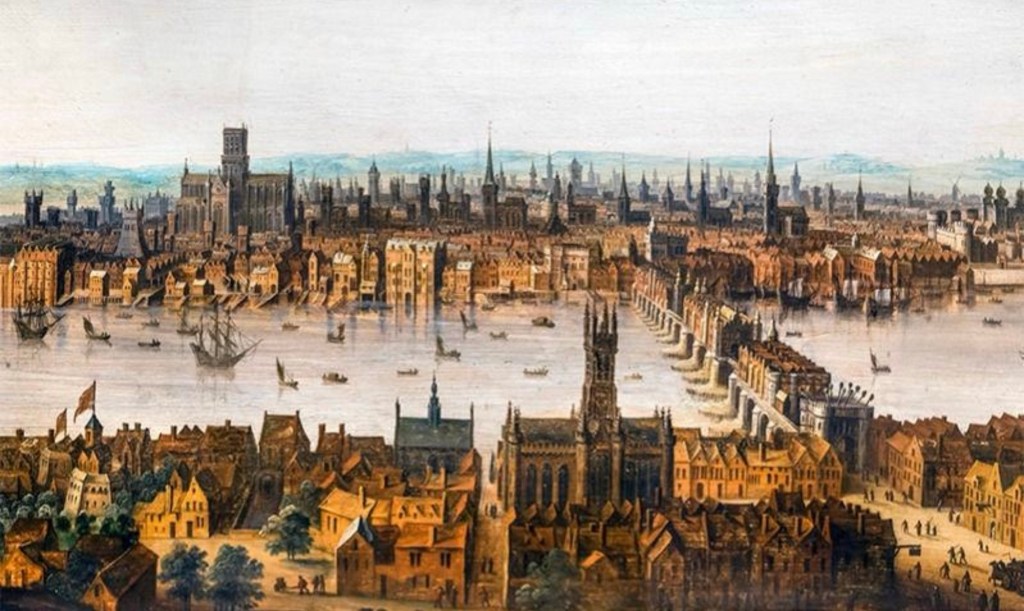
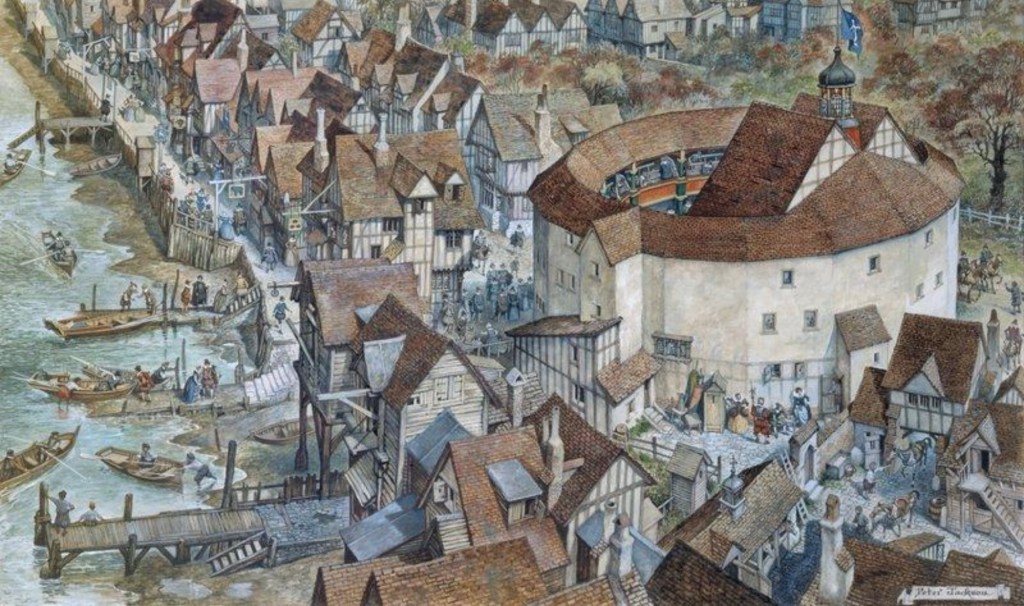
Category Archives: Gay Interest

The Buggery Act of 1533: Henry VIII, Power, Politics, and the Criminalisation of “Unnatural Offences” Part 2

Part II – The Act, the King’s Politics, and the Transformation of English Law

In the years immediately following Henry VIII’s break with Rome, Parliament became one of the King’s most powerful instruments. A succession of Acts fundamentally altered the relationship between Crown, Church and people. Historians often refer to these measures collectively as the Henrician Reformation, and among them was one relatively brief statute whose influence would echo for centuries: The Buggery Act of 1533.

Although only a few hundred words long, the Act fundamentally altered English criminal law. It did not invent the offence of buggery; rather, it changed who had the authority to prosecute it, how it would be punished, and who would ultimately benefit from convictions.

The Buggery Act of 1533

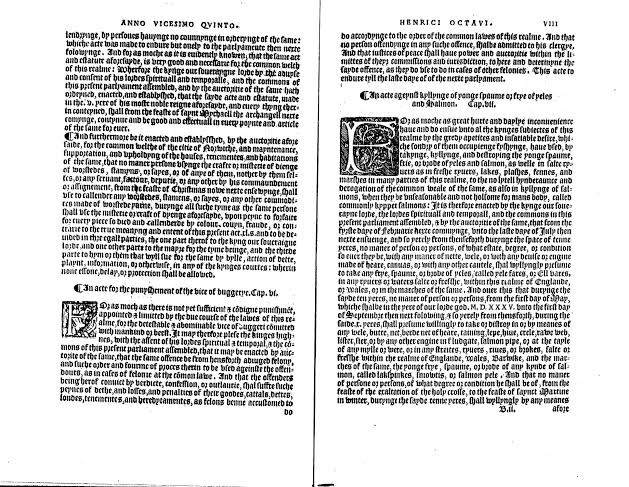
Officially titled An Acte for the punishment of the vice of Buggerye, the statute declared that the offence of buggery would henceforth be tried in the King’s courts rather than the ecclesiastical courts.

This seemingly administrative change was revolutionary.

The Church lost one of its long-standing judicial responsibilities.

The Crown gained another.

The Act provided that anyone convicted of the offence would suffer the punishment imposed for felony.

In Tudor England, that meant:

death by hanging

forfeiture of lands

confiscation of goods and property

loss of inheritance rights

Unlike many offences heard by Church courts, there was no opportunity to escape punishment through repentance or spiritual penance.

The offence had become one against the King himself.

Why Was Henry Interested?

This is where history becomes particularly interesting.

Many older histories assumed Henry VIII introduced the Act because he held especially strong moral objections to homosexual behaviour.

Modern historians tend to disagree.

Henry’s reign demonstrates repeatedly that moral consistency was not his defining characteristic.

He broke with the Pope.

Married six times.

Executed two queens.

Maintained mistresses.

Ordered political opponents to their deaths.

Altered religious doctrine whenever political necessity required.

His overriding concern was almost always power.

The Buggery Act therefore fits comfortably within Henry’s broader programme of centralisation.

Every responsibility removed from Church authority increased royal authority.

Every legal matter transferred to secular courts strengthened the Crown.

The legislation should therefore be understood as part of Henry’s constitutional revolution rather than an isolated moral crusade.


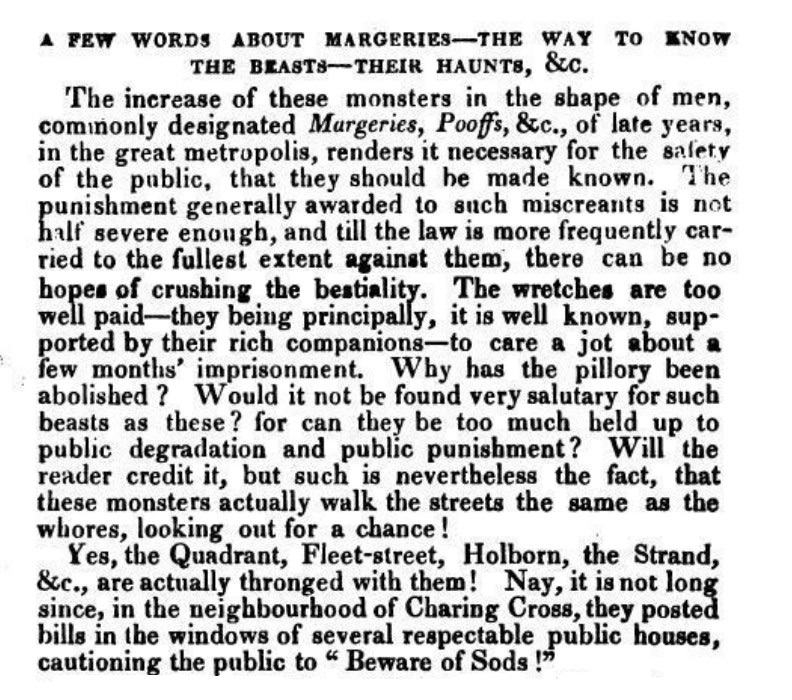
The Yokel’s Preceptor, a contemporary magazine, said this:

The End of Ecclesiastical Monopoly

For centuries, bishops and Church courts had exercised significant judicial power.

Henry gradually dismantled that system.

The Buggery Act declared that offences previously heard before ecclesiastical judges would now be prosecuted before royal judges.

This reflected an emerging Tudor principle:

The King—not the Pope—was the ultimate source of justice in England.

That principle extended far beyond sexual offences.

It affected marriage.

Inheritance.

Appeals.

Clerical discipline.

Property.

Monastic wealth.

And eventually almost every aspect of public life.

The Buggery Act therefore formed one piece of a much larger constitutional puzzle.

The Dissolution of the Monasteries

Only a few years after the Act, Henry began dissolving England’s monasteries.

Between 1536 and 1541, hundreds of religious houses disappeared.

Their lands became Crown property.

Their wealth flowed into royal coffers.

Their libraries were dispersed.

Their buildings destroyed or converted.

For the King, monasteries represented two things:

enormous wealth

and

potential loyalty to Rome.

Removing them weakened papal influence while enriching the Crown.

Sexual Accusations and Anti-Monastic Propaganda

One uncomfortable aspect of this period concerns the widespread allegations made against monasteries.

Royal commissioners investigating religious houses frequently reported accusations of:

sodomy

sexual immorality

corruption

financial dishonesty

moral decay

Modern historians urge considerable caution.

Many of these reports were gathered by officials who already knew what the King hoped to find.

Some accusations were undoubtedly genuine.

Others were probably exaggerated.

Some may have been entirely fabricated.

The commissioners’ task was not impartial historical investigation.

It was building a political case for dissolution.

By portraying monasteries as morally corrupt, Henry’s government made their destruction appear both necessary and righteous.

The Buggery Act provided another legal framework within which such accusations could be pursued.

Defining “Buggery”

One of the greatest difficulties facing historians is determining exactly what Tudor legislators meant by the word.

The Act itself offered no definition.

Instead, judges relied upon legal custom and previous interpretations.

Generally speaking, prosecutions involved:

anal intercourse between men

anal intercourse between a man and a woman

bestiality

Modern readers are often surprised that the law was not directed exclusively at male same-sex relations.

The offence concerned certain sexual acts rather than sexual orientation.

Again, this reflects Tudor thinking.

People were punished for what they were believed to have done—not for belonging to an identity category.

The concepts of heterosexuality and homosexuality would not emerge until more than three centuries later.

The Challenge of Proof

Although the penalties were severe, successful prosecutions were surprisingly difficult.

English common law demanded evidence.

By later legal standards, conviction generally required proof that:

penetration had occurred,

and

the act had been completed.

Witnesses were rare.

Confessions were uncommon.

Accusations frequently collapsed for lack of evidence.

As a result, the number of executions was considerably lower than many people imagine.

The existence of the law generated far more fear than actual convictions.

Yet fear itself can be an extraordinarily effective form of social control.

Many people regulated their own behaviour simply because the consequences of conviction were so catastrophic.

Who Was Prosecuted?

Most recorded prosecutions involved men.

This reflects both legal practice and prevailing assumptions about sexuality.

Women rarely appeared before the courts on charges of buggery.

This was not because female same-sex relationships were accepted.

Rather, English judges often struggled to determine whether existing legal definitions could encompass sexual acts between women.

Without penile penetration, many judges questioned whether the offence had technically occurred.

Consequently, women accused of same-sex intimacy were more likely to face social condemnation than prosecution under the Buggery Act itself.

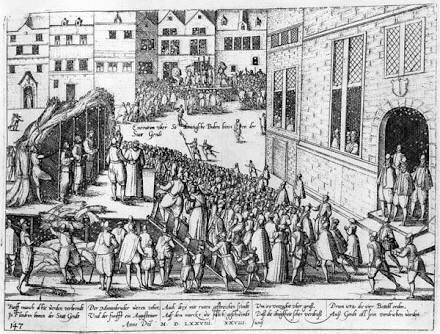
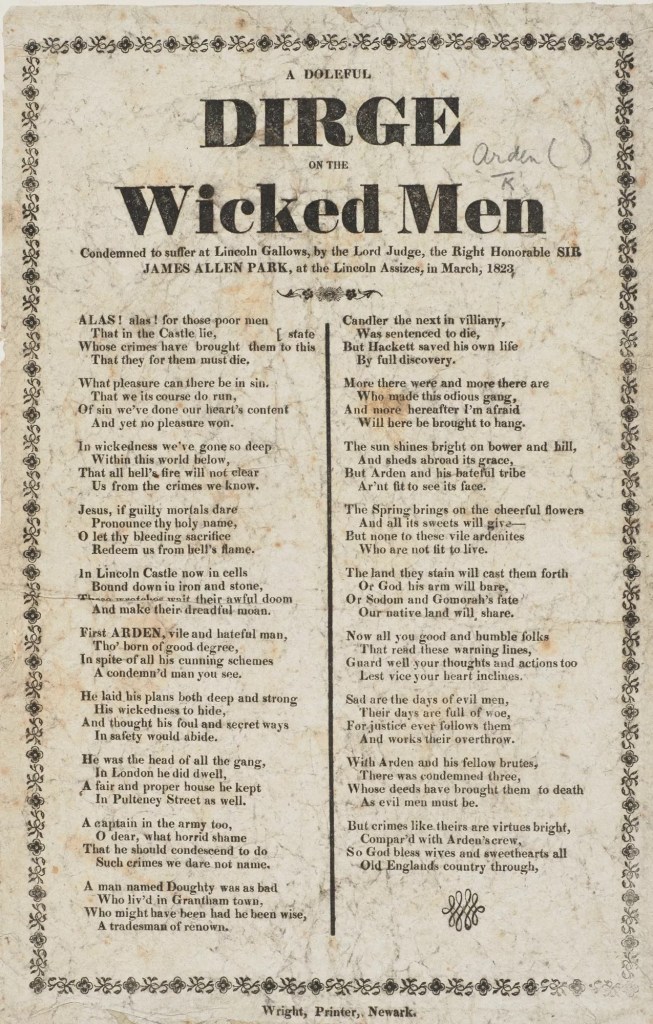
Convictions under the Buggery Act 1533 were punishable by death / British Library, Public Domain

A Weapon Beyond Sexuality

Like many Tudor laws, the Buggery Act possessed political utility.

An accusation alone could destroy reputations.

Even unsuccessful prosecutions carried enormous consequences.

Political enemies, unpopular clergy and social outsiders could all find themselves vulnerable.

Whether every accusation reflected genuine criminal behaviour is impossible to determine.

What is clear is that the law added another powerful weapon to the Tudor state’s expanding legal arsenal.

Fear, Reputation and Silence

Perhaps the Act’s greatest impact lay not in executions but in silence.

The possibility of prosecution encouraged secrecy.

Friendships became suspect.

Affection became dangerous.

Rumour acquired enormous power.

For centuries afterwards, many men lived under the constant awareness that an accusation—whether true or false—could destroy careers, families and lives.

That climate of fear became one of the Act’s most enduring legacies.

Looking Ahead

By the time Henry VIII died in 1547, England had been transformed.

The Pope no longer exercised authority over the English Church.

The monasteries had vanished.

The Crown controlled unprecedented legal and religious powers.

Among the many reforms Henry left behind was the Buggery Act—a statute that would survive kings, queens, civil wars, religious revolutions and even the British Empire itself.

Tim Alderman ©️2026

The Buggery Act of 1533: Henry VIII, Power, Politics, and the Criminalisation of “Unnatural Offences” Part 1

Introduction

Few pieces of legislation have cast such a long shadow over the lives of gay men and other sexual minorities as England’s Buggery Act of 1533. Commonly remembered as the first English law to make homosexual acts a secular capital offence, the Act is often portrayed as little more than an expression of King Henry VIII’s moral outrage. While morality undoubtedly played a part in Tudor thinking, modern historians increasingly argue that the legislation was driven by something much broader: Henry’s determination to centralise power, weaken the authority of the Roman Catholic Church, and establish the supremacy of the English Crown.

The Act marked a turning point in English legal history. Before 1533, accusations of sodomy or “buggery” generally fell under the jurisdiction of ecclesiastical courts. After the Act, they became crimes against the state itself, punishable by death and accompanied by the forfeiture of lands and property. This seemingly technical legal change had enormous consequences, not only for Tudor England but eventually for much of the British Empire. As English law spread across the globe, so too did legislation derived from Henry VIII’s reforms. Australia, India, Canada, Africa, the Caribbean and countless other territories inherited legal traditions whose origins could be traced back to this single Act.

The Buggery Act 1533, formally An Act for the punishment of the vice of Buggerie

Ironically, the legislation has outlived the circumstances that created it. Henry VIII sought to secure his authority against the Pope, yet one of the most enduring legacies of his reign became a law regulating private sexual conduct. Centuries later, long after England abandoned public executions and the British Empire disappeared, versions of the Buggery Act still lingered in the statute books of former colonies.

To understand the Act properly, however, one must begin before Henry VIII—back in medieval Europe, where ideas about sexuality, religion and criminality were already taking shape.

England Before the Buggery Act

Contrary to popular belief, Henry VIII did not invent laws condemning same-sex sexual activity. Medieval Christian Europe had long regarded sexual acts that could not lead to procreation as sinful. These ideas drew upon interpretations of biblical passages—particularly the story of Sodom and Gomorrah in the Book of Genesis—and upon the writings of influential theologians such as St Augustine and St Thomas Aquinas.

In medieval England, however, there was an important distinction between sin and crime.

Most offences involving sexual behaviour were dealt with by ecclesiastical courts, not by the Crown. Church courts handled matters relating to marriage, adultery, fornication, clerical misconduct and what was often described as the “sin against nature.”

Punishments imposed by Church authorities were generally spiritual rather than corporal. Offenders might be ordered to undertake public penance, fast, make pilgrimages or face excommunication. Although the penalties could be severe within the religious life of the community, they were very different from execution.

The offence itself was also less clearly defined than many modern readers imagine.

The medieval Latin term peccatum contra naturam (“the sin against nature”) encompassed a wide range of sexual behaviours. Depending upon the jurisdiction and period, this could include:

sexual acts between men

certain sexual acts between a man and a woman

bestiality

non-procreative sexual practices generally

The word buggery itself was not originally a sexual term at all.

Its linguistic ancestry is surprisingly complex. It derives from the Medieval Latin bulgaria, referring to Bulgaria. During the Middle Ages, members of the dualist Bogomil religious movement were accused by their enemies of heresy and various moral corruptions. Over time, “Bulgar” or “bougre” became a general insult in French and later English, eventually acquiring sexual connotations that had little to do with the historical Bogomils themselves.

Language, prejudice and religion had become intertwined.

Medieval Reality Versus Modern Assumptions

Popular imagination often pictures medieval Europe as relentlessly prosecuting homosexual behaviour.

The historical record paints a more complicated picture.

Surviving records show relatively few prosecutions compared with later centuries. This does not necessarily mean such relationships were accepted. Rather, it reflects several factors:

First, evidence was difficult to obtain.

Secondly, Church courts often preferred confession and repentance over spectacular punishment.

Thirdly, many accusations were folded into broader cases involving heresy, clerical misconduct or other offences.

This relative inconsistency would change dramatically during the Tudor period, when England experienced one of the greatest constitutional revolutions in its history.

Henry VIII’s Great Break

Henry VIII did not begin his reign intending to establish an independent English Church.

Indeed, he was one of Catholicism’s most enthusiastic defenders.

In 1521 he published Assertio Septem Sacramentorum (Defence of the Seven Sacraments), attacking Martin Luther’s criticisms of the Church. Pope Leo X rewarded Henry with the title Fidei Defensor—“Defender of the Faith”—a title British monarchs still bear today.

Everything changed because of Henry’s desperate desire for a legitimate male heir.

His marriage to Catherine of Aragon had produced only one surviving child, the future Mary I. Henry became convinced—or perhaps persuaded himself—that his marriage was invalid because Catherine had previously been married to his late brother, Arthur.

When Pope Clement VII refused to grant an annulment, partly because Catherine’s nephew was the powerful Holy Roman Emperor Charles V, Henry gradually abandoned attempts to obtain papal approval.

Instead, he embarked upon a constitutional revolution.

Between 1532 and 1534 Parliament passed a series of statutes that fundamentally altered England.

The Crown increasingly assumed powers previously exercised by Rome.

Appeals to the Pope were prohibited.

The Archbishop of Canterbury declared Henry’s marriage void.

Anne Boleyn became Queen.

Finally, in 1534, the Act of Supremacy proclaimed Henry VIII the Supreme Head of the Church of England.

England had not merely changed churches.

It had changed the entire relationship between Church and State.

Within this broader programme of reform, numerous legal powers formerly exercised by ecclesiastical authorities were transferred to secular courts.

The Buggery Act was one element—albeit an especially significant one—of that larger transformation.

Tim Alderman ©️2026

Taking the Sting Out of Words: The Reclaiming of Derogatory Language

How Minority Communities Transform Insults into Symbols of Identity

Language is one of humanity’s greatest achievements. It allows us to express love, inspire revolutions, preserve history and communicate ideas across generations. Yet language also possesses a darker side. Throughout history, words have been weaponised to demean, exclude and dehumanise individuals or entire communities. Few groups have experienced this more consistently than sexual minorities, whose identities have often been reduced to insults intended to provoke shame and fear.

Yet language is never static. Words evolve, meanings shift, and occasionally those who were once its victims seize ownership of the very vocabulary used against them. This remarkable process—known as linguistic reclamation—has transformed many former insults into expressions of pride, solidarity and identity.

The history of reclaimed language is therefore not simply about words. It is about power—who possesses it, who loses it, and how those without power sometimes wrest it back.

These words have been commonly used to insult the community

What Is a Derogatory Term?

A derogatory term is a word or expression intended to belittle, insult or diminish another person or group. Such words rarely describe objective facts. Instead, they convey contempt.

The word derogatory derives from the Latin derogare, meaning “to take away” or “to detract.” Originally it referred to diminishing legal rights or authority. Over centuries it evolved to describe language that diminishes a person’s dignity or social standing.

Derogatory language functions by reducing individuals to a single characteristic—whether race, religion, disability, sexuality, nationality or appearance—and suggesting that characteristic makes them inferior.

Throughout history societies have created thousands of such labels. Some disappear with time; others become deeply embedded in everyday speech.

Why Insults Matter

Words shape perception.

Calling someone “criminal,” “mad,” “heretic” or “pervert” does more than describe them—it creates expectations about how society should treat them.

Historically, insults have often accompanied legal discrimination.

Women were dismissed as hysterical.

People with disabilities were labelled “idiots” or “cripples.”

Religious minorities were branded infidels or heretics.

Gay men became “sodomites.”

Language normalised unequal treatment long before legislation codified it.

This is why insults are rarely “just words.” They reinforce social hierarchies.

The Psychology of Reclaiming Words

Reclaiming language is an act of psychological resistance.

Instead of allowing opponents to define identity, members of the targeted group redefine it themselves.

The strategy follows a simple principle:

A weapon loses much of its power when the intended victim refuses to be wounded by it.

Psychologists describe this as reducing the emotional impact of stigma. When an insult becomes an accepted badge of identity among friends, its ability to humiliate is weakened.

This does not mean the word becomes harmless.

Context remains everything.

A word spoken affectionately within a community may remain deeply offensive when used by outsiders.

The Gay Community and Linguistic Reclamation

Few communities have reclaimed as many insults as the gay community.

Centuries of persecution generated an extraordinary vocabulary of abuse.

Some expressions originated in legal documents.

Others came from religious preaching.

Many emerged from street culture.

Over time, however, some of these words underwent remarkable transformation.

“Gay”

Ironically, one of the most common words today began with an entirely different meaning.

Derived from the Old French gai, it originally meant cheerful, carefree or bright.

By the eighteenth century “gay women” often referred euphemistically to prostitutes, while “gay men” suggested a life devoted to pleasure.

During the twentieth century homosexual men increasingly adopted “gay” as a discreet, positive description of themselves.

By the late twentieth century it had become the preferred term across much of the English-speaking world.

Rather than accepting medical labels such as “homosexual,” many chose “gay” because it emphasised identity rather than pathology.

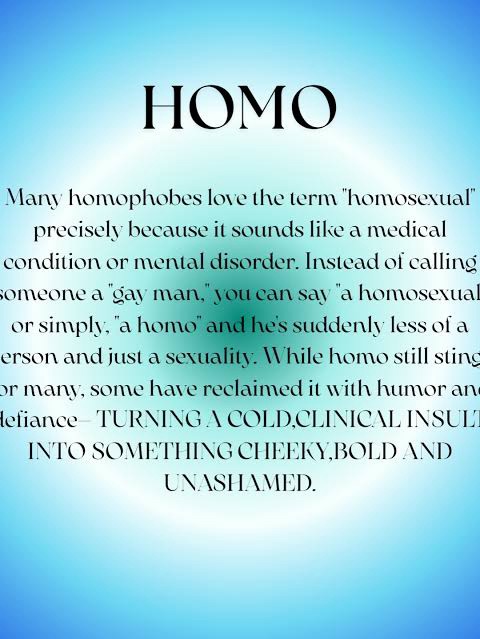
How the LGBTQ+ community reclaimed

“Homosexual”

Unlike “gay,” the word homosexual was never originally intended as an insult.

It was coined in nineteenth-century Europe from the Greek homos (“same”) and the Latin sexualis.

Initially regarded as a scientific description, it soon became associated with psychiatric diagnosis, criminal law and moral judgement.

For much of the twentieth century, official documents classified homosexuals as mentally ill or sexually deviant.

Consequently many gay people came to dislike the term.

Today it remains appropriate in medical, legal and historical contexts but often sounds clinical in everyday conversation.

“Queer”

Perhaps no reclaimed word illustrates linguistic transformation better than queer.

Originally meaning “strange” or “peculiar,” it became one of the harshest anti-gay insults during the late nineteenth and twentieth centuries.

Countless gay men remember hearing it shouted in schoolyards, workplaces and streets immediately before physical violence.

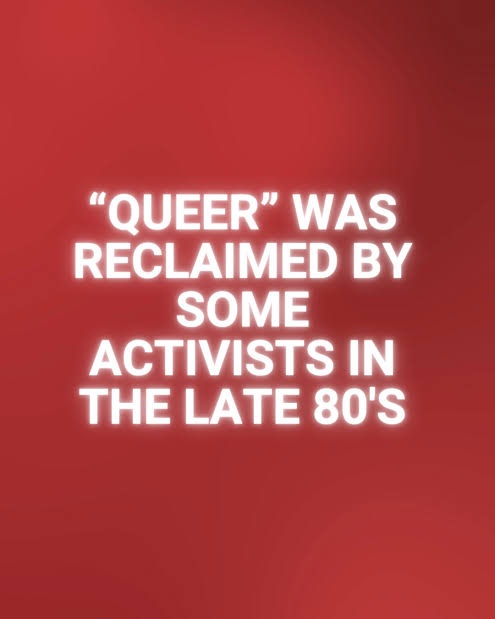
Beginning in the late 1980s and early 1990s, however, younger activists deliberately reclaimed it.

Groups such as Queer Nation argued that embracing the word deprived homophobes of its power.

Today “queer” appears in university departments, academic journals and community organisations.

Yet the word remains deeply divisive.

Many older gay men and lesbians who experienced it primarily as an insult still reject it completely. For them, the emotional associations are impossible to separate from decades of abuse.

Conversely, many younger people use it as an inclusive umbrella term for diverse sexual and gender identities.

Neither perspective is inherently right or wrong. They reflect different lived experiences across generations.

“Poof”

“Poof” (or “poofter”) developed in Britain during the twentieth century.

Its exact origins remain uncertain, though several theories connect it with the appearance of softness or effeminacy.

For decades it functioned almost exclusively as an insult.

In Australia and Britain, however, many gay men gradually began using it affectionately among themselves.

Friends greeting each other with “How are you, you old poof?” demonstrate how humour can strip hostility from language.

Yet, again, context matters enormously.

The identical word shouted aggressively by strangers carries an entirely different meaning.

“Fag” and “Faggot”

Few words generate stronger reactions.

Their origins remain disputed.

One theory connects faggot with bundles of sticks used as fuel, later becoming associated—perhaps apocryphally—with executions for heresy or sodomy. Most historians are cautious about this explanation, as direct evidence linking the term to executions is weak.

By the twentieth century it had become one of the most aggressive anti-gay slurs in the English-speaking world.

Some gay men, particularly in North America, have reclaimed “fag” within friendship circles.

Others reject any attempt to rehabilitate it.

The emotional wounds attached to the word remain too profound.

“Fairy”

Originally describing mythical beings, “fairy” became associated with effeminate gay men during the late nineteenth century.

Today it survives both affectionately and ironically within parts of the gay community, although it has largely declined in everyday use.

“Dyke”

Among lesbians, dyke followed a trajectory similar to “queer.”

Once intended solely as abuse, many lesbians reclaimed it during the feminist movement of the 1970s and 1980s.

Today events such as Dyke Marches openly celebrate the word as one of strength and visibility.

Reclamation Beyond the Gay Community

Reclaiming language is not unique to LGBTQ+ communities.

Many marginalised groups have followed similar paths.

People with disabilities have challenged medical labels previously regarded as insults.

Some racial minorities have reclaimed words once intended to dehumanise them, although the acceptability of such usage often depends heavily on who is speaking.

Women have reclaimed terms such as “witch” and “spinster,” transforming symbols of exclusion into expressions of independence or resistance.

The underlying process is remarkably consistent.

Control over language becomes control over identity.

Why Reclamation Remains Controversial

Not everyone supports reclaiming derogatory language.

Critics argue that some words carry too much historical trauma ever to become harmless.

Survivors of discrimination may understandably wish never to hear them again.

Others fear that widespread use among insiders may blur boundaries and encourage outsiders to use the same language offensively.

Supporters respond that reclaiming language does not erase history.

Instead, it demonstrates resilience.

The insult survives, but its intended effect changes.

The Importance of Context

Perhaps the greatest lesson is that words possess no fixed meaning independent of context.

Who speaks?

Who listens?

What relationship exists between them?

A close friend jokingly saying “old poof” differs profoundly from a stranger yelling the same word across a street.

Language always carries social meaning beyond dictionary definitions.

The history of derogatory language is ultimately the history of power.

Insults have long served as tools for exclusion, reinforcing legal discrimination, religious condemnation and social prejudice. Yet history also demonstrates that language is remarkably adaptable. Communities are not passive recipients of labels imposed upon them. They can reshape words, redefine identities and transform symbols of shame into expressions of solidarity.

Reclaiming language does not erase painful history, nor does it make every insult acceptable. Context, intent and lived experience remain crucial. A term embraced by one generation may still evoke painful memories for another, and words reclaimed within a community may remain offensive when used by outsiders.

Perhaps the greatest lesson is that language is never merely a collection of sounds or letters. It reflects society’s values, fears and aspirations. As those values evolve, so too do the words we use. The story of reclaimed language reminds us that dignity can sometimes be restored not by inventing new words, but by refusing to surrender old ones to hatred.

Tim Alderman ©️2026

Sources

Oxford English Dictionary (entries for gay, queer, faggot, derogatory).

David Crystal, The Cambridge Encyclopedia of the English Language.

Deborah Cameron, Verbal Hygiene.

Gregory M. Herek, research on stigma and sexual prejudice.

Judith Butler, Excitable Speech: A Politics of the Performative.

Eve Kosofsky Sedgwick, Epistemology of the Closet.

George Chauncey, Gay New York.

William L. Leap (ed.), Beyond the Lavender Lexicon.

Jonathan Green, Green’s Dictionary of Slang.

Simon Winchester, The Meaning of Everything.

Gay History: Captain Moonlite: Australia’s Bushranger Who Loved Another Man

“What has grabbed my attention today?”

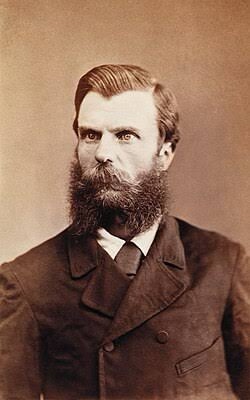
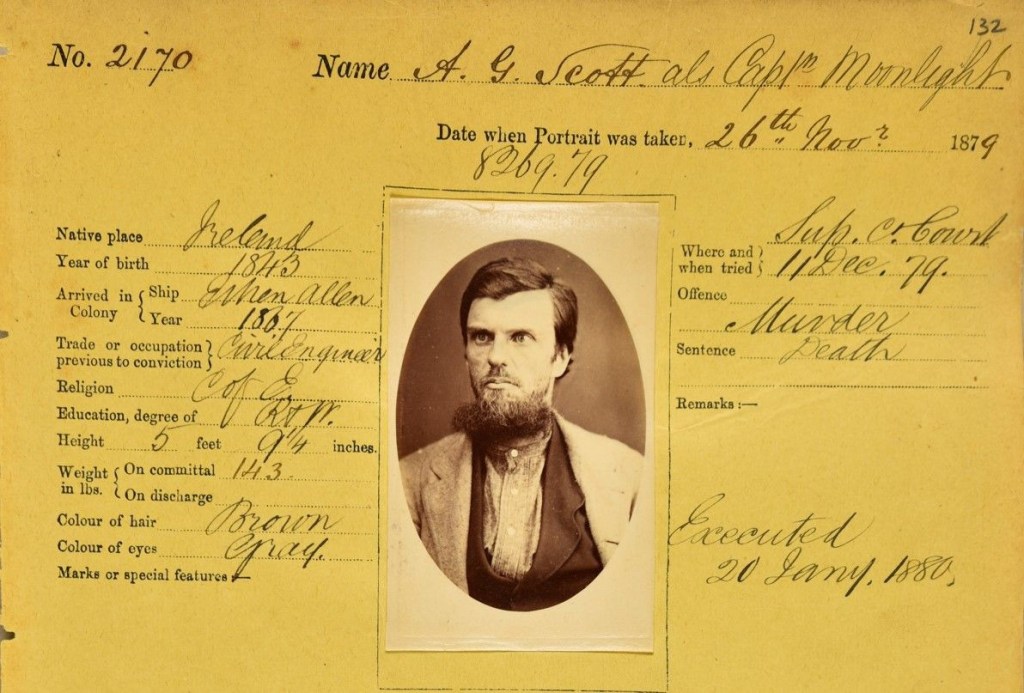
Andrew George Scott “Captain Moonlite”

Australian bushrangers have become part of our national mythology.

We know the names.

Ned Kelly.

Ben Hall.

Thunderbolt.

Captain Starlight.

Yet hidden among these famous outlaws is perhaps the most remarkable bushranger of them all—a man whose final letters reveal one of the most moving expressions of love in nineteenth-century Australia.

His name was Andrew George Scott.

History remembers him as Captain Moonlite.

An Unlikely Bushranger

Andrew George Scott was born in Ireland in 1842 into a respectable Presbyterian family.

Unlike the stereotypical bushranger, he was well educated, articulate and charismatic.

He even spent time as a lay preacher before his life took an unexpected turn.

Following financial difficulties and criminal convictions, Scott adopted the flamboyant persona of “Captain Moonlite.”

He robbed a bank.

Escaped.

Was captured.

Escaped again.

Eventually he found himself imprisoned in Melbourne’s Pentridge Prison.

It was there that history changed.

Meeting James Nesbitt

While serving his sentence, Scott met a much younger prisoner named James Nesbitt.

Whatever developed between the two men appears to have become extraordinarily close.

When both men were eventually released, they remained together.

They lived together.

Travelled together.

Eventually they became members of the gang that carried out the infamous hold-up at Wantabadgery Station in New South Wales in 1879.

During the siege that followed, police bullets struck several members of the gang.

James Nesbitt was mortally wounded.

Scott rushed to his side.

Witnesses described him kissing the dying man and weeping openly over his body.

Even hardened policemen reportedly found the scene deeply affecting.

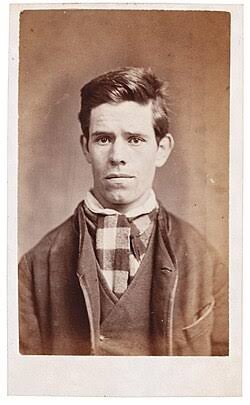
James Nesbitt

The Prison Letters

Captured and sentenced to death, Scott was taken to Darlinghurst Gaol.

Awaiting execution, he wrote numerous letters.

These letters survive.

They are among the most remarkable documents in Australian history.

Writing about James Nesbitt, Scott declared:

“We were one in heart and soul.”

In another letter he wrote:

“My dearest friend has gone before me. I am to follow. I hope to be with him through eternity.”

Perhaps his most poignant request concerned his burial.

Scott asked that he be buried beside James.

His wish was refused.

Instead, after his execution in January 1880, he was buried separately in Sydney.

Only in 1995—115 years later—were his remains reinterred beside Nesbitt in Gundagai, finally fulfilling the wish he had expressed before his death. (Environment NSW)

Were They Lovers?

This is the question historians continue to discuss.

Modern readers naturally ask whether Captain Moonlite was gay.

The honest historical answer is that we cannot know with absolute certainty.

Nineteenth-century Australians did not generally understand sexual identity in the way we do today.

Terms such as “gay,” “homosexual” and “bisexual” belong largely to later periods.

What we can say is that Scott’s surviving letters express extraordinary affection for James Nesbitt.

Several historians believe they strongly suggest a romantic relationship.

Others urge caution, noting that expressions of intense male friendship were often more emotionally demonstrative in the nineteenth century than they are today.

Nevertheless, many scholars argue that if identical letters had been exchanged between a man and a woman, few people would hesitate to describe them as love letters. (ABC News)

Rediscovering a Forgotten Story

For many years Captain Moonlite’s relationship with James Nesbitt received relatively little attention.

Recent scholarship, however, has revisited their story as part of Australia’s LGBTQ+ history.

In 2025 the graves of Captain Moonlite and James Nesbitt were entered on the New South Wales State Heritage Register.

The listing recognised not simply two bushrangers, but the historical significance of one of Australia’s earliest publicly acknowledged same-sex love stories. (Environment NSW)

Beyond the Bushranger Legend

Captain Moonlite reminds us that LGBTQ+ Australians did not suddenly appear in the twentieth century.

They have always been part of Australia’s story.

Often they lived quietly.

Sometimes they left almost no trace.

Occasionally, however, history preserves something extraordinary.

Captain Moonlite’s prison letters are one such treasure.

Whether one ultimately describes Andrew Scott and James Nesbitt as lovers, soulmates or devoted companions, their story speaks of profound affection, loyalty and grief.

It also reminds us that love has always found ways to express itself—even in an age when society lacked the language to describe it openly.

Perhaps the final word belongs to Captain Moonlite himself.

“We were one in heart and soul.”

More than 140 years later, those simple words continue to resonate.

Tim Alderman ©️ 2026

PS I should add that Garry Wotherspoon, whose work has helped preserve so much of Sydney’s gay history, is someone I know personally. We moved through the Sydney scene at the same time, and I have several of his books on Sydney gay history. That gives this story an added resonance for me: it is not simply about reclaiming Captain Moonlite, but about the broader work of recovering the lives, loves and communities that official history too often ignored.

Sources

Garry Wotherspoon, research on Captain Moonlite and Australian LGBTQ+ history.

Museums of History NSW, research on Captain Moonlite and James Nesbitt.

ABC News, “Story of Captain Moonlite reflects NSW’s queer history, historian says” (2025). (ABC News)

NSW Government, “Graves of Captain Moonlite and James Nesbitt listed on the State Heritage Register” (2025). (Environment NSW)

Matthew Grubits, “Was famous bushranger Captain Moonlite gay?” Fuse Magazine. (FUSE Magazine)

Before the Buggery Act: How Men Who Desired Men Found One Another in Medieval England

History has left us an extraordinary paradox.

We know that men desired other men in medieval England. We know that sexual relationships between men occurred. Church authorities preached against them, penitential literature prescribed punishments for them, courts occasionally investigated them, and scattered surviving records describe individual encounters.

Yet if we walk through the streets of London in 1400 and ask a deceptively simple question—

How did one man who desired another man actually find him?

—the historical record becomes remarkably quiet.

There were no gay bars.

No personal advertisements.

No telephone numbers exchanged discreetly on scraps of paper.

No dating apps.

There was not even a universally recognised social identity corresponding precisely to the modern idea of a gay man.

Nevertheless, men met.

They recognised opportunities.

They took risks.

Some formed relationships.

Others arranged fleeting sexual encounters.

Some exchanged money.

And presumably the overwhelming majority disappeared from history without leaving the slightest trace.

That last point is crucial.

Almost everything we know about male-male sexuality in medieval England comes from occasions when secrecy failed.

Someone was discovered.

Someone confessed.

Someone informed.

Someone was prosecuted.

Someone wrote a moral condemnation.

The successful encounter usually generated no document at all.

Reconstructing how men found one another before Henry VIII’s Buggery Act of 1533 therefore requires something approaching historical detective work.

We cannot simply search for medieval gay bars.

Instead, we must reconstruct the landscape of opportunity.

And that landscape was surprisingly extensive.

First, We Must Lose the Modern Label

Calling medieval men “gay” can be useful shorthand, particularly when writing modern gay history, but it carries a danger.

Our modern understanding of homosexuality generally involves identity.

A man may understand himself as gay regardless of whether he is currently sexually active. Sexual orientation becomes part of who he understands himself to be.

Medieval Europeans generally classified sexuality differently.

They concentrated much more heavily upon acts.

The important theological concept was sodomy, but even that word did not necessarily mean homosexuality in its modern sense. Depending upon the writer and period, sodomia could encompass several sexual practices considered unnatural or non-procreative.

Two men having sex could therefore commit a prohibited act without either possessing anything equivalent to a modern gay identity.

This distinction matters enormously.

A married man with children might also have sex with men.

A priest might have male lovers.

A young apprentice might engage sexually with another apprentice without constructing an identity around the experience.

Someone could participate in same-sex activity at one stage of life and not another.

Medieval sexuality was therefore simultaneously familiar and foreign to us.

The desire is recognisable.

The categories surrounding it often are not.

So How Did They Recognise Each Other?

This is the question historians would dearly love medieval people to have answered.

Unfortunately, nobody left us a useful handbook entitled How to Pick Up Men in Fourteenth-Century London.

Recognition probably depended heavily upon circumstances.

A glance held slightly too long.

A suggestive joke.

Physical familiarity.

Reputation.

Gossip.

Mutual acquaintances.

A proposition disguised sufficiently to permit retreat if it was rejected.

And perhaps most importantly:

gradual testing of boundaries.

Sexual minorities throughout history have repeatedly developed methods of recognising potential partners without explicitly announcing themselves.

But we must be cautious here.

We possess much better evidence for such signalling in later periods—particularly once identifiable Molly House networks developed—than we do for medieval England.

There is no securely documented medieval English equivalent of the later handkerchief code or recognisable gay slang.

The safest historical conclusion is therefore that men usually found one another through social proximity and opportunity rather than membership of a clearly identifiable gay subculture.

Fortunately, medieval society created enormous amounts of social proximity between men.

The Medieval World Was Intensely Homosocial

Modern Western society often assumes that men and women naturally socialise together.

Medieval society was considerably more segregated.

Many environments were overwhelmingly male.

Monasteries.

Universities.

Guilds.

Military companies.

Ships.

Workshops.

Clerical households.

Apprenticeships.

Merchant establishments.

Some forms of domestic service.

Men frequently ate together, worked together, travelled together and slept together.

Physical intimacy between men was also not automatically interpreted sexually.

Men embraced.

Men kissed.

Men shared beds.

Men expressed intense affection towards male friends.

None of these things necessarily indicated a sexual relationship.

Paradoxically, that could provide camouflage.

Two men could possess an emotionally intense friendship without attracting the suspicions that similar behaviour might provoke in later periods obsessed with identifying homosexuality.

The boundary between friendship and erotic relationship could therefore remain invisible to outsiders.

And sometimes, perhaps, deliberately so.

The Shared Bed

One of the most important things to forget when entering medieval England is the modern assumption that sharing a bed implies sexual intimacy.

Beds were expensive.

Space was limited.

Travellers shared beds in inns.

Servants shared sleeping accommodation.

Apprentices might sleep together.

Members of households slept communally.

Even strangers could find themselves sharing sleeping space.

This created an obvious opportunity for sexual encounters.

But again we face the historian’s problem.

If two men shared a bed and nothing happened, nobody recorded it.

If something happened and neither complained, nobody recorded that either.

Only when an encounter produced conflict, accusation or prosecution might the archive suddenly notice.

The surviving record therefore inevitably exaggerates unsuccessful encounters.

History remembers the proposition that went disastrously wrong.

The successful seduction sleeps peacefully through the night.

Inns and Taverns

If we were searching for environments conducive to anonymous encounters, inns would immediately attract attention.

Medieval inns were extraordinary social crossroads.

Merchants met travellers.

Servants encountered strangers.

Pilgrims gathered before journeys.

Sailors drank ashore.

Men arriving in London needed somewhere to sleep.

Alcohol loosened inhibitions.

Sleeping arrangements created opportunities.

Privacy could sometimes be purchased.

And travellers enjoyed one enormous advantage:

anonymity.

A man contemplating a sexual encounter with another man might understandably feel safer away from his own parish, family, employer and neighbours.

The stranger was simultaneously dangerous and attractive.

He might disappear tomorrow.

That was precisely the point.

Southwark

Which brings us straight back to the Stews.

Southwark possessed almost every ingredient required for clandestine sexuality.

Taverns.

Inns.

Brothels.

Bathhouses.

Wharves.

Travellers.

Sailors.

Labourers.

Pilgrims.

Entertainments.

And jurisdictional peculiarities that placed parts of the district beyond the ordinary authority of the City of London.

We cannot responsibly describe medieval Southwark as a gay district.

There is no evidence supporting such a claim.

But it was unquestionably a sexual district.

That distinction is important.

A district containing commercial sex, transient populations, alcohol, rented rooms and weakened community surveillance creates opportunities for many forms of sexuality, including forms authorities did not approve of.

Men seeking men did not require a specifically gay establishment.

They required somewhere where strangers could meet without too many questions being asked.

Southwark provided precisely that environment.

Bathhouses and Stews

Bathhouses deserve particular attention.

Communal bathing had a much more prominent role in medieval European life than later stereotypes about universally filthy medieval people suggest.

Bathhouses provided washing, warmth, food, drink and sociability.

Some also acquired reputations for prostitution.

The association became so strong that the English word “stew”, originally connected with heated bathing, eventually became synonymous with a brothel.

Could men meet sexually in bathhouses?

Almost certainly somewhere in medieval Europe they did.

But specific evidence for organised male homosexual activity in English bathhouses before 1533 is frustratingly sparse.

This is another point where responsible history requires restraint.

The environment made encounters possible.

Possibility is not proof.

That distinction will recur throughout this story.

Apprentices

Now we enter one of medieval England’s most important male social systems.

A boy or adolescent might leave his family and enter the household of a master craftsman.

There he lived, worked and trained alongside other apprentices and male workers.

The household was simultaneously home, workplace and training institution.

Young men spent years together.

Friendships developed.

Rivalries developed.

Sexual curiosity undoubtedly developed.

The overwhelmingly male environment created opportunities for experimentation and relationships.

But apprentices were also intensely supervised.

Masters possessed considerable authority.

Guilds regulated behaviour.

Reputation mattered.

An accusation of sodomy could therefore be devastating.

The very structure that created opportunity also created danger.

Masters, Servants and Power

Not every encounter between men was equal.

This deserves emphasis because romanticising clandestine medieval sexuality would seriously distort the evidence.

Medieval society was hierarchical.

Master over apprentice.

Employer over servant.

Priest over subordinate.

Teacher over pupil.

Older man over younger man.

Wealthy man over poor man.

Some male-male sexual encounters undoubtedly involved mutual desire.

Others involved coercion.

Others occupied uncomfortable territory somewhere between the two.

A servant dependent upon his employer for food and shelter did not possess the bargaining power of his master.

An apprentice could not simply walk away from his contractual obligations.

When examining accusations involving sex between men, historians therefore have to ask not merely:

Did this happen?

but also:

Who possessed the power to refuse?

Monasteries

And now we arrive at an institution almost designed to provoke the imagination of later writers.

Large numbers of unmarried men living together.

Sleeping in communal buildings.

Eating together.

Praying together.

Working together.

Forbidden sexual relationships with women.

Inevitably, medieval religious authorities worried about sexual relationships between monks.

Monastic rules repeatedly addressed sexual temptation.

Penitential literature prescribed punishments for sexual acts between men.

Visitations occasionally produced allegations of sexual misconduct.

But we should resist the equally tempting conclusion that monasteries were medieval gay communities.

They were not.

Most monks presumably lived within the expectations of their vocation most of the time.

Nevertheless, homosexual desire did not disappear when someone entered a monastery.

For some men, religious life may even inadvertently have placed them in the company of precisely the people to whom they were attracted.

The Church knew this possibility existed.

Its regulations demonstrate that knowledge.

The Clergy

The clergy provide some of the richest evidence concerning medieval same-sex sexuality—partly because the Church generated enormous quantities of documentation.

Clerical celibacy created its own contradictions.

Priests were forbidden wives.

Sexual relationships with women occurred nevertheless.

So did relationships with men.

Accusations of sodomy could also become political weapons. Because the charge was so damaging, enemies could deploy it regardless of whether it was true.

Every accusation therefore has to be examined carefully.

A sodomy charge tells us unquestionably that medieval society recognised sex between men.

It does not automatically prove that the accused man actually engaged in it.

Universities

Medieval universities were another extraordinary concentration of young men.

Oxford and Cambridge contained students living away from parental supervision, often grouped in male households and halls.

Alcohol, youth, intellectual independence and communal living created precisely the mixture familiar to universities ever since.

Church and university authorities worried constantly about student behaviour.

Sexual misconduct formed part of those anxieties.

Again, however, homosexual activity appears most clearly when authorities intervened.

The ordinary relationship that attracted no complaint remains invisible.

Sailors and the Waterfront

Ports created another distinctive sexual landscape.

Ships were overwhelmingly male environments.

Men might spend long periods away from wives and families.

Ports brought together sailors from different regions and countries.

Taverns, lodging houses and prostitution clustered around waterfront districts.

London’s Thames therefore produced an enormous floating population of strangers.

Southwark sat directly beside it.

We should be cautious about projecting the much better documented homosexual cultures of later navies backwards into the Middle Ages.

But ships and ports unquestionably created circumstances in which men lived in intense proximity for prolonged periods.

Once ashore, anonymity increased opportunities further.

The waterfront is therefore an important part of our landscape even when direct evidence remains elusive.

Pilgrims and Travellers

Medieval people travelled more than we sometimes imagine.

Merchants travelled.

Clergy travelled.

Students travelled.

Soldiers travelled.

Craftsmen travelled.

Pilgrims travelled.

And pilgrimage produced particularly interesting social conditions.

Groups of strangers could spend days or weeks travelling together before separating permanently.

Chaucer’s Canterbury Tales captures something of this extraordinary social mixture.

Southwark itself was a major gathering point for pilgrims heading towards Canterbury.

Travel temporarily loosened ordinary social surveillance.

The neighbour who watched your behaviour at home was miles away.

The stranger walking beside you knew nothing of your reputation.

For someone seeking a clandestine sexual encounter, that anonymity could be liberating.

Parks, Fields and Marginal Spaces

Later evidence shows that men frequently used public or semi-public outdoor spaces for sexual encounters.

Parks.

Fields.

Churchyards.

Alleys.

Riverbanks.

Public privies.

These become clearly identifiable cruising environments in later centuries.

How far can we project that behaviour backwards?

Only cautiously.

Human beings seeking clandestine sex have always required privacy, and urban margins obviously provided it.

But calling a particular medieval field a “gay cruising ground” without evidence would be anachronistic.

Again, we can identify conditions favourable to encounters without pretending we possess documentation that does not exist.

And Then There Is Eleanor Rykener

Suddenly, in 1394, the historical fog briefly lifts.

A person recorded in legal documents as John Rykener, but who used the name Eleanor while presenting as a woman, was arrested in London after being found with a man named John Britby.

The case is extraordinary.

Rykener described having sexual encounters with numerous men, including clergy, while presenting as Eleanor, and also described sexual relationships with women.

Modern historians debate how Rykener should be understood.

Was Eleanor a transgender woman?

A male cross-dressing sex worker?

Someone whose gender identity cannot be adequately expressed using modern categories?

The medieval record simply does not provide enough information to settle the question.

What it does provide is something immensely valuable.

A glimpse of an actual sexual network.

Eleanor described encounters in London and elsewhere, with clerics and laymen, and sometimes received payment.

Here, finally, we see something beyond theological condemnation.

We see people actually arranging sex.

And customers apparently knew how to find Eleanor.

That fact is enormously important.

It demonstrates that sexual information travelled socially.

Some form of reputation, introduction, observation or word of mouth connected potential clients with sexual partners.

The network existed even though its mechanism remains largely invisible.

Word of Mouth

This may ultimately provide our simplest answer.

How did men find men?

Through other men.

Once someone had successfully discovered one potential partner, an informal network could develop.

A friend knew someone.

A servant knew another servant.

A traveller mentioned someone encountered elsewhere.

A tavern keeper knew which customers were tolerant.

A sex worker knew clients with particular interests.

Someone acquired a reputation.

No formal gay community was required.

Human networks did the work.

And because revealing too much was dangerous, those networks were probably based heavily upon trust.

The Importance of Reputation

Medieval communities were intensely concerned with reputation.

People lived among neighbours who often knew enormous amounts about one another.

Sexual reputation could travel quickly.

That could be dangerous.

But it could also help people find each other.

A man suspected of preferring men might attract hostility.

He might also attract another man quietly hoping the rumour was true.

Gossip therefore had two edges.

It could expose.

It could connect.

The same information could produce either persecution or opportunity depending upon who heard it.

Was There a Medieval Gay Subculture?

Here we reach perhaps the most difficult question.

Probably not in the sense that we would recognise from later London.

By the eighteenth century, London’s Molly Houses provide clear evidence of recognisable social networks of men who had sex with men, with particular meeting places, language, rituals, friendships and forms of gender performance.

That is something approaching a subculture.

The evidence before 1533 is much thinner.

We can identify individuals.

We can identify sexual acts.

We can identify environments where encounters could occur.

We can sometimes glimpse networks.

But we cannot yet confidently reconstruct a continuous, organised medieval London gay community comparable with the later Molly House world.

Absence of evidence, however, is not evidence that men lived in complete isolation.

Rykener alone warns us against that assumption.

Networks existed.

We simply cannot see their full shape.

The Law Before 1533

Another misconception needs correcting.

Henry VIII did not invent the idea that sex between men was wrong.

Christian teaching had condemned sodomy for centuries.

Ecclesiastical courts could investigate sexual misconduct.

Penitential traditions prescribed punishments.

Secular authorities could sometimes intervene through other legal mechanisms.

But England lacked a permanent nationwide secular felony statute specifically establishing buggery as the offence created in 1533.

That changed under Henry VIII.

The Buggery Act 1533, passed during the Reformation Parliament, made the “detestable and abominable Vice of Buggery committed with mankind or beast” a felony.

Conviction carried death and forfeiture of property.

The wording itself is revealing.

The statute did not speak of homosexual people.

It criminalised an act.

And its inclusion of sex with animals demonstrates again why simply translating Tudor “buggery” as modern “homosexuality” is historically inaccurate.

Nevertheless, sex between men unquestionably fell within its reach.

A behaviour previously handled through a complicated mixture of religious condemnation and differing jurisdictions had entered English secular felony law in a dramatically explicit way.

Henry’s Motives

We should also resist assuming that Henry VIII suddenly became personally obsessed with homosexuality.

The Act appeared during the enormous redistribution of religious and legal authority produced by the English Reformation.

The Crown was expanding its jurisdiction into areas previously associated heavily with ecclesiastical authority.

Sexual regulation formed part of that transformation.

The statute therefore belongs not merely to gay history but also to the history of the Tudor state.

The government was claiming greater authority over bodies, morality and crime.

And the penalty was terrifying.

Death.

What Changed?

Ironically, everyday behaviour probably changed much less immediately than the statute book suggests.

Men continued desiring men.

They continued finding one another.

They continued taking risks.

The legislation could change punishment.

It could not change human sexuality.

And enforcement was never uniform.

Yet something fundamental had occurred.

The state now possessed an explicit legal weapon.

A private sexual encounter could become a capital felony.

That possibility altered the landscape of risk.

The Invisible Majority

There is something almost haunting about researching these men.

The archive encourages us to remember homosexuality through persecution.

Trials.

Executions.

Scandals.

Arrests.

Church condemnations.

But that cannot have been the whole experience.

There must also have been affection.

Flirtation.

Sexual curiosity.

Friendship becoming something else.

Awkward propositions.

Successful propositions.

Jealousy.

Heartbreak.

One-night encounters.

Long relationships disguised as friendship.

Men who married women while continuing relationships with men.

Men who never married.

Men who understood their desires perfectly well even though they possessed none of our modern vocabulary for describing them.

Almost none left records.

And perhaps that is because many succeeded at the thing upon which their survival depended.

They kept their private lives private.

Finding Each Other

So how did men who desired men find one another before the Buggery Act?

There was probably no single answer.

They found each other in inns and taverns.

In workshops and households.

Among apprentices.

Among clergy.

Within monasteries.

At universities.

On journeys.

Around docks and ships.

In rented rooms.

Perhaps in bathhouses.

Perhaps in marginal outdoor spaces.

Through reputation.

Through gossip.

Through mutual friends.

Through prostitution.

Through chance.

And through the oldest method of sexual communication humanity possesses:

one person taking the risk of signalling desire and waiting to discover whether another person responded.

There were no rainbow flags marking safe premises.

There was no recognised gay quarter.

There was no Grindr announcing that somebody was 200 yards away.

But there were eyes across crowded taverns.

There were shared beds at inns.

There were whispered reputations.

There were introductions.

There were strangers passing through town.

And there were undoubtedly moments when one man realised that another man was looking back.

The terminology has changed.

The legal landscape has changed enormously.

The meeting places have changed.

The fundamental human experience has not.

Long before Molly Houses, long before Oscar Wilde, long before modern gay liberation—and long before Henry VIII decided that Parliament should concern itself with what men did together in private—men who desired men had already been finding one another for centuries.

Most managed to do so without leaving their names behind.

Their anonymity should not be mistaken for their absence.

Tim Alderman ©️2026

Sources and Further Reading

Ruth Mazo Karras, Sexuality in Medieval Europe: Doing Unto Others, Routledge. An important study of medieval sexuality and the danger of imposing modern sexual identities upon medieval people.

Ruth Mazo Karras, Common Women: Prostitution and Sexuality in Medieval England, Oxford University Press. Particularly useful for prostitution, sexual regulation and the social world surrounding medieval commercial sex.

David Lorenzo Boyd and Ruth Mazo Karras, “The Interrogation of a Male Transvestite Prostitute in Fourteenth-Century London,” in Premodern Sexualities, edited by Louise Fradenburg and Carla Freccero. A major scholarly discussion and translation of the Rykener case.

Robert Mills, Seeing Sodomy in the Middle Ages, University of Chicago Press. An important examination of medieval understandings and representations of sodomy.

Tom Linkinen, Same-Sex Sexuality in Later Medieval English Culture, Amsterdam University Press. Especially valuable for attitudes towards male-male sexuality in later medieval England.

Alan Bray, Homosexuality in Renaissance England, Columbia University Press. A foundational study, especially valuable for understanding the transition from medieval concepts of sodomy towards the better-documented sexual cultures of early modern England.

The National Archives (UK), material concerning sexuality, crime and the historical development of laws regulating same-sex activity.

UK Parliament, historical material concerning the Buggery Act of 1533 and subsequent development of British laws governing sex between men.

The surviving 1394 interrogation of John/Eleanor Rykener, London Metropolitan Archives; translations and scholarly editions reproduce this exceptionally rare record of medieval sex work, gender presentation and sexual encounters.

Historical note: The words gay, homosexual, transgender and sex worker are modern categories. They can make medieval history understandable to modern readers, but none maps perfectly onto medieval identities. Where they are used here, they describe behaviours or provide modern points of comparison rather than claiming that medieval people necessarily understood themselves in those terms.
The Southwark Stews: Sex, Sin and the Bishop’s Brothels in Medieval London

Across London Bridge, beyond the tightly regulated streets of the medieval City of London, lay another world.

Southwark was noisy, crowded, transient and disreputable. Travellers arrived there before entering London. Pilgrims gathered in its inns before setting out towards Canterbury. Sailors and merchants came ashore along the Thames. Taverns provided drink and lodging. Entertainments flourished that respectable London preferred to keep at arm’s length.

There were gambling houses, animal-baiting arenas, inns, alehouses and, eventually, theatres.

And there were brothels.

They became known as the Southwark Stews.

Yet perhaps the most extraordinary thing about this notorious medieval red-light district was not that prostitution flourished there.

It was the identity of the landlord.

Much of the district belonged to the Bishop of Winchester.

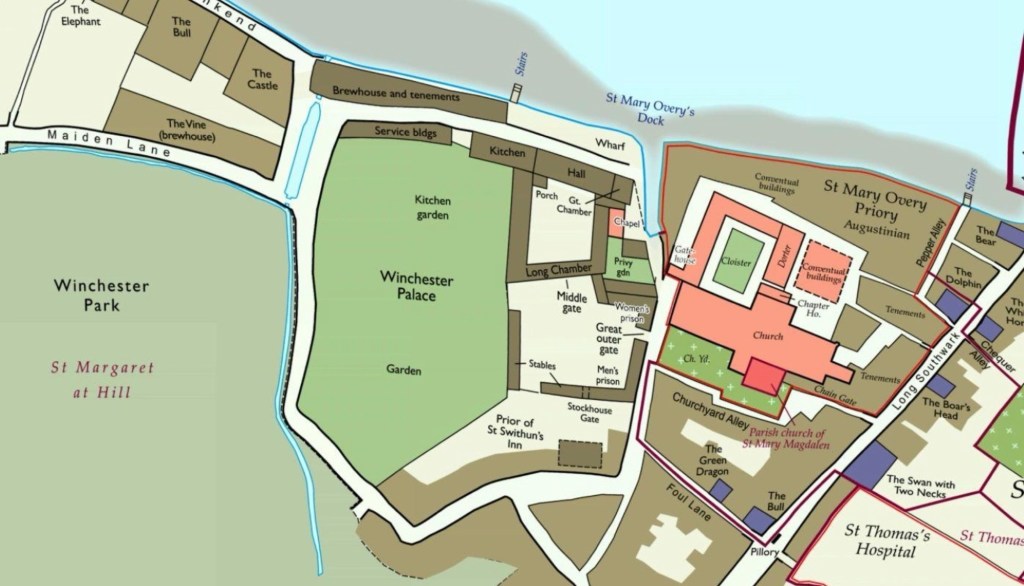
Liberty of London…Winchester Palace

For generations, therefore, an institution that preached against sexual sin simultaneously presided over a district in which commercial sex was tolerated, regulated and financially profitable.

The story of the Southwark Stews is consequently much more than a colourful footnote to London’s sexual history. It provides an extraordinary window into the compromises of medieval society: the enormous distance that could exist between religious doctrine and practical government, the precarious lives of women who sold sex, and the attempts of authorities to control sexual behaviour without ever really expecting to eliminate it.

And lurking behind the story is another intriguing question.

If heterosexual commercial sex could flourish semi-openly in medieval Southwark, what other sexual worlds existed alongside it?

That question leads eventually towards the largely hidden history of men who desired other men before Henry VIII’s Buggery Act of 1533.

But first, we must cross London Bridge and enter the Stews.

Across the Bridge

Medieval London was not one homogeneous city.

The City of London possessed its own government, courts, regulations and privileges. Immediately outside its jurisdiction, however, were numerous liberties and suburbs where different authorities exercised control.

Southwark lay across the Thames in Surrey.

The Bishop of Winchester owned extensive property there, centred upon his magnificent Winchester Palace, whose surviving ruins can still be seen near the modern Bankside.

At London Bridge…the Bishop of Winchester’s Palace

His territory became associated with the Liberty of the Clink, named after the bishop’s prison. The word clink eventually became slang for prison itself.

Southwark’s position made it ideal for activities that the authorities of London either prohibited or preferred to keep away from respectable neighbourhoods.

The river provided customers.

London Bridge provided customers.

The inns provided customers.

Travellers provided customers.

And the authorities provided something equally important:

a degree of tolerance.

By the late fourteenth century, prostitution in and around London was particularly associated with two tolerated districts: Cock Lane near Smithfield and Southwark. (Wellcome Collection)

The latter would become by far the more notorious.

Why Were They Called “Stews”?

The name sounds wonderfully peculiar today.

A stew originally had associations with heated baths and bathhouses. Public bathing establishments existed throughout medieval Europe, and some acquired reputations as places where customers could obtain considerably more than hot water.

Bathhouses and prostitution became so closely associated that stew gradually developed a secondary meaning: a brothel.

Not every bathhouse was a brothel, naturally, but the linguistic association became firmly established.

By the fifteenth century, the Southwark brothels were routinely known as the stews or stewhouses. (Wellcome Collection)

The district therefore acquired a name that was simultaneously geographic, commercial and sexual.

The Bishop’s Uncomfortable Business

Here we encounter one of the great contradictions of medieval Christianity.

The Church regarded prostitution as sinful.

Yet influential Christian thinkers had also developed the idea that prostitution could constitute a “necessary evil.”

The argument was essentially pragmatic. Human sexual desire could not realistically be abolished. Suppressing prostitution entirely, some theologians feared, might merely redirect male sexual behaviour towards adultery, rape or forms of sexuality regarded as even more sinful.

The result was an uncomfortable compromise.

Prostitution could be condemned morally while being tolerated socially.

Southwark demonstrates that compromise spectacularly.

The Bishop of Winchester did not personally run brothels in the modern sense. Rather, his administration possessed jurisdiction over the territory in which the stewhouses operated, and landlords, tenants, officials and brothel keepers existed within that economic and legal structure.

And money flowed through it.

Rents could be collected.

Fines could be imposed.

Regulations could be enforced.

Sin, it turned out, could generate remarkably respectable revenue.

The Winchester Geese

The women associated with the Southwark sex trade eventually became known as the “Winchester Geese.”

It is one of those historical expressions that sounds almost affectionate until one remembers the precarious circumstances behind it.

The Ferryman’s Seat, Southwark, London

A visit to a prostitute could even be described in later slang as being “bitten by a Winchester goose,” particularly in reference to contracting venereal disease.

The women themselves remain frustratingly silent in the surviving evidence.

Most records were created by men: bishops, officials, clerks, courts, landlords and moralists.

We therefore know considerably more about how authorities wanted the women controlled than about what the women themselves thought about their lives.

Historian Ruth Mazo Karras has pointed out that medieval ideas of the “common woman” were themselves revealing. A prostitute could be conceived not merely as a woman who accepted payment for sex but as a woman supposedly sexually available to men “in common.” (OUP Academic)

The terminology tells us almost as much about medieval attitudes towards female sexuality as it does about prostitution.

The Famous Ordinances

Much of what we know about the Stews comes from a remarkable surviving set of regulations generally known as the Ordinances Touching the Government of the Stewholders in Southwark.

There were dozens of provisions governing how the houses operated.

For many years an attractive story was repeated that these regulations had originated in 1161 or 1162 during the reign of Henry II.

There is a problem.

The surviving document’s claim that the regulations had been authorised by a parliament at Winchester at that time is historically impossible in the form described.

Modern scholarship instead places the customary containing these regulations in the fifteenth century. (Wellcome Collection)

It is an excellent warning about medieval history: a document can itself contain an invented history.

The authorities apparently wanted their regulations to look ancient.

Ancient custom carried authority.

Inside Crossbones Graveyard • Look Up London Tours

Regulating Sin

The ordinances are fascinating because they reveal that the Stews were not simply an anarchic sexual free-for-all.

Rules existed concerning both customers and women.

Among the most striking provisions was one forbidding stewholders from keeping women in their houses against their will.

Officials were supposed periodically to search the houses. If a single woman was discovered being detained involuntarily, she was to be permitted to leave without interference. (OUP Academic)

This does not mean medieval Southwark had solved sexual exploitation.

Far from it.

The existence of such a regulation strongly suggests that coercion was a recognised danger.

But it does demonstrate something important: authorities understood that brothel owners could exploit and imprison women, and attempted—at least on paper—to restrict that behaviour.

There were protections for customers too.

A brothel keeper was forbidden from detaining a man because he owed money, while another provision prohibited women from physically dragging potential customers into houses from the street. (Wellcome Collection)

Health was also regulated.

Women suffering from what the ordinances called a “burning disease” were forbidden from working, almost certainly reflecting contemporary awareness of sexually transmitted infections, even though medieval medicine understood them very differently from modern medicine. (Wellcome Collection)

The Stews therefore operated inside a strange mixture of commerce, policing, public health, morality and exploitation.

It sounds surprisingly modern because governments still struggle with exactly those questions.

A Female World Governed by Men

There is an uncomfortable reality behind all these regulations.

Men controlled virtually every official aspect of the system.

Men owned the property.

Men administered the courts.

Men wrote the ordinances.

Men collected rents.

Men imposed fines.

And men formed the principal customer base.

The women generated the trade but possessed comparatively little institutional power over it.

That does not mean every woman working in the Stews was necessarily a helpless victim. Medieval women’s experiences were considerably more complicated than that.

Some undoubtedly exercised agency within the limited economic choices available to them. Others may have entered sex work temporarily. Poverty could push women towards casual prostitution alongside other occupations.

Records elsewhere in London show laundresses, servants and women working in taverns being associated with occasional sex work. Dedicated brothels represented only one part of a much larger sexual economy in which taverns, alehouses and private homes could also provide places for commercial encounters. (OUP Academic)

The neat modern division between “prostitute” and “ordinary working woman” therefore does not always fit medieval society.

For some women, selling sex may have been one activity among several methods of earning enough money to survive.

Old London reconstructed: The Rose Theatre, Southwark

Southwark’s Perfect Location

Geography explains much of the Stews’ success.

Imagine walking south across London Bridge.

Behind you stood the crowded City.

Ahead lay roads leading towards Canterbury and southern England.

Nearby were wharves filled with sailors and labourers.

Inns accommodated travellers.

Merchants arrived on business.

Pilgrims passed through.

Young apprentices and servants moved through an overwhelmingly youthful city.

Southwark consequently contained precisely the population that sustained entertainment districts throughout history:

people away from home.

And people away from home often behaved differently.

The district’s marginal legal status compounded the effect. Things restricted within the City could flourish immediately beyond its jurisdiction.

Centuries later, Bankside would become famous for another supposedly dubious entertainment:

the theatre.

The Globe, the Rose and other playhouses eventually appeared in broadly the same entertainment landscape.

Shakespeare’s audiences were therefore visiting an area already famous for centuries as London’s playground.

The Stews and the Hidden Sexual City

This is where Southwark becomes particularly important to gay history.

We must resist the temptation to describe the Stews as gay brothels. The surviving ordinances overwhelmingly concern female sex workers serving male customers.

But sexual districts create networks.

Taverns, bathhouses, lodging houses, streets, docks and entertainment venues bring strangers together.

Southwark contained all of them.

And medieval England certainly contained men who had sex with other men.

The difficulty is that those men generally did not describe themselves using identities equivalent to the modern word gay.

Authorities were usually interested in acts, not identities.

Consequently, our evidence tends to appear when something went wrong:

an arrest,

a court case,

a confession,

a scandal,

or an ecclesiastical investigation.

Successful clandestine encounters generally left no paperwork.

That creates one of the central problems of writing gay medieval history.

The archive records the men who were caught.

It rarely records the thousands who presumably were not.

Before the Buggery Act

This becomes especially important when we move towards Henry VIII’s Buggery Act of 1533.

Before that legislation, sexual acts between men were certainly regarded as sinful and could be punished through ecclesiastical or other jurisdictions.

But England did not yet possess the particular nationwide secular statute created in 1533 making “buggery” a felony punishable by death.

That does not mean men enjoyed sexual freedom before Henry VIII.

It means the machinery regulating them was different.

And that raises our next great question:

How did they find one another?

They had no gay bars.

No dating apps.

No newspapers carrying personal advertisements.

No recognised gay neighbourhood in the modern sense.

Yet human desire existed nonetheless.

Men travelled.

Men drank together.

Men slept in communal accommodation.

Men worked in overwhelmingly male environments.

Sailors lived among sailors.

Apprentices lived among apprentices.

Clergy lived among clergy.

Servants shared households.

Soldiers travelled together.

Pilgrims slept in inns.

And thousands of strangers passed constantly through places such as Southwark.

Somehow, men who desired men recognised opportunities.

That largely invisible network is the landscape we should explore next.

Crackdowns — and Survival

Tolerance of the Stews was never absolute.

Authorities periodically attempted to suppress prostitution and bawdy houses.

The early sixteenth century witnessed repeated moral campaigns around London. A 1506 attempt sought permanently to close the Southwark Stews, while authorities elsewhere prosecuted hundreds of alleged bawdy-house offences during roughly the same period. (OUP Academic)

Yet the Stews survived.

Finally, in 1546, Henry VIII ordered their closure. (Wellcome Collection)

The irony is irresistible.

Henry had broken England from papal authority.

He had dissolved monasteries.

He had transformed the relationship between Crown and Church.

He had introduced the Buggery Act in 1533.

And towards the end of his reign he also brought the famous episcopally controlled Southwark brothels to an official end.

But closing brothels did not abolish prostitution.

It simply changed its geography.

Sex workers moved elsewhere.

Customers followed.

The sexual city reorganised itself.

It always does.

The Dead of Southwark

There is one final, haunting element to the story.

Near the former Stews lies Cross Bones Graveyard.

Later tradition associated the burial ground with the “single women” of Southwark—the euphemistic description traditionally connected with the Winchester Geese.

The evidence needs careful handling. The often-repeated claim that the Bishop of Winchester formally created Cross Bones specifically as a cemetery for prostitutes is much less securely documented than popular retellings sometimes suggest.

Nevertheless, antiquarian testimony recorded a tradition that women living the “sinful life” of the Stews could be denied Christian burial unless reconciled with the Church before death.

Cross Bones subsequently became a burial ground for the poor, and archaeological investigation revealed an extraordinarily crowded cemetery. Estimates suggest around 15,000 people may ultimately have been buried within its small area before its closure in 1853. (OUP Academic)

Today the site has become a place of remembrance for people historically pushed to society’s margins.

There is something deeply appropriate about that.

The women whom respectable society condemned, used, regulated and profited from have finally acquired a memorial.

Sin on One Side of the River

The Southwark Stews expose one of history’s recurring absurdities.

Across the Thames stood respectable London.

Across the bridge stood supposedly disreputable Southwark.

But the customers crossed the same bridge.

Respectability and vice were never really separate worlds.

They depended upon one another.

The Church condemned prostitution while an episcopal estate benefited economically from the district in which it flourished.

Authorities condemned sexual immorality while accepting that it could not be eliminated.

Men demanded sexual access while women bore much of the social disgrace associated with providing it.

And beneath the documented heterosexual economy existed other sexual networks about which the records tell us frustratingly little.

That is why the Southwark Stews matter to our larger exploration of gay history.

They show us that long before the emergence of Molly Houses in the seventeenth and eighteenth centuries, London already possessed a sexual geography: places where strangers mixed, conventional supervision weakened and opportunities for clandestine encounters multiplied.

Somewhere among those taverns, inns, bathhouses, wharves, markets and crowded streets, men who desired other men were also finding each other.

Their world is harder to reconstruct.

But it was there.

And that is where we go next.

Tim Alderman ©️2026

Sources and Further Reading

Ruth Mazo Karras, Common Women: Prostitution and Sexuality in Medieval England, Oxford University Press, 1996.

Kate Lister, “The Bishop’s Profitable Sex Workers,” Wellcome Collection, examining the Southwark Stews, Winchester Geese and surviving ordinances.

Past & Present, “Homosociality, Sexual Misconduct and Gendered Violence in England’s Pre-Modern Legal Profession,” Oxford Academic, particularly useful for prostitution, bawdy houses and the sexual geography of late-medieval London.

Claire Nally, “Cross Bones Graveyard: Excavating the Prostitute in Neo-Victorian Popular Culture,” Journal of Victorian Culture, Oxford University Press, 2018.

The fifteenth-century Ordinances Touching the Government of the Stewholders in Southwark under the Direction of the Bishop of Winchester, the customary governing the Southwark Stews.

Gay History: Gays in the Vatican: History, Secrecy and Speculation Behind the Walls of Saint Peter’s

“What has grabbed my attention today?”

Few institutions in the world attract as much fascination, reverence, criticism and speculation as the Vatican.

For centuries it has been the spiritual centre of Roman Catholicism, home to popes, cardinals, diplomats, theologians, artists and administrators. It is also a uniquely male environment, shaped by traditions of celibacy, hierarchy, discretion and obedience.

Unsurprisingly, questions surrounding homosexuality within the Vatican have long been the subject of discussion, rumour, scholarly inquiry and journalistic investigation.

Separating fact from conjecture is not always easy.

Yet the topic itself offers an intriguing window into the relationship between sexuality, power, institutional culture and religious ideals.

A Celibate Male Society

The Vatican is, in many respects, an unusual social environment.

It is a community composed predominantly of men who have undertaken vows or promises of celibacy.

Throughout history, monastic communities, seminaries, cathedral chapters and clerical households have created spaces in which men lived, worked and worshipped closely together.

This fact alone does not imply anything about sexual behaviour.

However, historians and sociologists have observed that environments characterised by gender segregation and expectations of lifelong celibacy can produce distinctive social dynamics.

Some clergy identify as heterosexual.

Some may experience same-sex attraction.

Others may not define themselves according to modern categories of sexual identity at all.

The contemporary distinction between identity, orientation and behaviour is a relatively recent development in historical terms.

Historical Perspectives

Until comparatively recently, discussions of sexuality within the Church were rarely public.

Personal relationships were generally treated as private matters unless they produced scandal.

Medieval and Renaissance sources occasionally mention accusations involving clergy and same-sex behaviour, although such allegations were often entangled with political rivalries, factional struggles and attempts at character assassination.

Historians therefore approach such evidence cautiously.

Claims made against ecclesiastical figures cannot always be accepted at face value.

At the same time, scholars generally recognise that clergy, like members of any large human institution, encompass a range of personalities, experiences and orientations.

The Vatican is unlikely to be an exception.

Rumour, Journalism and the “Gay Lobby”

Modern discussions intensified during the late twentieth and early twenty-first centuries.

Journalists, former clergy and commentators occasionally suggested the existence of informal networks of clergy connected through friendship, mutual support or shared experiences.

Some writers employed the phrase “gay lobby” to describe these alleged networks.

Others criticised the expression as imprecise, sensationalist or unfair.

Evidence for organised structures remains difficult to assess.

Some observers believe such networks exist in ways comparable to informal associations found within many institutions.

Others argue that media coverage has often relied heavily upon anecdote and speculation.

The reality is probably more nuanced than either extreme interpretation allows.

Like any bureaucracy, the Vatican contains alliances, friendships, factions and competing interests.

Sexual orientation may sometimes form part of those relationships, but it is unlikely to explain the entirety of institutional life.

Pope Francis and Public Conversation

Under the pontificate of Pope Francis, discussion of homosexuality within the Church entered public discourse more openly than in previous eras.

His famous remark,

“Who am I to judge?”

was widely interpreted as signalling a more pastoral tone towards gay Catholics.

At the same time, official Church teaching regarding sexual ethics has remained largely unchanged.

This distinction between doctrine and pastoral approach continues to shape contemporary debates.

The Church teaches that individuals experiencing same-sex attraction should be treated with dignity and respect, while maintaining traditional teachings regarding sexual relationships.

For many Catholics, this tension remains unresolved.

For others, it reflects an attempt to balance compassion with continuity.

The Question of Numbers

It is impossible to know how many clergy within the Vatican identify as gay, bisexual or same-sex attracted.

Reliable statistics do not exist.

Surveys concerning Catholic clergy in different countries have occasionally suggested proportions broadly comparable to those found in wider society, though methodologies vary considerably.

Without systematic evidence, sweeping conclusions should be avoided.

What can reasonably be said is that the Catholic priesthood, like any large global institution, includes individuals from diverse backgrounds and personal experiences.

Celibacy and Human Complexity

One of the enduring questions concerns celibacy itself.

Supporters regard celibacy as a spiritual discipline that allows clergy to devote themselves entirely to religious service.

Critics contend that it may create pressures, isolation or emotional difficulties for some individuals.

Debate on the issue has existed for centuries.

Some theologians advocate maintaining the discipline.

Others favour optional celibacy.

Still others believe broader conversations about sexuality are necessary.

Whatever position one adopts, discussions surrounding homosexuality in the Vatican cannot be reduced to simplistic narratives.

They touch upon larger questions of identity, vocation, institutional culture and personal integrity.

Beyond Stereotypes

Popular culture has often portrayed the Vatican as a place filled with intrigue, secrecy and hidden lives.

Novels, films and media reports have reinforced these images.

Reality is undoubtedly more complicated.

The Vatican is simultaneously:

a sovereign state;

a religious institution;

a diplomatic actor;

an administrative bureaucracy;

a centre of theological scholarship;

a community of individuals attempting to live according to demanding spiritual commitments.

Within such a setting, questions of sexuality inevitably arise.

Yet caution remains essential.

Generalisations can easily become caricatures.

Rumours can become accepted as fact.

Speculation can obscure genuine historical understanding.

The presence of gay men within the Catholic clergy is neither a startling revelation nor necessarily a contradiction.

Human societies are complex.

Religious communities are complex.

Institutions that have endured for centuries inevitably contain individuals whose experiences reflect the full range of human diversity.

The Vatican is no exception.

For historians, the more interesting question may not be whether gay men have existed within the Vatican—they almost certainly have, as they have within every major institution—but rather how attitudes toward sexuality, celibacy and identity have evolved over time.

The subject remains sensitive.

It remains contested.

It remains difficult to study with precision.

And perhaps that very ambiguity explains why it continues to fascinate observers both inside and outside the walls of Saint Peter’s.

For a place devoted to eternal truths, the Vatican continues to remind us that human realities are rarely simple.

Tim Alderman ©️ 2026

Gay History: Alice B. Toklas: More Than Gertrude Stein’s Companion

For many people, Alice B. Toklas is remembered simply as the lifelong companion of writer Gertrude Stein. Yet Toklas was far more than a literary footnote. She was a writer, editor, hostess, cultural facilitator and an important figure in twentieth-century lesbian history.

Born in 1877 in San Francisco, Alice Babette Toklas moved to Paris in 1907, where she soon met Gertrude Stein. Their partnership would last nearly four decades until Stein’s death in 1946.

Together they created one of the most famous literary salons of the twentieth century. Their home at 27 Rue de Fleurus became a gathering place for artists, writers and intellectuals, including Pablo Picasso, Ernest Hemingway and Henri Matisse.

At a time when same-sex relationships were often hidden or carefully coded, Stein and Toklas lived together openly within artistic circles. Although social conventions still imposed limitations, they fashioned a life that challenged expectations and offered an alternative model of domestic partnership.

Toklas played an essential role in Stein’s career. She typed manuscripts, organised correspondence, managed household affairs and provided emotional and intellectual support. Their relationship has often been described as one of the most enduring same-sex partnerships in modern cultural history.

After Stein’s death, Toklas found herself in difficult financial circumstances. Because their relationship lacked legal recognition, she inherited little security despite decades spent building a shared life.

In 1954 she published The Alice B. Toklas Cookbook, a work that combined recipes with memoir and anecdotes about artistic life in Paris. The book achieved lasting fame for its recipe for hashish fudge, later nicknamed “Alice B. Toklas brownies”, although Toklas herself was reportedly bemused by the attention this section received.

Her memoirs and writings preserve a unique perspective on a remarkable cultural world and on the realities faced by same-sex couples before legal protections existed.

Today Alice B. Toklas is increasingly recognised not merely as Gertrude Stein’s partner but as an important historical figure in her own right. Her life reminds us that queer history is not only a story of activism and protest, but also one of companionship, creativity, resilience and the determination to build meaningful lives despite social constraints.

For lesbian and queer historians, Toklas stands as a reminder that long before legal equality became possible, many same-sex couples forged enduring relationships, created families of choice and left lasting contributions to literature, art and culture.

Tim Alderman ©️ 2026

Gay History: The End of the Golden Mile: How HIV/AIDS, Social Change and Equality Reshaped Sydney’s Gay Ghetto

For decades, Sydney’s Oxford Street and the surrounding suburbs of Darlinghurst, Paddington and Surry Hills formed what was commonly known as Australia’s gay ghetto. To younger LGBTQ people, the term may sound strange, even negative. Yet for generations of gay men and lesbians, the ghetto was not a prison. It was a refuge.

It was where people found safety, friendship, love, employment, activism, healthcare and community in a society that often denied them all of those things.

Today, much of that world has disappeared. Many of the bars and clubs are gone. The crowds are smaller. The once-famous “Golden Mile” no longer dominates gay life in Australia as it once did.

It is tempting to blame one factor for this transformation. Some point to HIV/AIDS. Others blame gentrification. Some argue changing social attitudes made the ghetto unnecessary. Others suggest the internet killed it.

The truth is that the decline of Sydney’s gay ghetto resulted from all of these forces working together. Ironically, many of the victories fought for by generations of LGBTQ Australians helped make the ghetto less necessary than it once was.

Why the Ghetto Existed

To understand why it declined, we first need to understand why it existed.

Until relatively recently, homosexuality was criminalised throughout much of Australia. Gay men could lose their jobs, their families, their housing and their reputations simply because of who they were. Violence and harassment were common. Police raids on gay venues were an accepted part of life.

In such an environment, people naturally sought safety in numbers.

Sydney’s inner-city gay neighbourhood emerged because it offered something that could not be found elsewhere: community. A gay man could walk down Oxford Street and know he was not alone. He could meet friends in a bar, find information in a bookshop, access sympathetic doctors and counsellors, attend political meetings, or simply exist without constantly looking over his shoulder.

The ghetto was not merely a nightlife district.

It was a survival mechanism.

The Arrival of AIDS

Then came HIV/AIDS.

The first cases appeared in Australia in the early 1980s. What followed would become one of the defining experiences of modern gay history.

The epidemic struck hardest in communities where gay men lived, socialised and formed relationships. Sydney’s inner-city gay population found itself at the epicentre of a crisis unlike anything it had ever faced.

Suddenly, the bars and clubs that had represented freedom became places where rumours circulated about who was sick, who had died and who had vanished from the scene.

Entire friendship groups were affected.

Many younger Australians today struggle to grasp the scale of the loss. Thousands of men died. Others lived for years expecting to die. Funerals became a grim part of everyday life.

For those who survived, life priorities changed.

The hedonism and sexual liberation that characterised parts of gay culture in the 1970s gave way to something more serious. People became carers, activists and advocates. Safe-sex campaigns emerged. Fundraisers became common. Volunteer organisations appeared. Hospital wards became places of both suffering and extraordinary compassion.

Sydney’s gay ghetto became a community under siege.

HIV Strengthened the Community—and Weakened It

One of history’s great ironies is that HIV/AIDS both strengthened and weakened the gay ghetto at the same time.

It strengthened it because it forced the community to unite.

Political activism intensified. Community organisations became more professional. New networks of support developed. Relationships deepened through shared struggle.

Many people who lived through the epidemic still speak of a sense of solidarity that is difficult to explain to those who came later.

Yet HIV also weakened the community.

It removed thousands of people who would otherwise have become leaders, business owners, artists, activists and elders. It devastated social networks. It created trauma that lingered long after effective treatments arrived.

Perhaps most importantly, it caused many survivors to reassess what mattered in life.

After years of illness, funerals and grief, many people no longer wanted to spend every weekend in clubs and bars. Some sought stability. Others sought long-term relationships. Some moved away from the inner city entirely.

The seeds of a diaspora had already been planted.

Winning Equality Changed Everything

Another irony followed.

The success of LGBTQ activism helped undermine the need for a concentrated gay enclave.

As laws changed, discrimination slowly reduced and public attitudes softened, people gained choices previous generations never possessed.

For much of the twentieth century, many LGBTQ people moved to Sydney because it was one of the few places where they could live openly.

By the early twenty-first century, many no longer had to.

A gay couple could live in suburban Sydney, Newcastle, Wollongong, regional NSW or interstate without necessarily feeling isolated.

This was a tremendous social victory.

But it also reduced the practical necessity of living near Oxford Street.

Freedom dispersed the population.

The Changing Nature of Queer Spaces

The old gay scene was largely built around male spaces.

Many bars, clubs, bathhouses and social venues catered primarily or exclusively to men. Lesbians often created their own parallel social networks because they were not always welcome in male-dominated environments.

As society changed, so did expectations.

Women’s equality movements, anti-discrimination legislation and broader understandings of inclusion challenged many assumptions about who could enter particular venues and who those venues should serve.

Over time, many traditional gay male venues evolved into broader LGBTQ spaces.

This was undoubtedly a positive development for inclusion.

However, it also altered the character of some establishments. Places originally created by and for gay men increasingly became mixed queer venues serving a wider audience.

For some, this represented progress.

For others, it felt like the loss of something unique.

Both perspectives contain elements of truth.

The Internet Changed Geography

Before the internet, geography mattered enormously.

If you wanted to meet other gay people, there were limited options. You visited bars, clubs, community centres, sporting groups or social organisations.

The internet changed everything.

Dating moved online.

Friendships moved online.

Political discussion moved online.

Information moved online.

A young gay man living in Dubbo or Wagga Wagga could suddenly connect with others without relocating to Sydney.

The physical necessity of the ghetto diminished further.

The internet did not destroy the gay community.

It simply made community less dependent upon physical location.

Gentrification: The Final Blow

If HIV weakened the ghetto, and social change reduced its necessity, gentrification may have delivered the final blow.

The very neighbourhoods that attracted LGBTQ residents because they were affordable eventually became fashionable.

Property prices skyrocketed.

Rents increased.

Developers moved in.

Businesses that had served the community for decades struggled to survive.

Ironically, gay residents helped transform once-neglected neighbourhoods into desirable areas. Once those areas became valuable, many could no longer afford to remain there.

The result was another wave of dispersal.

The Great Diaspora

The story of Sydney’s gay ghetto is therefore not a story of extinction.

It is a story of diaspora.

The population did not disappear.

It spread.

Former residents moved to the Inner West, the Northern Beaches, regional NSW, Queensland, Victoria and beyond. Some sought cheaper housing. Others sought quieter lives. Many sought long-term relationships and family life.

The community became less visible because it became more integrated.

A generation that once clustered together for survival found itself free to live almost anywhere.

What Was Lost

Something valuable disappeared with the decline of the ghetto.

A concentrated community creates a sense of belonging that is difficult to replicate.

Older LGBTQ Australians often remember being able to walk down Oxford Street and recognise dozens of people. Friendships formed easily. News travelled quickly. Political mobilisation happened naturally.

There was comfort in visibility.

There was power in numbers.

There was also a sense of history.

Many younger people today inherit rights and freedoms won by those communities without necessarily seeing the places where those struggles occurred.

What Was Gained

Yet much was gained.

The ability to live openly outside the inner city.

Greater legal protections.

Better healthcare.

Marriage equality.

Broader social acceptance.

Safer workplaces.

More diverse forms of community.

Perhaps most importantly, younger LGBTQ Australians possess freedoms that earlier generations could scarcely imagine.

The very decline of the gay ghetto is evidence of how much society has changed.

Conclusion: A Community That Outgrew Its Fortress

The Sydney gay ghetto did not collapse because of HIV/AIDS.

Nor did it disappear because of women entering venues, anti-discrimination laws, the internet or rising property prices.

It declined because all of these forces combined to transform the world that created it.

The ghetto existed because society made it necessary.

As society changed, the need for that concentrated refuge diminished.

The result was not the death of a community, but its dispersal.

What emerged was a diaspora of gay people living across Sydney, across Australia and across society itself.

That dispersal brought freedom, opportunity and acceptance.

But it also brought a certain loneliness.

The old Oxford Street community was forged under pressure. Shared adversity created bonds that are difficult to recreate in more tolerant times.

Perhaps that is the central paradox of progress.

When a community wins many of the battles it has fought for, it gains freedom—but loses some of the solidarity that came from having to fight those battles together.

The story of Sydney’s gay ghetto is therefore neither a tragedy nor a triumph.

It is the story of a community that eventually outgrew the fortress it once needed to survive.

Tim Alderman ©️ 2026

Power Dynamics Between Men Who Have Sex with Men

The phrase “men who have sex with men” (MSM) is often used in public health and sociology to describe sexual behaviour rather than identity. It includes gay men, bisexual men, and some men who do not identify as homosexual but engage in sexual activity with other men. While discussions about same-sex relationships often focus on equality and shared experiences, power dynamics remain an important and sometimes overlooked aspect of male-to-male sexual relationships.

Power dynamics exist in virtually every human relationship. They may arise from differences in age, wealth, physical strength, social status, education, experience, attractiveness, race, culture, or emotional maturity. Relationships between men are no exception. In some ways, however, the absence of traditional male-female gender roles can create unique patterns of power negotiation that differ from those seen in heterosexual relationships.

Understanding Power

Power is not inherently negative. At its most basic, power refers to the ability to influence outcomes, make decisions, or shape the direction of a relationship. Healthy relationships often involve a balance of power, where both individuals feel respected and able to express their needs and boundaries.

Problems arise when power becomes unequal to the point of manipulation, coercion, or exploitation. In sexual relationships, power can affect consent, communication, emotional wellbeing, and sexual satisfaction.

Age and Experience

One of the most visible power differences in male same-sex relationships is age.

Older men may possess greater financial resources, social confidence, and sexual experience. Younger men may be attracted to these qualities, viewing older partners as mentors or sources of stability. Such relationships can be deeply rewarding and mutually beneficial.

However, significant age gaps may also create vulnerabilities. Younger partners may feel pressure to accept behaviours they are uncomfortable with due to admiration, financial dependence, or fear of losing the relationship. Older partners may unintentionally or deliberately wield influence that limits genuine equality.

Age-disparate relationships are not inherently problematic, but healthy examples usually involve open communication, respect for autonomy, and awareness of potential imbalances.

Physical Power and Masculinity

Unlike heterosexual relationships, male same-sex relationships involve two partners who have broadly similar physical capabilities. Nevertheless, differences in size, strength, fitness, or perceived masculinity can still influence relationship dynamics.

Throughout history, masculinity has often been associated with dominance, leadership, and control. Some gay male subcultures place considerable value on traditionally masculine traits, creating hierarchies based on physical appearance, athleticism, body size, or presentation.

Terms such as “alpha,” “bear,” “jock,” or “muscle” can carry social status within certain communities. Men who fit these ideals may enjoy greater visibility and desirability, while others may feel marginalised.

These dynamics can influence dating opportunities, self-esteem, and sexual roles, even when both partners consciously reject stereotypical notions of dominance and submission.

Economic Power

Financial resources frequently shape relationship dynamics regardless of sexual orientation.

A partner with significantly greater income may have more influence over housing choices, travel, social activities, and lifestyle decisions. Financial dependence can sometimes limit the less affluent partner’s ability to leave an unhealthy relationship.

Historically, economic disparities were often hidden within heterosexual marriages because traditional gender roles normalised unequal earning power. In relationships between men, financial differences may be more visible because there are fewer socially prescribed roles to obscure them.

When economic disparities exist, transparency and mutual respect become essential. Healthy couples recognise the difference between generosity and control.

Sexual Roles and Perceptions

Within gay male culture, sexual positioning—often described as top, bottom, or versatile—can sometimes become associated with assumptions about personality or power.

Historically, some cultures viewed the penetrative partner as more masculine or dominant and the receptive partner as more passive or submissive. Modern understandings increasingly reject these stereotypes, recognising that sexual roles do not determine personality, status, or authority.

Nevertheless, remnants of these beliefs persist in some communities. Men who identify as tops may sometimes be perceived as more dominant, while bottoms may encounter assumptions about submissiveness. These stereotypes can create unnecessary pressures and misunderstandings.

In reality, sexual preferences vary enormously, and many men move fluidly between roles or reject labels altogether.

Race, Culture, and Social Status

Power dynamics within MSM communities are also influenced by race and ethnicity.

Research has shown that some racial groups may experience exclusion, fetishisation, or stereotyping in dating environments. Certain physical characteristics become idealised while others are marginalised. These preferences are often shaped by broader societal attitudes rather than individual attraction alone.

For example, some men may be valued because they fit dominant beauty standards, while others encounter discrimination based on race, age, disability, or body type.

Such patterns can create subtle but significant power imbalances, affecting confidence, dating opportunities, and relationship experiences.

Emotional Power

Emotional investment is another important source of power.

In any relationship, the partner who is less emotionally attached may possess greater influence. If one person fears abandonment more than the other, they may tolerate behaviours that do not meet their needs simply to preserve the relationship.

This dynamic is not unique to same-sex couples, but it can be intensified by factors such as social isolation, minority stress, or limited opportunities to meet compatible partners.

Healthy relationships require emotional honesty and the ability to discuss fears, expectations, and boundaries openly.

Minority Stress and Internalised Stigma

Many MSM experience what psychologists call minority stress—the chronic stress associated with belonging to a stigmatised group.

Experiences of discrimination, rejection, bullying, or family estrangement can influence how men approach relationships. Some individuals may seek validation through sexual encounters or relationships, while others may struggle with self-worth or fear of intimacy.

Internalised homophobia can also affect power dynamics. Men who feel shame about their sexuality may conceal relationships, avoid emotional vulnerability, or exercise control in ways that protect their self-image.

Understanding these psychological influences can help partners develop greater empathy and healthier communication.

Power Exchange and Consent

Some men intentionally explore power differences as part of consensual sexual practices. Dominance and submission, role-play, and other forms of negotiated power exchange can be healthy expressions of sexuality when based on informed consent, trust, and clear communication.

The key distinction is consent. Consensual power exchange involves mutually agreed boundaries and ongoing communication. Abuse, by contrast, occurs when power is imposed rather than negotiated.

Within healthy sexual relationships, both partners retain the right to withdraw consent, express limits, and have those limits respected.

Building Balanced Relationships

While perfect equality may be impossible, healthy relationships strive for balance. Characteristics commonly associated with balanced power include:

Mutual respect.

Open communication.

Shared decision-making.

Financial transparency.

Respect for personal boundaries.

Freedom to express disagreement.

Support for each partner’s independence.

Recognition of individual strengths and vulnerabilities.

Successful male same-sex relationships often demonstrate that power need not be a source of conflict. Instead, awareness of power differences can help partners navigate them thoughtfully and ethically.

Power dynamics between men who have sex with men are complex and multifaceted. They can be shaped by age, money, physicality, emotional investment, sexual roles, race, social status, and cultural expectations. While the absence of traditional male-female gender roles creates unique opportunities for equality, it does not eliminate the existence of power.

Understanding these dynamics is essential for building healthy, respectful relationships. Whether in casual encounters or long-term partnerships, the most positive outcomes occur when power is recognised, discussed openly, and exercised responsibly. At its best, intimacy between men is not about dominance or control but about mutual respect, consent, trust, and shared human connection.

Tim Alderman ©️ 2026