Category Archives: Article

Gay History: The UpStairs Lounge Arson Attack.

http://www.patheos.com/blogs/friendlyatheist/2013/06/24/remembering-the-upstairs-lounge-the-u-s-a-s-largest-lgbt-massacre-happened-40-years-ago-today/
The 24th of June in 1973 was a Sunday. For New Orleans’ gay community, it was the last day of national Pride Weekend, as well as the fourth anniversary of 1969’s Stonewall uprising. You couldn’t really have an open celebration of those events — in ’73, anti-gay slurs, discrimination, and even violence were still as common as sin — but the revelers had few concerns. They had their own gathering spots in the sweltering city, places where people tended to leave them be, including a second-floor bar on the corner of Iberville and Chartres Street called the UpStairs Lounge.

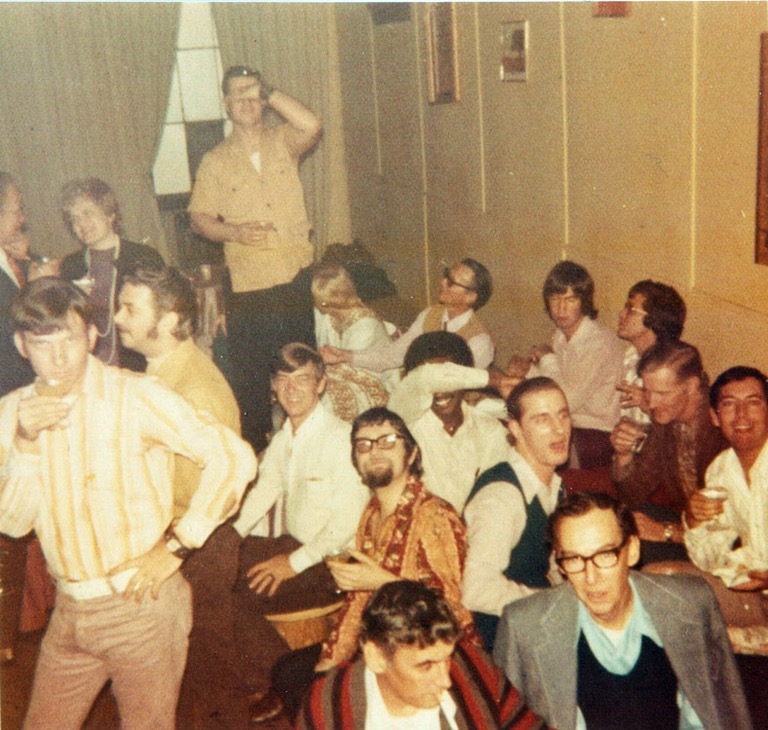
That Sunday, dozens of members of the Metropolitan Community Church (MCC), the nation’s first gay church, founded in Los Angeles in 1969, got together there for drinks and conversation. It seems to have been an amiable group. The atmosphere was welcoming enough that two gay brothers, Eddie and Jim Warren, even brought their mom, Inez, and proudly introduced her to the other patrons. Beer flowed. Laughter filled the room.

Just before 8:00p, the doorbell rang insistently. To answer it, you had to unlock a steel door that opened onto a flight of stairs leading down to the ground floor. Bartender Buddy Rasmussen, expecting a taxi driver, asked his friend Luther Boggs to let the man in. Perhaps Boggs, after he pulled the door open, had just enough time to smell the Ronsonol lighter fluid that the attacker of the UpStairs Lounge had sprayed on the steps. In the next instant, he found himself in unimaginable pain as the fireball exploded, pushing upward and into the bar.

The ensuing 15 minutes were the most horrific that any of the 65 or so customers had ever endured — full of flames, smoke, panic, breaking glass, and screams.

MCC assistant pastor George “Mitch” Mitchell escaped, but soon returned to try to rescue his boyfriend, Louis Broussard. Both died in the fire, their bodies clinging together in death, like a scene from the aftermath of Pompeii.

Metal bars on the UpStairs Lounge windows, meant to keep people from falling out, were just 14 inches apart; while some managed to squeeze through and jump, others got stuck. That’s how the MCC’s pastor, Rev. Bill Larson, died, screaming, “Oh, God, no!” as the flames charred his flesh. When police and firefighters surveyed and began clearing the scene, they left Larson fused to the window frame until the next morning.

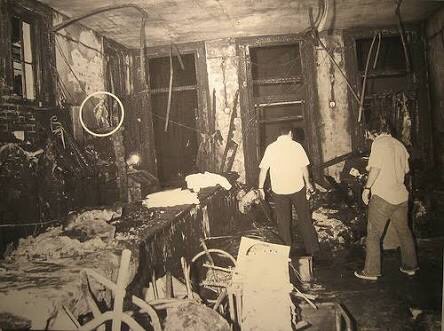
This news photo is among the most indelible I’ve ever seen

Thirty-two people lost their lives that Sunday 40 years ago — Luther Boggs, Inez Warren, and Warren’s sons among them.

Homophobia being what it was, several families declined to claim the bodies and one church after another refused to bury or memorialize the dead. Three victims were never identified or claimed, and were interred at the local potter’s field.

When the Rev. William Richardson, of St. George’s Episcopal Church, agreed to hold a small prayer service for the victims, about 80 people attended, but many more complained about Richardson to Iveson Noland, the Episcopalian bishop of New Orleans. Noland reportedly rebuked Richardson for his kindness, and the latter received volumes of hate mail.

The UpStairs Lounge arson was the deadliest fire in New Orleans history and the largest massacre of gay people ever in the U.S. Yet it didn’t make much of an impact news-wise. The few respectable news organizations that deigned to cover the tragedy made little of the fact that the majority of the victims had been gay, while talk-radio hosts tended to take a jocular or sneering tone: What do we bury them in? Fruit jars, sniggered one, on the air, only a day after the massacre.

Other, smaller disasters resulted in City Hall press conferences or statements of condolence from the governor, but no civil authorities publicly spoke out about the fire, other than to mumble about needed improvements to the city’s fire code.

Continuing this pattern of neglect, the New Orleans police department appeared lackluster about the investigation (the officers involved denied it). The detectives wouldn’t even acknowledge that it was an arson case, saying the cause of the fire was of “undetermined origin.” No one was ever charged with the crime, although an itinerant troublemaker with known mental problems, Rogder Dale Nunez, is said to have claimed responsibility multiple times. Nunez, a sometime visitor to the UpStairs Lounge, committed suicide in 1974.

The following Wikipedia article goes into more detail, and provides a huge list of references for anyone who wants to read more on this tragedy.

https://en.m.wikipedia.org/wiki/UpStairs_Lounge_arson_attack

The UpStairs Lounge arson attack took place on June 24, 1973, at a gay bar located on the second floor of the three-story building at 141 Chartres Street in the French Quarter of New Orleans, Louisiana, in the United States.[1] Thirty-two people died as a result of fire or smoke inhalation. The official cause is still listed as “undetermined origin”.[2] The most likely suspect, a gay man who had been thrown out of the bar earlier in the day, was never charged.[3] Until the 2016 Orlando nightclub shooting, it was the deadliest known attack on a gay club in U.S. history.

INCIDENT

On Sunday, June 24, 1973, the final day of Pride Weekend,[4] members of the Metropolitan Community Church, a pro-LGBT Protestant denomination, held services inside the club, located on the second floor of a three-story building at the corner of Chartres and Iberville Streets. The MCC was the United States’ first gay church, founded in Los Angeles in 1968.[5] After the service, the club hosted free beer and dinner for 125 patrons. At the time of the evening fire, some 60 people were listening to pianist David Gary perform[6] and discussing an upcoming MCC fundraiser for the local Crippled Children’s Hospital.At 7:56 p.m., a buzzer from downstairs sounded, and bartender Buddy Rasmussen, an Air Force veteran, asked Luther Boggs to answer the door, anticipating a taxi cab driver. Boggs opened the door to find the front staircase engulfed in flames, along with the smell of lighter fluid.[3] Rasmussen immediately led some twenty patrons out of the back exit to the roof, where the group could access a neighboring building’s roof and climb down to the ground floor. The others were accidentally locked inside the second-floor club,[7] some attempting to escape by squeezing through barred windows. One man managed to squeeze through the 14-inch gap, only to fall to his death while burning. Reverend Bill Larson of the MCC clung to the bars of one window until he died, and his charred remains were visible to onlookers for hours afterwards. MCC assistant pastor George “Mitch” Mitchell managed to escape, but then returned to attempt to rescue his boyfriend, Louis Broussard. Both died in the fire, their remains showing them clinging to each other.[8]

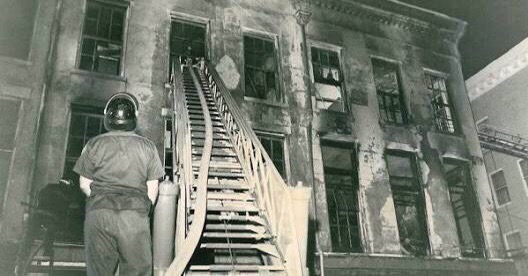
Firefighters stationed two blocks away found themselves blocked by cars and pedestrian traffic. One fire truck tried to maneuver on the sidewalk but crashed into a taxi. They arrived to find bar patrons struggling against the security bars and quickly brought the fire under control.[9] Twenty-eight people died at the scene of the sixteen-minute fire, and one died en route to the hospital. Another 18 suffered injuries, of whom three, including Boggs, died.
AFTERMATH

The official investigation failed to yield any convictions. The only suspect for the attack was Rodger Dale Nunez, a local hustler and troublemaker who had been ejected from the bar earlier in the evening after fighting with another customer.[3] Police attempted to question Nunez shortly after, but he was hospitalized with a broken jaw and could not respond. When questioned later on, police records show that he did not appear nervous at all. Nunez had a witness who claimed that he had been in and out of the bar during the 10–20 minutes before the fire, and that he had seen nobody enter or leave the building. Because police observed that the witness was stressed, and had lots of nervous tension, they dismissed the witness as a liar.[10]

Nunez had previously been diagnosed with “conversion hysteria” in 1970 and had visited numerous psychiatric clinics. He had been released from a treatment facility in the year before the fire.[11] After his arrest, Nunez escaped from psychiatric custody and was never picked up again by police, despite frequent appearances in the French Quarter. A friend later told investigators that Nunez confessed on at least four occasions to starting the fire. He told the friend that he squirted the bottom steps with Ronsonol lighter fluid bought at a local Walgreens and tossed a match. He did not realize, he claimed, that the whole place would go up in flames.[3] Nunez took his own life in November 1974.[9]
In 1980, the state fire marshal’s office, lacking leads, closed the case.[9]
MEDIA COVERAGE

Coverage of the fire by news outlets minimized the fact that LGBT patrons had constituted the majority of the victims, while editorials and talk radio hosts made light of the event.[6] No government officials made mention of the fire: as Robert L. Camina, writer/director of a documentary about the fire (Upstairs Inferno), said in 2013, “I was shocked at the disproportionate reaction by the city government. The city declared days of mourning for victims of other mass tragedies in the city. It shocked me that despite the magnitude of the fire, it was largely ignored.”[7]

CHRISTIANS’ REACTIONS

Reverend William P. Richardson of St. George’s Episcopal Church, agreed to hold a small prayer service for the victims on June 25. Approximately 80 people attended the event. The next day, Iveson B. Noland, the Episcopal bishop of New Orleans, rebuked Richardson for hosting the service. Noland received over 100 complaints from parishioners concerning the service, and Richardson’s mailbox filled with hate mail.[12]

Soon after two additional memorial services were held on July 1 at a Unitarian church and St. Mark’s United Methodist Church, headed by Louisiana’s Methodist bishop Finis Crutchfield and led by MCC founder Reverend Troy Perry, who came from Los Angeles to participate. Mourners exited through the church’s main door rather than an available side exit, a demonstration of a new willingness to be identified on camera.[9] Several families did not step forward to claim the bodies of the deceased. A few anonymous individuals stepped forward and paid for the three unknown men’s burials, and they were buried with another victim identified as Ferris LeBlanc in a mass grave at Holt Cemetery.[5] LeBlanc’s family would not learn of his death in the arson attack until January of 2015.[13]
In June 1998, the 25th anniversary of the fire, as part of Gay Pride celebrations, a memorial service was organized by Rev. Dexter Brecht of Big Easy Metropolitan Community Church (also known as Vieux Carre MCC) and Toni J. P. Pizanie.[7] It was held at the Royal Sonesta Hotel Grand Ball Room and attended by New Orleans Councilman Troy Carter, Rev. Carole Cotton Winn, Senior Rabbi Edward Paul Cohn of Temple Sinai, Rev. Kay Thomas from Grace Fellowship in Christ Jesus, Rev. Perry, and 32 members of the New Orleans community representing the victims. Carter then led a jazz funeral procession to the building on the corner of Chartres and Iberville Streets, the site of the club, and members of the local MCC laid a memorial plaque and wreaths. Among the attendees was the niece of victim Clarence McCloskey.[14]

LEGACY

  • In 1998 the reconstituted MCC congregation in New Orleans (Big Easy Metropolitan Community Church, since renamed again to MCC of New Orleans) held a 25th anniversary service to commemorate the arson and its 32 deaths. This event is significant because, unlike the one it memorialized, the 300 members of the congregation refused to hide their faces and instead insisted on entering and leaving the event through the church’s front doors.
  • In 2008 The North American Convocation of Pro-LGBT Christians planned to hold its “Many Stories, One Voice” event in New Orleans to commemorate the 25th anniversary of the conference (and the 35th anniversary of the tragedy), but eventually canceled the conference for the year due to Hurricane Gustav.[15]
  • In 2008 local artist Skylar Fein constructed an art installation titled Remember the Upstairs Lounge.[16] The New Orleans Museum of Art has since acquired Fein’s art exhibit, which includes a reproduction of the bar.[7]
  • A TAPS group in episode 15, Season 8 of Ghost Hunters visited the lounge to encounter alleged ghosts of the fire’s casualties. The episode identified the event as the “Jimani Lounge Massacre.”[17]
  • In 2013, noting the 40th anniversary of the fire, the Roman Catholic Archbishop of New Orleans, Gregory Michael Aymond, issued a statement of regret that his predecessor, Archbishop Philip Hannan, and the local church leadership ignored the arson attack. Aymond wrote to Time magazine that “In retrospect, if we did not release a statement we should have to be in solidarity with the victims and their families … The church does not condone violence and hatred. If we did not extend our care and condolences, I deeply apologize.”[18]
  • In 2013, Royd Anderson wrote, directed, and produced a documentary about the tragedy titled The UpStairs Lounge Fire.[19][20][21]
  • Also in 2013, Wayne Self (a playwright and composer from Natchitoches, Louisiana), first presented a musical called Upstairs about the tragedy.[22]
  • In 2014, McFarland & Company released the Clayton Delery-Edwards-penned account of the arson The Up Stairs Lounge Arson: Thirty-two Deaths in a New Orleans Gay Bar, June 24, 1973. The book was selected as one of the Louisiana Endowment for the Humanities 2015 Books of the Year.[23]
  • In 2014, Melange Dance Company of New Orleans performed a tribute show as part of the New Orleans Fringe Festival. ‘The UpStairs Lounge’ show aimed to uplift with a combination of dance and film that celebrate the Lounge, its patrons, and the strides taken towards Human Rights since the incident.[24]
  • In 2015, Melange Dance Company of New Orleans presented an extended performance of ‘The UpStairs Lounge’ show originally performed as part of the 2014 New Orleans Fringe Festival.[25]

RELATED

  • The space on the second floor formerly known as the UpStairs Lounge now contains business offices and a kitchen for the Jimani Lounge (established 1971), which is located on the first floor. The current owner, Jimmy Massacci, and his father, the former owner, personally witnessed the arson and its aftermath.[5] The third floor, then owned by the UpStairs Lounge, remains unused and partially damaged. The building itself dates back to at least 1848, when the earliest-known sale of the building is documented.[26]
  • The fire was the third arson attack to affect the MCC,[27] following a January 27, 1973, arson at the church’s headquarters in Los Angeles (resulting in the destruction and collapse of the building with no injuries) and another 1973 arson at an MCC church in Nashville, Tennessee (also with complete destruction of the church and its furnishings but no injuries).[28][29]

REFERENCES

  1.  “Upstairs Lounge Fire Memorial, 40 Years Later – NOLA DEFENDER”. Retrieved September 21, 2014.
  2. “The Up Stairs Lounge Arson: Thirty-Two Deaths in a New Orleans Gay Bar. By Clayton Delery-Edwards. P.118
  3. a b c d Townsend, Johnny (2011). Let the Faggots Burn: The UpStairs Lounge Fire. BookLocker.com, Inc. ISBN 9781614344537.
  4. “The Tragedy of THE UPSTAIRS LOUNGE”. The Jimani Lounge.
  5. a b c Alyne A. Pustanio (2010). “The Haunting Tragedy of the UpStairs Lounge”. AlynePustiano.com.
  6.  a b Erik Ose (July 3, 2008). “Gay Weddings and 32 Funerals: Remembering the UpStairs Lounge Fire”. Huffington Post.
  7. a b c d Diane Anderson-Minshall (November 15, 2013). Remembering the Worst Mass Killing of LGBT People in U.S. History. The Advocate.
  8. Eric Newhouse, Associated Press (1973-06-25). “Arson Eyed in New Orleans Fire”. Abilene Reporter-News, Texas.a b c d Freund, Helen (June 22, 2013). “UpStairs Lounge fire provokes powerful memories 40 years later”. New Orleans Times-Picayune. Retrieved June 26, 2013.
  9. The Up Stairs Lounge Arson: Thirty-Two Deaths in a New Orleans Gay Bar. By Clayton Delery-Edwards. P.122
  10. The Up Stairs Lounge Arson: Thirty-Two Deaths in a New Orleans Gay Bar. By Clayton Delery-Edwards. P.127
  11. William P. Richardson – Profile – LGBN-RAN
  12. The New Orleans Advocate. Family solves mystery after learning uncle died in infamous UpStairs Lounge Fire 40-plus years ago in New Orleans. June 6, 2015. Retrieved June 20, 2016.
  13.  “The Upstairs Fire – June 24, 1973 – 25th Anniversary Memorial Service”. Retrieved September 21, 2014.
  14. “Pro-LGBT Christians to mark 35th anniversary of deadliest fire in New Orleans’ history”.
  15. Doug MacCash (November 2, 2008). “Skylar Fein: Installation reignites memory of a deadly fire”. The Times-Picayune.
  16. “Ghost Hunters – Season 8, Episode 15: French Quarter Massacre”. Syfy. September 19, 2012.
  17. “The Upstairs Lounge Fire: The Little Known Story of the Largest Killing of Gays in US History”. Time. June 21, 2013. Retrieved June 25, 2013.
  18. “Mass killing at New Orleans gay lounge remembered 40 years later”. Nicole, Erin. WGNO-ABC. June 24, 2013.
  19. “The UpStairs Lounge Fire (2013 trailer)”. Royd Anderson Productions. Retrieved June 16, 2013.
  20. “Acadiana Pride Festival, “a celebration of culture””. Berry, Brheanna. KLFY-CBS. March 29, 2015.
  21. Wayne Self. “Upstairs”.
  22. The Advocate: Book of the Year: Biography Documenting Worst Mass Killing of Gays in U.S. History
  23. “Melange Dance Company Events”. November 20, 2014.
  24.  “Melange Dance Company Events”. March 27, 2015.
  25. “The Building”. The Jimani Lounge.
  26. Vicki Lynn Eaklor (2008). Queer America: A GLBT History of the 20th Century. p. 136.
  27. Dudley Clendinen; Adam Nagourney (June 5, 2001). Out For Good: The Struggle to Build a Gay Rights Movement in America. Simon and Schuster. p. 181. ISBN 978-0-684-86743-4. Retrieved December 13, 2012.
  28. The Rev. Elder Troy D. Perry; The Rev. Elder Nancy Wilson (November 1, 1997). Report to the President for the White House Conference On Hate Crimes (PDF). UFMCC.



Handbag! Does Any DJ Really Play That?

“Dance music is my love, is my passion, is my life. I live for my fans and take my art very seriously.” Steve Aoki 


Well, this one does, and though I know I’m going against the grain – I’ll always do so.
I work at alternative ends of the spectrum as far as dance music goes, and though I play and do mixes of Handbag music, my preferred dance genre is Uplifting Vocal Trance. My roots lie in a mix of Handbag and House music in the 90s, and HI-NRG in the 80s.

I started DJing as  resident DJ in the Oxford Hotel in Sydney’s Golden Mile (the gay ghetto) of Darlinghurst in 1990, and had a resident Sunday night spot at The Stronghold Bar (a leather bar), situated in the Clock Hotel in Crown Street, Surry Hills from 1992-1996. I will be the first to admit that back in the day, my muxing wasn’t all that great…but I was saved by selecting great music that gave me a following, and a certain popularity. The dance style that really made me popular was – Handbag.

The Urban Dictionary defines Handbag House dance music as “A type of House music. Handbag house consists of the obligatory disco diva lyrics, simple four-on-the-floor TR-909 kick drums, hi-hats on the upbeats, Basic synth stabs in a minor key, and sometimes a snare on beats two and four. Videos often feature the singer in a leather costume dancing around while a sculpted bald black man gyrates his hips whilst also attempting to look threatening. Its name comes from the phenomenon of a group of women dancing around a pile of their handbags.

Damn son this handbag house shit is GAY!” Perhaps a bit cliche…but close to the truth.

It is often referred to as trash or cheese music due to its “fluffy” style, and artists such as Kylie Minogue, Madonna, Jason Donovan, Bananarama, Mel & Kim, Pepsi & Shirley, Dead or Alive, Rick Astley, Paul Lakakis et al, and music labels such as SAW, PWL, and Almighty specialised in its production. 

“Serious” DJs hated it – with a passion! Wikipedia is a lot kinder in its description, and historical background. They use the “Diva House” terminology, and assert “The term “handbag house” appears to be particularly popular on British dancefloors and refers to the notion of a group of female club-goers dancing around a pile of their handbags.[3] Dance culture’s usage of the word ‘handbag house’ started life as a derogatory term.

In the 1990s, as gay clubs and gay culture became more mainstream so did house music. The accessibility of diva house lead to the mainstreaming of gay club music. In the UK especially, handbag house became emblematic of the clubbing culture. According to music historians Bill Brewster and Frank Broughton, by the mid-1990s handbag house had helped to make clubbing into a “mainstream leisure activity.”[4] With the mainstreaming of gay culture in the 1990s, “diva” was the word that bound house music to the gay dance scene, which was previously only defined by Italo disco compositions.
Music critic Simon Reynolds asserts that handbag house was “initially a disparaging term, coined by condescending cognoscenti vis-à-vis the anthemic, chart-penetrating house tunes that allegedly appealed to women, and above all to the folk-mythic construct of Sharon and Tracy.” [5] According to electronic music producer Ewan Pearson and academic Jeremy Gilbert, “handbag house” is often derided as “plastic disco” by dance music fans who prefer “the more esoteric sound of musics which eschew the ‘mainstream’ musical priorities of melody and verbal language.” [6] The mainstream appeal of handbag house caused underground dance music purists to flock to the spin-off genres of hardbag, progressive house, deep house, and garage house.[5] Sociologist Dunja Brill argues that criticism of handbag house carries a “misogynist slant in club cultural representations of the denigrated mainstream of ‘Handbag House’ against which Ravers define their subculture.”[7] Brill maintains that bias against handbag house “is expressed most clearly in a femininisation of the denigrated ‘mainstream’ of pop culture against which subcultures define themselves.”[8]”
Despite being considered “plastic” , and the term Handbag being used in a derogatory way, it continues to be popular, especially amongst gay males across all age groups. When DJing at The Oxford Hotel, its popularity was instantly noticeable by the bopping around of clientele, miming the words and a general feeling of  fun, which yas always geen associated with the genre. I was initially introduced to Handbag through Stock Aitken Waterman, and despite often disparaging their music…I still played it, as I knew that despite every track sounding pretty well exactly the same – it was popular. In the 90s I was exposed to the covers and remixes released through the British “Almighty” label (“Call Me Tonight” by Destiny Love was my first exposure to the label – a track I played to death), and which I primarily still,play now, as they have covered and remixed many popular gay dancefloor hits from the 80s – an era I have a particular affection for. Again, the purists are aghast that anyone would dare cover the music of that era. But to je, it is all about keeping the music alive, and relevant – despite who is doing it.

Handbag is, at its very heart, fun party music. If you were to put on a 2 hour mix of handbag tracks at a party at home you would ve watching nearly everyone there moving to the tracks, miming the words, and talking about memories the tracks invoked. Isn’t this what, in some respects, the music should be about? Does it always have to be serious and esoteric, existing on strobed dancefloors amongst a drug culture that needs a continual mind-fuck!

I upload all my mixes – both Trance & Handbag – to an online DJ service called Mixcloud. Of everything I upload, the most favourited, and most shared, mixes are the Handbag ones. Indeed, within minutes of going up, any mix with the word “Handbag” in the title will be shared. Because they are so popular, I continue to do them. I can’t say I don’t enjoy mixing them…because I do. They are a lot of fun to compile. 

Instead of pigeonholing and denigrating any form of dance music, perhaps we need to pose the question – why is it popular? Surely that a form of music like Handbag can initiate sensations of fun and frivolity, girlishness, and just getting people dancing can’t be a bad thing! It’s about a feeling, an atmosphere, a scene of jubilation and nostalgia. At its heart is the intention to…just make people smile!

Tim Alderman (C) 2016


References

3^ “handbag house@Everything2.com”. Everything2.com. 2001-12-14. Retrieved 2011-02-10.
4^ Brewster, Bill; Frank Broughton; Frank Broughton (2000). “Last Night a DJ Saved My Life: The History of the Disc Jockey”. Last Night a DJ Saved My Life: The History of the Disc Jockey. Headline Book Publishing. p. 396. Retrieved 28 December 2014.

5^ a b Reynolds, Simon (August 21, 1998). Energy Flash: A Journey Through Rave Music and Dance Culture. Picador. Retrieved 23 October 2012.

6^ Gilbert, Jeremy (September 19, 1999). “Discographies: Dance Music Culture and the Politics of Sound”. Discographies: Dance Music Culture and the Politics of Sound. Routledge. p. 70. Retrieved 23 October 2012.

7^ Brill, Dunja (Dec 15, 2008). Goth Culture: Gender, Sexuality and Style. Bloomsbury Academic.

8^ Brill, Dunja; Deicke, Wolfgang; Hodkinson, Paul (2007). “”Gender, status and subcultural status in the goth scene.””. Youth Cultures: Scenes, Subcultures and Tribes. Routledge. p. 122.

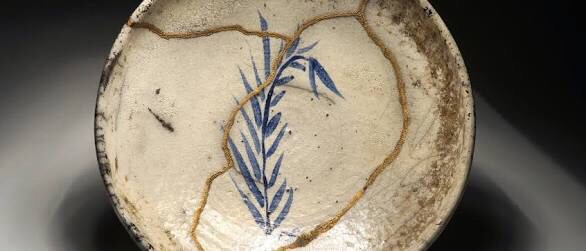
Kintsukuroi “golden mend”

“More beautiful for having been broken”

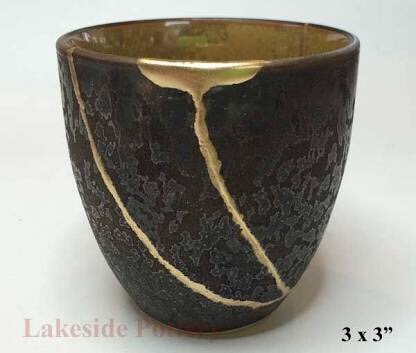
kintsukuroi tea bowl

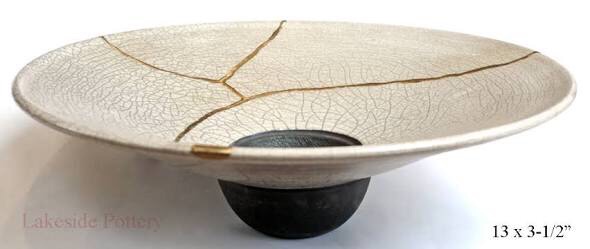
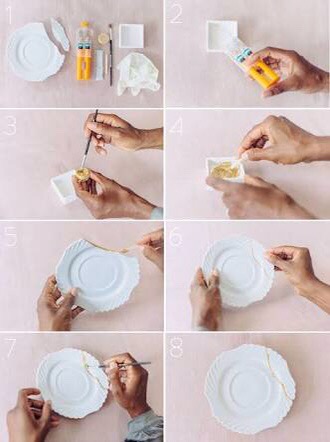
Kintsukuroi (“golden mend”) is the Japanese art of mending broken pottery using lacquer resin laced with gold or silver. As well as a nifty form of repair, kintsukuroi has a deeper philosophical significance. The mended flaws become part of the object’s design, and some people believe the pottery to be even more beautiful having gone through the process of being broken and repaired.
  

Through kintsukuroi, the cracks and seams are merely a symbol of an event that happened in the life of the object, rather than the cause of its destruction.


Like pots, bowls, cups, and plates, we endure our own bumps and scrapes. We experience drops from a dizzying height and unexpected knocks.


Sometimes we experience things that plant the seeds of shame: rejection, betrayal, abandonment, failure. So we try to avoid experiences that leave us vulnerable to these feelings as much as possible, lest the people around us see the evidence of just how imperfect, flawed, and “not good enough” we really are.


In other words, we stay hidden in the cupboard, right behind the best silver, because we don’t want to get a chip, a crack, or a complete break.


That’s not to say that I believe trauma or tragedy automatically makes us more beautiful—I don’t. I’ve known people who have dealt with these things and come out on the other end about as ugly as it gets.


I do believe these experiences change us though—and I think we have a choice.


We can choose to reject our bitter experiences and flaws, to wish and will them away, to regret, to pine, and to live in the land of “If only…” We can disguise with false-self personas, cover up with defences, distract with busyness.


Or we can choose to see these experiences for what they are: our golden seams.


The times when we get scratched, chipped, cracked and broken can feel totally shitty, but there can also be a strange beauty in the way we process them and the lessons we take from them afterwards… if we want.


Our experiences don’t define us, but they do influence us. We can decide to hide, or we can decide to embrace these experiences that have shaped us in some small way, the experiences to which we’ve applied our own special coating of gold-laced resin. We can decide to cover up, or we can decide to walk out into the world as ourselves, mended breaks and all.


Your story is yours to be told. Embrace the experiences that have influenced you. 
http://www.becomingwhoyouare.net/japanese-pottery-can-teach-us-feeling-flawed/

THE FABLE OF KINTSUKUROI

Once upon a time, in the far, far east, east even of Eden, lived a great emperor, in a great palace, gorgeously stocked with the richest of goods. It was early spring, and the season of royal visits, when kings and princes called on one another and admired each others’ choicest possessions, gave wonderful gifts and enjoyed bountiful banquets. And this year was special, because the visitors would see the investiture of his beloved son Kintsukuroi as Crown Prince of the empire.
The emperor was excited this year because he had a new and beautiful bowl to show to his friends, specially made for him by the finest of craftsmen from the finest of materials. Imagine then his horror when on going to his cabinet he discovered that it was broken apart, into a hundred pieces. How could it have happened? No-one knew. What could be done about it before the first visitors arrived? No-one could offer any idea, for the time was too short to start again and make another one.
The emperor was dismayed, sad that he could not show off his beautiful bowl, but even sadder that something so beautiful should have broken. He retired into his private apartments with only his beloved son to share his sorrow, and they talked long into the night together.
Next morning the emperor woke to the sound of a great commotion. His senior ministers demanded to see him urgently. The cabinet of treasures had now been broken into, and this time the great new golden diadem that has been made for his beloved son, ready for the investiture, was quite simply gone – along with the broken pieces of the broken bowl, but who cared about those now.
What is more, the thief had been seen, but not recognized, since he was covered in dirt and scars, with nothing to distinguish him from a thousand other down-and-outs who hung around the palace, for the emperor – to the annoyance of his ministers – refused to turn them out but shared his food with them.
No-one knew for sure where the thief had gone, but he had, they thought, run off towards the princes apartments. There the doors were most unusually now locked and there was no answer to their knocking, though they could hear sounds inside. Would the emperor give his permission for them to break down the door: they dare not act without it.
The emperor was silent for many minutes. On his face his ministers saw sadness but not anger, lament but also love. What was going on? Eventually the emperor spoke. “Leave the prince and his apartments alone. If he is ready to rule, he must be allowed to act. His will and my will are as one.” The ministers were not at all sure just what this meant, but the message was clear. They were to do precisely nothing.
So the day passed. The emperor remained in his private apartments. Those of the prince remained locked, though smoke could be seen coming out of the chimney and a fire had obviously been lit. And eventually the ministers tired of their waiting and went to bed. The important guests were expected the very next day.
Imagine now their surprise in the morning when they went to the treasure cabinet to prepare its items for display and found the precious bowl back in its place, whole again, but glistening with veins of gold where the cracks had been. Its beauty seemed all the greater. And by it the prince’s crown, a slim band now, but speaking in its simplicity of a strength, an authority all the more striking, because it had given itself away and given glory to another, but was the greater itself for it. The investiture could go ahead.
A smile of secret understanding passed between the emperor and the son whose newly scarred hands had shown him worthy to come into the kingdom.
https://philipchircop.wordpress.com/2013/11/10/the-fable-of-kintsukuroi/

A Mineral Worth Its Salt

3/4/2010 The Sydney Morning Herald

Author: Helen Greenwood

Section: Good Living

Page: 8

This often-maligned compound now comes in a dazzling array of flavours and textures from countries across the globe, writes Helen Greenwood.

We all know too much salt is bad for us. Yet we can’t live without the ionic compound known as sodium chloride or NaCl. Remove salt from the diet and you die. What’s more, your food tastes better with salt.
Thomas Keller writes in The French Laundry Cookbook: “The ability to salt food properly is the single most important skill in cooking … Salt opens up flavours, makes them sparkle. But if you taste salt in a dish, it’s too salty.”
The question is, which salt? In the past few years, Sydney cooks have been deluged with a flood of artisan salts. They are extracted from the Himalayas in Pakistan, skimmed at Halen Mon in Wales, drawn from pans in Brittany in France or evaporated from the sea at Trapani in Sicily. We are now inundated with choices. And colours. And textures.
Gourmet salts can be white (Maldon), pink (Murray River), black (Cypriot), red or green (Hawaiian) and grey or natural (Italian). They can be flaky or grainy, pyramid- or crystal-shaped. They can be damp, dry or powdery.
More importantly, these gourmet salts have different mineralities that give each one a different flavour. They have depth, power and pungency and need only to be used sparingly to great effect.

At Rock Restaurant in the Hunter Valley, chef and owner Andrew Clarke has been playing with gourmet salts. “We use anywhere up to 12 different salts in the restaurant,” he says. “We use the vanilla Halen Mon with balmain bugs after they’ve been grilled. We use a coarse-grain curing salt for meats. We use iodised salts to flavour blanching water. We use the Cyprus black salt to finish off our wood-roasted goat. We put Maldon on the table because it’s clean and has a soft sea-saltiness.”
All salt comes from the sea, whether it’s mined high in the Himalayan mountains or collected from salt flats in Bolivia. Yet this inorganic mineral carries the flavour of the environment in which it was formed. In the case of the famous French fleur de sel, or flower of the salt, which is “young” crystals that form on the surface of salt evaporation ponds, the flavour varies from region to region – like fine wines.

Alderman Providore is a specialist online food retailer that sells Himalayan, Hawaiian, Bolivian and French sea and rock salts. Former co-owner Tim Alderman maintains salts from different countries impart different flavours. “Each one has a different minerally quality, as distinct from Saxa,” he says. “The grey salt has a distinct mineral taste, the pink and rose salts tend to be more subtle and are different the Murray River salt. The textures change, too.”
This is a contrast to the traditional view of salt as a mono-flavouring. Most of us grew up with an iodised salt that just tasted, well, salty. It was mined and refined to remove most of its minerals and took away bitter – and any other – tastes. Plain table salt was also available but most people preferred iodised salt, which manufacturers starting producing in the 1920s after US studies found people were suffering from goitre, an enlargement of the thyroid gland caused by iodine deficiency. It is believed Australians’ consumption of iodine has dropped considerably in the past few decades.
Humans need less than 225 micrograms of iodine a day. The mineral is found in seafood and sea salts, both natural replacements for refined salt.
Sea salts are harvested from salt pans, ponds or marshes, or by channelling ocean water into large clay trays and allowing the sun and wind to evaporate it naturally. Sea salts are less treated than other commercial salts so they retain traces of iron, magnesium, calcium, potassium, manganese, zinc and iodine. Sea salts’ fans rave about their bright, subtle flavours.

Gourmet salts can be used for cooking or for finishing a dish and sometimes both. Like a spice or herbs, different salts lend themselves to being used at different times as you cook.
Kala Namak, or Indian black salt or sanchal, is an unrefined mineral salt that, despite it’s name, is a pearl-pink grey. It’s strong, sulphuric odour dissipates when used in Indian cooking and is magic with eggplant. You can also sprinkle it on melon or yoghurt as a final seasoning.

Italian sea salts, such as Ravida from Trapani, is produced from the low waters along the coast of Sicily. They are rich in iodine, fluorine, magnesium and potassium with a lower percentage of sodium chloride than regular table salt. Delicate but with a defined flavour, they are finishing salts that bring a salad or a sauce to life.
Both these salts were part of a tasting held by The Salt Book. A dozen gourmet, plain and flavoured salts were lined up and paired with a variety of foods.
The exercise was fascinating. Strips of rare, grilled sirloin fared better or worse depending on which salt you used.

The coarse rock crystals of pink Himalayan salt looked pretty but the Ravida sea salt from Sicily made the meat jump in your mouth. The green Hawaiian salt was recommended with yellow fin tuna but added a polish to prawns.
James Ballingall, program director at the William Blue College of Hospitality Management in North Sydney, which hosted the tasting, used a brine made from Olsson’s macrobiotic salt to cure a chicken before roasting. The wonderful, tender, firm flesh tasted more like chicken than most birds, apart from organic chooks.
Good all-rounders, favoured by chefs and home cooks, are the Maldon sea salt and the home-grown Murray River salt. Guerande Fleur de Sel stood out as a pure, light seasoning that should only be used at the table.
Fleur de sel is a soft, moist salt that looks like sea foam and surprises consumers who are used to their salt being dry and grainy. Italian salts such as those from Trapani are also moist and often off-white.
The wonderful Riserva Camillone from Cervia in the Emilia Romagna region is strangely sweet. Flavoured salts such as Netherlands smoked salt, Tetsuya’s truffle salt, Cyprus lemon salt flakes and vanilla fleur de sel figured in the tasting, too.
They overpowered the plain ones and need to be used carefully.
Suggestions include salmon, kipfler potatoes, poached prawns and desserts respectively.
The key to a healthy diet is to cook fresh produce and then season it with a salt that has personality and provenance.

The Salt Book, Arbon Publishing, by Fritz Gubler and David Glynn, $34.99.
PROCESSED FOODS: THE REAL SINNERS
About 20 per cent of the world’s salt production is used in food. The remainder is used in the chemical industry and applications such as de-icing roads.
Most of the 20 per cent we consume is “hidden salt” in manufactured foods, from breakfast cereals to instant soups.
The Australian division of World Action on Salt and Health (AWASH) has reported many Australians consume 10 times the amount of salt they need for a healthy diet. The recommended daily intake for salt is four grams but many Australians regularly consume up to 40 grams.
The chairman of AWASH, Professor Bruce Neal, has asked manufacturers of processed food to reduce the salt content of their products by 5 per cent a year.
AWASH’s research has shown excessive consumption of salt comes mainly from eating processed food and can lead to high blood pressure, kidney damage and stomach cancer.
A leading nutritionist, Rosemary Stanton, (pictured), advises people to avoid such products in the first place. “The problem is we eat so much of it,” she says. “That’s why our salt intake has increased so much in the past few decades.”

KNOW YOUR SODIUM CHLORIDE

COOKING SALTS

Kala namak (also known as sanchal) Use in Indian cooking, on raw tropical fruits and cooked vegetables. It’s sold at Indian grocery stores.
Celtic salt, French grey sea salt Use for general purpose, soups, stews and sauces. Buy Coarse Guerande Salt.
Coarse salt Use for salt crusts on meat or fish, curing and flavouring in soups, stews and sauces. Buy Himalayan Pink, La Baleine, Esprit du Sel.
Rock salt Use for curing and brining. Not ideal for the table.

FINISHING SALTS

Flake salt Use as an all-round general salt in cooking or at the table. Buy Maldon, Murray River, Halen Mon, Pyramid.
Fleur de Sel (Flower of Salt) Use for salads, cooked fresh vegetables and grilled meats. Buy Le Paludier.
French sea salt Use in salads and on cooked fresh vegetables and grilled meat. Buy Le Paludier.
Grey salt (sel gris, Celtic sea salt) Use at the end of the cooking process or on the table. Good for casseroles and stews. Buy Le Paludier, Riserva Camillone sale di Cervia, Trapani.
Hawaiian sea salt (alaea, Hawaiian red salt) A natural mineral called alaea (volcanic baked red clay) adds iron oxide and imparts a mellow flavour. Used to preserve and season native Hawaiian dishes. Good for meats. Buy Alaea.
Italian sea salt Use for salads and to finish roasts and sauces. Great as a garnish on bruschetta. Buy Ravida.
Organic salt Standards include purity of the water, cleanliness of salt beds and how the salt is harvested and packaged. Certifiers include Nature et Progres (France), BioGro (New Zealand), Soil Association Certified (Wales). Buy Halen Mon, Olsson’s.

SUPPLIERS

GJ Food The Fine Food Connection (Le Paludier Fleur du Sel and others from Guerande).
Cantarella Bros (Ravida).
Lario Imports (Trapani, Riserva Camillone sale di Cervia).
Alderman Providore, aldermanprovidore.com.au (Himalayan Pink, Alaea, Bolivian Rose, Sel Gris de Guerande).
Simon Johnson (Halen Mon).
F. Mayer Imports (Maldon).
The Essential Ingredient (Murray River Salt).
Waimea Trading, 0409 219 280 (Cyprus Black sea salt).
Olsson Industries, olssons.com.au (Olsson’s Pacific Salt).
HBC Trading, 9958 5688 (Himalayan Pink).
Kirk Food (Pyramid).

Salts


A Ghost of a Business

The original font & graphics for Alderman Providore

The ghosts of my business still survive in cyber-space. Alderman Providore started in 2006 as the next step along from Alderman Catering – a truly exhausting, though exciting business doing top-end party catering. The Providore was designed as an online business – still a very daring and risky step to take in 2006. It was started with $5000 that I begged, borrowed and stole (not really) and was originally a small store on Ebay, created from Ebay templates. 

By the end of 2006, I paid a website designer to create a site for a business, registered the name and domain, used a friend who is a graphic artist to design the typeface and graphic, and aldermanprovidore.com.au hit the internet. I bought gourmet grocery products from all sorts of rare and unique mum ‘n dad, hobby, localised, unknown businesses and created a unique space for their products. The sales started as a small trickle, but grew exponentially over time. David & I introduced product tasting parties, and along with some targeted advertising the business grew and grew. 

At the end of 2008, due to a personal interest in tea and teawares, and due to the rapid expansion of that area, I launched a second web site TeaCoffeeChocolate using the same premise as for the providore, along with a very large range of organic and free-trade products. 

Alderman Providore products in a magazine Christmas gift guide

By this time I had altered the business plan to embrace products from outside Australia IF it was a product that could not be sourced from within Australia. At this time an overhaul of the Alderman Providore site resulted in a fresher, more contemporary look. Magazines started approaching us for both advertising, and to supply products to use as props and in gift guides. Reps from companies contacted me about stocking their products. Sales grew and grew, and we had built a reputation for service, quality, uniqueness, pricing, and product delivery. Ideas were added – and subtracted ,often through being impractical. 

As Christmas 2009 approached, I started early purchasing preparations, and started to stock up on what should gave been our biggest Christmas ever. Like all small retail businesses, I purchased 20% more stock each year, which usually just covered growth, and ensured I wasn’t stuck with stick at the end of the season. If you didn’t get in early, and the product sold out…then bad luck. And the stock rolled in. Cakes, puddings, glacé fruit, sauces, relishes, fruit mince, biscuits and more. I was excited, and pumped for the excitement to come.


Then greed came to town. People who abuse the systems, deal illegally and fraudulently, who use other peoples money to satisfy their own selfish need. They created a monster that came to be known as the Global Financial Crisis (GFC). Everyone stopped buying. Online purchasing, in a growth phase at that time, was the first to be hit. That Christmas I sold…nothing. Thousands of dollars tied up in stock…and no market. By the time Christmas Eve rolled around, I was effectively broke. Money the business earned was sunk back into it. There was no excess. I remember ringing David, and a pudding supplier in tears, because, thanks to somebody else’s greed my business, my dream, was destroyed.
Early 2010 I put the business, good will, and web sites on the market. It sold to a mum in Brisbane who had an interest in food (but as I was to see…not a passion), and so it changed hands, and eventually a new name. Before we moved from Dulwich Hill to Brisbane, we had a HUGE market in our backyard to clear out the remainder of the stock. Anything left from that went to Vinnies.
So, for some unknown reason, today I searched for the ghost of my business. And it’s still there. A lot more than I expected, in fact. And a story of a past glory came out of it. Who knows what the future holds, as dreams do live on!

http://www.homemadefood.com.au/index.php?option=com_sobi2&sobi2Task=sobi2Details&catid=40&sobi2Id=676&Itemid=73

http://newsstore.fairfax.com.au/apps/viewDocument.ac;jsessionid=A5A960B20A0BA88AA9B4AFAA81406D95?sy=afr&pb=all_ffx&dt=selectRange&dr=1month&so=relevance&sf=text&sf=headline&rc=10&rm=200&sp=brs&cls=2353&clsPage=1&docID=SMH1004131I1G64QPB2R

The Alderman Providore masthead

Tim Alderman (C 2016)

So! Just WHO Owns Your Family History?

This is a question I have been asking myself, especially in the light of a recent experience.

I had started using the app for Find-a-Grave to locate any family members listed, and to add family that I have details of. I became a member of the group, but after finding that someone had added death details and pictures of the memorial for my Pickhills grandparents, and finding I couldn’t edit it to add birth details I enquired why. These two people are, after all, my family. A reply to my enquiry informed me “Hello Tim, Thank you for contacting Find A Grave. In order to update a memorial, please go to the memorial on the website, http://www.findagrave.com Click on the edit tab located in the upper right of the memorial page. Choose an option to update the memorial. The update will be sent to the manager of the memorial page. If you are related within transfer guidelines, http://www.findagrave.com/cgi-bin/fg.cgi?page=listFaqs#79 you may ask for a transfer with the edit tab under “suggest any other correction or addition”.Sincerely, (name withheld)”. 

In othe words, someone who is not a member of my family, and doesn’t know them from a bar of soap, currently has the management of grave details for my family in this app/web site! Okay, I can request that management be transferred to me, but the point is…if I hadn’t wanted to edit the details, and request the teansfer as a relative of the deceased, this person would have had control of my grandparents details at this sire permanently! 

These are the guidelines for requesting a teansfer “How do I get a relative’s memorial transferred to me? First, Determine if you really need the memorial transferred to you for management. Only request transferring of management if you have extensive changes to make to a memorial. You can add photos and suggest corrections without having to request management. Simply having someone in your family tree is not grounds for a management transfer request. With hundreds of thousands of contributors, we have many overlapping family trees and it would be impossible for all contributors to manage their entire tree. 

Second, Transfer requests will be for direct relatives within four generations. This would be your siblings, parents, grandparents, great-grandparents, children, grandchildren, and great-grandchildren. 
Third, If you have extensive additions/changes to make to a memorial, please contact the Find A Grave member who created the memorial via the “Suggest a Correction” link under the “Edit” tab on the memorial in question with your request to have the memorial management transferred to you. This will send an email request to the contributor, even if there is not an email address listed on their contributor page.
Fourth, Explain your relationship in the request! Any non-direct relatives (aunts, uncles, cousins, etc) are not required to be transferred. Keep in mind that the original contributor may also be related to the memorial and may not make the transfer. Again, always include your relationship to the memorial on a transfer request, in order for it to be considered. You may also want to include your specific interest in the memorial. Bulk surname requests must not be made. Be advised that memorials listed as famous or maintained by Find A Grave will not be transferred. 
Fifth, The “Suggest a correction” feature may also be used to submit corrections, an original biography, and family links to memorials that do not fall under the above definition. (Be sure to include the memorial ID#s for the family links and how they are related, father, mother or spouse. The original contributor will make any corrections and add any additional information you have for that memorial, such as links to parents and spouses, provided the information is accurate. 
Sixth, Please note that it is not appropriate to request a transfer and then, after receiving the transfer, delete that page and substitute it with a new memorial that you have created. This practice denies credit to the original contributor. Please use the original memorial page to make updates and add information.
NOTE: If you are unable to edit a memorial after it has been transferred to your account, try logging out of Find A Grave then logging back in.” 

The same applies to a memorial for one of my mother’s brothers. Personally, I find this a bit distressing. I have, needless to say, requested the memorials be transferred to my name.

The second incident involved a photograph of my great grandparents headstone. Yes, I did request through Find-a-Grave that someone photograph the memorial for me – though in the future I’ll organise it myself – and a photographer snapped it for me. When checking out the shot, I noticed that to the right, and in shot, another Barron memorial. I cropped the picture, and added the edited photograph to his memorial on the site. Naturally, within the hour, the photographer contacted me, reminding me that the photo was hers, and I was in breach of the apps photographs policy. I apologised, and removed the “offending” photo’s. But then I started thinking about it. I am the first to acknowledge the intellectual property rights of artists, and perhaps that is what niggles me! It s not as though she had photographed her own families graves. Again, this was a memorial with no connection to her whatsoever, total strangers who are nothing more than hames carved into stone. In a just world, the copyright on these types of ohotographs would be turned over – lock, stock & barrel – to the family of the graves photographed. I feel it is only just to do so, instead of blithly crying thief, and grasping control of the material.

Everybody involved in the distribution of family history information and documents greedily has their hands out these days. Anything advertised as “free” will only give you the bare bones. If you want the body and soul…fork out the money, honey!  Even to look and see if there is any material pertaining to your family will cop you a fee on some sites. If there are records being held, it will cost you even more. Subscriptions to genealogy sites like Ancestry don’t come cheap, and often come with a catch 22. I subscribe to record collections of Australia and United Kngdom on Ancestry. Very little of my family history resides in America, and to add America to my subscription adds a lot to its cost, with little value, in my view. So I get my records from Australa and the UK within my monthly fee, but for any of the rest of the world I pay per record – which can be anything from $1.49 to $2.49 per record. In the meantime, Ancestry has access to all the information that goes onto my tree – for which they pay…zilch! 

So, it would appear that we don’t own any of our family history, except that that can be added from personal or family recollection. It would appear that our families are owned by bureaucrats, big business, ancestry sights, photographers, apps, and just about anyone else who can make a quid out of it. There are even people with family tree’s who think that those accessing information from it should pay! For the record – if you want information from mine…help yourself. If others can benefit from my research, then good!

In many respects, it us appalling that others can lay claim to our family name, our family history. It is appalling that we often have to say “no” to accessing a snippet of information, as the cost is too high. Unfortunately, we live in a greedy, grasping world. Our relatives would literally “turn in their graves” if they knew. Just as well they don’t!

Tim Alderman (C 2016)

PS I am not the only person to have had bad experiences with Find-a-Grave. Read Julie’s story hear https://itsabeautifultree.com/2015/04/14/confessions-of-a-grave-robber/

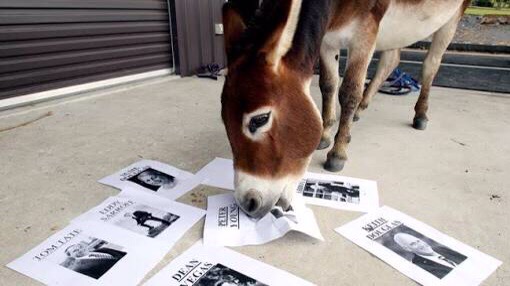
Political Snippet: Donkey Votes

“A donkey vote is a ballot cast in an election that uses a preference voting system, where a voter is permitted or required to rank candidates on the ballot paper, and ranks them based on the order they appear on the ballot paper. The voter that votes in this manner is referred to as a donkey voter.”

Could we, like America, be heading into a donkey vote election? Given the current sad lack of choice – both in major parties, minor parties and Independents – could the voters, fed up with over a decade of bad government, and potentially nothing to look forward to in the political arena, just decide to vote for…anyone! It is not a good scenario, I know that, but noone could blame them. The last term of Howard, followed by the Rudd/Gillard/Rudd/Abbott/Turnbull fiasco has worn everyone out, and made us a country of cynics in the democraric process. What a joke this has made of our political system! No educated voter – probably becoming a rare species with education cuts – takes our current batch of politicians seriously. Our choice of likeable, decent, fair-minded, secular politicians is about…zero. With the likes of Morrison, Joyce, Pyne, Abbott (the bad smell that just won’t go away! The man’s delusion is staggering!) et al has taken politics to a new low in this country. The opposition is no better, and the minor parties are just that – minor, and even that they are there at all makes one question the often dubious nature of our voting system.

So, maybe we should all do a donkey vote on July 2. Who knows – Fiona Patten for PM?…

Tim Alderman (C2016)

Frederick Lindsay Pickhills

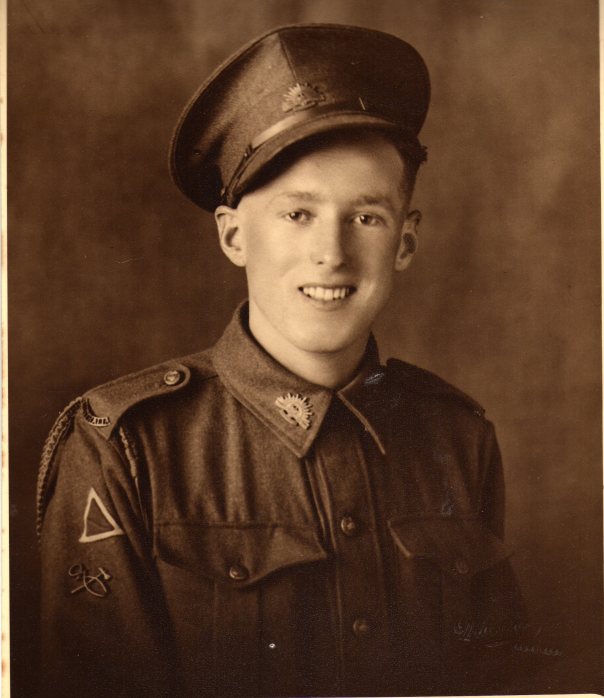
Joe in Army uniform

Frederick Lindsay was born at Chatswood, New South Wales, on the 10th July 1922 to Frederick George Rickinson Pickhills and Ethel Osmond, both from Bourke. He was the second-eldest child of four siblings, and the only male. His sisters are Dorothy, Dulcie and Eileen. I know little about his younger years other than that he was trained as a motor mechanic and a carpenter, two trades he was proficient in till the day he died. Photographs of the young (and the older) Frederick are few and far between, though what I do have show a man who was perhaps happier pre-war than post-war. There are photographs of him in overalls outside a garage where he worked during the 30’s; in Army uniform, and with his slightly cocked hat shows quite a handsome man; a casual photo in shorts; a small photo with his three sisters as youngsters: on a motor bike with a friend, a personal passion until a serious accident in the late 50’s; a lovely photograph with my mother that looks very 40’s; and a wedding photograph outside the church they were married in. He never, ever spoke about his military service and I have no idea of how his war experiences affected him other than that, apart from taking me to several ANZAC day marches, he never really approved of this wartime celebration and had nothing to do with his war comrades. However, I do have his war record and know that he enlisted at the Martin Place Recruiting Depot in Sydney on the 3rd of November 1941. His army number is NX50073. He had obviously lied about his age (he was 19 at the time of enlistment) as it is listed as 21 and three months which is then struck through and his true age inserted. He is listed as being single and a motor mechanic. A surprising find on the Attestation Form is his next of kin, noted as a Norman Emmanuel, who lived in Hillside Flats in Elizabeth St, Artarmon., and is an uncle. It is odd that he didn’t have a parent with him, and I have absolutely no idea who this supposed relative is. He took his oath of allegiance on the same day. There are small front and side photo’s at the bottom of the form. I also have his Army driving license no. 246312 which shows his rank as CFN (Craftsman), and lists the vehicle types he could drive. I also have his Record of Service Book which tells us he was 5’91/2″, weighed 131 lbs, had a 331/2″ chest, fair complexion, light brown hair, hazel eyes and a small scar right frontal region. He had qualified on the firing range, had done a motor mechanics course, he appears to have been appointed as a mechanic in 1941, and was a tester of motor vehicles in 1943. I’m of the thinking that he was a driving instructor. There is a listing of his leave, including in New Guinea and Borneo up till his discharge. We know he passed a chest x-ray in 1941. As for medals he received the 1939/45 Star, and the Pacific Star. His next of kin is listed here as Ethel Pickhills (mother) at 14 Saywell St, Chatswood. We also have all his Proceedings for Discharge, Determination of Demobilisation Priority, his Service and Casualty Forms and a copy of his Certificate of Discharge No. 401253 which informs us that No. NX50073 Craftsman Frederick Lindsay Pickhills of the 2/53 Aust Light Aid Detachment served on continuous full-time war service in the Australian Imperial Force from 3/11/1941 to 14/2/1946 for a total effective period of 1,565 days which included Active Service in Australia for 819 days and outside Australia for 584 days. He received the War Badge R.A.S. No. A.234189 and that he was discharged from the AIF on 14/2/1946.

I believe that the Australia he returned to was not the Australia he left, and I don’t think he ever came to terms with that. He maintained his 1940’s attitudes throughout the rest of his life which made him a difficult father as he could never reconcile himself to a more contemporary age. No wonder I rebelled. He never claimed his military service medals. I have attempted to claim them over the last couple of years, but due to his Last Will and Testament being made out in my step-mother and step-brothers favour I have not been able to procure them. I will follow this up at a later time.

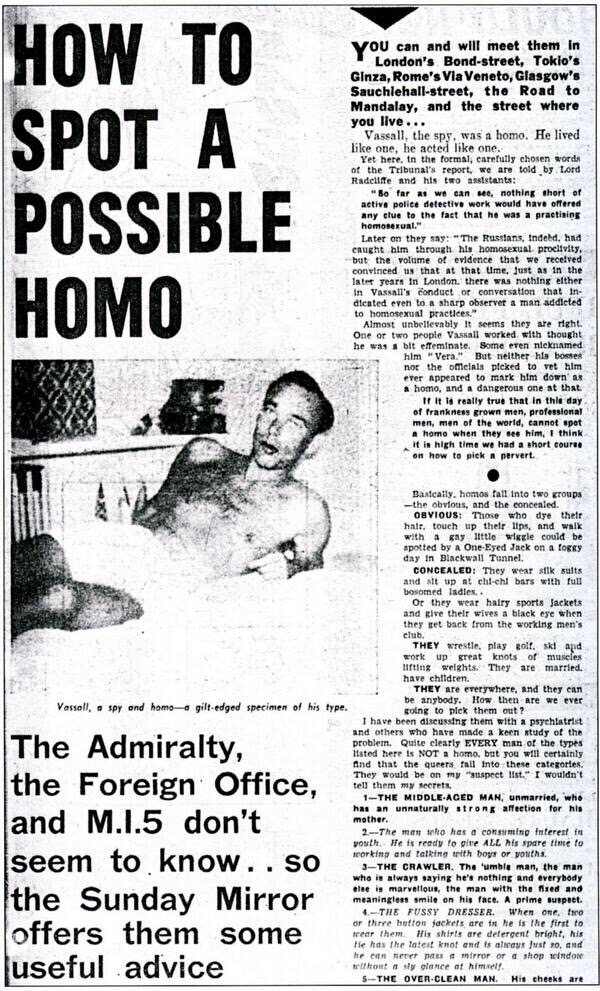
Gay History: How To Spot A Possible Homo!

I hope this helps…


1962 Newspaper Article

http://www.telegraph.co.uk/culture/books/3605777/A-change-of-shape.html

A change of shape

Robert Douglas-Fairhurst reviews Strangers: Homosexual Love in the Nineteenth Century by Graham Robb

12:01AM GMT 03 Nov 2003

How do you pick out a gay man in a crowd? According to Dr La Forest Potter’s Strange Loves, published in 1933, “the average homosexual” differs from “ordinary men” in 10 easily identifiable ways: he has “large, easily aroused nipples”, “a mincing walk”, “sloped and rounded shoulders”, “thick, luxuriant hair”, “a hairless chest”, “soft, delicate skin” free of manly spots, a lack of “dogmatic energy”, a “peculiar swinging motion of the hips” due to anatomical defects in the spine and pelvis, “a considerable deposit of fat in the region of hips, breasts and thighs”, and – the clinching clue – “feminine buttocks”.

Clearly the author of Strange Loves was a little peculiar himself (how could he know that homosexual nipples were “easily aroused”?), but he is hardly an isolated figure in the troubled history of 20th-century attitudes towards homosexuality. From Raphael Kirchner’s 1908 German handbook, How to Recognise Homosexuals, to the two-page guide on “How to Spot a Possible Homo” published in the Sunday Mirror in 1963 (“shifty glances”, “dropped eyes”, “a fondness for the theatre”), it has long been popular wisdom that “one of them” is easily distinguishable from “one of us”. Whether seen as a choice or a compulsion, in everything from lifestyle to hairstyle, the assumption has been that homosexuality is a secret that simply cannot be kept. It is as if the world had been told that the root of “homosexual”, “homos”, is Greek for “same”, meaning that there are men who fall in love with other men, and had misunderstood it to mean that homosexuals are all the same.

Recently, much of the blame for this sorry state of affairs has been laid at the door of the Victorians. According to the most popular line of argument, although there had always been same-sex activity between men, only during the 19th century did the exclusively homosexual person emerge as a distinct social type. Both as a word and a concept, “homosexuality” was a Victorian invention. From the doctors who attempted to diagnose homosexuality (Ambroise Tardieu claimed in 1857 that the telltale signs in men included a corkscrew-shaped penis and a large bottom: “I have seen one pederast whose buttocks were joined and formed a single, perfect sphere”) to the politicians who attempted to legislate against it, the 19th century gave birth not only to “the homosexual” but to the repressive social forces that continued to echo through the 20th century.

This, at least, is the version of events, much influenced by Michel Foucault’s writings on sexuality, which is dutifully wheeled out by most histories of gay life. But then, Foucault was never one to let the facts get in the way of a good theory and, as Graham Robb’s revisionist account proves, the truth was rather more complicated and a lot more interesting.

Almost every page of this book reverberates with the sound of stereotypes being flattened. For example, the assumption that the Victorians were repressive in their attitudes towards illicit sexual behaviour hardly squares with what was accepted and even celebrated. Consider the case of “Fanny” Park, a drag queen arrested for using the ladies’ room at the Strand Theatre, whose acquittal on sodomy charges in 1870 – secured by his solicitor, the wonderfully named Mr Straight – was loudly cheered; or the tight-trousered rent boys (“mollies”) who were an established tourist attraction in both London and New York; or the odd couples, such as the “married” artists Charles Ricketts and Charles Shannon, whose unconventional households attracted some notoriety and a great deal of indifference.

Indeed, for a love that supposedly dared not speak its name, homosexuality was a surprisingly noisy part of Victorian life, less a subculture than a parallel culture that ran alongside and occasionally ran into the heterosexual mainstream. Even Jane Austen, who was hardly in the vanguard of permissiveness, allowed herself a sly joke about gay sex, when Mary Crawford in Mansfield Park discusses her knowledge of admirals: “Of Rears, and Vices, I saw enough. Now, do not be suspecting me of a pun, I entreat.”

Not that the 19th century was an oasis of tolerance and good sense. Most gay men and women remained strangers to the society that had the power to ostracise them or lock them up. Many also remained strangers to one another. It could be hard to recognise a like-minded soul, and Robb has some moving examples of the tactics needed to sound someone out about their sexuality, simultaneously leading on and backing off, without risking rejection or assault.

Even if this hurdle was overcome, there was no guarantee that two gay people, like any other two people, would have anything to talk about. Oscar Wilde cannot have been alone in finding it hard to reconcile his ideals of a pure Grecian love with the pimply youths he took to bed, like the two Cockney lads Frank Harris recalled seeing him with at the Café Royal, talking about the Olympic Games. “‘Did you sy they was niked?’ ‘Of course,’ Oscar replied, ‘nude, clothed only in sunshine and beauty.'”

Perhaps inevitably, such public displays in the period are rare; the history of Victorian gay life is less one of explicit confessions than it is of flirtatious hints and glimpses. Fleshing out these details into a rich and satisfying narrative, Robb is an ideal guide to the period – unfailingly intelligent, compassionate and discreetly witty.

His earlier biographies of Hugo and Rimbaud showed that he has a sharp eye for the way that real lives tend to resist the neat shapes we impose on them, and Strangers is crammed with statistics and anecdotes that succeed brilliantly in changing what we thought we knew about homosexuality, both then and now. In seeking to explain some of the messy and unpredictable workings of love, Robb has produced a rare thing: not just a book with ideas, but a book with heart.

And this wonderful send-up;

http://www.landoverbaptist.net/showthread.php?t=53674

How to spot a homosexual: A step by step guide – 11-07-2010, 04:56 PM

Homosexuals are amongst us. Every day, they discreetly pollute the Good Lord’s Earth with their filthy ways. Luckily, me and Dimitri, at the Domnino League Against Sodomites, have compiled a list of data that will assist you in telling whether your closest friends are secretly queers.

Eating and Drinking:
Whether at the bathhouse, drinking beverages (in appropriate amounts, as prescribed in Timothy 5:23) in the company of fellow Christians, or simply eating lunch on the truck roads of northern Siberia, eating and drinking habits of those within your group of friends will reveal whether or not they are Closetfags™.
Foods consumed by men:

Anything with more than half a pound of meat.
Anything fried or deep fried.

Anything pie-like of the appropriate size.

Anything hunted/skinned yourself and cooked by your wife and/or daughter(s).

Foods consumed by homosexuals:
Anything that comes in small, faggy portions (Sushi, “Cocktail Snacks”)
Anything with a foreign name (Especially if in French)

Anything that is shared with other men (Tapas)

Drinks consumed by men:
Wine (Only if you are depressed. Wine must have a pronouncable name to avoid being mixed with “Faggy wine” [See below] ) Proverbs 31:6-7
Spirits (See Wine)

Beer (See Wine)

Water

Anything produced by the Coca-Cola Company, except drinks which reference fruit. These are considered “fruity”, e.g. homosexual beverages.

e.g. Coca-Cola Cherry.

Drinks consumed by homosexuals:

Cocktails (Notice the name!) – Not a proper drink. Any drink that is a mixture of two or more normally separate drinks is considered a cocktail.
Faggy Wine – Wine made outside of own country, probably in France. The name is distinctly not-English sounding and the label will most likely have pictures of men holding hands.

Conversation:
Homosexuals can often be caught out by listening to their conversation.
Conversation Word Limit
Men talk to exchange information. If any man exceeds the standard limit of 20 words per minute (Unless he is recounting a glorious story of conquest, preaching or praying), he is surely a homosexual.
If you fear you are nearly exceeding this limit in daily conversation, try the following tricks:
* Cut down on words like “Sure.”, “Okay.”, “Nah.” and replace them with indistinct grunts, or glares in the general direction of the person with whom the conversation is occuring.
* Ignore questions, then reproach them for asking you the same thing twice.

Topics of conversation suitable for men;

Comparing engine/tyre/gas tank sizes
Car/truck/van mechanical problems

Comparing your current events (Awful times) to similar events occuring 1/5/10/20 years ago (Good, Holy Christian times)

Your wife/daughter’s inability to cook/clean/etc.

Most recent [manly sport of your choice] game.

Women (In appropriate Christian fashion)

The Bible.

Topics of conversation considered homosexual:
The Weather (In a positive manner):
e.g. “The stars are so beautiful today.”

‘Famous people’ you haven’t heard of.

Clothes

Anything that uses the word “Gorgeous” or synonyms.

Indepth descriptions of sexual activities with other men.

Anything that is prefaced with “You’ll never guess what I saw in Vogue today!”

Other Signs
* In public toilets, a man uses a urinal next to your own.
* He often walks like a cowboy, but you have never seen him ride a horse.

* When you take a shower, he looks through your bathroom window.

Please add to our list if you find anything that is miss. Dimitri & I work very hard and will update once we discover more about this plague. If you suspect you have homosexuals in your neighbourhood, please seek professional aid and do not go outside alone.
Praise Christ.
Tim Alderman 2015

Gay History: How Bona To Vada Your Eek! Polari – The Gay Lingo

The most fascinating aspect of Polari isn’t so much what we no longer use, as how much we still use both on the scene, and in everyday slang.

From Wikipedia

Polari (or alternatively Parlare, Parlary, Palare, Palarie, Palari; from Italian parlare, “to talk”) is a form of cant slang used in Britain by actors, circus and fairground showmen, merchant navy sailors, criminals, prostitutes, and the gay subculture. There is some debate about its origins,[3] but it can be traced back to at least the nineteenth century and possibly the sixteenth century.[4] There is a long-standing connection with Punch and Judy street puppet performers who traditionally used Polari to converse.[5]

Description

Polari is a mixture of Romance (Italian[6] or Mediterranean Lingua Franca), Romani, London slang,[6] backslang, rhyming slang, sailor slang, and thieves’ cant. Later it expanded to contain words from the Yiddish language and from 1960s drug users. It was a constantly developing form of language, with a small core lexicon of about 20 words (including bona (good [7]), ajax (nearby), eek (face), cod (naff, vile), naff (bad, drab), lattie (room, house, flat), nanti (not, no), omi (man), palone (woman), riah (hair), zhoosh (tjuz) (smarten up, stylize), TBH (To Be Had, sexually accessible), trade (sex), vada (see)), and over 500 other lesser-known words.[8] According to a Channel 4 television documentary,[which?] there was once (in London) an “East End” version which stressed Cockney rhyming slang and a “West End” version which stressed theatrical and Classical influences. There was some interchange between the two.

Usage

Polari was used in London fishmarkets, the theatre, fairgrounds and circuses, hence the many borrowings from Romani. As many homosexual men worked in theatrical entertainment it was also used among the gay subculture, at a time when homosexual activity was illegal, to disguise homosexuals from hostile outsiders and undercover policemen. It was also used extensively in the British Merchant Navy, where many gay men joined ocean liners and cruise ships as waiters, stewards and entertainers.[9] On one hand, it would be used as a means of cover to allow gay subjects to be discussed aloud without being understood; on the other hand, it was also used by some, particularly the most visibly camp and effeminate, as a further way of asserting their identity.[citation needed]
The almost identical Parlyaree has been spoken in fairgrounds since at least the seventeenth century[10] and continues to be used by show travellers in England and Scotland. As theatrical booths, circus acts and menageries were once a common part of European fairs it is likely that the roots of Polari/Parlyaree lie in the period before both theatre and circus became independent of the fairgrounds. The Parlyaree spoken on fairgrounds tends to borrow much more from Romany, as well as other languages and argots spoken by travelling people, such as cant and backslang.
Henry Mayhew gave a verbatim account of Polari as part of an interview with a Punch and Judy showman in the 1850s. The discussion he recorded references the arrival of Punch in England, crediting these early shows to a performer from Italy called Porcini (see also John Payne Collier’s account of Porsini—Payne Collier calls him Porchini—in Punch and Judy).[11] Mayhew provides the following:

Punch Talk
“‘Bona Parle’ means language; name of patter. ‘Yeute munjare’ – no food. ‘Yeute lente’ – no bed. ‘Yeute bivare’ – no drink. I’ve ‘yeute munjare,’ and ‘yeute bivare,’ and, what’s worse, ‘yeute lente.’ This is better than the costers’ talk, because that ain’t no slang and all, and this is a broken Italian, and much higher than the costers’ lingo. We know what o’clock it is, besides.”[5]

There are additional accounts of particular words that relate to puppet performance: “‘Slumarys’ – figures, frame, scenes, properties. ‘Slum’ – call, or unknown tongue”[5] (“unknown” is a reference to the “swazzle”, a voice modifier used by Punch performers, the structure of which was a longstanding trade secret).
There are many sources of polari lexicons or “dictionaries” online, most of which are random collections with little or no research, rather than a descriptive list of terms in use.

Decline in use

Polari had begun to fall into disuse amongst the gay subculture by the late 1960s. The popularity of the Julian and Sandy characters played by Hugh Paddick and Kenneth Williams ensured that some of this secret language became public property,[12] and the gay liberationists of the 1970s viewed it as rather degrading and divisive as it was often used to gossip about, or criticise, others, as well as to discuss sexual exploits. In addition, the need for a secret subculture code declined with the legalisation of adult homosexual acts in England and Wales in 1967.

In popular culture

Polari was popularised in the 1960s on the popular BBC radio show Round the Horne starring Kenneth Horne. Camp Polari-speaking characters Julian and Sandy were played by Hugh Paddick and Kenneth Williams.[12]
In the first series of British comedians’ panel television series Jokers Wild (1969), comedian Ray Martine is asked to explain the term palone (woman), which he used while telling a joke. In response to the definition, programme presenter Barry Cryer refers to Martine as a bona omi (good man).
Jason King star Peter Wyngarde recorded a self-titled album in 1970 which contained the song “Hippie and the Skinhead” about Billy the “queer sexy hippie” “trolling the Dilly”.
In the long running BBC Programme Doctor Who, in the episode “Carnival of Monsters”, Vorg, a showman, believing The Doctor to be one himself, attempts to converse with him in Polari. The Doctor states that he doesn’t understand him.[13]
In 2015, filmmakers Brian Fairbairn and Karl Eccleston made a short film entirely in Polari, entitled “Putting on the Dish”.[14]

The lyrics to David Bowie’s 2016 song “Girl Loves Me” consist chiefly of a blend of Polari and Nadsat slang.
Use today


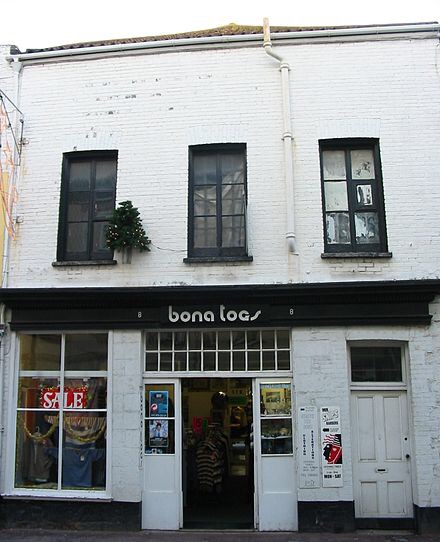
Bona Togs clothes shop
 

Since the mid-1990s, with the redistribution of cassettes and CDs of Round The Horne, and with increasing academic interest, Polari has undergone something of a revival. New words are being invented and updated to refer to more recent cultural concepts.[citation needed]

  • In 1990, Morrissey titled an album Bona Drag – Polari for “nice outfit” – and the single “Piccadilly Palare”.
  • Also in 1990, comic book writer Grant Morrison created the Polari-speaking character Danny the Street (based on Danny La Rue), a sentient transvestite street, for the comic Doom Patrol.
  • The 1998 film Velvet Goldmine, which chronicles a fictional retelling of the rise and fall of glam rock, contains a flashback to 1970 in which a group of characters converse in Polari, while their words are subtitled.
  • In 2002, two books on Polari were published, Polari: The Lost Language of Gay Men, and Fantabulosa: A Dictionary of Polari and Gay Slang (both by Paul Baker). Also in 2002, hip hop artist Juha released an album called Polari, with the chorus of the title song written entirely in the slang.
  • Characters in Will Self’s story Foie Humain, the first part of Liver, use Polari.
  • Comedians Paul O’Grady, Julian Clary, David Walliams, and Matt Lucas incorporate Polari in their comedy routines, as did Rik Mayall.[citation needed]
  • In 2012, artists Jez Dolan and Joseph Richardson created an iPhone app which makes available the Polari lexicon and comprehensive list of etymologies.[15][16]

Entry into standard English

A number of words from Polari have entered mainstream slang.
The Polari word naff, meaning inferior or tacky, has an uncertain etymology. Michael Quinion states that it is probably from the sixteenth-century Italian word gnaffa, meaning “a despicable person”.[17] There are a number of folk etymologies, many based on acronyms—Not Available For Fucking, Normal As Fuck—though these are backronyms. More likely etymologies include northern UK dialect naffhead, naffin, or naffy, a simpleton or blockhead; niffy-naffy, inconsequential, stupid, or Scots nyaff, a term of contempt for any unpleasant or objectionable person. An alternative etymology may lie in the Romany naflo, itself rooted in násfalo, meaning ill. The phrase “naff off” was used euphemistically in place of “fuck off” along with the intensifier “naffing” in Billy Liar by Keith Waterhouse (1959).[18] Usage of “naff” increased in the 1970s when television sitcom Porridge employed it as an alternative to expletives which were not considered broadcastable at the time.[17] Princess Anne famously told a reporter, “Why don’t you just naff off” at the Badminton horse trials in April 1982.[19]
“Zhoosh” (/ˈʒʊʃ/, /ˈʒuːʃ/ or /ˈʒʊʒ/[20]) (generally pronounced “zhuzh” with the vowel sound of “hood”) meaning to smarten up, style or improve something, became commonplace more recently, having been used in the 2003 United States TV series Queer Eye for the Straight Guy and What Not to Wear.

Polari glossary

Word Definition

acdc, bibi- bisexual[21]

ajax – nearby (shortened form of “adjacent to”)[21]

alamo! – they’re attractive! (via acronym “LMO” meaning “Lick Me Out!)[22]

aunt nell listen![23]

aunt nells – ears[24]

aunt nelly fakes – earrings[25]

aunt nell danglers – earrings[citation needed]

barney – a fight[26]

basket- the bulge of male genitalia through clothes[citation needed]

bat, batts, bates – shoes[26]

bitch – effeminate or passive gay man

bijou – small/little (means “jewel” in French)[27]

blag-, pick up[28]

blue -,code word for “homosexual”[citation needed]

bod – body[citation needed]

bona – good[29]

bona nochy – goodnight (from Italian – buona notte)[23]

bonaroo – wonderful, excellent[citation needed]

bungery – pub, this comes from bung.[citation needed]

butch -,masculine; masculine lesbian[30]

buvare – a drink; something drinkable (from Italian – bere or old-fashioned Italian – bevere or Lingua Franca bevire)[30]

cackle – talk/gossip[31]

camp – effeminate (possibly from Italian campare “exaggerate, make stand out”)

capello, capella, capelli, kapella – hat (from Italian, also Greek – cappello)[31]

carsey, karsey, khazi – toilet[31]

cartes – penis (from Italian – cazzo)[32]

cats – trousers[31]

charper – to search or to look (from Italian – acchiappare – to catch)[33]

charpering omi -,policeman

charver – sexual intercourse[28]

chicken – young man

clobber – clothes[34]

cod – bad[35]

cottage – a public lavatory used for sexual encounters

cottaging – seeking or obtaining sexual encounters in public lavatories

cove – taxi[36]

crimper – hairdresser[citation needed]

dally – sweet, kind. Possibly an alternate pronunciation of dolly.[citation needed]

dilly boy – a male prostitute[citation needed]

dinari – money (Latin denarii was the ‘d’ of the pre decimal penny)[citation needed]

dish – buttocks[24]

dolly – pretty, nice, pleasant, from Irish Gaelic dóighiúil ‘handsome’ pronounced ‘doil’

dona – woman (perhaps from Italian donna or Lingua Franca dona)[37]

dorcas – term of endearment, ‘one who cares’. The Dorcas Society was a ladies’ church association of the nineteenth century, which made clothes for the poor.[citation needed]

drag – clothes, esp. women’s clothes (prob from Romani — indraka — skirt; also possibly from German – tragen – v. to wear (clothes))[citation needed]

doss – bed[citation needed]

ecaf – face (backslang)[38]

eek – face (abbreviation of ecaf)[38]

ends – hair[citation needed]

esong, sedon – nose (backslang)[39]

fantabulosa – fabulous/wonderful

feele/freely/filly child- young (from the Italian figlio, for son)

fruit – queen

funt – pound

gelt – money (Yiddish)

handbag – money

hoofer – dancer

HP (homy polone) – effeminate gay man

jarry – food, also mangarie (from Italian mangiare or Lingua Franca mangiaria)

jubes -,breasts

kaffies – trousers

khazi – toilet, also spelt carsey

lacoddy – body

lallies (lylies) – legs, sometimes also knees (as in “get down on yer lallies”)

lallie tappers- feet

latty/lattie – room, house or flat

lills – hands

lilly – police (Lilly Law)

lyles – legs (prob. from “Lisle stockings”)

lucoddy – body

luppers – fingers (Yiddish — lapa — paw)

mangarie – food, also jarry (from Italian mangiare or Lingua Franca mangiaria)

martinis – hands

measures – money

meese – plain, ugly (from Yiddish “meeiskeit, in turn from Hebrew מָאוּס repulsive, loathsome, despicable, abominable)

meshigener – nutty, crazy, mental (from Yiddish ‘meshugge’, in turn from Hebrew מְשֻׁגָּע crazy)

metzas – money (Italian -mezzi “means, wherewithal”)

mince – walk (affectedly)

naff – awful, dull, hetero

nanti – not, no, none (Italian — niente)

national handbag – dole, welfare, government financial assistance

ogle -,look, admire

ogles – eyes

oglefakes – glasses

omi – man (from Romance)

omi-palone – effeminate man, or homosexual

onk – nose (cf “conk”)

orbs – eyes

oven – mouth (nanti pots in the oven = no teeth in the mouth)

palare pipe – telephone (“talk pipe”)

palliass – back

park, parker – give

plate feet – to fellate

palone – woman (Italian paglione – “straw mattress”, [cf. old Cant “hay-bag” = woman]); also spelled “polony” in Graham Greene’s 1938 novel Brighton Rock

palone-omi – lesbian

pots – teeth

remould – sex change

riah/riha – hair (backslang)

riah zhoosher – hairdresser

rough trade – a working class or blue collar sex partner or potential sex partner; a tough, thuggish or potentially violent sex partner

scarper – to run off (from Italian scappare, to escape or run away or from rhyming slang Scapa Flow, to go)

schlumph – drink

scotch – leg (scotch egg=leg)

screech – mouth, speak

sharpy – policeman (from — charpering omi)

sharpy polone – policewoman

shush – steal (from client)

shush bag – hold-all

shyker/shyckle – wig (mutation of the Yiddish sheitel)

slap – makeup

so – homosexual (e.g. “Is he ‘so’?”)

stimps – legs

stimpcovers -,stockings, hosiery

strides – trousers

strillers – piano

switch – wig

thews – thighs

tober – road (a Shelta word, Irish bóthar)

todd (Sloanne) – alone

tootsie trade – sex between two passive homosexuals (as in: ‘I don’t do tootsie trade’)

trade – sex, sex-partner, potential sex-partner

troll -,to walk about (esp. looking for trade)

vada/varder – to see (from Italian — dialect vardare = guardare – look at)

vardered — vardering

vera (lynn) – gin
vogue – cigarette (from Lingua Franca — fogus – “fire, smoke”)

vogueress – female smoker

willets – breasts

yews – (from French “yeux”) eyes

zhoosh -,style hair, tart up, mince (Romani – “zhouzho” – clean, neat)

zhoosh our riah — style our hair

zhooshy – showy

Polai in use

Omies and palones of the jury, vada well at the eek of the poor ome who stands before you, his lallies trembling.—taken from “Bona Law”, a Round The Horne sketch written by Barry Took and Marty Feldman
Translation: “Men and women of the jury, look well at the face of the poor man who stands before you, his legs trembling.”

So bona to vada…oh you! Your lovely eek and your lovely riah.—taken from “Piccadilly Palare”, a song by Morrissey
Translation: “So good to see…oh you! Your lovely face and your lovely hair.”

As feely ommes…we would zhoosh our riah, powder our eeks, climb into our bona new drag, don our batts and troll off to some bona bijou bar. In the bar we would stand around with our sisters, vada the bona cartes on the butch omme ajax who, if we fluttered our ogle riahs at him sweetly, might just troll over to offer a light for the unlit vogue clenched between our teeth.—taken from Parallel Lives, the memoirs of renowned gay journalist Peter Burton
Translation: “As young men…we would style our hair, powder our faces, climb into our great new clothes, don our shoes and wander/walk off to some great little bar. In the bar we would stand around with our gay companions, look at the great genitals on the butch man nearby who, if we fluttered our eyelashes at him sweetly, might just wander/walk over to offer a light for the unlit cigarette clenched between our teeth.”

In the Are You Being Served? episode “The Old Order Changes”, Captain Peacock asks Mr Humphries to get “some strides for the omi with the naff riah” (i.e. trousers for the fellow with the unstylish hair).[40]

See also

  • African American Vernacular English (sometimes called Ebonics)
  • Bahasa Binan
  • Boontling
  • Caló (Chicano)
  • Carny, North American fairground cant
  • Gayle language
  • Gay slang
  • Grypsera
  • IsiNgqumo
  • Lavender linguistics
  • Lunfardo and Vesre
  • Rotwelsch
  • Swardspeak
  • Verlan

References

  1.  Polari at Ethnologue (18th ed., 2015)
  2.  Nordhoff, Sebastian; Hammarström, Harald; Forkel, Robert; Haspelmath, Martin, eds. (2013). “Polari”. Glottolog. Leipzig: Max Planck Institute for Evolutionary Anthropology.
  3.  Quinion, Michael (1996). “How bona to vada your eek!”. WorldWideWords. Retrieved February 20, 2006.
  4.  Collins English Dictionary, Third Edition
  5.  a b c Mayhew, Henry (1968). London Labour and the London Poor, 1861 3. New York: Dover Press. p. 47.
  6. a b “British Spies: Licensed to be Gay.” Time. 19 August 2008
  7. “The secret language of polari”. liverpoolmuseums.org.uk. Retrieved on 27 August 2015.
  8. Baker, Paul (2002) Fantabulosa: A Dictionary of Polari and Gay Slang. London: Continuum ISBN 0-8264-5961-7
  9. “Gay men in the Merchant Marine, Liverpool Maritime Museum”. Liverpoolmuseums.org.uk. Retrieved 2010-10-03.
  10. Partridge, Eric (1937) Dictionary of Slang and Unconventional English
  11.  Punch and Judy. (with Illustrations by George Cruickshank). Thomas Hailes Lacey, London, 1859
  12. a b Stevens, Christopher (2010). Born Brilliant: The Life Of Kenneth Williams. John Murray. p. 206. ISBN 1-84854-195-3.
  13. Paul Baker (2 September 2003). Polari – The Lost Language of Gay Men. Routledge. p. 161. ISBN 9781134506347. Retrieved 13 August 2015.
  14.  Lowder, J. Bryan (2015-07-28). “Listen to Polari, the Lost Art of Gay Conversation”. Slate.
  15. New Europe Online (24.11.2013) http://www.neurope.eu/article/take-polari-safari
  16.  Polari on iTunes
  17.  a b Quinion, Michael. “Naff”. World Wide Words. Retrieved 10 January 2010.
  18. Waterhouse, Keith (1959). Billy Liar. Michael Joseph. pp. 35, 46. ISBN 0-7181-1155-9. p35 “Naff off, Stamp, for Christ sake!” p46 “Well which one of them’s got the naffing engagement ring?”
  19. The New Partridge Dictionary of Slang and Unconventional English Dalzell and Victor (eds.) Routledge, 2006, Vol. II p. 1349
  20. “Definition for zhoosh – Oxford Dictionaries Online (World English)”. Oxforddictionaries.com. Retrieved 2012-06-12.
  21.  a b Baker 2003, p. 49.
  22.  Baker 2003, p. 52, 59.
  23. a b Baker 2003, p. 52.
  24. a b Baker 2003, p. 45.
  25. Baker 2003, p. 59, 60.
  26. a b Baker 2003, p. 164.
  27. Baker 2003, p. 57.
  28. a b Baker 2003, p. 46.
  29. Baker 2003, p. 26, 32, 85.
  30.  a b Baker 2003, p. 167.
  31.  a b c d Baker 2003, p. 168.
  32. Baker 2003, p. 97.
  33. Baker 2003, p. 46, 168.
  34. Baker 2003, p. 138, 139, 169.
  35. Baker 2003, p. 169.
  36. Baker 2003, p. 61.
  37. Baker 2003, p. 26.
  38.  a b Baker 2003, p. 58, 210.
  39. Baker 2003, p. 31.
  40.  “The Old Order Changes”. Are You Being Served?. 18 March 1977.

Bibliography

Baker, Paul (2002) Fantabulosa: A Dictionary of Polari and Gay Slang. London: Continuum: ISBN 0-8264-5961-7
Baker, Paul (2003). Polari – The Lost Language of Gay Men. London: Routledge. ISBN 9781134506354.

Elmes, Simon & Rosen, Michael (2002) Word of Mouth. Oxford University Press: ISBN 0-19-866263-7

External links

Chris Denning’s article on Polari with bibliography

The Polari Bible by the Manchester Sisters of Perpetual Indulgence

Colin Richardsons What Brings You Trolling Back Then article

 http://www.worldwidewords.org/articles/polari.htm

Back in the dim days of my youth, the BBC had a succession of hugely successful radio comedy programmes which have never been matched since. The BBC itself has a strong tendency to be nostalgic about them, calling them the Golden Age of Radio Comedy, though these days the gold mainly ends up in the till, now it has discovered how many other people have fond memories of the shows and are prepared to pay to hear them again on CD or cassette. The best known is almost certainly the Goon Show, attested by its Usenet newsgroup and its fan clubs in North America, Britain and elsewhere. Others included Take It from Here, Hancock’s Half Hour and Round The Horne. This last show was introduced by Kenneth Horne, an urbane straight man, who had previously partnered Richard Murdoch in Much Binding in the Marsh, a send-up of a small RAF station “somewhere in England”, but who in the intervening years had had an extremely successful business career. He was partnered by Kenneth Williams, Hugh Paddick and Betty Marsden, with scripts by Marty Feldman and Barry Took.

One element of the show, which was stereotypical in its layout, always featured a pair of screamingly camp young men: “Hello, I’m Julian and this is my friend Sandy”, overplayed by Williams and Paddick to an extent which robbed it of much of its latent homophobia (particularly as both were known to be gay), though I cannot imagine a similar duo being allowed anywhere near a BBC microphone in this supposedly more permissive but also infinitely more sensitive age. These two spoke in a slangy language which was virtually incomprehensible to anyone hearing it for the first time, though by repetition week by week a mental glossary could be constructed. “How bona to vada your eek!” was a recurring expression; there were references to “butch omis” and to “omipalones”; they always “trolled” everywhere, though their “lallies” weren’t up to much of that; things were “naph”, “bona” or sometimes “fantabulosa”.

This was not a constructed language, but a secret vocabulary, a cant or argot in the linguist’s term, which uses the grammar and syntax of English as well as most of its core vocabulary. It was in fairly common use in the theatre and in related branches of show business such as ballet and the circus, to the extent that a book on the Round the Horne series remarked that Williams and Paddick often really did speak like that in real life. It is variously called Palare, Palyaree, Palary or Polari from its own word for “talk” or “speech”.

HORNE: Would I have vada’d any of them do you think?

SANDY: Oooaaawwh! He’s got all the Palare, ain’t he?

JULIAN: [archly] I wonder where he picks it up?

Linguists still argue about where it came from. The larger part of its vocabulary is certainly Italian in origin, but nobody seems to know how the words got into Britain. Some experts say its origins lie in the lingua franca of the shores of the Mediterranean, a pidgin in use in the Middle Ages and afterwards as a medium of communication between sailors and traders from widely different language groups, the core of this language being Italian and Occitan. Quite a number of British sailors learnt the lingua franca. On returning home and retiring from the sea it is supposed that many of them became vagabonds or travellers, because they had no other means of livelihood; this threw them into contact with roving groups of entertainers and fairground people, who picked up some of the pidgin terms and incorporated them into their own canting private vocabularies. However, other linguists point to the substantial number of native Italians who came to Britain as entertainers in the early part of the nineteenth century, especially the Punch and Judy showmen, organ grinders and peddlars of the 1840s.

But Polari is a linguistic mongrel. Words from Romany (originally an Indian dialect), Shelta (the cant of the Irish tinkers), Yiddish, back slang, rhyming slang and other non-standard English are interspersed with words of Italian origin. Take this exchange from one of the Round the Horne sketches:

SANDY: Roll up yer trouser legs … we want to vada yer calves.

JULIAN: Hmmm … his scotches may be a bit naph but his plates are bona.

[scotch = Scotch egg = leg; plates = plates of meat = feet]

So it would not be surprising to find that both the Italian showman and the lingua franca theories are right, each contributing words at different stages in Polari’s development. This might indeed explain the substantial number of synonyms noted at various times. However, the vocabulary is not well recorded, and now may never be, because it was normal until quite recently for linguists to ignore such low-life forms, which rarely turned up in print (and then only in partial glossaries). But we do know that a few of Polari’s terms have made it across the language barrier into semi-standard English, much of it seeming to come to us via Cockney: karsey, a lavatory; mankey, poor, bad or tasteless; ponce, a pimp; and scarper to run away.

The rest have stayed within the theatrical and circus worlds, and have also been incorporated particularly into the private languages of some homosexual groups, as Julian and Sandy make very clear. Some writers have sought to claim Polari exclusively for the gay community, renaming it Gayspeak. In the 1990s it certainly seems to be heavily used by some city-based British gays (but only male gays, not lesbians), who have invented new terms like nante ’andbag for “no money” (handbag here being a self-mocking example of metonymy). However, it can scarcely have always been so, unless every fairground showman, circus performer, strolling player, cheapjack and Punch and Judy man in history was gay, which seems somewhat unlikely.

There are other characteristics of the language of Julian and Sandy. They tend to make diminuitives of nouns: would you like a bijou drinkette? for example. They also playfully invent words based on Italian models, such as fantabulosa. And they use a few terms which seem to be Polari and yet are unrecorded in glossaries: luffer = finger and nish = no, stop (as in “nish shouting!”; unpublished researches of the OED suggest this is either of Yiddish origin or comes from Irish Gaelic.)

A quick Polari lexicon:

batt = shoe; bevvy = drink (or possibly an abbreviation of beverage, or both); bijou = small; bimbo = dupe, sucker; bona = good; camp = excessive or showy or affecting mannerisms of the opposite sex; charper = to search (leading to charpering omi = policeman); dolly = nice or pleasant; dona = woman (hence the Australian slang word donah); drag = clothes (and so possibly via the gay world to the informal but widespread use meaning to dress in the clothes of the opposite sex); eek = face; fantabulosa = excellent; feele = child (hence feely omi = a young man, sometimes specifically an underaged young man); lally = leg; lattie = house, lodgings; leucoddy = body; naph = bad (quite possibly the origin of the current British English slang term naff); nante = none or nothing; ogle = eye (hence ogleriah = eyelash); omi = man; omipalone = homosexual; palare = talk; palone; woman; riah = hair (possibly back-slang); tosheroon = half a crown (two shillings and sixpence), possibly a much-corrupted form of the Italian mezzo caroon; troll, = walk, wander; vada = look; walloper = dancer; zhoosh = fix, tidy. And perhaps you might like to be able to count to ten in Polari: una, duey, trey, quater, chinker, sey, setter, otto, nobber, dacha.

Now you can have a go at translating this:

As feely homies, we would zhoosh our riahs, powder our eeks, climb into our bona new drag, don our batts and troll off to some bona bijou bar.

http://www.polari.org.uk

Basket or Packet…………The bulge in a mans jeans

Betty bracelet……………Policewoman

Bijou……………………..Small 

Bod……………………….Body 

Bold………………………Daring 

Bona……………………..Good, Nice

Buns……………………..Ass cheeks

Butch…………………….Masculine

Camp…………………….Effeminate

Capello……………………Hat 

Carsey……………………Toilet

Chicken……………………Young man

Charper…………………..To Search 

Charpering omi…………….Policeman 

Cottage…………………..Public Toilet

Cottaging…………………Looking for sex in a cottage 

Crimper…………………..Hairdresser 

Dish ……………………..Nice looking man, Nice arse

Dizzy……………………..Scatty

Dolly………………………Pretty

Drag………………………Women’s clothes 

Eek ………………………Face (Backslang ecaf) 

Esong……………………..Nose 

Fantabulosa ………………Wonderful 

Fruit………………………Old queen 

Gay……………………….Good as you

Gelt……………………….Money 

Glossies……………………Magazines 

Hoofer…………………….Dancer 

Kaffies……………………Trousers

Lallies……………………..Legs 

Latty………………………House

Lills……………………….Hands 

lilly Law……………………Police

Luppers……………………Fingers

Mangarie…………………..Food

Mince………………………A camp walk

Naff ………………………Awfull ( Not Available For F–king) 

Nanti………………………None, no 

National handbag ………….Dole money

Oglefakes………………….Glasses 

Ogles…………………….. Eyes 

Omi………………………..Man 

Omipolone………………….Camp man

Palliass…………………….Back or rear

Polari………………………Talk , to chat

Polone………………………Woman 

Pots,………………………Teeth 

Riah……………………….Hair 

Riah shusher……………….Hairdresser 

Shush bag…………………Bag or Holdall 

Slap…………………………Makeup 

Thews……………………..Thighs 

Trade………………………Sex 

Troll ………………………..To go walking 

Varda………………………See, To look

A short video in polari

http://youtu.be/Y8yEH8TZUsk