All posts by timalderman

Unknown's avatar

About timalderman

Gay, visually-impaired guy writing professionally (and freelance) about disabilities, being gay, articles, opinion pieces, poems and short stories for over 15 years, mainly for small, local magazines. Obtained my Graduate Certificate in Writing from the University of Technology, Sydney in 2004.

The Curious Origins of Slang: The Word Nobody Can Explain

Language is one of humanity’s greatest inventions. It allows us to communicate ideas, tell stories, express emotions, preserve history and shape cultures. Yet language is never static. It constantly evolves, adapting to new technologies, new generations, new fashions and changing societies. One of the clearest examples of this evolution is slang—the colourful, informal vocabulary that gives every era and every community its own distinctive voice.

Ironically, while millions of people use the word slang every day, no one can say with certainty where the word itself came from.

Unlike most common English words, whose ancestry can be traced through centuries of written records into Old English, Latin, Greek or French, the origin of slang remains one of the great unsolved mysteries of historical linguistics. It is fitting, perhaps, that a word describing informal, ever-changing language should itself refuse to reveal its true identity.

A Word Without Parents

The earliest known appearance of the word slang dates from the middle of the eighteenth century, around the 1750s. By that time it was already being used to describe the colourful speech of London’s streets—particularly the language of thieves, beggars, actors, soldiers and market traders.

What puzzles linguists is that the word seems to appear almost without warning.

Normally, historians of language can follow a word backwards through older spellings and earlier forms. They may discover it evolved from an Old English word, entered English through Norman French, or was borrowed from Latin or Greek. The trail may stretch back more than a thousand years.

Not so with slang.

It simply emerges in written English with no obvious ancestor. Despite centuries of research, no earlier form has ever been convincingly identified.

For this reason, the Oxford English Dictionary simply describes its origin as “uncertain.”

Theories Behind the Mystery

Although nobody knows the answer, several intriguing theories have been proposed.

The London Underworld Theory

Perhaps the most widely accepted explanation is that slang originated within the colourful underworld of eighteenth-century London.

At that time London was the largest city in Europe, home to enormous wealth but also crushing poverty. Criminal gangs, pickpockets, prostitutes, street hawkers and confidence tricksters developed secret vocabularies to communicate without outsiders understanding them.

This hidden speech was often known as cant, but some scholars believe slang may originally have referred to this same underground language before gradually broadening its meaning to include all informal speech.

The difficulty is that no document explains how or why the word itself was created.

A Lost Dialect Word

Many modern linguists favour another possibility.

England once contained hundreds of regional dialects, many of which were spoken only by ordinary working people who rarely wrote anything down. Entire vocabularies have disappeared because they were never recorded.

It is entirely possible that slang was one such dialect word.

If so, it may have existed for generations before someone eventually wrote it in a book during the eighteenth century.

Unfortunately, if its spoken origins were never documented, they may be lost forever.

Scandinavian Connections

Because English borrowed thousands of words from Old Norse during the Viking Age, some researchers have searched Scandinavian languages for clues.

Several Scandinavian words resemble slang in sound and have meanings related to “throwing,” “casting,” or “moving quickly.” One theory suggests slang words were expressions casually “thrown around” in conversation.

While attractive, the evidence remains weak. No direct linguistic connection has ever been demonstrated.

The Invented Word Theory

There is another possibility.

Perhaps slang was simply invented.

Human beings coin new words all the time. Shakespeare created hundreds of them. Modern technology has given us words like blog, podcast, emoji and selfie.

The creators of London’s colourful street language may simply have invented the word slang itself.

If so, its birth may never have been recorded.

Spoken Language Leaves Few Footprints

One reason the mystery persists is that language existed long before dictionaries.

For most of history, ordinary people neither read nor wrote. Their words lived entirely in conversation.

Unlike royal decrees, church records or legal documents, everyday speech vanished the moment it was spoken.

Many expressions undoubtedly flourished for centuries before appearing in writing.

By the time lexicographers began compiling dictionaries during the seventeenth and eighteenth centuries, countless words had already come and gone without leaving a trace.

Slang was particularly vulnerable because it belonged largely to ordinary people rather than scholars.

Why Every Society Creates Slang

If the origin of the word is mysterious, the reason slang exists is much easier to understand.

Every society invents it.

People use slang to establish identity.

Teenagers create expressions their parents do not understand.

Soldiers develop language that reflects military life.

Sailors coin words from life at sea.

Doctors, lawyers, police officers, miners, shearers and truck drivers all possess specialised vocabularies that outsiders may find confusing.

Slang creates belonging.

If you understand the language, you belong to the group.

If you do not, you remain an outsider.

Sometimes slang also serves practical purposes.

Throughout history criminals used coded speech to avoid detection.

Political dissidents developed expressions to avoid censorship.

Minority communities often created private vocabularies for protection.

One of the most fascinating examples is the development of Polari in Britain.

Used primarily by gay men before the decriminalisation of homosexuality, Polari blended Italian, Romani, Yiddish, Cockney rhyming slang, theatrical language and naval terminology into a colourful code that allowed conversations to take place in public without attracting unwanted attention.

Australia developed its own equivalents, particularly within the gay communities of Sydney and Melbourne during decades when homosexuality remained criminalised and social prejudice was widespread.

Language became both shield and badge of identity.

Slang as Rebellion

Slang also challenges authority.

Teachers dislike it.

Parents complain about it.

Editors often avoid it.

Yet every generation invents fresh expressions despite repeated attempts to discourage them.

Victorian adults complained about the slang of their children.

The children of the 1920s developed their own vocabulary.

Baby Boomers horrified their parents.

Generation X puzzled the Boomers.

Millennials baffled Generation X.

Today’s teenagers leave almost everyone else wondering what on earth they are talking about.

This cycle has repeated for centuries.

What changes are the words—not the process itself.

Australia: A Nation Built on Slang

Few countries embrace slang as enthusiastically as Australia.

From the earliest convict settlements, Australian English developed its own distinctive character.

Convicts brought London’s criminal cant.

Irish immigrants added their own expressions.

Scottish and English dialects mixed freely.

Aboriginal languages contributed hundreds of place names and numerous everyday words.

Life in the bush encouraged brevity, humour and practicality.

Australians became famous for shortening almost everything.

Afternoon became arvo.

Service station became servo.

Mosquito became mozzie.

Breakfast became brekkie.

Football became footy.

Politician became pollie.

This habit of abbreviation reflects Australia’s relaxed conversational style.

Australian slang also celebrates equality.

Calling someone “mate” suggests friendship regardless of social status.

A person who becomes too self-important risks being “cut down to size.”

Humour, irony and understatement remain central features of Australian speech.

When Slang Grows Up

One of the most remarkable aspects of slang is that today’s informal language often becomes tomorrow’s standard English.

Words once dismissed as vulgar eventually lose their shock.

Consider a few examples.

The word mob originally referred to the disorderly crowd and was itself eighteenth-century slang, shortened from the Latin phrase mobile vulgus, meaning “the fickle crowd.”

Today it is perfectly respectable.

The word bus began as an abbreviation of the Latin-derived omnibus.

Nobody considers it slang now.

Even phone was once merely a casual shortening of telephone.

Language constantly promotes yesterday’s slang into today’s dictionary.

The Words We Leave Behind

Of course, countless slang terms disappear.

Many expressions fashionable during Victorian times now sound hopelessly old-fashioned.

The same fate awaits many of today’s fashionable expressions.

Every generation believes its slang is unique.

History suggests otherwise.

Some words survive because they fill a genuine need.

Others vanish as fashions change.

Together they form an archaeological record of everyday life.

Historians can often learn as much about a society from its slang as from its official documents.

The Great Irony

Perhaps the greatest irony is this.

The word slang describes language that refuses to stay still, refuses to obey rules and constantly reinvents itself.

Yet the word itself behaves exactly the same way.

It emerged unexpectedly in eighteenth-century England.

It left almost no clues about its ancestry.

Despite more than 250 years of linguistic scholarship, nobody has managed to identify its true origins with certainty.

Perhaps that is entirely appropriate.

Some mysteries lose their charm once solved.

The history of slang reminds us that language belongs not only to kings, scholars and dictionary writers, but also to ordinary people—dockworkers, convicts, actors, soldiers, miners, market traders, factory workers, teenagers and countless others whose conversations were rarely recorded.

Their voices shaped the English language every bit as much as Shakespeare’s or Samuel Johnson’s.

Most have been forgotten.

Their words, however, continue to echo through history.

And among those words is one that still keeps linguists guessing.

Slang.

Tim Alderman ©️2026

Sources

Oxford English Dictionary. Slang (entry and etymological notes).

Jonathan Green, Green’s Dictionary of Slang.

Eric Partridge, A Dictionary of Slang and Unconventional English.

Tony Thorne, Dictionary of Contemporary Slang.

Michael Adams, Slang: The People’s Poetry.

Jonathon Green, The Vulgar Tongue: Green’s History of Slang.

David Crystal, The Stories of English.

David Crystal, The Cambridge Encyclopedia of the English Language.

Oxford Reference, entries on slang, cant and argot.

Tim Alderman ©️2026

It’s Gone to Buggery: How Australians Turned a Tudor Capital Crime into a National Expression Part 3

Toyota and One Word That Captured Australia

If anyone doubted that bugger had become part of mainstream Australian English, Toyota settled the argument in 1999.

The television commercial was deceptively simple.

A succession of Australian farmers, stockmen, tradesmen and country characters encountered everyday mishaps.

A gate refused to open.

Livestock escaped.

Equipment failed.

The response was invariably the same.

“Bugger.”

The advertisement became an instant classic.

Ironically, complaints arrived almost as quickly as the laughs.

Some viewers regarded the word as offensive.

Others couldn’t understand what all the fuss was about.

For millions of Australians, however, Toyota had simply reflected everyday speech.

Many people who would never dream of using stronger profanity thought nothing of saying “bugger.”

The commercial became one of Australia’s most memorable advertising campaigns, not because it was shocking, but because it was instantly recognisable.

It spoke Australian.

Lost in Translation

Interestingly, the word rarely travels well.

Visitors from the United States often find Australian uses of bugger confusing.

American English developed along a different path.

Expressions such as:

“Poor bugger.”

“Lucky bugger.”

“Funny bugger.”

carry little emotional weight in Australia, yet can sound surprisingly harsh to overseas ears.

Likewise, Australians visiting Britain occasionally discover that some uses of the word retain a stronger edge than they do at home.

Language is never universal.

It reflects the history of the people who speak it.

A Word and the Gay Community

No discussion of bugger would be complete without acknowledging its place in gay history.

For centuries, the word was unquestionably associated with accusations directed at men suspected of same-sex relationships.

It appeared in legal documents.

Court records.

Religious sermons.

Newspaper reports.

Schoolyard insults.

For many gay men, particularly those who grew up before decriminalisation, the word could evoke painful memories of discrimination and social rejection.

Yet language is rarely experienced in exactly the same way by everyone.

Many Australians of your generation—including many gay men—have spent decades hearing the word used in completely non-sexual ways.

Someone says:

“Poor bugger.”

No offence is intended.

Someone remarks:

“The mower’s buggered.”

No reference to sexuality exists.

Another says:

“Bugger all happened today.”

Again, the original meaning has all but disappeared.

Others, however, still dislike the word because they remain conscious of its history.

Both responses are understandable.

Words carry different emotional baggage depending upon our own experiences.

What one person hears as harmless Australian slang, another may hear as an echo of prejudice.

Neither reaction is inherently right or wrong.

Both reflect lived experience.

The People’s Language

Linguists often observe that governments create dictionaries of law.

Ordinary people create dictionaries of language.

The Buggery Act attempted to define a crime.

Australians eventually redefined the word itself.

No parliament voted for the change.

No court approved it.

No academic committee planned it.

It simply happened.

One conversation at a time.

One generation after another.

The language quietly slipped its legal leash.

Henry VIII Would Never Have Believed It

There is delicious irony in imagining Henry VIII transported into twenty-first-century Australia.

He wanders into a suburban barbecue.

Someone drops the sausages.

Another discovers the gas bottle is empty.

The cricket is on television.

Australia has just lost three wickets for two runs.

Someone scratches his head and sighs:

“Well…it’s all gone to buggery.”

Henry waits.

Surely arrests will follow.

Surely someone will summon a magistrate.

Instead…

Everyone laughs.

Someone opens another beer.

Another throws fresh sausages onto the barbecue.

Life moves on.

One suspects the King would be utterly bewildered.

Five centuries earlier, he had transformed the word into one of the most serious offences known to English law.

Now it had become little more than an expression of mild inconvenience.

History, it seems, has a sense of humour.

The Australian Genius for Understatement

Perhaps this is what the story really tells us.

Australians have always preferred resilience to melodrama.

Rather than dwelling upon catastrophe, they reduce it to a sentence.

The cyclone was “a bit of a blow.”

The drought was “a bit dry.”

The old ute is “a bit buggered.”

The expression is not intended to minimise hardship.

It is intended to make hardship bearable.

Humour becomes a form of endurance.

Language becomes a form of resilience.

That spirit has shaped Australian English from the earliest convict settlements to the present day.

Conclusion

The journey of the word bugger is one of the most extraordinary stories in the English language.

Born from medieval accusations of heresy, transformed into a legal term under Henry VIII, feared for centuries as the name of a capital crime, it eventually crossed oceans with convicts, soldiers and settlers to Australia.

Here, something remarkable happened.

Australians stripped the word of much of its original terror.

They laughed at it.

Adapted it.

Softened it.

Turned it into a dozen expressions of affection, sympathy, annoyance, surprise and resignation.

In doing so, they demonstrated an enduring truth about language.

Governments can pass laws.

Kings can impose punishments.

Courts can define crimes.

But only ordinary people decide what words will ultimately mean.

Today, when an Australian shrugs and says:

“Well…it’s all gone to buggery.”

they are almost certainly not thinking about Henry VIII, Tudor law or medieval theology.

They are participating in a uniquely Australian tradition of meeting life’s frustrations with humour rather than despair.

That, perhaps, is the greatest irony of all.

A word once capable of sending a person to the gallows now most commonly accompanies a burnt snag, a flat tyre, a broken lawn mower or a cricket collapse.

If Henry VIII could hear it today…

…he’d probably think the English language had gone to buggery.

Tim Alderman ©️2026

Sources

Bruce Moore, Speaking Our Language: The Story of Australian English.

Bruce Moore (ed.), The Australian Oxford Dictionary.

Sidney J. Baker, The Australian Language.

G. A. Wilkes, A Dictionary of Australian Colloquialisms.

Green’s Dictionary of Slang.

The Oxford Dictionary of Slang.

Australian National Dictionary Centre.

National Film and Sound Archive of Australia (Toyota “Bugger” advertising campaign).

Oxford English Dictionary (etymology of bugger, bougre and buggery).

It’s Gone to Buggery: How Australians Turned a Tudor Capital Crime into a National Expression Part 2

Australia’s Great Linguistic Makeover

By the late nineteenth century, Australia had developed a reputation for treating the English language rather differently from the English themselves.

Where Britain often preserved distinctions of class through speech, Australians delighted in flattening them.

Judges, labourers, politicians and shearers all became simply “mate.”

Titles were shortened.

Names became nicknames.

Authority became something to be gently mocked rather than feared.

Even the language of the law was not immune.

If there is one characteristic that distinguishes Australian slang, it is its extraordinary ability to rob serious words of their solemnity.

This is a nation that affectionately calls redheads “Blue,” enormous men “Tiny,” and someone who has just suffered a spectacular mishap “a poor bugger.”

Nothing remains serious for very long.

Including words once associated with the gallows.

Bugger Becomes Australian

By the twentieth century, bugger had become one of the most versatile words in Australian English.

It no longer required any connection whatsoever with sexuality.

Instead, context supplied the meaning.

That single word could express sympathy.

Admiration.

Disbelief.

Frustration.

Affection.

Envy.

Humour.

Or simple resignation.

Few words in the English language perform so much work with so little effort.

It is, in many respects, the Swiss Army knife of Australian slang.

The Australian Dictionary of “Bugger”

If an overseas visitor wanted to understand Australia, they could do far worse than learning the many meanings of one remarkable word.

Bugger

Perhaps the simplest form.

Depending entirely upon tone, it may mean:

An idiot.

A nuisance.

An amusing rogue.

Or merely “that fellow.”

Examples:

“Who’s that bugger over there?”

“He’s a decent old bugger.”

“That little bugger pinched my sandwich.”

Notice that none of these expressions necessarily carries genuine hostility.

Indeed, some are positively affectionate.

Bugger It

Australia’s universal expression of surrender.

The printer jams.

The rain begins.

The barbecue won’t light.

Rather than becoming dramatic, Australians simply announce:

“Bugger it.”

Translation:

“I’ve reached the point where further effort seems pointless.”

It represents resignation rather than rage.

Buggered

Perhaps Australia’s favourite variation.

It has dozens of meanings.

“I’m buggered.”

Exhausted.

“The washing machine’s buggered.”

Broken.

“The holiday plans are buggered.”

Ruined.

“We’re buggered.”

Hopeless situation.

“That’s buggered the whole project.”

Completely disrupted.

Few languages possess a single adjective capable of covering such extraordinary territory.

Bugger All

An expression meaning almost nothing.

Examples:

“There’s bugger all left.”

“He knows bugger all about history.”

“We’ve had bugger all rain.”

It is concise.

Emphatic.

Entirely Australian.

Poor Bugger

Perhaps the gentlest use of the word.

It expresses sympathy.

Compassion.

Even affection.

“Poor bugger lost his house.”

“Poor bugger’s worked all weekend.”

There is nothing insulting about the expression.

Indeed, it often signals genuine concern.

Lucky Bugger

Envy without bitterness.

“Won first prize again.”

“Lucky bugger.”

Australians rarely resent success openly.

They are far more likely to tease the successful person than flatter them.

Funny Bugger

One of Australia’s favourite character assessments.

A “funny bugger” is not necessarily humorous.

He may simply be eccentric.

Unpredictable.

Difficult.

Slightly odd.

Every town appears to have one.

Silly Bugger

Self-explanatory.

Usually delivered with affection.

Occasionally directed at oneself.

“I locked myself out.”

“Silly bugger.”

Old Bugger

One of Australia’s great contradictions.

It can sound insulting.

Yet among friends it is frequently affectionate.

“He’s a good old bugger.”

One sentence.

Three compliments.

No offence intended.

Australian Humour at Work

These expressions reveal something deeper than vocabulary.

They reveal a national temperament.

Australians have long preferred understatement to melodrama.

A catastrophic mechanical failure becomes:

“She’s a bit buggered.”

A disastrous cricket collapse becomes:

“Well…that went to buggery.”

A life-changing setback becomes:

“Could’ve been worse.”

This tendency has puzzled overseas visitors for generations.

It reflects a culture shaped by droughts, bushfires, floods, isolation and economic uncertainty.

Humour became a practical coping mechanism.

Language followed.

The Great Australian Equaliser

One remarkable feature of Australian slang is that it often removes social hierarchy.

A millionaire may be called:

“Lucky bugger.”

A pensioner:

“Poor bugger.”

A Prime Minister:

“Silly bugger.”

An Olympic champion:

“Clever bugger.”

The word itself conveys surprisingly little.

Everything depends upon context, tone and relationship.

In this respect, Australians trust shared understanding more than precise vocabulary.

Did Australians Forget the Original Meaning?

Not entirely.

Most Australians understand that the word once possessed sexual connotations.

Few, however, think about them when speaking.

The process is known as semantic drift, where a word gradually acquires new meanings far removed from its origins, and semantic bleaching, where its emotional intensity fades through repeated everyday use.

This explains why an Australian can sincerely express sympathy by saying:

“Poor bugger.”

without making the slightest reference to sexuality.

Language evolves because speakers evolve.

Governments can legislate behaviour.

They cannot permanently legislate meaning.

Tim Alderman ©️2026

It’s Gone to Buggery: How Australians Turned a Tudor Capital Crime into a National Expression Part 1

Introduction

Few expressions are more unmistakably Australian than the resigned declaration:

“Well…it’s all gone to buggery.”

The car won’t start.

The lawn mower dies halfway through mowing.

Your football team is thirty points down at half-time.

The computer crashes just before you’ve saved two hours of work.

Without missing a beat, someone mutters:

“Bugger.”

Or perhaps:

“Bugger it.”

Or simply:

“It’s gone to buggery.”

To most Australians, these expressions are little more than colourful ways of acknowledging that things have gone spectacularly wrong. They belong to the same rich tradition of Australian understatement that turns disasters into jokes and frustrations into stories worth telling over a beer.

Yet few Australians realise that these harmless expressions descend from one of the most feared words in English legal history.

Five hundred years ago, “buggery” was not a joke.

It was a capital crime.

Conviction could lead to execution.

Property could be confiscated.

Families could be ruined.

The word itself carried a fear that is almost impossible to appreciate today.

Its transformation from a crime punishable by death into an affectionate piece of Australian slang is one of the most remarkable journeys in the history of the English language.

Like so much Australian English, it is also a story of ordinary people refusing to allow authority—even linguistic authority—to dictate how words should be used.

A Word Born Far from Australia

Ironically, the story begins nowhere near Australia, England or even Britain.

Its origins lie deep within medieval Europe.

The English word bugger ultimately derives from the Old French bougre, itself originating from the Medieval Latin bulgarus, meaning “Bulgarian.”

At first glance, this makes little sense.

What do Bulgarians have to do with Australian slang?

The answer lies in medieval religious conflict.

During the Middle Ages, a Christian movement known as the Bogomils emerged in Bulgaria. Their beliefs differed significantly from those of the established Church, and they were declared heretics by both the Eastern Orthodox and Roman Catholic Churches.

As often happened in medieval Europe, accusations soon moved beyond theology.

Opponents accused heretics of every imaginable vice.

Immorality.

Devil worship.

Sexual depravity.

Many of these allegations were little more than propaganda designed to discredit religious opponents.

Gradually the word bougre ceased referring specifically to Bulgarians and instead became a general insult meaning heretic, villain or morally corrupt person.

Only later did it acquire specifically sexual meanings.

The original Bulgarians had long since disappeared from the story.

The insult remained.

Henry VIII Gives the Word Teeth

For centuries, the word existed largely within religious vocabulary.

Then came Henry VIII.

As we explored in the previous article, Henry’s Buggery Act of 1533 transformed what had largely been an ecclesiastical offence into a secular crime prosecuted by the Crown.

From that point onwards, buggery ceased being merely a theological concept.

It became a legal one.

Its consequences were terrifying.

Conviction meant death.

Confiscation of property.

Public disgrace.

The word entered legal records, court proceedings and government documents.

It carried the full authority of the Tudor state.

For several centuries, simply being accused could destroy a person’s reputation.

Words have power.

During the Tudor period, few words possessed greater power than buggery.

Yet language has a remarkable habit of refusing to stay where governments place it.

When Ordinary People Take Over

Laws are written by governments.

Language belongs to everyone else.

This distinction explains much of what happened next.

While judges continued using “buggery” in courtrooms, ordinary people began adapting the shorter word bugger in everyday conversation.

At first it remained insulting.

Someone described as a “bugger” was generally considered dishonest, unpleasant or morally suspect.

Gradually, however, something curious occurred.

The word began losing its original emotional intensity.

Linguists refer to this process as semantic bleaching.

Over time, repeated everyday use wears away a word’s original force.

It does not necessarily lose all meaning.

Rather, the emotional sting fades.

Consider words like awful, which once meant “full of awe,” or terrific, which originally described something terrifying.

Neither retains its original meaning today.

The same process happened to bugger.

By the eighteenth and nineteenth centuries, many speakers were using it as a general expression of annoyance rather than a literal accusation of sexual behaviour.

The law remained severe.

Everyday speech had already begun moving on.

Convicts, Sailors and Soldiers

If Britain softened the word, Australia truly adopted it.

The earliest generations of European Australians consisted largely of convicts, soldiers, sailors and labourers.

These were not people known for delicate language.

Their speech was practical, colourful and often profane.

Words that shocked polite society frequently flourished among working people.

Many expressions regarded as offensive in Victorian drawing rooms became perfectly ordinary around campfires, wharves, shearing sheds and goldfields.

Australia’s vast distances and harsh environment encouraged a conversational style that valued directness over refinement.

Humour became a survival mechanism.

So did understatement.

When disaster struck, Australians preferred to laugh rather than lament.

The word bugger fitted perfectly into that tradition.

It was flexible.

Expressive.

Slightly irreverent.

Entirely Australian.

Tim Alderman ©️2026

The Buggery Act of 1533: Henry VIII, Power, Politics, and the Criminalisation of “Unnatural Offences” Part 3

Part III – From Tudor England to the British Empire: A Legacy That Refused to Die

Henry VIII died on 28 January 1547, leaving behind a kingdom profoundly altered. England had broken with Rome, monasteries lay in ruins, and the Crown possessed powers that earlier monarchs could scarcely have imagined.

Yet the Buggery Act itself was far from secure.

Like much of Tudor legislation, its fortunes rose and fell with the religious convictions of successive monarchs.

Ironically, the law’s first years were almost as turbulent as the reign that produced it.

Edward VI – Reform and Repeal

Henry’s only legitimate son, Edward VI, inherited the throne at the age of nine.

Real power rested with Protestant regents who accelerated England’s religious transformation.

During Edward’s reign, large sections of Henry’s legislation were reviewed and reorganised.

Among the Acts repealed in 1547 was the original Buggery Act.

At first glance, this appears to represent a sudden burst of compassion.

It was nothing of the sort.

The repeal formed part of a broader legal housekeeping exercise, removing numerous statutes considered technically defective or unnecessarily complicated.

The offence itself did not disappear from English law.

Rather, legislators soon realised they still wished to prosecute it.


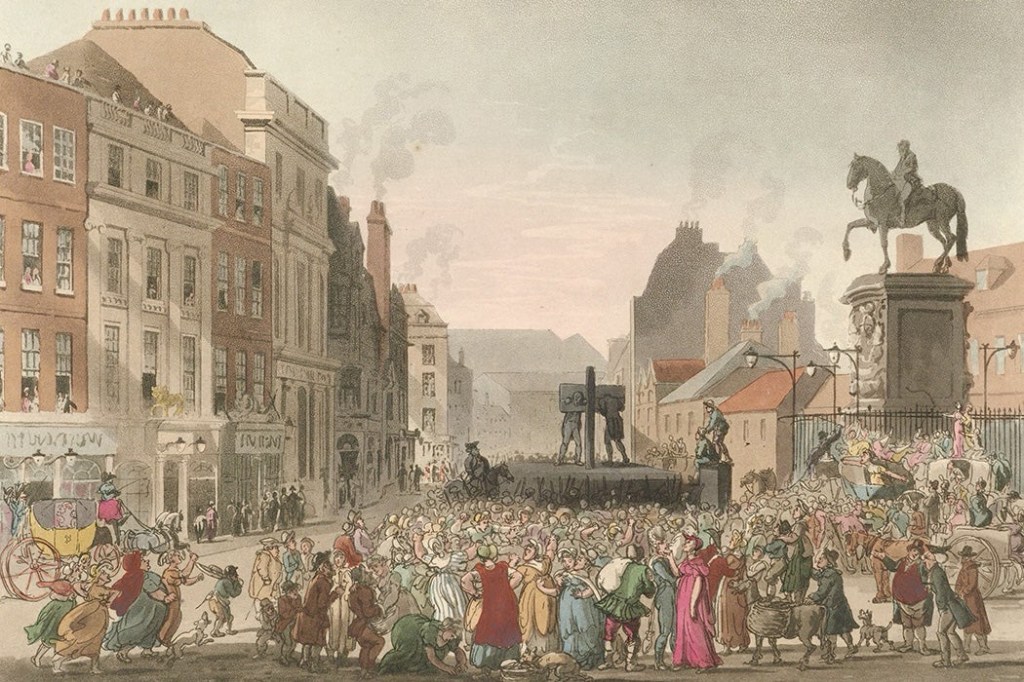
Execution outside Newgate Prison in London, early 19th century

Mary I – England Returns to Rome

Everything changed again in 1553.

Mary I, Henry’s eldest daughter by Catherine of Aragon, became Queen and immediately sought reconciliation with the Roman Catholic Church.

England briefly returned to papal authority.

Many Protestant reforms were reversed.

Ironically, this meant that the jurisdiction over offences such as buggery shifted once more.

The legal landscape became increasingly confused as religious and political authority changed hands.

Mary’s reign lasted only five years, but it demonstrated how closely criminal law remained tied to England’s religious identity.

Elizabeth I – Permanence at Last

When Elizabeth I succeeded her half-sister in 1558, England once again embraced Protestantism.

In 1563 Parliament passed a new Buggery Act.

This legislation largely restored Henry VIII’s original approach but with clearer drafting and improved legal procedure.

Unlike Henry’s statute, Elizabeth’s version endured.

For more than three centuries it formed the foundation of English criminal law relating to male same-sex sexual acts and bestiality.

The Act survived:

the Spanish Armada

the English Civil War

Oliver Cromwell

the Restoration

the Glorious Revolution

the Industrial Revolution

Kings and queens came and went.

Governments rose and fell.

Empires expanded.

Yet the law remained.

The Rise of the British Empire

During the seventeenth and eighteenth centuries Britain established colonies across the globe.

Settlers did not simply transport language and customs.

They transported law.

One of the fundamental principles of British colonisation was that English criminal law accompanied the Crown into new territories unless specifically altered.

Consequently, legislation derived from the Tudor Buggery Acts travelled with British administrators to North America, the Caribbean, India, Africa and, eventually, Australia.

Henry VIII could never have imagined Sydney.

Yet his legal revolution would eventually shape the criminal law of New South Wales.

Australia Inherits Tudor Law

When the First Fleet arrived in 1788, Governor Arthur Phillip brought with him English law.

Among the inherited offences was buggery.

Initially, prosecutions were relatively uncommon.

The realities of frontier life often meant authorities concentrated upon theft, violence, desertion and maintaining public order.

Nevertheless, the offence remained available to prosecutors.

Throughout the nineteenth century, colonial legislatures retained laws criminalising male same-sex sexual activity.

By then, however, the legislation owed as much to Victorian morality as it did to Tudor politics.

The legal principle established under Henry VIII had become deeply embedded within British legal tradition.

Australia inherited not merely one Act but an entire legal culture.

From Sin to Medical Condition

One of history’s great ironies emerged during the nineteenth century.

For centuries same-sex relations had primarily been viewed through religious and legal lenses.

Gradually another interpretation emerged.

Medicine.

Psychiatry.

Sexology.

Rather than asking whether such acts were sinful, many nineteenth-century scholars began asking why some individuals appeared consistently attracted to members of the same sex.

Among the most influential figures were:

Karl Heinrich Ulrichs

Richard von Krafft-Ebing

Magnus Hirschfeld

Havelock Ellis

By the late nineteenth century, the concept of homosexuality as a distinct identity had begun replacing the older legal emphasis upon isolated acts.

Ironically, this new understanding produced both progress and new prejudice.

People increasingly recognised that sexual orientation was more than behaviour.

Yet many physicians simultaneously classified homosexuality as a mental illness.

The Long Road Towards Reform

By the twentieth century, attitudes had begun changing.

One of the most significant turning points came with the Wolfenden Report of 1957.

After extensive investigation, the committee reached a conclusion that seems almost self-evident today but was revolutionary at the time:

“There must remain a realm of private morality and immorality which is, in brief and crude terms, not the law’s business.”

Those words represented a complete reversal of Henry VIII’s philosophy.

The Tudor state had expanded its authority into private sexual behaviour.

The Wolfenden Committee argued the state should withdraw from it.

Ten years later, England partially decriminalised consensual homosexual acts between adult men through the Sexual Offences Act 1967.


A Doleful Dirge on the Wicked Men: This newspaper goes to great lengths to allude to ‘crimes’ that these men have been tried and found guilty of’. / British Library, Public DomainBrowse Digital Magazines

Australia Follows

Australia moved more slowly.

South Australia became the first Australian jurisdiction to decriminalise consensual homosexual acts in 1975.

Other states followed over several decades.

Tasmania remained the last Australian state to repeal its criminal laws in 1997 after sustained legal and political pressure, including intervention by the United Nations Human Rights Committee.

By then, more than 460 years had passed since Henry VIII’s original legislation.

Henry’s Unexpected Legacy

Henry VIII never set out to influence gay rights debates.

He sought power.

He wanted control over England’s Church.

He wanted freedom from papal interference.

The Buggery Act formed one relatively small component of that larger constitutional struggle.

Yet history often remembers rulers for consequences they never anticipated.

The law Henry introduced eventually travelled around the world.

It shaped criminal justice systems on several continents.

It affected countless lives over nearly five centuries.

For millions of gay men, its descendants became symbols of fear, secrecy and exclusion.

Reassessing Henry VIII

Modern historians increasingly encourage us to view the Buggery Act through two lenses simultaneously.

The first is political.

It represented another stage in Henry VIII’s relentless concentration of power within the English Crown.

The second is human.

Whatever Henry’s intentions, the legislation established a legal framework that later generations used to persecute individuals whose only offence was engaging in consensual intimacy.

These two realities are not contradictory.

Indeed, they help explain why the Act endured for so long.

It served governments well.

It reflected prevailing religious beliefs.

It became embedded within legal tradition.

Only when society itself changed did the law finally begin to unravel.

Conclusion

The Buggery Act of 1533 occupies a unique place in legal history.

It was born amid the political upheaval of the English Reformation, forged in Henry VIII’s determination to subordinate the Church to the Crown. Although couched in the language of morality, its deeper significance lay in the transfer of judicial authority from ecclesiastical courts to the King’s courts. In doing so, it demonstrated one of the defining characteristics of the Tudor state: the increasing reach of royal power into areas of life once governed by the Church.

The Act’s consequences, however, extended far beyond Henry’s immediate ambitions. Re-enacted under Elizabeth I, absorbed into English common law, and carried across the globe by the expansion of the British Empire, it shaped legal systems on several continents. Generations of men lived under laws whose ancestry could be traced directly to the political struggles of sixteenth-century England.

Perhaps the greatest irony is that Henry VIII is remembered as much for his turbulent private life as for his legislation. A monarch whose reign was marked by multiple marriages, accusations of adultery, political executions and personal ambition became associated with one of history’s most enduring attempts to regulate the private conduct of others. That contradiction reminds us that laws often tell us less about morality than about power.

Today, historians no longer view the Buggery Act simply as an anti-homosexual statute. Instead, it is recognised as part of a much larger constitutional transformation that redefined the relationship between Church, State and individual. Yet acknowledging its political origins does not diminish its human cost. For centuries, its legal descendants contributed to fear, persecution and silence among countless people whose lives were shaped by its legacy.

History rarely unfolds as its participants intend. Henry VIII sought to create a stronger monarchy. Instead, he also created one of the most influential criminal statutes in the English-speaking world—one whose shadow would linger long after the Tudor dynasty, the British Empire and even the world that produced it had passed into history.

Tim Alderman ©️2026

Sources

Sir John Baker, An Introduction to English Legal History (5th ed., Oxford University Press, 2019).

J. A. Guy, Tudor England (Oxford University Press, 1988).

G. R. Elton, England Under the Tudors (Routledge, revised editions).

Diarmaid MacCulloch, Thomas Cromwell: A Life (Allen Lane, 2018).

Diarmaid MacCulloch, The Reformation: A History (Penguin, 2004).

The King’s Reformation.

The Stripping of the Altars.

Wolfenden Report (1957).

The National Archives – records of Tudor statutes and legal proceedings.

Parliament of the United Kingdom – historical texts of the Buggery Acts and subsequent legislation.

The Buggery Act of 1533: Henry VIII, Power, Politics, and the Criminalisation of “Unnatural Offences” Part 2

Part II – The Act, the King’s Politics, and the Transformation of English Law

In the years immediately following Henry VIII’s break with Rome, Parliament became one of the King’s most powerful instruments. A succession of Acts fundamentally altered the relationship between Crown, Church and people. Historians often refer to these measures collectively as the Henrician Reformation, and among them was one relatively brief statute whose influence would echo for centuries: The Buggery Act of 1533.

Although only a few hundred words long, the Act fundamentally altered English criminal law. It did not invent the offence of buggery; rather, it changed who had the authority to prosecute it, how it would be punished, and who would ultimately benefit from convictions.

The Buggery Act of 1533

Officially titled An Acte for the punishment of the vice of Buggerye, the statute declared that the offence of buggery would henceforth be tried in the King’s courts rather than the ecclesiastical courts.

This seemingly administrative change was revolutionary.

The Church lost one of its long-standing judicial responsibilities.

The Crown gained another.

The Act provided that anyone convicted of the offence would suffer the punishment imposed for felony.

In Tudor England, that meant:

death by hanging

forfeiture of lands

confiscation of goods and property

loss of inheritance rights

Unlike many offences heard by Church courts, there was no opportunity to escape punishment through repentance or spiritual penance.

The offence had become one against the King himself.

Why Was Henry Interested?

This is where history becomes particularly interesting.

Many older histories assumed Henry VIII introduced the Act because he held especially strong moral objections to homosexual behaviour.

Modern historians tend to disagree.

Henry’s reign demonstrates repeatedly that moral consistency was not his defining characteristic.

He broke with the Pope.

Married six times.

Executed two queens.

Maintained mistresses.

Ordered political opponents to their deaths.

Altered religious doctrine whenever political necessity required.

His overriding concern was almost always power.

The Buggery Act therefore fits comfortably within Henry’s broader programme of centralisation.

Every responsibility removed from Church authority increased royal authority.

Every legal matter transferred to secular courts strengthened the Crown.

The legislation should therefore be understood as part of Henry’s constitutional revolution rather than an isolated moral crusade.


The Yokel’s Preceptor, a contemporary magazine, said this:

The End of Ecclesiastical Monopoly

For centuries, bishops and Church courts had exercised significant judicial power.

Henry gradually dismantled that system.

The Buggery Act declared that offences previously heard before ecclesiastical judges would now be prosecuted before royal judges.

This reflected an emerging Tudor principle:

The King—not the Pope—was the ultimate source of justice in England.

That principle extended far beyond sexual offences.

It affected marriage.

Inheritance.

Appeals.

Clerical discipline.

Property.

Monastic wealth.

And eventually almost every aspect of public life.

The Buggery Act therefore formed one piece of a much larger constitutional puzzle.

The Dissolution of the Monasteries

Only a few years after the Act, Henry began dissolving England’s monasteries.

Between 1536 and 1541, hundreds of religious houses disappeared.

Their lands became Crown property.

Their wealth flowed into royal coffers.

Their libraries were dispersed.

Their buildings destroyed or converted.

For the King, monasteries represented two things:

enormous wealth

and

potential loyalty to Rome.

Removing them weakened papal influence while enriching the Crown.

Sexual Accusations and Anti-Monastic Propaganda

One uncomfortable aspect of this period concerns the widespread allegations made against monasteries.

Royal commissioners investigating religious houses frequently reported accusations of:

sodomy

sexual immorality

corruption

financial dishonesty

moral decay

Modern historians urge considerable caution.

Many of these reports were gathered by officials who already knew what the King hoped to find.

Some accusations were undoubtedly genuine.

Others were probably exaggerated.

Some may have been entirely fabricated.

The commissioners’ task was not impartial historical investigation.

It was building a political case for dissolution.

By portraying monasteries as morally corrupt, Henry’s government made their destruction appear both necessary and righteous.

The Buggery Act provided another legal framework within which such accusations could be pursued.

Defining “Buggery”

One of the greatest difficulties facing historians is determining exactly what Tudor legislators meant by the word.

The Act itself offered no definition.

Instead, judges relied upon legal custom and previous interpretations.

Generally speaking, prosecutions involved:

anal intercourse between men

anal intercourse between a man and a woman

bestiality

Modern readers are often surprised that the law was not directed exclusively at male same-sex relations.

The offence concerned certain sexual acts rather than sexual orientation.

Again, this reflects Tudor thinking.

People were punished for what they were believed to have done—not for belonging to an identity category.

The concepts of heterosexuality and homosexuality would not emerge until more than three centuries later.

The Challenge of Proof

Although the penalties were severe, successful prosecutions were surprisingly difficult.

English common law demanded evidence.

By later legal standards, conviction generally required proof that:

penetration had occurred,

and

the act had been completed.

Witnesses were rare.

Confessions were uncommon.

Accusations frequently collapsed for lack of evidence.

As a result, the number of executions was considerably lower than many people imagine.

The existence of the law generated far more fear than actual convictions.

Yet fear itself can be an extraordinarily effective form of social control.

Many people regulated their own behaviour simply because the consequences of conviction were so catastrophic.

Who Was Prosecuted?

Most recorded prosecutions involved men.

This reflects both legal practice and prevailing assumptions about sexuality.

Women rarely appeared before the courts on charges of buggery.

This was not because female same-sex relationships were accepted.

Rather, English judges often struggled to determine whether existing legal definitions could encompass sexual acts between women.

Without penile penetration, many judges questioned whether the offence had technically occurred.

Consequently, women accused of same-sex intimacy were more likely to face social condemnation than prosecution under the Buggery Act itself.

Convictions under the Buggery Act 1533 were punishable by death / British Library, Public Domain

A Weapon Beyond Sexuality

Like many Tudor laws, the Buggery Act possessed political utility.

An accusation alone could destroy reputations.

Even unsuccessful prosecutions carried enormous consequences.

Political enemies, unpopular clergy and social outsiders could all find themselves vulnerable.

Whether every accusation reflected genuine criminal behaviour is impossible to determine.

What is clear is that the law added another powerful weapon to the Tudor state’s expanding legal arsenal.

Fear, Reputation and Silence

Perhaps the Act’s greatest impact lay not in executions but in silence.

The possibility of prosecution encouraged secrecy.

Friendships became suspect.

Affection became dangerous.

Rumour acquired enormous power.

For centuries afterwards, many men lived under the constant awareness that an accusation—whether true or false—could destroy careers, families and lives.

That climate of fear became one of the Act’s most enduring legacies.

Looking Ahead

By the time Henry VIII died in 1547, England had been transformed.

The Pope no longer exercised authority over the English Church.

The monasteries had vanished.

The Crown controlled unprecedented legal and religious powers.

Among the many reforms Henry left behind was the Buggery Act—a statute that would survive kings, queens, civil wars, religious revolutions and even the British Empire itself.

Tim Alderman ©️2026

The Buggery Act of 1533: Henry VIII, Power, Politics, and the Criminalisation of “Unnatural Offences” Part 1

Introduction

Few pieces of legislation have cast such a long shadow over the lives of gay men and other sexual minorities as England’s Buggery Act of 1533. Commonly remembered as the first English law to make homosexual acts a secular capital offence, the Act is often portrayed as little more than an expression of King Henry VIII’s moral outrage. While morality undoubtedly played a part in Tudor thinking, modern historians increasingly argue that the legislation was driven by something much broader: Henry’s determination to centralise power, weaken the authority of the Roman Catholic Church, and establish the supremacy of the English Crown.

The Act marked a turning point in English legal history. Before 1533, accusations of sodomy or “buggery” generally fell under the jurisdiction of ecclesiastical courts. After the Act, they became crimes against the state itself, punishable by death and accompanied by the forfeiture of lands and property. This seemingly technical legal change had enormous consequences, not only for Tudor England but eventually for much of the British Empire. As English law spread across the globe, so too did legislation derived from Henry VIII’s reforms. Australia, India, Canada, Africa, the Caribbean and countless other territories inherited legal traditions whose origins could be traced back to this single Act.

The Buggery Act 1533, formally An Act for the punishment of the vice of Buggerie

Ironically, the legislation has outlived the circumstances that created it. Henry VIII sought to secure his authority against the Pope, yet one of the most enduring legacies of his reign became a law regulating private sexual conduct. Centuries later, long after England abandoned public executions and the British Empire disappeared, versions of the Buggery Act still lingered in the statute books of former colonies.

To understand the Act properly, however, one must begin before Henry VIII—back in medieval Europe, where ideas about sexuality, religion and criminality were already taking shape.

England Before the Buggery Act

Contrary to popular belief, Henry VIII did not invent laws condemning same-sex sexual activity. Medieval Christian Europe had long regarded sexual acts that could not lead to procreation as sinful. These ideas drew upon interpretations of biblical passages—particularly the story of Sodom and Gomorrah in the Book of Genesis—and upon the writings of influential theologians such as St Augustine and St Thomas Aquinas.

In medieval England, however, there was an important distinction between sin and crime.

Most offences involving sexual behaviour were dealt with by ecclesiastical courts, not by the Crown. Church courts handled matters relating to marriage, adultery, fornication, clerical misconduct and what was often described as the “sin against nature.”

Punishments imposed by Church authorities were generally spiritual rather than corporal. Offenders might be ordered to undertake public penance, fast, make pilgrimages or face excommunication. Although the penalties could be severe within the religious life of the community, they were very different from execution.

The offence itself was also less clearly defined than many modern readers imagine.

The medieval Latin term peccatum contra naturam (“the sin against nature”) encompassed a wide range of sexual behaviours. Depending upon the jurisdiction and period, this could include:

sexual acts between men

certain sexual acts between a man and a woman

bestiality

non-procreative sexual practices generally

The word buggery itself was not originally a sexual term at all.

Its linguistic ancestry is surprisingly complex. It derives from the Medieval Latin bulgaria, referring to Bulgaria. During the Middle Ages, members of the dualist Bogomil religious movement were accused by their enemies of heresy and various moral corruptions. Over time, “Bulgar” or “bougre” became a general insult in French and later English, eventually acquiring sexual connotations that had little to do with the historical Bogomils themselves.

Language, prejudice and religion had become intertwined.

Medieval Reality Versus Modern Assumptions

Popular imagination often pictures medieval Europe as relentlessly prosecuting homosexual behaviour.

The historical record paints a more complicated picture.

Surviving records show relatively few prosecutions compared with later centuries. This does not necessarily mean such relationships were accepted. Rather, it reflects several factors:

First, evidence was difficult to obtain.

Secondly, Church courts often preferred confession and repentance over spectacular punishment.

Thirdly, many accusations were folded into broader cases involving heresy, clerical misconduct or other offences.

This relative inconsistency would change dramatically during the Tudor period, when England experienced one of the greatest constitutional revolutions in its history.

Henry VIII’s Great Break

Henry VIII did not begin his reign intending to establish an independent English Church.

Indeed, he was one of Catholicism’s most enthusiastic defenders.

In 1521 he published Assertio Septem Sacramentorum (Defence of the Seven Sacraments), attacking Martin Luther’s criticisms of the Church. Pope Leo X rewarded Henry with the title Fidei Defensor—“Defender of the Faith”—a title British monarchs still bear today.

Everything changed because of Henry’s desperate desire for a legitimate male heir.

His marriage to Catherine of Aragon had produced only one surviving child, the future Mary I. Henry became convinced—or perhaps persuaded himself—that his marriage was invalid because Catherine had previously been married to his late brother, Arthur.

When Pope Clement VII refused to grant an annulment, partly because Catherine’s nephew was the powerful Holy Roman Emperor Charles V, Henry gradually abandoned attempts to obtain papal approval.

Instead, he embarked upon a constitutional revolution.

Between 1532 and 1534 Parliament passed a series of statutes that fundamentally altered England.

The Crown increasingly assumed powers previously exercised by Rome.

Appeals to the Pope were prohibited.

The Archbishop of Canterbury declared Henry’s marriage void.

Anne Boleyn became Queen.

Finally, in 1534, the Act of Supremacy proclaimed Henry VIII the Supreme Head of the Church of England.

England had not merely changed churches.

It had changed the entire relationship between Church and State.

Within this broader programme of reform, numerous legal powers formerly exercised by ecclesiastical authorities were transferred to secular courts.

The Buggery Act was one element—albeit an especially significant one—of that larger transformation.

Tim Alderman ©️2026

Taking the Sting Out of Words: The Reclaiming of Derogatory Language

How Minority Communities Transform Insults into Symbols of Identity

Language is one of humanity’s greatest achievements. It allows us to express love, inspire revolutions, preserve history and communicate ideas across generations. Yet language also possesses a darker side. Throughout history, words have been weaponised to demean, exclude and dehumanise individuals or entire communities. Few groups have experienced this more consistently than sexual minorities, whose identities have often been reduced to insults intended to provoke shame and fear.

Yet language is never static. Words evolve, meanings shift, and occasionally those who were once its victims seize ownership of the very vocabulary used against them. This remarkable process—known as linguistic reclamation—has transformed many former insults into expressions of pride, solidarity and identity.

The history of reclaimed language is therefore not simply about words. It is about power—who possesses it, who loses it, and how those without power sometimes wrest it back.

These words have been commonly used to insult the community

What Is a Derogatory Term?

A derogatory term is a word or expression intended to belittle, insult or diminish another person or group. Such words rarely describe objective facts. Instead, they convey contempt.

The word derogatory derives from the Latin derogare, meaning “to take away” or “to detract.” Originally it referred to diminishing legal rights or authority. Over centuries it evolved to describe language that diminishes a person’s dignity or social standing.

Derogatory language functions by reducing individuals to a single characteristic—whether race, religion, disability, sexuality, nationality or appearance—and suggesting that characteristic makes them inferior.

Throughout history societies have created thousands of such labels. Some disappear with time; others become deeply embedded in everyday speech.

Why Insults Matter

Words shape perception.

Calling someone “criminal,” “mad,” “heretic” or “pervert” does more than describe them—it creates expectations about how society should treat them.

Historically, insults have often accompanied legal discrimination.

Women were dismissed as hysterical.

People with disabilities were labelled “idiots” or “cripples.”

Religious minorities were branded infidels or heretics.

Gay men became “sodomites.”

Language normalised unequal treatment long before legislation codified it.

This is why insults are rarely “just words.” They reinforce social hierarchies.

The Psychology of Reclaiming Words

Reclaiming language is an act of psychological resistance.

Instead of allowing opponents to define identity, members of the targeted group redefine it themselves.

The strategy follows a simple principle:

A weapon loses much of its power when the intended victim refuses to be wounded by it.

Psychologists describe this as reducing the emotional impact of stigma. When an insult becomes an accepted badge of identity among friends, its ability to humiliate is weakened.

This does not mean the word becomes harmless.

Context remains everything.

A word spoken affectionately within a community may remain deeply offensive when used by outsiders.

The Gay Community and Linguistic Reclamation

Few communities have reclaimed as many insults as the gay community.

Centuries of persecution generated an extraordinary vocabulary of abuse.

Some expressions originated in legal documents.

Others came from religious preaching.

Many emerged from street culture.

Over time, however, some of these words underwent remarkable transformation.

“Gay”

Ironically, one of the most common words today began with an entirely different meaning.

Derived from the Old French gai, it originally meant cheerful, carefree or bright.

By the eighteenth century “gay women” often referred euphemistically to prostitutes, while “gay men” suggested a life devoted to pleasure.

During the twentieth century homosexual men increasingly adopted “gay” as a discreet, positive description of themselves.

By the late twentieth century it had become the preferred term across much of the English-speaking world.

Rather than accepting medical labels such as “homosexual,” many chose “gay” because it emphasised identity rather than pathology.

How the LGBTQ+ community reclaimed

“Homosexual”

Unlike “gay,” the word homosexual was never originally intended as an insult.

It was coined in nineteenth-century Europe from the Greek homos (“same”) and the Latin sexualis.

Initially regarded as a scientific description, it soon became associated with psychiatric diagnosis, criminal law and moral judgement.

For much of the twentieth century, official documents classified homosexuals as mentally ill or sexually deviant.

Consequently many gay people came to dislike the term.

Today it remains appropriate in medical, legal and historical contexts but often sounds clinical in everyday conversation.

“Queer”

Perhaps no reclaimed word illustrates linguistic transformation better than queer.

Originally meaning “strange” or “peculiar,” it became one of the harshest anti-gay insults during the late nineteenth and twentieth centuries.

Countless gay men remember hearing it shouted in schoolyards, workplaces and streets immediately before physical violence.

Beginning in the late 1980s and early 1990s, however, younger activists deliberately reclaimed it.

Groups such as Queer Nation argued that embracing the word deprived homophobes of its power.

Today “queer” appears in university departments, academic journals and community organisations.

Yet the word remains deeply divisive.

Many older gay men and lesbians who experienced it primarily as an insult still reject it completely. For them, the emotional associations are impossible to separate from decades of abuse.

Conversely, many younger people use it as an inclusive umbrella term for diverse sexual and gender identities.

Neither perspective is inherently right or wrong. They reflect different lived experiences across generations.

“Poof”

“Poof” (or “poofter”) developed in Britain during the twentieth century.

Its exact origins remain uncertain, though several theories connect it with the appearance of softness or effeminacy.

For decades it functioned almost exclusively as an insult.

In Australia and Britain, however, many gay men gradually began using it affectionately among themselves.

Friends greeting each other with “How are you, you old poof?” demonstrate how humour can strip hostility from language.

Yet, again, context matters enormously.

The identical word shouted aggressively by strangers carries an entirely different meaning.

“Fag” and “Faggot”

Few words generate stronger reactions.

Their origins remain disputed.

One theory connects faggot with bundles of sticks used as fuel, later becoming associated—perhaps apocryphally—with executions for heresy or sodomy. Most historians are cautious about this explanation, as direct evidence linking the term to executions is weak.

By the twentieth century it had become one of the most aggressive anti-gay slurs in the English-speaking world.

Some gay men, particularly in North America, have reclaimed “fag” within friendship circles.

Others reject any attempt to rehabilitate it.

The emotional wounds attached to the word remain too profound.

“Fairy”

Originally describing mythical beings, “fairy” became associated with effeminate gay men during the late nineteenth century.

Today it survives both affectionately and ironically within parts of the gay community, although it has largely declined in everyday use.

“Dyke”

Among lesbians, dyke followed a trajectory similar to “queer.”

Once intended solely as abuse, many lesbians reclaimed it during the feminist movement of the 1970s and 1980s.

Today events such as Dyke Marches openly celebrate the word as one of strength and visibility.

Reclamation Beyond the Gay Community

Reclaiming language is not unique to LGBTQ+ communities.

Many marginalised groups have followed similar paths.

People with disabilities have challenged medical labels previously regarded as insults.

Some racial minorities have reclaimed words once intended to dehumanise them, although the acceptability of such usage often depends heavily on who is speaking.

Women have reclaimed terms such as “witch” and “spinster,” transforming symbols of exclusion into expressions of independence or resistance.

The underlying process is remarkably consistent.

Control over language becomes control over identity.

Why Reclamation Remains Controversial

Not everyone supports reclaiming derogatory language.

Critics argue that some words carry too much historical trauma ever to become harmless.

Survivors of discrimination may understandably wish never to hear them again.

Others fear that widespread use among insiders may blur boundaries and encourage outsiders to use the same language offensively.

Supporters respond that reclaiming language does not erase history.

Instead, it demonstrates resilience.

The insult survives, but its intended effect changes.

The Importance of Context

Perhaps the greatest lesson is that words possess no fixed meaning independent of context.

Who speaks?

Who listens?

What relationship exists between them?

A close friend jokingly saying “old poof” differs profoundly from a stranger yelling the same word across a street.

Language always carries social meaning beyond dictionary definitions.

The history of derogatory language is ultimately the history of power.

Insults have long served as tools for exclusion, reinforcing legal discrimination, religious condemnation and social prejudice. Yet history also demonstrates that language is remarkably adaptable. Communities are not passive recipients of labels imposed upon them. They can reshape words, redefine identities and transform symbols of shame into expressions of solidarity.

Reclaiming language does not erase painful history, nor does it make every insult acceptable. Context, intent and lived experience remain crucial. A term embraced by one generation may still evoke painful memories for another, and words reclaimed within a community may remain offensive when used by outsiders.

Perhaps the greatest lesson is that language is never merely a collection of sounds or letters. It reflects society’s values, fears and aspirations. As those values evolve, so too do the words we use. The story of reclaimed language reminds us that dignity can sometimes be restored not by inventing new words, but by refusing to surrender old ones to hatred.

Tim Alderman ©️2026

Sources

Oxford English Dictionary (entries for gay, queer, faggot, derogatory).

David Crystal, The Cambridge Encyclopedia of the English Language.

Deborah Cameron, Verbal Hygiene.

Gregory M. Herek, research on stigma and sexual prejudice.

Judith Butler, Excitable Speech: A Politics of the Performative.

Eve Kosofsky Sedgwick, Epistemology of the Closet.

George Chauncey, Gay New York.

William L. Leap (ed.), Beyond the Lavender Lexicon.

Jonathan Green, Green’s Dictionary of Slang.

Simon Winchester, The Meaning of Everything.

The Medici Popes – Part V

The Legacy of the Medici Papacy: Renaissance Splendour, Religious Upheaval, and the End of an Era

“The Medici transformed the papacy into the greatest court in Europe—but in doing so, they also helped unleash forces that forever changed Christianity.”

The story of the Medici popes is one of dazzling contradiction. They presided over one of the greatest explosions of artistic achievement in human history while simultaneously steering the Roman Catholic Church into one of its deepest crises. They were patrons of genius, lovers of luxury, masters of political intrigue and, at times, surprisingly capable administrators. Yet they were also products of an age in which the Church had become entangled in wealth, dynastic ambition and secular politics.

Over the course of this series we have met three Medici popes—Leo X, Clement VII and the short-lived Leo XI. Together they represented the extraordinary rise of one Florentine banking family to the highest office in Christendom. Their reigns coincided with the flowering of the Renaissance, the birth of Protestantism, the sack of Rome and the beginning of the Catholic Church’s painful journey towards reform.

Their legacy deserves neither outright condemnation nor uncritical admiration. Instead, it is a cautionary tale about what can happen when spiritual authority becomes inseparable from political and financial power.

The Renaissance Papacy at its Zenith

By the early sixteenth century, the papacy had become something almost unimaginable to modern Catholics.

The Pope was no longer simply the Bishop of Rome or spiritual leader of Western Christianity. He was a prince, monarch, diplomat, military commander and one of Europe’s greatest patrons of the arts.

The Vatican rivalled the royal courts of France, Spain and the Holy Roman Empire.

Magnificent banquets, elaborate ceremonies and artistic commissions projected both religious devotion and worldly prestige.

The Medici embraced this vision wholeheartedly.

Leo X famously declared that God had given the papacy to the Medici family and they intended to enjoy it.

Whether or not he actually uttered those exact words, they accurately capture the spirit of his pontificate.

For Leo X, beauty glorified God.

Magnificent churches inspired worship.

Artists revealed divine truths.

Music elevated the soul.

Libraries preserved civilisation.

In many respects he was correct.

Without Medici patronage the world might never have inherited many of the masterpieces that continue to inspire millions today.

Patrons of Genius

Perhaps the greatest achievement of the Medici popes lies not in theology but culture.

They funded artists whose works still define Western civilisation.

Among those who flourished under Medici patronage were:

Michelangelo Buonarroti

Raphael

Leonardo da Vinci (through broader Medici patronage before the papacies)

Baldassare Peruzzi

Giulio Romano

The rebuilding of St Peter’s Basilica accelerated dramatically during their reigns.

The Vatican became a centre not only of religion but scholarship, archaeology, architecture, literature and music.

Classical manuscripts were preserved.

Ancient sculpture was collected.

Humanist learning flourished.

Ironically, many Protestants who denounced papal corruption nevertheless admired the artistic achievements funded by those very popes.

The Renaissance reached its fullest expression under the Medici.

The Cost of Splendour

Great art came with an enormous price.

The construction of St Peter’s Basilica alone required staggering sums.

Maintaining the papal court demanded even more.

Wars between Italian states drained the treasury.

Patronage networks required constant funding.

Luxury became expected.

Money had to come from somewhere.

That somewhere increasingly became the faithful.

Taxes increased.

Church offices were sold.

Benefices were granted for political loyalty.

Most notoriously, indulgence campaigns expanded across Europe.

Although indulgences themselves had long existed within Catholic theology, their aggressive promotion during Leo X’s reign convinced many ordinary Christians that salvation itself was being commercialised.

The Dominican friar Johann Tetzel became the public face of this fundraising.

His preaching provoked an Augustinian monk in Wittenberg.

That monk was Martin Luther.

The Protestant Reformation

No event shaped the Medici legacy more profoundly than the Protestant Reformation.

When Luther published his Ninety-five Theses in 1517, few imagined they would fracture Western Christianity.

Initially Leo X dismissed Luther as a troublesome monk.

The papacy underestimated both Luther’s determination and the widespread frustration simmering across Europe.

The issue was never simply indulgences.

People questioned:

corruption

absentee bishops

clerical wealth

papal taxation

political interference

moral standards among clergy

Printing presses spread reform ideas faster than Rome could suppress them.

By the time Leo realised the seriousness of the movement, events had escaped papal control.

Europe would never again be religiously united.

Clement VII and Catastrophe

If Leo X inadvertently ignited the Reformation, Clement VII inherited the fire.

His greatest political mistake was attempting to balance the competing ambitions of Francis I of France and Emperor Charles V.

The strategy failed spectacularly.

In 1527 imperial troops—many themselves Lutheran sympathisers—marched on Rome.

The Sack of Rome shocked Europe.

Churches were desecrated.

Nuns assaulted.

Priests murdered.

Cardinals ransomed.

Libraries destroyed.

Relics stolen.

The Pope himself fled through the Passetto di Borgo into the fortress of Castel Sant’Angelo, where he remained trapped for months.

Many contemporaries interpreted the catastrophe as divine judgement upon papal corruption.

Even loyal Catholics believed God had spoken.

England Breaks Away

As if the Reformation and Sack of Rome were not enough, Clement VII faced another impossible dilemma.

King Henry VIII sought an annulment from Catherine of Aragon.

Granting it would offend Emperor Charles V, Catherine’s nephew.

Refusing it risked alienating England.

Clement hesitated.

Years passed.

Eventually Henry rejected papal authority altogether.

The Church of England was born.

Another great kingdom slipped permanently beyond Rome’s control.

Leo XI: A Symbol Rather Than a Ruler

Leo XI’s pontificate lasted only twenty-seven days.

He achieved little in practical terms.

Yet symbolically his election represented the final flowering of Medici prestige.

The dynasty had produced three popes.

No family better embodied the fusion of banking, politics, Renaissance culture and ecclesiastical power.

His early death marked the end of Medici dominance within the papacy.

The age of Renaissance princely popes was drawing to a close.

The Catholic Response

The Church did not ignore its failures forever.

The crisis eventually forced reform from within.

The Council of Trent (1545–1563) became the defining moment of the Catholic Counter-Reformation.

Many abuses associated with the Renaissance papacy were finally addressed.

Seminaries improved priestly education.

Discipline tightened.

The sale of offices was curbed.

Indulgence abuses were restricted.

Residence requirements for bishops were enforced.

Theological teaching became more clearly defined.

Ironically, the very excesses associated with the Medici helped produce a stronger and more disciplined Catholic Church.

A Balanced Verdict

Modern historians increasingly avoid simplistic judgements.

The Medici popes were neither saints nor monsters.

They were Renaissance princes occupying a medieval office that was rapidly becoming unsuited to Renaissance politics.

Their failures reflected broader problems affecting European society.

Many bishops lived extravagantly.

Many monarchs interfered in religion.

Corruption existed throughout Europe.

Yet the popes bore greater responsibility because they claimed moral leadership over Christendom.

Their greatest failure was allowing worldly ambition to overshadow spiritual renewal.

Their greatest achievement was fostering one of history’s greatest cultural renaissances.

Few individuals have simultaneously inspired Michelangelo’s masterpieces and Martin Luther’s rebellion.

Their Lasting Legacy

More than five centuries later, the Medici popes continue to fascinate because they embody one of history’s greatest paradoxes.

They presided over extraordinary beauty while overlooking profound institutional decay.

They enriched civilisation with magnificent art while contributing to Christianity’s greatest division.

Their Rome dazzled the eye but often disappointed the conscience.

Yet history is rarely black and white.

Without the Medici there may have been no High Renaissance as we know it.

Without their mistakes there may never have been the sweeping reforms that revitalised the Catholic Church after Trent.

Their story reminds us that great civilisations often produce brilliance and blindness in equal measure.

The Medici popes stand as enduring symbols of an age when faith, politics, money and art became so closely entwined that separating them became almost impossible. Their triumphs still fill museums and churches. Their failures reshaped the religious map of Europe.

Few families have left a deeper mark on both the history of Christianity and the history of Western civilisation.

Tim Alderman ©️2026

Sources

The Oxford History of the Popes

A History of the Popes

The Renaissance Popes

The Reformation

The Renaissance

The Civilisation of the Renaissance in Italy

The Medici Popes – Part 4

Indulgences: From Spiritual Remedy to Renaissance Scandal

“When the coin in the coffer rings, the soul from purgatory springs.”
—attributed to Johann Tetzel

No aspect of Renaissance Catholicism has become more infamous than the sale of indulgences.

To many modern people, indulgences seem absurd—a medieval version of paying money to erase sins. Protestants often portray them as evidence of wholesale corruption, while Catholics frequently argue they have been misunderstood.

The truth lies somewhere between these extremes.

Indulgences did not begin as financial transactions. They emerged from centuries of Christian theology concerning sin, repentance and forgiveness. Yet by the early sixteenth century they had become intertwined with fundraising, politics and monumental building projects. Under the Medici pope Leo X, the abuse of indulgences reached such a level that it provoked one German monk—Martin Luther—to challenge the Church itself.

That challenge became the Protestant Reformation.

Understanding Sin

To understand indulgences, it is necessary first to understand how medieval Catholic theology viewed sin.

According to Church teaching, every sin carried two consequences.

The first was eternal punishment—separation from God.

The second was temporal punishment—the spiritual damage left even after forgiveness.

Imagine breaking a neighbour’s window.

Your neighbour forgives you.

The relationship is restored.

But the window still has to be repaired.

Catholic theology viewed sin in much the same way.

Confession restored the relationship with God, but the spiritual consequences remained.

Those consequences were believed to be purified through:

prayer

fasting

acts of charity

pilgrimages

suffering

or after death in Purgatory.

An indulgence addressed only this temporal punishment.

It did not forgive sins.

Only confession and genuine repentance could do that.

Pope Leo X

Purgatory

By the Middle Ages, belief in Purgatory had become deeply embedded in Western Christianity.

Most people believed few souls were holy enough to enter Heaven immediately.

Instead, they underwent purification.

This purification could last years—or, in medieval imagination, even centuries.

Families desperately wanted to shorten this suffering.

The Church taught that prayers, Masses and indulgences could assist souls in Purgatory.

This belief became enormously influential.

The Treasury of Merit

Another theological concept underpinned indulgences.

The Church taught that Christ’s sacrifice possessed infinite merit.

In addition, saints had accumulated spiritual merit through exceptionally holy lives.

Together these formed the Treasury of Merit.

As Christ’s representative on Earth, the Pope possessed authority to dispense this treasury for the benefit of believers.

Originally this concept had little to do with money.

The Earliest Indulgences

The first indulgences appeared during the early Middle Ages.

Originally they reduced harsh public penances.

A murderer might be required to undertake years of fasting.

Participation in certain acts of devotion could reduce part of this obligation.

Eventually indulgences became linked to pilgrimages.

Travelling to Rome, Jerusalem or Santiago de Compostela could earn spiritual benefits.

The Crusades further expanded the idea.

Popes granted complete indulgences to those risking their lives fighting in the Holy Land.

From Penance to Fundraising

Over centuries, indulgences became associated with charitable giving.

Donating money to hospitals…

Supporting monasteries…

Funding bridges…

Helping the poor…

Supporting crusades…

All became recognised as pious acts deserving spiritual reward.

Initially the emphasis remained on genuine charity.

But human nature—and institutional need—gradually changed the equation.

Renaissance Popes Need Money

The Renaissance papacy was astonishingly expensive.

Popes ruled territories.

Maintained armies.

Built palaces.

Commissioned artists.

Supported diplomats.

Patronised scholars.

Fought wars.

The Vatican increasingly resembled the court of a powerful Italian prince.

The Medici understood magnificence.

Florence itself had been transformed through Medici patronage.

As pope, Leo X inherited enormous financial obligations.

He had also inherited one of the greatest building projects in European history.

St Peter’s Basilica

Old St Peter’s Basilica had stood for over one thousand years.

By the early sixteenth century it was deteriorating.

Pope Julius II ordered its demolition and replacement with an entirely new basilica.

The scale was staggering.

The finest architects.

The greatest sculptors.

The most expensive materials.

It would become the largest church in Christendom.

Construction consumed fortunes.

When Leo X became pope in 1513, the project desperately required funding.

Indulgences offered an obvious solution.

The Great Indulgence Campaign

Leo X authorised an extensive indulgence campaign across Europe.

The official purpose was raising money for St Peter’s Basilica.

The campaign also served another purpose.

A young German prince,

Pope Leo X…the most extravagant pope in history

Archbishop Albert of Brandenburg,

had borrowed enormous sums to secure multiple ecclesiastical offices.

The powerful Fugger banking family financed these payments.

Half the indulgence income repaid Albert’s debts.

The remaining half financed St Peter’s.

Church, prince and bankers all benefited.

Johann Tetzel

The Dominican friar Johann Tetzel became the campaign’s most famous preacher.

Tetzel was a gifted public speaker.

He travelled from town to town delivering emotional sermons about Purgatory.

He described:

parents crying for help,

children suffering in flames,

husbands pleading for release.

Then came the solution.

Purchase an indulgence.

Whether Tetzel actually used the famous slogan:

“As soon as the coin in the coffer rings, the soul from Purgatory springs”

remains debated.

Regardless, the phrase perfectly captured popular perception.

People believed salvation could be purchased.

What the Church Officially Taught

Official Catholic teaching remained more restrained.

The Church insisted:

repentance remained essential;

confession remained necessary;

indulgences could not forgive sin;

indulgences could not guarantee salvation.

Unfortunately these theological distinctions often disappeared in popular preaching.

Ordinary people heard something much simpler.

Pay.

Receive spiritual benefits.

Martin Luther Objects

In 1517, an Augustinian monk named Martin Luther watched Tetzel’s campaign with increasing alarm.

Luther accepted indulgences in principle.

Initially.

What disturbed him was their abuse.

Poor villagers believed they could purchase forgiveness.

Many neglected confession.

Some imagined future sins could be prepaid.

Others purchased indulgences instead of changing their lives.

Luther saw this as spiritually disastrous.

On 31 October 1517 he published his famous Ninety-five Theses.

Many challenged indulgence preaching directly.

One asked:

Why does the Pope not simply empty Purgatory out of love instead of demanding money?

Another questioned why St Peter’s should be built using the savings of poor peasants rather than papal wealth.

The questions spread with astonishing speed thanks to the recently invented printing press.

Pope Leo X

Leo X Responds

Initially Leo X dismissed Luther.

He reportedly regarded him as merely:

“a drunken German monk.”

That proved a serious miscalculation.

Within a few years Luther had attracted widespread support.

Attempts to silence him only increased his influence.

By 1521 he had been excommunicated.

The division of Western Christianity had begun.

Reform Within the Catholic Church

Ironically, many Catholic leaders also recognised abuses.

The Council of Trent (1545–1563) retained indulgences but condemned their misuse.

The Church prohibited:

financial abuses;

commercialisation;

misleading preaching.

Indulgences remained part of Catholic theology.

Their sale did not.

“Pope Leo X (after Raphael)”, Fernando Botero, oil on canvas, 1964

Indulgences Today

Modern Catholic indulgences still exist.

They are granted for acts such as:

Eucharistic adoration;

reading Scripture;

praying the Rosary;

making pilgrimages;

participating in designated Holy Year events.

No money changes hands.

The emphasis is entirely on repentance, prayer and spiritual renewal.

Many non-Catholics remain sceptical of the theology itself, but the notorious Renaissance practice of effectively “selling” indulgences has long been abolished.

The Medici Legacy

For the Medici pope Leo X, indulgences solved an immediate financial problem.

They helped fund one of history’s greatest churches.

Yet they also exposed the dangers of mixing spiritual authority with financial necessity.

The magnificent dome of St Peter’s Basilica still dominates the Roman skyline, a masterpiece of Renaissance art and engineering. But beneath its stones lies a more complicated story—one in which faith, power, money and human ambition became inseparably entwined.

The irony is striking.

The very campaign intended to glorify the papacy instead triggered the greatest religious rupture in Western history.

Without the indulgence controversy, Martin Luther might have remained an obscure university professor.

Instead, the Medici pope Leo X inadvertently helped reshape Christianity forever.

Tim Alderman ©️2026

Sources

Catechism of the Catholic Church (2nd ed.), §§1471–1479.

The Oxford Dictionary of the Christian Church, Oxford University Press.

The Reformation.

Martin Luther: Renegade and Prophet.

The Renaissance Popes.

The Stripping of the Altars.

A History of Christianity.