Monthly Archives: June 2021

The Waratah Spring Festival, Sydney, 1956-1973

Sydney is today touted as a ‘festival hub’ and as one of the best festival cities in the world. Not a week seems to go by without a cultural festival taking place. But 60 years ago, Sydney (and indeed the rest of Australia) was a very different place; it was much more culturally conservative.
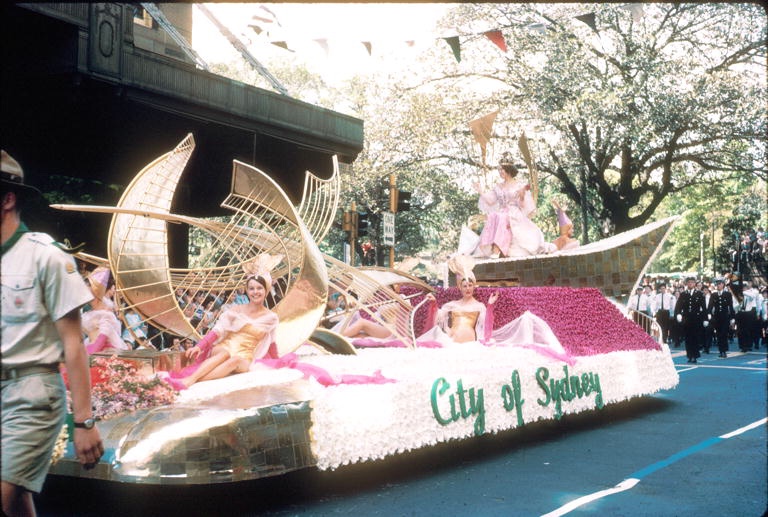
Waratah Princess lording it over some nymphettes aboard the City of Sydney float, 1965 (City of Sydney Archives, SRC18952)

The visit of Queen Elizabeth II to Australian shores in 1954marked a change in Australian cultural life. Her visits to the capital cities around the nation, in particular Sydney and Melbourne, attracted record crowds who gathered in the city centres to watch the royal spectacle. In the aftermath of her visit, civic forefathers in both cities saw an opportunity to attract people into the city centres with an annual festival.
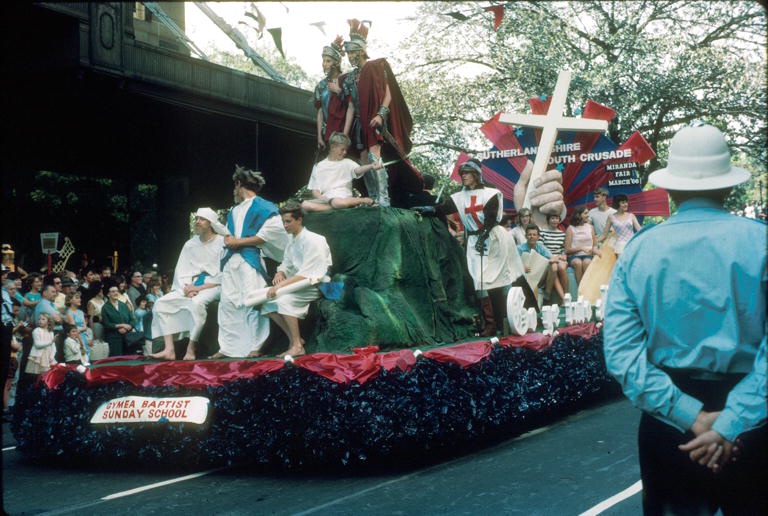
: Sutherland Shire Youth Crusade Gymea Baptist Sunday School float, 1965 (City of Sydney Archives, SRC18949)
Sutherland Shire Youth Crusade Gymea Baptist Sunday School float, 1965 (City of Sydney Archives, SRC18949)

Melbourne was first off the rank, with the Moomba Festival first held in March 1955. Not to be outdone, Sydney held its first annual festival, known as the Waratah Spring Festival, in October 1956. It was to be a spring festival, with the native Waratah flower chosen because it was both a symbol of NSW but also a plant indigenous to Sydney.

Marching bands in the Waratah Spring Festival procession, 1950s (City of Sydney Archives, SRC18287)
Marching band in the Waratah Spring Festival procession, 1950s (City of Sydney Archives, SRC18287)

The festival was initiated by the Sydney Committee led by the NSW Premier and the Mayor of Sydney Municipal Council; it was organised by the Council.

An estimated 250,000 spectators lined up to watch the first Waratah Spring Festival procession in 1956 – there were 140 decorated floats, 26 bands and 5,000 ‘marchers’. It was a spring festival – so it was held in October – and because the theme was ‘spring’, over two million flowers (both natural and artificial) were used to decorate the floats. Every year, there was a Waratah Pageant and a ‘Waratah Princess’ was crowned. The first Waratah Princess was Colleen Pike from Newtown.

Sydney County Council's float featuring a large plug, 1950s (City of Sydney Archives, SRC18258 )
Sydney County Council’s float featuring a large plug, 1950s (City of Sydney Archives, SRC18258 )

In 1964, there were 45 decorated floats and up to 5,000 people took part in the procession, which extended almost two miles.

Eighteen Waratah Spring Festivals were held between 1956 and 1973. In addition to the public spectacle of the street parades, the festival grew to encompass other events including an art competition, a decorative floral competition in the lower town hall and cultural events including ballet and theatre.

Waratah Princess 1963 (City of Sydney Archives, SRC17470)
Waratah Princess 1963 (City of Sydney Archives,
SRC17470)

By the early 1970s, the Waratah Festival was attracting ever fewer visitors to the centre of Sydney, and was gaining the reputation of being ‘tatty’.

The final Waratah Spring Festival was held in 1973, to coincide with the opening of the Sydney Opera House. In a report prepared in 1974, the Sydney Committee noted that the major sponsors had withdrawn their support and that the Festival had outlived its usefulness as a major attraction. The event was abandoned.

But three years later, it was relaunched as a summer festival, known as the Sydney Festival. The first Festival of Sydney was held in January 1977. It has been held annually since.

Reference

12 Politically Incorrect Toys We Never Knew We Were Missing

Warning: Some people might find the following images to be offensive.

It seems like just yesterday that Little Suzy and Bobby were playing with miniature minstrel kits and toy dogs that could smoke cigarettes. Well… maybe not yesterday.

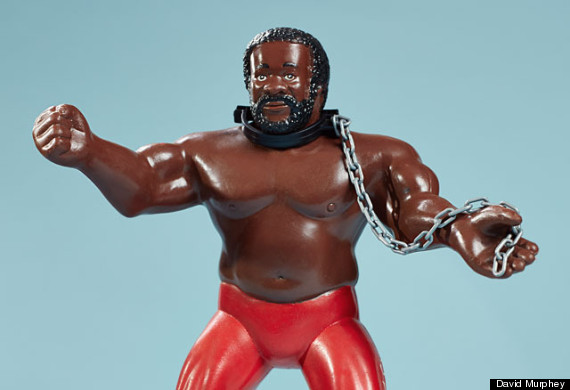
Thanks to a Kickstarter campaign titled “Politically Incorrect Toys,” our eyes have been opened to the ridiculous and highly insensitive world of vintage playthings. From a suspiciously accurate replica of a detective’s gun to a packet of “housewife” necessities aimed at young girls, the project seeks to bring odd relics of our past back into the spotlight.

“This project is a social commentary on how toys have changed over the years and how we, as a society can change our views about what is or is not socially acceptable,” explains Hawaii-based photographer David Murphey, the mastermind behind “Politically Incorrect Toys,” on his Kickstarter page.

“As a country, we’ve made great strides to equality, but at the same time we’ve gone backwards in some ways. We’ve lost the ability to laugh at ourselves and enjoy the individuality in each other. Wouldn’t it be great if we could put aside some of our sensitivities (once in a while) and find humor in our differences?”

Murphey has photographed a plethora of strange (and often shocking) toys, hoping to create a limited edition photography portfolio of all the knick knacks that somehow evaded exile on the Island of Misfit Toys. Scroll through a preview of the portfolio below, but be warned — your eyebrows will likely rise in confusion. If you’re hooked on the idea, you can help fund the project here.

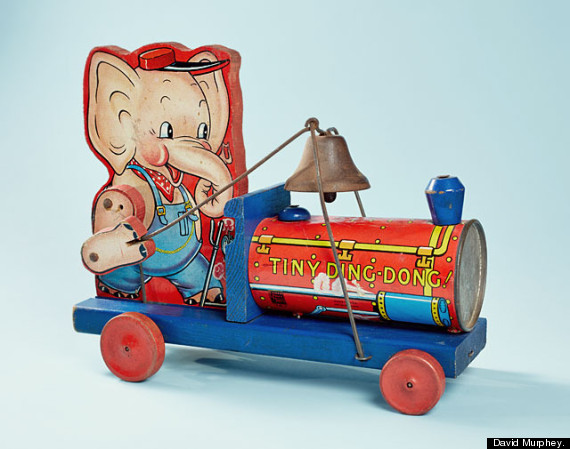
1. Tiny Ding Dong

tiny

2. The Smoking Pet

smoking

3. Detective Gun

dick

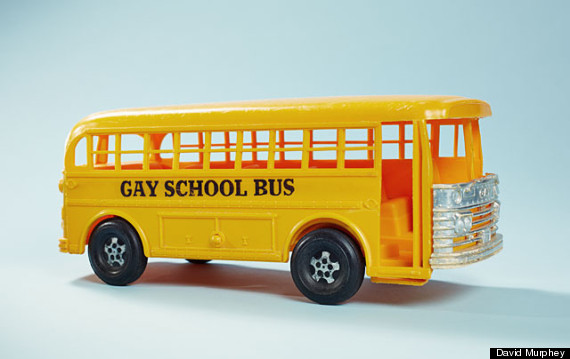
4. A Gay School Bus

gay

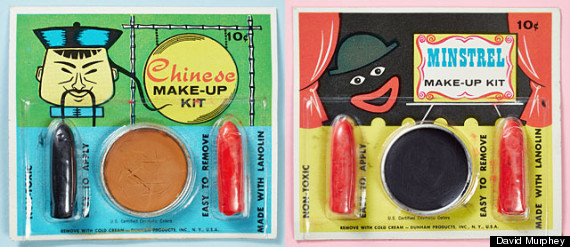
5. Minstrel and Chinese Makeup Kits

makeup

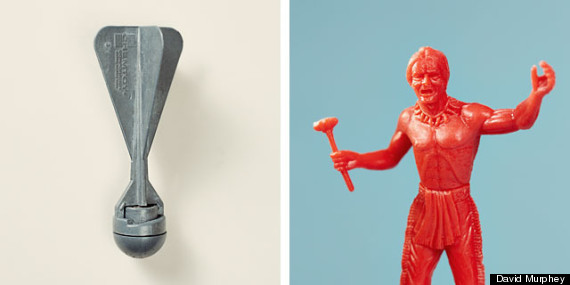
6. A Chemtoy Cap Bomb
7. A Red Indian

red indian

8. ET Finger
9. Mary the Housewife

et

10. Junkyard Dog

dog

11. Beetle Bailey Rubber Band Gun


12. Am I Like Father

Reference

Buddhism 101: The Historical Buddha’s Disciples

The First Generation

Xaume Olleros / Getty Images

We do not know how many monks and nuns were ordained by the Buddha during his lifetime. The early accounts sometimes describe monks and nuns by the thousands, but that is possibly exaggerated.

Of these unknown numbers some outstanding individuals emerge. These are individuals who contributed to the development of Buddhism and whose names one finds in the sutras. Through their life stories we can get at least a glimpse of the first generation of men and women who chose to follow the Buddha and practice his teaching.

Ananda

Statues depicting the disciples of the Buddha at Daigan-ji, a temple in Japan.
Sheryl Forbes / Getty Images

Ananda was the historical Buddha‘s cousin and also his attendant during the latter part of his life. Ananda is also remembered as the disciple who recited the Buddha’s sermons from memory at the First Buddhist Council, after the Buddha had died.

According to a possibly apocryphal story in the Pali Tipitika, Ananda persuaded a reluctant Buddha to accept women as his disciples.

Anathapindika

Ruins in Sravasti, India.
Ruins in Sravasti, India, thought to be of the Jeta Grove retreat center. Bpilgrim / Wikimedia Creative Commons

Anathapindika was a wealthy lay disciple and benefactor of the Buddha. His generosity to the poor earned him his name, which means “feeder of the orphans or helpless.”

The Buddha and his disciples traveled for most of the year, but they stayed indoors in seclusion during the summer monsoon season. With the Buddha’s permission, Anathapindika purchased a property that would be called the Jeta Grove. He then built a meeting hall, dining hall, sleeping cells, wells, lotus ponds, and whatever else the monks might need during their solitary rains retreats. This was the first Buddhist monastery.

Today, readers of the sutras may notice that the Buddha delivered many of his discourses “in the Jeta Grove, in Anathapindika’s Monastery.”null

Devadatta

Painting of Devadatta in a temple with deciples.
Devadatta Incites an Elephant to Charge the Buddha. Tevaprapas, Wikipedia Commons, Creative Commons License

Devadatta was a kinsman of the Buddha who became a disciple. According to some traditions, Devadatta became consumed with jealousy of the Buddha. After receiving a particularly harsh rebuke from the Buddha, Devadatta plotted to have the Buddha assassinated.

When his plots failed, he split the sangha by persuading many younger monks to follow him instead of the Buddha. The monks Sariputra and Maudgalyayana were able to persuade the wayward monks to return.null

Dhammadinna

Painting of Dhammadinna and Viskha from from a mural at Wat Pho, a temple in Bangkok, Thailand.
Dhammadinna and Visakha as a married couple. Anandajoti / Photo Dharma / Flickr.com, Creative Commons License

Some of the early sutras of Buddhism are about enlightened women who teach men. In Dhammadinna’s story, the man was the enlightened woman’s ex-husband. The Buddha praised Dhammadinna as “a woman of discerning wisdom.

Khema 

Statue of Khema with deciples.
 กสิณธร ราชโอรส / Wikimedia Commons

Queen Khema was a great beauty who became a nun and one of the chief women disciples of the Buddha. In the Khema Sutta (Samyutta Nikaya 44), this enlightened nun gives a dharma lesson to a king.

Mahakasyapa

Painting of the head of Mahakasyapa.
  Axb3 / Public domain / Wikimedia Commons

After the historical Buddha died, Mahakasyapa assumed a leadership position among the Buddha’s surviving monks and nuns. He convened and presided over the First Buddhist Council. For this reason, he is called the “father of the sangha.” He is also a patriarch of Chan (Zen).

Maudgalyayana 

Carving of Buddha and some of his diciples.
Sariputra and Maudgalyayana become disciples of Buddha. Nomu420craftsmen / Wikimedia Commons

Maudgalyayana was a lifelong friend of Sariputra; the two entered the order together. The Buddha’s instructions to Maudgalyayana as he struggled with his early practice have been valued by the many generations.

Pajapati

Painting of buddhist marriage in temple.
Marraige of Suddhodana and Mahapajapati. Photo Dharma from / Wikimedia Commons

Pajapati is credited with being the first Buddhist nun. She is often called Mahapajapati.

Pajapati was the Buddha’s aunt who raised the young Prince Siddhartha as her own child after the death of his mother, Queen Maya. After the Buddha’s enlightenment she and many of her court ladies shaved their heads, dressed in patched mendicants’ robes, and walked many miles barefoot to find the Buddha and ask to be ordained. In a section of the Pali Tipitika that remains controversial, the Buddha refused the request until persuaded to change his mind by Ananda.

Patacara 

A carving depicting Patacara and buddha in a temple amongst a crowd.
The story of Patacara. Anandajoti, Wikipedia Commons, Creative Commons License

Patacara was a nun who overcame unimaginable grief to realize enlightenment and become a leading disciple. Some of her poems are preserved in a section of the Sutta-pitaka called the Therigatha, or Verses of the Elder Nuns, in the Khuddaka Nikaya.
 

Punnika 

Punnika was a slave who, by chance, heard a sermon of the Buddha. In a famous story recorded in the Pali Sutta-pitaka, she inspired a Brahmin to seek out the Buddha. In time she became a nun and realized enlightenment.

Rahula

Ivory carving of Buddha leaving a woman and child sleeping in bed.
Siddhartha leaving sleeping Yashodhara and Rahula. Nomu420 / Wikimedia Commons

Rahula was the historical Buddha’s only child, born shortly before the Buddha left his life as a prince to seek enlightenment. It is said Rahula was ordained a monk while still a child and realized enlightenment at the age of 18.

Sariputra

Statues of Buddha, Mogallana and Sariputta in a museum.
Buddha with Mogallana and Sariputta. Origamiemensch / Wikimedia Commons

It was said Sariputra was second only to the Buddha in his ability to teach. He is credited with mastering and codifying the Buddha’s Abhidharma teachings, which became the third “basket” of the Tripitika.

Mahayana Buddhists will recognize Sariputra as a figure in the Heart Sutra.

Upali 

The Upali Thein temple on a sunny day.
The Upali Thein temple. Tsaetre / Wikimedia Commons

Upali was a low-caste barber who met the Buddha when he was called upon to cut the Buddha’s hair. He came to the Buddha to ask to be ordained with a group of the Buddha’s high-born kinsmen. The Buddha insisted on ordaining Upali first so that he would be their senior, and superior, in the order.

Upali became known for his faithful devotion to the Precepts and his understanding of the rules of the monastic order. He was called upon to recite the rules from memory at the First Buddhist Council, and this recitation became the basis of the Vinaya.

Reference

  • O’Brien, Barbara. “The Historical Buddha’s Disciples.” Learn Religions, Aug. 27, 2020, learnreligions.com/first-generation-of-buddhas-disciples-449657.

Buddhism 101: The Life of Ananda, Buddha’s Disciple and Attendant

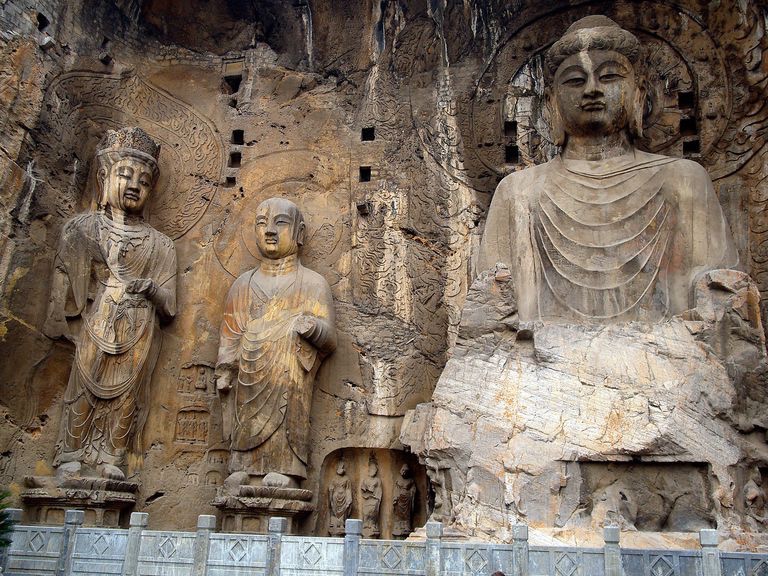
The large Vairocana Buddha with disciples Ananda and Kasyapa. Public Domain

Of all the principal disciples, Ananda may have had the closest relationship to the historical Buddha. Particularly in the Buddha’s later years, Ananda was his attendant and closest companion. Ananda also is remembered as the disciple who recited the Buddha’s sermons from memory at the First Buddhist Council, after the Buddha had died.null

What do we know about Ananda? It is widely agreed that Buddha and Ananda were first cousins. Ananda’s father was a brother to King Suddhodana, many sources say. It is thought that when the Buddha returned home to Kapilavastu for the first time after his enlightenment, cousin Ananda heard him speak and became his disciple.null

Beyond that, there are several conflicting stories. According to some traditions, the future Buddha and his disciple Ananda were born on the same day and were exactly the same age. Other traditions say Ananda was still a child, maybe seven years old, when he entered the Sangha, which would have made him at least thirty years younger than the Buddha. Ananda survived the Buddha and most of the other principal disciples, which suggests that the latter version of the story is more probable.

Ananda was said to be a modest, quiet man who was completely devoted to the Buddha. He also was said to have a prodigious memory; he could recite every sermon of the Buddha-word for word after hearing it only once. Ananda is credited with persuading the Buddha to ordain women into the Sangha, according to one famous story. However, he was slower than other disciples to realize enlightenment and did so only after the Buddha had died.

The Buddha’s Attendant 

When the Buddha was 55 years old, he told the sangha he needed a new attendant. The attendant’s job was a combination of servant, secretary, and confidant. He took care of “chores” such as washing and mending robes so that the Buddha could focus on teaching. He also relayed messages and sometimes acted as a gatekeeper, so that the Buddha would not be mobbed by too many visitors at once.

Many monks spoke up and nominated themselves for the job. Characteristically, Ananda remained quiet. When the Buddha asked his cousin to accept the job, however, Ananda accepted only with conditions. He asked that the Buddha never giver him food or robes or any special accommodations so that the position did not come with material gain.

Ananda also requested the privilege of discussing his doubts with the Buddha whenever he had them. And he asked that the Buddha repeat any sermons to him that he might have to miss while carrying out his duties. The Buddha agreed to these conditions, and Ananda served as attendant for the remaining 25 years of the Buddha’s life.

The Ordination of Pajapati 

The story of the ordination of the first Buddhist nuns is one of the most controversial sections of the Pali Canon. This story has Ananda pleading with a reluctant Buddha to ordain his stepmother and aunt, Pajapati, and the women who had walked with her to become the Buddha’s disciples.

The Buddha eventually agreed that women can become enlightened as well as men, and could be ordained. But he also predicted that the inclusion of women would be the undoing of the sangha.

Some modern scholars have argued that if Ananda really was more than thirty years younger than the Buddha, he would still have been a child when Pajapati approached the Buddha for ordination. This suggests the story was added, or at least re-written, a long time later, by someone who didn’t approve of nuns. Still, Ananda is credited with advocating for the right of women to be ordained.

Parinirvana 

One of the most poignant texts of the Pali Sutta-pitaka is the Maha-parinibbana Sutta, which describes the last days, death, and parinirvana of the Buddha. Again and again, in this sutta we see the Buddha addressing Ananda, testing him, giving him his final teachings and comfort. And as monks gather around him to witnesses his passing into Nirvana, the Buddha spoke in praise of Ananda—”Bhikkhus [monks], the Blessed Ones, Arahants, Fully Enlightened Ones of times past also had excellent and devoted attendant bhikkhus [monks], such as I have in Ananda.”

Enlightenment and the First Buddhist Council 

After the Buddha had passed, 500 enlightened monks came together to discuss how their master’s teachings might be preserved. None of the Buddha’s sermons had been written down. Ananda’s memory of the sermons was respected, but he had not yet realized enlightenment. Would he be allowed to attend?

The Buddha’s death had relieved Ananda of many duties, and he now dedicated himself to meditation. The evening before the Council was to begin, Ananda realized enlightenment. He attended the Council and was called upon to recite the Buddha’s sermons.

Over the next several months he recited, and the assembly agreed to commit the sermons to memory also and preserve the teachings through oral recitation. Ananda came to be called “The Keeper of the Dharma Store.”

It is said Ananda lived to be more than 100 years old. In the 5th century CE, a Chinese pilgrim reported finding a stupa holding Ananda’s remains, lovingly attended by nun. His life remains a model of the path of devotion and service.

Reference

  • O’Brien, Barbara. “The Life of Ananda, Buddha’s Disciple and Attendant.” Learn Religions, Aug. 27, 2020, learnreligions.com/life-of-ananda-449647.

Buddhism 101: The Laughing Buddha

How Buddha came to be fat and jolly

Godong / Getty Images

When many Westerners think of “Buddha,” usually they don’t visualize the Buddha of history, meditating or teaching. This “true” Buddha is known more completely as Gautama Buddha or Shakyamuni Buddha and is almost always depicted in deep meditation or contemplation. The image is very often of a very thin individual with a serious though the sublimely peaceful expression on his face.

The Laughing Buddha 

Most Westerners, though, think of a fat, bald, jolly character called “The Laughing Buddha” when they think of the Buddha. Just where did this figure come from?

The Laughing Buddha emerged from Chinese folktales of the 10th century. The original stories of the Laughing Buddha centered on a Ch’an monk named Ch’i-t’zu, or Qieci, from Fenghua, in what is now the province of Zhejiang. Ch’i-t’zu was an eccentric but much-loved character who worked small wonders, such as predicting the weather. Chinese history assigned the date of 907-923 CE to Ch’t’zu’s life, which means he lived considerably later than the historical Shakyamuni, the true Buddha. 

Maitreya Buddha 

According to tradition, just before Ch’i-t’zu died, he revealed himself to be an incarnation of Maitreya Buddha. Maitreya is named in the Tripitaka as the Buddha of a future age. Ch’i-t’zu’s last words were:

Maitreya, true Maitreya
Reborn innumerable times
From time to time manifested among men
The men of the age do not recognize him.

Pu-tai, Protector of Children 

The tales of Ch’i-t’zu spread throughout China, and he came to be called Pu-tai (Budai), which means “hempen sack.” He carries a sack with him full of good things, such as sweets for children, and he is often pictured with children. Pu-tai represents happiness, generosity and wealth, and he is a protector of children as well as of the poor and the weak.

Today, a statue of Pu-tai can often be found near the entrance of Chinese Buddhist temples. The tradition of rubbing Pu-tai’s belly for good luck is a folk practice, however, not a genuine Buddhist teaching. It is indicative of Buddhism’s broad tolerance of diversity that this laughing Buddha of folklore is accepted into the official practice. For Buddhists, any quality that represents Buddha-nature is to be encouraged, and the folklore of the kind, laughing Buddha is not regarded as any kind of sacrilege, even though people unwittingly may confuse him with Shakyamuni Buddha.

An Ideal Enlightened Master 

Pu-tai also is associated with the last panel of the Ten Ox-herding Pictures. These are 10 images that represent stages of enlightenment in Ch’an (Zen) Buddhism. The last panel shows an enlightened master who enters towns and marketplaces to give to ordinary people the blessings of enlightenment.

Pu-tai followed the spread of Buddhism into other parts of Asia. In Japan, he became one of the Seven Lucky Gods of Shinto and is called Hotei. He also was incorporated into Chinese Taoism as a deity of abundance.

Reference

  • O’Brien, Barbara. “The Laughing Buddha.” Learn Religions, Aug. 25, 2020, learnreligions.com/the-laughing-buddha-449784.