Monthly Archives: July 2017

Spiritually Faithless!

First published in “Talkabout” magazine October/November 2007. I make no secret of my intense dislike – an understatement – of organised religion! No singular institution in the history of nankind has had such a stultifying influence on mankind’s collective mind! It has caused more deaths and suffering than all our wars combined, has held back the advancement of civilisation, and is singularly responsible for the hi-jacking of common sense, logic, and free thought! It’s sheer hypocrisy on being incapable of practising what it preaches, and being unable to judge itself so, is staggering in its breadth! Right at this very instant, somewhere in this world, people are being massacred or tortured in the name of religion! This is my perspective!

“Batter my heart, three person’d God…”

John Donne Holy Sonnet XIV

I started watching “The Abbey” on ABC TV on Sunday night. What a time-trip back to when I was 23 and living in an enclosed monastery, following the Rule of St. Benedict, at Leura in the Blue Mountains. How I ended up in a monastery – and eventually left – was quite a journey. One might even say a quest, a search for identity, spirituality and this unfathomable thing called faith. I found the first, still hold onto the second and lost the third along the way.
The quest started when, as a 12-year-old Protestant boy from very Congregational Sylvania, I managed to get into one of the states leading Catholic boarding schools – St Gregory’s Agricultural College in Campbelltown. They had filled their Catholic places at the school, and were willing to take Protestants. I lucked in. I have to admit that I loved going to school there, though with most of the boys being from country regions I didn’t make any life-long friends. I learnt to really loathe sport – Marist Brothers and their bloody sports – which I had just disliked up until that time. Also had a fleeting homosexual encounter with another boy…in speedos…in the pool. 

However, it was the Catholic religion that overwhelmed me. It wasn’t just one aspect of Catholicism, it was the whole shebang! The beauty of its rituals; the whole mystery of the mass; the adoration of Mary and the saints; the dogma and theology; and the people who devoted themselves to enacting and teaching these beliefs. As someone who had come from the sparse simplicity of protestant services, it took my breath away. So much so that at the end of my first year there I converted, being baptized in the school chapel with my history teacher, Mr Higgins – who, being a chain-smoker , stank of nicotine – and one of the Year 12 boys, Tim Sheen, as my sponsors. Little did I know that the priest who baptized me was, several years later, to be arrested for molesting his altar boys. My appetite for religion, especially the theological aspects of it, was voracious. In 1969 when I finished my final year one of the brothers asked me if I would like to join the Marist Brothers. Despite the faint inklings of a vocation, the Marist order really wasn’t my cup of tea. While at St Greg’s, I had a personal confessor from a Discalced Carmelite monastery at Minto. Through him I had quite a lot of contact with the monastery, including attending vocational seminars. 

I found the contemplative lifestyle much more to my taste, though decided to wait a few years before making any decisions.
In 1976 I contacted a small enclosed monastic community in Leura called the Community of St Thomas Moore, who followed the Benedictine Rule.
The community lived in this rambling old convent originally owned by the Sisters of Charity. It had the monk’s enclosure at one end of this huge ‘H’ design, the chapel, visitors parlors and Prior’s office at the other end, and a huge retreat section in between. The community supported itself by running retreats. As the youngest novice it was my duty to rise at 5am to set up the chapel for morning Office and Mass. I would then go to the common room in the enclosure to start breakfast and set the tables, as well as turning on the heaters to warm the enclosure. At 5.30 I would circle the enclosure with a bell to raise the rest of the community to prayer. Between prayer and work the day went very fast, with grand silence starting at 9pm and going through until after breakfast the next morning. Despite it being a tough life – and don’t for one minute think that these men are uneducated or unaware of what is going on in the world – I loved it. I loved the strong sense of community, the calmness of quiet contemplation in long silences, and the daily rituals of work and the Divine Office that bind communities like these together. The church regards these communities of enclosed religious as ‘powerhouses of prayer’, and there is little doubting that if you are on the inside. 

A very strong visual image of my time there, and one that has always stayed with me, is of being in the kitchen at 5.30 one morning and looking out the window. The monastery was set on the edge of a valley, and it was an icy cold clear morning. Outside the window was a leafless tree covered in frozen water drops glistening in the sun. Beyond it, a mist was rolling up the sides of the valley. It was one of the most profoundly contemplative moments I have ever had in my life. It was as if I was the only one observing this beautiful scene, as if it had been reserved especially for me for some purpose that was yet to be revealed. I can still see it in my minds eye as I write this. Now that’s impact!

However, one of the ‘problems’ with the large periods of introspection and contemplation that is part of the monastic ideal is that you tend to look deeply into yourself. Fears and hidden truths are often revealed. This can either lead one deeper into the religious nature of their community, or alienate you personally from the community. The realisation I came to, the fear I had, the thing that I was running from was that I was gay. Hiding in a monastery is not a healthy thing to do if you are gay – though heaven knows there are enough caught in this situation. Many stay on through fear of who they are. They think that if they work themselves to the bone, and pray hard it will just go away. It doesn’t! It ends in a life of bitterness, recrimination and self-loathing. Many, like me, decided that to really live life without hypocrisy they had to leave the safety of the enclosure and go back into the world. The decision to enter a religious community is difficult enough on its own. 

The decision to leave is even harder. Driving through the gates to go home was quite devastating for me, knowing that I was leaving all peace and tranquility behind me. I hoped to carry it inside myself, but the hectic, tumultuous real world makes it difficult, if not impossible. Another world awaited me.

I still didn’t come out immediately. My family was quite formidable and I knew I would have to choose my time well. In the meantime, I worked for and eventually became manager of Pellegrini & Co Pty Ltd – not familiar with the name? It was a huge Catholic emporium, supplying not just devotional goods such as statues and rosary beads, but furniture, church plate and vestments to all the local churches – firstly in Sydney, then to Melbourne where I came out. By this time my father was dead, my family alienated. Melbourne was a safe space for me. In the way of enforcing contrasts in my life, after I left Pellegrini in the early 80’s. I became manager of a sex shop in Oxford St called ‘Numbers’. It is often joked about that I gave up ‘praying’ for ‘preying’.

I must say that at this stage my faith was going through a shaky period. The fight for gay recognition, rights and anti-discrimination was in full swing, and the Catholic Church was one of the biggest bugbears to these rights. I joined “Acceptance” Gay Catholics in Melbourne, though not initially to fight the good fight, so much as a way to meet people through the shared common ground of religion. It was through “Acceptance” – I eventually became committee secretary, as well as working on several working groups – that I realised just how discrimination could alienate a group of people. We could only go to Mass in one church in Fitzroy, and then only at a certain time of the evening. The Servite Fathers, who were an independent order and not under the auspices of the local Bishop or Archbishop were the only order who could conduct our First Friday Home Masses. At one mass at my unit in West Brunswich confessions were going to be held in my bedroom. I had all this porn attached to the back of the bedroom door – as you do when young and single – and went to considerable trouble to ensure paper was taped over it to hide it. Evidently during one of the confessions the paper suddenly gave way, and priest and confessor were confronted with all these pictures of naked men. I believe the priest didn’t bat an eye, but I have to wonder if there weren’t additional sins for the guy with him to confess. Over this time I just got angrier and angrier at the hypocrisy of it all. Coming from Protestant roots, I still carried a lot of the simpler theology with me, and often found myself arguing against the stupidity and naivety that had crept into the Catholic religion through the centuries, which we were (are?) still living with, and decrying its inability to move forward and fit into a more contemporary era. It gained me quite a few friends, and earned me a few enemies. I got so frustrated that I dropped religion altogether, and have never really found my way back.

I returned to Sydney on the tide of HIV hysteria, and religion for me became even less relevant. Hearing our dear religious brethren, especially those in politics advocating hunting us down and locking us away in quarantine; the way they flaunted the view that this was God’s retribution against the gay community fuelled my increasing hatred for religion. Despite HIV being something that should have initiated reconciliation between my lost faith, and me it just drove a wedge in.. The soul-destroying slaughter of all my friends, lovers and acquaintances over this time didn’t bring me back to faith. However, it did cause me a revaluation of my need for spirituality of some description. The free-form style of the funerals that were going on over this period made me realise that we all practiced ‘faith’ in many different ways, and that having faith wasn’t the same as being spiritual. You could have one without the other. Religion, to just about everyone I knew, was an alien concept with little tie-in to their lives. However, many were searching for spirituality. One friend in particular surprised me by returning to the rudimentaries of faith just before he died. 

He did make me wonder what I would do if faced with the same situation – would I call on a priest and fall back to my Catholic faith; would I contact someone more in tune with the simplicity of my original faith, such as MCC; or would I just continue to refute it all up to the time I died. It is something I still ponder occasionally. 

In my search for spirituality I tried a return to a more primitive religion in Wicca, but found it unsatisfying. I studied the writings of Aleister Crowley and the Golden Dawn but found it too weird – and scary; the Jewish Kabbalah – real Kabbalah, not Madonna’s version – but found it too deep and complex, and I didn’t feel I had a lifetime to study it in.
So, I guess that in some ways I am still searching. It is not an easy world to find faith or spirituality in. Certain groups in our world have distorted the concepts to such a degree that you wonder what they find in the dry, humourless, destructive force they call religion. Others go on preaching what they don’t practice – and astoundingly never realise the contradiction; intolerance and hatred is rife. The Zen ideal is possibly the closest to pure spirituality that I have found, Buddhism being the one religion that seems to be the reverse of all else that is surrounding us. Like the monastic ideal, you can find peace in contemplation and meditation, something that cuts off the noisy world around us, and causes us to withdraw into ourselves.
Over the years, and before meeting my current partner, I have asked myself what I would do…where I would go…if I found myself old and alone in this world. I thought I would eventually return to a monastery, try to find all that I had lost. There are many who would tell me that faith is easy to find – it is just a pure act of selfless belief, a mere blinkered view to all the external forces that fight against faith; submission to dogma and ritual. I can no longer do that. I question too readily, and demand answers that aren’t esoteric.

So back to “The Abbey”. The five women who have gone into the Abbey to see if they can withstand the rigours of the monastic life are all in need of some form of self-redemption. Despite renunciations and doubts they are all seeking ‘something’. It is easy to see why Sister Hilda is the superior of this monastic community. Full of faith, a sense of humour, immense amounts of understanding and compassion, she is indeed the monastic mother. Just by listening to what these 5 women say, she is, possibly unknown to her, being a counsellor. In five weeks time when these women leave the monastery to go back to their normal lives, they are going to be intrinsically changed – you can see it already. They are going to confront things that they don’t want to confront, and if they allow themselves to just sink into the life of the monastery, to let it surround them and not fight it they are going to come to an understanding of themselves that they never thought possible – and their lives will be forever changed. I know. I’ve been there. Perhaps you can take the boy out of the monastery, but you can’t take the monastery out of the boy!

And as for me…well maybe John Donne and I fight the same demons;
“…I, like an usurpt towne, to’another 

      Labour to’admit you, but Oh, to no end,

      Reason your viceroy in mee, mee should defend,

      But is captiv’d, and proves weake or untrue,

      Yet dearely’I love you,’and would be loved faine,

      But am betroth’d unto your enemie:

      Divorce mee;’untie, or breake that knot againe,

      Take mee to you, imprison mee, for I

      Except you’enthrall mee, never shall be free,

      Nor ever chaste, except you ravish me.”

John Donne; Holy Sonnet XIV
Tim Alderman ©October 2007


Impossibilities?! 

First published as “The Impossible Ask” in Talkabout December 2000/January 2001. Impossibilities…should that be a question, or a statement? Perhaps both, I feel!  A bit dated now, though it does capture the mentality at that time. I still dislike the terminology of the time, and despite my opinions on some issues changing over the last 17 years, there are points here that are still relevant! 

If you are newly diagnosed for HIV, and have just started treating, this article will not interest you. If you have been taking antiretroviral for up to two years, it may pique your curiosity. If you have been treating since the days of AZT monotherapy, you will not only find it interesting, you will probably relate to it. 
Treatment failure is a terminology I intensely dislike, almost as much as being informed that I have ‘advanced disease’, that I am not being ‘compliant’ – read ‘you are a naughty boy and should be caned’ – and that people with Lipodystrophy have ‘Buffalo Hump’. How rude is the latter! But unfortunately, treatment failure does exist, it is a problem I am currently groping with, and I can’t think of another term for it except ‘forgetfulness’ or maybe ‘I’m Over It Syndrome’. How long have you been shovelling pills down your throat for? 10 years or more, probably. How’s your viral load and CD4 count going? The big nowhere, undoubtedly! 10 years of pill taking for nothing more than year after year of the same blood results. 
“Results look really good” says doctor, “ nothing to write home about but they are really stable, which is really great news.” Well I’m sorry Doc, but it’s not really good! It’s bloody frustrating. Years of fabulous promises and unbelievable adherence (don’t like that word anymore than compliance), for the absolute minimum quality of life. No, that is not an exaggeration. You can never return to full-time work. You never know when the next illness is going to strike. Energy levels that run out mid way through doing something (even during sex). Depleted libido, side-effects, more blood taken out of you than the Blood Bank could ever dream of having, living with the left-over effects of any AIDS related illness you may have had, and a total lack of knowledge on long-term side-effects. This is not a high quality of life!

My doctors pretty good, I have to say. We have talked about these issues, and he is genuinely trying to help. I know I am no longer one hundred percent compliant, like I was, say, two years ago. And at that stage I was pushing 350 plus pills per week down my throat. There are days where I just forget, even days where because of it being such a regular habit I can’t remember if I have taken the bloody things or not. But now, there are days and times when I just can’t be bothered. If I see another 8000 viral load, or another 170 CD4 count I’m going to scream. It has been like that for years now, and is the main reason that occasionally I can’t be bothered. Doc calls it ‘Pill Fatigue’, and that sounds as good as anything to me. As he says, pills and people just don’t go together. You got it right there, Doc!

Ah, but what to do? This is the major problem. A structured treatment break (Drug Holiday sounds like more fun) has been mentioned, and I have to admit I’m tempted. God, imagine getting up in the morning, or going to bed at night without having to remember pills. Imagine being able to have a few drinks, knowing that because you are pill-less, you won’t get a grumbly stomach ten minutes after getting into bed. Imagine not having to line up in the hospital pharmacy once a month. Imagine no dietary considerations, no side effects, no trying to remember on the bus in the morning whether you took the damn things or not. Imagine heaven. Tempting, isn’t it?

We’ve discussed other options as well. Counseling or a HIV psychiatrist is one way to go. I don’t really mind, as long as I don’t have counseling that involves mothering, or having to relive my childhood AGAIN! It is so irrelevant as far as recent events go. I’m thinking about that. The trouble is, of cause, that I want either a treatment change, or to go onto a trial that may at least show some results. I always thought the end point of treatment was to show a result, not just maintain minimalism. I realize that changing treatments brings us back to the old furfie of adherence, and that getting onto a trial often means being on combination therapy of some description, and not having had AIDS. Find me someone who needs therapeutic trials who hasn’t had AIDS, and I will show you a walking miracle!

Well, I’ve got this far through this article, and I haven’t given any conclusive answers yet, have I? Frankly, I don’t think I’m going to be able to, because I don’t know what they are anymore than you, or my doctor does. In my more depressive moments years ago, I used to think it would have been easier to take the way out of most of my friends, and just die. It certainly would have been a lot less lonely doing it that way, and I wouldn’t be left feeling like a (sometimes) freak. But I don’t really see that as an answer anymore. There are more battles to come, and I don’t know why all of us in this situation fight them, but I know we will. It’s the human spirit isn’t it? To quote an Olympic cliché, it’s ‘the fire within’.

 And the hope of once a day dosing, with one pill!

Tim Alderman ©2000 (Revised 2017)

Gay History: A Navy Court Martial: First Lieutenant William Berry of HMS “Hazard” – 1807 

Tuesday, 6 October 1807

COURT MARTIAL.
On the 2d instant a Court Martial was held on board the Salvador del Mundo, in Hamoaze, Plymouth, on charges exhibited by Captain Dilkes, of His Majesty’s ship Hazard, atgainst William Berry, First Lieutenant of the said ship, for a breach of the 2d and 29th articles; the former respecting uncleanness, and the latter the horrid and abominable crime which delicacy forbids me to name.

     THOMAS GIBBS, a boy belonging to the ship, proved the offence, as charged to have been committed on the 23d August, 1807. Several other witnesses were called in corroboration, among whom was

     ELIZABETH BOWDEN, a little female, who has been on board the Hazard these eight months; curiosity had prompted her to look through the key hole of the cabin door, and it was thus she became possessed of the evidence which she gave. She appeared in Court dressed in a long jacket and blue trowsers.

The evidence being heard in support of the charges, but the prisoner not being prepared to enter upon his defence, begged time, which the Court readily granted,until ten o’clock on Saturday, at which hour the Court assembled again, and having heard what the prisoner had to offer in his defence, and having maturely and deliberately weighed and considered the same, the Court were of opinion, that the charges had been fully proved, and did adjudge the said William Berry to be hanged at the hard-arm of such one of his Majesty’s ships, and at such time, as the Right Hon. the Commissioner of the Admiralty shall direct. – Sir J. T. Duckworth was the President.
The unfortunate prisoner is above six feet high, remarkably well made, and as fine and handsome a man as is in the British navy. He was to have been married on his return to port.
          (Morning Chronicle; this cutting is in William Beckford’s scrapbook now in the Beinecke Library.)

[Royal correspondence: In The Later Correspondence of George III (Cambridge, 1968; vol. IV, p. 636), we learn that Lord Mulgrave informed George III of the sentence of the court martial and noted that “the full, clear & most disgusting evidence on which the Court has pronounced the awful sentence of death upon Lieutenant Berry leaves no opening for submitting any grounds for the extension of your Majesty’s mercy …” (Admiralty, 6 October 1807). George III replied that he “cannot hesitate in confirming the sentence of death passed on Lieutenant Berry of the Hazard sloop for a crime which, when fully proved, cannot admit of the interposition of the Crown. Consequently the law must take its course.” (Windsor Castle, 7 October 1807)]

Saturday, 10 October 1807
On Friday a Court Martial, at which Sir J. Duckworth presided, was held on board his Majesty’s ship Salvador del Mundo, in Hamoaze, Plymouth, on charges exhibited by Captain Dilkes, of his Majesty’s ship Hazard, against William Berry, First Lieutenant of the said ship, for a breach of the 2d and 29th articles of war; the former respecting uncleanliness, &c. the latter the commission of an unnatural crime with thomas Gibbs, a boy belonging to the Hazard, on the 23d of august, 1807. The evidence being heard in support of the charges, the prisoner not having prepared his defence, begged time, when the Court readily granted, till Saturday at ten o’clock. At that hour the Court assembled again, and having heard what the prisoner had to offer in his defence, and maturely weighed and considered the same, the Court was of opinion the charges had been fully proved, and accordingly adjudged the prisoner to be hanged at the yard arm of such one of his Majesty’s ships, and at such time as the Commissioners of the Admiralty shall direct. One of the witnesses on this awful land horrible trial was the little female tar, Elizabeth Bowden, who has been on board the Hazard these eight months. She appeared in Court in a long jacket and blue trowsers; that part of her evidence which respected the prisoner, curiosity had prompted her to observe through the key-hole of the cabin door. (Jackson’s Oxford Journal, Issue 2841)
Monday, 12 October 1807
COURT MARTIAL. – On Friday a Court Martial, at which Sir J. Duckworth presided was held on board his Majesty’s ship Salvador del Mundo, in Hamoaze, Plymouth, on charges exhibited by Capt. Dilkes, of his Majesty’s ship Hazard, against W. Berry, First Lieutenant of the said ship, for a breach of the 2d and 29th articles of war; the former respecting uncleanliness; &c. the latter for the commission of a crime we do not chuse to mention. The Court having heard what the prisoner had to offer in his defence, and having maturely considered the same, was of the opinion that the charges had been fully proved, and adjudged the prisoner to be hanged at the yard-arm of such one of his Majesty’s ships, as the Commissioners of the Admiralty shall direct. One of the witnesses was a little female Tar, Elizabeth Bowden, who has been on board the Hazard these eight months. She appeared in Court in a long jacket and blue trowsers; that part of her evidence which respected the prisoner, curiosity had prompted her to observe through the key-hole of the cabin-door. (Glasgow Herald)
22 October 1807
EXECUTION OF LIEUTENANT BERRY.
On Monday the sentence of the court-Martial was put in execution on Lieutenant Berry, late First Lieutenant of the Hazard sloop of war. The prisoner, being removed from the Salvador del Mundo, to the Hazard, lying alongside a hulk in Hamoaze, at nine o’clock uppeared, and mounted the scaffold with the greatest fortitude; he then requested to speak with the Rev. Mr. BIRDWOOD, on the scaffold; he said a few words to him, but in so low a tone of voice that he could not be distinctly heard: and on the blue cap being put over his face, the fatal bow-gun was fired, and he was immediately run up to the starboard fore-yard-arm, with a 32lb. shot tied to his legs. Unfortunately the knot had got round under his chin, which caused great convulsions for a quarter of an hour. After being suspended the usual time, he was lowered into his coffin, which was ready to receive him in a boat immediately under, and conveyed to the Royal Hospital, where his friends mean to apply for his body to inter. He was a native of Lancaster, and only 22 years of age. For the last week he seemed very penitent, and perfectly resigned.
A curious circumstance occurred while the prisoner was in the cabin with the Clergyman, receiving the sacrament. A woman came alongside the Hazard’s hulk, and handed a letter up, signed Elizabeth Roberts, addressed to the Commanding Officer, which stated that Lieutenant William Berry could be yet saved, and that the person who could do it was alongside; – it was by marriage. The woman was ordered on board, and put under the care of a sentinel. When the execution was over, Captain DILKES, with the Clergyman and others, questioned the woman: she said she had dreamed a dream last night, that if she went on board the Hazard this day, and that if Lieutenant Berry would marry her, he would not suffer death. On being asked who advsed her, she replied that she told her dream to some women where she lived in Dock, who recommended her to go, in consequence of her dream. She was admonished, and sent on shore.
          (The Times; the “curious circumstance” was also reported in the Aberdeen Journal for 28 October.)

Monday, 26 October 1807

EXECUTION OF LIEUT. BERRY.
PORTSMOUTH, OCT. 19. – This morning, at eight o’clock, the signal for an execution was made on board the Salvador del Mundo, 112, Admiral Young, in Hamaore; and repeated by the Hazard, 18, Capt. Dilkes on board which ship the execution was to take place. About nine a.m. a boat from each ship, manned and armed, attended round the Hazard. Lieut. Berry was then conveyed from the flag-ship, attended by the Provost Martial, in a boat to the Hazard, where he spent some time in prayer, attended by the Chaplain of the flag-ship. He was then conducted along the gangway to a platform erected on the forecastle: the executioner then reeved the rope round his neck, when, declaring he was ready, the fatal bow gun fired, and he was run up to the fore-yard arm. He appeared to struggle for a few moments, by the struggling soon ceased. – After hanging an hour, his remains were lowered into a shell in a boat alongside, and conveyed to the Royal Naval Hospital to be delivered to his friends for interment. – Thus perished, by the hands of the executioner, a young gentleman, in the bloom of life, for a crime not fit to be named among Christians. He was of a respectable family in Lancashire, and his father and uncle are overwhelmed with grief at the unhappy exit from this world of a favourite son and nephew. (Glasgow Herald)

Tuesday, 27 October 1807

[Report of Berry’s execution identical to that of The Times, but with the following addition:]
          For the last week he seemed penitent, firmly collected, and prepared to meet his fate. – Thus perished by the hands of the executioner, a young gentleman in the bloom of life, for a crime not fit to be named amongst Christians. – He was of a very respectable family; his father and uncle are overwhelmed with grief at the unhappy end of a favourite son and nephew. (The Hull Packet and Original Weekly Commercial, Literary and Genderal Advertiser, Issue 1085)


The interesting facts about witness Elizabeth Bowden (John Bowden) in the court martial of William Berty, HMS “Hazard”.

Women At Sea: Witness for the Prosecution

Found at http://www.paulinespiratesandprivateers.blogspot.com

Elizabeth Bowden (or Bowen) seems to have had it rough from the very beginning. Born into obscurity and poverty some time in 1793 in Truro, Cornwall, she seemed destined to a bleak life. Things went from bad to worse when she was orphaned at age twelve or thirteen.

Elizabeth had an older sister who, to the best of the girl’s knowledge, lived in that haven of the Royal Navy: Plymouth. Being nothing if not hardy, Elizabeth walked from Truro to Plymouth with the idea that she would take up residence with her sibling. Unfortunate as usual, Elizabeth could not find her sister. Elizabeth, who in our day and age would be termed a little girl, was penniless, starving and alone. Like so many nameless others of her generation, she turned to the sea.
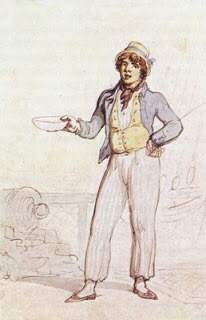
Dawning a boy’s trousers (and perhaps looking similar to this drawing by Thomas Rowlandson), Elizabeth signed aboard HMS Hazard at Plymouth in the last half of 1806 using the name John Bowden. Deemed fit to serve, she was rated a boy 3rd class and given the usual advance on her pay. Hazard left for sea not long after the new boy was taken aboard. No one seems to have questioned her sex, at least not right away.
Within six weeks something occurred, history is silent as to what, that gave Elizabeth’s gender away. One wonders if her menarche wasn’t the culprit but that is purely speculation. At any rate, rather than being turned ashore at the next port, Captain Charles Dilkes gave Elizabeth a separate sleeping space and made her an assistant to the officers’ stewards. This would have kept her out of the general ship’s population and put her more closely in contact with not only the stewards but the galley crew as well.
With all this, Elizabeth would probably have fallen through the cracks of history as did so many other women at sea. But a well publicized case of sodomy aboard HMS Hazard, and Elizabeth’s insistence that she had witnessed at least one of the incidents in question, brought her briefly into the lime light.
In August of 1807, while the ship was underway, Lieutenant William Berry was accused of regular abuse of a boy named Thomas Gibbs. Berry was twenty-two at the time but Gibbs, a ship’s boy second class, had to have been younger than fourteen as he was not charged at the court-martial. According to the trial records, Gibbs finally got fed up with Berry’s actions and told the gunroom steward, John Hoskins, what was going on. From the young man’s testimony it sounds as if there was physical as well as sexual abuse going on, although Hazard’s surgeon would say that he could “find no marks on the boy” and that Gibbs had only “complained of being sore”.
Hoskins took Gibbs to Captain Dilkes and had him repeat his story. Berry was questioned by the Captain who was evidently inclined to believe the boy. The Lieutenant was arrested and a court-martial was arranged in October, aboard HMS Salvador del Mundo, when Hazard reached Plymouth once again.
I won’t go into the details of the trial, which was presided over by Admiral John Duckworth, as that is not the focus of this post. What is interesting is that Elizabeth Bowden, known to be a girl, felt comfortable enough to step up and offer her story in the case. Even more fascinating is that the Royal Navy court took her testimony, it seems without batting an eye.
Elizabeth claimed to have seen an exchange between Berry and Gibbs by peering through the keyhole of Berry’s cabin. She was asked if she observed Gibbs entering Berry’s cabin frequently and answered yes. When asked “…and what induced you to look through the keyhole?” Elizabeth replied, quite simply, that Gibbs in Berry’s cabin seemed curious, and “…I thought I would see what he was about.” The court recorded this testimony and noted that she was “Elizabeth alias John Bowden (a girl) borne on the Hazard’s books as a Boy of the 3rd class.”
Lieutenant Berry, who called in family and friends to vouch for his good character and even had a girl come along side ship and offer to marry him, was found guilty under the 29th Article of War and hanged from the starboard fore yardarm of Hazard on October 19th.
And that is all we know about fourteen-year-old Elizabeth “John” Bowden. Whether she continued on in navy service, like the intrepid William Brown, found a husband and settled down, or came to what would then have been called a bad end is impossible to say. Her brief story, however, gives us another example of the much debated acceptance of women at sea.

Reference

Tim Alderman (2017)

Gerard Majella Society Sexual Abuse Case

As far back as the late 60s-mid 70s, I had heard rumours about the Gerard Majella Society from members of other religioys orders (themselves not beyond reproach!). The nembers were often referred to as having odd practises, in an order that was, in no uncertain terms, set up and run in an odd, almost surreptitious way. There was talk of odd “dress-up” sessions occuring in the monastery, and of a certain “sleaziness” surrounding the priests who ran things. With all the recent controversy surrounding goings-on in the Vatican, and with the supposed return of Cardinal George Pell – the third highest ranking official in the Vatican – to Australia to face historic sexual abuse charges, it came to my mind to find out what had happened to the Gerard Majella Society. It is, with a shudder, frightening to me that I have been surrounded by sexual abuse amongst Catholic brothers and other clergy for most of my life…though not directly affected personally. My experiences at Marist Brother’s St Gregory’s Agricultural College whereby my Dorm 2 dorm madter – Brother Brian – was mysteriously “transferred” after molesting boys in the dorm; the Rev Father Peter Cominsole – who baptised me at St Gregs – who was Parish Priest at St John the Evangelist church in Campbelltown, and the college chaplain, was jailed on sexual abuse charges; recent research into St Greg’s shows a headmaster charged with sexual abuse, and several others charged bith there, and at St Joseph’s, Hunters Hill; my interaction with the St John of the Cross brothers whilst having a brief stint in a monastery myself, and the outcry when it was revealed that they were sexually abusing mentally incapacitated patients in yheir care. It goes on and on! The Gerard Majella Society has now been disbanded, and the priests in charge sentenced to – in my opinion – very short prison sentences for the amount of distress, and psychological damage that they caused those who suffered the abuse. This is the story of the Gerard Majella Society as exposed by researchers at Broken Rites.


By a Broken Rites researcher

In the 1990s, Broken Rites helped to reveal sexual abuse of young people by Catholic priests in the St Gerard Majella religious order in western Sydney. Two decades later, on 15 September 2016, this religious order was mentioned at a public hearing of Australia’s national child-abuse Royal Commission. This Broken Rites article gives the background of the St Gerard Majella Society.

In the late 1990s the Sydney District Court jailed three priests who comprised the entire leadership of the St Gerard Majella Society. This society, operating in the Parramatta diocese in western Sydney, consisted of a core of three priests who recruited and “trained” a pool of young Brothers. The three priests were convicted for committing sexual offences against the trainees.
FATHER John Sweeney, then 59, head of the order, was sentenced on 18 July 1997 to 2 years 3 months jail (18 months minimum) after a jury found him guilty of three counts of indecent assault against a 19-year-old trainee Brother. Sweeney still faced further charges involving five other young males.
 FATHER Peter Harold Pritchard, then aged 53 (born on 21 May 1944), second-in-charge in the order (and known as Father “Joseph” Pritchard), was sentenced on 29 October 1997 to six years’ jail (four years minimum). Pritchard pleaded guilty to charges of buggery, intent to commit buggery; and indecent assault involving seven trainee Brothers and another young male, all aged 16 to 21, over a 19-year period.

 FATHER Stephen Joseph Robinson, the order’s novice master and “spiritual” director, was sentenced on 27 March 1998 to a minimum of 18 months’ jail after two juries convicted him for acts of indecency on two trainees. At the time of his sentencing, he was aged 51 (born in 1946).

The victims in these court cases were not the only victims, just those located by police. The sexual abuse continued for decades, right under the noses of the diocesan authorities, but the church ignored it and the victims had nowhere to go.

In sentencing, the judges said the three priests took advantage of the trainees’ naively and their vow of obedience. The trainees lived an “almost a child-like existence” in the order.
Pritchard, for example, silenced his victims by saying “nobody would believe” that Catholic priests would commit such acts.
The background
The St Gerard Majella Society was formed by Sweeney in 1958 to conduct religious classes for Catholic students in state high schools. It had the blessing of Cardinal Gilroy, the then archbishop of Sydney. Sweeney recruited like-minded men as Brothers, some being upgraded to priests. Members wore conservative neck-to-ankle clerical cassocks. It is believed that, in the 1990s, the St Gerard Majella Society comprised about eight priests, including the three who were convicted.

The Society administered the Catholic parish church at Greystanes (near Parramatta), of which Sweeney was the parish priest, and also the nearby Newman Catholic High School, where Pritchard was the principal.
The order had several monasteries where it conducted camps and retreats for secondary school students and for young military personnel, such as naval apprentices. It trained novice Brothers (some beginning as young as 16), who were bound by rules of obedience to the priests in charge.
Parents, students and parishioners complained about the St Gerard priests but nothing was done. However, the cover-up began to crumble in April 1993 when Father Pritchard pleaded guilty in Liverpool Court to indecent assault of a young naval apprentice who was in his care. Pritchard was placed on a $2,000 good behaviour bond. Although it did not attract media attention, this case prompted other St Gerard victims to think about redress.
In December 1993, after Broken Rites was mentioned in the media, Broken Rites began receiving calls from several ex-Brothers. Each caller described the St Gerard Society’s systematic sexual abuse. The callers alleged that this order was virtually a paedophile organisation, running a male harem.
The ex-Brothers also gave Broken Rites several confidential memoranda written by Bishop Bede Heather, of the Parramatta diocese, indicating that the church was going into damage control. One memo, in May 1993, said Heather had asked two Sydney priests, Rodger Austin and Peter Blayney, to gather written statements from St Gerard Society victims about the abuse. After this process, a second memo in September 1993 said Heather was suspending Sweeney, Pritchard and Robinson from priestly duties.
However, the laity were not told the truth. For example, the Greystanes parish newsletter merely announced that Father Sweeney “has elected to resign” as parish priest to have “a necessary time of renewal”.
Broken Rites advised the ex-Brothers to give statements to the NSW Police child protection unit, which they did during 1994. Detectives then located further victims.
The chief burglar
While this police investigation was proceeding, another cover-up in the Parramatta diocese became exposed. Broken Rites learned that one of the diocese’s most prominent priests, Father Richard Cattell, then 54, pleaded guilty on 19 August 1994 to five counts of indecently assaulting a 14-year-old boy. The boy had gone to Cattell (as a parish priest) in 1973-6 after being molested by a teacher.

In 1991 Bishop Heather appointed Cattell as his vicar-general to administer the 48 parishes of the Parramatta diocese (including Greystanes, where the St Gerard Society had its headquarters).
Therefore, anyone who wanted to complain about sexual abuse in the St Gerard Brothers in the early 1990s would have gone through a vicar-general who was himself a paedophile.
To report sexual crimes to the paedophile vicar-general Cattell was like reporting burglaries to a burglar. How many sex-abuse complaints were received by Cattell? And where, are the files?
[This is why Broken Rites recommends that victims should first report a church-abuse offence to the police child-protection unit, not merely to a church official. The church official is a colleague of the offender and may himself be an offender.]
Police raid
Broken Rites alerted the media to attend Cattell’s sentencing on 9 December 1994, when he was jailed for two years. Heather later wrote a letter to Cattell’s parishioners, supporting Cattell.

“He [Cattell] continues to be our brother priest,” Heather wrote.
St Gerard Society victims informed Broken Rites that four days later, on 13 December 1994, detectives asked Heather to hand over documents (including the Austin/Blayney report) relating to the St Gerard sex-abuse complaints but Heather allegedly refused. The detectives therefore returned with search warrants for both Heather’s office and the Sydney Archdiocese offices and seized the missing documents, including many written complaints that had not been forwarded to the police
Three days later, on 16 December 1994, Heather quietly announced that he was disbanding the St Gerard Society. The church evidently hoped that there would be no organisation left for the police to investigate but Broken Rites tipped off the media, and therefore in late December 1994 the Sydney and Parramatta newspapers began revealing the St Gerard scandal. Broken Rites then received more calls from informants.
The church promptly began disposing of the St Gerard Society’s property, believed to be worth millions of dollars. This was a big windfall for the church coffers.
The disposal would make it difficult for victims to tackle the St Gerard Society for damages. Innocent Brothers who had spent their teens and perhaps their twenties in the St Gerard order now had no job and no qualifications for a new one.
On 19 December 1994, Heather wrote to his clergy about the Cattell and St Gerard matters. He gave Cattell’s prison address, with suggestions for those priests “intending to visit”. He also indicated his depressed mood about all the scandals, saying that “priestly ministry has suffered a severe setback in the eyes of many people.” (That is, it was unfortunate that the scandals had become public.)
Sweeney, Pritchard and Robinson were arrested in early 1995 and their court appearances spanned three years. A week before the sentencing of Sweeney, Bishop Heather suddenly took early retirement (this could be interpreted as an attempt by the church to continue its traditional cover-up).
Several priests from the St Gerard Majella religious order, who had not been charged by police for sexual offences, were absorbed into the Parramatta diocese or other dioceses. And in 1999, Newman College Greystanes (formerly administered by the St Gerard Majella Brothers) changed its name to St Paul’s Catholic College Greystanes.
Thus, the St Gerard Majella religious order is gone — but not forgotten.
This article, based on Broken Rites research, is the most comprehensive article available about the St Gerard Majella case. Broken Rites conferred with some journalists, who wrote articles in the following newspapers: Sydney Daily Telegraph 19-7-1997, 13-11-1997, Sydney Morning Herald 13-11-1997, 3-3-1998, 4-3-1998, 28-3-1998; The Australian, 23-12-1994, p13, Sydney Sun-Herald 16-11-1997, p56.
Postscript, February 2012
In early 2012, according to several websites, Stephen Robinson is still associated with certain religious groups in Sydney (these groups are not in communion with the Vatican). For example:

 A congregation known as the “Metropolitan Community Church Good Shepherd”, at Granville, in Sydney’s western suburbs, stated that one of its contact persons is “Stephen Robinson, BTh, MA, DipTG, DCH Dip. Reflexology, cert. massage.” (This western-suburbs group is not to be confused with another Metropolitan Community Church congregation, located in inner Sydney.)

 Stephen Robinson has also had some connection with a body called Ecumenical Catholic Ministries. The National Library of Australia has a publication, by “Stephen Robinson, born 1946”, entitled The New Jerusalem Liturgy, which was produced in association with Ecumenical Catholic Ministries.

Apart from church matters, Stephen Robinson is also pursuing other interests. A website in February 2012 referred to Stephen Robinson in Sydney who is “currently in private practice as a body therapist and personal growth consultant”. And another website in February 2012 referred to Stephen Robinson running courses at the “College of Complementary Medicine” in Sydney — and his qualifications are said to include a Bachelor of Theology degree and a Diploma in Remedial Massage.

Postscript, April 2012
Stephen Robinson has been mentioned on the website of St Bernadette’s Catholic parish, Lalor Park (in the Parramatta diocese, western Sydney).

The website has stated on its “Parish History” page:

“In 2006, the Parish celebrated the 25th Anniversary of the building and dedication of their second church. The celebrations started on Friday 15th September 2006 with a Jubilee Mass for St Bernadette’s Parish School …

“New Hymn to St Bernadette and a new music Mass setting, dedicated to St Bernadette were composed by Stephen Robinson for the 25th Anniversary…

“Fr Andrew Robinson [the parish priest at St Bernadette’s] celebrated his 60th Birthday with his twin brother Stephen. The parishioners presented Father with a gift at the 10.00am Sunday Mass. After Mass the community shared a cuppa and birthday cake outside the Church to celebrate…”
“In 2008, icons of the Archangels Michael and Gabriel were painted by Stephen Robinson for the Sanctuary of the Church.”
On 13 March 2011, the St Bernadette’s parish bulletin stated:
“Our thanks are due to many people who assisted in making our Jubilee celebrations last weekend a special time at St Bernadette’s.
“…The Parish Ministry – singers, musicians who worked so passionately to learn the program of Sacred music, under the musical direction of Stephen Robinson… Thank you Stephen for composing all the hymns and Mass in honour of the Immaculate Conception for our Jubilee Year…” 

Addendum

http://www.smh.com.au/nsw/bishop-bede-heather-destroyed-documents-royal-commission-20160914-grgnxc.html
SEPTEMBER 15 2016

LICENSE ARTICLE

Bishop Bede Heather ‘destroyed’ documents: Royal Commission 

By Rachel Browne 
The former Catholic Bishop of Parramatta Bede Heather has told a royal commission he destroyed documents relating to potential legal action against a paedophile priest.

Bishop Heather told the public inquiry he destroyed documents because he was traumatised by a police search of his office as part of an earlier investigation into sexual abuse by clergy.

John Joseph Farrell (left) during a previous hearing. Photo: Barry Smith

The Royal Commission into Institutional Responses to Child Sexual Abuse heard Bishop Heather advised his lawyers Makinson & D’Apice of his actions in a 1996 letter.

“Following the police raid on our offices, shortly afterwards I took the precaution of destroying all papers of mine which could have been to the disadvantage of persons with whom I deal,” he wrote in the letter which was partly read out before the commission.

Bishop Bede Heather in 1996 Photo: Steven Siewe

“You’ve destroyed documents that might say something which could be adverse to an individual?,” commission chairman Peter McClellan asked.

“Yes,” Bishop Heather responded.

Justice McClellan: “That would include potential criminal offences?”
Bishop Heather: “It could, yes.”
The commission heard Bishop Heather destroyed material relating to a western Sydney priest who was first jailed for child sexual offences in 1994 even though he was aware there were potential further civil claims against the man.
Bishop Heather told the inquiry he became anxious about confidentiality following a police search of his office as part of a separate investigation into a local religious order, St Gerard Majella Society, which was part of the Parramatta Diocese.
“From that point onwards I became a bit cautious about what I kept on file,” he said.
“I was traumatised by the event . . . and suffered stress disorder as a result.”
Three brothers from the now defunct St Gerard Majella Society – Joseph Pritchard, John Sweeney and Stephen Robinson – were convicted of sexual offences, the commission heard.
Bishop Heather told the inquiry he did not report allegations about the brothers to the police when he first became aware of them.
“No I didn’t see that as my obligation,” he said. “I suppose I was principally concerned about the impact on the community, the church (and) the community of brothers.”
The fourth day of the hearing into how the Catholic Church responded to allegations about jailed paedophile priest John Joseph Farrell heard Bishop Heather accepted him into the Parramatta Diocese in 1990 because he wanted to “give him a fair go” despite knowing of child sexual abuse claims against him.
Bishop Heather told the commission he suspended Farrell in 1992 after learning he had behaved inappropriately with altar boys, checked to see if a school girl was wearing a bra and made a lewd comment to a teacher.
The commission heard Farrell returned to the Diocese of Armidale where he continued to work with children until at least 2000.
Former Bishop of Armidale, Luc Matthys, told the commission he did not believe people who had suffered abuse by clergy should get compensation from the Catholic Church.
The commission heard Bishop Matthys started the process of laicising Farrell on advice he posed an unacceptable risk to children.
Farrell was was sentenced to a minimum jail term of 18 years in May after being convicted of a string of child sex offences.
The hearing will resume on September 19.
Lifeline 13 11 14

Reference

Broken Rites Australia http://brokenrites.org.au/drupal/node/12

Further Reading

Barry M Coldrey: Religious life Without Integrity – The Sexual Abuse Crisis In the Catholic Church http://www.bishop-accountability.org/reports/2000_Coldrey_Integrity/integrity_23.htm

Child Sex Abuse In Australia Royal Commission http://www.tastessightssounds.com/2015/06/child-sexual-abuse-in-australia-royal.html

Gay History: A Sodomite Club In Warrington, Lancashire – 1806.

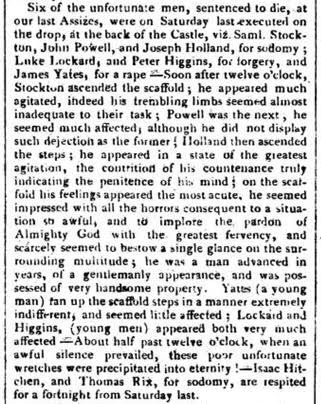
NOTE: In May 1806 a group of twenty-four men in Warrington and surrounding areas were arrested for homosexual offences, nine of whom were eventually tried. At the Lancaster assizes in August 1806 five men were convicted of buggery; Samuel Stockton, Thomas Rix, John Powell, and Joseph Holland had regularly assembled at the home of Isaac Hitchen, where they engaged in sex and called one another “Brother”, and kept assignations at the shop of Holland, a well-off pawnbroker. Most of the men had relations with John Knight, one of the most affluent men in Warrington, and with the confectioner Thomas Taylor, who both turned King’s Evidence to save themselves. Hitchen and Rix were sentenced to death but respite, but Stockton, Powell and Holland were hanged on the new drop erected at the back of the castle in Lancaster. Two other men were acquitted of buggery but re-charged with attempted sodomy, including 72-year-old Peter Atherton who had practised sodomy “for a great many years”. In 2004 it was discovered that the names of the men and some notes by them survived scratched on the walls of their cells. (Information gathered by Andy Denwood, from working on a project for BBC Radio which did not reach broadcast stage.)


          Thomas Taylor was a consenting partner, but in legal language this meant that he allowed or “suffered” himself to be “assaulted”. Taylor acknowledged that he had engaged in homosexual relations for the past ten years, and it seems likely that he regularly offered sex in exchange for “presents”. The other main witness, John Knight, also had sexual relations with more than one man, and in his case it seems likely that he offered favours to some of those who agreed to have sex with him. The sodomites’ main house of assignation was a public house in Sankey, a village on the outskirts of Warrington.

          For additional details, see Newspaper Reports for 1806.

REMARKABLE TRIALS AT THE LANCASTER ASSIZES
HELD AUGUST 1806,

A T L A N C A S T E R.

BEFORE

Sir ROBERT GRAHAM, Knight,

One of the Barons of His Majesty’s Court of Exchequer.

FAITHFULLY TAKEN IN SHORT-HAND

By VALENTINE JACKSON.

PRINTED FOR AND SOLD BY

R. BUTTERS, 22, FETTER-LANE, FLEET-STREET,

[PRICE THREE SHILLINGS.]

JOSEPH HOLLAND

FOR AN UNNATURAL CRIME.
I N D I C T M E N T

JOSEPH HOLLAND was indicted for that he not having the fear of God before his eyes, nor regarding the order of nature, but being moved and seduced by the instigation of the Devil, on the 9th day of July, in the forty-second year of the reign of his present Majesty, at Warrington, in the county of Lancaster, in and upon one Thomas Taylor, of Warrington aforesaid, did make an assault, and that he then and there feloniously, wickedly, diabolically and against the order of nature, carnally knew him the said Thomas Taylor, and then did commit that horrid, detestable, and abominable crime called b——y [buggery]. [p.31]

To this Indictment the Prisoner pleaded — NOT GUILTY.
The case was shortly opened on the part of the prosecution by Mr. Serjeant Cockell.
EVIDENCE FOR THE CROWN.
Thomas Taylor, sworn.

Q[uestion] You keep a shop at Warrington I believe. — A[nswer] Yes.

Q What kind of a shop is it? — A A confectioner’s.
Q Do you know the prisoner at the bar? — A I do.
Q What business is he? – A A pawnbroker.
Q Do you remember some time in the course of last year, seeing the prisoner one evening as you were shutting up your shop? — A Not in the last year.
Q Well in the year before. — A To the best of my recollection it was about four years ago.
Q What month was it in? — A I believe in the month of July.
Q Now state what passed. — A He asked me to go home with him to his house to get a glass of ale; I went with him home, but declined drinking any ale. He then desired me to go up stairs with him.
Q Was his wife at home at that time? — A She was not. I followed him up stairs and he asked me to undress myself.
Q Did you do so? — A I did.
Q In what manner did you undress your self? — A I pulled off my coat, and afterwards my waistcoat and breeches. [p.32]
Q What did he do? — A He did the same; he then asked me to lie down on the bed; I lay down.
Court.
Q In what way did you lie down? — A I lay down upon my back.

Q Did he lie down too? — A Yes, at my side.
Q Now state what took place further? — A He put his p— p— [i.e. private parts] between my things [sic, but probably a misprint for “thighs”], I told him to be quiet.
Q Well? — A He then asked me to turn on my side, which I did with my b—m [bottom, or perhaps bum] towards him; after this he took and put his p— [penis, or perhaps prick] into my f—t [fundament].
Court.
Now state particularly what occurred. — A I found myself wet.

Q How long did he continue in the position you have described? — A A few minutes; he then left off.
Q Did he do this of his own accord, or was it by your desire? — A He left off when he had done. [Note that Taylor evaded answering the question, as presumably it was by his own desire.]
Q What did he do with his body at first? — A I bent my —— [bottom?] towards him, and he worked his body backwards and forwards.
Q What took place when this affair was over? — A I dressed myself, took up my hat, bid him good night, and went home.
Cross-examined by Mr. Scarlett.
Now Taylor, attend to what I say, were you not taken up upon suspicion of having committed [p.33] this crime yourself? — A I never committed it on any man.

Q Were you not charged with having more than once committed this crime yourself upon others? — A I was suspected, but never committed it.
Q That is not an answer to my question, I ask you whether when you were taken up, you were not charged with this crime by more than one or two persons? — A I was charged by John Knight, but I never perpetrated the crime on any man.
Q How long ago is it since you suffered any person to commit this infamous crime upon you? — A About eight or nine years since.
Q How old are you now? — A About forty-five.
Q Then when you first submitted yourself to be contaminated with this abominable crime, you were about thirty years old?
Court Nay that would be fifteen years ago.
Counsel — True, is it not more than eight or nine? — A It was ten or eleven.
Q So then at that time you were thirty-five? — A Yes.
Q Did you ever make any resistance or complaints when this crime was attempted to be committed upon you? — A I have resisted.
Q Did you ever make any complaints to any person on these occasions? — A I never did except to the person that had committed it.
Q When you have complained to the persons [p.34] themselves was it before or after? — A Both before and after.
Q Did you ever receive money from these persons at any time? — A Never.
Q Did you ever threaten to disclose if they did not give you money? — A No.
Q Did you receive any money from the prisoner? — A I never did.
Q So then, on these occasions you suffered these persons voluntarily to perpetrate this horrid crime upon you, or in short to do as they would. — A I have resisted.
Q Had you know the prisoner any time, or had you had any particular acquaintance with him when he asked you to go with him to his house? — A I had not.
Q Where had you seenm the prsoner before this time? — A I had seen him at Isaac Hitchin’s, about three weeks before.
Q Had you ever seen him act contrary to decency or good morals, before the night when you say you went home with him? — A I never did.
Q Now how could the prisoner ask you to go with him home for this purpose, having had so little acquaintance, unless he knew, or had some reason to believe, that you were a person likely to make no resistance to his desires? — A I cannot tell.
Q You might have made your escape, I suppose there was nothing to hinder you. — A I suppose so.
Q On what day were you taken up? — A On Sunday the 6th of April.
Q Did you give any information against any persons on that day? — A I did not on that day, [p.35] for I had not a perfect knowledge of the circumstances.
Q Did you the day before? — A I did, against John Howard and Alexander Chorley.
Q How many persons did you inform against? — A Three.
Q You gave information against the prisoner, did you not? — A Yes.
Q Was this before or after the time you informed against the two you have mentioned? — A It was before.
Q How is it then you say you did not inform against any person on the day you were taken up, on Sunday? — A It was on Sunday I gave information against the prisoner.
Q O, then you did inform against somebody on the Sunday? — A I did.
Q Now, sir, I ask you whether at any time after you were apprehended, any promises of pardon were made to you, provided you would make a disclosure of what you know respecting the matters then under investigation. — A I was told that if I spoke the truth it would be no worse for me.
Q I must have an answer to the question I put; were you not given to understand, that if you would tell all you knew, and make good your story against the prisoner, you should not be prosecuted? — A Yes, I was told if I spoke the truth I should not.
Q Not be prosecuted. — A Yes.
Q Now when you were committed to Lancaster jail what did you suppose was the reason? — A I cannot tell.
Q You come here to tell the truth as you say, is it so? — A Yes. [p.36]
Q And you expect to be pardoned, don’t you, if you speak the truth? — A I do.
Court.
Q If you tell the truth you expect to save your life? — A Yes, to save my life.

James Nicholson, attorney, sworn.
Q Mr. Nicholson, I believe you were present sir when the prisoner was examined at Warrington. — A I was.

Q You assisted the magistrate, I believe sir, on that occasion. — A I did.
Q Now I will just ask you sir, were any promises or threats made use of previously to his making the confession we are about to hear? — A Not the least sir; in fact, the greatest attention was paid to this; indeed when he was examined, I even asked him whether he wishes me to put down what he said, to which he replied he did.
Q You took his examination in writing, I believe. — A Yes, sir.
Mr. Scarlett
Q The prisoner I believe was in custody some time before he was committed. — A Yes, several days.

Q Was any body permitted to see him? — A Yes, several persons were admitted, but we always took care to be informed when any body came. [p.37]
Q Then whether any promises or threats, or any thing of that nature had been sent to him by any of these persons, you do not know. — A Certainly not, but from the care that was taken I could not conceive it possible.
Q Was the prisoner in charge of a constable? — A He was.
Q Did he sleep alone? — A Yes.
Q Who was the constable that attended him? — A Paul Caldwell.
Paul Caldwell sworn.
Q Caldwell, did you attend the prisoner when he was in custody? — A I did.

Q Did you at any time make use of any threats or promises to him? — A I did not.
Q Were any such to your knowledge used by any other persons? — A No, not to my knowledge.
The examination was then read, which stated that the examinant, Joseph Holland, having been charged with committing the crime of buggery on Thomas Taylor at Warrington, says, That the said Thomas Taylor was at his house, and says that they lay down on the bed together, but did not perpetrate the crime.
Mr. Nicholson recalled.
Q Mr. Nicholson, was Thomas Taylor also examined before the magistrate? — A He was. [p.38]

Q His examination was also, I believe, signed and read over to him. — A It was; I did not take it all down in his precise words, for he had use of some expressions I did not chuse to wrote down.
Q However, it was in tenor and substance the same, and was read over to him? — A Yes.
The Examination of Thomas Taylor was then read; it was to the following effect: The examinant having been charged with the crime of b—— [buggery] says, that he did go with one Joseph Holland to his house about two years ago, that he went up stairs with him, that they undressed and lay down upon the bed, and that the said Joseph Holland did then and there commit upon him in part, this crime.
Mr. Scarlett.
(To Mr. Nicholson) Then Mr. Nicholson, though you did not take down Thomas Taylor’s exactly in his own words, you certainly did not understand him to mean that this crime was perpetrated so far back as four years ago, as he now states in evidence. — A I certainly did not understand him to say that it was any thing near so long since.

Q Pray did you write his examination in different terms from what he made use of? — A By no means, it was in effect the same, but he stated some things in a way that I did not think proper to copy closely; for instance, he stated that the [p.39] penetration was not much, or so great as it might have been with a stronger man, describing Mr. Holland as being enfeebled, and said to the best of my recollection, that he had joggled at him.
Mr. Peter Nicholson,
Was then called by the counsel for the Prosecution, and said, that having seen the witness Thomas Taylor after his examination, he said to him, “Mr. Nicholson, I believe there was an error in my examination, stating that the crime had been committed two years ago, for it was four.”
Here ended the evidence for the prosecution.

The Prisoner made no defence: he called three witnesses to his character. The evidence of the first, John White, being as follows; –
EVIDENCE FOR THE PRISONER.
John White sworn.

Examined by Mr. Scarlett.

Q You live in Warringotn, I believe. — A I do.

Q What are you? — A A plumber and glazer.
Q Do you know the prisoner? — A I do.
Q Did you not go up to London with him once? — A I did.
Q How long did you remain there? — A About three weeks. [p.40]
Q Where was this? — A At a friend of the prisoner’s.
Q Did you sleep with him while you were there? — A Yes, the whole time.
Q Did you ever know him guilty of any indecencies, or if you had, should you have suffered him to remain in the same bed with you? — A I should not.
Cross-examined by Mr. Cockell.
Q What took you to London, had you any business there? — A No, it was a journey of pleasure.

Q Who paid your expences, did not the prisoner pay them? — A He paid a very trifling part, I cannot justly recollect how much.
Q Had you money before you went up? — A Yes.
Q Where had you that money from? — A From my father.
Court. How much; had you more than a guinea? — A I had more than that.
Q The prisoner was going up to London at the time and offered to take you along with him. — A Yes.
Q You mentioned it to your father, and had his consent? — A Yes.
Q And he gave you money for the purposes? — A He did.
Q I believe you are with your father, who is also a plumber and glazer. — A I am.
Q Is he in considerable business? — A Yes.
Q The prisoner was known to him, and is a man of property? — A Yes.
The Court summed up the evidence, and the Jury found the prisoner — GUILTY. [p.41]
—————
THOMAS RIX

Was indicted for having committed a similar offence upon John Knight at Warrington.
Q John Knight, where do you live? — A At Warrington.
Q Do you remember the prisoner? — A I do.
Q Do you recollect any body calling upon you in September last with a message from the prisoner? — A A person named Saunders called upon me at the glass house [factory where glass and pottery was made], and said a gentleman wanted to speak to me, who was at a public house.
Q Did you go where he told you? — A Yes, I went there and saw the prisoner.
Q Well, you had some conversation. — A We had some ale together, and afterwards he invited me to meet at Mr. Holland’s the next day, and to bring some glass dust with me.
Q Did you go according to his request? — A I went about twelve or one o’clock the next day to Mr. Hollands with the glass dust.
Q What, did you purchase the glass dust for him? — A No sir, we have it at the glass house.
Q Oh, you got it gratis did you? — A Yes.
Q Well, proceed with our story. — A When I went to Mr. Holland’s I saw him standing at the door, he calle me, and asked me how I was, addressing me by the name of Brother Knight.
Q You went into his house. — A He brought me into the kitchen, when I saw the prisoner.
Q Was Holland’s wife at home? — A She was not, we drank some gin together, and afterwards Mr. Holland went into the shop.
Q Relate what happened them. — A The prisoner came to me, began unbjttoning my breeches and feeling at my p—e p—s [private parts]. He unbuttoned his own and we went into the parlour. [p.44]
Q Was any body there besides yourselves? — A Nobody, there was one of the parlour windows shut, for to prevent our being discerned: There was a sofa in the parlour. I went and leaned my hands upon the sofa and the prisoner put his y—d into my f—m—t [i.e.put his yard into my fundament].
Q How long did he remain so? — A A few minutes.
Court.
Did you perceive any thing come from him? — A Yes.

Q What into your body? — A Yes, and also with my hand on the outside.
Q You are sure of that? — A I am quite sure of that.
Q Well, what took place after this? — A After this Mr. Holland came in, and we had some more liquor, and then I went away to my work.
Cross-examination.
Q Have you not informed against several persons, besides the prisoner at the bar, since you were apprehended? — A I did.

Q And you have been promised pardon, or have had hopes of pardon given you, if you would make good your story against these people? — A Yes, if I tell the truth.
Q You say all that happened in Mr. Holland’s parlour. — A Yes.
Q Which looks into the front street. — A No, the back. [p.45]
Mr. Sanders
Was then called, who confirmed a part of Knight’s testimony, relating to his calling upon him, &c.

Court (to the prisoner).
What have you to say in your defence?

Prisoner.
I am not guilty of this crime.

The court shortly summed up the evidence, remarked that if the jury believed Knight’s evidence, the charge was fully brought home to the prisoner at the bar.
VERDICT, GUILTY — DEATH. [p.46]
—————
JOHN POWELL

FOR AN UNNATURAL CRIME.
I N D I C T M E N T.

JOHN POWELL was indicted for a similar offence, charged to have been committed by him on the 25th day of July, in the forty-second year of his present Majesty, &c. upon John Knight, at Warrington.

Mr. serjeant Cockell
Opened the case to the jury.

EVIDENCE FOR THE CROWN.
John Knight sworn.

Q Do you know the prisoner at the bar? — A I do.

Q What is he, and where does he live? — A He keeps a public house near Sankey chapel, in the neighbourhood of Warrington. [p.47]
Q Do you recollect being there on a Sunday about four years ago? — A Yes.
Q What time of the year was it? — A About July or August.
Q Now tell us who you saw there. — A There was a Mr. Allen from Liverpool, whose sister had just died at Warrington, and he was come over to bury her. I also saw Mr. Powell’s brother and brother in law.
Q Well, what passed at the prisoner’s house after that? — A I had some conversation with Mr. Powell about the death of his sister, and out of friendship he offered me a glass of his ale; we drank and conversed together some time, and afterwards Mr. Allen went away.
Q Did you got too? — A No, I staid there till between eight and nine o-clock, and Mr. Powell said he would see me a part of the way; we went out together.
Court.
Did any person see you go out? — A I don’t know whether Powell’s brother might not.

Q Well, the prisoner took you where? — A He came with me as far as the bridge on the road to Liverpool, where we stopped; he then unbuttoned his breeches and mine, and began feeling at my p—e p—s [private parts]. We then went into a field through a gate opposite the bridge, and walked up to the top of the field; as it was a wet night I had my top coat on. The prisoner pulled off my top coat, and laid it on the grass; I then laid down on my coat on my belly, and the prisoner —— [p.48]
(The witness here related what happened, amounting to the full charge laid in the indictment.)
Court.
Is the prisoner a married man? — A He is.

Q Well, when this was over you parted. — A Yes, after this we got up, and I went on my way.
Cross-examined by Mr. Scarlett.
This is the fourth* [Knight had already convicted Rix, Hitchen, and Stockton.] time today that you have given evidence against persons accused with this crime? — A I believe it is.

Q You think it a good joke perhaps, and smile at it? — A No, I do not think it any joke.
Q How many had you accused besides? — A I had not accused any person when I was first taken up at Warrington.
Q When was it that you accused the prisoner after? — A It was between Warrington and Lancaster; I told the constable I would tell all I know whether I saved my life or not.
Q Have you accused John Allen? — A No, but I have sent for him here.
Q You say you had something to drink at [p.49] Mr. Powell’s, now tell us how much you drank that afternoon. — A I spent three shillings.
Q What did you drink? — A Only ale.
Court.
Did you drink it all yourself? — A No, not all, I gave it to others in return.

Q Were you not drunk? — A I was not so drunk but I could tell what was done by me.
Q Now, sir, I ask you upon your oath, did not you say when you were examined before the magistrate that you on that occasion were so drunk that you could not tell what was done? — A When I was before the magistrate I was so fluttered that I did say at the first I was so drunk as not to know all that passed.
Q What was the reason that Powell offered to go with you on your way home? — A Powell said that as I was in that state he would see me part of the way.
Q Then that was the only reason for going with you, I suppose? — A I thought so.
Q If his motive had been to commit this crime, might he not as easily have done it in his own house? — A I wanted to be going.
Q Well, but you know he might have had an opportunity of doing it before you went if he had been so inclined; I suppose he has rooms, stables, or cellars, at his house, where you might have done your dark deeds? — A I was pressed to sleep there that night, but I wanted to go home.
Q Then you say he accompanied you to the [p.50] bridge, and there did what you described; pray is not that situated on a public road? — A Yes, on the road to Liverpool.
Q It was in the summer time, and therefore not yet dusk? — A It was so light that we were obliged to go into a field to prevent being seen.
Q Yes, you went into a field just opposite the bridge? — A Yes.
Q Any body might see into that field? — A Not where we were, we went to the far end of it.
Q Now I ask you sir, upon your oath, were you not at that time so drunk as to be unable to know what the prisoner did when you came upon the field? — A I could tell very well what was done by me, I had occasion to remember it for a week after.
Q What you mean to saw you were hurt, pray sir how long had you been before that in the practice of submitting yourself to be contaminated with this abominable crime? — A I had never submitted to it before this time.
Court.
Oh, this was the first time was it? — A Yes, nobody had ever gone that length with me before.

Q Now, sir, I want to know, have you not been informed that if you made good your story against the prisoner at the bar and the others that you have informed against, that you would be forgiven? — (The witness paused.)
Q I repeat the question, do you not expect to remain in this country if you make good your story? — A I cannot tell that. [p.51]
Q But you think to save your life? — A I mean to tell the truth whether I save my life or not.
Q It was a wet night when this affair happened was it? — A Yes it was.
John Allen sworn.
I remember being at Sankey chapel in that year, it was the Sunday after the death of my sister, she died in the month of July, and I went to Warrington on the Saturday. On Sunday afternoon I was at the public house, where I saw the prisoner and the last witness Mr. Knight. The latter enquired about my sister, and we conversed and drank together for some time; I remained there, to the est of my recollection, till about half past five o’clock, after which I took my leave.

Cross-examined.
Q Mr. Powell’s house, I believe, was much frequented? — A Yes.

Q About what time was it you were there? — A Just after the evening service at Sankey chapel.
Q Now, I’ll just ask you, sir, how did the last witness Mr. Knight seem when you were there? — A He appeared about half drunk, as one may say.
Q And you left at half past five o’clock? — A Yes, about that time, as near as I can remember. [p.52]
PRISONER’s DEFENCE.
My LORD,

I never committed this offence. This witness, John Knight, has scarcely told one word of truth in all he has said; I am sorry to say he is imposing upon you, my lord, he really is, he is indeed, he is imposing upon you most shamefully, and is only trifling with the lives of different people, and what he says about the gate opposite the bridge, is all false, for there is no such gate there.
————
The judges, in summing up, told the jury to pay particular attention to the circumstances of Knight’s intoxication, and to be perfectly satisfied, that he was not so far gone, as to be incapable of knowing what passed in the field, before they attached that degree of credit to his testimony which might lead to convict the prisoner. Respecting the prisoner’s declaration that the witness, Knight, was deceiving them, and that all he said was entirely false, the learned judge remarked that it was not every man that was capable of expressing himself in that very energetic manner in which the prisoner had done, a circumstance that induced him to wish most sincerely that the prisoner had brought some witnesses to his character; it was nevertheless a most notorious fact, [p. 53] naturally resultilng from the peculiar odium and disgust which attended this most abominable crime, that many persons possessed of that purity of mind which they would consider as contaminated by being brought forward, in any shape, on these occasions, were naturally solicitous to remain unexposed, even when it might be in their power to say some things favourable to the accused parties.

This was a circumstance which, undoubtedly, often rendered it extremely difficult for the prisoner to bring forward the desireable evidence in his own behalf, and, therefore, the jury would take this into their consideration.
At the same time, gentlemen, (continued his lordship) I certainly cannot state to you, that you are authorised by any means to place the simple declaration of the prisoner at the bar on the same footing with the sworn testimony of Knight, which in some instances has certainly been conformed by another. As to his sporting with the lives of the innocent, really, gentlemen, I am quite at a loss to conceive, considering that he has already convicted three of these unfortunate men, what could induce him to go further, and maliciously and diabolically swer what he has against the prisoner, if he knew it to be false.
If on weighing these circumstances in their minds they were induced to attach full credit to Knight’s evidence, they would then have to satisfy themselves whether the prisoner had fully, and completely, perpetrated the crime [i.e. full anal penetration and ejaculation] laid to his charge, before they could bring it home to him in [p.54] all its force; if so, they would discharge the painful, but necessary, duty of finding the prisoner guilty; but on thee other hand, if after a consideration of all their circumstances, there still remained any doubt upon their minds, and certainly (his lordship observed) this was one of those cases in which satisfactory testimony to the prisoner’s character would have greatly increased his own, they would in this case no doubt feel it their duty to acquit him.
The jury consulted for about ten minutes, and then brought in their verdict
GUILTY — DEATH. [p.55]
—————

JOSHUA NEWSHAM

FOR THE SAME OFFENCE.
I N D I C T M E N T.

JOSHUA NEWSHAM was indicted for having committed the same offence upon John Scott, a young man, about nineteen, on the 23d day of May, at Warrington, &c.

Mr. serjeant Cockell
Opened the case on the part of the crown.

John Scott sworn, examined by Mr. Park.

Q Where do you live? — A At Warrington.

Q What trade are you? — A A fustian cutter.
Q How old are you? — A I was twenty last March.
Q Do you know the prisoner? — A Yes. [p.56]
Q How long have you known him? — A Several years.
Q What business did he carry on when you first knew him? — A He was waiter at the St. George in Warrington.
Q Who kept the St. George? — A His brother.
Q What were you at that time? — A I was with a hair dresser who kept a public house called the Talbot.
Q Where is it situated? — A In Sankey-street, not far from the St. George.
Q How did you become acquainted with the prisoner at the bar? — A He used to come to my master’s to get shaved.
Q Do you rememer, about four years ago, the players being at Warrington? — A Yes, it was in the month of May.
Q Do you recollect seeing the prisoner about this time? — A Yes, sir, I was going to the theatre one evening, and standing at the door, the prisoner came up, he asked me if I was going in, and said he would treat me; he paid for me a place in the gallery, and I went up.
Q Did he go up wiht you? — A No, he went up into the boxes; about an hour after he came up, and asked me if I would go down and drink with him; I went down with im into a public house, and there he gave me three glasses of warm brandy and water.
Q Well, when you had drank the brandy and water, what happened? — A We went back to the play again.
Q Where did you go there, into what part of the house? — A Into the gallery again. In a [p.57] few minutes the prisoner came up and asked me if I would go into the boxes with him; I went and staid with him in the boxes till it was over, and then we went out together, adn two other young men with us.
Q Where did you go? — A We walked on towards the prisoner’s house.
Q Was that in your way home, I don’t mean the hair dresser’s, but where you lived? — A Yes, we called at a coffee house, and then the prisoner ordered me a glass of rum and water, and a bottle of wine for himself and the other two.
Q Did ye give you any wine? — A I think I had one glass.
Q Was there any more than one bottle of wine drank? — A They drank three bottles.
Q Now after this what followed? — A The prisoner invited me to go and take half of his bed.
Q Did you agree to this? — A Yes, for I was afraid to go home, as it was late, and said my father would scold me.
Q How far was it to the place where you lived? — A I lived at —— Mills, about a mile and a half from where we were.
Q What in the country? — A Yes.
Q Well? — A I went home with the prisoner to the St. George, we found the passage to the bar closed; we went into the yard, adn the prisoner desired the ostler to go and see where his brother was; the ostler came back and said, it is all clear, your brother is sitting at the bar fire, and won’t see you; we then went in, and the prisoner desired me to stick close to him, and let me up stairs into his bed room; the room was dark.[p.58]
Q You had no candle? — A No, he bid me get to the food of the bed, and undress me as fast as I could; he put my clothes under the feet of the bed, lest his brother should come up into the room and see me; I got into bed, and the prisoner went down. I cannot remember any thing more that passed then, or at what time the prisoner came to bed, for having drank some liquor I fell asleep.
Q Well, you cannot remember what happened immediately, but state what you next observed. — A Some time in the night I awoke, and found the prisoner had got upon my body, with his —— into my —— [yard into my fundament].
Q How long did he remain so? — A Perhaps two or three minutes; I said “Oh dear, Joseph, what are you doing?” he bid me lie still, and said, he should not hurt me any more; I said I would not, and struggling pretty hard he got off.
Q Did you perceive any thing at that time? — A I did not.
Q What, nothing at all after he had got off? — A No, nothing. [In other words, ejaculation had not occurred.]
Court.
Nothing but what you have described? — A No, sir; I fell asleep again, and in the morning about five o’clock, a gentleman rang a bell, whicih came into the prisoner’s room; he got up, but desired I would be still a little longer.

Q How long did you lie after this? — A About five minutes, and then he came up, and said, my brother is not up yet, dress yourself quick, and [p.59] I’ll let you out; I put on my clothes and went out.
Q Did you feel any thing at this time? — A Yes, I felt extremely sore the next morning, and grew worse and worse; I continued in that state several months.
Q Did you in consequence make any application to the prisoner? — A I never was in his company after; I wrote a letter to hium, as if coming from my mother, and desiring him to lend me a guinea, which he sent me by an old man that delivers out letters.
Q Had you in fact said any thing to your mother on the subject? — A I had not.
Q Did you ever see the prisoner after? — A Yes, I saw him again some time after, when the mountebanks were in Warrington, I saw the prisoner then, but did not speak to him.
Mr. Scarlet.
I think it hardly necessary to ask any questions – however I’ll just put one.

Q You say you awoke in the night on that happening which you described, and the prisoner desire dyou to lie a little longer? — A Yes.
Q But this you refused? — A Yes, the moment I awoke I bean to struggle, and by that means I got away from him.
Q And perceived nothing but what you have mentioned? — A Nothing at all. [p.60]
Court, to Counsel for Prosecution.
Q Do you mean to pursue this case?

Mr. serjeant Cockell,
No my lord; they have got to understand the law, that is clear [in other words, the defendant had been charged with the felony of sodomy, which required proof of both penetration and ejaculation, but since ejaculation had not occured the felony charge could no longer be maintained]; but that boy shall not be let off, he has forfeited his life.

————
Gentlemen of the Jury,

The prisoner at the bar has been indicted as you have heard for a capital offence, and really, gentlemen, I must say that this case does appear to have been attended with circumstances of peculiar aggravation; that a man of years should have meditated the foul design of contaminating a young inexperienced man, as the witness undoubtedly was, and though there is not sufficient evidence in point of law to convict him of the capital crime, I shall undoubtedly order him to be indicted again for a lesser offence. Gentlemen, under the present circumstances, you must acquit the prisoner. [p.61]
The jury accordingly found the prisoner
NOT GUILTY.
Court.

I will take no bail for Newsham.

N. B. Newsham was ordered by the judge to remain in custody, and another indictment to be preferred against him for a misdemeanor. [p.62]

—————

PETER ATHERTON

FOR LIKE OFFENCE.
I N D I C T M E N T.

PETER ATHERTON (aged seventy-two) was indicted for suffering and soliciting John Hill to commit a similar offence upon him, on the 10th day of August, 1796, and against the statute in that case made and provided, &c.

Mr. serjeant Cockell,
In opening the case, remarked with peculiar emphasis, that this case was rendered particularly shocking and disgusting, from the age of the prisoner at the bar who was no less than seventy-two years of age, and, he was sorry to add, that he had been in the habit of committing this horrid crime for a great number of years.

The learned counsel then briefly recaptulated the circumstances of the case, and proceeded to call the witnesses on behalf of the prosecution. [p.63]
EVIDENCE FOR THE PROSECUTION.
John Hill sworn.

Examined by Mr. Topping.

Q You life at Warringotn, I believe? — A Yes.

Q How long have you known the prisoner? — A About thirteen or fourteen years.
Q In what way did you become acquainted with him? — A For about a year before this offence was committed, he came frequently to our house, and often pressed me to go home and see him; he came one day and invited me to go home with him.
Q About what time was this? — A Five or six o’clock in the evening.
Q What time of the year? — A In the summer time, I went with him to his house.
Q Well, did he say any thing, I don’t mean any thing bad, but had you some general conversation? — A Yes, we talked for a while, and then he asked me to go up stairs with him; we went up into his room.
Q Was there a bed in the room? — A Yes.
Q Now what passed in the room? — A He began of groping at my thighs and unbuttoning of my breeches and his own.
Q Well, what else? — A He then laid hold of my —— [yard] and pulled me back towards the bed; he leaned against it with his —— [backside] towards me.
Q What, had he still hold of your —— [yard]? [p.64] — A Yes, all the time, it went a little way into his f——t [fundament].
Q What by his pulling it? — A Yes, I asked him to let me go, but he stuck to me.
Q Well, what happened then? — A My [yard] then went betwixt his thighs, that is all that I know.
Q Had you not e——ed s—d [emitted seed] in his body? — A No, I had not.
Mr. serjeant Cockell.
They have known the law since Saturday; of course we cannot proceed upon his indictment [i.e. since ejaculation had not occurred, he could not be prosecuted for the felony of sodomy], but I hope your lordship will order him to be detained.

Court.
Oh certainly, let him be again indicted.

Mr. serjeant Cockell.
I believe there is another indictment against him for a misdemeanor.

Court.
In that case it may as well be tried now.

Clerk of the crown.
My lord, I do not find any other.

Court.
Very likely; for the grand jury having [p.65] preferred one, would probably think a second inconsistent.

(The bills were looked over, but none being found, the prisoner was ordered to remain in custody, having been acquitted of this charge by the jury, under the judge’s direction, for want of evidence.)
The jury, according to the instructions of the court, returned a verdict —
NOT GUILTY.
S E N T E N C E:

ON MONDAY, AUGUST THE 25th, 1806,
Joseph Holland, Thomas Rix, John Powell, along with Isaac Hitchen and Samuel Stockton who had also been convicted by John Knight were brought into court to receive sentence, [p.66] and after having been asked what they had to say why sentence of death should not be passed upon them according to law – the court proceeded to pass sentence of death on Holland, in nearly the following terms:

John Holland, you stand convicted by a jury of your country of a crime which, according to the very energetic terms of the law, is a crime not to be named amongst Christians. I will not, therefore, offend the ears of any of those who may be before me, on this solemn occasion, by making any observations on the enormity of the offence of which you have been found guilty: — it is a crime of that nature and magnitude, that it is the duty the legislature owe to that society over which it presides, to mark it with the severest and most inevitable punishment.
I warn you, therefore, not to indulge any expectation that pardon will be extended toward you, but rather to make the best use of that short time which you will be allowed, in order to prepare yourself for that state into which you must shortly enter. — It now only remains with me to fulfil the painful task of pronouncing the awful sentence of the law, which is:

“That you Joseph Holland be taken from hence to the place of execution, there to be hanged by the neck until you are dead, and may God Almighty have mercy on your soul!!” [p.67]
Mr. Holland appeared in the highest degree alive to his awful situation, and exclaimed, after the sentence was pronounced, upon his knees, “Amen, the Lord have mercy!”
The same sentence was passed on the rest. [p.68]
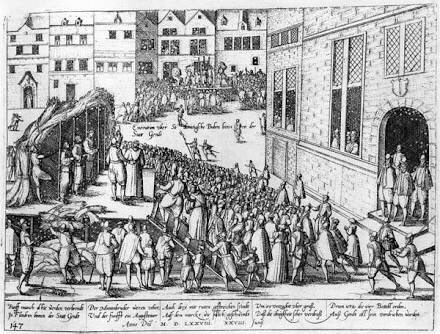
Newspaper at the time reported on these crimes.

Saturday 10 May 1806

The following persons have been committed to Lancaster Castle, since our last, by J. A. Borron, Esq. of Warrington, for the horrid crime of Sodomy. – viz. Joseph Holland, Alexander Chorley, John Howard, Joshua Smith, John Lightbourne, Thos. Rix, John Powell, John Hebden Cosntantine, James Ackerley, and Thomas Taylor. 

The Manchester Mercury of Tuesday last mentions that two persons have been apprehended in that town, charged with a similar crime, the bare mention of which is nearly sufficient to freeze the blood of a human being. (Lancaster Gazette)

Tuesday 13 May 1806
Within these few days, fourteen persons have been committed to Lancaster Castle, (by a magistrate at Warrington) charged with the horrid and unnatural crime of Sodomy! – It is said that two others, charged with the same, have been apprehended at Manchester! (Cumberland Pacquet, and Ware’s Whitehaven Advertiser)
Saturday, 17 May 1806
A discovery has lately been made in Warrington, and its vicinity, sufficient to freeze the bosom of humanity with horror. – The detestable crime of Sodomy appears to have been there systemized in such a manner, as to assume the form of a regular society, at the head of which are some of those men whom fortune had placed high in the list of respectability. About seventeen of the delinquents have been committed to Lancaster castle for trial, and some others found means to escape. The volunteers of that town were last week called out, and laudibly exerted themselves not only in securing the prisoners, but in protecting them against popular resentment. – Statesman. (The Newcastle Courant, Issue 6762)
Friday 1 August 1806

A few days ago, in Lancashire, England, 40 men were committed to prison, charged with a most unnatural and horrid crime. Several persons of property are in the number, and all are to abide their trials at the next assizes for that Shire. (Hibernian Journal; or, Chronicle of Liberty)
Friday 22 August 1806The calendar for the ensuing assizes at Lancaster (which commenced on Saturday), presents a dark picture of the human heart. – We are sorry to observe that there are no fewer than fifty-one prisoners committed for trial, among whom are five charged with murder, five with manslaughter, twenty-two with sodomy, four with forgery, two with croft-breaking, seven with burglary, two with picking pockets, and one with bigamy. (Stamford Mercury)

Saturday, 23 August 1806At Lancaster Assizes, which began on Saturday, there were four to be tried for forgery; fourteen for murder; and twenty-one for an unnatural crime. (Jackson’s Oxford Journal, Issue 2782)

Saturday 23 August 1806
True bills were found against Isaac Kitchen, Joshua Newsham, Joseph Holland, John Powell, John Hebden Constantine, Robt Aspinall, Jonathan alias John Denton, Peter Atherton, and John Smith, for sodomy; and against Samuel Stockton, Thomas Rix, Alexander Chorley, James Ackerley, Charles Davenport, George Ellis, and several others, for misdemeanours. – These remain to be tried. (Lancaster Gazette)
Thursday, 28 August 1806
At Lancaster Assizes, five persons were found guilty of forgery, one for a rape, four for stealing; and Isaac Hitchen, Samuel Stockton, Joseph Holland, John Powell, and Thomas Rix, for an unnatural crime; and all received sentence of death. Other four were to be tried on Monday for the same horrible crime. (Caledonian Mercury, Edinburgh, Issue 13206)
Saturday, 30 August 1806
Saturday, Isaac Hitchen, Samuel Stockton, Joseph Holland, John Powell, and Thomas Rix, five of the Warrington men, took their trials at Lancaster, for an unnatural crime, and were all found guilty. (The Ipswich Journal, Issue 3824. Similar brief report in Jackson’s Oxford Journal, 30 Aug. 1806, Issue 2783.)
Saturday 30 August 1806
LANCASTER ASSIZES.
The Court met on Saturday, pursuant to adjournment, when the following persons were convicted:– Joseph Holland (aged 50) of committing an unatural crime upon Thos. Taylor, of Warrington; – Isaac Hitchin (aged 62) of a similar offence upon John Knight, of Warrington; – Samuel Stockton (aged 50) of a similar offence on Thos. Taylor; – Thos. Rix (aged 47) of a similar offence on ditto; – and John Powell (aged 45) of a similar offence on J. Knight, at Great Sankey – Aspinall, Denton, and Smith, charged with similar offences, at Liverpool, were acquitted. 

          On Monday, Joshua Newsham (aged 84) was acquitted of a similar charge; but remanded, to take his Trial at the next Assizes, on another indictment; as was also Peter Atherton (ag3ed 72) – George Ellis (aged 50) was convicted of assaulting J. Knight, with an intent to commit a similar offence. 

          Joshua Smith, James Ackerley, John Hebden Constantine, and Charles Davenport, charted with similar offences, traversed, and were remanded for want of sureties. – Alexander Chorley, for a simlar offence, traversed, and was admitted to bail. – T. Knight, J. Howard, J. Lightburne, T. Taylor, J. Hill, and F. Smales, were admitted as King’s evidence. 

          Same day, the Assizes concluded, when Baron Graham, in a solemn and impressive manner, passed sentence of death on the following thirteen capital convicts, viz. – Joseph Holland, Isaac Hitchin, S. Stockton, T. Rix, and J. Powell, for sodomy; . . . George Ellis, for a misdemeanour (see above) to be imprisoned two years, and to stand twice in the pillory at Lancaster, one hour each time; . . . 

          Ellis is to be exhibited in the pillory, in our Market Place, this day, at noon. 

          It appeared, on the trials of the Sodomites, that they pretended to hold a kind of Masonic Lodge, and had taken a house, to carry on their diabolical purposes, which was kept by old Hitchin, and where they met on Monday and Friday evenings. – They accosted one another with the title of “Brother!” – Holland was an opulent man, as were some of the others: – Powell kept a public-house at Great Sankey. (Lancaster Gazette)

Saturday, 30 August 1806

LANCASTER ASSIZES.
At these Assizes, which closed on Monday last, thirteen prisoners were capitally convicted, and received sentence of death, viz.

          John Barlow, for stealing six pieces of calico, in the bleaching grounds of S. Nash, T. Jackson, and A. Lloyd, of Failsworth.

          Luke Lockard and Peter Higgins, for having been concerned in forging and uttering a bill of exchange for 29l. 10s. with intent to defraud G. Gardner, J. Hudswell, and J. Thorp, of Salford.

          James Sidebottom, for stealing a waistcoat, &c. the property of Z. Fletcher.

          Ralph Bolton, for a burglary in the house of W. Horrocks, and stealing therein a desk containing a quantity of gold coin.

          Charles Johnson and , for forging a bill of exchange of 30l. with intent to defraud J. and J. Irwin, of Manchester.

          James Yates, for wounding and ravishing Mary Hoyle, of Spolland.

          Isaac Hitchin, aged 62, for an assault, with an intent to commit an unnatural crime on John Knight.

          Samuel Stockton, , and Joseph Holland, for a similar offence on Thomas Taylor.

          And John Powell, for an unnatural crime with John Knight.

          The Judge (Baron GRAHAM), in the most impressive manner, advised the eight last-mentioned malefactors to prepare to meet the fate which the laws of their country had affixed to their heinous offences. Hopes of mercy were held out to the other five.

          It appeared on the trials of Hitchin, Stockton, Fox, Holland, and Powell, that they regularly assembled at the house of Hitchin, on Monday and Friday evenings. The Judge very properly ordered that no notes should be taken of these trials.

                    (Morning Chronicle, London, Issue 11634)

Tuesday 2 September 1806

Lancaster assizes concluded. – On Saturday se’nnight, Isaac Hitchen, Samuel Stockton, John Powell, Thos. Rix, and another, for an unnatural crime, were all found guilty. 
          On the trial of Denton, Smales, the only evidence against him, gave such an incoherent testimony, that the jury acquitted the prison; as they also did John Smith and Robert Aspinall, without further examination of Smales, the only evidence against them also. 

          On Monday, J. Newsham (aged 34), was put upon his trial for an unnatural crime. The evidence against him, however, not proving the actual commission of the crime [i.e. sodomy with penetration], he was acquitted; but, by the Judge’s order, immediately indicted for a misdemeanor [i.e. “attempted sodomy”], and remanded for trial at the next assizes. His Lordship refused to admit him to bail on any condition. Peter Hatherton (aged 72), was tried for a similar offence, and acquitted, but afterwards indicted for a misdemeanor. The indictment of John H. Constantine, as well as those of several others, were also changed to that of misdemeanors, and their trials postponed till next assizes. We understand that two of these wretched creatures are to be executed at Warrington, and the other tree, convicted of the same crime, at Lancaster. . . . 

          At the conclusion of this assize, a cause came on, which excited a considerable degree of interest in this city, the defendant being a resident tradesman of respectability, and a member of the volunteer corps, and from having, when upon permanent duty at Warrington, in 1805, been unfortunately introduced to one Robert Ball, late house steward to Colonel Patten, of Bank, near Warrington, who was admitted King’s evidence, and who, as it appeared upon the trial, has been an associate in that infernal gang, who have degraded themselves and human nature, by the commission of crimes (in the emphatic language of the law), not to be named among Christians, was by him charged with several indecencies, short of the capital crime [i.e. sex between men but short of sodomy with penetration]. The trial occupied but a short time; the defendant’s counsel, Mr. Scarlet (whose well-known abilities, accompanied with the most refined sensibility, need no eulogium from our pen), detected such glaring perjury upon the part of the witness, that, after an address to the jury, his Lordship would not suffer more than three of the defendant’s witnesses to be examined, but stopped proceedings to remark to the jury the impossibility of the defendant’s guilt, when the Attorney-General, actuated by the same conviction, begged to withdraw the prosecution. It was remarkable, that at the commencement of the trial, so strongly did the defendant’s innocence appear, that contrary to the usual practice, he was not placed at the bar, but was allowed to take a seat with his council at the green table. It is almost needless to add, that this honourable acquittal, almost unparalleled in the annals of criminal judicature, was received with the greatest exultation by a crowded court, who heartily and feelingly congratulated each other upon the blessings of an impartial administration of justice, and rejoicing, that even in the moment of indignation, excited by the preceding trials, still the modest voice of innocence was not disregarded. Baron Graham then congratulated the defendant upon his acquittal, and addressed him in these words:– “Young man, you will now return to your friends with unspotted purity of character.” His Lordship then ordered that the witness would not be discharged till he had procured bail to the amount of 1600l. to answer a bill of indictment, to be preferred against him next general assize. It is worthy of remark, that so great was the indignation of the populace against the evidence, Ball, that it was not thought advisable to trust him within the reach of their resentment. (Chester Courant)

Tuesday 16 September 1806
On Saturday last six of the unhappy culprits condemned at the last assizes, viz. two for forgery, one for a rape, and three for sodomy, were executed on the drop behind Lancaster Castle. They all demeaned themselves in a manner becoming their awful situation, except Yates, for the rape, who appeared to meet his fate with a degree of hardened impatience. Johnson and Thomas for forgery, and Hitchen and Fix for sodomy, have been respited – An immense concourse of spectators attended the execution. (Manchester Mercury)
Thursday, 18 September 1806
Six of the unfortunate men, lately under sentence of death, at Lancaster, were, on Saturday the 13th, executed on the new drop, erected at the back of the Castle, viz. James Stockton, James Powell and James Holland, for an unnatural crime; Luke Lockard and Peter Higgins, for forgery; and James Yates, for a rape. Previous to leaving the Castle, the prisoners seemed to join the clergyman in devout prayer, and their awful fate appeared to make a sensible impression on their minds. (Morning Chronicle, London, Issue 11650)
Friday 19 September 1806
Execution of the Malefactors at Lancaster.
Six of the unfortunate men, lately under sentence of death, at Lancaster, were on Saturday last executed on the new Drop, erected at the back of the castle, viz. S. Stockton, J. Powell, and James Holland, for sodomy; Luke Lockard and Peter Higgins, for forgery; and James Yates, for a rape. Previous to leaving the castle, the prisoners seemed to join the Clergyman in devout prayer, and their awful fate appeared to make a sensible impression on their minds. – The other prisoners in the castle, under sentence of death, viz. Chas. Johnson and Robt. Thomas, for forgery; Isaac Hitchen and J. Rix, for sodomy; are respited during his Majesty’s pleasure. (Chester Chronicle)

Saturday, 20 September 1806

Charles Johnson and Robert Thomas, under sentence of death in Lancaster castle, for forgery, are reprieved until his majesty’s pleasure be known: and on Friday night a respite was received, by express, for Isaac Hitchin and T. Rix, found guilty of sodomy. The other six unfortunate men, viz. Joseph Holland, S. Stockton, and J. Powell, for sodomy; Luke Lockard and Peter Higgins, for forgery, and Jas. Yates, for a rape, were executed on Saturday. (The Newcastle Courant, Issue 6780)
Saturday 20 September 1806
Six of the unfortunate men, sentenced to die, at our last Assizes, were on Saturday last executed on the drop, at the back of the Castle, viz. Saml. Stockton, John Powell, and Joseph Holland, for sodomy; Luke Lockard, and Peter Higgins, for forgery, and James Yates, for a rape. – Soon after twelve o’clock, Stockton ascended the scaffold; he appeared much agitated, indeed his tembling limbs seemed almost inadequate to their task; Powell was the next, he seemed much affected; although he did not display such dejection as the former; Holland then ascended the steps, he appeared in a state of the greatest agitation, the contrition of his countenance truly indicating the penitence of his mind; on the scaffold his feelings appeared the most acute, he seemed impressed with all the horrors consequent to a situation so awful, and to implore the pardon of Almighty God with the greatest fervency, and scarcely seemed to bestow a single glance on the surrounded multitude; he was a man advanced in years, of a gentlemanly appearance, and was possessed of very handsome property. Yates (a young man) ran up the scaffold steps in a manner extremely indifferent, and seemed little affected; Lockard and Higgins, (young men) appeared both very much affected. – About half past twelve o’clock, when an awful silence prevailed, these poor unfortunate wretches were precipitated into eternity! – Isaac Hitchen, and Thomas Rix, for sodomy, are respited for a fortnight from Saturday last. 
          At Chester city sessions, which commenced on the 3d inst. John Vaughan, aged 79, for assaulting Samuel Jones, with an intent to commit an unnatural crime, was found guilty, and sentenced to be imprisoned in the House of Correction twelve calendar months, and during that time kept to hard labour. (Lancaster Gazette)

Saturday, 20 September 1806
Six of the unfortunate men, lately under sentence of death at Lancaster, were executed on Saturday last, viz. S. Stockton, J. Powell, and J. Holland, for an unnatural crime, L. Lockard and P. Higgins, for forgery, and J. Yates, for a rape; Stockton seemed much agitated, and Holland, a man advanced in years, of a gentlemanly appearance, and possessed of handsome property, appeared extremely agitated. Hitchen and Rix, for an unnatural crime, and Johnson and Thomas, for forgery, are respited during his Majesty’s pleasure. (Jackson’s Oxford Journal, Issue 2786)
Saturday, 4 October 1806

On Saturday last, Isaac Hitchen and Thomas Rix, two of those who were convicted at our last Assizes, of sodomy, and whose sentences had been respited for fourteen days, were executed on the drop, behind the Castle. – They behaved with much fortitude, and appeared penitent. – Very few spectators attended the execution. (Lancaster Gazette)
Thursday, 9 October 1806
On Saturday last, HITCHEN and RIX, two of the persons convicted of an unnatural crime at last Lancaster assizes, and who had been respited for fourteen days, were executed at Lancaster. (Caledonian Mercury, Edinburgh, Issue 13224)
Saturday 1 November 1806

At Lancaster assizes, in August last, five persons were tried for an unnatural crime, and capitally convicted, viz. – Isaac Hitchins, Joseph Holland, John Powell, Thomas Rix, and Samuel Stockton. Sixteen others were to be tried for the same offence at next assizes, but six of them have been admitted King’s evidence. These persons pretend to hold a Mason Lodge, and took a house to carry on their diabolical purposes at Warrington. They were almost all young men of fortune. – Hitchins was worth L. 60,000. Holland possessed a fortune of L. 2000 a-year. The agitation of this poor man, when sentence was pronounced, was shocking in the extreme. He wrung his hands, beat his bosom and forehead, and shewed all the symptoms of the utmost extremity of despair. A rich Lancashire attorney, worth L. 40,000, implicated in the same crime, has absconded. On Saturday Sept. 13th, three of these unhappy men (Powell, Holland, and Stockton,) were executed on the drop behind Lancaster castle, alongst with two others for forgery, and one for a rape, amidst an immense concourse of spectators. Hitchins and Rix were executed at the same place on the 27th of Sept. They all demeaned themselves in a manner becoming their awful situation. (Scots Magazine)
References

SOURCE: Various newspapers, dates as given.

CITATION: If you cite this Web page, please use the following citation:
Rictor Norton (Ed.), “Newspaper Reports, 1806”, Homosexuality in Nineteenth-Century England: A Sourcebook, 5 May 2008, updated 17 February 2013, enlarged 19 January 2016 http://rictornorton.co.uk/eighteen/1806news.htm

SOURCE: Remarkable Trials at the Lancashire Assizes, London, 1806. (From copy in the Lancashire County Council Record Office.)

CITATION: If you cite this Web page, please use the following citation:
Rictor Norton (Ed.), “A Sodomite Club in Warrington, 1806”, Homosexuality in Nineteenth-Century England: A Sourcebook, 5 May 2008 http://rictornorton.co.uk/eighteen/1806lanc.htm
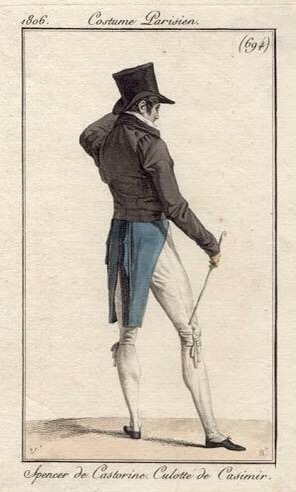

Tim Alderman (2017)

Gay History: British Newspaper Reports 1800-1803

Just to show that there is nothing new under the sun, these newspaper reports of the Detestable Sin of Sodomy in the early 19th century show that you can’t kerp a good (gay) man down, despite the illegality of homosexual acts. Highlights are: A man apologises for libelling a servant (Aug. 1800); several cases of blackmail; conviction of a one-armed homosexual seller of obscene literature (Oct. 1802); a drunken servant molests his master (Jan.–Mar. 1803).

Saturday 16 August 1800

WHEREAS I John Mallett, of Bromeswell, labourer, have very grossly and falsely propagated and raised scandalous reports, to the great injury of the character of Francis Scarff, servant to John Vancouver, of Sutton, Esq. particularly in reporting him guity of that detestable Crime of Sodomy, and for which he has very justly commenced a prosecution against me, but the said Francis Scarff has promised not to proceed any further therein, upon my promising not to do the like again, paying the expences already incurred, the expences of this advertisement, and thus publicly acknowledging my fault. I hereby declare, That I raised the said report without any foundation, and I do return the said Francis Scarff many thanks for the lenity he has shewn, by ceasing all further proceedings against me, and I do promise never to be guilty of the like again. As witness my hand this 14th day of August 1800. 

          The Mark X of JOHN MALLET

Witnessed In Court, Richard W., Oldham. 

                          (Ipswich Journal) Weekly Gazette)

Monday 22 December 1800

PORTSMOUTH,
SATURDAY, DECEMBER 20.

Last week a court martial was held on board his Majesty’s ship Gladiator, in this harbour, for the trial of John Hubbard and Geo. Hynes, two seamen belonging to the St. George, for an unnatural crime. The charges being fully proved against the prisoners, they were sentenced to be hanged on board such ship or ships, and at such times, as the Lord Commissioners of the Admiralty should direct. (Hampshire Chronicle)

Monday 29 December 1800

PORTSMOUTH, December 26.
Monday morning John Hubbard and George Hynes, two seamen belonging to the St. George, were executed on board that ship, pursuant to their sentence, for an unnatural crime. (Sherborne Mercury)

Monday 19 January 1801

[From a review of the travels of C. F. Damberger in 1781] From the country of the Caffrees [in the Cape] he turned westward, and continued his journey in a north-west direction, till he arrived in the kingdom of Angola. Among the Muhotians, a race not more savage, but more egregiously vicious than any horde he had before visited, he discovered the bodies of five Europeans, who appeared to have been cruely massacred; and was himself exposed to danger, from the unnatural lust of some wretches of that community. He, however, escaped from their brutality, and after long wanderings, came to Malemba, a walled town on the river Congo. (Hampshire Chronicle)

Saturday 28 February 1801

OXFORD February 28 This day Mr. Justice Rooke and Mr. Justice Lawrence will open their commission at Reading, for holding the Assize and General Gaol Delivery for the county of Berks. – And on Tuesday next their Lordships will open their commission for Oxfordshire, at the Town Hall, in this City, when the following prisoners are to take their trials, viz. [among others] John Bennwell, for an assault, with intent to commit an unnatural crime, at Newington; . . . (Jackson’s Oxford Journal, issue 2496)

Saturday 28 March 1801

Prisoners in Ipswich County Gaol.
. . . Wm. Chapman and Joseph Parker, charged with sodomy, and Robt. Norman, for theft, no prosecution. . . . (Ipswich Journal)

22 September 1801

PUBLIC OFFICE, BOW-STREET
Yesterday a person, calling himself John Sulman, was examined before A. Graham and William Kinnaird, Esqrs. on a charge of extorting 34l. 3s. from Mr. S. a publican in the neighbourhood of Hatton Garden, under a threat of charging him with an unnatural crime. Mr. S. stated that in the month of November last, as he was stopping under a gateway in Oxford-street the prisoner at the bar came up to him, seized him by the collar, charged him with an unnatural crime, and swore he would persevere in so doing, unless he would give him 20 guineas; that being extremely alarmed he consented to do it, and the prisoner followed him home, and waited in the street while he went and feched the twenty guineas, which he delivered to the prisoner, who went away. That in about three weeks afterwards, the prosecutor having been out of town in the interim, the prisoner called at his house, demanded some more money, making use of the same threats, and adding that he would write to his wife on the subject, unles he, the prosecutor, would make up the sum 40l.; that being under the same impression of fear as to his character, he gave the prisoner a ten-pound note, and they then went together to Fleet-street, where Prosecutor borrowed three guineas of an acquaintance, which he also gave to the Prisoner; and they again parted. That on Friday night last, between 10 and 11, he saw the Prisoner and another man in Oxford-street, when they followed him, and the Prisoner coming up to him, said, he would be damned if he would not have a gallon of brandy and a gallon of rum, which he ordered to be brought to him byi the Prosecutor yesterday morning, in Lincoln’s-inn-fields, saying, he would pay for the bottles but not the liquor. The Prosecutor then acquainting some friends of the transaction, they went at the appointed time yesterday morning to Lincoln’s Inn Fields, where they secured the prisoner, who had always represented himself to prosecutor as an officer of this Office (Bow-street), and had repeatedly threatened to take him to custody.

The prisoner, on being called on for his defence, denied the charge in toto. He was committed for further examination to-morrow, as there is reason to believe he has been guilty of other offences of a like nature, and which, in this case, amounts to a complete highway robbery. (Morning Chronicle)

Thursday 24 September 1801

PUBLIC OFFICE, BOW-STREET.
Yesterday John Solman, in custody for extorting money from the publican, under a threat of charging him with an unnatural crime, was re-examined before Aaron Graham, Esq. and fully committed to take his trial for a highway robbery, in stopping and taking the money from the prosecutor in the street. (Morning Chronicle)

Wednesday 11 November 1801

On Thursday the Sessions closed at the Old Bailey, when the following capital convicts received sentence of death:– William Keepe, only fourteen years of age, for taking a banknote out of a letter; Thomas Gout, and John Salmon [i.e. Solman], for robberies, by extorting money under pretence of accusing persons of an unnatural crime; . . . The convicts seemed to have very little sense of the awful situation they were in. (Hereford Journal)

Thursday 12 November 1801

The trials at the Old Bailey concluded on Thursday, when sentence of death was passed on . . . Thos. Gout and John Solman, for highway-robberies; . . . (Bath Chronicle and Weekly Gazette)

1 April 1802

EXETER, Wednesday, March 31 The Assizes for the County of Devon, held at the Castle of this city, before Sir Simon Le Blanc and Sir Soulden Lawrence, did not finish until Saturday last. – The following Prisoners were tried and convicted, viz.
          [among others] Robert Harris for charging Sir Francis B. Y. Buller, bart. with an attempt to commit an unnatural crime, and for endeavering [sic] to extort from him 500l. by such threat, to be transported for 7 years. (Trewman’s Exeter Flying Post, issue 2006)

8 May 1802

Monday, at the city sessions, Bath, Joseph Tucker, convicted of an attempt to commit an unnatural crime, was fined 3s. sentenced to twelve months’ imprisonment, the three last in a solitary cell; and to be bound, himself in 100l. and two sureties in 50l. each, for his future good behaviour. (Jackson’s Oxford Journal, Issue 2558)

Friday 17 September 1802

WHEREAS an action was brought in His Majesty’s Court of Great Sessions for the county of Flint, by Nathaniel Griffith, of Holywell, in the said county, Flax-Dresser, against Evan Evans, of the same place, Cutler, for having charged the said Nathaniel Griffith of being guilty of an unnatural crime; and in order to stop all farther proceedings in the said action, the said Evan Evans hath paid all costs incurred in the said action, which the said Nathaniel Griffith hath consented and agreed to discontinue all proceedings, upon having the whole costs paid, and the undermentioned Declaration, signed by the said Evan Evans, and be made public, that he is innocent from the crime laid to his charge, of which the following is a copy:– 
“I Evan Evans, do hereby declare, that Nathaniel Griffith is innocent from the crime of Sodomy, for ought I know to the contrary. As witness my hand this 4th day of September, 1802.”
          The mark (X) of the said EVAN EVANS. Witness, G. WILLIAMS.

                    Holywell, 15th Sept. 1802.

                                        (Chester Chronicle)

13 October 1802

GUILDHALL, TUESDAY. George Flamsted and his son Richard were fully committed for trial by the Lord Mayor at the Mansion House, charged, on the oaths of Abigail Seewright, John Watts, William Robinson, John Barnfield, and William Seewright, on suspicion of an attempt to commit an unnatural crime. His Lordship told the prisoners, that since had been Chief Magistrate he had not met with an investigation which had given him more heartfelt pain than the present; but as he could not find any thing against the characters of the witnesses, he found it his duty to commit them for trial, and let the Jury judge of the evidence. He ordered that, T. Sapwell, the constable, should be the prosecutor, at the expense of the parish. (Morning Chronicle, Issue 10421)

23 October 1802

POLICE
WESTMINSTER SESSIONS.

Yesterday John Harris was indicted for distributing and selling prints of an obscene and immoral tendency. The nature of his case will be best understood by giving an outline of the pernicious consequences which the prosecution was intended to counteract.

          The Defendant, sensible no doubt of the enormity of his crime, and convinced that any defence would but add to the criminality of his conduct, very wisely judged it expedient to plead Guilty. It was of course [thereby] rendered unnecessary to go into all the details of the case, which otherwise might have been indispensible.

          Mr. KNAPP opened the case for the prosecution, and stated that he appeared as the representative of a very respectable society, the object of whose institution was the promotion of morality, and the suppression of that corruption which at present formed so general a subject of almost universal regret. It was of course an indispensible part of their duty to watch over every thing which might have the least tendency to debauch the morals or to impair the decency of any class of society. The object which the society had in view was general reformation; but they properly wished to guard in the most particular manner against the attacks of those profligate individuals, who by the most insidious means were desirous of destroying all that is most amiable in private life. In the exercise of their duty they had found it necessary to direct their attention to a class of men, whose great business it was to distribute prints of the most obscene and disgusting description. It was not the class of reflecting and industrious individuals which they thought proper to address, but it was against the less protected and more innocent branches of the community that their attacks were directed. It was among women and children that these pernicious individuals chose to sow the seeds of their destruction. It was among these that vice had received the greatest encouragement; it was therefore among these that the efforts of the society were most particularly demanded. On these principles the Society had acted, and it was on these grounds that the present prosecution had been instituted. The prisoner was one of the most dangerous and criminal menbers which could exist in any civilized society. He had employed himself in circulating prints, the only tendency of which was to destroy whatever is most respectable or most amiable in the community of mankind. They were beyond description infamous and abominable. They would be produced to the Court, and the criminality of the Defendant in their circulation would require no effort to increase the enormity of his offence. Having stated these particulars, the learned Counsel adverted to the circumstance of the information, which was to be derived from the evidence of an agent whom the Society had appointed to search into the mystery of this most infamous and disgraceful business. This agent had on one occasion purchased six of these obscene pictures, and at that time the Defendant had forty more in his possession. He met the Defendant a second time, left a deposit for another purchase, and on the same occasion had a person in readiness to take him into custody. At the time of the prisoner’s apprehension he was possessed of a number of prints, but he pretended that they were for the use of his friends. Other particulars were added in evidence, which, from motives of delicacy, we are obliged to suppress.

          The Prisoner, in his defence, said that it was needless for one in his situation to advance any thing in his defence. He threw himself on the mercy of the Court, and had only to plead that distress had driven him to the present criminal conduct.

          Mr. MAINWARING, after a very appropriate and impressive address, pronounced the sentence of the Court, which was, that the culprit should be confined for two years in the House of Correction, and within one month be placed in the pillory at Charing Cross during the space of one hour.

          This monster (for a milder epithet would want expression) has already stood twice in the pillory. On one of these occasions he suffered punishment for an attempt to commit an unnatural crime, and on the other he was convicted of the same offence for which he is again destined to suffer. (Morning Chronicle) (For the earlier offence, see News Reports for January 1798.)

28 October 1802

John Harris, sentenced at the late Westminster Sessions to two years’ imprisonment, and to stand once in the pillory for selling obscene books and prints. – The avowed professions of this man was that of a vender of ballads, which he daily exposed to sale on Privy Gardens Wall, nearly opposite the Treasury. Whenever boys or girls stopped to read his songs he took the opportunity of intimating to them in a sly, and sometimes facetious manner, that he had funny prints about his person, and of alluring them by various persuasive ats, to particular private places near at hand, where he produced and sold his indecent articles of trade. The places to which he generally resorted with his young customers were the back of the wall where he exhibited his ballads, behind the Banquetting House, and somewhere near Cannon’s-row; but his infamous dealings were not confined to these retired haunts: he frequently took young men and women home to his lodgings in St. Martin’s-lane, where he had a room into which he shewed his visitors, hung round with scandalous pictures. Here he had an assortment of prints and books, all of them indecent, and many of them of an obscenity so disgusting, unnatural and monstrous as to forbid the bare mention of their nature. This latter description of prints and books were known among those who purchased them, by the name of Novelties. Those who had transactions with Harris of the above nature were in general genteel youths, apprentice boys out on errands, and female servants, many of whom were nursery maids carrying children in their arms, and living in the neighbourhood of Westminster. We are also credibly informed that Harris confessed to one of the agents of the Society at whose instance the prosecution against him was instituted, that during a former imprisonment he had made a clear profit by the sale of one description of his infamous goods only, of 2l. 10s. per week. This disgraceful wretch has but one arm, is in advanced years, and of a very remarkable appearance. (Morning Chronicle)

15 January 1803

CHELMSFORD, Jan. 14. Yesterday Samuel Smith, one of the domestic servants of C. C. Western, Esq. Member for Maldon, was committed to our goal [sic], charged upon the oath of his master, with an assault upon him on the night of the 11th instant, and also with intent to commit an unnatural crime. (Ipswich Journal, Issue 3647)

Saturday 22 January 1803

Thursday, Samuel Smith, one of the domestic servants of Charles C. Western, Esq. M. P. was committed to Chelmsford Gaol, upon the oath of his master, with an assault upon him on the night of the 14th instant, with an intent to commit an unnatural crime. (Norfolk Chronicle)

Wednesday 26 January 1803

At the adjourned sessions for this county, holden at Lynn, January 18, . . . James Murden, being convicted of an assault, with an attempt to commit an unnatural crime, was ordered to pay a fine of 40s. and to be imprisoned in the said Bridewell for 12 months. Murden had officiated as a Methodist Preacher in a licensed house in Swaffham. (Bury and Norwich Post)

Monday 14 March 1803

CHELMSFORD
CROWN SIDE.

Before Mr. BARON HOTHAM, Saturday, March 12.

          Samuel Smith, valet to CALLIS WESTERN, Esq. Member for Malden, was indicted for an assault upon his master, with intent to commit an unnatural offence. The circumstances of this case were very unusual, and, as related by Mr. WESTERN, as follow: he said, that he was at Chelmsford at the last Quarter Sessions, held on the 11th of October: the prisoner, his servant, accompanied him. On the evening of that day he supped with his brother Magistrates at the Saracen’s Head in the town, and about twelve retired to his lodgings; he felt himself very sick, and was apprehensive he should vomit. He ordered the prisoner to get him some warm water. The prisoner said, “Sir, let me rub the pit of your stomach, it will be of service to you.” He replied, “No, no, get me some warm water; I will get into bed, and perhaps I may fall asleep.” The sickenss he complained of, was not altogether the effect of excess, but was an habitual complaint, which was always relieved by the use of warm water. The prisoner left the room, and the witness went to bed and fell asleep. He could not have slept long, when he was awakened by something rubbing his stomach. At first, half awake, he could not tell what it was, but being roused, he felt the prisoner’s hand pressing indecently against him; he ordered him immediately to leave the room, which he did, saying something about doing him good. The next morning he felt himself very unhappy, and did not know what to do; at last he mentioned it to Mr. MONTAGU BURGOYNE, and Mr. BATE DUDLEY; they sent for the prisoner, and in their presence he told him that his conduct had been such, that he should dismiss him his service immediately. The prisoner said, he was so drunk the night before, he had no trace of recollection as to what passed, and begged his master to keep it a secret. This, Mr. W. said, he refused to do, but told him to go home, get his things away, and return to Chelmsford the next day. The prisoner did so, and was, on his return, committed to prison. On cross-examination, Mr. WESTERN said, he had hired the prisoner in May last, and had a fair character with him. He had behaved very well during all the time he had continued in his service, and had attended him in a severe illness, during which he sat up with him every alternate night, and had in all things, until this affair, conducted himself as well as a servant could do. He saw he was a little drunk when he came to wait upon him, but he thought he was sufficiently sober to attend him at his retiring to bed.

          Mr. BATE DUDLEY corroborated the testimony of Mr. WESTERN, as to the examination of the prisoner before them, when he pleaded his being drunk, and said he knew not what had passed; the only recollection he had was, that he was roused as he was kneeling by his master’s bed-side. To disprove this assertion of the prisoner, the servant of the house where Mr. WESTERN lodged was called: she stated, that the prisoner came down for the tea kettle of boiling water, which he carrie dup stairs with apparent steadiness. The boy of the inn, with whom the prisoner slept, was also called, who said, that the prisoner came home, went up the ladder leading to the bed-room, undressed himself, put out the candle, and came to bed to him, observing, that it was a very cold night. 

          Mr. GURNEY, for the prisoner, rested his defence on the ground of intoxication, and called four witnesses, who swore that the prisoner had dined at the inn with three or four servants more; that they drank five bottles of wine, and four pots of beer, for dinner; that the prisoner afterwards drank brandy and water until near twelve, and, when he went to his master, was so drunk he could hardly stand. 

          Mr. GARROW, on replying to this evidence, commented with great indignation, and proper severity, on the profligacy of servants, who pampered their appetities until they were inflamed to the committing of most brutal crimes. 

          The Jury deliberated for about a quarter of an hour, and then returned a verdict of – Not Guilty. (Morning Post)

Monday 4 April 1803

At Taunton Assizes, Absolom, Hant., . . . Mr. Thomas Sampson, clothier, of Freshford, was tried on two charges of an unnatural tendency. Mr. Gibbs addressed the Jury in behalf of the accused, in a most earnest and eloquent manner, and pointed out the infamy of the prosecutions; and said that it was not enough for his client to have a verdict f acquittal from the hand of the Jury, but the world must be convinced that he had not a stain left upon his character. He strongly reprobated the conduct of the two prosecutors, Hart and Broad. Of both charges Mr. Sampson was acquitted. 
          At the Nisi Prius bar, there was an action of defamation, brought by the said Mr. Sampson, against one Startup, a taylor, of Freshford; wherein he obtained 50l. damages. (Gloucester Journal)

Wednesday 13 April 1803

At the Somerset Assizes, the Rev. G. Donisthorpe was found guilty of an assault, with an attempt to commit an unnatural offence: he is to receive judgment in the Court of King’s Bench. (Bury and Norwich Post)

Thursday 14 April 1803

At BRISTOL [assizes], Thos. Rowland, for an unnatural crime, to be confined in a solitary cell twelve momths, and to stand once in the pillory. (Bath Chronicle and Weekly Gazette)

Saturday 21 May 1803

A clergyman named Denisthorpe, for an attempt to commit an unnatural crime, was ordered to be imprisoned in the county gaol of Somerset for two years. (Newcastle Courant)

Saturday 18 June 1803

WHEREAS it has been falsely reported, that I had some time since accused Samuel Crosby of Tunstall in the county of Suffolk, wheelwright, of attempting to commit an unnatural crime upon me; Now I do hereby certify and declare, that the said Samuel Crosby never did attempt to commit the same, and that I never asserted any such thing. As witness my hand. 
          X The mark of ROBERT WALKER. 

          Signed in the presence of Samuel Crosby the 12th day of June 1803.

                              (Ipswich Journal)

Saturday 20 August 1803

ASSIZES. – At Warwick, last week, the following eight prisoner were capitally convicted and received sentence of death, viz. . . . Thomas Pitt, for a rape; . . . Joseph Bird, for an unnatural crime; . . . Pitt and Bird are left for execution, and the others reprived. (Oxford Journal)

Thursday 1 September 1803

Friday Joseph Bird was executed at Warwick, for an unnatural crime. (Bath Chronicle and Weekly Gazette)

Wednesday 30 November 1803

Friday the Rev. John Greaves received judgment, being convicted of an assault with an intent to commit an unnatural crime, when he was ordered to be imprisoned in Newgate for the term of two years; and find security for hs good behaviour for seven years, himself in 500l. and two sureties in 250l. each, and that he continue in confinement until the security be given. (Bury and Norwich Post)

Monday 12 December 1803

At the Old Bailey on Saturday . . . The Recorder then passed sentence upon the prisoners tried this sessions. Several were ordered to be transported, or to suffer similar punishments, and sentence of death was passed upon the following malefactors:– Daniel Fitzmorris and Michael Brown, for returning from transportation; Methuselah Spalding, for an unnatural crime; John Green, and John Pownsforth, for highway robbery. (Hampshire Chronicle)

Reference:

Rictor Norton (Ed.), Homosexuality in Nineteenth-Century England: A Sourcebook. Updated 2 June 2017 http://rictornorton.co.uk/eighteen/nineteen.htm

Tim Alderman (2017)
Photo Essay: Men In Photo Booths

I love these photo’s, taken in photo booths where space is limited, so you move in close. It captures a side of men not often seen – soft, vulnerable, loving, touching. There are no judgements or assumptions on these mens relationships to each other – some are obvious, others could be lovers, partners, brothers or close friends. Whatever they are to each other, they are beautiful.

All By Ourselves: The Death of HIV Services! 

Originally published in the September 1999 issue of “Talkabout” under the title “Dream Chasing”. The intro below is a 2017 addendum!

This is an ongoing problem even now, but this particular rant is from around 1999! I had received an email from Pene Manolas to say that, due to funding cuts, the Colao Project was to be wound up! Our only treatment management service was closing! I was furious! In the early days of HIV, ACON provided helpful and necessary services, giving peer support to those fighting the hard battle with HIV, helping people transition onto pensions and housing subsidies, legal services, some counseling, and supporting services such as MAG (Mature Age Gays). But as time went on, they became greedier and more controlling. They hated not having control of the whole sector (along with Community Health…they were both tarred with the same brush!), so if a service wasn’t being offered under their own roof, the service would suddenly find itself without funding, so matter how well used and useful it was! Colao provided guys who survived AIDS, and found themselves on the new antiretroviral treatments, strategies for coping with their situation, how to remain compliant with the huge pill intake they had (in the day), and ways to get their lives back on track! At this time, ACON was not providing this service, and there were only vague rumours of them starting up a similar progeam! So, in the interim – providing another service was to start up – the guys who would have benefited from a service like Colao…had nothing! Once again, as so often happened in those days, they were left to fall through the cracks! The HIV sector here were always well behind in service provision, and took excessively long periods of time to grt things up and running – if they happened at all! There seemed to be plenty of money to pay excessive numbers of staff, impressive CEO salaries, and advertising campaigns that were often off the mark, irrelevant or flogging tired and long dead practices…but for the clients, the guys on the street fighting the real battles, there was little to nothing! When I was spewed out of Prince Henry hospital mid-1996 after a life-altering near death experience…nothing had been established to help me deal with a return to the world of the living! No 24-hour counseling services, no treatment management services, no one to advise me on options regarding work or education choices, housing needs etc. Considering that there were always knowledge of what was to come, our service sectors were never prepared for it, and again…by the time some of the needed services were established, many had – again -fallen  through the cracks, left floundering to sort shit out for themselves. Even when services were eventually established, they often just repeated the services already covered by then defunct groups (probably also defunded!). Return to work services were a good example, with the several incarnations of these not really helping people to make choices regarding future life supports, but rehashing the old resume writing/interview techniques/how to dress for an interview scenarios! The only way I got yhe sdvise I wanted to help establish a business was to put my foot down, and demand it…there was no one set up to help me through the process! No, ACON saw themselves as the one-stop-shop for HIV services, and went to great lengths to draw needed, working organisations such as BGF & CSN under their umbrella…only to see those organisations strictly controlled, and no longer providing the much needed services they originally provided. My dislike of ACON is no secret, and yes…I put the boot in at every opportunity! They have never really provided what we heed…only what they want! Here is my rant regarding the closure of Colao:

I just love the current ACON campaign, to stop people taking drug holidays. No, I’m not kidding! It really is a smart campaign. Shame we don’t have a treatment management course to go hand in hand with it, which is really making it a waste of advertising money…again!

The closure of the Colao Project, done with little fanfare via the local press, is in actual fact a major disaster for the HIV/AIDS community in Sydney. Though sponsored by drug company money (the drug company keeping their noses out of its running), it provided the only treatment management workshops in Sydney. I was in the very first group run by Colao, in fact the group that was partially responsible for the project becoming the success it was. We were the group from which all the ‘bugs’ were ironed out. 

Yet it was from this group that I learnt how to manage long term treatment taking, stress management, and self-motivation. My whole life from that point up until now has been influenced by what I learnt from Colao, and what they motivated me to do, especially in regards to my writing career. Apart from this, both personally, and through peer support, I have pointed many people in the direction of Colao.

We have to question, in the light of its closure, why in the face of a responsible, working model of treatment management did no-one else take up the banner. ACON, being an AIDS council, and doing a major campaign on how to manage treatments, should perhaps have thought doing treatment management themselves. 

It’s not that I don’t personally approve of drug companies supporting, and putting money into these ventures. After all, they make the drugs that we have to take, for better or worse, to try to improve our lot in life. What concerns me is that, having put their own money into it, if they can’t see anything of value to them coming out of it, at the end of the day they will withdraw the money! Some of our lobbying groups should also have taken up the banner, and lobbied for a community take-up of treatment management. One has to ask “why was the whole lot dropped only in Colao’s lap?”.

Now let’s not confuse issues here! We are talking treatment management, not treatment support. For the latter, we have many takers-peer support groups, counsellors, and places such as the Luncheon Club, the Positive Living Centre, and NorthAIDS. I’m sure all these do a perfectly good job at support, but they can’t teach you to manage the problems. Long term management of treatment (read drug) taking is of vital importance to PLWHAs. We are not doing a weeks course in antibiotics here. We are taking hundreds of tablets every week, and are expected to do it, at least at this stage, indefinitely. This involves being able to motivate yourself to get up every day and take these tablets. 

The end result of such compliance is stress, and a loss of motivation, a feeling that you have lost control, and the drugs are running your life. For those who are hale and hearty as a result of this compliance, returning to the workforce can be a major issue, with concerns centred around compliance, and side affect issues, in the workplace. To this end, Colao was invaluable, and will be sorely missed by many. 

Tim Alderman ©1999 (Revised 2017)


Viral Games!

Originally published in “Talkabout”, September 1999.

In May 1999 I had one of the scariest HIV-related experiences I have had since my encounters with CMV in 1996! I literally, for a brief period of time, lost control of my feet. Already having problems with peripheral neuropathy, this just added to the incertainty and conjecture surrounding the causes. Initially, I couldn’t walk a steaight line up a footpath, but staggered from left to right with no control whatsoever. It got so severe that I eventually had to resort to using a walking stick to get around! Cassie Workman was at a loss! Thyroid, cortisol, B12, folate, a CT scan, Gallium scan all done to negative results. It took a further MRI and lumbar puncture test to reveal that at some stage during my transition from one drug combination to another, the virus had crossed the blood/brain barrier and got into my brain! By the time it was discovered, the new combination had kicked in, and problem resolved itself. It was a scare I could have done without, as the symptoms were also indicative of some very serious – and deadly – brain disorders! HIV in those days was good at throwing curve balls!


  The moral to this story is to never brag! I had been telling a work colleague of a rise in my weight to over 70 kgs, a record weight for me, and a record I was damn proud of. Within a few days of this, however, chaos had set in, and the treasured weight was going to have to be fought for.

This bloody virus just never leaves you alone! I stare at the magnetic scan images in my hand, and admire just how sneaky it can be. The pale grey ‘clouds’ that drift over the image of my brain are evidence of its brief visitation, the disorientation and fear it caused, all too recent to be forgotten.


 It started so simply. As I have mentioned in other articles, I returned to work just 18 months ago. My health, including T-cells and viral load, had been excellent for this period of time. I guess I may have become a bit complacent, thinking good health was something I could now take for granted. As has also been mentioned in other articles, I have severe peripheral neuropathy in my feet. It is slowly progressing, and is about half way along my feet. When the staggering started, my immediate thought was that it was just another phase in the progression of the PN. I could not walk a straight line, and when walking up the street, staggered quite visibly from one side of the footpath to the other. At the time this was happening, I mentioned to people that I wasn’t feeling ‘right’, I couldn’t put a finger on what it was, it was just a general feeling that things weren’t as they are supposed to be. I was going through some changes to my combination therapy also at this time, and thought that may have had something to do with it. Well, it did! But not in the way I expected.

The next phase of the illness consisted of a feeling of chronic lethargy. It became an effort not just to get up in the morning, but to get dressed, and to motivate myself to get up the street to get to work. I lost my appetite, and libido. Then I started to drift off to sleep on the bus in the morning, this symptom extending to falling asleep at home as soon as I sat in front of the TV, both these things not being normal for me. It wasn’t until I nodded off to sleep in front of the computer at work that I realised something was going seriously wrong. 

A series of tests was started. I had iron, folate, and B12 tests. They were all normal. I went to Albion St Clinic and had a test for a disease called Addisons (the symptoms for this disease were identical to what I had), and it also came back negative. I went and had Gallium and CT scans, and nothing showed up. By this stage, my walking had deteriorated to such an extent that I was relying on a walking stick to get around. It was thought I may have had bio-chemical depression brought about by returning to work and suddenly finding myself with the prospect of ongoing life, so I was, reluctantly, prescribed anti-depressants. My weight dropped to 58 kgs, and I literally had no appetite at all. My partner and I had up until then a very healthy sex life, and this dropped away (quite rapidly) to nothing. He started to get very concerned, though managing to hide it. Going out anywhere with me, especially with the walking stick, was a long ordeal. The only advantage to it was that I always got a seat on the bus.


My doctor eventually ran out of possible causes for my condition, and made an appointment for me to see a neurologist at St. Vincent’s Clinic. He put me through a long consultation, with a series of tests to check reflexes and responsiveness. During the consult, he asked me to do a number of simple walking steps like heel-to-toe, and I was unable to do them without losing my balance. His diagnosis wasn’t hopeful, telling me that it could have been one of several very nasty diseases, including one called PML (Progressive Multifocal Leukoencephalopathy). I don’t actually know what it is, but the look on his face said all that had to be said. There was a possibility of undetected Syphilis infection from years ago, but a test soon cancelled that option out. He wanted me to have a lumbar puncture, but rang me the next day to say I was to have a magnetic scan first, just to see if anything turned up. These scans are more thorough than CT scans, and more likely to show up problems.

If you are claustrophobic, don’t even consider these scans. You have to stick your whole head inside this small cylinder, with ear- plugs in, and foam wedges to hold you steady. The machine itself makes a noise like a pneumatic drill. I took one look at it, and said ‘no way unless you knock me out’. They did!

As mysteriously as all this started, it began to reverse. I returned to the neurologist a week and a half later, he being as surprised as I was to see I was walking again. He had received the scans, and they showed evidence of HIV infection on the brain, quite visible when viewing them.


To say this frightened the shit out of me is an under-statement. I have always been very good with my treatments, and consider myself about 95% compliant, which is pretty good, considering how long I have been popping pills and, at times, the quantity I have had to take. Somehow, the virus had used an opportune moment between combinations to cross the blood/brain barrier. Everyone on combinations take at least one drug to prevent this happening, so it shows you how persistent the virus can be. It doesn’t so much hide as sneak around, looking for opportunities to invade various parts of us that are not so well protected. If I ever thought there was an argument not to take drug holidays, this is it! What damage it could have done to my brain if left unchecked horrifies me, especially the prospect of Dementia. They seem to think that the anti-virals brought it under control, and for my sake I would like to think the same.i

A month after all this and I am back to normal – appetite, energy levels, libido, the whole works. I hope to return to work within the next month. It looks as though I will still have to undergo a lumbar puncture (they’ll have to knock me out for this one, too!), as they want to know what drugs I have become resistant to. Over the period of the illness my viral load did a rise, the first in almost two years. The frightening part is that within one week, it rose from 3000 to 19000. It is now back under control.

I have lived a long time with this virus Almost all my time as an active gay man has been spent as HIV+. I have put up with, and survived, a number of HIV related illnesses. I intend at this time to live a lot longer with it. If drugs and hope are the ways and means I will have to use to follow this intention through, then that is just what I will do.     

Tim Alderman ©2000 (Revised 2017)